FROM STEM TO STEAM: THEORY-
GROUNDED AND PRACTICAL
APPLICATIONS FOR INSTRUCTION
Eileen O’Connor, Ph.D.
SUNY Empire State College
Eileen.oconnor@esc.edu
Agenda:
• Educational Grounding &
Standards
• Applications and Ideas
• SUNY Empire – partners?
• So, what’s the challenge?
https://www.slideshare.net/eoconnor/STEM-LIT2019
STEM – HISTORY & MY EXPERIENCE
• Middle school – St. Ignatius Montana
• Chemist > tech > education w/ both
• STEMTEC – U. Mass & Amherst – 1999 – 2001 – NSF evaluator
• Science ed / tech ed / STEM Education certificate
• Before recent tech explosion – inquiry-based science
• Foundation of K12 Science Education > NSTA & NCR > Next Generation Science
Standards
• Practices with inquiry
• Inquiry – labs – cross disciplinary: have ALWAYS been
lauded in the research . . . .
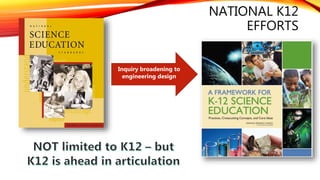
NATIONAL K12
EFFORTS
Inquiry broadening to
engineering design
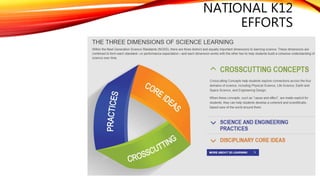
NATIONAL K12
EFFORTS
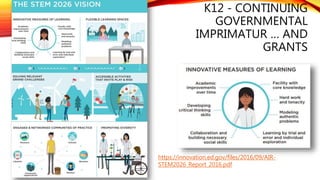
K12 - CONTINUING
GOVERNMENTAL
IMPRIMATUR … AND
GRANTS
https://innovation.ed.gov/files/2016/09/AIR-
STEM2026_Report_2016.pdf
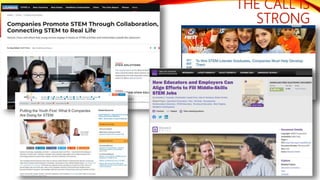
THE CALL IS
STRONG
THE CALL IS
STRONG
CONSTRUCTING
MEANING
- THOUGHTS
FROM THE UK
THEORY-
GROUNDING
“Constructivism is a learning theory that perceives learning as a process
of constructing knowledge based from experience. Issues of difficulty in
translating this learning theory into a teaching and learning practice have
become a debate among educational researchers. One of the learning
approaches that reflect the theory of constructivism is project-based learning or
PjBL. Terms such as “authentic learning activity” and “hands-on learning” is
commonly represented as constructivist which believes and addressed learning
through rigorous, relevant and hands-on practice.”
https://www.researchgate.net/publication/320558653_Project-
Based_Learning_from_Constructivism_Point_of_View
THEORY-GROUNDING
- CONTINUED FROM PREVIOUS SLIDE
Suggestions:
• Learning tasks need to be designed in a way it
requires learners to engage in more cognitive
demanding tasks.
• Continuous assessment and monitoring is also
challenging in PjBL setting.
• Assessment for learning and learner’s reflection of
learning are also integral to PjBL.
NATIONAL K12
EFFORTS
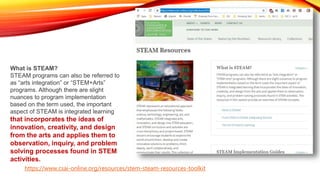
What is STEAM?
STEAM programs can also be referred to
as “arts integration” or “STEM+Arts”
programs. Although there are slight
nuances to program implementation
based on the term used, the important
aspect of STEAM is integrated learning
that incorporates the ideas of
innovation, creativity, and design
from the arts and applies them to
observation, inquiry, and problem
solving processes found in STEM
activities.
https://www.csai-online.org/resources/stem-steam-resources-toolkit
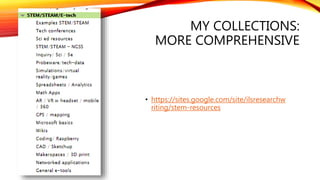
MY COLLECTIONS:
MORE COMPREHENSIVE
• https://sites.google.com/site/ilsresearchw
riting/stem-resources
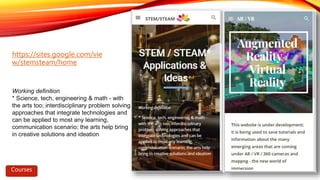
MY COLLECTIONS
https://sites.google.com/vie
w/stemsteam/home
Working definition
* Science, tech, engineering & math - with
the arts too; interdisciplinary problem solving
approaches that integrate technologies and
can be applied to most any learning,
communication scenario; the arts help bring
in creative solutions and ideation
Courses
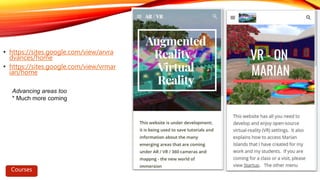
RELATED AREA
• https://sites.google.com/view/arvra
dvances/home
• https://sites.google.com/view/vrmar
ian/home
Advancing areas too
* Much more coming
Courses
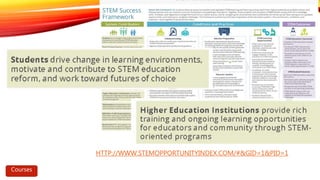
HTTP://WWW.STEMOPPORTUNITYINDEX.COM/#&GID=1&PID=1
Courses
STEM SERIOUS GAMES – IN ONE
MEETING / OVER TIME; MODEL A
SCIENCE ENTERPRISE
• Role playing – as scientists
• Discussions
• Presentations – critical peer review
• Actual scientist visits – bring in background elements too / images, links, PPT
• A 2.5 minute video on an integrated healthcare application -
https://www.youtube.com/watch?v=xOtW4cAAlTE
• https://youtu.be/esPRsT-lmw8 - fascinating TED talk on brain scans & behavior; and
the mind change learn and change – could be a next step for youth to pursue
Courses
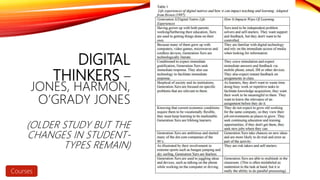
DIGITAL
THINKERS –
JONES, HARMON,
O’GRADY JONES
(OLDER STUDY BUT THE
CHANGES IN STUDENT-
TYPES REMAIN)
Courses
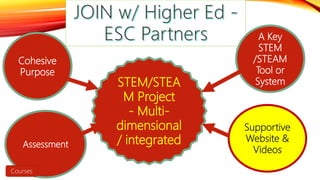
STEM/STEA
M Project
- Multi-
dimensional
/ integrated
A Key
STEM
/STEAM
Tool or
System
Supportive
Website &
Videos
Cohesive
Purpose
Assessment
Courses
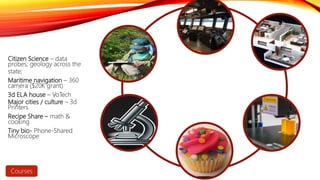
Citizen Science – data
probes; geology across the
state;
Maritime navigation – 360
camera ($20K grant)
3d ELA house – VoTech
Major cities / culture – 3d
Printers
Recipe Share – math &
cooking
Tiny bio- Phone-Shared
Microscope
Courses
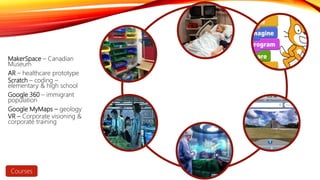
MakerSpace – Canadian
Museum
AR – healthcare prototype
Scratch – coding –
elementary & high school
Google 360 – immigrant
population
Google MyMaps – geology
VR – Corporate visioning &
corporate training
Courses
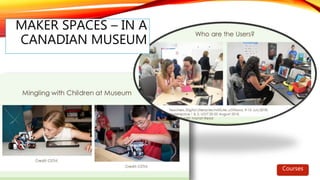
MAKER SPACES – IN A
CANADIAN MUSEUM
Courses
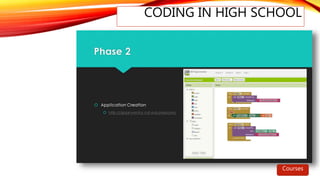
CODING IN HIGH SCHOOL
Courses
Courses
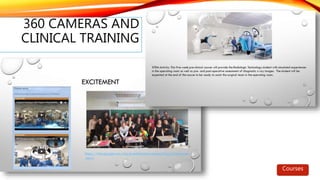
360 CAMERAS AND
CLINICAL TRAINING
Courses
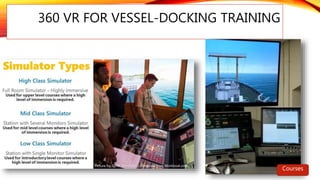
360 VR FOR VESSEL-DOCKING TRAINING
Courses
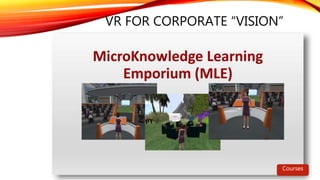
VR FOR CORPORATE “VISION”
Courses
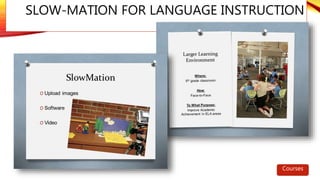
SLOW-MATION FOR LANGUAGE INSTRUCTION
Courses
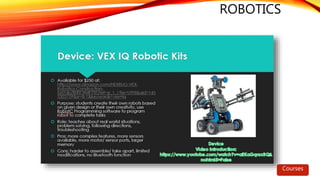
ROBOTICS
Courses
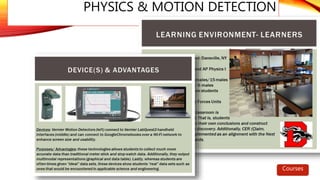
PHYSICS & MOTION DETECTION
Courses
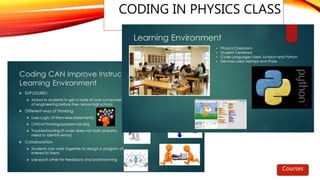
CODING IN PHYSICS CLASS
Courses
AR FOR EXTENDING MANIKIN WORK
IN NURSING CLINICAL TRAINING
Courses
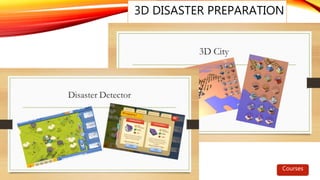
3D DISASTER PREPARATION
Courses
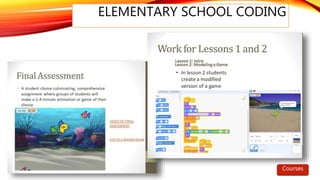
ELEMENTARY SCHOOL CODING
Courses
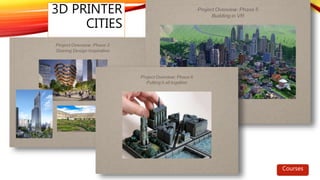
3D PRINTER
CITIES
Courses
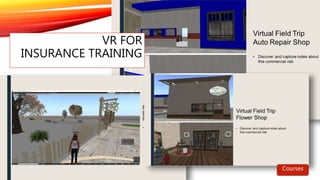
VR FOR
INSURANCE TRAINING
Courses
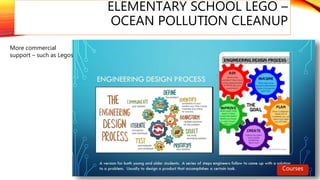
ELEMENTARY SCHOOL LEGO –
OCEAN POLLUTION CLEANUP
More commercial
support – such as Legos
Courses
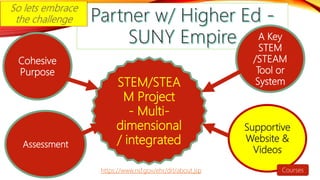
STEM/STEA
M Project
- Multi-
dimensional
/ integrated
A Key
STEM
/STEAM
Tool or
System
Supportive
Website &
Videos
Cohesive
Purpose
Assessment
Courseshttps://www.nsf.gov/ehr/drl/about.jsp
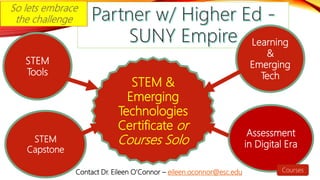
STEM &
Emerging
Technologies
Certificate or
Courses Solo
Learning
&
Emerging
Tech
Assessment
in Digital Era
STEM
Tools
STEM
Capstone
CoursesContact Dr. Eileen O’Connor – eileen.oconnor@esc.edu
INFORMATION FROM SUNY EMPIRE’S
STEM AND MALET COURSES
https://www.esc.edu/graduate-studies/masters-degrees/education-programs/ma-learning-emerging-technologies/
STEM CAPSTONE
• EDET-6125 CAPSTONE: DEVELOPING AN INTEGRATED, IMMERSIVE STEM LEARNING
ENVIRONMENT 3 cr. In this online course, STEM teachers and educators begin by deepening
their understanding of a concept or application through an instructor approved study within
appropriate standards area. Their study findings are posted for instructor assessment and
peer review. The latter portion of the class consists of a team-developed STEM project that
could be shared with other schools or STEM organizations. Although the teams develop
their own project area, participants are given framing guidelines for the type of projects, the
student and teacher resources, and the educational/scientific extensions that can support
the project and justify its instructional design. Guidelines also structure and evaluate the
participation of individuals and of team members. The intention is that these STEM projects
could be extended to other schools or organizations through 21st century technologies
(tutorials provided). The collaborative work is an important outcome; however, unique
situations may be addressed by the instructor. Periodic synchronous meetings; required
course for the advance
Courses
CHANGE IS NEVER EASY
• EDET-6070 INNOVATION: MEETING THE CHALLENGES OF ORGANIZATION OR
SYSTEMS INTEGRATION 3 cr. Despite the need for the adoption of technology
interventions in our expanding and global networks, the integration of technology
innovations can be a challenge for both those who create the innovations and the
organization or systems that could possibly benefit from the adoption. Within this
course, students will begin with the study of large-scale, documented organizational
and institutional responses to innovation and change and then they will research
responses to change within the specific organization for which they have a
professional interest. This study will lead to students designing and testing an
approach to help them gain the entrance and acceptance of an innovation within
the environment of their particular interest. (Occasional synchronous meetings.)
STEM TOOLS
• EDET-6150 STEM TOOLS, DEVICES AND SIMULATIONS: MEASURING, REPRESENTING AND
UNDERSTANDING THE WORLD 3 cr. Within this course, participants will explore the ways to
use digital tools, devices, applications and simulations (called devices herein) to engage
diverse learners in the varied applications of science, technology, engineering and
mathematics (STEM). Within a common course framework, participants will study the devices
of their particular interest, considering the educational needs of the intended audience or
learners, finding educational and psychological solutions for challenges learners may have
with these devices, and constructing instructional supports and assessment approaches to
help their learners work productively with these devices. Throughout the course, participants
will share their emerging ideas about effective instructional approaches, gaining insights
from these peer interactions. Synchronous meetings occur periodically within this online
environment. Participants are welcome from all STEM and healthcare areas if they need to
ensure their intended audience is understanding and using these devices appropriately.
Participants must supply their own device.
M4.4: IMPACT ON THE FIELD / Challenges (6/23/19)
Certainly a basic tenant of this course has been the value of STEM/STEAM projects and efforts.
Education pundits laud the value of these program; businesses claim the need for innovators; common
sense says that engage learning is more long-lasting and more effective. However, significant
challenges await those who try to bring STEM/STEAM projects into their work environment. Often they
can be “disruptive” to the way the organization or school runs. Having developed, or at least advanced
significantly, and STEM/TEAM project, you should have a good perspective on the value of this project.
And, in the extended study, you have also looked at the larger field with in which this type of learning
can be situated.
Now, in closing the loop to a strong effort to bring this beyond the online course environment into actual
reality, or extend this if you have run this already with your intended audience, develop a report of 1 ½
SINGLE SPACED text (750 – 1000 words) where you state your case from the education research and
from the effects you hope to achieve from the project as to why this could be of important value for the
school or institution you have been considering. In developing this presentation, locate and report-on at
least ONE academic, educational, or sociological report that has shown some of the
challenges that are attended to this type of educational approach. It could be a: report that school
districts think this is not sufficiently focused for high-stakes test based environments; challenges to
breaking into lecture-and-test-based corporate training models; insufficient resources or time to have
such open-ended learning; etc. Integrate into your report a way that you might address the challenge
that has been raised in the literature.
M4.4: Implementing the actual expansion or professional development (Template) (6/16/19)
Whether you have envisioned a large-scale project that could involve different geographies, technologies, virtual spaces, or machinelike or
graphical representations OR whether you have delved deeply within an integrated focused unit, for this course you need to think of ways to
expand this to other teachers/instructors like yourself apprising them of how they might run this project or to other organizations or schools that
you might bring them in on a collaborative basis. Either way you will need to make an outreach to other adult professionals. The scope of
this course does not allow for systematic and deep project management, however, you should be able to think about and address the following
questions that are placed within a template that is attached so that you can been actively thinking or mentally role-playing through these areas:
How can you reach out to this external audience where can you find these individuals/organizations; what network can you join or outreaches
can you make to find these individuals;
· What timeline would be relevant to getting into the time-and-space of these individuals (do you need to work around an academic year?
Do you need to be prepared for a department meeting? Could you be planning on presenting at a professional conference?
· What are the highlights that will be most important in convincing this audience to join you or to follow the model that you have developed?
How would you communicate this information (face-to-face? Presentation at a conference? A proposal paper that you could email?)
· Where might a somewhat interested party go to find more information about your project (would you send them to your website? Would
you develop a promotional Facebook page? Other ideas?)
· How would you apprise this individual or organization about what they need to do to participate in the project — addressing areas of the
time involved, the equipment that might be needed, the ways they could participate? Will this be on your website?
· What type of materials can summarize (being sufficiently informative without having overwhelming initial detail) and can present the steps,
timelines, resources needed and the like at this initial point?
· What’s going to be valued by that organization if you are to prove that this is ultimately going to be successful?
The questions above are not intended to be exhaustive but can get you thinking about the complexity of moving a project into the real world.
Hopefully to it illustrates the importance of having your project well delineated and organized through the website format that you have been
developing in this course. The goal of this STEM Education and Emerging Technologies Certificate is to give you the ability to create and then
implement effective STEM/STEAM projects. Thinking through these contextually based, practically-speaking project considerations can help you
make projects that are fruitful and meaningful. Technologies today give you the ability to create frameworks that then can be replicated and
scaled — important concepts in applying for any larger scale funding.
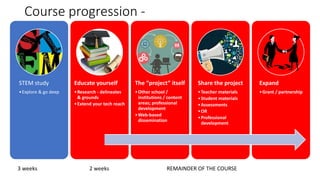
Course progression -
STEM study
•Explore & go deep
Educate yourself
•Research - delineates
& grounds
•Extend your tech reach
The “project” itself
•Other school /
institutions / content
areas; professional
development
•Web-based
dissemination
Share the project
•Teacher materials
•Student materials
•Assessments
•OR
•Professional
development
Expand
•Grant / partnership
3 weeks 2 weeks REMAINDER OF THE COURSE
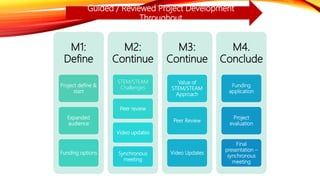
M1:
Define
Project define &
start
Expanded
audience
Funding options
M2:
Continue
STEM/STEAM
Challenges
Peer review
Video updates
Synchronous
meeting
M3:
Continue
Value of
STEM/STEAM
Approach
Peer Review
Video Updates
M4.
Conclude
Funding
application
Project
evaluation
Final
presentation –
synchronous
meeting
Guided / Reviewed Project Development
Throughout
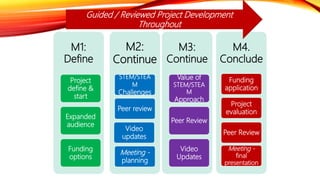
M1:
Define
Project
define &
start
Expanded
audience
Funding
options
M2:
Continue
STEM/STEA
M
Challenges
Peer review
Video
updates
Meeting -
planning
M3:
Continue
Value of
STEM/STEA
M
Approach
Peer Review
Video
Updates
M4.
Conclude
Funding
application
Project
evaluation
Peer Review
Meeting -
final
presentation
Guided / Reviewed Project Development
Throughout
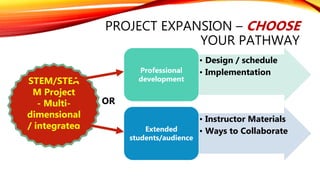
PROJECT EXPANSION – CHOOSE
YOUR PATHWAY
• Design / schedule
• ImplementationProfessional
development
• Instructor Materials
• Ways to CollaborateExtended
students/audience
STEM/STEA
M Project
- Multi-
dimensional
/ integrated
OR

STEM / STEAM - integrating into a master's program

  • 1.
    FROM STEM TOSTEAM: THEORY- GROUNDED AND PRACTICAL APPLICATIONS FOR INSTRUCTION Eileen O’Connor, Ph.D. SUNY Empire State College Eileen.oconnor@esc.edu Agenda: • Educational Grounding & Standards • Applications and Ideas • SUNY Empire – partners? • So, what’s the challenge? https://www.slideshare.net/eoconnor/STEM-LIT2019
  • 2.
    STEM – HISTORY& MY EXPERIENCE • Middle school – St. Ignatius Montana • Chemist > tech > education w/ both • STEMTEC – U. Mass & Amherst – 1999 – 2001 – NSF evaluator • Science ed / tech ed / STEM Education certificate • Before recent tech explosion – inquiry-based science • Foundation of K12 Science Education > NSTA & NCR > Next Generation Science Standards • Practices with inquiry • Inquiry – labs – cross disciplinary: have ALWAYS been lauded in the research . . . .
  • 3.
  • 4.
  • 5.
    K12 - CONTINUING GOVERNMENTAL IMPRIMATUR… AND GRANTS https://innovation.ed.gov/files/2016/09/AIR- STEM2026_Report_2016.pdf
  • 6.
  • 7.
  • 8.
  • 9.
    THEORY- GROUNDING “Constructivism is alearning theory that perceives learning as a process of constructing knowledge based from experience. Issues of difficulty in translating this learning theory into a teaching and learning practice have become a debate among educational researchers. One of the learning approaches that reflect the theory of constructivism is project-based learning or PjBL. Terms such as “authentic learning activity” and “hands-on learning” is commonly represented as constructivist which believes and addressed learning through rigorous, relevant and hands-on practice.” https://www.researchgate.net/publication/320558653_Project- Based_Learning_from_Constructivism_Point_of_View
  • 10.
    THEORY-GROUNDING - CONTINUED FROMPREVIOUS SLIDE Suggestions: • Learning tasks need to be designed in a way it requires learners to engage in more cognitive demanding tasks. • Continuous assessment and monitoring is also challenging in PjBL setting. • Assessment for learning and learner’s reflection of learning are also integral to PjBL.
  • 11.
    NATIONAL K12 EFFORTS What isSTEAM? STEAM programs can also be referred to as “arts integration” or “STEM+Arts” programs. Although there are slight nuances to program implementation based on the term used, the important aspect of STEAM is integrated learning that incorporates the ideas of innovation, creativity, and design from the arts and applies them to observation, inquiry, and problem solving processes found in STEM activities. https://www.csai-online.org/resources/stem-steam-resources-toolkit
  • 12.
    MY COLLECTIONS: MORE COMPREHENSIVE •https://sites.google.com/site/ilsresearchw riting/stem-resources
  • 13.
    MY COLLECTIONS https://sites.google.com/vie w/stemsteam/home Working definition *Science, tech, engineering & math - with the arts too; interdisciplinary problem solving approaches that integrate technologies and can be applied to most any learning, communication scenario; the arts help bring in creative solutions and ideation Courses
  • 14.
    RELATED AREA • https://sites.google.com/view/arvra dvances/home •https://sites.google.com/view/vrmar ian/home Advancing areas too * Much more coming Courses
  • 15.
  • 16.
    STEM SERIOUS GAMES– IN ONE MEETING / OVER TIME; MODEL A SCIENCE ENTERPRISE • Role playing – as scientists • Discussions • Presentations – critical peer review • Actual scientist visits – bring in background elements too / images, links, PPT • A 2.5 minute video on an integrated healthcare application - https://www.youtube.com/watch?v=xOtW4cAAlTE • https://youtu.be/esPRsT-lmw8 - fascinating TED talk on brain scans & behavior; and the mind change learn and change – could be a next step for youth to pursue Courses
  • 17.
    DIGITAL THINKERS – JONES, HARMON, O’GRADYJONES (OLDER STUDY BUT THE CHANGES IN STUDENT- TYPES REMAIN) Courses
  • 18.
    STEM/STEA M Project - Multi- dimensional /integrated A Key STEM /STEAM Tool or System Supportive Website & Videos Cohesive Purpose Assessment Courses
  • 19.
    Citizen Science –data probes; geology across the state; Maritime navigation – 360 camera ($20K grant) 3d ELA house – VoTech Major cities / culture – 3d Printers Recipe Share – math & cooking Tiny bio- Phone-Shared Microscope Courses
  • 20.
    MakerSpace – Canadian Museum AR– healthcare prototype Scratch – coding – elementary & high school Google 360 – immigrant population Google MyMaps – geology VR – Corporate visioning & corporate training Courses
  • 21.
    MAKER SPACES –IN A CANADIAN MUSEUM Courses
  • 22.
    CODING IN HIGHSCHOOL Courses
  • 23.
  • 24.
    360 CAMERAS AND CLINICALTRAINING Courses
  • 25.
    360 VR FORVESSEL-DOCKING TRAINING Courses
  • 26.
    VR FOR CORPORATE“VISION” Courses
  • 27.
    SLOW-MATION FOR LANGUAGEINSTRUCTION Courses
  • 28.
  • 29.
    PHYSICS & MOTIONDETECTION Courses
  • 30.
    CODING IN PHYSICSCLASS Courses
  • 31.
    AR FOR EXTENDINGMANIKIN WORK IN NURSING CLINICAL TRAINING Courses
  • 32.
  • 33.
  • 34.
  • 35.
  • 36.
    ELEMENTARY SCHOOL LEGO– OCEAN POLLUTION CLEANUP More commercial support – such as Legos Courses
  • 37.
    STEM/STEA M Project - Multi- dimensional /integrated A Key STEM /STEAM Tool or System Supportive Website & Videos Cohesive Purpose Assessment Courseshttps://www.nsf.gov/ehr/drl/about.jsp
  • 38.
    STEM & Emerging Technologies Certificate or CoursesSolo Learning & Emerging Tech Assessment in Digital Era STEM Tools STEM Capstone CoursesContact Dr. Eileen O’Connor – eileen.oconnor@esc.edu
  • 39.
    INFORMATION FROM SUNYEMPIRE’S STEM AND MALET COURSES https://www.esc.edu/graduate-studies/masters-degrees/education-programs/ma-learning-emerging-technologies/
  • 40.
    STEM CAPSTONE • EDET-6125CAPSTONE: DEVELOPING AN INTEGRATED, IMMERSIVE STEM LEARNING ENVIRONMENT 3 cr. In this online course, STEM teachers and educators begin by deepening their understanding of a concept or application through an instructor approved study within appropriate standards area. Their study findings are posted for instructor assessment and peer review. The latter portion of the class consists of a team-developed STEM project that could be shared with other schools or STEM organizations. Although the teams develop their own project area, participants are given framing guidelines for the type of projects, the student and teacher resources, and the educational/scientific extensions that can support the project and justify its instructional design. Guidelines also structure and evaluate the participation of individuals and of team members. The intention is that these STEM projects could be extended to other schools or organizations through 21st century technologies (tutorials provided). The collaborative work is an important outcome; however, unique situations may be addressed by the instructor. Periodic synchronous meetings; required course for the advance Courses
  • 41.
    CHANGE IS NEVEREASY • EDET-6070 INNOVATION: MEETING THE CHALLENGES OF ORGANIZATION OR SYSTEMS INTEGRATION 3 cr. Despite the need for the adoption of technology interventions in our expanding and global networks, the integration of technology innovations can be a challenge for both those who create the innovations and the organization or systems that could possibly benefit from the adoption. Within this course, students will begin with the study of large-scale, documented organizational and institutional responses to innovation and change and then they will research responses to change within the specific organization for which they have a professional interest. This study will lead to students designing and testing an approach to help them gain the entrance and acceptance of an innovation within the environment of their particular interest. (Occasional synchronous meetings.)
  • 42.
    STEM TOOLS • EDET-6150STEM TOOLS, DEVICES AND SIMULATIONS: MEASURING, REPRESENTING AND UNDERSTANDING THE WORLD 3 cr. Within this course, participants will explore the ways to use digital tools, devices, applications and simulations (called devices herein) to engage diverse learners in the varied applications of science, technology, engineering and mathematics (STEM). Within a common course framework, participants will study the devices of their particular interest, considering the educational needs of the intended audience or learners, finding educational and psychological solutions for challenges learners may have with these devices, and constructing instructional supports and assessment approaches to help their learners work productively with these devices. Throughout the course, participants will share their emerging ideas about effective instructional approaches, gaining insights from these peer interactions. Synchronous meetings occur periodically within this online environment. Participants are welcome from all STEM and healthcare areas if they need to ensure their intended audience is understanding and using these devices appropriately. Participants must supply their own device.
  • 43.
    M4.4: IMPACT ONTHE FIELD / Challenges (6/23/19) Certainly a basic tenant of this course has been the value of STEM/STEAM projects and efforts. Education pundits laud the value of these program; businesses claim the need for innovators; common sense says that engage learning is more long-lasting and more effective. However, significant challenges await those who try to bring STEM/STEAM projects into their work environment. Often they can be “disruptive” to the way the organization or school runs. Having developed, or at least advanced significantly, and STEM/TEAM project, you should have a good perspective on the value of this project. And, in the extended study, you have also looked at the larger field with in which this type of learning can be situated. Now, in closing the loop to a strong effort to bring this beyond the online course environment into actual reality, or extend this if you have run this already with your intended audience, develop a report of 1 ½ SINGLE SPACED text (750 – 1000 words) where you state your case from the education research and from the effects you hope to achieve from the project as to why this could be of important value for the school or institution you have been considering. In developing this presentation, locate and report-on at least ONE academic, educational, or sociological report that has shown some of the challenges that are attended to this type of educational approach. It could be a: report that school districts think this is not sufficiently focused for high-stakes test based environments; challenges to breaking into lecture-and-test-based corporate training models; insufficient resources or time to have such open-ended learning; etc. Integrate into your report a way that you might address the challenge that has been raised in the literature.
  • 44.
    M4.4: Implementing theactual expansion or professional development (Template) (6/16/19) Whether you have envisioned a large-scale project that could involve different geographies, technologies, virtual spaces, or machinelike or graphical representations OR whether you have delved deeply within an integrated focused unit, for this course you need to think of ways to expand this to other teachers/instructors like yourself apprising them of how they might run this project or to other organizations or schools that you might bring them in on a collaborative basis. Either way you will need to make an outreach to other adult professionals. The scope of this course does not allow for systematic and deep project management, however, you should be able to think about and address the following questions that are placed within a template that is attached so that you can been actively thinking or mentally role-playing through these areas: How can you reach out to this external audience where can you find these individuals/organizations; what network can you join or outreaches can you make to find these individuals; · What timeline would be relevant to getting into the time-and-space of these individuals (do you need to work around an academic year? Do you need to be prepared for a department meeting? Could you be planning on presenting at a professional conference? · What are the highlights that will be most important in convincing this audience to join you or to follow the model that you have developed? How would you communicate this information (face-to-face? Presentation at a conference? A proposal paper that you could email?) · Where might a somewhat interested party go to find more information about your project (would you send them to your website? Would you develop a promotional Facebook page? Other ideas?) · How would you apprise this individual or organization about what they need to do to participate in the project — addressing areas of the time involved, the equipment that might be needed, the ways they could participate? Will this be on your website? · What type of materials can summarize (being sufficiently informative without having overwhelming initial detail) and can present the steps, timelines, resources needed and the like at this initial point? · What’s going to be valued by that organization if you are to prove that this is ultimately going to be successful? The questions above are not intended to be exhaustive but can get you thinking about the complexity of moving a project into the real world. Hopefully to it illustrates the importance of having your project well delineated and organized through the website format that you have been developing in this course. The goal of this STEM Education and Emerging Technologies Certificate is to give you the ability to create and then implement effective STEM/STEAM projects. Thinking through these contextually based, practically-speaking project considerations can help you make projects that are fruitful and meaningful. Technologies today give you the ability to create frameworks that then can be replicated and scaled — important concepts in applying for any larger scale funding.
  • 45.
    Course progression - STEMstudy •Explore & go deep Educate yourself •Research - delineates & grounds •Extend your tech reach The “project” itself •Other school / institutions / content areas; professional development •Web-based dissemination Share the project •Teacher materials •Student materials •Assessments •OR •Professional development Expand •Grant / partnership 3 weeks 2 weeks REMAINDER OF THE COURSE
  • 46.
    M1: Define Project define & start Expanded audience Fundingoptions M2: Continue STEM/STEAM Challenges Peer review Video updates Synchronous meeting M3: Continue Value of STEM/STEAM Approach Peer Review Video Updates M4. Conclude Funding application Project evaluation Final presentation – synchronous meeting Guided / Reviewed Project Development Throughout
  • 47.
    M1: Define Project define & start Expanded audience Funding options M2: Continue STEM/STEA M Challenges Peer review Video updates Meeting- planning M3: Continue Value of STEM/STEA M Approach Peer Review Video Updates M4. Conclude Funding application Project evaluation Peer Review Meeting - final presentation Guided / Reviewed Project Development Throughout
  • 48.
    PROJECT EXPANSION –CHOOSE YOUR PATHWAY • Design / schedule • ImplementationProfessional development • Instructor Materials • Ways to CollaborateExtended students/audience STEM/STEA M Project - Multi- dimensional / integrated OR

Editor's Notes

  • #2 From STEM to STEAM: Theory-Grounded and Practical Applications for Instruction Integrating aspects of science, technology, engineering, arts, and mathematics (STEAM) can provide rich, interdisciplinary experiences that can ensure engaged, active learning. A constructivist framework will be provided with both general and specific examples and with links to Creative Commons resources to bring these applications into K12 and higher-education environments, resonating with the best practices heralded by standards organizations in K12 environments, in discipline-specific areas, and in all levels of multidisciplinary education. Become an Avatar: And, Explore Virtual Reality In this workshop, you will be guided through an immersive virtual reality experience where you will experiment with the different components of virtual reality, modifying your avatar, visiting locations created by SUNY Empire State College students, and even dabbling in some of your own creations. Experience the immersive effects of these environments that you can now develop readily from free open-source venues which you can design or repurpose, hosting on your own servers or paying nominal server rental fees. Links to Creative Commons documentation will be provided.