



Technologies to support
self-directed learning through
social interaction
Dragan Gašević
@dgasevic March 15, 2016
Digital Learning Week 2016
UniSA, Adelaide, SA, Australia
Joint work with Zoran Jeremic, Nikola Milikic, George Siemens, and Shane Dawson
Educational landscape today
“Non-traditional” students
Long time to complete degrees
Large classrooms
Long waiting lists
Confirmation of different needs
MOOCs
Learning does not
i) happen only in school and
ii) end with graduation
Departing from
credit hours & performance focus
Mastery learning through
competency focus
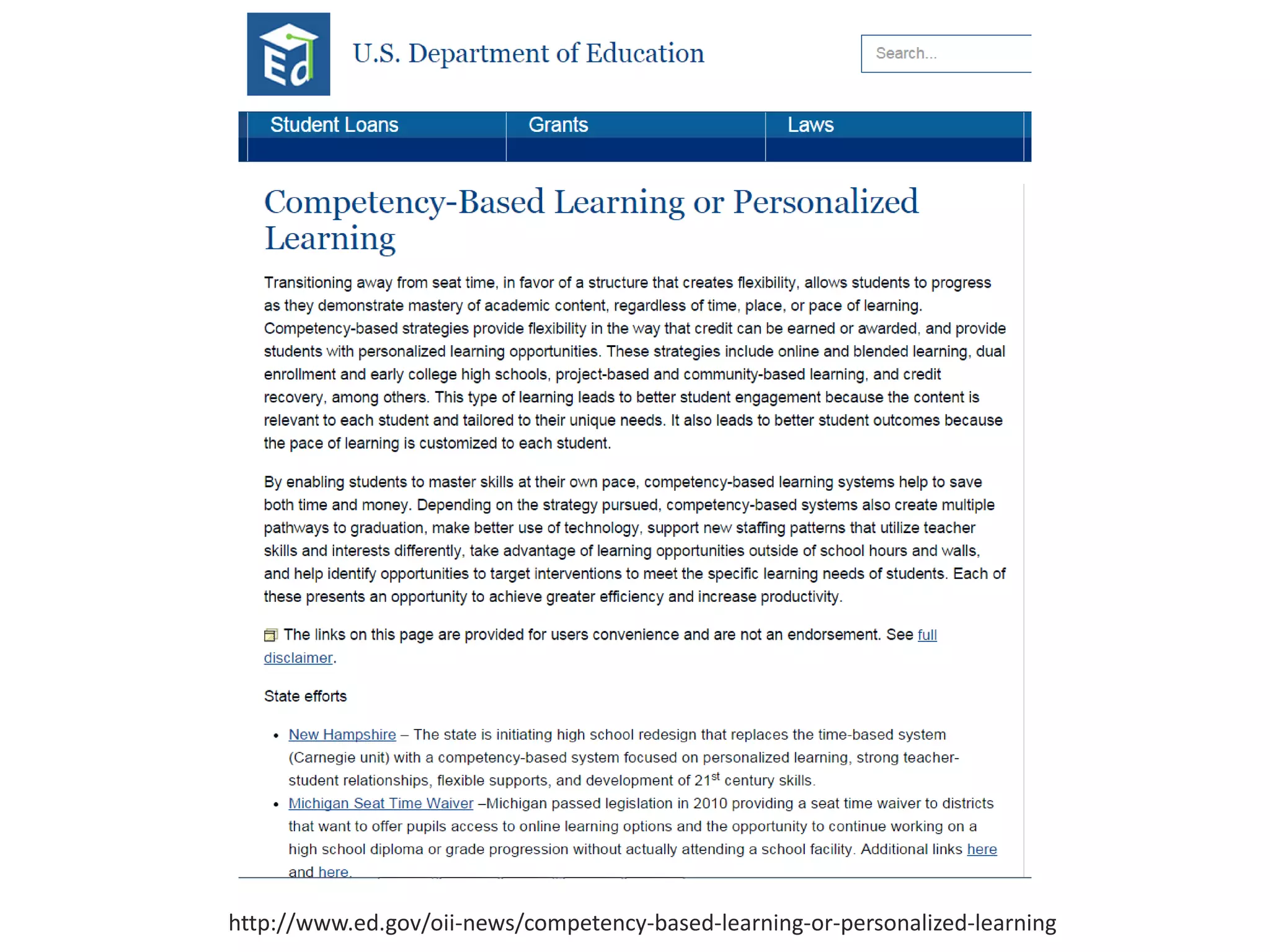
http://www.ed.gov/oii-news/competency-based-learning-or-personalized-learning
Personalized learning
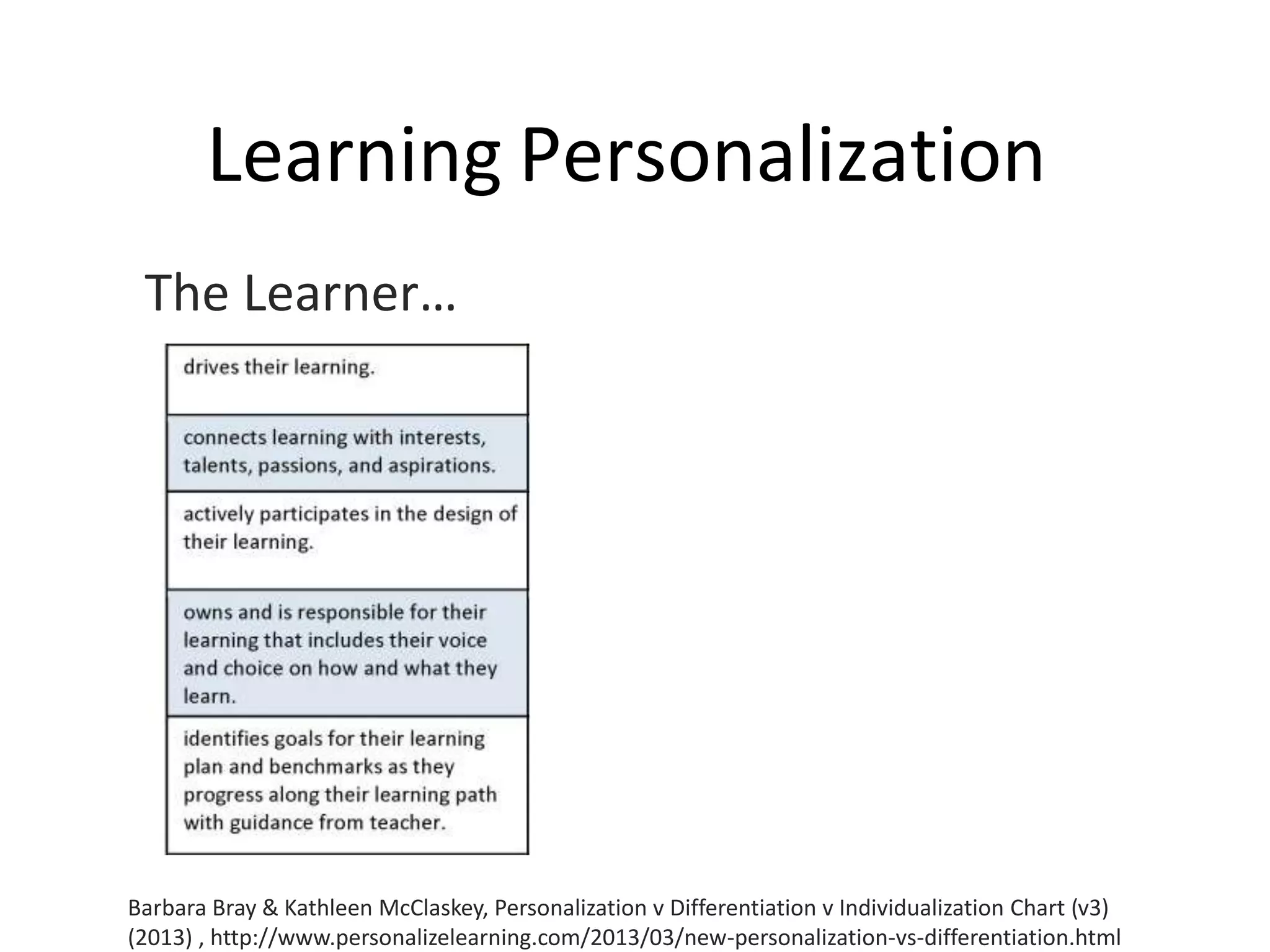
Learning Personalization
The Learner…
Barbara Bray & Kathleen McClaskey, Personalization v Differentiation v Individualization Chart (v3)
(2013) , http://www.personalizelearning.com/2013/03/new-personalization-vs-differentiation.html
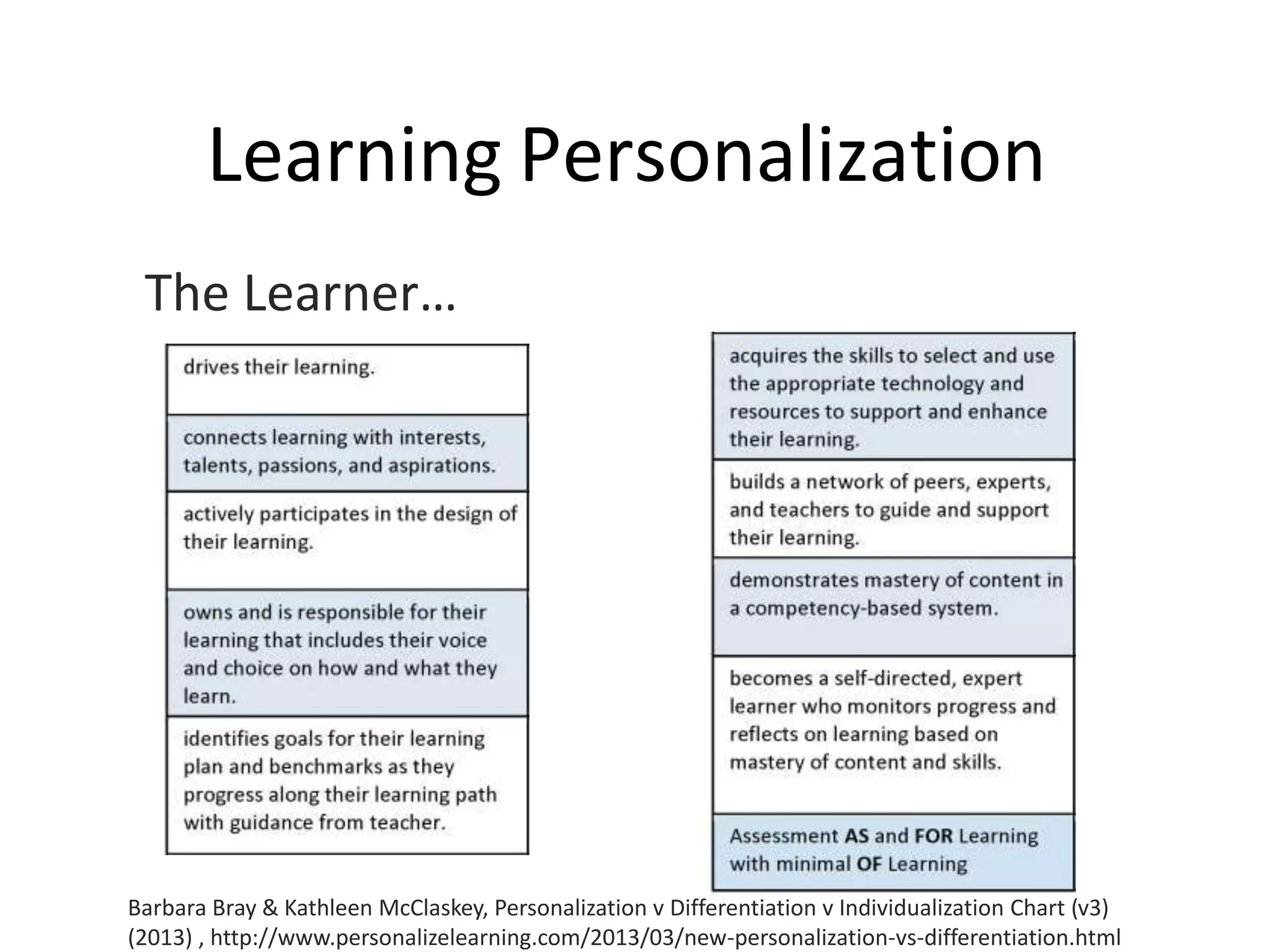
The Learner…
Learning Personalization
Barbara Bray & Kathleen McClaskey, Personalization v Differentiation v Individualization Chart (v3)
(2013) , http://www.personalizelearning.com/2013/03/new-personalization-vs-differentiation.html
Social interaction in learning
Personal learning environments
Scaffolding?
Assessment?
Credentialing?
How to tie all these different
pressing concerns together?
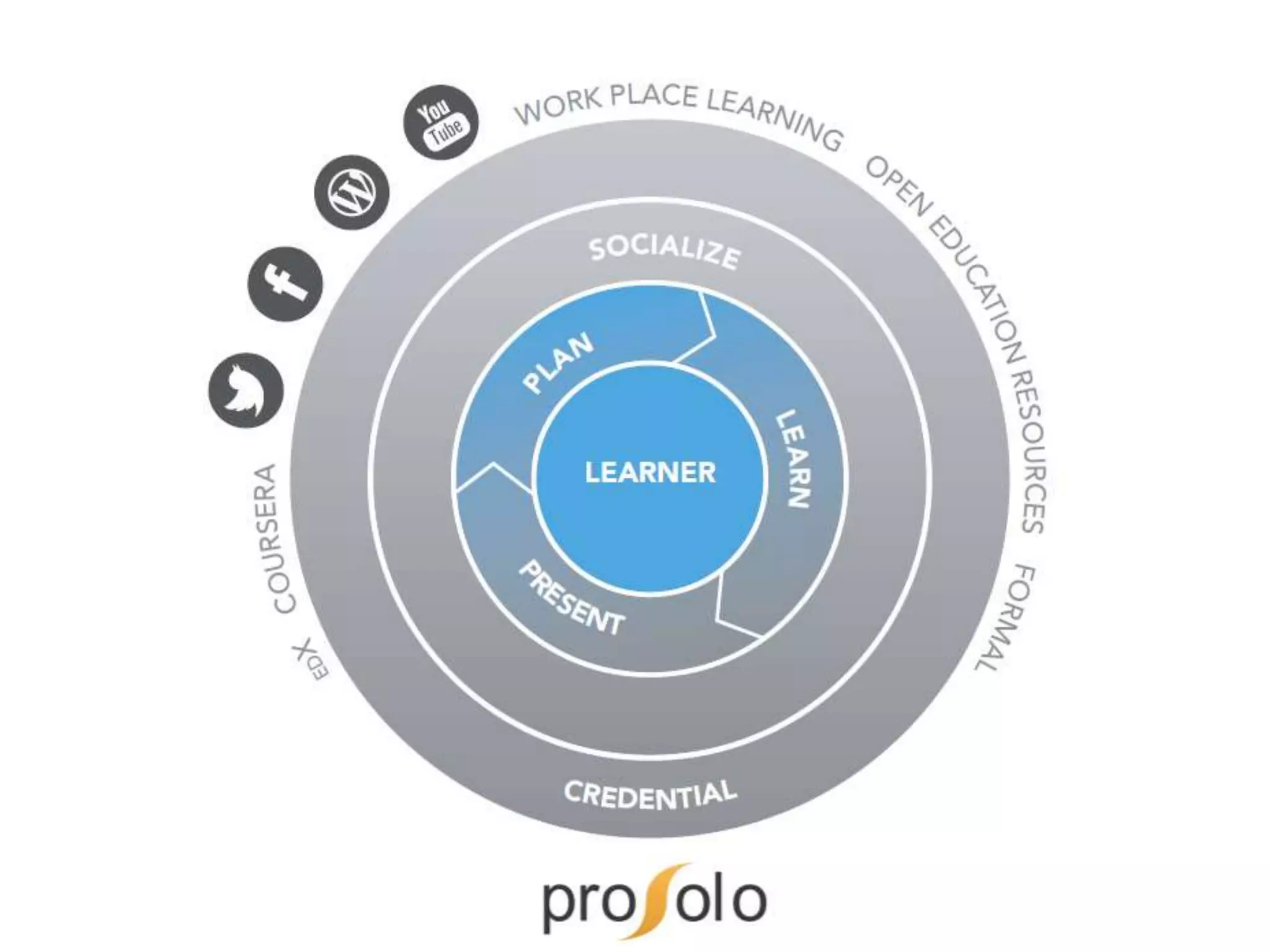
PROSOLO DESIGN PRINCIPLES
Self-directed learning with
instructional, social, and
technological scaffolding
Learners construct knowledge
Learners are agents
Winne, P. H. (2006). How software technologies can improve research on learning and bolster school reform.
Educational Psychologist, 41(1), 5–17.
Feedback,
especially process and formative,
is a must
Hattie, J., & Timperley, H. (2007). The power of feedback. Review of educational research, 77(1), 81-112.
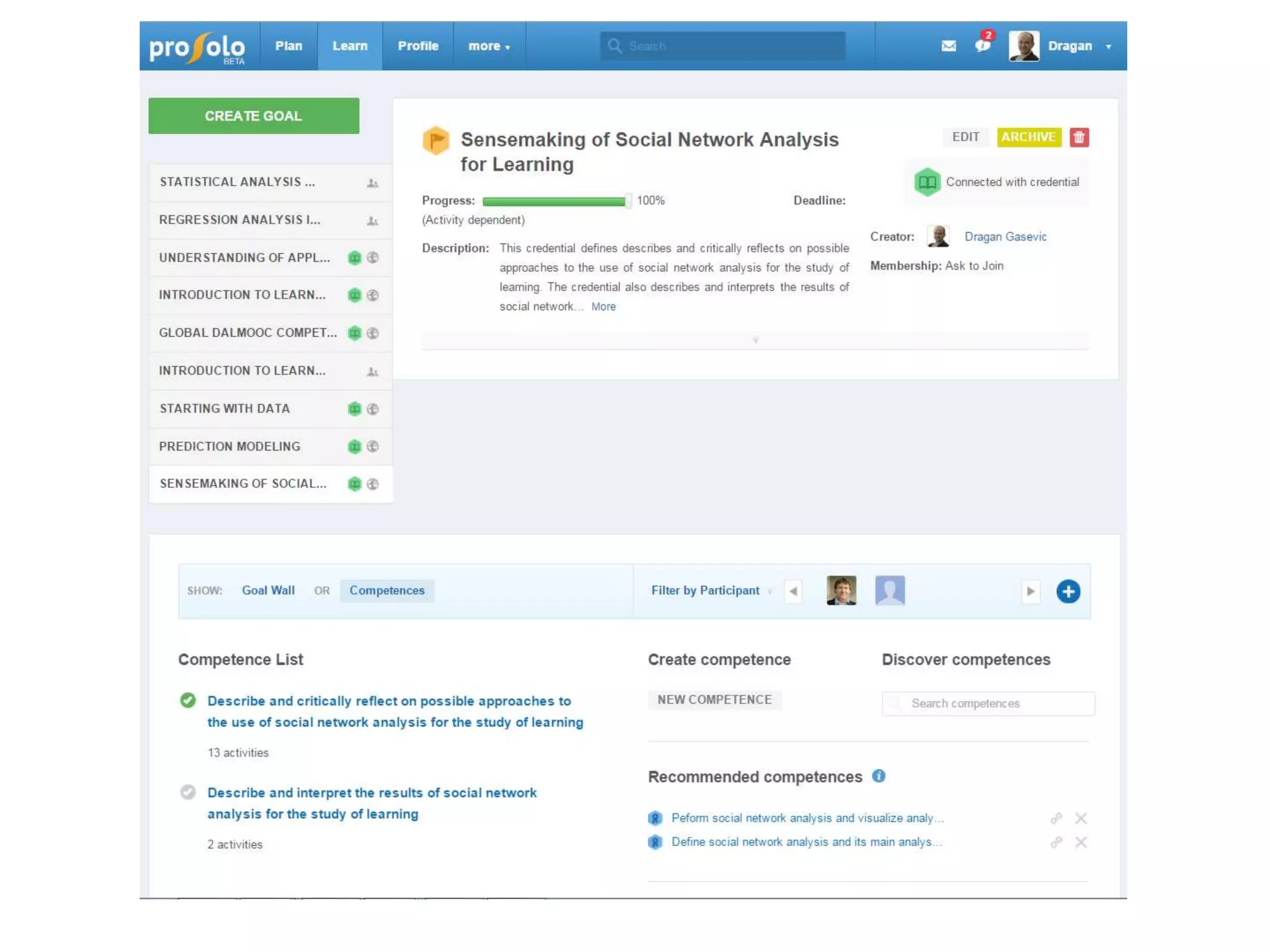
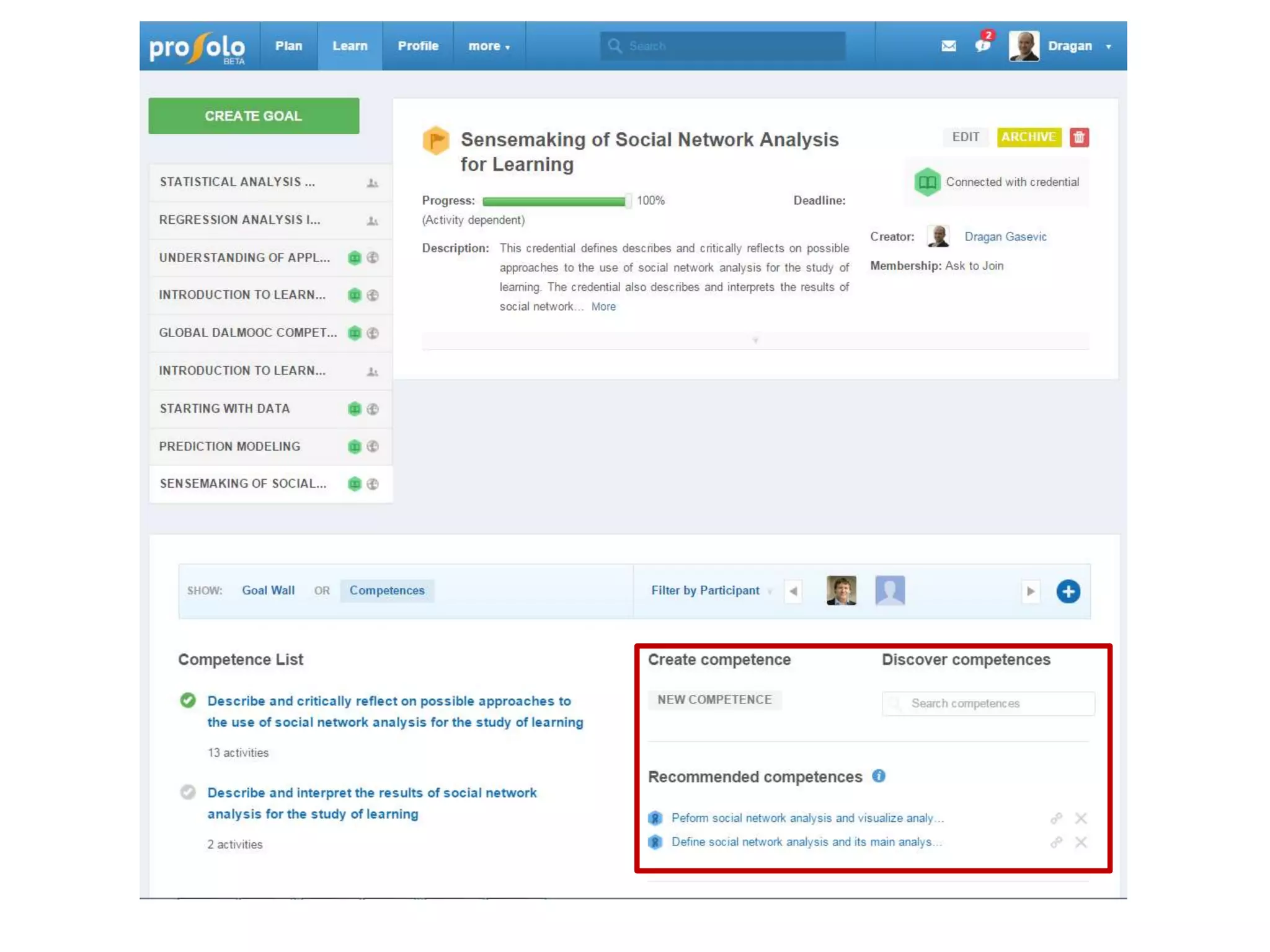
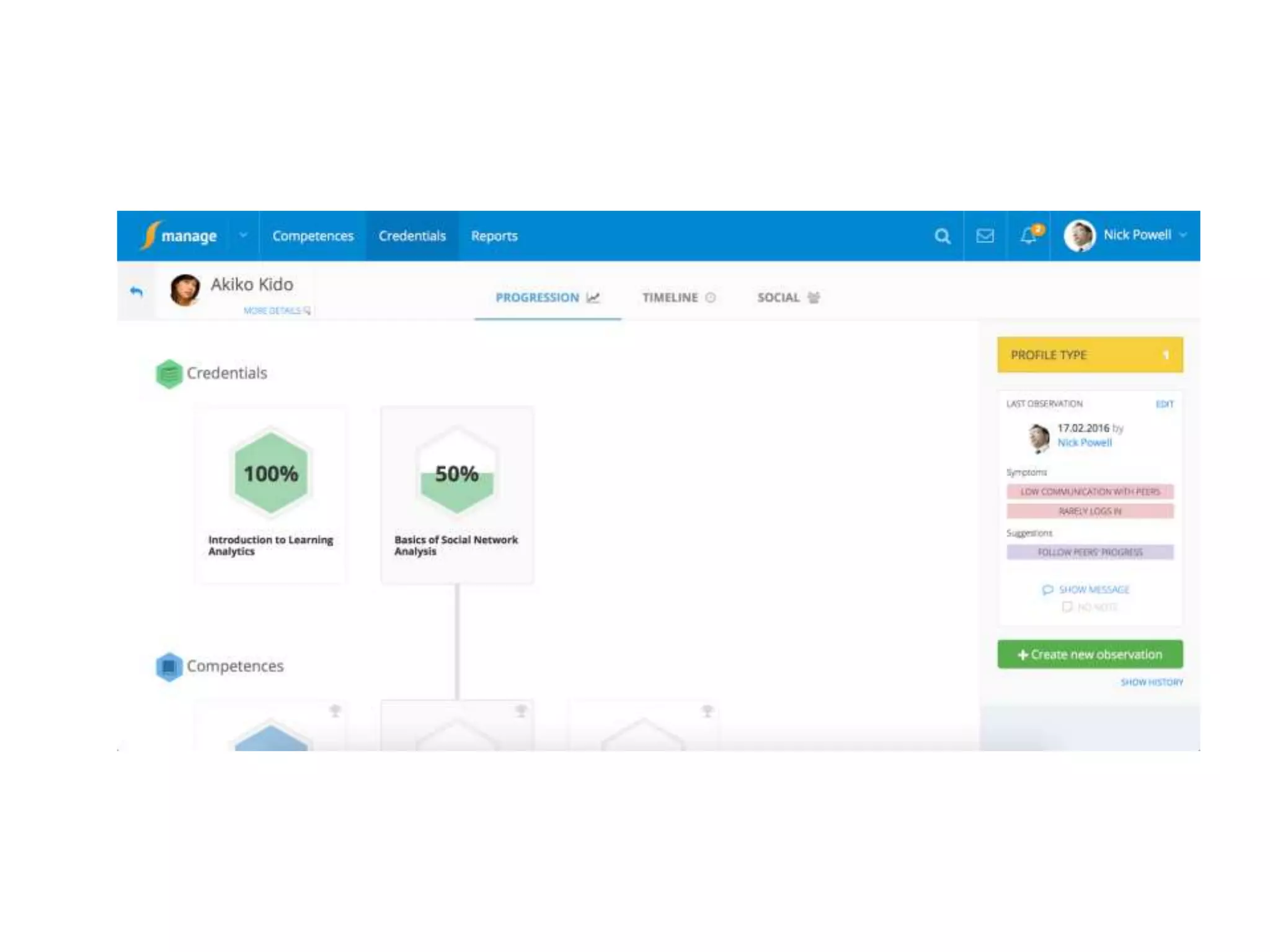
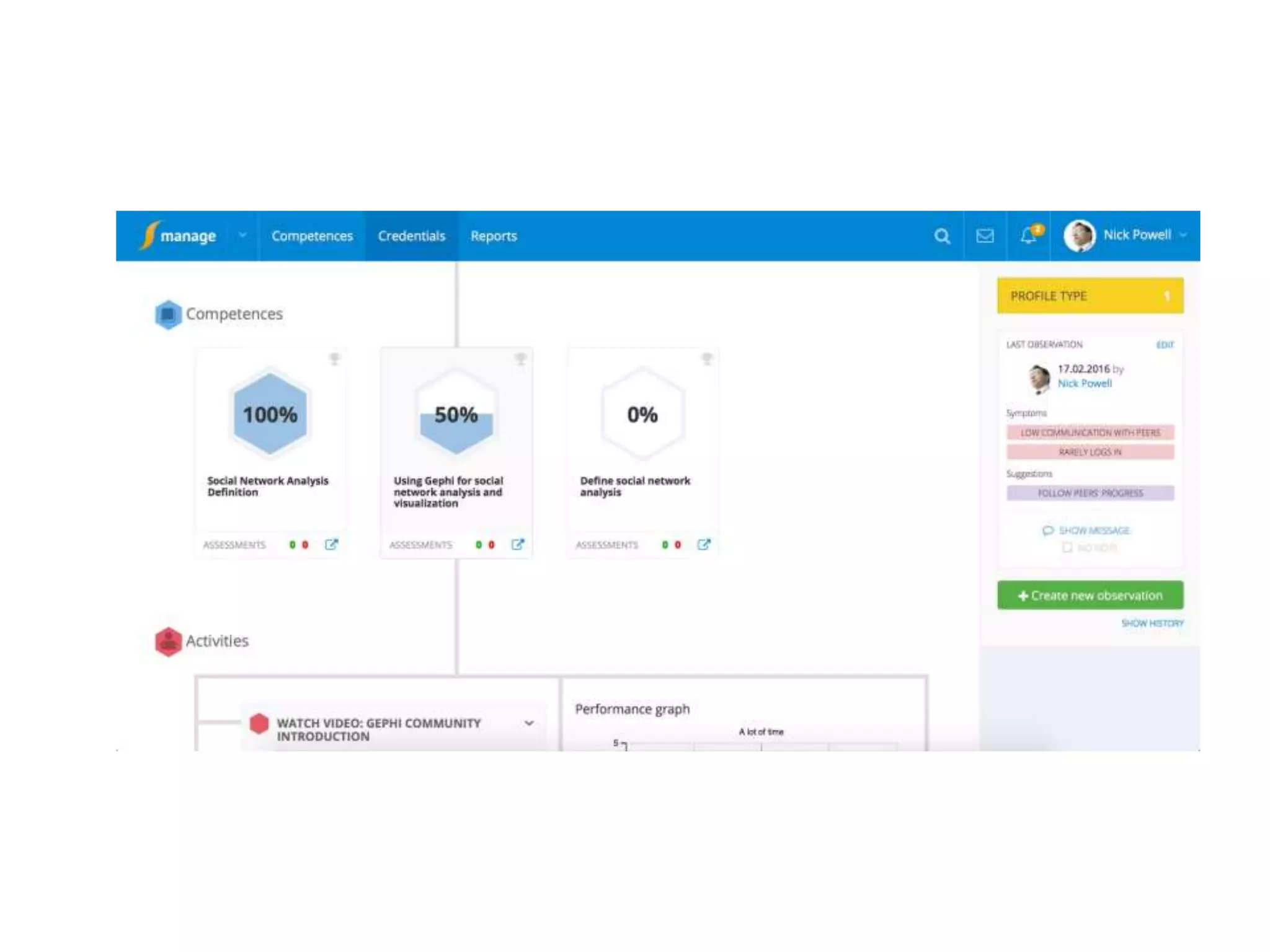
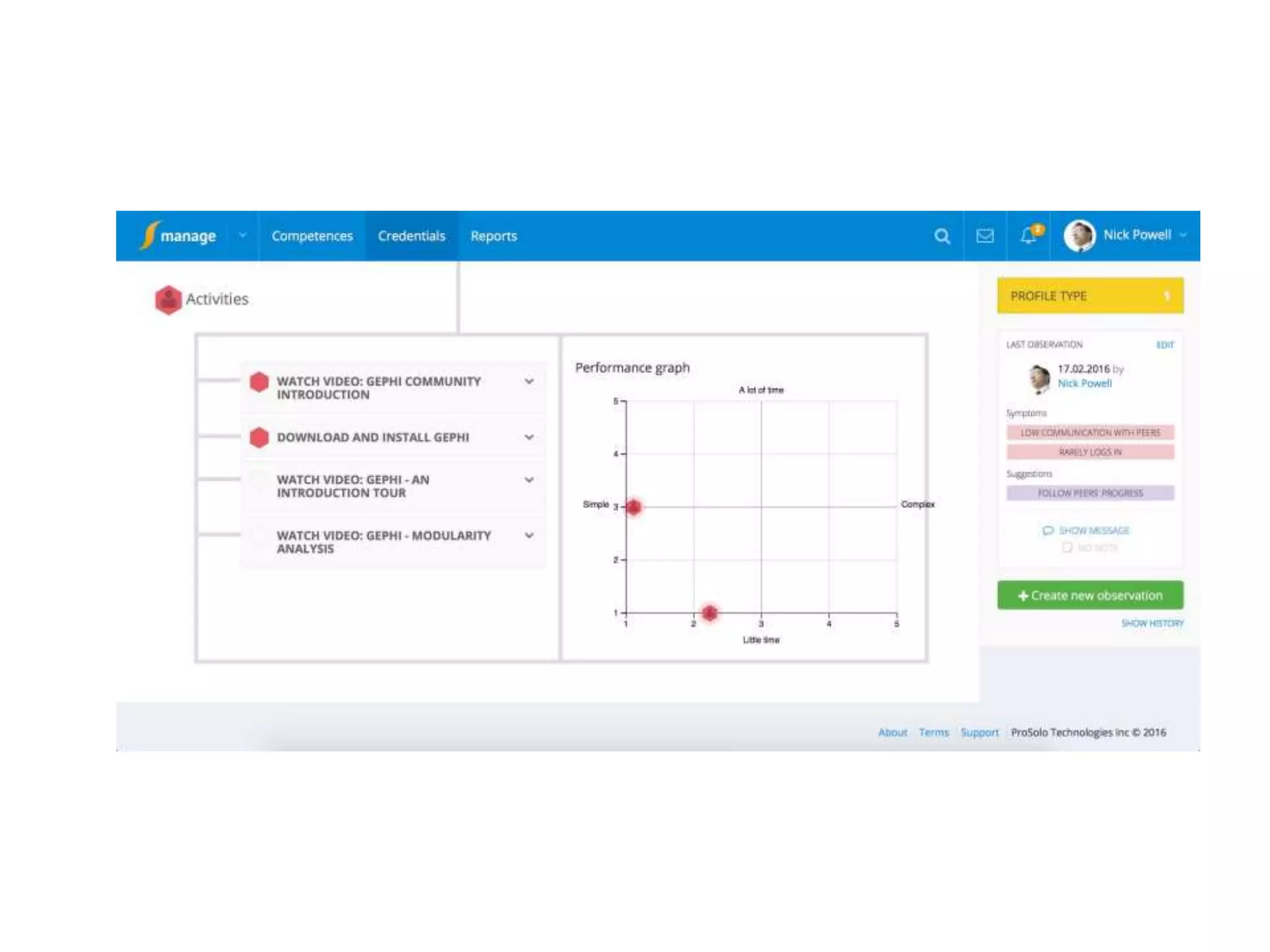
Competency is a social object
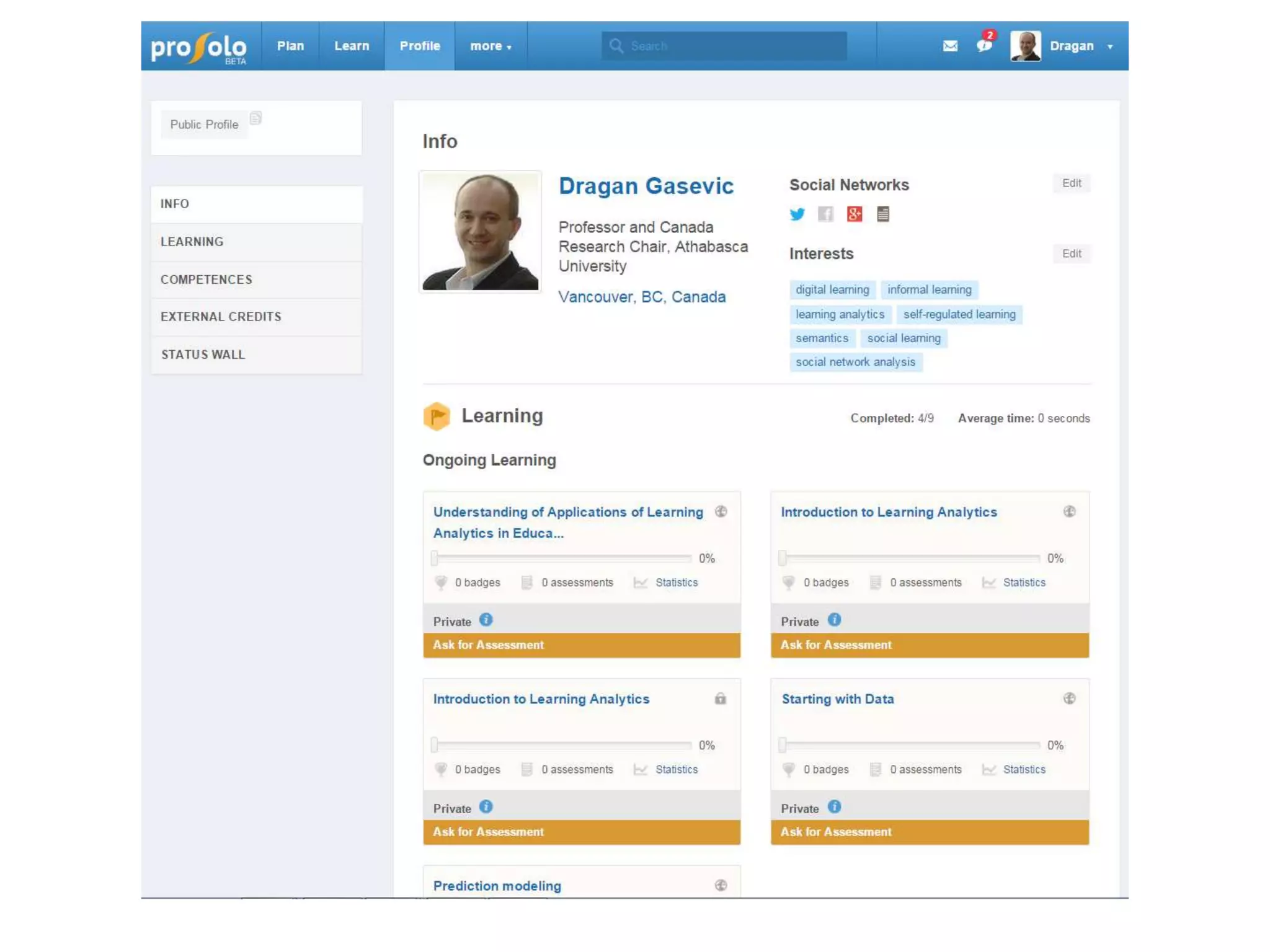
Learners are unique and
so are their profiles
Learning does not happen
in a silo
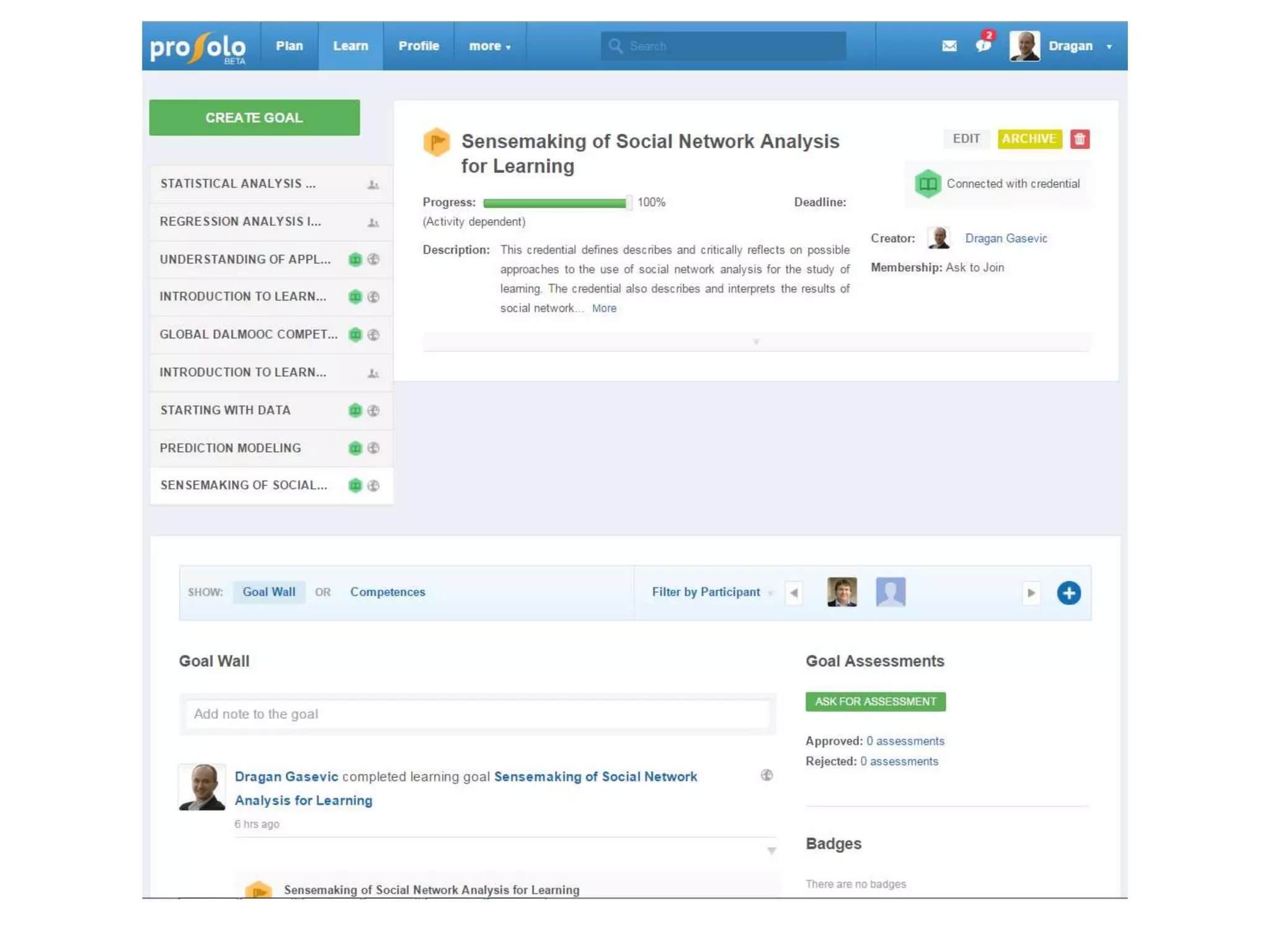
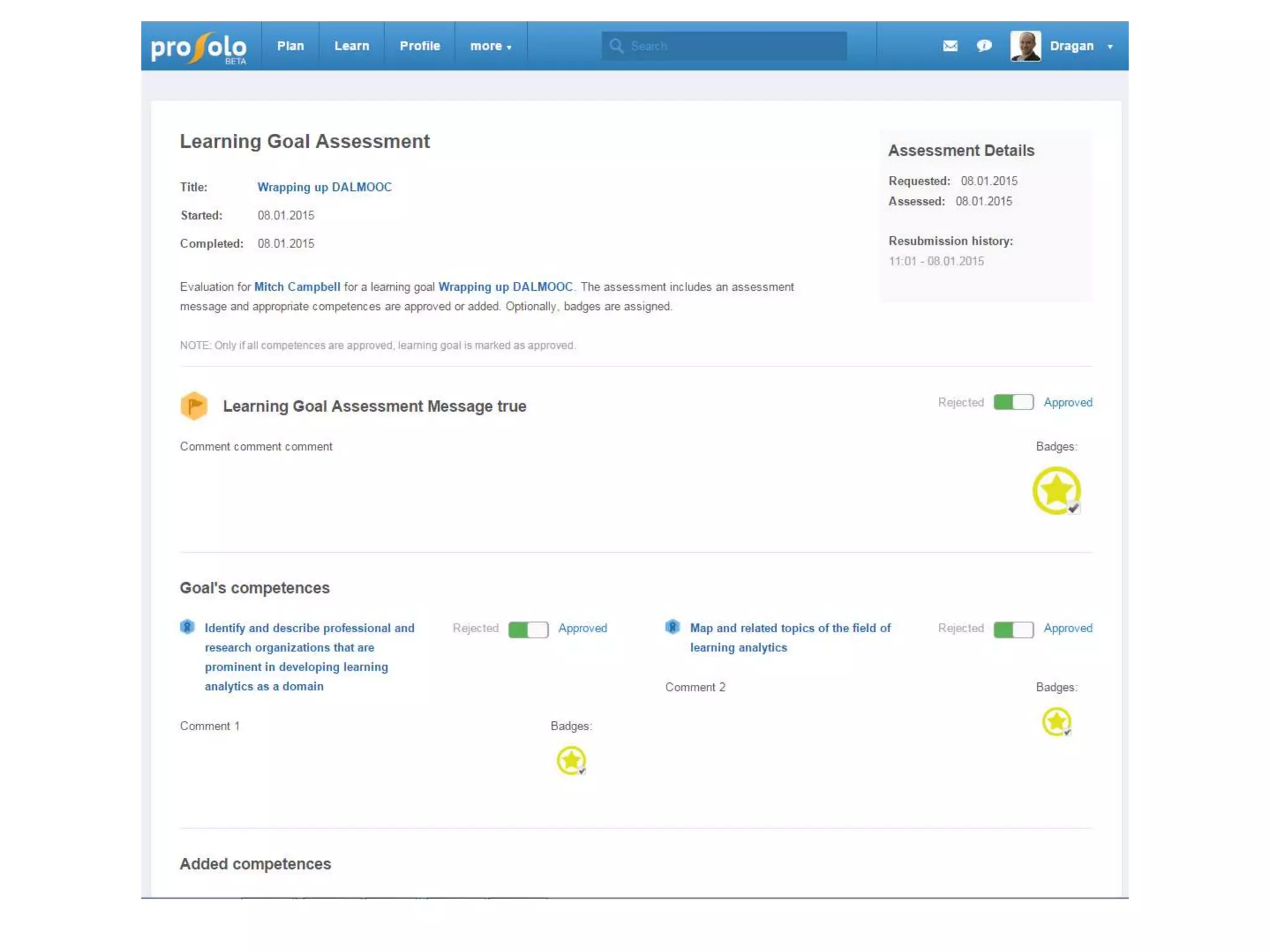
Learning is credentialed
based on evidence produced
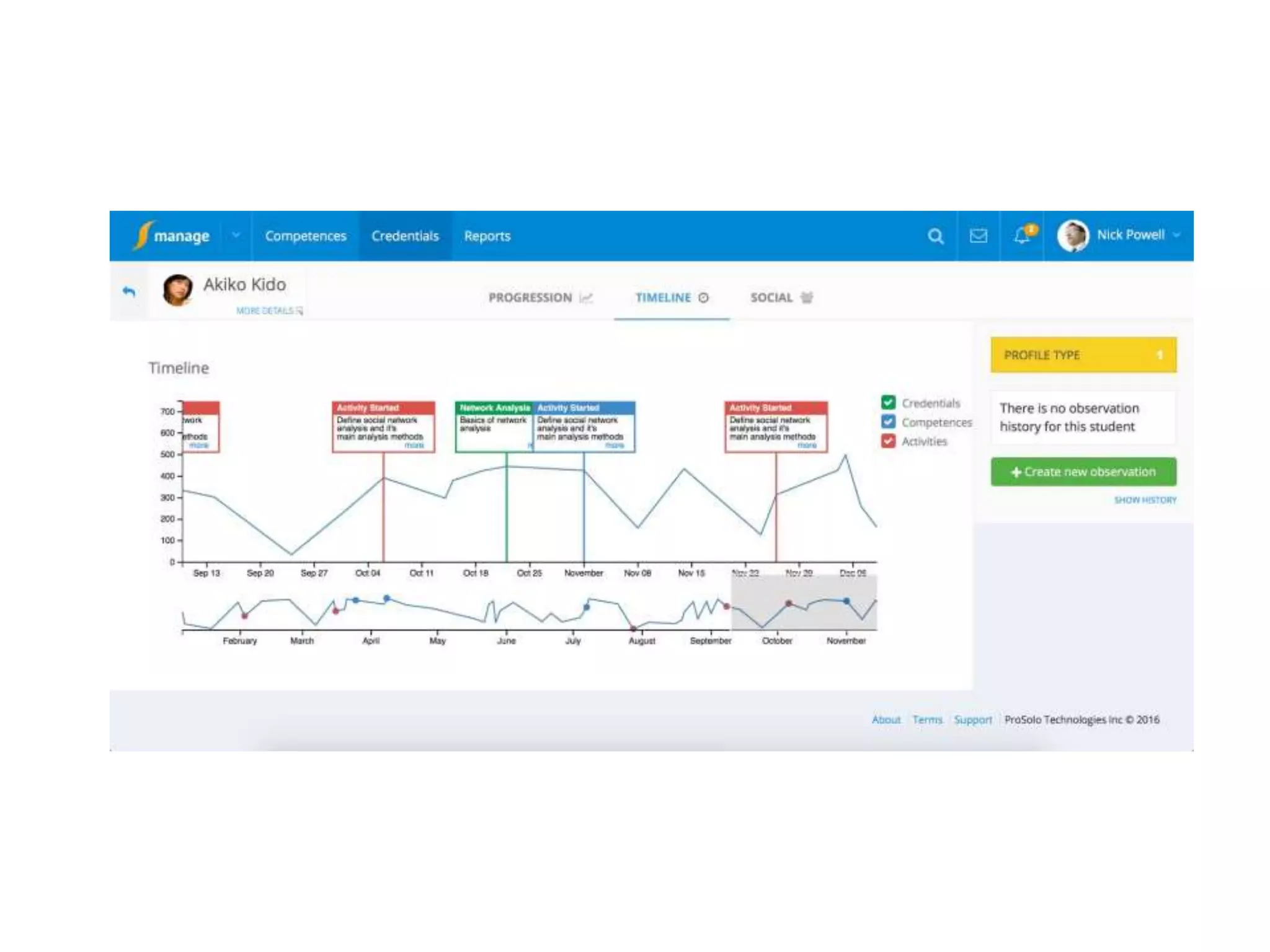
Institutions learn too
(as learning organizations)
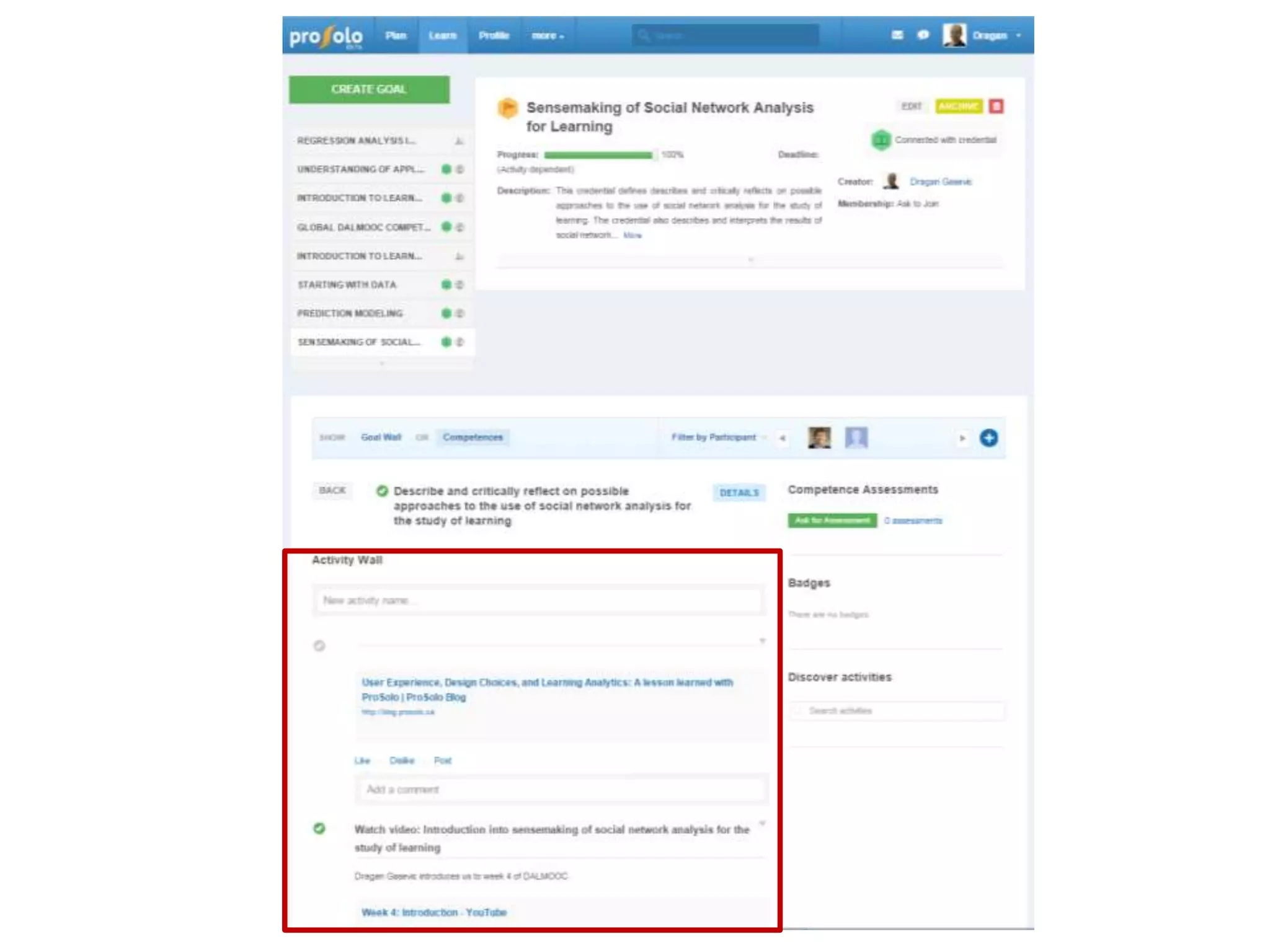
Tenologies builds on
Existing learning technologies (LTI),
social media, learning analytics,
machine learning, information retrieval,
recommender systems,…
http://dalmooc.prosolo.ca
PROSOLO IMPLEMENTATION
Design-based approach
iterative with interventions
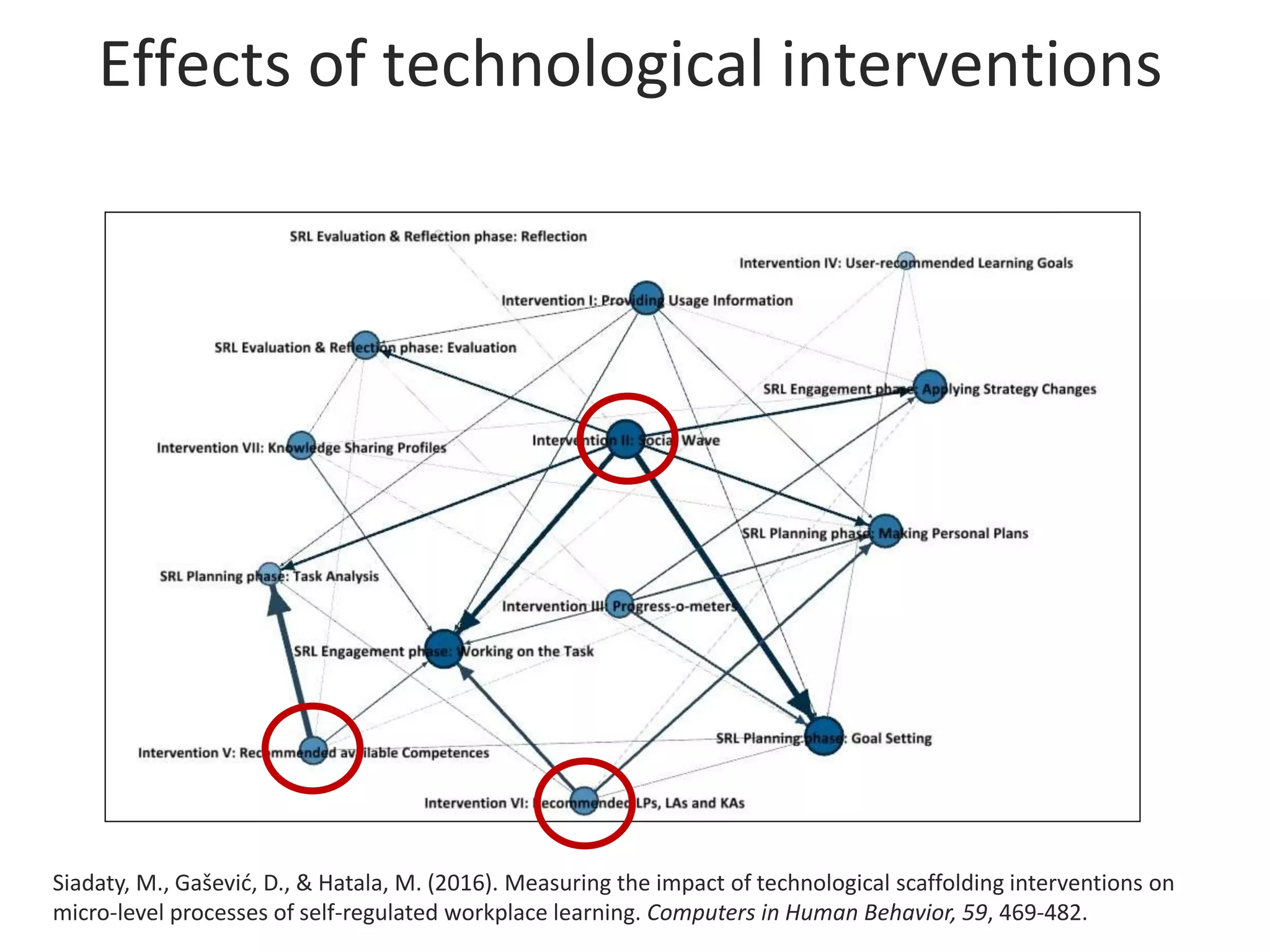
Siadaty, M., Gašević, D., & Hatala, M. (2016). Measuring the impact of technological scaffolding interventions on
micro-level processes of self-regulated workplace learning. Computers in Human Behavior, 59, 469-482.
Effects of technological interventions
LESSONS AND DIRECTIONS
Individual and systemic
Adjustment to
the new approach
External locus of control
Change of discourse needed!
From adaptive learning
to adaptive learners
Challenge
Metacognitive skills
Bjork, R. A., Dunlosky, J., & Kornell, N. (2013). Self-Regulated Learning: Beliefs, Techniques, and Illusions.
Annual Review of Psychology, 64, 417-444. doi:10.1146/annurev-psych-113011-143823
Instructional design as
the most active ingredient
Clark, R. E. (2009). Translating research into new instructional technologies for higher education: The active ingredient
process. Journal of Computing in Higher Education, 21(1), 4-18.
Central role of instructors
empowered with technology
Learning is not algorithmically driven!
Credentialing as
a big opportunity
(if done right!)
Policy development necessary
Restructuring
exiting educational resources
around competencies
Content frameworks across
different disciplines
Thank you!
Dragan Gašević
@dgasevic

Technologies to support self-directed learning through social interaction

Editor's Notes

  • #5 Learners develop their competencies by harnessing the opportunities offered by social media and connections learners create while learning, working, or playing
  • #6 Learners develop their competencies by harnessing the opportunities offered by social media and connections learners create while learning, working, or playing
  • #7 Learners develop their competencies by harnessing the opportunities offered by social media and connections learners create while learning, working, or playing
  • #8 Learners develop their competencies by harnessing the opportunities offered by social media and connections learners create while learning, working, or playing
  • #9 Learners develop their competencies by harnessing the opportunities offered by social media and connections learners create while learning, working, or playing
  • #10 Results of this study indicated that the instructors who used Signals perceived this technology primarily as away of transmitting summative feedback multiple times in a semester. With this technology, instructors aimed to inform students where they are standing early in the semester. Results indicated that student success was associated with instructional rather than motivational feedback, and type of rather than frequency of summative and formative feedback. Implications of these findings are discussed below. ► Study 1 examined how instructors define the content and nature of feedback in Signals with content analysis. ► Although formative feedback yields better learning experiences and outcomes, instructors focused on summative feedback. ► Study 2 examined the content and nature of feedback students received via Signals messages and their relation with success. ► Instructors should focus on type of rather than frequency of feedback, and send explicit and instructional feedback. ► Discrepancy between perception and application suggests a feedback message guideline or an inclusive message library. Tanes, Z., Arnold, K. E., King, A. S., & Remnet, M. A. (2011). Using Signals for appropriate feedback: Perceptions and practices. Computers & Education,57(4), 2414-2422.
  • #11 Results of this study indicated that the instructors who used Signals perceived this technology primarily as away of transmitting summative feedback multiple times in a semester. With this technology, instructors aimed to inform students where they are standing early in the semester. Results indicated that student success was associated with instructional rather than motivational feedback, and type of rather than frequency of summative and formative feedback. Implications of these findings are discussed below. ► Study 1 examined how instructors define the content and nature of feedback in Signals with content analysis. ► Although formative feedback yields better learning experiences and outcomes, instructors focused on summative feedback. ► Study 2 examined the content and nature of feedback students received via Signals messages and their relation with success. ► Instructors should focus on type of rather than frequency of feedback, and send explicit and instructional feedback. ► Discrepancy between perception and application suggests a feedback message guideline or an inclusive message library. Tanes, Z., Arnold, K. E., King, A. S., & Remnet, M. A. (2011). Using Signals for appropriate feedback: Perceptions and practices. Computers & Education,57(4), 2414-2422.
  • #16 understanding and documenting what learners know, regardless of where learning happens, is essential for creating adaptive learning opportunities;
  • #17 understanding and documenting what learners know, regardless of where learning happens, is essential for creating adaptive learning opportunities;
  • #19 Learners develop their competencies by harnessing the opportunities offered by social media and connections learners create while learning, working, or playing
  • #20 Learners develop their competencies by harnessing the opportunities offered by social media and connections learners create while learning, working, or playing
  • #21 understanding and documenting what learners know, regardless of where learning happens, is essential for creating adaptive learning opportunities;
  • #22 understanding and documenting what learners know, regardless of where learning happens, is essential for creating adaptive learning opportunities;
  • #23 Although learning may occur in informal and authentic contexts, a robust credentialing pipeline is necessary to assess and validate the evidence learners provide in order to demonstrate the achievement of stated competencies.
  • #29 understanding and documenting what learners know, regardless of where learning happens, is essential for creating adaptive learning opportunities;
  • #57 Students generally have poor self-regulation skills: Weak metacomprehension – assessment of own knowledge – stop learning, when they don’t know enough Confusion of the rate of learning - stop learning, when they don’t know enough Externally-generated self-monitoring prompts – Azevedo Weak metacognitive awareness – inefficient study tactics used