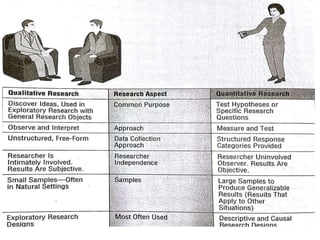
Qualitative Research
It is done when researcher is interested more in qualities
than quantities
It elaborates a market phenomena without depending on
numerical data
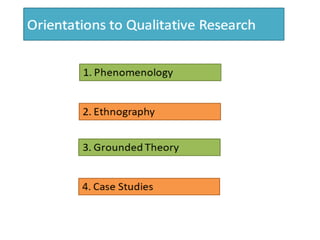
Orientation to Qualitative Research
1. Phenomenology
2. Ethnography
3. Grounded Research
4. Case Studies
1. Phenomenology
• A phenomenological approach to study
human experiences based on the idea that
human experience itself.
• It's the study of human experiences that one
shares as a story. Recorded as audio or video
and later interpreted by a researcher.
• Researcher can become the member of group
and than experience himself or herself and ask
questions from group members.
2. Ethnography
• The scientific description of people and
culture with their customs, habits and mutual
differences.
• It's a way of study in which researchers
become highly active within that culture.
3. Grounded Theory
• Grounded theory is a systematic methodology
involving the construction of theories through
methodical gathering and analyzing data.
4. Case Studies
• It is a documented history of a particular
person, group or event.
• A case study is a research strategy and an
empirical inquiry that investigates a
phenomenon within its real life context.
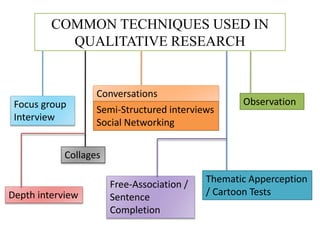
COMMON TECHNIQUES USED IN
QUALITATIVE RESEARCH
Focus group
Interview
Depth interview
Conversations
Semi-Structured interviews
Social Networking
Free-Association /
Sentence
Completion
Observation
Collages
Thematic Apperception
/ Cartoon Tests
Focus group Interview
• Focus group interview is a tool for
qualitative market research where a
group of people are selected and
asked about their opinion or
perceptions about a particular topic.
Focus group Interview
Advantages of focus group interview :
• It is a tool for acquiring feedback about
products or topics
• It provides information about various aspects
of a product that is yet to be launched in the
market so that the product can be modified
• Easy to conduct, low cost and less time to get
results.
Depth Interview
Depth Interview
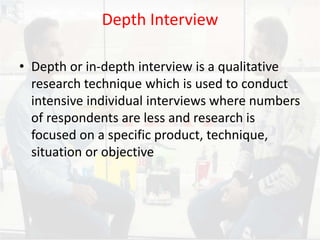
• Depth or in-depth interview is a qualitative
research technique which is used to conduct
intensive individual interviews where numbers
of respondents are less and research is
focused on a specific product, technique,
situation or objective
Advantages of In-depth interviews
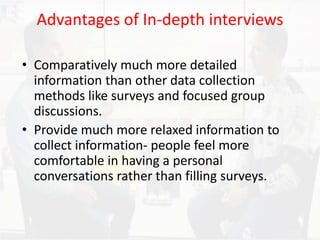
• Comparatively much more detailed
information than other data collection
methods like surveys and focused group
discussions.
• Provide much more relaxed information to
collect information- people feel more
comfortable in having a personal
conversations rather than filling surveys.
Conversations
• A talk, especially an informal one, between
two or more people, in which news and ideas
are exchange.
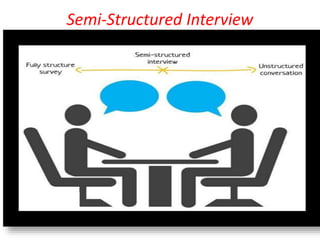
Semi-Structured Interview
• A semi-structured interview is a meeting in
which the interviewer does not strictly follow
a formalized list of questions. They will ask
more open-ended questions, allowing for a
discussion with the interviewee rather than a
straightforward question and answer format.
Opinion is taken from society. If the image of
the product is negative then a strategy is
developed to turn it into positive opinion
WORD ASSOCIATION TEST
• Generally, a list of words (stimuli) is given to
subjects(either in writing or in oral form). The
subjects are asked to respond with the first
word that comes into their mind(responses).
HONDA
IDEAS-
GULL AHMED
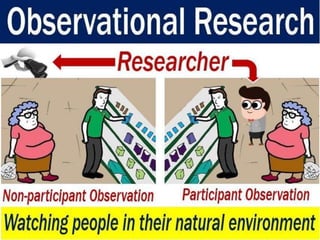
OBSERVATION
• DEFINITION:
As a means of gathering information for research,
may be defined as perceiving data through the
senses: sight, hearing, tastes, touch and smell
C:UsersX1 CarbonDesktop(25) Art of Observation -
YouTube.html
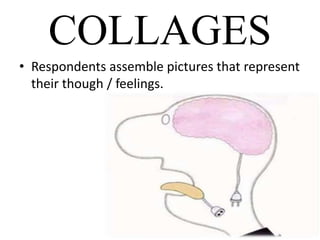
COLLAGES
• Respondents assemble pictures that represent
their though / feelings.
THEMATIC APPERCEPTION TEST
• Researchers provide an confusing picture and
respondent tell about the story
• Allows to get at sensitive issue flexible.
• Example: Explain the given picture in your
own words.
Exploratory Research
• Exploratory research is research conducted
for a problem that has not been studied more
clearly, intended to establish priorities,
develop operational definitions and improve
the final research design.
Exploratory Research and Qualitative Analysis

Exploratory Research and Qualitative Analysis

  • 2.
    Qualitative Research It isdone when researcher is interested more in qualities than quantities It elaborates a market phenomena without depending on numerical data
  • 7.
    Orientation to QualitativeResearch 1. Phenomenology 2. Ethnography 3. Grounded Research 4. Case Studies
  • 8.
    1. Phenomenology • Aphenomenological approach to study human experiences based on the idea that human experience itself. • It's the study of human experiences that one shares as a story. Recorded as audio or video and later interpreted by a researcher. • Researcher can become the member of group and than experience himself or herself and ask questions from group members.
  • 9.
    2. Ethnography • Thescientific description of people and culture with their customs, habits and mutual differences. • It's a way of study in which researchers become highly active within that culture.
  • 10.
    3. Grounded Theory •Grounded theory is a systematic methodology involving the construction of theories through methodical gathering and analyzing data.
  • 11.
    4. Case Studies •It is a documented history of a particular person, group or event. • A case study is a research strategy and an empirical inquiry that investigates a phenomenon within its real life context.
  • 12.
    COMMON TECHNIQUES USEDIN QUALITATIVE RESEARCH Focus group Interview Depth interview Conversations Semi-Structured interviews Social Networking Free-Association / Sentence Completion Observation Collages Thematic Apperception / Cartoon Tests
  • 13.
  • 14.
    • Focus groupinterview is a tool for qualitative market research where a group of people are selected and asked about their opinion or perceptions about a particular topic. Focus group Interview
  • 15.
    Advantages of focusgroup interview : • It is a tool for acquiring feedback about products or topics • It provides information about various aspects of a product that is yet to be launched in the market so that the product can be modified • Easy to conduct, low cost and less time to get results.
  • 16.
  • 17.
    Depth Interview • Depthor in-depth interview is a qualitative research technique which is used to conduct intensive individual interviews where numbers of respondents are less and research is focused on a specific product, technique, situation or objective
  • 18.
    Advantages of In-depthinterviews • Comparatively much more detailed information than other data collection methods like surveys and focused group discussions. • Provide much more relaxed information to collect information- people feel more comfortable in having a personal conversations rather than filling surveys.
  • 19.
    Conversations • A talk,especially an informal one, between two or more people, in which news and ideas are exchange.
  • 20.
  • 21.
    Semi-Structured Interview • Asemi-structured interview is a meeting in which the interviewer does not strictly follow a formalized list of questions. They will ask more open-ended questions, allowing for a discussion with the interviewee rather than a straightforward question and answer format.
  • 22.
    Opinion is takenfrom society. If the image of the product is negative then a strategy is developed to turn it into positive opinion
  • 24.
    WORD ASSOCIATION TEST •Generally, a list of words (stimuli) is given to subjects(either in writing or in oral form). The subjects are asked to respond with the first word that comes into their mind(responses).
  • 25.
  • 26.
    OBSERVATION • DEFINITION: As ameans of gathering information for research, may be defined as perceiving data through the senses: sight, hearing, tastes, touch and smell C:UsersX1 CarbonDesktop(25) Art of Observation - YouTube.html
  • 29.
    COLLAGES • Respondents assemblepictures that represent their though / feelings.
  • 31.
    THEMATIC APPERCEPTION TEST •Researchers provide an confusing picture and respondent tell about the story • Allows to get at sensitive issue flexible. • Example: Explain the given picture in your own words.
  • 34.
    Exploratory Research • Exploratoryresearch is research conducted for a problem that has not been studied more clearly, intended to establish priorities, develop operational definitions and improve the final research design.