WHAT IS RESEARCH?
WHATIS RESEARCH?
The word derived from the old French word
“Cerchier” (seek or search). Search means to
investigate, the prefix “RE” means “again”
and signifies of the research.
means “INVESTIGATE AGAIN”
5.
WHAT IS QUALITATIVE?
WHATIS QUALITATIVE?
A type of educational research in which the
reseacher relies on the views of participants, ask
broad, general questions, collect data consisting
largely words (text) from participants, describes
and analyzes these words for themes and conducts
the Inquiry in a subjective, biased manner.
7.
Characteristics
of Qualitative
Natural environment
(naturalsetting)
Qualitative researchers collect field
data at the locations where
participants experience the
problem or issue to be studied.
Qualitative researchers do not
change the environmental settings
and activities of the participants.
Information is gathered by talking
directly to people and seeing them
act directly in a natural context.
8.
Characteristics
of Qualitative
Researcher asa key
instrument
Qualitative researchers
generally collect their own
research data through
participant observation,
documentation, or direct
interviews with participants.
These researchers generally do
not use instruments or
questionnaires made by other
researchers, because they are
the only key to the study.
9.
Characteristics
of Qualitative
Multiple sourcesof
data
Qualitative researchers
generally choose to collect the
required data from various
sources such as interviews,
documentation, and
observations, rather than
relying only on one source
data.
Characteristics
of Qualitative
The meaningof the participants
(participant’s meaning)
In the entire research
process, the researcher must
focus on studying the
meaning obtained from the
participants about the issue
or research problem, not the
meaning conveyed by other
authors or researchers in
certain literatures.
12.
Characteristics
of Qualitative
Design thatdevelops
(emergent design)
Qualitative researchers argue that
qualitative research is always
evolving and dynamic. This can
mean that the initial plan is not a
standard that must be adhered to,
all stages of research may change
after the researcher goes into the
field and collects data. Provided that
these changes are still in line in
achieving the research objectives,
namely obtaining information about
the problem or research issue.
Characteristics
of Qualitative
Interpretive
Qualitative researchersmake
an interpretation of what
they see, hear and what they
understand. Usually there are
differences in interpretation
between researchers and
readers and participants, so
it appears that qualitative
research offers different
views on a content or
problem.
15.
Characteristics
of Qualitative
A holisticaccount
Qualitative researchers
usually try to make a
complex picture of a
research issue or problem.
Researchers describe the
perspectives and factors
associated with the problem
as a whole.
17.
ACTION
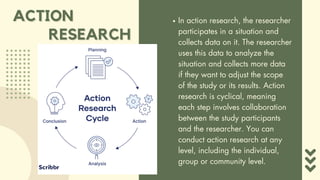
ACTION In actionresearch, the researcher
participates in a situation and
collects data on it. The researcher
uses this data to analyze the
situation and collects more data
if they want to adjust the scope
of the study or its results. Action
research is cyclical, meaning
each step involves collaboration
between the study participants
and the researcher. You can
conduct action research at any
level, including the individual,
group or community level.
RESEARCH
RESEARCH
18.
The phenomenological methodis a
qualitative research technique that
seeks to understand the meaning
that people give to their
experiences. This type of research
uses the phenomenological inquiry
method, which focuses on how
individuals experience events.
Phenomenological researchers
focus on subjective understanding
and biases to look at what people
say about themselves, rather than
on objective interpretations of what
participants say. This helps
researchers better understand
people's experiences.
PHENOME-
PHENOME-
NOLOGICAL
NOLOGICAL
19.
ETHNOGRAPHIC
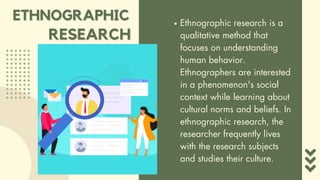
ETHNOGRAPHIC Ethnographic researchis a
qualitative method that
focuses on understanding
human behavior.
Ethnographers are interested
in a phenomenon's social
context while learning about
cultural norms and beliefs. In
ethnographic research, the
researcher frequently lives
with the research subjects
and studies their culture.
RESEARCH
RESEARCH
20.
CASE
CASE Case studiesare in-depth
examinations of people or
groups of people. They help
researchers understand an
intervention's context,
process and outcomes.
Case studies also help
researchers understand the
cause-and-effect
relationships between
variables and the change
process over time
STUDY
STUDY
21.
NARRATIVE
NARRATIVE Narrative researchis a popular
qualitative research method
because it helps you understand
how people live and make
decisions. You collect data about
subjects by tracking them as they
go through different stages of
your study. By understanding
these experiences through
observations of participants over
time, businesses can create buyer
personas for their products and
services based on these
narratives.
MODEL
MODEL
22.
NARRATIVE
NARRATIVE Researchers explorea few
participants' experiences by
collecting information on their
attitudes, beliefs and behaviors
during specific situations. The
narrative research method
involves collecting stories from
participants to share later.
This process involves asking
questions like: What was
happening? How did it feel?
Why was this important? What
did you do next?
MODEL
MODEL
23.
GROUNDED
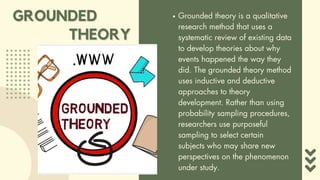
GROUNDED Grounded theoryis a qualitative
research method that uses a
systematic review of existing data
to develop theories about why
events happened the way they
did. The grounded theory method
uses inductive and deductive
approaches to theory
development. Rather than using
probability sampling procedures,
researchers use purposeful
sampling to select certain
subjects who may share new
perspectives on the phenomenon
under study.
THEORY
THEORY
24.
FOCUS
FOCUS Focus groupsare an important
tool in qualitative research. They
reveal people's attitudes,
perceptions and beliefs to
enhance researchers' knowledge
of a particular topic. For
instance, moderators might
conduct focus groups with eight
to 12 participants who meet at
set times over several weeks or
months. Participants may test out
a new product, and researchers
can observe subjects and
conduct interviews about their
experience.
GROUPS
GROUPS
25.
HISTORICAL
HISTORICAL Historical studiesidentify, locate,
evaluate and synthesize data
from the past. Historical research
helps researchers understand
why something happened and
what its impact was. Researchers
can use this data to predict the
future or understand the past
better. You can find data for
historical research in documents
or relics and artifacts. These
include books, published works
such as newspapers and older
texts and letters from people who
lived during certain periods.
RESEARCH
RESEARCH
27.
ADVANTAGES
ADVANTAGES
In-depth Understanding
Qualitative providesrich, detailed
insights into participants' experiences,
emotions, and perceptions, allowing
researchers to understand the "why" and
"how" behind phenomena. not provide
statistical representation, limiting the
ability to make quantitative comparisons.
28.
ADVANTAGES
ADVANTAGES
Flexibility
It allows researchersto adapt and modify
their approach as new insights emerge
during the study. This flexibility is useful in
exploratory or evolving areas of research.
Contextual Relevance
Qualitative research takes into account the
context in which a phenomenon occurs,
making it possible to capture the nuances
and complexities of real-world situations.
29.
ADVANTAGES
ADVANTAGES
Exploratory Nature
It iswell-suited for exploring new or
poorly understood topics, where the
goal is to gather insights rather than test
pre-existing hypotheses.
Qualitative research is often used to
generate new theories or hypotheses,
providing a foundation for further
quantitative investigation.
Theory Development
ADVANTAGES
ADVANTAGES
Participant-Centered
It gives voiceto participants, often
highlighting perspectives that might be
overlooked in quantitative research.
This is especially valuable in
marginalized or underrepresented
groups.
33.
DISADVANTAGES
DISADVANTAGES
Not Statistically Representative
Qualitativeresearch does not provide
statistical representation, limiting the
ability to make quantitative comparisons.
Responses in qualitative research cannot
usually be measured, leading to
potential data duplication over time.
Data Duplication
34.
DISADVANTAGES
DISADVANTAGES
Time-Consuming
Qualitative research canbe time-consuming
and labor-intensive due to the detailed
nature of data collection and analysis.
Due to the subjective nature of
qualitative data, replicating results can
be challenging, impacting the reliability
of findings
Difficulty in Replicating Results
35.
DISADVANTAGES
DISADVANTAGES
Subjective
Another disadvantage ofqualitative
research is that it is highly subjective.
Qualitative research relies on the
interpretation and analysis of
observations, which can be difficult to
quantify and measure objectively.
Additionally, the researcher’s own
biases can influence the results of the
study.
DISADVANTAGES
DISADVANTAGES
Expensive
Qualitative research canalso be
expensive to conduct. It requires a
considerable amount of time, which can
translate to a significant amount of
money. Additionally, the cost of data
collection, such as traveling to conduct
interviews and focus groups, can add to
the overall cost of the research.
38.
DISADVANTAGES
DISADVANTAGES
Difficult to Analyze
Qualitativeresearch data can also be
difficult to analyze. Since the data is
often subjective and open to
interpretation, it can be difficult to make
sense of the data and draw valid
conclusions from it. Additionally, the
analysis of qualitative research data is
often labor-intensive and time-
consuming.
39.
Qualitative research isa method that explores people’s
experiences, behaviors, and emotions in their natural
settings. It uses interviews, observations, and
documents to collect data, with the researcher directly
involved. It focuses on understanding participants’
perspectives and allows flexibility as the study evolves.
Methods include case studies, interviews, and
ethnography. While it provides deep insights into
complex topics, it can be time-consuming, subjective,
and not statistically representative. Despite these
challenges, it helps uncover detailed and meaningful
information about real-life issues.