INTRODUCTION TO QUALITATIVE DATA COLLECTION METOHDS
By
Vinothini S
Qualitative Research
Qualitative research involves collecting and analyzing non-numerical data (e.g., text, video, or
audio) to understand concepts, opinions, or experiences. It can be used to gather in-depth insights
into a problem or generate new ideas for research.
Qualitative research is commonly used in the humanities and social sciences, in subjects such as
anthropology, sociology, education, health sciences, history, etc.
Qualitative Data
Qualitative data is descriptive information that captures observable qualities and characteristics not
quantifiable by numbers. It is collected from interviews, focus groups, observations, and
documents offering insights into experiences, perceptions, and behaviors.
Data collection in qualitative research focuses on gathering contextual information. Unlike
quantitative data, which focuses primarily on numbers to establish ‘how many’ or ‘how much,’
qualitative data collection tools allow you to assess the ‘why’s’ and ‘how’s’ behind those statistics.
This is vital for nonprofits as it enables organizations to determine:
• Existing knowledge surrounding a particular issue.
• How social norms and cultural practices impact a cause.
• What kind of experiences and interactions people have with your brand.
• Trends in the way people change their opinions.
• Whether meaningful relationships are being established between all parties.
Purpose of Qualitative Research
The purpose of qualitative research is to explore and understand the subjective experiences,
behaviors, and perspectives of individuals or groups in a particular context. Unlike quantitative
research, which focuses on numerical data and statistical analysis, qualitative research aims to
provide in-depth, descriptive information that can help researchers develop insights and theories
about complex social phenomena.
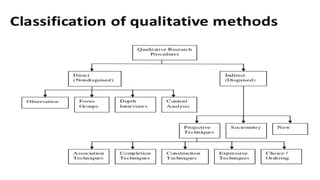
Types of Qualitative Data Collection Methods
 Interviews
 Focus Groups
 Observation
 Open-Ended Surveys and Questionnaires
 Case Studies
 Text Analysis
 Audio and Video Recordings
 Hybrid Methodologies
Interviews
One-on-one interviews are one of the most commonly used data collection methods in qualitative
research because they allow you to collect highly personalized information directly from the source.
Interviews explore participants' opinions, motivations, beliefs, and experiences and are particularly
beneficial in gathering data on sensitive topics because respondents are more likely to open up in a
one-on-one setting than in a group environment. Interviews can be conducted in person or by online
video call. Typically, they are separated into three main categories:
1.Structured Interviews - Structured interviews consist of predetermined (and usually closed)
questions with little or no variation between interviewees. There is generally no scope for elaboration
or follow-up questions, making them better suited to researching specific topics.
2.Unstructured Interviews – Conversely, unstructured interviews have little to no organization or
preconceived topics and include predominantly open questions. As a result, the discussion will flow in
completely different directions for each participant and can be very time-consuming. For this reason,
unstructured interviews are generally only used when little is known about the subject area or when
in-depth responses are required on a particular subject.
3.Semi-Structured Interviews – A combination of the two interviews mentioned above, semi-
structured interviews comprise several scripted questions but allow both interviewers and
interviewees the opportunity to diverge and elaborate so more in-depth reasoning can be explored.
Cond…..
While each approach has its merits, semi-structured interviews are typically favored as a way to
uncover detailed information in a timely manner while highlighting areas that may not have been
considered relevant in previous research efforts. Whichever type of interview you utilize,
participants must be fully briefed on the format, purpose, and what you hope to achieve. With that
in mind, here are a few tips to follow:
Give them an idea of how long the interview will last
If you plan to record the conversation, ask permission beforehand
Provide the opportunity to ask questions before you begin and again at the end.
Focus Groups
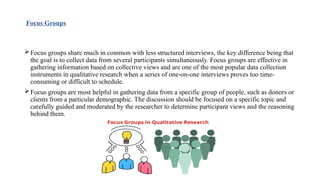
Focus groups share much in common with less structured interviews, the key difference being that
the goal is to collect data from several participants simultaneously. Focus groups are effective in
gathering information based on collective views and are one of the most popular data collection
instruments in qualitative research when a series of one-on-one interviews proves too time-
consuming or difficult to schedule.
Focus groups are most helpful in gathering data from a specific group of people, such as donors or
clients from a particular demographic. The discussion should be focused on a specific topic and
carefully guided and moderated by the researcher to determine participant views and the reasoning
behind them.
Cond…
Feedback in a group setting often provides richer data than one-on-one interviews, as participants
are generally more open to sharing when others are sharing too. Plus, input from one participant
may spark insight from another that would not have come to light otherwise. However, here are a
couple of potential downsides:
If participants are uneasy with each other, they may not be at ease openly discussing their feelings
or opinions.
If the topic is not of interest or does not focus on something participants are willing to discuss,
data will lack value.
The size of the group should be carefully considered. Research suggests over-recruiting to avoid
risking cancellation, even if that means moderators have to manage more participants than
anticipated. The optimum group size is generally between six and eight for all participants to be
granted ample opportunity to speak. However, focus groups can still be successful with as few as
three or as many as fourteen participants.
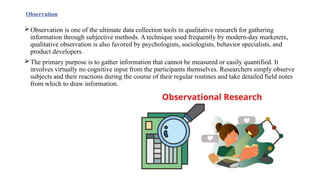
Observation
Observation is one of the ultimate data collection tools in qualitative research for gathering
information through subjective methods. A technique used frequently by modern-day marketers,
qualitative observation is also favored by psychologists, sociologists, behavior specialists, and
product developers.
The primary purpose is to gather information that cannot be measured or easily quantified. It
involves virtually no cognitive input from the participants themselves. Researchers simply observe
subjects and their reactions during the course of their regular routines and take detailed field notes
from which to draw information.
Cond…
Observational techniques vary in terms of contact with participants. Some qualitative observations
involve the complete immersion of the researcher over a period of time. For example, attending
the same church, clinic, society meetings, or volunteer organizations as the participants. Under
these circumstances, researchers will likely witness the most natural responses rather than relying
on behaviors elicited in a simulated environment. Depending on the study and intended purpose,
they may or may not choose to identify themselves as a researcher during the process.
Regardless of whether you take a covert or overt approach, remember that because each researcher
is as unique as every participant, they will have their own inherent biases. Therefore, observational
studies are prone to a high degree of subjectivity. For example, one researcher’s notes on the
behavior of donors at a society event may vary wildly from the next. So, each qualitative
observational study is unique in its own right.
Open-Ended Surveys and Questionnaires
Open-ended surveys and questionnaires allow organizations to collect views and opinions from
respondents without meeting in person. They can be sent electronically and are considered one of
the most cost-effective qualitative data collection tools. Unlike closed question surveys and
questionnaires that limit responses, open-ended questions allow participants to provide lengthy
and in-depth answers from which you can extrapolate large amounts of data.
The findings of open-ended surveys and questionnaires can be challenging to analyze because
there are no uniform answers. A popular approach is to record sentiments as positive, negative, and
neutral and further dissect the data from there.
To gather the best business intelligence, carefully consider the presentation and length of your survey
or questionnaire. Here is a list of essential considerations:
Number of questions: Too many can feel intimidating, and you’ll experience low response rates. Too
few can feel like it’s not worth the effort. Plus, the data you collect will have limited actionability. The
consensus on how many questions to include varies depending on which sources you consult.
However, 5-10 is a good benchmark for shorter surveys that take around 10 minutes and 15-20 for
longer surveys that take approximately 20 minutes to complete.
Personalization: Your response rate will be higher if you greet patients by name and demonstrate a
historical knowledge of their interactions with your brand.
Visual elements: Recipients can be easily turned off by poorly designed questionnaires. Besides, it’s
a good idea to customize your survey template to include brand assets like colors, logos, and fonts to
increase brand loyalty and recognition.
Reminders: Sending survey reminders is the best way to improve your response rate. You don’t want
to hassle respondents too soon, nor do you want to wait too long. Sending a follow-up at around the
3-7 mark is usually the most effective.
Building a feedback loop: Adding a tick-box requesting permission for further follow-ups is a
proven way to elicit more in-depth feedback. Plus, it gives respondents a voice and makes their
opinion feel valued.
Case Studies
Case studies are often a preferred method of qualitative research data collection for organizations
looking to generate incredibly detailed and in-depth information on a specific topic. Case studies
are usually a deep dive into one specific case or a small number of related cases. As a result, they
work well for organizations that operate in niche markets.
Case studies typically involve several qualitative data collection methods, including interviews,
focus groups, surveys, and observation. The idea is to cast a wide net to obtain a rich picture
comprising multiple views and responses. When conducted correctly, case studies can generate
vast bodies of data that can be used to improve processes at every client and donor touchpoint.
Cond…
The best way to demonstrate the purpose and value of a case study is with an example:
A Longitudinal Qualitative Case Study of Change in Nonprofits – Suggesting A New Approach to
the Management of Change
.
The researchers established that while change management had already been widely researched in
commercial and for-profit settings, little reference had been made to the unique challenges in the
nonprofit sector. The case study examined change and change management at a single nonprofit
hospital from the viewpoint of all those who witnessed and experienced it. To gain a holistic view
of the entire process, research included interviews with employees at every level, from nursing
staff to CEOs, to identify the direct and indirect impacts of change. Results were collated based on
detailed responses to questions about preparing for change, experiencing change, and reflecting on
change
Text Analysis
Text analysis has long been used in political and social science spheres to gain a deeper
understanding of behaviors and motivations by gathering insights from human-written texts. By
analyzing the flow of text and word choices, relationships between other texts written by the same
participant can be identified so that researchers can draw conclusions about the mindset of their
target audience. Though technically a qualitative data collection method, the process can involve
some quantitative elements, as often, computer systems are used to scan, extract, and categorize
information to identify patterns, sentiments, and other actionable information.
Cond…
You might be wondering how to collect written information from your research subjects. There are
many different options, and approaches can be overt or covert.
Examples include:
Investigating how often certain cause-related words and phrases are used in client and donor social
media posts.
Asking participants to keep a journal or diary.
Analyzing existing interview transcripts and survey responses.
By conducting a detailed analysis, you can connect elements of written text to specific issues,
causes, and cultural perspectives, allowing you to draw empirical conclusions about personal
views, behaviors, and social relations. With small studies focusing on participants' subjective
experience on a specific theme or topic, diaries and journals can be particularly effective in
building an understanding of underlying thought processes and beliefs.
Audio and Video Recordings
Similarly to how data is collected from a person’s writing, you can draw valuable conclusions by
observing someone’s speech patterns, intonation, and body language when you watch or listen to
them interact in a particular environment or within specific surroundings.
Video and audio recordings are helpful in circumstances where researchers predict better results by
having participants be in the moment rather than having them think about what to write down or
how to formulate an answer to an email survey.
You can collect audio and video materials for analysis from multiple sources, including:
Previously filmed records of events
Interview recordings
Video diaries
Cond…
Utilizing audio and video footage allows researchers to revisit key themes, and it's possible to use
the same analytical sources in multiple studies – providing that the scope of the original recording
is comprehensive enough to cover the intended theme in adequate depth.
It can be challenging to present the results of audio and video analysis in a quantifiable form that
helps you gauge campaign and market performance. However, results can be used to effectively
design concept maps that extrapolate central themes that arise consistently.
Concept Mapping offers organizations a visual representation of thought patterns and how ideas
link together between different demographics. This data can prove invaluable in identifying areas
for improvement and change across entire projects and organizational processes.
Hybrid Methodologies
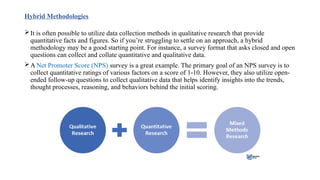
It is often possible to utilize data collection methods in qualitative research that provide
quantitative facts and figures. So if you’re struggling to settle on an approach, a hybrid
methodology may be a good starting point. For instance, a survey format that asks closed and open
questions can collect and collate quantitative and qualitative data.
A Net Promoter Score (NPS) survey is a great example. The primary goal of an NPS survey is to
collect quantitative ratings of various factors on a score of 1-10. However, they also utilize open-
ended follow-up questions to collect qualitative data that helps identify insights into the trends,
thought processes, reasoning, and behaviors behind the initial scoring.
Limitations of Qualitative Research
Subjectivity: Qualitative research relies on the subjective interpretation of researchers, which can
introduce bias into the research process. The researcher’s perspective, beliefs, and experiences can
influence the way data is collected, analyzed, and interpreted.
Time-consuming: Qualitative research can be a time-consuming process, requiring significant
resources for data collection, analysis, and interpretation.
 Limited reliability: Qualitative research may be less reliable than quantitative research, as it
relies on the subjective interpretation of researchers. This can make it difficult to replicate findings
or compare results across different studies.
Ethics and confidentiality: Qualitative research involves collecting sensitive information from
participants, which raises ethical concerns about confidentiality and informed consent.
Researchers must take care to protect the privacy and confidentiality of participants and obtain
informed consent.
THANK YOU

QUALITATIVE DATACOLLECTION METOHDS - statistic.pptx

  • 1.
    INTRODUCTION TO QUALITATIVEDATA COLLECTION METOHDS By Vinothini S
  • 2.
    Qualitative Research Qualitative researchinvolves collecting and analyzing non-numerical data (e.g., text, video, or audio) to understand concepts, opinions, or experiences. It can be used to gather in-depth insights into a problem or generate new ideas for research. Qualitative research is commonly used in the humanities and social sciences, in subjects such as anthropology, sociology, education, health sciences, history, etc.
  • 3.
    Qualitative Data Qualitative datais descriptive information that captures observable qualities and characteristics not quantifiable by numbers. It is collected from interviews, focus groups, observations, and documents offering insights into experiences, perceptions, and behaviors. Data collection in qualitative research focuses on gathering contextual information. Unlike quantitative data, which focuses primarily on numbers to establish ‘how many’ or ‘how much,’ qualitative data collection tools allow you to assess the ‘why’s’ and ‘how’s’ behind those statistics. This is vital for nonprofits as it enables organizations to determine: • Existing knowledge surrounding a particular issue. • How social norms and cultural practices impact a cause. • What kind of experiences and interactions people have with your brand. • Trends in the way people change their opinions. • Whether meaningful relationships are being established between all parties.
  • 4.
    Purpose of QualitativeResearch The purpose of qualitative research is to explore and understand the subjective experiences, behaviors, and perspectives of individuals or groups in a particular context. Unlike quantitative research, which focuses on numerical data and statistical analysis, qualitative research aims to provide in-depth, descriptive information that can help researchers develop insights and theories about complex social phenomena.
  • 6.
    Types of QualitativeData Collection Methods  Interviews  Focus Groups  Observation  Open-Ended Surveys and Questionnaires  Case Studies  Text Analysis  Audio and Video Recordings  Hybrid Methodologies
  • 7.
    Interviews One-on-one interviews areone of the most commonly used data collection methods in qualitative research because they allow you to collect highly personalized information directly from the source. Interviews explore participants' opinions, motivations, beliefs, and experiences and are particularly beneficial in gathering data on sensitive topics because respondents are more likely to open up in a one-on-one setting than in a group environment. Interviews can be conducted in person or by online video call. Typically, they are separated into three main categories: 1.Structured Interviews - Structured interviews consist of predetermined (and usually closed) questions with little or no variation between interviewees. There is generally no scope for elaboration or follow-up questions, making them better suited to researching specific topics. 2.Unstructured Interviews – Conversely, unstructured interviews have little to no organization or preconceived topics and include predominantly open questions. As a result, the discussion will flow in completely different directions for each participant and can be very time-consuming. For this reason, unstructured interviews are generally only used when little is known about the subject area or when in-depth responses are required on a particular subject. 3.Semi-Structured Interviews – A combination of the two interviews mentioned above, semi- structured interviews comprise several scripted questions but allow both interviewers and interviewees the opportunity to diverge and elaborate so more in-depth reasoning can be explored.
  • 8.
    Cond….. While each approachhas its merits, semi-structured interviews are typically favored as a way to uncover detailed information in a timely manner while highlighting areas that may not have been considered relevant in previous research efforts. Whichever type of interview you utilize, participants must be fully briefed on the format, purpose, and what you hope to achieve. With that in mind, here are a few tips to follow: Give them an idea of how long the interview will last If you plan to record the conversation, ask permission beforehand Provide the opportunity to ask questions before you begin and again at the end.
  • 10.
    Focus Groups Focus groupsshare much in common with less structured interviews, the key difference being that the goal is to collect data from several participants simultaneously. Focus groups are effective in gathering information based on collective views and are one of the most popular data collection instruments in qualitative research when a series of one-on-one interviews proves too time- consuming or difficult to schedule. Focus groups are most helpful in gathering data from a specific group of people, such as donors or clients from a particular demographic. The discussion should be focused on a specific topic and carefully guided and moderated by the researcher to determine participant views and the reasoning behind them.
  • 11.
    Cond… Feedback in agroup setting often provides richer data than one-on-one interviews, as participants are generally more open to sharing when others are sharing too. Plus, input from one participant may spark insight from another that would not have come to light otherwise. However, here are a couple of potential downsides: If participants are uneasy with each other, they may not be at ease openly discussing their feelings or opinions. If the topic is not of interest or does not focus on something participants are willing to discuss, data will lack value. The size of the group should be carefully considered. Research suggests over-recruiting to avoid risking cancellation, even if that means moderators have to manage more participants than anticipated. The optimum group size is generally between six and eight for all participants to be granted ample opportunity to speak. However, focus groups can still be successful with as few as three or as many as fourteen participants.
  • 12.
    Observation Observation is oneof the ultimate data collection tools in qualitative research for gathering information through subjective methods. A technique used frequently by modern-day marketers, qualitative observation is also favored by psychologists, sociologists, behavior specialists, and product developers. The primary purpose is to gather information that cannot be measured or easily quantified. It involves virtually no cognitive input from the participants themselves. Researchers simply observe subjects and their reactions during the course of their regular routines and take detailed field notes from which to draw information.
  • 13.
    Cond… Observational techniques varyin terms of contact with participants. Some qualitative observations involve the complete immersion of the researcher over a period of time. For example, attending the same church, clinic, society meetings, or volunteer organizations as the participants. Under these circumstances, researchers will likely witness the most natural responses rather than relying on behaviors elicited in a simulated environment. Depending on the study and intended purpose, they may or may not choose to identify themselves as a researcher during the process. Regardless of whether you take a covert or overt approach, remember that because each researcher is as unique as every participant, they will have their own inherent biases. Therefore, observational studies are prone to a high degree of subjectivity. For example, one researcher’s notes on the behavior of donors at a society event may vary wildly from the next. So, each qualitative observational study is unique in its own right.
  • 14.
    Open-Ended Surveys andQuestionnaires Open-ended surveys and questionnaires allow organizations to collect views and opinions from respondents without meeting in person. They can be sent electronically and are considered one of the most cost-effective qualitative data collection tools. Unlike closed question surveys and questionnaires that limit responses, open-ended questions allow participants to provide lengthy and in-depth answers from which you can extrapolate large amounts of data. The findings of open-ended surveys and questionnaires can be challenging to analyze because there are no uniform answers. A popular approach is to record sentiments as positive, negative, and neutral and further dissect the data from there.
  • 15.
    To gather thebest business intelligence, carefully consider the presentation and length of your survey or questionnaire. Here is a list of essential considerations: Number of questions: Too many can feel intimidating, and you’ll experience low response rates. Too few can feel like it’s not worth the effort. Plus, the data you collect will have limited actionability. The consensus on how many questions to include varies depending on which sources you consult. However, 5-10 is a good benchmark for shorter surveys that take around 10 minutes and 15-20 for longer surveys that take approximately 20 minutes to complete. Personalization: Your response rate will be higher if you greet patients by name and demonstrate a historical knowledge of their interactions with your brand. Visual elements: Recipients can be easily turned off by poorly designed questionnaires. Besides, it’s a good idea to customize your survey template to include brand assets like colors, logos, and fonts to increase brand loyalty and recognition. Reminders: Sending survey reminders is the best way to improve your response rate. You don’t want to hassle respondents too soon, nor do you want to wait too long. Sending a follow-up at around the 3-7 mark is usually the most effective. Building a feedback loop: Adding a tick-box requesting permission for further follow-ups is a proven way to elicit more in-depth feedback. Plus, it gives respondents a voice and makes their opinion feel valued.
  • 16.
    Case Studies Case studiesare often a preferred method of qualitative research data collection for organizations looking to generate incredibly detailed and in-depth information on a specific topic. Case studies are usually a deep dive into one specific case or a small number of related cases. As a result, they work well for organizations that operate in niche markets. Case studies typically involve several qualitative data collection methods, including interviews, focus groups, surveys, and observation. The idea is to cast a wide net to obtain a rich picture comprising multiple views and responses. When conducted correctly, case studies can generate vast bodies of data that can be used to improve processes at every client and donor touchpoint.
  • 17.
    Cond… The best wayto demonstrate the purpose and value of a case study is with an example: A Longitudinal Qualitative Case Study of Change in Nonprofits – Suggesting A New Approach to the Management of Change . The researchers established that while change management had already been widely researched in commercial and for-profit settings, little reference had been made to the unique challenges in the nonprofit sector. The case study examined change and change management at a single nonprofit hospital from the viewpoint of all those who witnessed and experienced it. To gain a holistic view of the entire process, research included interviews with employees at every level, from nursing staff to CEOs, to identify the direct and indirect impacts of change. Results were collated based on detailed responses to questions about preparing for change, experiencing change, and reflecting on change
  • 18.
    Text Analysis Text analysishas long been used in political and social science spheres to gain a deeper understanding of behaviors and motivations by gathering insights from human-written texts. By analyzing the flow of text and word choices, relationships between other texts written by the same participant can be identified so that researchers can draw conclusions about the mindset of their target audience. Though technically a qualitative data collection method, the process can involve some quantitative elements, as often, computer systems are used to scan, extract, and categorize information to identify patterns, sentiments, and other actionable information.
  • 19.
    Cond… You might bewondering how to collect written information from your research subjects. There are many different options, and approaches can be overt or covert. Examples include: Investigating how often certain cause-related words and phrases are used in client and donor social media posts. Asking participants to keep a journal or diary. Analyzing existing interview transcripts and survey responses. By conducting a detailed analysis, you can connect elements of written text to specific issues, causes, and cultural perspectives, allowing you to draw empirical conclusions about personal views, behaviors, and social relations. With small studies focusing on participants' subjective experience on a specific theme or topic, diaries and journals can be particularly effective in building an understanding of underlying thought processes and beliefs.
  • 20.
    Audio and VideoRecordings Similarly to how data is collected from a person’s writing, you can draw valuable conclusions by observing someone’s speech patterns, intonation, and body language when you watch or listen to them interact in a particular environment or within specific surroundings. Video and audio recordings are helpful in circumstances where researchers predict better results by having participants be in the moment rather than having them think about what to write down or how to formulate an answer to an email survey. You can collect audio and video materials for analysis from multiple sources, including: Previously filmed records of events Interview recordings Video diaries
  • 21.
    Cond… Utilizing audio andvideo footage allows researchers to revisit key themes, and it's possible to use the same analytical sources in multiple studies – providing that the scope of the original recording is comprehensive enough to cover the intended theme in adequate depth. It can be challenging to present the results of audio and video analysis in a quantifiable form that helps you gauge campaign and market performance. However, results can be used to effectively design concept maps that extrapolate central themes that arise consistently. Concept Mapping offers organizations a visual representation of thought patterns and how ideas link together between different demographics. This data can prove invaluable in identifying areas for improvement and change across entire projects and organizational processes.
  • 22.
    Hybrid Methodologies It isoften possible to utilize data collection methods in qualitative research that provide quantitative facts and figures. So if you’re struggling to settle on an approach, a hybrid methodology may be a good starting point. For instance, a survey format that asks closed and open questions can collect and collate quantitative and qualitative data. A Net Promoter Score (NPS) survey is a great example. The primary goal of an NPS survey is to collect quantitative ratings of various factors on a score of 1-10. However, they also utilize open- ended follow-up questions to collect qualitative data that helps identify insights into the trends, thought processes, reasoning, and behaviors behind the initial scoring.
  • 23.
    Limitations of QualitativeResearch Subjectivity: Qualitative research relies on the subjective interpretation of researchers, which can introduce bias into the research process. The researcher’s perspective, beliefs, and experiences can influence the way data is collected, analyzed, and interpreted. Time-consuming: Qualitative research can be a time-consuming process, requiring significant resources for data collection, analysis, and interpretation.  Limited reliability: Qualitative research may be less reliable than quantitative research, as it relies on the subjective interpretation of researchers. This can make it difficult to replicate findings or compare results across different studies. Ethics and confidentiality: Qualitative research involves collecting sensitive information from participants, which raises ethical concerns about confidentiality and informed consent. Researchers must take care to protect the privacy and confidentiality of participants and obtain informed consent.
  • 24.