UNIVERSITY SCHOOL OF
MANGEMENT
TOPIC
EXPLORATORY RESEARCH DESIGN
SUBMITTED TO
DR. NARESH
(Asst. Professor)
SUBMITTED BY
MEGHNA GOEL 82
ANCHAL GOYAL 86
CONTENT
• RESEARCH DESIGN
• TYPES OF RESEARCH DESIGN
• EXPLORATORY RESEARCH
• EXPLORATORY RESEARCH DESIGN
• CHRACTERSTICS OF EXPLORATORY RESEARCH DESIGN
• APPLICABILITY OF EXPLORATORY RESEARCH DESIGN
• CLASSIFICATION OF EXPLORATORY RESEARCH DESIGN
• METHODS IN CONTEXT OF EXPLORATORY RESEARCH
DESIGN
RESEARCH DESIGN
A research design is a framework or blueprint for
conducting the marketing research project. It
details the procedures necessary for obtaining
the information needed to structure or solve
marketing research problems. In simple words it
is the general plan of how you will go about your
research.
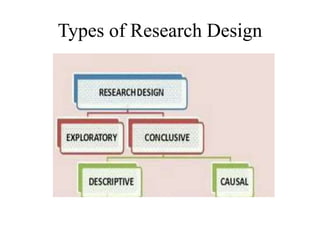
Types of Research Design
Exploratory Research
Exploratory research is often conducted
because a problem has not been clearly
defined as yet, or its real scope is as yet
unclear.
EXPLORATORY RESEARCH
DESIGN
Exploratory research design is chosen to gain
background information and to define the terms of the
research problem. This is used to clarify research
problems and hypotheses and to establish research
priorities. It helps organizations to formulate their
problems clearly.
CHARACTERISTICS OF
EXPLORATORY RESEARCH DESIGN
Sample Size : Small sample and large sample
Degree of structure : Flexible and unstructured
Cost : low cost / medium
Purpose and objective : Discovery of new ideas ,
development of hypothesis
Awareness of problem : Minimal awareness
APPLICABILITY OF
EXPLORATORY RESEARCH
DESIGN
Look at how ER is used in business.
For instance, let's say you own a bakery called
The Cupcake King. If you wanted to improve
your sales, but weren't sure where to start, you
might employ ER to find out the areas of your
business that need improvement.
APPLICABILITY OF
EXPLORATORY RESEARCH
DESIGN
• QUALITATIVE
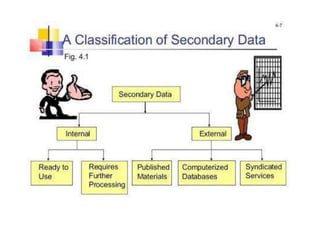
• SECONDARY
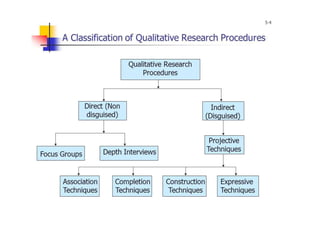
Qualitative Research
Qualitative Research is primarily exploratory
research. It is used to gain an understanding of
underlying reasons, opinions, and motivations.
It provides insights into the problem or helps to
develop ideas or hypotheses for potential
quantitative research
Methods in Context of Research
Design
• Literature Review
• Experience Survey
• Analysis of insight stimulating cases
LITERATURE REVIEW
This refers to “referring to a literature to develop a new
hypothesis”. The literature referred are – trade journals,
professional journals, market research finding
publications, statistical publications etc.
Suppose a problem is “Why are sales down?”
This can quickly be analyzed with the help of published
data which should indicate “whether the problem is an
“industry problem” or a “firm problem”.
Three possibilities exist to formulate the
hypothesis.
 The company’s market share has declined but
industry’s figures are normal.
 The industry is declining and hence the
company’s market share is also declining.
 The industry’s share is going up but the
company’s share is declining.
• If we accept the situation that our company’s
sales are down despite the market showing an
upward trend, then we need to analyse the
marketing mix variables.
EXPERIENCE SURVEY
In experience surveys, it is desirable to talk to persons
who are well informed in the area being investigated.
These people may be company executives or persons
outside the organization. Here, no questionnaire is
required.
A publisher might want to find out the reason for poor
circulation of newspaper introduced recently.
He might meet (a) Newspaper sellers (b) Public reading
room (c) General public (d) Business community; etc.
These are experienced persons whose knowledge
researcher can use.
ANALYSIS OF INSIGHT
STIMULATING CASES
In this method of Exploratory Research, some
units are analyzed; each unit is called Case.
Study of relationships between different
factors of each case is more important and not
the number.
EXPLORATORY RESEARCH DESIGN

EXPLORATORY RESEARCH DESIGN

  • 1.
    UNIVERSITY SCHOOL OF MANGEMENT TOPIC EXPLORATORYRESEARCH DESIGN SUBMITTED TO DR. NARESH (Asst. Professor) SUBMITTED BY MEGHNA GOEL 82 ANCHAL GOYAL 86
  • 2.
    CONTENT • RESEARCH DESIGN •TYPES OF RESEARCH DESIGN • EXPLORATORY RESEARCH • EXPLORATORY RESEARCH DESIGN • CHRACTERSTICS OF EXPLORATORY RESEARCH DESIGN • APPLICABILITY OF EXPLORATORY RESEARCH DESIGN • CLASSIFICATION OF EXPLORATORY RESEARCH DESIGN • METHODS IN CONTEXT OF EXPLORATORY RESEARCH DESIGN
  • 3.
    RESEARCH DESIGN A researchdesign is a framework or blueprint for conducting the marketing research project. It details the procedures necessary for obtaining the information needed to structure or solve marketing research problems. In simple words it is the general plan of how you will go about your research.
  • 4.
  • 5.
    Exploratory Research Exploratory researchis often conducted because a problem has not been clearly defined as yet, or its real scope is as yet unclear.
  • 6.
    EXPLORATORY RESEARCH DESIGN Exploratory researchdesign is chosen to gain background information and to define the terms of the research problem. This is used to clarify research problems and hypotheses and to establish research priorities. It helps organizations to formulate their problems clearly.
  • 7.
    CHARACTERISTICS OF EXPLORATORY RESEARCHDESIGN Sample Size : Small sample and large sample Degree of structure : Flexible and unstructured Cost : low cost / medium Purpose and objective : Discovery of new ideas , development of hypothesis Awareness of problem : Minimal awareness
  • 8.
    APPLICABILITY OF EXPLORATORY RESEARCH DESIGN Lookat how ER is used in business. For instance, let's say you own a bakery called The Cupcake King. If you wanted to improve your sales, but weren't sure where to start, you might employ ER to find out the areas of your business that need improvement.
  • 9.
  • 10.
    Qualitative Research Qualitative Researchis primarily exploratory research. It is used to gain an understanding of underlying reasons, opinions, and motivations. It provides insights into the problem or helps to develop ideas or hypotheses for potential quantitative research
  • 13.
    Methods in Contextof Research Design • Literature Review • Experience Survey • Analysis of insight stimulating cases
  • 14.
    LITERATURE REVIEW This refersto “referring to a literature to develop a new hypothesis”. The literature referred are – trade journals, professional journals, market research finding publications, statistical publications etc. Suppose a problem is “Why are sales down?” This can quickly be analyzed with the help of published data which should indicate “whether the problem is an “industry problem” or a “firm problem”.
  • 15.
    Three possibilities existto formulate the hypothesis.  The company’s market share has declined but industry’s figures are normal.  The industry is declining and hence the company’s market share is also declining.  The industry’s share is going up but the company’s share is declining. • If we accept the situation that our company’s sales are down despite the market showing an upward trend, then we need to analyse the marketing mix variables.
  • 16.
    EXPERIENCE SURVEY In experiencesurveys, it is desirable to talk to persons who are well informed in the area being investigated. These people may be company executives or persons outside the organization. Here, no questionnaire is required. A publisher might want to find out the reason for poor circulation of newspaper introduced recently. He might meet (a) Newspaper sellers (b) Public reading room (c) General public (d) Business community; etc. These are experienced persons whose knowledge researcher can use.
  • 17.
    ANALYSIS OF INSIGHT STIMULATINGCASES In this method of Exploratory Research, some units are analyzed; each unit is called Case. Study of relationships between different factors of each case is more important and not the number.