EXPLORATORY FACTOR ANALYSIS
Shailendra Tomar
Index
• What is Factor Analysis?
• Conducting Factor Analysis: Steps
• Formulate the problem: Case Study
• Correlation matrix
• Significance tests
• Determine the method of Factor Analysis
• Determine the number of factors
• Factor rotation methods
• Rotate the factors
• Interpret the factors
• Determine the model fit
• Run Factor Analysis using SAS 2
WHAT IS FACTOR ANALYSIS?
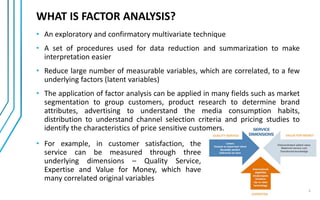
• For example, in customer satisfaction, the
service can be measured through three
underlying dimensions – Quality Service,
Expertise and Value for Money, which have
many correlated original variables
• An exploratory and confirmatory multivariate technique
• A set of procedures used for data reduction and summarization to make
interpretation easier
• Reduce large number of measurable variables, which are correlated, to a few
underlying factors (latent variables)
• The application of factor analysis can be applied in many fields such as market
segmentation to group customers, product research to determine brand
attributes, advertising to understand the media consumption habits,
distribution to understand channel selection criteria and pricing studies to
identify the characteristics of price sensitive customers.
3
CONDUCTING FACTOR ANALYSIS: STEPS
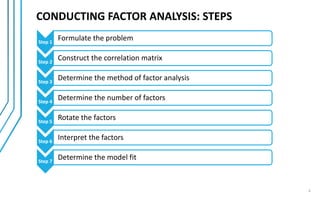
Step 1
Formulate the problem
Step 2
Construct the correlation matrix
Step 3
Determine the method of factor analysis
Step 4
Determine the number of factors
Step 5
Rotate the factors
Step 6
Interpret the factors
Step 7
Determine the model fit
4
FORMULATE THE PROBLEM: CASE STUDY
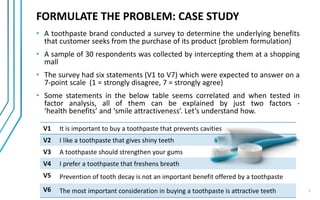
• A toothpaste brand conducted a survey to determine the underlying benefits
that customer seeks from the purchase of its product (problem formulation)
• A sample of 30 respondents was collected by intercepting them at a shopping
mall
• The survey had six statements (V1 to V7) which were expected to answer on a
7-point scale (1 = strongly disagree, 7 = strongly agree)
• Some statements in the below table seems correlated and when tested in
factor analysis, all of them can be explained by just two factors -
‘health benefits’ and ‘smile attractiveness’. Let’s understand how.
V1 It is important to buy a toothpaste that prevents cavities
V2 I like a toothpaste that gives shiny teeth
V3 A toothpaste should strengthen your gums
V4 I prefer a toothpaste that freshens breath
V5 Prevention of tooth decay is not an important benefit offered by a toothpaste
V6 The most important consideration in buying a toothpaste is attractive teeth 5
Correlation Matrix
Correlations
V1 V2 V3 V4 V5 V6
V1 1 -0.05322 0.87309 -0.08616 -0.85764 0.00417
V2 -0.05322 1 -0.15502 0.57221 0.01975 0.64046
V3 0.87309 -0.15502 1 -0.24779 -0.77785 -0.01807
V4 -0.08616 0.57221 -0.24779 1 -0.00658 0.64046
V5 -0.85764 0.01975 -0.77785 -0.00658 1 -0.1364
V6 0.00417 0.64046 -0.01807 0.64046 -0.1364 1
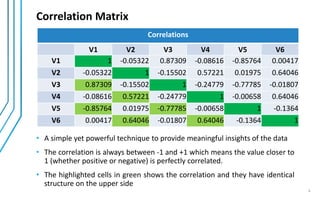
• A simple yet powerful technique to provide meaningful insights of the data
• The correlation is always between -1 and +1 which means the value closer to
1 (whether positive or negative) is perfectly correlated.
• The highlighted cells in green shows the correlation and they have identical
structure on the upper side
6
Significance tests
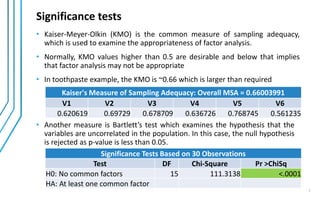
• Another measure is Bartlett’s test which examines the hypothesis that the
variables are uncorrelated in the population. In this case, the null hypothesis
is rejected as p-value is less than 0.05.
• Kaiser-Meyer-Olkin (KMO) is the common measure of sampling adequacy,
which is used to examine the appropriateness of factor analysis.
• Normally, KMO values higher than 0.5 are desirable and below that implies
that factor analysis may not be appropriate
• In toothpaste example, the KMO is ~0.66 which is larger than required
Kaiser's Measure of Sampling Adequacy: Overall MSA = 0.66003991
V1 V2 V3 V4 V5 V6
0.620619 0.69729 0.678709 0.636726 0.768745 0.561235
Significance Tests Based on 30 Observations
Test DF Chi-Square Pr >ChiSq
H0: No common factors 15 111.3138 <.0001
HA: At least one common factor
7
DETERMINE THE METHOD OF FACTOR ANALYSIS
• After selecting the variables for the analysis, the right method of factor
analysis should be chosen
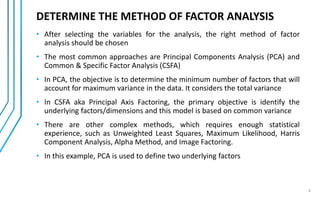
• The most common approaches are Principal Components Analysis (PCA) and
Common & Specific Factor Analysis (CSFA)
• In PCA, the objective is to determine the minimum number of factors that will
account for maximum variance in the data. It considers the total variance
• In CSFA aka Principal Axis Factoring, the primary objective is identify the
underlying factors/dimensions and this model is based on common variance
• There are other complex methods, which requires enough statistical
experience, such as Unweighted Least Squares, Maximum Likelihood, Harris
Component Analysis, Alpha Method, and Image Factoring.
• In this example, PCA is used to define two underlying factors
8
DETERMINE THE NUMBER OF FACTORS
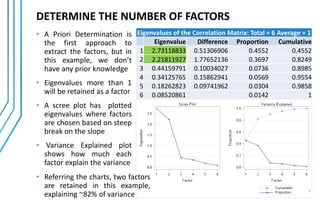
• A Priori Determination is
the first approach to
extract the factors, but in
this example, we don’t
have any prior knowledge
• Eigenvalues more than 1
will be retained as a factor
• A scree plot has plotted
eigenvalues where factors
are chosen based on steep
break on the slope
• Variance Explained plot
shows how much each
factor explain the variance
Eigenvalues of the Correlation Matrix: Total = 6 Average = 1
Eigenvalue Difference Proportion Cumulative
1 2.73118833 0.51306906 0.4552 0.4552
2 2.21811927 1.77652136 0.3697 0.8249
3 0.44159791 0.10034027 0.0736 0.8985
4 0.34125765 0.15862941 0.0569 0.9554
5 0.18262823 0.09741962 0.0304 0.9858
6 0.08520861 0.0142 1
• Referring the charts, two factors
are retained in this example,
explaining ~82% of variance
9
FACTOR ROTATION METHODS
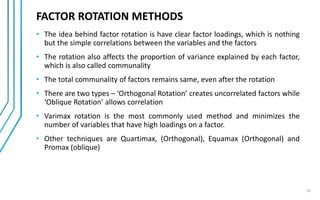
• The idea behind factor rotation is have clear factor loadings, which is nothing
but the simple correlations between the variables and the factors
• The rotation also affects the proportion of variance explained by each factor,
which is also called communality
• The total communality of factors remains same, even after the rotation
• There are two types – ‘Orthogonal Rotation’ creates uncorrelated factors while
‘Oblique Rotation’ allows correlation
• Varimax rotation is the most commonly used method and minimizes the
number of variables that have high loadings on a factor.
• Other techniques are Quartimax, (Orthogonal), Equamax (Orthogonal) and
Promax (oblique)
10
ROTATE THE FACTORS
Factor Pattern Rotated Factor Pattern
Factor1 Factor2 Factor1* Factor2*
V1 0.92834 0.25323 V1 0.96189 -0.02663
V2 -0.30053 0.79525 V2 -0.05721 0.84821
V3 0.93618 0.13089 V3 0.93394 -0.14599
V4 -0.34158 0.78897 V4 -0.09832 0.8541
V5 -0.86876 -0.35079 V5 -0.93313 -0.08401
V6 -0.17664 0.87116 V6 0.08337 0.88497
Variance explained Variance explained
Factor1 Factor2 Factor1* Factor2*
2.731188 2.21812 2.6881106 2.261197
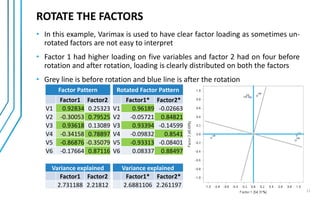
• In this example, Varimax is used to have clear factor loading as sometimes un-
rotated factors are not easy to interpret
• Factor 1 had higher loading on five variables and factor 2 had on four before
rotation and after rotation, loading is clearly distributed on both the factors
• Grey line is before rotation and blue line is after the rotation
11
INTERPRET THE FACTORS
• Factors are interpreted based on the correlation between variables and the
associated factors
• Factor pattern plot also explain how variables are correlated with factors.
• Variables, which are at the end of an axis, have higher loadings while near the
origin represent small loading
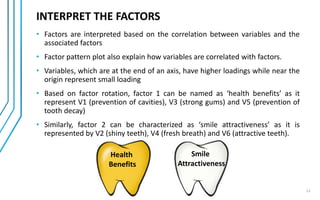
• Based on factor rotation, factor 1 can be named as ‘health benefits’ as it
represent V1 (prevention of cavities), V3 (strong gums) and V5 (prevention of
tooth decay)
• Similarly, factor 2 can be characterized as ‘smile attractiveness’ as it is
represented by V2 (shiny teeth), V4 (fresh breath) and V6 (attractive teeth).
Health
Benefits
Smile
Attractiveness
12
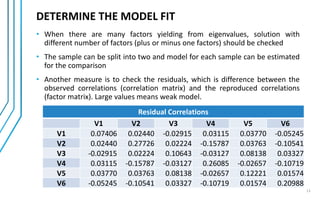
DETERMINE THE MODEL FIT
• When there are many factors yielding from eigenvalues, solution with
different number of factors (plus or minus one factors) should be checked
• The sample can be split into two and model for each sample can be estimated
for the comparison
• Another measure is to check the residuals, which is difference between the
observed correlations (correlation matrix) and the reproduced correlations
(factor matrix). Large values means weak model.
Residual Correlations
V1 V2 V3 V4 V5 V6
V1 0.07406 0.02440 -0.02915 0.03115 0.03770 -0.05245
V2 0.02440 0.27726 0.02224 -0.15787 0.03763 -0.10541
V3 -0.02915 0.02224 0.10643 -0.03127 0.08138 0.03327
V4 0.03115 -0.15787 -0.03127 0.26085 -0.02657 -0.10719
V5 0.03770 0.03763 0.08138 -0.02657 0.12221 0.01574
V6 -0.05245 -0.10541 0.03327 -0.10719 0.01574 0.20988
13
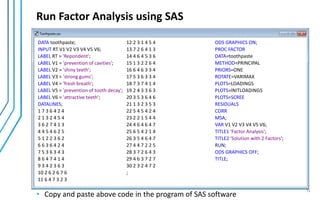
Run Factor Analysis using SAS
DATA toothpaste;
INPUT RT V1 V2 V3 V4 V5 V6;
LABEL RT = 'Repondent';
LABEL V1 = 'prevention of cavities';
LABEL V2 = 'shiny teeth';
LABEL V3 = 'strong gums';
LABEL V4 = 'fresh breath';
LABEL V5 = 'prevention of tooth decay';
LABEL V6 = 'attractive teeth';
DATALINES;
1 7 3 6 4 2 4
2 1 3 2 4 5 4
3 6 2 7 4 1 3
4 4 5 4 6 2 5
5 1 2 2 3 6 2
6 6 3 6 4 2 4
7 5 3 6 3 4 3
8 6 4 7 4 1 4
9 3 4 2 3 6 3
10 2 6 2 6 7 6
11 6 4 7 3 2 3
12 2 3 1 4 5 4
13 7 2 6 4 1 3
14 4 6 4 5 3 6
15 1 3 2 2 6 4
16 6 4 6 3 3 4
17 5 3 6 3 3 4
18 7 3 7 4 1 4
19 2 4 3 3 6 3
20 3 5 3 6 4 6
21 1 3 2 3 5 3
22 5 4 5 4 2 4
23 2 2 1 5 4 4
24 4 6 4 6 4 7
25 6 5 4 2 1 4
26 3 5 4 6 4 7
27 4 4 7 2 2 5
28 3 7 2 6 4 3
29 4 6 3 7 2 7
30 2 3 2 4 7 2
;
ODS GRAPHICS ON;
PROC FACTOR
DATA=toothpaste
METHOD=PRINCIPAL
PRIORS=ONE
ROTATE=VARIMAX
PLOTS=LOADINGS
PLOTS=INITLOADINGS
PLOTS=SCREE
RESIDUALS
CORR
MSA;
VAR V1 V2 V3 V4 V5 V6;
TITLE1 'Factor Analysis';
TITLE2 'Solution with 2 Factors';
RUN;
ODS GRAPHICS OFF;
TITLE;
• Copy and paste above code in the program of SAS software
14
Thank You

Exploratory Factor Analysis

  • 1.
  • 2.
    Index • What isFactor Analysis? • Conducting Factor Analysis: Steps • Formulate the problem: Case Study • Correlation matrix • Significance tests • Determine the method of Factor Analysis • Determine the number of factors • Factor rotation methods • Rotate the factors • Interpret the factors • Determine the model fit • Run Factor Analysis using SAS 2
  • 3.
    WHAT IS FACTORANALYSIS? • For example, in customer satisfaction, the service can be measured through three underlying dimensions – Quality Service, Expertise and Value for Money, which have many correlated original variables • An exploratory and confirmatory multivariate technique • A set of procedures used for data reduction and summarization to make interpretation easier • Reduce large number of measurable variables, which are correlated, to a few underlying factors (latent variables) • The application of factor analysis can be applied in many fields such as market segmentation to group customers, product research to determine brand attributes, advertising to understand the media consumption habits, distribution to understand channel selection criteria and pricing studies to identify the characteristics of price sensitive customers. 3
  • 4.
    CONDUCTING FACTOR ANALYSIS:STEPS Step 1 Formulate the problem Step 2 Construct the correlation matrix Step 3 Determine the method of factor analysis Step 4 Determine the number of factors Step 5 Rotate the factors Step 6 Interpret the factors Step 7 Determine the model fit 4
  • 5.
    FORMULATE THE PROBLEM:CASE STUDY • A toothpaste brand conducted a survey to determine the underlying benefits that customer seeks from the purchase of its product (problem formulation) • A sample of 30 respondents was collected by intercepting them at a shopping mall • The survey had six statements (V1 to V7) which were expected to answer on a 7-point scale (1 = strongly disagree, 7 = strongly agree) • Some statements in the below table seems correlated and when tested in factor analysis, all of them can be explained by just two factors - ‘health benefits’ and ‘smile attractiveness’. Let’s understand how. V1 It is important to buy a toothpaste that prevents cavities V2 I like a toothpaste that gives shiny teeth V3 A toothpaste should strengthen your gums V4 I prefer a toothpaste that freshens breath V5 Prevention of tooth decay is not an important benefit offered by a toothpaste V6 The most important consideration in buying a toothpaste is attractive teeth 5
  • 6.
    Correlation Matrix Correlations V1 V2V3 V4 V5 V6 V1 1 -0.05322 0.87309 -0.08616 -0.85764 0.00417 V2 -0.05322 1 -0.15502 0.57221 0.01975 0.64046 V3 0.87309 -0.15502 1 -0.24779 -0.77785 -0.01807 V4 -0.08616 0.57221 -0.24779 1 -0.00658 0.64046 V5 -0.85764 0.01975 -0.77785 -0.00658 1 -0.1364 V6 0.00417 0.64046 -0.01807 0.64046 -0.1364 1 • A simple yet powerful technique to provide meaningful insights of the data • The correlation is always between -1 and +1 which means the value closer to 1 (whether positive or negative) is perfectly correlated. • The highlighted cells in green shows the correlation and they have identical structure on the upper side 6
  • 7.
    Significance tests • Anothermeasure is Bartlett’s test which examines the hypothesis that the variables are uncorrelated in the population. In this case, the null hypothesis is rejected as p-value is less than 0.05. • Kaiser-Meyer-Olkin (KMO) is the common measure of sampling adequacy, which is used to examine the appropriateness of factor analysis. • Normally, KMO values higher than 0.5 are desirable and below that implies that factor analysis may not be appropriate • In toothpaste example, the KMO is ~0.66 which is larger than required Kaiser's Measure of Sampling Adequacy: Overall MSA = 0.66003991 V1 V2 V3 V4 V5 V6 0.620619 0.69729 0.678709 0.636726 0.768745 0.561235 Significance Tests Based on 30 Observations Test DF Chi-Square Pr >ChiSq H0: No common factors 15 111.3138 <.0001 HA: At least one common factor 7
  • 8.
    DETERMINE THE METHODOF FACTOR ANALYSIS • After selecting the variables for the analysis, the right method of factor analysis should be chosen • The most common approaches are Principal Components Analysis (PCA) and Common & Specific Factor Analysis (CSFA) • In PCA, the objective is to determine the minimum number of factors that will account for maximum variance in the data. It considers the total variance • In CSFA aka Principal Axis Factoring, the primary objective is identify the underlying factors/dimensions and this model is based on common variance • There are other complex methods, which requires enough statistical experience, such as Unweighted Least Squares, Maximum Likelihood, Harris Component Analysis, Alpha Method, and Image Factoring. • In this example, PCA is used to define two underlying factors 8
  • 9.
    DETERMINE THE NUMBEROF FACTORS • A Priori Determination is the first approach to extract the factors, but in this example, we don’t have any prior knowledge • Eigenvalues more than 1 will be retained as a factor • A scree plot has plotted eigenvalues where factors are chosen based on steep break on the slope • Variance Explained plot shows how much each factor explain the variance Eigenvalues of the Correlation Matrix: Total = 6 Average = 1 Eigenvalue Difference Proportion Cumulative 1 2.73118833 0.51306906 0.4552 0.4552 2 2.21811927 1.77652136 0.3697 0.8249 3 0.44159791 0.10034027 0.0736 0.8985 4 0.34125765 0.15862941 0.0569 0.9554 5 0.18262823 0.09741962 0.0304 0.9858 6 0.08520861 0.0142 1 • Referring the charts, two factors are retained in this example, explaining ~82% of variance 9
  • 10.
    FACTOR ROTATION METHODS •The idea behind factor rotation is have clear factor loadings, which is nothing but the simple correlations between the variables and the factors • The rotation also affects the proportion of variance explained by each factor, which is also called communality • The total communality of factors remains same, even after the rotation • There are two types – ‘Orthogonal Rotation’ creates uncorrelated factors while ‘Oblique Rotation’ allows correlation • Varimax rotation is the most commonly used method and minimizes the number of variables that have high loadings on a factor. • Other techniques are Quartimax, (Orthogonal), Equamax (Orthogonal) and Promax (oblique) 10
  • 11.
    ROTATE THE FACTORS FactorPattern Rotated Factor Pattern Factor1 Factor2 Factor1* Factor2* V1 0.92834 0.25323 V1 0.96189 -0.02663 V2 -0.30053 0.79525 V2 -0.05721 0.84821 V3 0.93618 0.13089 V3 0.93394 -0.14599 V4 -0.34158 0.78897 V4 -0.09832 0.8541 V5 -0.86876 -0.35079 V5 -0.93313 -0.08401 V6 -0.17664 0.87116 V6 0.08337 0.88497 Variance explained Variance explained Factor1 Factor2 Factor1* Factor2* 2.731188 2.21812 2.6881106 2.261197 • In this example, Varimax is used to have clear factor loading as sometimes un- rotated factors are not easy to interpret • Factor 1 had higher loading on five variables and factor 2 had on four before rotation and after rotation, loading is clearly distributed on both the factors • Grey line is before rotation and blue line is after the rotation 11
  • 12.
    INTERPRET THE FACTORS •Factors are interpreted based on the correlation between variables and the associated factors • Factor pattern plot also explain how variables are correlated with factors. • Variables, which are at the end of an axis, have higher loadings while near the origin represent small loading • Based on factor rotation, factor 1 can be named as ‘health benefits’ as it represent V1 (prevention of cavities), V3 (strong gums) and V5 (prevention of tooth decay) • Similarly, factor 2 can be characterized as ‘smile attractiveness’ as it is represented by V2 (shiny teeth), V4 (fresh breath) and V6 (attractive teeth). Health Benefits Smile Attractiveness 12
  • 13.
    DETERMINE THE MODELFIT • When there are many factors yielding from eigenvalues, solution with different number of factors (plus or minus one factors) should be checked • The sample can be split into two and model for each sample can be estimated for the comparison • Another measure is to check the residuals, which is difference between the observed correlations (correlation matrix) and the reproduced correlations (factor matrix). Large values means weak model. Residual Correlations V1 V2 V3 V4 V5 V6 V1 0.07406 0.02440 -0.02915 0.03115 0.03770 -0.05245 V2 0.02440 0.27726 0.02224 -0.15787 0.03763 -0.10541 V3 -0.02915 0.02224 0.10643 -0.03127 0.08138 0.03327 V4 0.03115 -0.15787 -0.03127 0.26085 -0.02657 -0.10719 V5 0.03770 0.03763 0.08138 -0.02657 0.12221 0.01574 V6 -0.05245 -0.10541 0.03327 -0.10719 0.01574 0.20988 13
  • 14.
    Run Factor Analysisusing SAS DATA toothpaste; INPUT RT V1 V2 V3 V4 V5 V6; LABEL RT = 'Repondent'; LABEL V1 = 'prevention of cavities'; LABEL V2 = 'shiny teeth'; LABEL V3 = 'strong gums'; LABEL V4 = 'fresh breath'; LABEL V5 = 'prevention of tooth decay'; LABEL V6 = 'attractive teeth'; DATALINES; 1 7 3 6 4 2 4 2 1 3 2 4 5 4 3 6 2 7 4 1 3 4 4 5 4 6 2 5 5 1 2 2 3 6 2 6 6 3 6 4 2 4 7 5 3 6 3 4 3 8 6 4 7 4 1 4 9 3 4 2 3 6 3 10 2 6 2 6 7 6 11 6 4 7 3 2 3 12 2 3 1 4 5 4 13 7 2 6 4 1 3 14 4 6 4 5 3 6 15 1 3 2 2 6 4 16 6 4 6 3 3 4 17 5 3 6 3 3 4 18 7 3 7 4 1 4 19 2 4 3 3 6 3 20 3 5 3 6 4 6 21 1 3 2 3 5 3 22 5 4 5 4 2 4 23 2 2 1 5 4 4 24 4 6 4 6 4 7 25 6 5 4 2 1 4 26 3 5 4 6 4 7 27 4 4 7 2 2 5 28 3 7 2 6 4 3 29 4 6 3 7 2 7 30 2 3 2 4 7 2 ; ODS GRAPHICS ON; PROC FACTOR DATA=toothpaste METHOD=PRINCIPAL PRIORS=ONE ROTATE=VARIMAX PLOTS=LOADINGS PLOTS=INITLOADINGS PLOTS=SCREE RESIDUALS CORR MSA; VAR V1 V2 V3 V4 V5 V6; TITLE1 'Factor Analysis'; TITLE2 'Solution with 2 Factors'; RUN; ODS GRAPHICS OFF; TITLE; • Copy and paste above code in the program of SAS software 14
  • 15.