Exploded Views   In order to construct an object, you have to know how many pieces make up the object and how these pieces fit together. An  exploded view  provides you with this information.  Unit 2 – Design & Measurement
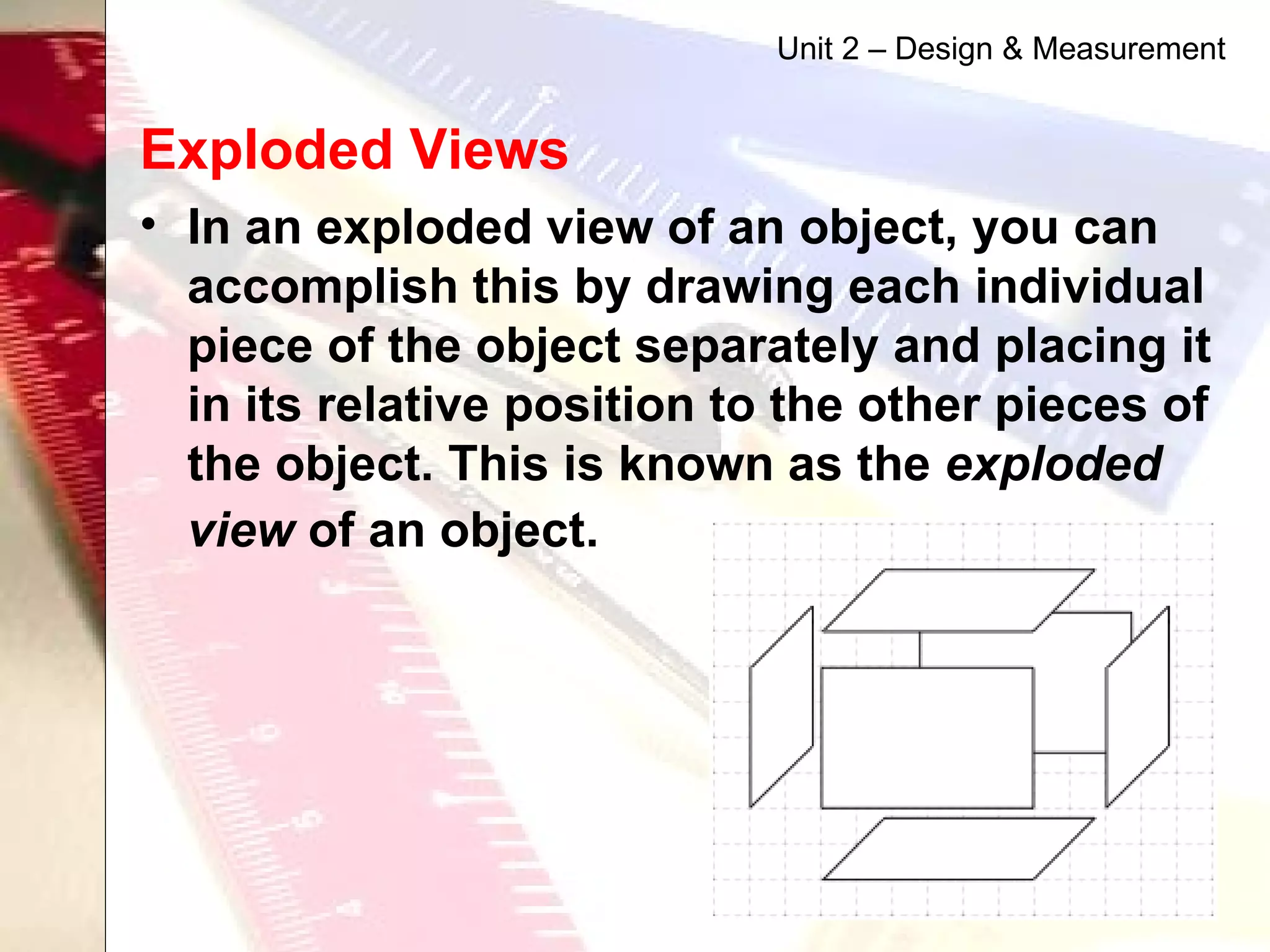
Exploded Views   In an exploded view of an object, you can accomplish this by drawing each individual piece of the object separately and placing it in its relative position to the other pieces of the object. This is known as the  exploded view  of an object.   Unit 2 – Design & Measurement
Exploded Views   In order to familiarize you with exploded views, in the first two examples of this lesson, you are given exploded views and asked to draw oblique (3 D drawings) projections.  In the last two examples of this lesson, you are given oblique projections and asked to draw exploded views.  Unit 2 – Design & Measurement
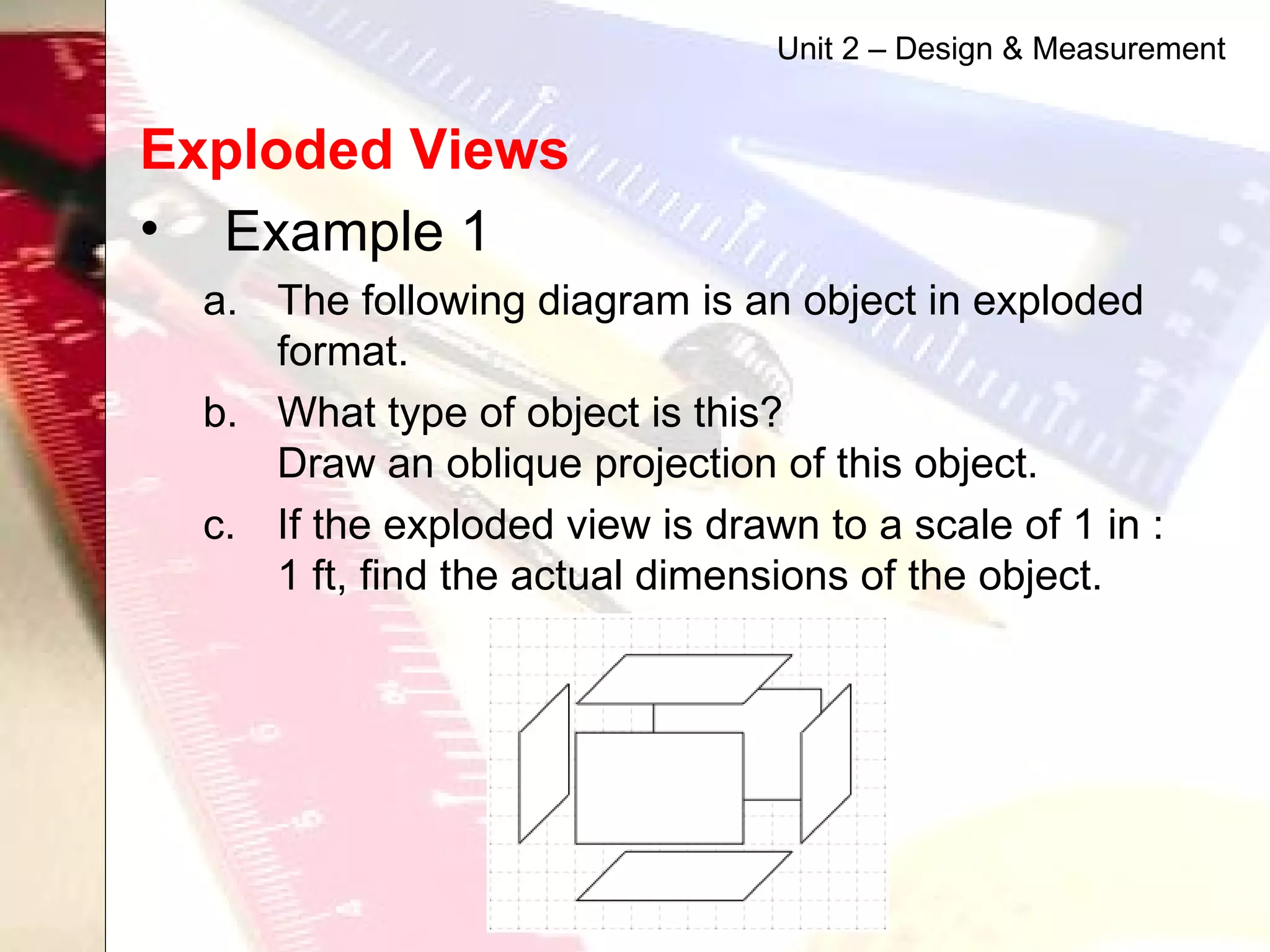
Exploded Views   Example 1 The following diagram is an object in exploded format.  What type of object is this?  Draw an oblique projection of this object. If the exploded view is drawn to a scale of 1 in : 1 ft, find the actual dimensions of the object.  Unit 2 – Design & Measurement
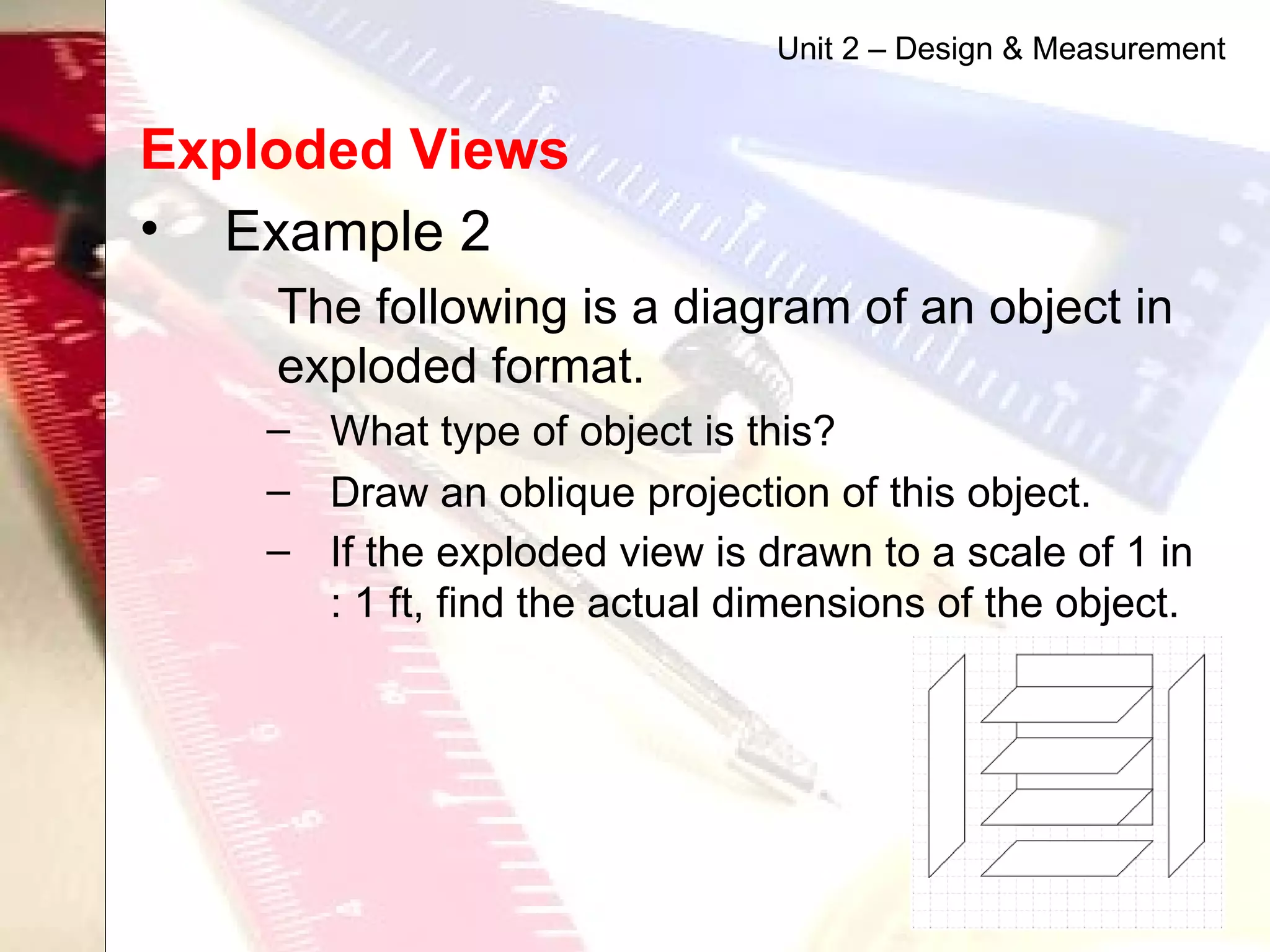
Exploded Views   Example 2 The following is a diagram of an object in exploded format.  What type of object is this? Draw an oblique projection of this object. If the exploded view is drawn to a scale of 1 in : 1 ft, find the actual dimensions of the object.   Unit 2 – Design & Measurement
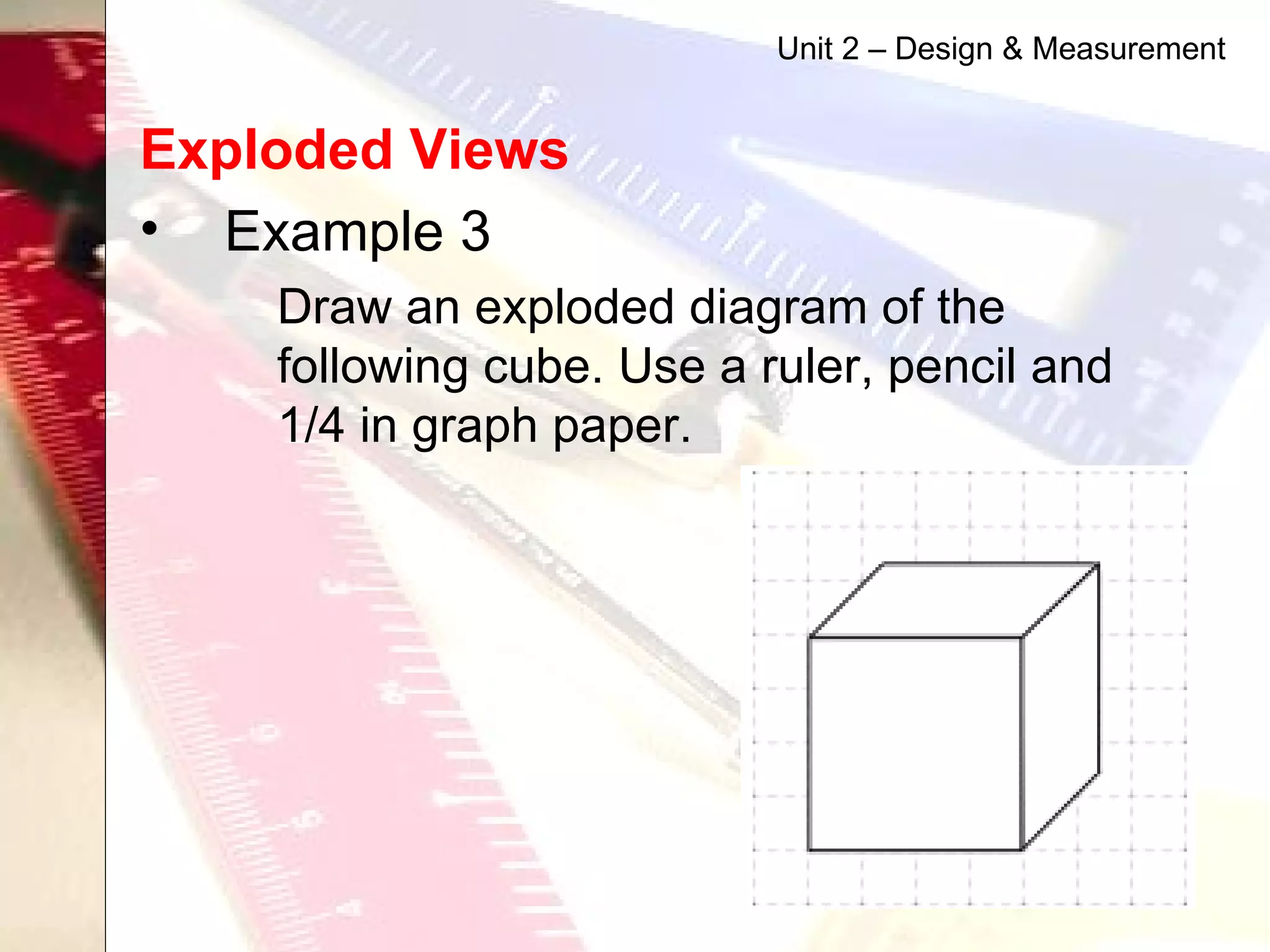
Exploded Views   Example 3 Draw an exploded diagram of the following cube. Use a ruler, pencil and 1/4 in graph paper.  Unit 2 – Design & Measurement
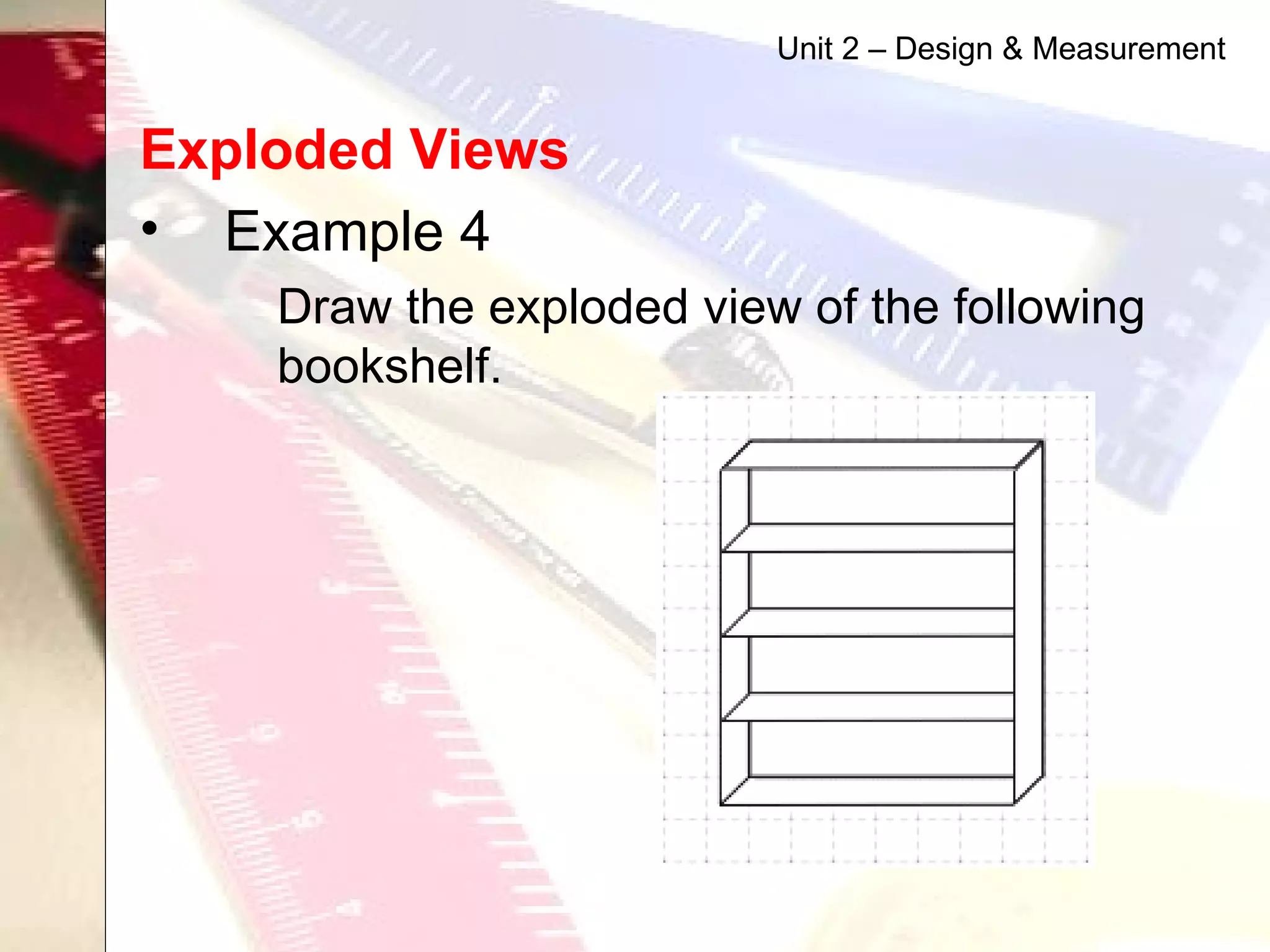
Exploded Views   Example 4 Draw the exploded view of the following bookshelf.  Unit 2 – Design & Measurement
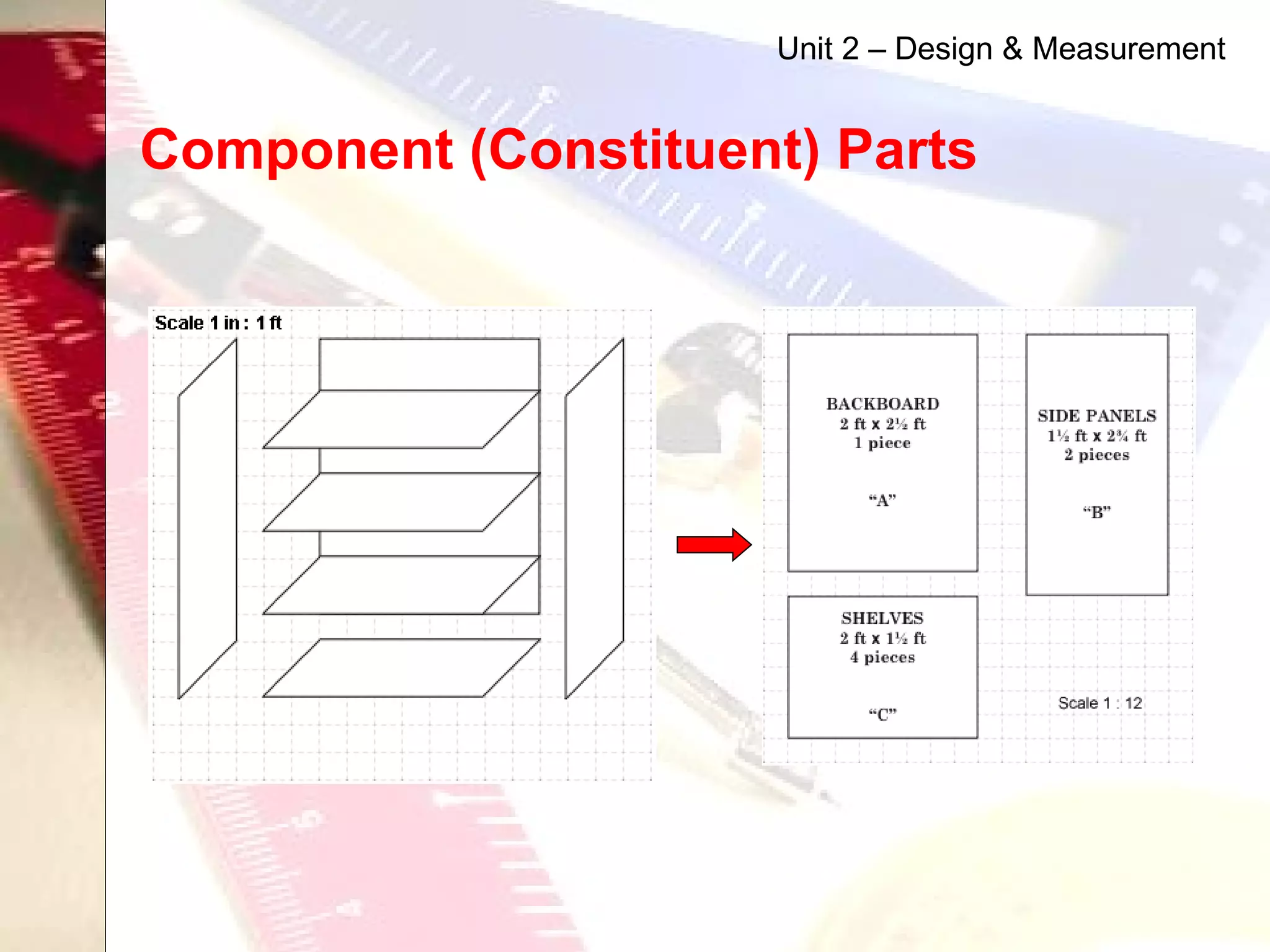
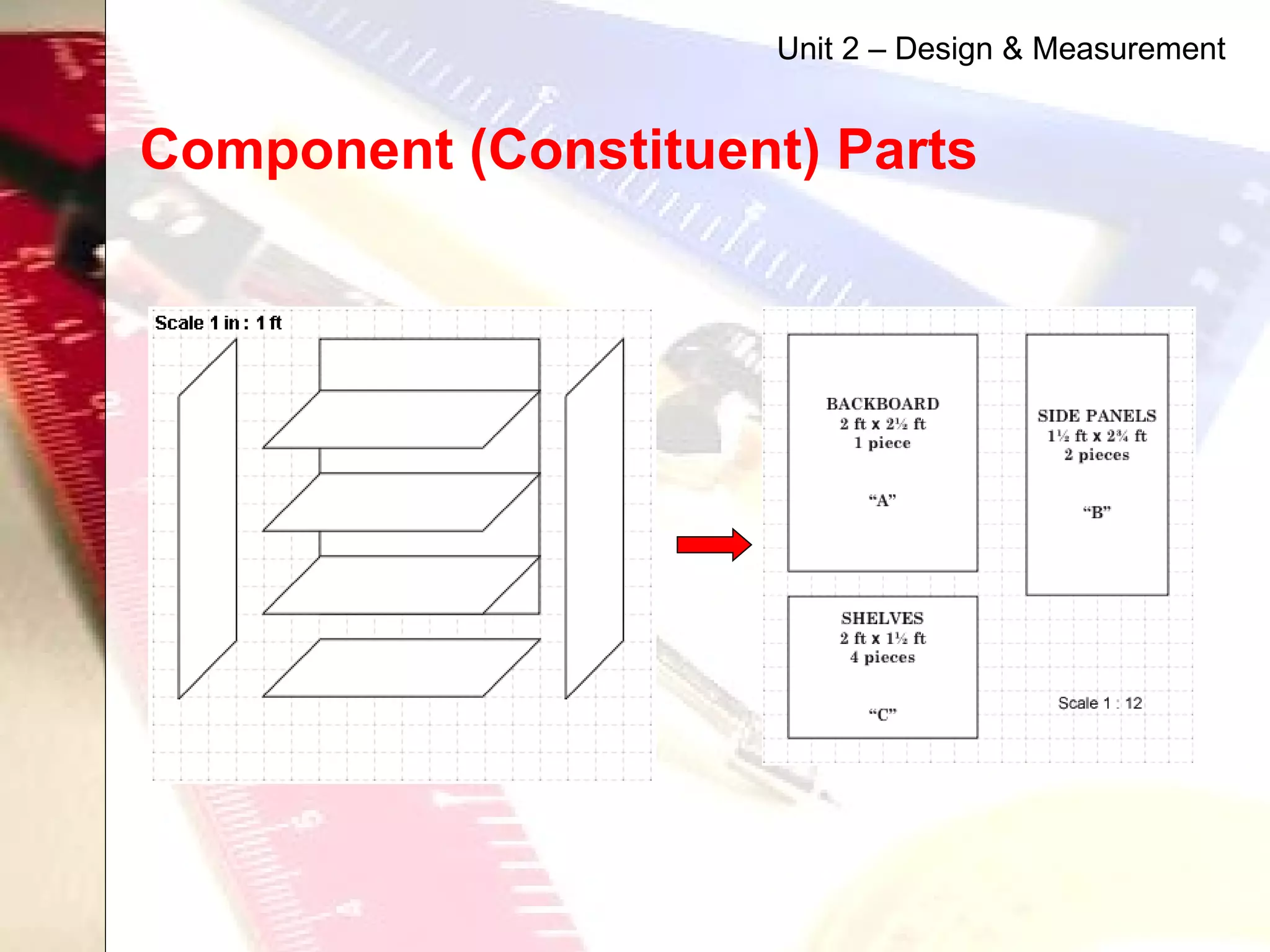
Component (Constituent) Parts   Similar to the exploded representation of an object, a constituent parts representation identifies the individual pieces of an object. However, unlike the exploded representation of an object, a constituent parts representation sketches the individual pieces in two dimensions.  In a constituent parts diagram, pieces with the same dimensions are only drawn once.  Unit 2 – Design & Measurement
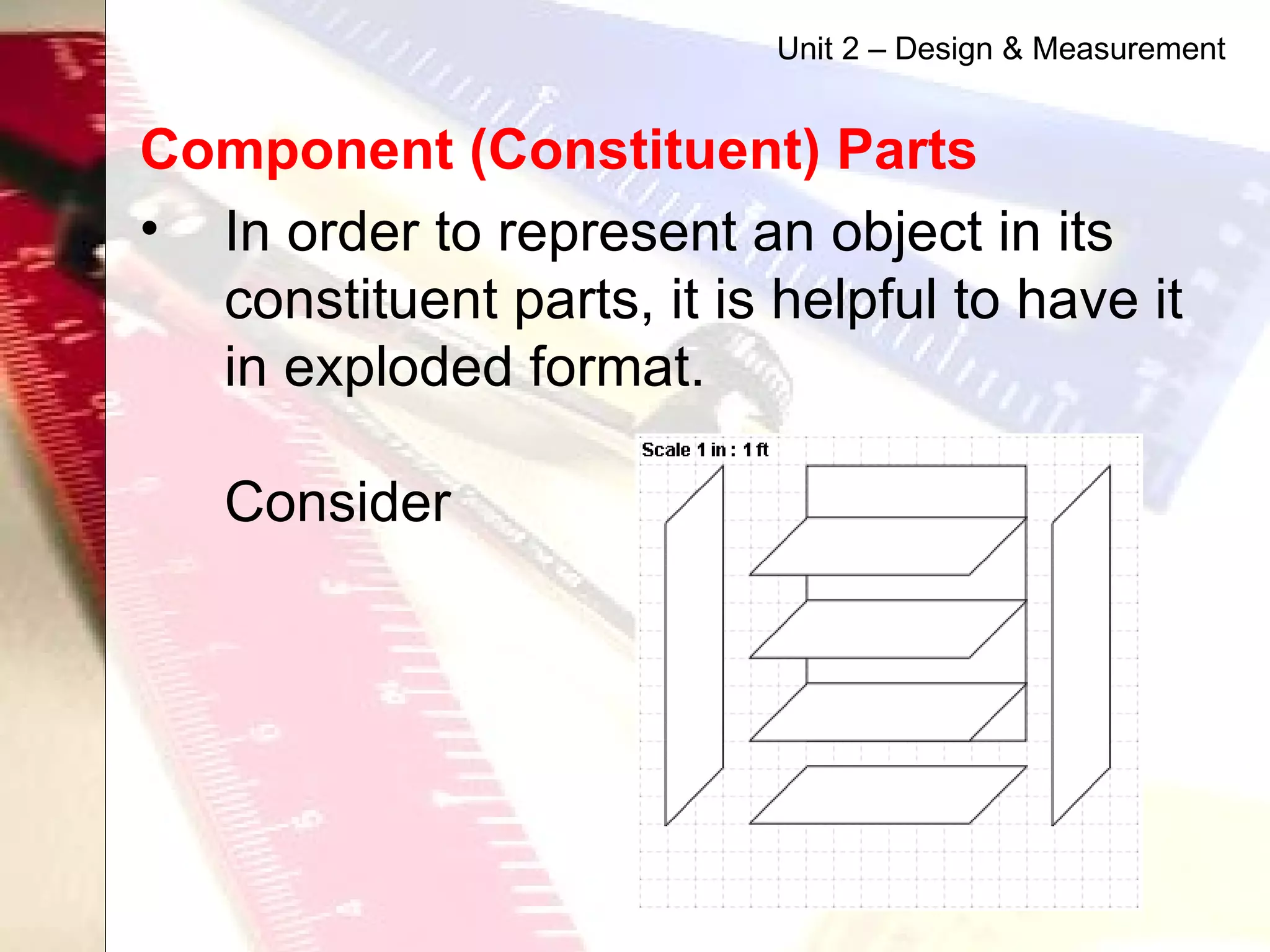
Component (Constituent) Parts   In order to represent an object in its constituent parts, it is helpful to have it in exploded format.  Consider  Unit 2 – Design & Measurement
Component (Constituent) Parts   Unit 2 – Design & Measurement
Notebook Assignments Page 86 – Q. 1 – 4 Unit 2 – Design & Measurement

Exploded Views

  • 1.
    Exploded Views In order to construct an object, you have to know how many pieces make up the object and how these pieces fit together. An exploded view provides you with this information. Unit 2 – Design & Measurement
  • 2.
    Exploded Views In an exploded view of an object, you can accomplish this by drawing each individual piece of the object separately and placing it in its relative position to the other pieces of the object. This is known as the exploded view of an object. Unit 2 – Design & Measurement
  • 3.
    Exploded Views In order to familiarize you with exploded views, in the first two examples of this lesson, you are given exploded views and asked to draw oblique (3 D drawings) projections. In the last two examples of this lesson, you are given oblique projections and asked to draw exploded views. Unit 2 – Design & Measurement
  • 4.
    Exploded Views Example 1 The following diagram is an object in exploded format. What type of object is this? Draw an oblique projection of this object. If the exploded view is drawn to a scale of 1 in : 1 ft, find the actual dimensions of the object. Unit 2 – Design & Measurement
  • 5.
    Exploded Views Example 2 The following is a diagram of an object in exploded format. What type of object is this? Draw an oblique projection of this object. If the exploded view is drawn to a scale of 1 in : 1 ft, find the actual dimensions of the object. Unit 2 – Design & Measurement
  • 6.
    Exploded Views Example 3 Draw an exploded diagram of the following cube. Use a ruler, pencil and 1/4 in graph paper. Unit 2 – Design & Measurement
  • 7.
    Exploded Views Example 4 Draw the exploded view of the following bookshelf. Unit 2 – Design & Measurement
  • 8.
    Component (Constituent) Parts Similar to the exploded representation of an object, a constituent parts representation identifies the individual pieces of an object. However, unlike the exploded representation of an object, a constituent parts representation sketches the individual pieces in two dimensions. In a constituent parts diagram, pieces with the same dimensions are only drawn once. Unit 2 – Design & Measurement
  • 9.
    Component (Constituent) Parts In order to represent an object in its constituent parts, it is helpful to have it in exploded format. Consider Unit 2 – Design & Measurement
  • 10.
    Component (Constituent) Parts Unit 2 – Design & Measurement
  • 11.
    Component (Constituent) Parts Unit 2 – Design & Measurement
  • 12.
    Notebook Assignments Page86 – Q. 1 – 4 Unit 2 – Design & Measurement