Enables the researcher to go beyond description and
prediction, beyond identifying relationships. It helps
to determine what is the cause and what is the effect
.
EXPERIMENTAL METHOD
•It is the most scientifically sophisticated research method.
•It is defined as observation under controlled conditions.
•It studies the observable changes that take place to establish cause
and effect relationship.
It describes and analyses
•What will be?
•What can occur?
•What can be made to occur? under carefully controlled conditions.
Bases of Experimental Method
Law of single variable
If two situations are similar in every respect,
one element is added or subtracted any
difference that develops is the result of the
operation of that element added or subtracted.
Variables
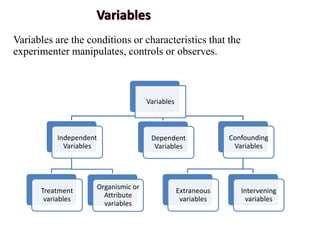
Variables are the conditions or characteristics that the
experimenter manipulates, controls or observes.
Variables
Independent
Variables
Treatment
variables
Organismic or
Attribute
variables
Dependent
Variables
Confounding
Variables
Extraneous
variables
Intervening
variables
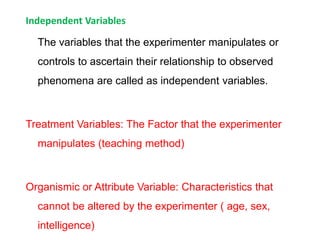
Independent Variables
The variables that the experimenter manipulates or
controls to ascertain their relationship to observed
phenomena are called as independent variables.
Treatment Variables: The Factor that the experimenter
manipulates (teaching method)
Organismic or Attribute Variable: Characteristics that
cannot be altered by the experimenter ( age, sex,
intelligence)
Dependant Variables
The conditions or characteristics that appear,
disappear or change as the experimenter introduces,
removes or changes the independent variable.
Intervening variables
– Certain variables that cannot be controlled or measured directly
may have an important effect on the outcome and intervene
between the cause and effect. (Eg. anxiety, fatigue, motivation)
Extraneous variables
– Those uncontrolled variables that may have significant influence
on the results of the study. (Eg. teacher enthusiasm, age, socio
economic status)
Confounding Variables
• Factors that might influence the dependent variable (outcome
measure) and whose effect may be confused with the effects of
the independent variable are called as confounding variable.
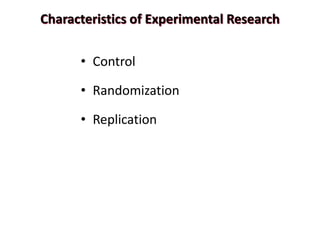
Characteristics of Experimental Research
• Control
• Randomization
• Replication
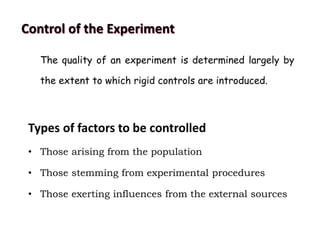
Control of the Experiment
The quality of an experiment is determined largely by
the extent to which rigid controls are introduced.
Types of factors to be controlled
• Those arising from the population
• Those stemming from experimental procedures
• Those exerting influences from the external sources
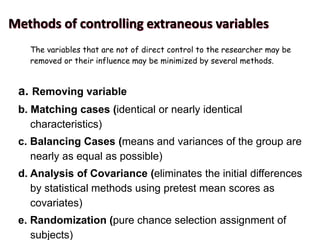
Methods of controlling extraneous variables
The variables that are not of direct control to the researcher may be
removed or their influence may be minimized by several methods.
a. Removing variable
b. Matching cases (identical or nearly identical
characteristics)
c. Balancing Cases (means and variances of the group are
nearly as equal as possible)
d. Analysis of Covariance (eliminates the initial differences
by statistical methods using pretest mean scores as
covariates)
e. Randomization (pure chance selection assignment of
subjects)
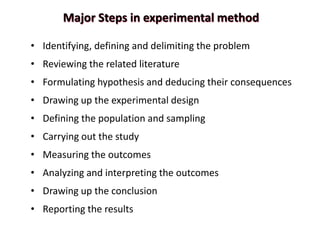
Major Steps in experimental method
• Identifying, defining and delimiting the problem
• Reviewing the related literature
• Formulating hypothesis and deducing their consequences
• Drawing up the experimental design
• Defining the population and sampling
• Carrying out the study
• Measuring the outcomes
• Analyzing and interpreting the outcomes
• Drawing up the conclusion
• Reporting the results
Validity of Research process
Any experiment should be valid. There are two types
of experimental validity.
•Internal Validity
•External Validity
• Internal Validity - It is concerned with the true variance in the dependent
variable that has been brought about by the induced variations in the
independent variable.
Factors affecting internal validity
Maturation - spontaneous growth and development of the individuals.
History - external event that occurs in the course of the experiment.
Testing - familiarity or experience with the test affects the outcome.
Measurement Error - unreliable and inapt handling of measuring instruments.
Statistical Regression - extreme cases in the pre-test to move towards the mean in
the post-test due to statistical regression affect the outcome.
Selection Bias - the control and experimental groups are not made equivalent.
Experimental Mortality - loss of subjects during the experimental period.
Interaction Effects - Some of the above mentioned factors interact together and
affect the results of the study.
• External Validity - is concerned with the
generalizability of the outcomes (findings) of the
experiment.
Factors affecting external validity
• Prior treatment: effects of a previous experiment will often
be carried over to the next experiment.
• Artificiality of Experimental setting
IMPORTANCE OF EXPERIMENTAL METHOD
• Most satisfactory means for obtaining reliable
knowledge.
• Cause and effect relationship are analyzed with greater
speed and certainty.
• Serves as the basis for scientific generalization and
prediction.
LIMITATIONS OF EXPERIMENTAL METHOD
• Control of factors affecting dependent variable is not
quite possible in social sciences.
• Identifying and measuring the factors affecting
dependent variable is a tedious task.
• Therefore results of experimental method in social
science is not that much reliable as in pure sciences

Experimental method

  • 1.
    Enables the researcherto go beyond description and prediction, beyond identifying relationships. It helps to determine what is the cause and what is the effect .
  • 2.
    EXPERIMENTAL METHOD •It isthe most scientifically sophisticated research method. •It is defined as observation under controlled conditions. •It studies the observable changes that take place to establish cause and effect relationship. It describes and analyses •What will be? •What can occur? •What can be made to occur? under carefully controlled conditions.
  • 3.
    Bases of ExperimentalMethod Law of single variable If two situations are similar in every respect, one element is added or subtracted any difference that develops is the result of the operation of that element added or subtracted.
  • 4.
    Variables Variables are theconditions or characteristics that the experimenter manipulates, controls or observes. Variables Independent Variables Treatment variables Organismic or Attribute variables Dependent Variables Confounding Variables Extraneous variables Intervening variables
  • 5.
    Independent Variables The variablesthat the experimenter manipulates or controls to ascertain their relationship to observed phenomena are called as independent variables. Treatment Variables: The Factor that the experimenter manipulates (teaching method) Organismic or Attribute Variable: Characteristics that cannot be altered by the experimenter ( age, sex, intelligence)
  • 6.
    Dependant Variables The conditionsor characteristics that appear, disappear or change as the experimenter introduces, removes or changes the independent variable.
  • 7.
    Intervening variables – Certainvariables that cannot be controlled or measured directly may have an important effect on the outcome and intervene between the cause and effect. (Eg. anxiety, fatigue, motivation) Extraneous variables – Those uncontrolled variables that may have significant influence on the results of the study. (Eg. teacher enthusiasm, age, socio economic status) Confounding Variables • Factors that might influence the dependent variable (outcome measure) and whose effect may be confused with the effects of the independent variable are called as confounding variable.
  • 8.
    Characteristics of ExperimentalResearch • Control • Randomization • Replication
  • 9.
    Control of theExperiment The quality of an experiment is determined largely by the extent to which rigid controls are introduced. Types of factors to be controlled • Those arising from the population • Those stemming from experimental procedures • Those exerting influences from the external sources
  • 10.
    Methods of controllingextraneous variables The variables that are not of direct control to the researcher may be removed or their influence may be minimized by several methods. a. Removing variable b. Matching cases (identical or nearly identical characteristics) c. Balancing Cases (means and variances of the group are nearly as equal as possible) d. Analysis of Covariance (eliminates the initial differences by statistical methods using pretest mean scores as covariates) e. Randomization (pure chance selection assignment of subjects)
  • 11.
    Major Steps inexperimental method • Identifying, defining and delimiting the problem • Reviewing the related literature • Formulating hypothesis and deducing their consequences • Drawing up the experimental design • Defining the population and sampling • Carrying out the study • Measuring the outcomes • Analyzing and interpreting the outcomes • Drawing up the conclusion • Reporting the results
  • 12.
    Validity of Researchprocess Any experiment should be valid. There are two types of experimental validity. •Internal Validity •External Validity
  • 13.
    • Internal Validity- It is concerned with the true variance in the dependent variable that has been brought about by the induced variations in the independent variable. Factors affecting internal validity Maturation - spontaneous growth and development of the individuals. History - external event that occurs in the course of the experiment. Testing - familiarity or experience with the test affects the outcome. Measurement Error - unreliable and inapt handling of measuring instruments. Statistical Regression - extreme cases in the pre-test to move towards the mean in the post-test due to statistical regression affect the outcome. Selection Bias - the control and experimental groups are not made equivalent. Experimental Mortality - loss of subjects during the experimental period. Interaction Effects - Some of the above mentioned factors interact together and affect the results of the study.
  • 14.
    • External Validity- is concerned with the generalizability of the outcomes (findings) of the experiment. Factors affecting external validity • Prior treatment: effects of a previous experiment will often be carried over to the next experiment. • Artificiality of Experimental setting
  • 15.
    IMPORTANCE OF EXPERIMENTALMETHOD • Most satisfactory means for obtaining reliable knowledge. • Cause and effect relationship are analyzed with greater speed and certainty. • Serves as the basis for scientific generalization and prediction.
  • 16.
    LIMITATIONS OF EXPERIMENTALMETHOD • Control of factors affecting dependent variable is not quite possible in social sciences. • Identifying and measuring the factors affecting dependent variable is a tedious task. • Therefore results of experimental method in social science is not that much reliable as in pure sciences