200
International Journal of Research and Innovation (IJRI)
EXPERIMENTAL BEHAVIOUR OF SELF COMPACTING CONCRETE USING GGBS
WITH PARTIAL REPLACMENT OF CEMENT
K.L.N.Madhav rao1
, K. Mythili Rao2
.
1 Research Scholar, Department of Civil Engineering, Aurora's Scientific Technological and Research Academy, Hyderabad, India.
2 Assistant professor , Department of Civil Engineering, Aurora's Scientific Technological and Research Academy, Hyderabad, India.
*Corresponding Author:
K.L.N.Madhav rao,
Research Scholar, Department of Civil Engineering,
Aurora's Scientific Technological and Research Academy,
Hyderabad, India.
Published: August 03, 2015
Review Type: peer reviewed
Volume: II, Issue : III
Citation: K.L.N.Madhav rao , Research Scholar (2015) "EXPERI-
MENTAL BEHAVIOUR OF SELF COMPACTING CONCRETE US-
ING GGBS WITH PARTIAL REPLACMENT OF CEMENT"
INTRODUCTION
GENERAL
Self – compacting concrete (SCC) is a fluid mixture, which
is suitable for placing difficult conditions and also in con-
gested reinforcement, without vibration. In principle, a
self – compacting or self – consolidating concrete must:
• Have a fluidity that allows self – compaction without
External energy
• Remains homogeneous in a form during and after the
process and
• Flow easily through reinforcement
Self-consolidating concrete has recently been used in the
pre – cast industry and in some commercial applications,
however the relatively high material cost still hinders the
wide spread use of such specialty concrete in various seg-
ments of the construction industry, including commercial
and residential construction.
Compared with conventional concrete of similar me-
chanical properties, the material cost of SCC is more
due to relatively high demand of Cementation materials
and chemical admixtures including high – range water
reducing admixtures (HRWRA) and viscosity enhancing
admixtures (VEA). Typically, the content in Cementation
materials can vary between 450 and 525 Kg/m3
for SCC
targeted for the filling of highly restricted areas and for re-
pair applications. Such applications require low aggregate
volume to facilitate flow among restricted spacing without
blockage and ensure the filling of the formwork without
consolidation. The incorporation of high volumes of finely
ground powder materials is necessary to enhance cohe-
siveness and increase the paste volume required for suc-
cessful casting of SCC.
scope and objective of investigation
• Involves finding the effect of GGBS (ground granulated
blast furnace slag) when replaced with cement of 40% and
50% percentages for both M30 & M40 grades, mainly
to increase the compressive strength and bring down the
emission of gas such as co2
& cost & make the concrete
cost effective.
• In general, increasing the CaO content of the slag re-
sults in raised slag basicity and an increase in compres-
sive strength.
• Adding super plasticizer as poly carboxylic either
(ADVA960) is a (retarder) used to increase the initial set-
ting time and the secondary effect reduce the W/C ratio
20% to 30%.
• The mix designs calculated for SCC M30 & SCC M40 for
replacing 40% & 50% ggbs by using IS10262-2009 code.
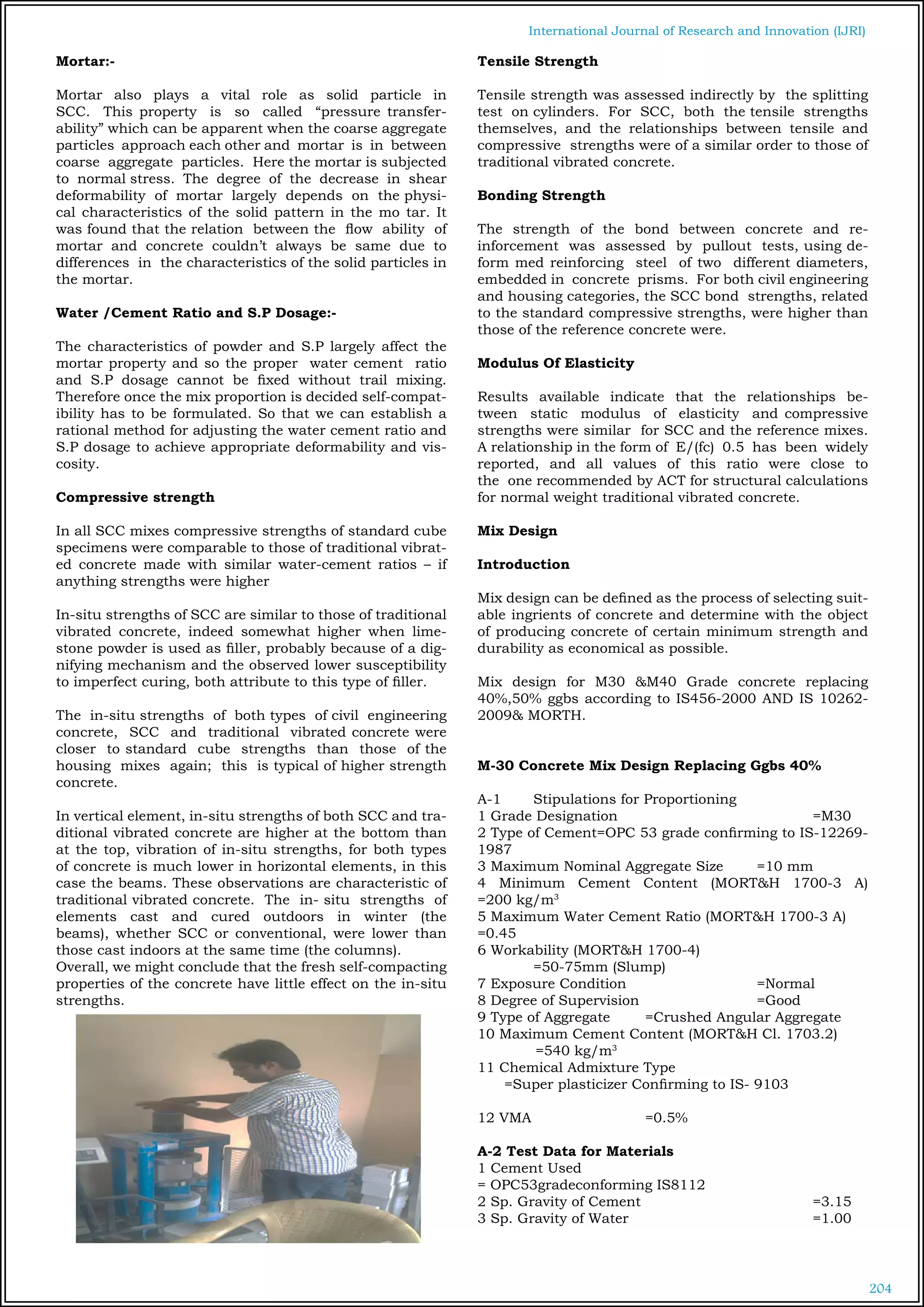
• This experiment is made to the self compacting ability
by conducting test such as slump flow test, L box test, v
box test when it replaced by GGBS and calculating the
compressive strength by changing W/C ratio.
Abstract
Concrete is Most widely used construction Material in the Modern Era because of its good Compressive strength and
high durability. As we know Concrete comprises a Mixture of cement, sand (fine aggregate), course aggregate and water
which makes up normal plain concrete, to increase the strength of concrete we can design the mix with greater Flexibil-
ity, but the problems Arises in structure as load age, increaseof floors which demands increase of high strength concrete
and more steel. So, especially at the beams, columns joints heavy reinforcement meshing is done so that it becomes If
the concrete is not compacted then strength may not be achieved, so the solution for the problem is SCC which we call
it asself-compacting concrete. Were this SCC has ability to compact by itself Gravity and self-flow ability same strength
can be Here in the research, it is carried out self-compaction concrete to improve strength & make concrete economical
so, a mix is dispend of M30,M40 Grades with adding chemical admixture named poly carboxylic ether (ADVA960) , a
Retarder Basically Which also increases strength and workability &replacing cement with GGBS (Ground Granulated
Blast Furnace Slag) 40%&50% .The tests are carried out to find the increase in strength by adding chemical admixture &
replacing GGBS 40% & 50%.By the chemical admixture adding up to 2% Max were previous strength shows that adding
of chemical admixture greater than 2% which results to increase the initial setting time and decrease in the w/c ratio.
Test will be conducted for 3,7,28 days find the increase of strength and its other properties
1401-1402
201
International Journal of Research and Innovation (IJRI)
Test on materials
cement	
	
The most common cement currently used in construc-
tion is type I/I I Portland cement. This cement conform
to the strength requirement of a Type I and the C3A
content restriction of a Type II. This type of cement is
typically used in construction and is readily available
from a variety of sources. The Blaine fineness is used
to quantify the surface area of cement.
The surface area provides a direct indication of the ce-
ment fineness. The typical fineness of cement ranges from
350 to 500m2
/kg for Type I and Type III cements, respec-
tively.
NORMAL CONSISTENCY OF FINENESS OF CEMENT
Aim: To determine the percentage of water required for
preparing cement paste of standard consistency, used for
other tests.
Apparatus: Vicat apparatus with plunger,
I.S. Sieve No. 9,
Measuring jar,
Weighing balance
Procedure:
• The vicat’s apparatus consists of a D- frame with mov-
able rod. An indicator is attached to the movable rod,
which gives the penetration on a vertical scale.
• A plunger of 10 mm diameter, 50 mm long is attached to
the movable rod to find out normal consistency of cement.
Take 300 gm of cement sieved through I.S. Sieve No. 9
and add 30% by weight (90 ml) water to it.
• Mix water and cement on a non-porous surface thor-
oughly with in 3 to 4 minutes.
• The cement paste is filled in the vicat’s mould and top
surface is leveled with a trowel. The filled up mould shall
be placed along with its bottom non-porous plate on the
base plate of the vicat’s apparatus centrally below the
movable rod.
• The plunger is quickly released into the paste. The set-
tlement of the plunger is noted down. If the penetration
is between 33 mm to 35 mm from top (or) 5 mm to 7 mm
from the bottom, the amount of water added is correct.
• If the penetration is less than required, process is re-
peated with different percentages of water till the desired
penetration is obtained.
S.NO AMOUNT OF
WATER
PENETRATION OF
PLUNGER FROM
TOP
1 80 33.3
2 85 33.8
3 90 34.2
Result:-The normal consistency of cement= 33.6 mm
INITIAL AND FINAL SETTING TIMES OF CEMENT
Aim: To find initial and final setting times of cement.
Apparatus:
Vicat apparatus with mould, I.S. sieve No. 9,
Initial and final setting time needles,
Measuring jar, weighing balance, etc.
Procedure:
Initial setting time:
• Initial setting time is defined as the time elapsed be-
tween the moment that the water is added to the cement,
to the time that the paste starts losing its plasticity i.e.
the initial setting time needle fails to penetrate the cement
paste kept in the mould by about 33-35 mm from the top
or 5-7 mm from bottom of the indicator is called initial
setting time.
• Take a cement sample weighing 300 gm, sieved through
I.S. sieve No. 9 and mixed with percentage of water as
determined in normal consistency test.
• Stopwatch should be started at the instant when water
is added to the cement. Now the prepared cement paste is
filled in vicat’s mould and leveled with trowel.
• the mould filled with cement paste kept on the non po-
rous plate is now placed under the movable rod with ini-
tial setting time needle of cross section 1mm x 1mm the
needle is quickly released and it is allowed to penetrate
the cement paste.
• In the beginning the needle penetrates completely. It is
then taken out and dropped at a fresh place. This proce-
dure is repeated at regular intervals till the needle does
not penetrate the block for about 5 mm measured from
the bottom of indicator. Note the time for initial setting
of cement.
• The initial setting time of an ordinary Portland cement
shall not be less than 30 minutes.	
Final setting time:
• After noting the time for initial setting of cement,
• The needle shall be replaced by the final setting time
needle and then movable rod is slowly released on to the
cement paste.
• In the initial stages the needle and collar may pierce
through the paste. But after some time the same proce-
dure is followed.
• Such trials shall be carried out until the needle only
makes as impression on the top surface of the cement
paste and the collar of the needle fails to do so.
• Note the time for final setting time of cement. The final
setting time of an ordinary Portland cement shall not be
more than 10 hours
.
Result: 1. Initial setting time of cement= 180 Min
2. Final setting time of cement = 342 Min
SOUNDNESS OF CEMENT
Unsoundness of cement means, that the cement having
excess lime, magnesium sulphates, etc. due to excess of
these items there will be volume changes and large expan-
sions, there by reduces the durability of the structures.
AIM: - To find out the soundness of cement.
APPARATUS: - Le-Chatelier Apparatus Cement,
		 Water,
		 Glass plate.
Procedure:-
• Cement is gauged with 0.78 times the water required for
standard consistency (0.78P) in a standard manner and
filled in to the Le-Chatelier mould which is present on the
on the glass plate.
• The mould is covered on the top with another glass plate.
• The whole assembly is immersed in water at tempera-
ture of 27o
C to 32o
C and kept there for 24 hrs.
• Measure the distance between the indicator points.
202
International Journal of Research and Innovation (IJRI)
• Submerge the mould again in water, heat the water up
to boiling point in 30 minutes and keep it boiling for 3
hrs.
• Remove the mould from hot water and allow it to cool
and measure the distance between the indicator points.
• The distance between these two measurements gives the
expansion of cement.
• This must not exceed 10mm for OPC, RHC, LHC, etc.
• If the expansion is more than 10mm, the cement is un-
sound.
Soundness of cement:- 8mm
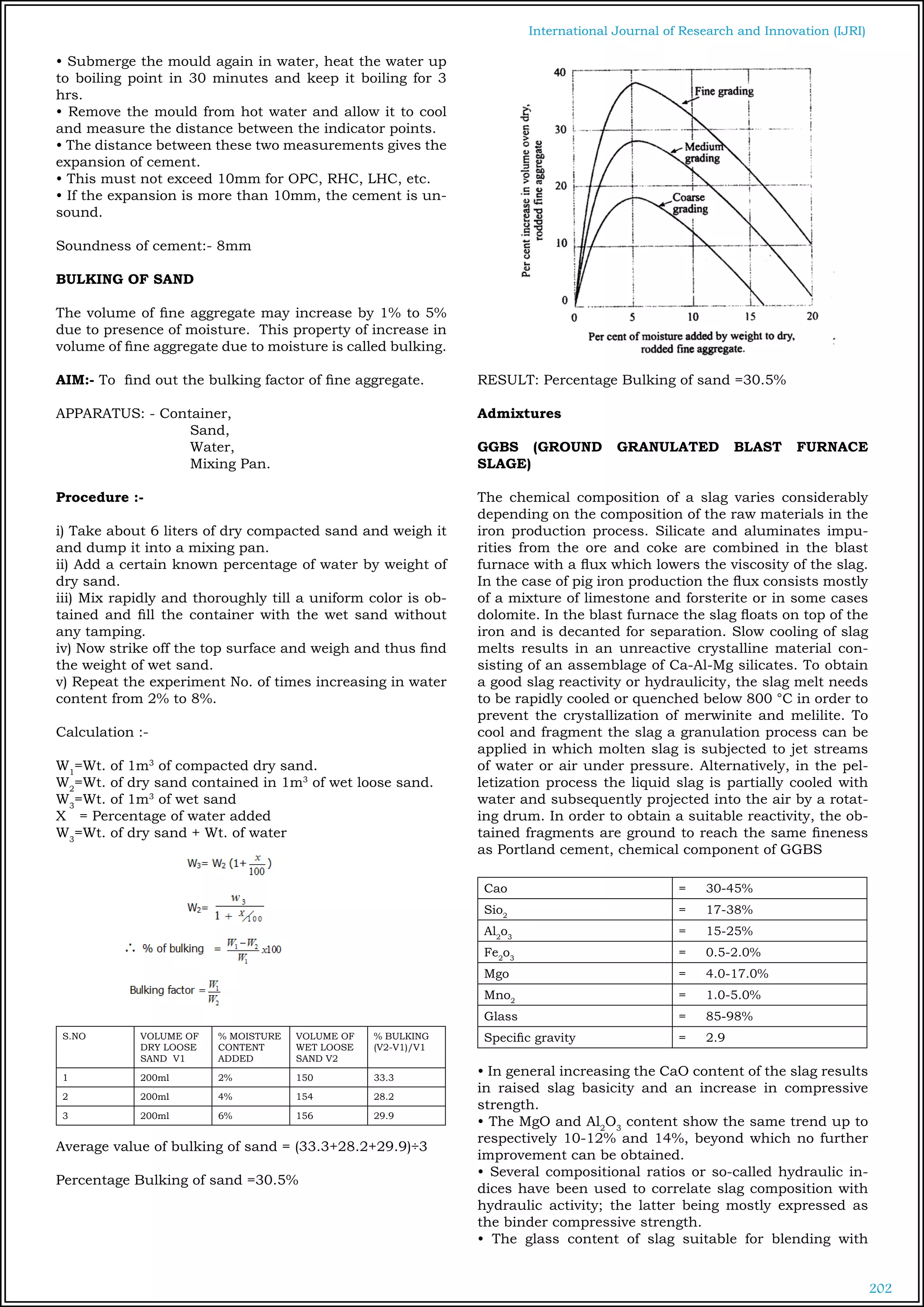
BULKING OF SAND
The volume of fine aggregate may increase by 1% to 5%
due to presence of moisture. This property of increase in
volume of fine aggregate due to moisture is called bulking.
AIM:- To find out the bulking factor of fine aggregate.
APPARATUS: - Container,
		 Sand,
		 Water,
		 Mixing Pan.
Procedure :-
i) Take about 6 liters of dry compacted sand and weigh it
and dump it into a mixing pan.
ii) Add a certain known percentage of water by weight of
dry sand.
iii) Mix rapidly and thoroughly till a uniform color is ob-
tained and fill the container with the wet sand without
any tamping.
iv) Now strike off the top surface and weigh and thus find
the weight of wet sand.
v) Repeat the experiment No. of times increasing in water
content from 2% to 8%.
Calculation :-
W1
=Wt. of 1m3
of compacted dry sand.
W2
=Wt. of dry sand contained in 1m3
of wet loose sand.
W3
=Wt. of 1m3
of wet sand
X = Percentage of water added
W3
=Wt. of dry sand + Wt. of water
S.NO VOLUME OF
DRY LOOSE
SAND V1
% MOISTURE
CONTENT
ADDED
VOLUME OF
WET LOOSE
SAND V2
% BULKING
(V2-V1)/V1
1 200ml 2% 150 33.3
2 200ml 4% 154 28.2
3 200ml 6% 156 29.9
Average value of bulking of sand = (33.3+28.2+29.9)÷3
				
Percentage Bulking of sand =30.5%
RESULT: Percentage Bulking of sand =30.5%
Admixtures
GGBS (GROUND GRANULATED BLAST FURNACE
SLAGE)
The chemical composition of a slag varies considerably
depending on the composition of the raw materials in the
iron production process. Silicate and aluminates impu-
rities from the ore and coke are combined in the blast
furnace with a flux which lowers the viscosity of the slag.
In the case of pig iron production the flux consists mostly
of a mixture of limestone and forsterite or in some cases
dolomite. In the blast furnace the slag floats on top of the
iron and is decanted for separation. Slow cooling of slag
melts results in an unreactive crystalline material con-
sisting of an assemblage of Ca-Al-Mg silicates. To obtain
a good slag reactivity or hydraulicity, the slag melt needs
to be rapidly cooled or quenched below 800 °C in order to
prevent the crystallization of merwinite and melilite. To
cool and fragment the slag a granulation process can be
applied in which molten slag is subjected to jet streams
of water or air under pressure. Alternatively, in the pel-
letization process the liquid slag is partially cooled with
water and subsequently projected into the air by a rotat-
ing drum. In order to obtain a suitable reactivity, the ob-
tained fragments are ground to reach the same fineness
as Portland cement, chemical component of GGBS
Cao = 30-45%
Sio2
= 17-38%
Al2
o3
= 15-25%
Fe2
o3
= 0.5-2.0%
Mgo = 4.0-17.0%
Mno2
= 1.0-5.0%
Glass = 85-98%
Specific gravity = 2.9
• In general increasing the CaO content of the slag results
in raised slag basicity and an increase in compressive
strength.
• The MgO and Al2
O3
content show the same trend up to
respectively 10-12% and 14%, beyond which no further
improvement can be obtained.
• Several compositional ratios or so-called hydraulic in-
dices have been used to correlate slag composition with
hydraulic activity; the latter being mostly expressed as
the binder compressive strength.
• The glass content of slag suitable for blending with
203
International Journal of Research and Innovation (IJRI)
Portland cement typically varies between 90-100% and
depends on the cooling method and the temperature at
which cooling is initiated.
• The glass structure of the quenched glass largely de-
pends on the proportions of network-forming elements
such as Si and Al over network-modifiers such as Ca, Mg
and to a lesser extent Al.
• Increased amounts of network-modifiers lead to higher
degrees of network depolymerization and reactivity.	
• Common crystalline constituents of blast-furnace slag
are merwinite and melilite.
• Other minor Components which can form during pro-
gressive crystallization, arebelite, monticellite, rankinite,
wollastonite and forsterite. Minor amounts of reduced
sulphur are commonly encountered as oldhamite.
• The performance of slag largely depends on the chemical
composition. Glass content and fineness of grinding. The
quality of slag is governed by IS 12089 of 1987
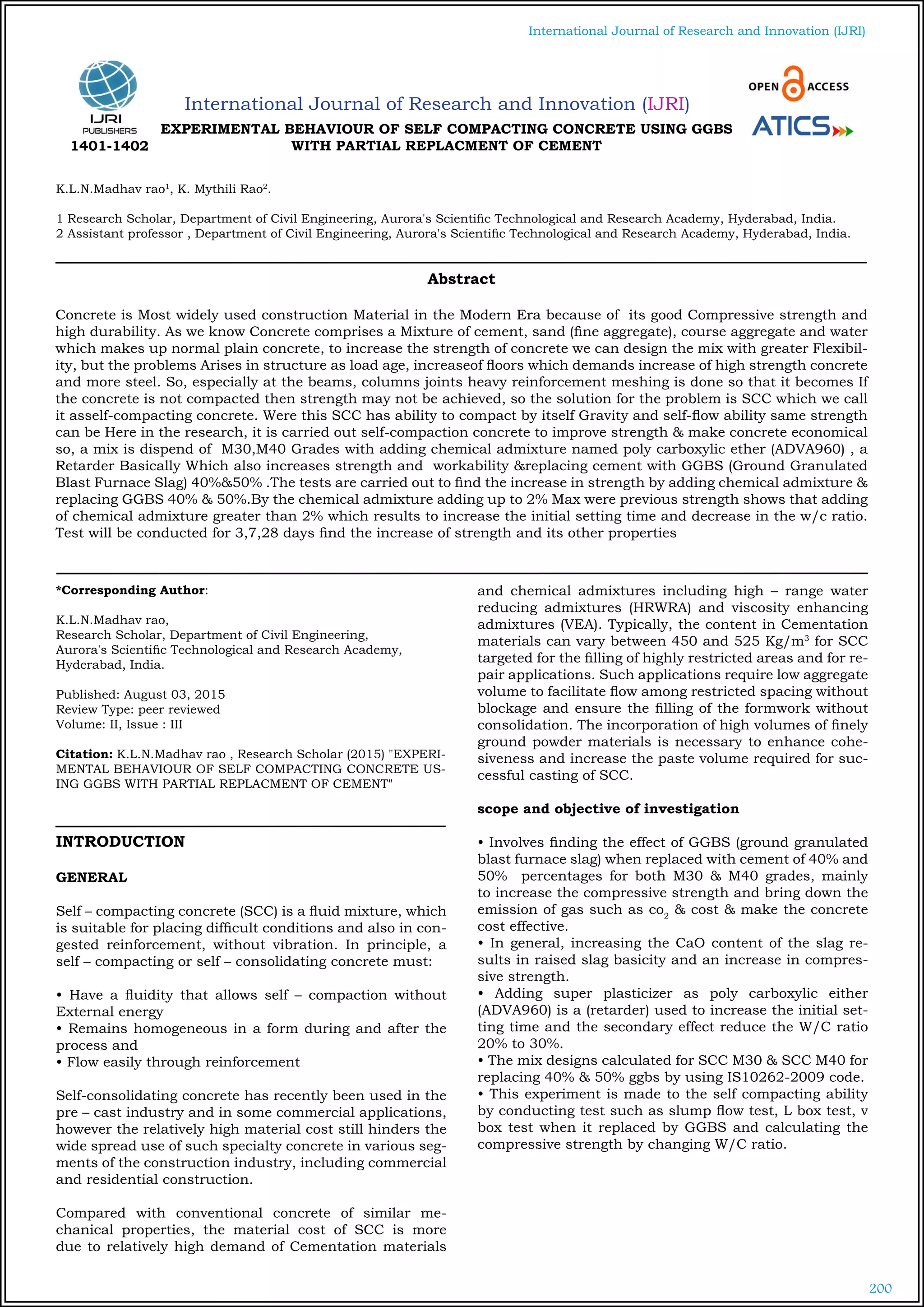
Placing Of Mix In Moulds
After mixing the proportions in the mixing machine, it is
taken out into the bucket. The concrete is placed in to
the moulds (cubes, beams & cylinders), which are already
oiled simply by means of hands only without using any
compacting devises.
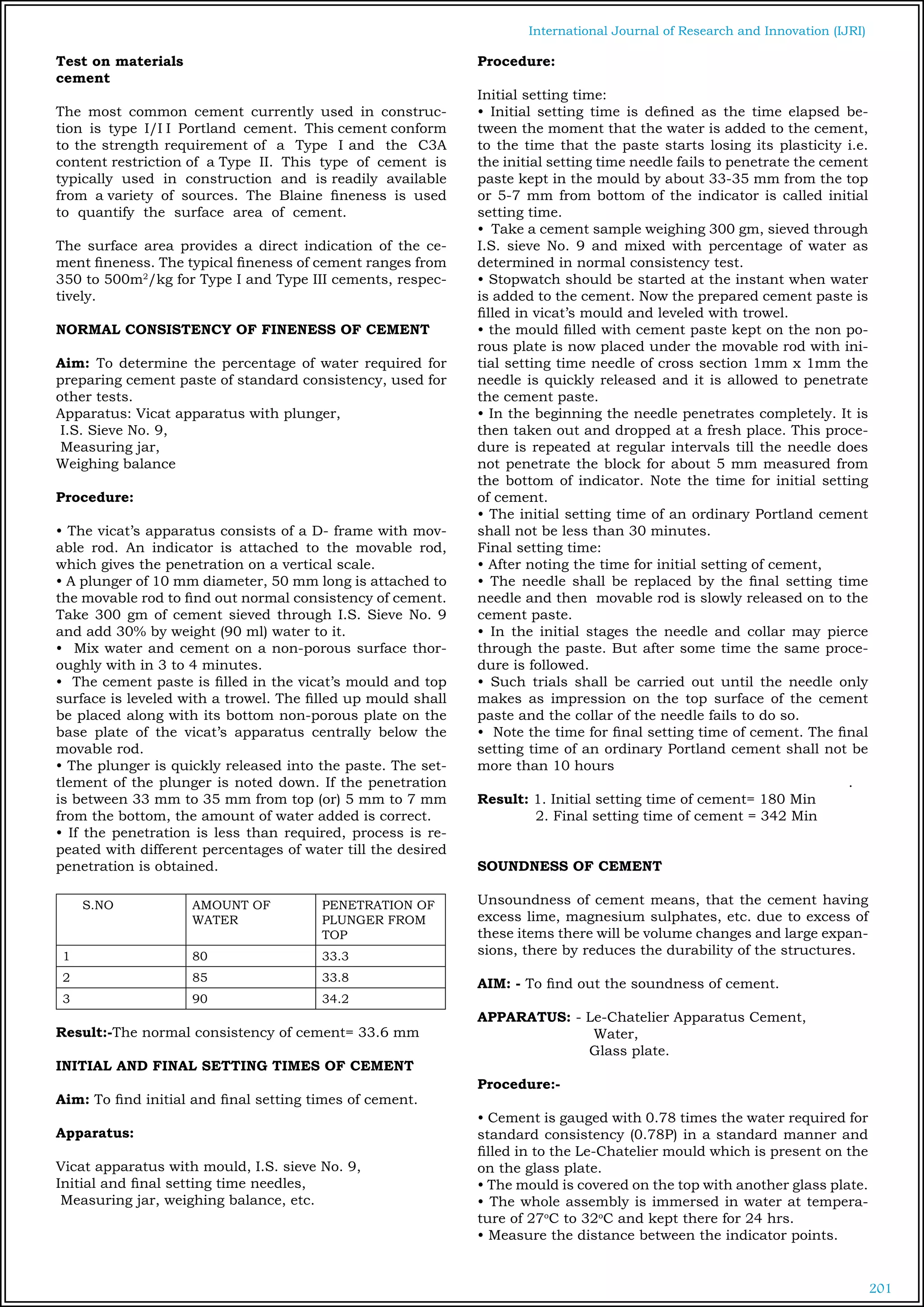
Curing
After 24 hours the specimens were removed from
the moulds and immediately submerged in clean fresh
water and kept there until taken out just prior to testing.
Properties Of Scc specimen
Workability
The level of fluidity of the SCC is governed chiefly by
the dosing of the Super plasticizer. However overdos-
ing may lead to the risk of segregation and block-
age. Consequently the characteristics of the fresh SCC
need to be carefully controlled using preferably two
of the different types of test.
Segregation Resistance
Due to the high fluidity of SCC, the risk of segregation
and blocking is very high. Preventing segregation is there-
fore an important feature of the control regime. The ten-
dency to segregation can be reduced by the use of a
sufficient amount of fines (<0.125mm), or using a
Viscosity Modifying Admixture (VMA).
Open Time
The time during which the Scc maintains its desired rheo-
logical properties is very important to obtain good results
in the concrete placing. This time can be adjusted by
choosing the right type of super plasticizers or the com-
bined use of retarding admixtures. Different admix-
tures have different effects on open time and they can
be used according to the type of cement and the timing
of the transport and placing of the SCC
Properties of Hardened SCC
Shrinkage And Creep
None of the results obtained indicates that the shrinkage
and the creep of the SCC mixes were significantly greater
than those of traditional vibrated concrete.		
		
Some Aspects Of Durability
Elements of all types of concrete have been left exposed
for future assessment of durability but some preliminary
tests have been carried out.
The permeability of the concrete, a recognized indicator
of likely durability, has been examined by measuring the
water absorption of near surface concrete. The results
suggest that in the SCC mixes, the near surface con-
crete was denser and more resistant to water ingress
than in the reference mixes. Carbonation depths have
been measured at one year. The civil mixes (both SCC and
reference) show no carbonation. The evidence in hand
and data from other source suggest that the durability
performance of SCC is likely to be equal or better
than that of traditional vibrated concrete.
Structural Performances
The structural performance of the concrete was as-
sessed by loading the full-size reinforced columns and
beams to failure. For the columns, the actual failure load
exceeded the calculated failure load for both types of
concrete (SCC and traditional vibrated concrete).
For the beams the only available comparison is between
SCC and traditional vibrated concrete in the civil engi-
neering category. Here the behavior of the two con-
cretes in terms of cracking moment, crack width & load-
deflection was similar
204
International Journal of Research and Innovation (IJRI)
Mortar:-
Mortar also plays a vital role as solid particle in
SCC. This property is so called “pressure transfer-
ability” which can be apparent when the coarse aggregate
particles approach each other and mortar is in between
coarse aggregate particles. Here the mortar is subjected
to normal stress. The degree of the decrease in shear
deformability of mortar largely depends on the physi-
cal characteristics of the solid pattern in the mo tar. It
was found that the relation between the flow ability of
mortar and concrete couldn’t always be same due to
differences in the characteristics of the solid particles in
the mortar.
Water /Cement Ratio and S.P Dosage:-
The characteristics of powder and S.P largely affect the
mortar property and so the proper water cement ratio
and S.P dosage cannot be fixed without trail mixing.
Therefore once the mix proportion is decided self-compat-
ibility has to be formulated. So that we can establish a
rational method for adjusting the water cement ratio and
S.P dosage to achieve appropriate deformability and vis-
cosity.
	
Compressive strength
In all SCC mixes compressive strengths of standard cube
specimens were comparable to those of traditional vibrat-
ed concrete made with similar water-cement ratios – if
anything strengths were higher
In-situ strengths of SCC are similar to those of traditional
vibrated concrete, indeed somewhat higher when lime-
stone powder is used as filler, probably because of a dig-
nifying mechanism and the observed lower susceptibility
to imperfect curing, both attribute to this type of filler.
The in-situ strengths of both types of civil engineering
concrete, SCC and traditional vibrated concrete were
closer to standard cube strengths than those of the
housing mixes again; this is typical of higher strength
concrete.
In vertical element, in-situ strengths of both SCC and tra-
ditional vibrated concrete are higher at the bottom than
at the top, vibration of in-situ strengths, for both types
of concrete is much lower in horizontal elements, in this
case the beams. These observations are characteristic of
traditional vibrated concrete. The in- situ strengths of
elements cast and cured outdoors in winter (the
beams), whether SCC or conventional, were lower than
those cast indoors at the same time (the columns).
Overall, we might conclude that the fresh self-compacting
properties of the concrete have little effect on the in-situ
strengths.
Tensile Strength
Tensile strength was assessed indirectly by the splitting
test on cylinders. For SCC, both the tensile strengths
themselves, and the relationships between tensile and
compressive strengths were of a similar order to those of
traditional vibrated concrete.
Bonding Strength
The strength of the bond between concrete and re-
inforcement was assessed by pullout tests, using de-
form med reinforcing steel of two different diameters,
embedded in concrete prisms. For both civil engineering
and housing categories, the SCC bond strengths, related
to the standard compressive strengths, were higher than
those of the reference concrete were.
Modulus Of Elasticity
Results available indicate that the relationships be-
tween static modulus of elasticity and compressive
strengths were similar for SCC and the reference mixes.
A relationship in the form of E/(fc) 0.5 has been widely
reported, and all values of this ratio were close to
the one recommended by ACT for structural calculations
for normal weight traditional vibrated concrete.
Mix Design
Introduction
Mix design can be defined as the process of selecting suit-
able ingrients of concrete and determine with the object
of producing concrete of certain minimum strength and
durability as economical as possible.
Mix design for M30 &M40 Grade concrete replacing
40%,50% ggbs according to IS456-2000 AND IS 10262-
2009& MORTH.
M-30 Concrete Mix Design Replacing Ggbs 40%
A-1	 Stipulations for Proportioning
1 Grade Designation 				 =M30
2 Type of Cement=OPC 53 grade confirming to IS-12269-
1987
3 Maximum Nominal Aggregate Size	 =10 mm
4 Minimum Cement Content (MORT&H 1700-3 A)
=200 kg/m3
5 Maximum Water Cement Ratio (MORT&H 1700-3 A)	
=0.45
6 Workability (MORT&H 1700-4) 			
	 =50-75mm (Slump)
7 Exposure Condition			 =Normal
8 Degree of Supervision			 =Good
9 Type of Aggregate	 =Crushed Angular Aggregate
10 Maximum Cement Content (MORT&H Cl. 1703.2)	
=540 kg/m3
11 Chemical Admixture Type	
=Super plasticizer Confirming to IS- 9103
12 VMA			 =0.5%
A-2 Test Data for Materials
1 Cement Used				
= OPC53gradeconforming IS8112
2 Sp. Gravity of Cement				 =3.15
3 Sp. Gravity of Water				 =1.00
205
International Journal of Research and Innovation (IJRI)
4 Chemical Admixture		
=ADVA960(POLYCARBOXLIC EITHER)
6 Sp. Gravity of 10 mm Aggregate		 =2.74
7 Sp. Gravity of Sand				 =2.605
9 Water Absorption of 10 mm Aggregate		 =1.0%
10 Water Absorption of Sand			 =1.23%
12 Free (Surface) Moisture of 10 mm Aggregate	 =nil
13 Free (Surface) Moisture of Sand		 =nil
14 Sieve Analysis of Individual Coarse Aggregates	
	 =Separate Analysis Done
15 Sieve Analysis of Combined Coarse Aggregates	
	 =Separate Analysis Done
15 Sp. Gravity of Combined Coarse Aggregates	 =2.882
16 Sieve Analysis of Fine Aggregates 	
							
=CONFORMINGTO GRADING ZONE-1 IS383	
A-8 Mix Calculations
1 Volume of Concrete in m3
		 =1.00 m3
2 Volume of Cement in m3
				
(Mass of Cement) / (Sp. Gravity of Cement) x 1000	
= (224/3.15)*1000=0.0710m3
3 Volume of Water in m3
(Mass of Water) / (Sp. Gravity of Water) x 1000	
=0.154m3
4Volume of ggbs		
(Mass of ggbs) / (Sp. Gravity of ggbs) x 1000	
=150/2.9*1000=0.051 m3
5 Volume of chemical Admixture @ 2% in m3
	
(Mass of Admixture) / (Sp. Gravity of Admixture)x1000	
=4.4/1.09*1000=0.0040 m3
6 Volume of All in Aggregate in m3
	
Sr. no. 1 – (Sr. no. 2+3+4)=1-(0.071+0.154+0.0040+0.051)
=0.72 m3
				
7 Volume of Course Aggregate in m3
	
	 Sr. no. 6 x 0.56			
=0.72*0.56*2.74*1000=1104 kgs
8 Volume of Fine Aggregate in m3
	
	 Sr. no. 6 x 0.44			
=0.72*0.44*2.74*1000=868 kgs
A-9 Mix Proportions for One cum of Concrete (SSD
Condition)
1 Mass of Cement in kg/m3
		 =224 kgs
2 Mass of Water in kg/m3
	 	 =154 liters
3 Mass of Fine Aggregate in kg/m3
	 =868kgs
4 Mass of Coarse Aggregate in kg/m3
	 =1104 kgs
5 Mass of chemical Admixture in kg/m3
	 =4.4 kg/m3
6 Mass of GGBS kg/m3
	 =150 kg/m3
7 Water Cement Ratio			 =0.41
8 Vma	 =0.187 liters /m3
Mixing Ratio
(GGBS+CEMENT): FINE AGGREGATE: COURSE AGGRE-
GATE: W/C RATIO
(0.4+0.60)=1 :	 2.32		 :	 2.95
:	 0.41 	
M-30 Concrete Mix Design Replacing Ggbs 50%
Cementious material content	 =340X 1.10=374kg/m3
	 Water content			 =154 kg/m3
	 Water/cement ratio	 = 154/374 =0.41
GGBS @50% of total Cementious material 	 = 374*
50%=187 kg/m3
	 Cement (opc)		 =374-187=187 kg/m3
Saving of cement while using ggbs=374-187=187 kg/m3
Ggbs used 				 = 187 kg/m3
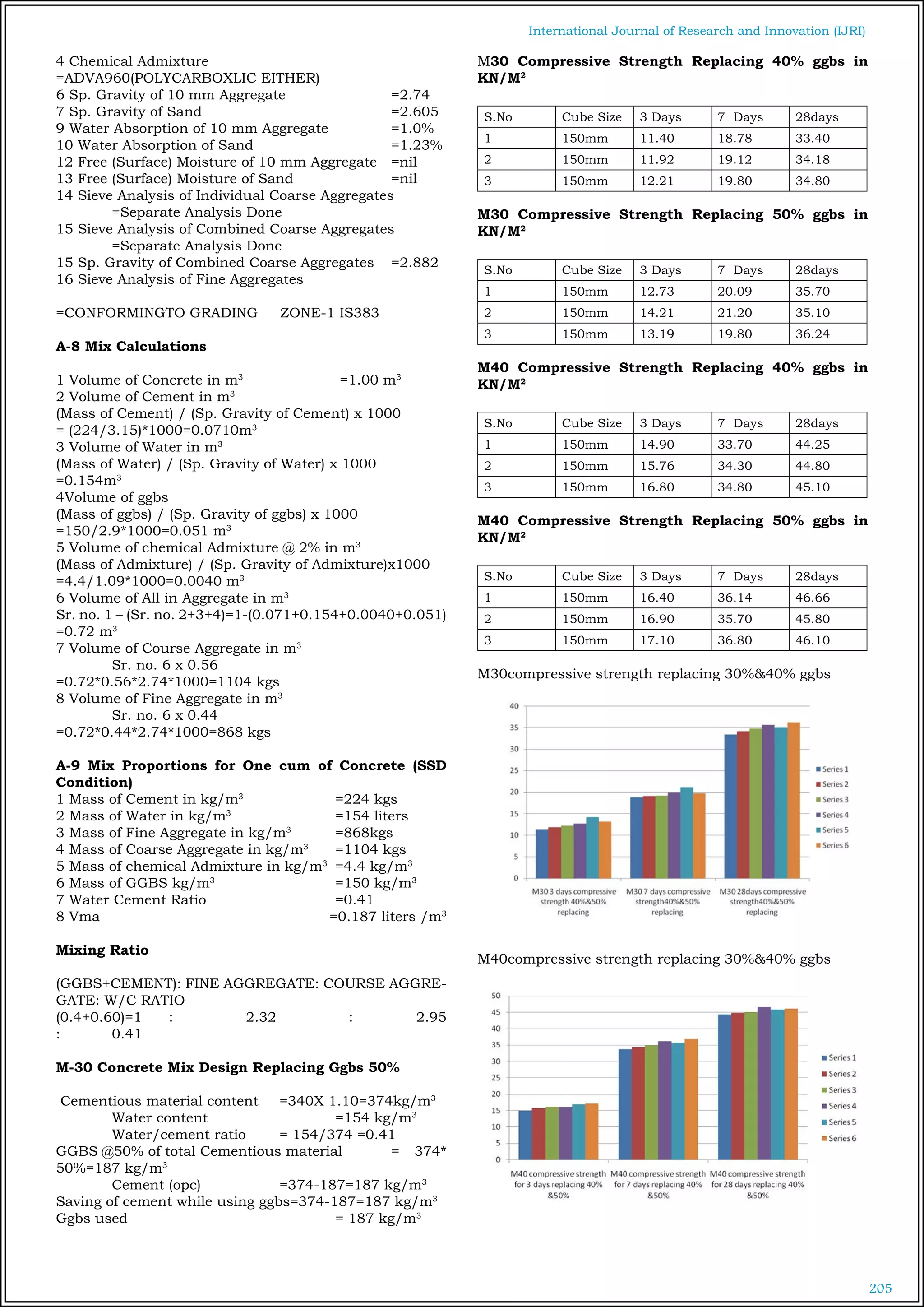
M30 Compressive Strength Replacing 40% ggbs in
KN/M2
S.No Cube Size 3 Days 7 Days 28days
1 150mm 11.40 18.78 33.40
2 150mm 11.92 19.12 34.18
3 150mm 12.21 19.80 34.80
M30 Compressive Strength Replacing 50% ggbs in
KN/M2
S.No Cube Size 3 Days 7 Days 28days
1 150mm 12.73 20.09 35.70
2 150mm 14.21 21.20 35.10
3 150mm 13.19 19.80 36.24
M40 Compressive Strength Replacing 40% ggbs in
KN/M2
S.No Cube Size 3 Days 7 Days 28days
1 150mm 14.90 33.70 44.25
2 150mm 15.76 34.30 44.80
3 150mm 16.80 34.80 45.10
M40 Compressive Strength Replacing 50% ggbs in
KN/M2
S.No Cube Size 3 Days 7 Days 28days
1 150mm 16.40 36.14 46.66
2 150mm 16.90 35.70 45.80
3 150mm 17.10 36.80 46.10
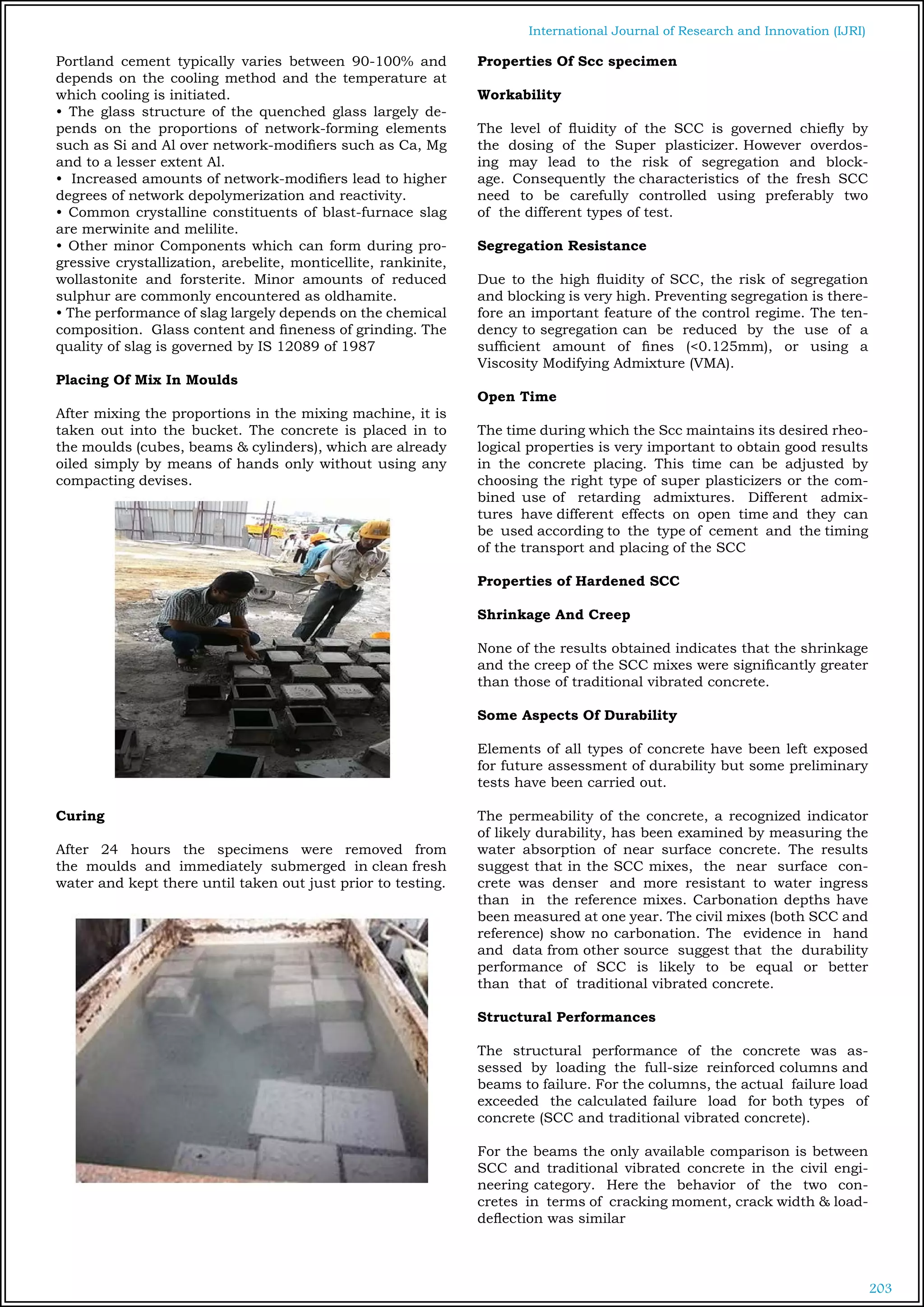
M30compressive strength replacing 30%&40% ggbs
M40compressive strength replacing 30%&40% ggbs
206
International Journal of Research and Innovation (IJRI)
Conclusion
• When compare to the previous papers test’s on replacing GGBS
above 30% the compressive strength have reduced, for every in-
terval of replacing 5%. Added Conplast SP430 as super plasti-
cizer and maintained w/c ratio is kept constant throughout the
investigation as 0.45.
• as per Results suggest that as much of 50% of cement can be
replaced without any significant consequences on the concrete,
by using the chemical admixture as super plasticizer ADVA960
(poly carboxylic either) is a retarder increase the initial setting
time
• Compressive strength is increased by replacing 50% of GGBS
for cement and maintained w/c ratio as per mix design obtained,
the mineral admixture replacement have a better workable con-
crete.
• Avg Compressive Strength For M30scc Replacing 40%GGBS 3
days=11.84 KN/M2
• Avg Compressive Strength For M30scc Replacing 40%GGBS 7
days=19.23 KN/M2
• Avg Compressive Strength For M30scc Replacing 40%GGBS 28
days=34.12 KN/M2
• Avg Compressive Strength For M30scc Replacing 50%GGBS 3
days=13.37 KN/M2
• Avg Compressive Strength For M30scc Replacing 50%GGBS 7
days=20.36 KN/M2
• Avg Compressive Strength For M30scc Replacing 50%GGBS 28
days=35.69 KN/M2
• Avg Compressive Strength For M40scc Replacing 40%GGBS 3
days=15.82 KN/M2
• Avg Compressive Strength For M40scc Replacing 40%GGBS 7
days=34.26 KN/M2
• Avg Compressive Strength For M40scc Replacing 40%GGBS 28
days=44.71 KN/M2
• Avg Compressive Strength For M40scc Replacing 50%GGBS 3
days=16.80 KN/M2
• Avg Compressive Strength For M40scc Replacing 50%GGBS 7
days=36.21 KN/M2
• Avg Compressive Strength For M40scc Replacing 50%GGBS 28
days=46.18 KN/M2
Scope for Further Study
SCC can be replaced upto 50% further test can be carried out by
increasing percentage and maintain w/c ratio as per mix design,
Since there is no standard method of mix design is available for
SCC. Hence the mix proportion is obtained as per the guidelines
of IS10262-2009 so further study’s can be carried out to find the
Durability &serviceability factors, temperature effect and flexural
strength add present of GGBS more than 50% may shows vari-
ation in obtaining strength.
References
• [1] k.l.n madhav rao “experimental behavior of self compaction
concrete with GGBS “ by using mix design IS 10262-2009and IS
456-2000.
• B. H. Venkataram Pai, Maitreyee Nandy, A. Krishnamoorthy,
Pradip Kumar Sarkar, C.Pramukh Ganapathy, Philip George,
“Development of self compacting concrete with various mineral
admixtures”, American Journal of Civil Engineering, May 30,
2014.
• Dinakarpasla,Mr. Kaliprasannasethy and Umesh c sahoo, “
Development of High Strength Self-Compacting Concrete with
Ground Granulated Blast Furnace Slag – A New Mix Design
Methodology”
• K. Ganesh Babu and V. Sree Rama Kumar, “Efficiency of
GGBS in concrete” , Cement and Concrete Research 30 (2000),
PP.1031- 1036.
• Mallikarjuna Reddy V, Seshagiri Rao M V, Srilakshmi P and
SateeshKumar B,“Effect of W/C Ratio on Workability and Me-
chanical Properties of High Strength Self Compacting Con-
crete (M70 Grade)” International Journal of Engineering Re-
search and Development.
• Mr. Dhruvkumar H. Patel, Mr Dixitkumar D. Patel, Mr
Dhaval P. Patel, Mr Vivek A. Patva, Mr Yashasvikumar R.
Patel, “ Literature Review On Self Compacting Concrete”, In-
ternational Journal For Technological Research In Engineering,
Vol 1, No 9, May-2014.
• P. Ramanathan, I. Baskar, P. Muthupriya, and R. Venkatasu-
bramani .
“ Performance of Self-compacting concrete containing differ-
ent mineral admixtures”. KSCE Journal of Civil Engineering
17(2):465-472, May 30. 2012. 				
• SabeerAlavi.C, I.Baskar and R.Venkatasubramani , “Strength
and Durability Characteristics of GGBFS based SCC , Interna-
tional Journal of Emerging trends in Engineering and Develop-
ment March (2013).
• EFNARC,“Specification and guidelines for Self Compacting con-
crete”, UK (2002).
	
• Jump up^ Winnefeld, F; Becker, S; Pakusch, J; Goetz, T (2011)
"Effects of the molecular architecture of comb-shaped super
plasticizers on their performance in cementitious systems". Ce-
ment and ConcreteComposites 41 (10): 1058. doi:10.1016/j.
cemconcomp.2006.12.006.
• Jump up^ Plank, J; Pollmann, K; Zouaoui, N; Andres, P;
Schaefer, C (2007). "Synthesis and performance of methacrylic
ester based polycarboxylate superplasticizers possessing hy-
droxy terminated poly(ethylene glycol) side chains". Cement
and Concrete Research 29 (4): 251. doi: 10.1016/j.cemconres
.2008.01.007.
Author
K.L.N.Madhav rao,
Research Scholar,
Department of Civil Engineering,
Aurora's Scientific Technological and Research Academy,
Bandlaguda,Hyderabad,
India.
Mythili Rao,
Assistant Professor,
Department of Civil Engineering,
Aurora's Scientific Technological and Research Academy,
Bandlaguda,Hyderabad, India.

EXPERIMENTAL BEHAVIOUR OF SELF COMPACTING CONCRETE USING GGBS WITH PARTIAL REPLACMENT OF CEMENT

  • 1.
    200 International Journal ofResearch and Innovation (IJRI) International Journal of Research and Innovation (IJRI) EXPERIMENTAL BEHAVIOUR OF SELF COMPACTING CONCRETE USING GGBS WITH PARTIAL REPLACMENT OF CEMENT K.L.N.Madhav rao1 , K. Mythili Rao2 . 1 Research Scholar, Department of Civil Engineering, Aurora's Scientific Technological and Research Academy, Hyderabad, India. 2 Assistant professor , Department of Civil Engineering, Aurora's Scientific Technological and Research Academy, Hyderabad, India. *Corresponding Author: K.L.N.Madhav rao, Research Scholar, Department of Civil Engineering, Aurora's Scientific Technological and Research Academy, Hyderabad, India. Published: August 03, 2015 Review Type: peer reviewed Volume: II, Issue : III Citation: K.L.N.Madhav rao , Research Scholar (2015) "EXPERI- MENTAL BEHAVIOUR OF SELF COMPACTING CONCRETE US- ING GGBS WITH PARTIAL REPLACMENT OF CEMENT" INTRODUCTION GENERAL Self – compacting concrete (SCC) is a fluid mixture, which is suitable for placing difficult conditions and also in con- gested reinforcement, without vibration. In principle, a self – compacting or self – consolidating concrete must: • Have a fluidity that allows self – compaction without External energy • Remains homogeneous in a form during and after the process and • Flow easily through reinforcement Self-consolidating concrete has recently been used in the pre – cast industry and in some commercial applications, however the relatively high material cost still hinders the wide spread use of such specialty concrete in various seg- ments of the construction industry, including commercial and residential construction. Compared with conventional concrete of similar me- chanical properties, the material cost of SCC is more due to relatively high demand of Cementation materials and chemical admixtures including high – range water reducing admixtures (HRWRA) and viscosity enhancing admixtures (VEA). Typically, the content in Cementation materials can vary between 450 and 525 Kg/m3 for SCC targeted for the filling of highly restricted areas and for re- pair applications. Such applications require low aggregate volume to facilitate flow among restricted spacing without blockage and ensure the filling of the formwork without consolidation. The incorporation of high volumes of finely ground powder materials is necessary to enhance cohe- siveness and increase the paste volume required for suc- cessful casting of SCC. scope and objective of investigation • Involves finding the effect of GGBS (ground granulated blast furnace slag) when replaced with cement of 40% and 50% percentages for both M30 & M40 grades, mainly to increase the compressive strength and bring down the emission of gas such as co2 & cost & make the concrete cost effective. • In general, increasing the CaO content of the slag re- sults in raised slag basicity and an increase in compres- sive strength. • Adding super plasticizer as poly carboxylic either (ADVA960) is a (retarder) used to increase the initial set- ting time and the secondary effect reduce the W/C ratio 20% to 30%. • The mix designs calculated for SCC M30 & SCC M40 for replacing 40% & 50% ggbs by using IS10262-2009 code. • This experiment is made to the self compacting ability by conducting test such as slump flow test, L box test, v box test when it replaced by GGBS and calculating the compressive strength by changing W/C ratio. Abstract Concrete is Most widely used construction Material in the Modern Era because of its good Compressive strength and high durability. As we know Concrete comprises a Mixture of cement, sand (fine aggregate), course aggregate and water which makes up normal plain concrete, to increase the strength of concrete we can design the mix with greater Flexibil- ity, but the problems Arises in structure as load age, increaseof floors which demands increase of high strength concrete and more steel. So, especially at the beams, columns joints heavy reinforcement meshing is done so that it becomes If the concrete is not compacted then strength may not be achieved, so the solution for the problem is SCC which we call it asself-compacting concrete. Were this SCC has ability to compact by itself Gravity and self-flow ability same strength can be Here in the research, it is carried out self-compaction concrete to improve strength & make concrete economical so, a mix is dispend of M30,M40 Grades with adding chemical admixture named poly carboxylic ether (ADVA960) , a Retarder Basically Which also increases strength and workability &replacing cement with GGBS (Ground Granulated Blast Furnace Slag) 40%&50% .The tests are carried out to find the increase in strength by adding chemical admixture & replacing GGBS 40% & 50%.By the chemical admixture adding up to 2% Max were previous strength shows that adding of chemical admixture greater than 2% which results to increase the initial setting time and decrease in the w/c ratio. Test will be conducted for 3,7,28 days find the increase of strength and its other properties 1401-1402
  • 2.
    201 International Journal ofResearch and Innovation (IJRI) Test on materials cement The most common cement currently used in construc- tion is type I/I I Portland cement. This cement conform to the strength requirement of a Type I and the C3A content restriction of a Type II. This type of cement is typically used in construction and is readily available from a variety of sources. The Blaine fineness is used to quantify the surface area of cement. The surface area provides a direct indication of the ce- ment fineness. The typical fineness of cement ranges from 350 to 500m2 /kg for Type I and Type III cements, respec- tively. NORMAL CONSISTENCY OF FINENESS OF CEMENT Aim: To determine the percentage of water required for preparing cement paste of standard consistency, used for other tests. Apparatus: Vicat apparatus with plunger, I.S. Sieve No. 9, Measuring jar, Weighing balance Procedure: • The vicat’s apparatus consists of a D- frame with mov- able rod. An indicator is attached to the movable rod, which gives the penetration on a vertical scale. • A plunger of 10 mm diameter, 50 mm long is attached to the movable rod to find out normal consistency of cement. Take 300 gm of cement sieved through I.S. Sieve No. 9 and add 30% by weight (90 ml) water to it. • Mix water and cement on a non-porous surface thor- oughly with in 3 to 4 minutes. • The cement paste is filled in the vicat’s mould and top surface is leveled with a trowel. The filled up mould shall be placed along with its bottom non-porous plate on the base plate of the vicat’s apparatus centrally below the movable rod. • The plunger is quickly released into the paste. The set- tlement of the plunger is noted down. If the penetration is between 33 mm to 35 mm from top (or) 5 mm to 7 mm from the bottom, the amount of water added is correct. • If the penetration is less than required, process is re- peated with different percentages of water till the desired penetration is obtained. S.NO AMOUNT OF WATER PENETRATION OF PLUNGER FROM TOP 1 80 33.3 2 85 33.8 3 90 34.2 Result:-The normal consistency of cement= 33.6 mm INITIAL AND FINAL SETTING TIMES OF CEMENT Aim: To find initial and final setting times of cement. Apparatus: Vicat apparatus with mould, I.S. sieve No. 9, Initial and final setting time needles, Measuring jar, weighing balance, etc. Procedure: Initial setting time: • Initial setting time is defined as the time elapsed be- tween the moment that the water is added to the cement, to the time that the paste starts losing its plasticity i.e. the initial setting time needle fails to penetrate the cement paste kept in the mould by about 33-35 mm from the top or 5-7 mm from bottom of the indicator is called initial setting time. • Take a cement sample weighing 300 gm, sieved through I.S. sieve No. 9 and mixed with percentage of water as determined in normal consistency test. • Stopwatch should be started at the instant when water is added to the cement. Now the prepared cement paste is filled in vicat’s mould and leveled with trowel. • the mould filled with cement paste kept on the non po- rous plate is now placed under the movable rod with ini- tial setting time needle of cross section 1mm x 1mm the needle is quickly released and it is allowed to penetrate the cement paste. • In the beginning the needle penetrates completely. It is then taken out and dropped at a fresh place. This proce- dure is repeated at regular intervals till the needle does not penetrate the block for about 5 mm measured from the bottom of indicator. Note the time for initial setting of cement. • The initial setting time of an ordinary Portland cement shall not be less than 30 minutes. Final setting time: • After noting the time for initial setting of cement, • The needle shall be replaced by the final setting time needle and then movable rod is slowly released on to the cement paste. • In the initial stages the needle and collar may pierce through the paste. But after some time the same proce- dure is followed. • Such trials shall be carried out until the needle only makes as impression on the top surface of the cement paste and the collar of the needle fails to do so. • Note the time for final setting time of cement. The final setting time of an ordinary Portland cement shall not be more than 10 hours . Result: 1. Initial setting time of cement= 180 Min 2. Final setting time of cement = 342 Min SOUNDNESS OF CEMENT Unsoundness of cement means, that the cement having excess lime, magnesium sulphates, etc. due to excess of these items there will be volume changes and large expan- sions, there by reduces the durability of the structures. AIM: - To find out the soundness of cement. APPARATUS: - Le-Chatelier Apparatus Cement, Water, Glass plate. Procedure:- • Cement is gauged with 0.78 times the water required for standard consistency (0.78P) in a standard manner and filled in to the Le-Chatelier mould which is present on the on the glass plate. • The mould is covered on the top with another glass plate. • The whole assembly is immersed in water at tempera- ture of 27o C to 32o C and kept there for 24 hrs. • Measure the distance between the indicator points.
  • 3.
    202 International Journal ofResearch and Innovation (IJRI) • Submerge the mould again in water, heat the water up to boiling point in 30 minutes and keep it boiling for 3 hrs. • Remove the mould from hot water and allow it to cool and measure the distance between the indicator points. • The distance between these two measurements gives the expansion of cement. • This must not exceed 10mm for OPC, RHC, LHC, etc. • If the expansion is more than 10mm, the cement is un- sound. Soundness of cement:- 8mm BULKING OF SAND The volume of fine aggregate may increase by 1% to 5% due to presence of moisture. This property of increase in volume of fine aggregate due to moisture is called bulking. AIM:- To find out the bulking factor of fine aggregate. APPARATUS: - Container, Sand, Water, Mixing Pan. Procedure :- i) Take about 6 liters of dry compacted sand and weigh it and dump it into a mixing pan. ii) Add a certain known percentage of water by weight of dry sand. iii) Mix rapidly and thoroughly till a uniform color is ob- tained and fill the container with the wet sand without any tamping. iv) Now strike off the top surface and weigh and thus find the weight of wet sand. v) Repeat the experiment No. of times increasing in water content from 2% to 8%. Calculation :- W1 =Wt. of 1m3 of compacted dry sand. W2 =Wt. of dry sand contained in 1m3 of wet loose sand. W3 =Wt. of 1m3 of wet sand X = Percentage of water added W3 =Wt. of dry sand + Wt. of water S.NO VOLUME OF DRY LOOSE SAND V1 % MOISTURE CONTENT ADDED VOLUME OF WET LOOSE SAND V2 % BULKING (V2-V1)/V1 1 200ml 2% 150 33.3 2 200ml 4% 154 28.2 3 200ml 6% 156 29.9 Average value of bulking of sand = (33.3+28.2+29.9)÷3 Percentage Bulking of sand =30.5% RESULT: Percentage Bulking of sand =30.5% Admixtures GGBS (GROUND GRANULATED BLAST FURNACE SLAGE) The chemical composition of a slag varies considerably depending on the composition of the raw materials in the iron production process. Silicate and aluminates impu- rities from the ore and coke are combined in the blast furnace with a flux which lowers the viscosity of the slag. In the case of pig iron production the flux consists mostly of a mixture of limestone and forsterite or in some cases dolomite. In the blast furnace the slag floats on top of the iron and is decanted for separation. Slow cooling of slag melts results in an unreactive crystalline material con- sisting of an assemblage of Ca-Al-Mg silicates. To obtain a good slag reactivity or hydraulicity, the slag melt needs to be rapidly cooled or quenched below 800 °C in order to prevent the crystallization of merwinite and melilite. To cool and fragment the slag a granulation process can be applied in which molten slag is subjected to jet streams of water or air under pressure. Alternatively, in the pel- letization process the liquid slag is partially cooled with water and subsequently projected into the air by a rotat- ing drum. In order to obtain a suitable reactivity, the ob- tained fragments are ground to reach the same fineness as Portland cement, chemical component of GGBS Cao = 30-45% Sio2 = 17-38% Al2 o3 = 15-25% Fe2 o3 = 0.5-2.0% Mgo = 4.0-17.0% Mno2 = 1.0-5.0% Glass = 85-98% Specific gravity = 2.9 • In general increasing the CaO content of the slag results in raised slag basicity and an increase in compressive strength. • The MgO and Al2 O3 content show the same trend up to respectively 10-12% and 14%, beyond which no further improvement can be obtained. • Several compositional ratios or so-called hydraulic in- dices have been used to correlate slag composition with hydraulic activity; the latter being mostly expressed as the binder compressive strength. • The glass content of slag suitable for blending with
  • 4.
    203 International Journal ofResearch and Innovation (IJRI) Portland cement typically varies between 90-100% and depends on the cooling method and the temperature at which cooling is initiated. • The glass structure of the quenched glass largely de- pends on the proportions of network-forming elements such as Si and Al over network-modifiers such as Ca, Mg and to a lesser extent Al. • Increased amounts of network-modifiers lead to higher degrees of network depolymerization and reactivity. • Common crystalline constituents of blast-furnace slag are merwinite and melilite. • Other minor Components which can form during pro- gressive crystallization, arebelite, monticellite, rankinite, wollastonite and forsterite. Minor amounts of reduced sulphur are commonly encountered as oldhamite. • The performance of slag largely depends on the chemical composition. Glass content and fineness of grinding. The quality of slag is governed by IS 12089 of 1987 Placing Of Mix In Moulds After mixing the proportions in the mixing machine, it is taken out into the bucket. The concrete is placed in to the moulds (cubes, beams & cylinders), which are already oiled simply by means of hands only without using any compacting devises. Curing After 24 hours the specimens were removed from the moulds and immediately submerged in clean fresh water and kept there until taken out just prior to testing. Properties Of Scc specimen Workability The level of fluidity of the SCC is governed chiefly by the dosing of the Super plasticizer. However overdos- ing may lead to the risk of segregation and block- age. Consequently the characteristics of the fresh SCC need to be carefully controlled using preferably two of the different types of test. Segregation Resistance Due to the high fluidity of SCC, the risk of segregation and blocking is very high. Preventing segregation is there- fore an important feature of the control regime. The ten- dency to segregation can be reduced by the use of a sufficient amount of fines (<0.125mm), or using a Viscosity Modifying Admixture (VMA). Open Time The time during which the Scc maintains its desired rheo- logical properties is very important to obtain good results in the concrete placing. This time can be adjusted by choosing the right type of super plasticizers or the com- bined use of retarding admixtures. Different admix- tures have different effects on open time and they can be used according to the type of cement and the timing of the transport and placing of the SCC Properties of Hardened SCC Shrinkage And Creep None of the results obtained indicates that the shrinkage and the creep of the SCC mixes were significantly greater than those of traditional vibrated concrete. Some Aspects Of Durability Elements of all types of concrete have been left exposed for future assessment of durability but some preliminary tests have been carried out. The permeability of the concrete, a recognized indicator of likely durability, has been examined by measuring the water absorption of near surface concrete. The results suggest that in the SCC mixes, the near surface con- crete was denser and more resistant to water ingress than in the reference mixes. Carbonation depths have been measured at one year. The civil mixes (both SCC and reference) show no carbonation. The evidence in hand and data from other source suggest that the durability performance of SCC is likely to be equal or better than that of traditional vibrated concrete. Structural Performances The structural performance of the concrete was as- sessed by loading the full-size reinforced columns and beams to failure. For the columns, the actual failure load exceeded the calculated failure load for both types of concrete (SCC and traditional vibrated concrete). For the beams the only available comparison is between SCC and traditional vibrated concrete in the civil engi- neering category. Here the behavior of the two con- cretes in terms of cracking moment, crack width & load- deflection was similar
  • 5.
    204 International Journal ofResearch and Innovation (IJRI) Mortar:- Mortar also plays a vital role as solid particle in SCC. This property is so called “pressure transfer- ability” which can be apparent when the coarse aggregate particles approach each other and mortar is in between coarse aggregate particles. Here the mortar is subjected to normal stress. The degree of the decrease in shear deformability of mortar largely depends on the physi- cal characteristics of the solid pattern in the mo tar. It was found that the relation between the flow ability of mortar and concrete couldn’t always be same due to differences in the characteristics of the solid particles in the mortar. Water /Cement Ratio and S.P Dosage:- The characteristics of powder and S.P largely affect the mortar property and so the proper water cement ratio and S.P dosage cannot be fixed without trail mixing. Therefore once the mix proportion is decided self-compat- ibility has to be formulated. So that we can establish a rational method for adjusting the water cement ratio and S.P dosage to achieve appropriate deformability and vis- cosity. Compressive strength In all SCC mixes compressive strengths of standard cube specimens were comparable to those of traditional vibrat- ed concrete made with similar water-cement ratios – if anything strengths were higher In-situ strengths of SCC are similar to those of traditional vibrated concrete, indeed somewhat higher when lime- stone powder is used as filler, probably because of a dig- nifying mechanism and the observed lower susceptibility to imperfect curing, both attribute to this type of filler. The in-situ strengths of both types of civil engineering concrete, SCC and traditional vibrated concrete were closer to standard cube strengths than those of the housing mixes again; this is typical of higher strength concrete. In vertical element, in-situ strengths of both SCC and tra- ditional vibrated concrete are higher at the bottom than at the top, vibration of in-situ strengths, for both types of concrete is much lower in horizontal elements, in this case the beams. These observations are characteristic of traditional vibrated concrete. The in- situ strengths of elements cast and cured outdoors in winter (the beams), whether SCC or conventional, were lower than those cast indoors at the same time (the columns). Overall, we might conclude that the fresh self-compacting properties of the concrete have little effect on the in-situ strengths. Tensile Strength Tensile strength was assessed indirectly by the splitting test on cylinders. For SCC, both the tensile strengths themselves, and the relationships between tensile and compressive strengths were of a similar order to those of traditional vibrated concrete. Bonding Strength The strength of the bond between concrete and re- inforcement was assessed by pullout tests, using de- form med reinforcing steel of two different diameters, embedded in concrete prisms. For both civil engineering and housing categories, the SCC bond strengths, related to the standard compressive strengths, were higher than those of the reference concrete were. Modulus Of Elasticity Results available indicate that the relationships be- tween static modulus of elasticity and compressive strengths were similar for SCC and the reference mixes. A relationship in the form of E/(fc) 0.5 has been widely reported, and all values of this ratio were close to the one recommended by ACT for structural calculations for normal weight traditional vibrated concrete. Mix Design Introduction Mix design can be defined as the process of selecting suit- able ingrients of concrete and determine with the object of producing concrete of certain minimum strength and durability as economical as possible. Mix design for M30 &M40 Grade concrete replacing 40%,50% ggbs according to IS456-2000 AND IS 10262- 2009& MORTH. M-30 Concrete Mix Design Replacing Ggbs 40% A-1 Stipulations for Proportioning 1 Grade Designation =M30 2 Type of Cement=OPC 53 grade confirming to IS-12269- 1987 3 Maximum Nominal Aggregate Size =10 mm 4 Minimum Cement Content (MORT&H 1700-3 A) =200 kg/m3 5 Maximum Water Cement Ratio (MORT&H 1700-3 A) =0.45 6 Workability (MORT&H 1700-4) =50-75mm (Slump) 7 Exposure Condition =Normal 8 Degree of Supervision =Good 9 Type of Aggregate =Crushed Angular Aggregate 10 Maximum Cement Content (MORT&H Cl. 1703.2) =540 kg/m3 11 Chemical Admixture Type =Super plasticizer Confirming to IS- 9103 12 VMA =0.5% A-2 Test Data for Materials 1 Cement Used = OPC53gradeconforming IS8112 2 Sp. Gravity of Cement =3.15 3 Sp. Gravity of Water =1.00
  • 6.
    205 International Journal ofResearch and Innovation (IJRI) 4 Chemical Admixture =ADVA960(POLYCARBOXLIC EITHER) 6 Sp. Gravity of 10 mm Aggregate =2.74 7 Sp. Gravity of Sand =2.605 9 Water Absorption of 10 mm Aggregate =1.0% 10 Water Absorption of Sand =1.23% 12 Free (Surface) Moisture of 10 mm Aggregate =nil 13 Free (Surface) Moisture of Sand =nil 14 Sieve Analysis of Individual Coarse Aggregates =Separate Analysis Done 15 Sieve Analysis of Combined Coarse Aggregates =Separate Analysis Done 15 Sp. Gravity of Combined Coarse Aggregates =2.882 16 Sieve Analysis of Fine Aggregates =CONFORMINGTO GRADING ZONE-1 IS383 A-8 Mix Calculations 1 Volume of Concrete in m3 =1.00 m3 2 Volume of Cement in m3 (Mass of Cement) / (Sp. Gravity of Cement) x 1000 = (224/3.15)*1000=0.0710m3 3 Volume of Water in m3 (Mass of Water) / (Sp. Gravity of Water) x 1000 =0.154m3 4Volume of ggbs (Mass of ggbs) / (Sp. Gravity of ggbs) x 1000 =150/2.9*1000=0.051 m3 5 Volume of chemical Admixture @ 2% in m3 (Mass of Admixture) / (Sp. Gravity of Admixture)x1000 =4.4/1.09*1000=0.0040 m3 6 Volume of All in Aggregate in m3 Sr. no. 1 – (Sr. no. 2+3+4)=1-(0.071+0.154+0.0040+0.051) =0.72 m3 7 Volume of Course Aggregate in m3 Sr. no. 6 x 0.56 =0.72*0.56*2.74*1000=1104 kgs 8 Volume of Fine Aggregate in m3 Sr. no. 6 x 0.44 =0.72*0.44*2.74*1000=868 kgs A-9 Mix Proportions for One cum of Concrete (SSD Condition) 1 Mass of Cement in kg/m3 =224 kgs 2 Mass of Water in kg/m3 =154 liters 3 Mass of Fine Aggregate in kg/m3 =868kgs 4 Mass of Coarse Aggregate in kg/m3 =1104 kgs 5 Mass of chemical Admixture in kg/m3 =4.4 kg/m3 6 Mass of GGBS kg/m3 =150 kg/m3 7 Water Cement Ratio =0.41 8 Vma =0.187 liters /m3 Mixing Ratio (GGBS+CEMENT): FINE AGGREGATE: COURSE AGGRE- GATE: W/C RATIO (0.4+0.60)=1 : 2.32 : 2.95 : 0.41 M-30 Concrete Mix Design Replacing Ggbs 50% Cementious material content =340X 1.10=374kg/m3 Water content =154 kg/m3 Water/cement ratio = 154/374 =0.41 GGBS @50% of total Cementious material = 374* 50%=187 kg/m3 Cement (opc) =374-187=187 kg/m3 Saving of cement while using ggbs=374-187=187 kg/m3 Ggbs used = 187 kg/m3 M30 Compressive Strength Replacing 40% ggbs in KN/M2 S.No Cube Size 3 Days 7 Days 28days 1 150mm 11.40 18.78 33.40 2 150mm 11.92 19.12 34.18 3 150mm 12.21 19.80 34.80 M30 Compressive Strength Replacing 50% ggbs in KN/M2 S.No Cube Size 3 Days 7 Days 28days 1 150mm 12.73 20.09 35.70 2 150mm 14.21 21.20 35.10 3 150mm 13.19 19.80 36.24 M40 Compressive Strength Replacing 40% ggbs in KN/M2 S.No Cube Size 3 Days 7 Days 28days 1 150mm 14.90 33.70 44.25 2 150mm 15.76 34.30 44.80 3 150mm 16.80 34.80 45.10 M40 Compressive Strength Replacing 50% ggbs in KN/M2 S.No Cube Size 3 Days 7 Days 28days 1 150mm 16.40 36.14 46.66 2 150mm 16.90 35.70 45.80 3 150mm 17.10 36.80 46.10 M30compressive strength replacing 30%&40% ggbs M40compressive strength replacing 30%&40% ggbs
  • 7.
    206 International Journal ofResearch and Innovation (IJRI) Conclusion • When compare to the previous papers test’s on replacing GGBS above 30% the compressive strength have reduced, for every in- terval of replacing 5%. Added Conplast SP430 as super plasti- cizer and maintained w/c ratio is kept constant throughout the investigation as 0.45. • as per Results suggest that as much of 50% of cement can be replaced without any significant consequences on the concrete, by using the chemical admixture as super plasticizer ADVA960 (poly carboxylic either) is a retarder increase the initial setting time • Compressive strength is increased by replacing 50% of GGBS for cement and maintained w/c ratio as per mix design obtained, the mineral admixture replacement have a better workable con- crete. • Avg Compressive Strength For M30scc Replacing 40%GGBS 3 days=11.84 KN/M2 • Avg Compressive Strength For M30scc Replacing 40%GGBS 7 days=19.23 KN/M2 • Avg Compressive Strength For M30scc Replacing 40%GGBS 28 days=34.12 KN/M2 • Avg Compressive Strength For M30scc Replacing 50%GGBS 3 days=13.37 KN/M2 • Avg Compressive Strength For M30scc Replacing 50%GGBS 7 days=20.36 KN/M2 • Avg Compressive Strength For M30scc Replacing 50%GGBS 28 days=35.69 KN/M2 • Avg Compressive Strength For M40scc Replacing 40%GGBS 3 days=15.82 KN/M2 • Avg Compressive Strength For M40scc Replacing 40%GGBS 7 days=34.26 KN/M2 • Avg Compressive Strength For M40scc Replacing 40%GGBS 28 days=44.71 KN/M2 • Avg Compressive Strength For M40scc Replacing 50%GGBS 3 days=16.80 KN/M2 • Avg Compressive Strength For M40scc Replacing 50%GGBS 7 days=36.21 KN/M2 • Avg Compressive Strength For M40scc Replacing 50%GGBS 28 days=46.18 KN/M2 Scope for Further Study SCC can be replaced upto 50% further test can be carried out by increasing percentage and maintain w/c ratio as per mix design, Since there is no standard method of mix design is available for SCC. Hence the mix proportion is obtained as per the guidelines of IS10262-2009 so further study’s can be carried out to find the Durability &serviceability factors, temperature effect and flexural strength add present of GGBS more than 50% may shows vari- ation in obtaining strength. References • [1] k.l.n madhav rao “experimental behavior of self compaction concrete with GGBS “ by using mix design IS 10262-2009and IS 456-2000. • B. H. Venkataram Pai, Maitreyee Nandy, A. Krishnamoorthy, Pradip Kumar Sarkar, C.Pramukh Ganapathy, Philip George, “Development of self compacting concrete with various mineral admixtures”, American Journal of Civil Engineering, May 30, 2014. • Dinakarpasla,Mr. Kaliprasannasethy and Umesh c sahoo, “ Development of High Strength Self-Compacting Concrete with Ground Granulated Blast Furnace Slag – A New Mix Design Methodology” • K. Ganesh Babu and V. Sree Rama Kumar, “Efficiency of GGBS in concrete” , Cement and Concrete Research 30 (2000), PP.1031- 1036. • Mallikarjuna Reddy V, Seshagiri Rao M V, Srilakshmi P and SateeshKumar B,“Effect of W/C Ratio on Workability and Me- chanical Properties of High Strength Self Compacting Con- crete (M70 Grade)” International Journal of Engineering Re- search and Development. • Mr. Dhruvkumar H. Patel, Mr Dixitkumar D. Patel, Mr Dhaval P. Patel, Mr Vivek A. Patva, Mr Yashasvikumar R. Patel, “ Literature Review On Self Compacting Concrete”, In- ternational Journal For Technological Research In Engineering, Vol 1, No 9, May-2014. • P. Ramanathan, I. Baskar, P. Muthupriya, and R. Venkatasu- bramani . “ Performance of Self-compacting concrete containing differ- ent mineral admixtures”. KSCE Journal of Civil Engineering 17(2):465-472, May 30. 2012. • SabeerAlavi.C, I.Baskar and R.Venkatasubramani , “Strength and Durability Characteristics of GGBFS based SCC , Interna- tional Journal of Emerging trends in Engineering and Develop- ment March (2013). • EFNARC,“Specification and guidelines for Self Compacting con- crete”, UK (2002). • Jump up^ Winnefeld, F; Becker, S; Pakusch, J; Goetz, T (2011) "Effects of the molecular architecture of comb-shaped super plasticizers on their performance in cementitious systems". Ce- ment and ConcreteComposites 41 (10): 1058. doi:10.1016/j. cemconcomp.2006.12.006. • Jump up^ Plank, J; Pollmann, K; Zouaoui, N; Andres, P; Schaefer, C (2007). "Synthesis and performance of methacrylic ester based polycarboxylate superplasticizers possessing hy- droxy terminated poly(ethylene glycol) side chains". Cement and Concrete Research 29 (4): 251. doi: 10.1016/j.cemconres .2008.01.007. Author K.L.N.Madhav rao, Research Scholar, Department of Civil Engineering, Aurora's Scientific Technological and Research Academy, Bandlaguda,Hyderabad, India. Mythili Rao, Assistant Professor, Department of Civil Engineering, Aurora's Scientific Technological and Research Academy, Bandlaguda,Hyderabad, India.