Rebound hammer test. 
BY BY: 
AKSHAY R MANOHAR 
MTech-Construction Technology 
CIVIL ENGINEERING DEPT. 
NMAMIT-NITTE.
REBOUND HAMMER 
(ASTM C 805-79)
CONTENTS 
• INTRODUCTION 
• PRINCIPLE 
• PROCEDURE 
• ADVANTAGES 
• DIS-ADVANTAGES 
• CONCLUSION
INTRODUCTION 
• The rebound hammer test is one of the non-destructive 
tests used to check the compressive strength of concrete . 
• An empirical relationship has been determined between 
the a absorbed by the concrete when given a high impact 
and its compressive strength . 
• the rebound hammer is designed to carryout instant non-destructive 
test on concrete structure without damage 
and gives an immediate indication of the compressive 
strength of the concrete using the calibration curve 
applied each instrument . 
• the hammer is simply pressed firmly against the concrete 
whereupon a powerful internal spring is first compressed 
and thin tripped to deliver a hammer blow through the 
hardened concrete trip to the surface being tested.
Rebound hammer test 
• Rebound hammer test is done to find out the compressive 
strength of concrete by using rebound hammer as per IS: 
13311 (Part 2) – 1992. 
• Principle of the rebound hammer test is: The rebound of 
an elastic mass depends on the hardness of the surface 
against which its mass strikes. 
• When the plunger of the rebound hammer is pressed 
against the surface of the concrete, the Spring-controlled 
mass rebounds and the extent of such a rebound depends 
upon the surface hardness of the concrete. 
• The surface hardness and therefore the rebound is taken to 
be related to the compressive strength of the concrete.
• The rebound value is read from a graduated 
scale and is designated as the rebound 
number or rebound index. 
• The compressive strength can be read directly 
from the graph provided on the body of the 
hammer.
Procedure 
• Should be tested against the test anvil. 
• Apply light pressure on the plunger and allow 
it to extend to the ready position for the test. 
• Apply a gradual increase in pressure until the 
hammer impacts. 
• Take the average of about 15 readings.
Rebound Hammer test: 
•Assessing the likely 
compressive strength of 
concrete . 
•Assessing the quality of 
concrete in relation to 
standard requirements. 
• NDT
Interpretation of Results: 
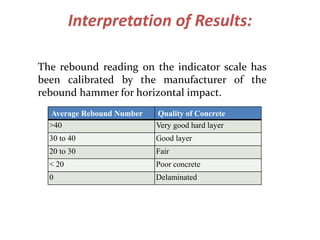
The rebound reading on the indicator scale has 
been calibrated by the manufacturer of the 
rebound hammer for horizontal impact. 
Average Rebound Number Quality of Concrete 
>40 Very good hard layer 
30 to 40 Good layer 
20 to 30 Fair 
< 20 Poor concrete 
0 Delaminated 
Table:- Average Rebound number and quality of concrete
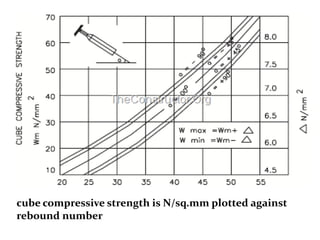
RELATIONSHIP B/W REBOUND HAMMER AND 
COMPRESSIVE STRENGTH
cube compressive strength is N/sq.mm plotted against 
rebound number
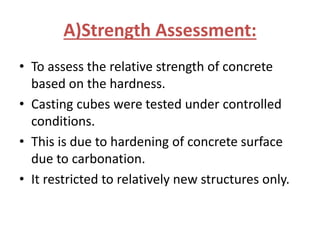
A)Strength Assessment: 
• To assess the relative strength of concrete 
based on the hardness. 
• Casting cubes were tested under controlled 
conditions. 
• This is due to hardening of concrete surface 
due to carbonation. 
• It restricted to relatively new structures only.
B)Survey of weak and delaminating 
concrete: 
• It helps to identify relative surface weakness 
in cover concrete and to determine the 
relative compressive strength of concrete. 
• This survey is carried by dividing the member 
into well-defined grid points. 
• The grid matrix should have a spacing of 
approximately 300mm x 300mm.
ADVANTAGE 
• Simple to use. No special experience 
is needed to conduct the test. 
• Establishes uniformity of properties. 
• Equipment is inexpensive and is 
readily available. 
• A wide variety of concrete test hammers is 
available with an operational range of 
M10 to M70. 
• For rehabilitation of old Monuments..
DISADVANTAGE 
• Evaluates only the local point and 
layer of masonry to which it is applied. 
• No direct relationship to strength or 
deformation properties. 
• Unreliable for the detection of flaws. 
• Cleaning maintenance of probe and spring 
mechanism
Conclusion 
• The rebound value can be measured discretionary, 
whereas the number of crushed specimens is limited. 
• The combination of both methods is the best and 
most reliable procedure to determine the compressive 
strength of concrete structures. 
• The method does not damage the structure like the 
classical method, where cores must be taken for the 
evaluation of the compressive strength. 
• It is a fast, inexpensive and easy to perform method 
using a light and portable test equipment.
REFERENCE 
• Estimating the Strength of Concrete Using 
Surface Rebound Value and Design Parameters 
of Concrete Material. Jen-Chei Liu, Mou-Lin Sue and Chang- 
Huan Kou*Department of Civil Engineering and Engineering Informatics‚ 
Chung-Hua University,Hsin Chu, Taiwan 300‚ R.O.C 
• CONCRETE TECHNOLOGY – A text book- ML Gambhir.
THANK YOU

Rebound Hammer Test-priciple,procedure,cons&pros.....

  • 1.
    Rebound hammer test. BY BY: AKSHAY R MANOHAR MTech-Construction Technology CIVIL ENGINEERING DEPT. NMAMIT-NITTE.
  • 2.
  • 5.
    CONTENTS • INTRODUCTION • PRINCIPLE • PROCEDURE • ADVANTAGES • DIS-ADVANTAGES • CONCLUSION
  • 6.
    INTRODUCTION • Therebound hammer test is one of the non-destructive tests used to check the compressive strength of concrete . • An empirical relationship has been determined between the a absorbed by the concrete when given a high impact and its compressive strength . • the rebound hammer is designed to carryout instant non-destructive test on concrete structure without damage and gives an immediate indication of the compressive strength of the concrete using the calibration curve applied each instrument . • the hammer is simply pressed firmly against the concrete whereupon a powerful internal spring is first compressed and thin tripped to deliver a hammer blow through the hardened concrete trip to the surface being tested.
  • 7.
    Rebound hammer test • Rebound hammer test is done to find out the compressive strength of concrete by using rebound hammer as per IS: 13311 (Part 2) – 1992. • Principle of the rebound hammer test is: The rebound of an elastic mass depends on the hardness of the surface against which its mass strikes. • When the plunger of the rebound hammer is pressed against the surface of the concrete, the Spring-controlled mass rebounds and the extent of such a rebound depends upon the surface hardness of the concrete. • The surface hardness and therefore the rebound is taken to be related to the compressive strength of the concrete.
  • 9.
    • The reboundvalue is read from a graduated scale and is designated as the rebound number or rebound index. • The compressive strength can be read directly from the graph provided on the body of the hammer.
  • 10.
    Procedure • Shouldbe tested against the test anvil. • Apply light pressure on the plunger and allow it to extend to the ready position for the test. • Apply a gradual increase in pressure until the hammer impacts. • Take the average of about 15 readings.
  • 11.
    Rebound Hammer test: •Assessing the likely compressive strength of concrete . •Assessing the quality of concrete in relation to standard requirements. • NDT
  • 12.
    Interpretation of Results: The rebound reading on the indicator scale has been calibrated by the manufacturer of the rebound hammer for horizontal impact. Average Rebound Number Quality of Concrete >40 Very good hard layer 30 to 40 Good layer 20 to 30 Fair < 20 Poor concrete 0 Delaminated Table:- Average Rebound number and quality of concrete
  • 13.
    RELATIONSHIP B/W REBOUNDHAMMER AND COMPRESSIVE STRENGTH
  • 14.
    cube compressive strengthis N/sq.mm plotted against rebound number
  • 16.
    A)Strength Assessment: •To assess the relative strength of concrete based on the hardness. • Casting cubes were tested under controlled conditions. • This is due to hardening of concrete surface due to carbonation. • It restricted to relatively new structures only.
  • 17.
    B)Survey of weakand delaminating concrete: • It helps to identify relative surface weakness in cover concrete and to determine the relative compressive strength of concrete. • This survey is carried by dividing the member into well-defined grid points. • The grid matrix should have a spacing of approximately 300mm x 300mm.
  • 18.
    ADVANTAGE • Simpleto use. No special experience is needed to conduct the test. • Establishes uniformity of properties. • Equipment is inexpensive and is readily available. • A wide variety of concrete test hammers is available with an operational range of M10 to M70. • For rehabilitation of old Monuments..
  • 20.
    DISADVANTAGE • Evaluatesonly the local point and layer of masonry to which it is applied. • No direct relationship to strength or deformation properties. • Unreliable for the detection of flaws. • Cleaning maintenance of probe and spring mechanism
  • 21.
    Conclusion • Therebound value can be measured discretionary, whereas the number of crushed specimens is limited. • The combination of both methods is the best and most reliable procedure to determine the compressive strength of concrete structures. • The method does not damage the structure like the classical method, where cores must be taken for the evaluation of the compressive strength. • It is a fast, inexpensive and easy to perform method using a light and portable test equipment.
  • 22.
    REFERENCE • Estimatingthe Strength of Concrete Using Surface Rebound Value and Design Parameters of Concrete Material. Jen-Chei Liu, Mou-Lin Sue and Chang- Huan Kou*Department of Civil Engineering and Engineering Informatics‚ Chung-Hua University,Hsin Chu, Taiwan 300‚ R.O.C • CONCRETE TECHNOLOGY – A text book- ML Gambhir.
  • 23.