Concrete Technology
Dr Suryamani Behera
Cement: Portland cement- chemical composition, Hydration, Setting of cement, Structure of hydrate cement,
Test on physical properties, Different grades of cement.
Admixtures: Types of admixtures - mineral and chemical admixtures -properties - dosages - effects - usage.
Aggregates: Classification of aggregate, Particle shape & texture, Bond, strength & other mechanical
properties of aggregate, Specific gravity, Bulk density, porosity, adsorption & moisture content of aggregate,
Bulking of sand, Deleterious substance in aggregate, Soundness of aggregate, Alkali aggregate reaction,
Thermal properties, Sieve analysis, Fineness modulus, Grading curves, Grading of fine & coarse Aggregates,
Gap graded aggregate, Maximum aggregate size.
21/08/2025 Concrete Technology by Dr Suryamani Behera 2
Cement
 Cement is a material with adhesive and cohesive properties which make it capable of bonding mineral fragments into
a compact whole. For constructional purposes, the meaning of the term "cement" is restricted to the binding materials
used with stones, sand, bricks, etc.
 The name "Portland cement" was given originally due to the resemblance of the colour and quality of the hardened
cement to Portland stone (found in Portland Island, England).
Properties of Cement
The important properties of cement are as follows:
 It acts as an excellent binding material.
 It gives strength to the concrete or masonry.
 It offers good resistance to the moisture.
 It makes the fresh concrete or mortar easily workable.
 It stiffens or hardens in less time.
21/08/2025 Concrete Technology by Dr Suryamani Behera 3
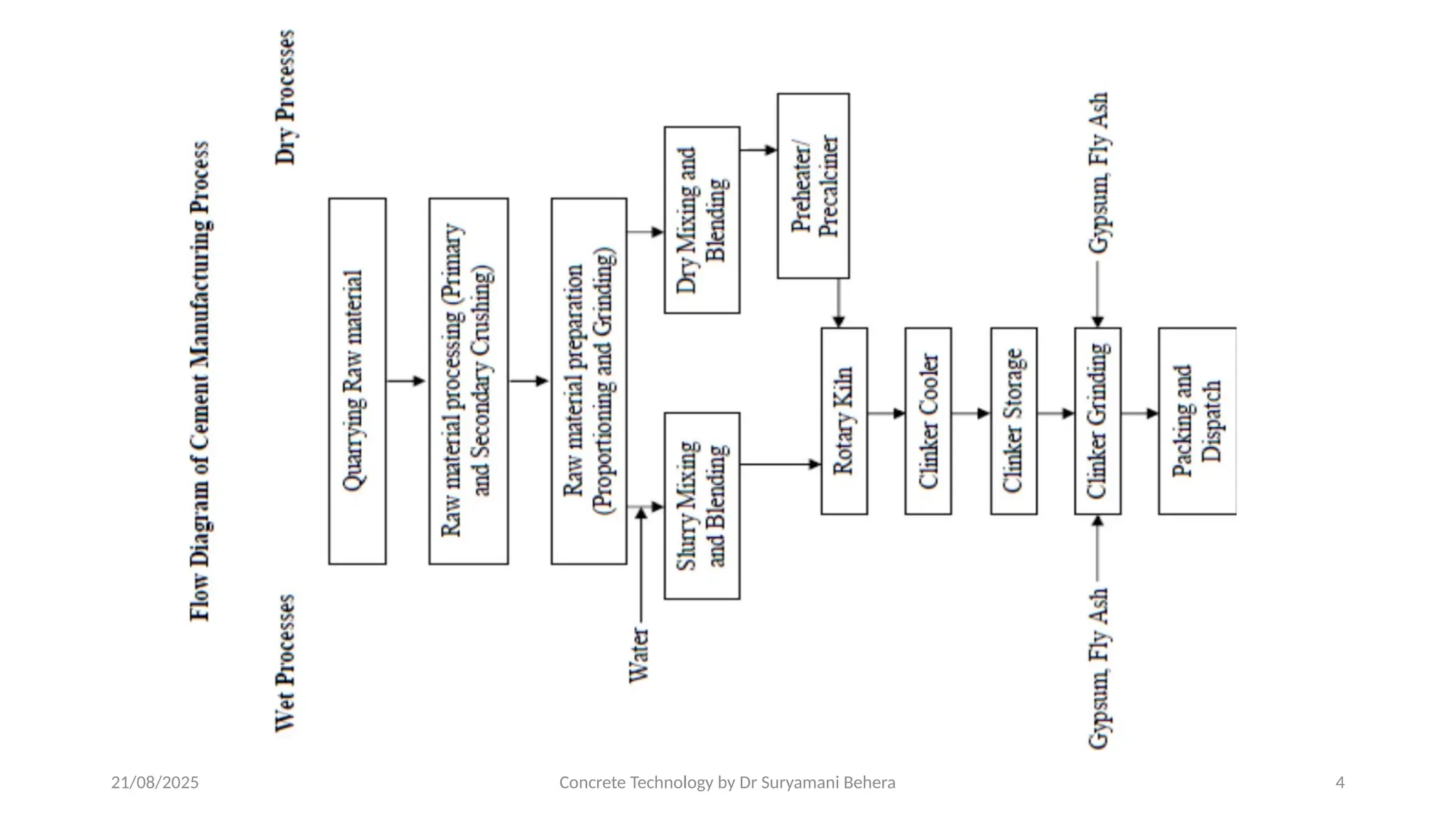
Manufacturing Process of Portland cement
Raw materials
• Calcareous material – such as limestone or chalk, as a source of lime (CaO).
• Clayey material – such as clay or shale (soft clayey stones), as a source of silica and alumina.
There are four stages in the manufacture of Portland cement:
1. crushing and grinding the raw materials,
2. blending the materials in the correct proportions,
3. burning the prepared mix in a kiln, and
4. grinding the burned product, known as “clinker” (3-25 mm diameter) together with some 5 per cent of gypsum (to
control the time of set of the cement).
Methods of Cement Manufacturing
The three processes of manufacturing cement are:
5. Wet process - raw materials are ground wet and fed to the kiln as a slurry.
6. Dry process - raw materials are ground dry and fed as a dry powder.
7. Semidry process - raw materials are ground dry and then moistened to form nodules that are fed to the kiln.
21/08/2025 Concrete Technology by Dr Suryamani Behera 4
21/08/2025 Concrete Technology by Dr Suryamani Behera 5
21/08/2025 Concrete Technology by Dr Suryamani Behera 6
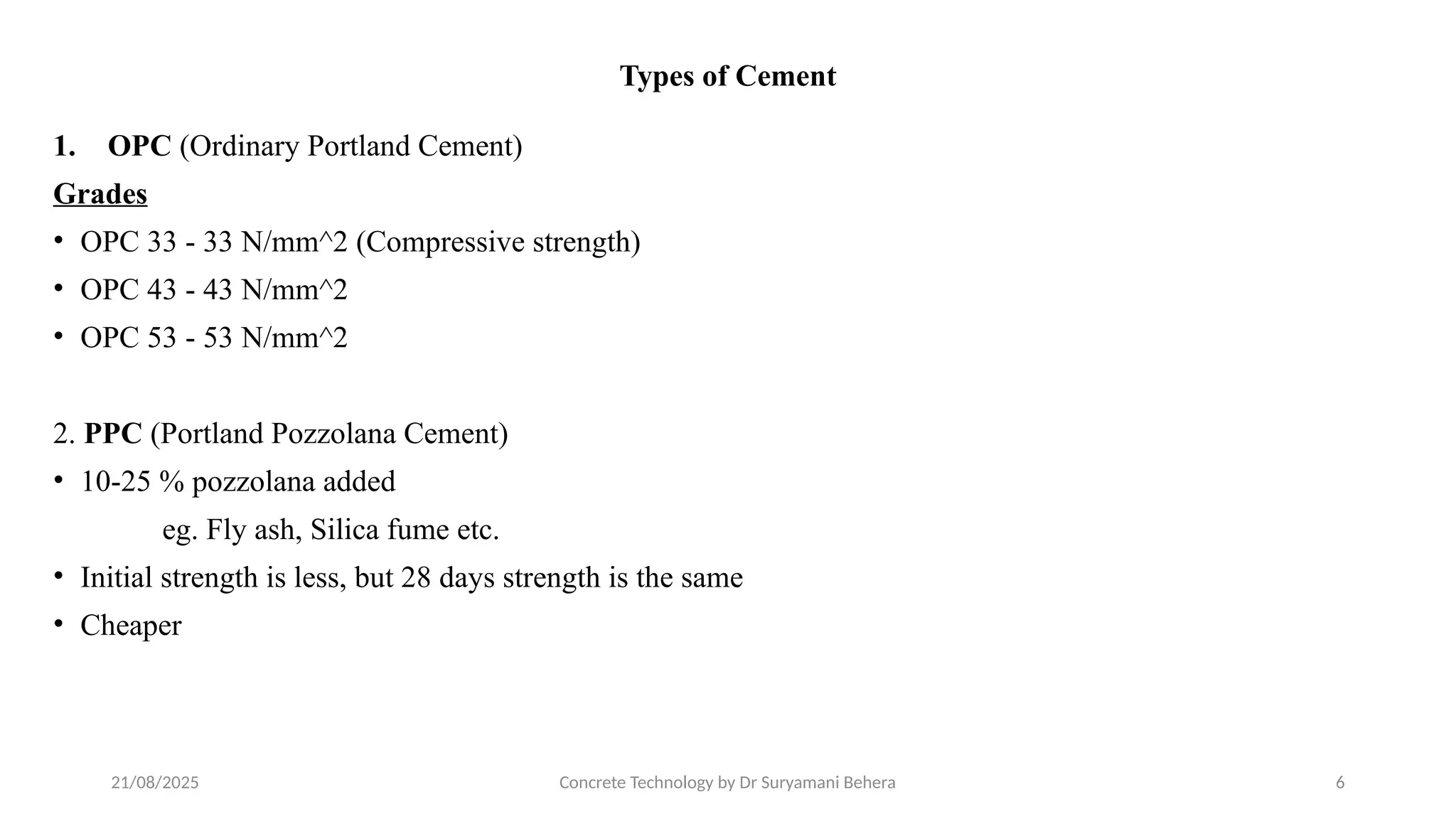
Types of Cement
1. OPC (Ordinary Portland Cement)
Grades
• OPC 33 - 33 N/mm^2 (Compressive strength)
• OPC 43 - 43 N/mm^2
• OPC 53 - 53 N/mm^2
2. PPC (Portland Pozzolana Cement)
• 10-25 % pozzolana added
eg. Fly ash, Silica fume etc.
• Initial strength is less, but 28 days strength is the same
• Cheaper
21/08/2025 Concrete Technology by Dr Suryamani Behera 7
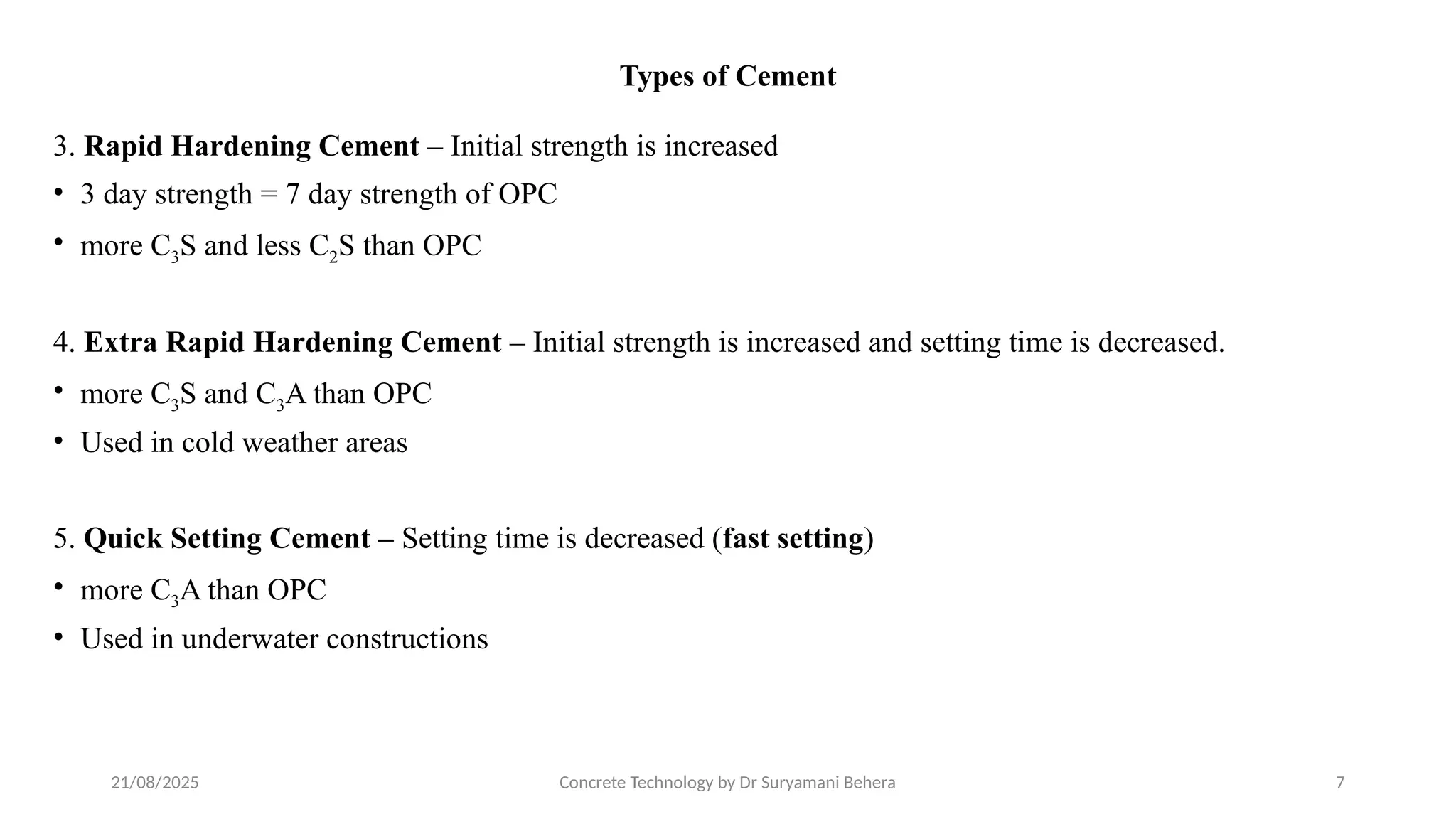
Types of Cement
3. Rapid Hardening Cement – Initial strength is increased
• 3 day strength = 7 day strength of OPC
• more C3S and less C2S than OPC
4. Extra Rapid Hardening Cement – Initial strength is increased and setting time is decreased.
• more C3S and C3A than OPC
• Used in cold weather areas
5. Quick Setting Cement – Setting time is decreased (fast setting)
• more C3A than OPC
• Used in underwater constructions
21/08/2025 Concrete Technology by Dr Suryamani Behera 8
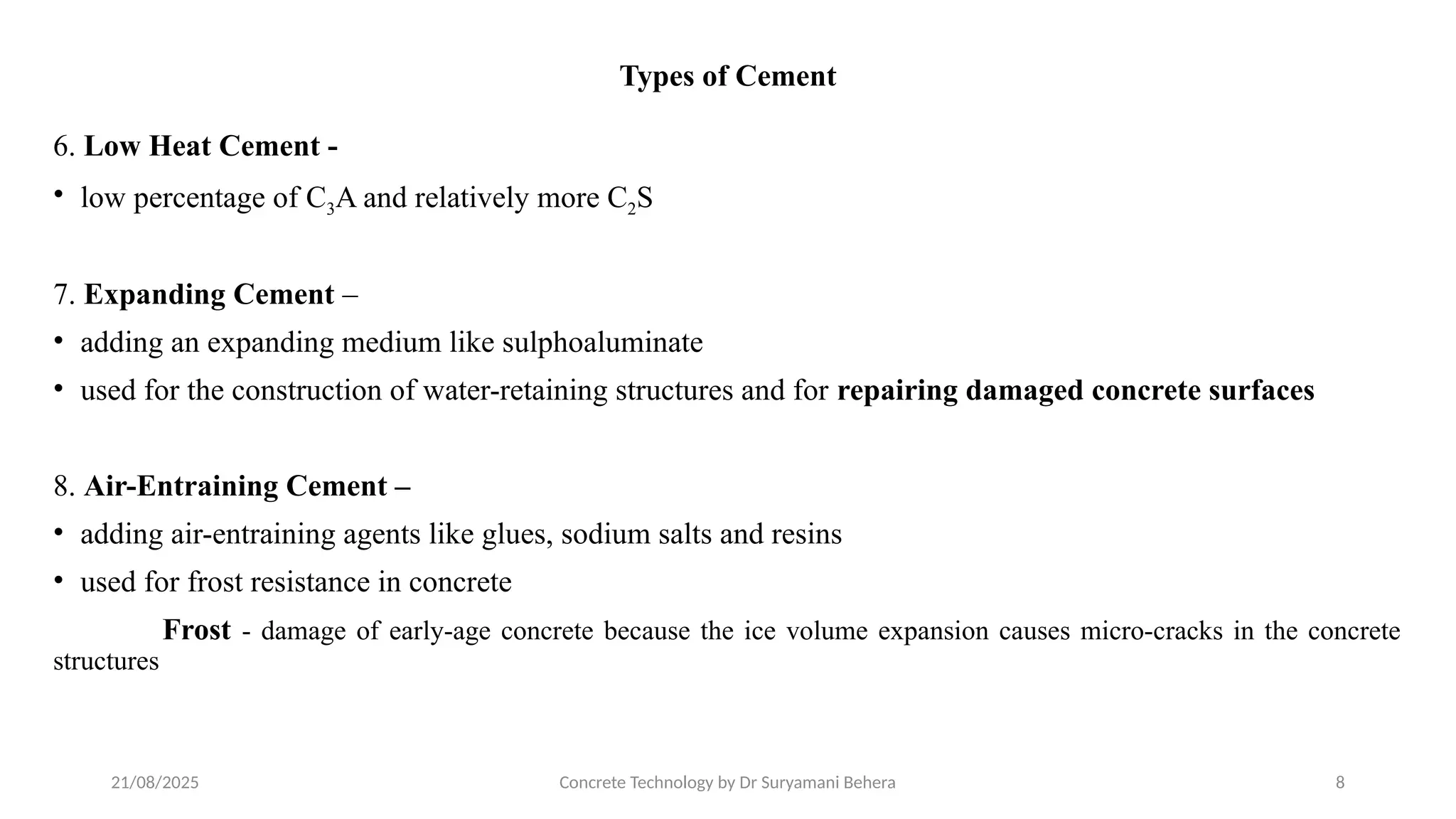
Types of Cement
6. Low Heat Cement -
• low percentage of C3A and relatively more C2S
7. Expanding Cement –
• adding an expanding medium like sulphoaluminate
• used for the construction of water-retaining structures and for repairing damaged concrete surfaces
8. Air-Entraining Cement –
• adding air-entraining agents like glues, sodium salts and resins
• used for frost resistance in concrete
Frost - damage of early-age concrete because the ice volume expansion causes micro-cracks in the concrete
structures
21/08/2025 Concrete Technology by Dr Suryamani Behera 9
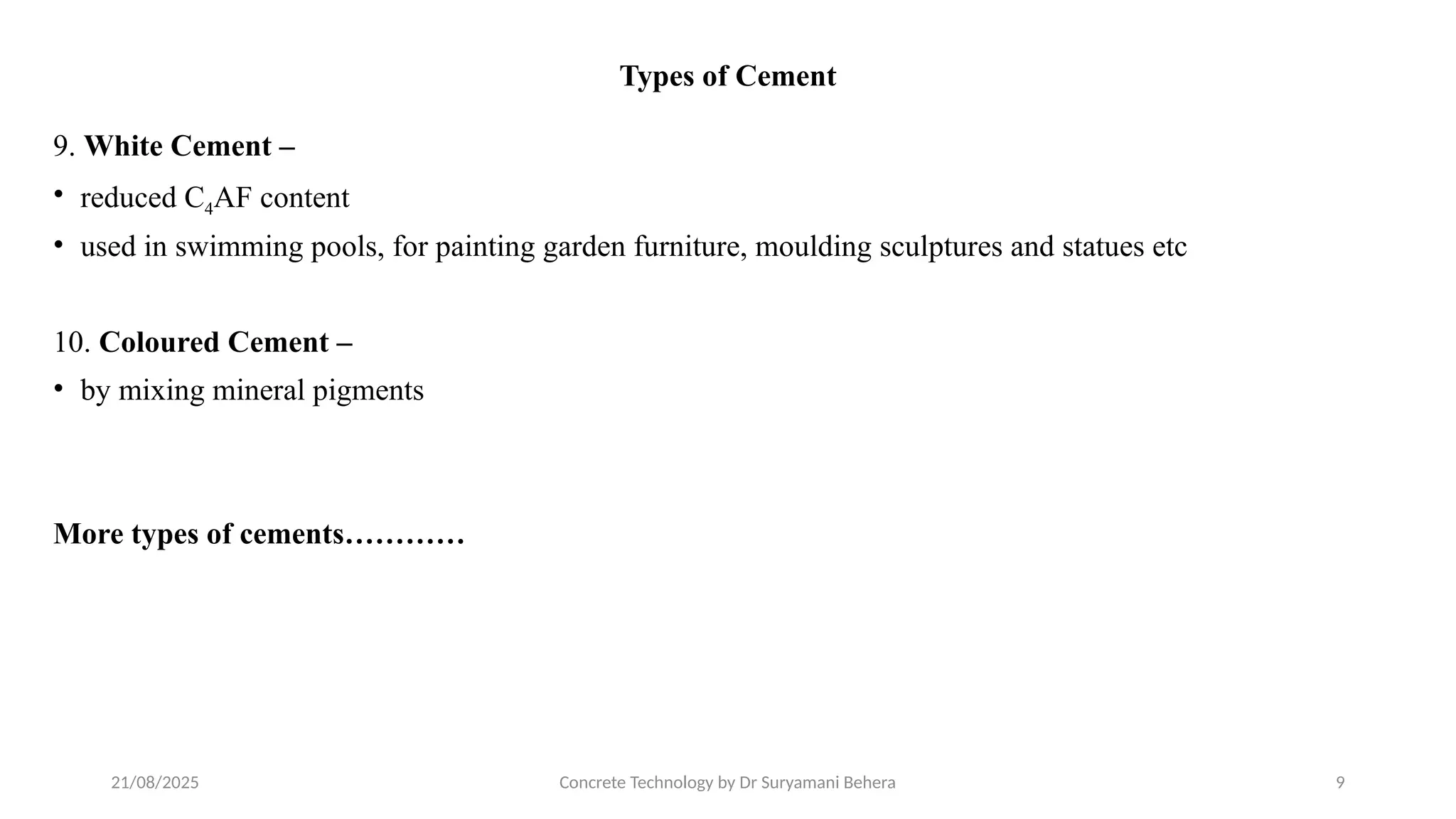
Types of Cement
9. White Cement –
• reduced C4AF content
• used in swimming pools, for painting garden furniture, moulding sculptures and statues etc
10. Coloured Cement –
• by mixing mineral pigments
More types of cements…………
21/08/2025 Concrete Technology by Dr Suryamani Behera 10
Various tests on Cement
• Field test
• Laboratory test
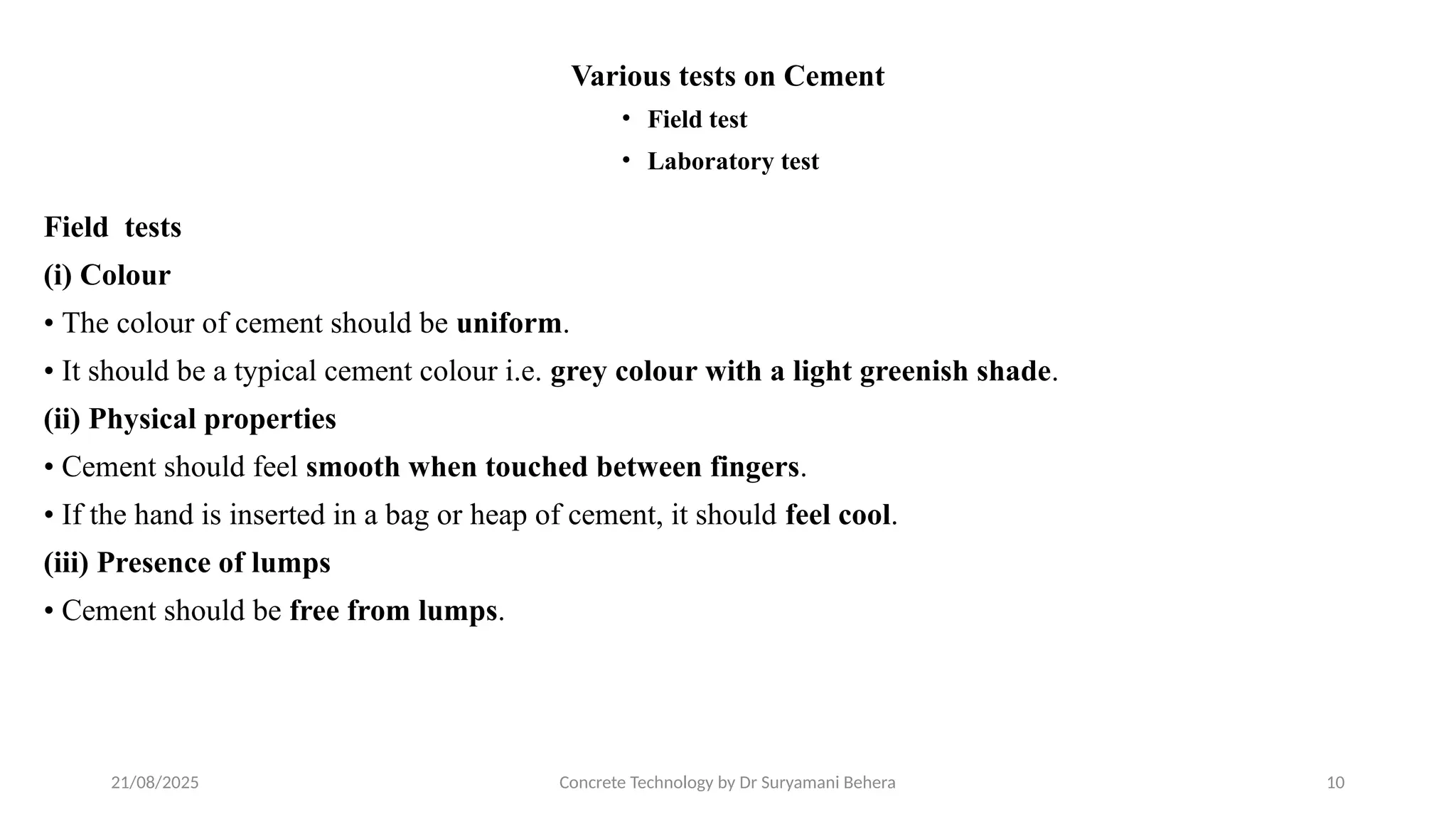
Field tests
(i) Colour
• The colour of cement should be uniform.
• It should be a typical cement colour i.e. grey colour with a light greenish shade.
(ii) Physical properties
• Cement should feel smooth when touched between fingers.
• If the hand is inserted in a bag or heap of cement, it should feel cool.
(iii) Presence of lumps
• Cement should be free from lumps.
21/08/2025 Concrete Technology by Dr Suryamani Behera 11
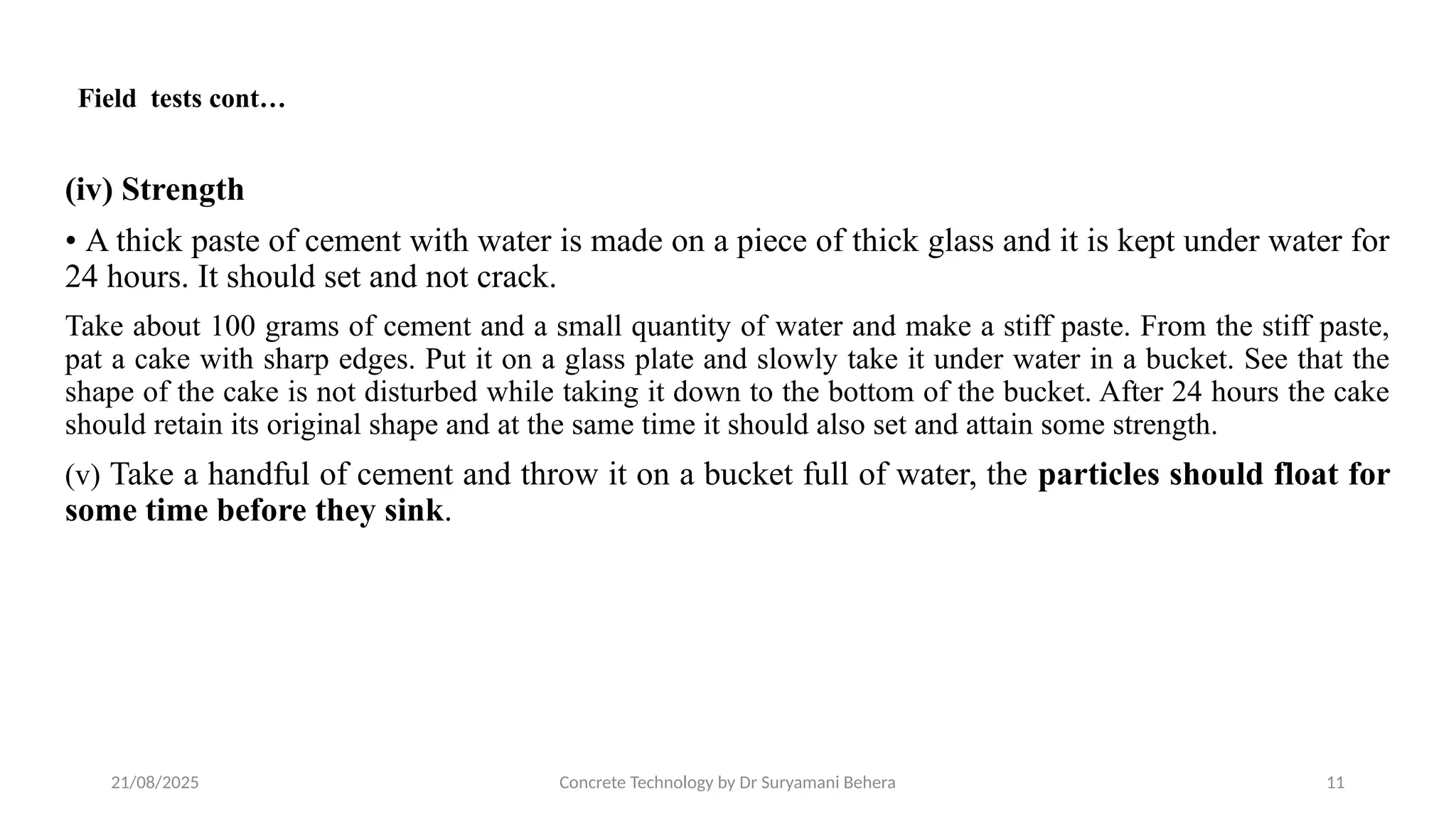
(iv) Strength
• A thick paste of cement with water is made on a piece of thick glass and it is kept under water for
24 hours. It should set and not crack.
Take about 100 grams of cement and a small quantity of water and make a stiff paste. From the stiff paste,
pat a cake with sharp edges. Put it on a glass plate and slowly take it under water in a bucket. See that the
shape of the cake is not disturbed while taking it down to the bottom of the bucket. After 24 hours the cake
should retain its original shape and at the same time it should also set and attain some strength.
(v) Take a handful of cement and throw it on a bucket full of water, the particles should float for
some time before they sink.
Field tests cont…
21/08/2025 Concrete Technology by Dr Suryamani Behera 12
Laboratory tests:
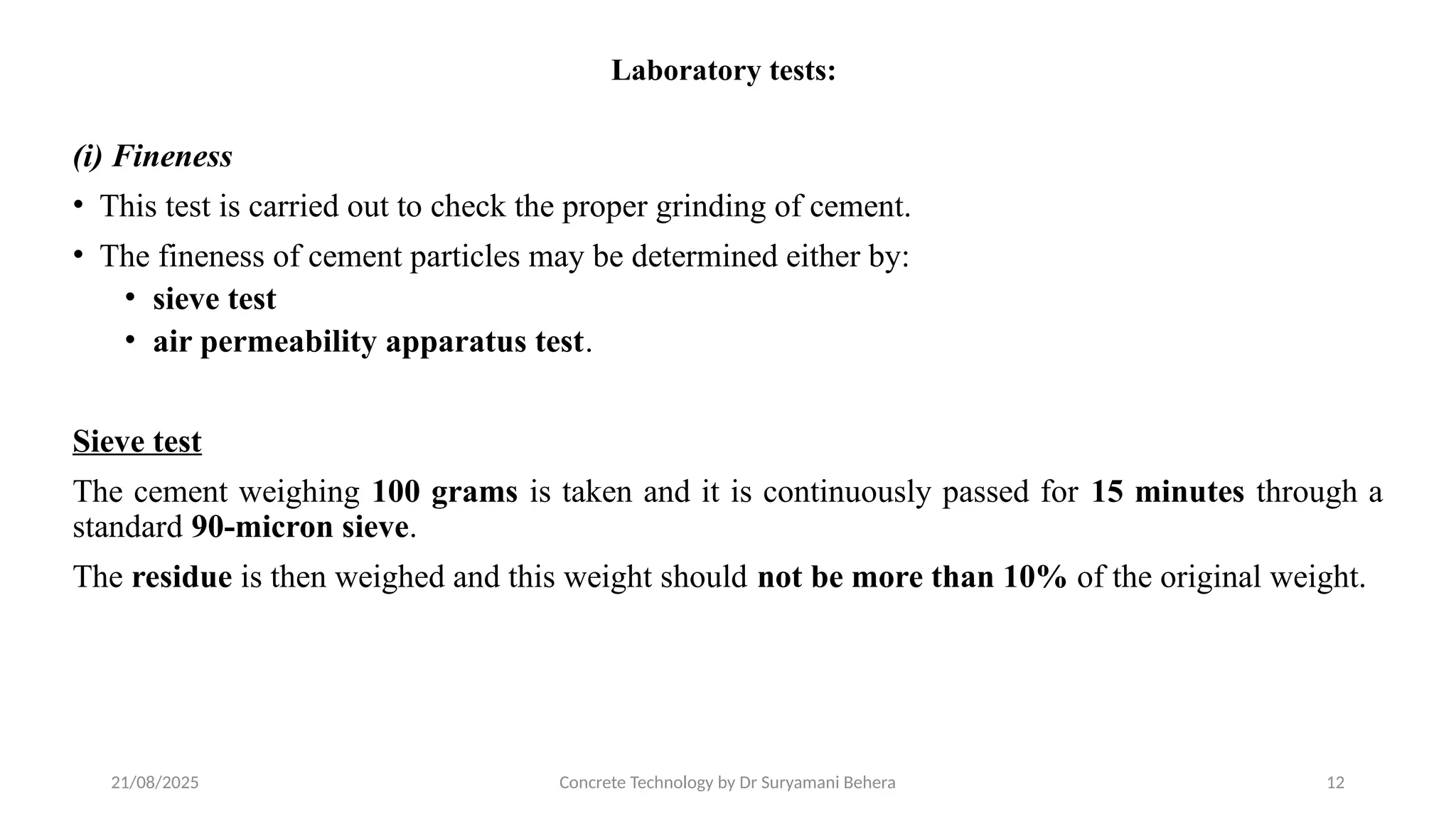
(i) Fineness
• This test is carried out to check the proper grinding of cement.
• The fineness of cement particles may be determined either by:
• sieve test
• air permeability apparatus test.
Sieve test
The cement weighing 100 grams is taken and it is continuously passed for 15 minutes through a
standard 90-micron sieve.
The residue is then weighed and this weight should not be more than 10% of the original weight.
21/08/2025 Concrete Technology by Dr Suryamani Behera 13
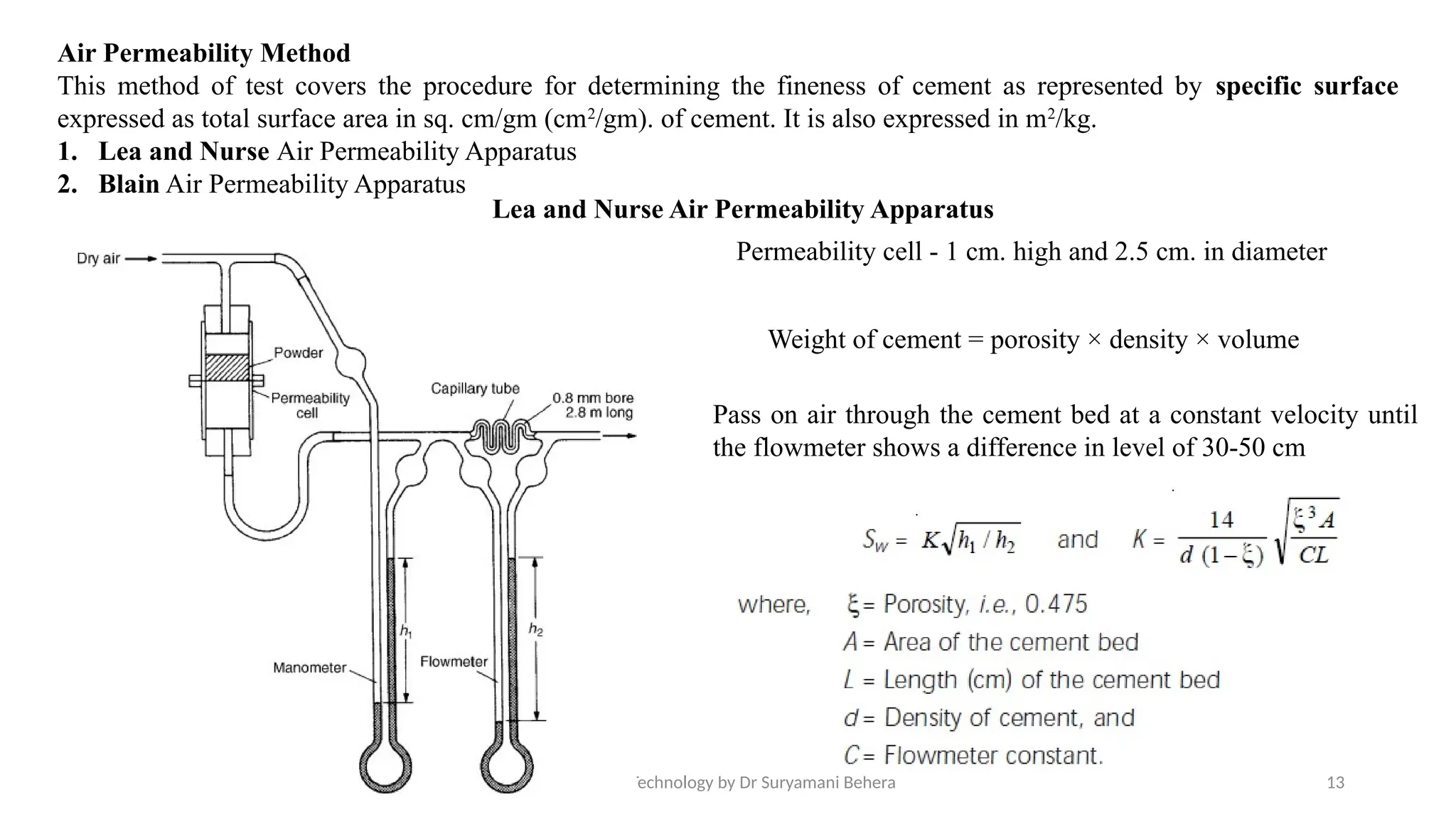
Air Permeability Method
This method of test covers the procedure for determining the fineness of cement as represented by specific surface
expressed as total surface area in sq. cm/gm (cm2
/gm). of cement. It is also expressed in m2
/kg.
1. Lea and Nurse Air Permeability Apparatus
2. Blain Air Permeability Apparatus
Weight of cement = porosity × density × volume
Permeability cell - 1 cm. high and 2.5 cm. in diameter
Pass on air through the cement bed at a constant velocity until
the flowmeter shows a difference in level of 30-50 cm
Lea and Nurse Air Permeability Apparatus
21/08/2025 Concrete Technology by Dr Suryamani Behera 14
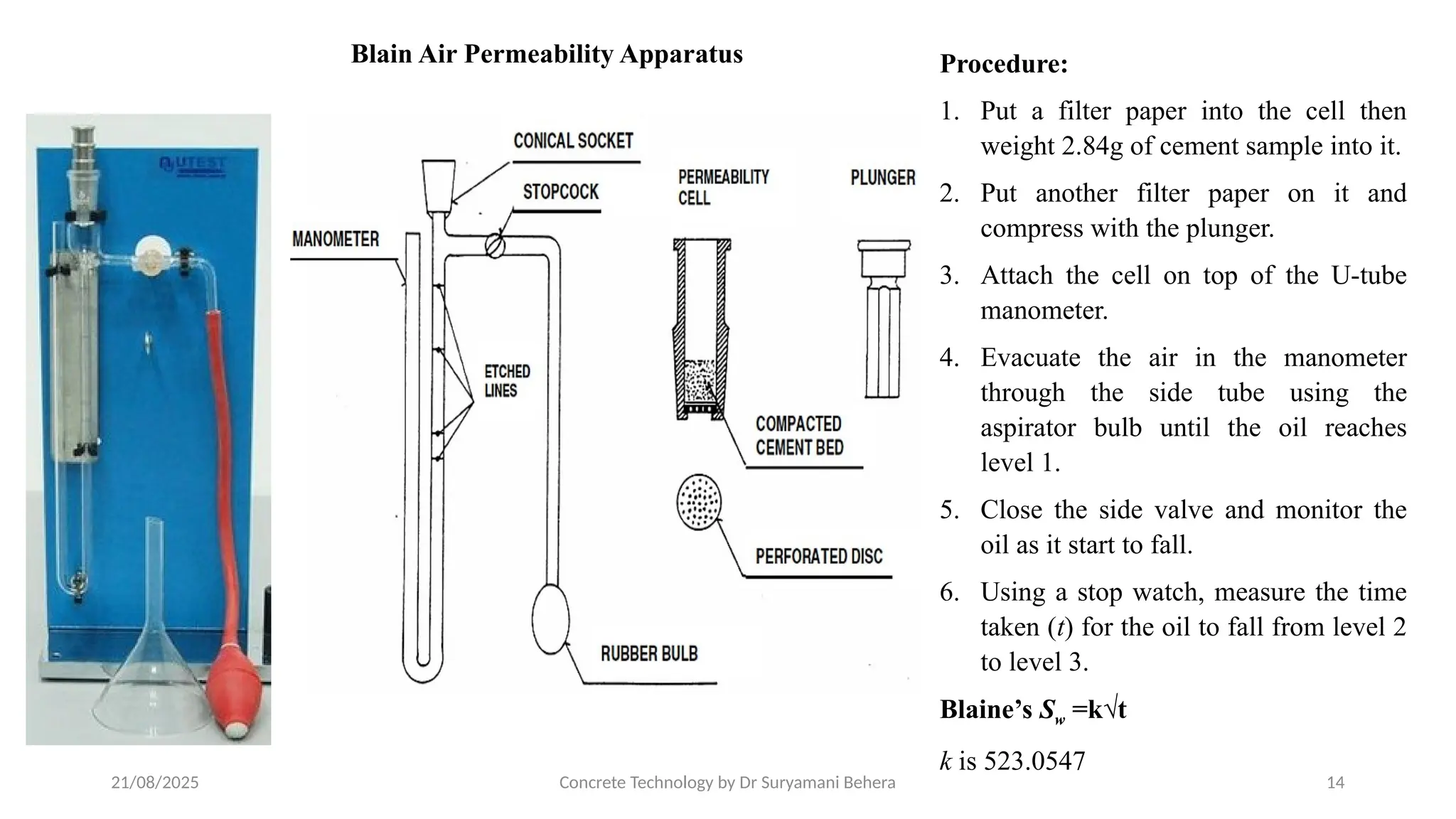
Blain Air Permeability Apparatus Procedure:
1. Put a filter paper into the cell then
weight 2.84g of cement sample into it.
2. Put another filter paper on it and
compress with the plunger.
3. Attach the cell on top of the U-tube
manometer.
4. Evacuate the air in the manometer
through the side tube using the
aspirator bulb until the oil reaches
level 1.
5. Close the side valve and monitor the
oil as it start to fall.
6. Using a stop watch, measure the time
taken (t) for the oil to fall from level 2
to level 3.
Blaine’s Sw =k√t
k is 523.0547
21/08/2025 Concrete Technology by Dr Suryamani Behera 15
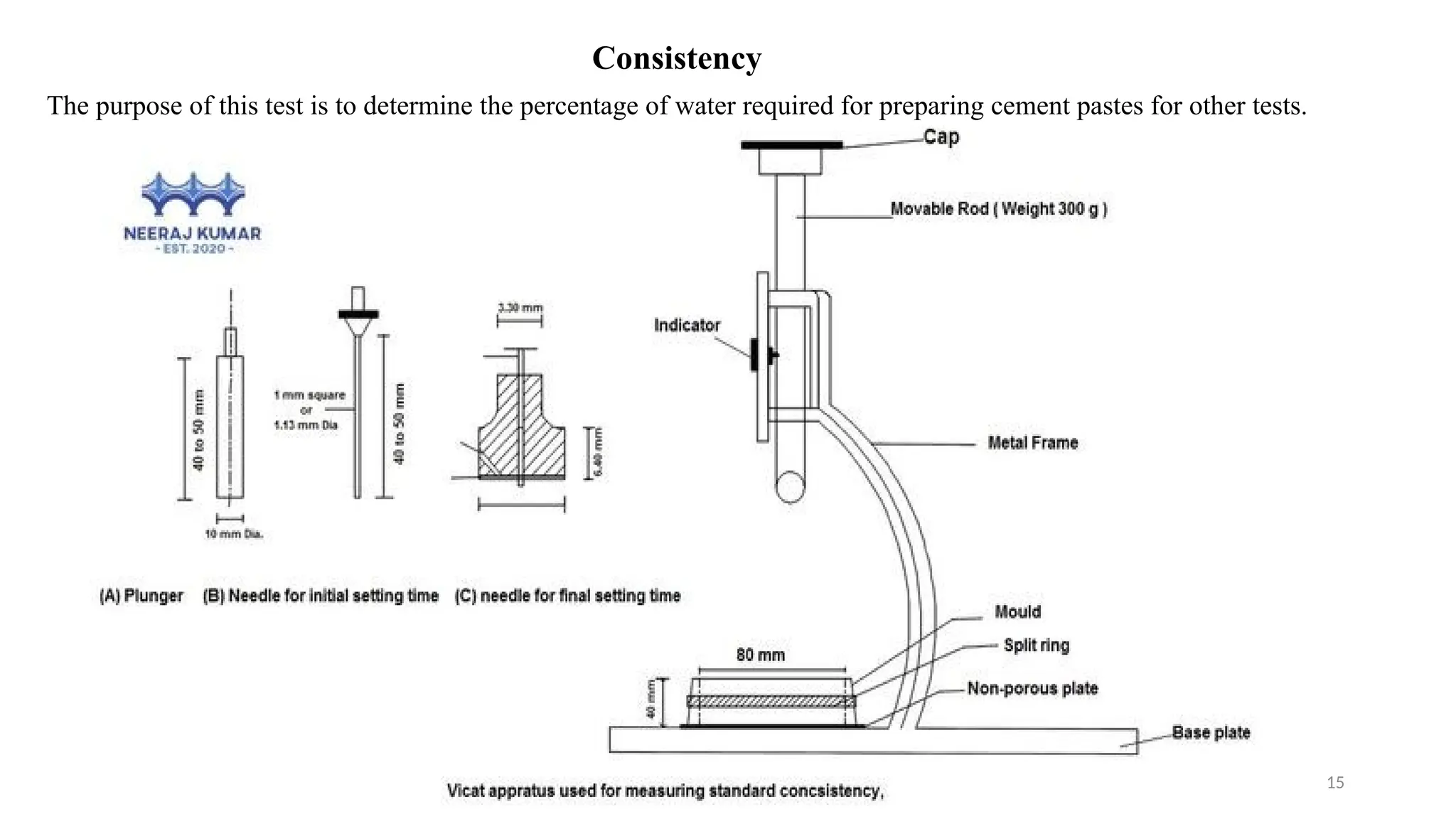
Consistency
The purpose of this test is to determine the percentage of water required for preparing cement pastes for other tests.
21/08/2025 Concrete Technology by Dr Suryamani Behera 16
21/08/2025 Concrete Technology by Dr Suryamani Behera 17
• Take 300 gm of cement and add 30 per cent by weight or 90 gm of water to it.
• Fill the mould of the Vicat’s apparatus and the gauging time should be 3.75 to 4.25
minutes.
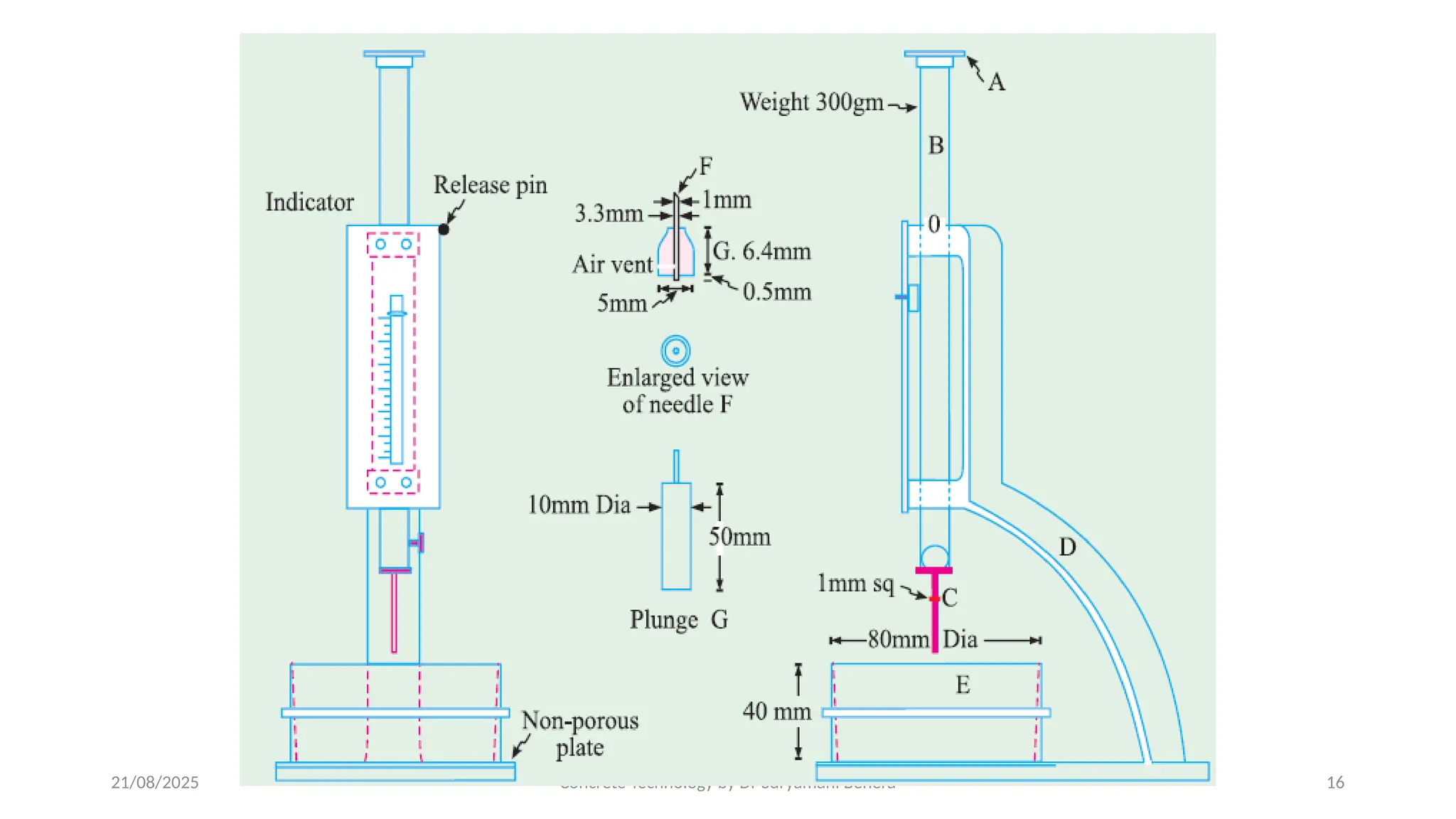
• Vicat apparatus consists of a movable rod with an indicator attached to it. The
movable rod bears the needles.
• There are three attachments: plunger, square needle, and needle with annular
collar.
• The plunger is attached to the movable rod for the consistency test. The plunger is
brought down to touch the surface of the paste in the test block and quickly released
allowing it to sink into the paste by its own weight.
• The settlement of the plunger is noted. If the penetration is between 5 mm to 7 mm
from the bottom of the mould, the water added is correct. If not, the process is
repeated with different percentages of water till the desired penetration is obtained.
Consistency test
21/08/2025 Concrete Technology by Dr Suryamani Behera 18
Setting time test
The time taken by the cement to harden is called the setting time of cement.
The setting time of cement is differentiated on the basis of the time taken by the cement to set.
 Initial setting time
 Final setting time
A Vicat’s apparatus is used to determine the setting time of cement.
Test procedure
Initial Preparation
1. Consistency test to be done before starting the test procedure to find out the water required to give the paste
normal consistency (P).
2. Take 400 gm of cement and prepare a neat cement paste with 0.85P of water by the weight of the cement.
3. Gauge time is kept between 3 to 5 minutes. Start the stopwatch at the instant when the water is added to the
cement. Record this time (T1).
4. Fill the Vicat mould, resting on a glass plate, with the cement paste gauged as above. Fill the mould completely
and smooth off the surface of the paste making it level with the top of the mould. The cement block thus
prepared is called a test block.
21/08/2025 Concrete Technology by Dr Suryamani Behera 19
Test for Initial Setting Time
1. Place the test block confined in the mould and resting on
the non-porous plate, under the rod bearing the needle
with a 1 mm square cross-section.
2. Lower the needle gently until it comes in contact with the
surface of the test block and quickly release, allowing it
to penetrate the test block.
3. In the beginning the needle completely pierces the test
block. Repeat this procedure i.e. quickly releasing the
needle after every 2 minutes till the needle fails to
pierce the block for about 5 mm measured from the
bottom of the mould. Note this time (T2).
Test for Final Setting Time
1. For determining the final setting time, replace the
needle of the Vicat’s apparatus with the needle having
an annular hollow metallic attachment with a
circular cutting edge of 5 mm diameter and having a
0.5 mm projection at the end.
2. The cement is considered finally set, when upon
applying the final setting needle gently to the surface of
the test block, the 0.5 mm projection of the needle
makes an impression thereon, while the 5 mm
diameter attachment fails to do so. Record this time
(T3).
Initial setting time=T2-T1
Final setting time=T3-T1
T1 =Time at which water is first added to cement
T2 =Time when needle fails to penetrate 5 mm to 7 mm from the bottom of the mould
T3 =Time when the needle makes an impression but the attachment fails to do so.
Initial setting time should not be less than 30 minutes for ordinary Portland cement.
Final setting time should not be more than 10 hours.
21/08/2025 Concrete Technology by Dr Suryamani Behera 20
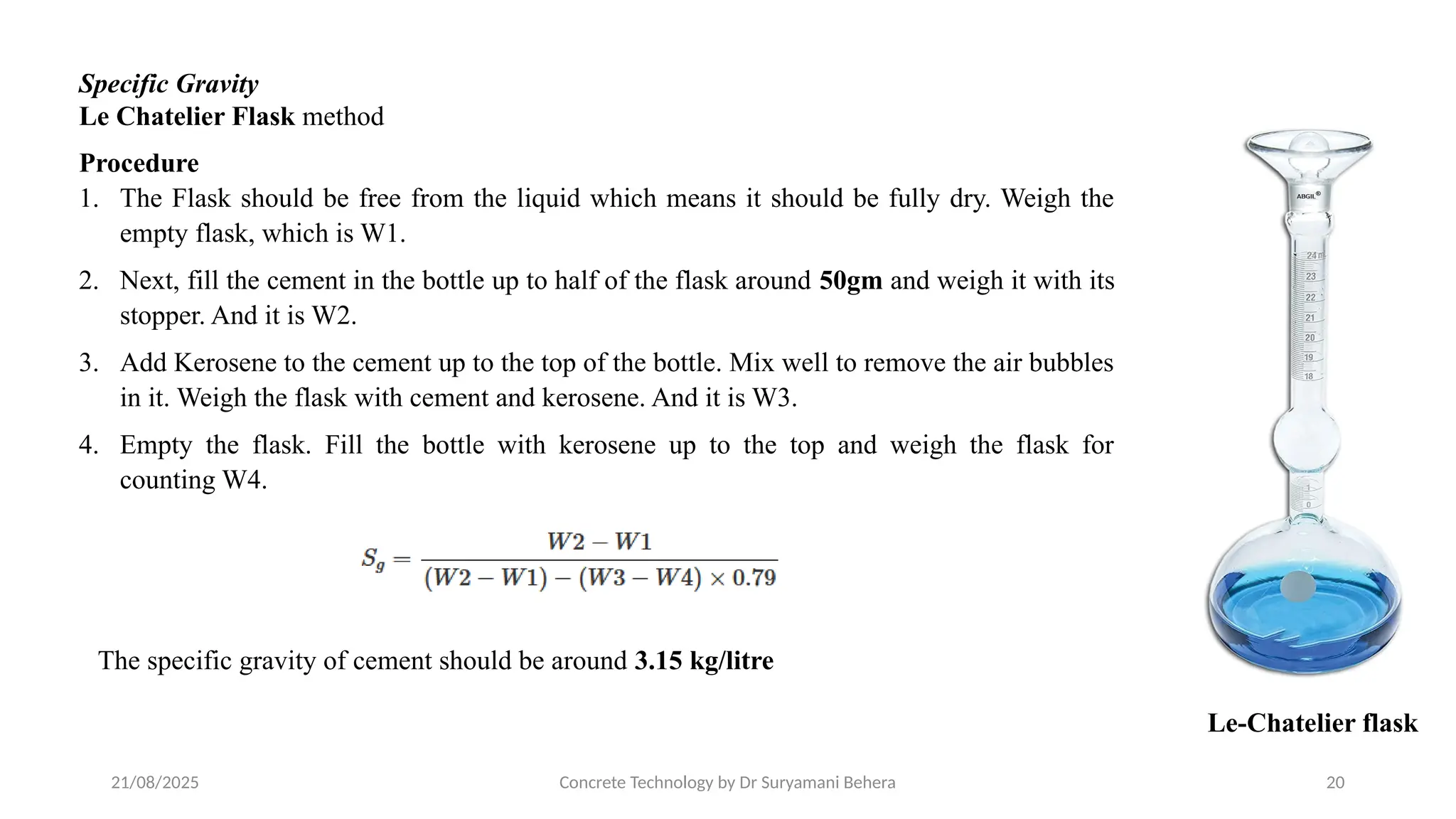
Specific Gravity
Le Chatelier Flask method
Le-Chatelier flask
Procedure
1. The Flask should be free from the liquid which means it should be fully dry. Weigh the
empty flask, which is W1.
2. Next, fill the cement in the bottle up to half of the flask around 50gm and weigh it with its
stopper. And it is W2.
3. Add Kerosene to the cement up to the top of the bottle. Mix well to remove the air bubbles
in it. Weigh the flask with cement and kerosene. And it is W3.
4. Empty the flask. Fill the bottle with kerosene up to the top and weigh the flask for
counting W4.
The specific gravity of cement should be around 3.15 kg/litre
21/08/2025 Concrete Technology by Dr Suryamani Behera 21
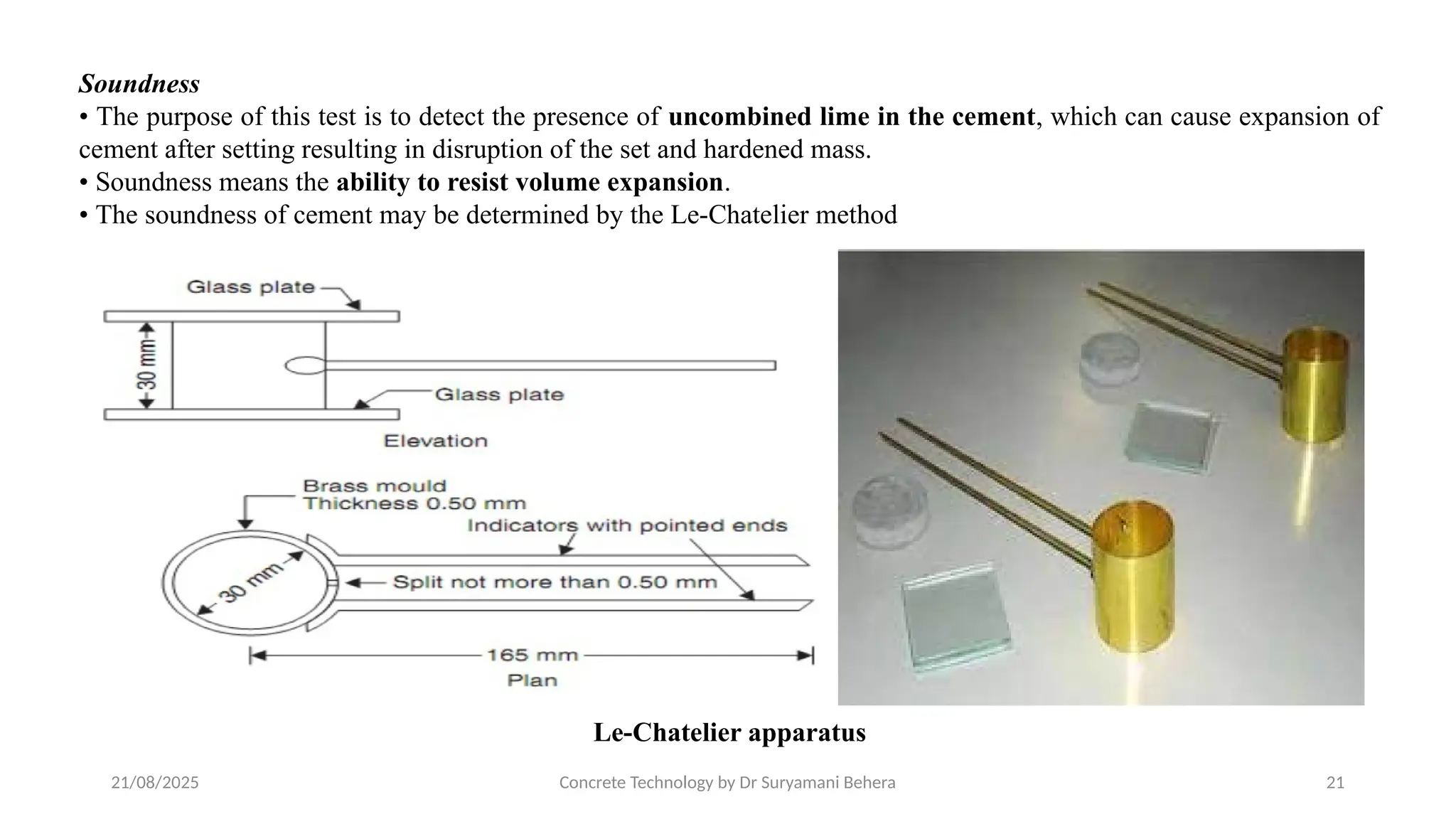
Soundness
• The purpose of this test is to detect the presence of uncombined lime in the cement, which can cause expansion of
cement after setting resulting in disruption of the set and hardened mass.
• Soundness means the ability to resist volume expansion.
• The soundness of cement may be determined by the Le-Chatelier method
Le-Chatelier apparatus
21/08/2025 Concrete Technology by Dr Suryamani Behera 22
Procedure
• Prepare a cement paste as in the consistency test with 0.78P water.
• The mould is placed on a glass plate and is filled with cement paste.
• It is covered at the top by another glass plate. A small weight is placed at the top and the whole assembly is
submerged in water for 24 hours.
• The distance between the points of the indicator is noted. The mould is again placed in water and heat is
applied in such a way that the boiling point of water is reached in about 30 minutes. The boiling of water
is continued for 3 hours.
• The mould is removed from water and it is allowed to cool down.
• The distance between the points of the indicator is again measured. The difference between the two readings
indicates the expansion of cement and it should not exceed 10 mm.
21/08/2025 Concrete Technology by Dr Suryamani Behera 23
Compressive
strength
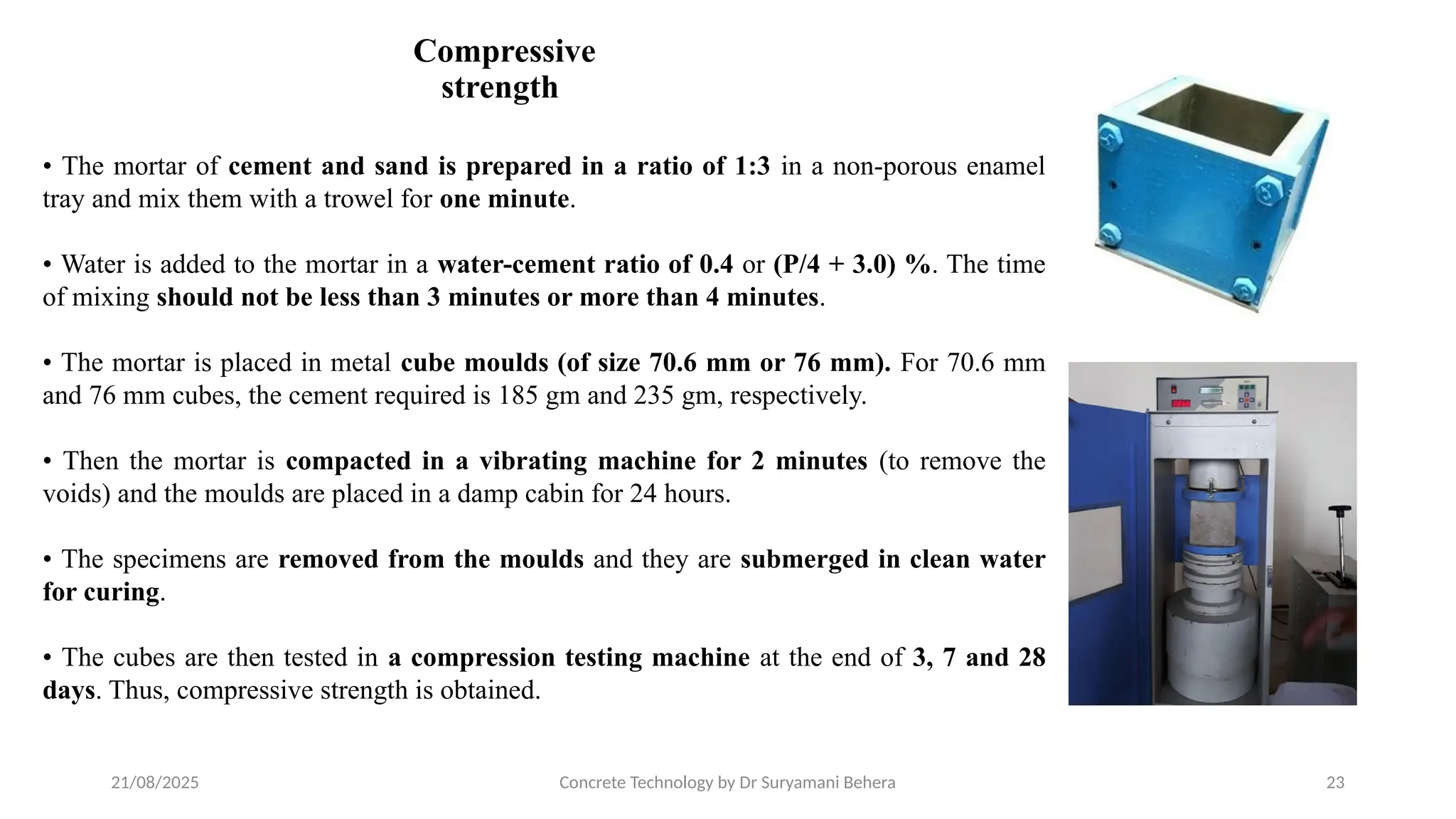
• The mortar of cement and sand is prepared in a ratio of 1:3 in a non-porous enamel
tray and mix them with a trowel for one minute.
• Water is added to the mortar in a water-cement ratio of 0.4 or (P/4 + 3.0) %. The time
of mixing should not be less than 3 minutes or more than 4 minutes.
• The mortar is placed in metal cube moulds (of size 70.6 mm or 76 mm). For 70.6 mm
and 76 mm cubes, the cement required is 185 gm and 235 gm, respectively.
• Then the mortar is compacted in a vibrating machine for 2 minutes (to remove the
voids) and the moulds are placed in a damp cabin for 24 hours.
• The specimens are removed from the moulds and they are submerged in clean water
for curing.
• The cubes are then tested in a compression testing machine at the end of 3, 7 and 28
days. Thus, compressive strength is obtained.
21/08/2025 Concrete Technology by Dr Suryamani Behera 24
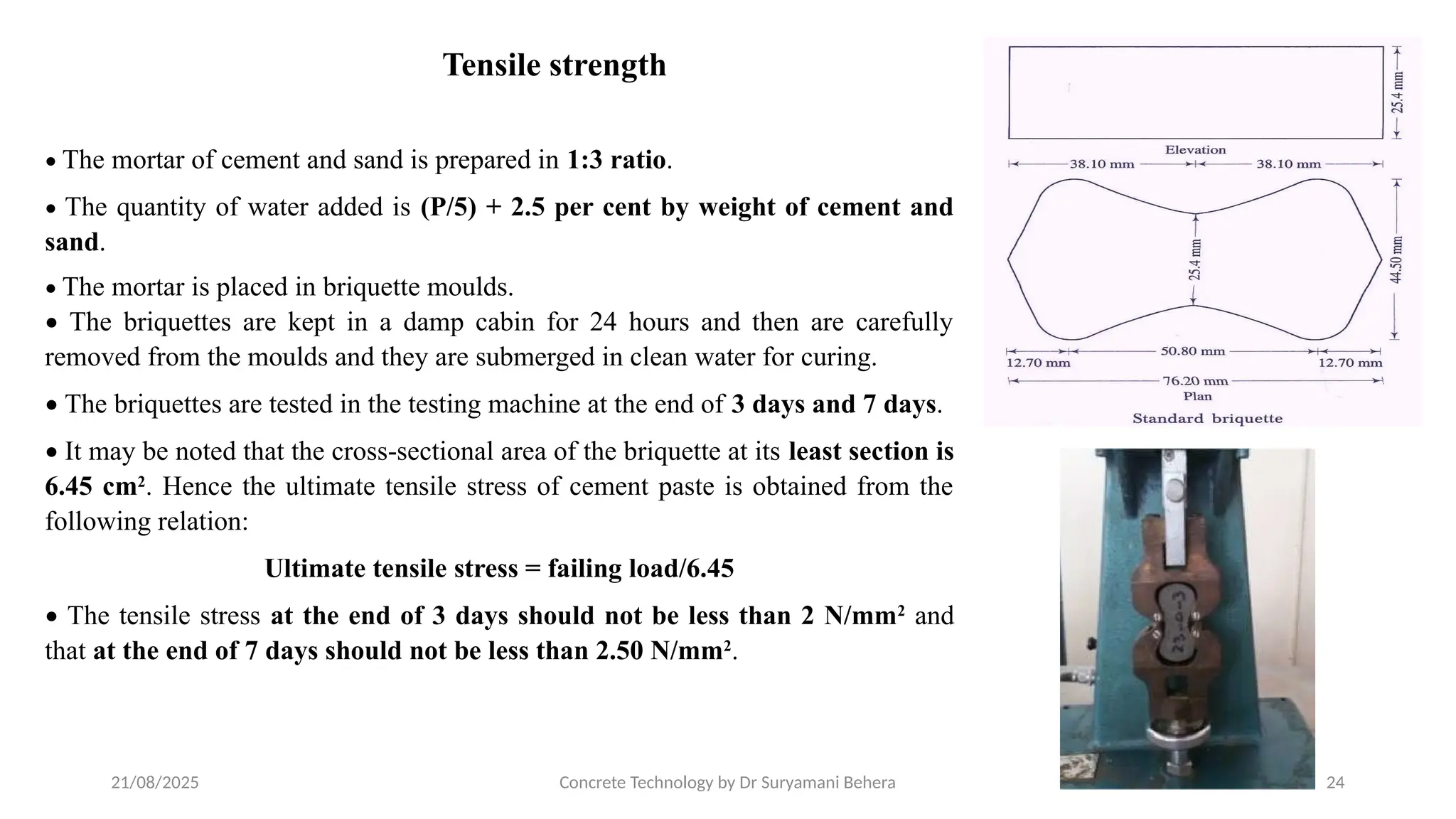
Tensile strength
• The mortar of cement and sand is prepared in 1:3 ratio.
• The quantity of water added is (P/5) + 2.5 per cent by weight of cement and
sand.
• The mortar is placed in briquette moulds.
• The briquettes are kept in a damp cabin for 24 hours and then are carefully
removed from the moulds and they are submerged in clean water for curing.
• The briquettes are tested in the testing machine at the end of 3 days and 7 days.
• It may be noted that the cross-sectional area of the briquette at its least section is
6.45 cm2
. Hence the ultimate tensile stress of cement paste is obtained from the
following relation:
Ultimate tensile stress = failing load/6.45
• The tensile stress at the end of 3 days should not be less than 2 N/mm2
and
that at the end of 7 days should not be less than 2.50 N/mm2
.
21/08/2025 Concrete Technology by Dr Suryamani Behera 25
Aggregates
21/08/2025 Concrete Technology by Dr Suryamani Behera 26
Aggregates
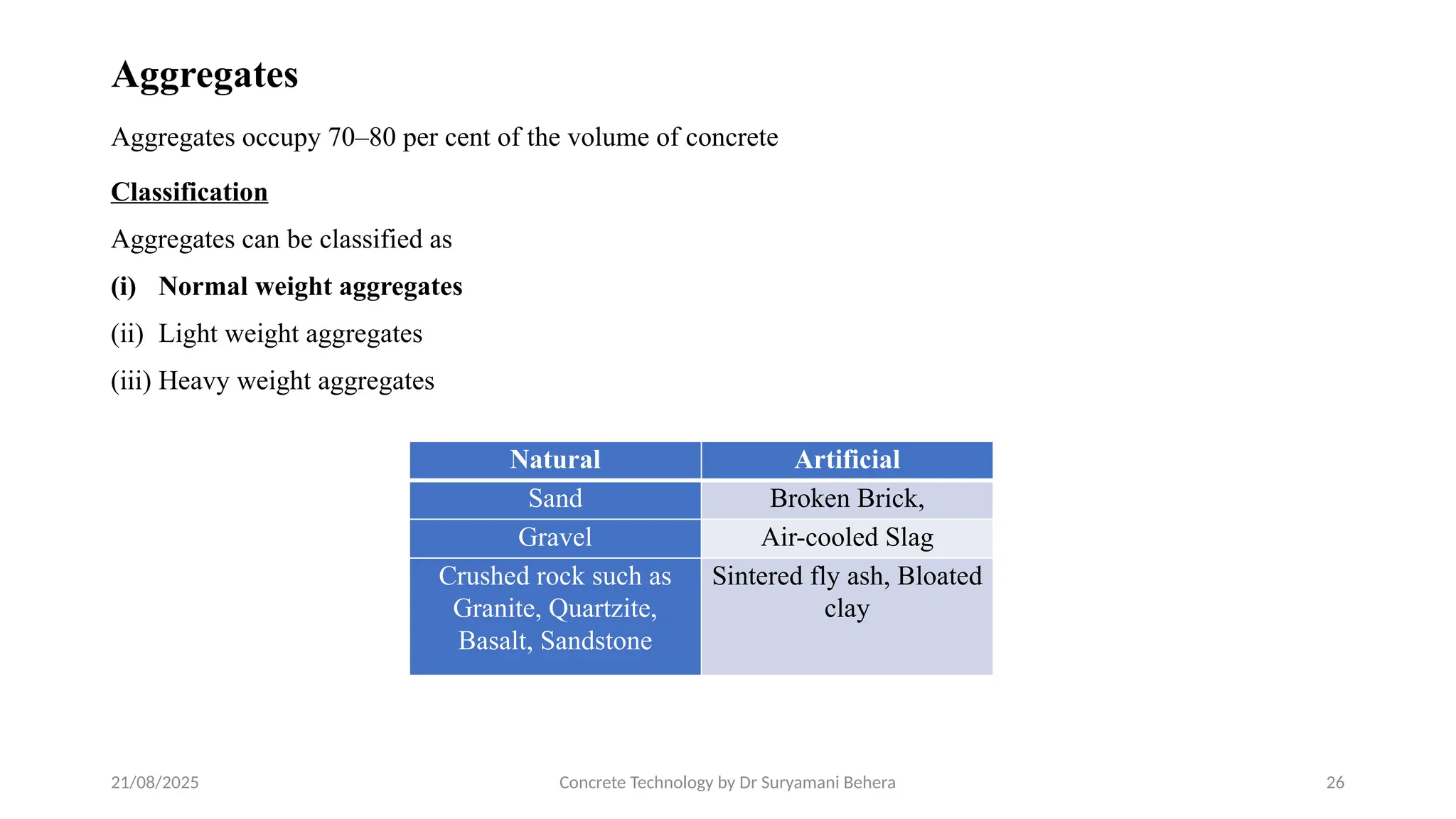
Aggregates occupy 70–80 per cent of the volume of concrete
Classification
Aggregates can be classified as
(i) Normal weight aggregates
(ii) Light weight aggregates
(iii) Heavy weight aggregates
Natural Artificial
Sand Broken Brick,
Gravel Air-cooled Slag
Crushed rock such as
Granite, Quartzite,
Basalt, Sandstone
Sintered fly ash, Bloated
clay
21/08/2025 Concrete Technology by Dr Suryamani Behera 27
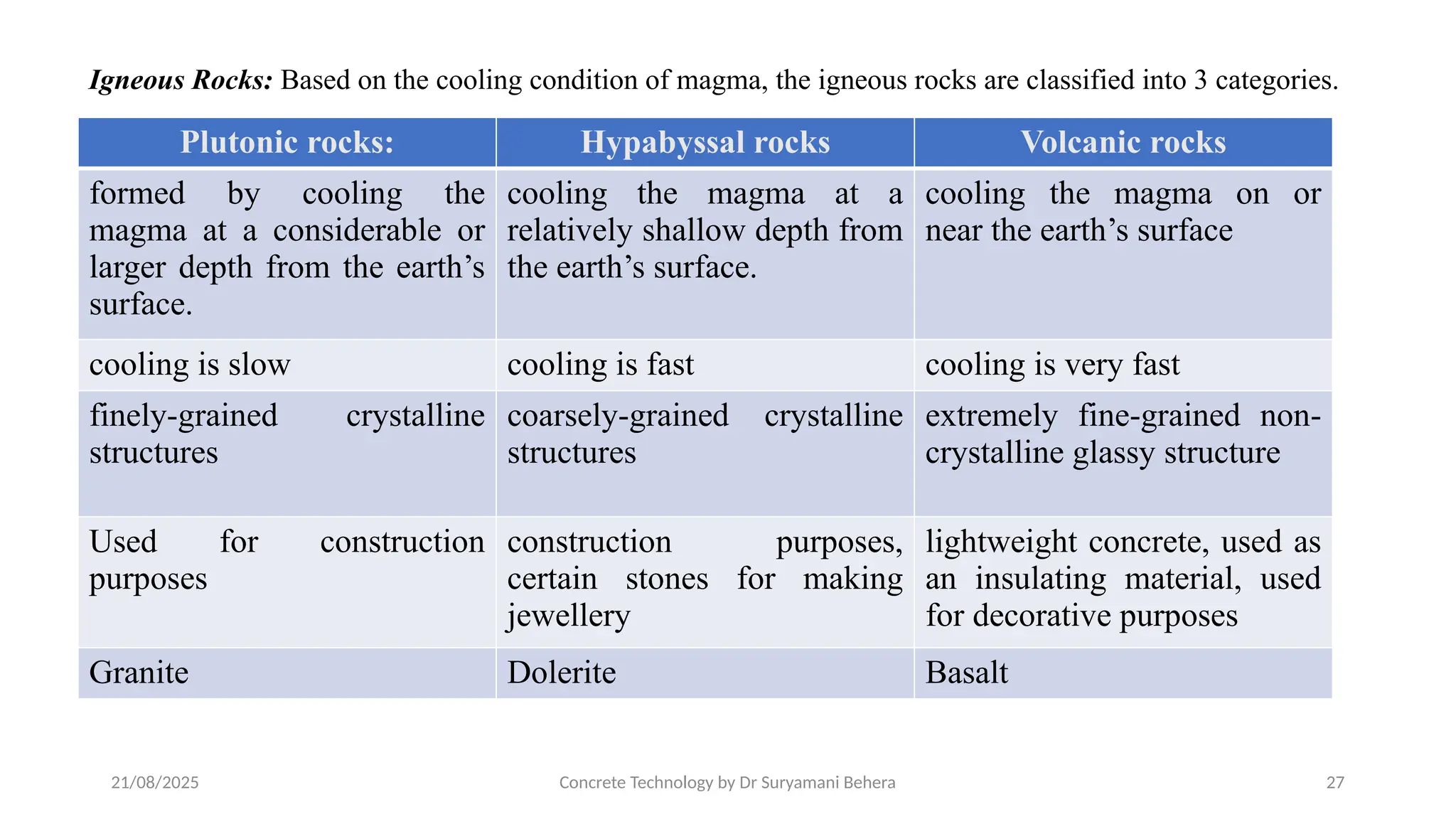
Igneous Rocks: Based on the cooling condition of magma, the igneous rocks are classified into 3 categories.
Plutonic rocks: Hypabyssal rocks Volcanic rocks
formed by cooling the
magma at a considerable or
larger depth from the earth’s
surface.
cooling the magma at a
relatively shallow depth from
the earth’s surface.
cooling the magma on or
near the earth’s surface
cooling is slow cooling is fast cooling is very fast
finely-grained crystalline
structures
coarsely-grained crystalline
structures
extremely fine-grained non-
crystalline glassy structure
Used for construction
purposes
construction purposes,
certain stones for making
jewellery
lightweight concrete, used as
an insulating material, used
for decorative purposes
Granite Dolerite Basalt
21/08/2025 Concrete Technology by Dr Suryamani Behera 28
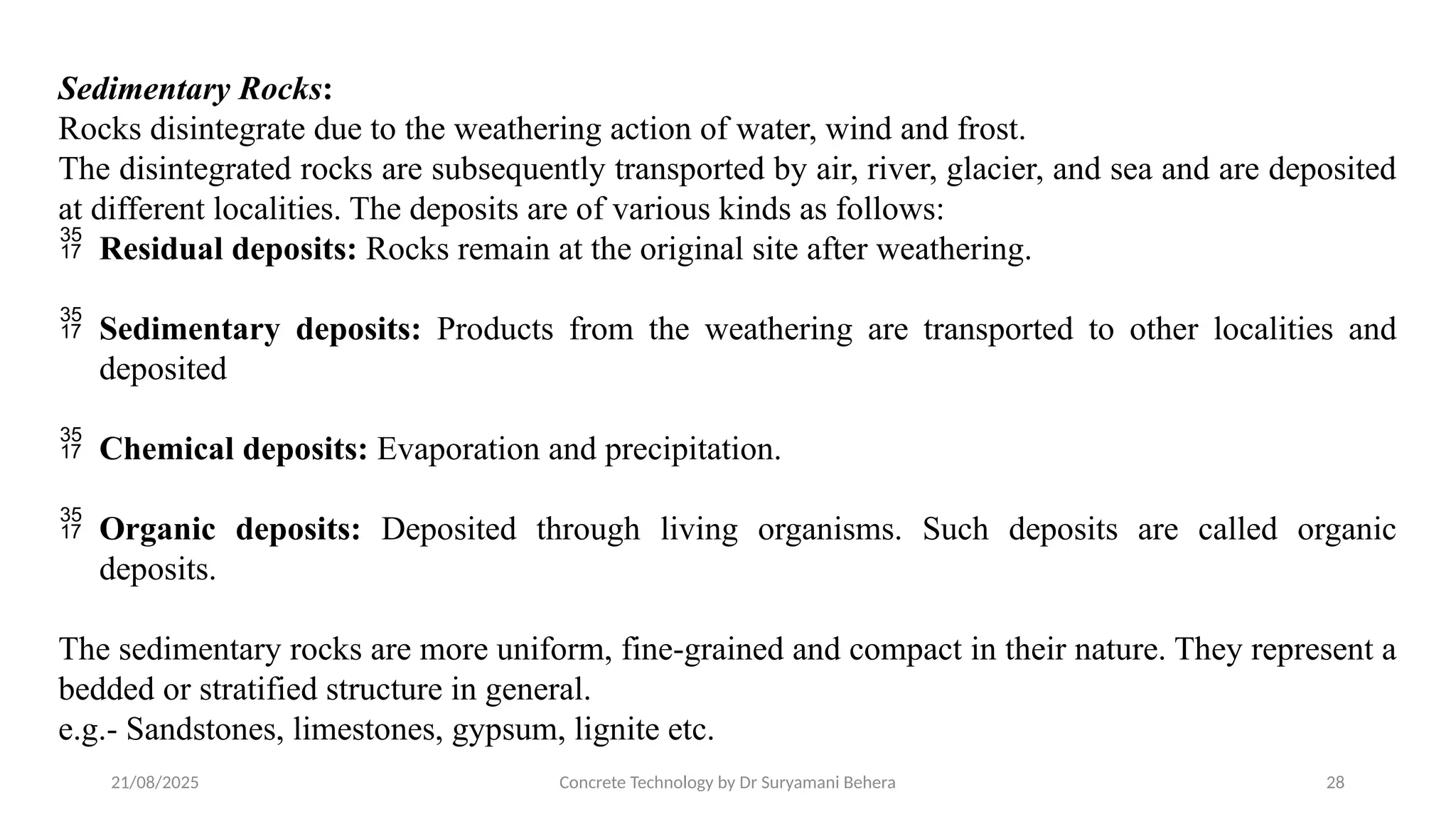
Sedimentary Rocks:
Rocks disintegrate due to the weathering action of water, wind and frost.
The disintegrated rocks are subsequently transported by air, river, glacier, and sea and are deposited
at different localities. The deposits are of various kinds as follows:
 Residual deposits: Rocks remain at the original site after weathering.
 Sedimentary deposits: Products from the weathering are transported to other localities and
deposited
 Chemical deposits: Evaporation and precipitation.
 Organic deposits: Deposited through living organisms. Such deposits are called organic
deposits.
The sedimentary rocks are more uniform, fine-grained and compact in their nature. They represent a
bedded or stratified structure in general.
e.g.- Sandstones, limestones, gypsum, lignite etc.
21/08/2025 Concrete Technology by Dr Suryamani Behera 29
Metamorphic Rocks: Previously formed rocks undergo changes in their properties due to metamorphic
action of great pressure and heat. This process of change is called metamorphism.
The agents of metamorphism are heat, pressure and chemicals.
Based on the various combinations of metamorphic agents, metamorphism is of 4 types as follows:
 Thermal: It happens when rock is heated up by an intrusion of hot magma. Heat is the predominant
factor in this type of metamorphism.
 Cataclastic: A high-pressure metamorphism resulting from the crushing and shearing of rock during
tectonic movement, mostly along faults due to direct pressure. (areas of detachment where rocks slide past
one another).
 Dynamo-thermal: Dynamo-thermal metamorphism is due to the cooperation of directed pressure and
heat. This metamorphism occurs with the increase in the depth.
 Plutonic: Metamorphism is meant due to the changes which are produced in rocks by great heat and
uniform pressure. (greater depth - no direct pressure).
e.g.- Due to metamorphic action,
 lime stone changes to marble
 mud stone becomes slate
21/08/2025 Concrete Technology by Dr Suryamani Behera 30
Size of aggregates
80 mm size is the maximum size that could be conveniently used for concrete making.
Using the largest possible maximum size will result in
(i) reduction of the cement content
(ii) reduction in water requirement
(iii) reduction of drying shrinkage.
But in any case, not greater than one-fourth of the minimum thickness of the member.
For heavily reinforced concrete member the nominal maximum size of aggregate should usually be restricted to
• 5 mm less than the minimum clear distance between the main bars
• 5 mm less than the minimum cover to the reinforcement, whichever is smaller.
But from various other practical considerations, for reinforced concrete work, aggregates having a maximum size
of 20 mm are generally considered satisfactory.
21/08/2025 Concrete Technology by Dr Suryamani Behera 31
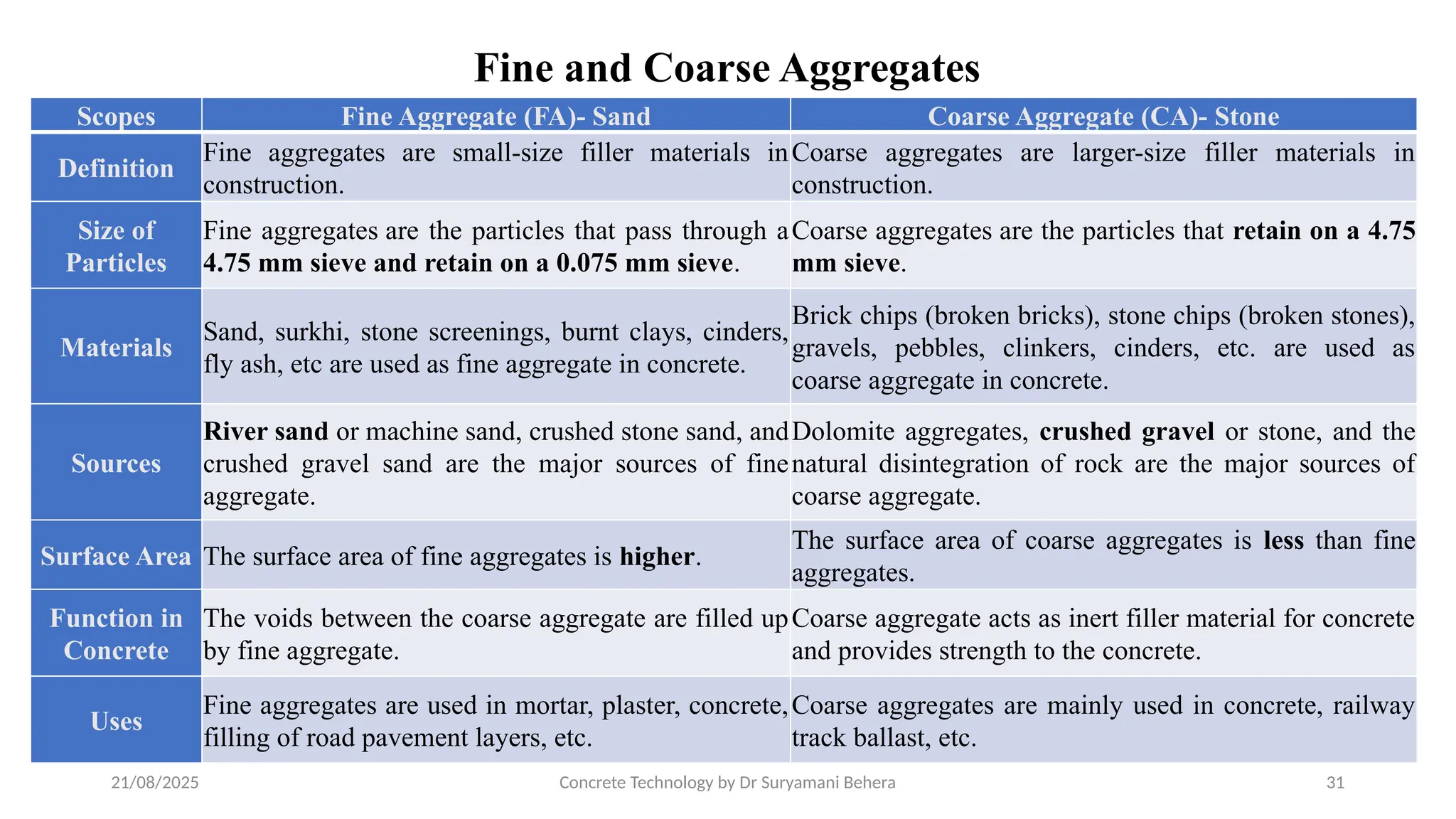
Scopes Fine Aggregate (FA)- Sand Coarse Aggregate (CA)- Stone
Definition
Fine aggregates are small-size filler materials in
construction.
Coarse aggregates are larger-size filler materials in
construction.
Size of
Particles
Fine aggregates are the particles that pass through a
4.75 mm sieve and retain on a 0.075 mm sieve.
Coarse aggregates are the particles that retain on a 4.75
mm sieve.
Materials
Sand, surkhi, stone screenings, burnt clays, cinders,
fly ash, etc are used as fine aggregate in concrete.
Brick chips (broken bricks), stone chips (broken stones),
gravels, pebbles, clinkers, cinders, etc. are used as
coarse aggregate in concrete.
Sources
River sand or machine sand, crushed stone sand, and
crushed gravel sand are the major sources of fine
aggregate.
Dolomite aggregates, crushed gravel or stone, and the
natural disintegration of rock are the major sources of
coarse aggregate.
Surface Area The surface area of fine aggregates is higher.
The surface area of coarse aggregates is less than fine
aggregates.
Function in
Concrete
The voids between the coarse aggregate are filled up
by fine aggregate.
Coarse aggregate acts as inert filler material for concrete
and provides strength to the concrete.
Uses
Fine aggregates are used in mortar, plaster, concrete,
filling of road pavement layers, etc.
Coarse aggregates are mainly used in concrete, railway
track ballast, etc.
Fine and Coarse Aggregates
21/08/2025 Concrete Technology by Dr Suryamani Behera 32
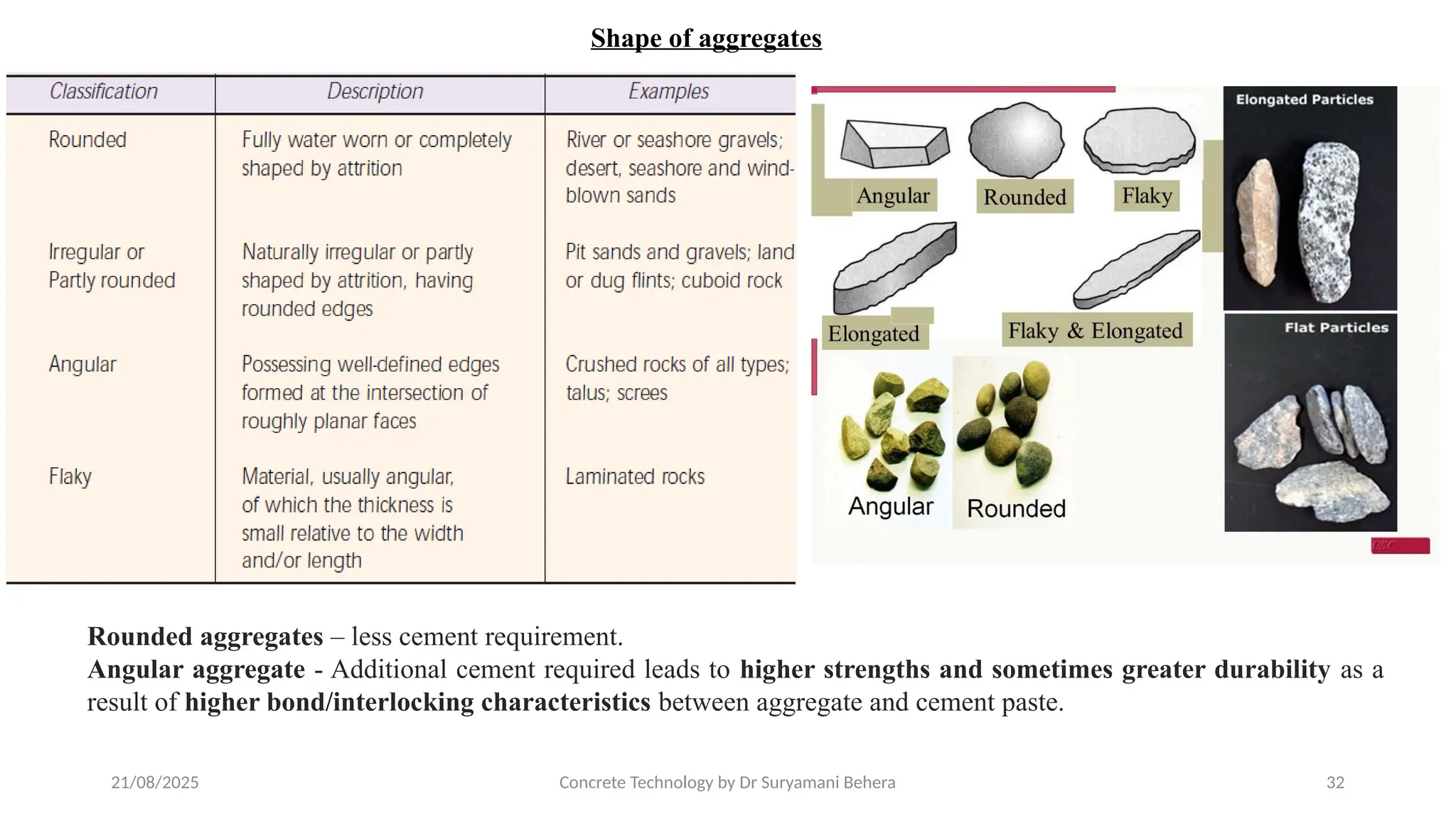
Shape of aggregates
Rounded aggregates – less cement requirement.
Angular aggregate - Additional cement required leads to higher strengths and sometimes greater durability as a
result of higher bond/interlocking characteristics between aggregate and cement paste.
21/08/2025 Concrete Technology by Dr Suryamani Behera 33
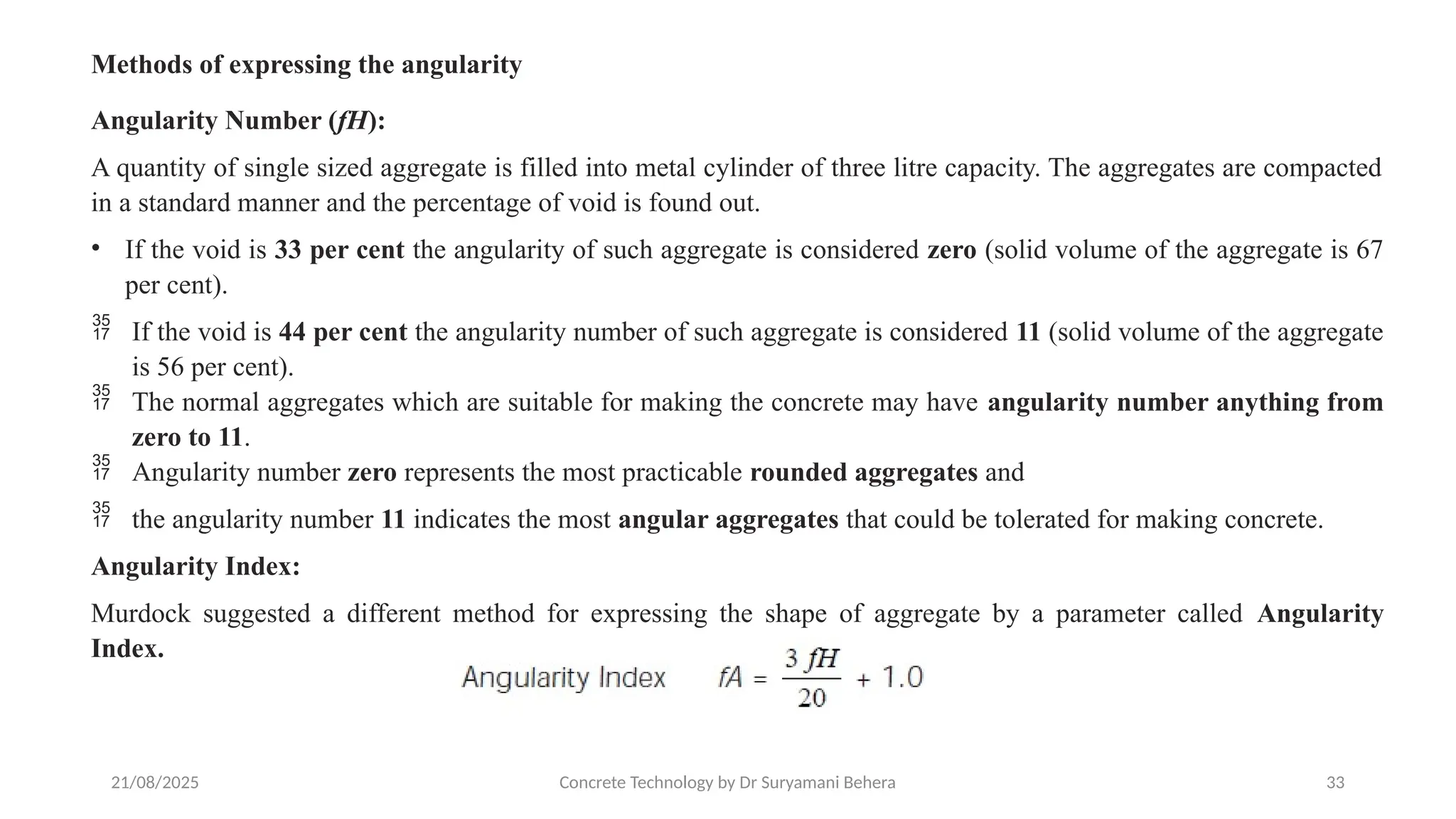
Methods of expressing the angularity
Angularity Number (fH):
A quantity of single sized aggregate is filled into metal cylinder of three litre capacity. The aggregates are compacted
in a standard manner and the percentage of void is found out.
• If the void is 33 per cent the angularity of such aggregate is considered zero (solid volume of the aggregate is 67
per cent).
 If the void is 44 per cent the angularity number of such aggregate is considered 11 (solid volume of the aggregate
is 56 per cent).
 The normal aggregates which are suitable for making the concrete may have angularity number anything from
zero to 11.
 Angularity number zero represents the most practicable rounded aggregates and
 the angularity number 11 indicates the most angular aggregates that could be tolerated for making concrete.
Angularity Index:
Murdock suggested a different method for expressing the shape of aggregate by a parameter called Angularity
Index.
21/08/2025 Concrete Technology by Dr Suryamani Behera 34
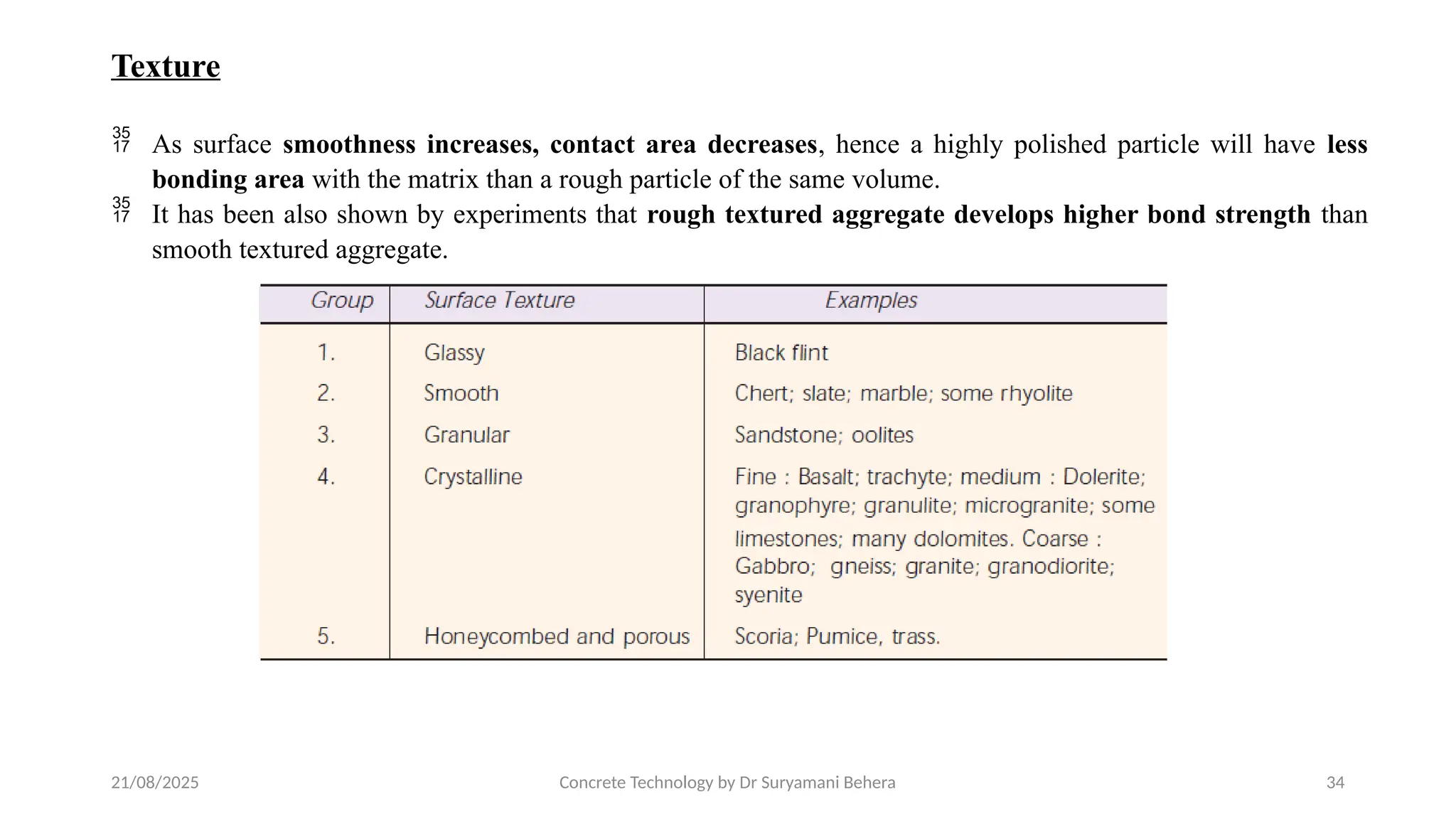
Texture
 As surface smoothness increases, contact area decreases, hence a highly polished particle will have less
bonding area with the matrix than a rough particle of the same volume.
 It has been also shown by experiments that rough textured aggregate develops higher bond strength than
smooth textured aggregate.
21/08/2025 Concrete Technology by Dr Suryamani Behera 35
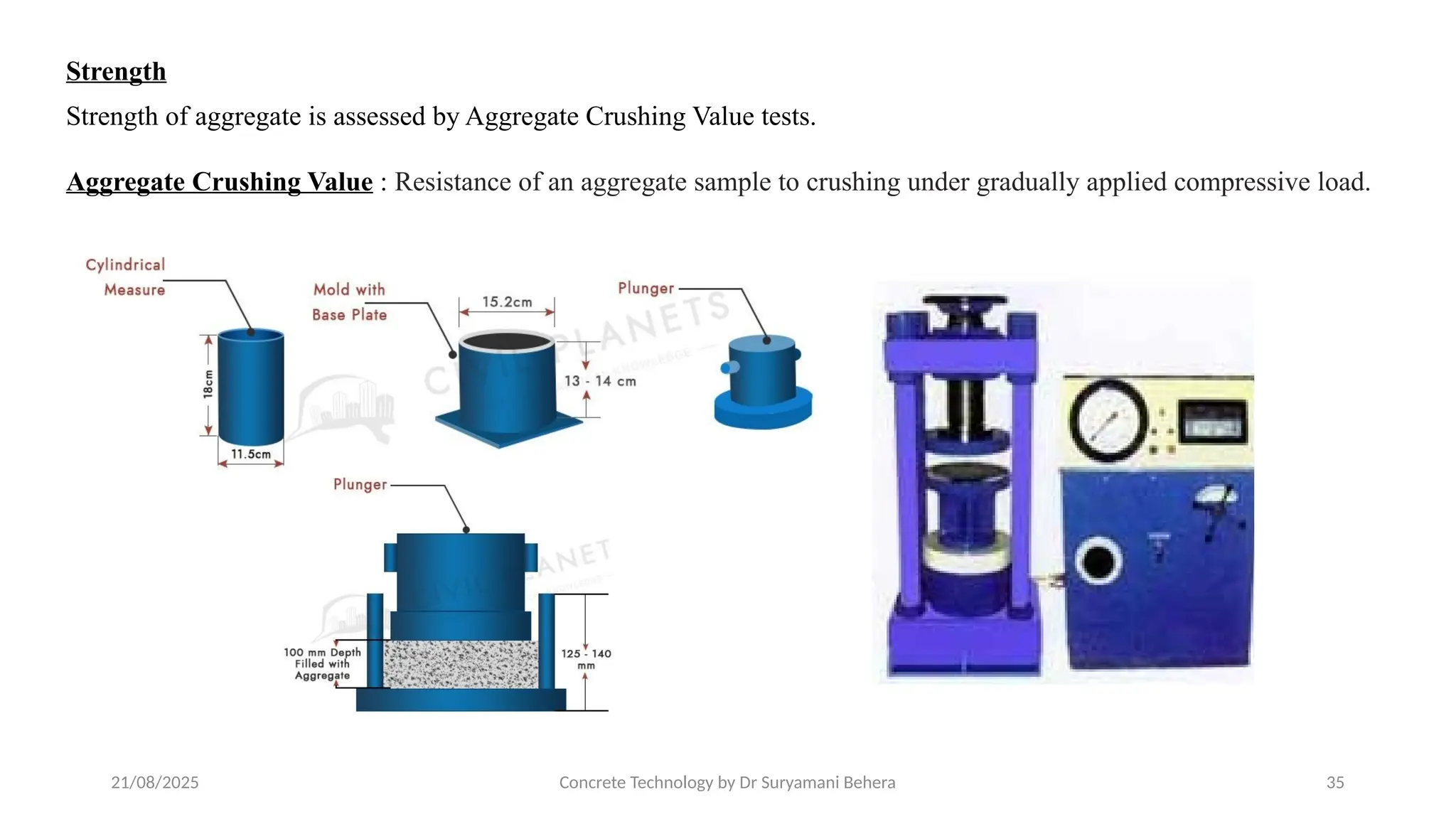
Strength
Strength of aggregate is assessed by Aggregate Crushing Value tests.
Aggregate Crushing Value : Resistance of an aggregate sample to crushing under gradually applied compressive load.
21/08/2025 Concrete Technology by Dr Suryamani Behera 36
Procedure
1. aggregate passing a 12.5 mm IS Sieve and retained on a 10 mm IS Sieve
2. The aggregate shall be tested in a surface-dry condition. If dried by heating - Maximum four hours, 100 to 110°C and
cooled to room temperature
3. Filling the cylindrical measure in three layers of approximately equal depth, each layer being tamped 25 times by
tamping rod and finally levelled off.
4. The weight of material comprising the test sample shall be determined (Weight A) and the same weight of sample shall
be taken for the repeat test.
5. The cylinder of the test apparatus shall be put in position on the base plate and the test sample added in the same
manner as before. The surface of the aggregate shall be carefully levelled and the plunger is inserted.
6. The apparatus, with the test sample and plunger in position, shall then be loaded at as uniform a rate as possible so that
the total load is reached in 10 minutes. The total load shall be 400 kN.
7. The load shall be released and the whole of the material removed from the cylinder and sieved on a 2.36 mm IS Sieve
for the standard test. The fraction passing the sieve shall be weighed (Weight B).
Calculation
Aggregate Crushing Value = (B/A) × 100
The crushing value of aggregate is restricted to
• 30 per cent for concrete used for roads and pavements and
• 45 per cent may be permitted for other structures.
10 per cent fines value !!
21/08/2025 Concrete Technology by Dr Suryamani Behera 37
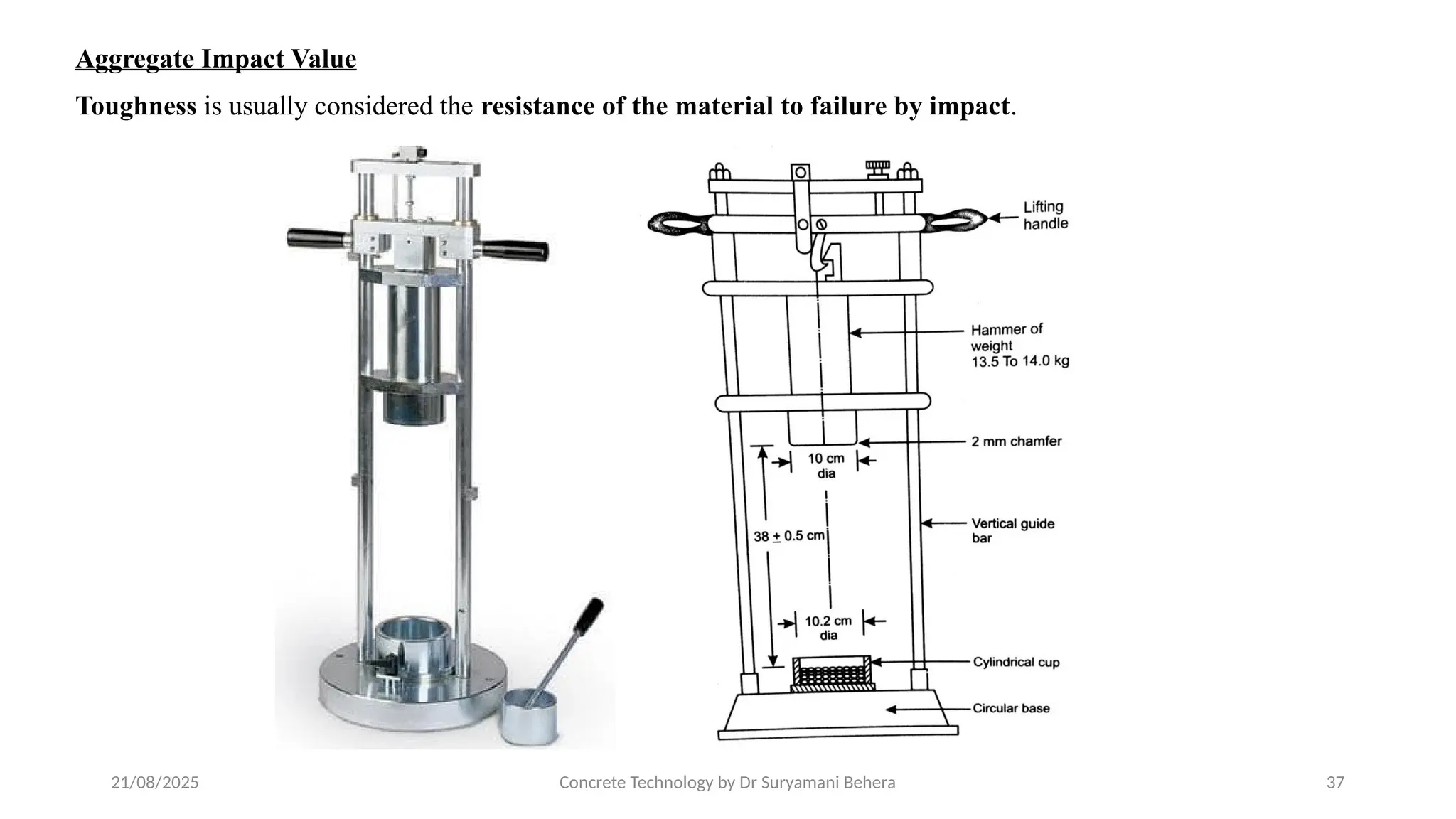
Aggregate Impact Value
Toughness is usually considered the resistance of the material to failure by impact.
21/08/2025 Concrete Technology by Dr Suryamani Behera 38
Procedure
1. Aggregate passed a 12.5 mm IS Sieve and retained on a 10 mm IS Sieve and dried in an oven for a period of 4 hours at
a temperature of 100 to 110°C and cooled.
2. The measure shall be filled in 3 layers (each 35 blows) and the surplus aggregate struck off. The net weight of aggregate
in the measure shall be determined to the nearest gram (Weight A).
3. The cup shall be fixed firmly in position on the base of the machine and the whole of the test sample placed in it and
compacted by a single tamping of 25 strokes of the tamping rod.
4. The hammer (weight = 14 kg) shall be raised until its lower face is 380 mm above the upper surface of the aggregate in
the cup, and allowed to fall freely onto the aggregate - 15 such blows
5. The crushed aggregate fraction passing through a 2.36 mm IS is weighed to an accuracy of 0.1 g (Weight B).
6. The fraction retained on the sieve shall also be weighed (Weight C).
7. If the total weight (C+B) is less than Weight A by more than one gram, the result shall be discarded.
Calculation
Aggregate Impact Value = (B/A) × 100
The aggregate impact value shall not exceed
• 45 per cent by weight for aggregate used for concrete other than wearing surfaces and
• 30 per cent by weight, for concrete for wearing surfaces, such as runways, roads and pavements.
21/08/2025 Concrete Technology by Dr Suryamani Behera 39
Aggregate Abrasion Value
Testing the aggregate with respect to its resistance to wear.
Three tests are in common use to test aggregate for its abrasion resistance.
(i) Deval attrition test
(ii) Dorry abrasion test
(iii)Los Angels test
Procedure
Sieve Size Weight in gm. of Test Sample for Grade
Passing
(mm)
Retained
on (mm)
A B C D E F G
80 63 2500
63 50 2500
50 40 5000 5000
40 25 1250 5000 5000
25 20 1250 5000
20 12.5 1250 2500
12.5 10 1250 2500
10 6.3 2500
6.3 4.75 2500
4.75 2.36 5000
Gradation of Aggregate
21/08/2025 Concrete Technology by Dr Suryamani Behera 40
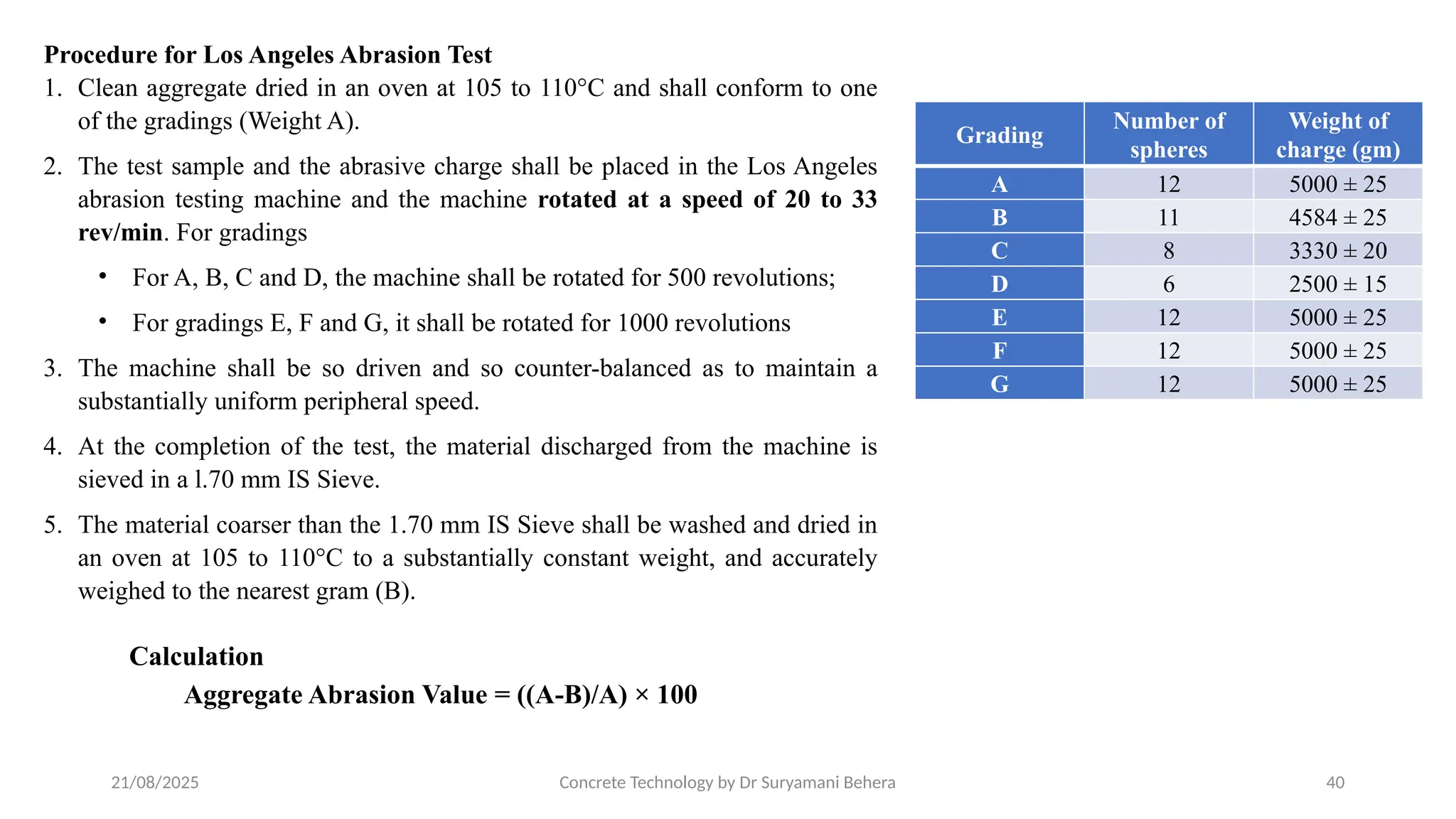
Procedure for Los Angeles Abrasion Test
1. Clean aggregate dried in an oven at 105 to 110°C and shall conform to one
of the gradings (Weight A).
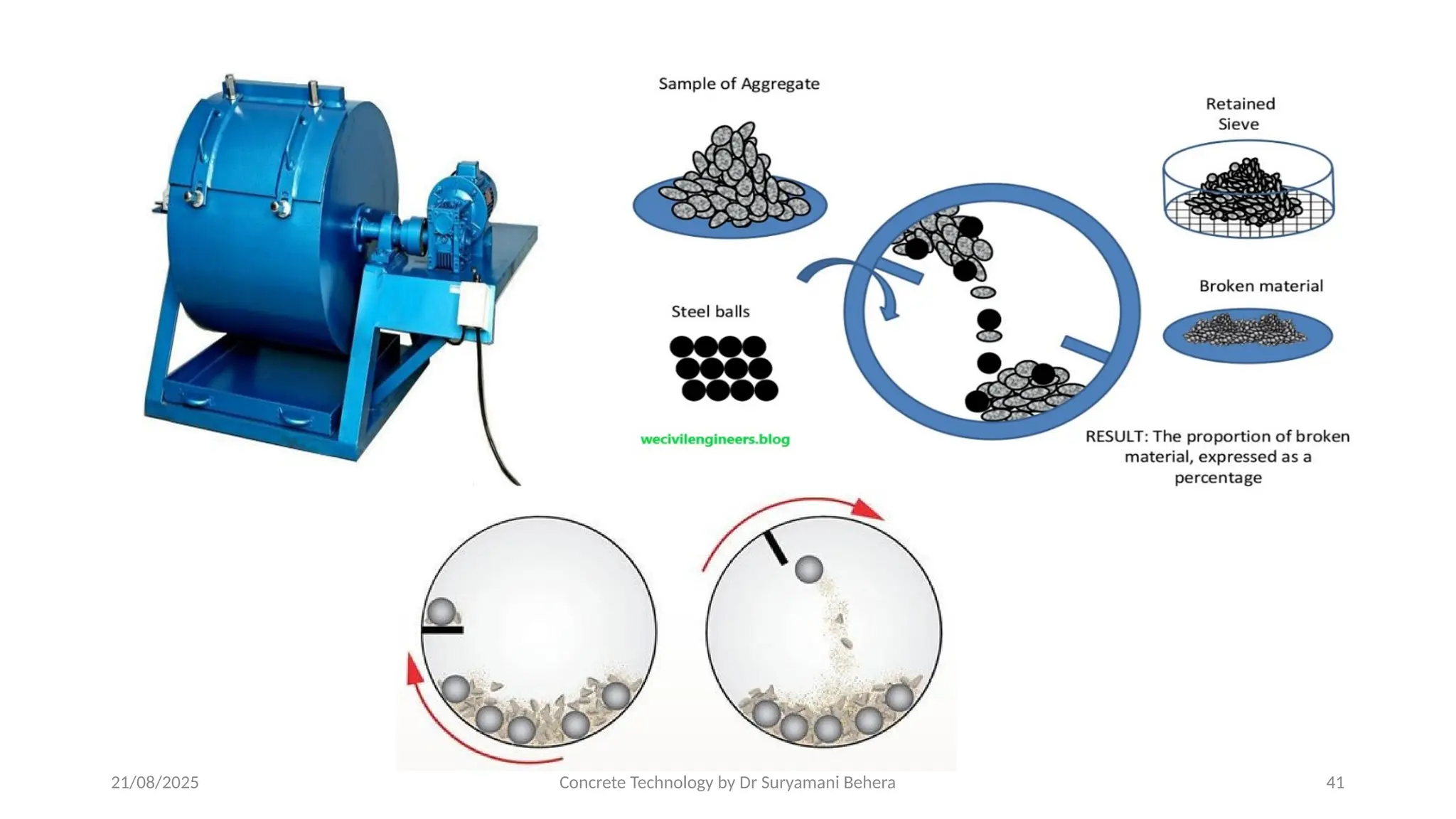
2. The test sample and the abrasive charge shall be placed in the Los Angeles
abrasion testing machine and the machine rotated at a speed of 20 to 33
rev/min. For gradings
• For A, B, C and D, the machine shall be rotated for 500 revolutions;
• For gradings E, F and G, it shall be rotated for 1000 revolutions
3. The machine shall be so driven and so counter-balanced as to maintain a
substantially uniform peripheral speed.
4. At the completion of the test, the material discharged from the machine is
sieved in a l.70 mm IS Sieve.
5. The material coarser than the 1.70 mm IS Sieve shall be washed and dried in
an oven at 105 to 110°C to a substantially constant weight, and accurately
weighed to the nearest gram (B).
Grading
Number of
spheres
Weight of
charge (gm)
A 12 5000 ± 25
B 11 4584 ± 25
C 8 3330 ± 20
D 6 2500 ± 15
E 12 5000 ± 25
F 12 5000 ± 25
G 12 5000 ± 25
Calculation
Aggregate Abrasion Value = ((A-B)/A) × 100
21/08/2025 Concrete Technology by Dr Suryamani Behera 41
21/08/2025 Concrete Technology by Dr Suryamani Behera 42
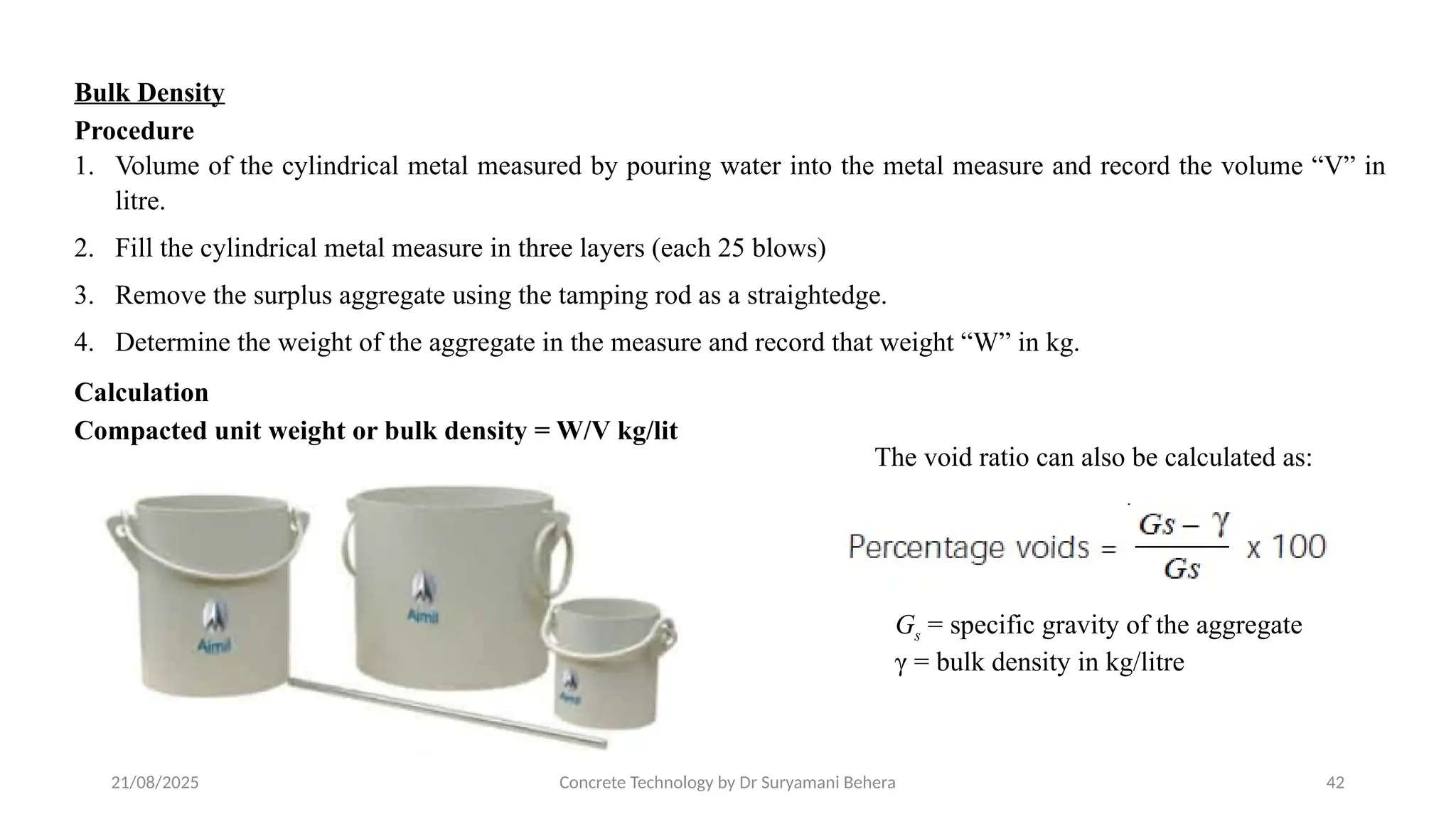
Bulk Density
Procedure
1. Volume of the cylindrical metal measured by pouring water into the metal measure and record the volume “V” in
litre.
2. Fill the cylindrical metal measure in three layers (each 25 blows)
3. Remove the surplus aggregate using the tamping rod as a straightedge.
4. Determine the weight of the aggregate in the measure and record that weight “W” in kg.
Calculation
Compacted unit weight or bulk density = W/V kg/lit
The void ratio can also be calculated as:
Gs = specific gravity of the aggregate
γ = bulk density in kg/litre
21/08/2025 Concrete Technology by Dr Suryamani Behera 43
Specific Gravity (for Aggregate coarser than 6.3mm)
Procedure (Wire basket apparatus)
1. About 2 kg of aggregate sample is taken, washed to remove fines and then placed in the
wire basket. The wire basket is then immersed in water, which is at a temperature of 220
C
to 320
C.
2. Immediately after immersion the entrapped air is removed from the sample by lifting the
basket 25 mm above the base of the tank and allowing it to drop, 25 times at a rate of
about one drop per second.
3. The basket, with aggregate is kept completely immersed in water for a period of 24 ± 0.5
hour.
4. The basket and aggregate are weighed (W1) while suspended in water, which is at a
temperature of 220
C to 320
C.
5. The basket and aggregates are removed from the water and dried with dry absorbent
cloth.
6. The weight of basket is measured (W2).
7. The surface dried aggregates are also weighed (W3).
8. The aggregate is placed in a shallow tray and heated to about 1100
C in the oven for 24
hours. Later, it is cooled in an airtight container and weighed (W4).
Apparent Specific Gravity: W4 / [W4 – (W1 - W2 )]
21/08/2025 Concrete Technology by Dr Suryamani Behera 44
Specific Gravity (for Aggregate finer than 6.3mm)
1. A clean, dry pycnometer is taken and its empty weight is determined (W1).
2. About 1000g of clean sample is taken into the pycnometer, and it is weighed (W2).
3. Water at 270
C is filled up in the pycnometer with the aggregate sample, to just
immerse the sample.
4. Immediately after immersion the entrapped air is removed from the sample by shaking
the pycnometer, placing a finger on the hole at the top of the sealed pycnometer.
5. Now the pycnometer is completely filled up with water till the hole at the top, and
after confirming that there is no more entrapped air in it, it is weighed (W3).
6. The contents of the pycnometer are discharged, and it is cleaned.
7. Water is filled up to the top of the pycnometer, without any entrapped air. It is then
weighed (W4).
Apparent Specific Gravity: (W2 – W1) / [(W4 – W1) - (W3 - W2 )]
21/08/2025 Concrete Technology by Dr Suryamani Behera 45
Absorption and Moisture Content
• Some of the aggregates are porous and absorptive.
• Porosity and absorption of aggregate will affect the water/cement ratio and hence the workability of concrete.
• The porosity of aggregate will also affect the durability of concrete when the concrete is subjected to freezing and
thawing.
• The water absorption of aggregate is determined by measuring the increase in weight of an oven-dry sample when
immersed in water for 24 hours. The ratio of the increase in weight to the weight of the dry sample expressed as a
percentage is known as absorption of aggregate.
• The absorption capacity of the coarse aggregate is of the order of about 0.5 to 1 per cent by weight of aggregate.
• Free moisture in both coarse aggregate and fine aggregate affects the quality of concrete in more than one way.
21/08/2025 Concrete Technology by Dr Suryamani Behera 46
Bulking of Aggregates
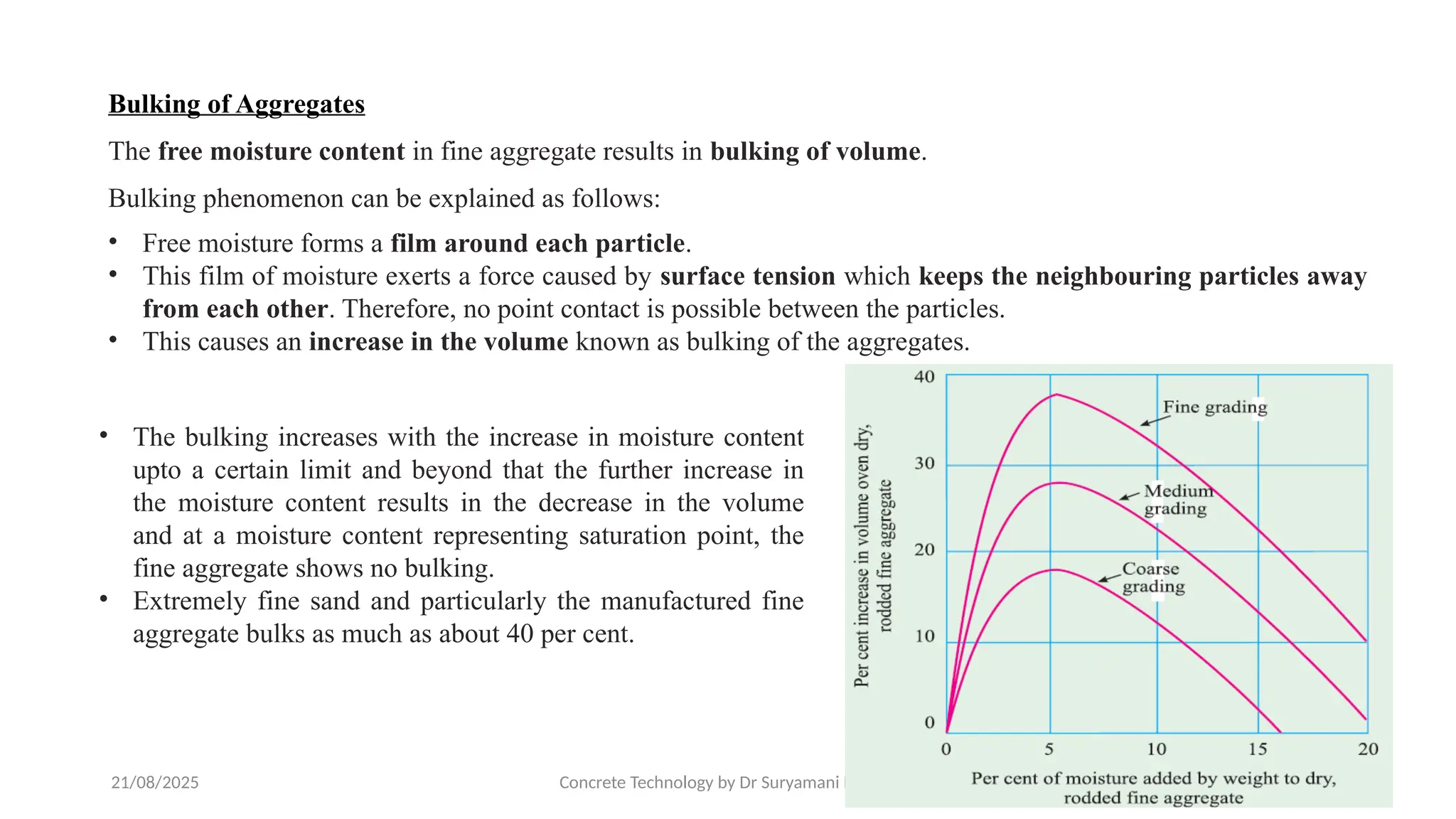
The free moisture content in fine aggregate results in bulking of volume.
Bulking phenomenon can be explained as follows:
• Free moisture forms a film around each particle.
• This film of moisture exerts a force caused by surface tension which keeps the neighbouring particles away
from each other. Therefore, no point contact is possible between the particles.
• This causes an increase in the volume known as bulking of the aggregates.
• The bulking increases with the increase in moisture content
upto a certain limit and beyond that the further increase in
the moisture content results in the decrease in the volume
and at a moisture content representing saturation point, the
fine aggregate shows no bulking.
• Extremely fine sand and particularly the manufactured fine
aggregate bulks as much as about 40 per cent.
21/08/2025 Concrete Technology by Dr Suryamani Behera 47
Bulking measurement
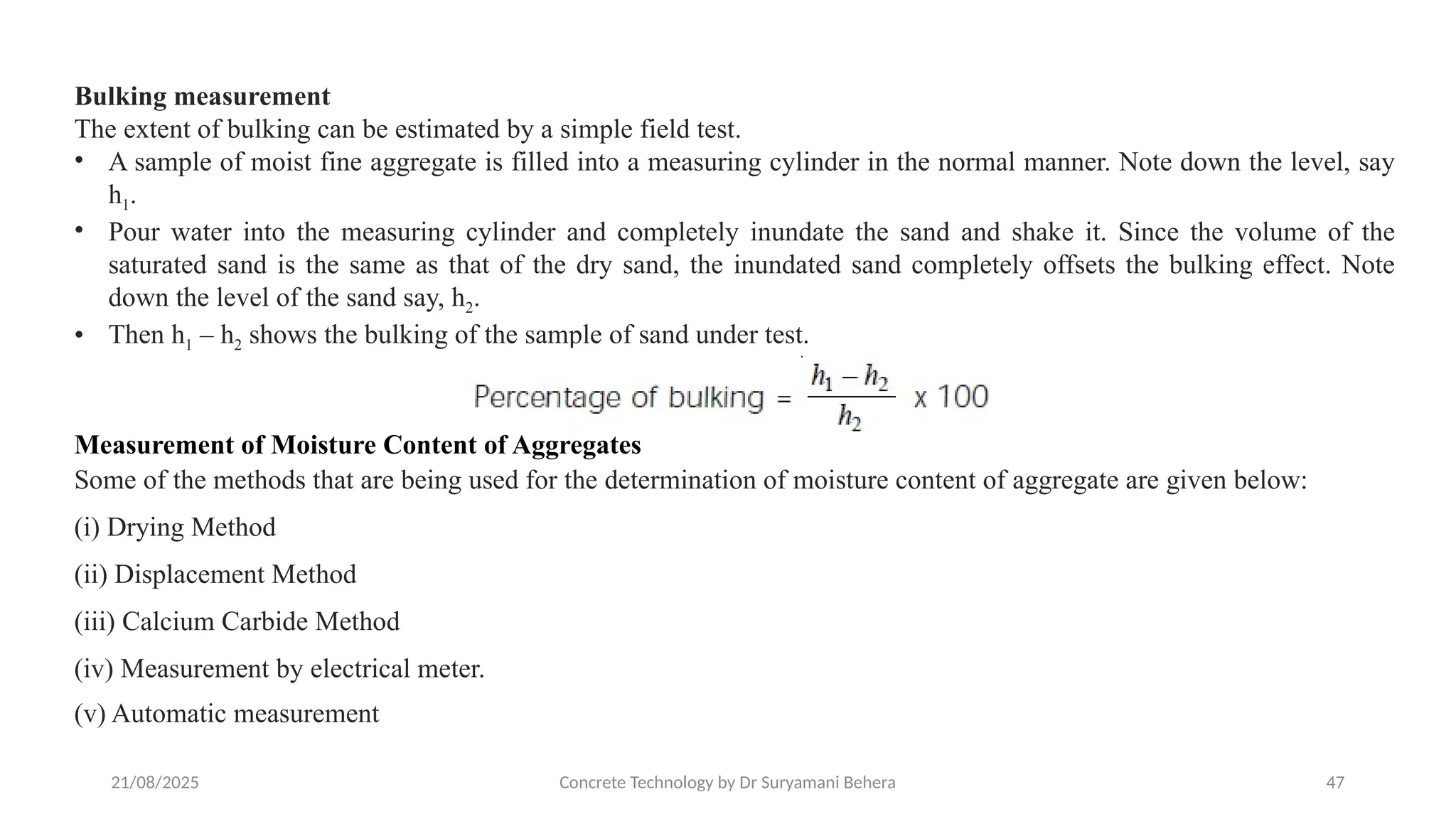
The extent of bulking can be estimated by a simple field test.
• A sample of moist fine aggregate is filled into a measuring cylinder in the normal manner. Note down the level, say
h1.
• Pour water into the measuring cylinder and completely inundate the sand and shake it. Since the volume of the
saturated sand is the same as that of the dry sand, the inundated sand completely offsets the bulking effect. Note
down the level of the sand say, h2.
• Then h1 – h2 shows the bulking of the sample of sand under test.
Measurement of Moisture Content of Aggregates
Some of the methods that are being used for the determination of moisture content of aggregate are given below:
(i) Drying Method
(ii) Displacement Method
(iii) Calcium Carbide Method
(iv) Measurement by electrical meter.
(v) Automatic measurement
21/08/2025 Concrete Technology by Dr Suryamani Behera 48
Cleanliness
The concrete aggregates should be free from impurities and deleterious substances.
Deleterious materials in aggregate are those substances which detrimentally affect the fresh and hardened properties of
concrete for instance strength, workability, and long-term performance of the concrete.
There are some deleterious materials:
(i) Organic impurities
(ii) clay
(iii)silt and crushed dust
(iv)salts
(v) unsound particles
(vi)alkali aggregate reactions
Organic Impurities
 Organic impurities interfere with the hydration reaction.
 Frequently, it is found in sand and consists of products of decay of vegetable matter.
 Organic matter may be removed from sand by washing.
21/08/2025 Concrete Technology by Dr Suryamani Behera 49
Clay
 Clay may coat the surface of aggregates which impair bond strength between aggregate and cement paste.
Consequently, it adversely affecting the strength and durability of concrete
 It is necessary to control the amount of clay in aggregate
Silt and Crusher dust
 Silt and dust, owing to their fineness, increase the surface area and therefore increase the amount of water
necessary to wet all the particles in the mix.
 Impair wear resistance
 Reduce durability
 They may result popouts
Salts
 Salts are present in certain types of aggregates such as Sand from seashore, sand and Coarse aggregate dredged
from the sea or a river estuary, and desert sand.
 Salts coming through aggregates cause reinforcement corrosion and also absorb moisture from the air and cause
efflorescence.
21/08/2025 Concrete Technology by Dr Suryamani Behera 50
Unsound Particles
 Unsound particles lead to disruptive expansion on freezing or even on exposure to water.
 Shale, clay lumps, wood, coal, mica, gypsum, and iron pyrites are examples of unsound particles.
 Unsound particles in large quantities (over 2 to 5% of the mass of the aggregate) affect the strength of concrete.
Alkali- Aggregate Reactions
 Reaction between alkali from cement and silica or carbonate from aggregate is called “alkali- aggregate reaction”.
 Active silica constituents of the aggregate and alkalis in cement - “alkali-silica reaction”
 Aggregates containing carbonate and alkalis in cement - “alkali-carbonate reaction”
 Both types of the reactions cause deterioration of concrete, mainly cracking.
 The reactive forms of silica opal (amorphous, i.e. shapeless), Chalcedony (cryptocrystalline fibrous), volcanic glass,
zeolites, and tridymite (crystalline) etc.
 The gel formation on the surface of aggregate particles destroys the bond between the aggregate and cement paste.
 The swelling nature of the gel exerts internal pressure and eventually lead to expansion, cracking and disruption of
the hydrated cement paste.
21/08/2025 Concrete Technology by Dr Suryamani Behera 51
Soundness of Aggregate
Soundness refers to the ability of aggregate to resist excessive changes in volume as a result of changes in physical
conditions. These physical conditions that affect the soundness of aggregate are freezing the thawing, variation in
temperature, alternate wetting and drying under normal conditions and wetting and drying in salt water.
Factors Promoting the Alkali-Aggregate Reaction
(i) Reactive type of aggregate
(ii) High alkali content in cement
(iii) Availability of moisture
(iv) Optimum temperature conditions
Control of Alkali-Aggregate Reaction
Alkali-aggregate reaction can be controlled by the following methods:
(i) Selection of non-reactive aggregates;
(ii) By the use of low alkali cement;
(iii) By the use of corrective admixtures such as pozzolanas;
(iv) By controlling the void space in concrete;
(v) By controlling moisture condition and temperature.
21/08/2025 Concrete Technology by Dr Suryamani Behera 52
Thermal Properties
Rock and aggregate possesses three thermal properties which are significant in establishing the quality of aggregate for
concrete constructions. They are:
(i) Coefficient of expansion
(ii)Specific heat
(iii)Thermal conductivity
When we are dealing with the aggregate, in general, it will be sufficient at this stage to deal with only the
coefficient of expansion of the aggregate, since it interacts with the coefficient of thermal expansion of cement
paste in the body
Thermal coefficient of expansion of concrete - 5.8 x 10⁻⁶
per °C to 14 x 10–6
per °C
Thermal coefficient of expansion of mortar - 7.9 x 10⁻⁶
per °C to 12.6 x 10⁻⁶
per °C
Thermal coefficient of expansion of rock - 0.9 x 10⁻⁶
per °C to 16 x 10–6
per °C
Thermal compatibility between the aggregate and concrete or aggregate - at higher range
Thermal incompatibility between aggregate and concrete or aggregate - at lower range
Difference between these coefficients exceeds 5.4 x 10⁻⁶
per °C, caution should be taken in the selection of the
aggregate for highly durable concrete.
21/08/2025 Concrete Technology by Dr Suryamani Behera 53
Grading of Aggregates
• Good grading implies that a sample of aggregates contains all standard fractions of aggregate in required
proportion such that the sample contains minimum voids.
• A sample of the well-graded aggregate containing minimum voids will require minimum paste to fill up the voids
in the aggregates.
Sieve Analysis
The aggregates used for making concrete are normally of the maximum size 80 mm, 40 mm, 20 mm, 10 mm, 4.75
mm, 2.36 mm, 600 micron, 300 micron and 150 micron.
21/08/2025 Concrete Technology by Dr Suryamani Behera 54
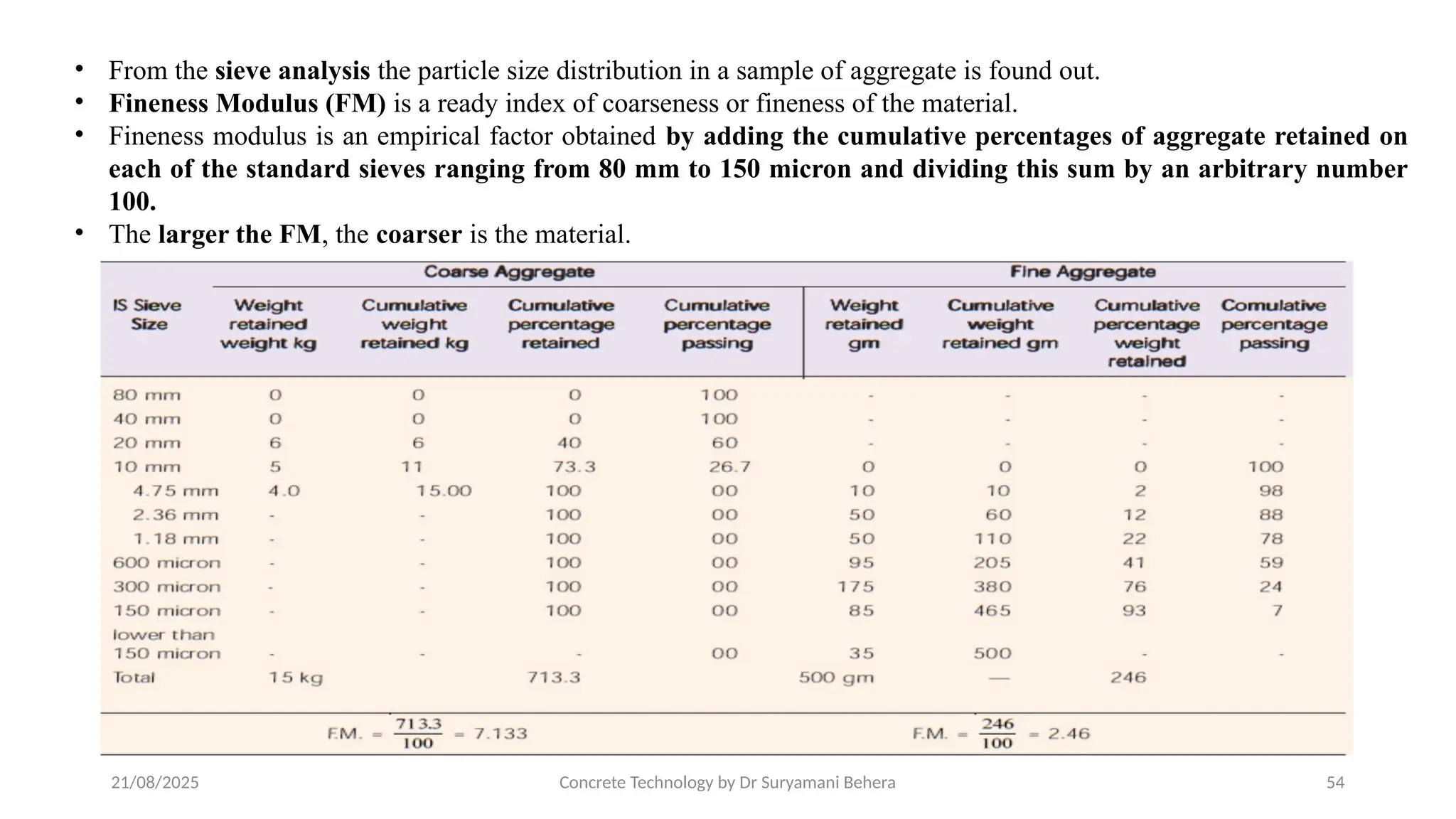
• From the sieve analysis the particle size distribution in a sample of aggregate is found out.
• Fineness Modulus (FM) is a ready index of coarseness or fineness of the material.
• Fineness modulus is an empirical factor obtained by adding the cumulative percentages of aggregate retained on
each of the standard sieves ranging from 80 mm to 150 micron and dividing this sum by an arbitrary number
100.
• The larger the FM, the coarser is the material.
21/08/2025 Concrete Technology by Dr Suryamani Behera 55
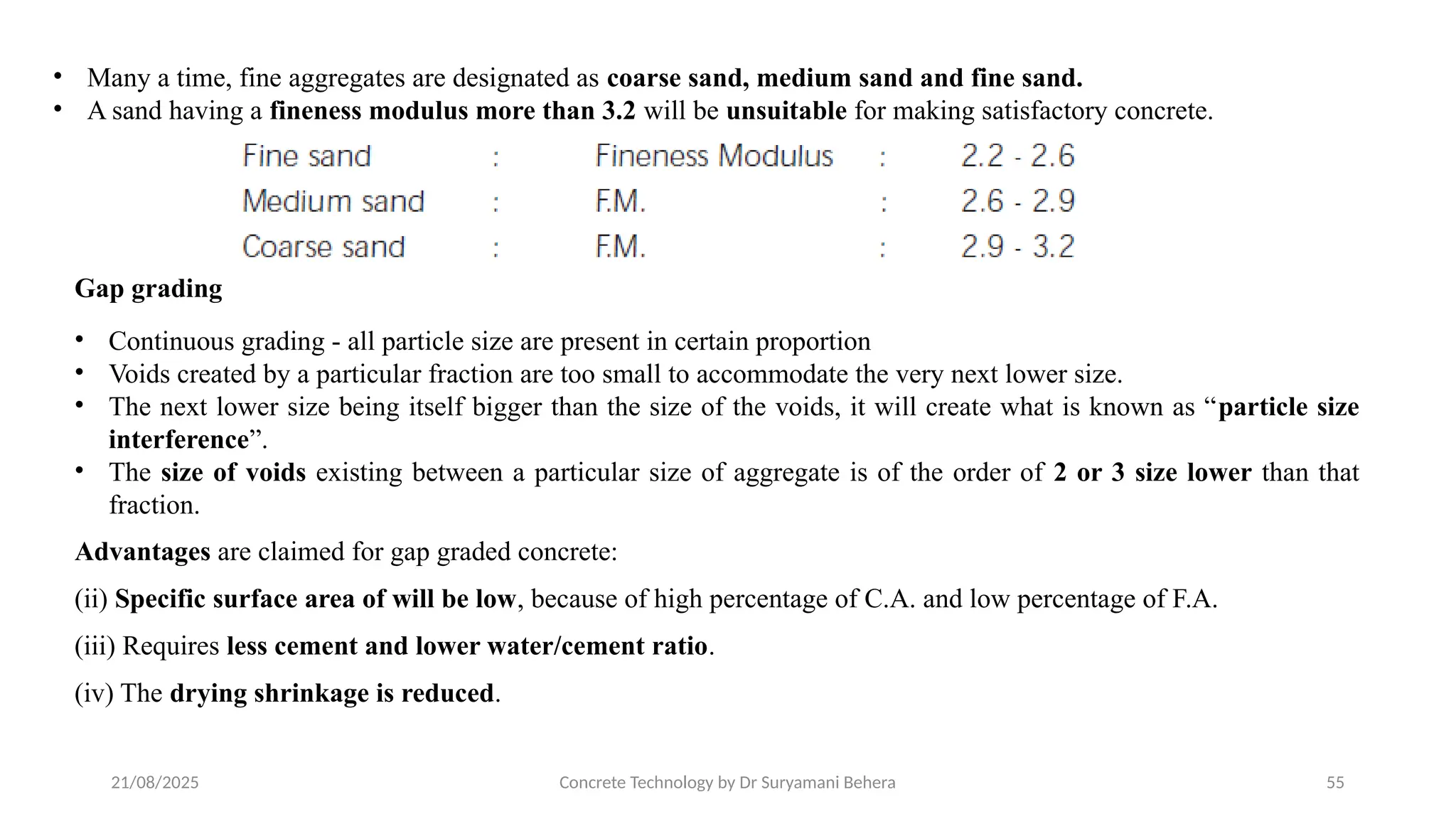
• Many a time, fine aggregates are designated as coarse sand, medium sand and fine sand.
• A sand having a fineness modulus more than 3.2 will be unsuitable for making satisfactory concrete.
Gap grading
• Continuous grading - all particle size are present in certain proportion
• Voids created by a particular fraction are too small to accommodate the very next lower size.
• The next lower size being itself bigger than the size of the voids, it will create what is known as “particle size
interference”.
• The size of voids existing between a particular size of aggregate is of the order of 2 or 3 size lower than that
fraction.
Advantages are claimed for gap graded concrete:
(ii) Specific surface area of will be low, because of high percentage of C.A. and low percentage of F.A.
(iii) Requires less cement and lower water/cement ratio.
(iv) The drying shrinkage is reduced.
21/08/2025 Concrete Technology by Dr Suryamani Behera 56
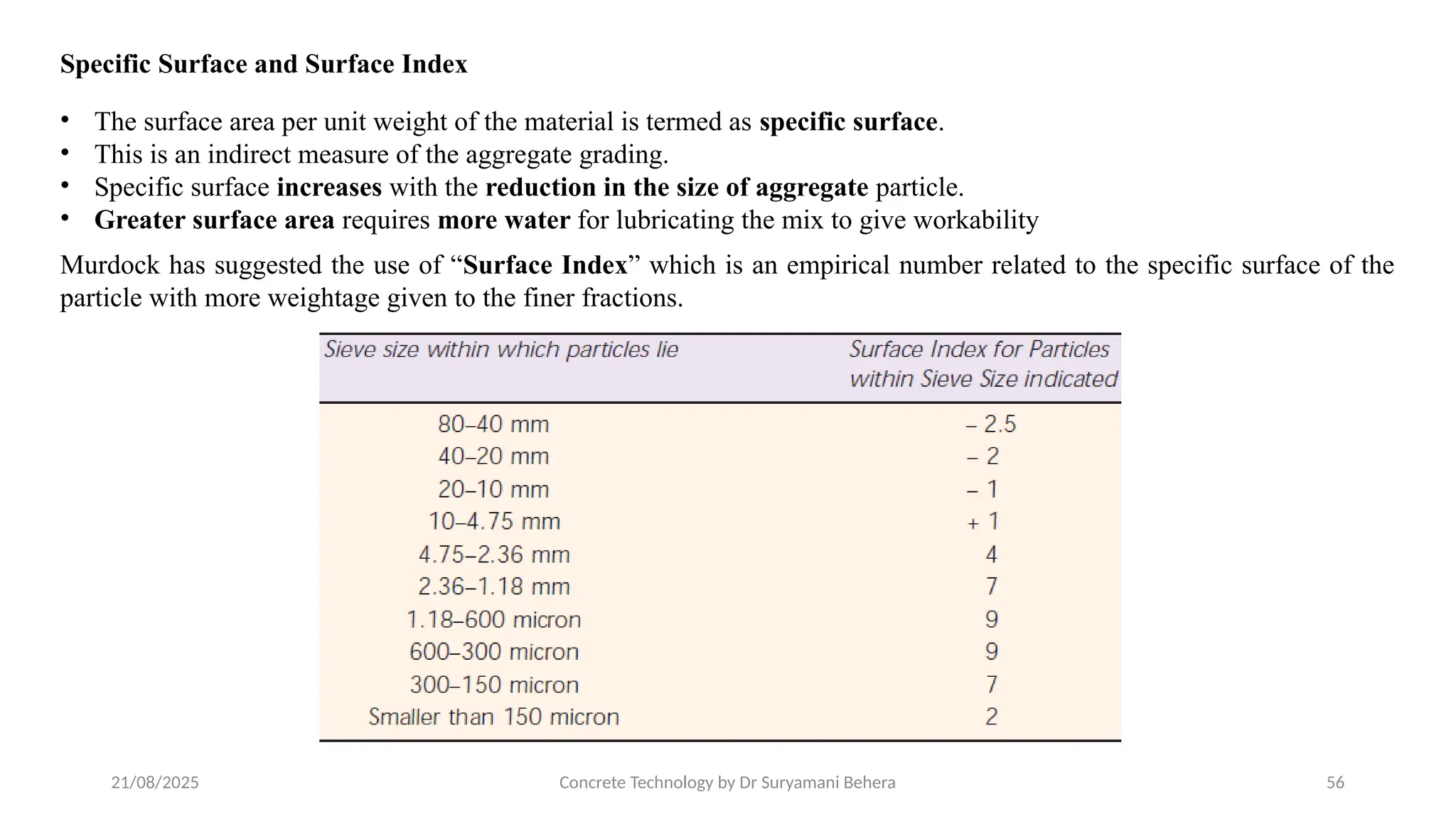
Specific Surface and Surface Index
• The surface area per unit weight of the material is termed as specific surface.
• This is an indirect measure of the aggregate grading.
• Specific surface increases with the reduction in the size of aggregate particle.
• Greater surface area requires more water for lubricating the mix to give workability
Murdock has suggested the use of “Surface Index” which is an empirical number related to the specific surface of the
particle with more weightage given to the finer fractions.
21/08/2025 Concrete Technology by Dr Suryamani Behera 57
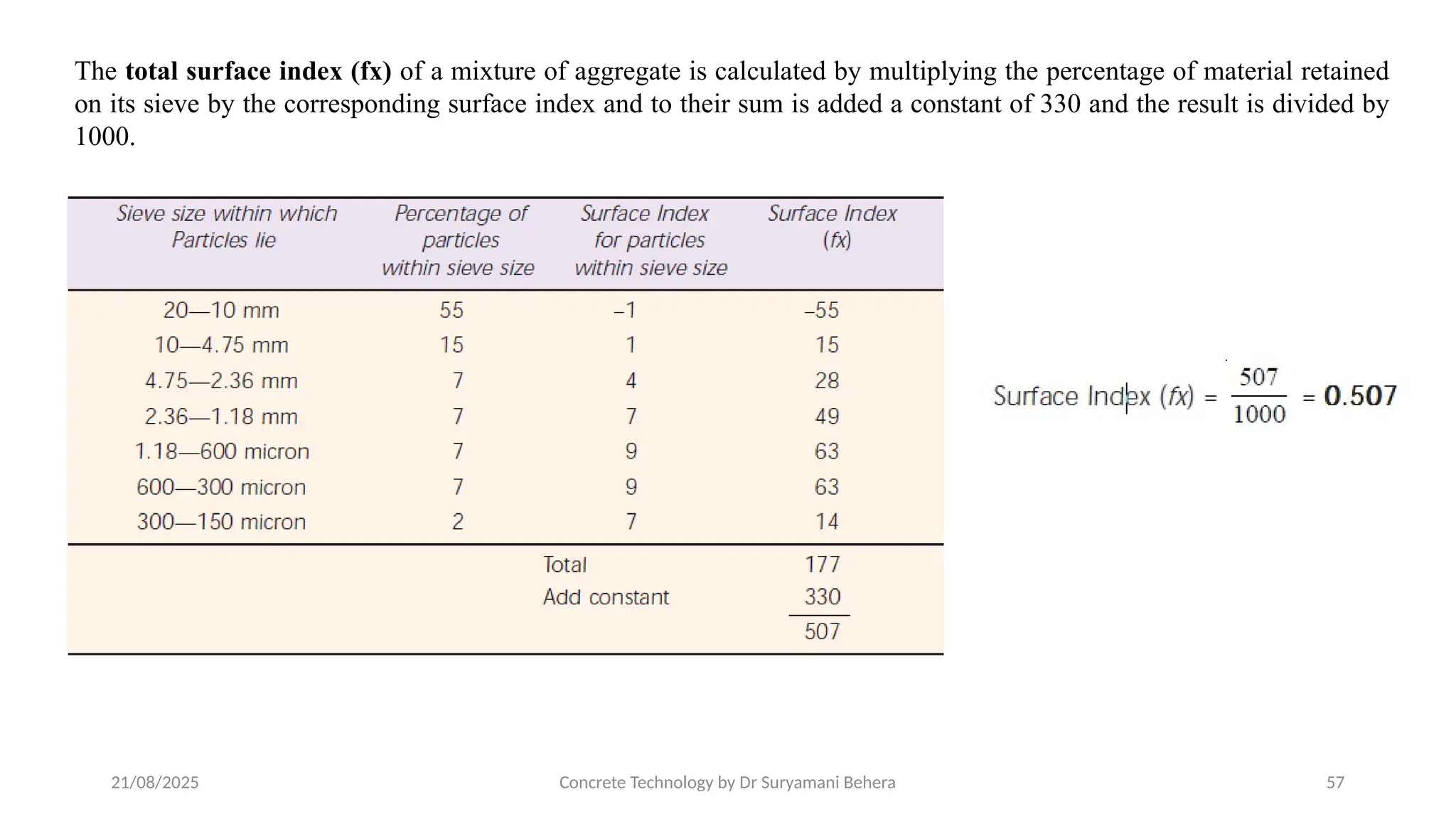
The total surface index (fx) of a mixture of aggregate is calculated by multiplying the percentage of material retained
on its sieve by the corresponding surface index and to their sum is added a constant of 330 and the result is divided by
1000.
21/08/2025 Concrete Technology by Dr Suryamani Behera 58
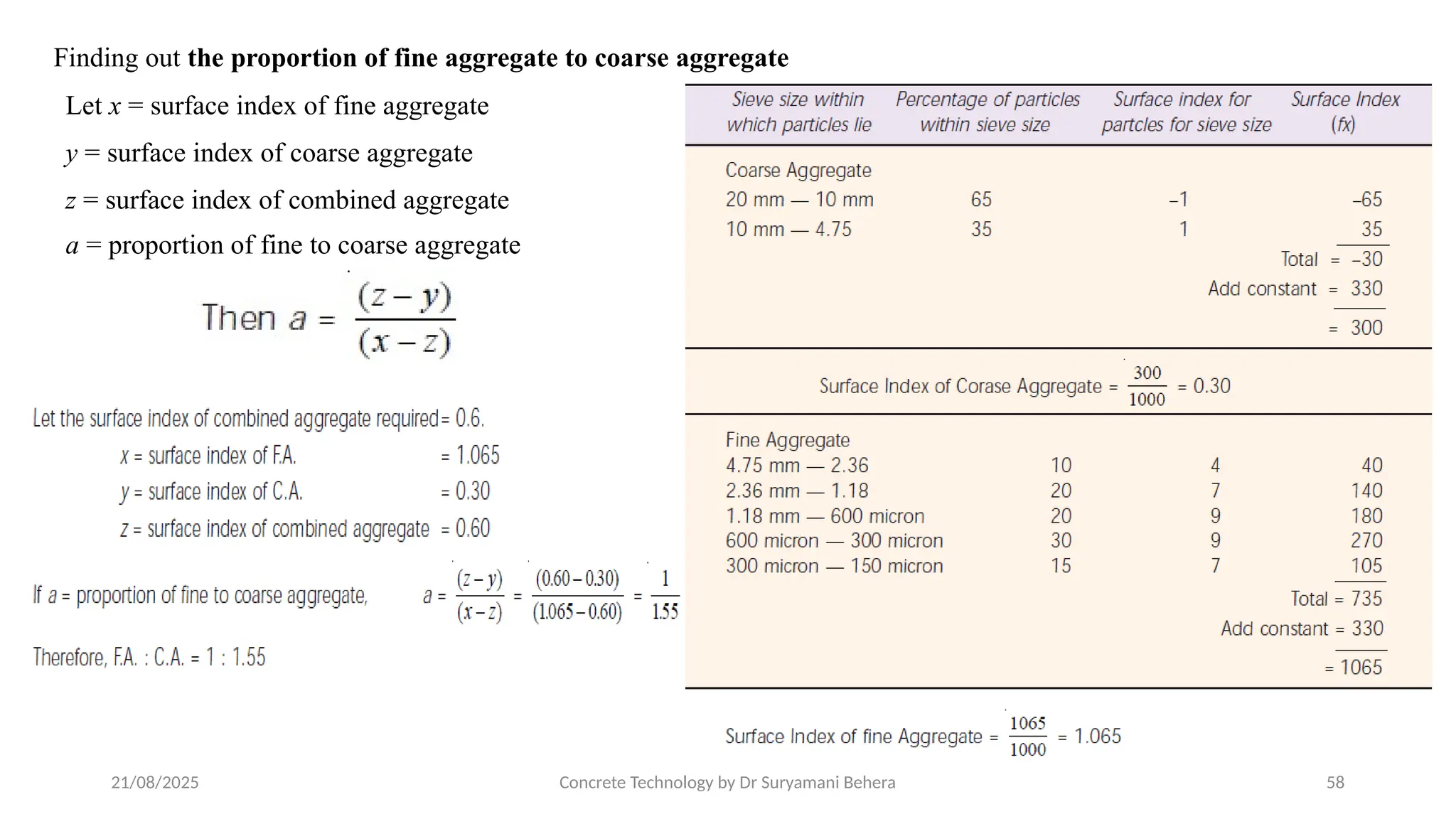
Finding out the proportion of fine aggregate to coarse aggregate
Let x = surface index of fine aggregate
y = surface index of coarse aggregate
z = surface index of combined aggregate
a = proportion of fine to coarse aggregate
21/08/2025 Concrete Technology by Dr Suryamani Behera 59
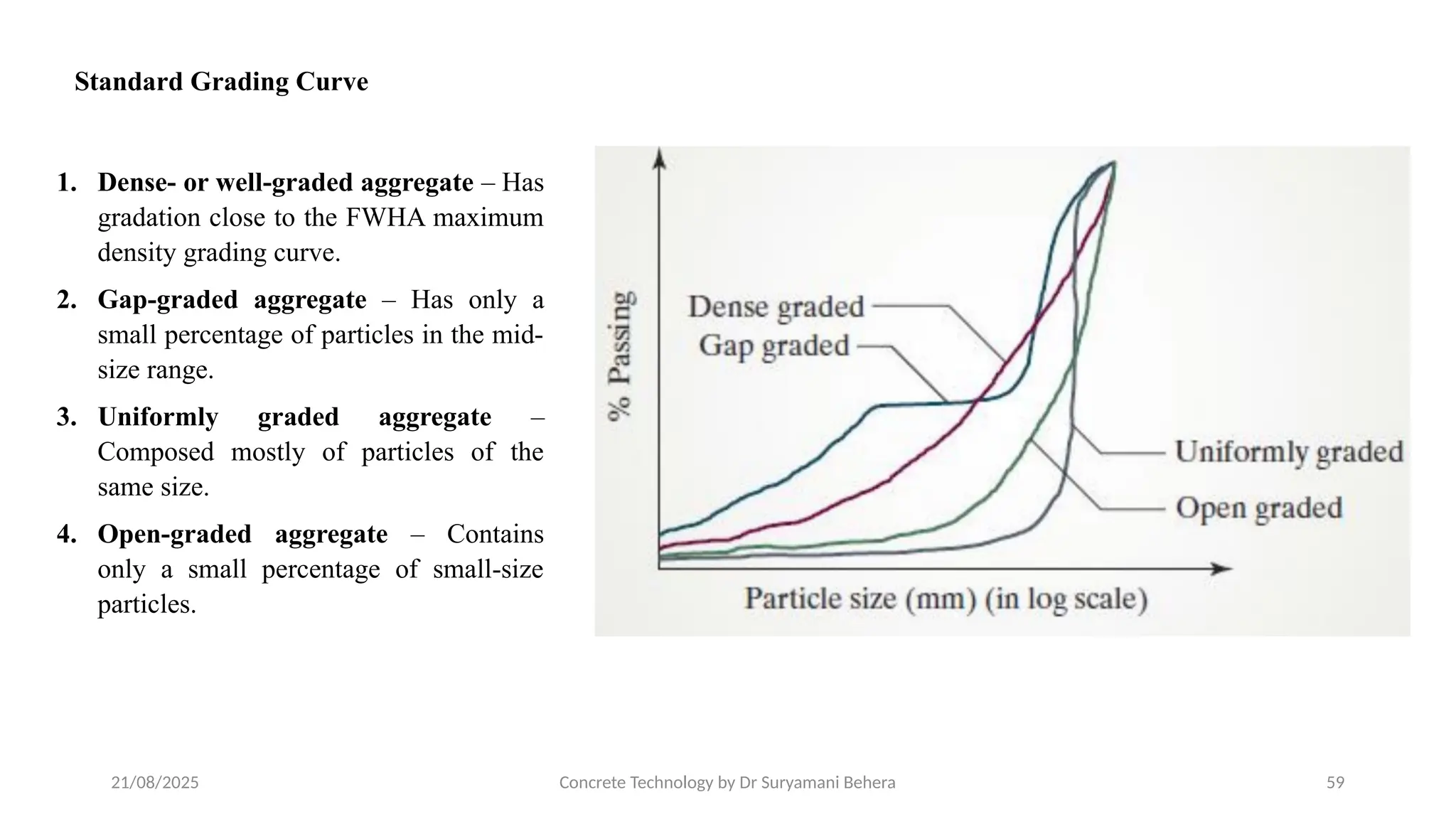
Standard Grading Curve
1. Dense- or well-graded aggregate – Has
gradation close to the FWHA maximum
density grading curve.
2. Gap-graded aggregate – Has only a
small percentage of particles in the mid-
size range.
3. Uniformly graded aggregate –
Composed mostly of particles of the
same size.
4. Open-graded aggregate – Contains
only a small percentage of small-size
particles.
21/08/2025 Concrete Technology by Dr Suryamani Behera 60
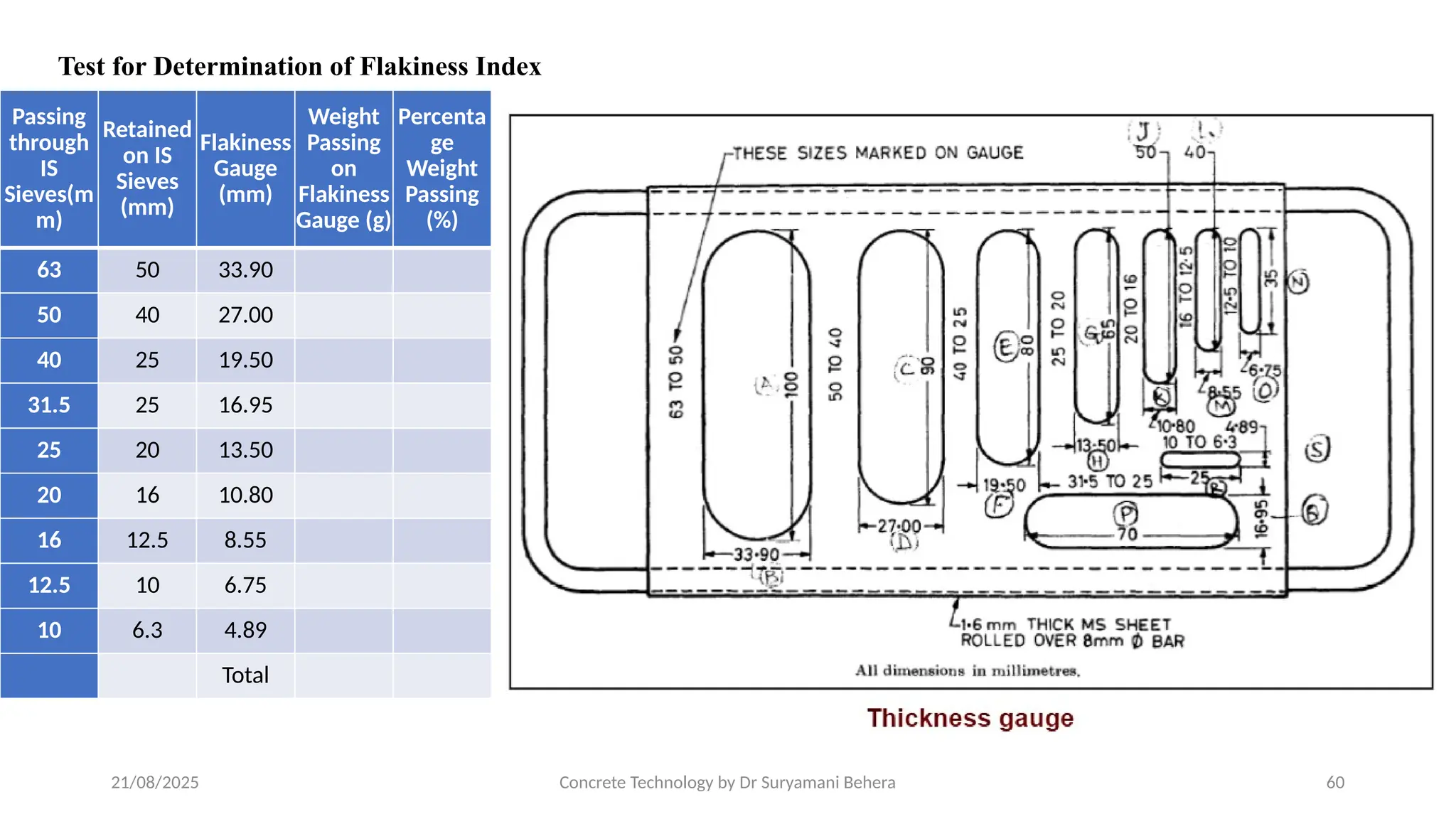
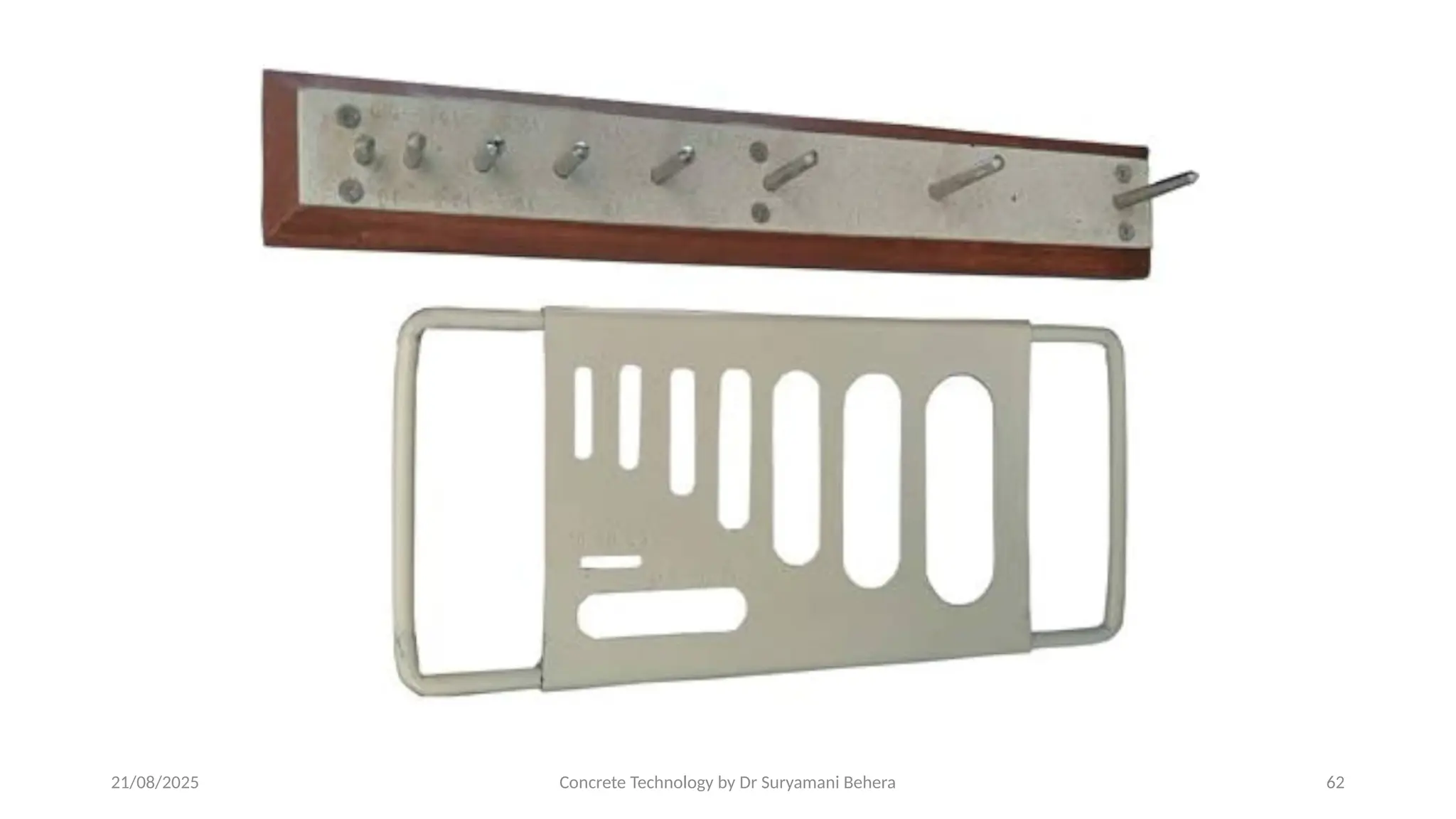
Test for Determination of Flakiness Index
Passing
through
IS
Sieves(m
m)
Retained
on IS
Sieves
(mm)
Flakiness
Gauge
(mm)
Weight
Passing
on
Flakiness
Gauge (g)
Percenta
ge
Weight
Passing
(%)
63 50 33.90
50 40 27.00
40 25 19.50
31.5 25 16.95
25 20 13.50
20 16 10.80
16 12.5 8.55
12.5 10 6.75
10 6.3 4.89
Total
21/08/2025 Concrete Technology by Dr Suryamani Behera 61
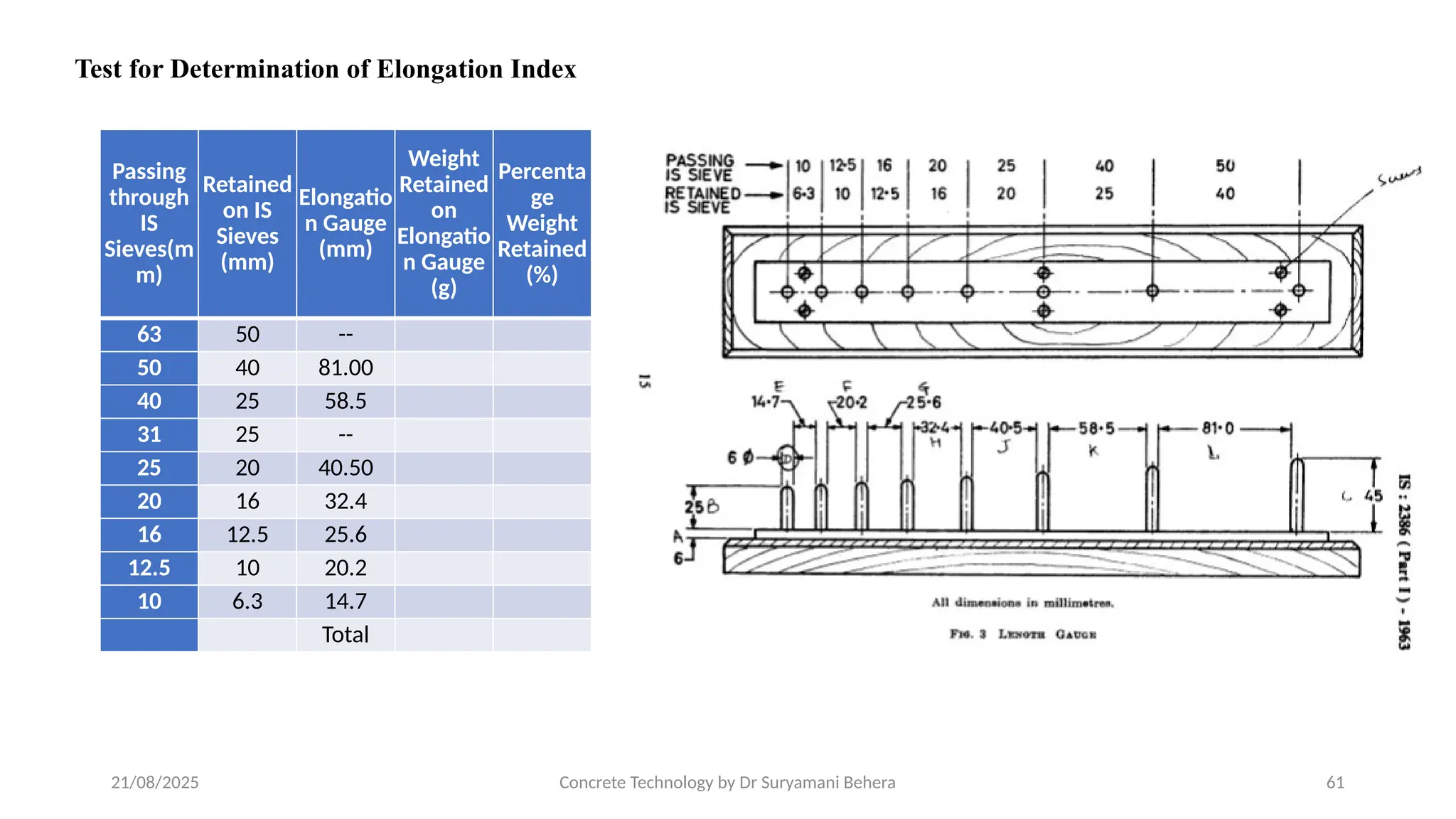
Test for Determination of Elongation Index
Passing
through
IS
Sieves(m
m)
Retained
on IS
Sieves
(mm)
Elongatio
n Gauge
(mm)
Weight
Retained
on
Elongatio
n Gauge
(g)
Percenta
ge
Weight
Retained
(%)
63 50 --
50 40 81.00
40 25 58.5
31 25 --
25 20 40.50
20 16 32.4
16 12.5 25.6
12.5 10 20.2
10 6.3 14.7
Total
21/08/2025 Concrete Technology by Dr Suryamani Behera 62
21/08/2025 Concrete Technology by Dr Suryamani Behera 63
Admixtures
• Admixture is defined as a material, other than cement, water and aggregates, that is used as an ingredient of
concrete and is added to the batch immediately before or during mixing.
• The conditions where ordinary concrete may fail to exhibit the required quality performance or durability,
admixture is used to alter the properties of fresh concrete or enhance the properties of the hardened
concrete.
CHEMICALADMIXTURES
 plasticizers
 superplasticizers
 set accelerators
 set retarders
 air entrainers
 corrosion inhibitors
 shrinkage control
 alkali-silica reactivity inhibitors
 colouring admixtures etc……..
21/08/2025 Concrete Technology by Dr Suryamani Behera 64
Plasticizers (Water Reducers) and Superplasticizers (High Range Water Reducers)
Uses/effects:
• Reduce the water/cement ratio for the given workability,
• Reduction in the water/cement ratio increases the strength.
• Reduction in the water/cement ratio improves the durability of concrete
• Reduce the cement content and heat of hydration in mass concrete.
0.1% to 0.4% by weight of cement (Keeping constant workability)
Plasticizer - reduction in mixing water is expected to be of the order of 5% to 15%.
Superplasticizer - reduction of water to the extent up to 30 per cent
21/08/2025 Concrete Technology by Dr Suryamani Behera 65
Action of Plasticizers and Superplasticizers
The action of plasticizers is mainly to fluidify the mix and improve the workability of concrete.
The mechanisms that are involved could be explained in the following way:
Dispersion effect:
Portland cement have a tendency to flocculate in wet concrete. This flocculation entraps a certain amount of water
used in the mix and thereby all the water is not freely available to fluidify the mix.
When plasticizers are used, they get adsorbed on the cement particles. The adsorption of charged polymer on
the particles of cement creates particle-to-particle repulsive forces which overcome the attractive forces. This
repulsive force is called Zeta Potential.
The overall result is that the cement particles are deflocculated and dispersed. When cement particles are
deflocculated, the water trapped inside the flocs gets released and is now available to fluidify the mix.
Retarding Effect:
It is mentioned earlier that plasticizer gets adsorbed on the surface of cement particles and forms a thin sheath.
This thin sheath inhibits the surface hydration reaction between water and cement as long as sufficient plasticizer
molecules are available at the particle/solution interface. The quantity of available plasticizers will progressively
decrease as the polymers become entrapped in hydration products.
21/08/2025 Concrete Technology by Dr Suryamani Behera 66
Compatibility of Superplasticizers and Cement
• It has been noticed that all superplasticizers do not show the same extent of improvement in fluidity with all types
of cement.
• Some superplasticizers may show a higher fluidizing effect on some types of cement than other cement.
• The fact is that they are just not compatible to show maximum fluidizing effect.
• The optimum fluidizing effect at the lowest dosage is an economical consideration.
Simple field tests show the optimum dose of the superplasticizer to the cement.
The following methods could be adopted.
 Marsh cone test
 Mini slump test
 Flow table test
21/08/2025 Concrete Technology by Dr Suryamani Behera 67
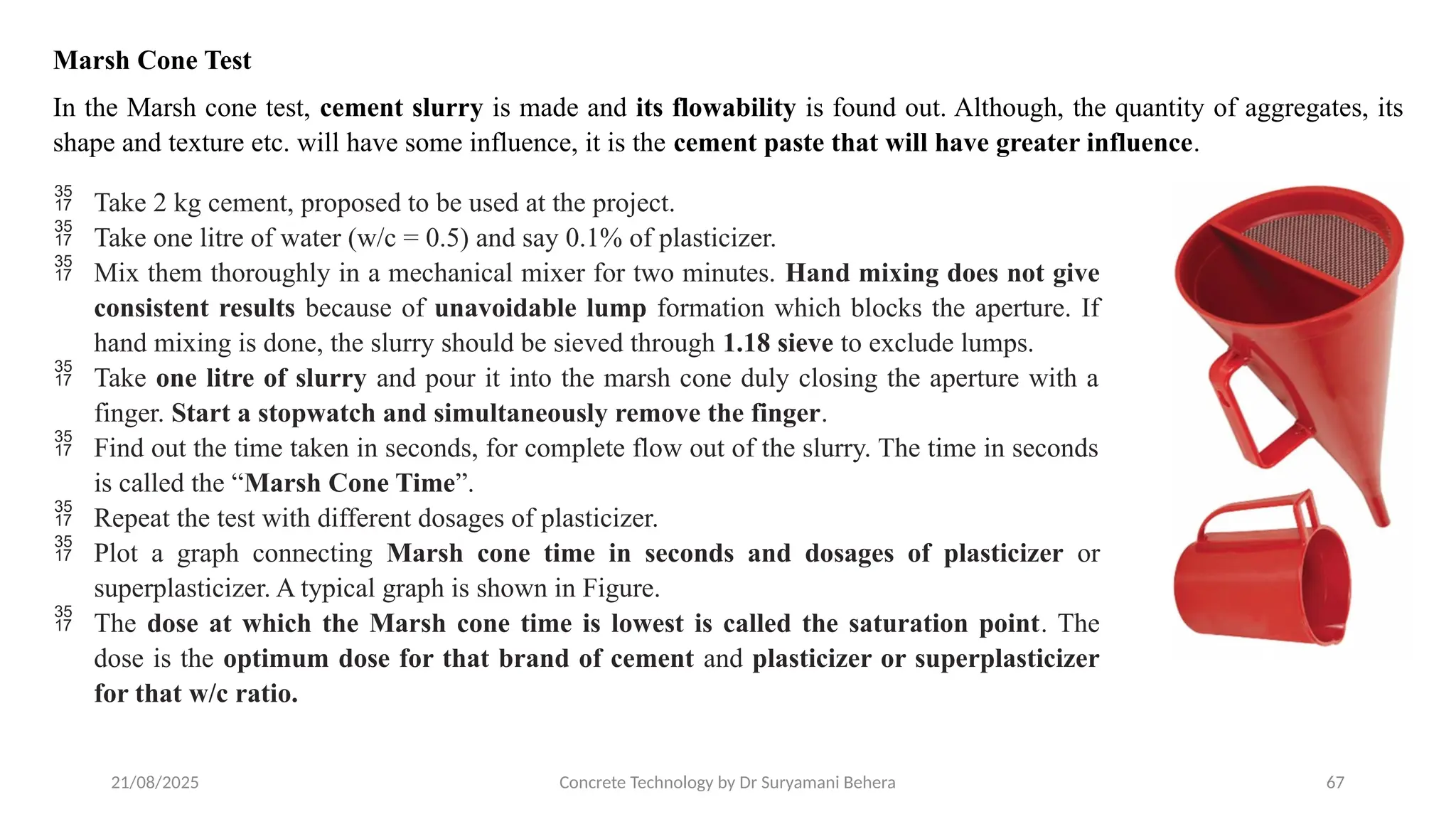
Marsh Cone Test
In the Marsh cone test, cement slurry is made and its flowability is found out. Although, the quantity of aggregates, its
shape and texture etc. will have some influence, it is the cement paste that will have greater influence.
 Take 2 kg cement, proposed to be used at the project.
 Take one litre of water (w/c = 0.5) and say 0.1% of plasticizer.
 Mix them thoroughly in a mechanical mixer for two minutes. Hand mixing does not give
consistent results because of unavoidable lump formation which blocks the aperture. If
hand mixing is done, the slurry should be sieved through 1.18 sieve to exclude lumps.
 Take one litre of slurry and pour it into the marsh cone duly closing the aperture with a
finger. Start a stopwatch and simultaneously remove the finger.
 Find out the time taken in seconds, for complete flow out of the slurry. The time in seconds
is called the “Marsh Cone Time”.
 Repeat the test with different dosages of plasticizer.
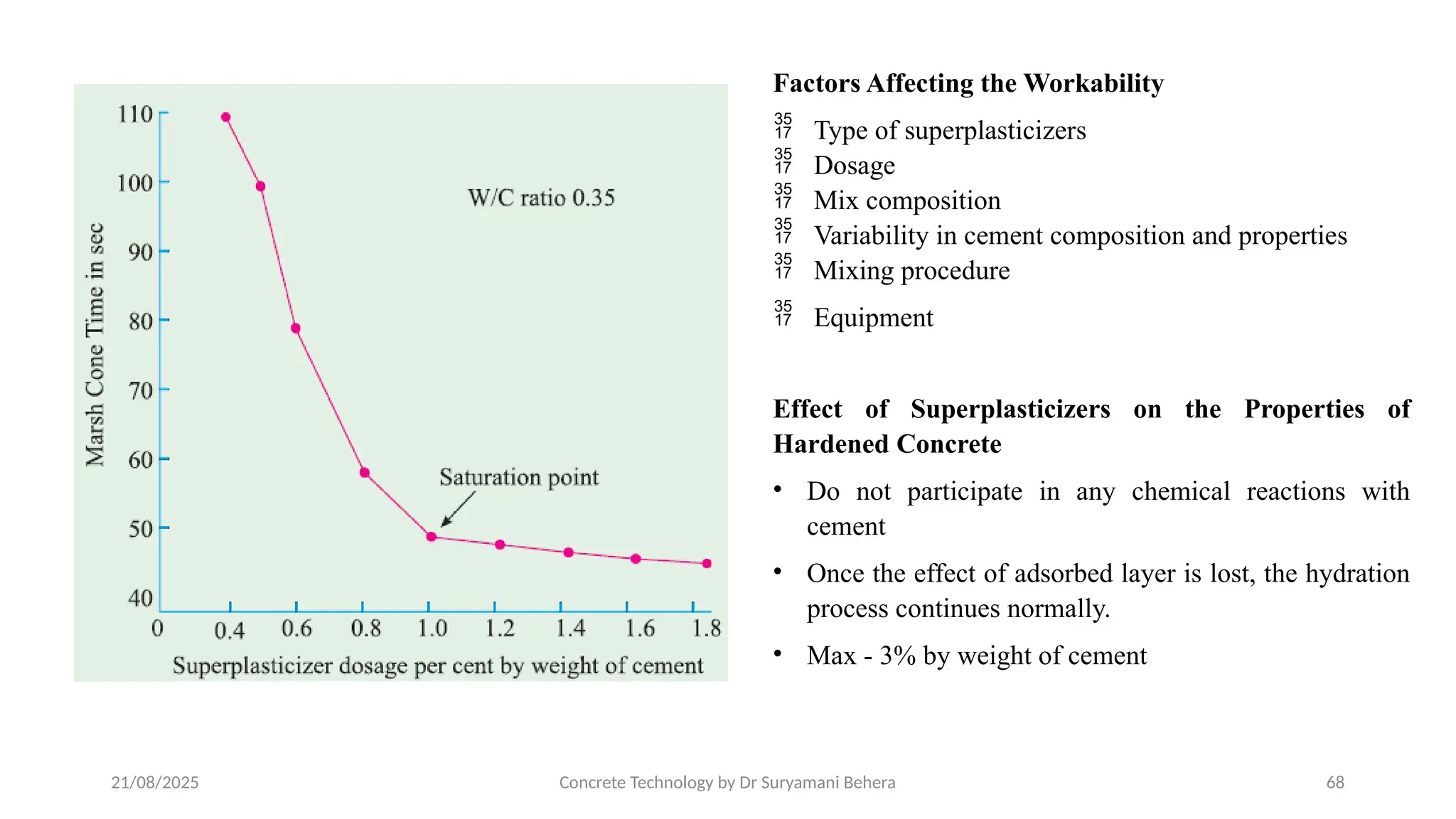
 Plot a graph connecting Marsh cone time in seconds and dosages of plasticizer or
superplasticizer. A typical graph is shown in Figure.
 The dose at which the Marsh cone time is lowest is called the saturation point. The
dose is the optimum dose for that brand of cement and plasticizer or superplasticizer
for that w/c ratio.
21/08/2025 Concrete Technology by Dr Suryamani Behera 68
Factors Affecting the Workability
 Type of superplasticizers
 Dosage
 Mix composition
 Variability in cement composition and properties
 Mixing procedure
 Equipment
Effect of Superplasticizers on the Properties of
Hardened Concrete
• Do not participate in any chemical reactions with
cement
• Once the effect of adsorbed layer is lost, the hydration
process continues normally.
• Max - 3% by weight of cement
21/08/2025 Concrete Technology by Dr Suryamani Behera 69
Retarders
A retarder is an admixture that slows down the chemical process of hydration so that concrete remains plastic and
workable for a longer time.
Uses:
 The retarders are used in casting and consolidating large number of pours without the formation of cold joints.
 They are also used in grouting oil wells. Oil wells are sometimes taken upto a depth of about 6000 meter deep
where the temperature may be about 200°C (quick hardening of cement). The annular spacing between the steel
tube and the wall of the well will have to be sealed with cement grout.
 The retarder sprayed to the surface of the formwork, prevents the hardening of matrix at the interface of
concrete and formwork, whereas the rest of the concrete gets hardened,
Examples: Gypsum, Sugar, Starches, Cellulose products etc…
The addition of sugar 0.05 to 0.10 per cent has little effect on the rate of hydration,
but if the quantity is increased to 0.2 per cent, hydration can be retarded to such an extent that final set may not take
place for 72 hours or more.
Retarding Plasticizers
The retardation by Plasticizers and superplasticizers may not be sufficient many times. Instead of adding retarders
separately, retarders are mixed with plasticizers or superplasticizers at the time of commercial production. Such
commercial brand is known as retarding plasticizers or retarding superplasticizers.
21/08/2025 Concrete Technology by Dr Suryamani Behera 70
Accelerators
Accelerating admixtures are added to concrete to increase the rate of early strength development in concrete to
 permit earlier removal of formwork
 reduce the required period of curing
 advance the time that a structure can be placed in service
 partially compensate for the retarding effect of low temperature during cold weather concreting
Examples: Calcium chloride, soluble carbonates, silicates fluosilicates
Accelerating Plasticizers
21/08/2025 Concrete Technology by Dr Suryamani Behera 71
Air-entraining Admixture
Air-entraining agents incorporate millions of non-coalescing air bubbles, which will act as flexible ball bearings
and will modify the properties of concrete.
The air voids present in concrete can be brought under two groups:
(a) Entrained air (b) Entrapped air
Entrained air is intentionally incorporated and distributed evenly in the entire mass of concrete.
Entrapped air is the void present in the concrete due to insufficient compaction.
Examples:
(a) Natural wood resins
(b) Animal and vegetable fats and oils, such as tallow, olive oil.
(c) Water soluble soaps of resin acids,
(d) Sodium salts of petroleum sulphonic acids, hydrogen peroxide and aluminium powder, etc…
21/08/2025 Concrete Technology by Dr Suryamani Behera 72
The Effect of Air Entrainment on the Properties of Concrete
Air entrainment will affect directly the following three properties of concrete:
(a) Increased resistance to freezing and thawing.
(b) Improvement in workability.
(c) Reduction in strength.
Incidentally, air entrainment will also affect the properties of concrete in the following ways:
(a) Reduces the tendencies of segregation.
(b) Reduces the bleeding and laitance.
(c) Decreases the permeability.
(d) Increases the resistance to chemical attack.
(e) Improves place ability and early finishing.
(f) Reduces the cement content, cost, and heat of hydration.
(g) Permits reduction in water content.
(h) Reduces the alkali-aggregate reaction.
21/08/2025 Concrete Technology by Dr Suryamani Behera 73
Measurement of Air Content in Air Entrained Concrete
• Too little air results in insufficient workability and too much air will result in low strength.
• It is, therefore, necessary that the air content should be maintained at the stipulated value.
• If the air content is found to be varying beyond the specified limit, adjustment is made by altering the amount of air
entraining agent.
There are mainly three methods for measuring air content of fresh concrete:
(a) Gravimetric Method; (b) Volumetric Method; (c) Pressure Method.
Gravimetric Method
• Gravimetric method was the first to be used and it did not require any special equipment.
• The procedure is principally one of determining the density of fresh concrete compacted in a standard manner. This
is then compared with the theoretical density of air-free concrete, calculated from the mix proportions and specific
gravities of the constituent materials making the concrete.
• Thus, if the air-free density is 2380 kg/cu.m. and the measured density is 2220 kg/cu.m.,
• then one cu.m. of concrete will contain 2220/2380 cu.m. of solid and liquid matter and the rest being air.
• Therefore, the air content then is 1 –2220/2380 = 0.07 or 7%.
21/08/2025 Concrete Technology by Dr Suryamani Behera 74
MINERALADMIXTURES
 Mineral admixtures make mixtures more economical, reduce permeability, increase strength, and influence
other concrete properties.
 Mineral admixtures affect the nature of the hardened concrete through hydraulic or pozzolanic activity.
 They can be used with Portland cement, or blended cement either individually or in combinations.
Pozzolanic materials are siliceous or siliceous and aluminous materials, which in themselves possess little or no
cementitious value.
But in finely divided form and in the presence of moisture, they chemically react with calcium hydroxide liberated
on hydration to form compounds possessing cementitious properties.
The reaction can be shown as:
Pozzolan + Calcium Hydroxide + Water  C – S – H (Gel)
21/08/2025 Concrete Technology by Dr Suryamani Behera 75
Pozzolanic materials can be divided into two groups: natural pozzolana and artificial pozzolana.
Natural Pozzolans
 Clay and Shales
 Opalinc Cherts
 Diatomaceous Earth
 Volcanic Tuffs and Pumicites
Artificial Pozzolans
 Fly ash
 Ground Granulated Blast-Furnace Slag
 Silica Fume
 Rice Husk ash
 Metakaoline
 Surkhi
21/08/2025 Concrete Technology by Dr Suryamani Behera 76
Fly Ash
Fly ash is a finely divided residue resulting from the combustion of powdered coal and transported by the flue
gases and collected by an electrostatic precipitator.
Fly ash is the most widely used pozzolanic material all over the world.
Why ?
In India alone, we produce about 75 million tons of fly ash per year, the disposal of which has become a serious
environmental problem. The effective utilisation of fly ash in concrete making is, therefore, attracting serious
considerations of concrete technologists and government departments.
Secondly, cement is the backbone for global infrastructural development. It was estimated that global production
of cement is about 1.3 billion tons in 1996. It is observed that 7% of the world’s carbon dioxide emission is
attributable to Portland cement industry.
21/08/2025 Concrete Technology by Dr Suryamani Behera 77
Properties of fly ash:
 High fineness, low carbon content, good reactivity are the essence of good fly ash.
 The amorphous characteristics greatly contribute to the pozzolanic reaction between cement and fly ash.
 One of the important characteristics of fly ash is the spherical form of the particles. This shape of the particle
improves the flowability and reduces the water demand.
Types of fly ash:
Class F: Fly ash normally produced by burning anthracite or bituminous coal, usually has less than 5% CaO. Class F
fly ash has pozzolanic properties only.
Class C: Fly ash normally produced by burning lignite or sub-bituminous coal. Some class C fly ash may have CaO
content in excess of 10%. In addition to pozzolanic properties, class C fly ash also possesses cementitious
properties.
21/08/2025 Concrete Technology by Dr Suryamani Behera 78
Effect of Fly Ash on Fresh Concrete
Good fly ash with high fineness, low carbon content, highly reactive forms only a small fraction of total fly ash
collected.
 The ESP fly ash collected in chambers I and II are generally very coarse, non spherical particles showing large
ignition loss. They can be called coal ash rather than fly ash. Such fly ash (coal ash) are not suitable for use as
pozzolan and they do not reduce the water demand.
 Use of right quality fly ash, results in reduction of water demand for desired slump. With the reduction of unit
water content, bleeding and drying shrinkage will also be reduced. Since fly ash is not highly reactive, the heat of
hydration can be reduced through replacement of part of the cement with fly ash.
Effects of Fly Ash on Hardened Concrete
 Fly ash, when used in concrete, contributes to the strength of concrete due to its pozzolanic reactivity. However,
since the pozzolanic reaction proceeds slowly, the initial strength of fly ash concrete tends to be lower than that of
concrete without fly ash. Due to continued pozzolanic reactivity concrete develops greater strength at later age, which
may exceed that of the concrete without fly ash.
 The pozzolanic reaction results in a decrease in water permeability and gas permeability.
 It should be noted that since the pozzolanic reaction can only proceed in the presence of water, enough moisture
should be available for a long time. Therefore, fly ash concrete should be cured for a longer period. In this sense, fly
ash concrete used in under-water structures such as dams will derive full benefits of attaining improved long-term
strength and water-tightness.
21/08/2025 Concrete Technology by Dr Suryamani Behera 79
Silica Fume
 Silica fume, also referred to as microsilica or condensed silica fume, is another material that is used as an artificial
pozzolanic admixture.
 It is a product resulting from reduction of high purity quartz with coal in an electric arc furnace in the manufacture
of silicon or ferrosilicon alloy.
 Silica fume rises as an oxidised vapour. It cools, condenses and is collected in cloth bags. It is further processed to
remove impurities and to control particle size.
 Condensed silica fume is essentially silicon dioxide (more than 90%) in noncrystalline form. Since it is an airborne
material like fly ash, it has spherical shape.
 It is extremely fine with particle size less than 1 micron and with an average diameter of about 0.1 micron, about
100 times smaller than average cement particles.
Pozzolanic Action
 Microsilica is much more reactive than fly ash or any other natural pozzolana.
 The reactivity of a pozzolana can be quantified by measuring the amount of Ca(OH)2 in the cement paste at different
times. In one case, 15% of microsilica reduced the Ca(OH)2 of two samples of cement from 24% to 12% at 90 days
and from 25% to 11% in 180 days.
 Most research workers agree that the C – S – H formed by the reaction between microsilica and Ca(OH)2 appears
dense and amorphous.
21/08/2025 Concrete Technology by Dr Suryamani Behera 80
Influence on Fresh Concrete
 Water demand increases in proportion to the amount of microsilica added. The increase in water demand of
concrete containing microsilica will be about 1% for every 1% of cement substituted. Measures can be taken to
avoid this increase by adjusting the aggregate grading and using superplasticizers.
 The addition of microsilica will lead to lower slump but more cohesive mix. The microsilica make the fresh
concrete sticky in nature and hard to handle.
 It was also found that there was large reduction in bleeding and concrete with microsilica could be handled and
transported without segregation.
 It is reported that concrete containing microsilica is vulnerable to plastic shrinkage cracking and, therefore, sheet
or mat curing should be considered.
 Microsilica concrete produces more heat of hydration at the initial stage of hydration. However, the total
generation of heat will be less than that of reference concrete.
Influence on Hardened Concrete
 Concrete containing microsilica showed outstanding characteristics in the development of strength. It has been
observed that 60 to 80 MPa can be obtained relatively easily.
 It has been also found out that modulus of elasticity of microsilica concrete is less than that of concrete without
microsilica at the same level of compressive strength.
 An improvement in durability of concrete with microsilica is also observed.
21/08/2025 Concrete Technology by Dr Suryamani Behera 81
Rice Husk Ash
 Rice husk ash, is obtained by burning rice husk in a controlled manner without causing environmental
pollution.
 When properly burnt it has high SiO2 content and can be used as a concrete admixture.
 Rice husk ash exhibits high pozzolanic characteristics and contributes to high strength and high
impermeability of concrete.
 There is a good potential to make use of RHA as a valuable pozzolanic material to give almost the same
properties as that of microsilica.
Ground Granulated Blast Furnace Slag (GGBS)
• Ground granulated blast-furnace slag is a non-metallic product consisting essentially of silicates and aluminates
of calcium and other bases.
• The molten slag is rapidly chilled by quenching in water to form a glassy sand-like granulated material.
• The granulated material when further ground to less than 45 microns to form GGBS.

Concrete technology and its behavior details

  • 1.
    Concrete Technology Dr SuryamaniBehera Cement: Portland cement- chemical composition, Hydration, Setting of cement, Structure of hydrate cement, Test on physical properties, Different grades of cement. Admixtures: Types of admixtures - mineral and chemical admixtures -properties - dosages - effects - usage. Aggregates: Classification of aggregate, Particle shape & texture, Bond, strength & other mechanical properties of aggregate, Specific gravity, Bulk density, porosity, adsorption & moisture content of aggregate, Bulking of sand, Deleterious substance in aggregate, Soundness of aggregate, Alkali aggregate reaction, Thermal properties, Sieve analysis, Fineness modulus, Grading curves, Grading of fine & coarse Aggregates, Gap graded aggregate, Maximum aggregate size.
  • 2.
    21/08/2025 Concrete Technologyby Dr Suryamani Behera 2 Cement  Cement is a material with adhesive and cohesive properties which make it capable of bonding mineral fragments into a compact whole. For constructional purposes, the meaning of the term "cement" is restricted to the binding materials used with stones, sand, bricks, etc.  The name "Portland cement" was given originally due to the resemblance of the colour and quality of the hardened cement to Portland stone (found in Portland Island, England). Properties of Cement The important properties of cement are as follows:  It acts as an excellent binding material.  It gives strength to the concrete or masonry.  It offers good resistance to the moisture.  It makes the fresh concrete or mortar easily workable.  It stiffens or hardens in less time.
  • 3.
    21/08/2025 Concrete Technologyby Dr Suryamani Behera 3 Manufacturing Process of Portland cement Raw materials • Calcareous material – such as limestone or chalk, as a source of lime (CaO). • Clayey material – such as clay or shale (soft clayey stones), as a source of silica and alumina. There are four stages in the manufacture of Portland cement: 1. crushing and grinding the raw materials, 2. blending the materials in the correct proportions, 3. burning the prepared mix in a kiln, and 4. grinding the burned product, known as “clinker” (3-25 mm diameter) together with some 5 per cent of gypsum (to control the time of set of the cement). Methods of Cement Manufacturing The three processes of manufacturing cement are: 5. Wet process - raw materials are ground wet and fed to the kiln as a slurry. 6. Dry process - raw materials are ground dry and fed as a dry powder. 7. Semidry process - raw materials are ground dry and then moistened to form nodules that are fed to the kiln.
  • 4.
    21/08/2025 Concrete Technologyby Dr Suryamani Behera 4
  • 5.
    21/08/2025 Concrete Technologyby Dr Suryamani Behera 5
  • 6.
    21/08/2025 Concrete Technologyby Dr Suryamani Behera 6 Types of Cement 1. OPC (Ordinary Portland Cement) Grades • OPC 33 - 33 N/mm^2 (Compressive strength) • OPC 43 - 43 N/mm^2 • OPC 53 - 53 N/mm^2 2. PPC (Portland Pozzolana Cement) • 10-25 % pozzolana added eg. Fly ash, Silica fume etc. • Initial strength is less, but 28 days strength is the same • Cheaper
  • 7.
    21/08/2025 Concrete Technologyby Dr Suryamani Behera 7 Types of Cement 3. Rapid Hardening Cement – Initial strength is increased • 3 day strength = 7 day strength of OPC • more C3S and less C2S than OPC 4. Extra Rapid Hardening Cement – Initial strength is increased and setting time is decreased. • more C3S and C3A than OPC • Used in cold weather areas 5. Quick Setting Cement – Setting time is decreased (fast setting) • more C3A than OPC • Used in underwater constructions
  • 8.
    21/08/2025 Concrete Technologyby Dr Suryamani Behera 8 Types of Cement 6. Low Heat Cement - • low percentage of C3A and relatively more C2S 7. Expanding Cement – • adding an expanding medium like sulphoaluminate • used for the construction of water-retaining structures and for repairing damaged concrete surfaces 8. Air-Entraining Cement – • adding air-entraining agents like glues, sodium salts and resins • used for frost resistance in concrete Frost - damage of early-age concrete because the ice volume expansion causes micro-cracks in the concrete structures
  • 9.
    21/08/2025 Concrete Technologyby Dr Suryamani Behera 9 Types of Cement 9. White Cement – • reduced C4AF content • used in swimming pools, for painting garden furniture, moulding sculptures and statues etc 10. Coloured Cement – • by mixing mineral pigments More types of cements…………
  • 10.
    21/08/2025 Concrete Technologyby Dr Suryamani Behera 10 Various tests on Cement • Field test • Laboratory test Field tests (i) Colour • The colour of cement should be uniform. • It should be a typical cement colour i.e. grey colour with a light greenish shade. (ii) Physical properties • Cement should feel smooth when touched between fingers. • If the hand is inserted in a bag or heap of cement, it should feel cool. (iii) Presence of lumps • Cement should be free from lumps.
  • 11.
    21/08/2025 Concrete Technologyby Dr Suryamani Behera 11 (iv) Strength • A thick paste of cement with water is made on a piece of thick glass and it is kept under water for 24 hours. It should set and not crack. Take about 100 grams of cement and a small quantity of water and make a stiff paste. From the stiff paste, pat a cake with sharp edges. Put it on a glass plate and slowly take it under water in a bucket. See that the shape of the cake is not disturbed while taking it down to the bottom of the bucket. After 24 hours the cake should retain its original shape and at the same time it should also set and attain some strength. (v) Take a handful of cement and throw it on a bucket full of water, the particles should float for some time before they sink. Field tests cont…
  • 12.
    21/08/2025 Concrete Technologyby Dr Suryamani Behera 12 Laboratory tests: (i) Fineness • This test is carried out to check the proper grinding of cement. • The fineness of cement particles may be determined either by: • sieve test • air permeability apparatus test. Sieve test The cement weighing 100 grams is taken and it is continuously passed for 15 minutes through a standard 90-micron sieve. The residue is then weighed and this weight should not be more than 10% of the original weight.
  • 13.
    21/08/2025 Concrete Technologyby Dr Suryamani Behera 13 Air Permeability Method This method of test covers the procedure for determining the fineness of cement as represented by specific surface expressed as total surface area in sq. cm/gm (cm2 /gm). of cement. It is also expressed in m2 /kg. 1. Lea and Nurse Air Permeability Apparatus 2. Blain Air Permeability Apparatus Weight of cement = porosity × density × volume Permeability cell - 1 cm. high and 2.5 cm. in diameter Pass on air through the cement bed at a constant velocity until the flowmeter shows a difference in level of 30-50 cm Lea and Nurse Air Permeability Apparatus
  • 14.
    21/08/2025 Concrete Technologyby Dr Suryamani Behera 14 Blain Air Permeability Apparatus Procedure: 1. Put a filter paper into the cell then weight 2.84g of cement sample into it. 2. Put another filter paper on it and compress with the plunger. 3. Attach the cell on top of the U-tube manometer. 4. Evacuate the air in the manometer through the side tube using the aspirator bulb until the oil reaches level 1. 5. Close the side valve and monitor the oil as it start to fall. 6. Using a stop watch, measure the time taken (t) for the oil to fall from level 2 to level 3. Blaine’s Sw =k√t k is 523.0547
  • 15.
    21/08/2025 Concrete Technologyby Dr Suryamani Behera 15 Consistency The purpose of this test is to determine the percentage of water required for preparing cement pastes for other tests.
  • 16.
    21/08/2025 Concrete Technologyby Dr Suryamani Behera 16
  • 17.
    21/08/2025 Concrete Technologyby Dr Suryamani Behera 17 • Take 300 gm of cement and add 30 per cent by weight or 90 gm of water to it. • Fill the mould of the Vicat’s apparatus and the gauging time should be 3.75 to 4.25 minutes. • Vicat apparatus consists of a movable rod with an indicator attached to it. The movable rod bears the needles. • There are three attachments: plunger, square needle, and needle with annular collar. • The plunger is attached to the movable rod for the consistency test. The plunger is brought down to touch the surface of the paste in the test block and quickly released allowing it to sink into the paste by its own weight. • The settlement of the plunger is noted. If the penetration is between 5 mm to 7 mm from the bottom of the mould, the water added is correct. If not, the process is repeated with different percentages of water till the desired penetration is obtained. Consistency test
  • 18.
    21/08/2025 Concrete Technologyby Dr Suryamani Behera 18 Setting time test The time taken by the cement to harden is called the setting time of cement. The setting time of cement is differentiated on the basis of the time taken by the cement to set.  Initial setting time  Final setting time A Vicat’s apparatus is used to determine the setting time of cement. Test procedure Initial Preparation 1. Consistency test to be done before starting the test procedure to find out the water required to give the paste normal consistency (P). 2. Take 400 gm of cement and prepare a neat cement paste with 0.85P of water by the weight of the cement. 3. Gauge time is kept between 3 to 5 minutes. Start the stopwatch at the instant when the water is added to the cement. Record this time (T1). 4. Fill the Vicat mould, resting on a glass plate, with the cement paste gauged as above. Fill the mould completely and smooth off the surface of the paste making it level with the top of the mould. The cement block thus prepared is called a test block.
  • 19.
    21/08/2025 Concrete Technologyby Dr Suryamani Behera 19 Test for Initial Setting Time 1. Place the test block confined in the mould and resting on the non-porous plate, under the rod bearing the needle with a 1 mm square cross-section. 2. Lower the needle gently until it comes in contact with the surface of the test block and quickly release, allowing it to penetrate the test block. 3. In the beginning the needle completely pierces the test block. Repeat this procedure i.e. quickly releasing the needle after every 2 minutes till the needle fails to pierce the block for about 5 mm measured from the bottom of the mould. Note this time (T2). Test for Final Setting Time 1. For determining the final setting time, replace the needle of the Vicat’s apparatus with the needle having an annular hollow metallic attachment with a circular cutting edge of 5 mm diameter and having a 0.5 mm projection at the end. 2. The cement is considered finally set, when upon applying the final setting needle gently to the surface of the test block, the 0.5 mm projection of the needle makes an impression thereon, while the 5 mm diameter attachment fails to do so. Record this time (T3). Initial setting time=T2-T1 Final setting time=T3-T1 T1 =Time at which water is first added to cement T2 =Time when needle fails to penetrate 5 mm to 7 mm from the bottom of the mould T3 =Time when the needle makes an impression but the attachment fails to do so. Initial setting time should not be less than 30 minutes for ordinary Portland cement. Final setting time should not be more than 10 hours.
  • 20.
    21/08/2025 Concrete Technologyby Dr Suryamani Behera 20 Specific Gravity Le Chatelier Flask method Le-Chatelier flask Procedure 1. The Flask should be free from the liquid which means it should be fully dry. Weigh the empty flask, which is W1. 2. Next, fill the cement in the bottle up to half of the flask around 50gm and weigh it with its stopper. And it is W2. 3. Add Kerosene to the cement up to the top of the bottle. Mix well to remove the air bubbles in it. Weigh the flask with cement and kerosene. And it is W3. 4. Empty the flask. Fill the bottle with kerosene up to the top and weigh the flask for counting W4. The specific gravity of cement should be around 3.15 kg/litre
  • 21.
    21/08/2025 Concrete Technologyby Dr Suryamani Behera 21 Soundness • The purpose of this test is to detect the presence of uncombined lime in the cement, which can cause expansion of cement after setting resulting in disruption of the set and hardened mass. • Soundness means the ability to resist volume expansion. • The soundness of cement may be determined by the Le-Chatelier method Le-Chatelier apparatus
  • 22.
    21/08/2025 Concrete Technologyby Dr Suryamani Behera 22 Procedure • Prepare a cement paste as in the consistency test with 0.78P water. • The mould is placed on a glass plate and is filled with cement paste. • It is covered at the top by another glass plate. A small weight is placed at the top and the whole assembly is submerged in water for 24 hours. • The distance between the points of the indicator is noted. The mould is again placed in water and heat is applied in such a way that the boiling point of water is reached in about 30 minutes. The boiling of water is continued for 3 hours. • The mould is removed from water and it is allowed to cool down. • The distance between the points of the indicator is again measured. The difference between the two readings indicates the expansion of cement and it should not exceed 10 mm.
  • 23.
    21/08/2025 Concrete Technologyby Dr Suryamani Behera 23 Compressive strength • The mortar of cement and sand is prepared in a ratio of 1:3 in a non-porous enamel tray and mix them with a trowel for one minute. • Water is added to the mortar in a water-cement ratio of 0.4 or (P/4 + 3.0) %. The time of mixing should not be less than 3 minutes or more than 4 minutes. • The mortar is placed in metal cube moulds (of size 70.6 mm or 76 mm). For 70.6 mm and 76 mm cubes, the cement required is 185 gm and 235 gm, respectively. • Then the mortar is compacted in a vibrating machine for 2 minutes (to remove the voids) and the moulds are placed in a damp cabin for 24 hours. • The specimens are removed from the moulds and they are submerged in clean water for curing. • The cubes are then tested in a compression testing machine at the end of 3, 7 and 28 days. Thus, compressive strength is obtained.
  • 24.
    21/08/2025 Concrete Technologyby Dr Suryamani Behera 24 Tensile strength • The mortar of cement and sand is prepared in 1:3 ratio. • The quantity of water added is (P/5) + 2.5 per cent by weight of cement and sand. • The mortar is placed in briquette moulds. • The briquettes are kept in a damp cabin for 24 hours and then are carefully removed from the moulds and they are submerged in clean water for curing. • The briquettes are tested in the testing machine at the end of 3 days and 7 days. • It may be noted that the cross-sectional area of the briquette at its least section is 6.45 cm2 . Hence the ultimate tensile stress of cement paste is obtained from the following relation: Ultimate tensile stress = failing load/6.45 • The tensile stress at the end of 3 days should not be less than 2 N/mm2 and that at the end of 7 days should not be less than 2.50 N/mm2 .
  • 25.
    21/08/2025 Concrete Technologyby Dr Suryamani Behera 25 Aggregates
  • 26.
    21/08/2025 Concrete Technologyby Dr Suryamani Behera 26 Aggregates Aggregates occupy 70–80 per cent of the volume of concrete Classification Aggregates can be classified as (i) Normal weight aggregates (ii) Light weight aggregates (iii) Heavy weight aggregates Natural Artificial Sand Broken Brick, Gravel Air-cooled Slag Crushed rock such as Granite, Quartzite, Basalt, Sandstone Sintered fly ash, Bloated clay
  • 27.
    21/08/2025 Concrete Technologyby Dr Suryamani Behera 27 Igneous Rocks: Based on the cooling condition of magma, the igneous rocks are classified into 3 categories. Plutonic rocks: Hypabyssal rocks Volcanic rocks formed by cooling the magma at a considerable or larger depth from the earth’s surface. cooling the magma at a relatively shallow depth from the earth’s surface. cooling the magma on or near the earth’s surface cooling is slow cooling is fast cooling is very fast finely-grained crystalline structures coarsely-grained crystalline structures extremely fine-grained non- crystalline glassy structure Used for construction purposes construction purposes, certain stones for making jewellery lightweight concrete, used as an insulating material, used for decorative purposes Granite Dolerite Basalt
  • 28.
    21/08/2025 Concrete Technologyby Dr Suryamani Behera 28 Sedimentary Rocks: Rocks disintegrate due to the weathering action of water, wind and frost. The disintegrated rocks are subsequently transported by air, river, glacier, and sea and are deposited at different localities. The deposits are of various kinds as follows:  Residual deposits: Rocks remain at the original site after weathering.  Sedimentary deposits: Products from the weathering are transported to other localities and deposited  Chemical deposits: Evaporation and precipitation.  Organic deposits: Deposited through living organisms. Such deposits are called organic deposits. The sedimentary rocks are more uniform, fine-grained and compact in their nature. They represent a bedded or stratified structure in general. e.g.- Sandstones, limestones, gypsum, lignite etc.
  • 29.
    21/08/2025 Concrete Technologyby Dr Suryamani Behera 29 Metamorphic Rocks: Previously formed rocks undergo changes in their properties due to metamorphic action of great pressure and heat. This process of change is called metamorphism. The agents of metamorphism are heat, pressure and chemicals. Based on the various combinations of metamorphic agents, metamorphism is of 4 types as follows:  Thermal: It happens when rock is heated up by an intrusion of hot magma. Heat is the predominant factor in this type of metamorphism.  Cataclastic: A high-pressure metamorphism resulting from the crushing and shearing of rock during tectonic movement, mostly along faults due to direct pressure. (areas of detachment where rocks slide past one another).  Dynamo-thermal: Dynamo-thermal metamorphism is due to the cooperation of directed pressure and heat. This metamorphism occurs with the increase in the depth.  Plutonic: Metamorphism is meant due to the changes which are produced in rocks by great heat and uniform pressure. (greater depth - no direct pressure). e.g.- Due to metamorphic action,  lime stone changes to marble  mud stone becomes slate
  • 30.
    21/08/2025 Concrete Technologyby Dr Suryamani Behera 30 Size of aggregates 80 mm size is the maximum size that could be conveniently used for concrete making. Using the largest possible maximum size will result in (i) reduction of the cement content (ii) reduction in water requirement (iii) reduction of drying shrinkage. But in any case, not greater than one-fourth of the minimum thickness of the member. For heavily reinforced concrete member the nominal maximum size of aggregate should usually be restricted to • 5 mm less than the minimum clear distance between the main bars • 5 mm less than the minimum cover to the reinforcement, whichever is smaller. But from various other practical considerations, for reinforced concrete work, aggregates having a maximum size of 20 mm are generally considered satisfactory.
  • 31.
    21/08/2025 Concrete Technologyby Dr Suryamani Behera 31 Scopes Fine Aggregate (FA)- Sand Coarse Aggregate (CA)- Stone Definition Fine aggregates are small-size filler materials in construction. Coarse aggregates are larger-size filler materials in construction. Size of Particles Fine aggregates are the particles that pass through a 4.75 mm sieve and retain on a 0.075 mm sieve. Coarse aggregates are the particles that retain on a 4.75 mm sieve. Materials Sand, surkhi, stone screenings, burnt clays, cinders, fly ash, etc are used as fine aggregate in concrete. Brick chips (broken bricks), stone chips (broken stones), gravels, pebbles, clinkers, cinders, etc. are used as coarse aggregate in concrete. Sources River sand or machine sand, crushed stone sand, and crushed gravel sand are the major sources of fine aggregate. Dolomite aggregates, crushed gravel or stone, and the natural disintegration of rock are the major sources of coarse aggregate. Surface Area The surface area of fine aggregates is higher. The surface area of coarse aggregates is less than fine aggregates. Function in Concrete The voids between the coarse aggregate are filled up by fine aggregate. Coarse aggregate acts as inert filler material for concrete and provides strength to the concrete. Uses Fine aggregates are used in mortar, plaster, concrete, filling of road pavement layers, etc. Coarse aggregates are mainly used in concrete, railway track ballast, etc. Fine and Coarse Aggregates
  • 32.
    21/08/2025 Concrete Technologyby Dr Suryamani Behera 32 Shape of aggregates Rounded aggregates – less cement requirement. Angular aggregate - Additional cement required leads to higher strengths and sometimes greater durability as a result of higher bond/interlocking characteristics between aggregate and cement paste.
  • 33.
    21/08/2025 Concrete Technologyby Dr Suryamani Behera 33 Methods of expressing the angularity Angularity Number (fH): A quantity of single sized aggregate is filled into metal cylinder of three litre capacity. The aggregates are compacted in a standard manner and the percentage of void is found out. • If the void is 33 per cent the angularity of such aggregate is considered zero (solid volume of the aggregate is 67 per cent).  If the void is 44 per cent the angularity number of such aggregate is considered 11 (solid volume of the aggregate is 56 per cent).  The normal aggregates which are suitable for making the concrete may have angularity number anything from zero to 11.  Angularity number zero represents the most practicable rounded aggregates and  the angularity number 11 indicates the most angular aggregates that could be tolerated for making concrete. Angularity Index: Murdock suggested a different method for expressing the shape of aggregate by a parameter called Angularity Index.
  • 34.
    21/08/2025 Concrete Technologyby Dr Suryamani Behera 34 Texture  As surface smoothness increases, contact area decreases, hence a highly polished particle will have less bonding area with the matrix than a rough particle of the same volume.  It has been also shown by experiments that rough textured aggregate develops higher bond strength than smooth textured aggregate.
  • 35.
    21/08/2025 Concrete Technologyby Dr Suryamani Behera 35 Strength Strength of aggregate is assessed by Aggregate Crushing Value tests. Aggregate Crushing Value : Resistance of an aggregate sample to crushing under gradually applied compressive load.
  • 36.
    21/08/2025 Concrete Technologyby Dr Suryamani Behera 36 Procedure 1. aggregate passing a 12.5 mm IS Sieve and retained on a 10 mm IS Sieve 2. The aggregate shall be tested in a surface-dry condition. If dried by heating - Maximum four hours, 100 to 110°C and cooled to room temperature 3. Filling the cylindrical measure in three layers of approximately equal depth, each layer being tamped 25 times by tamping rod and finally levelled off. 4. The weight of material comprising the test sample shall be determined (Weight A) and the same weight of sample shall be taken for the repeat test. 5. The cylinder of the test apparatus shall be put in position on the base plate and the test sample added in the same manner as before. The surface of the aggregate shall be carefully levelled and the plunger is inserted. 6. The apparatus, with the test sample and plunger in position, shall then be loaded at as uniform a rate as possible so that the total load is reached in 10 minutes. The total load shall be 400 kN. 7. The load shall be released and the whole of the material removed from the cylinder and sieved on a 2.36 mm IS Sieve for the standard test. The fraction passing the sieve shall be weighed (Weight B). Calculation Aggregate Crushing Value = (B/A) × 100 The crushing value of aggregate is restricted to • 30 per cent for concrete used for roads and pavements and • 45 per cent may be permitted for other structures. 10 per cent fines value !!
  • 37.
    21/08/2025 Concrete Technologyby Dr Suryamani Behera 37 Aggregate Impact Value Toughness is usually considered the resistance of the material to failure by impact.
  • 38.
    21/08/2025 Concrete Technologyby Dr Suryamani Behera 38 Procedure 1. Aggregate passed a 12.5 mm IS Sieve and retained on a 10 mm IS Sieve and dried in an oven for a period of 4 hours at a temperature of 100 to 110°C and cooled. 2. The measure shall be filled in 3 layers (each 35 blows) and the surplus aggregate struck off. The net weight of aggregate in the measure shall be determined to the nearest gram (Weight A). 3. The cup shall be fixed firmly in position on the base of the machine and the whole of the test sample placed in it and compacted by a single tamping of 25 strokes of the tamping rod. 4. The hammer (weight = 14 kg) shall be raised until its lower face is 380 mm above the upper surface of the aggregate in the cup, and allowed to fall freely onto the aggregate - 15 such blows 5. The crushed aggregate fraction passing through a 2.36 mm IS is weighed to an accuracy of 0.1 g (Weight B). 6. The fraction retained on the sieve shall also be weighed (Weight C). 7. If the total weight (C+B) is less than Weight A by more than one gram, the result shall be discarded. Calculation Aggregate Impact Value = (B/A) × 100 The aggregate impact value shall not exceed • 45 per cent by weight for aggregate used for concrete other than wearing surfaces and • 30 per cent by weight, for concrete for wearing surfaces, such as runways, roads and pavements.
  • 39.
    21/08/2025 Concrete Technologyby Dr Suryamani Behera 39 Aggregate Abrasion Value Testing the aggregate with respect to its resistance to wear. Three tests are in common use to test aggregate for its abrasion resistance. (i) Deval attrition test (ii) Dorry abrasion test (iii)Los Angels test Procedure Sieve Size Weight in gm. of Test Sample for Grade Passing (mm) Retained on (mm) A B C D E F G 80 63 2500 63 50 2500 50 40 5000 5000 40 25 1250 5000 5000 25 20 1250 5000 20 12.5 1250 2500 12.5 10 1250 2500 10 6.3 2500 6.3 4.75 2500 4.75 2.36 5000 Gradation of Aggregate
  • 40.
    21/08/2025 Concrete Technologyby Dr Suryamani Behera 40 Procedure for Los Angeles Abrasion Test 1. Clean aggregate dried in an oven at 105 to 110°C and shall conform to one of the gradings (Weight A). 2. The test sample and the abrasive charge shall be placed in the Los Angeles abrasion testing machine and the machine rotated at a speed of 20 to 33 rev/min. For gradings • For A, B, C and D, the machine shall be rotated for 500 revolutions; • For gradings E, F and G, it shall be rotated for 1000 revolutions 3. The machine shall be so driven and so counter-balanced as to maintain a substantially uniform peripheral speed. 4. At the completion of the test, the material discharged from the machine is sieved in a l.70 mm IS Sieve. 5. The material coarser than the 1.70 mm IS Sieve shall be washed and dried in an oven at 105 to 110°C to a substantially constant weight, and accurately weighed to the nearest gram (B). Grading Number of spheres Weight of charge (gm) A 12 5000 ± 25 B 11 4584 ± 25 C 8 3330 ± 20 D 6 2500 ± 15 E 12 5000 ± 25 F 12 5000 ± 25 G 12 5000 ± 25 Calculation Aggregate Abrasion Value = ((A-B)/A) × 100
  • 41.
    21/08/2025 Concrete Technologyby Dr Suryamani Behera 41
  • 42.
    21/08/2025 Concrete Technologyby Dr Suryamani Behera 42 Bulk Density Procedure 1. Volume of the cylindrical metal measured by pouring water into the metal measure and record the volume “V” in litre. 2. Fill the cylindrical metal measure in three layers (each 25 blows) 3. Remove the surplus aggregate using the tamping rod as a straightedge. 4. Determine the weight of the aggregate in the measure and record that weight “W” in kg. Calculation Compacted unit weight or bulk density = W/V kg/lit The void ratio can also be calculated as: Gs = specific gravity of the aggregate γ = bulk density in kg/litre
  • 43.
    21/08/2025 Concrete Technologyby Dr Suryamani Behera 43 Specific Gravity (for Aggregate coarser than 6.3mm) Procedure (Wire basket apparatus) 1. About 2 kg of aggregate sample is taken, washed to remove fines and then placed in the wire basket. The wire basket is then immersed in water, which is at a temperature of 220 C to 320 C. 2. Immediately after immersion the entrapped air is removed from the sample by lifting the basket 25 mm above the base of the tank and allowing it to drop, 25 times at a rate of about one drop per second. 3. The basket, with aggregate is kept completely immersed in water for a period of 24 ± 0.5 hour. 4. The basket and aggregate are weighed (W1) while suspended in water, which is at a temperature of 220 C to 320 C. 5. The basket and aggregates are removed from the water and dried with dry absorbent cloth. 6. The weight of basket is measured (W2). 7. The surface dried aggregates are also weighed (W3). 8. The aggregate is placed in a shallow tray and heated to about 1100 C in the oven for 24 hours. Later, it is cooled in an airtight container and weighed (W4). Apparent Specific Gravity: W4 / [W4 – (W1 - W2 )]
  • 44.
    21/08/2025 Concrete Technologyby Dr Suryamani Behera 44 Specific Gravity (for Aggregate finer than 6.3mm) 1. A clean, dry pycnometer is taken and its empty weight is determined (W1). 2. About 1000g of clean sample is taken into the pycnometer, and it is weighed (W2). 3. Water at 270 C is filled up in the pycnometer with the aggregate sample, to just immerse the sample. 4. Immediately after immersion the entrapped air is removed from the sample by shaking the pycnometer, placing a finger on the hole at the top of the sealed pycnometer. 5. Now the pycnometer is completely filled up with water till the hole at the top, and after confirming that there is no more entrapped air in it, it is weighed (W3). 6. The contents of the pycnometer are discharged, and it is cleaned. 7. Water is filled up to the top of the pycnometer, without any entrapped air. It is then weighed (W4). Apparent Specific Gravity: (W2 – W1) / [(W4 – W1) - (W3 - W2 )]
  • 45.
    21/08/2025 Concrete Technologyby Dr Suryamani Behera 45 Absorption and Moisture Content • Some of the aggregates are porous and absorptive. • Porosity and absorption of aggregate will affect the water/cement ratio and hence the workability of concrete. • The porosity of aggregate will also affect the durability of concrete when the concrete is subjected to freezing and thawing. • The water absorption of aggregate is determined by measuring the increase in weight of an oven-dry sample when immersed in water for 24 hours. The ratio of the increase in weight to the weight of the dry sample expressed as a percentage is known as absorption of aggregate. • The absorption capacity of the coarse aggregate is of the order of about 0.5 to 1 per cent by weight of aggregate. • Free moisture in both coarse aggregate and fine aggregate affects the quality of concrete in more than one way.
  • 46.
    21/08/2025 Concrete Technologyby Dr Suryamani Behera 46 Bulking of Aggregates The free moisture content in fine aggregate results in bulking of volume. Bulking phenomenon can be explained as follows: • Free moisture forms a film around each particle. • This film of moisture exerts a force caused by surface tension which keeps the neighbouring particles away from each other. Therefore, no point contact is possible between the particles. • This causes an increase in the volume known as bulking of the aggregates. • The bulking increases with the increase in moisture content upto a certain limit and beyond that the further increase in the moisture content results in the decrease in the volume and at a moisture content representing saturation point, the fine aggregate shows no bulking. • Extremely fine sand and particularly the manufactured fine aggregate bulks as much as about 40 per cent.
  • 47.
    21/08/2025 Concrete Technologyby Dr Suryamani Behera 47 Bulking measurement The extent of bulking can be estimated by a simple field test. • A sample of moist fine aggregate is filled into a measuring cylinder in the normal manner. Note down the level, say h1. • Pour water into the measuring cylinder and completely inundate the sand and shake it. Since the volume of the saturated sand is the same as that of the dry sand, the inundated sand completely offsets the bulking effect. Note down the level of the sand say, h2. • Then h1 – h2 shows the bulking of the sample of sand under test. Measurement of Moisture Content of Aggregates Some of the methods that are being used for the determination of moisture content of aggregate are given below: (i) Drying Method (ii) Displacement Method (iii) Calcium Carbide Method (iv) Measurement by electrical meter. (v) Automatic measurement
  • 48.
    21/08/2025 Concrete Technologyby Dr Suryamani Behera 48 Cleanliness The concrete aggregates should be free from impurities and deleterious substances. Deleterious materials in aggregate are those substances which detrimentally affect the fresh and hardened properties of concrete for instance strength, workability, and long-term performance of the concrete. There are some deleterious materials: (i) Organic impurities (ii) clay (iii)silt and crushed dust (iv)salts (v) unsound particles (vi)alkali aggregate reactions Organic Impurities  Organic impurities interfere with the hydration reaction.  Frequently, it is found in sand and consists of products of decay of vegetable matter.  Organic matter may be removed from sand by washing.
  • 49.
    21/08/2025 Concrete Technologyby Dr Suryamani Behera 49 Clay  Clay may coat the surface of aggregates which impair bond strength between aggregate and cement paste. Consequently, it adversely affecting the strength and durability of concrete  It is necessary to control the amount of clay in aggregate Silt and Crusher dust  Silt and dust, owing to their fineness, increase the surface area and therefore increase the amount of water necessary to wet all the particles in the mix.  Impair wear resistance  Reduce durability  They may result popouts Salts  Salts are present in certain types of aggregates such as Sand from seashore, sand and Coarse aggregate dredged from the sea or a river estuary, and desert sand.  Salts coming through aggregates cause reinforcement corrosion and also absorb moisture from the air and cause efflorescence.
  • 50.
    21/08/2025 Concrete Technologyby Dr Suryamani Behera 50 Unsound Particles  Unsound particles lead to disruptive expansion on freezing or even on exposure to water.  Shale, clay lumps, wood, coal, mica, gypsum, and iron pyrites are examples of unsound particles.  Unsound particles in large quantities (over 2 to 5% of the mass of the aggregate) affect the strength of concrete. Alkali- Aggregate Reactions  Reaction between alkali from cement and silica or carbonate from aggregate is called “alkali- aggregate reaction”.  Active silica constituents of the aggregate and alkalis in cement - “alkali-silica reaction”  Aggregates containing carbonate and alkalis in cement - “alkali-carbonate reaction”  Both types of the reactions cause deterioration of concrete, mainly cracking.  The reactive forms of silica opal (amorphous, i.e. shapeless), Chalcedony (cryptocrystalline fibrous), volcanic glass, zeolites, and tridymite (crystalline) etc.  The gel formation on the surface of aggregate particles destroys the bond between the aggregate and cement paste.  The swelling nature of the gel exerts internal pressure and eventually lead to expansion, cracking and disruption of the hydrated cement paste.
  • 51.
    21/08/2025 Concrete Technologyby Dr Suryamani Behera 51 Soundness of Aggregate Soundness refers to the ability of aggregate to resist excessive changes in volume as a result of changes in physical conditions. These physical conditions that affect the soundness of aggregate are freezing the thawing, variation in temperature, alternate wetting and drying under normal conditions and wetting and drying in salt water. Factors Promoting the Alkali-Aggregate Reaction (i) Reactive type of aggregate (ii) High alkali content in cement (iii) Availability of moisture (iv) Optimum temperature conditions Control of Alkali-Aggregate Reaction Alkali-aggregate reaction can be controlled by the following methods: (i) Selection of non-reactive aggregates; (ii) By the use of low alkali cement; (iii) By the use of corrective admixtures such as pozzolanas; (iv) By controlling the void space in concrete; (v) By controlling moisture condition and temperature.
  • 52.
    21/08/2025 Concrete Technologyby Dr Suryamani Behera 52 Thermal Properties Rock and aggregate possesses three thermal properties which are significant in establishing the quality of aggregate for concrete constructions. They are: (i) Coefficient of expansion (ii)Specific heat (iii)Thermal conductivity When we are dealing with the aggregate, in general, it will be sufficient at this stage to deal with only the coefficient of expansion of the aggregate, since it interacts with the coefficient of thermal expansion of cement paste in the body Thermal coefficient of expansion of concrete - 5.8 x 10⁻⁶ per °C to 14 x 10–6 per °C Thermal coefficient of expansion of mortar - 7.9 x 10⁻⁶ per °C to 12.6 x 10⁻⁶ per °C Thermal coefficient of expansion of rock - 0.9 x 10⁻⁶ per °C to 16 x 10–6 per °C Thermal compatibility between the aggregate and concrete or aggregate - at higher range Thermal incompatibility between aggregate and concrete or aggregate - at lower range Difference between these coefficients exceeds 5.4 x 10⁻⁶ per °C, caution should be taken in the selection of the aggregate for highly durable concrete.
  • 53.
    21/08/2025 Concrete Technologyby Dr Suryamani Behera 53 Grading of Aggregates • Good grading implies that a sample of aggregates contains all standard fractions of aggregate in required proportion such that the sample contains minimum voids. • A sample of the well-graded aggregate containing minimum voids will require minimum paste to fill up the voids in the aggregates. Sieve Analysis The aggregates used for making concrete are normally of the maximum size 80 mm, 40 mm, 20 mm, 10 mm, 4.75 mm, 2.36 mm, 600 micron, 300 micron and 150 micron.
  • 54.
    21/08/2025 Concrete Technologyby Dr Suryamani Behera 54 • From the sieve analysis the particle size distribution in a sample of aggregate is found out. • Fineness Modulus (FM) is a ready index of coarseness or fineness of the material. • Fineness modulus is an empirical factor obtained by adding the cumulative percentages of aggregate retained on each of the standard sieves ranging from 80 mm to 150 micron and dividing this sum by an arbitrary number 100. • The larger the FM, the coarser is the material.
  • 55.
    21/08/2025 Concrete Technologyby Dr Suryamani Behera 55 • Many a time, fine aggregates are designated as coarse sand, medium sand and fine sand. • A sand having a fineness modulus more than 3.2 will be unsuitable for making satisfactory concrete. Gap grading • Continuous grading - all particle size are present in certain proportion • Voids created by a particular fraction are too small to accommodate the very next lower size. • The next lower size being itself bigger than the size of the voids, it will create what is known as “particle size interference”. • The size of voids existing between a particular size of aggregate is of the order of 2 or 3 size lower than that fraction. Advantages are claimed for gap graded concrete: (ii) Specific surface area of will be low, because of high percentage of C.A. and low percentage of F.A. (iii) Requires less cement and lower water/cement ratio. (iv) The drying shrinkage is reduced.
  • 56.
    21/08/2025 Concrete Technologyby Dr Suryamani Behera 56 Specific Surface and Surface Index • The surface area per unit weight of the material is termed as specific surface. • This is an indirect measure of the aggregate grading. • Specific surface increases with the reduction in the size of aggregate particle. • Greater surface area requires more water for lubricating the mix to give workability Murdock has suggested the use of “Surface Index” which is an empirical number related to the specific surface of the particle with more weightage given to the finer fractions.
  • 57.
    21/08/2025 Concrete Technologyby Dr Suryamani Behera 57 The total surface index (fx) of a mixture of aggregate is calculated by multiplying the percentage of material retained on its sieve by the corresponding surface index and to their sum is added a constant of 330 and the result is divided by 1000.
  • 58.
    21/08/2025 Concrete Technologyby Dr Suryamani Behera 58 Finding out the proportion of fine aggregate to coarse aggregate Let x = surface index of fine aggregate y = surface index of coarse aggregate z = surface index of combined aggregate a = proportion of fine to coarse aggregate
  • 59.
    21/08/2025 Concrete Technologyby Dr Suryamani Behera 59 Standard Grading Curve 1. Dense- or well-graded aggregate – Has gradation close to the FWHA maximum density grading curve. 2. Gap-graded aggregate – Has only a small percentage of particles in the mid- size range. 3. Uniformly graded aggregate – Composed mostly of particles of the same size. 4. Open-graded aggregate – Contains only a small percentage of small-size particles.
  • 60.
    21/08/2025 Concrete Technologyby Dr Suryamani Behera 60 Test for Determination of Flakiness Index Passing through IS Sieves(m m) Retained on IS Sieves (mm) Flakiness Gauge (mm) Weight Passing on Flakiness Gauge (g) Percenta ge Weight Passing (%) 63 50 33.90 50 40 27.00 40 25 19.50 31.5 25 16.95 25 20 13.50 20 16 10.80 16 12.5 8.55 12.5 10 6.75 10 6.3 4.89 Total
  • 61.
    21/08/2025 Concrete Technologyby Dr Suryamani Behera 61 Test for Determination of Elongation Index Passing through IS Sieves(m m) Retained on IS Sieves (mm) Elongatio n Gauge (mm) Weight Retained on Elongatio n Gauge (g) Percenta ge Weight Retained (%) 63 50 -- 50 40 81.00 40 25 58.5 31 25 -- 25 20 40.50 20 16 32.4 16 12.5 25.6 12.5 10 20.2 10 6.3 14.7 Total
  • 62.
    21/08/2025 Concrete Technologyby Dr Suryamani Behera 62
  • 63.
    21/08/2025 Concrete Technologyby Dr Suryamani Behera 63 Admixtures • Admixture is defined as a material, other than cement, water and aggregates, that is used as an ingredient of concrete and is added to the batch immediately before or during mixing. • The conditions where ordinary concrete may fail to exhibit the required quality performance or durability, admixture is used to alter the properties of fresh concrete or enhance the properties of the hardened concrete. CHEMICALADMIXTURES  plasticizers  superplasticizers  set accelerators  set retarders  air entrainers  corrosion inhibitors  shrinkage control  alkali-silica reactivity inhibitors  colouring admixtures etc……..
  • 64.
    21/08/2025 Concrete Technologyby Dr Suryamani Behera 64 Plasticizers (Water Reducers) and Superplasticizers (High Range Water Reducers) Uses/effects: • Reduce the water/cement ratio for the given workability, • Reduction in the water/cement ratio increases the strength. • Reduction in the water/cement ratio improves the durability of concrete • Reduce the cement content and heat of hydration in mass concrete. 0.1% to 0.4% by weight of cement (Keeping constant workability) Plasticizer - reduction in mixing water is expected to be of the order of 5% to 15%. Superplasticizer - reduction of water to the extent up to 30 per cent
  • 65.
    21/08/2025 Concrete Technologyby Dr Suryamani Behera 65 Action of Plasticizers and Superplasticizers The action of plasticizers is mainly to fluidify the mix and improve the workability of concrete. The mechanisms that are involved could be explained in the following way: Dispersion effect: Portland cement have a tendency to flocculate in wet concrete. This flocculation entraps a certain amount of water used in the mix and thereby all the water is not freely available to fluidify the mix. When plasticizers are used, they get adsorbed on the cement particles. The adsorption of charged polymer on the particles of cement creates particle-to-particle repulsive forces which overcome the attractive forces. This repulsive force is called Zeta Potential. The overall result is that the cement particles are deflocculated and dispersed. When cement particles are deflocculated, the water trapped inside the flocs gets released and is now available to fluidify the mix. Retarding Effect: It is mentioned earlier that plasticizer gets adsorbed on the surface of cement particles and forms a thin sheath. This thin sheath inhibits the surface hydration reaction between water and cement as long as sufficient plasticizer molecules are available at the particle/solution interface. The quantity of available plasticizers will progressively decrease as the polymers become entrapped in hydration products.
  • 66.
    21/08/2025 Concrete Technologyby Dr Suryamani Behera 66 Compatibility of Superplasticizers and Cement • It has been noticed that all superplasticizers do not show the same extent of improvement in fluidity with all types of cement. • Some superplasticizers may show a higher fluidizing effect on some types of cement than other cement. • The fact is that they are just not compatible to show maximum fluidizing effect. • The optimum fluidizing effect at the lowest dosage is an economical consideration. Simple field tests show the optimum dose of the superplasticizer to the cement. The following methods could be adopted.  Marsh cone test  Mini slump test  Flow table test
  • 67.
    21/08/2025 Concrete Technologyby Dr Suryamani Behera 67 Marsh Cone Test In the Marsh cone test, cement slurry is made and its flowability is found out. Although, the quantity of aggregates, its shape and texture etc. will have some influence, it is the cement paste that will have greater influence.  Take 2 kg cement, proposed to be used at the project.  Take one litre of water (w/c = 0.5) and say 0.1% of plasticizer.  Mix them thoroughly in a mechanical mixer for two minutes. Hand mixing does not give consistent results because of unavoidable lump formation which blocks the aperture. If hand mixing is done, the slurry should be sieved through 1.18 sieve to exclude lumps.  Take one litre of slurry and pour it into the marsh cone duly closing the aperture with a finger. Start a stopwatch and simultaneously remove the finger.  Find out the time taken in seconds, for complete flow out of the slurry. The time in seconds is called the “Marsh Cone Time”.  Repeat the test with different dosages of plasticizer.  Plot a graph connecting Marsh cone time in seconds and dosages of plasticizer or superplasticizer. A typical graph is shown in Figure.  The dose at which the Marsh cone time is lowest is called the saturation point. The dose is the optimum dose for that brand of cement and plasticizer or superplasticizer for that w/c ratio.
  • 68.
    21/08/2025 Concrete Technologyby Dr Suryamani Behera 68 Factors Affecting the Workability  Type of superplasticizers  Dosage  Mix composition  Variability in cement composition and properties  Mixing procedure  Equipment Effect of Superplasticizers on the Properties of Hardened Concrete • Do not participate in any chemical reactions with cement • Once the effect of adsorbed layer is lost, the hydration process continues normally. • Max - 3% by weight of cement
  • 69.
    21/08/2025 Concrete Technologyby Dr Suryamani Behera 69 Retarders A retarder is an admixture that slows down the chemical process of hydration so that concrete remains plastic and workable for a longer time. Uses:  The retarders are used in casting and consolidating large number of pours without the formation of cold joints.  They are also used in grouting oil wells. Oil wells are sometimes taken upto a depth of about 6000 meter deep where the temperature may be about 200°C (quick hardening of cement). The annular spacing between the steel tube and the wall of the well will have to be sealed with cement grout.  The retarder sprayed to the surface of the formwork, prevents the hardening of matrix at the interface of concrete and formwork, whereas the rest of the concrete gets hardened, Examples: Gypsum, Sugar, Starches, Cellulose products etc… The addition of sugar 0.05 to 0.10 per cent has little effect on the rate of hydration, but if the quantity is increased to 0.2 per cent, hydration can be retarded to such an extent that final set may not take place for 72 hours or more. Retarding Plasticizers The retardation by Plasticizers and superplasticizers may not be sufficient many times. Instead of adding retarders separately, retarders are mixed with plasticizers or superplasticizers at the time of commercial production. Such commercial brand is known as retarding plasticizers or retarding superplasticizers.
  • 70.
    21/08/2025 Concrete Technologyby Dr Suryamani Behera 70 Accelerators Accelerating admixtures are added to concrete to increase the rate of early strength development in concrete to  permit earlier removal of formwork  reduce the required period of curing  advance the time that a structure can be placed in service  partially compensate for the retarding effect of low temperature during cold weather concreting Examples: Calcium chloride, soluble carbonates, silicates fluosilicates Accelerating Plasticizers
  • 71.
    21/08/2025 Concrete Technologyby Dr Suryamani Behera 71 Air-entraining Admixture Air-entraining agents incorporate millions of non-coalescing air bubbles, which will act as flexible ball bearings and will modify the properties of concrete. The air voids present in concrete can be brought under two groups: (a) Entrained air (b) Entrapped air Entrained air is intentionally incorporated and distributed evenly in the entire mass of concrete. Entrapped air is the void present in the concrete due to insufficient compaction. Examples: (a) Natural wood resins (b) Animal and vegetable fats and oils, such as tallow, olive oil. (c) Water soluble soaps of resin acids, (d) Sodium salts of petroleum sulphonic acids, hydrogen peroxide and aluminium powder, etc…
  • 72.
    21/08/2025 Concrete Technologyby Dr Suryamani Behera 72 The Effect of Air Entrainment on the Properties of Concrete Air entrainment will affect directly the following three properties of concrete: (a) Increased resistance to freezing and thawing. (b) Improvement in workability. (c) Reduction in strength. Incidentally, air entrainment will also affect the properties of concrete in the following ways: (a) Reduces the tendencies of segregation. (b) Reduces the bleeding and laitance. (c) Decreases the permeability. (d) Increases the resistance to chemical attack. (e) Improves place ability and early finishing. (f) Reduces the cement content, cost, and heat of hydration. (g) Permits reduction in water content. (h) Reduces the alkali-aggregate reaction.
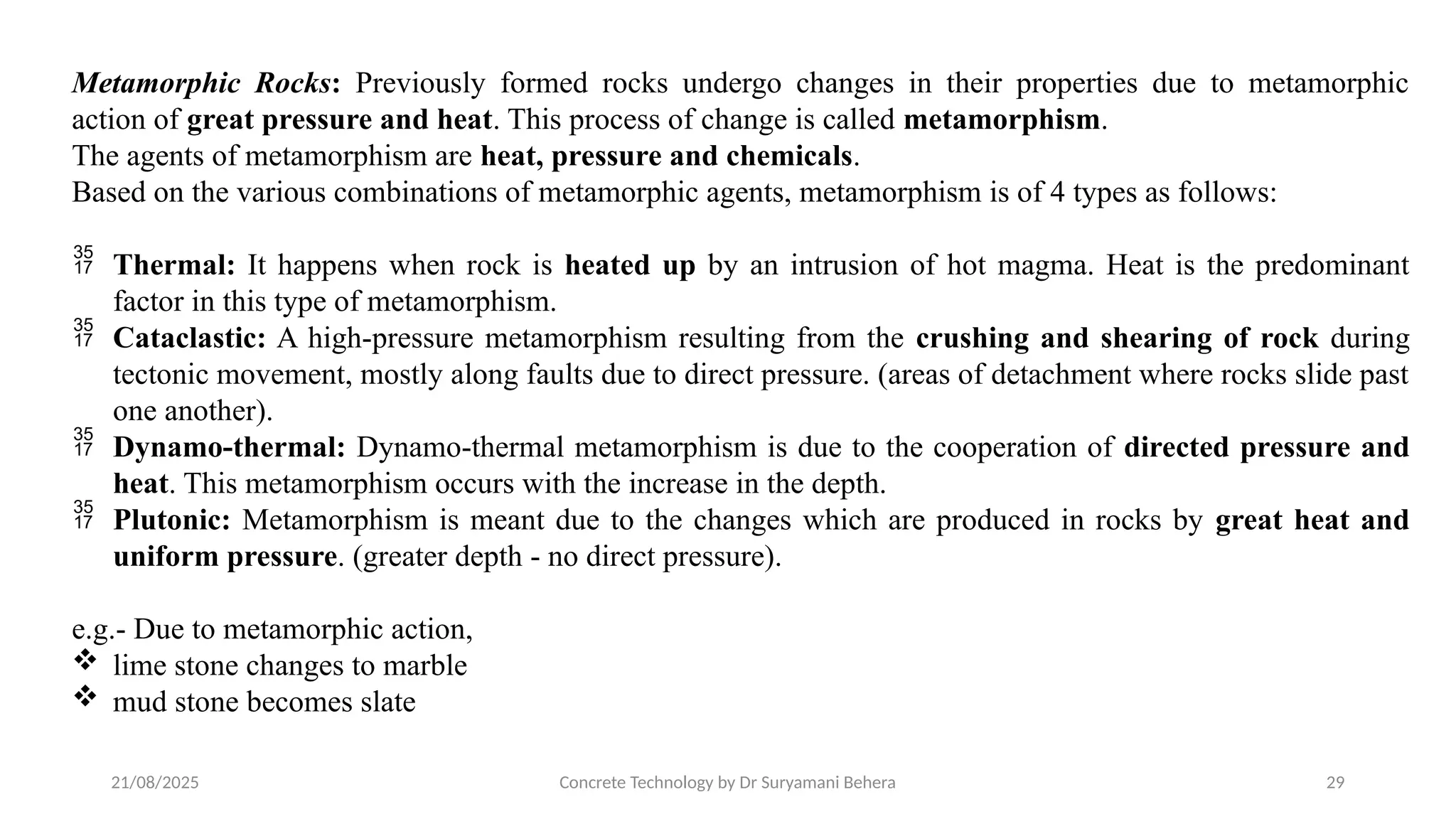
  • 73.
    21/08/2025 Concrete Technologyby Dr Suryamani Behera 73 Measurement of Air Content in Air Entrained Concrete • Too little air results in insufficient workability and too much air will result in low strength. • It is, therefore, necessary that the air content should be maintained at the stipulated value. • If the air content is found to be varying beyond the specified limit, adjustment is made by altering the amount of air entraining agent. There are mainly three methods for measuring air content of fresh concrete: (a) Gravimetric Method; (b) Volumetric Method; (c) Pressure Method. Gravimetric Method • Gravimetric method was the first to be used and it did not require any special equipment. • The procedure is principally one of determining the density of fresh concrete compacted in a standard manner. This is then compared with the theoretical density of air-free concrete, calculated from the mix proportions and specific gravities of the constituent materials making the concrete. • Thus, if the air-free density is 2380 kg/cu.m. and the measured density is 2220 kg/cu.m., • then one cu.m. of concrete will contain 2220/2380 cu.m. of solid and liquid matter and the rest being air. • Therefore, the air content then is 1 –2220/2380 = 0.07 or 7%.
  • 74.
    21/08/2025 Concrete Technologyby Dr Suryamani Behera 74 MINERALADMIXTURES  Mineral admixtures make mixtures more economical, reduce permeability, increase strength, and influence other concrete properties.  Mineral admixtures affect the nature of the hardened concrete through hydraulic or pozzolanic activity.  They can be used with Portland cement, or blended cement either individually or in combinations. Pozzolanic materials are siliceous or siliceous and aluminous materials, which in themselves possess little or no cementitious value. But in finely divided form and in the presence of moisture, they chemically react with calcium hydroxide liberated on hydration to form compounds possessing cementitious properties. The reaction can be shown as: Pozzolan + Calcium Hydroxide + Water  C – S – H (Gel)
  • 75.
    21/08/2025 Concrete Technologyby Dr Suryamani Behera 75 Pozzolanic materials can be divided into two groups: natural pozzolana and artificial pozzolana. Natural Pozzolans  Clay and Shales  Opalinc Cherts  Diatomaceous Earth  Volcanic Tuffs and Pumicites Artificial Pozzolans  Fly ash  Ground Granulated Blast-Furnace Slag  Silica Fume  Rice Husk ash  Metakaoline  Surkhi
  • 76.
    21/08/2025 Concrete Technologyby Dr Suryamani Behera 76 Fly Ash Fly ash is a finely divided residue resulting from the combustion of powdered coal and transported by the flue gases and collected by an electrostatic precipitator. Fly ash is the most widely used pozzolanic material all over the world. Why ? In India alone, we produce about 75 million tons of fly ash per year, the disposal of which has become a serious environmental problem. The effective utilisation of fly ash in concrete making is, therefore, attracting serious considerations of concrete technologists and government departments. Secondly, cement is the backbone for global infrastructural development. It was estimated that global production of cement is about 1.3 billion tons in 1996. It is observed that 7% of the world’s carbon dioxide emission is attributable to Portland cement industry.
  • 77.
    21/08/2025 Concrete Technologyby Dr Suryamani Behera 77 Properties of fly ash:  High fineness, low carbon content, good reactivity are the essence of good fly ash.  The amorphous characteristics greatly contribute to the pozzolanic reaction between cement and fly ash.  One of the important characteristics of fly ash is the spherical form of the particles. This shape of the particle improves the flowability and reduces the water demand. Types of fly ash: Class F: Fly ash normally produced by burning anthracite or bituminous coal, usually has less than 5% CaO. Class F fly ash has pozzolanic properties only. Class C: Fly ash normally produced by burning lignite or sub-bituminous coal. Some class C fly ash may have CaO content in excess of 10%. In addition to pozzolanic properties, class C fly ash also possesses cementitious properties.
  • 78.
    21/08/2025 Concrete Technologyby Dr Suryamani Behera 78 Effect of Fly Ash on Fresh Concrete Good fly ash with high fineness, low carbon content, highly reactive forms only a small fraction of total fly ash collected.  The ESP fly ash collected in chambers I and II are generally very coarse, non spherical particles showing large ignition loss. They can be called coal ash rather than fly ash. Such fly ash (coal ash) are not suitable for use as pozzolan and they do not reduce the water demand.  Use of right quality fly ash, results in reduction of water demand for desired slump. With the reduction of unit water content, bleeding and drying shrinkage will also be reduced. Since fly ash is not highly reactive, the heat of hydration can be reduced through replacement of part of the cement with fly ash. Effects of Fly Ash on Hardened Concrete  Fly ash, when used in concrete, contributes to the strength of concrete due to its pozzolanic reactivity. However, since the pozzolanic reaction proceeds slowly, the initial strength of fly ash concrete tends to be lower than that of concrete without fly ash. Due to continued pozzolanic reactivity concrete develops greater strength at later age, which may exceed that of the concrete without fly ash.  The pozzolanic reaction results in a decrease in water permeability and gas permeability.  It should be noted that since the pozzolanic reaction can only proceed in the presence of water, enough moisture should be available for a long time. Therefore, fly ash concrete should be cured for a longer period. In this sense, fly ash concrete used in under-water structures such as dams will derive full benefits of attaining improved long-term strength and water-tightness.
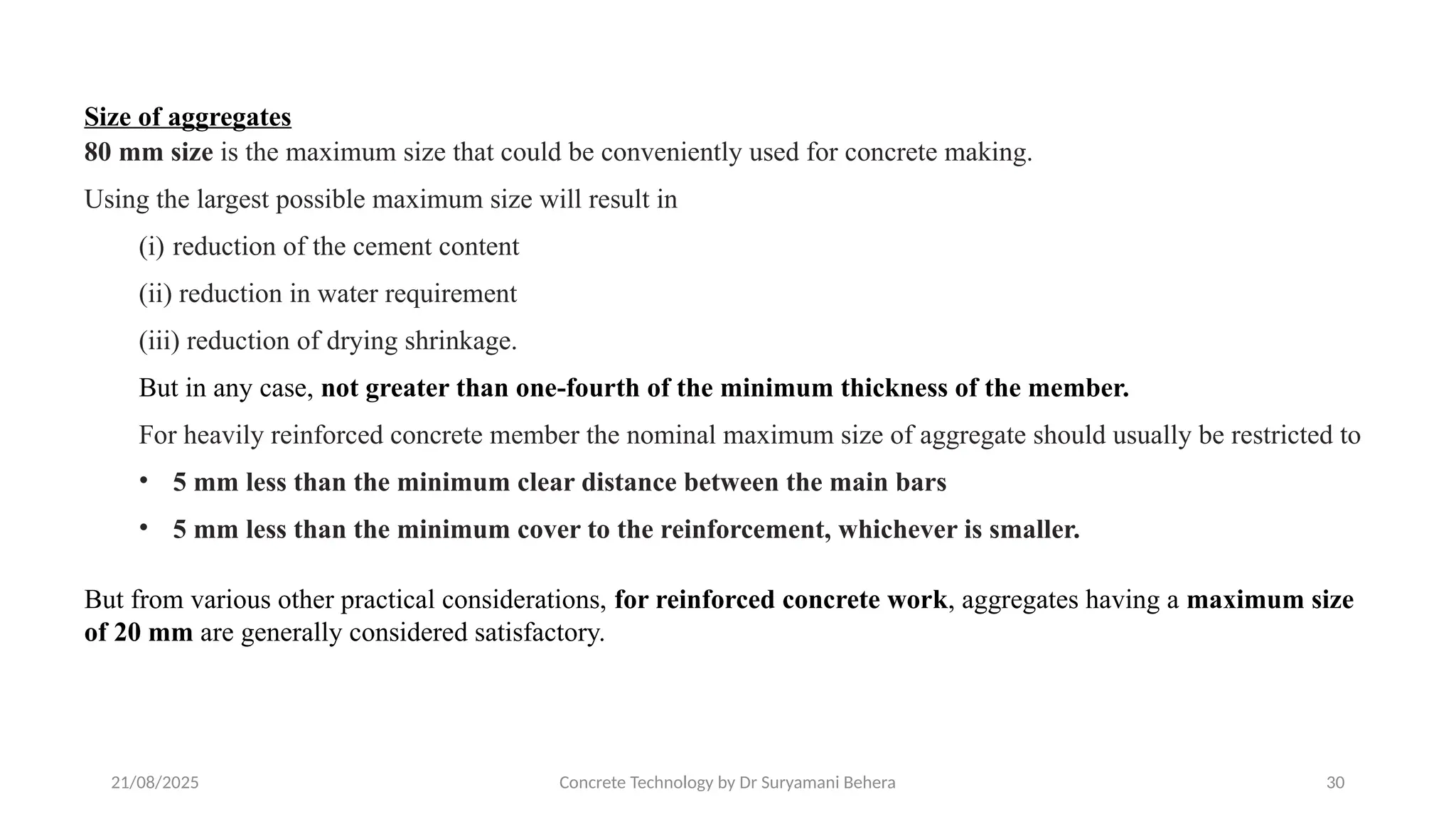
  • 79.
    21/08/2025 Concrete Technologyby Dr Suryamani Behera 79 Silica Fume  Silica fume, also referred to as microsilica or condensed silica fume, is another material that is used as an artificial pozzolanic admixture.  It is a product resulting from reduction of high purity quartz with coal in an electric arc furnace in the manufacture of silicon or ferrosilicon alloy.  Silica fume rises as an oxidised vapour. It cools, condenses and is collected in cloth bags. It is further processed to remove impurities and to control particle size.  Condensed silica fume is essentially silicon dioxide (more than 90%) in noncrystalline form. Since it is an airborne material like fly ash, it has spherical shape.  It is extremely fine with particle size less than 1 micron and with an average diameter of about 0.1 micron, about 100 times smaller than average cement particles. Pozzolanic Action  Microsilica is much more reactive than fly ash or any other natural pozzolana.  The reactivity of a pozzolana can be quantified by measuring the amount of Ca(OH)2 in the cement paste at different times. In one case, 15% of microsilica reduced the Ca(OH)2 of two samples of cement from 24% to 12% at 90 days and from 25% to 11% in 180 days.  Most research workers agree that the C – S – H formed by the reaction between microsilica and Ca(OH)2 appears dense and amorphous.
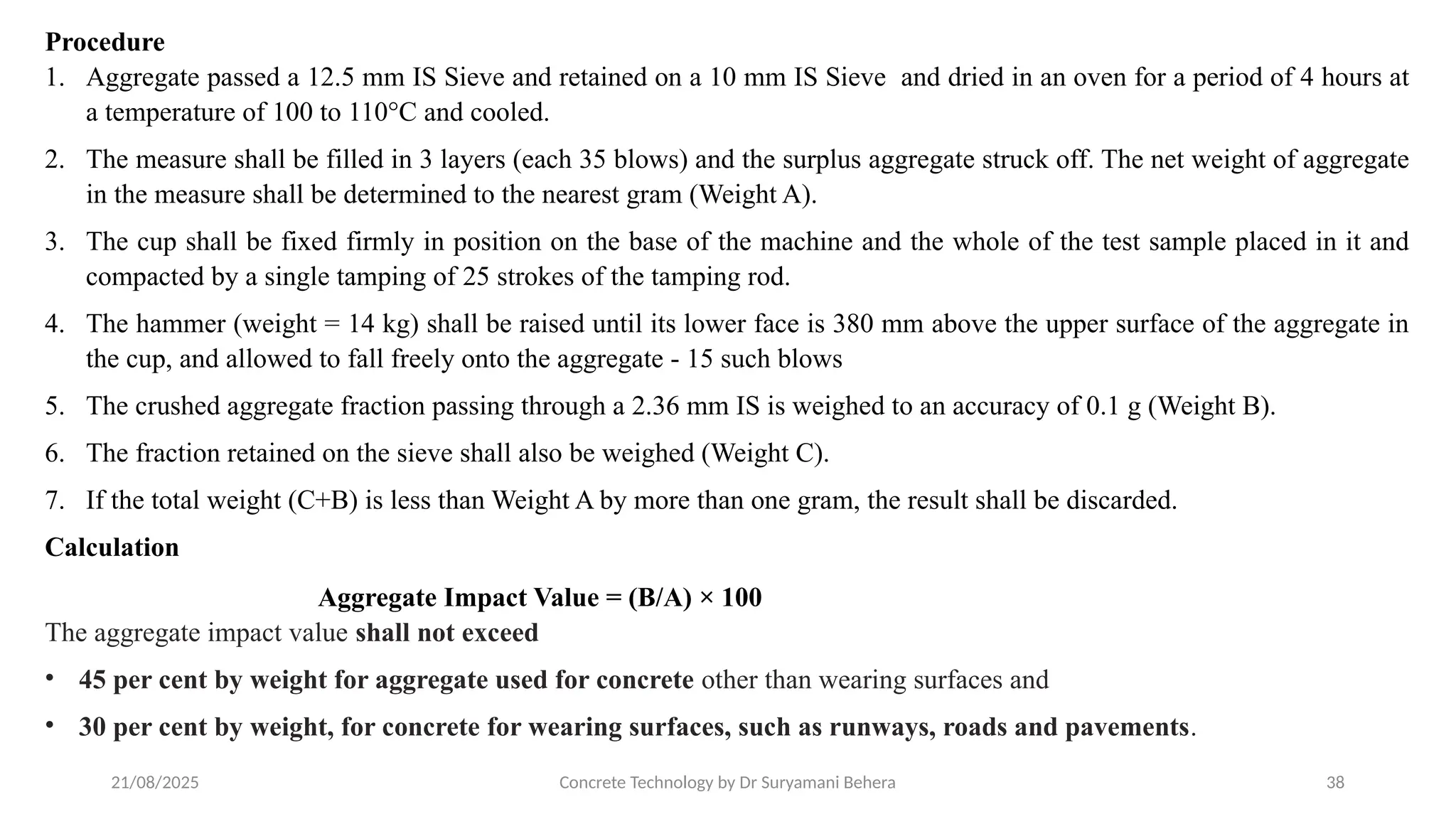
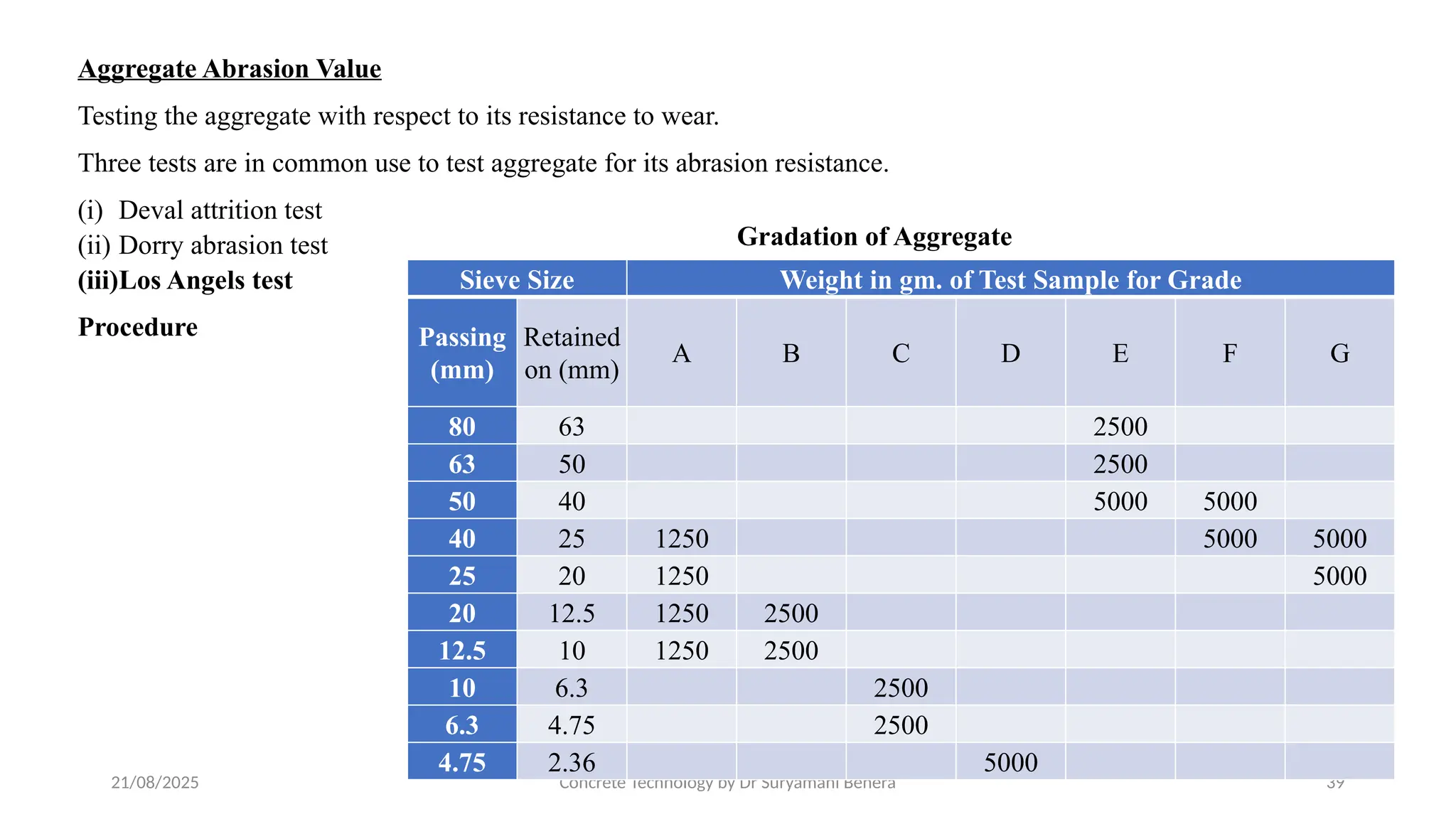
  • 80.
    21/08/2025 Concrete Technologyby Dr Suryamani Behera 80 Influence on Fresh Concrete  Water demand increases in proportion to the amount of microsilica added. The increase in water demand of concrete containing microsilica will be about 1% for every 1% of cement substituted. Measures can be taken to avoid this increase by adjusting the aggregate grading and using superplasticizers.  The addition of microsilica will lead to lower slump but more cohesive mix. The microsilica make the fresh concrete sticky in nature and hard to handle.  It was also found that there was large reduction in bleeding and concrete with microsilica could be handled and transported without segregation.  It is reported that concrete containing microsilica is vulnerable to plastic shrinkage cracking and, therefore, sheet or mat curing should be considered.  Microsilica concrete produces more heat of hydration at the initial stage of hydration. However, the total generation of heat will be less than that of reference concrete. Influence on Hardened Concrete  Concrete containing microsilica showed outstanding characteristics in the development of strength. It has been observed that 60 to 80 MPa can be obtained relatively easily.  It has been also found out that modulus of elasticity of microsilica concrete is less than that of concrete without microsilica at the same level of compressive strength.  An improvement in durability of concrete with microsilica is also observed.
  • 81.
    21/08/2025 Concrete Technologyby Dr Suryamani Behera 81 Rice Husk Ash  Rice husk ash, is obtained by burning rice husk in a controlled manner without causing environmental pollution.  When properly burnt it has high SiO2 content and can be used as a concrete admixture.  Rice husk ash exhibits high pozzolanic characteristics and contributes to high strength and high impermeability of concrete.  There is a good potential to make use of RHA as a valuable pozzolanic material to give almost the same properties as that of microsilica. Ground Granulated Blast Furnace Slag (GGBS) • Ground granulated blast-furnace slag is a non-metallic product consisting essentially of silicates and aluminates of calcium and other bases. • The molten slag is rapidly chilled by quenching in water to form a glassy sand-like granulated material. • The granulated material when further ground to less than 45 microns to form GGBS.