CEMENT
2
Cement is abinder, a substance that sets and hardeneds
independently, and can bind other materials together.
3.
3
HISTORY OF CEMENT
•Egyptians mostly used cementing materials, obtained
by burning gypsum.
• The Greeks and Romans used cementing
materials obtained by burning limestone.
• First manufacture of cement and patent by James
Frost and established in 1811.
• Joseph Aspdin took the patent of Portland cement
on 21st October 1824.
4.
4
• The fancyname of Portland was given owing to
resemblance of this hardened cement to the natural
stone occurring at Portland in England.
• In India, Portland cement was first manufactured in
1904 near Madras, by the south india industrial ltd.
But this venture failed.
• Between 1912 and 1913, the indian cement co. ltd was
established at porbander (gujarat) and by 1914 this
company was able to deliver about 1000 tons of
portland cement.
5.
• German standardspecification was drawn in 1877.
• British standard specification was drawn in 1904
• ASTM ( American standards for testing materials) in 1904
6.
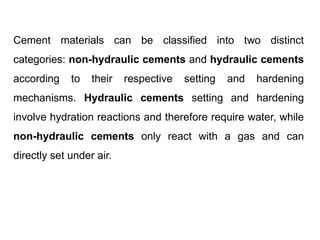
Cement materials canbe classified into two distinct
categories: non-hydraulic cements and hydraulic cements
according to their respective setting and hardening
mechanisms. Hydraulic cements setting and hardening
involve hydration reactions and therefore require water, while
non-hydraulic cements only react with a gas and can
directly set under air.
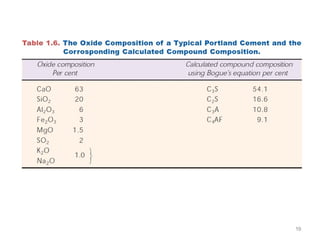
11.
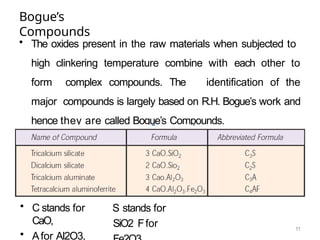
Bogue’s
Compounds
• The oxidespresent in the raw materials when subjected to
high clinkering temperature combine with each other to
form complex compounds. The identification of the
major compounds is largely based on R.H. Bogue’s work and
hence they are called Bogue’s Compounds.
• C stands for
CaO,
• Afor Al2O3,
S stands for
SiO2 Ffor 11
12.
12
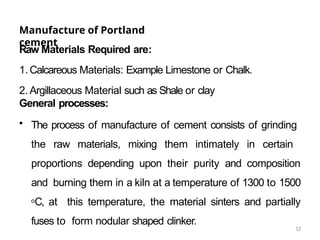
Manufacture of Portland
cement
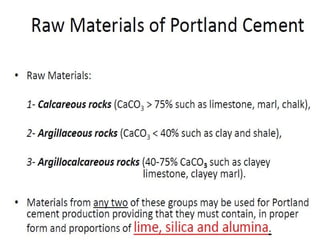
RawMaterials Required are:
1.Calcareous Materials: Example Limestone or Chalk.
2.Argillaceous Material such as Shale or clay
General processes:
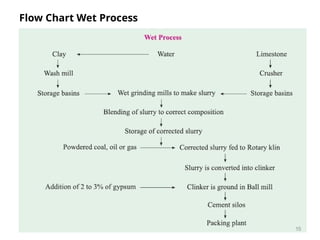
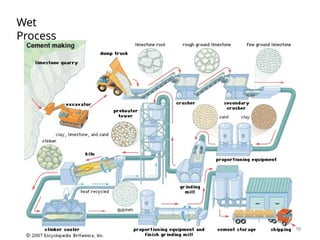
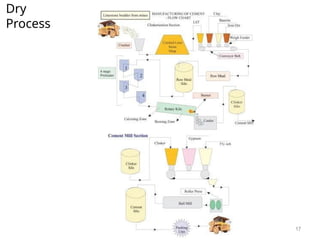
• The process of manufacture of cement consists of grinding
the raw materials, mixing them intimately in certain
proportions depending upon their purity and composition
and burning them in a kiln at a temperature of 1300 to 1500
oC, at this temperature, the material sinters and partially
fuses to form nodular shaped clinker.
13.
• The clinkeris cooled and ground to fine powder with addition
of about 3 to 5 % of gypsum. The product formed by using
this procedure is Portland cement.
14.
14
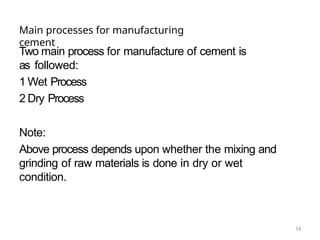
Main processes formanufacturing
cement
Two main process for manufacture of cement is
as followed:
1 Wet Process
2 Dry Process
Note:
Above process depends upon whether the mixing and
grinding of raw materials is done in dry or wet
condition.
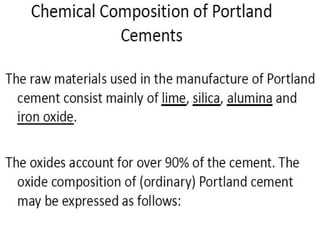
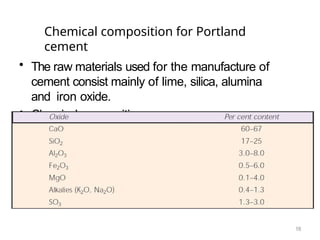
Chemical composition forPortland
cement
• The raw materials used for the manufacture of
cement consist mainly of lime, silica, alumina
and iron oxide.
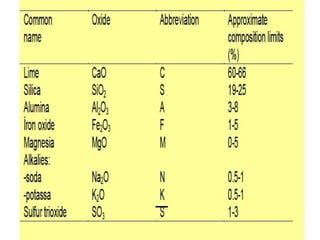
• Chemical composition are
18
20
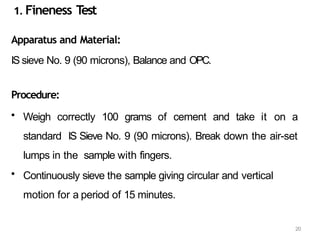
1. Fineness T
est
Apparatusand Material:
IS sieve No. 9 (90 microns), Balance and OPC.
Procedure:
• Weigh correctly 100 grams of cement and take it on a
standard IS Sieve No. 9 (90 microns). Break down the air-set
lumps in the sample with fingers.
• Continuously sieve the sample giving circular and vertical
motion for a period of 15 minutes.
21.
• Weigh theresidue left on the sieve. This weight shall not
exceed 10% for ordinary cement.
Note:
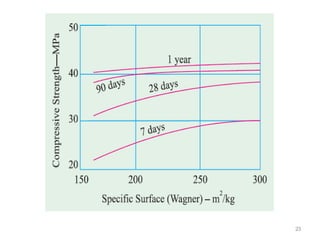
• Finer cement offers a greater surface area for hydration
and hence faster the development of strength.
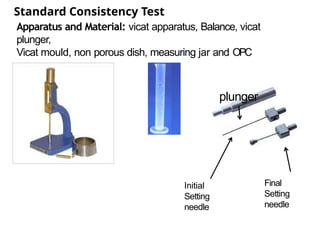
Standard Consistency Test
Apparatusand Material: vicat apparatus, Balance, vicat
plunger,
Vicat mould, non porous dish, measuring jar and OPC
plunger
Initial
Setting
needle
Final
Setting
needle
26
Procedure:
• T
ake about500 gms of cement and prepare a paste with
a weighed quantity of water (say 24 per cent by weight
of cement) for the first trial.
• The paste must be prepared in a standard manner and
filled into the Vicat mould within 3-5 minutes. After
completely filling the mould, shake the mould to expel air.
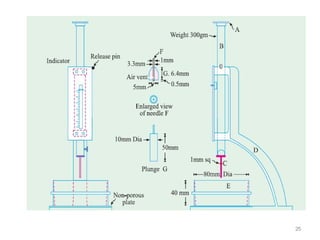
• A standard plunger, 10 mm diameter, 50 mm long is
attached and brought down to touch the surface of the
paste in the test block and quickly released allowing it to
sink into the paste by its own weight.
27.
27
• T
ake thereading by noting the depth of penetration of the
plunger. Conduct a 2nd trial (say with 25 per cent of water)
and find out the depth of penetration of plunger.
• Similarly, conduct trials with higher and higher
water/cement ratios till such time the plunger penetrates
for a depth of 33mm - 35mm from the top.
• That particular percentage of water which allows the
plunger to penetrate only to a depth of 33-35 mm from
the top of the mould is known as the percentage of water
required to produce a cement paste of standard
consistency. This
percentage is usually denoted as ‘P’.
28.
How to DetermineStandard Consistency of the Cement -- Ceme
nt Test #1 --[via torchbrowser.com].mp4
29.
Setting Time
T
est
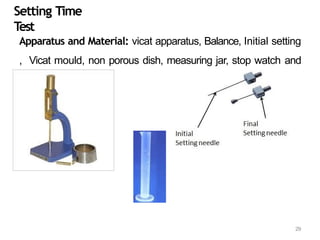
Apparatus andMaterial: vicat apparatus, Balance, Initial setting
, Vicat mould, non porous dish, measuring jar, stop watch and
OPC
29
30.
30
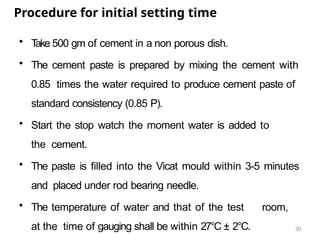
Procedure for initialsetting time
• T
ake 500 gm of cement in a non porous dish.
• The cement paste is prepared by mixing the cement with
0.85 times the water required to produce cement paste of
standard consistency (0.85 P).
• Start the stop watch the moment water is added to
the cement.
• The paste is filled into the Vicat mould within 3-5 minutes
and placed under rod bearing needle.
• The temperature of water and that of the test room,
at the time of gauging shall be within 27°C ± 2°C.
31.
31
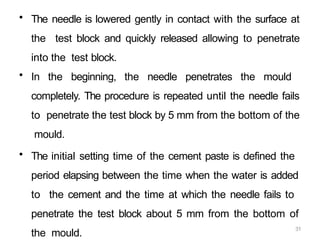
• The needleis lowered gently in contact with the surface at
the test block and quickly released allowing to penetrate
into the test block.
• In the beginning, the needle penetrates the mould
completely. The procedure is repeated until the needle fails
to penetrate the test block by 5 mm from the bottom of the
mould.
• The initial setting time of the cement paste is defined the
period elapsing between the time when the water is added
to the cement and the time at which the needle fails to
penetrate the test block about 5 mm from the bottom of
the mould.
32.
32
Procedure for finalsetting time
• T
ake 500 gm of cement in a non porous dish.
• The cement paste is prepared by mixing the cement with 0.85
times the water required to produce cement paste of standard
consistency (0.85 P).
• Start the stop watch the moment water is added to the cement.
• The paste is filled into the Vicat mould within 3-5 minutes and
placed under rod bearing needle.
33.
• The temperatureof water and that of the test room, at
the time of gauging shall be within 27°C ± 2°C.
• The needle is replaced by final setting time needle with an
annular attachment.
• The cement is considered as finally set when upon applying
the needle gently to the surface of the test block, the
needle makes an impression there, but the attachment
fails to do so.
• How to Determine the Initial & Final Setting Time of the
Cement -- Cement Test #2 --[via torchbrowser.com].mp
4
34.
Strength Test
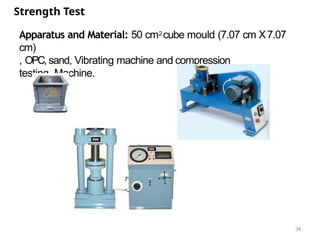
Apparatus andMaterial: 50 cm2 cube mould (7.07 cm X7.07
cm)
, OPC, sand, Vibrating machine and compression
testing Machine.
34
35.
Procedure.
• Cement mortarcube are prepared by mixing 1 part of
cement
𝑃
, 3 parts of sand and (+3 ) %of water. Where P is % of
water
4
required for producing normal consistency paste of cement
and 3 indicating 3 %of combine weight of cement and sand.
• The mould is filled with the mortar and vibrate using
vibrating machine for 2 minutes.
• After 24 hours of casting, the block is removed from
the mould and cured in water.
36.
• The specimenis tested in compression after curing for 3 days
and 7 days in a compression testing machine and 3 day
compression value 16 Mpa and 7 days 22 Mpa.
• Compression strength is determined by dividing the load by
area of the specimen which is 50 cm2.
How to Determine the Compressive Strength of Cement --
Cement Test #3 --[via torchbrowser.com].mp4
38
Procedure
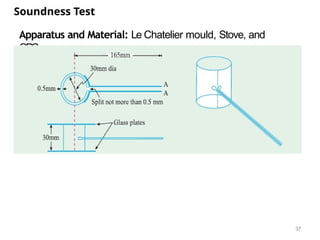
• The mouldis placed on a glass plate and filled with cement
paste by mixing cement with 0.78 times Of P
. where P is
standard consistency value.
• The mould is covered with another piece of glass plate and a
small weight is placed on it.
• The whole assembly is submerged immediately in
water at a temperature of 27 to 32 oC and kept there
for 24 hours.
• The mould is removed from water and the distance
separating the indicator points is measured.
39.
• The mouldis submerged again in water and the water is
heated till it reaches the boiling point in 25 to 32 minutes.
• The mould is kept in boiling water for 3 hours. The mould is
removed from water, allowing to cool and the distance
between the indicator points is measured again.
• For a good cement the expansion should not exceed 10 mm.
the change in distance is a measure of the unsoundness.
• Soundness Test by Le-Chatelier
Method[via torchbrowser.com].mp4
40.
Heat of
Hydration
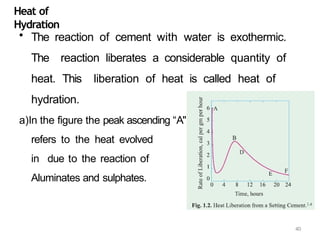
• Thereaction of cement with water is exothermic.
The reaction liberates a considerable quantity of
heat. This liberation of heat is called heat of
hydration.
a)In the figure the peak ascending “A"
refers to the heat evolved
in due to the reaction of
Aluminates and sulphates.
40
42
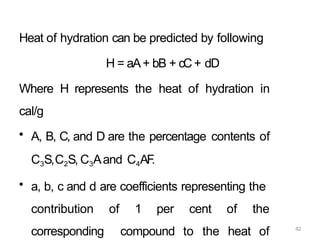
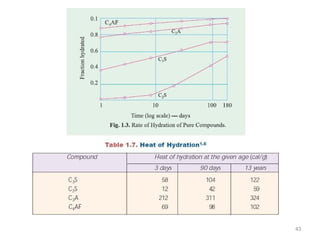
Heat of hydrationcan be predicted by following
H = aA+ bB + cC+ dD
Where H represents the heat of hydration in
cal/g
• A, B, C, and D are the percentage contents of
C3S,C2S, C3Aand C4AF
.
• a, b, c and d are coefficients representing the
contribution of 1 per cent of the
corresponding compound to the heat of
44
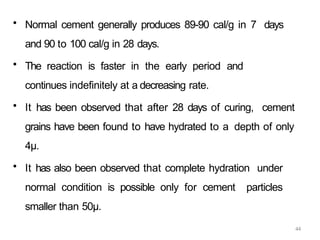
• Normal cementgenerally produces 89-90 cal/g in 7 days
and 90 to 100 cal/g in 28 days.
• The reaction is faster in the early period and
continues indefinitely at a decreasing rate.
• It has been observed that after 28 days of curing, cement
grains have been found to have hydrated to a depth of only
4μ.
• It has also been observed that complete hydration under
normal condition is possible only for cement particles
smaller than 50μ.
45.
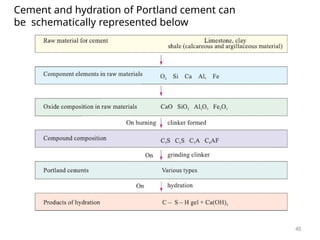
Cement and hydrationof Portland cement can
be schematically represented below
45
46.
46
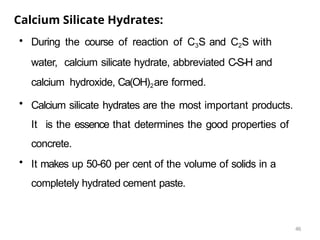
Calcium Silicate Hydrates:
•During the course of reaction of C3S and C2S with
water, calcium silicate hydrate, abbreviated C-S-H and
calcium hydroxide, Ca(OH)2are formed.
• Calcium silicate hydrates are the most important products.
It is the essence that determines the good properties of
concrete.
• It makes up 50-60 per cent of the volume of solids in a
completely hydrated cement paste.
47.
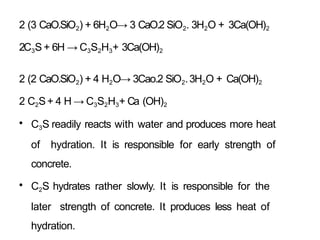
2 (3 CaO.SiO2)+ 6H2O→ 3 CaO.2 SiO2. 3H2O + 3Ca(OH)2
2C3S + 6H → C3S2H3+ 3Ca(OH)2
2 (2 CaO.SiO2) + 4 H2O→ 3Cao.2 SiO2.3H2O + Ca(OH)2
2 C2S+ 4 H → C3S2H3+ Ca (OH)2
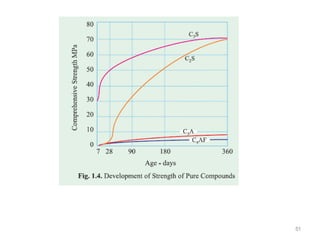
• C3S readily reacts with water and produces more heat
of hydration. It is responsible for early strength of
concrete.
• C2S hydrates rather slowly. It is responsible for the
later strength of concrete. It produces less heat of
hydration.
48.
48
Calcium Hydroxide Ca(OH)2
•The other products of hydration of C3S and C2S is
calcium hydroxide.
• It constitutes 20 to 25 per cent of the volume of solids in
the hydrated paste.
• Calcium hydroxide reacts with sulphate present in soil or
water to form calcium sulphates which further reacts with
C3A
and causes deterioration of concrete. This is known as
sulphate attack.
49.
49
Calcium Aluminate Hydrates
•Due to the hydration of C3A , a calcium aluminate
system CaO– Al2O3– H2O is formed.
• The cubic compound C3AH6 is probably the only stable
compound formed which remains stable up to about 225°C.
• The reaction of pure C3A with water is very fast and this
may lead to flash set.
• T
o prevent this flash set, gypsum is added at the time of
grinding the cement clinker.
50.
50
Calcium alumina Ferritehydrate
• On hydration, C4AF is believed to form a system of the
form CaO– Fe2O3– H2O. Ahydrated calcium ferrite of the
form C3FH6is comparatively more stable.
• This hydrated product does not contribute anything
to the strength.
• The hydrates of C4AF show a comparatively higher
resistance to the attack of sulphates than the hydrates of
calcium aluminate.
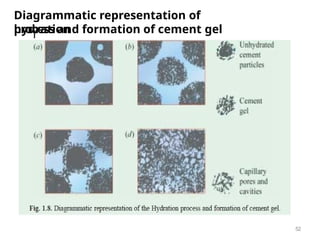
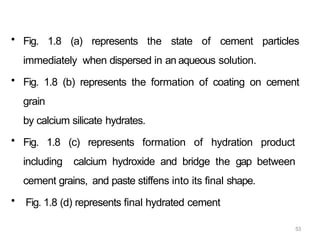
53
• Fig. 1.8(a) represents the state of cement particles
immediately when dispersed in an aqueous solution.
• Fig. 1.8 (b) represents the formation of coating on cement
grain
by calcium silicate hydrates.
• Fig. 1.8 (c) represents formation of hydration product
including calcium hydroxide and bridge the gap between
cement grains, and paste stiffens into its final shape.
• Fig. 1.8 (d) represents final hydrated cement
54.
54
Water Requirement forhydration
• C3S requires 24% of water by weight of cement and
C2S requires 21%.
• On an average 23% of water by weight of cement is
required for chemical reaction with Portland cement
compounds. This 23% of water chemically combines with
cement and, therefore, it is called bound water.
55.
• A certainquantity of water is imbibed within the gel-pores.
This water is known as gel-water. It is estimated that about 15
per cent by weight of cement is required to fill up the gel-
pores.
• Therefore, a total 38 per cent of water by weight of cement
is required for the complete chemical reactions and to
occupy the space within gel-pores.
56.
56
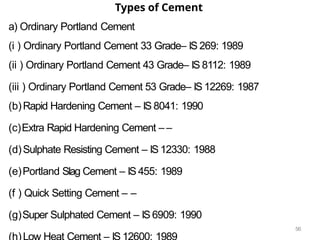
Types of Cement
a)Ordinary Portland Cement
(i ) Ordinary Portland Cement 33 Grade– IS 269: 1989
(ii ) Ordinary Portland Cement 43 Grade– IS 8112: 1989
(iii ) Ordinary Portland Cement 53 Grade– IS 12269: 1987
(b)Rapid Hardening Cement – IS 8041: 1990
(c)Extra Rapid Hardening Cement – –
(d)Sulphate Resisting Cement – IS 12330: 1988
(e)Portland Slag Cement – IS 455: 1989
(f ) Quick Setting Cement – –
(g)Super Sulphated Cement – IS 6909: 1990
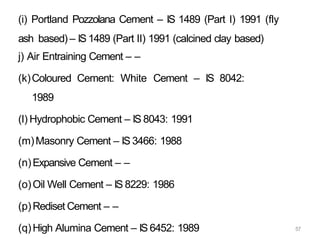
57.
57
(i) Portland PozzolanaCement – IS 1489 (Part I) 1991 (fly
ash based) – IS 1489 (Part II) 1991 (calcined clay based)
j) Air Entraining Cement – –
(k)Coloured Cement: White Cement – IS 8042:
1989
(l) Hydrophobic Cement – IS 8043: 1991
(m)Masonry Cement – IS 3466: 1988
(n)Expansive Cement – –
(o)Oil Well Cement – IS 8229: 1986
(p)Rediset Cement – –
(q)High Alumina Cement – IS 6452: 1989
58.
58
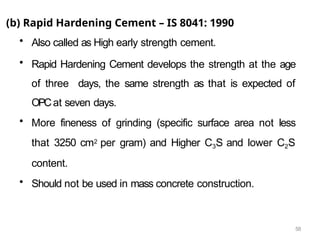
(b) Rapid HardeningCement – IS 8041: 1990
• Also called as High early strength cement.
• Rapid Hardening Cement develops the strength at the age
of three days, the same strength as that is expected of
OPCat seven days.
• More fineness of grinding (specific surface area not less
that 3250 cm2 per gram) and Higher C3S and lower C2S
content.
• Should not be used in mass concrete construction.
59.
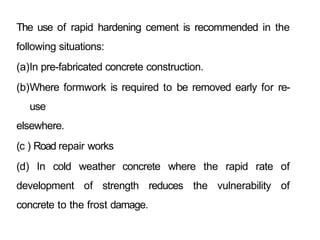
The use ofrapid hardening cement is recommended in the
following situations:
(a)In pre-fabricated concrete construction.
(b)Where formwork is required to be removed early for re-
use
elsewhere.
(c ) Road repair works
(d) In cold weather concrete where the rapid rate of
development of strength reduces the vulnerability of
concrete to the frost damage.
60.
60
C. Extra RapidHardening Cement
• Extra rapid hardening cement is obtained by intergrinding
calcium chloride with rapid hardening Portland cement.
• The normal addition of calcium chloride should not exceed
2 percent by weight of the rapid hardening cement.
• It is necessary that the concrete made by using extra
rapid hardening cement should be transported, placed
and compacted and finished within about 20 minutes.
• It is also necessary that this cement should not be stored
for more than a month.
• Extra rapid hardening cement accelerates the setting and
hardening process.
61.
• 25 %morestrength than RHCat one or two days and 10-20 %
more at 7 days and same as that of OPCat 90 days
• Specific surface area is 5000 to 6000 cm2 /gm
• Size of particles are generally less than 3 microns.
• Difficult to store as it is liable to air set.
• There is small amount of initial corrosion of reinforcement.
62.
62
D Sulphate resistingcement
• Sulphate reacts both with free calcium hydroxide in set
cement to form calcium sulphate and with hydrate of
calcium aluminate to form calcium sulpho aluminate, the
volume of which is approximately 227 % of the original
aluminates.
• Their expansion within the form work of hardened
cement paste results in cracks and subsequent
disruption.
• This is known as sulphate attack and is greatly
accelerated if accompanied by alternate wetting and
drying which normally takes places in marine structure
63.
• T
o remedythe sulphate attack, the use of cement with low
C3A content is found to be effective and this type of cement
is known as sulphate resisting cement.
•This has high silica content and C3A content is limited to
5%.
Recommended for:
1. Concrete to be used in marine condition.
2 . In foundation and basement, where soil is intensified
with sulphate particles.
3. Concrete to be used in the construction of sewage
treatment works.
64.
64
E Portland Slagcement
• Portland slag cement is obtained by mixing portland
cement clinker, gypsum and granulated blast furnace slag
in suitable proportions and grinding the mixture to get a
thorough and intimate mixture between the constituents.
• It may also be obtained by separately grinding portland
cement clinker, gypsum and ground granulated blast furnace
slag and later mixing them intimately.
65.
• Themajor advantagesare:
1. Reducedheatofhydration
2. Reduced permeability
3. Increased resistance
to chemical attack.
66.
66
F Quick Settingcement
• Sets very early
• By reducing gypusum content at time of clinker grinding
• For under water construction and grouting operations.
G Super Sulphated Cement
• 85% for granulated slag+10-15% of hard burnt gypsum+5%
of
portland cement clinker.
• Specific surface area must not be less than 4000 cm2/gm
• Low heat of hydration 40-45 cal/gm at 7 days and 45 to
50 cal /gm at 28 days.
67.
67
H Low HeatCement
• Low C3Sand C3Acontents and high C2S content.
• Slow rate of gain of strength but ultimate strength is same
as that of OPC cement.
• 7 days- not more than 65 cal/gm.
28 days- not more than 75 cal/gm
• Specific surface area is not less than 3200 cm2/gm.
68.
68
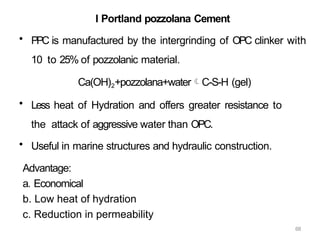
I Portland pozzolanaCement
• PPC is manufactured by the intergrinding of OPC clinker with
10 to 25% of pozzolanic material.
Ca(OH)2+pozzolana+waterC-S-H (gel)
• Less heat of Hydration and offers greater resistance to
the attack of aggressive water than OPC.
• Useful in marine structures and hydraulic construction.
Advantage:
a. Economical
b. Low heat of hydration
c. Reduction in permeability
69.
69
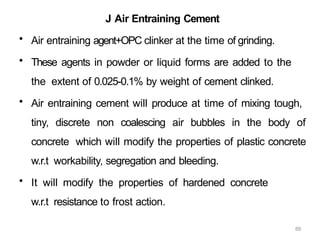
J Air EntrainingCement
• Air entraining agent+OPC clinker at the time of grinding.
• These agents in powder or liquid forms are added to the
the extent of 0.025-0.1% by weight of cement clinked.
• Air entraining cement will produce at time of mixing tough,
tiny, discrete non coalescing air bubbles in the body of
concrete which will modify the properties of plastic concrete
w.r.t workability, segregation and bleeding.
• It will modify the properties of hardened concrete
w.r.t resistance to frost action.
70.
70
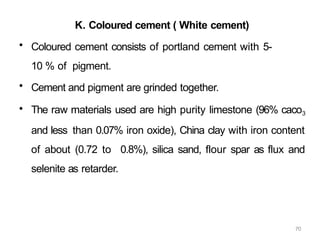
K. Coloured cement( White cement)
• Coloured cement consists of portland cement with 5-
10 % of pigment.
• Cement and pigment are grinded together.
• The raw materials used are high purity limestone (96% caco3
and less than 0.07% iron oxide), China clay with iron content
of about (0.72 to 0.8%), silica sand, flour spar as flux and
selenite as retarder.
71.
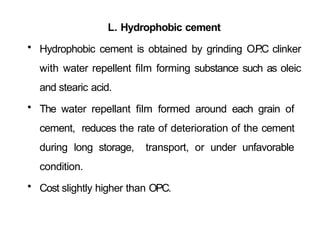
L. Hydrophobic cement
•Hydrophobic cement is obtained by grinding O.P
.C clinker
with water repellent film forming substance such as oleic
and stearic acid.
• The water repellant film formed around each grain of
cement, reduces the rate of deterioration of the cement
during long storage, transport, or under unfavorable
condition.
• Cost slightly higher than OPC.
72.
72
M. Oil-Well Cement
•Cement slurry is used to seal off the annular space
between steel casing and rock strata and also to seal off
any other fissures or cavities in the sedimentary rock
layer.
• The cement slurry has to be pumped into position, at
considerable depth where the prevailing temperature may
be upto 175°C. The pressure required may go upto 1300
kg/cm2.
• It may also have to resist corrosive conditions from sulphur
gases or waters containing dissolved salts. The type of
73.
73
N Masonry cement
•Masonry cement is made with a combination of such
material which when used for making mortar, incorporating
all the good properties of lime mortar and discards all the
not so ideal properties of cement mortar.
• Mostly used for masonry construction
• Contains certain amount of air entraining agent and
mineral admixture to improve plasticity and water
retentivity.
74.
O. Expansive cement
•Ordinary Portland cement shrinks while setting due to
loss of free water. This is known as drying shrinkage.
• A slight expansion with time will prove to be
advantageous for grouting purpose.
• This type of cement which suffers no overall change in
volume on drying is known as expansive cement.
• 8-20 parts of the sulpho-aluminate clinker are mixed
with 100 parts of the Portland cement and 15 parts of
the stabilizer.
75.
75
P
. Rediset Cement
•The cement allows a handling time of just about 8 to
10 minutes.
• The strength pattern is similar to that of ordinary Portland
cement mortar or concrete after one day or 3 days. What is
achieved with “REDISET” in 3 to 6 hours can be achieved
with normal concrete only after 7 days.
• More heat of hydration
• The rate of shrinkage is fast but the total shrinkage is similar
to that of ordinary Portland cement concrete.
76.
76
Application:
(a ) very-high-early(3 to 4 hours) strength concrete and mortar,
(b) patch repairs and emergency repairs,
(c ) quick release of forms in the precast concrete products
Industry.
Q. High Alumina Cement
• High alumina cement is obtained by fusing or sintering a
mixture, in suitable proportions, of alumina and calcareous
materials and grinding the resultant product to a fine
powder.
• The raw materials used for the manufacture of high
77.
77
R. Very highstrength cement
(a) Macro-defect-free cements
• MDF refers to the absence of relatively large voids or defects
which are usually present in conventional mixed cement
pastes because of entrapped air and inadequate dispersion.
• In the MDF process 4-7% of one of several water-soluble
polymers (such as hydroxypropylmethyle cellulose,
polyacrylamide of hydrolysed polyvinylacetate) is added
as
rheological aid to permit cement to be mixed with very
small amount of water.
78.
• At finalprocessing stage entrapped air is removed by applying
a modest pressure of 5 MPa.
• With this process a strength of 300 MPa for calcium aluminate
system and 150 MPa for Portland cement system can be
achieved.
(b) Densely Packed System (DSP).
• Normal Portland cement and ultra-fine silica fume are mixed.
• The size of cement particles may very from 0.5 to 100μ
and that of silica fume varies from 0.005 to 0.5μ.
• Silica fume is generally added from 5 to 25 %.
• A compressive strength of 270 MPa have been achieved with
silica fume substituted paste.
79.
79
(c) Pressure Densificationand Warm Pressing
• Compressive strength as much as 650 MPa and tensile
strength up to 68 MPa have been obtained by warm pressing
Portland and calcium aluminate cements.
• Enormous increases in strength resulted from the removal of
most of the porosity and generation of very homogeneous,
fine micro-structures with the porosities as low as 1.7%.
80.
80
(d) High EarlyStrength Cement.
• Lithium salts have been effectively used as accelerators in
high alumina cement.
• Resulted in very high early strength in cement and a marginal
reduction in later strength.
• Strength as high as 4 MPa has been obtained within 1 hour
and 27 MPa has been obtained within 3 hours time and 49
MPa in one day.
81.
(e) Pyrament Cement
•In this cement no chlorides are added
during the manufacturing process.
• Pyrament cement produces a high and very early
strength of concrete and mortar which can be used
for repair of Air Field Run-ways.
82.
82
(f) Magnesium PhosphateCement (MPC)
• Magnesium Phosphate Cement, an advanced cementing
material, giving very high early strength mortar and
concrete has been developed by Central Road Research
Institute, New Delhi.
• MPC is a prepacked mixture of dead burn magnesite with
fine aggregate mixed with phosphate. It sets rapidly and
yields durable high strength cement mortar.
• This cement can be used for rapid repair of damaged
concrete roads and airfield pavements.
![Siev
e
22
Test for fineness of cement[via torchbrowse
r.com].mp4](https://image.slidesharecdn.com/cement-250920070911-68d2fff0/85/Cement-notes-in-concrete-technology-pptx-22-320.jpg)
![How to Determine Standard Consistency of the Cement -- Ceme
nt Test #1 --[via torchbrowser.com].mp4](https://image.slidesharecdn.com/cement-250920070911-68d2fff0/85/Cement-notes-in-concrete-technology-pptx-28-320.jpg)
![• The temperature of water and that of the test room, at
the time of gauging shall be within 27°C ± 2°C.
• The needle is replaced by final setting time needle with an
annular attachment.
• The cement is considered as finally set when upon applying
the needle gently to the surface of the test block, the
needle makes an impression there, but the attachment
fails to do so.
• How to Determine the Initial & Final Setting Time of the
Cement -- Cement Test #2 --[via torchbrowser.com].mp
4](https://image.slidesharecdn.com/cement-250920070911-68d2fff0/85/Cement-notes-in-concrete-technology-pptx-33-320.jpg)
![• The specimen is tested in compression after curing for 3 days
and 7 days in a compression testing machine and 3 day
compression value 16 Mpa and 7 days 22 Mpa.
• Compression strength is determined by dividing the load by
area of the specimen which is 50 cm2.
How to Determine the Compressive Strength of Cement --
Cement Test #3 --[via torchbrowser.com].mp4](https://image.slidesharecdn.com/cement-250920070911-68d2fff0/85/Cement-notes-in-concrete-technology-pptx-36-320.jpg)
![• The mould is submerged again in water and the water is
heated till it reaches the boiling point in 25 to 32 minutes.
• The mould is kept in boiling water for 3 hours. The mould is
removed from water, allowing to cool and the distance
between the indicator points is measured again.
• For a good cement the expansion should not exceed 10 mm.
the change in distance is a measure of the unsoundness.
• Soundness Test by Le-Chatelier
Method[via torchbrowser.com].mp4](https://image.slidesharecdn.com/cement-250920070911-68d2fff0/85/Cement-notes-in-concrete-technology-pptx-39-320.jpg)