

REPAIR TURBOCHARGER

  What is a turbocharger, how to install
   a turbocharger and much more!!!


source: http://www.buyautoparts.com/howto/repair-turbocharger.htm
What is a
Turbocharger?


          source:
http://www.buyautoparts.c
   om/howto/what-is-a-
     turbocharger.htm
What is a Turbocharger?
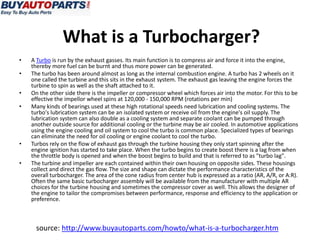
•   A Turbo is run by the exhaust gasses. Its main function is to compress air and force it into the engine,
    thereby more fuel can be burnt and thus more power can be generated.
•   The turbo has been around almost as long as the internal combustion engine. A turbo has 2 wheels on it
    one called the turbine and this sits in the exhaust system. The exhaust gas leaving the engine forces the
    turbine to spin as well as the shaft attached to it.
•   On the other side there is the impeller or compressor wheel which forces air into the motor. For this to be
    effective the impellor wheel spins at 120,000 - 150,000 RPM (rotations per min)
•   Many kinds of bearings used at these high rotational speeds need lubrication and cooling systems. The
    turbo's lubrication system can be an isolated system or receive oil from the engine's oil supply. The
    lubrication system can also double as a cooling system and separate coolant can be pumped through
    another outside source for additional cooling or the turbine may be air cooled. In automotive applications
    using the engine cooling and oil system to cool the turbo is common place. Specialized types of bearings
    can eliminate the need for oil cooling or engine coolant to cool the turbo.
•   Turbos rely on the flow of exhaust gas through the turbine housing they only start spinning after the
    engine ignition has started to take place. When the turbo begins to create boost there is a lag from when
    the throttle body is opened and when the boost begins to build and that is referred to as "turbo lag".
•   The turbine and impeller are each contained within their own housing on opposite sides. These housings
    collect and direct the gas flow. The size and shape can dictate the performance characteristics of the
    overall turbocharger. The area of the cone radius from center hub is expressed as a ratio (AR, A/R, or A:R).
    Often the same basic turbocharger assembly will be available from the manufacturer with multiple AR
    choices for the turbine housing and sometimes the compressor cover as well. This allows the designer of
    the engine to tailor the compromises between performance, response and efficiency to the application or
    preference.


     source: http://www.buyautoparts.com/howto/what-is-a-turbocharger.htm
What is a
Wastegate?


          source:
http://www.buyautoparts.c
 om/howto/introduction-
   to-the-wastegate.htm
What is a Wastegate?
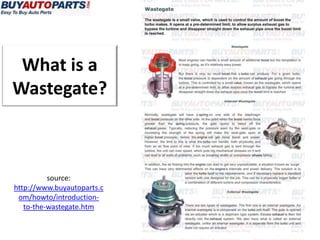
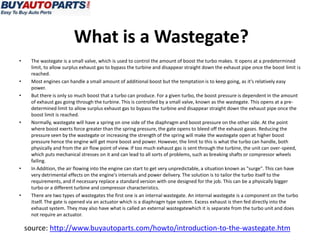
•    The wastegate is a small valve, which is used to control the amount of boost the turbo makes. It opens at a predetermined
     limit, to allow surplus exhaust gas to bypass the turbine and disappear straight down the exhaust pipe once the boost limit is
     reached.
•    Most engines can handle a small amount of additional boost but the temptation is to keep going, as it's relatively easy
     power.
•    But there is only so much boost that a turbo can produce. For a given turbo, the boost pressure is dependent in the amount
     of exhaust gas going through the turbine. This is controlled by a small valve, known as the wastegate. This opens at a pre-
     determined limit to allow surplus exhaust gas to bypass the turbine and disappear straight down the exhaust pipe once the
     boost limit is reached.
•    Normally, wastegate will have a spring on one side of the diaphragm and boost pressure on the other side. At the point
     where boost exerts force greater than the spring pressure, the gate opens to bleed off the exhaust gases. Reducing the
     pressure seen by the wastegate or increasing the strength of the spring will make the wastegate open at higher boost
     pressure hence the engine will get more boost and power. However, the limit to this is what the turbo can handle, both
     physically and from the air flow point of view. If too much exhaust gas is sent through the turbine, the unit can over-speed,
     which puts mechanical stresses on it and can lead to all sorts of problems, such as breaking shafts or compressor wheels
     failing.
•    In Addition, the air flowing into the engine can start to get very unpredictable, a situation known as "surge". This can have
     very detrimental effects on the engine's internals and power delivery. The solution is to tailor the turbo itself to the
     requirements, and if necessary replace a standard version with one designed for the job. This can be a physically bigger
     turbo or a different turbine and compressor characteristics.
•    There are two types of wastegates the first one is an internal wastegate. An internal wastegate is a component on the turbo
     itself. The gate is opened via an actuator which is a diaphragm type system. Excess exhaust is then fed directly into the
     exhaust system. They may also have what is called an external wastegatewhich it is separate from the turbo unit and does
     not require an actuator.

    source: http://www.buyautoparts.com/howto/introduction-to-the-wastegate.htm
What is
Turbo Lag?


        source:
http://www.buyautopar
ts.com/howto/understa
  nding-turbo-lag.htm
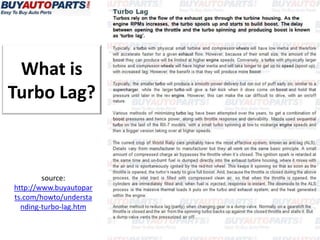
What is a Turbo Lag?
•    Turbos rely on the flow of the exhaust gas through the turbine housing. As the engine RPMs increase the turbo spools and
     begins to build boost. The delay between the opening of the throttle and the turbo spinning and producing boost is known
     as "turbo lag".
•    Typically, a turbo with a physically small turbine and compressor wheel will have low inertia and therefore accelerate faster
     for a given exhaust flow. However, because of their small size, the amount of boost they can produce will be limited at
     higher engine speeds. Conversely, a turbo with a physically larger turbine and compressor wheel will have higher inertia and
     will take longer to "spool up" or get to speed. With increased lag however the trade-off is increased boost at higher RPM.
•    On average a small turbo can deliver good power early on but run out of steam pretty quickly. Similar to a supercharger.
     While a larger turbo will give a fair kick when the boost comes on and will hold that through the rest of the rev range. This
     can be an issue because it can make a car difficult to drive.
•    Various methods of minimizing turbo lag have been attempted over the years. To get a combination of boost pressure and
     hence power along with fast throttle response and drivability. Mazda used a sequential turbo on the last of the RX-7 models,
     with a small turbo spinning at low to mid-range engine speeds and then a bigger version taking over at high speeds.
•    The current crop of World Rally cars probably have the most efficient system, known as anit-lag (ALS). Details vary from
     manufacturer to manufacturer but they all work on the same basic principle. A small amount of compressed charge air can
     bypass the throttle when it's closed. The ignition spark in retarded at the same time and un-burnt fuel is dumped directly
     into the exhaust turbine housing, where it mixes with the air and is spontaneously ignited by the red hot wheel. This keeps it
     spinning so that as soon as the throttle is opened, the turbo's ready to give full boost. Because the throttle is closed during
     the above process the inlet tract is filled with compressed clean air, so that when the throttle is opened, the cylinders are
     immediately filled and when the fuel is injected, response is instant. The downside is the ALS process is the massive thermal
     loads it puts on the turbo and exhaust system, and the heat generated in the engine.
•    Another method to reduce lag (partly) when changing gear is a dump valve. Normally on a gearshift the throttle is closed
     and the air from the spinning turbo backs up against the closed throttle and stalls it. But a dump valve vents the pressurized
     air off.

    source: http://www.buyautoparts.com/howto/introduction-to-the-wastegate.htm
How to Diagnose a Failed Turbocharger
• A failed turbo can be much more than just an
  immediate issue, the turbocharger failure may have
  occurred due to external issues. Turbochargers are
  designed to operate in very specific tolerances that
  don’t leave much room for variation. Failures can
  occur for a number of reasons from metal fatigue to
  overheating and physical damages caused by
  external debris.


 source: http://www.buyautoparts.com/howto/diagnosing-a-defective-turbo.htm
External Housing Issues


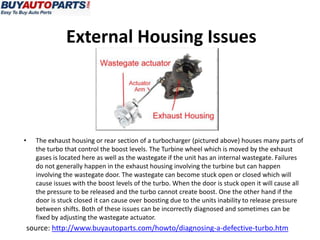
•   The exhaust housing or rear section of a turbocharger (pictured above) houses many parts of
    the turbo that control the boost levels. The Turbine wheel which is moved by the exhaust
    gases is located here as well as the wastegate if the unit has an internal wastegate. Failures
    do not generally happen in the exhaust housing involving the turbine but can happen
    involving the wastegate door. The wastegate can become stuck open or closed which will
    cause issues with the boost levels of the turbo. When the door is stuck open it will cause all
    the pressure to be released and the turbo cannot create boost. One the other hand if the
    door is stuck closed it can cause over boosting due to the units inability to release pressure
    between shifts. Both of these issues can be incorrectly diagnosed and sometimes can be
    fixed by adjusting the wastegate actuator.
source: http://www.buyautoparts.com/howto/diagnosing-a-defective-turbo.htm
Internal Housing Issues


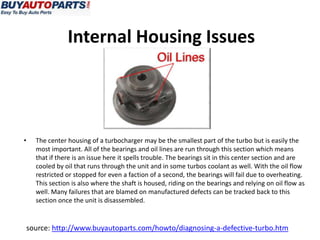
•   The center housing of a turbocharger may be the smallest part of the turbo but is easily the
    most important. All of the bearings and oil lines are run through this section which means
    that if there is an issue here it spells trouble. The bearings sit in this center section and are
    cooled by oil that runs through the unit and in some turbos coolant as well. With the oil flow
    restricted or stopped for even a faction of a second, the bearings will fail due to overheating.
    This section is also where the shaft is housed, riding on the bearings and relying on oil flow as
    well. Many failures that are blamed on manufactured defects can be tracked back to this
    section once the unit is disassembled.


source: http://www.buyautoparts.com/howto/diagnosing-a-defective-turbo.htm
Wastegate Issues


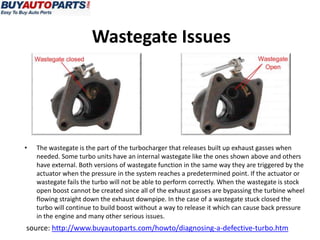
•   The wastegate is the part of the turbocharger that releases built up exhaust gasses when
    needed. Some turbo units have an internal wastegate like the ones shown above and others
    have external. Both versions of wastegate function in the same way they are triggered by the
    actuator when the pressure in the system reaches a predetermined point. If the actuator or
    wastegate fails the turbo will not be able to perform correctly. When the wastegate is stock
    open boost cannot be created since all of the exhaust gasses are bypassing the turbine wheel
    flowing straight down the exhaust downpipe. In the case of a wastegate stuck closed the
    turbo will continue to build boost without a way to release it which can cause back pressure
    in the engine and many other serious issues.
source: http://www.buyautoparts.com/howto/diagnosing-a-defective-turbo.htm
Foreign Object Damage


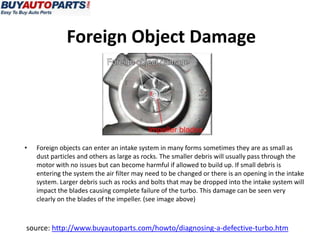
•   Foreign objects can enter an intake system in many forms sometimes they are as small as
    dust particles and others as large as rocks. The smaller debris will usually pass through the
    motor with no issues but can become harmful if allowed to build up. If small debris is
    entering the system the air filter may need to be changed or there is an opening in the intake
    system. Larger debris such as rocks and bolts that may be dropped into the intake system will
    impact the blades causing complete failure of the turbo. This damage can be seen very
    clearly on the blades of the impeller. (see image above)


source: http://www.buyautoparts.com/howto/diagnosing-a-defective-turbo.htm
Oil Starvation


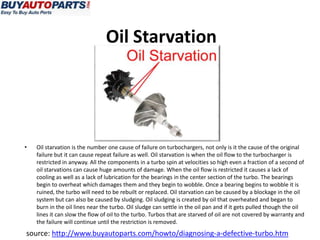
•   Oil starvation is the number one cause of failure on turbochargers, not only is it the cause of the original
    failure but it can cause repeat failure as well. Oil starvation is when the oil flow to the turbocharger is
    restricted in anyway. All the components in a turbo spin at velocities so high even a fraction of a second of
    oil starvations can cause huge amounts of damage. When the oil flow is restricted it causes a lack of
    cooling as well as a lack of lubrication for the bearings in the center section of the turbo. The bearings
    begin to overheat which damages them and they begin to wobble. Once a bearing begins to wobble it is
    ruined, the turbo will need to be rebuilt or replaced. Oil starvation can be caused by a blockage in the oil
    system but can also be caused by sludging. Oil sludging is created by oil that overheated and began to
    burn in the oil lines near the turbo. Oil sludge can settle in the oil pan and if it gets pulled though the oil
    lines it can slow the flow of oil to the turbo. Turbos that are starved of oil are not covered by warranty and
    the failure will continue until the restriction is removed.
source: http://www.buyautoparts.com/howto/diagnosing-a-defective-turbo.htm
How to Diagnose a Failed Turbocharger
• Just like any other auto parts turbochargers will only last if
  they are properly taken care of. Any part will fail with lacking
  maintenance but a turbo is particularly fragile due to its
  nature. The only true turbo failure is metal fatigue which is
  caused by the metal in the turbo becoming fragile due to heat
  cycling thousands of times. The unfortunate fact is that a
  turbocharger has an average life span of about 80 – 120K
  miles. On a diesel motor that life span can be closer to 4 times
  that but still the turbo will eventually fail. When the turbo
  does fail be sure to check for a cause before replacing the
  unit, otherwise it could cost much more than expected.


 source: http://www.buyautoparts.com/howto/diagnosing-a-defective-turbo.htm
REPAIR TURBOCHARGER
                                The End
For more Auto How To Tips visit, http://www.buyautoparts.com/howto/

If you need to purchase an auto part
- Visit www.buyautoparts.com
- Call 1-888-907-7225
- Or send an email to sales@buyautoparts.com


                               THANKS

     source: http://www.buyautoparts.com/howto/repair-turbocharger.htm

Repair Turbocharger

  • 1.
    REPAIR TURBOCHARGER What is a turbocharger, how to install a turbocharger and much more!!! source: http://www.buyautoparts.com/howto/repair-turbocharger.htm
  • 2.
    What is a Turbocharger? source: http://www.buyautoparts.c om/howto/what-is-a- turbocharger.htm
  • 3.
    What is aTurbocharger? • A Turbo is run by the exhaust gasses. Its main function is to compress air and force it into the engine, thereby more fuel can be burnt and thus more power can be generated. • The turbo has been around almost as long as the internal combustion engine. A turbo has 2 wheels on it one called the turbine and this sits in the exhaust system. The exhaust gas leaving the engine forces the turbine to spin as well as the shaft attached to it. • On the other side there is the impeller or compressor wheel which forces air into the motor. For this to be effective the impellor wheel spins at 120,000 - 150,000 RPM (rotations per min) • Many kinds of bearings used at these high rotational speeds need lubrication and cooling systems. The turbo's lubrication system can be an isolated system or receive oil from the engine's oil supply. The lubrication system can also double as a cooling system and separate coolant can be pumped through another outside source for additional cooling or the turbine may be air cooled. In automotive applications using the engine cooling and oil system to cool the turbo is common place. Specialized types of bearings can eliminate the need for oil cooling or engine coolant to cool the turbo. • Turbos rely on the flow of exhaust gas through the turbine housing they only start spinning after the engine ignition has started to take place. When the turbo begins to create boost there is a lag from when the throttle body is opened and when the boost begins to build and that is referred to as "turbo lag". • The turbine and impeller are each contained within their own housing on opposite sides. These housings collect and direct the gas flow. The size and shape can dictate the performance characteristics of the overall turbocharger. The area of the cone radius from center hub is expressed as a ratio (AR, A/R, or A:R). Often the same basic turbocharger assembly will be available from the manufacturer with multiple AR choices for the turbine housing and sometimes the compressor cover as well. This allows the designer of the engine to tailor the compromises between performance, response and efficiency to the application or preference. source: http://www.buyautoparts.com/howto/what-is-a-turbocharger.htm
  • 4.
    What is a Wastegate? source: http://www.buyautoparts.c om/howto/introduction- to-the-wastegate.htm
  • 5.
    What is aWastegate? • The wastegate is a small valve, which is used to control the amount of boost the turbo makes. It opens at a predetermined limit, to allow surplus exhaust gas to bypass the turbine and disappear straight down the exhaust pipe once the boost limit is reached. • Most engines can handle a small amount of additional boost but the temptation is to keep going, as it's relatively easy power. • But there is only so much boost that a turbo can produce. For a given turbo, the boost pressure is dependent in the amount of exhaust gas going through the turbine. This is controlled by a small valve, known as the wastegate. This opens at a pre- determined limit to allow surplus exhaust gas to bypass the turbine and disappear straight down the exhaust pipe once the boost limit is reached. • Normally, wastegate will have a spring on one side of the diaphragm and boost pressure on the other side. At the point where boost exerts force greater than the spring pressure, the gate opens to bleed off the exhaust gases. Reducing the pressure seen by the wastegate or increasing the strength of the spring will make the wastegate open at higher boost pressure hence the engine will get more boost and power. However, the limit to this is what the turbo can handle, both physically and from the air flow point of view. If too much exhaust gas is sent through the turbine, the unit can over-speed, which puts mechanical stresses on it and can lead to all sorts of problems, such as breaking shafts or compressor wheels failing. • In Addition, the air flowing into the engine can start to get very unpredictable, a situation known as "surge". This can have very detrimental effects on the engine's internals and power delivery. The solution is to tailor the turbo itself to the requirements, and if necessary replace a standard version with one designed for the job. This can be a physically bigger turbo or a different turbine and compressor characteristics. • There are two types of wastegates the first one is an internal wastegate. An internal wastegate is a component on the turbo itself. The gate is opened via an actuator which is a diaphragm type system. Excess exhaust is then fed directly into the exhaust system. They may also have what is called an external wastegatewhich it is separate from the turbo unit and does not require an actuator. source: http://www.buyautoparts.com/howto/introduction-to-the-wastegate.htm
  • 6.
    What is Turbo Lag? source: http://www.buyautopar ts.com/howto/understa nding-turbo-lag.htm
  • 7.
    What is aTurbo Lag? • Turbos rely on the flow of the exhaust gas through the turbine housing. As the engine RPMs increase the turbo spools and begins to build boost. The delay between the opening of the throttle and the turbo spinning and producing boost is known as "turbo lag". • Typically, a turbo with a physically small turbine and compressor wheel will have low inertia and therefore accelerate faster for a given exhaust flow. However, because of their small size, the amount of boost they can produce will be limited at higher engine speeds. Conversely, a turbo with a physically larger turbine and compressor wheel will have higher inertia and will take longer to "spool up" or get to speed. With increased lag however the trade-off is increased boost at higher RPM. • On average a small turbo can deliver good power early on but run out of steam pretty quickly. Similar to a supercharger. While a larger turbo will give a fair kick when the boost comes on and will hold that through the rest of the rev range. This can be an issue because it can make a car difficult to drive. • Various methods of minimizing turbo lag have been attempted over the years. To get a combination of boost pressure and hence power along with fast throttle response and drivability. Mazda used a sequential turbo on the last of the RX-7 models, with a small turbo spinning at low to mid-range engine speeds and then a bigger version taking over at high speeds. • The current crop of World Rally cars probably have the most efficient system, known as anit-lag (ALS). Details vary from manufacturer to manufacturer but they all work on the same basic principle. A small amount of compressed charge air can bypass the throttle when it's closed. The ignition spark in retarded at the same time and un-burnt fuel is dumped directly into the exhaust turbine housing, where it mixes with the air and is spontaneously ignited by the red hot wheel. This keeps it spinning so that as soon as the throttle is opened, the turbo's ready to give full boost. Because the throttle is closed during the above process the inlet tract is filled with compressed clean air, so that when the throttle is opened, the cylinders are immediately filled and when the fuel is injected, response is instant. The downside is the ALS process is the massive thermal loads it puts on the turbo and exhaust system, and the heat generated in the engine. • Another method to reduce lag (partly) when changing gear is a dump valve. Normally on a gearshift the throttle is closed and the air from the spinning turbo backs up against the closed throttle and stalls it. But a dump valve vents the pressurized air off. source: http://www.buyautoparts.com/howto/introduction-to-the-wastegate.htm
  • 9.
    How to Diagnosea Failed Turbocharger • A failed turbo can be much more than just an immediate issue, the turbocharger failure may have occurred due to external issues. Turbochargers are designed to operate in very specific tolerances that don’t leave much room for variation. Failures can occur for a number of reasons from metal fatigue to overheating and physical damages caused by external debris. source: http://www.buyautoparts.com/howto/diagnosing-a-defective-turbo.htm
  • 10.
    External Housing Issues • The exhaust housing or rear section of a turbocharger (pictured above) houses many parts of the turbo that control the boost levels. The Turbine wheel which is moved by the exhaust gases is located here as well as the wastegate if the unit has an internal wastegate. Failures do not generally happen in the exhaust housing involving the turbine but can happen involving the wastegate door. The wastegate can become stuck open or closed which will cause issues with the boost levels of the turbo. When the door is stuck open it will cause all the pressure to be released and the turbo cannot create boost. One the other hand if the door is stuck closed it can cause over boosting due to the units inability to release pressure between shifts. Both of these issues can be incorrectly diagnosed and sometimes can be fixed by adjusting the wastegate actuator. source: http://www.buyautoparts.com/howto/diagnosing-a-defective-turbo.htm
  • 11.
    Internal Housing Issues • The center housing of a turbocharger may be the smallest part of the turbo but is easily the most important. All of the bearings and oil lines are run through this section which means that if there is an issue here it spells trouble. The bearings sit in this center section and are cooled by oil that runs through the unit and in some turbos coolant as well. With the oil flow restricted or stopped for even a faction of a second, the bearings will fail due to overheating. This section is also where the shaft is housed, riding on the bearings and relying on oil flow as well. Many failures that are blamed on manufactured defects can be tracked back to this section once the unit is disassembled. source: http://www.buyautoparts.com/howto/diagnosing-a-defective-turbo.htm
  • 12.
    Wastegate Issues • The wastegate is the part of the turbocharger that releases built up exhaust gasses when needed. Some turbo units have an internal wastegate like the ones shown above and others have external. Both versions of wastegate function in the same way they are triggered by the actuator when the pressure in the system reaches a predetermined point. If the actuator or wastegate fails the turbo will not be able to perform correctly. When the wastegate is stock open boost cannot be created since all of the exhaust gasses are bypassing the turbine wheel flowing straight down the exhaust downpipe. In the case of a wastegate stuck closed the turbo will continue to build boost without a way to release it which can cause back pressure in the engine and many other serious issues. source: http://www.buyautoparts.com/howto/diagnosing-a-defective-turbo.htm
  • 13.
    Foreign Object Damage • Foreign objects can enter an intake system in many forms sometimes they are as small as dust particles and others as large as rocks. The smaller debris will usually pass through the motor with no issues but can become harmful if allowed to build up. If small debris is entering the system the air filter may need to be changed or there is an opening in the intake system. Larger debris such as rocks and bolts that may be dropped into the intake system will impact the blades causing complete failure of the turbo. This damage can be seen very clearly on the blades of the impeller. (see image above) source: http://www.buyautoparts.com/howto/diagnosing-a-defective-turbo.htm
  • 14.
    Oil Starvation • Oil starvation is the number one cause of failure on turbochargers, not only is it the cause of the original failure but it can cause repeat failure as well. Oil starvation is when the oil flow to the turbocharger is restricted in anyway. All the components in a turbo spin at velocities so high even a fraction of a second of oil starvations can cause huge amounts of damage. When the oil flow is restricted it causes a lack of cooling as well as a lack of lubrication for the bearings in the center section of the turbo. The bearings begin to overheat which damages them and they begin to wobble. Once a bearing begins to wobble it is ruined, the turbo will need to be rebuilt or replaced. Oil starvation can be caused by a blockage in the oil system but can also be caused by sludging. Oil sludging is created by oil that overheated and began to burn in the oil lines near the turbo. Oil sludge can settle in the oil pan and if it gets pulled though the oil lines it can slow the flow of oil to the turbo. Turbos that are starved of oil are not covered by warranty and the failure will continue until the restriction is removed. source: http://www.buyautoparts.com/howto/diagnosing-a-defective-turbo.htm
  • 15.
    How to Diagnosea Failed Turbocharger • Just like any other auto parts turbochargers will only last if they are properly taken care of. Any part will fail with lacking maintenance but a turbo is particularly fragile due to its nature. The only true turbo failure is metal fatigue which is caused by the metal in the turbo becoming fragile due to heat cycling thousands of times. The unfortunate fact is that a turbocharger has an average life span of about 80 – 120K miles. On a diesel motor that life span can be closer to 4 times that but still the turbo will eventually fail. When the turbo does fail be sure to check for a cause before replacing the unit, otherwise it could cost much more than expected. source: http://www.buyautoparts.com/howto/diagnosing-a-defective-turbo.htm
  • 16.
    REPAIR TURBOCHARGER The End For more Auto How To Tips visit, http://www.buyautoparts.com/howto/ If you need to purchase an auto part - Visit www.buyautoparts.com - Call 1-888-907-7225 - Or send an email to sales@buyautoparts.com THANKS source: http://www.buyautoparts.com/howto/repair-turbocharger.htm