EXCRETORY
SYSTEM
By: A. Thomas
Excretory organs
 Skin
 The skin is a part of the excretory system: it releases
sweat, which helps cool the body and regulate the
concentration of salt. The salt helps the water
evaporate, cooling off the skin. The skin is made up of a
lot of layers.
 Kidneys
 The kidneys are placed on either side of the spinal
column near the lower back. They are primarily
responsible for filtering blood by removing nitrogenous
wastes, though they also regulate blood pressure in a
process called osmoregulation.
Controlling the Internal
Concentrations
 Water moves in and out of cells by osmosis
 The maintenance of the balance in water and salts is
known as OSMOREGULATION
THE KIDNEY
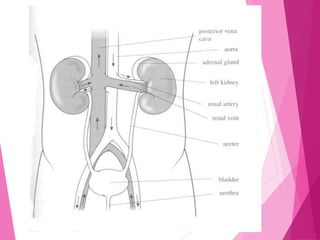
 The urinary system is made-up of the kidneys, ureter,
bladder, and urethra.
 The kidneys are bean-shaped organs, each about the size of
a fist
 They are located near the middle of the back, just below
the rib cage, one on each side of the spine
 Every day, a person’s kidneys process about 200 quarts of
blood to sift out about 2 quarts of waste products and extra
water.
 The wastes and extra water become urine, which flows to
the bladder through tubes called ureters.
 The bladder stores urine until releasing it through
urination.
Overview of function of
Kidney
 Blood flows to kidney via the renal artery
 The blood is filtered and the following materials enter
the kidney tubules
 1. water
 2. salt
 3. Urea
 4. glucose
 Every thing that the body needs in reabsorbed including
some water and all the sugar and mineral ions needed
by the body.
 The amount of water reabsorbed is dependent on the
amount that it needs
 The waste; urea, water and excess mineral ions that are
not needed are released in the urine
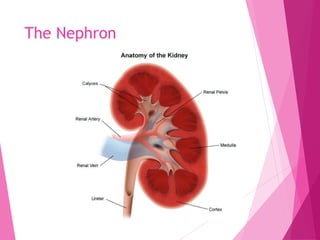
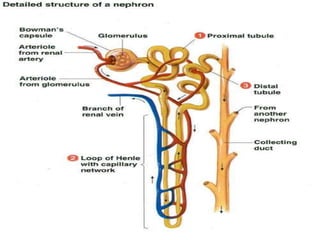
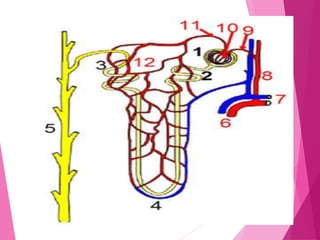
The Nephron
The Nephron
 Its principal function is to control the absorption of
water and soluble substances such as sodium salts by
filtering the blood, reabsorbing what is required and
excreting the rest as urine.
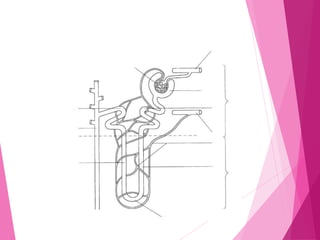
Structures of the nephron
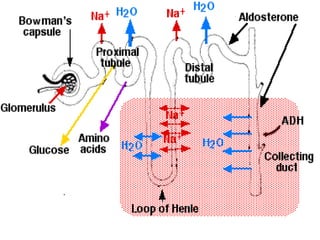
 BOWMAN’S CAPSULE:
 the site of ultrafiltration of the blood.
 This is done by force generated when the blood flowing
in a larger vessel is forced into smaller capillaries.
 The walls of the capillaries acts as a filter
 Blood cells and protiens are too large to pass through
the gaps
 Water, salt, glucose, urea and mineral ions pass through
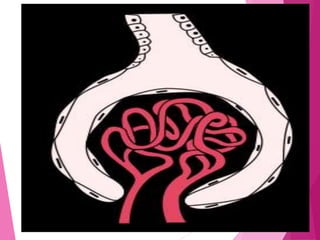
GLOMERULUS:
 The knot of blood vessels in the bowman’s capsule
where the pressure builds up so ultrafiltration occurs.
 FIRST CONVOLUTED TUBULE
 The fluid that enters from the Bowmans Capsule is
known as the Glomerular filtrate
 A lot of reabsorption takes place here
 All the glucose
 ~67% sodium ions
 80% water
 LOOP OF HENLE
 This is where the urine is concentrated and more water
is reabsorbed
 SECOND CONVOLUTED TUBULE
 This is where the main water balance is done
 If the body is short of water then more is reabsorbed
 ADH is involved
 The remaining salt is reabsorbed here
 COLLECTING DUCT
 The urine is collected here
 No glucose is present
 The level of salt and water depends on the diet
 Very high concentration of urine
 Reabsorption of water can take place here if it is badly
needed.
 ADH is responsible
 The urine then passes through the URETER to the
BLADDER.
 The bladder is a muscular bag which stores the urine
until we let it out.
 The urine then passes the URETHRA to the outside world
as we urinate
INTERACTIVE
 http://www.biologymad.com/resources/kidney.swf
 SUMMARY OF STRUCTURES involved in urine production
 Renal artery – glomerulus – bowman’s capsule – proximal
convolution – loop of henle – distal convolution –
collecting duct – ureter – bladder – urethra - toilet
Excretory system

Excretory system

  • 1.
  • 2.
    Excretory organs  Skin The skin is a part of the excretory system: it releases sweat, which helps cool the body and regulate the concentration of salt. The salt helps the water evaporate, cooling off the skin. The skin is made up of a lot of layers.  Kidneys  The kidneys are placed on either side of the spinal column near the lower back. They are primarily responsible for filtering blood by removing nitrogenous wastes, though they also regulate blood pressure in a process called osmoregulation.
  • 3.
    Controlling the Internal Concentrations Water moves in and out of cells by osmosis  The maintenance of the balance in water and salts is known as OSMOREGULATION
  • 4.
    THE KIDNEY  Theurinary system is made-up of the kidneys, ureter, bladder, and urethra.  The kidneys are bean-shaped organs, each about the size of a fist  They are located near the middle of the back, just below the rib cage, one on each side of the spine  Every day, a person’s kidneys process about 200 quarts of blood to sift out about 2 quarts of waste products and extra water.  The wastes and extra water become urine, which flows to the bladder through tubes called ureters.  The bladder stores urine until releasing it through urination.
  • 5.
    Overview of functionof Kidney  Blood flows to kidney via the renal artery  The blood is filtered and the following materials enter the kidney tubules  1. water  2. salt  3. Urea  4. glucose
  • 6.
     Every thingthat the body needs in reabsorbed including some water and all the sugar and mineral ions needed by the body.  The amount of water reabsorbed is dependent on the amount that it needs  The waste; urea, water and excess mineral ions that are not needed are released in the urine
  • 8.
  • 9.
    The Nephron  Itsprincipal function is to control the absorption of water and soluble substances such as sodium salts by filtering the blood, reabsorbing what is required and excreting the rest as urine.
  • 11.
    Structures of thenephron  BOWMAN’S CAPSULE:  the site of ultrafiltration of the blood.  This is done by force generated when the blood flowing in a larger vessel is forced into smaller capillaries.  The walls of the capillaries acts as a filter  Blood cells and protiens are too large to pass through the gaps  Water, salt, glucose, urea and mineral ions pass through
  • 12.
    GLOMERULUS:  The knotof blood vessels in the bowman’s capsule where the pressure builds up so ultrafiltration occurs.
  • 14.
     FIRST CONVOLUTEDTUBULE  The fluid that enters from the Bowmans Capsule is known as the Glomerular filtrate  A lot of reabsorption takes place here  All the glucose  ~67% sodium ions  80% water
  • 15.
     LOOP OFHENLE  This is where the urine is concentrated and more water is reabsorbed
  • 16.
     SECOND CONVOLUTEDTUBULE  This is where the main water balance is done  If the body is short of water then more is reabsorbed  ADH is involved  The remaining salt is reabsorbed here
  • 17.
     COLLECTING DUCT The urine is collected here  No glucose is present  The level of salt and water depends on the diet  Very high concentration of urine  Reabsorption of water can take place here if it is badly needed.  ADH is responsible
  • 18.
     The urinethen passes through the URETER to the BLADDER.  The bladder is a muscular bag which stores the urine until we let it out.  The urine then passes the URETHRA to the outside world as we urinate
  • 21.
  • 22.
     SUMMARY OFSTRUCTURES involved in urine production  Renal artery – glomerulus – bowman’s capsule – proximal convolution – loop of henle – distal convolution – collecting duct – ureter – bladder – urethra - toilet