URINARY SYSTEM
MR. TEJAS KHANDARE
F. Y. B. PHARMACY
SUB – HUMAN ANATOMY AND PHYSIOLOGY 2
K .K. WAGH COLLEGE OF PHARMACY NASHIK .
CONTENTS
 Introduction
 Parts of urinary system
 Kidney
 Ureter
 Urinary bladder
 Urethra
Introduction
 For body to function effectively , their environment should be maintained relatively constant.
 Continuous working of cells necessities utilization of nutrients and oxygen and results into
production of certain waste substances.
 To maintain homeostasis ,the waste products of cell metabolism should be removed from the
body.
 The urinary system eliminates variety of cellular metabolic products such as urea, uric acid and
creatinine and maintains water and electrolyte balance of the body .
 Its purpose is to regulate blood volume ,blood pressure ,control electrolytes and metabolites and
to regulate blood PH.
 The urinary system consists of the organs that produce and excrete urine from the body.
Parts of urinary system
 KIDNEY - Regulate blood volume and composition, regulate PH, produce 2 hormones and
excrete waste.
 URETERS – Transport urine from kidney to urinary bladder.
 URINARY BLADDER –To store urine and expels through urethra.
 URETHRA – Discharge urine from the body.
KIDNEY
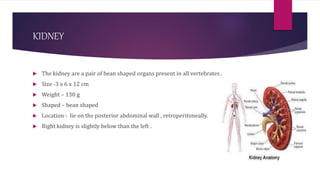
 The kidney are a pair of bean shaped organs present in all vertebrates .
 Size -3 x 6 x 12 cm
 Weight – 130 g
 Shaped – bean shaped
 Location - lie on the posterior abdominal wall , retroperitoneally.
 Right kidney is slightly below than the left .
ANATOMY OF KIDNEY
 Reddish –Brown in color
 They are situated posteriorly behind the peritoneum on each side of the vertebral
column and are surrounded by adipose tissue.
 Superiorly – upper border of the twelfth thoracic vertebra.
 The right is usually slightly inferior to the left probably reflecting its relationship to
the liver .
 The long axis of each kidney is directed inferolateral and the transverse axis
posteromedially .
 The transpyloric plane passes through the superior part of the night renal hilum and
the inferior part of the left KIDNEY.
Renal Capsule – outer membrane that surrounds the kidney ; it is thin but tough and fibrous..
Renal Pelvis - basin-like area that collects urine from the nephrons, it narrows into the upper end of the ureter
.
Calyx- extension of the renal pelvis; they channel urine from the pyramids to the renal pelvis.
Cortex the outer
Nephron - these are the filtration units in the kidneys .
Medulla- inner region of the kidney contains 8-12 renal pyramids. The pyramids empty into the calyx.
Medullary pyramids - formed by the collecting ducts, inner part of the kidney
Ureter collects filtrate and urine from renal pelvis and takes it to the bladder for urination .
Renal Artery branches off of the aorta bringing waste-filled blood into the kidney for filtering in the nephrons; the
renal artery is further subdivided into several branches inside the kidney. Each minute, the kidneys receive 20% of
the blood pumped by the heart. Some arteries nourish the kidney cells themselves.
Renal vein – removes the filtered blood from the kidney to the inferior vena cava.
nephron
 The functional unit of the kidney is called the
nephron.
 About a million in each kidney .
 Consist of 2 part : renal corpuscle, and renal
tubule .
 RENAL CORPUSCLE : Glomerular ( bowman’s
capsule ), glomerulus.
 RENAL TUBE : Proximal convoluted tubules,
Nephron loop ( descending and ascending ), Distal
convoluted tubule.
Process of filtration
 The kidneys filter unwanted substances from the blood and produce urine to excrete
them. There are three main steps of urine formation:
 Glomerular filtration
 Reabsorption
 secretion
Glomerular filtration
 Glomerular filtration is the process by which the kidneys filter the blood, removing excess wastes
and fluids.
 Blood enters the kidney via the renal artery . It forms many afferent arterioles, each of which
delivers blood to an individual kidney nephron each consist of microscopic filter called
glomerulus.
 The pressure of the blood inside the glomerulus is increased due to the difference in diameter of
the incoming and out-going arterioles.
 he diameter of the afferent arteriole is greater than the diameter of the efferent arteriole.
 This increased blood pressure helps to force water , salts , glucose and urea from the blood out of
the glomerular capillaries .
Glomerular filtration
 The components of blood are filtered based on their particle size.
 The water and salts forced out of the glomerular capillaries pass into the Bowman's
Capsule and are called the glomerular filtrate.
 The glomerular filtrate then passes from the renal corpuscle to the renal tubule.
reabsorption
 Occurring more commonly within the nephron system than filtration, this is a form of
active transport which takes the useful substances for the body from the tubules and
places them back into the blood filled capillaries.
 Within the PROXIMAL CONVOLUTED TUBULE reabsorption occurs when pH needs to
be maintained and bicarbonate ions are reabsorbed back into the bloodstream.
Glucose, Amino Acids and Potassium ions are all beneficial for the body so they are
actively transported into the blood as well. Sodium and Chlorine ions are also moved
back into the capillaries so that some salt regulation can occur. On the other end of
the scale, substances such as hydrogen ions and toxins are actively secreted from the
blood into the tubule.
reabsorption
 Within the LOOP OF HENLE, the descending limb allows for the reabsorption of
water through osmosis whereas the ascending limb allows for the passive and active
trans port of salts such as sodium to move out of the tubules and be reabsorbed.
 The DISTAL CONVOLUTED TUBULE is where the final adjustments are made to the
passing urine within the tubule systems. This is where highly selective reabsorption
takes place allowing for small adjustments to be made especially between the
presence of Potassium and Sodium.
secretion
 The third process by which the kidneys clean blood (regulating its composition and volum e) is called
tubular secretion and involves substances being added to the tubular fluid. This removes excessive
quantities of certain dissolved substances from the body, and also maintains the blood at a normal
healthy pH (which is typically in the range pH 7.35 to pH 7.45
 The substances that are secreted into the tubular fluid (for removal from the body) include:
- potassium ions (K’)
- Hydrogen ions (H)
- Ammonium ions (NH,").
- Creatinine
- urea
- some hormones
- some drugs (e.g. penicillin).
secretion
 Tubular secretion occurs from the epithelial cells that line the renal tubules and
collecting ducts.
 It is the tubular secretion of H' and NH, from the blood into the tubular fluid (i.e.
urine which is then excreted from the body via the ureter, bladder, and urethra) that
helps to keep blood pH at its normal level. The movement of these ions also helps to
conserve sodium bicarbonate (NaHCO3).
 The typical pH of urine is about 6.
 Urine formed via the three processes outlined above trickles into the kidney pelvis.
At this final stage it is only approx. 1% of the originally filtered volume but includes
high concentrations of urea and creatinine, and variable concentrations of ions.
 The typical volume of urine produced by an average adult is around 1.5 - 2.0 dm per
day.
Functions of kidney
 Excretion of metabolic waste products and foreign chemicals.
 Regulation of water and electrolyte balances .
 Regulation of body fluid osmolality and electrolyte concentrations.
 Regulation of arterial pressure.
 Regulation of acid base balance.
 Regulation of erythrocyte production.
 Secretion metabolism ,and excretion of hormone .
 Gluconeogenesis
URETER
 The ureter is a tube that carries urine from the kidney to the urinary bladder.
 There are two ureters, one attached to each kidney.
 The upper half of the ureter is located in the abdomen and the lower half is located in the pelvic
area.
 The ureters are tubes made of smooth muscle that propel urine from the kidneys to the urinary
bladder.
 In a human adult, the ureters are usually 20–30 cm (8–12 in) long and around 3–4 mm (0.12–0.16
in) in diameter.
 The ureter is lined by urothelial cells, a type of transitional epithelium, and has an additional smooth
muscle layer in third closest to the bladder that assists with peristalsis.
Histology of ureter
 The wall of the ureter have 3 layers;
1. The outer layer : The fibrous coat.
2.The middle layer : The muscular coat /the main function of this layer is peristalsis to push the urine.
3. The inner layer (the mucosa) : This layer is made up of transition / This layer secretes mucus which
coats and protects the surface of the cells .
 Smooth muscle layers in the walls contract to propel urine into the bladder.
 Once urine has entered the bladder . It is prevented from flowing back into ureters by small valve.
Urinary bladder
 The urinary bladder stores urine until it
is expelled from the body.
 The bladder has three openings: two for
the ureters and one for the urethra.
 The bladder wall is expandable .
 tis lined with mucosa of transitional
epithelium.
 The urinary bladder, or simply bladder, is a hollow muscular organ in humans and other vertebrates
that stores urine from the kidneys before disposal by urination .
 In humans the bladder is a hollow distensible organ that sits on the pelvic floor. Urine enters the
bladder via the ureters and exits via the urethra.
 The urinary bladder is posterior to the pubic symphysis.
 The shape of urinary bladder depends on how much urine is contain. When empty, it look like a
deflated balloon.
 Capacity 700-800 ml
 Smaller in female because, uterus occupies the space superior to the urinary bladder.
 Toward the base of urinary bladder, the ureter drains into the urinary bladder via the ureteral opening.
urethra
 The urethra is a muscular tube that extends from inferior surface of urinary bladder and carries
urine to the exterior of the body.
 At the pelvic floor when it passes through the muscle, (urogenital diaphragm) it is surrounded by
the external urethral sphincter.
 Present in both male and female but there are some differences between the two.
 In females, it is a narrow membranous canal extending from bladder to external orifice the
meatus ,and about 03..8 cm in length.
 It is placed obliquely downwards and forwards along the anterior wall of vagina. The meatus is the
narrowest part and is located between the clitoris and the opening of the vagina.
Difference between
Male urethra
 Long
 Length = 18-20 cm
 Function – 1. urination
2. ejaculation of semen
 Course – curved (double)
Female urethra
 Short
 Length = 4 cm
 Function – only urination
 Course – nearly straight
Urinary system

Urinary system

  • 1.
    URINARY SYSTEM MR. TEJASKHANDARE F. Y. B. PHARMACY SUB – HUMAN ANATOMY AND PHYSIOLOGY 2 K .K. WAGH COLLEGE OF PHARMACY NASHIK .
  • 2.
    CONTENTS  Introduction  Partsof urinary system  Kidney  Ureter  Urinary bladder  Urethra
  • 3.
    Introduction  For bodyto function effectively , their environment should be maintained relatively constant.  Continuous working of cells necessities utilization of nutrients and oxygen and results into production of certain waste substances.  To maintain homeostasis ,the waste products of cell metabolism should be removed from the body.  The urinary system eliminates variety of cellular metabolic products such as urea, uric acid and creatinine and maintains water and electrolyte balance of the body .  Its purpose is to regulate blood volume ,blood pressure ,control electrolytes and metabolites and to regulate blood PH.  The urinary system consists of the organs that produce and excrete urine from the body.
  • 4.
    Parts of urinarysystem  KIDNEY - Regulate blood volume and composition, regulate PH, produce 2 hormones and excrete waste.  URETERS – Transport urine from kidney to urinary bladder.  URINARY BLADDER –To store urine and expels through urethra.  URETHRA – Discharge urine from the body.
  • 6.
    KIDNEY  The kidneyare a pair of bean shaped organs present in all vertebrates .  Size -3 x 6 x 12 cm  Weight – 130 g  Shaped – bean shaped  Location - lie on the posterior abdominal wall , retroperitoneally.  Right kidney is slightly below than the left .
  • 7.
    ANATOMY OF KIDNEY Reddish –Brown in color  They are situated posteriorly behind the peritoneum on each side of the vertebral column and are surrounded by adipose tissue.  Superiorly – upper border of the twelfth thoracic vertebra.  The right is usually slightly inferior to the left probably reflecting its relationship to the liver .  The long axis of each kidney is directed inferolateral and the transverse axis posteromedially .  The transpyloric plane passes through the superior part of the night renal hilum and the inferior part of the left KIDNEY.
  • 8.
    Renal Capsule –outer membrane that surrounds the kidney ; it is thin but tough and fibrous.. Renal Pelvis - basin-like area that collects urine from the nephrons, it narrows into the upper end of the ureter . Calyx- extension of the renal pelvis; they channel urine from the pyramids to the renal pelvis. Cortex the outer Nephron - these are the filtration units in the kidneys . Medulla- inner region of the kidney contains 8-12 renal pyramids. The pyramids empty into the calyx. Medullary pyramids - formed by the collecting ducts, inner part of the kidney Ureter collects filtrate and urine from renal pelvis and takes it to the bladder for urination . Renal Artery branches off of the aorta bringing waste-filled blood into the kidney for filtering in the nephrons; the renal artery is further subdivided into several branches inside the kidney. Each minute, the kidneys receive 20% of the blood pumped by the heart. Some arteries nourish the kidney cells themselves. Renal vein – removes the filtered blood from the kidney to the inferior vena cava.
  • 9.
    nephron  The functionalunit of the kidney is called the nephron.  About a million in each kidney .  Consist of 2 part : renal corpuscle, and renal tubule .  RENAL CORPUSCLE : Glomerular ( bowman’s capsule ), glomerulus.  RENAL TUBE : Proximal convoluted tubules, Nephron loop ( descending and ascending ), Distal convoluted tubule.
  • 10.
    Process of filtration The kidneys filter unwanted substances from the blood and produce urine to excrete them. There are three main steps of urine formation:  Glomerular filtration  Reabsorption  secretion
  • 11.
    Glomerular filtration  Glomerularfiltration is the process by which the kidneys filter the blood, removing excess wastes and fluids.  Blood enters the kidney via the renal artery . It forms many afferent arterioles, each of which delivers blood to an individual kidney nephron each consist of microscopic filter called glomerulus.  The pressure of the blood inside the glomerulus is increased due to the difference in diameter of the incoming and out-going arterioles.  he diameter of the afferent arteriole is greater than the diameter of the efferent arteriole.  This increased blood pressure helps to force water , salts , glucose and urea from the blood out of the glomerular capillaries .
  • 12.
    Glomerular filtration  Thecomponents of blood are filtered based on their particle size.  The water and salts forced out of the glomerular capillaries pass into the Bowman's Capsule and are called the glomerular filtrate.  The glomerular filtrate then passes from the renal corpuscle to the renal tubule.
  • 13.
    reabsorption  Occurring morecommonly within the nephron system than filtration, this is a form of active transport which takes the useful substances for the body from the tubules and places them back into the blood filled capillaries.  Within the PROXIMAL CONVOLUTED TUBULE reabsorption occurs when pH needs to be maintained and bicarbonate ions are reabsorbed back into the bloodstream. Glucose, Amino Acids and Potassium ions are all beneficial for the body so they are actively transported into the blood as well. Sodium and Chlorine ions are also moved back into the capillaries so that some salt regulation can occur. On the other end of the scale, substances such as hydrogen ions and toxins are actively secreted from the blood into the tubule.
  • 14.
    reabsorption  Within theLOOP OF HENLE, the descending limb allows for the reabsorption of water through osmosis whereas the ascending limb allows for the passive and active trans port of salts such as sodium to move out of the tubules and be reabsorbed.  The DISTAL CONVOLUTED TUBULE is where the final adjustments are made to the passing urine within the tubule systems. This is where highly selective reabsorption takes place allowing for small adjustments to be made especially between the presence of Potassium and Sodium.
  • 15.
    secretion  The thirdprocess by which the kidneys clean blood (regulating its composition and volum e) is called tubular secretion and involves substances being added to the tubular fluid. This removes excessive quantities of certain dissolved substances from the body, and also maintains the blood at a normal healthy pH (which is typically in the range pH 7.35 to pH 7.45  The substances that are secreted into the tubular fluid (for removal from the body) include: - potassium ions (K’) - Hydrogen ions (H) - Ammonium ions (NH,"). - Creatinine - urea - some hormones - some drugs (e.g. penicillin).
  • 16.
    secretion  Tubular secretionoccurs from the epithelial cells that line the renal tubules and collecting ducts.  It is the tubular secretion of H' and NH, from the blood into the tubular fluid (i.e. urine which is then excreted from the body via the ureter, bladder, and urethra) that helps to keep blood pH at its normal level. The movement of these ions also helps to conserve sodium bicarbonate (NaHCO3).  The typical pH of urine is about 6.  Urine formed via the three processes outlined above trickles into the kidney pelvis. At this final stage it is only approx. 1% of the originally filtered volume but includes high concentrations of urea and creatinine, and variable concentrations of ions.  The typical volume of urine produced by an average adult is around 1.5 - 2.0 dm per day.
  • 17.
    Functions of kidney Excretion of metabolic waste products and foreign chemicals.  Regulation of water and electrolyte balances .  Regulation of body fluid osmolality and electrolyte concentrations.  Regulation of arterial pressure.  Regulation of acid base balance.  Regulation of erythrocyte production.  Secretion metabolism ,and excretion of hormone .  Gluconeogenesis
  • 18.
    URETER  The ureteris a tube that carries urine from the kidney to the urinary bladder.  There are two ureters, one attached to each kidney.  The upper half of the ureter is located in the abdomen and the lower half is located in the pelvic area.  The ureters are tubes made of smooth muscle that propel urine from the kidneys to the urinary bladder.  In a human adult, the ureters are usually 20–30 cm (8–12 in) long and around 3–4 mm (0.12–0.16 in) in diameter.  The ureter is lined by urothelial cells, a type of transitional epithelium, and has an additional smooth muscle layer in third closest to the bladder that assists with peristalsis.
  • 20.
    Histology of ureter The wall of the ureter have 3 layers; 1. The outer layer : The fibrous coat. 2.The middle layer : The muscular coat /the main function of this layer is peristalsis to push the urine. 3. The inner layer (the mucosa) : This layer is made up of transition / This layer secretes mucus which coats and protects the surface of the cells .  Smooth muscle layers in the walls contract to propel urine into the bladder.  Once urine has entered the bladder . It is prevented from flowing back into ureters by small valve.
  • 21.
    Urinary bladder  Theurinary bladder stores urine until it is expelled from the body.  The bladder has three openings: two for the ureters and one for the urethra.  The bladder wall is expandable .  tis lined with mucosa of transitional epithelium.
  • 22.
     The urinarybladder, or simply bladder, is a hollow muscular organ in humans and other vertebrates that stores urine from the kidneys before disposal by urination .  In humans the bladder is a hollow distensible organ that sits on the pelvic floor. Urine enters the bladder via the ureters and exits via the urethra.  The urinary bladder is posterior to the pubic symphysis.  The shape of urinary bladder depends on how much urine is contain. When empty, it look like a deflated balloon.  Capacity 700-800 ml  Smaller in female because, uterus occupies the space superior to the urinary bladder.  Toward the base of urinary bladder, the ureter drains into the urinary bladder via the ureteral opening.
  • 23.
    urethra  The urethrais a muscular tube that extends from inferior surface of urinary bladder and carries urine to the exterior of the body.  At the pelvic floor when it passes through the muscle, (urogenital diaphragm) it is surrounded by the external urethral sphincter.  Present in both male and female but there are some differences between the two.  In females, it is a narrow membranous canal extending from bladder to external orifice the meatus ,and about 03..8 cm in length.  It is placed obliquely downwards and forwards along the anterior wall of vagina. The meatus is the narrowest part and is located between the clitoris and the opening of the vagina.
  • 25.
    Difference between Male urethra Long  Length = 18-20 cm  Function – 1. urination 2. ejaculation of semen  Course – curved (double) Female urethra  Short  Length = 4 cm  Function – only urination  Course – nearly straight