Excretion
Glomerular filtration
 Filtrate is a plasma-derived fluid that is
 processed by the renal tubules to form
 urine.
 Urine is the end product of excretory
 activity on the filtrate, and contains mostly
 metabolic wastes and unneeded substances.
Net filtration pressure is responsible for
filtrate formation, and is the product of the
forces acting at the glomerular bed.
Glomerular hydrostatic pressure is the
primary force pushing water and solutes out
of the blood across the filtration membrane.
Colloid osmotic pressure and capsular
hydrostatic pressure are forces that drive
fluids back into glomerular capillaries.
Glomerular filtration rate is the total amount
of filtrate formed per minute by the kidneys.
Renal autoregulation is a process by which
the kidney can adjust its own resistance to
blood flow, by maintaining a nearly
constant glomerular filtration rate.
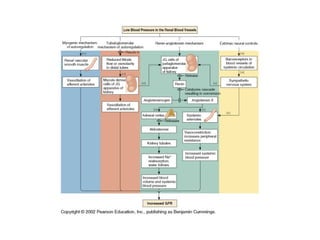
The myogenic mechanism reflects the
general tendency of vascular smooth muscle
to contract when it is stretched.
The renin-angiotensin mechanism is
triggered when the juxtaglomerular cells
release renin in response to various stimuli.
Angiotensin converting enzyme (ACE)
catalyzes the reaction that converts
angiotensin I to angiotensin II.
Tubular reabsorption
 Tubular reabsorption is a reclamation
 process that prevents significant loss of
 plasma volume during the filtration process.
Passive tubular reabsorption is the
movement of substances along their
electrochemical gradient without the use of
ATP.
Because water follows salt in the osmotic
process, a sodium-linked water flow is
established, called obligatory water
reabsorption.
Solvent drag explains the passive
reabsorption of lipid-soluble substances in
the filtrate, as a result of solutes following
the movement of solvent.
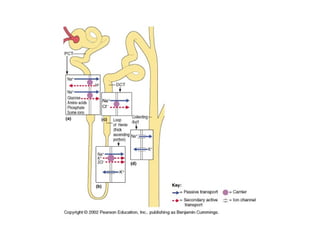
Secondary active transport is due to the
gradient created by the Na+/K+ pump, which
causes the reabsorption of glucose, amino
acids, lactate vitamins and most cations.
The transport maximum reflects the number
of carriers in the renal tubules available to
carry each substance.
Urea, creatinine, and uric acid are important
substances not reabsorbed completely by
the nephron.
Tubule Segment Substance Reabsorbed            Mechansim
Proximal convuluted Sodium ions                Active transport via sodium/potassium carrier; sets up
tubule                                         electrochemical gradient of passive solute diffusion,
                                               Aldosterone promotes Na+ retention
                  Nutrients (glucose, amino    Active transport; cotransport with sodium
                  acids, vitamins)
                  Cations                      Active transport; cotransport with sodium
                  Anions                       Passive transport; paracellular diffusion by electrochemical
                                               gradient
                  Water                        Osmosis
                  Urea                         Passive diffusion via solvent drag
                  Small proteins               Pinocytosed by tubule cells, digested to amino acids

Loop of Henle
  Descending loop Water                        Osmosis
  Ascending loop Sodium, Chloride, Potassium   Active transport
Tubule Segment Substance Reabsorbed              Mechansim
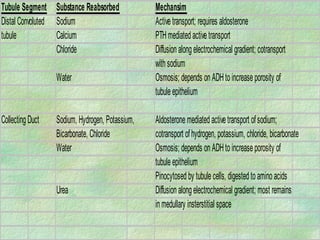
Distal Convoluted Sodium                         Active transport; requires aldosterone
tubule            Calcium                        PTH mediated active transport
                  Chloride                       Diffusion along electrochemical gradient; cotransport
                                                 with sodium
                  Water                          Osmosis; depends on ADH to increase porosity of
                                                 tubule epithelium

Collecting Duct   Sodium, Hydrogen, Potassium,   Aldosterone mediated active transport of sodium;
                  Bicarbonate, Chloride          cotransport of hydrogen, potassium, chloride, bicarbonate
                  Water                          Osmosis; depends on ADH to increase porosity of
                                                 tubule epithelium
                                                 Pinocytosed by tubule cells, digested to amino acids
                  Urea                           Diffusion along electrochemical gradient; most remains
                                                 in medullary insterstitial space
Tubular secretion
 Tubular secretion is another method, like
 failure of tubule cells to reabsorb filtered
 solutes, of clearing plasma of unwanted
 substances.
Regulation of urine
concentration and volume
 Osmolality is the number of solute particles
 dissolved in one liter (1000 grams) of water
 in a solution.
 An osmol is equivalent of 1 mole of a non-
 ionizing substance in l liter of water.
 A milliosmol is equal to 0.001 osmol, and is
 used to describe the solute concentration of
 body fluids.
The countercurrent mechanism allows the
kidneys to keep the solute load of body
fluids constant at about 300 mosm (= to
blood plasma), by directing fluids in
opposite directions through adjacent
channels.
Phases of the countercurrent
multiplier
1)   The descending limb of the loop of
     Henle is relatively impermeable to
     solutes and freely permeable to water.
2)   The ascending limb of the loop of Henle
     is impermeable to water and actively
     transports sodium chloride into the
     surrounding interstitial fluid.
3)  The collecting ducts in the deep
    medullary regions are permeable to
 urea.
4) The vasa recta as a countercurrent
    exchanger, maintaining the osmotic
    gradient while delivering the nutrient
    blood supply to cells in the area.
The countercurrent exchanger protects the
medullary gradient set up by the loop of
Henle by preventing rapid removal of salt
from the medullary interstitial space.
Formation of concentrated urine
 Antidiuretic hormone inhibits urine output
 (diuresis), by increasing the number of
 water-filled channels in the principal cells
 of the collecting ducts.
Water reabsorption that depends on the
presence of ADH is called facultative water
reabsorption.
Diuretics are chemicals that enhance
urinary output.
Renal clearance
 Renal clearance is the volume of plasma
 from which a particular substance is
 completely cleared by the kidneys in a
 given time, usually 1 minute.
Characteristics and composition
of urine
 Urochrome is a pigment that results from
 the destruction of hemoglobin, and is
 responsible for the color of urine.
 Urine, because it is water plus solutes, has a
 higher specific gravity, or weighs more than
 water.
 Nitrogenous wastes include urea, uric acid,
 and creatinine.

Excretion

  • 1.
  • 3.
    Glomerular filtration Filtrateis a plasma-derived fluid that is processed by the renal tubules to form urine. Urine is the end product of excretory activity on the filtrate, and contains mostly metabolic wastes and unneeded substances.
  • 4.
    Net filtration pressureis responsible for filtrate formation, and is the product of the forces acting at the glomerular bed. Glomerular hydrostatic pressure is the primary force pushing water and solutes out of the blood across the filtration membrane.
  • 5.
    Colloid osmotic pressureand capsular hydrostatic pressure are forces that drive fluids back into glomerular capillaries. Glomerular filtration rate is the total amount of filtrate formed per minute by the kidneys.
  • 7.
    Renal autoregulation isa process by which the kidney can adjust its own resistance to blood flow, by maintaining a nearly constant glomerular filtration rate. The myogenic mechanism reflects the general tendency of vascular smooth muscle to contract when it is stretched.
  • 9.
    The renin-angiotensin mechanismis triggered when the juxtaglomerular cells release renin in response to various stimuli. Angiotensin converting enzyme (ACE) catalyzes the reaction that converts angiotensin I to angiotensin II.
  • 10.
    Tubular reabsorption Tubularreabsorption is a reclamation process that prevents significant loss of plasma volume during the filtration process.
  • 12.
    Passive tubular reabsorptionis the movement of substances along their electrochemical gradient without the use of ATP. Because water follows salt in the osmotic process, a sodium-linked water flow is established, called obligatory water reabsorption.
  • 13.
    Solvent drag explainsthe passive reabsorption of lipid-soluble substances in the filtrate, as a result of solutes following the movement of solvent. Secondary active transport is due to the gradient created by the Na+/K+ pump, which causes the reabsorption of glucose, amino acids, lactate vitamins and most cations.
  • 14.
    The transport maximumreflects the number of carriers in the renal tubules available to carry each substance. Urea, creatinine, and uric acid are important substances not reabsorbed completely by the nephron.
  • 15.
    Tubule Segment SubstanceReabsorbed Mechansim Proximal convuluted Sodium ions Active transport via sodium/potassium carrier; sets up tubule electrochemical gradient of passive solute diffusion, Aldosterone promotes Na+ retention Nutrients (glucose, amino Active transport; cotransport with sodium acids, vitamins) Cations Active transport; cotransport with sodium Anions Passive transport; paracellular diffusion by electrochemical gradient Water Osmosis Urea Passive diffusion via solvent drag Small proteins Pinocytosed by tubule cells, digested to amino acids Loop of Henle Descending loop Water Osmosis Ascending loop Sodium, Chloride, Potassium Active transport
  • 16.
    Tubule Segment SubstanceReabsorbed Mechansim Distal Convoluted Sodium Active transport; requires aldosterone tubule Calcium PTH mediated active transport Chloride Diffusion along electrochemical gradient; cotransport with sodium Water Osmosis; depends on ADH to increase porosity of tubule epithelium Collecting Duct Sodium, Hydrogen, Potassium, Aldosterone mediated active transport of sodium; Bicarbonate, Chloride cotransport of hydrogen, potassium, chloride, bicarbonate Water Osmosis; depends on ADH to increase porosity of tubule epithelium Pinocytosed by tubule cells, digested to amino acids Urea Diffusion along electrochemical gradient; most remains in medullary insterstitial space
  • 17.
    Tubular secretion Tubularsecretion is another method, like failure of tubule cells to reabsorb filtered solutes, of clearing plasma of unwanted substances.
  • 19.
    Regulation of urine concentrationand volume Osmolality is the number of solute particles dissolved in one liter (1000 grams) of water in a solution. An osmol is equivalent of 1 mole of a non- ionizing substance in l liter of water. A milliosmol is equal to 0.001 osmol, and is used to describe the solute concentration of body fluids.
  • 20.
    The countercurrent mechanismallows the kidneys to keep the solute load of body fluids constant at about 300 mosm (= to blood plasma), by directing fluids in opposite directions through adjacent channels.
  • 22.
    Phases of thecountercurrent multiplier 1) The descending limb of the loop of Henle is relatively impermeable to solutes and freely permeable to water. 2) The ascending limb of the loop of Henle is impermeable to water and actively transports sodium chloride into the surrounding interstitial fluid.
  • 23.
    3) Thecollecting ducts in the deep medullary regions are permeable to urea. 4) The vasa recta as a countercurrent exchanger, maintaining the osmotic gradient while delivering the nutrient blood supply to cells in the area.
  • 24.
    The countercurrent exchangerprotects the medullary gradient set up by the loop of Henle by preventing rapid removal of salt from the medullary interstitial space.
  • 25.
    Formation of concentratedurine Antidiuretic hormone inhibits urine output (diuresis), by increasing the number of water-filled channels in the principal cells of the collecting ducts.
  • 28.
    Water reabsorption thatdepends on the presence of ADH is called facultative water reabsorption. Diuretics are chemicals that enhance urinary output.
  • 29.
    Renal clearance Renalclearance is the volume of plasma from which a particular substance is completely cleared by the kidneys in a given time, usually 1 minute.
  • 30.
    Characteristics and composition ofurine Urochrome is a pigment that results from the destruction of hemoglobin, and is responsible for the color of urine. Urine, because it is water plus solutes, has a higher specific gravity, or weighs more than water. Nitrogenous wastes include urea, uric acid, and creatinine.