Chapter 17
                                             Physiology of the
                                                 Kidneys

                                                        Lecture PowerPoint


Copyright © The McGraw-Hill Companies, Inc. Permission required for reproduction or display.
Kidney Function


•   1. Maintain proper water balance in the body.
•   2. Regulate the concentrations of most ECF ions such as Na+, H+, K+, Cl-, HCO3-,
         Mg++, PO4--etc.
•   3. Maintain the proper plasma volume and therefore helping to regulating blood
    pressure.
•   4. Help maintain the proper acid-base balance of the body.
•   5. Maintain the proper osmolality of body fluids.
•   6. Excrete waste products of metabolism.
•   7. Excrete many foreign compounds such as drugs, food additives etc.
•   8. Secrete erythropoietin, the hormone that controls red blood cell production.
•   9. Secrete renin, an enzyme which participates in regulation of Na+ levels and blood
    pressure.
•   10. Convert vitamin D into its active form which helps us absorb calcium from our
    food.
                                                                                        17-3
Overview of Kidney Structure


                               17-4
Kidney Structure
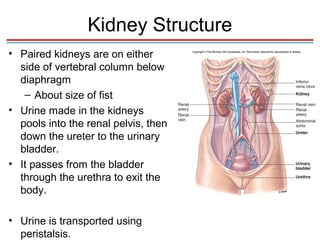
• Paired kidneys are on either
  side of vertebral column below
  diaphragm
   – About size of fist
• Urine made in the kidneys
  pools into the renal pelvis, then
  down the ureter to the urinary
  bladder.
• It passes from the bladder
  through the urethra to exit the
  body.

• Urine is transported using
  peristalsis.
Kidney Structure
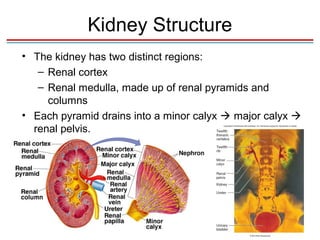
• The kidney has two distinct regions:
   – Renal cortex
   – Renal medulla, made up of renal pyramids and
     columns
• Each pyramid drains into a minor calyx  major calyx 
  renal pelvis.
Nephron


          17-9
Microscopic Kidney Structure
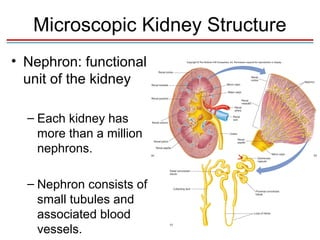
• Nephron: functional
  unit of the kidney

  – Each kidney has
    more than a million
    nephrons.

  – Nephron consists of
    small tubules and
    associated blood
    vessels.
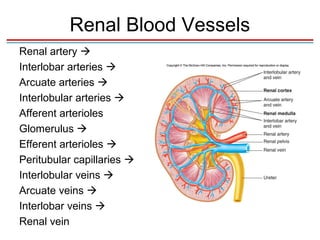
Renal Blood Vessels
Renal artery 
Interlobar arteries 
Arcuate arteries 
Interlobular arteries 
Afferent arterioles
Glomerulus 
Efferent arterioles 
Peritubular capillaries 
Interlobular veins 
Arcuate veins 
Interlobar veins 
Renal vein
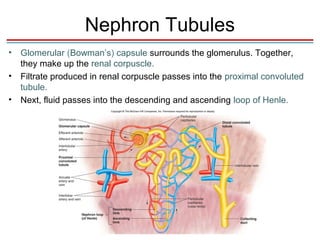
Nephron Tubules
•   Glomerular (Bowman’s) capsule surrounds the glomerulus. Together,
    they make up the renal corpuscle.
•   Filtrate produced in renal corpuscle passes into the proximal convoluted
    tubule.
•   Next, fluid passes into the descending and ascending loop of Henle.
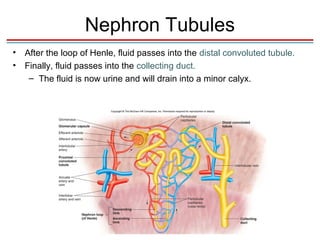
Nephron Tubules
•   After the loop of Henle, fluid passes into the distal convoluted tubule.
•   Finally, fluid passes into the collecting duct.
     – The fluid is now urine and will drain into a minor calyx.
Copyright © The McGraw-Hill Companies, Inc. Permission required for reproduction or display.


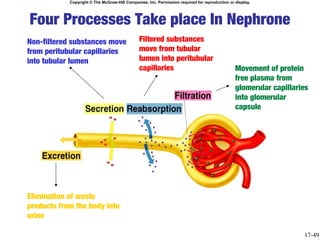
Four Processes Take place In Nephrone
Non-filtered substances move                   Filtered substances
from peritubular capillaries                   move from tubular
into tubular lumen                             lumen into peritubular
                                               capillaries                                      Movement of protein
                                                                                                free plasma from
                                                                                                glomerular capillaries
                                                                                                into glomerular
                                                                                                capsule


Elimination of waste
products from the body into
urine

                                                                                                                    17-49
II. Glomerular Filtration
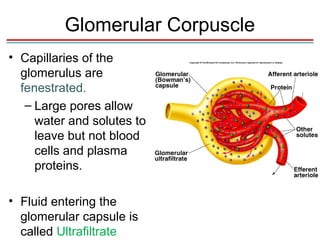
Glomerular Corpuscle
• Capillaries of the
  glomerulus are
  fenestrated.
   – Large pores allow
     water and solutes to
     leave but not blood
     cells and plasma
     proteins.

• Fluid entering the
  glomerular capsule is
  called Ultrafiltrate
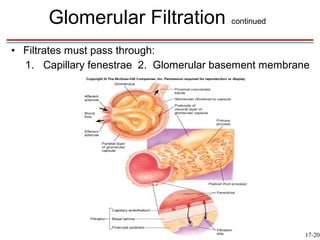
Glomerular Filtration continued
• Filtrates must pass through:
  1. Capillary fenestrae 2. Glomerular basement membrane


                                                       17-20
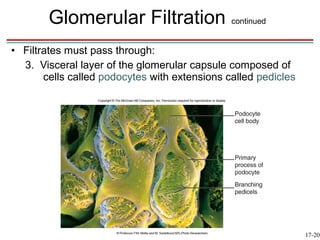
Glomerular Filtration continued
• Filtrates must pass through:
  3. Visceral layer of the glomerular capsule composed of
       cells called podocytes with extensions called pedicles


                                                                17-20
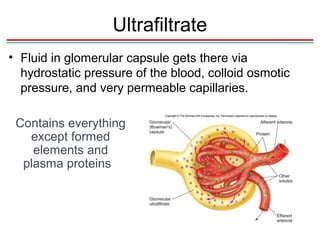
Ultrafiltrate
• Fluid in glomerular capsule gets there via
  hydrostatic pressure of the blood, colloid osmotic
  pressure, and very permeable capillaries.
 Contains everything
   except formed
    elements and
  plasma proteins
Filtration Rates
• Glomerular filtration rate (GFR): volume of
  filtrate produced by both kidneys each
  minute = 115−125 ml.

  – 180 ml/ day

  – Total blood volume filtered every 40 minutes

  – Most must be reabsorbed immediately
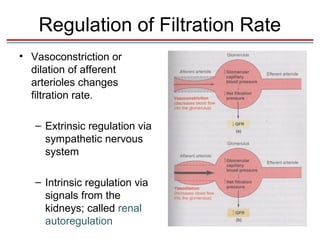
Regulation of Filtration Rate
• Vasoconstriction or
  dilation of afferent
  arterioles changes
  filtration rate.

   – Extrinsic regulation via
     sympathetic nervous
     system

   – Intrinsic regulation via
     signals from the
     kidneys; called renal
     autoregulation
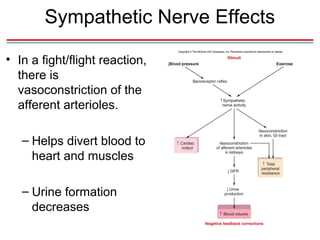
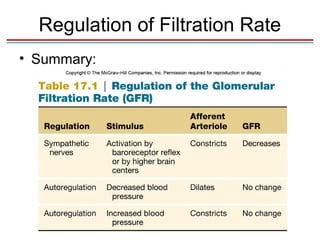
Sympathetic Nerve Effects

• In a fight/flight reaction,
  there is
  vasoconstriction of the
  afferent arterioles.
   – Helps divert blood to
     heart and muscles

   – Urine formation
     decreases
Renal Autoregulation

• GFR is maintained at a constant level even
  when blood pressure (BP) fluctuates
  greatly.
   – Afferent arterioles dilate if BP < 70.
   – Afferent arterioles constrict if BP >
     normal.

  Achieved via effects of locally produced
   chemicals on afferent arterioles
Regulation of Filtration Rate
• Summary:
III. Reabsorption of Salt and
           Water
Reabsorption
• 180 ml of water is filtered per day, but only
  1−2 ml is excreted as urine.
  – This will increase when well hydrated and
    decrease when dehydrated.
  – A minimum 400 ml must be excreted to rid
    the body of wastes = obligatory water loss.
  – 85% of reabsorption occurs in the proximal
    tubules and descending loop of Henle.This
    portion is unregulated.
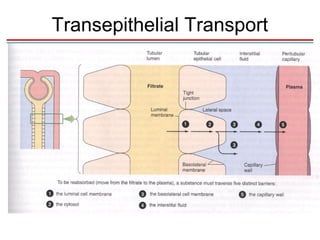
Transepithelial Transport
Active Transport
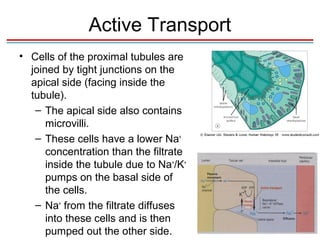
• Cells of the proximal tubules are
  joined by tight junctions on the
  apical side (facing inside the
  tubule).
   – The apical side also contains
      microvilli.
   – These cells have a lower Na+
      concentration than the filtrate
      inside the tubule due to Na+/K+
      pumps on the basal side of
      the cells.
   – Na+ from the filtrate diffuses
      into these cells and is then
      pumped out the other side.
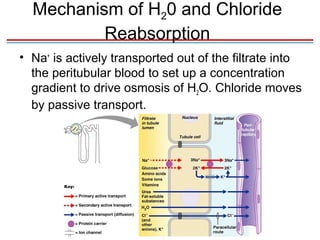
Mechanism of H20 and Chloride
          Reabsorption
• Na+ is actively transported out of the filtrate into
  the peritubular blood to set up a concentration
  gradient to drive osmosis of H2O. Chloride moves
  by passive transport.
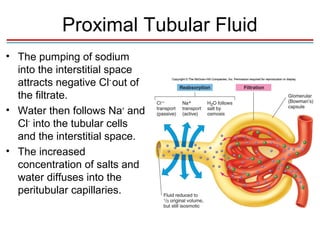
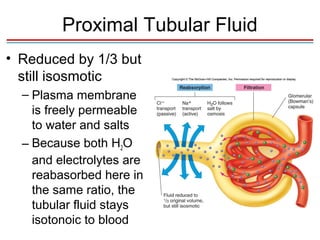
Proximal Tubular Fluid
• The pumping of sodium
  into the interstitial space
  attracts negative Cl− out of
  the filtrate.
• Water then follows Na+ and
  Cl− into the tubular cells
  and the interstitial space.
• The increased
  concentration of salts and
  water diffuses into the
  peritubular capillaries.
Proximal Tubular Fluid
• Reduced by 1/3 but
  still isosmotic
  – Plasma membrane
    is freely permeable
    to water and salts
  – Because both H2O
    and electrolytes are
    reabasorbed here in
    the same ratio, the
    tubular fluid stays
    isotonoic to blood
Significance of PCT Reabsorption

• ≈65% Na+, Cl-, & H20 is reabsorbed in PCT &
  returned to bloodstream
• An additional 20% is reabsorbed in descending
  loop of Henle
• Thus 85% of filtered H20 & salt are reabsorbed
  early in tubule
  – This is constant & independent of hydration levels
  – Energy cost is 6% of calories consumed at rest
  – The remaining 15% is reabsorbed variably,
    depending on level of hydration
                                                         17-35
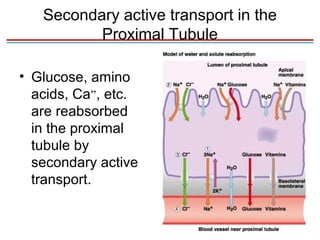
Secondary active transport in the
          Proximal Tubule

• Glucose, amino
  acids, Ca++, etc.
  are reabsorbed
  in the proximal
  tubule by
  secondary active
  transport.
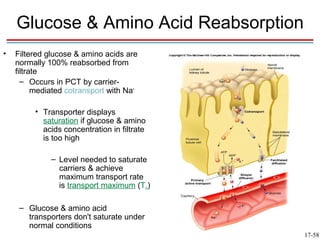
Glucose & Amino Acid Reabsorption
•   Filtered glucose & amino acids are
    normally 100% reabsorbed from
    filtrate
      – Occurs in PCT by carrier-
          mediated cotransport with Na+

         • Transporter displays
           saturation if glucose & amino
           acids concentration in filtrate
           is too high

              – Level needed to saturate
                carriers & achieve
                maximum transport rate
                is transport maximum (Tm)

     – Glucose & amino acid
       transporters don't saturate under
       normal conditions
                                             17-58
Glycosuria

• Is presence of glucose in urine
• Occurs when glucose > 180-200mg/100ml
  plasma
  (= renal plasma threshold)
  – Glucose is normally absent because plasma levels
    stay below this value
  – Hyperglycemia has to exceed renal plasma
    threshold
  – Diabetes mellitus occurs when hyperglycemia
    results in glycosuria

                                                   17-59
Renal Acid-Base Regulation
• Kidneys help regulate blood pH by excreting H +
  &/or reabsorbing HC03-
• Most H+ secretion occurs across walls of PCT in
  exchange for Na+ (Na+/H+ antiporter)
• Normal urine is slightly acidic (pH = 5-7)
  because kidneys reabsorb almost all HC0 3- &
  excrete H+


                                               17-73
Reabsorption of HCO3- in PCT

• Is indirect because apical membranes of PCT
  cells are impermeable to HCO3-


                                                17-74
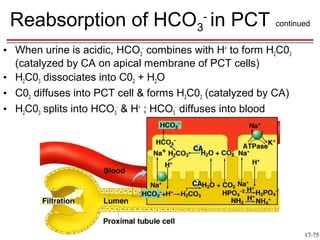
Reabsorption of HCO3- in PCT continued
• When urine is acidic, HCO3- combines with H+ to form H2C03
  (catalyzed by CA on apical membrane of PCT cells)
• H2C03 dissociates into C02 + H2O
• C02 diffuses into PCT cell & forms H2C03 (catalyzed by CA)
• H2C03 splits into HCO3- & H+ ; HCO3- diffuses into blood


                                                               17-75
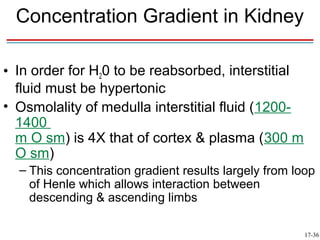
Concentration Gradient in Kidney

• In order for H20 to be reabsorbed, interstitial
  fluid must be hypertonic
• Osmolality of medulla interstitial fluid (1200-
  1400
  m O sm) is 4X that of cortex & plasma (300 m
  O sm)
  – This concentration gradient results largely from loop
    of Henle which allows interaction between
    descending & ascending limbs

                                                       17-36
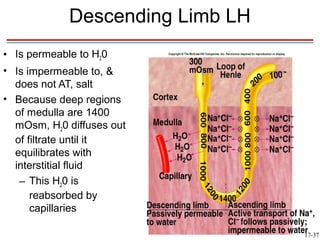
Descending Limb LH
• Is permeable to H20
• Is impermeable to, &
  does not AT, salt
• Because deep regions
  of medulla are 1400
  mOsm, H20 diffuses out
  of filtrate until it
  equilibrates with
  interstitial fluid
   – This H20 is
      reabsorbed by
      capillaries

                                  17-37
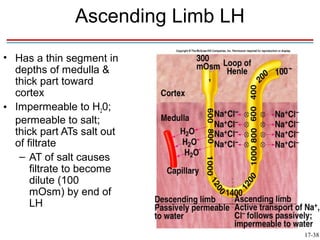
Ascending Limb LH
• Has a thin segment in
  depths of medulla &
  thick part toward
  cortex
• Impermeable to H20;
  permeable to salt;
  thick part ATs salt out
  of filtrate
   – AT of salt causes
      filtrate to become
      dilute (100
      mOsm) by end of
      LH

                                   17-38
Countercurrent Multiplier System

• Countercurrent flow & proximity allow descending & ascending
  limbs of LH to interact in way that causes osmolality to build in
  medulla
• Salt pumping in thick ascending part raises osmolality around
  descending limb, causing more H20 to diffuse out of filtrate
    – This raises osmolality of filtrate in descending limb which
      causes more concentrated filtrate to be delivered to
      ascending limb
    – As this concentrated filtrate is subjected to AT of salts, it
      causes even higher osmolality around descending limb
      (positive feedback)
    – Process repeats until equilibrium is reached when osmolality
      of medulla is 1400

                                                                17-41
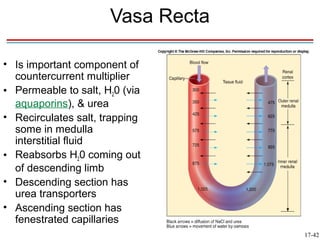
Vasa Recta

• Is important component of
  countercurrent multiplier
• Permeable to salt, H20 (via
  aquaporins), & urea
• Recirculates salt, trapping
  some in medulla
  interstitial fluid
• Reabsorbs H20 coming out
  of descending limb
• Descending section has
  urea transporters
• Ascending section has
  fenestrated capillaries
                                   17-42
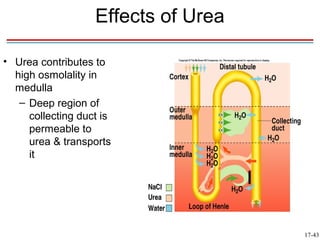
Effects of Urea

• Urea contributes to
  high osmolality in
  medulla
   – Deep region of
     collecting duct is
     permeable to
     urea & transports
     it


                                     17-43
17-44
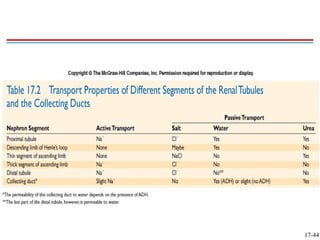
Collecting Duct (CD)

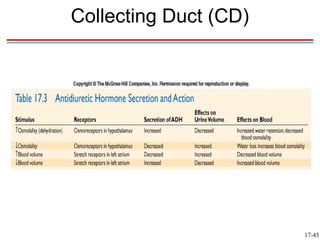
• Plays important role in water conservation
• Is impermeable to salt in medulla
• Permeability to H20 depends on levels of ADH


                                                 17-45
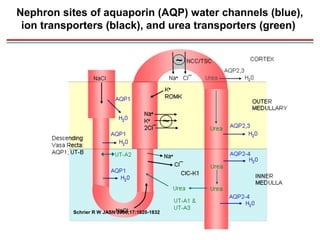
Nephron sites of aquaporin (AQP) water channels (blue),
 ion transporters (black), and urea transporters (green)


           Schrier R W JASN 2006;17:1820-1832
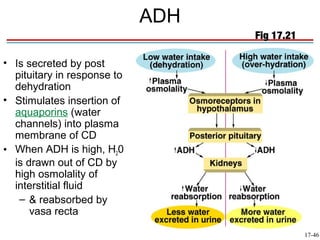
ADH
                                   Fig 17.21

• Is secreted by post
  pituitary in response to
  dehydration
• Stimulates insertion of
  aquaporins (water
  channels) into plasma
  membrane of CD
• When ADH is high, H20
  is drawn out of CD by
  high osmolality of
  interstitial fluid
   – & reabsorbed by
      vasa recta

                                               17-46
Collecting Duct (CD)


                       17-45
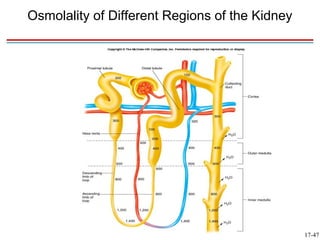
Osmolality of Different Regions of the Kidney


                                                17-47
anim0082-rm_kidney_func.rm
Hormonal Effects


                   17-60
Electrolyte Balance

• Kidneys regulate levels of Na+, K+, H+, HC03-, Cl-,
  & PO4-3 by matching excretion to ingestion

• Control of plasma Na+ is important in regulation
  of blood volume & pressure

• Control of plasma of K+ important in proper
  function of cardiac & skeletal muscles

                                                   17-61
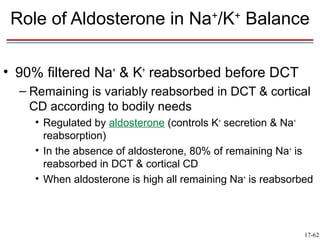
Role of Aldosterone in Na+/K+ Balance

• 90% filtered Na+ & K+ reabsorbed before DCT
  – Remaining is variably reabsorbed in DCT & cortical
    CD according to bodily needs
    • Regulated by aldosterone (controls K+ secretion & Na+
      reabsorption)
    • In the absence of aldosterone, 80% of remaining Na+ is
      reabsorbed in DCT & cortical CD
    • When aldosterone is high all remaining Na+ is reabsorbed


                                                            17-62
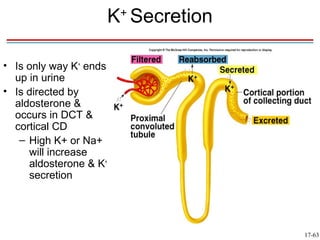
K+ Secretion

• Is only way K+ ends
  up in urine
• Is directed by
  aldosterone &
  occurs in DCT &
  cortical CD
   – High K+ or Na+
     will increase
     aldosterone & K+
     secretion


                                       17-63
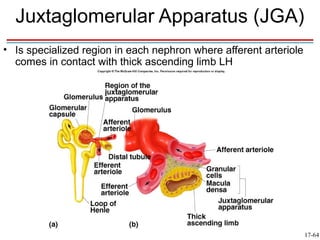
Juxtaglomerular Apparatus (JGA)
• Is specialized region in each nephron where afferent arteriole
  comes in contact with thick ascending limb LH


                                                                   17-64
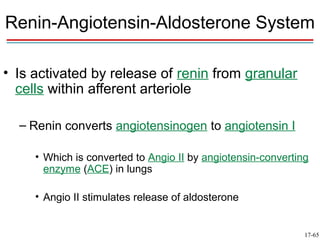
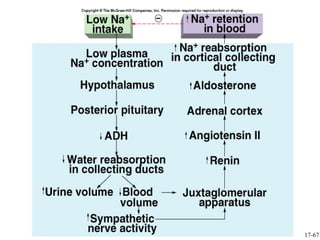
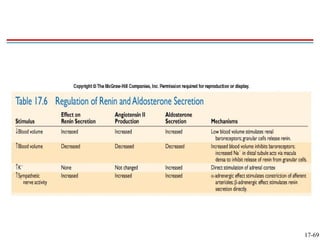
Renin-Angiotensin-Aldosterone System

• Is activated by release of renin from granular
  cells within afferent arteriole

  – Renin converts angiotensinogen to angiotensin I

     • Which is converted to Angio II by angiotensin-converting
       enzyme (ACE) in lungs

     • Angio II stimulates release of aldosterone


                                                              17-65
Regulation of Renin Secretion

• Inadequate intake of NaCl always causes
  decreased blood volume
  – Because lower osmolality inhibits ADH, causing
    less H2O reabsorption
  – Low blood volume & renal blood flow stimulate renin
    release
    • Via direct effects of BP on granular cells & by Symp
      activity initiated by arterial baroreceptor reflex (see Fig
      14.26)


                                                                    17-66
17-67
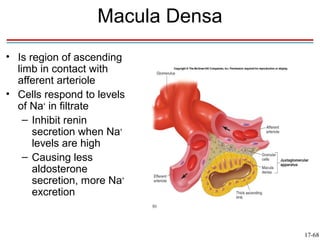
Macula Densa
• Is region of ascending
  limb in contact with
  afferent arteriole
• Cells respond to levels
  of Na+ in filtrate
    – Inhibit renin
      secretion when Na+
      levels are high
    – Causing less
      aldosterone
      secretion, more Na+
      excretion


                                  17-68
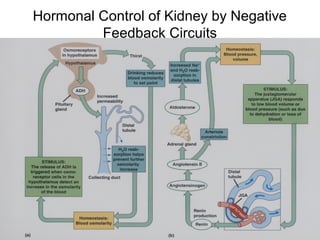
Hormonal Control of Kidney by Negative
         Feedback Circuits
17-69
Atrial Natriuretic Peptide (ANP)
• Is produced by atria due to stretching of walls
• Acts opposite to aldosterone
• Stimulates salt & H20 excretion
• Acts as an endogenous diuretic


                                                    17-70
Na , K , H , & HC03
  +   +   +           -

  Relationships


                          17-71
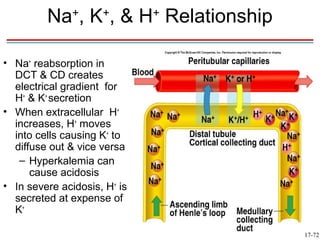
Na+, K+, & H+ Relationship

• Na+ reabsorption in
  DCT & CD creates
  electrical gradient for
  H+ & K+ secretion           Insert fig. 17.27
• When extracellular H+
  increases, H+ moves
  into cells causing K+ to
  diffuse out & vice versa
   – Hyperkalemia can
      cause acidosis
• In severe acidosis, H+ is
  secreted at expense of
  K+

                                                  17-72
Urinary Buffers
• Nephron cannot produce urine with pH < 4.5
• Excretes more H+ by buffering H+s with HPO4-2 or
  NH3 before excretion
• Phosphate enters tubule during filtration
• Ammonia produced in tubule by deaminating
  amino acids
• Buffering reactions
       – HPO4-2 + H+ → H2PO4-
       – NH3 + H+ → NH4+ (ammonium ion)


                                                17-76

Chapter 17 lecture-1

  • 1.
    Chapter 17 Physiology of the Kidneys Lecture PowerPoint Copyright © The McGraw-Hill Companies, Inc. Permission required for reproduction or display.
  • 2.
    Kidney Function • 1. Maintain proper water balance in the body. • 2. Regulate the concentrations of most ECF ions such as Na+, H+, K+, Cl-, HCO3-, Mg++, PO4--etc. • 3. Maintain the proper plasma volume and therefore helping to regulating blood pressure. • 4. Help maintain the proper acid-base balance of the body. • 5. Maintain the proper osmolality of body fluids. • 6. Excrete waste products of metabolism. • 7. Excrete many foreign compounds such as drugs, food additives etc. • 8. Secrete erythropoietin, the hormone that controls red blood cell production. • 9. Secrete renin, an enzyme which participates in regulation of Na+ levels and blood pressure. • 10. Convert vitamin D into its active form which helps us absorb calcium from our food. 17-3
  • 3.
    Overview of KidneyStructure 17-4
  • 4.
    Kidney Structure • Pairedkidneys are on either side of vertebral column below diaphragm – About size of fist • Urine made in the kidneys pools into the renal pelvis, then down the ureter to the urinary bladder. • It passes from the bladder through the urethra to exit the body. • Urine is transported using peristalsis.
  • 5.
    Kidney Structure • Thekidney has two distinct regions: – Renal cortex – Renal medulla, made up of renal pyramids and columns • Each pyramid drains into a minor calyx  major calyx  renal pelvis.
  • 6.
  • 7.
    Microscopic Kidney Structure •Nephron: functional unit of the kidney – Each kidney has more than a million nephrons. – Nephron consists of small tubules and associated blood vessels.
  • 8.
    Renal Blood Vessels Renalartery  Interlobar arteries  Arcuate arteries  Interlobular arteries  Afferent arterioles Glomerulus  Efferent arterioles  Peritubular capillaries  Interlobular veins  Arcuate veins  Interlobar veins  Renal vein
  • 9.
    Nephron Tubules • Glomerular (Bowman’s) capsule surrounds the glomerulus. Together, they make up the renal corpuscle. • Filtrate produced in renal corpuscle passes into the proximal convoluted tubule. • Next, fluid passes into the descending and ascending loop of Henle.
  • 10.
    Nephron Tubules • After the loop of Henle, fluid passes into the distal convoluted tubule. • Finally, fluid passes into the collecting duct. – The fluid is now urine and will drain into a minor calyx.
  • 11.
    Copyright © TheMcGraw-Hill Companies, Inc. Permission required for reproduction or display. Four Processes Take place In Nephrone Non-filtered substances move Filtered substances from peritubular capillaries move from tubular into tubular lumen lumen into peritubular capillaries Movement of protein free plasma from glomerular capillaries into glomerular capsule Elimination of waste products from the body into urine 17-49
  • 12.
  • 13.
    Glomerular Corpuscle • Capillariesof the glomerulus are fenestrated. – Large pores allow water and solutes to leave but not blood cells and plasma proteins. • Fluid entering the glomerular capsule is called Ultrafiltrate
  • 14.
    Glomerular Filtration continued •Filtrates must pass through: 1. Capillary fenestrae 2. Glomerular basement membrane 17-20
  • 15.
    Glomerular Filtration continued •Filtrates must pass through: 3. Visceral layer of the glomerular capsule composed of cells called podocytes with extensions called pedicles 17-20
  • 16.
    Ultrafiltrate • Fluid inglomerular capsule gets there via hydrostatic pressure of the blood, colloid osmotic pressure, and very permeable capillaries. Contains everything except formed elements and plasma proteins
  • 17.
    Filtration Rates • Glomerularfiltration rate (GFR): volume of filtrate produced by both kidneys each minute = 115−125 ml. – 180 ml/ day – Total blood volume filtered every 40 minutes – Most must be reabsorbed immediately
  • 18.
    Regulation of FiltrationRate • Vasoconstriction or dilation of afferent arterioles changes filtration rate. – Extrinsic regulation via sympathetic nervous system – Intrinsic regulation via signals from the kidneys; called renal autoregulation
  • 19.
    Sympathetic Nerve Effects •In a fight/flight reaction, there is vasoconstriction of the afferent arterioles. – Helps divert blood to heart and muscles – Urine formation decreases
  • 20.
    Renal Autoregulation • GFRis maintained at a constant level even when blood pressure (BP) fluctuates greatly. – Afferent arterioles dilate if BP < 70. – Afferent arterioles constrict if BP > normal. Achieved via effects of locally produced chemicals on afferent arterioles
  • 21.
    Regulation of FiltrationRate • Summary:
  • 22.
    III. Reabsorption ofSalt and Water
  • 23.
    Reabsorption • 180 mlof water is filtered per day, but only 1−2 ml is excreted as urine. – This will increase when well hydrated and decrease when dehydrated. – A minimum 400 ml must be excreted to rid the body of wastes = obligatory water loss. – 85% of reabsorption occurs in the proximal tubules and descending loop of Henle.This portion is unregulated.
  • 24.
  • 25.
    Active Transport • Cellsof the proximal tubules are joined by tight junctions on the apical side (facing inside the tubule). – The apical side also contains microvilli. – These cells have a lower Na+ concentration than the filtrate inside the tubule due to Na+/K+ pumps on the basal side of the cells. – Na+ from the filtrate diffuses into these cells and is then pumped out the other side.
  • 26.
    Mechanism of H20and Chloride Reabsorption • Na+ is actively transported out of the filtrate into the peritubular blood to set up a concentration gradient to drive osmosis of H2O. Chloride moves by passive transport.
  • 27.
    Proximal Tubular Fluid •The pumping of sodium into the interstitial space attracts negative Cl− out of the filtrate. • Water then follows Na+ and Cl− into the tubular cells and the interstitial space. • The increased concentration of salts and water diffuses into the peritubular capillaries.
  • 28.
    Proximal Tubular Fluid •Reduced by 1/3 but still isosmotic – Plasma membrane is freely permeable to water and salts – Because both H2O and electrolytes are reabasorbed here in the same ratio, the tubular fluid stays isotonoic to blood
  • 29.
    Significance of PCTReabsorption • ≈65% Na+, Cl-, & H20 is reabsorbed in PCT & returned to bloodstream • An additional 20% is reabsorbed in descending loop of Henle • Thus 85% of filtered H20 & salt are reabsorbed early in tubule – This is constant & independent of hydration levels – Energy cost is 6% of calories consumed at rest – The remaining 15% is reabsorbed variably, depending on level of hydration 17-35
  • 30.
    Secondary active transportin the Proximal Tubule • Glucose, amino acids, Ca++, etc. are reabsorbed in the proximal tubule by secondary active transport.
  • 31.
    Glucose & AminoAcid Reabsorption • Filtered glucose & amino acids are normally 100% reabsorbed from filtrate – Occurs in PCT by carrier- mediated cotransport with Na+ • Transporter displays saturation if glucose & amino acids concentration in filtrate is too high – Level needed to saturate carriers & achieve maximum transport rate is transport maximum (Tm) – Glucose & amino acid transporters don't saturate under normal conditions 17-58
  • 32.
    Glycosuria • Is presenceof glucose in urine • Occurs when glucose > 180-200mg/100ml plasma (= renal plasma threshold) – Glucose is normally absent because plasma levels stay below this value – Hyperglycemia has to exceed renal plasma threshold – Diabetes mellitus occurs when hyperglycemia results in glycosuria 17-59
  • 33.
    Renal Acid-Base Regulation •Kidneys help regulate blood pH by excreting H + &/or reabsorbing HC03- • Most H+ secretion occurs across walls of PCT in exchange for Na+ (Na+/H+ antiporter) • Normal urine is slightly acidic (pH = 5-7) because kidneys reabsorb almost all HC0 3- & excrete H+ 17-73
  • 34.
    Reabsorption of HCO3-in PCT • Is indirect because apical membranes of PCT cells are impermeable to HCO3- 17-74
  • 35.
    Reabsorption of HCO3-in PCT continued • When urine is acidic, HCO3- combines with H+ to form H2C03 (catalyzed by CA on apical membrane of PCT cells) • H2C03 dissociates into C02 + H2O • C02 diffuses into PCT cell & forms H2C03 (catalyzed by CA) • H2C03 splits into HCO3- & H+ ; HCO3- diffuses into blood 17-75
  • 36.
    Concentration Gradient inKidney • In order for H20 to be reabsorbed, interstitial fluid must be hypertonic • Osmolality of medulla interstitial fluid (1200- 1400 m O sm) is 4X that of cortex & plasma (300 m O sm) – This concentration gradient results largely from loop of Henle which allows interaction between descending & ascending limbs 17-36
  • 37.
    Descending Limb LH •Is permeable to H20 • Is impermeable to, & does not AT, salt • Because deep regions of medulla are 1400 mOsm, H20 diffuses out of filtrate until it equilibrates with interstitial fluid – This H20 is reabsorbed by capillaries 17-37
  • 38.
    Ascending Limb LH •Has a thin segment in depths of medulla & thick part toward cortex • Impermeable to H20; permeable to salt; thick part ATs salt out of filtrate – AT of salt causes filtrate to become dilute (100 mOsm) by end of LH 17-38
  • 39.
    Countercurrent Multiplier System •Countercurrent flow & proximity allow descending & ascending limbs of LH to interact in way that causes osmolality to build in medulla • Salt pumping in thick ascending part raises osmolality around descending limb, causing more H20 to diffuse out of filtrate – This raises osmolality of filtrate in descending limb which causes more concentrated filtrate to be delivered to ascending limb – As this concentrated filtrate is subjected to AT of salts, it causes even higher osmolality around descending limb (positive feedback) – Process repeats until equilibrium is reached when osmolality of medulla is 1400 17-41
  • 40.
    Vasa Recta • Isimportant component of countercurrent multiplier • Permeable to salt, H20 (via aquaporins), & urea • Recirculates salt, trapping some in medulla interstitial fluid • Reabsorbs H20 coming out of descending limb • Descending section has urea transporters • Ascending section has fenestrated capillaries 17-42
  • 41.
    Effects of Urea •Urea contributes to high osmolality in medulla – Deep region of collecting duct is permeable to urea & transports it 17-43
  • 42.
  • 43.
    Collecting Duct (CD) •Plays important role in water conservation • Is impermeable to salt in medulla • Permeability to H20 depends on levels of ADH 17-45
  • 44.
    Nephron sites ofaquaporin (AQP) water channels (blue), ion transporters (black), and urea transporters (green) Schrier R W JASN 2006;17:1820-1832
  • 45.
    ADH Fig 17.21 • Is secreted by post pituitary in response to dehydration • Stimulates insertion of aquaporins (water channels) into plasma membrane of CD • When ADH is high, H20 is drawn out of CD by high osmolality of interstitial fluid – & reabsorbed by vasa recta 17-46
  • 46.
  • 47.
    Osmolality of DifferentRegions of the Kidney 17-47
  • 48.
  • 49.
  • 50.
    Electrolyte Balance • Kidneysregulate levels of Na+, K+, H+, HC03-, Cl-, & PO4-3 by matching excretion to ingestion • Control of plasma Na+ is important in regulation of blood volume & pressure • Control of plasma of K+ important in proper function of cardiac & skeletal muscles 17-61
  • 51.
    Role of Aldosteronein Na+/K+ Balance • 90% filtered Na+ & K+ reabsorbed before DCT – Remaining is variably reabsorbed in DCT & cortical CD according to bodily needs • Regulated by aldosterone (controls K+ secretion & Na+ reabsorption) • In the absence of aldosterone, 80% of remaining Na+ is reabsorbed in DCT & cortical CD • When aldosterone is high all remaining Na+ is reabsorbed 17-62
  • 52.
    K+ Secretion • Isonly way K+ ends up in urine • Is directed by aldosterone & occurs in DCT & cortical CD – High K+ or Na+ will increase aldosterone & K+ secretion 17-63
  • 53.
    Juxtaglomerular Apparatus (JGA) •Is specialized region in each nephron where afferent arteriole comes in contact with thick ascending limb LH 17-64
  • 54.
    Renin-Angiotensin-Aldosterone System • Isactivated by release of renin from granular cells within afferent arteriole – Renin converts angiotensinogen to angiotensin I • Which is converted to Angio II by angiotensin-converting enzyme (ACE) in lungs • Angio II stimulates release of aldosterone 17-65
  • 55.
    Regulation of ReninSecretion • Inadequate intake of NaCl always causes decreased blood volume – Because lower osmolality inhibits ADH, causing less H2O reabsorption – Low blood volume & renal blood flow stimulate renin release • Via direct effects of BP on granular cells & by Symp activity initiated by arterial baroreceptor reflex (see Fig 14.26) 17-66
  • 56.
  • 57.
    Macula Densa • Isregion of ascending limb in contact with afferent arteriole • Cells respond to levels of Na+ in filtrate – Inhibit renin secretion when Na+ levels are high – Causing less aldosterone secretion, more Na+ excretion 17-68
  • 58.
    Hormonal Control ofKidney by Negative Feedback Circuits
  • 59.
  • 60.
    Atrial Natriuretic Peptide(ANP) • Is produced by atria due to stretching of walls • Acts opposite to aldosterone • Stimulates salt & H20 excretion • Acts as an endogenous diuretic 17-70
  • 61.
    Na , K, H , & HC03 + + + - Relationships 17-71
  • 62.
    Na+, K+, &H+ Relationship • Na+ reabsorption in DCT & CD creates electrical gradient for H+ & K+ secretion Insert fig. 17.27 • When extracellular H+ increases, H+ moves into cells causing K+ to diffuse out & vice versa – Hyperkalemia can cause acidosis • In severe acidosis, H+ is secreted at expense of K+ 17-72
  • 63.
    Urinary Buffers • Nephroncannot produce urine with pH < 4.5 • Excretes more H+ by buffering H+s with HPO4-2 or NH3 before excretion • Phosphate enters tubule during filtration • Ammonia produced in tubule by deaminating amino acids • Buffering reactions – HPO4-2 + H+ → H2PO4- – NH3 + H+ → NH4+ (ammonium ion) 17-76

Editor's Notes

  • #45 Nephron sites of aquaporin (AQP) water channels (blue), ion transporters (black), and urea transporters (green). ROMK, renal outer medullary potassium channel; UT, urea transporter.