Exchange Rate Determination
By: Hesniati, SE., MM.
4Chapter
Chapter Objectives
• To explain how exchange rate movements are
measured;
• To explain how the equilibrium exchange rate is
determined; and
• To examine the factors that affect the equilibrium
exchange rate.
Measuring
Exchange Rate Movements
• An exchange rate measures the value of one
currency in units of another currency.
• When a currency declines in value, it is said to
depreciate. When it increases in value, it is said to
appreciate.
• On the days when some currencies appreciate
while others depreciate against the dollar, the
dollar is said to be “mixed in trading.”
Measuring
Exchange Rate Movements
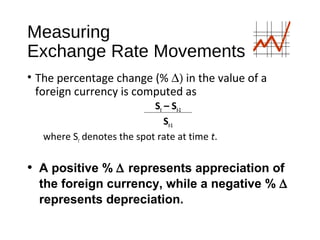
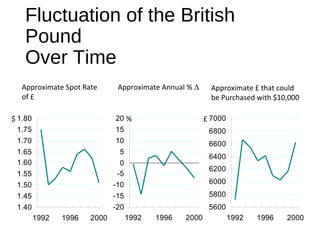
• The percentage change (% ∆) in the value of a
foreign currency is computed as
St – St-1
St-1
where St denotes the spot rate at time t.
• A positive % ∆ represents appreciation of
the foreign currency, while a negative % ∆
represents depreciation.
1.40
1.45
1.50
1.55
1.60
1.65
1.70
1.75
1.80
1992 1996 2000
Approximate Spot Rate
of £
$
5600
5800
6000
6200
6400
6600
6800
7000
1992 1996 2000
Approximate £ that could
be Purchased with $10,000
£
-20
-15
-10
-5
0
5
10
15
20
1992 1996 2000
Approximate Annual % ∆
%
Fluctuation of the British
Pound
Over Time
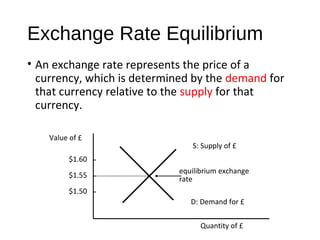
Value of £
Quantity of £
D: Demand for £
$1.55
$1.50
$1.60
S: Supply of £
equilibrium exchange
rate
Exchange Rate Equilibrium
• An exchange rate represents the price of a
currency, which is determined by the demand for
that currency relative to the supply for that
currency.
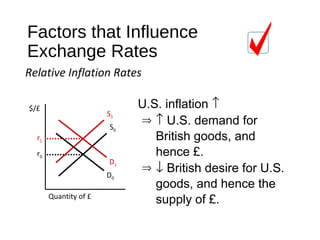
$/£
Quantity of £
S0
D0
r0
U.S. inflation ↑
⇒ ↑ U.S. demand for
British goods, and
hence £.
D1
r1
S1
Factors that Influence
Exchange Rates
Relative Inflation Rates
⇒ ↓ British desire for U.S.
goods, and hence the
supply of £.
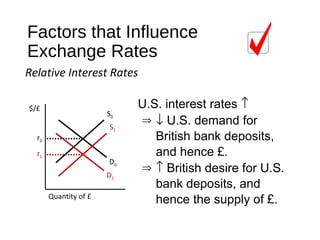
$/£
Quantity of £
r0
S0
D0
S1
D1
r1
U.S. interest rates ↑
⇒ ↓ U.S. demand for
British bank deposits,
and hence £.
Factors that Influence
Exchange Rates
Relative Interest Rates
⇒ ↑ British desire for U.S.
bank deposits, and
hence the supply of £.
Factors that Influence
Exchange Rates
Relative Interest Rates
• It is thus useful to consider real interest
rates, which adjust the nominal interest
rates for inflation.
• A relatively high interest rate may actually
reflect expectations of relatively high
inflation, which discourages foreign
investment.
Factors that Influence
Exchange Rates
Relative Interest Rates
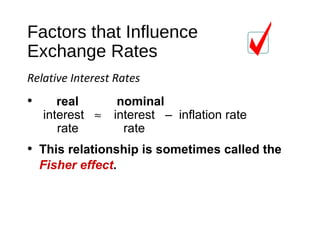
• This relationship is sometimes called the
Fisher effect.
• real nominal
interest ≈ interest – inflation rate
rate rate
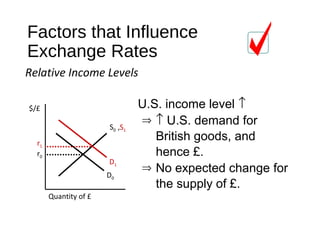
$/£
Quantity of £
S0
D0
r0
U.S. income level ↑
⇒ ↑ U.S. demand for
British goods, and
hence £.
D1
r1
Factors that Influence
Exchange Rates
Relative Income Levels
⇒ No expected change for
the supply of £.
,S1
Factors that Influence
Exchange Rates
Government Controls
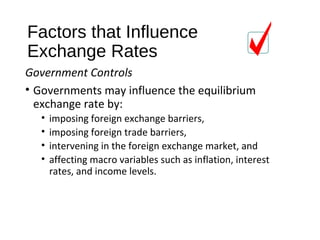
• Governments may influence the equilibrium
exchange rate by:
• imposing foreign exchange barriers,
• imposing foreign trade barriers,
• intervening in the foreign exchange market, and
• affecting macro variables such as inflation, interest
rates, and income levels.
Factors that Influence
Exchange Rates
Expectations
• Foreign exchange markets react to any news that
may have a future effect.
• Institutional investors often take currency positions
based on anticipated interest rate movements in
various countries.
• Because of speculative transactions, foreign
exchange rates can be very volatile.
Factors that Influence
Exchange Rates
Expectations
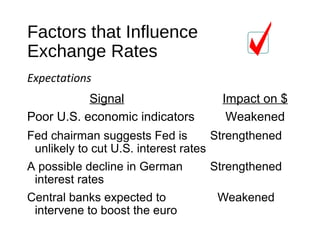
Fed chairman suggests Fed is Strengthened
unlikely to cut U.S. interest rates
A possible decline in German Strengthened
interest rates
Central banks expected to Weakened
intervene to boost the euro
Signal Impact on $
Poor U.S. economic indicators Weakened
Factors that Influence
Exchange Rates
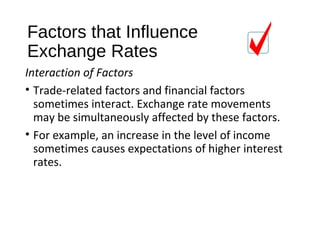
Interaction of Factors
• Trade-related factors and financial factors
sometimes interact. Exchange rate movements
may be simultaneously affected by these factors.
• For example, an increase in the level of income
sometimes causes expectations of higher interest
rates.
Factors that Influence
Exchange Rates
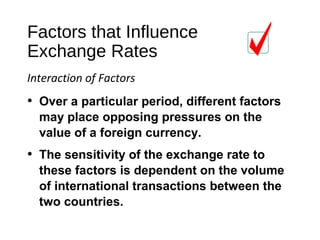
Interaction of Factors
• The sensitivity of the exchange rate to
these factors is dependent on the volume
of international transactions between the
two countries.
• Over a particular period, different factors
may place opposing pressures on the
value of a foreign currency.
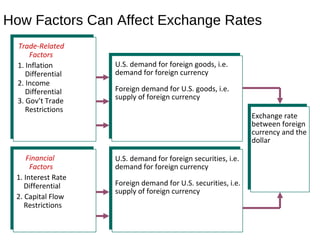
Trade-Related
Factors
1. Inflation
Differential
2. Income
Differential
3. Gov’t Trade
Restrictions
Financial
Factors
1. Interest Rate
Differential
2. Capital Flow
Restrictions
How Factors Can Affect Exchange Rates
U.S. demand for foreign goods, i.e.
demand for foreign currency
Foreign demand for U.S. goods, i.e.
supply of foreign currency
U.S. demand for foreign securities, i.e.
demand for foreign currency
Foreign demand for U.S. securities, i.e.
supply of foreign currency
Exchange rate
between foreign
currency and the
dollar
Factors that Influence
Exchange Rates
How Factors Have Influenced Exchange Rates
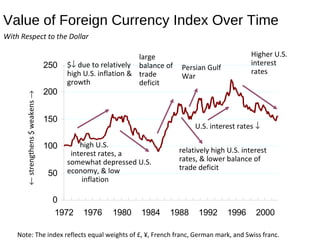
• Because the dollar’s value changes by different
magnitudes relative to each foreign currency,
analysts often measure the dollar’s strength with an
index.
• The weight assigned to each currency is determined
by its relative importance in international trade
and/or finance.
With Respect to the Dollar
Value of Foreign Currency Index Over Time
0
50
100
150
200
250
1972 1976 1980 1984 1988 1992 1996 2000
←strengthens$weakens→
Note: The index reflects equal weights of £, ¥, French franc, German mark, and Swiss franc.
$↓ due to relatively
high U.S. inflation &
growth
high U.S.
interest rates, a
somewhat depressed U.S.
economy, & low
inflation
large
balance of
trade
deficit
relatively high U.S. interest
rates, & lower balance of
trade deficit
Persian Gulf
War
U.S. interest rates ↓
Higher U.S.
interest
rates
Exchange at
$0.52/NZ$
4. Holds $20,912,320
2. Holds NZ$40
million
Exchange at
$0.50/NZ$
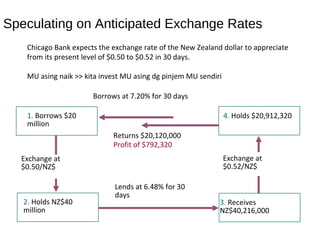
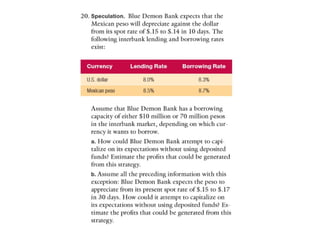
Speculating on Anticipated Exchange Rates
Chicago Bank expects the exchange rate of the New Zealand dollar to appreciate
from its present level of $0.50 to $0.52 in 30 days.
MU asing naik >> kita invest MU asing dg pinjem MU sendiri
1. Borrows $20
million
Borrows at 7.20% for 30 days
Lends at 6.48% for 30
days
3. Receives
NZ$40,216,000
Returns $20,120,000
Profit of $792,320
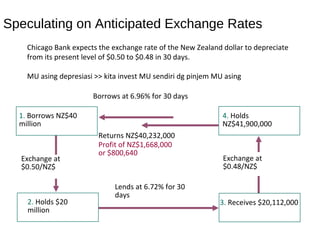
Speculating on Anticipated Exchange Rates
Chicago Bank expects the exchange rate of the New Zealand dollar to depreciate
from its present level of $0.50 to $0.48 in 30 days.
MU asing depresiasi >> kita invest MU sendiri dg pinjem MU asing
Exchange at
$0.48/NZ$
4. Holds
NZ$41,900,000
2. Holds $20
million
Exchange at
$0.50/NZ$
1. Borrows NZ$40
million
Borrows at 6.96% for 30 days
Lends at 6.72% for 30
days
3. Receives $20,112,000
Returns NZ$40,232,000
Profit of NZ$1,668,000
or $800,640
Impact of Exchange Rates on an MNC’s Value
( ) ( )[ ]
( )∑
∑














+
×
=
n
t
t
m
j
tjtj
k1=
1
,,
1
ERECFE
=Value
E (CFj,t ) = expected cash flows in currency j to be
received by the U.S. parent at the end of period t
E (ERj,t ) = expected exchange rate at which
currency j can be converted to dollars at the end of
period t
Inflation Rates, Interest Rates,
Income Levels, Government Controls,
Expectations
Chapter Review
• Measuring Exchange Rate Movements
• Exchange Rate Equilibrium
• Demand for a Currency
• Supply of a Currency for Sale
• Equilibrium
Chapter Review
• Factors that Influence Exchange Rates
• Relative Inflation Rates
• Relative Interest Rates
• Relative Income Levels
• Government Controls
• Expectations
• Interaction of Factors
• How Factors Have Influenced Exchange Rates
Chapter Review
• Speculating on Anticipated Exchange Rates
• How Exchange Rates Affect an MNC’s Value

Exchange Rate Determination

  • 1.
    Exchange Rate Determination By:Hesniati, SE., MM. 4Chapter
  • 2.
    Chapter Objectives • Toexplain how exchange rate movements are measured; • To explain how the equilibrium exchange rate is determined; and • To examine the factors that affect the equilibrium exchange rate.
  • 3.
    Measuring Exchange Rate Movements •An exchange rate measures the value of one currency in units of another currency. • When a currency declines in value, it is said to depreciate. When it increases in value, it is said to appreciate. • On the days when some currencies appreciate while others depreciate against the dollar, the dollar is said to be “mixed in trading.”
  • 4.
    Measuring Exchange Rate Movements •The percentage change (% ∆) in the value of a foreign currency is computed as St – St-1 St-1 where St denotes the spot rate at time t. • A positive % ∆ represents appreciation of the foreign currency, while a negative % ∆ represents depreciation.
  • 5.
    1.40 1.45 1.50 1.55 1.60 1.65 1.70 1.75 1.80 1992 1996 2000 ApproximateSpot Rate of £ $ 5600 5800 6000 6200 6400 6600 6800 7000 1992 1996 2000 Approximate £ that could be Purchased with $10,000 £ -20 -15 -10 -5 0 5 10 15 20 1992 1996 2000 Approximate Annual % ∆ % Fluctuation of the British Pound Over Time
  • 6.
    Value of £ Quantityof £ D: Demand for £ $1.55 $1.50 $1.60 S: Supply of £ equilibrium exchange rate Exchange Rate Equilibrium • An exchange rate represents the price of a currency, which is determined by the demand for that currency relative to the supply for that currency.
  • 7.
    $/£ Quantity of £ S0 D0 r0 U.S.inflation ↑ ⇒ ↑ U.S. demand for British goods, and hence £. D1 r1 S1 Factors that Influence Exchange Rates Relative Inflation Rates ⇒ ↓ British desire for U.S. goods, and hence the supply of £.
  • 8.
    $/£ Quantity of £ r0 S0 D0 S1 D1 r1 U.S.interest rates ↑ ⇒ ↓ U.S. demand for British bank deposits, and hence £. Factors that Influence Exchange Rates Relative Interest Rates ⇒ ↑ British desire for U.S. bank deposits, and hence the supply of £.
  • 9.
    Factors that Influence ExchangeRates Relative Interest Rates • It is thus useful to consider real interest rates, which adjust the nominal interest rates for inflation. • A relatively high interest rate may actually reflect expectations of relatively high inflation, which discourages foreign investment.
  • 10.
    Factors that Influence ExchangeRates Relative Interest Rates • This relationship is sometimes called the Fisher effect. • real nominal interest ≈ interest – inflation rate rate rate
  • 11.
    $/£ Quantity of £ S0 D0 r0 U.S.income level ↑ ⇒ ↑ U.S. demand for British goods, and hence £. D1 r1 Factors that Influence Exchange Rates Relative Income Levels ⇒ No expected change for the supply of £. ,S1
  • 12.
    Factors that Influence ExchangeRates Government Controls • Governments may influence the equilibrium exchange rate by: • imposing foreign exchange barriers, • imposing foreign trade barriers, • intervening in the foreign exchange market, and • affecting macro variables such as inflation, interest rates, and income levels.
  • 13.
    Factors that Influence ExchangeRates Expectations • Foreign exchange markets react to any news that may have a future effect. • Institutional investors often take currency positions based on anticipated interest rate movements in various countries. • Because of speculative transactions, foreign exchange rates can be very volatile.
  • 14.
    Factors that Influence ExchangeRates Expectations Fed chairman suggests Fed is Strengthened unlikely to cut U.S. interest rates A possible decline in German Strengthened interest rates Central banks expected to Weakened intervene to boost the euro Signal Impact on $ Poor U.S. economic indicators Weakened
  • 15.
    Factors that Influence ExchangeRates Interaction of Factors • Trade-related factors and financial factors sometimes interact. Exchange rate movements may be simultaneously affected by these factors. • For example, an increase in the level of income sometimes causes expectations of higher interest rates.
  • 16.
    Factors that Influence ExchangeRates Interaction of Factors • The sensitivity of the exchange rate to these factors is dependent on the volume of international transactions between the two countries. • Over a particular period, different factors may place opposing pressures on the value of a foreign currency.
  • 17.
    Trade-Related Factors 1. Inflation Differential 2. Income Differential 3.Gov’t Trade Restrictions Financial Factors 1. Interest Rate Differential 2. Capital Flow Restrictions How Factors Can Affect Exchange Rates U.S. demand for foreign goods, i.e. demand for foreign currency Foreign demand for U.S. goods, i.e. supply of foreign currency U.S. demand for foreign securities, i.e. demand for foreign currency Foreign demand for U.S. securities, i.e. supply of foreign currency Exchange rate between foreign currency and the dollar
  • 18.
    Factors that Influence ExchangeRates How Factors Have Influenced Exchange Rates • Because the dollar’s value changes by different magnitudes relative to each foreign currency, analysts often measure the dollar’s strength with an index. • The weight assigned to each currency is determined by its relative importance in international trade and/or finance.
  • 19.
    With Respect tothe Dollar Value of Foreign Currency Index Over Time 0 50 100 150 200 250 1972 1976 1980 1984 1988 1992 1996 2000 ←strengthens$weakens→ Note: The index reflects equal weights of £, ¥, French franc, German mark, and Swiss franc. $↓ due to relatively high U.S. inflation & growth high U.S. interest rates, a somewhat depressed U.S. economy, & low inflation large balance of trade deficit relatively high U.S. interest rates, & lower balance of trade deficit Persian Gulf War U.S. interest rates ↓ Higher U.S. interest rates
  • 20.
    Exchange at $0.52/NZ$ 4. Holds$20,912,320 2. Holds NZ$40 million Exchange at $0.50/NZ$ Speculating on Anticipated Exchange Rates Chicago Bank expects the exchange rate of the New Zealand dollar to appreciate from its present level of $0.50 to $0.52 in 30 days. MU asing naik >> kita invest MU asing dg pinjem MU sendiri 1. Borrows $20 million Borrows at 7.20% for 30 days Lends at 6.48% for 30 days 3. Receives NZ$40,216,000 Returns $20,120,000 Profit of $792,320
  • 21.
    Speculating on AnticipatedExchange Rates Chicago Bank expects the exchange rate of the New Zealand dollar to depreciate from its present level of $0.50 to $0.48 in 30 days. MU asing depresiasi >> kita invest MU sendiri dg pinjem MU asing Exchange at $0.48/NZ$ 4. Holds NZ$41,900,000 2. Holds $20 million Exchange at $0.50/NZ$ 1. Borrows NZ$40 million Borrows at 6.96% for 30 days Lends at 6.72% for 30 days 3. Receives $20,112,000 Returns NZ$40,232,000 Profit of NZ$1,668,000 or $800,640
  • 22.
    Impact of ExchangeRates on an MNC’s Value ( ) ( )[ ] ( )∑ ∑               + × = n t t m j tjtj k1= 1 ,, 1 ERECFE =Value E (CFj,t ) = expected cash flows in currency j to be received by the U.S. parent at the end of period t E (ERj,t ) = expected exchange rate at which currency j can be converted to dollars at the end of period t Inflation Rates, Interest Rates, Income Levels, Government Controls, Expectations
  • 24.
    Chapter Review • MeasuringExchange Rate Movements • Exchange Rate Equilibrium • Demand for a Currency • Supply of a Currency for Sale • Equilibrium
  • 25.
    Chapter Review • Factorsthat Influence Exchange Rates • Relative Inflation Rates • Relative Interest Rates • Relative Income Levels • Government Controls • Expectations • Interaction of Factors • How Factors Have Influenced Exchange Rates
  • 26.
    Chapter Review • Speculatingon Anticipated Exchange Rates • How Exchange Rates Affect an MNC’s Value