JAIKE A. PASCUA
SHS-Teacher
PRACTICAL RESEARCH 1
PRAYER
CHECKING OF ATTENDANCE
CLASSROOM NORMS
CHECKING OF ASSIGNMENTS
ENERGIZER
REVIEW
LESSON OBJECTIVES
MOTIVATION
Activity 1:
• Group into three
• Within 5 minutes, draw a picture of something that you
want to invent that will be of great help in your house or
community.
• Choose a reporter to explain your drawing.
Analysis
• What are your inventions?
• What are the essence of your inventions are made
for?
• Does your inventions is important?
• What will you do to improve your inventions?
Nature of Inquiry and Research
Presentation / Activity
Activity 2:
• Group into three
• Within 5 minutes, share your ideas, experiences and
knowledge about research and explains the
importance of research in daily life.
• Present the importance of research in daily life
in your own innovative and creative way.
• Each group is given two minutes to present..
Discussion / Analysis
• How did you find the activity?
• What are the difficulties that you encountered during the
activity?
• What enabled you to accomplish the task?
• How do research affect our time or society? (localize
research effect)
• Why are we doing research?
Values Integration
• Having research in our daily life, it will develop what
value?
Developmental Activity / Abstraction
Inquiry - is a learning process that motivates
you to obtain knowledge or information
about people, things,places, or events. You
do this by investigating or asking questions
about something you are inquisitive about.
It requires to collect data, meanings, facts
and information about the object of your
inquiry, examine such data carefully.
In your analysis, you execute varied thinking strategies
that range from lower-order thinking to higher-order
thinking skills such as inferential, critical, integrative, and
creative thinking. Engaging yourself in many ways of
thinking, you come to conclude that inquiry is an active
learning process. (Baraceros 2016)
Inquiry
Research is a process of executing various mental acts for
discovering and examining facts and information to
the accuracy and truthfulness of your claims and
conclusions about the topic of your research. Research
requires you to inquire or investigate about your chosen
research topic by asking questions that will make you
engage yourself in top-level thinking strategies of
interpreting, analyzing, synthesizing, criticizing,
appreciating, or creating to enable you to discover truths
about many things you tend to wonder about the topic
your research work. (Litchman 2013; Baraceros 2016)
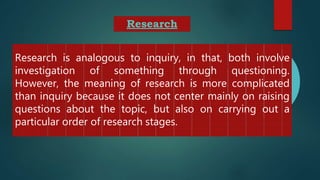
Research is analogous to inquiry, in that, both involve
investigation of something through questioning.
However, the meaning of research is more complicated
than inquiry because it does not center mainly on raising
questions about the topic, but also on carrying out a
particular order of research stages.
Research
Importance of Research Studies: Research
studies these days are gaining an
unprecedented focus and attention.
researchable area in any academic discipline
is an area that has an ample scope to be
explored. Research takes place within most of
the professions of life. What is the
importance of research in practical life to
understand?
Importance of Research Studies
Research is a thinking way under which researcher examines
the various aspects of daily work critically. It helps in
understanding and formulation of guiding principles that
govern a particular procedure. Apart from that it also helps in
developing and testing new theories that are contributing to
the advancement of your practical life works within a
profession.
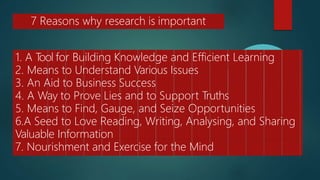
7 Reasons why research is important
1. A T
ool for Building Knowledge and Efficient Learning
2. Means to Understand Various Issues
3. An Aid to Business Success
4. A Way to Prove Lies and to Support Truths
5. Means to Find, Gauge, and Seize Opportunities
6.A Seed to Love Reading, Writing, Analysing, and Sharing
Valuable Information
7. Nourishment and Exercise for the Mind
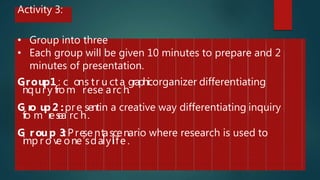
Activity 3:
• Group into three
• Each group will be given 10 minutes to prepare and 2
minutes of presentation.
G
i
n
r
q
o
u
u
i
r
p
y
1
fr
:
o
c
m
on
r
s
e
t
s
r
e
u
a
c
r
t
c
a
h.
graphicorganizer differentiating
G
f
r
o
r
o
m
u
p
r
e
2
s
e
:
a
p
r
r
c
e
h
s
.
entin a creative way differentiating inquiry
G
i
m
r
p
o
r
u
o
p
v
e
3
:
o
P
n
r
e
e
’
s
s
e
d
n
a
t
i
l
a
y
s
l
i
c
f
e
e
n
.
ario where research is used to
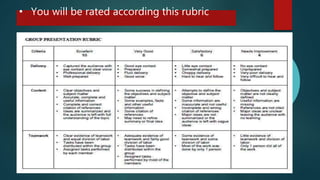
• You will be rated according this rubric
Generalization / Application
• Group into three
• Each group will be given 5 minutes to prepare and 2
minutes of presentation.
Group 1: what is inquiry and research?
Grou
I
p
le
2
a
:
r
H
n
o
th
w
a
i
t
m
re
p
s
o
e
r
a
ta
rc
n
h
t
i
i
n
sr
d
e
a
s
i
e
ly
ar
l
c
if
h
e…
inour daily life?
I realized that research in daily life…
Based from the realization, I will…
Group 3: Based on your realization about importance of
research, Design a research that would help your
community.
Generalization / Application
Quote of the day!
Evaluation
Directions: Identify the following items whether true or
false. Write the letter of the correct answer in your 1/2
sheet of paper. Answer directly.
acts
1. Research is the process of executing various mental
for discovering and examining facts and information to
prove the accuracy and truthfulness of your claims and
conclusions about the topic.
a. True False
Evaluation
2. Inquiry is a learning process that motivates you to
obtain knowledge or information about people, things,
places, or events.
a. True b. False
3. Research develops appropriate treatments to
improve individual’s quality of life.
a. True False
4. Research shapes peoples understanding of the world
around them.
a. True b. False
5. Inquiry is a systematic way of investigation and study
of materials and sources to establish facts and reach new
conclusions.
a. True b. False
II.Identify the characteristics of Research.Write the letter only.
A.EMPIRICAL B.LOGICAL C.CYCLICAL D.ANALYTICAL
E.METHODICAL F.CRITICAL G.REPLICABILITY
6.Research is based on direct experience or observation by the researcher.
7.Research is based on valid procedures and principles.
8.Research is a _______process because it starts with a problem and ends
with a problem.
9.Research utilizes proven _______procedures in gathering the data,
whether historical, descriptive, and experimental and case study.
10.Research exhibits careful and precise judgment.
11.Research is conducted in a _______manner without bias using
systematic method and procedures.
12.The research design and procedures are replicated or repeated to enable
the researcher to arrive at valid and conclusive results.
13-18.ENUMERATE THE PROCESSES
INVOLVED IN RESEARCH
19-33.Ethical codes and policies in
Research.
34-35.Differentiate inquiry vs.research.
36-38.Example of Research
39-40.Example of Inquiry
Key Answers
A 1. True
A 2. True
A 3. True
A. 4. True
B. 5. False
Remedial / Enrichment
If you are to make a research within our school or
community, what would be your research about, and how it
would benefit the community or the school?
Assignment
Research on the question below, write it on your notebook:
o What are the characteristics, processes, and ethics of
research?
The End
Thank you!
Keep phones
and other
devices on
SILENT MODE
during sessions.
Keep an open
mind and listen
constructively.
Everyone’s
input and
questions
should be
equally valued.
Respect the
person
talking; don’t
take part in
side
conversation
s. Listen &
ask
meaningful
questions.
Discussions,
questions, and
critiques will
focus on ideas
and issues, not
on people.
Encourage
others,
respect
differences,
and work
together.
CLASSROOM NORMS
Objectives:
At the end of the session, students shall be able to:
a. differentiate inquiry from research;
b. appreciate the importance of research in daily life;
c. state the importance of research in daily life.

Introduction PR1 lesson.pptx

  • 1.
  • 2.
    PRAYER CHECKING OF ATTENDANCE CLASSROOMNORMS CHECKING OF ASSIGNMENTS ENERGIZER REVIEW LESSON OBJECTIVES
  • 3.
    MOTIVATION Activity 1: • Groupinto three • Within 5 minutes, draw a picture of something that you want to invent that will be of great help in your house or community. • Choose a reporter to explain your drawing.
  • 4.
    Analysis • What areyour inventions? • What are the essence of your inventions are made for? • Does your inventions is important? • What will you do to improve your inventions?
  • 5.
    Nature of Inquiryand Research
  • 6.
    Presentation / Activity Activity2: • Group into three • Within 5 minutes, share your ideas, experiences and knowledge about research and explains the importance of research in daily life. • Present the importance of research in daily life in your own innovative and creative way. • Each group is given two minutes to present..
  • 7.
    Discussion / Analysis •How did you find the activity? • What are the difficulties that you encountered during the activity? • What enabled you to accomplish the task? • How do research affect our time or society? (localize research effect) • Why are we doing research?
  • 8.
    Values Integration • Havingresearch in our daily life, it will develop what value?
  • 9.
    Developmental Activity /Abstraction Inquiry - is a learning process that motivates you to obtain knowledge or information about people, things,places, or events. You do this by investigating or asking questions about something you are inquisitive about. It requires to collect data, meanings, facts and information about the object of your inquiry, examine such data carefully.
  • 10.
    In your analysis,you execute varied thinking strategies that range from lower-order thinking to higher-order thinking skills such as inferential, critical, integrative, and creative thinking. Engaging yourself in many ways of thinking, you come to conclude that inquiry is an active learning process. (Baraceros 2016) Inquiry
  • 11.
    Research is aprocess of executing various mental acts for discovering and examining facts and information to the accuracy and truthfulness of your claims and conclusions about the topic of your research. Research requires you to inquire or investigate about your chosen research topic by asking questions that will make you engage yourself in top-level thinking strategies of interpreting, analyzing, synthesizing, criticizing, appreciating, or creating to enable you to discover truths about many things you tend to wonder about the topic your research work. (Litchman 2013; Baraceros 2016)
  • 12.
    Research is analogousto inquiry, in that, both involve investigation of something through questioning. However, the meaning of research is more complicated than inquiry because it does not center mainly on raising questions about the topic, but also on carrying out a particular order of research stages. Research
  • 13.
    Importance of ResearchStudies: Research studies these days are gaining an unprecedented focus and attention. researchable area in any academic discipline is an area that has an ample scope to be explored. Research takes place within most of the professions of life. What is the importance of research in practical life to understand?
  • 14.
    Importance of ResearchStudies Research is a thinking way under which researcher examines the various aspects of daily work critically. It helps in understanding and formulation of guiding principles that govern a particular procedure. Apart from that it also helps in developing and testing new theories that are contributing to the advancement of your practical life works within a profession.
  • 15.
    7 Reasons whyresearch is important 1. A T ool for Building Knowledge and Efficient Learning 2. Means to Understand Various Issues 3. An Aid to Business Success 4. A Way to Prove Lies and to Support Truths 5. Means to Find, Gauge, and Seize Opportunities 6.A Seed to Love Reading, Writing, Analysing, and Sharing Valuable Information 7. Nourishment and Exercise for the Mind
  • 16.
    Activity 3: • Groupinto three • Each group will be given 10 minutes to prepare and 2 minutes of presentation. G i n r q o u u i r p y 1 fr : o c m on r s e t s r e u a c r t c a h. graphicorganizer differentiating G f r o r o m u p r e 2 s e : a p r r c e h s . entin a creative way differentiating inquiry G i m r p o r u o p v e 3 : o P n r e e ’ s s e d n a t i l a y s l i c f e e n . ario where research is used to
  • 17.
    • You willbe rated according this rubric
  • 18.
    Generalization / Application •Group into three • Each group will be given 5 minutes to prepare and 2 minutes of presentation. Group 1: what is inquiry and research? Grou I p le 2 a : r H n o th w a i t m re p s o e r a ta rc n h t i i n sr d e a s i e ly ar l c if h e… inour daily life? I realized that research in daily life… Based from the realization, I will…
  • 19.
    Group 3: Basedon your realization about importance of research, Design a research that would help your community. Generalization / Application
  • 20.
  • 21.
    Evaluation Directions: Identify thefollowing items whether true or false. Write the letter of the correct answer in your 1/2 sheet of paper. Answer directly.
  • 22.
    acts 1. Research isthe process of executing various mental for discovering and examining facts and information to prove the accuracy and truthfulness of your claims and conclusions about the topic. a. True False Evaluation
  • 23.
    2. Inquiry isa learning process that motivates you to obtain knowledge or information about people, things, places, or events. a. True b. False
  • 24.
    3. Research developsappropriate treatments to improve individual’s quality of life. a. True False
  • 25.
    4. Research shapespeoples understanding of the world around them. a. True b. False
  • 26.
    5. Inquiry isa systematic way of investigation and study of materials and sources to establish facts and reach new conclusions. a. True b. False
  • 27.
    II.Identify the characteristicsof Research.Write the letter only. A.EMPIRICAL B.LOGICAL C.CYCLICAL D.ANALYTICAL E.METHODICAL F.CRITICAL G.REPLICABILITY 6.Research is based on direct experience or observation by the researcher. 7.Research is based on valid procedures and principles. 8.Research is a _______process because it starts with a problem and ends with a problem. 9.Research utilizes proven _______procedures in gathering the data, whether historical, descriptive, and experimental and case study. 10.Research exhibits careful and precise judgment. 11.Research is conducted in a _______manner without bias using systematic method and procedures. 12.The research design and procedures are replicated or repeated to enable the researcher to arrive at valid and conclusive results.
  • 28.
    13-18.ENUMERATE THE PROCESSES INVOLVEDIN RESEARCH 19-33.Ethical codes and policies in Research. 34-35.Differentiate inquiry vs.research. 36-38.Example of Research 39-40.Example of Inquiry
  • 29.
    Key Answers A 1.True A 2. True A 3. True A. 4. True B. 5. False
  • 30.
    Remedial / Enrichment Ifyou are to make a research within our school or community, what would be your research about, and how it would benefit the community or the school?
  • 31.
    Assignment Research on thequestion below, write it on your notebook: o What are the characteristics, processes, and ethics of research?
  • 32.
  • 33.
    Keep phones and other deviceson SILENT MODE during sessions. Keep an open mind and listen constructively. Everyone’s input and questions should be equally valued. Respect the person talking; don’t take part in side conversation s. Listen & ask meaningful questions. Discussions, questions, and critiques will focus on ideas and issues, not on people. Encourage others, respect differences, and work together. CLASSROOM NORMS
  • 34.
    Objectives: At the endof the session, students shall be able to: a. differentiate inquiry from research; b. appreciate the importance of research in daily life; c. state the importance of research in daily life.