Foreign Exchange (FX) reserves
Rajiv Poplai
• Definition and trends
• Constituents
• Global Comparison
• Sources and Spending
• Conclusion
Agenda
“ External assets that are
readily available to,
and controlled by,
monetary authorities
for direct financing of
external payments
imbalances, for
indirectly regulating the magnitudes of
such imbalances through intervention in
exchange markets to affect the currency
exchange rate, and/or for other purposes”
Definition
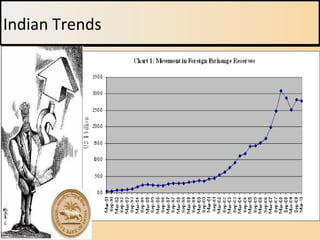
Indian Trends
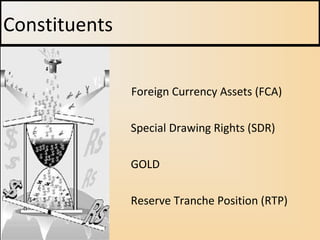
• Foreign Currency Assets (FCA)
• Special Drawing Rights (SDR)
• GOLD
• Reserve Tranche Position (RTP)
Constituents
Rank Country Billion USD (end of month)
1 People's Republic of China [note 1]
$ 2648.3 (Sep 2010)[2]
2 Japan $ 1019 (Jun 2009)[3]
— Eurozone $ 753 (Sep 2010)
3 Russia[note 2]
$ 476 (Oct 2010)[4]
4 Republic of China (Taiwan) $ 383.38 (Sept 2010) [5]
5 Saudi Arabia $ 410 (Dec 2009)[6]
6 India [note 2]
$ 297.96 (Oct 29, 2010)[7]
7 South Korea $ 293.35 (October 2010)[8]
8 Brazil[note 3]
$ 287 (Oct 2010)[9]
— Hong Kong $ 266.1(Sep 2010)
9 Switzerland[note 4]
$ 250 (Aug 2010)
10 Singapore $ 214.7 (Sep 2010)
11 Germany $ 184 (Sep 2009)
12 Thailand $ 159.1 (Sep 2010)[10]
13 Italy $ 144 (June 2010)
14 France $ 143 (June 2010)
15 United States $ 129 (July 2010)
Global Comparison
Sources
• Foreign Investment
• External Commercial
Borrowings (ECB)
• Short Term Credit
• Banking Capital
• To stabilize Issued Currency
• To counter volatility
• Prepayment/Repayment of External Debt
• Investment
Spending
• Foreign exchange reserves are important
indicators of ability to repay foreign debt
and for currency defense, and are used to
determine credit ratings of nations
Conclusion
Thank You !

Foreign Exchange (FX) reserves

  • 1.
    Foreign Exchange (FX)reserves Rajiv Poplai
  • 2.
    • Definition andtrends • Constituents • Global Comparison • Sources and Spending • Conclusion Agenda
  • 3.
    “ External assetsthat are readily available to, and controlled by, monetary authorities for direct financing of external payments imbalances, for indirectly regulating the magnitudes of such imbalances through intervention in exchange markets to affect the currency exchange rate, and/or for other purposes” Definition
  • 4.
  • 5.
    • Foreign CurrencyAssets (FCA) • Special Drawing Rights (SDR) • GOLD • Reserve Tranche Position (RTP) Constituents
  • 6.
    Rank Country BillionUSD (end of month) 1 People's Republic of China [note 1] $ 2648.3 (Sep 2010)[2] 2 Japan $ 1019 (Jun 2009)[3] — Eurozone $ 753 (Sep 2010) 3 Russia[note 2] $ 476 (Oct 2010)[4] 4 Republic of China (Taiwan) $ 383.38 (Sept 2010) [5] 5 Saudi Arabia $ 410 (Dec 2009)[6] 6 India [note 2] $ 297.96 (Oct 29, 2010)[7] 7 South Korea $ 293.35 (October 2010)[8] 8 Brazil[note 3] $ 287 (Oct 2010)[9] — Hong Kong $ 266.1(Sep 2010) 9 Switzerland[note 4] $ 250 (Aug 2010) 10 Singapore $ 214.7 (Sep 2010) 11 Germany $ 184 (Sep 2009) 12 Thailand $ 159.1 (Sep 2010)[10] 13 Italy $ 144 (June 2010) 14 France $ 143 (June 2010) 15 United States $ 129 (July 2010) Global Comparison
  • 7.
    Sources • Foreign Investment •External Commercial Borrowings (ECB) • Short Term Credit • Banking Capital
  • 8.
    • To stabilizeIssued Currency • To counter volatility • Prepayment/Repayment of External Debt • Investment Spending
  • 9.
    • Foreign exchangereserves are important indicators of ability to repay foreign debt and for currency defense, and are used to determine credit ratings of nations Conclusion
  • 10.