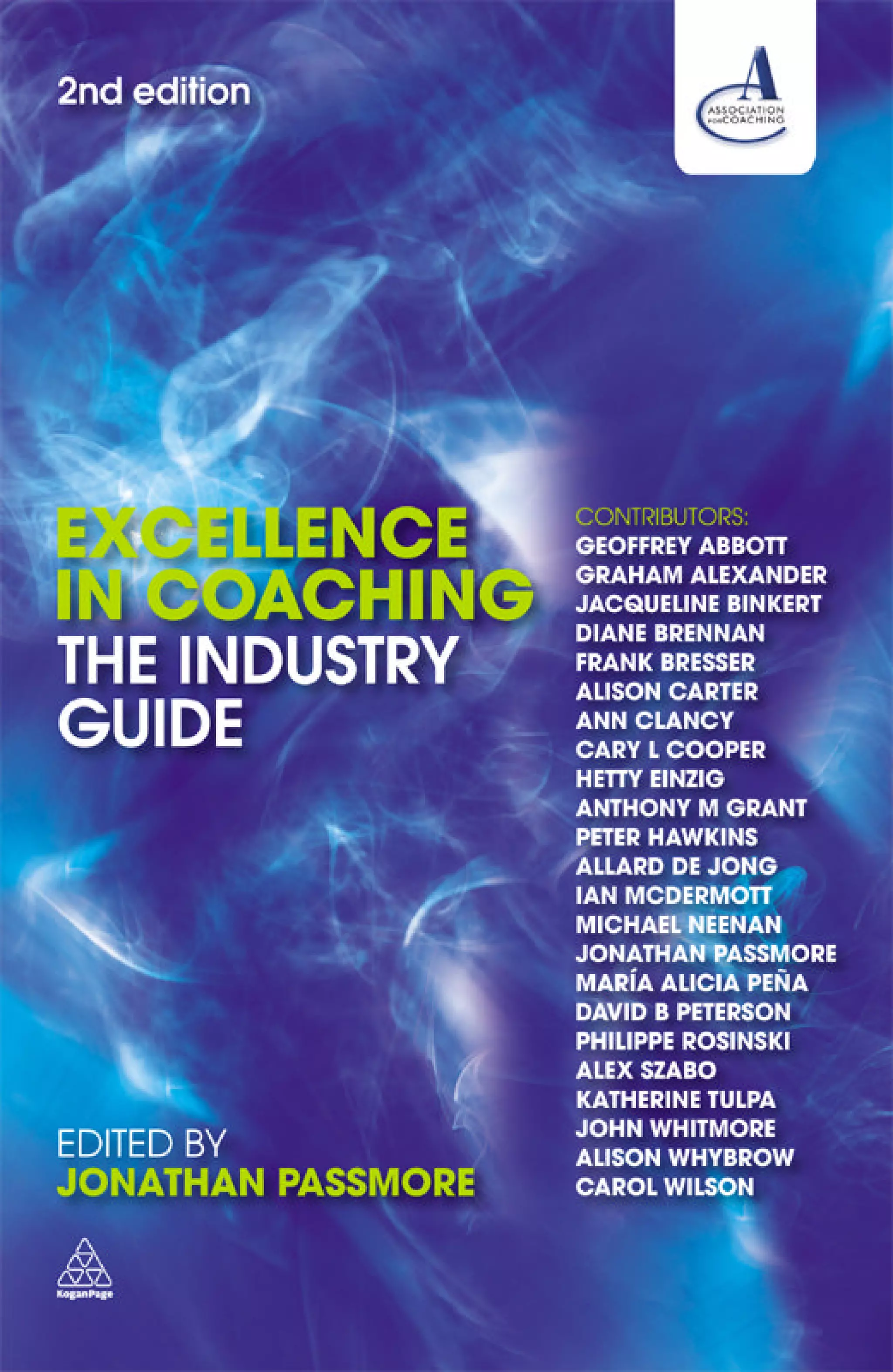
EXCELLENCE
IN COACHING
THE INDUSTRY
GUIDE
	 i
Praise for Excellence in Coaching
“What a wonderful offering that covers an impressive range of material from practical
issues to applicable theories to ethical and supervisory issues in coaching!”
Diane Stober, faculty, Organizational and Management Development,
Fielding Graduate University, co-editor of Evidence-Based Coaching Handbook:
Putting best practice to work for your clients
“Top managers are increasingly turning to specialist coaches to help them think,
earn and redirect╛╛.╛╛.╛╛.╛╛This very helpful book is for those in the growing profession
of coaching, the facilitative partners who are helping today’s executives maximize
their own performance.”
Greg Parston, Director, Institute for Public Services Value, Accenture
“The variety of chapter contributions is commendable and the cumulative effect is
both affirming and edifying.”
Dr Elaine Cox, Director of Postgraduate Coaching and Mentoring
Programmes, Westminster Institute of Education,
Oxford Brookes University
“Offers a breadth of perspectives on the subject╛╛.╛╛.╛╛.╛╛Written by experts in the
different fields, it leaves the reader to judge which of these various methods
are the most appropriate for their particular needs.”
People Management
“Anyone who invests in this book will not feel cheated.”
Training and Coaching Today
“If you only have one coaching book on your shelf, this is the one to have.”
Resource Magazine
iiâ•…
EDITED BY
JONATHAN PASSMORE
2nd edition
EXCELLENCE
IN COACHING
THE INDUSTRY
GUIDE
	 iii
Publisher’s note
Every possible effort has been made to ensure that the information contained in this book is
accurate at the time of going to press, and the publishers and authors cannot accept responsibility
for any errors or omissions, however caused. No responsibility for loss or damage occasioned to
any person acting, or refraining from action, as a result of the material in this publication can be
accepted by the editor, the publisher or any of the authors.
First published in Great Britain and the United States in 2006 by Kogan Page Limited
Second edition 2010
Apart from any fair dealing for the purposes of research or private study, or criticism or review,
as permitted under the Copyright, Designs and Patents Act 1988, this publication may only be
reproduced, stored or transmitted, in any form or by any means, with the prior permission in
writing of the publishers, or in the case of reprographic reproduction in accordance with the terms
and licences issued by the CLA. Enquiries concerning reproduction outside these terms should be
sent to the publishers at the undermentioned addresses:
120 Pentonville Road	 525 South 4th Street, #241	 4737/23 Ansari Road
London N1 9JN	 Philadelphia PA 19147	 Daryaganj
United Kingdom	 USA	 New Delhi 110002
www.koganpage.com		 India
© The Association for Coaching, 2006, 2010
The right of The Association for Coaching to be identified as the author of this work has been
asserted by them in accordance with the Copyright, Designs and Patents Act 1988.
ISBN	 978 0 7494 5667 2
E-ISBN	 978 0 7494 5924 6
Association for Coaching – formed in the United Kingdom in 2002, the Association for Coaching is a
non-profit and independent professional body whose aim is to promote best practice and to raise
awareness and standards of coaching while providing value-added benefits to its members – whether
they are professional coaches or organizations involved in coaching.
www.associationforcoaching.comâ•… ‘promoting excellence & ethics in coaching’
British Library Cataloguing-in-Publication Data
A CIP record for this book is available from the British Library.
Library of Congress Cataloging-in-Publication Data
Excellence in coaching : the industry guide / Association for Coaching, Jonathan Passmore. – 2nd ed.
p. cm.
Includes bibliographical references and index.
ISBN 978-0-7494-5667-2 – ISBN 978-0-7494-5924-6 (ebk)â•… 1.╇ Employees–Coaching of.â•…
I.╇ Passmore, Jonathan.╅ II.╇ Association for Coaching.
HF5549.5.C53E93 2010
658.3′124–dc22
	 2010006389
Typeset by Graphicraft Limited, Hong Kong
Printed and bound in India by Replika Press Pvt Ltd
ivâ•…
Contents
About the editor	 ix
Contributors	 x
Foreword	 xvi
Preface	 xvii
Acknowledgements	 xix
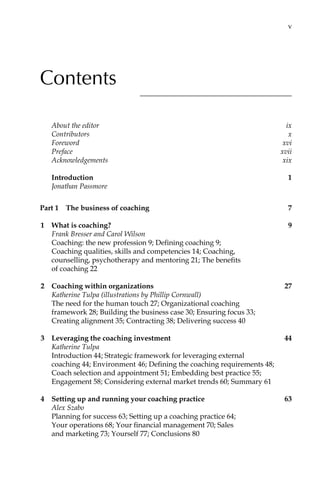
	 Introduction	 1
Jonathan Passmore
Part 1â•… The business of coaching	 7
1	 What is coaching?	 9
Frank Bresser and Carol Wilson
Coaching: the new profession 9; Defining coaching 9;
Coaching qualities, skills and competencies 14; Coaching,
counselling, psychotherapy and mentoring 21; The benefits
of coaching 22
2	 Coaching within organizations	 27
Katherine Tulpa (illustrations by Phillip Cornwall)
The need for the human touch 27; Organizational coaching
framework 28; Building the business case 30; Ensuring focus 33;
Creating alignment 35; Contracting 38; Delivering success 40
3	 Leveraging the coaching investment	 44
Katherine Tulpa
Introduction 44; Strategic framework for leveraging external
coaching 44; Environment 46; Defining the coaching requirements 48;
Coach selection and appointment 51; Embedding best practice 55;
Engagement 58; Considering external market trends 60; Summary 61
4	 Setting up and running your coaching practice	 63
Alex Szabo
Planning for success 63; Setting up a coaching practice 64;
Your operations 68; Your financial management 70; Sales
and marketing 73; Yourself 77; Conclusions 80
	 v
viâ•… ❚â•… Contents
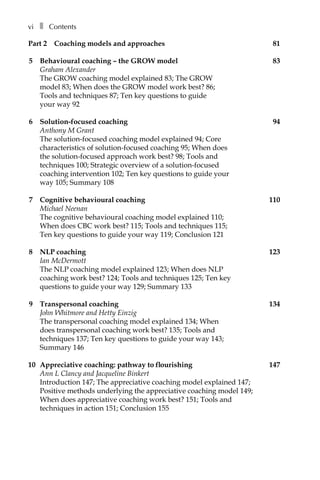
Part 2â•… Coaching models and approaches	 81
5	 Behavioural coaching – the GROW model	 83
Graham Alexander
The GROW coaching model explained 83; The GROW
model 83; When does the GROW model work best? 86;
Tools and techniques 87; Ten key questions to guide
your way 92
6	 Solution-focused coaching	 94
Anthony M Grant
The solution-focused coaching model explained 94; Core
characteristics of solution-focused coaching 95; When does
the solution-focused approach work best? 98; Tools and
techniques 100; Strategic overview of a solution-focused
coaching intervention 102; Ten key questions to guide your
way 105; Summary 108
7	 Cognitive behavioural coaching	 110
Michael Neenan
The cognitive behavioural coaching model explained 110;
When does CBC work best? 115; Tools and techniques 115;
Ten key questions to guide your way 119; Conclusion 121
8	 NLP coaching	 123
Ian McDermott
The NLP coaching model explained 123; When does NLP
coaching work best? 124; Tools and techniques 125; Ten key
questions to guide your way 129; Summary 133
9	 Transpersonal coaching	 134
John Whitmore and Hetty Einzig
The transpersonal coaching model explained 134; When
does transpersonal coaching work best? 135; Tools and
techniques 137; Ten key questions to guide your way 143;
Summary 146
10	 Appreciative coaching: pathway to flourishing	 147
Ann L Clancy and Jacqueline Binkert
Introduction 147; The appreciative coaching model explained 147;
Positive methods underlying the appreciative coaching model 149;
When does appreciative coaching work best? 151; Tools and
techniques in action 151; Conclusion 155
Contentsâ•… ❚â•… vii
11	 Integrative coaching	 157
Jonathan Passmore
The integrative coaching model explained 157; When does
integrative coaching work best? 164; Tools and techniques 165;
Ten key questions to guide your way 168
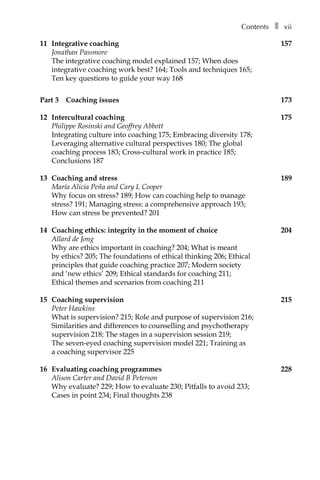
Part 3â•… Coaching issues	 173
12	 Intercultural coaching	 175
Philippe Rosinski and Geoffrey Abbott
Integrating culture into coaching 175; Embracing diversity 178;
Leveraging alternative cultural perspectives 180; The global
coaching process 183; Cross-cultural work in practice 185;
Conclusions 187
13	 Coaching and stress	 189
María Alicia Peña and Cary L Cooper
Why focus on stress? 189; How can coaching help to manage
stress? 191; Managing stress: a comprehensive approach 193;
How can stress be prevented? 201
14	 Coaching ethics: integrity in the moment of choice	 204
Allard de Jong
Why are ethics important in coaching? 204; What is meant
by ethics? 205; The foundations of ethical thinking 206; Ethical
principles that guide coaching practice 207; Modern society
and ‘new ethics’ 209; Ethical standards for coaching 211;
Ethical themes and scenarios from coaching 211
15	 Coaching supervision	 215
Peter Hawkins
What is supervision? 215; Role and purpose of supervision 216;
Similarities and differences to counselling and psychotherapy
supervision 218; The stages in a supervision session 219;
The seven-eyed coaching supervision model 221; Training as
a coaching supervisor 225
16	 Evaluating coaching programmes	 228
Alison Carter and David B Peterson
Why evaluate? 229; How to evaluate 230; Pitfalls to avoid 233;
Cases in point 234; Final thoughts 238
viiiâ•… ❚â•… Contents
17	 Coach accreditation	 240
Diane Brennan and Alison Whybrow
Introduction 240; The case for accreditation 240; Coach accreditation:
recent history and developing trends 244; Understanding existing and
emerging professional accreditation systems in the coaching space 245;
Coaching and coaching psychology 250; Where to from here? 255;
Conclusion 257; Appendix 259
The Association for Coaching	 260
Index	 263
About the editor
Jonathan Passmore is one of the UK’s leading coaches. He is a chartered
psychologist, an accredited coach, a coaching supervisor and fellow of
the CIPD. He has wide business consulting experience having worked for
PricewaterhouseCoopers, IBM Business Consulting and OPM, and as a chief
executive and company chairman in the sports and leisure sector. He is based at
the School of Psychology, University of East London, and is Director for the
Coaching and Coaching Psychology programmes. He has published widely
and is the author of several books including titles on the psychology of social
networking and on organizational change, plus the five books in this series;
Excellence in Coaching, Psychometrics in Coaching (2008), Diversity in Coaching
(2009), Leadership in Coaching (2010) and Super�vision in Coaching (2011). He can
be contacted at: jonathancpassmore@yahoo.co.uk.
	 ix
Contributors
Geoffrey Abbott is an executive coach and researcher currently based in
El Salvador where he has been completing his doctoral studies on coaching
with the Australian National University. Geoff was previously an executive
with the Special Broadcasting Service in Sydney, Australia, where he managed
strategic planning processes and cross-cultural research. He is an Associate of
ESEN (the School of Economics and Business) in San Salvador. Geoff works
mainly in Central America with clients from the commercial and development
sectors. He has a particular interest in cross-cultural coaching as a strategy for
enhancing global competitiveness. He can be contacted at geoffabbott@yahoo.com.
Graham Alexander is often described as a ‘super coach’ and has been attributed
with introducing business coaching to the UK. He is one of the few people
coaching at the top level of UK/international business, specifically CEOs,
boards and senior executives, and has coached more UK CEOs than anyone.
Graham developed the GROW model, which has become the world’s best-
known business coaching framework. He has published two books and is Senior
Vice President, Europe, of the Hudson Highland Center for High Performance.
Graham can be contacted at graham@grahamalexander.com.
Dr Jacqueline Binkert is principal of Appreciative Coaching Collaborative,
LLC, is co-author of Appreciative Coaching: A positive process for change, a researched,
evidence-based approach to coaching founded on appreciative inquiry. She
presents appreciative coaching workshops internationally and teaches an
academic online appreciative coaching course with The Fielding Graduate
University. Jackie specializes in executive coaching and for over 20 years she
has worked with clients from non-profit organizations and international corpor�
ations to educational institutions, governmental agencies and manufacturing,
including the Executive Development Center of a Fortune 50 company.
Diane Brennan is passionate about the power of coaching. She became
involved as a leader within the International Coach Federation (ICF) to expand
global conversations and professionalization across the community. Diane
served as the ICF global President in 2008. She is an executive coach,
consultant, author and co-editor of the book, The Philosophy and Practice of
Coaching. She holds an MBA, ICF Master Coach and is fellow of the American
xâ•…
Contributorsâ•… ❚â•… xi
College of Medical Practice Executives. She was also the first Director of
Training for Fielding University coaching programme. She can be reached at
diane@coachdiane.com.
Frank Bresser is a leading, global business expert for the successful implemen-
tation and improvement of coaching. Supported by his worldwide team, he
advises companies on the effective use of coaching. His expertise is used and
put in practice successfully in organizations across the globe and has set inter-
national standards in the implementation and improvement of coaching. He
holdsanMBAwithDistinctioninInternationalManagementfromtheUniversity
of East London, and also is a visiting lecturer on coaching at the UEL today. He is
based in Germany and can be contacted at www.frank-bresser-consulting.com.
Dr Alison Carter is a Principal Research Fellow at the Institute for Employment
Studies (IES). Formerly a corporate management development practitioner, for
the past 10 years she has undertaken research on coaching and HR strategy/
function issues as well as helping organizations evaluate the impact of their
coaching schemes. She is a Fellow of the CIPD and a former Director of EMCC.
Alison can be contacted on alison.carter@employment-studies.co.uk.
Dr Ann L Clancy is a principal of Appreciative Coaching Collaborative, LLC.
She is co-author of Appreciative Coaching: A positive process for change, a researched,
evidence-based approach to coaching founded on appreciative inquiry. She
travels internationally offering appreciative coaching workshops and teaches
an academic online appreciative coaching course with The Fielding Graduate
University. Over the past 20 years, she has worked with a wide range of executive
and business clients from corporations, retail companies, governmental agencies,
community groups and non-profit organizations.
Professor Cary L Cooper is Distinguished Professor of Organizational
Psychology and Health and Pro Vice Chancellor at Lancaster University. He is
the author of over 120 books (on occupa�tional stress, women at work and
industrial and organizational psychology), has written over 400 scholarly
articles for academic journals, and is a frequent contributor to national
newspapers, TV and radio. Professor Cooper is the immediate past President of
the British Academy of Management. He is a Fellow of the Academy of
Management (having also won the 1998 Distinguished Service Award) and in
2001 he was awarded a CBE in the Queen’s Birthday Honours List for his
contribution to organizational health.
Hetty Einzig is a Performance Consultants partner and executive coach
working in the areas of business coaching, transpersonal coaching, organ�
izational and team development, transformational leadership, organizational
synthesis and emotional literacy. Her coaching style is holistic, spanning
xiiâ•… ❚â•… Contributors
work, life and strategic development issues. She is a UKCP registered psycho�
therapist and a Fellow of the Royal Society of Arts. Hetty can be contacted
at hetty@performanceconsultants.co.uk.
Dr Anthony M Grant is a coaching psychologist. He holds a BA (Hons) in
Psychology, a Masters of Arts in Behavioural Science and PhD. Anthony left
school at the age of 15 with no qualifications, completed his training as a
carpenter and ran his own contracting business. He embarked on a second
career in direct sales and marketing, before beginning tertiary studies in 1993 as
a mature-age student and commencing a third career in his 30s as a coaching
psychologist. In January 2000 Anthony established the world’s first Coaching
Psychology Unit at the School of Psychology at Sydney University where he is
the director. He has co-written and/or co-edited five books on evidence-based
coaching and has over 30 coaching-related publications. He can be contacted at
anthonyg@psych.usyd.edu.au.
Dr Peter Hawkins is Chairman of Bath Consultancy Group, a leading
international consultancy in the field of organizational transformation, culture
for performance and leadership, which he co-founded in 1986 and which runs
leading training courses in coaching supervision. He also co-founded Centre
for Staff Team Development in 1979, one of the leading organizations in the
field of supervision development across all the professional fields. He is author
of The Wise Fool’s Guide to Leadership and co-author of the best-selling Supervision
in the Helping Professions and Coaching, Mentoring and Organizational Consultancy.
Peter can be contacted at peter.hawkins@bathconsultancygroup.com.
Allard de Jong is an international development specialist, performing team
coaching, process facilitation and leadership coaching. He is currently Director
of Change and Challenge, and an associate at Penna and LHH. He lectures on
coaching, leadership and change throughout Spain. He holds a Master’s Degree
in Communication Studies and Bachelor Degree in International Business
Administration. Allard can be contacted at allard@changeandchallenge.com.
Ian McDermott is founder and Director of Training for International Teaching
Seminars (ITS). For nearly 20 years ITS has been committed to training the next
generation of NLP trainers, practitioners and coaches. Named one of Britain’s
Top 10 Coaches and described as ‘the Coaches’ Coach’ (Independent on Sunday),
Ian has pioneered the integration of NLP and Coaching. He continues to work
personally with key senior executives focusing on strategic issues. His work is
featured in the Open University MBA course ‘Creativity, Innovation and
Change’. His numerous books include the bestsellers The Art of Systems Thinking,
Way of NLP, The NLP Coach, Your Inner Coach and The Coaching Bible and have
been translated into 15 languages. Ian can be reached on +44 (0) 1268 777125 or
at www.itsnlp.com.
Contributorsâ•… ❚â•… xiii
Michael Neenan is an honorary vice-president of the Association for Coaching,
co-director of the coaching training programme at the Centre for Coaching,
Blackheath, an accredited cognitive-behavioural therapist and a visiting tutor at
Goldsmiths College, University of London. He has co-written (with Professor
Windy Dryden) over 20 books on cognitive behaviour therapy including the
best-selling Life Coaching: A cognitive behavioural approach. His coaching practice
focuses on both personal and professional development. Michael can be
contacted at neenanmikel@aol.com.
Dr Jonathan Passmore is a chartered psychologist, accredited coach and
coaching supervisor. He works with senior executives on coaching, organization
change and leadership programmes. He holds five degrees and is an active
contributor through articles, books and conference speeches. Jonathan has
worked at board level in the private, public and not-for-profit sectors and
has worked for a range of firms including PricewaterhouseCoopers, IBM
and OPM. In his spare time he keeps bees. Jonathan can be contacted at
jonathancpassmore@yahoo.co.uk.
María Alicia Peña is a chartered counselling psychologist and occupational
psychologist. She has worked both in the NHS and in the private sector, and is
now Acting Head of Counselling and Well-being, Reading University. For her
doctorate she is researching the factors that lead to an effective return to work
after absence due to stress, burnout, anxiety or depression. Her clinical work
focuses on both individuals and couples across a wide range of mental health
issues. She is qualified to use EMDR, an effective method to help people over-
come the effects of trauma. Alicia can be contacted at apena@hotmail.co.uk.
David B Peterson, PhD, is Senior Vice President at PDI Ninth House, where he
has been leading executive coaching services worldwide for over 20 years.
Based in San Francisco, he coaches CEOs and senior executives in Global 1000
companies, as well as helping organizations design their own coaching pro-
grammes. He has authored numerous articles and two best-selling books. David
can be reached at david.peterson.phd@gmail.com.
Philippe Rosinski is an expert in executive coaching, team coaching, and global
leadership development, sought after by leading international corporations.
He is principal of Rosinski & Company (www.philrosinski.com). He is the
author of Coaching Across Cultures and his pioneering work in bringing the
crucial intercultural dimension into the practice of coaching has won him
worldwide acclaim. Philippe is the first European to have been designated
Master Certified Coach by the International Coach Federation. COF is available
at www.philrosinski.com/cof.
xivâ•… ❚â•… Contributors
Alex Szabo is a qualified and accredited personal and professional coach. She
is a business professional with extensive experience in strategic management
and operations. Her background of psychology, training, merchant banking,
and entrepreneurial experience led her to found Tailored Coaching, which
provides results-orientated personal, business, executive and group coaching.
Alex was a nominee for the Honorary AC Awards Influencing Coaching
category; and is co-founder of the Association for Coaching, the UK’s leading
professional body. She can be contacted at www.tailoredcoaching.com.
Katharine Tulpa is Founding Chair and CEO of the Association for Coaching,
and Co-Founder of Wisdom8, a firm specializing in Cross-cultural and CEO/
Top Team Coaching. A driving force for coaching excellence, she has won a
number of awards, including ‘Influencing and Impacting the Coaching
Profession’ and ‘Coaching/Mentoring Person of the Year’ by Coaching at Work.
Katherine is also a sought-after board-level global coach, speaker, coach mentor
and author, with contributions to the AC’s Excellence in Coaching, Diversity in
Coaching, and Leadership Coaching (Kogan Page 2006, 2009, 2010). She can be
contacted on ktulpa@wisdom8.com.
Sir John Whitmore was a successful professional racing driver before moving
into business. He then moved to California to study and promote the emerging
psychologies, before returning to the UK to set up a tennis and ski school based
on a new learning method called The Inner Game, which redefined coaching.
He then teamed up with former Olympians to found Performance Consultants,
bringing coaching into business. In 2004, he was made recipient of the AC
Honorary Award for Impacting the Coaching Profession and his book Coaching for
Performance is a business best-seller and has been translated into 14 languages.
www.performanceconsultants.co.uk.
Dr Alison Whybrow has been at the forefront of the development of the coach-
ing psychology profession in the UK. She has held an executive position within
the Coaching Psychology group of the British Psychological Society since 2004
and has supported the development of professionalism in coaching and coach-
ing psychology globally. As well as having a strong coaching and consulting
prac�tice, Alison contributes as an editor and writer to coaching and coaching
psychology publications. She is continually delighted by the power of purpose-
ful conversation and can be contacted at alison@i-coachacademy.com.
Carol Wilson is Managing Director of Performance Coach Training, a joint
venture with coaching pioneer Sir John Whitmore’s Performance Consultants
International,andHeadofProfessionalStandards&ExcellenceattheAssociation
for Coaching. She designs and delivers programmes to create coaching cultures
for organizations including the Arts Council, IKEA, NCR, CLM 2012 Olympic
Development Partner, various public sector organizations including schools
and county councils, and open programmes to train coaches. She experienced
Contributorsâ•… ❚â•… xv
the value of a coaching culture at first hand during a decade working at board
level with Sir Richard Branson. Carol was nominated for the AC Awards
‘Influence in Coaching’ and ‘Impact in Coaching’ and is the author of
Best Practice in Performance Coaching. She can be contacted via her web page:
www.performancecoachtraining.com.
Foreword
Books about coaching generally offer the perspective of a single coach drawing
on their experiences from the field. My book Coaching for Performance is one of
those. They serve to contribute to the body of coaching knowledge and to the
income and reputation of the author.
This one is different. It brings together a range of the best writings on the
subject without judgement or favour. As such, it gives the reader an opportunity
to sample the field and take responsibility for their own choice of which path or
paths to follow or combine, or whether to carve out a new path of their own.
Any coach, or would-be coach, is bound to gain from the richness that is offered,
from practical experience of, and advice on, running a coaching practice to
important issues such as standards, ethics and supervision; this book embraces
many different methodologies.
A recently emerging theme in the coaching industry is the recognition of the
need to collaborate for the benefit and the reputation of the industry as a whole
and its clients, rather than maintaining the protective self-interest that has
characterized much of business in the past. This book reflects this view; for
example, the editor and contributors have not received any payment for their
efforts, and have thereby made a genuine contribution to the industry as a whole,
one that transcends personal gain.
Coaching has been established for more than two decades, and it is now coming
into maturity and revealing more of its depth. At a superficial level, coaching
helps people to clarify their goals, to schedule their actions and to succeed more
readily at work and in life. It helps people to learn and perform better by
enhancing their awareness, responsibility, self-confidence and self-reliance. At
a deeper level, when undertaken well and responsibly, it helps people along
their evolutionary journey towards higher or deeper levels of themselves – to
discover who they really are. It is a psycho-spiritual journey that is both universal
and as pre-programmed as is the Darwinian one of biological evolution.
The principle and practice of coaching is a choice of making kit on a micro
scale, and let us hope that these principles will spread to the macro in time. We
are a fledgling industry but, as Margaret Mead said, ‘Never believe that a small
group of dedicated individuals can not change the world – indeed it is the only
thing that ever has’. Is the Association for Coaching such a group? Let us cast aside
our self-limiting beliefs and cooperate towards a higher goal, higher version. This
end is something to which this book contributes and of which it is an example.
John Whitmore
Author of Coaching for Performance
xviâ•…
Preface
This book came about during a conversation at an Association for Coaching event
in London. Katherine Tulpa and I reflected on the need for a single guide to
coaching practice that would bring current issues together.
With the help of the back of an envelope and a delayed train from King’s
Cross station this book moved from a vague conversation over coffee to a book
proposal. The simple idea was to bring together the top English-speaking
coaching writers to contribute to a single book. This book assembles two dozen
of the world’s top coaches, all of whom have written and published elsewhere
and are experts in their individual fields. It covers issues which have not been
written about widely, such as coaching supervision and coaching ethics, but
which are of importance if coaching is to develop as a profession. It also aims to
offer the reader a selection of the most popular coaching models, written by the
leaders in each of these areas, along with guidance on getting started in
coaching.
The book is divided into three sections. The first is what we have called
‘Coaching basics’, and covers the themes of ‘What is coaching?’, ‘Coaching
within organizations’ and ‘Running your coaching practice’. If you are new to
coaching, studying coaching or are setting up your coaching practice, this
section will be of interest to you. The second section contains a selection of
the most popular coaching approaches, with chapters by the leading writers in
each of these areas. Most coaches use a single model in their coaching practice;
by offering an accessible description of a range of models we hope coaches
will be able to develop their practice further, first by reading and then secur�
ing further training in some of the specialist areas such as cognitive, trans�
personal and motivational interviewing. The third section explores current
issues within coaching, from supervision to ethics and diversity. Much of the
material in this section is new thinking and seeks to take forward the debate
in these areas.
As always with editions like this, as editor I end up frustrating authors who
wanted to bring a creative touch to their writing while I attempted to create
some consistency in look and feel throughout the book. On the other side is the
frustrated publisher keen to move forward while I attempt to herd authors
towards the finish post of the publication deadline. The result is never the
perfect book, but I hope it will be a useful addition to every coach’s book shelf.
Throughout the book we have tried to use the term coachee for the person
who sits in the session with the coach, and the term client for the person who
commissions the coaching and pays the bill. Sometimes these are the same
person; however, often in organizational settings they are different people.
	 xvii
xviiiâ•… ❚â•… Preface
The ideas and views expressed in each chapter are those of the individual
authors, and do not necessarily represent my own views as editor or those
of the Association for Coaching. As the editor, a chartered psychologist, coaching
practitioner and a researcher into coaching practice, I am interested to hear
your views.
Acknowledgements
I would like to express my thanks to Katherine Tulpa and Alex Szabo who
supported the idea of the book and for their encouragement during the process.
Thanks are also due to the authors who gave of their time, without payment,
to contribute to this collaborative piece and for putting up with my desire for
redraft after redraft.
I would like to pay tribute to my wife, Katharine, who has allowed me to
spend many hours at the keyboard typing and engaged in discussions about
the book during the past year. Her help was invaluable. This book is dedicated
to her.
Jonathan Passmore
	 xix
xxâ•…
THIS PAGE IS INTENTIONALLY LEFT BLANK
Introduction
Jonathan Passmore
Coaching: the future
Since we launched the first edition of Excellence in Coaching in 2006 the book has
established itself as a popular read for practitioners and those studying coach-
ing. The book has sold across the world and is now a course text on several
coaching programmes. Its popularity has led to numerous reprints, and after
four years we have decided to produce a second edition.
Since the original book, several other collected editions have been published
which have offered a more academic focus, including excellent contributions to
the field by Stephen Palmer and Alison Whybrow (The Handbook of Coaching
Psychology), Elaine Cox, Tatiana Bachkirova and David Clutterbuck (The Sage
Handbook of Coaching) and Bob Garvey and his colleagues.
In revising this edition we have stuck to the original model: a short and acces-
sible book for practitioners interested in how coaching works, with references
for readers who want a deeper coverage of issues to follow up.
In this new edition we have added several chapters to reflect the changing
market in standards and evaluation. We have also added a model on a positive
psychology approach to coaching; Appreciative Inquiry, and have updated the
other chapters.
In the new edition we have retained the division into three sections. The first
deals with the nature of coaches. These chapters cover how coaches can estab-
lish and best manage their business and how to work in parallel with clients
and coachees. The second section of the book is concerned with coaching
models and techniques. Rather than concentrate on a single model we have
offered a number of models: behavioural, cognitive behavioural, NLP, trans�
personal, solution-focused, Appreciative Inquiry and integrative. Our aim is to
help coaches to extend their professional practice. Most people are taught a single
coaching model in their coach training; we have tried to encourage trainers and
coaches to use a diverse range of models which meet the needs of their coachee
and of the issue. I have previously advocated that coaches develop a personal
integrated model of coaching which blends together different approaches, and
I hope that the range of models will help coaches in this endeavour. The third
	 1
2â•… ❚â•… Introduction
section of the book focuses on issues facing coaches, from working with stress
to ethics, cross-cultural working and standards.
Coaching at work
The research evidence from the Chartered Institute of Personnel and Develop�
ment (CIPD) and others demonstrates that coaching has become a popular
organizational intervention that now ranks alongside leadership development
and management skills programmes. Further, there is growing evidence that
coaching can have a positive impact on individuals and on individual per�
formance. It is clear that coaching as an intervention is here to stay.
It has been suggested that coaching is the most powerful method for develop-
ing managers (Lee, 2003). However, the ability to harness this gain takes self-
awareness, self-belief, personal motivation and tools to enable the coachee to
put new ideas into new ways of behaving. The role of the executive coach in the
relationship is to facilitate and coordinate these elements, working in harmony
with his or her coachee. Some have suggested that the harmonic relationship in
coaching should be like conducting a band, waving the baton of the question
and focusing attention on each element in turn. I would prefer to see this more
like playing jazz, with the coach and coachee working together to weave the
journey that emerges from the process.
In organizations there is the added complexity of working with a second
‘client’: the organization sponsors. They have their own views about what needs
to be delivered from coaching. In 2006 I suggested that organization sponsors
were relatively naïve about how they can direct coaching, possibly fearing that
they may cross the confidentiality boundary. In the past four years organiza-
tions have become increasing savvy at the commissioning process, as some of
our new contributions note. As the market continues to develop and HR profes-
sionals become more confident in managing coaching contracts, it is likely that
organizational coaching relationships will start with tripartite meetings to set
the scene and agree the objectives, and will close with a similar review, and that
organizations will review the competencies and qualifications of their coaches.
We are likely to see a continued shift to professionalization, which means more
coaching degrees and accreditation from professional bodies.
Life coaching
In the arena of life coaching the market too has been growing. The market itself
is even more diverse, ranging from coaches working in health areas such as
smoking cessation, stress and diet management, to more traditional lifestyle
work. For these health interventions, coaches with backgrounds in health
services or psychology are typically trained. The emergence of this work may
develop further as the health sector recognizes the potential of coaching as an
alternative to counselling, with its associated negative images. At the lifestyle
end of the spectrum coaches and coachees are working on relationships, faith
and work–life balance.
Introductionâ•… ❚â•… 3
Coaching training standards
What is clear from the developments in the sector is a need for robust training
and the maintenance of ethical practice. As of 2010, becoming a coach is still
as easy as saying the word. There are no standards or licensing arrangements in
the United States, the UK or Australia. While national or state-managed licens-
ing is some way off, accreditation and training through professional bodies are
continuing to grow. The challenge, however, with such voluntary schemes is
ensuring that coaches participate and that the public understand the scheme,
and this is why we have included a chapter on the issue in the second edition.
The issue is still not settled and there is ongoing debate about the benefits and
value of accreditation, training and licensing. Such debate mirrors much of
what has gone before in other professions, such as counselling and psycho-
therapy, as they moved towards standards in the 1980s (Mowbray, 1995).
While the debate continues, the professional bodies have responded through
establishing accreditation schemes. Such schemes will help coaches and also
help clients identify the ‘good’ from the ‘less good’ in the market.
Coaching competencies
In an environment where few coaches were trained, knowing which behaviours
were effective was arguably of limited importance. The development of coach-
ing and its journey towards becoming a profession brings with it the question
of standards and training.
What does a coach need to learn to be effective? A small number of writers
have sought to answer this question. Alexander and Renshaw (2005) suggest
that a number of key competencies are important. They felt that coaching com-
petencies should be divided into three clusters: relationship, being and doing.
In the first of these, relationship, coaches need to demonstrate that they are open
and honest and that they value others. In the second cluster, being, coaches
need to have self-confidence to be able to work with their coachee through
difficult challenges. They also need to maintain an enabling style, to avoid slip-
ping into a directive approach with their coachee, and to be self-aware. In the
third cluster, doing, coaches need to hold a clear methodology, to be skilful in
applying the method and its associated tools and techniques, and to be fully
present. Few of these competencies easily lend themselves to a formal training.
Research suggests that coachees have a very clear view of what they value within
a coaching relationship. They expect their coaches to have strong communica�
tion skills, to be able to listen, to recall information accurately, to challenge
while maintaining support for them as an individual and to direct attention
through questions. The senior executives in the study also expressed the view
that relationship skills were important. In this respect, credibility and previous
experience helped to establish and maintain the relationship, alongside empathy
and affirming the coachee. There was also a view that knowledge about human
behaviour and knowledge of the sector were valued. The second of these, sector
knowledge, is often contested but this may reflect a desire to divide coaching
4â•… ❚â•… Introduction
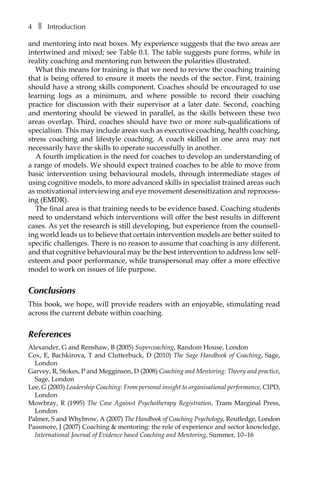
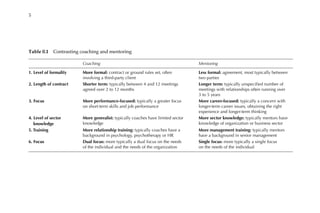
and mentoring into neat boxes. My experience suggests that the two areas are
intertwined and mixed; see Table€0.1. The table suggests pure forms, while in
reality coaching and mentoring run between the polarities illustrated.
What this means for training is that we need to review the coaching training
that is being offered to ensure it meets the needs of the sector. First, training
should have a strong skills component. Coaches should be encouraged to use
learning logs as a minimum, and where possible to record their coaching
practice for discussion with their supervisor at a later date. Second, coaching
and mentoring should be viewed in parallel, as the skills between these two
areas overlap. Third, coaches should have two or more sub-qualifications of
specialism. This may include areas such as executive coaching, health coaching,
stress coaching and lifestyle coaching. A coach skilled in one area may not
necessarily have the skills to operate successfully in another.
A fourth implication is the need for coaches to develop an understanding of
a range of models. We should expect trained coaches to be able to move from
basic intervention using behavioural models, through intermediate stages of
using cognitive models, to more advanced skills in specialist trained areas such
as motivational interviewing and eye movement desensitization and reprocess-
ing (EMDR).
The final area is that training needs to be evidence based. Coaching students
need to understand which interventions will offer the best results in different
cases. As yet the research is still developing, but experience from the counsell�
ing world leads us to believe that certain intervention models are better suited to
specific challenges. There is no reason to assume that coaching is any different,
and that cognitive behavioural may be the best intervention to address low self-
esteem and poor performance, while transpersonal may offer a more effective
model to work on issues of life purpose.
Conclusions
This book, we hope, will provide readers with an enjoyable, stimulating read
across the current debate within coaching.
References
Alexander, G and Renshaw, B (2005) Supercoaching, Random House, London
Cox, E, Bachkirova, T and Clutterbuck, D (2010) The Sage Handbook of Coaching, Sage,
London
Garvey, R, Stokes, P and Megginson, D (2008) Coaching and Mentoring: Theory and practice,
Sage, London
Lee, G (2003) Leadership Coaching: From personal insight to organisational performance, CIPD,
London
Mowbray, R (1995) The Case Against Psychotherapy Registration, Trans Marginal Press,
London
Palmer, S and Whybrow, A (2007) The Handbook of Coaching Psychology, Routledge, London
Passmore, J (2007) Coaching & mentoring: the role of experience and sector knowledge,
International Journal of Evidence based Coaching and Mentoring, Summer, 10↜–16
Table 0.1â•… Contrasting coaching and mentoring
Coaching Mentoring
1. Level of formality More formal: contract or ground rules set, often
involving a third-party client
Less formal: agreement, most typically between
two parties
2. Length of contract Shorter term: typically between 4 and 12 meetings
agreed over 2 to 12 months
Longer term: typically unspecified number of
meetings with relationships often running over
3 to 5 years
3. Focus More performance-focused: typically a greater focus
on short-term skills and job performance
More career-focused: typically a concern with
longer-term career issues, obtaining the right
experience and longer-term thinking
4. Level of sector
	 knowledge
More generalist: typically coaches have limited sector
knowledge
More sector knowledge: typically mentors have
knowledge of organization or business sector
5. Training More relationship training: typically coaches have a
background in psychology, psychotherapy or HR
More management training: typically mentors
have a background in senior management
6. Focus Dual focus: more typically a dual focus on the needs
of the individual and the needs of the organization
Single focus: more typically a single focus
on the needs of the individual
5
THIS PAGE IS INTENTIONALLY LEFT BLANK
6â•…
Part 1
The business of coaching
	 7
THIS PAGE IS INTENTIONALLY LEFT BLANK
8â•…
1
What is coaching?
Frank Bresser and Carol Wilson
Coaching: the new profession
This chapter sets out to describe the nature of coaching: its boundaries with
other helping interventions, the skills required to make an effective coach and
the evidence of the impact of coaching on individuals and organizations.
Coaching is one of the fastest-growing professions. Having emerged from the
area of sports in the 1960s, coaching transferred to business throughout the
1970s and 1980s, underwent a high degree of diversification and populariza�tion
in the 1990s, and is today accepted as a respected and widely used resource for
personal development. Accordingly, various forms of coaching (life coaching,
executive coaching, career coaching, sports coaching, etc) now exist. This chapter
addresses the question of what is the essence of coaching, what qualities, skills
and competencies a coach actually needs, what are the relevant differences
between coaching and other disciplines, and what benefits coaching offers.
Defining coaching
Leaving aside the hyperbole that currently surrounds the term ‘coaching’, there
exists a common understanding of what it actually means. Although different
definitions abound, they mostly describe the same phenomenon.
Coaching is╛╛.╛╛.╛╛.╛╛
l	 ‘unlocking a person’s potential to maximize their own performance. It is helping
them to learn rather than teaching them’ (Whitmore, 2009);
l	 ‘a collaborative, solution-focused, results-orientated and systematic process in
which the coach facilitates the enhancement of work performance, life ex�peri�
ence, self-directed learning and personal growth of the coachee’ (Grant, 1999;
basic definition also referred to by the Association for Coaching, 2006);
	 9
10â•… ❚â•… The business of coaching
l	 ‘a professional partnership between a qualified coach and an individual or team
that supports the achievement of extraordinary results, based on goals set by the
individual or team’ (ICF, 2005);
l	 ‘the art of facilitating the unleashing of people’s potential to reach meaningful,
important objectives’ (Rosinski, 2003).
At the heart of coaching lies the idea of empowering people by facilitating self-
directed learning, personal growth and improved performance.
Beyond this shared understanding, a host of issues are still under discussion
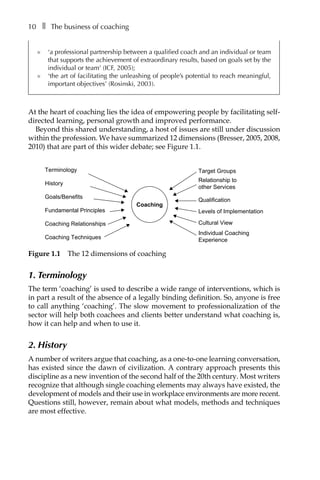
within the profession. We have summarized 12 dimensions (Bresser, 2005, 2008,
2010) that are part of this wider debate; see Figure€1.1.
Terminology
History
Goals/Benefits
Fundamental Principles
Coaching Relationships
Coaching Techniques
Target Groups
Relationship to
other Services
Qualification
Levels of Implementation
Cultural View
Individual Coaching
Experience
Coaching
Figure€1.1╅ The 12 dimensions of coaching
1. Terminology
The term ‘coaching’ is used to describe a wide range of interventions, which is
in part a result of the absence of a legally binding definition. So, anyone is free
to call anything ‘coaching’. The slow movement to professionalization of the
sector will help both coachees and clients better understand what coaching is,
how it can help and when to use it.
2. History
A number of writers argue that coaching, as a one-to-one learning conversation,
has existed since the dawn of civilization. A contrary approach presents this
discipline as a new invention of the second half of the 20th century. Most writers
recognize that although single coaching elements may always have existed, the
development of models and their use in workplace environments are more recent.
Questions still, however, remain about what models, methods and techniques
are most effective.
What is coaching?â•… ❚â•… 11
3. Goals/Benefits
Commonly mentioned benefits of coaching include enhanced personal and
organizational performance, better work–life balance, higher motivation, better
self-reflection, optimized decision making and improved change management.
One question remains the subject of ongoing debate: whose goals – those of
the coachee or the sponsor organization – should be primarily served by
coaching? Some argue that above all it is in the very nature of coaching to serve
the coachee’s goals, others emphasize the sponsor’s payment and organizational
context as dominant elements and prioritize the interests of the sponsor organ�
ization. A middle view stresses the importance of professional contracting in
the beginning to ensure a win–win situation all the time. In any case, an effec-
tive coach needs to be able to identify and address the issue of competing
priorities.
4. Fundamental principles
Commonly agreed fundamental principles of coaching are self-responsibility,
respect, acceptance, confidentiality, integrity, transparency, flexibility and neu-
trality. However, debate continues about the interpretation and practice of the
principles. How should the coach handle possible conflicts of interest? How can
the coach be resilient towards external pressures? How does the coach most
effectively deal with his or her own blind spots?
5. Coaching relationship
There is a broad consensus that the coachee retains responsibility and owner-
ship of the outcomes and is the leader of the whole coaching process, while the
coach tailors the coaching around the coachee’s needs and remains detached.
Coaching requires a coaching contract as the fundamental basis for a good
coaching relationship. This relationship is commonly described as an equal
one, neither participant being superior nor subordinate to the other. But what
happens in more complex relationships where coaching is used within organ�
izations? Can a manager coach a direct report at all? What impact does delivery
by human resources within the organization have on the coachee’s willingness
to share fully his or her story?
6. Coaching techniques
The techniques of listening, questioning, clarifying and giving feedback are
essential. What other tools are admissible and how these may be applied in
coaching, however, is subject to debate. Also, the pros and cons of alternatives
to face-to-face communication, such as the telephone, e-mail or videoconferen�
cing, are open to dispute. What effect do these have on the coaching process
and outcomes?
12â•… ❚â•… The business of coaching
7. Target groups
Coaches vary in whom they offer services to. Some coaches are willing to work
across issues and sectors, others are more specialist. A debate persists over
whether and to what extent coaching is equally applicable to all these target
groups, what approaches work best with different issues and whether coaches
are more, or less, effective when they attempt to work across all domains.
8. Relationship to other services
A clear distinction between coaching and other services (eg mentoring, therapy,
counselling) is crucial and is dealt with below. Where coaching and another
service are mixed, some argue that this is not coaching; others argue that the term
‘coaching’ encompasses every service that includes any element of coaching.
9. Qualification
Listening, questioning and clarifying skills are indispensable for any coach.
Depending on each coaching approach, additional coaching skills may also be
required. But how far should the coach understand the issues faced by the
coachee? Should the coach have management or sector knowledge? The main
source of coaching proficiency (talent/natural ability, learning/training, experi�
ence or a combination of these) is also a topic for controversy, and contributes
to the debate about training and development of coaches.
10. Levels of implementation
The importance of each level is assessed differently depending on the school of
thought (Figure€1.2). However, that coaching is a professional service provided
by professional coaches is commonly accepted. Whether it is preferable that
such coaches are external (from outside the company) or internal (own staff↜) is
again a matter of debate. Also, there is no doubt that companies are now in-
creasingly starting to make use of coaching forms beyond the one-to-one coach-
ing paradigm as well and to ingrain the coaching principles at the workplace.
One distinction that is useful to be aware of is between managers who coach
their direct reports and managers who demonstrate a coaching leadership style.
While the first category are acting like professional coaches and giving formal
sessions, the latter maintain their role as leaders and integrate coaching elements,
such as listening, skilful questioning and empowerment, into their everyday
methods of leadership. It is advisable to be very reluctant and careful about
using the first category due to the inherent, likely conflicts of roles.
11. Cultural view
Coaching extends across various cultures at the global, regional, national,
organizational and individual level and is a worldwide phenomenon today.
What is coaching?â•… ❚â•… 13
There is some debate over how far coaching can be applicable to all cultures
and to what extent different cultures require different coaching definitions (see
Frank Bresser Consulting, 2009; Passmore, 2009; Rosinski, 2003).
Coaching in Japan
About 10↜–↜20 per cent of Japanese executives are aware of coaching. In contrast to
many Americans who, for example, may simply ‘jump right in and tell you what they
want’, the typical attitude in a Japanese coaching session is more likely to be, ‘You
tell me! I’m here to learn from you!’ (Foster, 2004: 31). Coaching in a Japanese
organization might therefore tend to be slightly directive at first, which may not be
the practice in other countries.
12. Individual coaching experience
Each person’s unique coaching experience inimitably shapes their individual
understanding of coaching. People may see and define coaching in a certain
way simply because of how they came across it for the first time. Reflection on
and acknowledgement of one’s own subjectivity regarding coaching is key to
maintaining sound detachment and the right context.
Team/Groupcoaching
Coaching leadership style
Coaching business/management culture
Peer coaching/Self-coaching
Classic one-to-one-coaching
(by internal or external coaches)
Manager as coach of direct reports
Figure 1.2â•… Levels of implementation
14â•… ❚â•… The business of coaching
Coaching is still work in progress. The 12 themes illustrate the issues that
are part of the ongoing debate as the coaching profession develops. It is this
diversity of approaches that provides the rich source of inspiration required for
the beneficial advancement of today’s coaching profession.
Coaching qualities, skills and competencies
Core elements
In his seminal book Coaching for Performance, published in 1982 and since trans-
lated into 35 languages, Sir John Whitmore defined the principles of coaching as
‘Awareness and Responsibility’. The diagram below adds another seven and
encapsulates the core principles as understood in coaching internationally today:
Action
Blame
free
Self-
belief
Awareness
Self-
Directed
Learning
Trust
Challenge
Responsibility
Solution
focus
Figure 1.3â•… Core elements of good coaching
The fundamental skills the coach will use in exercising these principles are lis-
tening, questioning and clarifying within a framework of goals, strategies and
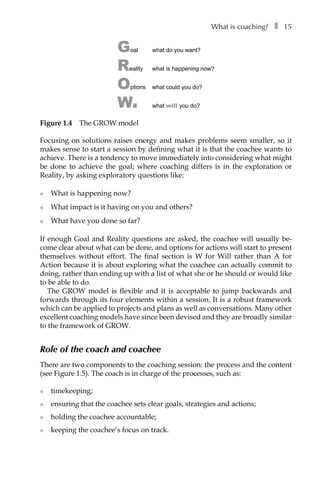
actions. The most well-known framework developed for coaching is the GROW
model, which was created by Sir John and his associates, and popularized
through his book:
What is coaching?â•… ❚â•… 15
Goal what do you want?
Reality what is happening now?
Options what could you do?
Will what will you do?
Figure 1.4â•… The GROW model
Focusing on solutions raises energy and makes problems seem smaller, so it
makes sense to start a session by defining what it is that the coachee wants to
achieve. There is a tendency to move immediately into considering what might
be done to achieve the goal; where coaching differs is in the exploration or
Reality, by asking exploratory questions like:
l	 What is happening now?
l	 What impact is it having on you and others?
l	 What have you done so far?
If enough Goal and Reality questions are asked, the coachee will usually be-
come clear about what can be done, and options for actions will start to present
themselves without effort. The final section is W for Will rather than A for
Action because it is about exploring what the coachee can actually commit to
doing, rather than ending up with a list of what she or he should or would like
to be able to do.
The GROW model is flexible and it is acceptable to jump backwards and
forwards through its four elements within a session. It is a robust framework
which can be applied to projects and plans as well as conversations. Many other
excellent coaching models have since been devised and they are broadly similar
to the framework of GROW.
Role of the coach and coachee
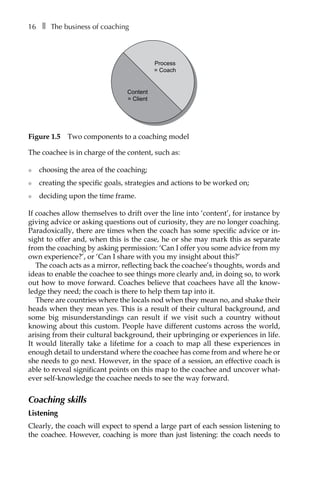
There are two components to the coaching session: the process and the content
(see Figure€1.5). The coach is in charge of the processes, such as:
l	 timekeeping;
l	 ensuring that the coachee sets clear goals, strategies and actions;
l	 holding the coachee accountable;
l	 keeping the coachee’s focus on track.
16â•… ❚â•… The business of coaching
The coachee is in charge of the content, such as:
l	 choosing the area of the coaching;
l	 creating the specific goals, strategies and actions to be worked on;
l	 deciding upon the time frame.
If coaches allow themselves to drift over the line into ‘content’, for instance by
giving advice or asking questions out of curiosity, they are no longer coaching.
Paradoxically, there are times when the coach has some specific advice or in-
sight to offer and, when this is the case, he or she may mark this as separate
from the coaching by asking permission: ‘Can I offer you some advice from my
own experience?’, or ‘Can I share with you my insight about this?’
The coach acts as a mirror, reflecting back the coachee’s thoughts, words and
ideas to enable the coachee to see things more clearly and, in doing so, to work
out how to move forward. Coaches believe that coachees have all the know�
ledge they need; the coach is there to help them tap into it.
There are countries where the locals nod when they mean no, and shake their
heads when they mean yes. This is a result of their cultural background, and
some big misunderstandings can result if we visit such a country without
knowing about this custom. People have different customs across the world,
arising from their cultural background, their upbringing or experiences in life.
It would literally take a lifetime for a coach to map all these experiences in
enough detail to understand where the coachee has come from and where he or
she needs to go next. However, in the space of a session, an effective coach is
able to reveal significant points on this map to the coachee and uncover what-
ever self-knowledge the coachee needs to see the way forward.
Coaching skills
Listening
Clearly, the coach will expect to spend a large part of each session listening to
the coachee. However, coaching is more than just listening: the coach needs to
Process
= Coach
Content
= Client
Figure 1.5â•… Two components to a coaching model
What is coaching?â•… ❚â•… 17
be active in the listening process through using the skills of questioning and
clarifying.
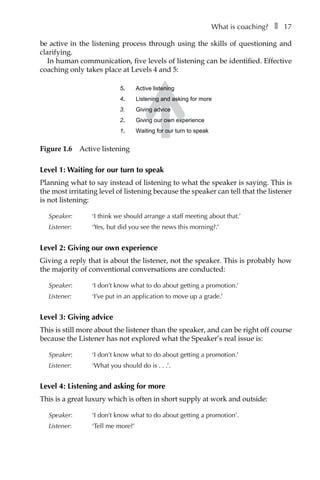
In human communication, five levels of listening can be identified. Effective
coaching only takes place at Levels 4 and 5:
5. Active listening
4. Listening and asking for more
3. Giving advice
2. Giving our own experience
1. Waiting for our turn to speak
Figure 1.6â•… Active listening
Level 1: Waiting for our turn to speak
Planning what to say instead of listening to what the speaker is saying. This is
the most irritating level of listening because the speaker can tell that the listener
is not listening:
Speaker: 	 ‘I think we should arrange a staff meeting about that.’
Listener: 	 ‘Yes, but did you see the news this morning?.’
Level 2: Giving our own experience
Giving a reply that is about the listener, not the speaker. This is probably how
the majority of conventional conversations are conducted:
Speaker: 	 ‘I don’t know what to do about getting a promotion.’
Listener: 	 ‘I’ve put in an application to move up a grade.’
Level 3: Giving advice
This is still more about the listener than the speaker, and can be right off course
because the Listener has not explored what the Speaker’s real issue is:
Speaker: 	 ‘I don’t know what to do about getting a promotion.’
Listener: 	 ‘What you should do is╛╛.╛╛.╛╛.’.
Level 4: Listening and asking for more
This is a great luxury which is often in short supply at work and outside:
Speaker: 	 ‘I don’t know what to do about getting a promotion’.
Listener: 	 ‘Tell me more?’
18â•… ❚â•… The business of coaching
Level 5: Active listening
The Speaker’s thought processes are helped by prompting and incisive
questioning:
Speaker: 	 ‘I don’t know what to do about getting a promotion.’
Listener: 	 ‘Tell me more╛╛.╛╛.╛╛.’
Speaker: 	 ‘I have to arrange a meeting with the boss and I never seem to find
the time to do it.’
Listener: 	 ‘What’s getting in the way?’
Speaker: 	 ‘Oh, I don’t know. I’m busy, or she’s busy. I don’t seem to be able to
stop long enough to work out how to do it.’
Listener: 	 ‘Is there anything else that’s stopping you?’
Speaker: 	 ‘Actually, I keep putting it off because I hate asking.’
Listener: 	 ‘And what do you hate about asking?’
Speaker: 	 ‘I’m afraid she will say no.’
In the example the speaker in the final exchange at Level 5 has gained an im�
portant new insight – that fear of rejection is the block, not lack of time. At best,
a coach listens at Level 5 throughout every session. This may sound like hard
work, but is in fact stimulating and energizing, rather like being in a game and
calculating how and when to return the ball.
Questioning
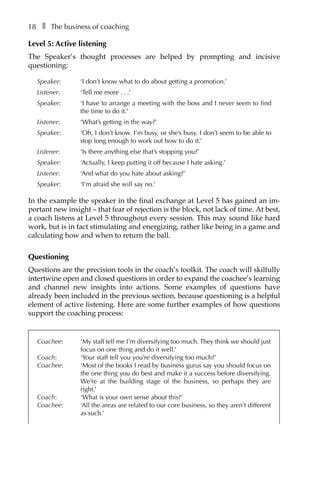
Questions are the precision tools in the coach’s toolkit. The coach will skilfully
intertwine open and closed questions in order to expand the coachee’s learning
and channel new insights into actions. Some examples of questions have
already been included in the previous section, because questioning is a helpful
element of active listening. Here are some further examples of how questions
support the coaching process:
Coachee: 	 ‘My staff tell me I’m diversifying too much. They think we should just
focus on one thing and do it well.’
Coach: 	 ‘Your staff tell you you’re diversifying too much?’
Coachee: 	 ‘Most of the books I read by business gurus say you should focus on
the one thing you do best and make it a success before diversifying.
We’re at the building stage of the business, so perhaps they are
right.’
Coach: 	 ‘What is your own sense about this?’
Coachee: 	 ‘All the areas are related to our core business, so they aren’t different
as such.’
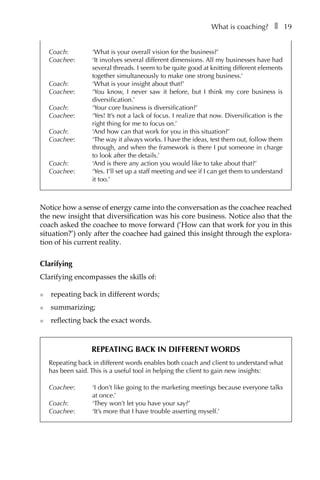
What is coaching?â•… ❚â•… 19
Coach: 	 ‘What is your overall vision for the business?’
Coachee: 	 ‘It involves several different dimensions. All my businesses have had
several threads. I seem to be quite good at knitting different elements
together simultaneously to make one strong business.’
Coach: 	 ‘What is your insight about that?’
Coachee: 	 ‘You know, I never saw it before, but I think my core business is
diversification.’
Coach: 	 ‘Your core business is diversification?’
Coachee: 	 ‘Yes! It’s not a lack of focus. I realize that now. Diversification is the
right thing for me to focus on.’
Coach: 	 ‘And how can that work for you in this situation?’
Coachee: 	 ‘The way it always works. I have the ideas, test them out, follow them
through, and when the framework is there I put someone in charge
to look after the details.’
Coach: 	 ‘And is there any action you would like to take about that?’
Coachee: 	 ‘Yes. I’ll set up a staff meeting and see if I can get them to understand
it too.’
Notice how a sense of energy came into the conversation as the coachee reached
the new insight that diversification was his core business. Notice also that the
coach asked the coachee to move forward (‘How can that work for you in this
situation?’) only after the coachee had gained this insight through the explora-
tion of his current reality.
Clarifying
Clarifying encompasses the skills of:
l	 repeating back in different words;
l	 summarizing;
l	 reflecting back the exact words.
Repeating back in different words
Repeating back in different words enables both coach and client to understand what
has been said. This is a useful tool in helping the client to gain new insights:
Coachee: 	 ‘I don’t like going to the marketing meetings because everyone talks
at once.’
Coach: 	 ‘They won’t let you have your say?’
Coachee: 	 ‘It’s more that I have trouble asserting myself.’
20â•… ❚â•… The business of coaching
Summarizing
Sometimes coachees get bogged down in story telling and detail. Shortening
what they have said is a polite way of interrupting and may also provide clarity
in the same way as the previous example:
Coachee: 	 ‘I’ve had the most awful day. I got stuck on the telephone, then the
train was late so I missed my connection. And I’d forgotten to charge
the mobile so╛╛.╛╛.╛╛.’.
Coach: 	 ‘Sounds like you had a calamitous start to the day. How are you feel-
ing now?’
Reflecting
Reflecting back a coachee’s exact words is one of the most powerful tools in
coaching. It affirms to coachees that they have been heard, that what they have
said is worth hearing, and that they can now move on:
Coachee: 	 ‘I want to replace a member of my team, but I’m not sure how to go
about it.’
Coach: 	 ‘You want to replace a member of your team, but you’re not sure how
to go about it?’
Coachee: 	 ‘Exactly!’
It may sound trite or awkward to a third-party listener, but coachees receive a
validation when they hear their own words coming from someone else and do
not usually notice anything unusual about the process.
Another reason for reflecting back is to ensure that both coach and coachee
are on the same cultural map, as we discussed earlier in this section.
Goals, strategies and actions
Goals
To be effective, a goal must be inspiring, challenging, measurable and have
a deadline. It must also resonate and be congruent with the coachee’s values
and personal culture. A goal with such qualities emanates a magnetism that
pulls the coachee towards it. One of the ways in which this works is through
the brain’s reticular activation system (RAS). This is the part of the brain that
screens out 99 per cent of life’s daily bombardment of the senses, allowing us
to notice only what is immediately useful. A goal featuring the qualities
specified above will embed itself into the subconscious and, through the RAS,
we will start to notice pointers along the way that we might otherwise have
missed.
People frequently find that once they know what they want (and to find out
is often the reason they hire a coach in the first place), extraordinary coinci-
dences seem to occur that bring their goal closer.
What is coaching?â•… ❚â•… 21
Strategies
One of the areas where a coach can be of greatest help is in strategic planning.
An effective coach ensures that all the essential groundwork is in place to
achieve the goal, always remembering that it is the coachee who must decide
what that groundwork will consist of. Strategies act like a ladder to take the
coachee up to the goals.
Actions
If strategies are a ladder, then actions are the rungs upon it. Setting actions in
coaching is quite different from setting them in ordinary life. Actions in the real
world are often regarded as chores that we tend to put off. A good coach will not
ask the coachee to set an action until that coachee has reached a new level of in-
sight. Once this is reached, the insight acts as a springboard catapulting the coachee
into action; indeed it would be hard to stop someone from taking action at this
point. The coach’s job here is simply to channel the coachee’s energy into suit-
able, challenging and productive actions, with deadlines for carrying them out.
A coach who can bring both structure and the principles of self-directed
learning to coaching is most likely to achieve great results. It also pays to re-
member that there is an underlying journey for the coachee: uncovering new
awareness and new insights, and changing deep-seated habits. At the end of a
series of sessions, it is often the case that whatever coachees have achieved in
terms of their goals, the result that they prize most highly is the new knowledge
they have gained about themselves along the way.
Coaching, counselling, psychotherapy and mentoring
Coaching draws its influences from, and stands on the shoulders of, a wide
range of disciplines, including counselling, management consultancy, personal
development and psychology. However, there are a number of core differences
that distinguish coaching from its related fields and these are most easily high-
lighted through the metaphor of driving a car:
l	 A therapist will explore what is stopping you driving your car.
l	 A counsellor will listen to your anxieties about the car.
l	 A mentor will share tips from his or her own experience of driving cars.
l	 A consultant will advise you on how to drive the car.
l	 A coach will encourage and support you in driving the car.
1. Coaching is forward focused
Coaching always focuses on moving the coachee forward. Counselling may be
more appropriate than coaching for, say, the newly bereaved who need to
22â•… ❚â•… The business of coaching
explore their grief over a period of time before moving on. Psychotherapy is a
broad field and is usually sought in order to fix a particular problem arising
from past trauma. Although the overall effect of both of these disciplines is
sometimes to move the client forward, it is not therapy or counselling’s primary
focus as is the case with coaching. While therapy may be about damage and
counselling about distress, coaching is about desire.
2. Coaching is coachee led
Psychotherapists sometimes use techniques that lead and influence the patient
and which could cause damage to the psyche if applied by an insufficiently
experienced practitioner. However, coaches should be trained not to lead,
judge, advise or influence their coachees. Their role is to respond to the desires
and expressed needs of their coachees, and to operate with the belief that the
coachee has all the required knowledge to solve his or her own problem. The
role of the coach is thus limited to one of a facilitator, unleashing the coachee’s
potential.
3. Coaching is about improving performance
The focus of coaching is about enhancing performance. In this sense, executive
and personal coaching are similar to sports coaching. As a result, a key feature of
coaching is behaviour, supported by cognition and motivation.
4. Coaching is not mentoring
Mentoring, while having similarities to coaching, is fundamentally different.
A mentor has experience in a particular field and imparts specific knowledge,
acting as adviser, counsellor, guide, tutor, or teacher. In contrast, the coach’s
role is not to advise but to assist coachees in uncovering their own knowledge
and skills and to facilitate coachees in becoming their own advisers.
The benefits of coaching
Coaching, when properly applied, can create win–win situations to the benefit
of all stakeholders. Potential outcomes of coaching – both short and long term
– can be identified at an individual, team, organizational and social level. The
key benefits for each level are specified below:
Individual level:
l	 better self-awareness and self-reflection;
l	 increased individual performance;
What is coaching?â•… ❚â•… 23
l	 higher motivation and commitment;
l	 better leadership skills;
l	 personal growth;
l	 higher quality of life/work–life balance;
l	 clarity in purpose and meaning;
l	 better management of change processes;
l	 improved communication and relationships;
l	 efficient implementation of acquired skills;
l	 sustainable form of personal development.
Team level:
l	 improved team efficiency/performance;
l	 clearer vision development and objectives;
l	 improved team spirit and conflict management;
l	 better communication and relationships;
l	 creating synergies;
l	 higher motivation;
l	 unleashing group potential.
Organizational level:
l	 improved organizational performance;
l	 higher profitability/ROI/productivity/sales;
l	 better staff motivation and retention;
l	 less absenteeism;
l	 buy-in to organizational values and behaviours;
l	 better flexibility/ability to change;
l	 more effective communication;
l	 open and productive organizational culture;
l	 realizing the learning organization;
l	 sustainable form of learning and development.
24â•… ❚â•… The business of coaching
Social level:
l	 successful company (with the associated classic benefits for society);
l	 positive role model for other organizations;
l	 promotion of ‘cleaner’ high performance;
l	 positive, wider impact on employees’ social environments;
l	 higher sustainability and corporate social responsibility (CSR).
The actual impact of a coaching intervention varies, of course, from case to case
and is influenced by a number of factors, for example organizational receptive-
ness or the coaching approach taken.
A key decision affecting the outcome of coaching is choosing the appropriate
level of implementation (see dimension 10, above), which can dictate the different
degrees of organizational penetration by coaching (see Bresser, 2005/2006, 2010).
Research evidence
While there is limited research, the evidence that is available confirms the bene�
fits of coaching.
On the level of quantitative evaluation/ROI
Despite the high complexity and difficulty of calculating precise return on in-
vestments (ROI) of coaching (see eg American Management Association, 2008:
16–17), some noticeable attempts in this area have been made: the return on
investment of coaching was measured at 529 per cent (and at an astonishing 788
per cent when including the financial benefits from employee retention) for a
coaching programme integral to a leadership programme implemented at
Nortel Networks (Anderson, Dauss and Mitsch, 2002; MetrixGlobal, 2005). The
Manchester study in 2001 (see Johnson, 2004) measured a return of 5.7 times
the initial investment for executive coaching, and one-to-one career coaching
produced an ROI of 100 per cent with enhanced staff retention (Skiffington
and Zeus, 2003). According to Dembkowski (2005), US studies go so far as to
indicate a possible ROI of up to 22:1.
Qualitative, perceptual evaluation of outcomes
There are plenty of research studies and company experiences documenting
a highly perceived value of coaching by organizations and people. Here are
some examples: according to the CIPD (2004) study in the UK, 99 per cent of the
organizations using coaching say that it can deliver tangible benefits to both
individuals and organizations. In Germany, 89 per cent of executives being
coached and 93 per cent of HR managers see coaching as a successful tool (Böning
What is coaching?â•… ❚â•… 25
and Fritschle, 2005; Heidrick and Struggles, 2004), and 99 per cent have a positive
attitude towards coaching according to another study (PEF, 2005). In Switzer�
land, 92 per cent confirm the beneficial impact of coaching (Mindmove, 2005).
Four out of five executives think they would benefit from coaching at
work and 93 per cent of managers believe coaching should be available to all
employees regardless of seniority (Industrial and Commercial Training, 2002).
Moreover, more than 70 per cent of HR professionals believe that coaching is
actually more effective than training courses as a means of changing behaviour
and improving the performance of senior executives and high-flyers (Training
Strategies for Tomorrow, 2003).
These and other findings make a strong case for coaching as a worthwhile
investment leading to potentially tremendous benefits. At the same time we
need to continue to develop our understanding of which coaching elements
specifically support these outcomes and to use this knowledge in refining coach-
ing practice and training. For this learning process, sound detachment and good
sense are needed to allow for realistic assessments of the impact of coaching.
References
American Management Association (2008) Coaching – A Global Study of Successful Practices,
www.amanet.org
Association for Coaching (2006) Coaching Definitions, www.associationforcoaching.com/
about/coachdef.htm
Anderson, M C, Dauss, C and Mitsch, B F (2002) The return-on-investment of executive
coaching, in Coaching for Extraordinary Results, ed J J Phillips and D Mitsch, ASTD,
pp€9↜–↜22
Böning, U and Fritschle, B (2005) Coaching fürs Business, managerSeminare, Bonn
Bresser, F (2005) The 12 dimensions of coaching, Coach the Coach, 15 and 16
Bresser, F (2005/2006) Best implementation of coaching in business, Coach the Coach,
Dec and Jan
Bresser, F (2008) The 12 dimensions of coaching, in Executive Coaching and Mentoring, ed
R S Wawge, The Icfai University Press, Hyderabad, India
Bresser, F (2010) The Global Business Guide for the Successful Use of Coaching in Organisations,
www.frank-bresser-consulting.com
CIPD (2004) Coaching and Buying Coaching Services, Chartered Institute of Personnel and
Development, London (www.cipd.co.uk)
Dembkowski, S (2005) Executive coaching – die 7 größten Vorurteile, www.coaching-
magazin.de, pp€1–↜5
Foster, M (2004) Enter the coach: executives learn to learn from the experts as change
sweeps across corporate Japan, ACCJ Journal, May, pp€28↜–↜33
Frank Bresser Consulting (2009) Global Coaching Survey 2008/2009 – Today’s Situation of
Coaching across the Globe, www.frank-bresser-consulting.com/globalcoachingsurvey.
html
Grant, A M (1999) Enhancing Performance through Coaching: The promise of CBT, Paper€
presented at the First State Conference of the Australian Association of Cognitive
Behaviour Therapy (NSW), Sydney
Heidrick and Struggles (2004) Führungskräfte. Manager mit Coaching. Wirtschaftswoche,
18, 04/2004, p 140
26â•… ❚â•… The business of coaching
ICF (2005) FAQs about coaching, www.coach-federation.org
Industrial and Commercial Training (2002) Managers urge wider use of coaching, 34 (6/7),
p 294
Johnson, H (2004) The ins and outs of executive coaching, Training, 41 (5), pp€36↜–↜41
MetrixGlobal (2005) Executive Briefing: Case study on the return on investment of executive
coaching, www.metrixglobal.net/images/pdfs/metrixglobal_coaching_roi_briefing.pdf
Mindmove (2005) MindMove Coachingmarktstudie, www.mindmove.ch/images/stories/
mgtsummary05.pdf
Passmore, J (2009) Diversity in Coaching, Kogan Page/Association for Coaching, London/
Philadelphia
PEF (2005) Forschungsbericht – Bedeutung und Einsatz von Coaching in der PersonalentÂ�
wicklung, www.pef.at/news.aspx
Rosinski, P (2003) Coaching across Cultures, Nicholas Brealey, London
Skiffington, S and Zeus, P (2003) Behavioural Coaching: How to build sustainable personal
and organizational strength, McGraw-Hill, Sydney
Training Strategies for Tomorrow (2003) When executive coaching fails to deliver, 17 (2),
pp€17↜–↜20
Whitmore, J (2009) Coaching for Performance, 4th edn, Nicholas Brealey, London
2
Coaching within
organizations
Katherine Tulpa (illustrations by Phillip Cornwall)
The need for the human touch
This chapter sets out to provide a framework, along with success factors, for
coaching within organizations. Written primarily for the executive/team coach
or companies providing coaching-related services, it is not intended to serve as
an extensive ‘how to’ guide, but one which will hopefully stimulate thinking
and promote good coaching practice.
In futurist John Naisbitt’s book Megatrends which inspired me while I was in
business school during the 1980s, there is a theme that can be viewed as a key
factor behind the remarkable growth and attraction of coaching, which is, ‘The more
high technology around us, the more the need for human touch’ (Naisbitt, 1982).
Naisbitt declared that in order for human beings to evolve, we need to find
greater ways to connect and find balance as society and technology accelerate.
In other words, become more high touch in a high-tech world.
Today, we find ourselves in an even quicker, more complex society, where
technology reaches most parts of the globe. Organizations need to take notice
of how they lead, develop and engage their stakeholders in a climate where
e-mails and remote ways of working can hamper effective communication.
We are in a society where many baby-boomers in white-collar jobs are feeling
tired, unfulfilled, or are looking for deeper meaning and purpose. A society
where the younger generation Y, or ‘millennials’ (born after 1979), are expected
to have higher, more demanding expectations of their employer than their
predecessors (Raines, 2002).
Added to this is an emerging need for employees to find more meaning at
work. This is highlighted in research (Penna, 2005) indicating that employers
who create an environment that promotes a greater sense of ‘self’, community
and challenge that is ‘more than just a job’ will help to increase motivation,
loyalty and staff productivity. Also, there are the questions that have arisen out
of the recent economic downturn, requesting a new form of leadership.
	 27
28â•… ❚â•… The business of coaching
So what do these trends have to do with coaching? If you accept that profes-
sionals and leaders in our high-tech world will need to further connect with
themselves and others in their quest for deeper meaning, balance and success,
then this is both an opportunity and a role for coaches and coaching providers
working within organizations.
Additionally, this creates a responsibility. As the emerging coaching profes-
sion on a global scale is still in its early growth stages, those now within it are
pioneers. Our actions and ways of working will help to shape and harness the
uptake of coaching services in decades to come. Our profession will hopefully
be one that is not only sustainable and models excellence, but continues to
provide a human touch to help our clients evolve and achieve significant,
lasting change.
Organizational coaching framework
Successful coaching within organizations goes far beyond the quality of the
delivery. When coaching was in the early adapter stage, there may have been more
scope where the external coach and the executive could go off into a private
room somewhere, enjoy six months of coaching or one-to-one professional
development, then conclude the sessions with little or no reporting back to the
sponsor or line manager.
Now, however, the tides are changing. Coaching, along with its perceived
benefits, is much more visible across the organization; it is no longer mainly a
1:1 intervention for the most senior executives. Team coaching, along with
coaching skills programmes, continues to grow in popularity. Within the UK,
for instance, up to 90 per cent of organizations are now using coaching, in some
capacity(CIPD,2009).WhiletherearevariancesacrossEurope(TulpaandBresser,
2009) as well as other parts of the world, indicators are reinforcing that coaching
has become, or is on track to become, mainstream. Many within the profession are
pleased we are in this dynamic period, for this is where alliances form to benefit
all parties involved and ensure acceptable levels of standards are achieved.
As demand and usage increase, this is also resulting in organizations, in parti�
cular those driving leadership, talent or learning and development programmes,
bringing in more formal coaching processes and measurements. Today, there
are examples – in particular within larger, global organizations which have estabÂ�
lished coaching as a strategic initiative – which have set up more consistent
ways of working. These organizations are further up the growth curve.
Therefore, as coaching grows in demand, this also creates greater pressure,
in particular for the buyers or sponsors of coaching within organizations, to
investigate how they procure coaching services, how they manage them, and
how they measure them. According to the CIPD (2004), the key challenges facing
HR practitioners are:
l	 integrating coaching with the bigger picture;
l	 opening ‘closed doors’;
Coaching within organizationsâ•… ❚â•… 29
l	 meeting the needs of both the organization and the individual;
l	 information flow and confidentiality;
l	 scoping and controlling costs.
Discussions with coaching professionals and buyers of coaching suggest that
challenges occur when the coaching programme or group intervention is un�
focused; the right chemistry or ‘fit’ between the coach, coachee and company
culture isn’t there; or there are unclear communications as to the purpose of the
programme, the way it was ‘sold in’, or what the outcomes are.
These are issues that will not go away immediately, but over time coaches
and providers of these services can adapt their approach to be more systemic,
thereby helping to close the gap and meet their client’s needs. My personal
view is that if we want to make a real difference and stay within the organiza-
tional coaching arena, as coaches we will need to master our game and stretch
ourselves to have greater discipline. This includes aligning with the needs of
not just the coachee, but also his or her manager, the sponsor and organization
as a whole.
There is one more dimension, which is for the coach or provider to choose
and align their services with clients that are most appropriate to their personal/
business requirements. When the fit is right, this is highly energizing and one
where there is the most added value. When it’s not, this can deplete not only
their energy and focus, but those of others, too. Having the courage to say ‘no’
at times is not only acceptable, but good practice.
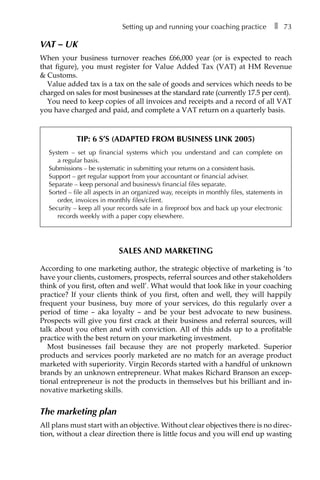
Taken into account these points, I have illustrated an organizational coaching
framework (OCF) that looks to address some of these issues, as well as other
areas for successful coaching within organizations (see Figure€2.1).
ORGANIZATIONAL COACHING
FRAMEWORK (OCF)
Contracting
Delivering Success
Creating Alignment
Ensuring Focus
Building the Business Case
Figure 2.1â•… Organization coaching framework (OCF)
30â•… ❚â•… The business of coaching
The content of the framework will be explained in further detail in the rest of
the chapter; however, as an overview, the main sub-headings are:
1.	 Building the business case
–	 systemic profiling;
–	 key challenges;
–	 gain commitment.
2.	 Ensuring focus
–	 maintain drive;
–	 identify stakeholders;
–	 clarify business drivers.
3.	 Creating alignment
–	 establish aims;
–	 matching criteria;
–	 best fit teams.
4.	 Contracting
–	 goals and outcomes;
–	 agreements;
–	 commitments.
5.	 Delivering success
–	 build confidence;
–	 solicit feedback;
–	 measure value.
1. Building the business case
In Chapter 1, the role of the coach, coaching definitions, the business return on
investment and the potential outcomes at the individual, team and organiza-
tional levels were described. These are useful as a baseline of knowledge when
meeting with potential clients.
To expand upon this, this section looks at helping organizations understand
and buy into the real value of coaching. As there are still organizations that are
not clear on what coaching is, helping the sponsor appreciate the business case
will increase the likelihood of coaching being used as an effective tool for leader�
ship and as a compliment to other human resource interventions. Figure€2.2
looks at the stages involved in building the business case.
Systemic profiling
Two of the fundamental principles of attracting and working with the right
kind of clients for the coach’s or provider’s business are: 1) knowing where
Coaching within organizationsâ•… ❚â•… 31
to target, and 2) taking a systemic perspective. These can be referred to as
‘systemic profiling’. One way of defining systemic is ‘complete’ or looking at a
situation in its entirety. Like an investigative reporter, it involves discovering
information from all angles, with a number of radars, and not accepting the first
lead as truth.
On a practical level, the first step to building the business case is for the coach
or provider to justify to themselves ‘why’ they are choosing to work with a
particular organization. In other words, stepping back and identifying that the
prospect or client is aligned with their vision, service offerings, capabilities and
passions.
As we’re currently in a market where there is more overall supply than
demand, it’s easy for the coaching professional to adopt the ‘I’ll take what I can
get’ approach. However, this can be very stressful, and from a marketing
perspective, not very strategic.
In what areas of your business can you carry out systemic profiling?
Once the coach or provider has satisfied their criteria, this will not only
give them further clarity, but help them know where to target and provide
further choice. Like good coaching, it all starts with self-awareness – my
suggestion here is that a coach/provider will also need self-awareness for their
business.
Key challenges
When identifying ‘best fit’ clients, it may also be useful to investigate the client
organization’s vision, size, budgets, reporting lines and offerings, as well as its
culture, attitudes and past experiences with coaching. A company website will
give a snapshot view; the rest can come from taking a coaching approach in
meetings with them.
Through the art of developing rapport, listening, asking power questions and
giving feedback, a client will normally readily give this information. By taking
the coaching approach, the sponsor will begin to share with you their goals and
Systemic Profiling
Key Challenges
Gain Commitment
Building the Business Case
Figure 2.2â•… Building the business case
32â•… ❚â•… The business of coaching
challenges, and embrace any support the coach/provider can give them in
building the business case for coaching.
For others who are less receptive, it’s useful to enter into discussions about
their key challenges. These can be further drawn out by asking SPIN™ (situÂ�
ational, problem, implication, needs payoff↜) questions (Huthwaite, Inc). Typical
challenges are listed in Figure€2.3.
Once the organizational challenges are unravelled, the client’s level of aware-
ness is raised and they form a basis for entering into discussions on how
coaching may help.
Gain commitment
After coaching has been established as an appropriate tool for the client’s
needs, and they understand some of the benefits and what it can help them
achieve, the last stage is gaining commitment. Note, the goal here is to establish
an appropriate ‘next step’ (not necessarily to close the deal).
Again, this is where a coach’s natural coaching skills are useful, as working
with a sponsor to commit to a goal or course of action is not that different from
working with a coachee. Commitment is defined as follows: ‘the act of binding
yourself (intellectually or emotionally) to a course of action’ (Princeton
University, 2003).
A prospective client will more than likely be making emotional decisions,
rational decisions, or a combination of both. For those familiar with the Myers–
Briggs Type Indicator (MBTI®), for instance, or some of the techniques used in
Appreciative Inquiry (ie building on strengths, ‘what works’), among others,
these can be useful when trying to gain greater understanding or influence a client.
1. Keeping employees motivated during change
2. Giving our leaders and managers further skills to support the strategy
3. Moving from a transactional (or task-based) culture to transformational
4. Having our people stay focused during a sluggish market/ low performance
5. Finding ways to build leadership capabilities, innovation and strategic thinking
6. Retaining our best people in a competitive market
7. Discovering ways to reduce stress and increase team morale
8. Identifying ways to engage our people with the company's vision and values
Figure 2.3â•… Key challenges
Coaching within organizationsâ•… ❚â•… 33
What’s important is to draw out options and possibilities from the client, eg
‘What could building a coaching culture at XYZ lead to?’, so they can witness
and experience first hand what coaching is about. From here it is useful to guide
them into action, which can result in a commitment to an outcome and, if
relevant, supporting them for their coaching needs.
2. Ensuring focus
This section explains ways to keep up the momentum gained from your initial
client meetings, identify key stakeholders and, most importantly, clarify the
organization’s aims and objectives.
In the previous section, the focus was on getting to understand both the
coach’s/provider’s and the client’s needs (at this point, the sponsor or first
point of contact within the organization). Note, there is still not an emphasis on
aiming to promote or sell ‘offerings’, as this will evolve naturally as the coach
goes through the rest of the process.
Maintain the drive
By this stage, there should have been some encouraging conversations with the
sponsor and they have committed to a next step. So how does the coach main-
tain the drive?
One perspective is to continue with normal coaching delivery (the comfort
zone), and if the sponsor likes the coach, they will call – after all, ‘one wouldn’t
want to appear too pushy!’ Another perspective is take a proactive view, stay-
ing close to the client and exploring ways to support them – an approach that
models behaviours one would have with any coachee.
Many coaches love the delivery part of the business, but dread the ‘selling’ aspects.
To overcome this block, if they can reframe their thinking and continue to focus
their energy on the three key activities illustrated in the ‘Building the business
case’ section and in Figure€2.4, this will help maintain the drive with the client.
There is a fourth activity too, which is important to our profession: being
abundant. By taking an approach to serve, the universe has a wonderful way of
giving back.
At this juncture, it’s a matter of the coach taking responsibility and staying
focused on helping the sponsor achieve their aims. By becoming a true partner,
1. Know your company’s requirements, challenges and strengths
2. Understand your client’s requirements, challenges and strengths
3. Take a coach approach eg developing rapport, effective listening, powerful
questioning, giving honest feedback
Figure 2.4â•… Key activities
34â•… ❚â•… The business of coaching
a coach who is abundant and shares their knowledge at the front-end can help
set their service apart from others.
Identify stakeholders
To help ensure focus and support a sponsor in bringing in a successful coaching
programme, it’s useful to identify key stakeholders as part of an overall delivery
plan. Taking a systemic view and looking at all those affected by the initiative
will help the coach and the organizational sponsor adopt strategies for greater
buy-in, understanding and communication throughout the process. Figure€2.5
indicates key stakeholder groups.
For smaller programmes, this is a simpler exercise, as there are fewer implica-
tions and risks. For larger initiatives, which can be time consuming and costly,
the needs of the key influencers and decision makers need to be considered.
Getting the boss and/or most senior leader involved at the outset is vital, to
gain top-down support.
At this time, it may be useful to discuss budgets, timelines, other talent, leader�
ship or change initiatives planned, and any other agendas or priorities
that could have an impact on the programme’s success. At this stage, too, if
the sponsor asks for a proposal, you may wish to defer this until there is further
understanding of the drivers, purpose and aims.
Clarify business drivers
There is widespread agreement that successful coaching within organizations
needs to be strongly linked to the overall strategy and business drivers. This can
Peers
Boss
MD/CEO
Procurement
Clients
Marketing
Direct
Reports
Coachee
Coach
Coach’s
Colleagues
Human
Resources/
L&D
Figure 2.5â•… Key stakeholder groups
Coaching within organizationsâ•… ❚â•… 35
be a challenge where the strategy is not always clear among the leadership
teams, let alone those beneath them.
With that said, in order for coaching to continue to thrive, in particular as
uptake increases, it needs to show a return on investment. While we wouldn’t
want to lose the magic of what the human touch offers, which is invaluable, the
profession is indeed getting pressure to measure how our services impact the
organization’s bottom-line performance. In later chapters of this book, we refer
to further ways this can be done.
Some executive coaches, too, who also work in the leadership and organiza-
tional development domain, can help their clients shape and articulate their
strategies. For others, whose expertise is in pure forms of coaching, it may be
useful to start asking questions to clarify what the company’s business drivers
and, equally, the priorities are. People within the identified stakeholder groups
can be a great source of answers.
This quote from the Thin Book of Appreciative Inquiry may inspire coaches and
providers to ask the wider questions: ‘The act of asking questions of an organÂ�
ization or group influences the group in some way’ (Hammond, 1996).
3. Creating alignment
This section focuses on the third dimension of the OCF – creating alignment –
which helps to align the coaching programme and matching process with the
needs of the coachee (individual or team), the coach and the business (Figure€2.6).
There is no doubt that coaching, when done well, can make a difference to an
individual’s leadership, management and communication skills (CompassPoint
Non Profit Services, 2003) as well as increase confidence and job motivation
(Association for Coaching, 2004). The CIPD (2004) training and development
survey also states, ‘when coaching is managed effectively, it can have a positive
Of Needs
Business Needs
Coach’s/
Provider’s Needs
Individual/
Team’s Needs
= valuable
Organizational
Coaching
Alignment
Figure 2.6â•… Creating alignment
36â•… ❚â•… The business of coaching
impact on the organization’s bottom line’. The double benefits of coaching, for
the individual and the organization, are now being evidenced in numerous
studies (Grant et al, 2010).
Establish aims
To make a difference to the organization involves creating alignment, which
begins by establishing the aims and objectives, key messages, positioning, what
the coaching is for, and internal selection criteria. It’s also a good opportunity to
reinforce the benefits, and to discuss potential pitfalls and success factors, and
how a coaching approach can manifest cultural change.
To do this successfully, it’s useful to facilitate a design meeting with the
identified stakeholders, linking in the key challenges, business strategy, and
other talent and leadership initiatives. If the group doesn’t have all the answers,
that’s ok, as this is where a coach can bring in their knowledge, where required.
The purpose is to gain clarity and buy-in from all those who can be ambassadors
of the programme, to ensure it gets a first-class start. ‘The most valuable coach-
ing fosters cultural change for the benefit of the organization’ (Sherman and
Freas, 2004).
Matching criteria
Once the overall programme has been approved (usually a client will request a
proposal to confirm the aims, content and fees) and the coach has helped the
client set up a clear and upbeat communications plan (see ‘build confidence’),
the next stage is making sure a coach’s skills and experience are aligned with
the needs of the individuals or teams participating.
A number of organizations and clients that are large users of coaching recog-
nize the value of developing a diverse and rich talent pool of coaches and pro-
viders who can accommodate the individual needs and preferences of their
executive and managers. In other words, a consistent message is that one size
doesn’t fit all, with the matching process being one of the biggest challenges
and an area it’s possible to ‘get it wrong’.
As coaches or providers, the more they can do to help their clients with this
concern, the better aligned they will be with their requirements. Figure€ 2.7
shows a model that can be used by both organizations and providers when
trying to create a match.
The model recognizes that a good coach, in addition to tangible expertise and
credibility, also needs to possess the intangible skills of influence and authenticity.
For selecting tangible skills, some organizations have set up coach-matching
systems which help managers select a company-approved coach or provider
based on their expertise, preferences (eg face-to-face, location) and other search
criteria (eg development need). Figure€2.8 displays components for selecting a
coach based on expertise.
However, as with most technologies and hard data, this does not replace the
need for the human perspective. Usually this means a face-to-face meeting with
Coaching within organizationsâ•… ❚â•… 37
the manager, where the right fit is also based on instinct, the quality of the rela-
tionship and other intangibles.
Best fit teams
The concept of best fit teams is one where coaches meet with their prospective
coachee for the first time to determine their needs, with the outcome being to
Matching Criteria
EXPERTISE
(experience & qualifications)
INFLUENCE
(communication, style,
relationship)
CREDIBILITY
(proven success, 'real'
insight)
AUTHENTICITY
(self-awareness, alignment)
Creating Alignment
Figure 2.7â•… Matching criteria
- breadth & depth of coaching
- one to one, groups or both
- at which levels, how long
EXPERTISE
(experience & qualification)
- models & approach
- academic or applied learning
- accredited by independent body
- worked on an Exec Team?
- line management experience
- entrepreneur: running a business
- industry-related experience
- degree in discipline
- assessment capabilities
- member of professional body
- recent cpd, in supervision
Professional Qualifications
Coaching Experience
Coaching Qualifications
Business Experience
Figure 2.8â•… Selecting a coach
38â•… ❚â•… The business of coaching
establish whether there is a best fit. Many organizations call this a ‘chemistry’,
or briefing meeting.
Because coaching is both a relationship and a partnership, an initial briefing
is extremely valuable, for it needs to work from both ends. The main point
during this process is for the coach to be honest about their experience and
capabilities. It’s also useful for the coach to remember that the coachee is buying
into the ‘whole’ coach, not just their profile and knowledge base.
Taking a coaching approach during the meeting will help gain greater under-
standing for both the coach and the coachee. It’s also useful to discuss clear
ways of working, models used, and types of clients that have best suited the
coach’s style, and in what scenarios. This is all very useful information for both
parties to determine whether there is a good fit.
There are times when coaches are not a good match for their skills and pre�
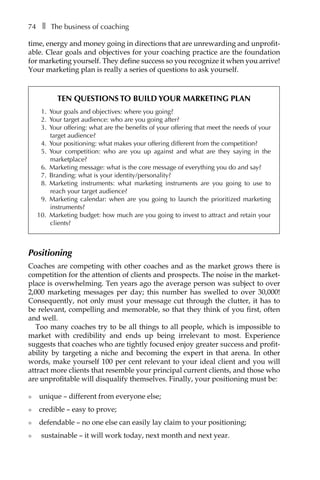
ferences; when this occurs, it’s best to hold up their hand. An ‘even better’ way
is to provide an organization with recommendations to source a more appro-
priate coach.
4. Contracting
Once there is agreement of fit, the coach/provider has been selected and the
coaching needs are aligned with the business, the next stage is contracting.
Sherman and Freas (2004) define contracting in the context of effective coaching
as follows: ‘By “contracting” we mean not just documenting the legal and financial
aspects of coaching, but also defining the goals, roles, and account�ability of each
party. It works when each term gains the uncoerced agreement of all concerned:
client, coach, and coachee.’ Furthermore, successful contracting sets the psycho-
logical contract, while helping to define the outcomes, set realistic expectations
and discuss ‘what if’ scenarios. The ultimate aim is to pave the way for a rich,
highly rewarding learning experience, where all parties see the end results –
one where communication and openness are a common thread throughout.
Goals and outcomes
To manage expectations, prior to the contracting session it’s useful for the coach
to contact their coachee to explain the purpose of the contracting session, who
will be attending, and what to expect. So that they have a chance to reflect on their
programme goals, it’s also useful to send them a draft ‘learning agreement’
prior to the session, which may include:
l	 company aims;
l	 business goals (eg team, career);
l	 development areas;
l	 desired outcomes;
l	 any previous assessments/feedback.
Coaching within organizationsâ•… ❚â•… 39
At the session, these are discussed with all parties, which typically include
the coach, the coachee (executive or manager) and their boss and/or sponsor
(eg HR, Learning & Development).
The role of the coach is to facilitate the process and to encourage open
feedback, where typically the goals, outcomes and priorities of the coachee’s
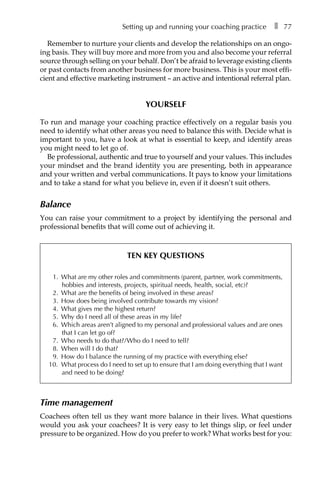
develop�ment programme are discussed. The group will also need to conclude
that these goals are congruent and integrate with the company strategy, key
drivers and aims.
Although the group shares the responsibility – often referred to as a ‘triangular
relationship’ – the role of the facilitator is to check to make sure the goals and
desired outcomes are realistic and that there are mutual clarity and under�
standing, and to listen intently, as terminology and the team’s ‘interference’
(Gallwey, 2000) can sometimes get in the way.
Agreements
After the goals and outcomes are clearly defined, the next step in the contract-
ing stage is to discuss and agree the terms. Acknowledging that the programme
is an investment in the executive or manager’s development, fully backed by
the company, helps set the tone for the level of responsibility required by all
parties. It’s also useful to have a one-page overview of the draft terms at hand,
to be finalized at the session.
Figure€2.9, adapted from Coaching in Organizations (Association for Coaching,
2004), provides some guidelines. One area worth highlighting is confidentiality.
There are different views on this. Some professionals feel that any feedback
being reported to the manager or sponsor needs to come directly from the
coachee so that it doesn’t jeopardize the amount of self-disclosure and trust
F
1. Terms of relationships – coaching involves the coach, coachee and the sponsor paying for
the coaching and/or the line manager
2. Organization of sessions – location, length and frequency, along with what basis contact is
made between sessions
3. Commitment to sessions – is the assignment based on a flexible or open-ended programme,
or a fixed number of sessions
4. Review dates – agreed measurements and timescales, along with specifying the stakeholders
involved in the review
5. Other participants and roles – roles to be specified and agreed
6. Boundaries – this links with confidentiality and should identify the purpose of the coach’s role
and therefore boundaries of the relationship
7. Cancellation and payment terms – understanding of fees, policies and agreements
(NB If this is a part of an overall programme, it may be appropriate to discuss separately)
8. Confidentiality – basics include:
– existing organization confidentiality agreements will be adhered to by the coach
– the coach should be part of a professional association and abide by a code of ethics,
not revealing any personal information
– the sponsor recognizes the right to confidentiality but may ask for some
success measures
igure 2.9â•… Guidelines for agreeing contracting terms
40â•… ❚â•… The business of coaching
required for effective coaching. Other views are that, while issues of confidential�
ity still need to be maintained, the client or organization is part of the coaching
relationship, so a degree of reporting back is essential. This is to help support
the coachee’s progress and learning objectives, as well as the overall programme
success. It’s also a view of the Association for Coaching (2004).
So how does this work in reality? A way to handle this is to discuss in the
contracting session the types of information that will be disclosed, at which
levels, by whom, and how often. What’s important is that all parties are trans-
parent and very comfortable with what’s agreed, paying close attention to the
views of the coachee.
Commitments
After the goals and agreements are in place, the last step is to confirm the levels
of commitment to the programme. This is where it is helpful to allow time for
questions and discuss ‘what if’ scenarios, the promises of each party member,
and programme success factors. Here are some typical ‘what if’ questions, as
possible discussion points:
l	 What happens if there is a change of goals?
l	 What happens if, after all this coaching, ‘x’ decides to leave us?
l	 What happens if I require a different style of coach halfway through the
programme?
l	 What happens if I want additional coaching for my team outside the pro-
gramme parameters?
l	 What happens if I find it hard to make the time in my diary?
l	 What will a successful coaching programme look like?
l	 What does each of us in this room need to commit to?
There are other questions that may arise, but the important thing is that the
group discusses and agrees how to respond to these, rather than the coach
feeling a need to provide the solutions. Like good coaching, this helps to gain
commitment.
5. Delivering success
By this time, the coach is finally at a stage to do some delivery of coaching –
whether it’s at the executive, manager or individual level, or working with
teams. They have also built a strong foundation based on achieving clarity, focus
and alignment. This last section looks at how to sustain and deliver success
by working with all stakeholders within the programme to build confidence,
solicit feedback and measure value.
Coaching within organizationsâ•… ❚â•… 41
Build confidence
At the very heart of coaching is a core quality that permeates the entire coaching
process – building confidence. Whether this is coaching an individual at a reme-
dial level, a leader at a transformational level or a group at an organizational
level, when people or teams are looking to reach into the horizon, coaches need
confidence in ample supply.
To fuel confidence, our inner power, requires a total belief, trust and respect
in not only self, but the client. In ‘Coaching for influence and impact’ (Tulpa,
2005), a person’s Centre of Power™ is one that ‘inspires, engages, ignites and
creates change’: ‘If coaches take a systemic view, in that coaching is what goes
on in the space between the coach, coachee and organization, then what can
happen if not only coaches are able to connect with our inner power, but also
the manager/leader and the organization?’
Building confidence starts off by giving self and a client permission not to shy
away from success stories. For every manager or leader that is coached, asking
themtotellastoryoftheirexperiencecanbeextremelybeneficial.Communication
and confidence are partners – to create larger ripples across the organization, a
coaching or leadership initiative needs to be communicated widely, and often.
The real impact will come when it has top-down support. When the CEO or
leader going through coaching with their team can endorse the programme,
there is a greater likelihood of success. When it’s seen as a reward for high per-
formers, and helping them become even more successful, it helps to build the
case for coaching and create a pull rather than a push.
Solicit feedback
Exchanging success stories isn’t the only aspect of communication. To be able to
deliver a successful coaching programme, adapt it appropriately and increase
the coachee’s learning, soliciting feedback is a key activity.
Beyond using individual assessment and 360° tools (multi-rater feedback),
there are additional methods you can apply, including:
l	 shadow coaching;
l	 face-to-face feedback;
l	 group feedback sessions;
l	 organizational surveys;
l	 learning surveys (for the coach);
l	 co-coaching forums;
l	 informal feedback forums;
l	 client roundtables;
l	 coaching evaluation forms.
42â•… ❚â•… The business of coaching
Treating the programme as one that touches and impacts various stakeholders
across the organization (see Figure€2.5) can help a coach select the type required.
The main points to consider are ethics: 1) adhering to confidentialities, 2) solicit-
ing feedback on a volunteer basis only, and 3) following up with all those to whom
it pertains in a specific and timely manner.
Measure value
In the introduction, I spoke about how coaching can help add a human touch to
an increasingly detached world. I’ve also used the word ‘value’, one that goes
beyond coaching delivery and delights all people that coaches ‘touch’ within the
organization – the impact can be far and wide.
In Chapter 1, reference is made to ROI studies on organizational coaching.
While the results for organizations are evident, and we need to continue to
monitor this, it is the coachees – individuals and teams – who have gone through
the coaching experience and are the ones measuring the value. They see first-
hand the effects that coaching has on their skills and performance, which can
leave an imprint at a deeper level.
Also, based on usage figures and commitment to spend from organizations
that have seen first-hand the impression it can make on their people, coaching
appears here to stay. In 2004, coaching expenditure in the United States was
estimated at $1 billion per annum (Sherman and Freas, 2004), and there are now
indicators that this figure has more than doubled as coaching expands globally
as a key development tool for increasing performance.
That’s not to say we don’t have our work cut out for us – delivering value to
an often complex organization is not an easy task. Green and Grant (2003) give
a broader view of today’s modern organization: ‘An organization is a dynamic
system. It is a growing, changing group of people and connections. Patterns
emerge, the shape changes, only one thing is certain, it cannot remain the
same.’
While we can never control a system’s response to a change, we can be mind-
ful of the currents and help to inspire and support our clients’ development
journeys as we ‘ride the wave of change’ (Tulpa, 2004).
References
Association for Coaching (2004) Summary Report: ROI from corporate coaching, http://
www.associationforcoaching.com
CIPD (2004) Coaching and Buyers Guide, CIPD, London
CIPD (2009) Taking the Temperature of Coaching, Summer, London, www.cipd.co.uk
CompassPoint Non Profit Services (2003) Executive Coaching Project: Evaluation of findings
(based on a study by Harder + Company Community Research), http://www.com-
passpoint.org
Gallwey, T W (2000) The Inner Game of Work, Orion Business, London
Grant, A M, Passmore, J, Cavanagh, M and Parker, H (2010) The state of play in coach-
ing, International Review of Industrial & Organizational Psychology, 25, pp 125↜–↜68
Green, J and Grant, A (2003) Solution-focused Coaching, Pearson, London
Coaching within organizationsâ•… ❚â•… 43
Hammond, S A (1996) The Thin Book of Appreciative Inquiry, Bend, OR
Naisbitt, J (1982) Megatrends, Warner Books, New York
Penna plc (2005) Meaning at Work (based on Research by Roffey Park), http://www.e-
penna.com
Princeton University (2003) WorldNet 2.0, ‘commitment’, http://dictionary.reference.com
Raines, C (2002) Managing Millennials, Generations at Work, www.generationsatwork.com
Sherman, S and Freas, A (2004) The wild west of executive coaching, Harvard Business
Review, www.hbr.org
Tulpa, K (2004) ‘Ride the wave of change’, welcoming address, Association for Coaching
International Conference, London
Tulpa, K (2005) Coaching for influence and impact, Coach the Coach, 17
Tulpa, K and Bresser, F (2009) Coaching in Europe, in Diversity in London: Working with
gender, culture, race and age, ed J Passmore, Kogan Page, London
3
Leveraging the coaching
investment
Katherine Tulpa
Introduction
Coaching’s contribution to the performance of teams, individuals and organiza-
tions is no longer questioned, with up to 90 per cent taking place in organiza-
tions (CIPD, 2009) in one form or another. In many cases, coaching is the most
accepted form of development, as executive coaching (1:1, team) and coaching
skills programmes, such as ‘manager as coach’, continue to be rolled out as
organizations look to build coaching cultures to drive performance.
The questions, therefore, that are now being asked from leaders/consultants
(or ‘sponsors’) involved in leading an organization’s coaching investment are:
‘How do we lead and manage the significant investment?’ and ‘How do we
ensure it is strategic and that each coaching maximizes business performance?’
In this chapter, the aim is to endeavour to respond to these questions, with
a particular emphasis on getting the best when bringing in external coaches/
providers, as opposed to internally led initiatives (although some of the
same principles apply). To enable sponsors in achieving the best, and provide
a strategic framework with accompanying best practice principles, to both
challenge and stimulate the thinking and practice in this area.
The strategic framework shared is based primarily on experiences of working
with a number of global organizations involved significantly in coaching. This
is based on roles as coach assessor and coach/provider, as well as interviewing
a number of organizational sponsors leading the way in this area.
Strategic framework for leveraging
external coaching
In putting together the framework, considerations have been made for the key
elements that require the sponsor’s attention, if the desired outcome is to ensure
44â•…
Leveraging the coaching investmentâ•… ❚â•… 45
that the organization is leveraging its strategic external coaching investment
(Figure€3.1).
The key assumptions to this framework are:
1.	 The organization’s focus is on performance coaching vs remedial coaching.
When using the term ‘performance coaching’, this explicitly means coach-
ing that is focused on fast tracking the performance of an individual, group
of individuals or teams, for the purpose of increasing organizational
performance.
2.	 The framework is dynamic and not intended to be a point-by-point guide.
As readers engage with the different elements of the framework and
review the framework holistically, the aim is that it will provoke and
stimulate the development of the approach they are recommending and/or
implementing.
Defining the
Coaching
Requirements
* Strategic Coaching
Definition
* Best Practice
Guidelines
* Defining Selection
Criteria & Process
Environment
* Performance
Context
* Business ‘Story’
* Inspiring Outcomes
Engagement
* Key Stakeholders
* Learning & Dialogue
Platform
* Partnership & Relationships
Coach Selection and
Appointment
* Guiding Principles
* Contracting with
the Market
* Key Success
Factors
Embedding Best
Practice
* Performance
Management
* Ongoing
Governance
* Evaluation
Considering
External Market
Trends
* Coaching/Other
Professions
* Global Integration
* Sustainability
Figure 3.1â•… Strategic framework for leveraging external coaching
46â•… ❚â•… The business of coaching
Therefore, the proposed strategic framework, along with the recommended
principles, is for a) organizations wishing to deliver greater organizational per-
formance from the existing external coaching investment; or b) those embark-
ing on a significant development approach, where performance coaching is a
key part of the recommended learning intervention.
It is encouraged that the framework is used in a way that is integrated with
the company’s overall organizational development (OD) strategy. This is not only
good practice, but commercially makes sense if sponsors are to drive optimum
organizational performance through their external coaching investment.
Environment
As organizations continue to use external coaching to build a diverse range of
capability, the more they need to focus on creating the right environment for
coaching to succeed.
Creating the right environment requires setting high expectations on the
financial investment, along with the anticipated results, so that there is more
opportunity to leverage the external coach spend and the significant benefits
that coaching can bring. It also requires the sponsor and key ambassadors (in-
ternally and externally) taking the time to proactively educate all stakeholders
on ‘what good looks like’ throughout.
There are key areas of focus in order to cultivate this environment and achieve
the greatest impact for the business. This includes the performance context, the
business ‘story’, and inspiring outcomes, outlined in the sections below.
Performance context
Many organizations leave the briefings for the external coaching to the indi-
viduals or teams being coached. While this provides important context for the
coaching, it is only part of the equation. What is often missing is the broader
frame of reference, or greater understanding of the business environment,
which can help coaches perform at their optimal abilities.
This knowledge, called here the ‘performance context’, is one of the benefits
that internal coaching can bring; however, with further briefings and communi-
cation, there is no reason why this information cannot be shared with those
within the coaching pool made up of external coaches/providers.
It is also recommended that sponsors take the lead on this, being proactive
in de�fining this performance context, and communicate this to external coaches
on an ongoing basis. This will enable the external coaches to focus and deliver
within the broader environment, as well as the individual and team coaching
context – therefore, optimizing the contribution of the organization’s external
coaches.
For organizations that do not provide the overall organizational performance
context, a critical component, then the external coaching investment will be
minimized.
Leveraging the coaching investmentâ•… ❚â•… 47
Business ‘story’
The term the business ‘story’ is used to describe what the organization has or
needs to develop in respect to their growth agenda.
The ‘story’ is the way the organization articulates their:
l	 key business drivers;
l	 hopes, ambitions and goals;
l	 short- and medium-term business outcomes;
l	 organizational and leadership capabilities required to drive the business
forward;
l	 other characteristics, values and attributes that will lead to success.
Essential to the story will be the relationship the organization sees between
performance and talent, along with clear accountabilities that leaders and man-
agers need to have in order to create an environment for people to perform.
For many organizations, this is the talent story; however, the business story
is one that is owned by all leaders of the business, which the talent agenda is
designed to deliver against. Inherent in the story is the ambition and the per-
formance stretch that clearly define the potential which exists between current
performance and the future business performance. The story needs to be succinct
yet compelling.
Within the story, there is clarity about the strategic and current business out-
comes and what is required to meet these objectives. There is also a level of
transparency with regard to the challenges the business faces. This is balanced
by a belief, or confidence, by key stakeholders that the desired outcomes are
achievable.
Inspiring outcomes
While many organizations can state their strategic goals and performance plans,
how they intend to achieve the outcomes is sometimes not clearly articulated
to key stakeholders, including the external coaches they work with. Further�
more, when they do articulate them, they might not create the followership
they require.
In creating and articulating desired outcomes, there are some key factors to
draw out to include in the business ‘story’ to inspire and engage key stakeÂ�
holders, including the external coaches. These factors also help the leaders be
accountable for shaping and articulating a compelling business performance
context, as defined in Table€3.1.
48â•… ❚â•… The business of coaching
l	 Performance outcomes: how are the overarching short- and long-term perfor�m�
ance outcomes for the business articulated?
l	 Environment: what is the larger ‘playing ground’ and greater operating environ-
ment the company is operating in? What is it looking to create and influence?
l	 Competitive strengths: what does the company want to strengthen and develop?
What is the brand and how is it positioned in the marketplace?
l	 Signature strengths: what are the company’s signature strengths and how will
these be leveraged in order to achieve the short- and long-term outcomes?
l	 Measures of ‘performance’: what does the company expect and value in respect
to delivery?
l	 Capabilities required to deliver the short- and long-term goals.
l	 Leaders’ roles and responsibilities: what are the leaders’ roles and responsibilities
for delivering all of the above?
Engaging a diverse range of stakeholders in formulating the above to distil the
most powerful messaging is recommended.
To truly leverage the external coaches’ capability, the organization needs to
articulate the broader business performance context in which they want their
coaches to deliver. Doing this will result in key stakeholders, including external
coaches, being inspired to work to the broader organizational outcomes, as well
as individual or team development goals.
Defining the coaching requirements
Many organizations have yet to think through, articulate and engage their
key stakeholders in defining their organization’s strategic external coaching
approach, resulting in a rather individualistic approach which can impact the
organization’s investment in this area. While this approach can deliver results
Table 3.1â•… Key factors for articulating desired outcomes
Type of support Support available
Meeting other coaches face to face for networking Coach networking groups
E-mail contact with other coaches E-mail coach forums
Learning from other coaches
Continuous professional development (CPD)
Seminars, professional forums,
co-coaching events, conferences
Working with other coaches
Working for other coaches
Professional bodies
Coaching associate companies
Training companies/schools
Internal coaching programmes
Business networking Business networking forums
Professional bodies
Leveraging the coaching investmentâ•… ❚â•… 49
to an individual/team’s performance agenda, it often misses the opportunity to
drive the overall organization’s performance agenda. This opportunity, if taken,
can drive even greater performance, leverage the commercial investment and
transfer capability from external coaches into the broader organization.
Defining the external coaching requirements may well take the shape of a
standalone coaching strategy, or it may form part of the organization’s broader
OD/HR strategy. Regardless of where it resides, in our experience, there are
some key considerations that will enable sponsors to fast track their thinking in
how to shape, direct and deploy the external coaching investment. These are
highlighted in the sections below.
Key elements to defining the strategic external coaching
requirements
There are key elements that are useful to address when defining what is re-
quired from the external coaching investment. In Table€3.2, lists what is con�
sidered to be the key elements, providing a brief outline of questions needed,
in order to develop a position for each. The outputs provide information and
clarity that help to direct strategic decisions in all aspects of external coach
selection, assessment, appointment and evaluation. It also provides the direc-
tion in order to embed best practice external coaching across the organization.
Encouraging sponsors to consult and engage key stakeholders, to create
and articulate outputs around these elements is recommended. It is also helpful
to make this information readily available to all stakeholders, including coaches,
so they can perform at their best and deliver against organizational require-
ments. Both the conversations and the outputs from these activities will enable
sponsors to lead, shape and manage the external coaching investment.
Best practice guidelines for use of external coaches
After completing the strategic coaching requirements, taking the time to create and
communicate a set of guidelines on what the organization’s best practice is in
respect to the use of external coaches is vital. These guidelines at a minimum will
establish the ground rules for engaging external coaches and outline the selection
criteria and organizational expectations of each external coaching intervention.
Some suggested guidelines are to:
l	 Explicitly state the organization’s position on the use of external coaches,
including the strategic position taken on both external coaching and where
the annual investment will be focused.
l	 Clearly define what is meant by external coaching. Not everyone has the
same definition, so this alone will create change. Coaching in our experience
is hard to define. Therefore providing people with a description of what the
organization considers best practice coaching will fast track understanding
and buy-in.
50â•… ❚â•… The business of coaching
Table 3.2â•… Key elements to defining your strategic external coaching
requirements
Elements Considerations
Description – what
does the organization
mean by external
coaching?
l	 When leaders and people in the organization have
experienced great coaching, what makes/made it
great?
l	 What are the behaviours of these coaches – how do
they create the performance impact?
l	 Does coaching refer just to external coaches or does it
include the transfer of knowledge that consulting
companies bring – eg innovation?
Outcome – what is the
outcome you expect
from every external
coaching intervention?
l	 What are the performance outcomes you expect from
every external coaching assignment?
l	 What has been in place from external coaching
assignments that have had the biggest performance
impact on individual/team, eg sponsorship, line
management involvement?
Organizational
Aspirations – what are
the stated performance
aspirations of the total
organization?
l	 What are the overall performance outcomes that the
business wants to drive – what capabilities are needed
to drive this?
l	 What are the organizational capabilities (leadership,
people, values) that are required to be embedded through
development practices?
Accountabilities
– clarity and
articulation of
organization approach
– macro and micro
l	 Is a centralized or decentralized approach to leading/
managing your external coaching investment best? Is the
right outcome a blend of the two?
l	 Who holds overall accountability for leading/managing?
l	 What are the roles and deliverables of key stakeholders in
every coaching interventions – eg coach, coachee, and line
manager?
Annual Spend –
proportion of
development budget
to be spent on external
coach
l	 What is the right proportion of your development spend on
external coaching?
l	 What % of this will be on team vs Individual coaching?
l	 Which populations will you target with your investment?
External Coaching/
Market Trends
l	 What is the latest thinking/practice from the marketplace?
l	 What is the latest research on coaching results?
Leveraging the coaching investmentâ•… ❚â•… 51
l	 Make transparent what external coaches’ capabilities are used in selecting
the external coaches. This will influence organizational users of external
coaching to reflect on their coaching experiences and fast track their under-
standing of why the company has set the benchmark that it has.
l	 Identify expectations of the external coach investment. Recommend what
each external coaching intervention will contain, eg length, deliverables,
accountabilities of the coach, coachee and line manager.
These guidelines will provide the organization with the opportunity to reinforce
the benchmark it has set in respect to the use of external coaches and promote
consistency throughout the business for both team and individual coaching.
Selection criteria and process
As each organization defines and uses coaches in different ways, it’s helpful to
develop a set of criteria for coach selection that is aligned with the strategic
coaching approach. Where this is not clear, then as a starter it needs to be aligned
with the culture and overall business and people strategies, whether the need is
for one-to-one coaching, team coaching, or both.
Furthermore, there are many companies that consciously select a diverse
coaching pool, seeking coaches from different backgrounds and training, to
accommodate the different types of leaders and the scenarios they would
be working in. Others look for coaches that can demonstrate a firm grasp of
their business, and/or fit in with the company’s values, above and beyond the
necessary coaching competencies, experience and qualifications.
Table€3.3 identifies common or basic requirements that show up across vari-
ous coach selection criteria within larger organizations.
While it’s easy to put out a questionnaire into the marketplace to sift through
coaches’ suitability to meet the basic criteria, there is a word of caution before
this is done. Allowing enough time to first spend determining what to measure,
along with how these areas will be evaluated is recommended.
It is also useful to determine whom to involve in the selection process. Some
companies outsource this to consultancies that specialize in coach selection –
and in doing so, still find it crucial to involve key stakeholders within the busi-
ness, so there is ownership from within.
In terms of coach levels, typically these processes run to work with the
organization’s most senior leaders; however, recently we have seen organiza-
tions bringing in external coaches to work at the middle to senior management
levels, at lower fees.
Coach selection and appointment
Regardless of the level of coaches sought, going through a formal selection
process is a large investment of time and resources, for both the organization
52â•… ❚â•… The business of coaching
and the provider/coach involved. Below are defined guiding principles and
other areas to take into consideration in order to maximize the return from
coach selection, including success factors for what works well, in the appoint-
ment of suitable coaches.
Guiding principles
From our experiences, looking at a number of coach selection processes across
mainly larger, global organizations, it is useful for have some guiding principles
in place. These include the following, to be reinforced, in particular, by the
organizational sponsor:
l	 To build a partnering ethos, based on trust and respect.
l	 To be clear and honest in communications.
l	 To walk the talk and deliver on promises made.
l	 To create a platform for learning.
When any of these are missing, there may be challenges in attracting the highest
calibre of coaching in the market (if that is what the organization is seeking), or
risking getting the reputation of being a company that does not take a professional
Table 3.3â•… Coach selection – basic requirements
l	 Ability to demonstrate a strong business acumen
l	 Willingness to work to the organizational agenda, as well as the individual or team
agenda
l	 An accredited coach with a minimum of 3–5 years’ professional coaching experience
and/or a minimum of 500 coach hours*
l	 Coaching qualifications from a credible school and/or significant related experience
l	 In ongoing reflective practice, with high levels of self-awareness and commitment to
their ongoing personal development
l	 Certifications in various psychometrics/instruments (ie MBTI, EQ-i, etc)
l	 Ability to hold the client ‘safe’ – boundary management (ie, not going into therapy
when not qualified, etc)
l	 Has a ‘learner’ mindset – is equally comfortable as the learner as the coach
l	 Can clearly articulate his or her underpinning beliefs, philosophy, and approach to
coaching, and what informs this
l	 Demonstrates a clear process, with proven effectiveness of his or her coaching
l	 Has the breadth and versatility to coach in complex, dynamic environments
l	 A member of a professional body, with a commitment to ethics and best practice
*	 For board-level executives, the average is typically higher – a minimum of 6+ years
experience and/or a minimum of 1,000 coach hours.
Leveraging the coaching investmentâ•… ❚â•… 53
or coaching approach in how they work with, or engage with, their external
talent, in particular their coaches or providers.
Although there is a danger in generalizing, there have been cases where
companies have mainly looked to commoditize or run the coach buying and
selection through procurement, and have missed the mark in that the core coach-
ing principles get lost. This can result in a lower overall success rate, as well as
being a growing concern for the profession.
Equally, it’s important to seek these same principles and related behaviours
in the coaches themselves, aligned with the selection criteria and the strategic
coaching approach.
Contracting with the marketplace
Before contracting with the marketplace, it’s very useful to give potential coaches/
suppliers an indication of the estimated business they would be expected to
have, if they were successful in being chosen to join the organization’s coaching
pool, or ‘academy’. This builds on the principle of establishing a partnering
ethos, as many formal coach selection and appointment processes can take 2↜–↜5
days out of their diary, which is non-billable time.
As an indicator, Table€3.4 gives forms of assessment methods used, along
with estimated timings they take for participants. Many experienced coaches
both appreciate and use this information in their decision-making process –
both the projections and whether or not the sponsor has done their ‘ground-
work’ internally – on whether or not they put themselves forward.
Similarly, other considerations from the coaches’ and supplier’s end are
whether or not the organization has given an indicator of the rate ranges or
budgets – as being transparent around the budget parameters at the outset can
manage expectations.
Table 3.4â•… Assessment methods and timings
Phase Method Est. timing (with prep)
‘Go to market’ Questionnaire ½ day–1 day
Pre-interviews 2 hrs–4 hrs
Development centre Presentations 2 hrs–4 hrs
Live coaching demo 1.5 hrs–2 hrs
1:1/Panel interviews 1.5 hrs–2 hrs
Critical review/write-up 1.5 hrs–4 hrs
Co-supervision (observed) 1.5 hrs–2 hrs
Ethics case study .5 hr–1.5 hrs
Follow-up/Appointment Post-development feedback .5 hr–1.5 hrs
Induction/Briefing day ½ day–1 day
Coach matching meeting 1.5 hrs–4 hrs
Procurement conversations 1.5 hs–4 hrs
54â•… ❚â•… The business of coaching
While many coaches find going through a formal selection process, when run
well, to be a highly rewarding experience in terms of their ongoing professional
development, it is useful to be mindful of these factors when ‘going to market’
to select suitable coaches. Companies who do this well have limited the ratio to
no more than 1:5. In other words, if 20 coaches are required, the maximum
number of entries they would be initially looking for when contracting with
the market is 100, from which would be selected those invited to go through a
development centre or further assessment methods.
Key success factors
In addition to what’s already been mentioned – engaging key stakeholders, de-
fining the coaching strategy and approach, establishing selection criteria that
are appropriate for the business, and being clear on the estimated volume of
business and rates before going to market, below lists key success factors for a
winning coach selection process:
l	 Be mindful of not overdoing what’s being called for without carefully estab-
lishing what’s actually required – longer isn’t always better!
l	 Position the coach review as a development and learning opportunity for
coaches – eg having a ‘Development Centre’ as opposed to an ‘Assessment
Day’.
l	 Bring in expert input – eg representatives from professional coaching bodies to
serve on the selection panel to provide an independent, broader perspective.
l	 Use both theoretical and practical forms of assessment and calibrate the two
– a highly competent coach can demonstrate a combination of both.
l	 Write a clear brief, and communicate upfront what will be measured. This will
allow some coaches/providers who do not qualify to de-select themselves.
l	 Set realistic timelines and meet all deadlines given – in particular, when the
final decisions will be made and whether there will be follow-up feedback.
l	 Establish in advance a number of dates when the development days will
take place, to enable busy coaches/providers to fit this into their diaries.
l	 Show diversity in the pool – different coaches for different needs/leaders.
Having coaches versed in different models, with different experience, can be
highly useful.
l	 Adhere to all confidentiality and data protection policies – a coach’s reputa-
tion, along with data provided, is sensitive information and not to be treated
lightly.
l	 Create a win–win – striking the right balance between ‘asking’ and ‘giving’
at any stage throughout. This includes post-appointment, to build a longer-
term relationship.
Leveraging the coaching investmentâ•… ❚â•… 55
Once appointed, in order to create this win–win, some organizational sponsors
have successfully recommended partners within their coaching pool to other
companies looking for coaches within their wider network (typically other HR
or L&D).
Although it is not recommended to take these coaches on at face value (as an
appropriate coach for one organization isn’t necessarily a good fit for another),
it is still a good place to start, especially if the company’s coach selection
strategy is to initially cast a smaller net rather than a wider net that is typical
when broadcasting requirements to the larger coaching community. There are
strengths/weaknesses both ways.
Regardless, this is just one example on how sponsors can develop strong
relationships and a partnering ethos with their appointed coaches, which will
yield positive returns.
Embedding best practice
Embedding an external coaching strategic approach is important if the organiza�
tion is to sustain its approach and leverage its annual investment in external coach�
ing. Below are three areas that will provide greater traction in achieving this.
Performance management
In our experience, performance-oriented organizations who successfully invest
in external coaching have a high expectation or mindset that a significant per-
formance shift will occur as a result of every external coaching intervention.
Setting this expectation is a key part of leveraging the external coaching invest-
ment that the organization can make. When this expectation is set at the outset, it
helps to focus the coaching and ensures that all parties involved are committed
to doing their part in making the performance shift happen.
Therefore, it is recommended that the performance outcome, specifically the
behaviours the coachee is committed to making as a result of the external coach-
ing investment, is recorded and tracked as part of the organization’s perform-
ance process conversations and system. Of course, the detail of this will depend on
the performance management system which exists in the organization.
In our view, one cannot go wrong by focusing on recording and tracking the
following:
l	 The outcome the coachee or team is driving to – recording and tracking the
outcome rather than the content or detail.
l	 Making sure the outcome is linked to the business, thereby focusing the out-
come again on performance to support the end game.
l	 The role the line manager will play in supporting and enabling the coachee
or team to make the shifts (to be tracked and recorded in their performance
commitments).
56â•… ❚â•… The business of coaching
l	 Defining key success measures on what is working in practice as a result of
the coaching intervention.
l	 For all stakeholders to have similar expectations, with agreement to proac-
tively use the performance management system to record the performance
outcomes that the coaching is designed to deliver.
l	 To have key miletones along the coaching intervention. This is important,
as the capability that coaching brings is to broaden the capability of the
individual or team.
Experienced coaches and leaders will proactively encourage the tracking and
recording of commitments through the organization’s performance manÂ�
agement system. They understand that if there is a commitment from the
organization to invest in external coaching, then it needs to be matched by
the individual’s and team’s commitment to deliver change as a result of the
investment.
Each coaching assignment begins with exploration. Therefore, if performance
outcomes are not written in an outcome-focused way, it can hinder the progress
stakeholders make as they engage in the coaching work.
As a word of caution, it is strongly advised that the external coaches do not
get involved in any form of feedback conversations that relate directly to the
coachee’s performance; for instance, asking the coach to advise on whether or
not the coachee is suitable for a potential promotion, or having the coach parti�
cipate in salary or pay review discussions. Even with the best intentions, this is
clearly outside most coaches’ boundaries and code of ethics, as a professional
coach.
Establishing ongoing governance
The role of ongoing governance is essential for embedding the strategic approach
to external coaching that has been defined. Ongoing governance entails ensur-
ing that all accountabilities associated with the external coaching investment
are clearly understood and communicated. All stakeholders, including coaches,
should be informed of what their accountabilities are, and where they should sit.
In addition to having the roles and responsibilities defined for each stake-
holder, it is also useful to build upon the organizational best practice guidelines
established for using external coaches, and create easy-to-access ‘how to’ guides
for working with their coach/provider.
Here are some of the key areas to include in the guides:
l	 A list of the selected coaches/providers, along with their contact details,
geographical location and a short summary of each coach’s background,
strengths and style.
l	 Rules of engagement: eg budgeting, contracting, review process, confidenti-
alities, cancellation clauses, etc.
Leveraging the coaching investmentâ•… ❚â•… 57
l	 Expectations and parameters: eg if the selected coaching pool are the ones
used within the company, this needs to be clearly articulated.
l	 Recommended length of external coaching assignments: who is to involved
in matching, and how external coaches should exit.
l	 When the final meeting with the coachee and line manager takes place,
so that the expectations and outcomes of the coaching intervention are
transparent.
These will help those responsible for choosing the right coach for the team and/
or individual for whom they wish to provide a development intervention.
Some companies, too, set up a dedicated coaching portal on their internal
intranet system, which makes the information widely accessible. This is es�
pecially beneficial if it is the leader/managers in the business procuring their
own services for coaching, as opposed to a more centrally led initiative.
Evaluation
The third key area which will ensure that the strategic external coaching
approach developed by the organization is embedded and continually en-
hanced is ongoing evaluation. This evaluation needs be linked to measuring
both individual and team coaching interventions, such as highlighted in Chapter
16 on evaluating coaching programmes. For the purpose of this chapter on how
organizations can leverage their external coaching investment, below a couple
of recommendations in line with the systemic approach and performance orien-
tation of the framework that is being proposed.
First and foremost, evaluating the strategic coaching approach is a prerequi-
site for embedding best practice. Being open to learning and incorporating the
learning into a sponsor’s approach will best serve the organization in its desire
to maximize its investment in coaching.
The focus and design of all external coaching evaluation should be systemic,
in which case it will take into consideration and evaluate the following:
1.	 the performance impact or changes that are created as a result of the external
coaching investment;
2.	 the behavioural shifts in coachees – how they are behaving differently and
contributing more to business results;
3.	 the contribution of the external coach in enabling the coachee to make the
required performance shift;
4.	 the contribution of other key stakeholders in enabling the coachee to make the
performance shift eg line manager in contributing to the performance shift.
Ensuring that the evaluation focuses on all of the above areas will enable the
organization to assess the factors that are contributing to, and limiting, the
58â•… ❚â•… The business of coaching
business results at both a strategic and individual/team coaching intervention
level. A combination of surveys, interviews and review meetings at regular in-
tervals will develop the organization’s knowledge of coaching and the results;
help to building the organization’s intellectual property around coaching; and
provide insights into the key levers that will inform this approach to both the
coaching strategy and best practice coaching interventions.
Engagement
The levels of engagement, both internally and externally, for any significant
coaching investment have a direct impact on the return of the coaching invest-
ment. In the sections below, this highlights some of the key components to en-
courage high levels of engagement.
Key stakeholders
The importance of involving key stakeholders both inside and outside the busi-
ness as part of the evaluation process, as a source of learning, which can feed
into the broader coaching agenda has already been discussed. If listened to,
and dealt with effectively, this can create opportunities that can unlock further
business performance.
Working with a number of organizations that do this well, they do get this
balance right, establishing a partnership ethos throughout by treating the
coaches as part of the company, and encouraging a number of stakeholders
across the company to be accountable for the success of the coaching. If it has
been positioned well as a strategic initiative, both top down and bottom up,
then this makes it easier to do in practice.
This is where, too, developing the influencing skills of the sponsors initially
kicking off the initiative needs to be strong. They need to have the ear of the
CEO or board, and be able to translate the investment into real business terms,
which adds shareholder value. This does come down to the quality of relation-
ships established and the amount of time spent on them, as opposed to most of
it being in the process or ‘nuts and bolts’.
Furthermore, it’s helpful to communicate to the members of the lower tiers,
even those not going through coaching, why their managers are going through
it, in terms of their development. This can help to create a learning environ-
ment, inspire leadership through a pull approach, and create further energy
and support for the programme.
Platform of learning and dialogue
Creating and building a platform of continual learning and dialogue across key
stakeholders will promote numerous benefits for both the organization and ex-
ternal coaches. It will also ensure that the strategic coaching approach delivers
against its objectives.
Leveraging the coaching investmentâ•… ❚â•… 59
Ongoing dialogue and learning requires all stakeholders to start with an
intention to be open and engage in conversations where trust and tran�
sparency underpin the relationships in pursuit of organizational performance
delive�rables. The sponsors can take the biggest lead in this area by creating a
way of working with external coaches that provides all stakeholders with a
structure that will enable and inspire them to contribute fully. This structure
includes many of the things being recommended as part of the strategic
framework model, including providing a clear and compelling business
performance context that contains a clear set of accountabilities for all key
stakeholders.
Accompanying the structure must be an ethos of partnership and relation-
ship that will establish and build a way of working that fosters learning and
dialogue among all key parties. As part of the engagement strategy, building a
two-way communication process between the organization and coaches that
will provide the opportunity to share experience, information and learning is
also encouraged.
Another key element of the engagement strategy is to ensure that all communi�
cation opportunities maximize the opportunity to deliver updates on the busi-
ness performance context, along with setting up media for continuous dialogue
with external coaches. These media can take the form of telecons, evaluation
meetings, education forums, or even through a blog/web portal, to make the
updates easily accessible.
Partnership and relationships
Having a ‘partnership ethos’ is another principle identified as something that
needs to exist across key stakeholders in order for the results of coaching to be
truly leveraged.
In companies who are leading successful coaching programmes that were
studied, this mindset – followed by a set of behaviours – is prevalent. This helps
in creating strong relationships, and those involved in turn become advocates for
the initiative, both inside and outside the company.
In fact, even with coaches or providers who were not chosen within a selec-
tion process, if they were treated well, this created goodwill and ripples in the
marketplace. This can only help a company’s reputation, essential for attracting
top talent, or, for instance, lead to being seen as a company ‘easy to do business
with’ as a way to secure new business or clients.
The best companies, too, involve their CEO and/or executive team as a partner
in the programme – not just at the commencement of the coaching, but through-
out. This commitment helps to drive coaching as an enabler to deliver business
performance.
To summarize, having continuous dialogue across all stakeholder groups,
with clear accountabilities, and building ongoing, trusting relationships that
are aligned to the overall performance agenda are among the most essential
success factors. Not taking the time to do so can be a sponsor’s biggest
mistake.
60â•… ❚â•… The business of coaching
Considering external market trends
Owing to the dynamic, global trading economy which now touches every
member of society, business leaders, more than ever, need to consider carefully
the external market factors that can impact on the welfare of their business. In
short, being too insular or inwardly focused will make or break an organiza-
tion, and at a rapid rate. The events of the recent banking crisis have demon-
strated this.
As previously established, coaching needs to be positioned at the highest
levels of the organization, as a board or strategic imperative, in order to maxi-
mize shareholder value and drive performance. This also helps in getting the
right levels of engagement and support, so that over time the benefits of coach-
ing become inherent to the company’s culture.
This section identifies some of the external market factors and trends worth
considering within the strategic framework, to ensure a higher return from
coaching across the business.
Coaching/Other professions
As coaching evolves into a profession, demonstrating codes of ethics, best prac-
tices and standards, accreditation, evidence-based research, academic journals
and shared statement of values (Coaching Roundtable UK, 2008), amongst others,
those within it are continually identifying success criteria, measurements and
approaches to help the profession advance.
These include a number of professional coaching bodies, such as the Associa�
tion for Coaching (AC), the International Coach Federation (ICF) and the
European Coaching and Mentoring Council (EMCC), which are at the forefront
of these advancements.
There are also a host of academic institutions and training/service providers
offering degrees and advanced certifications in coaching, along with peer-to-
peer coaching forums, networks and government institutions, many of whom
are pooling their shared knowledge and resources.
Furthermore, there are other industries and professions, including consult-
ing, training, learning and development, psychology, counselling, career transi-
tion, and even executive search, which may add additional perspectives and
learning into what is occurring within the wider talent, or people development,
marketplace.
In short, as the coaching profession continues to grow and become more
globally connected, there will continue to be a wider set of experiences and
research into ‘what works’ – and therefore a rich source of data available for
organizations investing in coaching interventions.
Global integration
According to the research (Cave and Tappin, 2008), adapting to rapid technology
changes, including social networking and other virtual ways of doing business,
Leveraging the coaching investmentâ•… ❚â•… 61
will be one of biggest challenges for organizations. Another is what they refer
to as ‘hard globalization’, where competition is coming from all directions
worldwide. Succeeding in this game requires leaders to have a truly global
mindset.
As boundaries become blurred and trading becomes more integrated and
complex, this breaks down a number of our conventional ways of working and
doing business. There are not only cultural influences to consider, but language
barriers and an increasingly diverse and remote talent base, which can initially
hamper communications and team working.
For leaders introducing a coaching strategy that will make a real impact on
the business, it is useful to consider these factors. In particular, not just the
types of coaches they use, who may require more cross-cultural competencies,
or working with global leaders around these areas, but also mindset. It also
may require talent to be identified more locally, and/or the coach to be well
versed in telephone coaching or other forms that maximize the use of
technology.
Sustainability
Recent events have also influenced businesses to add ‘sustainability’ to the
boardroom agenda. Broader than the term corporate social responsibility (which
is getting a bit dated), sustainability looks at social, economic, environmental
and ethical factors.
These areas are especially important as companies trade globally, so they
need to be aware of international and local laws effecting these decisions. Also,
there are new stakeholders to consider (eg UK banking institutions having the
government as a key investor), with a shifting of power bases. Finally, there is
an increasingly demanding client base starting to make purchasing and employ�
ment decisions based on the company’s values and actions around sustainÂ�
ability. This is especially apparent in the younger generations.
With that said, offering coaching as a strategic intervention, tied into the
sustainability agenda, can underpin or reinforce these considerations. Based on
the Meaning and Purpose survey (Association for Coaching/Coaching at Work,
2008), a number of coaches are seeing this show up more and more frequently
in their coaching. This can only help in supporting leaders through these
changes and in driving the agenda forward.
Summary
Our aim in writing this chapter is to prompt and stimulate the thinking of every
sponsor (internal and external) who has accountability for leading and man�
aging an organization’s external coaching investment.
Much has been written about the benefits of coaching in accelerating the
performance of individuals and teams and its contribution to organizational
performance. However, there is also a strong need in the marketplace to pull
62â•… ❚â•… The business of coaching
together a strategic framework to emphasize the important leadership role
that organizations need to play in leveraging the external coaching investment
and maximizing the returns for all parties involved.
The framework is systemic in its design, and takes into consideration a
number of different elements that readers will benefit from as they design and
embed their strategic approach to external coaching. While this chapter has
focused mainly on external coaching for the purposes of this chapter, many of
the principles outlined in the framework can easily be applied to internal
coaching.
Finally, it is encouraged that all those who embark on this journey, design
and embed an integrated approach to their strategic coaching investment, so
that the results are not only sustainable, but make a lasting difference within
their organizations and beyond.
References
Association for Coaching® (AC) www.associationforcoaching.com
Association for Coaching/Coaching at Work (2009) Meaning and Purpose Survey,
retrieved from http://www.wisdom8.com/resources/meaning_and_purpose.html
on 4 February 2010
CIPD (2009) Taking the Temperature of Coaching, Summer, London, www.cipd.co.uk
Coaching Roundtable, UK (2008) Statement of Shared Professional Values, www.association-
forcoaching.com/news/M80221.htm
Cave, A and Tappin, S (2008) The Secrets of CEOs, Nicolas Brealey, London
European Mentoring and Coaching Council (EMCC), www.emccouncil.org
International Coach Federation (ICF), www.coach-federation.org
4
Setting up and running
your coaching practice
Alex Szabo
Planning for success
The aim of this chapter is to help the self-employed and those thinking of
setting up a coaching business to plan their next steps. The chapter focuses on
the key elements of running a business, looking at what the individual already
has in place, what areas need to be developed, and how to move forward.
A large percentage of businesses fail within their first three years of trading.
The reasons for this are usually related to at least one or more aspects of the
business that are not being run effectively on a consistent basis. There may be
enough clients to generate sufficient turnover, yet financial controls are lacking
or the systems and administration processes are not in place. Alternatively,
clients may not know who you are or what you do.
The starting point in this process is to ask yourself, what do I want? For most
of us this is a difficult question to answer. What would you do if you had a
coachee like you? Ask yourself the same questions you would ask them – write
down your questions and reflect on what your answers would be.
In planning ahead you might also need to give some thought to a series of
questions about the nature of your business:
l	 What do I want my business to look like?
l	 What stages are the different parts of my business at?
l	 What do I need to do to take my business to the next level?
l	 Why do I want my business to grow?
l	 Which areas of my business need to develop?
l	 Who needs to do that?
l	 When does it need to be done by?
l	 How is it going to happen?
	 63
64â•… ❚â•… The business of coaching
Setting up a coaching practice
Company structure
When setting up your coaching practice you will need to decide on the ‘trading
form’ it will take (Table€4.1). The options you choose will dictate the tax you
pay, the management information systems you keep and how you protect your
personal assets.
The final structure may also depend on how much time you want to dedicate
to your coaching practice and your involvement in any other activities. It is best
to seek advice as to what might be right for you from your local business
adviser, solicitor and accountant.
Data protection
The Data Protection Act requires everyone who uses computers to keep
personal information on other people to register the purpose for which they
will use the information.
There are exemptions and you would need to contact the Information
Commissioner to ask for personal advice.
Insurance
Types of insurance applicable to small businesses include: professional in�
demnity insurance; contents insurance; and illness/loss of earnings (and where
applicable, public and employer liability insurance). It must be relevant to your
industry in order to ensure that you have the cover that you require for your
own particular needs.
Protection
Trade or service marks – the logo/design adopted by a company to identify its
service or products – can be registered at the Patent Office.
Copyright – no registration is necessary, you are automatically covered if you
create something original. It is advisable to use a copyright symbol © to identify
it as your intellectual property. You can post it to yourself using registered post
and keep it unopened in a secure place.
Assessing the business
In assessing where you are before starting out, think about your skills under
four headings:
When you run your own coaching practice you need to be multi-skilled. Talk
to others who have run their own businesses, and in particular talk to other
coaches who run their own coaching practices:
Setting up and running your coaching practice â•… ❚â•… 65
l	 What is the most important thing they have learnt since starting in
business?
l	 What would have been useful to know before starting in this field?
l	 If you were to start all over again, what would you do differently?
In gathering views, aim to answer five questions for yourself:
1.	 What should I have in each of the above categories?
2.	 What do I currently have?
3.	 What is missing in each area (skill/service/process/technology)?
4.	 What resources do I need to close the gap?
5.	 What support do I need?
All of us have gaps in our strengths when we start out: the key to success is
having a plan to manage them.
Balance
Time management
My environment
Support
Working on my own /for others /with others
Personal Strengths/Skills/CPD
Membership of a professional body
Registration/Mgt/Liability
Company format
Data Protection
Insurance
Assessing the business
Resources
Planning
Protection
Financial forecasting
Support
Cash book/systems
Invoicing
Bank accounts
Reporting and Tax Implications
Balance Sheet
Support
VAT
Operations systems
Administration
Client files
Feedback
Technology
The Marketing Plan
Positioning
Marketing message
Marketing instruments
Your Sales and Marketing
Your Operations
Your Finance
Yourself
Setting up
your
practice
Your Coaching
Practice
Figure 4.1â•… Overview: Your coaching practice structure
Table 4.1â•… US and UK company structures
Type Set up Management and raising finance Liability
Sole trader
Sole
proprietor
Register as self-employed with HM
Revenue & Customs within three months
of start-up.
In order to register your sole
proprietorship, you’ll need to file a DBA
with the state or county if you’re going to
use a company name.
You can make the decisions and raise
funds on your own assets (raise capital
or use your own money/credit to fund
your company).
Personally responsible.
Partnership
(general
partnership)
€– two
people +
Each partner to register as self-employed
with HM Revenue & Customs.
Have a written agreement.
Forming a business partnership involves
filing a name statement, obtaining an
employer identification number and
creating a written agreement that outlines
who the partners are. Contact local
government agencies to obtain licenses
and permits for a partnership.
Partners to manage business and raise
money from own assets.
General partners share equal rights
and responsibilities in connection with
management of the business, and any
individual partner can bind the entire
group to a legal obligation. Each
individual partner assumes full
responsibility for all of the business’s
debts and obligations.
Each partner personally responsible
(and comes with a tax advantage:
partnership profits are not taxed to
the business, but pass through to the
partners, who include the gains on their
individual tax returns at a lower rate).
Limited
liability
partnership
(LLP)
Two designated members. Members to manage business and
raise money from own assets.
Because the LLP form changes some of
the fundamental aspects of the
traditional partnership, some state tax
authorities may subject a limited
liability partnership to non-partnership
tax rules. The Internal Revenue Service
views these businesses as partnerships,
however, and allows partners to use
the pass through technique.
LLPs have two designated members
who have extra legal responsibilities.
Limited liability partnerships (LLPs)
retain the tax advantages of the general
partnership form, but offer some
personal liability protection to the
participants. Individual partners in a
limited liability partnership are not
personally responsible for the wrongful
acts of other partners, or for the debts
or obligations of the business.
66â•…
Type Set up Management and raising finance Liability
Limited
liability
company
(LLC)
Incorporated at Companies House;
one director and company secretary.
An LLC is not a corporation; it provides
the flexibility of organization of a
proprietorship or a general partnership –
you don’t have to have shareholders,
directors, and officers.
Directors to manage business and
finance raised from shareholders,
borrowing on retained profits.
Choose an available business name
that complies with your state’s LLC
rules.
File formal paperwork, usually called
articles of organization, and pay the
filing.
Create an LLC operating agreement,
which sets out the rights and
responsibilities of the LLC members.
Obtain licenses and permits that may
be required for your business.
Shareholders not personally
responsible.
Like shareholders of a corporation, all
LLC owners are protected from personal
liability for business debts and claims.
Because only LLC assets are used to pay
off business debts, LLC owners stand to
lose only the money that they’ve
invested in the LLC.
Limited
partnership
Not every partner can benefit from this
limitation – at least one participant must
accept general partnership status,
exposing himself or herself to full personal
liability for the business’s debts and
obligations. The general partner retains the
right to control the business, while the
limited partner(s) do(es) not participate in
management decisions.
The general partner can be set up as
an LLC to protect them. Both general
and limited partners benefit from
business profits.
A limited partnership allows each
partner to restrict his or her personal
liability to the amount of his or her
business investment.
Note: text in italic relates to US practice.
67
68â•… ❚â•… The business of coaching
Case study: Resourcing
Charlie is a successful coach. While she is intelligent and probably could have
found the time to learn and develop an appropriate financial system for herself,
financial management does not excite her. She recognized that this was something
she needed to get on top of in order to manage her business successfully.
During her coaching supervision she explored her options. She decided that she
did not want to take time to develop herself in this area but rather use the expertise
of others to take on these roles. In this way she was able to use her time more
effectively to coach others and spend time following her other interests. The actions
for her included deciding what she was able and interested in doing, clarifying
specifically what she wanted another individual to do, deciding what format she
wanted the information in, researching a good bookkeeper who lived locally,
getting quotes and meeting bookkeepers, deciding on who she was going to use,
and making the necessary arrangements to collect her receipts and invoices in a file
to be passed over to a bookkeeper to sort and log in the format she needed.
She bought in the necessary resources so that she could focus on what she
needed and wanted to do:
l	 what: effective financial management of the business;
l	 why: to be aware of the financial position in order to make astute business deci-
sions and be free to focus on her core business responsibilities;
l	 who: someone who has expertise in this area;
l	 when: on a weekly basis;
l	 how: carry out the identified actions and follow a process whereby receipts and
invoices would be passed over and presented back in the agreed management
information format.
Planning
Follow the process for yourself, gain clarity about why you need to do this by
planning effectively, setting your goals/strategies for each area and take the
relevant action. Hold yourself accountable, or ask someone you know/or a
coach to do this for you, or work with someone who is going through the same
process.
Success arrives much quicker if you plan things first. There may need to be
several goals running concurrently, so work in a way that suits you. As a coach,
outline the drivers for yourself, your values, the benefits to you and your busi-
ness, and be clear about the key outcomes you want.
Your operations
This section is about the key day-to-day functions of the business. For the
purposes of this chapter it is assumed that you know how to prepare and run a
coaching session.
Setting up and running your coaching practice â•… ❚â•… 69
Operations
The systems and administration processes that cover initial client contact
through to the end of client contracts are known as your ‘management informa-
tion systems’. This consistent service should meet and suit your own and your
customers’ requirements. Essential elements include:
l	 Preparation:
–	 details of initial contact with client including payment terms;
–	 session preparation;
–	 first trial session/presentation: setting expectations; coaching; contract-
ing; confidentiality.
l	 Session:
–	 preparation;
–	 delivery;
–	 coachee notes;
–	 payment record;
–	 setting future sessions.
l	 Follow-up
–	 record keeping;
–	 filing;
–	 logging feedback;
–	 post-session response to client;
–	 session tracking;
–	 financial tracking;
–	 continuous evaluation and improvement.
Client and coachee files
Create a checklist and file for each client so the relevant information can be logged.
This can include: a record of their details; contract; client notes; dates of client meet�
ings; recording of the payments made; and an overall summary of the number
of sessions. You may also want to keep brief summary details of each session.
What supporting processes do you need? As well as having checklists, know
what the next steps are within the client engagement process. Consider develop�
ing a process that outlines what you need to do and by when. You may need to
use a customer relation management (CRM) software package to record and
achieve better customer relations.
Coachee notes need to be kept securely and recorded accurately. In particular,
your notes need to be legible and laid out in an understandable format. As
client notes are personal data, the coachee has a right to request to see them,
so ensure that what you write is appropriate to share. A second issue is
70â•… ❚â•… The business of coaching
the potential claim on these records by the courts. While coachees would not
generally share notes with a client (such as the head of HR in an organization),
if legal action is taken the courts may request access to your papers.
Remember that in your coaching work you are not giving advice, so your
notes need to be simple and useful for you to help guide your journey. One
mnemonic that you could use is ACT:
A: 	 Actual or factual information that the coachee shares and is relevant to record.
C: 	 Coaching considerations, which may be further research you need to under�
take, or ideas you have during the coaching session that are inappropriate
to share at that time.
T: 	 Tasks that you agree with the coachees they will undertake after the coach-
ing session.
The length of time records are kept varies and in coaching there are no de�
finitive guidelines. The Association for Coaching recommends that records are
retained for a period of at least five years.
Feedback
It is useful to obtain feedback from your clients. Such feedback can help:
l	 monitor the effectiveness of coaching;
l	 draw attention to areas of development for the coach;
l	 emphasize areas that still need to be addressed within the coaching
engagement.
Questionnaires are a good way to collect this information.
Technology
Do you have appropriate technology? Invest in a computer with suitable hard-
ware and software that is going to meet your needs. Keep it backed up and up
to date. Organize your files methodically so that you can save time retrieving
resources or the information on a project/client file that you are working on.
You can improve performance by automating routine procedures and free your
time to do more creative and productive work.
Your financial management
Forecasting – personal
When starting a business it is helpful to ascertain how much money you need
to make from the business, to ensure that personal financial needs are covered.
Setting up and running your coaching practice â•… ❚â•… 71
A realistic personal budget includes categories such as food, rent, bills, general
housekeeping. Outline these in a spreadsheet and record actual expenditure
against the projected expenditure, which will adjust the yearly budget.
Forecasting – business
You need to identify how much income your business will make, what the likely
expenditure will be and then how much profit you hope to make.
This can be done by:
l	 estimating total income from the sales of products and services;
l	 estimating the business-related expenditure;
l	 calculating salary (and dividends if applicable), including relevant tax
payments.
The difference between what you are taking out of the business and your
personal forecast is the sum you will potentially need to find from other
sources.
Cash book/Systems
It is important to log everything that you do with regards to income and
expenditure. In the early stages of your business development it is advan�
tageous to set up a simple Excel spreadsheet to reflect everything that is
coming in and going out under ‘payments received in’ (eg coaching sessions/
training, other) and ‘payments out’. Keep: all your receipts; cheque books; bank
paying-in books; bank statements; copies of your own invoices and suppliers’
invoices.
Invoicing
Invoice the companies/individuals you are working with, explaining your
payment terms, and ensure that your invoice arrives with them in good time in
the format they need for processing.
Set up a system whereby you check what is coming in and going out of your
account. Or you may decide to have a process checklist for each client:
Name
Session No
Date
Invoice sent
Payment received
Tracking date.
72â•… ❚â•… The business of coaching
Bank accounts
After you have decided what sort of company to set up, it would be advisable
to set up a separate bank account under your company name. This will avoid
confusion when reconciling your accounts. All banks provide start-up business
account packs and many have a small business adviser who will be able to
advise you on your particular needs. It is also advisable to get online internet
banking in order to log and monitor your account.
Case study
M was an entrepreneur on his third business. When asked what he had learnt
and what he would have done differently from past business ventures, he was able
to identify two aspects that he could now apply to his third business: 1) check out
his subcontractors’ financial status (one had gone bankrupt); 2) have accurate
record keeping (his second business had fines imposed on it due to late submis-
sions and poor financial record keeping). Although the offerings of both businesses
were excellent, they had suffered due to the poor financial and administration
processes.
Reporting and tax implications
Depending on the structure you have chosen, there will be different administra-
tive processes, tax and liability implications.
A balance sheet
1.	 fixed assets – eg what the business owns;
2.	 tangible (computers, buildings);
3.	 intangible (goodwill, intellectual property rights (IPR), trademarks, domain
names);
4.	 current assets – eg what the business is owed (work in progress, owed by
clients);
5.	 current liabilities – what the business owes short term (overdrafts, loans,
taxes);
6.	 long-term liabilities – eg owner’s capital, creditors after one year, 1 year +
loans
All financial records kept by business owners must be retained for six years.
Setting up and running your coaching practice â•… ❚â•… 73
VAT – UK
When your business turnover reaches £66,000 year (or is expected to reach
that figure), you must register for Value Added Tax (VAT) at HM Revenue
& Customs.
Value added tax is a tax on the sale of goods and services which needs to be
charged on sales for most businesses at the standard rate (currently 17.5 per cent).
You need to keep copies of all invoices and receipts and a record of all VAT
you have charged and paid, and complete a VAT return on a quarterly basis.
TIP: 6 S’s (adapted from Business Link 2005)
System – set up financial systems which you understand and can complete on
a regular basis.
Submissions – be systematic in submitting your returns on a consistent basis.
Support – get regular support from your accountant or financial adviser.
Separate – keep personal and business/s financial files separate.
Sorted – file all aspects in an organized way, receipts in monthly files, statements in
order, invoices in monthly files/client.
Security – keep all your records safe in a fireproof box and back up your electronic
records weekly with a paper copy elsewhere.
Sales and marketing
According to one marketing author, the strategic objective of marketing is ‘to
have your clients, customers, prospects, referral sources and other stakeholders
think of you first, often and well’. What would that look like in your coaching
practice? If your clients think of you first, often and well, they will happily
frequent your business, buy more of your services, do this regularly over a
period of time – aka loyalty – and be your best advocate to new business.
Prospects will give you first crack at their business and referral sources, will
talk about you often and with conviction. All of this adds up to a profitable
practice with the best return on your marketing investment.
Most businesses fail because they are not properly marketed. Superior
products and services poorly marketed are no match for an average product
marketed with superiority. Virgin Records started with a handful of unknown
brands by an unknown entrepreneur. What makes Richard Branson an excep-
tional entrepreneur is not the products in themselves but his brilliant and in-
novative marketing skills.
The marketing plan
All plans must start with an objective. Without clear objectives there is no direc-
tion, without a clear direction there is little focus and you will end up wasting
74â•… ❚â•… The business of coaching
time, energy and money going in directions that are unrewarding and unprofit-
able. Clear goals and objectives for your coaching practice are the foundation
for marketing yourself. They define success so you recognize it when you arrive!
Your marketing plan is really a series of questions to ask yourself.
Ten questions to build your marketing plan
1.	 Your goals and objectives: where you going?
2.	 Your target audience: who are you going after?
3.	 Your offering: what are the benefits of your offering that meet the needs of your
target audience?
4.	 Your positioning: what makes your offering different from the competition?
5.	 Your competition: who are you up against and what are they saying in the
marketplace?
6.	 Marketing message: what is the core message of everything you do and say?
7.	 Branding: what is your identity/personality?
8.	 Marketing instruments: what marketing instruments are you going to use to
reach your target audience?
9.	 Marketing calendar: when are you going to launch the prioritized marketing
instruments?
10.	 Marketing budget: how much are you going to invest to attract and retain your
clients?
Positioning
Coaches are competing with other coaches and as the market grows there is
competition for the attention of clients and prospects. The noise in the market-
place is overwhelming. Ten years ago the average person was subject to over
2,000 marketing messages per day; this number has swelled to over 30,000!
Consequently, not only must your message cut through the clutter, it has to
be re�levant, compelling and memorable, so that they think of you first, often
and well.
Too many coaches try to be all things to all people, which is impossible to
market with credibility and ends up being irrelevant to most. Experience
suggests that coaches who are tightly focused enjoy greater success and profit-
ability by targeting a niche and becoming the expert in that arena. In other
words, make yourself 100 per cent relevant to your ideal client and you will
attract more clients that resemble your principal current clients, and those who
are unprofitable will disqualify themselves. Finally, your positioning must be:
l	 unique – different from everyone else;
l	 credible – easy to prove;
l	 defendable – no one else can easily lay claim to your positioning;
l	 sustainable – it will work today, next month and next year.
Setting up and running your coaching practice â•… ❚â•… 75
Your marketing message
Imagine walking into an arena where every seat is filled with your ideal
prospects. Could you walk out on that stage and present to them effectively?
Now let’s raise the stakes. The audience is told: ‘You had to come, but you don’t
have to stay. If this person (↜you) fails to keep your interest, you can simply get
up and leave.’ What do you think would happen? Are you really ready?
Here’s what’s probably going on with your audience. At any given time, 3
per cent of your prospects are currently in the market to buy your product or
service and looking right now to get it. Another 6 to 7 per cent are open to it, but
not currently looking. The other 90 per cent are divided into three nearly equal
categories:
1.	 Not really thinking about it right now.
2.	 Think they’re not interested (but might be, if you did a good job at present-
ing to them).
3.	 They know they’re not interested.
So here’s the real challenge. Let’s imagine you have an extraordinary value
proposition for your coaching, but at this time, 90 per cent of the audience isn’t
in the market for your coaching. At least, they think they’re not interested. That
means if you walk out into the arena and begin telling them how great your
coaching is, 90 per cent of your audience is going to get up and leave.
What are you going to do?
So you need to ‘wow’ them by beginning your presentation with information
that makes your prospects say: ‘I didn’t know that.’ The focus must be on them
and the things of interest to them, not you. So rule number one of your ‘killer
presentation’ is that it must be focused on the prospect and not on you or your
coaching (at least not initially).
We have seen presentations that increase closing ratios from one out of ten to
eight out of ten. Also, a compelling presentation can significantly increase your
ability just to get in front of your prospects in the first place. How?
Offer prospects something of value outside your product or service, some-
thing important to them. For example, a marketing coach we know never talks
about his coaching or his marketing experience and skills before telling his
clients about ‘The four marketing traps and how to avoid them’. Remember, 97
per cent of his prospects think they are happy with their current marketing, but
he finds they almost all can relate to the pitfalls and find themselves in one or
more of the ‘traps’, so they begin to listen and relate. Why? Because the infor-
mation is of value to the prospects even if they have never heard about your
offering or do not perceive a current need.
What information can you give away to your prospective clients that is above
and beyond your product–service offering and would be considered extremely
valuable to them?
76â•… ❚â•… The business of coaching
Marketing instruments
There is no shortage of things you can do to market your practice. In fact there
are over 125 ways to market your business. The point is to be selective. Pick the
right 15 to 20 instruments that will best market your practice and provide the
best return on your marketing investment. In fact, you need to assess marketing
on a continuous basis, much like managing a financial portfolio. Inevitably you
will find marketing instruments that perform well; continue to invest in these,
perhaps even invest more. Then there will be those that need some tweaking.
Finally, there’s the bottom 20 per cent of your marketing activities that perform
poorly╛╛.╛╛.╛╛.╛╛throw them out and replace them with other marketing activities
that could provide better yields on your investment.
Many marketing books have lists of marketing instruments, or a quick web
search on ‘marketing instruments’ will help you.
Case study: Marketing
Luke is an accredited coach with extensive business experience. He knew he had
to take the next steps to market himself and his coaching practice. He had little
practical marketing experience and decided to employ a marketing coach/consultant.
His coach enabled him to achieve his goal of ‘To be generating 20 prospects per
week and acquiring 12 coachees in the first three months of 2005 through the
development of a successful marketing plan supported by a website and a targeted
marketing campaign’.
The coach identified with him the elements that would take him to the next level,
from the name of his business, the method he would use to deliver his service, the
branding, the website content, the stationery, the marketing message, instruments
and calendar, public relations, the sales training and sales presentation, through to the
growth plan. Today he is a very successful coach with a thriving coaching practice.
Luke became successful because he developed a plan and then took focused and
consistent action by implementing the plan according to the agreed timescales.
Luke was able to monitor his progress as he could see that everything he was
doing was achieving a result. He distinguished himself from the competition and
communicated a compelling and relevant message to his target audience using
appropriate marketing instruments. His client base exceeded the targets that he had
originally set himself.
Execution starts with a plan and is maintained by regular action and reviewing.
Sales
Why all the emphasis on marketing? Sales without marketing means you
must constantly beat a path to your prospects’ door. But a tenacious marketing
strategy properly executed will result in prospects beating a path to your door.
As long as you can develop positive relationships and you are priced fairly,
you will win over many profitable clients.
Setting up and running your coaching practice â•… ❚â•… 77
Remember to nurture your clients and develop the relationships on an ongo-
ing basis. They will buy more and more from you and also become your referral
source through selling on your behalf. Don’t be afraid to leverage existing clients
or past contacts from another business for more business. This is your most effi�
cient and effective marketing instrument – an active and intentional referral plan.
Yourself
To run and manage your coaching practice effectively on a regular basis you
need to identify what other areas you need to balance this with. Decide what is
important to you, have a look at what is essential to keep, and identify areas
you might need to let go of.
Be professional, authentic and true to yourself and your values. This includes
your mindset and the brand identity you are presenting, both in appearance
and your written and verbal communications. It pays to know your limitations
and to take a stand for what you believe in, even if it doesn’t suit others.
Balance
You can raise your commitment to a project by identifying the personal and
professional benefits that will come out of achieving it.
Ten key questions
1.	 What are my other roles and commitments (parent, partner, work commitments,
hobbies and interests, projects, spiritual needs, health, social, etc)?
2.	 What are the benefits of being involved in these areas?
3.	 How does being involved contribute towards my vision?
4.	 What gives me the highest return?
5.	 Why do I need all of these areas in my life?
6.	 Which areas aren’t aligned to my personal and professional values and are ones
that I can let go of?
7.	 Who needs to do that?/Who do I need to tell?
8.	 When will I do that?
9.	 How do I balance the running of my practice with everything else?
10.	 What process do I need to set up to ensure that I am doing everything that I want
and need to be doing?
Time management
Coachees often tell us they want more balance in their lives. What questions
would you ask your coachees? It is very easy to let things slip, or feel under
pressure to be organized. How do you prefer to work? What works best for you:
78â•… ❚â•… The business of coaching
scheduling or having flexibility? Having set days or putting things in your
diary as and when? Do you need to build in ‘me’ time? What is the first thing
that slips when you are busy? Develop an intentional plan that takes these
factors into account.
Seek help either through reading, further training, or getting coaching in the
areas you need to develop, such as procrastination, meeting deadlines, plan-
ning, meeting targets and working under pressure. These can be overcome and
enable you to move forward and realize your and your company’s potential.
Get the balance right between what you need to do for yourself personally
and what you need to do for your business to grow.
Working environment
Managing the environment you work in helps you achieve your best. If your
office is in part of your home you will need to ensure you have the following:
l	 separate defined working space;
l	 suitable technology (computer/fax/scanner/telephone/headset);
l	 desk/chair;
l	 filing and storage facilities;
l	 adequate lighting/heating/ventilation;
l	 bookshelf;
l	 set working hours.
If you are seeing coachees from home you will also need an extra chair, to have
the office clean and tidy, and ensure your insurance covers you seeing clients
from your home office. Adapt your environment to maximize your potential.
Support
Tele-coaching from your home office can be quite isolating. Assess what sort of
support you need – see Table€4.2.
There is a vibrant coaching community, including co-coaching support
groups, CPD events and coaching networking events, so there is no need to
work in isolation if you don’t want to. Most professional bodies should be able
to put you in contact with the type of support that you need, want and will
benefit from. Identify what you want as an outcome so that you can join the
right group for you.
Working with others
If you find that working for yourself is too isolating or you find it difficult
to motivate yourself, you may decide that you would like to work with
Setting up and running your coaching practice â•… ❚â•… 79
others for a coaching associate company. If so, it’s worth considering the
following:
l	 the solvency of the company;
l	 the type of coaching work they would be offering and to what client base;
l	 style of coaching;
l	 frequency of work;
l	 sales commitment;
l	 payment split and transparency of this (percentage to the coach and percent�
age to the company);
l	 payment terms;
l	 time commitment;
l	 contractual terms;
l	 client confidentiality;
l	 travel/other expenses;
l	 supervision;
l	 group meetings;
l	 structure;
l	 trust;
l	 copyright ownership;
l	 administration processes;
l	 format of contact.
Table 4.2â•… Support
Type of support Support available
Meeting other coaches face to face for networking Coach networking groups
E-mail contact with other coaches E-mail coach forums
Learning from other coaches. Continuous
Professional Development (CPD)
Seminars, professional forums,
co-coaching events
Working with other coaches Professional bodies
Working for other coaches Coaching associate companies
Training companies/schools
Internal coaching programmes
Business networking Business networking forums
Professional bodies
80â•… ❚â•… The business of coaching
Personal strengths
Use your personal strengths, skills and experience to adopt a professional
attitude and maintain a proactive approach in developing yourself and your
coaching practice.
There is no right or wrong way to organize yourself, just more effective ways
of working. Most coaches I know work differently and have various strengths.
Not all of us get it right all of the time, but the good thing about coaches is that
we like to learn and develop ourselves. We use techniques and interventions
that will help our clients and us.
Appropriate training and skills are a requirement to be an excellent coach. I
would encourage everyone to undertake continuous professional development
(CPD), which is particularly important if you want to become accredited.
Attendance at seminars, events, conferences and reading books all count as
hours towards CPD.
Professional body
As a co-founder and COO of the Association for Coaching (AC), I believe
membership of a professional body such as the AC can help and support
coaches. It can guide your professional practice through its code of ethics and
good practice and help you to develop yourself and your business through
training and personal development opportunities. Professional bodies also
provide coaches with access to a wider network of like-minded individuals
and organizations who are working to achieve excellence and best practice.
Conclusions
The aim of this chapter was to see how aligned you and your coaching practice
are and to ensure that the key elements of running a business were covered. The
focus was on growth coming from what the individual already has in place,
what areas he or she needs to develop, and how to move forward, emphasizing
under�standing the reasons for, and the benefits of taking relevant action,
through a series of questions.
As you have progressed through the chapter, a number of essential elements
of running your business have been highlighted and brought to your attention.
Reflecting on the information that you have gathered can form a base upon
which your coaching practice will develop to its next level.
Only you have the answers to your questions and it will be your responsibility
to decide on the appropriate next step. When you are in the early stages of
running a business it can useful to focus on the day-to-day aspects. However,
once you are operational it can pay dividends to think about the long term
and to identify objectives and implement some strategic planning around
essential best practice so that you can effectively focus on your core business
responsibilities.
Part 2
Coaching models and
approaches
	 81
82â•…
THIS PAGE IS INTENTIONALLY LEFT BLANK
5
Behavioural coaching –
the GROW model
Graham Alexander
The GROW coaching model explained
The GROW model developed in the 1980s (Alexander and Renshaw, 2005) from
my work with senior executives. Over the past 20 years the model has become
the industry standard. A Google search conducted in October 2005 identified
over a million internet mentions.
In the early days of coaching, although my coachees gave me positive feed-
back, I wasn’t clear why. I questioned whether there was an implicit structure
in my interactions, or whether I just made it up as I went along. When I started
training coaches, including HR practitioners and middle-level managers, I was
forced to clarify my methodology.
I reflected on my countless coaching sessions to understand what was going
on. Gradually I saw that there was an inherent structure to what I was doing. It
was not always possible to predict how it happened, but it was clear that certain
milestones were reached in each effective session. My challenge was to capture
them in a simple and memorable format that could be used by other coaches.
GROW, a simple and effective model that can be applied to all coaching interac-
tions, stands for Goal, Reality, Options and Wrap-up; see Figure€5.1.
The GROW model
Effective coaches have GROW or similar models internalized so that it becomes
an unconscious competence act (Howell and Fleishman, 1982). Within this
framework the coaching is fluid, natural and artistic. The coachee is not sub-
jected to a mechanistic and linear approach. While our language requires us to
describe the GROW model as linear, in fact most coaching sessions are cyclical
in nature. A coach recaps earlier phases of the GROW model throughout a
coaching interaction, helping the coachee to see clearly and move forward.
	 83
84â•… ❚â•… Coaching models and approaches
Step 1. Coaching topic
After establishing rapport and connection, the coach asks his coachee or pro-
poses what he or she would like to look at during the coaching session.
It is often the case that a coachee does not have full clarity about what he or she
wants to talk about, hence topics are presented vaguely. It’s important to unravel
a generalized topic and gain clarity about what a coachee really wants to focus
on. In some cases gaining this insight plays a large part in resolving the topic.
Step 2. Coaching goal
Perhaps one of the most significant steps in my own coaching work was the
recognition of the critical need to differentiate between the topic of a coaching
session and a specific outcome. Unless the agreed topic can be distilled into a
bite-sized chunk that is achievable during the agreed time frame, it can lead to
a frustrating, purposeless and sometimes meandering conversation. Therefore
the intention in the goal stage of the GROW model is to set a goal for the session
so that the coachee can walk away with a result.
The coach should attempt to establish a goal after agreeing the topic, but the
coachee may not be able initially to express it clearly and specifically. The use of
further questioning and probing enables the coach to drill down into the topic
until a realistic goal becomes clear.
All coaching has a defined outcome and in most cases this takes the form of
an action step or steps. Coaching has a defined point to it and it is the coach’s
responsibility to ensure that the outcome is made crystal clear for his coachee.
Step 3. Reality
In my experience the bulk of time in coaching is spent in the reality phase.
This is the time when a coach can help shine the light of awareness onto the
Topic
Decide on
subject for
discussion
Goal
Agree measurable
output/outcome
Reality
Describe current
situation
Uncover real
issues
Options
Draw out all
possible solutions
Select preferred
solution/s
Wrap-up
Discuss possible
implications/
obstacles
Commit to action
steps
Identify support
Check goal
achieved
GROW
Figure 5.1â•… The GROW model
Behavioural coaching – the GROW model â•… ❚â•… 85
reality of a coachee. As it is brought into sharp focus the coachee may gain
new insights, raise his or her awareness and see an issue or need with more
clarity. The use of open-ended questions is the primary tool that enables reality
to be understood.
In the majority of cases the options for finding a solution become clearer as a
direct consequence of having invested in the reality phase. The intention is to
help a coachee probe into things, peel away the layers of the onion, see things
specifically, clarify meaning, strip away assumptions and judgements, use
precise language and provide real-world examples of assertions.
Step 4. Options
Once the coachee has described his or her reality in rich detail, the coach’s role
is to help the coachee generate some options to explore how to move forward.
In the vast majority of my sessions I have been astonished at the inherent
capability of our coachees to see their way through issues, problems and develop�
ment needs. In most cases it is not necessary for me to intrude too overtly into
this natural process of self-discovery.
In the option phase the most effective strategy is to start by asking open-
ended questions. Coaching sessions don’t always have to draw out new or
particularly novel ideas. Often they bring previous thoughts into sharper focus
and confront the coachee with whether certain choices are desirable.
After these baseline questions, coaches can become more creative with their
questioning style. The coach’s aim is flush out a variety of options to be pinned
down or discarded in the wrap-up phase.
At this stage it may be that a coachee would like the coach’s perspective. This
can happen if the coachee feels blocked, if the solutions he or she has generated
are inadequate, or if he is covering old ground.
The coachee now has a comprehensive list of options available, which have
predominantly come from his or her own wisdom, experience or creativity,
with some possible additions from the coach.
Step 4. Wrap-up/way forward
The coaching session now arrives at the action phase. If the coach was rigorous
with the previous stages, appropriate actions may have become obvious.
Having established the coachee’s immediate preferences it is important to
have him describe the reason for his choices. This tests the coachee’s thinking
and provides greater clarity about the level of certainty and confidence he has
in taking particular options forward.
The coachee may still have several options on the table, therefore the crucial
thing is to narrow them down. Through this process the coachee arrives at one
final option that he or she is ready to break down into specific action steps. This
is the moment when the coach needs the coachee to be rigorous about evaluat-
ing the implications of the action, its practicality, any obstacles that could arise
and any support that may be needed.
86â•… ❚â•… Coaching models and approaches
The coachee is now ready to drill down to his final action plan, including the
specific action steps he will take, when he will take them, who is involved and
when they will be reviewed.
This is one of the key times that taking a challenging approach can be
supportive. Using a variety of closed questions or feedback can ensure that a
coachee has fully checked his or her position.
Taking this approach will increase commitment and ensure that a coachee
feels accountable for any outcome. It is the job of a coach to ensure that his or
her coachees have made a full and complete assessment of their potential action
steps and what benefit they might derive as a result.
Thus, a coachee can finally get up from a coaching session with one or more
tangible steps that he or she has contracted to take and that will be reviewed in
the next meeting.
When does the GROW model work best?
A comprehensive report in the UK (CIPD, 2004) highlights the widespread use
of coaching in organizations. Almost four-fifths of respondents now use coach-
ing in their organization (79 per cent). Use of coaching as a development tool
has seen rapid growth in recent years, with 77 per cent of respondents reporting
that their organization’s use of coaching had increased in the last few years.
Coaching underpins the responsibilities of a manager. It is the glue that binds
leadership activities with the achievement of objectives. Thus coaching has to
be a large part of what the effective manager does each day (Goleman, 2002).
This role of leading using coaching as a key management style has changed
over the past 20 years (Figure€5.2).
Management
Coaching
Leadership
Management Leadership
Coaching
Leadership
Management
Coaching
Old Style
Renewing
Evolved
Management roles
Figure 5.2â•… The changing mix in leadership
Behavioural coaching – the GROW model â•… ❚â•… 87
For most managers, GROW offers an excellent, accessible and comprehens�
ible approach that allows them to respond to this new agenda. It builds on
managers’ existing knowledge and offers a perfect tool for a management
coaching style in the workplace, alongside other management styles (Goleman,
2002). Unlike many of the other approaches, it does not require a psychologist’s
training or a background in psychotherapy. It assumes that the coachee is func-
tional rather than dysfunctional and that personal development is about work-
ing with others as equals.
A second reason to select GROW above the range of alternatives – cognitive
behavioural, psychodynamic or solution-focused – is that this approach plays
to the organizational view of the world. GROW, as a model, is strongly suited
to the world of work. One example is the growing use of leadership com�
petencies. GROW’s focus allows the coach to work explicitly with competencies
and recognizes their validity as a component to develop improved performance.
Clearly, there is value in working with cognition and with the unconscious.
But for many managers who are highly functional and often self-aware in�
dividuals, the desire is to reflect on all aspects of their leadership, management,
effectiveness and so on through goal setting and challenge thus enabling them
to be even more successful.
Tools and techniques
Within the overall framework of the GROW model and continuing to employ
thecoreskillsofquestioning,listening,summarizing,offeringfeedbackandsugges�
tions, the following tools (Alexander and Renshaw, 2005) are very valuable.
The precision model, shown in Figure€5.3, is a useful tool that enables coaches
to become highly attentive when helping their coachees decode what they
are saying. I have found that coachees often use imprecise and generalized
language and that each coachee has his or her own meaning, so coaches need
to avoid making assumptions based on their own frame of reference.
If coachees use a noun such as ‘the team’, a coach can help them clarify who
and what is meant. By asking ‘Who specifically do you mean?’, ‘Is that all the
team or some of the team?’, or ‘What do you mean by the team?’, a coach en-
sures that coachees see clearly what lies behind the statement.
When coachees use a verb, ‘to communicate’, asking what is meant forces the
coachee to give detailed thought to a broad statement, for example: ‘Be briefer
and clearer in what I say’, ‘To build understanding’ or ‘To say what I think’.
If coachees use terms such as ‘more than’, ‘better than’, or ‘less than’, the
coach can clarify what they mean by asking, ‘More than whom?’, ‘More than
what?’, ‘Less than whom?’, ‘Better than what?’
When coachees generalizes, saying ‘I never have enough time’, ‘Nobody ever
listens to me’ or ‘Everybody thinks the CEO is too remote’, the precision model
challenges them to think specifically about what they means. ‘Do you really
mean that you never have time?’ ‘Do you really mean nobody ever listens to
you?’ ‘Do you really mean everybody thinks the CEO is too remote?’
88â•… ❚â•… Coaching models and approaches
In the area of self-limiting statements it can be revealing to challenge the
coachee. If the coachee makes comments such as, ‘I must finish this report by
6 o’clock’, ‘I should have one-to-ones with my direct reports every week’ or
‘I have to be present at every meeting I’m asked to attend’, asking, ‘According
to whom?’ ‘How do you know this?’ ‘What measure are you using?’ ‘What
would happen if you didn’t?’ encourages him or her to test the constraint.
In summary, the precision model enables a coachee to move from making
general statements to articulating exactly what is meant. This can help to re-
evaluate the coachee’s thinking, shed new light on an issue and ensure that
before taking any action he has rigorously tested his or her hypothesis, saving
both time and effort.
The ‘structure of a problem’
A problem is a state in which coachees are ‘stuck’ in a situation and unclear
about how to proceed. It usually involves a topic that plays on their mind,
causing distraction and internal conflict. Using ‘structure of a problem’ helps to
address a coachee’s mindset and enables him or her to move from a ‘problem
state of mind’ to a ‘project state of mind’ (Figure€5.4). The goal is not necessarily
to generate a complete solution but to tap into the coachee’s internal motivation
and help him or her feel empowered, become unstuck and see a way forward.
The process involves using index cards or similar to jot down various aspects,
giving coachees a visual illustration of their situation. First the coach gets the
coachees to identify the topic and captures the essence of the problem in a word
or short phrase on a card. Next he or she asks the coachee to describe the current
Precision Model
GENERALIZATION
Is that true?
COMPARISON…
more/less than who/what?
VERB
What do you mean?
NOUN/PRONOUN
What/who do you mean?
SELF-LIMITATION
What would
happen if you did/did not?
Figure 5.3â•… The precision model
Behavioural coaching – the GROW model â•… ❚â•… 89
reality and summarize it in a few words. It’s useful to put pace into this exercise
so that the coachee doesn’t get bogged down with too much detail. Then move
on to the desired future state. The coach asks the coachee to describe it using
sense-based language (what he or she wants to see, feel and hear). Again, the
coach captures it on a card.
Next the coach asks the coachee to identify any barriers, obstacles or con-
straints perceived exist between the current state and the desired future state
and jots them down, one per card. Simple questions, such as ‘What barriers exist
between where you are now and where you want to be?’, ‘What obstacles do
you face?’ and ‘What constraints do you experience?’, flush out the main
interferences.
Having identified the obstacles, the coach asks where the coachee locates
them in one of three places; in him- or herself, in another named person or
persons, or in his or her environment. It enables the coachee to see clearly where
barriers exist and thus helps him or her to take action where possible, and to
recognize whether there are other possible barriers outside his or her sphere of
control. Generally speaking, the coachee finds that the majority of the barriers
exist within him- or herself and so is able to act. Once the coachee has clarified
which of the obstacles to tackle it is possible to generate options and wrap up as
per a normal GROW model coaching session. The coachee has moved from
stuck to unstuck.
Issue resolution
Index cards can also be used to clarify large or complex coaching topics such
as organizational structural issues, managing teams or evaluating job options
(Figure€5.5). Helping coachees disaggregate the different facets of a topic onto
a set of cards enables them to see the various aspects of the issue in new ways.
Current state Desired future state
Barrier, obstacle or constraint
Where is barrier, obstacle,
constraint located – in self, named
other(s), or environment?
Figure 5.4â•… The ‘structure of a problem’
90â•… ❚â•… Coaching models and approaches
The coach should encourage his or her coachee to jot down in shorthand the
various aspects of the issue or problem. The key is to get the coachee’s inner
world onto cards and laid out in front of him or her as quickly as possible. This
act taps into the power of insight and new possibilities come into play once the
coachee gains a new perspective.
‘Areas of life’ cards
A further use of cards is to create a pack at the outset of a coaching programme
to help formulate a coaching agenda based on each aspect of the coachee’s work
and life. This presents an opportunity to externalize his or her internal reality
and begin to prioritize what’s most important. A coachee could have the cards
shown in Figure€5.6.
This tool can then be used for coachees to describe their current reality and
aspirations. It also acts as a diagnostic aid to evaluate issues such as work–life
balance, time management and personal fulfilment, providing information to
assess where the most valuable focus can be applied. Over time coachees may
want to add to or refine the way they have compartmentalized the different
areas of their work and life.
Perceptual positions
Many coaching issues have their roots in relationship dilemmas. Perceptual
positions (see Figure€ 5.7) illustrate three standpoints in a relationship: first
position, self (how you see the world); second position, other (your perspec-
tive); and third position, observer (a neutral, objective viewpoint). By taking the
position of other and observer, coachees are able to heighten their awareness of
Role Prospects Package Location Family Timing
NEW JOB
Figure 5.5â•… Issue resolution
Vision
Family
Career Network
Development Performance
Health Leisure
Finance
Figure 5.6â•… ‘Areas of life’ cards
Behavioural coaching – the GROW model â•… ❚â•… 91
a situation and bring valuable insight back into their own reality, which may
alter their perception and behaviour.
A coach can keep moving the coachee around the three positions until he or
she has clarity about what the real issue is and what might constitute a way
forward. In the third position it can also be helpful for the coachee to imagine
a mentor, boss, respected colleague or partner giving advice to add another
dimension to the reflective process.
FLOW model
It is important for the coach to assess the quality of the coaching session as it
proceeds. With this in mind I developed the FLOW model (see Figure€5.8). This
plays on the idea of ‘being in flow’ within a conversation and as an acronym it
stands for ‘Fast, Linked, Outcome and Worthwhile’.
Self
Observer
Other
Figure 5.7â•… Perceptual positions
FAST – effective use of time?
LINKED – joined up?
OUTCOME – on track to deliver?
WORTHWHILE – valuable to the coachee?
Figure 5.8â•… FLOW model
92â•… ❚â•… Coaching models and approaches
I suggest that coaches use it as a checklist with their coachees, enabling them
to know whether they are being effective. Over time it can be internalized and
used implicitly to monitor interactions as they unfold.
Ten key questions to guide your way
It would be a mistake to think that there is an ultimate list of ‘killer questions’.
Coaching interactions always need to be appropriate to the individual in his or
her unique position, and thus a coach who falls back on a predictable set of tried
and trusted questions is likely to be mechanical and out of tune with the coachee.
Having said this, the following list of questions (Alexander and Renshaw, 2005),
based on thousands of hours of coaching, have a high probability of value to the
coachee, particularly if couched in language that fits for both the coach and
coachee.
1. What is your purpose in your life and your career?
This question helps coachees clarify their vision, mission and values. The out-
come can be that coachees develop an effective and potent mission statement
that captures their unique and enduring reason for being.
Typically I start by asking a coachee the purpose of his or her work and life.
Given that many coachees have a variety of options for what they could be do-
ing, the question helps to discover a person’s drivers and motivations.
2. What would be the most valuable topic to focus on?
It’s important at the outset of a coaching session to help coachees gain clarity
about what they really want to focus on. In some cases gaining this insight plays
a part in resolving it.
3. When you get up out of your chair, what outcome would be
most valuable for you?
Having established the topic it is vital for a coachee to clarify what he or she
really wants out of a coaching session and what would be the ‘takeaways’ at
the end of the session.
4. What is the current situation?
It is vital for coachees to describe all aspects of their current reality in relation to
the topic of the coaching session before moving on to resolution.
5. What could you do?
Having described current reality in rich detail, the coach then helps the coachee
to identify options for moving forward in relation to the topic of the coaching
session.
Behavioural coaching – the GROW model â•… ❚â•… 93
6. If you could do anything, what would you do?
On occasion it’s appropriate for coachees to consider radical concepts that chal-
lenge their habitual frame of reference. The purpose of this type of questioning
technique is to generate as many options (however unlikely, impractical or
zany) as possible. This type of question facilitates a more ‘outside the box’ phase
in the coaching process, and can be added to with the use of other creative
thinking techniques.
7. If you could only take the one option that you believe would
add the most value, what would it be?
Once the coachee has a comprehensive list of options the coach asks more open
questions in order to pin down the best option.
8. What are the implications of taking this action?
The coachee arrives at one final option that he or she is ready to break down
into specific action steps, but prior to this further probing is necessary.
9. What will you do, when?
Assuming the appropriateness of the option chosen, the coach now pins the
coachee down to commit to action.
10. Is this an effective use of time?
A coach needs to check if a coaching session has moved too fast or too slowly.
This type of question at the end of a session provides permission for feedback
and space for a conversation on what is working and what is not working in the
coaching relationship.
References
Alexander, G and Renshaw, B (2005) Supercoaching, Random House Business Books,
London
CIPD (2004) Coaching and Buying Coaching Services, Chartered Institute of Personnel and
Development, London
Goleman, D (2002) The New Leaders: Transforming the art of leadership into the science of
results, Little Brown, Boston, MA
Howell, W and Fleishman, E (ed) (1982) Human Performance and Productivity. Vol. 2:
Information processing and decision making, Erlbaum, Hillsdale, NJ
6
Solution-focused coaching
Anthony M Grant
THE SOLUTION-FOCUSED COACHING MODEL
EXPLAINED
Coaching is necessarily a solution-focused activity. Coaching focuses on where
people want to go, how they are going to get there, and how they are going to
achieve outstanding results. Rather than where they have been or what has
happened to them in the past. Coaching can be defined as a collaborative,
solution-focused, results-oriented and systematic process, in which the coach
facilitates the enhancement of performance, life experience, self-directed learn-
ing and personal growth of individuals and organizations. Coaching is more
about asking the right questions than telling coachees what to do. Coaches
work with their coachee to help them identify and construct possible solutions,
delineate a range of goals and options, and then facilitate the development and
enactment of action plans to achieve those goals.
The solution-focused approach to coaching, like many coaching models,
comes originally from the therapeutic world. Solution-focused approaches have
their roots in Milton H Erickson’s approach to strategic therapy. Brief solution-
focused therapy was developed by therapists such as Insoo Kim Berg, and Steve
de Shazer (de Shazer, 1988) at the Brief Family Therapy Centre in Milwaukee,
which was founded in 1982 (see Berg and Szabo, 2005 for further information).
These therapists had become disenchanted with the diagnostic medical
approach. Rather than trying to analyse problems, develop diagnoses, uncover
root causes, and prescribe treatment plans based on an a priori theoretical model
of the issue, they began to simply ask questions that focused their clients’ atten-
tion on building solutions. They found that, in many cases, this could be a very
effective methodology. Indeed, there is a body of research that shows that
solution-focused therapy can be effective for a range of problems including
couple counselling (Murray and Murray, 2004), child and adolescent counsell�
ing (Corcoran and Stephenson, 2000; Lethem, 2002) and depression (Dahl,
Bathel and Carreon, 2000), and there is also research that supports the use of
solution-focused coaching in both personal coaching (Green, Oades and Grant,
2006) and workplace coaching (Barrett, 2004).
94â•…
Solution-focused coachingâ•… ❚â•… 95
CORE CHARACTERISTICS OF SOLUTION-FOCUSED
COACHING
Coaching emerged during the mid-1990s as an important tool for personal and
organizational change. Looking for fast and user-friendly ways to facilitate
change, coaches began to use the techniques and principles of solution-focused
therapy. Drawing on the work of O’Connell (1998), the following are central
characteristics of solution-focused approaches, and the key principles under�
pinning the solution-focused approach to coaching:
l	 Use of a non-pathological framework: problems are not indications of
pathology or dysfunctionality, rather they stem from a limited repertoire of
behaviour.
l	 A focus on constructing solutions: the coach primarily facilitates the con-
struction of solutions rather than trying to understand the aetiology of the
problem.
l	 Coachee-based expertise: the idea is that the coachee is the expert in his or
her own life rather than the coach.
l	 Learning from the coachee: each coaching session is an opportunity for the
coach to learn more about coaching from the coachee. This is a useful attitude
that helps prevent the solution-focused coach slipping into an ‘I’m the
expert’ mindset. At the beginning of each session, ask yourself, ‘What can
I learn from this coachee?’
l	 Use of client resources: the coach helps the coachee recognize and utilize
existing resources.
l	 Action-orientation: there is a fundamental expectation on the coach’s part
that positive change will occur, and the coach expects the coachee to do the
work of change outside of the coaching session.
l	 Clear, specific goal setting: setting of stretching but attainable goals within a
specific time frame.
l	 Assumption that change can happen in a short period of time: this stands in
contrast to the assumption that change must be worked on over a long
period of time.
l	 Strategic: coaching interventions are designed specifically for each coachee.
l	 Future-orientation: the emphasis is more on the future (what the coachee
wants to have happen) than the present or the past.
l	 Attraction: the coaching process is designed and conducted in a way that is
attractive and engaging for the coachee.
l	 Active and influential coaching: the coach is openly influential and chal-
lenges the coachee to think in a new way.
96â•… ❚â•… Coaching models and approaches
The emphasis on solution construction in preference to problem analysis, as
well as the use of positive, non-pathological language is important in coaching.
The use of pathological or medical terminology can be unhelpful (de Shazer,
1984) and may even create or maintain problem behaviours (Walter and Peller,
1996). This is not to say that a solution-focused approach ignores the existence
of problems. As Insoo Kim Berg has said – just because we are solution-focused,
it does not mean that we are problem-phobic! Many coachees want to talk about
their problems, and stopping them from doing so can alienate them. Having the
time and space to talk about problems can be cathartic. Indeed, in doing so
coachees often develop significant clarity and insight, and such conversations
can build rapport between coachee and coach.
The point here is that the solution-focused coach’s skills lie in helping the
coachee tell his or her problem story in a way that reframes the presenting prob-
lem as being solvable. The talk needs to move from a problem-focused dis-
course towards a discourse that emphasizes self-directed learning, the coachee’s
resources and his or her own personal ability to define and then move towards
a solution. The skilful coach can do this at quite a fast conversational pace while
at the same time building a collaborative and motivating relationship.
Self-directed learning
Self-directed learning lies at the heart of the solution-focused approach. The
principles of self-directed learning include a self-reliance on discovering solu-
tions to problems, seeking and accepting feedback on progress and reflecting on
such feedback, taking responsibility for creating change, the use of structured
learning activities, and the integration of the learning experience into other
aspects of one’s life (Zachary, 2005). Self-directed learning and self-regulation
go hand in hand in coaching.
Self-regulation is essentially about the ability to set and work towards goals.
The cycle of self-regulation is an important part of the solution-focused
approach. The cycle is a simple process of setting a goal, developing an action
plan, acting, monitoring, evaluating, and then changing what does not work
and doing more of what does (see Figure€6.1). The coach’s role is to facilitate the
coachee’s journey through this cycle while holding the coachee’s focus on his or
her goal(s).
Philosophical issues
There are some controversial philosophical issues related to the solution-
focused approach that have important implications for both theory and coaching
practice. It has been argued that solution-focused approaches are theory-free
methodologies in which the coach does not need any expert knowledge about
the coachee’s problems, and only needs to ask the right questions in order to help
the coachee develop appropriate solutions (eg, de Shazer, 1988).
However, this cannot truly be the case. For the coach to ask the right ques-
tions, the coach must have a theory about the issue, and a theory about what
Solution-focused coachingâ•… ❚â•… 97
kind of question will best help the coachee articulate a solution. Furthermore,
the coach needs to have solid well-developed skills in rapport building and
process facilitation, and these involve the use of expert knowledge and the
application of theory to practice. If the coach really had no expert knowledge or
skills, or no theory about how best to help the coachee, then it is hard to under-
stand why the coachee would employ the coach in the first place (see Held,
1996, for a detailed discussion of these issues).
Coaching is a process of facilitation in which the coach helps the coachee
uncover solutions. This process requires a fine balance between asking ques-
tions that foster self-discovery and self-directed learning, and giving the coachee
information or advice. The use of questions thus lie on a dimension, from being
very non-directive, for example, asking ‘What is the most useful thing you
could do next?’, to a more directive approach such as, ‘Other people have found
X and Y to be very helpful, because of Z. Which might work best for you?’
Asking the right questions and steering the coaching conversation towards
solution-construction requires that the coach is constantly developing working
hypotheses about what the presenting issues are and what the possible solu-
tions could be. This kind of conceptualization is the theory that underpins
any solution-focused coaching intervention. Although the coach is constantly
developing ideas about the nature of the issue, and the factors that maintain the
problem, in solution-focused coaching this information is not normally overtly
brought into the conversation by the coach. Rather the emphasis is on what
might work. Coaches needs to be able to draw on their knowledge of human
change, and their understanding of the coachee’s specific context in order to
ask the right questions and move the conversation forward at just the right
pace. Too fast and the coachee will be left fumbling in the dark reaching for
Goal
Action
plan
Act
Monitor
Change what’s not working
Do more of what works!
Celebrate
success
Evaluate
Figure 6.1â•… The cycle of self-regulation
98â•… ❚â•… Coaching models and approaches
answers that will not appear; too slow and the coachee will overly focus on the
problem.
Used well, the solution-focused approach enables people to access and use
their own wealth of personal experience, skills, expertise and intuition to set
goals and develop action plans. It allows coachees to find individualized and
creative solutions to the issues and concerns that face them, and does so in a
way that builds their skills, knowledge and well-being.
WHEN DOES THE SOLUTION-FOCUSED APPROACH
WORK BEST?
What is needed for the solution-focused approach to be effective? Let’s consider
the coach’s beliefs, feelings and behaviours.
First, the coach needs to believe in the solution-focused approach, to be en-
gaged in a solution-focused mindset and be able to see the coachee as being
resourceful, creative and able to construct possible solutions. Holding the
coachee in such unconditional positive regard is not always easy, but it is vital
because the quality of the working alliance significantly contributes to success
(Horvath and Symonds, 1991). There will be many times when the coach will
not know what to say, or how to handle a particular situation. Having the faith
to fall back on basic solution-focused principles and techniques and apply
these without knowing how the conversation will develop is challenging,
particularly for coaches whose previous training has centred on the delivery of
expert knowledge as therapists or business consultants.
Second, the coach needs to be able to generate the feelings that will best help
coachees reach their goal. The coach works on multiple levels simultaneously
with the coachee. As the conversation develops, the coach uses the basic com-
munication skills of open or closed questioning, reflection, paraphrasing and
summarizing to help raise the coachee’s awareness of the facts of the issue, and
in doing so, helps him or her articulate possible solutions. But the coach also
needs to be working on an emotional level, recognizing emotions as they are
expressed in the conversation, and then amplifying or moderating them through
conversation in order to develop the coachee’s levels of motivation and enÂ�
thusiasm. This aspect of the coaching conversation is rarely discussed in the
coaching literature, but it is a vital part of coaching. This is not about excessive
emotional hyperbole; rather it is about judiciously recognizing when the coachee
has a useful emotional response and then reflecting and amplifying that in order
to enhance engagement and motivation.
Third, the coach needs a sophisticated set of behavioural skills: coaching is as
much about doing as being. In addition to core communication skills, the coach
needs the skills to work with a range of different coachees and issues and to
be able to manage the coaching process. Such management skills include
effectively structuring the individual coaching sessions and helping the coachee
design action plans and action steps. In addition, skilful management of the
processes and procedures involved in the coaching engagement is particularly
Solution-focused coachingâ•… ❚â•… 99
important when providing external coaching for organizations, and many
coaching engagements fail because the boundaries of the coaching engagement
and its relationship to the sponsoring organization have not been skilfully
defined (Jay, 2003).
The coachee’s characteristics also impact on whether a solution-focused
approach will be successful. Broadly speaking there are three factors. There
needs to be discontent with the present. If there is no recognition that the situation
could be better, then there is no motivation to change. The coach may need to
work to amplify existing levels of discontent. Such discontent could come from
a recognition of missed opportunities, unfulfilled dreams or some type of self-
examination or from feedback from others.
The coachee also needs to have a vision of the future. This vision needs to
incorporate both a vague ‘fuzzy vision’ of the distant future, and more specific
immediately attainable goals. Clearly these need to be inspirational and
motivational and be based on values and beliefs that are congruent with the
coachee. Much of the solution-focused conversation will be about getting the
coachee to articulate his or her preferred future vision and, in doing so, path-
ways to goal attainment will become clear.
Last, the coachee needs to have the skills to do the work of change. He or she
needs the ability to form a plan of action, to enact the plan, to maintain action,
and also to celebrate success. This process often involves developing an under-
standing of his or her personal responses to change and examining a range of
assumptions about themself and the world, and this can be personally quite
challenging, particularly if the coachee is heavily problem-saturated.
Proud to be superficial?
The solution-focused approach avoids delving deeply into examinations of
coachees’ problems, their psychological profile, or in-depth explorations of other
issues that may have been influential in the past. Is this a superficial, surface
approach?
Solution-focused approaches have been criticized for being superficial
(eg, Ellis, 1997), and it has been claimed that, for coaching to be truly effective,
a ‘deeper’ approach is necessary (eg, Kilburg, 2004). Of course, there are times
when the solution-focused approach is not appropriate, for example, when
coachees have both longstanding problems and an entrenched need to explore
aetiology, or the coachee comes to coaching with a strong commitment to a
specific philosophical framework that is not congruent with the principles of
solution-focused coaching. In these cases the coachees may already have
embedded causal stories about how the problem arose, and such stories may
well be an important and central part of their world view. For such coachees,
the solution-focused approach may pose significant challenges, and here the
solution-focused coach needs to make informed choices about whether to refer
on, or work with the coachee. Indeed, to force a solution-focused perspective
onto an unwilling coachee runs counter to the core principle of respecting the
coachee’s personal world view, although experience shows that giving coachees
100â•… ❚â•… Coaching models and approaches
a solid rationale for the use of a solution-focused approach can significantly
help foster a shift towards acceptance of such an approach.
It is interesting to note that the notion of any specific approach being ‘surface’
or ‘deep’ is really a subjective value judgement about the worth of different
approaches, rather than an objective measurement of how much any specific
approach strikes to the heart of an individual’s sense of self. Further, it has been
my experience when using solution-focused coaching approaches that if an
issue is really important, it will become apparent in time, and then it can be
addressed. There is no need to go looking for ‘deeper’ underlying issues. There
is a real discipline in staying solution-focused, working with what is presented,
working on the ‘surface’, and in this sense, solution-focused coaches should
indeed be proud to be superficial!
TOOLS AND TECHNIQUES
A very useful tool to help coaches develop solution-focused skills is the ask-tell
matrix (see Figure€6.2). The questions we ask as coaches lie on two intersecting
dimensions: ‘telling to asking’, and ‘why to how’. Observe yourself when you
are coaching. Which quadrant are you in at any specific moment? Do you spend
most of your time telling the coachee how to do things, or in asking how to?
Or maybe you spend a lot of time telling them or asking them why? Of course,
it is not wrong to ask coachees a ‘why’ question, or to give advice. The point is
that a skilful solution-focused coach will emphasize asking ‘how to questions’
rather than ‘telling or why’.
Change the viewing to change the doing!
There are two key factors involved in solution-focused work 1) changing the
viewing – that is, helping the coachee to see the situation anew, and 2) changing
the doing – that is, helping the coachee to develop new behaviours.
Changing the viewing is about acknowledging the progress made so far;
identifying exceptions to the problem; detailing the preferred outcome; amplify�
ing existing resources; and building coachee self-efficacy.
Ask
Tell
How to?Why?
Figure 6.2â•… The ask–tell matrix
Solution-focused coachingâ•… ❚â•… 101
Changing the doing is about recognizing possibilities by turning presenting
problems into springboards for solution construction; asking ‘how’ questions
instead of ‘why’ questions; generating coachee-centred multiple options; using
small specific achievable action steps; and finding ways to leverage systems to
facilitate individual change.
This is a non-exhaustive list of solution-focused tools and techniques to help
change the viewing and the doing:
l	 A refusal to purchase the problem. In every conversation there is a buyer
and a seller. One person ‘sells’ his or her explanatory story of the situation
to the other, and the other person ‘buys’ it. Successful solution-focused
coaches refuse to buy into problem stories. Rather, they keep listening until
they hear the glimmer of a solution. Maintaining an attitude of intelligent
curiosity, service and facilitation allows the coach to respectfully, but firmly,
hold the conversation on solution construction.
l	 Compliments. Appropriately praising the coachee and paying them compli-
ments builds self-confidence.
l	 Exceptions to the problem. Highlighting when the problem does not exist
gives clues as to what to do to make those exception times more frequent.
l	 Doing more of what works. Once you have uncovered when the problem
does not exist, the coachee can plan to do more of whatever it is that is
making the difference.
l	 Do less of what doesn’t work. This sounds obvious, but we frequently keep
trying to solve problems by using the same (failed) solutions. Insanity, as
they say, is doing the same thing but expecting different results!
l	 Scaling. This is a versatile way of subjectively measuring experience, and
can be used in many different ways, for example ask coachees to rate on a 1
to 10 scale how close to their goal they are, and then ask them what would
take them to the next point on the scale.
l	 Small steps. Have coachees take small, easily achievable steps that build
in time to overall stretching goals, rather than overwhelm them with large
initial actions.
l	 Highlighting resources. Listen out for hidden and unacknowledged re-
sourses. It is amazing how often a presenting problem holds unrecognized
strengths and resources. It is a cliché but true, that every problem is the seed
of its solution.
l	 Possibility language. This involves communicating with the coachee in a
way that fosters discovery of potential solutions. A well-known technique is
the ‘magic question’ in which the coach asks something like, ‘Imagine that
you went to bed tonight, and when you woke up the problem had somehow
magically disappeared, and the solution was present╛╛.╛╛.╛╛.╛╛but you didn’t
know that the solution had arrived╛╛.╛╛.╛╛.╛╛what is the first thing that you’d
102â•… ❚â•… Coaching models and approaches
notice that would tell you that the solution was present?’ Sometimes this
kind of language is not congruent with the coachee, and this kind of mis-
match can make it quite difficult for the coachee to answer the question. A
useful variation is the ‘what if’ question – ‘If things were going a bit better,
what would be different?’
l	 Reframing. Reframing is a vital tool. The coach needs to be able to reflect
and reframe the coachee’s statements in a way that creates new ways of
viewing and doing.
Reframing draws on the tools and techniques above. Following are some ex�
amples of solution-focused reframing:
l	 Reframing that uses compliments. Coachee: ‘It’s far too expensive.’ Coach:
‘It’s great that you are concerned about keeping on budget. How can we
make it more affordable?’
l	 Reframing that highlights exceptions. Coachee: ‘I really loath my work.’
Coach: ‘It sounds very unpleasant╛╛.╛╛.╛╛.╛╛tell me, which parts of your job are less
unpleasant for you?’
l	 Reframing that acknowledges possibilities. Coachee: ‘I just can’t relate to
those people.’ Coach: ‘So, up till now you haven’t found a way to communi-
cate with them. I wonder what might help to begin to develop good
communication?’
l	 Reframing that clarifies goals. Coachee: ‘I really want to improve my parent-
ing skills.’ Coach: ‘So, what does good parenting mean to you?’
l	 Reframing that moves them forward and creates options. Coachee: ‘I feel
completely overwhelmed with this situation╛╛.╛╛.╛╛.╛╛I feel so lost.’ Coach: ‘So,
you’d like to get back a sense of direction and control? What would give you
that?’
l	 Reframing that rolls with resistance. Coachee: ‘But I couldn’t do all of that.╛╛.╛╛.╛╛.’
Coach: ‘So which bits could you do?’
l	 Reframing that fosters a shift to a systems perspective. Coachee: ‘I really don’t
think I can handle this.’ Coach: ‘I wonder who would be most surprised to
hear you say that?’
STRATEGIC OVERVIEW OF A SOLUTION-FOCUSED
COACHING INTERVENTION
So, how are the ideas expressed so far actually applied in typical coaching en-
gagement? The coaching process starts with the very first contact between the
coachee and the coach. This is often a short phone call in which an appointment
is made and a brief overview of the issues is normally presented by the coachee.
Solution-focused coachingâ•… ❚â•… 103
Rather than wait for the first coaching session to begin, the solution-focused
coach may ask the coachee to keep a lookout for any signs that things are
getting better, and to be ready in the first coaching session to talk about any
changes that he or she notices.
A useful initial task is for the coachee to keep a lookout for any ‘nuggets’ that
might appear. Nuggets are those moments when things go really well, or events
that are particularly good. It really is amazing how many nuggets there are in
each day, yet oftentimes we simply are not on the lookout for them and we fail
to notice the simple but great things that happen in our day-to-day lives. The
coach should follow-up on the results of this experiment: any successes can
form a useful beginning point for the coaching session.
The coaching agreement
The first coaching session would probably start with a brief explanation of what
coaching is, and what it is not, and would explain that the coach’s role is to ask
questions that challenge coachees to find their own solutions rather than telling
them what to do. This initial part of the coaching relationship is vital in setting
expectations. Here the coach asks for permission to challenge and stretch the
coachee. The coach might say something like, ‘During our coaching, I will proÂ�
bably sometimes ask you questions that will be quite difficult or challenging.
Is that ok with you?’ Many professional coaches will have some kind of printed
handout with such details. Experience shows that most of the problems in
coaching can be circumvented by having a clear upfront coaching agreement.
The coach might then ask the coachee what he or she would like to get out of
the coaching relationship, and also what he or she would like to get out of the
present session. Sometimes coachees can clearly articulate exactly what they
want to achieve. Sometimes coachees want to engage in problem talk, and ex-
plain the problem in great depth, but are much less clear about their goals.
The coach will try to shift from a problem-focused conversation to a solution-
focused one as quickly as is possible without alienating the coachee. This shift
can occur quite soon, within a few minutes. However, with some heavily problem-
saturated coachees the coach will have to be patient. It is not unknown for
coachees to take a number of sessions before they can start to adopt a solution-
focused mindset.
Oscillating process
A typical process is for the coachee to start with problem talk, and then shift to
solution talk, but then loop back again to problem talk, and then back to solu-
tion talk again. This kind of oscillation can be frustrating for the inexperienced
coach. The tip here is for the coach to simply stay with the process: allow
coachees to explore their thinking, and act as a facilitator rather than the expert
who has to deliver a solution. Taking a ‘not the expert consultant’ position is
one of the most powerful tools in the solution-focused coach’s toolbox because
it allows the coach to relax and enjoy the creative process of coaching without
104â•… ❚â•… Coaching models and approaches
being fixated on delivering a specific outcome. It is the ability to sit with the
uncertainty and ambiguity that marks creativity which differentiates the effec-
tive coach from the novice.
As the coaching conversation unfolds, the coach is working to build up a
picture of the coachee’s preferred future through reflection and reframing.
Scaling can be used to help the coachee judge his or her progress in relation to
specific goals. Scaling is nearly always an opportunity for the coach to give a
compliment. Even if the coachees say that they are at a 3 on a 10-point scale, the
coach can respond, ‘Well done – one third of the way there already.’ Although
this comment is meant in all seriousness, this kind of technique clearly requires
that the coach has a fairly robust and well-grounded sense of humour, while at
the same time holding the coachee in genuine unconditional positive regard.
The miracle question
It might be useful during the above process to start asking direct possibility
questions, such as the miracle question, once the coachee has shifted from
a deliberative mindset to an implementational mindset (Gollwitzer, 1996;
Heckhausen and Gollwitzer, 1987). The deliberative mindset is quite problem-
focused, and is characterized by a careful weighing of the pros and cons of action
(Carver and Scheier, 1998). The implementational mindset is more solution-
focused and is engaged once the decision to act has been made. This mindset
has a determined, focused quality, and is biased in favour of thinking about
success rather than failure. To ask the miracle question before the coachee
has moved into an implementational mindset can result in confusion, a lack of
engagement, and even anger or resentment.
The timing of these questions is vital. To ask a big picture miracle question
before the coachee has had a chance to move on from any problem talk about
his or her current situation, will almost certainly not be effective, and could well
result in the response from the coachee along the lines of, ‘Well – that’s what I’m
paying you for╛╛.╛╛.╛╛.╛╛to tell me what to do╛╛.╛╛.╛╛.’. In such a case the coach has to
make a choice. The coach could explain that, ‘I understand╛╛.╛╛.╛╛.╛╛and as we dis-
cussed in the first session, sometimes my role is to ask difficult questions╛╛.╛╛.╛╛.╛╛this
is one of those times╛╛.╛╛.╛╛.╛╛is that ok?’ The coach could then either ask a more con-
crete variation of the magic question – such as the ‘two videos’ question. Here
the coach asks the coachee to picture two videos in his or her mind’s eye. One
video shows the problem as it is, the other video shows the preferred outcome.
The coachee’s role is to simply describe the difference between the two. Most
people can do this. Failing this the coach can ask, ‘If you had a friend in the
same situation, what would you advise them to do?’ The point of these ques-
tions is to get coachees to take a meta-cognitive position, to stand outside of
themselves and take a different perspective – to change the viewing to change
the doing!
Such resistance from the coachee is often a sign that he or she has not
spent enough time talking about the problem. So, when faced with resistance,
the coach could just roll with it, move on, and change the topic by possibly
Solution-focused coachingâ•… ❚â•… 105
revisiting some of the problem talk, and then come back to possibility talk
later. When all fails, a useful question is to ask the coachee, ‘What would be the
most useful question I could ask you right now?’ Such techniques can be very
effective, but of course it is better to pace the session so that rapport is
maintained.
One way to purposefully pace the coaching conversation is to give the
session a clear structure. Structured sessions can be extremely powerful ways of
holding the conversation on track, and depending on which models are used,
can pro�vide an invaluable road map of the coaching conversation. What is a
structured coaching conversation? And why should the solution-focused coach
use them?
Structuring the coaching session
A structured coaching session is one where there are clearly differentiated sec-
tions within a single coaching session, and each section has a particular func-
tion, for example, setting goals, uncovering barriers to change, or developing
action plans, and within each section the coach tries to focus the conversation
on those specific factors. This allows the conversation to be highly focused, and
session structure has been shown to be positively related to outcomes (Howard
et al, 1986). Skilful coaches are able to track the coaching process and know at
any time which section they are in and where they are aiming to go next.
Coaching sessions are typically quite structured, although there should always
be flexibility in the way structures are applied. Session structures tend to fall
into one of two camps: those that have outcomes or goal setting as the very first
activity in the session; and those that focus on the current situation, problem or
issue before moving on to goal setting.
You can read elsewhere, such as in Chapter 4, ways in which you could struc-
ture the session. GROW offers a useful structure in which the solution-focused
approach can work, moving the coachee from objective (goals) to action plan-
ning (way forward).
TEN KEY QUESTIONS TO GUIDE YOUR WAY
1. If our coaching sessions work out, what will be
different for you?
This question could be asked at the beginning of the coaching relationship
and would be asked to get the coachee to begin to articulate, from his or her
own personal perspective, the key hallmarks of success. The coachee’s ability (or
inability) to give a coherent well-thought-out response to this will give the
coach useful insights about the extent to which the coachee is ready for change,
what is important to him or her and how the coachee thinks about him- or her-
self and the world. If the coachee has a lot of trouble answering this question, as
many will, it may be best not to push for a specific response because that can
106â•… ❚â•… Coaching models and approaches
make the coachee feel as if he or she has ‘failed’. Instead, elicit a broad vague
response and then try the next question.
2. How would other people be able to tell if our coaching
had been successful?
The point of this question is to help the coachee look at the situation from other
people’s perspectives. This is a way of fostering a meta-cognitive viewpoint and
can be very useful for coachees who are very bound up in their own personal
experience, and who see themselves as being the total centre of the universe.
Sometimes you will get a quite astonished reaction, almost as if the coachee had
never thought about how other people might perceive them. This is a great
question for exploring the system in which the coachee lives or works.
3. What do you want to take away from this session?
Use this question at the start of a session to set a goal for the session. Try to
make the goal as specific as possible. Coachees will not always be able to articu-
late what they specifically want to get out of the session. If that is the case, then
take time to visit and re-visit the goal over the course of the session. Beware of
rushing to set the goal. Take your time. It will be important that the coachee
is aware that each session will start with explicitly setting a goal, otherwise
they may experience the goal-directed nature of these questions as invasive or
intrusive.
4. What would you really like to do?
Emphasize the really and this question becomes a great tool for getting to the
heart of what they actually want, as opposed to what they think they should
want. You can use this question when you sense ambiguity or lack of commit-
ment to a goal or action plan. The key to this question is to be comfortable with
silence and uncertainty. Ask the question and then let it hang there.
5. Is it x or y that we need to focus on?
This question is a closed, double-bind question that encourages the coachee to
make a decision. Use this question when both choices have been discussed and
there is uncertainty in the coachee’s mind, or the coaching conversation is going
around in circles. Using this question at the wrong time, before adequate dis-
cussion has taken place, may result in increased resistance to making a choice.
6. What personal strengths do you bring to this?
This question can be asked once the goal has been articulated. This is a useful
question when exploring options and action plans where the coachee seems to
Solution-focused coachingâ•… ❚â•… 107
be hesitant in committing to action steps or seems to lack confidence. Used well
this question can really build coachees’ self-efficacy through helping them to
list all the resources they have. The coach may need to be very encouraging, as
some people find it hard to list their personal strengths. Judicious (and
genuine) use of compliments and praise may be useful here.
7. What are you committed to actually doing?
Asked well, this question cuts to the heart of the coachee’s commitment to
action. The coach will need to pace this question well, and emphasize the
actually doing. This question gives the coachee permission to select some actions
over others. Make sure that you ask this question from an attitude of facilita-
tion, curiosity and service, rather than judgement. This can be quite a challeng-
ing, confrontational question so only ask it when there is good rapport with the
coachee.
8. How confident are you, on a scale of 1 to 10, that you can do this?
This is a straightforward scaling question to help coachees self-assess their
ability to actually do the action steps. The word ‘confident’ is important here as
it is less threatening for many people than a word such as ‘committed’. Unless
they respond with ‘10’ always ask, ‘What would it take to take you to (the next
point on the scale)?’ This question should be asked at the end of all coaching
sessions once action steps have been outlined. This question can act as a check
to ensure that the action plans are truly congruent for the coachee. On occasion,
despite apparent rapport and motivation during the session, a coachee will
report quite low confidence. In that case spend some time to uncover what
would make the difference. The coach should also learn from this how he or she
could have improved his or her coaching technique.
9. How can you keep track of your successes?
This question should be asked in the wrap-up stage of the coaching session,
during the action planning process. This question presupposes success and
links the coaching action plans explicitly to the cycle of self-regulation: monitor,
evaluate, change what’s not working and do more of what works. The coachees
need to be able to keep track of their successes in concrete measurable ways,
and this will help keep the coaching grounded.
10. Tell me some more about that╛╛.╛╛.╛╛.╛╛?
This is one of the most useful questions in the coach’s toolbox and is an open
question that invites the coachee to elaborate on previous comments. In addi-
tion to eliciting more detail from the coachee, this is also very useful for the
times when the coach does not know what to say next!
108â•… ❚â•… Coaching models and approaches
SUMMARY
The solution-focused approach to coaching is about asking the right questions,
about keeping coachees focused on what they want to achieve, not what has
happened in the past. It is about stretching coachees so they can be the best they
can be. Its primary focus on outcomes over analysis may seem simplistic to
some, but the solution-focused approach takes pride in keeping it simple.
Staying focused on solutions is the essence of great coaching.
References
Barrett, F (2004) Coaching for resilience, Organization Development Journal, 22 (1),
pp€93↜–↜96
Berg, I K and Szabo, P (2005) Brief Coaching for Lasting Solutions, W W Norton, New York
Carver, C S and Scheier, M F (1998) On the Self-regulation of Behaviour, Cambridge
University Press, Cambridge
Corcoran, J and Stephenson, M (2000) The effectiveness of solution-focused therapy with
child behavior problems: a preliminary report, Families in Society, 81 (5), pp€468↜–↜74
Dahl, R, Bathel, D and Carreon, C (2000) The use of solution-focused therapy with an
elderly population, Journal of Systemic Therapies, 19 (4), pp€45↜–↜55
de Shazer, S (1984) The imaginary pill technique, Journal of Strategic & Systemic Therapies,
3 (1), pp€30↜–↜34
de Shazer, S (1988) Clues: Investigating solutions in brief therapy, Norton and Co, New York
Ellis, A (1997) Response to Jeffrey T. Guterman’s response to my critique of his article ‘A
social constructionist position for mental health counseling’, Journal of Mental Health
Counseling, 19 (1), pp€57↜–↜63
Gollwitzer, P M (1996) The volitional benefits of planning, in The Psychology of Action, ed
P M Gollwitzer and J A Bargh, pp€287↜–↜312, Guilford, New York
Green, L S, Oades, L G and Grant, A M (2006) Cognitive-behavioural, solution-focused
life coaching: enhancing goal striving, well-being and hope, Journal of Positive
Psychology, 1 (3), pp€142↜–↜49
Heckhausen, H and Gollwitzer, P M (1987) Thought contents and cognitive functioning
in motivational versus volitional states of mind, Motivation and Emotion, 11, pp 101↜–↜20
Held, B S (1996) Solution-focused therapy and the postmodern: a critical analysis, in
Handbook of Solution-focused Brief Therapy, ed S D Miller, M A Hubble and B L Duncan,
pp€27↜–↜43, Jossey-Bass, San Francisco, CA
Horvath, A O and Symonds, B (1991) Relation between working alliance and outcome in
psychotherapy: a meta-analysis, Journal of Counseling Psychology, 38 (2), pp€139↜–↜49
Howard, K I, Kopta, S, Krause, M S and Orlinsky, D E (1986) The dose-effect relationship
in psychotherapy, American Psychologist, 41 (2), pp€159↜–↜64
Jay, M (2003) Understanding how to leverage executive coaching, Organization
Development Journal, 21 (2), pp€6↜–↜19
Kilburg, R R (2004) When shadows fall: using psychodynamic approaches in executive
coaching, Consulting Psychology Journal: Practice and Research, 56 (4), pp€246↜–↜68
Lethem, J (2002) Brief solution-focused therapy, Child and Adolescent Mental Health, 7 (4),
pp€189↜–↜92
Murray, C E and Murray, T L, Jr (2004) Solution-focused premarital counseling: helping
couples build a vision for their marriage, Journal of Marital and Family Therapy, 30 (3),
pp€349↜–↜58
Solution-focused coachingâ•… ❚â•… 109
O’Connell, B (1998) Solution-focused Therapy, Sage, London
Walter, J L and Peller, J E (1996) Rethinking our assumptions: assuming anew in a post-
modern world, in Handbook of Solution-focused Brief Therapy, ed S C Miller, M A Hubble
and B L Duncan, pp€9↜–↜27, Jossey-Bass, San Francisco, CA
Zachary, L J (2005) Raising the bar in a mentoring culture, Training & Development, 59 (6),
pp 26↜–↜27
7
Cognitive behavioural
coaching
Michael Neenan
The cognitive behavioural coaching
model explained
Coaching helps individuals to get the best out of themselves in order to achieve
their important work/life goals. While this may be an inspirational message
for a coachee to hear, simply following a goal-oriented action plan is usually
in�sufficient to bring about this end. What often blocks the way to change are
the coachee’s self-limiting/defeating thoughts and beliefs (eg ‘I’m not good
enough’), counterproductive behaviours (eg procrastination) and troublesome
emotions (eg prolonged anxiety). Cognitive behavioural coaching (CBC) helps
coachees to identify, examine and change such thoughts and beliefs, develop
more productive behaviours and become more skilled at emotional manage-
ment – all of which leads to coachees demonstrating greater resilience in tack-
ling their present and future difficulties (Neenan, 2009). The ultimate goal of
CBC is for the coachee to become his or her own coach.
CBC derives from the work of two leading cognitive behavioural theorists,
researchers and therapists, Aaron Beck (1976) and Albert Ellis (1962): Beck’s
model is known as cognitive therapy while Ellis’s is called rational emotive
behaviour therapy – the similarities and differences between the two models are
beyond the scope of this chapter. The origins of cognitive behavioural therapy
(CBT) can be traced back to the Stoic philosophers, Epictetus and Marcus
Aurelius. Epictetus stated a profound truth that is at the heart of CBT: ‘People
are disturbed not by things, but by the views which they take of them.’ In other
words, the viewpoint we choose determines our reaction to ‘things’. The idea of
choosing a viewpoint can trigger a range of responses in coachees, from revela-
tion and receptivity to resistance. With the first group, coachees are eager to dis�
cover new problem-solving perspectives; the second group are willing to engage
with CBC and expect a successful outcome; the last group may insist that their
views are determined, not chosen, by past or present events or are too ingrained
to change but, reluctantly, give CBC the benefit of the doubt for a trial period.
110â•…
Cognitive behavioural coachingâ•… ❚â•… 111
By helping coachees to recognize their idiosyncratic styles of problem-
perpetuating thinking and using reason and reality testing to modify them,
they learn to think about their concerns in more helpful, balanced and adaptive
ways. The philosopher Simon Blackburn describes self-reflection thus:
Human beings are relentlessly capable of reflecting on themselves╛╛.╛╛.╛╛. We can
habitually think things, and then reflect on what we are thinking. We can ask our-
selves (or sometimes we get asked by other people) whether we know what we are
talking about. To answer that we need to reflect on our own positions, our own un-
derstanding of what we are saying, our own sources of authority╛╛.╛╛.╛╛. We might start
to wonder whether what we say is ‘objectively’ true, or merely the outcome of our
own perspective, or our own ‘take’ on a situation. (Blackburn, 1999: 4)
CBT does not say that problems are created solely by one’s thinking: adverse
events do occur but how we think about these events can increase our difficulties
in dealing with them (eg accused of being the ‘weak link’ on a project, the person
dwells on the unfairness of the accusation instead of dealing directly with it,
and falls behind with his work on the project thereby justifying the original
accusation). CBT might suggest by its name that emotion is ignored, but this is
untrue as it does explore upsetting feelings but not endlessly so, as this can
actually strengthen these feelings and the beliefs underpinning them (Grieger
and Boyd, 1980). The route to emotional change is through cognitive and be-
havioural change, as with a coachee who thinks her ‘boss is a bully’ and gets
angry every time she sees or thinks about him; by developing an assertive out-
look, the coachee is able to ‘coach upwards’ and moderate her boss’s abrasive
interpersonal style as well as her own anger.
CBT can sometimes be misconstrued as positive thinking: the therapist being
a ‘cheerleader’ for always looking on the bright side of life (Leahy, 2003). Rather,
CBT emphasizes realistic thinking, ie trying to ascertain how things actually
are, free from distortions in our thinking such as accepting that we live in a
world of probability and chance rather than insisting on guarantees that our
endeavours will never backfire. Positive thinking should not be confused with
a positive attitude: the first outlook relies on mindless optimism while the
second one seeks to find constructive ways of handling difficulty and distress
with the expectation that things will eventually turn out well.
Beck and Ellis have been eager to move CBT out of the counsellor’s office to
reach a wider audience with their psychological problem-solving approaches.
With this aim in mind, turning CBT into CBC has been growing apace in both
personal and workplace coaching (Anderson, 2002; Grant and Greene, 2001;
Kodish, 2002; Neenan and Dryden, 2002; Peltier, 2001; Reivich and Shatté, 2002).
Research
CBT, or more particularly Beck’s cognitive therapy, has become the ‘single
most important and best validated psychotherapeutic approach. It is the
psychological treatment of choice for a wide range of psychological pro�
blems’ (Salkovskis, 1996: xiii). Moreover, ‘there are indications that they [CBT
112â•… ❚â•… Coaching models and approaches
approaches] may produce an enduring effect rarely shared by other ap�
proaches’ (Hollon and Beck, 2004: 482). The current guidelines of the National
Institute for Health and Clinical Excellence (NICE, 2005) make CBT the first line
treatment for a range of clinical disorders.
Does the success of CBT in treating clinical problems translate into similar
success in coaching with coachees who are striving for personal and profes-
sional satisfaction? Research into CBC is limited. Grant (2001) found that
combined cognitive and behavioural approaches with trainee accountants ‘was
associated with an increase in academic performance, deep and achieving
approaches to learning, enhanced self-concepts related to academic perform-
ance, and a reduction in test anxiety’. Other studies that use evidence-based
cognitive behavioural, solution-focused (CB-SF) techniques in life coaching
have found significant increases in coachees’ goal-striving, well-being and hope
(Green, Oades and Grant, 2006) and coaching outcomes are enhanced when
coaching is provided by a professional life coach rather than someone from
one’s peer group acting as a coach (Spence and Grant, 2007). Grant and Greene
(2001) have developed manualized CB-SF coaching programmes. Cognitive
coaching, which is taught in educational and other settings, uses meta-cognition
(thinking about your thinking) to enhance self-directed learning and improve

decision-making skills and problem-solving capacities. Research in cognitive
coaching has linked its implementation to increased student achievement,
greater teacher efficacy and satisfaction, higher levels of conceptual thinking
among teachers and more professional, collaborative cultures (Edwards, 2001).
Many coaching texts make great claims for the effectiveness of coaching but,
presently, lack great empirical data to support such claims (though, of course,
lack of adequate testing does not mean lack of effectiveness). However, as
various authors observe, research into coaching is in its early stages but ‘it is
growing and the empirical foundations of the profession are strengthening’
(Skiffington and Zeus, 2003: 5). Furnham (2004) states that to determine if coach-

ing works it should be subjected to the ‘gold standard’ of scientific evaluation
– randomized controlled trials (RCTs). An RCT provides the highest grade of
evidence for an intervention’s effectiveness because the evidence produced
from the trial is the least likely to be contaminated by bias (Wessely, 2001).
CBC practice
The usual structure of each session is to discuss and clarify the coachee’s issues,
establish goals (clear, specific, measurable and within the coachee’s control to
achieve), develop action plans, confirm the coachee’s responsibility for imple-
menting these plans and, at the end of the session, gain feedback to determine
what was helpful and unhelpful about the session in order to customize coach-
ing to the coachee’s preferences. At the next session, progress with the action
plans is reviewed. This is the smooth-running view of coaching, which some-
times occurs.
More often than not, psychological difficulties intrude at the outset (eg the
coachee believes he or she has been ‘sent’ for coaching or is ambivalent about
Cognitive behavioural coachingâ•… ❚â•… 113
the benefits of change) and/or during its course (eg the coachee becomes
demoralized as the hard work of change kicks in). Cognitive behavioural coach-
ing is therefore a twin-track approach to goal achievement: the psychological
and the practical (Neenan and Dryden, 2002). The psychological track helps
to remove the stumbling blocks to change such as procrastination, excessive
self-doubt, indecisiveness and self-deprecation, while the practical track
assists coachees to develop an orderly sequence of goal-directed action steps
(sometimes coachees articulate clear and exciting goals but are vague about the
steps that are required to get them there).
However, the practical side of coaching can be neglected because, in my ex-
perience, some coaches, particularly from counselling backgrounds, are too eager
to ‘dig deep’ into psychological issues, overly focusing on them before there is
evidence to warrant such an investigation or before they have been given per-
mission from the coachee to do so. Such behaviour is likely to lead to a poor coach�
ing relationship punctuated by frequent ruptures. It is important to point
out to these coaches that understanding and removing psychological blocks is
necessary but not necessarily sufficient to bring about change: following an action
plan leads to self-actualization and achieving the satisfactions that the coachee
has been seeking. Therefore, dealing with the practical aspects of goal-
achievement is equally as important as the psychological blocks that impede it.
The ABCDE model
A framework for understanding and dealing with psychological blocks in coach�
ing is the ABCDE model (Dryden and Neenan, 2004; Ellis and MacLaren, 1998).
Situational A (activating event)
The coachee’s objective description of the situation – giving a presentation to
colleagues in two weeks’ time.
Critical A (activating event)
The coachee’s subjective account of the most troubling aspect of the situation –
‘I might not be able to answer some of the questions.’
B = self-limiting/defeating beliefs
These are triggered by the critical A – ‘I must be able to answer all the questions
otherwise I’ll be exposed as a phoney, derided as the so-called expert.’
C = consequences
Emotional	 rising anxiety.
Behavioural	 frantic over-preparation, sleep disturbance, reduced work
	 performance.
114â•… ❚â•… Coaching models and approaches
Physical	 continual tension, headaches.
Interpersonal	 irritation with family and work colleagues.
Cognitive	 catastrophic thoughts and images about the aftermath of
	 being exposed as a ‘phoney’.
D = disputing or examining these self-defeating beliefs
l	 Is this belief rigid or flexible: does it allow for outcomes other than the one
demanded – answering all the questions?
l	 Is this belief extreme or non-extreme: is it excessive for the person to call
himself a ‘phoney’ because he may be unable to answer a question or two?
l	 Does this belief make sense: because he wants an outcome to occur (answer-
ing all the questions), does it follow logically that this outcome must occur?
l	 Is this belief realistic: where is the evidence that he must be able to answer
all the questions rather than do the best he can on the day? If he was a
phoney rather than an imagined one, would his boss have asked him to give
the presentation?
l	 Is keeping this belief helpful: are the costs greater than the benefits?
E = new and effective outlook
(Adaptive, compassionate, balanced, and self- and performance-enhancing.)
‘I now realize that my standards are rigid and harsh. A true phoney would
be attempting to deceive his audience, which I’m definitely not trying to do.
On the other hand, an expert is very, not completely, knowledgeable. If I can’t
answer a question I will ask someone in the audience or find out myself. Gaps
in my knowledge are to be filled, not condemned. I expect to give a competent
performance with a strong preference for improvement over time. If one or two
people do think I’m a phoney, then I can choose whether or not to agree with
them.’
The coachee’s new outlook is lengthy and elaborate because it takes a rounded
view of the situation, in stark contrast to the all-or-nothing quality of his
original self-defeating beliefs. He is now able to view the forthcoming presenta-
tion with ‘excited curiosity’ instead of as a potential catastrophe. In order to
internalize his new outlook, the coachee made regular presentations, as a one-
off presentation is unlikely to dislodge his old ideas.
When teaching the ABCDE model, the coach needs to emphasize that A
(events – past, present or future) does not cause C (but contributes to it); B
(beliefs) largely determines C (consequences). This is an empowering view of
how change occurs because it allows us to develop different beliefs (D→E)
about A and, consequently, modify our reactions at C; if A really did cause C
then we would be dependent on others or situations changing first before we
could.
Cognitive behavioural coachingâ•… ❚â•… 115
When does CBC work best?
CBC works best with coachees who are psychologically minded and are keen to
detect, examine and change their maladaptive thinking because they see its
adverse effects upon their performance. With coachees who are less psycho-
logically adept at introspection, the presentation of the CBC model linked to
examples of their current problematic behaviour can quickly help them to ‘tune’
into which aspects of their thinking need modifying, which, in turn, can
produce quickly observable performance improvements. Just as one swallow
does not make a summer, initial gains from CBC need to be maintained over the
longer term to demonstrate that substantial change has occurred. Maintenance
of gains, including the ability to deal with setbacks by pinpointing the reactiva-
tion of former self-defeating beliefs and behaviours, shows that coachees have
made optimal use of CBC.
CBC might not work well with people who find it difficult to engage in
introspection, see it as an ‘intimate’ process they feel uncomfortable with, are
not prepared to expend the effort to become aware of, examine and modify
their problematic thinking, are worried about a stranger ‘poking about in my
head’, or see action as the answer to their current concerns, not ‘navel-gazing’
(navel-gazing is self-absorption or profitless introspection whereas developing
realistic thinking is goal-oriented). In my experience, the real problem is not
usually outright rejection of the CBC model but how it is presented and imple-
mented by the coach.
Tools and techniques
Tools and techniques are used to help coachees understand and implement the
ABCDE model that is at the heart of CBC.
Teaching the cognitive model
This demonstrates how our thoughts are congruent with our mood and
behaviour. For example, a coachee comes to coaching irritable and restless
(‘Coaching is just another bloody fad! All it’s really about is how to get more
work out of you’). The coach addresses the coachee’s perceptions of coaching
without dodging the issue of improved performance as an organizational goal;
additionally, the coachee’s personal needs are elicited (‘I want to get these long
hours under control’). By focusing on the organizational and personal, the
coachee begins to feel hopeful and relaxed in the session (‘Maybe there is some-
thing in it for me. I’m prepared to give it a go’). The coach then reviews the two
different viewpoints that the coachee has expressed and their impact on her
mood and behaviour, to demonstrate the cognitive model in action. The coach
would also want to know if the coachee has any reservations about, objections
to or criticisms of the model so they can discuss them.
116â•… ❚â•… Coaching models and approaches
Other ways of teaching the model (and tweaking it for business purposes)
would be to couple self-defeating beliefs to reductions in performance, pro�
ductivity and profit such as a person believing that completing important
paperwork is ‘dull and boring’, procrastinates over doing it and thereby misses
deadlines and reduces sales.
Inference chaining
This involves asking your coachee a series of assumption-driven questions to
tease out his or her personally significant inferences about a situation in order
to pinpoint its most troubling aspect, called the critical A. In this example, a
manager is anxious about confronting one of her staff about his poor perform-
ance and the coach follows the logical implications of each coachee thought:
Coach: 	 What’s anxiety-provoking in your mind about doing that?
Coachee: 	 He probably won’t like it.
Coach: 	 And if he doesn’t?
Coachee: 	 He’ll probably get angry.
Coach: 	 And if he does respond like that?
Coachee: 	 Then I’ll be placed in an awkward position.
Coach: 	 How so? (This is a clarifying question before resuming inference chaining.)
Coachee: 	 I don’t like dealing with angry people. I avoid it whenever I can.
Coach: 	 And if you don’t avoid it and try to deal with him?
Coachee: 	 Then I’ll become all tongue-tied, red-faced, my mind will go blank,
and I’ll probably crumble.
Coach: 	 And if you do crumble?
Coachee: 	 Then I’ll have lost my credibility as a manager. It will be all round the
office. Him smirking and strutting around like he’s won.
Coach: 	 So is losing your credibility as a manager the most troubling aspect of
this situation?
Coachee: 	 Losing my credibility.That’s it. (The coachee’s critical A has been located.)
The critical A triggered the coachee’s rigid key belief: ‘I must not lose my
credibility as a manager in dealing with this man otherwise I will be seen as
weak and pathetic.’ Through discussion and cognitive restructuring (ie belief
change), the coachee was able to see that she was taking one aspect of her role,
dealing with interpersonal conflict, as the cornerstone of her credibility as a
manager and forgetting or minimizing her managerial strengths (most of her
staff respected her). By stepping back from this belief she was able to formulate
a new one: ‘The evidence shows I’m a competent manager but I do need to
toughen-up in dealing with this man. I don’t like confrontation and probably
never will but it’s something I want to try to get to grips with because it’s likely
to happen again.’
Cognitive behavioural coachingâ•… ❚â•… 117
It is important that the coach does not push the coachee for radical restructur-
ing of her beliefs (‘learn to embrace confrontation’), because this strategy is
likely to be met with understandable resistance as she sees these beliefs being
undermined through forced, false and fast change. Coachees are more likely to
modify their beliefs when change is gradual and stays within their value system
(Dowd, 1996).
Common cognitive distortions (CCDs)
CCDs are also known as ‘thinking traps’, which result from coachees proÂ�
cessing information in a consistently biased way thereby helping to main�
tain their troublesome feelings and problematic behaviours. Typical distortions
include:
l	 All-or-nothing thinking: viewing events as either black or white. ‘Either
you’re for me or against me.’
l	 Overgeneralization: drawing sweeping conclusions on the basis of a single
incident or insufficient evidence. ‘As I wasn’t given the lead on this project,
I’ll never lead another one.’
l	 Mental filter: only the negative aspects of a situation are noticed. ‘Look at all
the things that have gone wrong this week.’
l	 Catastrophizing: assuming the worst and, if it occurs, your inability to deal
with it. ‘It will be terrible if I don’t get the promotion. I’ll be stuck at this
level for ever and vegetate.’
l	 Musts and shoulds: rigid rules that you impose on yourself and others. ‘I
must never show any weaknesses to my colleagues’; ‘Everyone should work
as long and as hard as I do.’
l	 Fallacy of fairness: believing in a just world. ‘Bad things won’t happen to
you if you’re a good, hard-working, honest person.’
l	 Perfectionism: striving for standards that are beyond reach or reason (Burns,
1980). ‘I must do everything perfectly or else I’m no good. A competent per-
formance equals failure.’
Coachees can learn to identify the distortions in their thinking and determine
the accuracy of them: ‘There’s that all-or-nothing thinking again about people
being for or against me. Based on the evidence, people have a range of reactions
to me, not simply for or against. I want to develop more balanced thinking
about this issue and stop this extremist nonsense.’
Experiments
Thoughts are viewed as hypotheses, not facts (unless they can be verified).
Carrying out experiments allows coachees to test the validity of their predictions.
118â•… ❚â•… Coaching models and approaches
For example, a coachee thought that if she presented her ideas at a meeting they
would be rejected or ridiculed. While her ideas were neither rejected nor
ridiculed, they were considered to be ‘insufficiently robust at the present time
and need more work’ (guidelines for improvement were suggested). While the
coachee was not overly pleased with this outcome, at least it pointed the way to
possible eventual acceptance of some of her ideas if she acted on the new infor-
mation generated by the experiment.
Self-acceptance
This is a way of being, not a technique. Self-acceptance means rating aspects of
oneself but never judging oneself on the basis of these aspects: ‘My perform-
ance was poor in that situation based on the feedback. I want to learn from the
feedback in order to improve my performance, but my performance can never
define me.’ A person is too complex to be given a global evaluation like ‘useless’
or ‘worthless’; in other words, such evaluations are meaningless. Self-acceptance
also involves looking at oneself in the round by acknowledging one’s strengths
and weaknesses and attempting to change the latter if desired, and frequently
reminding oneself that human fallibility cannot be eradicated (so do not waste
time trying!) but the incidence of fallible behaviour can be reduced by learning
from one’s mistakes thereby making fewer of them.
Self-condemnation adds nothing of value or clarity to problem solving. If
coachees doubt this, they can spend a week, for example, noting how much
time they waste on self-condemnation and feeling frustrated when things go
wrong instead of focusing on immediate problem solving. Self-acceptance can
be difficult to learn but its practical effects can be seen and felt through higher
levels of performance and motivation.
Task assignment record
This is filled in near the end of every session and helps to keep coachees focused
on their goal-directed action steps:
l	 What is the task you are going to complete before the next session? (‘Make
three contacts as part of my marketing strategy to launch my coaching
practice.’)
l	 What is the purpose of doing this? (‘To stop procrastinating over setting
myself up as a coach and to keep reminding myself that my confidence
and competence as a coach develops over time, not straight away, so get on
with it!’)
l	 Any anticipated obstacles in completing the task and what solutions will
you use to overcome them? (‘I may start procrastinating again so I will make
all three contacts in the next 48 hours rather than leaving them until the end
of the week.’)
Cognitive behavioural coachingâ•… ❚â•… 119
It is important that the tasks are reviewed in every session to discover what the
coachee did or did not do. Task review is based on learning, not success or
failure. Whatever is learnt provides valuable information on your progress or
lack of it towards goal achievement.
Three key insights
These can act as an aide-mémoire for present and future problem solving:
1.	 You largely feel the way you think (‘largely’ because you are influenced,
but not controlled, by other factors). You can control your emotional reac-
tions to an extent you may never have realized by paying close attention to
how you think when you get upset.
2.	 No matter how you acquired your unhelpful beliefs, you still choose to
subscribe to them today (‘I didn’t go university so I have to keep proving
I’m not stupid’) and act in ways that strengthen these beliefs, such as trying
to impress graduate colleagues with how smart you are.
3.	 The way to get rid of or weaken these beliefs is to continually think and act
against them by adopting a more helpful viewpoint, ‘I know I’m an inÂ�
telligent person because I now look at a wide range of factors connected to
the question of intelligence instead of my previous black or white view of
university or stupidity’, and stop trying to impress the graduates and let
them make up their own minds about how smart you are.
Ten key questions to guide your way
1. What thoughts are going through your mind in that situation?
This helps the coachee to become aware of and identify negative thoughts
linked to counterproductive behaviours, unpleasant feelings and bodily sensa-
tions. A possibly reply from the coachee is, ‘I don’t know.’ This often results
from the coach not helping the coachee to imagine the situation as clearly as
possible. Once this is done, thoughts and feelings are usually activated.
2. What stops you from╛╛.╛╛.╛╛.╛╛(following a particular course of
action)?
This is an assessment question to uncover blocks to change and discover what
the maintaining factors are in holding back the coachee, such as low frustration
tolerance (‘It’s too hard or boring’) or perfectionism. The coachee might say,
‘I’m not sure.’ A way round this is to ask the coachee to imagine not being stuck
and what would have changed in order for him or her to move on. Even if the
blocks are practical ones like skills deficits or lack of knowledge, there is often a
120â•… ❚â•… Coaching models and approaches
psychological block impeding remediation of these practical difficulties, so the
same tactic can be used.
3. What are the short- and long-term costs and benefits of change?
Some coachees might reply, ‘Lots of benefits’, yet little change is occurring. This
might be because these coachees are dwelling on the unarticulated costs of
change (‘I’m worried that it all could go wrong’) while publicly espousing the
benefits. What is ‘hidden’ needs to be uncovered and examined.
4. What is the clear and specific goal you want to achieve?
This is to clarify the coachee’s thinking about goal selection and counter the
vagueness of ‘I want to be happier’ or ‘I want to be more confident’. In what
specific contexts does the coachee want to be more confident and what does
more confident actually look like?
5.What’s the problem with making mistakes or experiencing failure?
‘Because I don’t like it’ comes the standard reply. On further investigation,
coachees are often coupling their self-worth to performance failure, which has
a much deeper and more unpleasant resonance than simply not liking it.
6. What advice would you give to someone else struggling with
the same issue as yourself?
This encourages the coachee to step back from the issue to gain more objectivity
in thinking about it. However, coachees often say, ‘But I wouldn’t follow my
own advice.’ This response reveals a double standard, which usually involves
showing compassion and understanding to others (‘If you miss a few perform-
ance targets it’s not the end of the world’), but being harsh and unforgiving
towards oneself (‘Missing my targets shows how utterly incompetent I am. It does
feel like the end of the world’), which would then require further examination.
7. What would be the first concrete steps towards reaching
your goal?
Once the coachee’s concerns have been clarified and goals agreed, specific
action is now required rather than a general statement of intent: ‘I’d better start
getting into gear on this issue.’
8. How will you know you are making progress towards your goals?
A usual reply is, ‘I’ll feel better.’ The coachee is informed that specific beÂ�
havioural evidence is required to evaluate progress, not just subjective responses.
Cognitive behavioural coachingâ•… ❚â•… 121
9. What are the most valuable ideas and techniques you have
got from coaching?
If the coachee says, ‘I got a lot from it’, the coach needs to encourage him or her
to be specific.
10. Acting as a self-coach, how will you maintain and
strengthen your gains from coaching?
‘Keep at it, I suppose’ might be the doubtful reply. Developing an idiosyncratic
and detailed blueprint for the future reminds the coachee that self-coaching
needs to become a way of life if his or her gains are not to decay.
Conclusion
CBC is a powerful way to help coachees reach their potential with its focus on
both the psychological and practical aspects of goal achievement. Coachees can
learn that many obstacles to change are psychologically constructed rather than
stand as immutable facts and that by trying out new ways of thinking and be-
having, obstacles dissolve and exciting possibilities beckon.
References
Anderson, J P (2002) Executive coaching and REBT: some comments from the field,
Journal of Rational-Emotive and Cognitive-Behavior Therapy, 20 (3/4), pp€223↜–↜33
Beck, A T (1976) Cognitive Therapy and the Emotional Disorders, International Universities
Press, New York
Blackburn, S (1999) Think, Oxford University Press, Oxford
Burns, D D (1980) The perfectionist’s script for self-defeat, Psychology Today, November,
pp€34↜–↜51
Dowd, E T (1996) Resistance and reactance in cognitive therapy, International Cognitive
Therapy Newsletter, 10 (3) pp€3↜–↜5
Dryden, W and Neenan, M (2004) Rational Emotive Behavioural Counselling in Action,
3rd edn, Sage, London
Edwards, J (2001) Cognitive Coaching SM: A synthesis of the research, Center for Cognitive
Coaching, Highlands Ranch, CO
Ellis, A (1962) Reason and Emotion in Psychotherapy, Citadel, Secaucus, NJ (rev edn Birch
Lane Press, New York, 1994)
Ellis, A and MacLaren, C (1998) Rational Emotive Behavior Therapy: A therapist’s guide,
Impact Publishers, Atascadero, CA
Furnham, A (2004) Management and Myths: Challenging business fads, fallacies and fashions,
Palgrave MacMillan, Basingstoke
Grant, A M (2001) Coaching for enhanced performance: Comparing cognitive and behavioral
approaches to coaching, Paper presented at the 3rd International Spearman Seminar:
Extending Intelligence: Enhancement and New Constructs, Sydney
Grant, A M and Greene, J (2001) Coach Yourself: Make real change in your life, Momentum,
London
122â•… ❚â•… Coaching models and approaches
Green, L S, Oades, L G and Grant, A M (2006) Cognitive-behavioral, solution-focused life
coaching: enhancing goal-striving, well-being, and hope, Journal of Positive Psychology,
1 (3), pp€142↜–↜49
Grieger, R and Boyd, J (1980) Rational-Emotive Therapy: A skills-based approach, Van
Nostrand Reinhold, New York
Hollon, S D and Beck, A T (2004) Cognitive and cognitive behavioral therapies, in Bergin
and Garfield’s Handbook of Psychotherapy and Behavior Change, 5th edn, ed M J Lambert,
Wiley, New York
Kodish, S P (2002) Rational emotive behaviour coaching, Journal of Rational-Emotive and
Cognitive-Behavior Therapy, 20 (3/4), pp€235↜–↜46
Leahy, R L (2003) Cognitive Therapy Techniques: A practitioner’s guide, Guilford Press, New
York
National Institute for Health and Clinical Excellence (2005) Clinical Guidelines for Treating
Mental Health Problems, NICE, London
Neenan, M (2009) Developing Resilience: A cognitive behavioural approach, Routledge,
Hove
Neenan, M and Dryden, W (2002) Life Coaching: A cognitive-behavioural approach, Brunner-
Routledge, Hove
Peltier, B (2001) The Psychology of Executive Coaching, Brunner-Routledge, New York
Reivich, K and Shatté, A (2002) The Resilience Factor: Seven essential skills for overcoming
life’s inevitable obstacles, Broadway Books, New York
Salkovskis, P M (1996) Preface, in Frontiers of Cognitive Therapy, ed P M Salkovskis,
Guilford Press, New York
Skiffington, S and Zeus, P (2003) Behavioral Coaching: How to build sustainable personal and
organizational strength, McGraw-Hill, Sydney
Spence, G B and Grant, A M (2007) Professional and peer life coaching and the enhance-
ment of goal-striving and well-being: an exploratory study, Journal of Positive
Psychology, 2 (3) pp€185↜–↜94
Wessely, S (2001) Randomised controlled trials: the gold standard?, in Evidence in the
Psychological Therapies: A critical guide for practitioners, ed C Mace, S Moorey and B
Roberts, Brunner-Routledge, Hove
8
NLP coaching
Ian McDermott
THE NLP COACHING MODEL EXPLAINED
Originating in the USA in the mid-1970s, neuro-linguistic programming (NLP)
has since spread around the world, primarily I suspect because it delivers prac-
tical tools that can greatly improve performance. But these are really just the
fruits of a unique mindset that focuses on two things, the study and replication
of excellence, and, the structure of subjective experience. Structure here refers
not to the content of experience but to the way it is put together – not to the
fact that a person feels overwhelmed but to exactly how that sensation and ex-
perience is put together internally. What we want to know are the building
blocks of that experience.
The primary tool employed in NLP is modelling. A model is a simplified de-
scription of the key elements of a process. The value of any model is its usefulness.
The title of the very first NLP book, The Structure of Magic (Bandler and Grinder,
1975), suggested that, though what certain therapists did seemed quite magical,
there was in fact a structure to their way of working that could be discovered and
organized into a working model. That model could then be taught to others.
In NLP the word ‘model’ is also used in another sense – one who is a model
of excellence. NLP practitioners are interested in looking for models of excel-
lence in just about any field of human endeavour and will be asking, ‘How do
they do that?’ They seek to specify precisely what it is that makes this individual
or organization outstanding. NLP has developed a range of tools and distinc-
tions that aid this process. Another may be good but this one is outstanding.
NLP is interested in what it is that makes the difference. Wouldn’t you like to
know just how an outstanding coach achieves such consistent excellence?
Wouldn’t you like to have the opportunity to achieve that level of excellence?
That’s what NLP aims to deliver.
In 1990 I proposed a four-fold typology of elements that represented the
essence of an NLP approach. I called them the ‘Four pillars of NLP’ (O’Connor
and McDermott, 1996). These have now been widely adopted. They are: the
capacity to establish and maintain rapport, an outcome orientation, heightened
sensory acuity and great behavioural flexibility.
	 123
124â•… ❚â•… Coaching models and approaches
Both NLP and coaching presuppose that most coachees have within them the
ability to determine what they want and how they might go about achieving it.
Both presuppose that it is possible for coachees to shape their destiny if they are
able to access the resources they need. Both therefore presuppose a vast re�
servoir of potential that it’s possible for the coachee to tap. NLP coaching offers
a way of realizing these assumptions at a very practical level for both coach and
coachee.
All coach training programmes say that it is important to listen to the coachee.
NLP actually teaches people how to do this by giving them the linguistic tools to
understand the structure of what is being said (eg, the meta model, page 127).
Again, all training schools exhort their students to notice what’s going on with
the coachee. NLP empowers the coach to do this by teaching how to notice
what’s happening so students acquire a whole new level of sensory acuity.
Over the last few years I have been interested to see bona fide coaches apply-
ing to take our NLP practitioner training. When I’ve asked them why, they tell
me the speed of NLP means they can be more effective in the limited time of a
coaching session. However, as a trainer of coaches, what I’ve actually observed
is that coaches who learn NLP work with a much greater degree of precision.
WHEN DOES NLP COACHING WORK BEST?
To answer this question accurately it’s important to consider not only the
coachee but also the coach. As regards coachees, NLP coaching works best
when they are unclear either about what they want or how to achieve it. As
ever, a little motivation goes a long way, but an NLP approach is very well
suited to working with ambivalence because it presupposes ambivalence to
have a positive intention. (Specific techniques have been developed which
allow all of the elements to be honoured.)
The tools developed make NLP coaching particularly valuable when coachees
need to engage in belief change work, strategic thinking or learn the specific
how-tos that are part of acquiring new capabilities. Whenever issues are multi-
factorial or require shifts in physiology NLP will have tools that make change
easier.
The coaches most suited to an NLP approach are those who are naturally
curious, ethical, willing to be flexible, able to address macro and micro issues,
who don’t need to know the answers and who are willing to work with issues
at all logical levels (see page 125).
NLP coaching, however, is not for everybody. It is, of course, no substitute
for therapy, not even NLP therapy (McDermott and Jago, 2001a). And it should
be avoided when coachees are really seeking subject specialist input – eg finan-
cial planning. Because it is remarkably empowering NLP coaching makes it
difficult to maintain the fiction that we are only on the receiving end of life:
if you know how to change your internal experience you know how to
change your life, and this may be more than some coachees are willing to take
on. Similarly NLP coaching does not sit well with coaches who have a low
NLP coachingâ•… ❚â•… 125
tolerance for alternative maps of the world. Coaches who believe there is only
one right way, who think they know what’s best for the coachee, or who favour
the relentless ‘to do’ list approach to coaching are unlikely to feel at ease with
the NLP approach.
TOOLS AND TECHNIQUES
Over the last 30 years a remarkable array of NLP tools and techniques have
been developed that offer specific intervention protocols that can be almost
endlessly modified and enhanced to suit individual needs, requirements and
circumstances. They provide a bridge between aspiration and realization by
making new distinctions that can be operationalized and offer step-by-step
how-to templates.
It is not possible here to do justice to such a range; a fuller account can be
found in McDermott and Jago (2003). A book such as this is primarily a linguistic
medium. I have therefore chosen to focus on linguistic tools as this medium can
accommodate these most readily. Clearly this skews things. Even here, though,
I want to start by highlighting the importance of states as they are central to
NLP. Were this a DVD you’d be seeing a lot of this more limbic dimension of
NLP as I’d probably be demonstrating how NLP works with physiology by
showing you the remarkable changes that are possible.
States and physiology
Anyone who speaks more than one language fluently will know that the way
you use your body is quite different depending on the language you are speak-
ing. Each language has its own physiology. In the same way different activities
– be they external behaviour or internal processing – have different physiologies.
Arguably one of the most effective ways of increasing our choices is to extend
the range of use of physiology that we are comfortable with. Getting into the
right state can make all the difference. At one extreme it’s the basis of ‘fake it till
you make it’; at the other it’s what every world-class athlete does prior to the
crucial event.
If coachees are to achieve the goals they aspire to they will need to be able to
access the states that support what they’re going for. But states are equally im-
portant for the coach. What’s the optimal state for you to be in to coach at your
best? Do you know how to access this at will? We owe it to our coachees to find
out. NLP offers both coaches and coachees a range of specific techniques and
protocols to establish and maintain an appropriate state – at will.
Logical levels
One of the primary ways we can achieve greater leverage in our lives is to make
distinctions that clarify what kind of issues we are dealing with. Logical levels
are a set of such distinctions which coaches and coachees find extraordinarily
126â•… ❚â•… Coaching models and approaches
useful. They can both help identify what the ‘real’ issue is and the appropriate
level at which to intervene.
Imagine that as a coach you hear the following six statements from six different
coachees:
1.	 I wish I was doing a job that served some higher purpose.
2.	 I just don’t feel I can be myself in this job.
3.	 I don’t believe in this job.
4.	 I don’t think I know how to do this job.
5.	 I don’t know what to do in this job.
6.	 I don’t think I can do this job in this kind of working environment.
Clearly these six coachees are talking about very different things:
1.	 When someone says they can’t do the job in this kind of working environ-
ment, they’re not saying they can’t do the job. The implication is that they
could do the job if it were a different kind of working environment. So the
issue is the environment.
2.	 If you don’t know what to do that’s different again. This is about what you
actually do. It’s a matter of behaviour.
3.	 Not knowing how to do something means you lack certain skills at least at
this time. These would give you the capability.
4.	 When someone doesn’t believe in something they are obviously telling you
about their beliefs and this will probably take you into their values as well.
So here we are addressing beliefs and values.
5.	 If you don’t feel you can be yourself doing a certain job you’re talking about
your sense of yourself – your identity.
6.	 Finally, if you wish your job served a higher purpose you have now gone
beyond your own identity; you may be envisaging some larger system,
purpose or being. We might call this spiritual but I tend to use the more
value-neutral phrase that in some way you have gone beyond identity.
We can represent these levels either as a series of concentric circles or a vertical
hierarchy:
l	 beyond identity;
l	 identity;
l	 beliefs and values;
l	 capabilities;
NLP coachingâ•… ❚â•… 127
l	 behaviour;
l	 environment.
None are more important than the others. But it is fascinating to note the biases
that people – and not least coaches – betray. I often find trainee coaches are
surprised to find that they prefer to work with issues at particular logical levels.
From an NLP point of view I want them to be flexible enough to honour
and work at any logical level. Often when I am training I will pause during a
demonstration session with a coachee to ask students at what logical level
the issue as just stated is. As they get used to thinking in this way their dia�
gnostic skills – and the kind of interventions they deem appropriate – improve
dramatically.
Many coachees find logical levels an invaluable strategic thinking tool. It sen-
sitizes them to how frequently messages are sent from one level (eg behaviour)
but received at another (identity) – as in the annual review, a parent-child fracas
or a lovers’ quarrel. It also alerts them to incongruencies. Corporate clients, for
instance, will often talk of the need to win hearts and minds. To achieve this
they’ll need to address the levels of beliefs and identity. Frequently, though, the
proposed initiatives are at the behaviour level. Now they begin to understand
why these are so ineffectual.
The value of the logical levels may also stem in part from how they seem to
fit with idiomatic English where we sometimes make distinctions by referring
to levels. As one of my coachees put it in a recent final review: ‘On one level
losing my major customer last year was a disaster, but on another it freed me
up. It made me question whether I really wanted (beliefs and values) to keep
doing (behaviour) the same kind of things. I had the skills (capabilities) to work
in different corporate environments (environment). The question was, did I
have the courage (beliefs and identity)? Over the past six months this coaching
has given me faith in myself (identity), clarity about what to do next (behaviour)
and why it really matters (beliefs and values) to me (identity).’
The meta model
The way we use language can be enormously informative for the coach. As
ever, it ain’t just what we say, it’s the way that we say it. The linguistic distinc-
tions that the meta model gives us enable us to examine the deeper structure of
the language we use.
To make sense of our experience, NLP suggests we need to construct some
kind of model of the world. The meta model postulates three primary processes
we use to do this: deletion, generalization and distortion:
l	 Deletion – to avoid sensory overwhelm we ignore or don’t notice a lot of
information.
l	 Generalization – we devise rules that predict what is likely to happen and the
way the world works.
128â•… ❚â•… Coaching models and approaches
l	 Distortion – we assign information – eg other’s behaviour – meaning often
on minimal evidence.
In using the meta model the first step is to recognize the patterns that you or
others are using. Are you deleting, generalizing or distorting and is that helping
or hindering? Each process will be reflected in your use of language. At the
absolute minimum we can identify a dozen different language patterns. Once
you have identified the pattern you may choose to intervene and change the
language used. So often when you change the language you change the ex�
perience. This, of course, has enormous implications for coaching.
In dealing with generalizations, for instance, the coach’s outcome is to explore
and sometimes challenge their accuracy and efficacy. By so doing they can
expand the limits of the coachee’s model of the world. ‘I’ve never been any
good at this.’ ‘Never? Never, everâ•›.╛╛.╛╛.╛╛? There has not been a single moment in
your life when you have ever been any good at this at all?’ Generalizations are
extraordinarily vulnerable: it only takes one counter-example to require some
qualification of the original claim. When that starts to happen new boundaries
of reality are being delineated. ‘Well, maybe there have been times when I’ve
been able to.’ ‘And if you could do it once, what might be possible nowâ•›.╛╛.╛╛.╛╛?’
These are the obvious kind of generalizations.
However, there is a more subtle form. Technically they are known as ‘modal
operators’. These articulate the coachee’s beliefs about what is possible and
necessary given their model of the world. An example: a coachee says, ‘I can’t
speak to my boss.’ If the coach asks, ‘What stops you?’ he or she will learn
something of the coachee’s model of the world as regards the perceived cause
of his or her problem. Alternatively, inquiring, ‘What would happen if you
did?’ will help him or her come to understand the presumed effects. Just two
questions, therefore, could provide an insight into how this coachee has cause
and effect structured in his or her understanding of this issue. Teasing this
information into consciousness is itself a powerful intervention.
Meta programmes
Meta programmes are largely unconscious sorting patterns that we use to filter
our experience and determine what to pay attention to. They help us clarify what
is important for us and are the means by which we organize our experience.
Many have been identified in NLP. I shall touch on just one which coaches have
repeatedly told me has been especially valuable in their work. It’s called ‘Moving
away from – moving towards’.
Suppose your coachee says, ‘I want to stop spending so much time at work
and I’m fed up with feeling tired.’ Clearly, he or she wishes to move away from
the current experience. At this moment the coach has no idea what he or she
might wish to move towards. The NLP coach will seek to pace the coachee so
that he or she can move from avoidance towards something he or she deems
desirable. Learning to do this can make a profound difference for a coachee
who is used to focusing on what he or she doesn’t want.
NLP coachingâ•… ❚â•… 129
Successful institutions and group leaders need to be able to recognize and
accommodate both meta programmes. One dazzling example would be the
Christian Church, which has appealed both towards and away from meta pro-
grammes for centuries by offering believers both the carrot of heaven and the
stick of hell.
If you know your predominant meta programmes you can play to your
strengths. For instance, you’ll know how to motivate yourself, but people often
presume that what works for them will surely work for others. Many times I
have seen team leaders who have a strong towards meta programme provide
wonderful towards incentives. But some members of their team just don’t seem
to respond. This is not surprising given that in any group you’ll probably have
a mix of towards and away froms. Motivating the away froms means making
clear the unpleasant consequences of not following a proposed course of action.
What’s needed is the acuity to determine the predominant meta programme
and the flexibility to respond appropriately in real time.
Each pattern is valuable, each has its strengths and weaknesses. Maybe an
away from mindset seems a bit negative? But a coach needs to know that
towards coachees who tell you what they want and what they like are often less
adept at recognizing what should be avoided. They may tend to minimize nega�
tive consequences and at the extreme can be oblivious to what is going wrong.
That’s a different meta programme. NLP coaching can redress such imbalances,
first interpersonally by providing a savvy coach, and second intra-psychically
by helping the coachee internalize an additional way of thinking.
TEN KEY QUESTIONS TO GUIDE YOUR WAY
When I first read the brief from the editor for this chapter I was puzzled by this
heading. When I am working with a coachee there most certainly is not a set of
questions that I am working through. But as I thought about it more there
certainly are considerations that I will probably address as I come to under-
stand what it is that the coachee and I are focusing upon. They come from an
orientation. In what follows I have coded this orientation in question format.
A health warning: this list is neither comprehensive nor definitive.
1. What do you want?
This is one question that every NLP coach will ask explicitly of a coachee and
often repeat over time. It presupposes that the coachee knows or can find out
through exploration. Even in its simplest form it has extraordinary power. If
you have been grappling with some problem this question will take you from
the present state to the desired state. As you begin detailing what it is that you
want, you make it more vivid. This has neurophysiological consequences. So
often when coachees begin to focus on what they’re really going for their state
changes in palpably observable ways.
130â•… ❚â•… Coaching models and approaches
One of the more subtle effects of this basic question is the reorientation in
time that it frequently achieves. It is not uncommon for it to move a coachee
from the present to a hoped for future. However, it is not only a question for the
coachee. A good coach will be asking this of him- or herself in their own life as
well as when working with a particular coachee.
2. How would you know if you got it?
‘I just want to feel like I’m doing something worthwhile with my life.’ But how
will this coachee know when he or she is? This is a fundamental, epistemolog�
ical question: how do we know what we know? And how will the coach know
that this coachee has achieved his or her outcome? Both coach and coachee need
to have some kind of evidence procedure. It could take many forms but to be
most useful it will need to be sensory specific. So, what will you see, hear and
feel (maybe even taste and smell) that will demonstrate to you that the outcome
has been achieved? I find that paying attention to these specifics early on saves
an awful lot of time later. In answering this inquiry coachees frequently get
much clearer about what it is they do and don’t want at the outset.
3. What is being presupposed here?
A coachee says, ‘I wish I was more confident. Then I could meet somebody
and settle down and be really happy’ Another, who has been referred by his
manager for coaching says, ‘But I’m really good at my job.’ In both cases there’s
a lot that’s being presupposed – for instance, more confidence will make new
behaviour possible that could lead to romance, or that if you’re good at your
job you don’t need a coach.
While it is important to understand how coachees’ presuppositions are struc-
turing their world it is just as important for the coach to be aware of his or her
own. This is true moment by moment in any coaching session. Every question
has built into it a number of presuppositions – not least that of all the questions
one could ask, this particular question merits asking right now. These pre�
suppositions frame our perception. So what will the coach be presupposing in
the next question he or she asks? And will this be useful to the coachee?
4. What resources are needed?
One useful way of thinking about pretty much any issue that an individual or a
corporate client might raise is that they come with a present state. We then deter�
mine what would be a desired state. The challenge is how to move from the former
to the latter. In NLP coaching we will be looking for what resources are needed
which, if applied, will make this transition possible. So many of the tools and
techniques that have been developed in NLP are designed to provide the how-
tos that make it possible to fully access these resources and incorporate them.
A resource can be almost anything. On occasion it may be some obvious external
tangible asset, such as financial backing. More often though, the resources that
NLP coachingâ•… ❚â•… 131
can make all the difference are decidedly intangible: a change in attitude, an
improved relationship sometimes with another, sometimes with oneself, a find-
ing of purpose or the acquisition of a new skill set. We can formulate this way
of thinking very simply:
Present State + Resources = Desired State.
5. How am I right now?
So often my own internal state is an invaluable barometer to what it is actually
going on. There have been times when, after a good night’s sleep, feeling re-
freshed and alert I am with a coachee and I notice a change in my own state.
Maybe I have become suddenly uneasy, restless, tired or bored. On one occa-
sion I found myself starting to feel bored and I couldn’t think why. So I said to
the coachee, ‘You know it’s a funny thing, up until a few minutes ago I was
right with you but then my mind starting wandering, my energy’s gone down
and I now just feel a bit bored.’ And the coachee’s response? ‘Me too╛╛.╛╛.╛╛.╛╛I think
I was just trying to convince myself but it’s a con really. I just don’t believe what
I was saying anymore.’
6. What is the structure of this subjective experience?
How we put our internal experience together can make our world heaven or
hell. Our senses provide the building blocks of our experience. Our internal
world is ultimately comprised of sensory data – ie what we see, hear, feel, taste
and smell – which we represent to ourselves in endlessly varied ways. If you
want to know just how powerful these representations can be, consider this. For
anyone who has a phobia it is quite unnecessary to be physically in the presence
of what they’re phobic about for them to have a phobic response. Talk about
it in enough detail and they’ll start having that phobic response. From an
NLP point of view this is very good news! You are generating the response so
potentially it could come under your control. If you understand the structure of
the subjective experience that you have created internally you can change it and
produce an equally dramatic but beneficial change in your physiology.
All internal experience has a structure. When you know how something is
put together you can effectively rearrange it if you choose. By exploring with
coachees how they (usually unconsciously) manipulate images, sounds, feel-
ings, tastes and smells to help or hinder their experience and aspirations, the
NLP coach is often able to help a coachee design new ways of thinking, quite
literally.
7. What is an appropriate state and physiology?
The state you are in at any given moment has an enormous impact on what you
are capable of at that time. Imagine having to make most of your life’s major
decisions when in the state that goes with having flu! A person’s physiology
132â•… ❚â•… Coaching models and approaches
and internal state are critical. For the NLP coach a recurring question is going to
be, what state is the coachee in and what state does he or she need to be in to
achieve and sustain the changes he or she seeks?
While many elements can influence our state – for instance, the kind of
thoughts we’re having – one that is frequently focused on in NLP is our use of
physiology. Just how we are standing, sitting and moving generally (or not)
will have a profound impact on our state. Many times I have encouraged
coachee to get up and walk around so that they may energize themselves and
their thinking.
Suppose you needed to be at your best on a particular day because you were
going to be making a presentation or going for an interview. How would you
prepare? So often coachees attempt to resource themselves by acquiring infor-
mation. But being able to be in the right state can make all the difference. NLP
coaching can give coachees – and coaches – the tools to access at will the state
they need to be in to give of their best.
8. What are the systemic implications?
Any proposed change has systemic implications (O’Connor and McDermott,
1997). After all, no man – or indeed woman – is an island. It’s important to me
to understand what the potential consequences of change could be for the larger
system in which this individual operates. I think of that larger system as having
three dimensions: the intra-psychic, the interpersonal, and the organizational. If
we want the change to be real and sustainable we will need to take into account
all three dimensions. The intra-psychic – if the coachee is at odds with him- or
herself this does not bode well: ‘Well, part of me really wants to start a new life,
but part of me says it’s too late.’ Clearly we have work to do. The interpersonal
– you may have decided to become self-employed but how does your spouse
feel about this? The organizational – even if you are the head of the organiza-
tion you would be well advised to take into account the likely perceptions and
implications of any change programme before you implement it.
9. What are the positive by-products of the present status quo?
In my experience coachees rarely seek coaching because everything is wonderful
and they wish to make it even more so. Usually there is a strong desire to effect
change that will, they believe, result in some kind of improvement. Sometimes
this can produce an impatience and dissatisfaction with the way things are now.
They want to get on, make the changes and be finished with the old.
However, in order that this can be achieved I often find myself in the some-
what paradoxical position, at least temporarily, of being an ‘advocate’ for the
status quo. I’ll be asking coachees, be they private individuals or employees,
questions like, ‘So, what do you get out of what you do now?’ or, ‘What might
you be in danger of losing?’ Many times I have asked someone who wanted to
quit smoking what they get out of smoking. A Danish coachee who found
smoking gave her 32 specific benefits holds the record. It was, for instance, the
NLP coachingâ•… ❚â•… 133
primary way she would ‘give time to myself’. For her this was a revelation
and finally explained why it had been so difficult to give up previously. We
prioritized these benefits and looked at how she could find alternative ways of
achieving them.
Too often when we seek change both individuals and organizations are in
danger of throwing out the baby with the bath water. When we do so we make
it hard to sustain the change because we are violating our own internal ecology.
So often this could be avoided if someone had known and taken the trouble to
ask: what do we get out of what we do now?
10. How do you do that?
Really this is a modelling question. The perseverance and attention to detail
that modelling requires means you’ve really got to want to know! You need to
be really curious. Curiosity is non-judgemental and can be applied not only to
excellence but also to understanding how we mess up. It can be of enormous
value in coaching.
Many times I have found that my own curiosity about just how clients man-
age to consistently achieve a result they do not want has been sufficient to
enable them also, perhaps for the first time, to become genuinely curious about
just how do they do that? Even as they pay closer attention than usual they
actually step back and see things with a fresh eye. They can take a dispassionate
interest in how they do what they do.
SUMMARY
I’ve sometimes been struck by how, when NLP coaches encounter coaches from
different backgrounds, they are always curious about that alternative approach
and want to know more. Equally striking, this curiosity is often not reciprocated.
But such curiosity is invaluable not just for coachees but also for the coach’s
own development. If we want to be the best we can be more of the time, it’s
probably going to be useful to model our own best practice. So, when you’ve
done a really good job you too might want to ask, ‘Just how did I do that?’
References
Bandler, R and Grinder, J (1975) The Structure of Magic, Science and Behaviour Books,
Palo Alto, CA
McDermott, I and Jago, W (2001a) Brief NLP Therapy, Sage, London
McDermott, I and Jago, W (2001b) The NLP Coach, Piatkus, London
McDermott, I and Jago, W (2003) Your Inner Coach, Piatkus, London
O’Connor, J and McDermott, I (1996) Way of NLP, Thorsons, London
O’Connor, J and McDermott, I (1997) The Art of Systems Thinking, Thorsons, London
9
Transpersonal coaching
John Whitmore and Hetty Einzig
THE TRANSPERSONAL COACHING MODEL EXPLAINED
Transpersonal coaching has its origins in the wider transpersonal psychological
movement. Transpersonal means ‘beyond the personal’ though of course it
includes the personal. For example, family therapy is beyond the personal
because the child with psychological difficulties cannot be successfully treated
in isolation. The therapist works with the whole family. The child is a part of a
system. The transpersonal perspective is a systems approach: it recognizes the
interconnectedness of individuals, families, communities and organizations
and actively engages our deeper awareness of this (McBeath and Wynne, 1985).
It also recognizes and works with the yearning, ingrained in the human psyche,
for something beyond the personal, beyond the material and the everyday. This
may be expressed in many different ways, through religious or ethical practice,
through creativity within and outside the workplace, through volunteering,
community work and other forms of service.
The most important distinguishing feature of transpersonal psychology is
that it does not draw a line between personal and spiritual development but
sees them as stages on a continuum. So what do we mean by spiritual? In the
last several decades the word has more often than not aroused embarrassment
in the West as religious practice declined rapidly with the rise of the consumer
society. We equated spiritual with organized religion and rejected it along
with rejection of the Church, preferring to keep our spiritual ideas or practices
private. However, there has always been in the West a solid interest in Eastern
spirituality and mysticism and many have turned to Buddhism or more esoteric
religions for guidance and solace (The Dalai Lama and Cutler, 1998; Hardy
1987). In recent years, and particularly with advances in physics and the neuro-
sciences and the consequent revival of debates about mind and consciousness,
the spiritual is slowly re-entering the agenda for debate, and in private and in
public more people are quietly ‘owning up’ to the importance of the spiritual in
their lives (Jaworski, 1998; Senge et al, 2004). Here is how one of the fathers of
the transpersonal defines the spiritual:
134â•…
Transpersonal coachingâ•… ❚â•… 135
[the spiritual includes] not only the specific religious experience, but all the states of
awareness, all the functions and activities which have as common denominator the
possessing of values higher than the average, values such as the ethical, the aesthetic,
the heroic, the humanitarian and the altruistic. (Assagioli, 1965)
It is this dimension that gives a uniquely human shape to our lives:
that which gives╛╛.╛╛.╛╛.╛╛unique definition╛╛.╛╛.╛╛.╛╛to our humanity is our need to place our
enterprises in a frame of wider meaning and purpose. The spiritual in human beings
makes us ask why we are doing what we are going and makes us seek some funda-
mentally better way of doing it. It makes us want our lives╛╛.╛╛.╛╛.╛╛to make a difference.
(Zohar and Marshall, 2004)
Just as the introduction of the concept of emotional intelligence – EQ (Goleman,
1995), moved us on from the IQ as the key measure of intelligence, so current
reference to spiritual intelligence (SQ), is demanding a further shift in under-
standing (Zohar and Marshall, 2004). SQ requires us to access our sense of
deeper purpose, a purpose aligned with one’s own potential and also perhaps
with wider, even global, needs – or as one coach put it, being willing to seek a
win-win-win (wins for self, the organization and the planet). At its most basic
level, fuelled by increased global competition and a highly fluid and insecure
market, those who seek the edge of high performance in business are being
challenged to identify what really matters to them, where their passion lies and
how they can best serve the organization as a whole. This is the domain of the
transpersonal work that is now being done in leadership training within the
corporate sector.
Individuals express their spirituality in two principle ways: transcendent or
immanent. ‘Transcenders’ are people who find the everyday world lacking and
humdrum. They focus instead on big ideas and higher ideals and, if action-
oriented, are often driven to change things. People who express their spirituality
in an immanent way are more focused on ‘right living’, behaving ethically, with
care and consideration, within everyday life. Most of us have both these orienta�
tions but a stronger tendency towards one or the other. Both expressions contain
some element of service, of being more focused on the good of others rather
than one’s own gain.
The form of transpersonal psychology that lends itself extremely well to coach�
ing is psychosynthesis. As well as supporting coaches in the underpinning
spiritual approach they take to their work (as described above), psychosynthesis
offers accessible maps and models that can be used creatively and flexibly in
coaching interventions. We will explore some of these later in this chapter.
WHEN DOES TRANSPERSONAL COACHING WORK BEST?
Here is a sample list of the types of coaching issues coaches are often asked to
address:
136â•… ❚â•… Coaching models and approaches
l	 solve a problem;
l	 perform a task better – well;
l	 learn a new skill;
l	 become a more effective manager;
l	 plan a career path;
l	 develop oneself personally;
l	 live a more balanced life;
l	 become more creative;
l	 address a crisis;
l	 find meaning and purpose in life;
l	 develop a career path of service.
The further down the list we go the more essential transpersonal coaching be-
comes. The last five issues can barely be addressed at all without recognition of
the spiritual for they are largely spiritual issues; but what of the others?
Whereas good coaches will follow the agenda and the direction that the
coachee takes in a session, they also, consciously or unconsciously, via their
own attitudes and beliefs, prescribe the frame of the coaching sessions. So let us
for a moment consider three ways in which a coach might perceive the coachee
and thus set the frame:
1.	 If the coachee has a history of bringing problems to the table, it is under-
standable that the coach might no longer see a person coming through the
door but, with sinking heart, feel, ‘Here comes trouble! Yet another problem.’
2.	 An alternative view – and probably a healthier one for coachee and coach
– is to see the coachee as ‘a person who has a problem’.
3.	 A transpersonal coach is likely to have a very different frame for most
situations, however great or small. It would be something like this: ‘Here is
a person who is full of potential and has all the skills and qualities needed
to tackle his problems’, or like this: ‘Here is a soul who has challenges and
obstacles to overcome on her journey through the university of life. This is
another such learning opportunity.’
A coach adopting these transpersonal points of view will have far more com-
passion and positive regard for the coachee and for the coachee’s problem. We
suggest therefore that even if coaches are coaching coachees on more mundane
issues most of the time, they and their coachees would gain much if the coaches
were transpersonally oriented.
Let us take another cut at what transpersonal coaching may be used for. The
traditional or behavioural way to teach a new skill is to use demonstration,
Transpersonal coachingâ•… ❚â•… 137
instruction and correction. The coaching approach is to facilitate the learner
to discover ‘how to do it’ from the coachee’s own experience with coaching
enhanced awareness, possibly adding in a few hints and tips where discovery
is not bearing fruit.
However, this too falls short of the coaching process. Gallwey (1974) identified
this issue: ‘you begin to play the Inner Game when you recognize that the
opponent within your own head is more formidable that the one the other side
of the net’. The object of the ‘Inner Game’ that Gallwey refers to is to eliminate
the internal obstacles to learning, performance and enjoyment. Once those
obstacles, of which fear of failure is the most common, are eliminated, a person
is able to learn or to play at his or her best.
TOOLS AND TECHNIQUES
Psychosynthesis brings us many techniques and some maps and models, all
highly applicable to coaching. We briefly outline the main ones here, however
a word of caution. Transpersonal coaching is not a question of simply expand-
ing the coach’s toolkit with some clever new tricks. The techniques are decep-
tively simple in themselves since they are also powerful in opening doors not
opened by more conventional cognitive methods. This may be daunting for the
coach if he or she is not familiar with this deeper territory. As we said earlier on
in this chapter, we advise anyone guiding someone on a journey to have been
on or be currently travelling on their own journey of discovery.
The ‘egg’ model, devised by Assagioli (1974) – see Figure€9.1 – is a major
contribution to psychological thinking in a number of ways. However, as all
practitioners and writers on psychosynthesis always stress, it is a map, not
the territory: it is not the truth. Discovery of the territory must be through each
individual’s journey. It is the individual’s personal experience that verifies the
model, not the other way round.
PRESENT
PAST
FUTURE
Field of
awareness
‘I’
lower
unconscious
super-
conscious
middle
unconscious
Universality
Individuality
Figure 9.1â•… The ‘egg’ model
138â•… ❚â•… Coaching models and approaches
Most important, the diagram gives equal weight to the super-conscious as to
the lower unconscious. This means that focusing on our future and the develop-
ment of our potential, on accessing more of our intuition and inspiration, and
our higher feelings (eg altruism, care, service) is every bit as important as examin-
ing our past or feelings and events we have repressed. While it is generally
agreed that the realm of the lower unconscious belongs to those trained in
counselling and psychotherapy, the super-conscious is very much the domain
of transpersonal coaching.
At the centre of our psyche is the ‘I’ or ‘self’. This is linked to and reflects the
higher Self. The Self (with a capital S) is half in and half out of the egg, which
itself has a dotted line around it to indicate the permeable nature of the psyche,
with energy flowing both ways.
Around the ‘I’ is the field of awareness instantly accessible to us at will, and
beyond this are aspects of ourselves, others, our environment, of which we are
more or less conscious. Most current coaching takes place in this realm, helping
the coachee to become more aware of his or her current reality. As his or her
awareness broadens, to include an understanding of the deeper organizational
dynamics, of the marketplace, of the social and global context in which the
company operates, the coachee and coach will draw increasingly on the field of
the super-conscious.
Within the field of awareness will be what Ferrucci (1982) calls ‘a disordered
collection of clashing tendencies’. Perhaps the first aim of transpersonal coach-
ing is to help the coachee meaningfully harmonize these around the centre, the
‘I’, to become effective and resilient. So what are these ‘clashing tendencies’?
Sub-personalities
The concept that we are both unified and multiple – both one and many people
within one skin – is not a new one: all philosophies, religions and psychologies
have grappled with this paradox. It is a central feature of psychosynthesis
and enables us to work with coachees in many different creative ways. Sub-
personalities are parts of ourselves with distinct mini-personalities. They can
form around our identification with stereotypical roles (father, worker, boss),
with job titles (accountant, doctor), with personality characteristics (being clever,
angry or always happy), with psychological formations (the winner, the victim),
or with cultural, racial and social alliances. We each have a cast of characters
within us (eg the victim, nice guy, perfectionist, joker, stern father, fair man�
ager, the charmer, control freak, tower of strength) each with its own beliefs and
behaviours. Each has a certain quality, tone and triggers. The best analogy is
with instruments in an orchestra: the French horn is very different to the violin
and again quite distinct from the flute. But together they make up a whole: an
orchestra.
The trouble is that we have a tendency to identify with whichever sub-
personality is dominant, triggered by the situation. We forget that there are
other perspectives on current reality, or that we have other skills and qualities
that we might bring to bear on this situation. So the orchestra often sounds like
Transpersonal coachingâ•… ❚â•… 139
it’s tuning up – a cacophony of clashing voices and arguments as we bounce
from one sub-personality to another.
The sub-personality principle is best used in coaching as an awareness-
raising tool. When a coachee reveals a conflict between the desires of two sub-
personalities, the coach might ask some of these questions: ‘What part of you
wants to do this and what part wants something else? What else does that part
want? What need is that part of you seeking to meet? How else could you meet
that need without an internal struggle? Let us imagine a negotiation between
these two parts of you.’ Most often the consequent understanding of the internal
conflict is sufficient to dissolve it in the short term. As awareness of this sub-
personality and its needs increases, its power to disrupt and undermine starts
to dissipate.
During the coaching (individually or in a group) coachees can easily identify
half a dozen different sub-personalities and the situations in which each comes
to the fore. Of course, through these sub-personalities, we may play out our
lives, but they are not who we really are. The coaching work may continue to
focus largely on sub-personalities since the ideal is for the coachee to recognize,
accept and harmonize them, as one would with a real team of different players
or an orchestra – so that they can ‘play music together’.
Dis-identification and the I
The transpersonal perspective asserts that we are all ‘spiritual beings’, that our
core is pure spirit. We have a body, we have emotions, we have a mind and an
intellect, but in essence we are a soul (or spirit, light, energy). This gives coaches
a broader perspective of our coachees and allows us to help them gain a measure
of distance from themselves and their problems. As coachees become more
familiar with and accepting of their orchestra of sub-personalities, they start to
see them more clearly, to be less driven by them, and they are able to feel less
identified with them.
It may seem paradoxical but the process of dis-identifying gives us a stronger
sense of self. Using a variety of techniques we can help the coachee to move closer
to a sense of the essential I, to that sense of ‘I am’. This is also described as one’s
core, one’s centre, or essence. Identifying with one’s ‘I’ is immensely freeing; it
does not mean abandoning all the colour and interest of sub-personalities, but
it does mean gaining a vantage point above the hurly burly and gaining some
choice over one’s actions. The ‘I’ is the conductor of the orchestra: it is the
conductor who directs the various instruments in their playing and helps them
create together a piece of music that is greater than the sum of the parts.
The ‘I’ is at the centre of the psyche, at the core of our being. It is difficult to
describe because it is empty of content. The psychosynthesis definition some-
times used is: the place of pure consciousness and pure will. Here are the qualities
we associate with the ‘I’:
l	 consciousness (awareness);
l	 will (responsibility);
140â•… ❚â•… Coaching models and approaches
l	 self-managing, self-directing, choice;
l	 free from distortion, restriction;
l	 individuality, identity;
l	 non-judgemental;
l	 stillness, constancy, continuity.
The will
In psychosynthesis the will is given a central part in the psyche paired with its
counterpoint energy, love (expressed as awareness, consideration, empathy,
care for others, tolerance, etc). Like yin and yang together they form the ‘I’.
Assagioli (1974) contributed this new understanding of will to counteract the
Victorian notion of will-power, which smacked of duty and of ‘pulling up your
boot straps’ and which was rejected fairly completely by the anti-authoritarian
youth culture of the 1960s.
But will is essential if we are going to act in the world. It provides motive
force, a sense of direction and energy to make things happen. It underpins our
ability to live our lives with purpose. At a pragmatic level, will is expressed
through responsibility – the choice to take ownership for one’s actions; then
through the purposeful life and, at the highest level, a sense of being a part of
the purposeful universe. The roots of the core coaching concepts of awareness
and responsibility (Whitmore D, 2004) lie in the rich areas of love and will,
which we find at the very heart of the human being.
Two dimensions of development
Our life can be seen as a journey. Figure€9.2 shows how, in our society, for the
most part we develop along the lateral axis, maturing psychologically, gaining
THE
HIGHER
SELF
Psychological/Quantitative/Achievement
CRISIS OF
MEANING
CRISIS OF
DUALITY
Spiritual/Qualitative/Values
Figure 9.2â•… Developmental journey
Transpersonal coachingâ•… ❚â•… 141
success in our careers and personal lives. However, many of us will at some point
hit a crisis of meaning. This may be triggered by a dramatic event (a redun-
dancy, a personal shock) or a creeping sense of meaninglessness, or by a sense
of alienation from the values we once took for granted. This crisis was typically
associated with mid-life, but we are now seeing it among many younger people
too. It can manifest in myriad different ways: as depression, a sense of losing one’s
grip, fits of anger, uncontrollable stress, workaholism, dependency on escapist
drugs and activities. The crisis may be sudden or last for years. Helping coachees
realize the nature of this crisis, that they are not weak, useless or going mad,
and that this is a stage in their life journey is a keynote of transpersonal coaching:
it involves helping the coachee find a sense of purpose (Scouller, 2005; Whitmore J,
2002). This crisis represents an opportunity for coachees to make a step change
in their life, work and performance and we find that working with crises of this
nature may precede the individual taking on significant leadership roles.
The vertical axis represents the spiritual development path. Again this may
not look overtly ‘spiritual’ but may characterize those people who, for example,
love the creative side of business but hate the compromises and sheer grind
often needed to bring projects to fruition. You may recognize this orientation
in those who are full of integrity, whose values are admirable, but who are
unable to actualize, to pay the bills and keep their lives in a semblance of
order; or the ‘space cadets’ full of marvellous plans but unwilling to get their
hands dirty with everyday life. Those who are ‘higher sidelining’, as we some-
times call it, may at some point hit the crisis of duality. Essentially this is where
the gap between the person’s idealized vision of how the world should be
and the ‘crassness’ of the world becomes so wide and so painful that a crisis
ensues.
Apart from furthering the coach’s understanding of the coachee’s life journey,
one application of this model is to simply present coachees with a paper on
which is drawn the two axes and give them some time to draw their own journey
to date as they see it. This awareness-raising process will throw up questions
such as, ‘What triggered this change in direction of your life line?’, ‘How did
this change affect x?’, ‘What direction do you wish to go in now, and what
would you have to do to achieve that?’ It will soon become clear to the coachee
that steering towards the middle path brings many benefits.
Emerging purpose: pain, crisis and failure
Coaching tends to be viewed in the business world as an action-oriented way of
addressing problems. However, the traditional coaching focus on problem solv-
ing is based on a deficit model of work as a succession of problems to be dealt
with. It presupposes an ideal that we are always trying, unsuccessfully, to reach
– the glass is always half-empty. Furthermore it is a very limited model of the
human being as destined to just fix what has gone wrong. This can become
ultimately dispiriting and energy draining.
As a popular organizational development model, appreciative inquiry has
done much to raise understanding that what we give attention, or oxygen, to will
142â•… ❚â•… Coaching models and approaches
grow. Put simply, if we focus on problems, then we will get more of them. If we
look for where the positive energy is, the vitality, the spirit, and explore and build
on it then this is what will grow, within an individual or within a company.
Transpersonal coaching takes this deeper and proposes that every problem,
crisis, moment of failure and pain harbours within it an emergent purpose: a
clue to the next step on our journey. This is in no way to make light of the very
real distress that people suffer, but on the contrary to experience and move
through the situation with a sense of meaning and intention.
Usually when we hit a problem or crisis we react in the following ways: denial,
anger, blaming, bargaining, self-pity, resistance, rebellion, paralysis or depression.
As a coach we can help our coachees through their crisis by guiding a different
process. The transpersonal coach asks the coachee to consider these questions:
l 	 What does this mean for me, for us, for the organization?
l 	 What needs to change here?
l 	 What needs to happen?
l 	 What is the next step?
l 	 What is trying to emerge or unfold?
l 	 What is the bigger picture?
All writers on the transpersonal, since the earliest times, talk about these moments
of despair and crisis – at its most extreme, the ‘dark night of the soul’. Leadership
writer Warren Bennis sees what he terms ‘crucible experiences’ as the defining
moments for stepping into leadership (Bennis and Thomas, 2002). It is the indi-
vidual’s ability to live through and be transformed by the crisis (from base metal
to gold as in the alchemist’s crucible) that differentiates the leader from the rest.
The key to coming through a time of crisis is how one chooses to perceive the
situation: we cannot always change outer circumstances, but we can change our
inner response. Acceptance is the point that needs to be reached before trans�
formation can take place (Frankl, 1987; Kubler-Ross, 1969). This is not resignation
but a true spiritual act of will, a choice to be in the present with no further striv-
ing to change it: eliminating the ‘useless acts of rebellion’ and ‘collaborating
with the inevitable’, as Assagioli put it. Paradoxically, this is when real change
can occur because we cease to be a victim. Energy is channelled, new insights
are released and a sense of unity or wholeness is achieved. This imparts a new
depth to the individual’s character; perhaps a new gravitas, a stronger focus
and sense of purpose resulting in a step-change rise in performance.
Guided imagery
Use of imagery is one of the main and most powerful techniques used in
transpersonal coaching. More than a technique, it is central to transpersonal
work since without imagination there is no empathy and no future: it is only
our capacity to imagine the other and to imagine change that creates these. The
Transpersonal coachingâ•… ❚â•… 143
Israeli novelist, Amos Oz went further in an article in The Guardian (3 September
2005). Reflecting on the need for understanding in the world today, he said
‘imagining the other is a powerful antidote to fanaticism and hatred╛╛.╛╛.╛╛.╛╛It is
also, in my view, a major moral imperative.’
Working with imagery directly reflects the language of the unconscious: this
is non-rational, weaves stories and pictures, pays little heed to the rules of the
‘real’ world, relies strongly on intuition, instinct and insight, and experiences
time completely differently to clock time. Using imagery, whether through
guided visualizations, drawing, producing a symbol for a goal or idea, accesses
and cultivates the skills and qualities of the unconscious and super-conscious,
the myth-making, story-telling parts of ourselves, thereby developing EQ, SQ
and general creativity (Whitmore D, 2004).
The decision to use guided imagery must be based on the coach’s assessment
of the coachee’s inner experience and behaviour. A contraindication for using
imagery work would be, for example, where the coachee appears ungrounded
or ‘flaky’, talks in the abstract most of the time without giving specific examples,
tends to ‘higher sidelining’, has an over-active imagination with little or no
actualization or will to action. In effect this coachee has a shaky sense of identity
and an underdeveloped ‘I’ (Whitmore J, 2004).
There are two principal ways we work with imagery: evocative and directive.
Evocative is the drawing out from the coachees’ own unconscious an image
or symbol to represent and deepen their understanding of a situation and them-
selves. Working with closed eyes to reduce distractions and direct attention
inwards, coachees might be asked to evoke the situation or problem they have
just been talking about, see it clearly in detail again in their mind’s eye and then
at a certain point to allow an image or symbol to emerge for the pro�blem, the
other person or for what needs to happen to resolve the issue – whatever is
most useful to move the coachee’s awareness of the issue forwards.
In directive imagery work we draw on archetypal images to help cultivate a
skill, quality or behaviour that the coachee most wants or needs to enhance
at this point in his or her journey. Often this is done via a guided visualization.
Imagery always expands awareness; it creates new understanding and mean-
ing. So if you use imagery you need to balance the coachee’s new awareness
with a focus on responsibility – the ability to respond: the coach will help the
coachee integrate the new insights and ground them in action and in the
coachee’s life. This might look similar to the kind of coaching done in the will
section of the GROW model.
TEN KEY QUESTIONS TO GUIDE YOUR WAY
1. What makes your heart sing? What are you passionate about
outside work? What brings you joy?
We often use this type of question very early on in the coaching. It helps evoke
the positive, enlivening energy of the client, which will feed into the work ahead
by sparking the super-conscious. It also sets the tone for the style of coaching,
144â•… ❚â•… Coaching models and approaches
letting coachees know that the coach is interested in their potential and the life-
enhancing aspects of their inner world, not just their problems. The choice of
out-of-ordinary words such as ‘passion’, ‘joy’, ‘heart’, ‘sing’ is deliberate and
helps the client move out of the box of intellectual, workplace language.
2. What does this sub-personality want? What does he or she
need? What benefits or ‘gifts’ do they bring?
This group of three questions, asked one by one, is always asked when working
with sub-personalities. The first brings the most obvious and accessible drive of
the sub-personality to awareness, the second asks the coachee to go deeper and
understand what the underlying need might be, and the third encourages an
appreciation of qualities and skills that this sub-personality gives to the coachee.
This last question is especially important as we often identify our most trouble-
some and least likeable sub-personalities. The urge is to get rid of them, but
they will keep sabotaging our best intentions until we understand and value
their gifts.
3. How could these two parts of you come to an
accommodation with or even cooperate with one another?
Usually a difficult sub-personality is clashing with another, equally insistent
character – hence the circular conversations we have in our heads. This question
is asked when the work indicated by question 2 has taken place, to en�courage
the coachee to harmonize and integrate the two within the overall personality.
This, like all sub-personality work, is excellent for raising the coachee’s awareness
of, and skill in dealing with, conflict in his or her team and wider workplace.
4. What do you see when you step back and view the whole?
This encourages the coachee to adopt the observer position, perhaps after sub-
personality work or talking through a complex situation involving others in the
workplace. It provides fresh insight, and is the first step in dis-identification and
towards the ‘I’. The coachee will start to experience the stillness, compassion,
non-judgemental quality of the ‘I’ as he or she becomes skilled at dis-identifying
from his or her warring sub-personalities or the passions of workplace conflict.
5. What direction do you wish to go in now, and what would
you have to do to achieve that?
As coachees begin to conceive of their life as a journey, they come to realize
(through sub-personality and other coaching work) that they can make choices
and take some control over steering their life course. This question galvanizes
the coachees’ will and stimulates their creativity in looking at different routes to
achieve their choices.
Transpersonal coachingâ•… ❚â•… 145
6. What does this mean for me, for us, for the organization?
With transpersonal work we seek to look behind a problem for its meaning and
wider implications, rather than dive into solutions. This question also fosters
the coachee’s ability to be aware of the interface and impacts across three key
domains: the self, the immediate environment (team, department, function),
and the wider environment (whole organization).
7. What needs to change here? What needs to happen?
What is the next step?
Again these questions stimulate the coachees’ will, their sense of responÂ�
sibility, and their active creativity. This is key to moving coachees away from
the victim position of, ‘It’s all their fault’ or, ‘They got us into this so they can
sort it out.’
8. What is trying to emerge or unfold?
A quintessentially transpersonal question, this moves the coachee on from a
solution-focused stance to understanding deeper patterns and meaning. The
coachee is encouraged by this question to relate the current situation to his or
her whole life journey, or to the organization’s journey and growth.
9. What is an image or symbol for x?
Since the transpersonal works a great deal with the unconscious, this question
aims to bring the insights hidden there to consciousness so they can enrich the
coachee’s understanding. Images have an essential force, they have power and
they have extraordinary longevity. People can remember scenes and objects
and people’s faces from their earliest past quite vividly today – and the emotions
associated with that time, place or person come flooding back just as sharply. It
is the same with new images and symbols. These can provide the coachee with
a kind of personal talisman that he or she can subsequently evoke at will when
needed, and draw on the required feeling, energy, thoughts and physical sensa-
tions encapsulated by the symbol.
10. What is the bigger picture?
Finally, the transpersonal sees the individual as part of the whole, the micro
within the macro, the interconnectedness of everything. This question encour-
ages expanded thinking at all levels. It asks the coachee to imagine beyond his
or her issue or problem to what this might reflect of the team, of the organization
and the wider marketplace, both national and global and beyond. It encourages
the coachee to tap into his or her higher self and thereby into the collective
unconscious.
146â•… ❚â•… Coaching models and approaches
SUMMARY
From the egg diagram you will recognize by now that most regular coaching
takes place in the middle unconscious realm, where the coach takes coachees
deeper than their normal field of awareness into their partially unconscious
mind, but generally using rational, cognitive methods.
You will also have recognized that a transpersonal perspective of the coachee
and the issue might give better results even at this level of coaching. It is clear
also that there is a whole new realm that the coachee can explore with the help
of a transpersonal coach – the area known as the super-conscious where access
to our higher qualities, creativity, aspiration, inspiration, peak experience and
our meaning and purpose can be found.
When we are working transpersonally we are working with what the Greeks
called ‘entelechy’: the dynamic propulsion to be all that we can be. Coaching in
this wider context is highly rewarding for both parties and may give the coach
a deep sense of fulfilment through assisting another person on their journey.
References
Assagioli, R (1974) The Act of Will: A guide to self actualisation and self-realisation, Turnstone
Press, Wellingborough
Bennis, W and Thomas, R (2002) Geeks and Geezers: How era, values and defining moments
shape leaders, Harvard Business School Press, Harvard
Dalai Lama, His Holiness, and Cutler, H (1998) The Art of Happiness: A handbook for living,
Hodder and Stoughton, London
Ferrucci, P (1982) What We May Be: The visions and techniques of psychosynthesis, Turnstone
Press, Wellingborough
Frankl, V (1987) Man’s Search for Meaning, Hodder and Stoughton, London
Gallwey, T (1974) The Inner Game of Tennis, Random House, New York
Goleman, D (1995) Emotional Intelligence, Bloomsbury Press, London
Hardy, J (1987) A Psychology with a Soul: Psychosynthesis in evolutionary context, Routledge
and Kegan Paul, London
Jaworski, J (1998) Synchronicity: The inner path of leadership, Berrett-Koehler, San Francisco,
CA
Kubler-Ross, E (1969) On Death and Dying, Scribner, New York
McBeath, B and Wynne, D (1985) Integrating Systems in Psychosynthesis: Applications
to work with families, groups and organisations, in Readings in Psychosynthesis: Theory,
process and practice, ed J Weiser and T Yeomans, Department of Applied Psychology,
The Ontario Institute for Studies in Education, Toronto
Scouller, J (2005) The challenge of coaching to evoke a sense of purpose, MSc Paper,
Coaching and Development, Department of Business Studies, University of Portsmouth
Senge, P, Scharmer, C O, Jaworski, J and Flowers, B S (2004) Presence: Human purpose and
the field of the future, SoL publishing, Cambridge, MA
Whitmore, D (2004) Psychosynthesis Counselling in Action, 3rd edn, Sage Publications,
London
Whitmore, J (2002) Coaching for Performance, 3rd edn, Nicholas Brealey Publishing, London
Zohar, D and Marshall, I (2004) Spiritual Capital: Wealth we can live by, Bloomsbury, London
10
Appreciative coaching:
pathway to flourishing
Ann L Clancy and Jacqueline Binkert
Introduction
In this chapter we will explain the appreciative approach to coaching, drawing
on the Appreciative Inquiry (AI) model of change, which has become increas-
ingly popular as a change methodology owing to its focus on strengths. We
start with a review of the AI model. We set out how Appreciative coaching can
work and offer the reader some tools and techniques.
The appreciative coaching model explained
In seeking to make the most of our own lives and as appreciative coaches
striving to help others get the most out of theirs, we have, over time, gradually
broadened our view of what is possible in life. Personally and professionally,
we’ve journeyed from a limited perspective of life (satisfied with surviving and
recovering from hardships and thwarted dreams) to a belief that we as humans
intrinsically have the capacity to be not only resilient in life but also to thrive
and flourish. Keyes (2003) describes flourishing as being filled with positive
emotion and to be functioning well both psychologically and socially. We are
happy to report that we now live in this state for the most part, as do many of
our clients.
Perhaps this capacity to flourish can be best understood in light of some very
illuminating discoveries made in the field of Positive Psychology which are
integral to the theory and practice of appreciative coaching. First, one of the
best ways to help people in need is to focus on positive aspects of life. Second,
experiences that lead to positive emotion cause negative emotion to dissipate
rapidly. Third, a person’s strengths and virtues act as buffers against the impact
of misfortune or psychological disorders and are keys to building a person’s
resilience. It appears that at the core of a person’s sense of well-being is the
presence of positive feelings.
	 147
148â•… ❚â•… Coaching models and approaches
This core belief in the power of positive feelings was implicit in the original
article describing Appreciative Inquiry by David Cooperrider and Suresh
Srivastva in 1987. It presaged a radical new approach to organizational change.
In this discipline-shaping article, Cooperrider and Srivastva offered AI as a
conceptual reconfiguration of action-research, a tool for problem solving which,
they asserted, largely failed to transform organizations in fundamental ways.
Little did they anticipate that they had started a groundbreaking movement,
shifting attention from what is wrong and needs to be fixed to what is right and
positive and what can be created.
At the time of the article, the belief in the power of problem solving was con-
sidered the primary approach for change in organizations. This was due in part
to the prevailing view of organizations-as-machines; that is, organizations were
seen as problems to be fixed by applying rational change processes. Inherent in
the problem-solving approach (still the predominant practice of organizational
change) is the logic-based conviction that with the right information all problems
can be fixed. This, coupled with the tendency to categorize every issue, challenge
or opportunity as a problem, has resulted in problem solving as a default mode
(Lewis, Passmore and Cantore, 2008). This methodology works well for ‘tame’
pro�blems that can be clearly formulated or written down so any knowledgeable
person can apply a logic-based process. The difficulty arises in that issues in
the human realm are rarely tame; they are, instead, as Rittel (1972) describes,
‘wicked problems’ which have the following characteristics:
l	 A wicked problem has no definitive formulation.
l	 How a wicked problem is formulated indicates the solution, so that every
reformulation suggests a different solution.
l	 There is no stopping rule; that is, you can always do better in describing a
wicked problem.
l	 A solution to a wicked problem cannot be tested to be proven right or
wrong.
l	 Every wicked problem is essentially unique.
With the traditional problem-solving approach, action is considered to be linearly
sequenced; that is, one action must precede another. This belief that action only
occurs in a linear sequence is a legacy of the Newtonian worldview which
defines us as living in an objective, predictable and controllable universe – the
universe-as-machine. In such a universe, time proceeds along a fixed line from
past through present to future. Cause always precedes effect and the two are
forever separated in time. In organizations, therefore, the belief has been first to
investigate an issue before taking action and then develop a plan to fix the problem.
Implicit in this understanding is a second belief, identified by Lewis et al, that
this first phase of investigation does not really change anything. This approach
does not recognize that organizations are actually ‘living human systems’
that when prodded (asked questions) will react. In other words, just the act of
Appreciative coaching: pathway to flourishingâ•… ❚â•… 149
inquiring about or investigating an issue in the organization will produce some
change (Lewis et al, 2008).
While the Newtonian static view of the world has held sway over our concepts
of human change, a ‘new science’ paradigm has emerged that accounts for the
dynamic nature of the universe. It explains the complexity, chaos, subjectivity
and interconnectedness of human life as well as the use of language to create
social reality. In this new paradigm of change it is understood that inquiring
into an aspect of organizational life is not consequence-free; rather, the more
inquiry into a particular area, the more information will be generated and the
more that area will grow. According to Lewis et al, this leads to two important
points about change in human beings. ‘First, there is recognition that to inquire
is not a precursor to doing something – it is doing something. And second, that
since we are likely to produce more of what we ask about, we should take care
selecting that into which we choose to inquire, as it will change our lives.’
Given the nature of wicked problems and a new understanding about human
change, it is not surprising that Cooperrider and Srivastva found problem solv-
ing to be inadequate in dealing with organizational problems and searched for
an alternative method for change:
Used in place of the traditional problem-solving approach – finding what is wrong
and forging solutions to fix the problems – Appreciative Inquiry seeks what is ‘right’
in an organization and uses these as a force for change (Passmore and Hain, 2005).
It is a habit of mind, heart, and imagination that searches for the success, the life-
giving force, the incidence of joy. It moves toward what the organization is doing
right and provides a frame for creating an imagined future that builds on and expands
the joyful and life-giving realities as the metaphor and organizing principle of the
organization. (Watkins and Cooperrider, 2000)
It is not that AI ignores problems or difficulties in life; rather it shifts attention
to what is the desired future. For that future to be created, problems are resolved
or become inconsequential.
Positive methods underlying the appreciative
coaching model
The AI interest in a positive approach to change expanded beyond its roots at
Case Western Reserve University. Other centres of learning were established
such as the Taos Institute in New Mexico and the Center for Positive
Organizational Scholarship at the University of Michigan Ross Business School.
In 2000, Martin Seligman and Mihaly Csikszentmihalyi wrote a seminal article
on Positive Psychology stating, ‘The exclusive focus on pathology that has
dominated so much of our discipline results in a model of the human being
lacking the positive features that make life worth living.’ They challenged their
field to look beyond how people survive and endure adversity to understand
and build the positive qualities that allow people to flourish. Appreciative
coaching is a further step in the movement that considers joy, hope, wisdom,
150â•… ❚â•… Coaching models and approaches
spirituality, perseverance and the like to be unique characteristics of human be-
ings that allow us not only to deal with negative circumstances but to thrive.
We were intrigued by the idea of applying the highly successful organiza-
tional model and principles of AI to the one-on-one methodology of coaching.
We launched a two-year research project to explore its application, which cul-
minatedinthedevelopmentofourappreciativecoachingmodel(seeFigure€10.1).
This model is based on the four stages of AI as seen in Figure€10.1: Discovery
(reflecting on and discovering one’s strengths and abilities), Dream (articulat-
ing potential and one’s future), Design (directing attention and action to create
that future), and Destiny (seeing and living the dream in the present). Not
evident in the model is the interplay of five clearly defined principles from AI
that are part of the philosophy of Appreciative coaching and which come into
play through all four stages: the Constructionist, Positive, Simultaneity, Poetic
and Anticipatory Principles.
Our model is also based on the discipline of Positive Organizational Scholar�
ship which, like AI, investigates the positive, asking us to imagine organiza-
tions that are characterized by trustworthiness, resilience, wisdom, humility
and high levels of positive energy (Orem, Binkert and Clancy, 2007). As already
mentioned, Positive Psychology, with its shift to studying flourishing or optimal
functioning of individuals, has provided appreciative coaching with direction
in how to support our clients in their growth, both when they are in a state of
positive expectations and when they are not. Positive Psychology helps us under�
stand as coaches what happiness is and how we can guide our clients to use
their strengths to achieve their deepest desires.
Finally, Solution-Focused Brief Therapy (SFBT), which emerged from family
psychotherapy, also underlies appreciative coaching. Like the disciplines men-
tioned above, this model offers a non-problem-solving approach to individual
change. A core premise of SFBT is that the future is created and negotiated.
Therefore, individuals are not considered slaves of past experiences, not even of
traumatic events, but can learn to negotiate and implement many useful steps
leading to a more satisfying life. In addition, SFBT rests on the belief that a small
change can lead to big differences in the future. Change in one part of the
system can effect change in the whole system. All these positive methods
underlie Appreciative coaching and contribute significantly to the tools,
Discovery
Dream
Design
Destiny Coaching
Figure 10.1â•… The appreciative coaching model
Appreciative coaching: pathway to flourishingâ•… ❚â•… 151
techniques and processes that are intrinsic to this life-generating approach to
coaching individual change.
When does appreciative coaching work best?
To become a practitioner of Appreciative coaching is to accept a core belief about
our clients and how they change: individuals are mysteries to be appreciated.
We do not see our clients as problems to be solved or as deficient in some way.
Our job is not to fix them. Our job is to partner with them in a positive, genera-
tive approach in which they are agents of their own change. At times, our clients
will have problems to resolve, but the clients themselves are not problems. This
is a profound distinction for us that we have grown to respect as a result of our
appreciative research and experiences. We discovered early in our research
process that beliefs in the deficiencies of humans (especially when it comes to
our own frailties) are deep seated.
Acknowledging the core belief that individuals are mysteries to be appreciated
is the first step in ensuring the effective application of Appreciative coaching. It
requires a shift in perception on the part of the coach away from looking at the
world and oneself through the dull and incomplete lens of problems and deficits
to seeing the fullness of life through appreciative and positive eyes. Yes there
are problems in life but there are also infinite possibilities for hope, joy and ex-
citement in our present and future. Our lives are made up of endless solutions,
not problems. To truly support others in generative change, we believe coaches
need to adopt what we call an ‘appreciative stance’.
There are a number of key ways that Appreciative coaching has been applied
in the field of coaching:
l	 embracing it as the primary coaching model and approach in a coaching
practice;
l	 applying selectively such elements as appreciative language, questions, and
tools to enhance other coaching methods;
l	 training managers and supervisors in appreciative coaching skills;
l	 presenting the underlying theory, principles and stages of appreciative
coaching in an educational or training context.
We have been coaching executives, business owners, professionals and authors
using this approach. We have also been teaching Appreciative coaching in online
courses, workshops and seminars in countries around the world.
Tools and techniques in action
Powerful shifts of perception and energy have come about for our clients
through the steady application of the five appreciative principles. They form
152â•… ❚â•… Coaching models and approaches
the foundation of a worldview that with practice helps make us resilient and
inspires us to be our best selves. To understand the role of the five principles,
imagine the craft involved in weaving beautiful handmade rugs. The founda-
tion of each hand-woven rug is made up of threads that run the length (warp)
of the loom. They form the base on which the horizontal threads (wefts) are
then interwoven. For the weaver to move the weft threads across the loom, the
warp threads must be strong and resilient enough to hold the weft in place. The
five principles are like the warp threads on the loom: they are philosophically
resilient enough to form the base on which the appreciative stages unfold, and
they inspire the processes and tools that guide us to maintain the integrity of
the appreciative approach. They also help identify the distinctions between
Appreciative coaching and other coaching methodologies.
Based on these principles, we identify five tools we consistently use with our
clients to help them take that next step towards building flourishing lives. These
tools are the power of vision (Anticipatory Principle), appreciative stance
(Constructionist Principle), art of the question (Simultaneity Principle), pivoting
(Poetic Principle) and genuine affirmation (Positive Principle). We have in�
cluded Ian’s1
story below to exemplify how the Appreciative coaching princi-
ples and techniques can lead to significant shifts of perception and energy for
clients.
The Anticipatory Principle relates to our innate human capacity for anticipat-
ing the future. This ability to anticipate or imagine our future is one of the most
important resources we have for individual change. Our images of the future
not only guide our current behaviour in the direction of that future, they also
create a tension within us that compels us to act towards that future. It is no
surprise that research demonstrates a relationship between positive imagery
and positive action. Individuals with strong positive beliefs about themselves
will take on more serious challenges, relinquish difficult tasks less easily, and
see themselves as capable and successful, even when they experience failure. By
using the power of vision, we can help clients identify a positive future by so-
liciting and listening for phrases that paint images of, and express longings for,
their desires. As appreciative coaches, we understand what a powerful creative
force our images and expectations are in influencing what is to come. We there-
fore nurture our clients’ expectations and encourage them to be proactive about
their future.
When his coach was introduced to Ian, he was the head of a hospital. He was
young, enthusiastic and a high-potential leader in the medical system. In the
first meeting with his mentor and coach, Ian expressed his desire to apply for a
Regional President position in the system where an external search was under
way. While his mentor was his advocate and a strong supporter, he was not
sure the timing was right for Ian to take on the larger responsibility. Ian, how-
ever, came to coaching with a clear vision of his future, one where he saw him-
self as leader of a large complex system. His coach sensed the creative tension
within him between his present situation and his strong longing for his desired
future. His coach supported Ian in building on that powerful creative force to
take action towards that vision. By being courageous in first expressing that
Appreciative coaching: pathway to flourishingâ•… ❚â•… 153
vision for himself, Ian was then able, with the support of his coach, to proac-
tively express it to others.
The Constructionist Principle, as the name implies, expresses the view that
how we see the world constructs or creates our world. That is, what we pay
attention to and are curious about forms the foundation for how we take action
in creating our future. This means that the stance from which we see the world
will impact how we will react and interact with it. Because a person’s self-
awareness and destiny are interwoven, choosing to take an appreciative
stance will influence how we view ourselves, and that, in turn, will influence
the actions we decide to take and the circumstances we bring about. By taking
an appreciative stance, it is possible to make desired changes through conscious
choices. An important part of Appreciative coaching is the examination of who
the client is now and how he or she talks about him- or herself in the past,
present and future. Choosing to take an appreciative stance through this pro�
cess of self-examination is a liberating act.
As is typical with many executive coaching engagements, the coaching process
with Ian began with 360° interviews and, with the support of his coach, Ian decided
that he wanted to be assessed in comparison to senior executives. While risky, this
positive stance encouraged him to hear high-level feedback about actions and
behaviours he would need to grow into. He was coached on how to appreciate
his current strengths and successes and on how he could apply them in his future
arena. He also discovered some talents and capabilities that showed him ways in
which he was already living part of his vision. Just by taking an appreciative stance,
Ian created opportunities for himself to move forward. By putting energy and vision
into where he wanted to be in the future, he began to grow his future in the
present.
The Simultaneity Principle underscores the power of the present in effecting
change. Inquiry and change are not really separate moments in time (as implied
in traditional problem solving) but happen simultaneously. As we change the
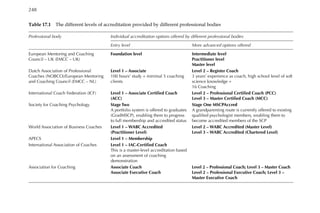
present through our questions and dialogue, so do the meanings of the past and
future change, and as the past and future change, so do the meanings of the
present – simultaneously. The questions we ask ‘laser’ attention in a certain
direction, intended or not, and sow the seeds of change. What we discover
through our questions becomes the linguistic material for the stories we use to
conceive, talk about and construct our future. As questions literally create the
path of inquiry and change, developing the art of asking questions is a key tool
for appreciative coaches. These are not just any questions, but questions that
are carefully crafted to create a joyfully focused state of mind as our clients
consider and answer them.
154â•… ❚â•… Coaching models and approaches
Ian and his coach were not only careful in selecting questions that would give him
the information he sought, they were also strategic in the persons they invited into
the interview process. The system CEO, COO and a board member were among
the respondents.The coach’s questioning of these members sent vibrations through-
out the system. Asking these individuals about Ian’s capabilities, his successes and
his abilities as compared to those of a senior executive caused them to visualize Ian
as a real candidate. Their assessment of him shifted and he was invited to apply for
the Regional Pre�sident position.
The Poetic Principle affirms that we are continually writing and rewriting the
stories of our lives. Through the choices we make, we find that the experiences
of our past, present and future are endless sources of learning and interpretation,
just like reading a good poem. When our life journey does not take a straight
path and new situations arise to challenge us, we can apply this principle to
help us shift our perspective and find new possibilities. Pivoting is the con-
scious act of turning attention from what we do not want or what is wrong to
what we do want or what is good. It is like a basketball player making a quick
turn or pivot on the gymnasium floor to move past an obstacle towards a more
favourable direction. Pivoting can help us turn our attention from what we do
not like in a situation or what makes us uncomfortable to discovering what is
already good there or what we want in place of the discomfort. Implicit in the
negative statements is a desire for something better. When we find ourselves or
others talking about the negative aspects of a situation, we can ask, ‘What you
don’t want is x, so what do you want instead?’ or the question can take the
form, ‘What you don’t like is x, so what is good in the situation?’
When Ian first viewed the results of his 360° interviews, he did what many of us
do – he focused on the perceived gaps and deficiencies. He focused on ‘lack of’
rather than on what he might do ‘more of’. With the help of his coach, he began
to see the areas where he was already demonstrating his strategic abilities and
other executive talents that the feedback was encouraging him to expand and build
on. The feedback was filled with what he was doing right and on areas he would
need to grow into. Ian realized, with a shift of focus (a pivot), that the 360° reÂ�
spondents were seeing his strengths and providing him with encouraging feed�
back for growth into an expanded role. Immediately, he felt more grounded. He
acknowledged that he did not need to change himself so much as demonstrate more
of who he already was.
The Positive Principle is an expression of all the concrete ways we can focus on
the power of the positive. Research has shown that momentum for change re-
quires large amounts of positive affect and social bonding in order to succeed.
Positive emotions are contagious; positive inquiry moves us towards what we
Appreciative coaching: pathway to flourishingâ•… ❚â•… 155
most desire. When we are in a positive mode, we act more effectively. To gain
and maintain this positive mode, people need lots of positive feeling and posi-
tive social bonding to make lasting changes in their lives. A person’s positive
core expands as it is affirmed and appreciated by others. This positive emotion
not only affects how we are today but also influences our ability to change and
move towards a new future. The principal tool related to the Positive Principle
is genuine affirmation from people who encourage us to use our best abilities,
stay focused and keep heart. They represent the Positive Principle in action.
Throughout the process, Ian’s coach consistently reminded him to consider how his
successes, abilities and desires made him a strong candidate for an executive posi-
tion. He was encouraged to take a balanced view of himself and to stretch into his
dream. Ian not only applied for the Regional President position; he also went
through the interview process and actually secured the position. While this achieve-
ment is all Ian’s, he insists that his coach’s genuine affirmation and positive support
of his capabilities increased his confidence and belief that he indeed possessed the
talent to carry him into the new role.
Conclusion
Ian’s story is about an individual who went from thriving in his career to
flourishing. When coaching began, he was successful in his career as a hospital
administrator and he was grateful to his mentor for supporting him in becom-
ing an outstanding leader in that role. With the help of his mentor, he knew the
areas where he needed development and was looking forward to working with
his coach. But his coach soon discovered that Ian had a grander dream – a dream
of becoming the CEO of a large system. Following the Appreciative coaching
model, his coach shifted the focus of coaching from the areas that needed to be
developed to a clearer picture of his dream and how he could begin creating
that dream in the present. His development would still need to occur, but in the
more exciting context of his dream.
In a short amount of time, Ian went from being seen as a valued leader of the
hospital to being seen as an executive leader in the system. In fact, Ian expressed
surprise at how quickly this change came about and how at times it seemed
almost magical. While he had always held a clear vision for his future, he had
not seen himself stepping into the role in the circumstances presented to him.
But with the support of his coach, he began paying more attention to his
strengths and abilities and thereby steadily increasing the possibilities and
momentum for change. His coach reminded him many times that it was his
shifts in perception about himself and his situation that allowed him to see
opportunities and take new, bold action. While it may have seemed almost
magical at times, the creation of his desired future in a short time span was all
his own doing. He chose to€create his pathway to flourishing.
156â•… ❚â•… Coaching models and approaches
Clients like Ian are living examples that flourishing in work and life is indeed
possible. Our clients are truly mysteries to be appreciated and viewing them
from a problem-solving perspective cannot begin to tap into the generative
power for change that they possess. What is exciting to realize is that we as
coaches now have the tools and knowledge to lead ourselves and others along
the appreciative path to flourishing.
Note
1.	 We have changed the name of this client for confidentiality purposes.
References
Cooperrider, D L and Srivastva, S (1987) Appreciative inquiry in organizational life, in
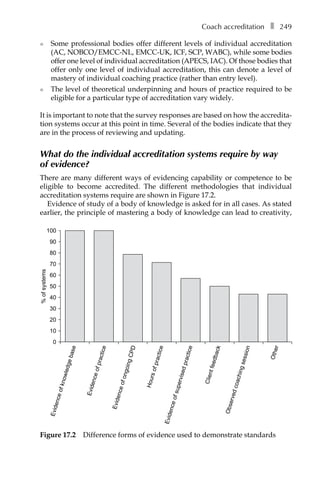
Research in Organization Change and Development, Vol. I, ed W Pasmore and R W
Woodman, pp€129↜–↜69, JAI Press, Greenwich, CT
Keyes, C (2003) The Mental Health Continuum: from languishing to flourishing in life,
Journal of Health and Social Research, 43 (2), pp 207↜–22
Lewis, S, Passmore, J and Cantore, S (2008) Appreciative Inquiry for Change Management:
Using AI to facilitate organizational development, Kogan Page, Philadelphia
Orem, S L, Binkert, J and Clancy, A L (2007) Appreciative Coaching: A positive process for
change, Jossey-Bass, San Francisco
Passmore, J and Hain, D (2005) Appreciative inquiry: positive psychology for organiza-
tional change, Selection and Development Review, 21 (5), pp€13↜–17
Rittel, H (1972) On the planning crisis: systems analysis of the ‘first and second genera-
tions’, Bedriftsokonomen, NR8, pp€390↜–↜96
Seligman, M E P and Csikszentmihalyi, M (2000) Positive psychology, American
Psychologist, 55 (1), pp€5↜–14
Watkins, J M and Cooperrider, D (2000) Appreciative inquiry: a transformative para-
digm, OD Practitioner, 32 (1), pp€6↜–12
11
Integrative coaching
Jonathan Passmore
The integrative coaching model explained
Previous chapters in this book have offered frameworks based on single models.
These models are often derived from psychological schools of thinking such as
behaviourism (GROW) and cognitive psychology (cognitive behavioural coach-
ing) or from theories of human behaviour and behavioural change (NLP and
solution-focused). The integrative model seeks to depart from this approach. It
offers a model that has been designed exclusively for executive coaching.
The integrative model consists of six streams that flow together to form an
integrated model for use by the coach. The first two streams work collectively
and are concerned with the formation and maintenance of the relationship
between the coach and coachee. The next three streams are the focus of the
work between the coach and coachee. They are concerned with the coachee’s
behaviour, his or her conscious thought and unconscious thoughts. While
working in each of these three streams, the coach maintains attention on the
relationship and works to sustain the relationship without which progress
cannot be made. The final stream is systemic. An overview of the model is
provided in Figure€11.1.
Streams 1 and 2: The coaching partnership
Before any coaching to enhance performance can begin, the coach needs to build
a working relationship with the coachee. It is this work that I have called stream
1 (developing the relationship). The potentially close and affirming relationship
of coaching demands mutual respect and trust. To create these, the coach needs to
invest in the relationship. However, once established this work on the relation-
ship cannot stop, although less effort may be needed. It is at this point the coach
moves into stream 2 (maintaining the relationship).
What are the key ingredients to create an effective working relationship?
This question has in part already been answered by writers within the coun�
selling tradition, such as Carl Rogers (1961). Rogers suggested that a series of
elements need to be in place for a successful ‘therapeutic alliance’ to be formed.
	 157
BEHAVIOURAL FOCUS
Aim: deepen problem-solving and
planning behaviour
Actions: objectives, assessment,
option-planning
CONSCIOUS COGNITION
Aim: deepen understanding of relationship
between thoughts and behaviour
Action: explore thoughts and beliefs,
dispute irrational thoughts, reference
UNCONSCIOUS COGNITION
Aim: Deepen awareness of self
Actions: Draw unconscious thought
and motivation into consciousness
MAINTAINING THE
COACHING PARTNERSHIP
Awareness of coachee
Adaptation of behaviour
Awareness of self
DEVELOPING THE
COACHING PARTNERSHIP
Unconditional
positive regard
N
on-possession
Deeper
understanding
of self
Stronger
motivation to
act
Improved self-
regard
More effective
behaviour
Improved performance at work
Empathy
Congruence
Positive self-regard Non-judgemental
© Passmore 2005
Figure 11.1â•… Integrative coaching model
158â•…
Integrative coachingâ•… ❚â•… 159
These relationship elements are of importance to any work with individuals
in the consulting world. However, the one-to-one nature of coaching
demands a stronger investment in the relationship by the coach than training or
consulting.
During the first and possibly the second coaching session the coachee is
evaluating the coach: Do I trust him or her? Do I like him or her? Do I value
what he or she is offering me? If the coachee reaches a conclusion that he or she
does trust, like and value the coach, the real work can start. However, if coachees
reach the conclusion that they do not trust or respect the coach, it is unlikely
they will reveal much during coaching, even though coaching may continue,
at least over an initially agreed set of sessions. If they don’t like the coach, the
relationship is most likely to come to an end.
Rogers’ six conditions provide an excellent starting point to help in the for-
mation of a coaching partnership:
1.	 The first of these six elements Rogers called ‘positive self-regard’. This is the
coach’s belief that he or she is able to work constructively in an adult
relationship with another person. This maybe typified by the ‘I’m ok’ part
of the transactional analysis (TA) model (I’m ok, you’re ok) – a belief that he
or she, the coach, is a worthwhile and valuable person.
2.	 The second feature is ‘unconditional positive regard’ of the coachee by the
coach. It is an acceptance of him or her as a whole person. This can be
regarded as the ‘you’re ok’ part of transactional analysis. It is a belief that
the coachee is a good person, even if the coach may disagree with or dislike
aspects of the coachee’s behaviour or values.
3.	 The third element is empathy. This is the ability of the coach to show under-
standing of the coachee’s situation; ‘to see their world, as if it was our
own’.
4.	 The fourth element is the establishment and maintenance of a non-
judgemental mind. This means the coach is slow to judge. If judgements are
made these are restricted to behaviours outside of society’s norms, such as
murder. However, the person is never judged and categorized. An example
of this is to challenge the behaviour of a murderer, but continue to value the
person.
5.	 The fifth element is congruence. This is the idea that the coach should
express what he or she feels. The coach, if angry, should appropriately
express this anger with the coachee, in a way that is helpful to him or her,
rather than pretend he or she is happy. The key aspect in this is to reveal
material for the benefit of the coachee, rather than to satisfy the needs or
desire of the coach.
6.	 The final element that supports the development of a coaching partnership
is non-possessive warmth. This is the idea that the coach views the coachee
as a capable person, who knows the solution to his or her own problem. The
160â•… ❚â•… Coaching models and approaches
role of the coach is to act as a guide, helping the coachee along a path until
he or she discovers this solution for themself. This ability to maintain a non-
possessive relationship means the coach can be free from responsibility for
the coachee’s actions. The coach is neither a ‘super-hero’ if the coachee
succeeds, nor a ‘villain’ if the coachee fails.
The result of these elements is the development of an appropriate, warm, trust-
ing and open relationship, a relationship in which the coachee is able to share
the full truth of his or her perception and feels accepted rather than judged. It is
a relationship where coachees accept responsibility for their success. It is also
a relationship in which the coach is able to gradually increase the level of
personal challenge without devaluing the affirming nature of the relationship.
Once a relationship has been formed, the role of the coach is to maintain this
relationship. The maintenance of the relationship is the second stream, and
flows on directly from the work of building the relationship.
To maintain the relationship an effective coach needs to pay attention to three
further aspects: his or her own emotions and behaviours, the emotions and
behaviours of the coachee, and adapting his or her own behavioural responses
appropriately to remain professionally detached while offering personal inti-
macy. These components make up the building blocks of emotional intelligence
(Caruso and Salovey, 2004; Stein and Book, 2000).
In addition to emotional intelligence, the highly effective coach also needs to
consider transference and counter-transference issues. These aspects are of
particular importance in the executive boardroom where power and role
modelling are key features. However, these aspects can be relevant to the
close working relationship between any coach and coachee.
These two aspects, building and maintaining the relationship, form a ring
around the three remaining streams. Without this coaching partnership the
coach is unable to begin to work in the three streams that will facilitate change.
Stream 3: Behavioural focus
The third and most popular stream in which the coach works is that of
behavioural coaching. Whatever the coach’s theoretical orientation, a focus on
external behaviour and how this is developed is a central feature of almost all
coaching relationships.
The popularity of behaviourism is rooted in the 1920s, with the work of
Pavlov (1927). Pavlov uncovered the concept of conditioned reflex: a response
to a situation that is an adaptation to environmental conditions. While human
motivation is more complex and broader than that of other species, the use of
appropriate rewards or punishments is still a common feature within the
workplace.
This view informed much of subsequent management writing during the
pre- and post-war period, with a belief that, with an appropriate stimulus,
behavioural change could be brought about. Much of management writing
has not acknowledged its behavioural basis, but in management today,
Integrative coachingâ•… ❚â•… 161
performance-�related pay, performance management, goal setting and the use of
competency frameworks all have links back to behavioural thinking.
In the 1970s, the work of Bandura (1969) took thinking into a new arena by
adding social learning to the mix of stimulus–response models. Bandura
argued that learning can take place not only in person, but also by observing
others’ successes and failures. The use of role models in organizations, as well
as mentoring schemes, provides further support for the extent of behaviourist
thinking.
Perhaps the most interesting concept identified by Bandura was self-efficacy:
a person’s belief in their own abilities. The concept is based on a self-perception;
how well the individual believes they perform a task. Bandura (1977) argued
that people with high self-efficacy perform better, as they are able to persevere
longer without corresponding increases in stress. Subsequent research (Gist
and Mitchell, 1992; Locke and Latham, 1990) has shown a strong relationship
between high self-efficacy and high work performance. Also key to perform-
ance is the use of goals as a focus for measuring behavioural output and for
rewarding success.
The development of these behavioural concepts has contributed considerably
to our thinking and practice in management, human learning and, more recently,
executive coaching. The most popular example is the ubiquitous GROW model.
The model initially developed by Alexander (Alexander and Renshaw, 2005)
has been popularized by many coaching writers (Whitmore, 2009), and is used
in many of the blue-chip institutions as their own in-house coaching model.
GROW is a four-step coaching model, and has traditionally been viewed as a
non-psychological model, suitable for coaches without psychological training.
The coach adopts a Socratic learning style, using open questions to help the
coachee move through the four steps. It aims to help coachees achieve enhanced
performance or a stated goal.
The first of the steps is the identification of a goal. The second is a review of the
current reality, the third a consideration of options, and the fourth a conclusion
and the agreement on a way forward. There is considerable debate about the
nature of goals, and this is covered in more detail elsewhere (Passmore, 2003).
While rejected by some coaching psychologists as a non-psychological
model, GROW is a simple and useful tool that can easily be taught to coachees
during the coaching process. More sophisticated behavioural models have been
developed that complement the essence of GROW (Passmore, 2005; Skiffington
and Zeus, 2003). These add elements such as explicit statements about contract-
ing, the ground rules of the coach–coachee relationship and the more legal
contractor aspects of times and fees, or have been developed for the coaching
manager.
The behavioural approach is of greatest value at the start of a relationship.
However, adopting a single methodology limits the coach’s ability to facilitate
change. Around half of coaching interventions stay in this stream, once a ‘coach-
ing partnership’ has been established. As experience grows, either through
participation in training events or through intuitive awareness, the more
experienced coach broadens his or her approach.
162â•… ❚â•… Coaching models and approaches
Stream 4: Conscious cognition
The effective coach, having established the relationship and explored be�
haviours, is able to explore the cognitive patterns that sit behind the visible
behaviours. In this stream the coach will typically draw upon cognitive
behavioural techniques, initially developed by Beck (1991) and Ellis (1998) but
refined by coaches (Neenan and Dryden, 2001; Peltier, 2001) to make them more
suitable for the work of the coach than the counsellor.
Cognitive-based counselling interventions have grown significantly in popu-
larity in the UK, and are now the most popular approach within government-
funded counselling services. While this popularity has yet to extend to coaching,
the growth in coaching training suggests that cognitive behavioural approaches
will become the most popular approach used by experienced coaches.
In the integrative model, coaches would typically begin to explore thought
patterns when they judged that the coachee was displaying or holding irra-
tional thoughts that might inhibit successful performance, and they have al-
ready explored behaviourally based solutions. Such irrational thoughts might
be harsh judgements about themselves as coachee or judgements of their current
or future abilities. The key feature is that the judgement is irrational, that is, it is
not substantiated by facts. One danger is that irrational is confused with ‘nega-
tive’. So the coach seeks to help the coachee challenge all negative views or
perspectives. This is not CBC. Such an approach, if always looking on the sunny
side, is naïve and lacks any evidence of being an effective intervention.
Working in this stream shares many of the principles that are applied to the
other four streams: a dynamic process where both the coach and the coachee are
constantly changing, a collaborative process between the coach and coachee,
a focus on solutions and particularly on an agreed goal, an emphasis on the
present, and a desire to use the process to give the coachee the ability to act
independently in the future. Each of these principles is important to maintain-
ing the working relationship and using coaching in a way that builds the
coachee’s ability to become a self-sustaining learner rather than increases his or
her dependence on the coach.
The central concept within this stream is encouraging coachees to identify the
irrational beliefs and then helping them to challenge these. This two-stage
process is supported through the diverse range of cognitive behavioural and
rational emotive behavioural techniques used within counselling. However,
these need to be grounded within the appropriate context or focus of the coach-
ing relationship. Michael Neenan provides some excellent examples of tools
in his chapter, and a few of these are described below in ‘Tools and techniques’.
It is recognized that many of these techniques can be used equally successfully
in the fourth stream.
Stream 5: Unconscious cognition
For some people the fifth stream has echoes of the psychodynamic tradition
because of its explicit ‘unconscious’ label. This is deliberate, and reflects a belief
that unconscious thoughts influence our daily lives and behaviours, and that
Integrative coachingâ•… ❚â•… 163
elements of the psychodynamic tradition can help the coach address these
issues. However, this positive start also carries with it a warning. While many
of the psychodynamic techniques may work well in the counselling room, they
lack face validity for work with coachees, particularly with executives, and are
less appropriate for the short and more focused work of coaching.
A second technique that can be drawn upon is EMDR (Eye Movement
Desensitization and Reprocessing), which can be a valuable intervention to
exploreunconsciousthoughts,particularlyinvolvingtraumaticstress(Passmore
and Pena, 2005). EMDR has to date been primarily used in the treatment of
post-traumatic stress disorder, although there are limited references to its use in
coaching (Foster and Lendl, 1996 ). Given the limited space in this chapter, the
focus is on exploring unconscious aspects of motivation, drawing on motiva-
tional interviewing (Miller and Rollnick, 2002).
Motivational interview (MI) is a technique that has been developed in addic-
tion counselling to help address low motivation to change. The approach helps
the counselling client bring into conscious awareness the consequences of his or
her behaviours and thus stimulates a stronger motivation to act. For coaches,
MI offers an additional tool that is particularly useful where the coachee is
resistant to change, but is unclear why initial efforts to change stall before they
take off (Passmore, 2007).
As with humanistic, behavioural and cognitive streams within the integra-
tive coaching model, MI has a track record of evidence-based application. This
ranges from alcohol and substance abuse counselling (Burke, Arkowitz and
Menchola, 2003; Miller and Moyers, 2002; Solomon and Fioritti, 2002) through
management of chronic illness (Channon, Smith and Gregory 2003; Prochaska
and Zinman, 2003) to working with teenage contraception counselling (Cowley,
Farley and Beamis, 2002). Despite this track record, the use of MI in the coaching
sphere to date appears to be limited (Passmore and Whybrow, 2007).
The MI approach requires the coach to recognize and understand ambiva-
lence as a natural part of the change process (Miller and Rollnick, 2002) and to
move from using cognitive grounded questions to exploring beliefs and think-
ing patterns. A starting point for the coach is identifying which stage the coachee
is at in his or her personal change journey. To identify this, the coach could ask
the coachee to rate his or her perceived readiness to change on a scale of 0 to 10,
with 10 being that he or she has already made the change, and 0 being not at all
interested in changing (Figure€11.2).
Change continuum
The coach then works with the coachee to help build arguments for change.
Traditionally, in managing change the coach might offer counter-arguments
that support change, effectively arguing against the coachee. MI takes a different
perspective of change. It seeks to work alongside the person, to help him or her
to more fully understand the consequences and benefits of his or her actions.
In this sense it draws on aspects of rational thinking. One model for doing this,
the balance sheet, is included in the ‘Tools and techniques’.
164â•… ❚â•… Coaching models and approaches
As fits the overall integrative coaching model, there is a strongly collaborative
approach, with the coach being an ally of the coachee, rather than being an expert
into whose hands the coachee casts his or her troubles, or an authority issuing
advice.
I would most typically step into the unconscious cognition stream where the
coachee has been referred by others concerned about his or her work perform-
ance, or when the behaviours are having a significant impact on others and
which the coachee feels pressure from others to address, although he or she
may unconsciously be resistant to doing so.
Stream 6: Systemic
The last and final stream that the coach and coachee work within is the environ-
ment and cultural context. In some respects this stream captures and surrounds
all of the preceding streams.
The coach may work simultaneously in this stream and in one of the three
action streams of behavioural, conscious cognition or unconscious cognition. In
this stream the task for the coach is to help coachees to understand the wider
system within which they work, and how this system influences their behaviour
and the behaviour of others they work with, including the coach. In this level
the coach seeks to bring these individuals into the coaching room. These may be
individuals whom the coach works alongside, such as members of the team; it
may be individuals from suppliers or customer organizations; it may include
individuals and organizations from the wider environment that create legisla-
tion or influence the way work is conducted or people behave.
As well as helping the coachee to draw upon the influences of these individuals,
the coach needs to make explicit his or her influence, as the coach too is part of
this wider system.
When does integrative coaching work best?
It can be argued that the integrative model has almost universal application
within the coaching environment. However, it is particularly suited to executive
coaching and sports coaching. Its suitability for use in other areas of coaching
0
Not interested
in making a change
10
Changes
already
made
Figure 11.2â•… Change continuum
Integrative coachingâ•… ❚â•… 165
such as health and life coaching is due largely to its use of a wide range of
elements from other coaching traditions. The approach pays attention to the
coachee’s need to form a relationship. Without a relationship there is likely to
be little progress in coaching.
Integrative coaching acknowledges that most people are, at least initially,
drawn to coaching to be different. This difference may be being more successful
at work or more successful in forming relationships. For some it may be about
developing and refining a skill, or stopping a habit they have developed. In
most cases this ‘being different’ involves behaving differently. The approach’s
use of behavioural elements enables it to contribute towards this behavioural
goal.
Coachees, however, sometimes want something more. They recognize that
their ineffective thinking or ‘negative thoughts’ get in the way of them succeed-
ing. By addressing thinking styles, with a focus on developing more rational
thinking, the model too can meet these needs.
For the most experienced coaches there is a recognition that addressing
behaviour and thinking style is not always enough. To achieve the outcomes
the coachee wants, the coach also needs to work at an unconscious level, some-
times with thinking styles, thoughts and beliefs that are outside of conscious
awareness, and sometimes with motivation. In these cases the coach needs to
help deepen self-awareness. The integrative model recognizes the role of the
unconscious and seeks to integrate this into its pattern of working through
drawing on elements from within the psychodynamic and motivational
interviewing.
It may begin to feel as if integrative coaching is a magic bullet, a one-shot
solution. The reality is that as an integrated approach it takes what works best
for coaching from a series of previously evidenced-based approaches and
blends them together. Arguably most experienced coaches probably do this
already, and the model simply describes what they are doing.
The integrative model has its areas of weakness. These are inherent in its
development within the executive coaching arena. The first of these weaknesses
is that the model lacks a spiritual dimension. The desire to deepen one’s spiritual
self is a healthy and arguably central aspect of life. Where this is an explicit goal
of the coachee, the coach would be better advised to work with models such as
the transpersonal model.
A second weakness of the model is that it assumes that behavioural change is
what is being sought. Again, this is an outcome of its executive coaching focus.
However, if the coachee is seeking a more general model to explore his or her
experience of life and the future, a humanistic framework could arguable serve
exclusively as a tool to achieve this objective.
Tools and techniques
The integrative model as described draws on tools and techniques from a range
of approaches, including behavioural, cognitive behavioural, psychodynamic
166â•… ❚â•… Coaching models and approaches
and motivational interviewing approaches. In this section some suggestions are
made for each stream: building and maintaining the partnership, engaging in
behavioural change, developing performance-enhancing thinking and deepen-
ing self-awareness.
In each case, the reader may wish to review the chapters on GROW (be�
havioural), cognitive behavioural coaching and stress coaching where more
detailed examples illustrate the techniques within these models. This section
provides more of an overview for each area.
The first of these is the process of developing and maintaining the relation-
ship. A key tool at this stage is to set out the ground rules. In doing this the
coach helps the coachee understand what is ‘in’ and what is ‘outside’ the coach-
ing relationship. It sets out the conditions for confidentiality: largely everything
is confidential with the exception of risk of self-harm and illegal activities where
the coach has a duty to protect others. The ground rules also provide an oppor-
tunity for the coach to set out his or her credentials, providing reassurance to the
coachee that the coach is a competent and reliable person. A second technique
to help build the relationship is to provide space for the coachee to talk at length
during the early period of the first session. This opportunity for the coachee to
tell his or her story is not primarily to gather information, but to listen and show
that the coach values what the coachee has to say. In listening, the coach may be
summarizing and reflecting back to check understanding. Once the relationship
has been built, the coach needs to continue to invest in it. However, the invest-
ment is contingent upon his or her coachee’s needs. This draws the coach to
deploy emotionally intelligent responses.
The second set of techniques is within the behavioural focus stream. While
there is a range of models, the GROW model offers a four-stage process. The
coach encourages the coachee to set a clear SMART goal, which can be more
difficult than first thought (Passmore, 2003). Once established, the coach works
to help gather evidence on current performance. A useful technique for doing
this would be to ask the coachee to bring or review behaviour evidence from
colleagues and peers. A 360° competency questionnaire is an excellent tool for
doing this. Outside of the workplace, the coach may ask the coachee to go and
talk to others about how he or she is perceived, either generally or in relation-
ship to the skills or behaviour and its impact on others. This development of
a holistic picture provides the coachee with stronger evidence of his or her
current reality than a personal perspective.
Another technique in the behavioural focus stream is to help the coachee to
get specific on his or her action plan. Typically the coachee offers a vague
action plan, with little regard to when, how or what gets in the way. The use of
effective and robust challenge at this stage will help the coachee to make the
goal real.
The third set of techniques is within the cognitive stream. Typical techniques
in this stream include reframing, emersion, visualization and the use of home-
work tasks to support activities within the coaching process. In reframing, the
coach engages in a process of moving the coachee from a view of the world that
lacks rational evidence to one that is based on evidence. Questions might
Integrative coachingâ•… ❚â•… 167
include: ‘How would your boss, mentor or colleague view this situation?’, ‘How
might Ghandi tackle this problem if you asked him?’, ‘What other possible out-
comes are there?’, ‘How likely is each of the possible outcomes?’
A second approach is the use of emersion. This technique is used in counsell�
ing as a way to gradually overcome irrational fears. This is in contrast to
flooding, which is a rapid and immediate process of encounter. To illustrate the
contrast between the two, emersion is gradually getting into the pool from the
shallow end, flooding is jumping in the deep end. While flooding is generally to
be avoided, emersion can help the coachee to test his or her new behaviours or
skills gradually.
Visualization is a technique that is commonly used in sports coaching.
References to it are pervasive throughout sport, such as Daley Thompson’s
visualization for a quick start, leaving the starting blocks at the ‘b’ of the bang.
These examples help the coach to improve the face validity of this technique for
the coachee. One area in which visualization can be of real value for the coach
is helping coachees visualize the task they have set themselves, and particularly
to identify potential barriers, and them overcoming these barriers.
The last example of techniques from the cognitive stream is the use of home-
work. While in other streams I would encourage the coachees to reflect on the
session, and maybe to practise new behaviours, in this stream the homework
task is a useful component. This may be encouraging coachees to monitor their
automatic thoughts. An alternative is to ask coachees to practise the skill or
activity in a controlled way, so using emersion, and at the next session review-
ing its impact or the feedback that they have received.
The final selection of techniques is from the unconscious cognitive stream. In
this stream the coach may encourage the coachee to examine patterns. This may
involve patterns of working over many jobs, and even patterns of behaviour
back to childhood. The assumption is that such patterns may reveal unconscious
processes about beliefs or thoughts.
A second way within the unconscious cognitive stream is to explore these
patterns and their meaning. One technique is to use a metaphor for exploring
the mind, such as the technique of the old house. In this technique the coach
may ask the coachee to visualize an old house in which he or she lives, and
like most of us, stores stuff in the loft or cellar. In this house, however, there
are a series of rooms in the loft. The idea is that the coach helps the coachee
through the visualization to explore deeper into past events, stored in these
rooms.
The third technique is drawn from motivational interviewing. This is the use
of the balance sheet (see Figure€ 11.3). The balance sheet can help coachees
explore their motivation for change by listing the benefits and costs of the two
options they are evaluating. One option may be to stay as they are; a second
option would be for change. The aim of the coach is to help coachees to build up
stronger benefits for change, where the current behaviour is destructive or
damaging to them or others. The coachee, when evaluating the costs and
benefits, may only have identified the immediate benefits to him or her of the
behaviour, and tends to ignore or minimize the impact of his or her behaviour
168â•… ❚â•… Coaching models and approaches
on others. By bringing these elements into active consideration the coachee can
begin to reflect consciously on a wider range of costs and benefits.
Ten key questions to guide your way
The first 4 questions are based within the behavioural focus stream, questions 5
to 7 are questions from the cognitive stream, and 8 to 10 from the unconscious
cognitive stream.
1. What do you want to achieve?
This is a typical question for use within the behavioural GROW model. The aim
of the question is to help the coachee to explicitly state his or her goal. Frequently,
less experienced coaches take at face value the first statement and move on, and
thus need to return to this at a later stage. More experienced coaches recognize
that time spent at this stage, exploring the features of the goal, will save time
later.
2. What is happening?
This question aims to help the coach and coachee gather evidence on what is the
current situation. How close or far is the coachee to or from his or her goal? In
gathering evidence, the less experienced coach can be tempted to accept at face
value what the coachee provides as evidence. It is wise for the coach to chal-
lenge initial claims, and seek third-party evidence for these. A 360° question-
naire, psychometric questionnaire and appraisal feedback all provide such
evidence, and help ensure that the coach and coachee are working with a
rounded view, not a single perspective, whether this is the coachee’s or his or
her manager’s.
3. What options do you think there are?
Exploring options is a valuable process in all coaching, if there is a belief that the
coachee already has the answer to his or her own question. Reviewing options is a
two-part process. The coachee needs to be clear what criteria he or she is evaluating
Benefits of change Costs of changeCosts of activityBenefits of activity
Figure 11.3â•… Coaching for change balance sheet
Integrative coachingâ•… ❚â•… 169
the options against. As a result the coachee needs to generate the criteria first,
before he or she can start a process of generating or evaluating options.
4. Can you summarize what you going to do and by when?
This question is concerned with action planning when working in the behav-
ioural focus stream. The question encourages coachees to take responsibility for
reviewing their process, summarizing what has been discussed and to formally
state what they intend to do. This is a useful question to ask towards the end of
a coaching session, even if the coach has been working with cognitive and
unconscious cognitive aspects. The coach may then encourage the coachee to
document this, and develop an action plan that includes a series of sub-goals or
steps that take him or her to this goal over the coming week, month or year.
5. How would your boss, mentor or colleague see this situation?
This question encourages the coachee to begin to explore the issue or challenge
that he or she faces from a number of different perspectives. Often an issue
looks to be an insurmountable problem to us, but when considered from the
perspective of another person, either solutions can be found or a deeper under-
standing of the issue gained. A parallel type of question is asking the coachee to
consider the challenge as if he or she were a famous person. For a management
issue, the coach may ask the coachee to consider how Richard Branson would
deal with the problem, followed by a question on how Ronald Reagan would
deal with the challenge. For a relationship issue, the coach might select two
different characters offering different perspectives: Marilyn Monroe and Nelson
Mandela. Initially the coachee typically provides a short or flippant remark, but
the coach needs to focus the coachee’s response and ensure that he or she fully
explores the issue and provides a what, where and when descriptive answer.
6. I would like you to close your eyes and describe to me what
would happen if the event went perfectly
This visualization technique gets coachees to engage with a visualization and
explore what they see and, with follow-up questions, what they feel, smell and
think. Evidence has shown in the sports psychology arena that visualization not
only builds self-confidence but also creates physical changes in the brain structure
that aid subsequent muscle movement and thus enhance performance.
7. Can you summarize for me the task that you will try out
before we meet again?
The summarizing task that has already been discussed is applied in this context
to focus the attention of the coachee on a homework task. The use of the task
provides an opportunity for emersion: gradual exposure to the challenging
170â•… ❚â•… Coaching models and approaches
behaviour. Follow-up questions might be, ‘What would stop you achieving
this?’, ‘What could you do to overcome these barriers?’ These questions enable
the coachee to prepare for the real world of competing priorities and stake�
holders who may need to be persuaded.
8. Tell me about a time when you have felt a similar feeling before
This may be a useful question to explore patterns. Preceding the question the
coach will have encouraged coachees to talk about the current issue or problem,
and in particular to draw out the feelings within their body which they ex�
perience. Using these bodily sensations the coach may then ask the pattern
question that may help coachees to identify similar events, but to access these
from bodily feelings rather than events.
9. How would others, such as your partner or family, be affected?
This question within motivational interview is drawn from work around the
balance sheet. The coach may be exploring with coachees the costs and benefits
of their behaviour. Coachees can underestimate the effect of their behaviour on
others, and thus fail to include this in the calculation. The coach can focus the
coachee’s attention on this through the question and often build up the costs
side of the equation for the coachee.
10. How ready do you feel you are to change on a scale of 1 to 10;
where 10 is that you have already made the change, and 0 that
you are not at all interested in changing?
This question refers to the motivational interviewing approach. This is a
complex technique and suggests that the developing coach would benefit from
training before making use of the technique. However, questions such as this
provide clues to whether the coachee is likely to change, or if he or she needs
more help to explore the benefits of changing. A low score of 1 to 7 would
suggest that focusing on change tools would be a wasted effort; instead the
coach needs to invest time exploring motivation and helping the coachee to
develop the intrinsic motivation to change.
References
Alexander, G and Renshaw, B (2005) Supercoaching, Random House, London
Bandura, A (1969) Principles of Behaviour Modification, Holt, Reinhart and Winston, New York
Bandura, A (1977) Self-efficacy: towards a unifying theory of behaviour change,
Psychological Review, 84, pp€191–↜215
Beck, A (1991) Cognitive Therapy of Depression, Guildford Press, New York
Burke, B L, Arkowitz, I I and Menchola, M (2003) The efficacy of motivational interview-
ing: a meta analysis of controlled clinical trials, Journal of Consulting Clinical Psychology,
71, pp€843↜–↜61
Integrative coachingâ•… ❚â•… 171
Caruso, D and Salovey, P (2004) The Emotionally Intelligent Manager: How to develop and
use the four key emotional skills of leadership, Jossey-Bass, San Francisco, CA
Channon, S, Smith, V J and Gregory, J W (2003) A pilot study of motivational interview-
ing in adolescents with diabetes, Archives of Disease in Childhood, 88 (8), pp€680↜–↜83
Cowley, C B, Farley, T and Beamis, K (2002) ‘Well, maybe I’ll try the pill for just a few
months’â•›.╛╛.╛╛.╛╛. Brief motivational and narrative-based interventions to encourage con-
traceptive use among adolescents at high risk for early childbearing, Families, Systems
and Health, 20, pp€183
Ellis, A (1998) The Practice of Rational Emotive Behavioural Therapy, Free Association Books,
London.
Foster, S and Lendl, J (1996) Eye movement desensitization and reprocessing: four case
studies of a new tool for executive coaching and restoring employee performance after
setbacks, Consulting Psychology Journal: Practice & Research, 48 (3), 155↜–↜61.
Gist, M and Mitchell, T (1992) Self-efficacy: a theoretical analysis of its determinism and
malleability, Academy of Management Review, 17 (2), pp€183↜–↜211
Locke, E and Latham, G (1990) A Theory of Goal Setting and Task Performance, Prentice
Hall, Englewood Cliffs, NJ
Miller, W R and Rollnick, S (2002) Motivational Interviewing: Preparing people for change,
2nd edn, Guilford Press, New York
Miller, J H and Moyers, T (2002) Motivational interviewing in substance abuse: applica-
tions for occupational medicine, Occupational Medicine, 17 (1), pp€51–↜65
Neenan, M and Dryden, W (2001) Life Coaching: A cognitive behavioural approach, Brunner-
Routledge, London
Passmore, J (2003) Goal-focused coaching, The Occupational Psychologist, August
Passmore, J (2005) The heart of coaching, The Coaching Psychologist, Winter
Passmore, J (2007) Addressing deficit performance through coaching: using motivational
interviewing for performance improvement in coaching, International Coaching
Psychology Review, 2 (3), 265↜–↜79
Passmore, J and Pena, A (2005) How to manage trauma, People Management, 28 July
Passmore, J and Whybrow, A (2007) Motivational interviewing: a specific approach
for coaching psychologists, in The Handbook of Coaching Psychology, ed S Palmer and
A Whybrow, pp€160↜–↜73, Brunner-Routledge, London
Pavlov, I (1927) Conditioned Reflexes, Oxford University Press, Oxford
Peltier, B (2001) The Psychology of Executive Coaching: Theory and application, Brunner-
Routledge, London
Prochaska, J O and Zinman, B (2003) Changes in diabetes self care behaviours make a
difference in glycemic control: the Diabetes Stages of Change (DISC) study, Diabetes
Care, 26, pp€732↜–↜37
Rogers, C (1961) On Becoming a Person, Houghton Mifflin, Boston, MA
Skiffington, S and Zeus, P (2003) Behavioural Coaching: How to build sustainable personal
and organizational strength, McGraw-Hill, New York
Solomon, J and Fioritti, A (2002) Motivational intervention as applied to systems change:
the case of dual diagnosis, Substance Use and Misuse, 37 (14), pp€1833↜–↜51
Stein, S and Book, H (2000) The EQ edge: Emotional intelligence and your success, MHS,
Toronto
Whitmore, J (2009) Coaching for Performance: Growing people, performance and purpose,
4th edn, Nicholas Brealey, London
THIS PAGE IS INTENTIONALLY LEFT BLANK
172â•…
Part 3
Coaching issues
	 173
174â•…
THIS PAGE IS INTENTIONALLY LEFT BLANK
12
Intercultural coaching
Philippe Rosinski and Geoffrey Abbott
INTEGRATING CULTURE INTO COACHING
Weseecultureasanimportantinfluenceinallcoachingrelationships.Sometimes
the influence is obvious, sometimes it is subtle – but it is always influential. By
exploring the way culture might be influencing thoughts, feelings and behav-
iours in the different contexts of their coaching, coaches can utilize culture as a
powerful force of change and development. We therefore see the consideration
of culture as a virtual necessity in any high-impact coaching programme. Culture
provides opportunity. We believe that coaching as a profession has not taken
advantage of this opportunity. It is almost as though there is an underlying
assumption that culture is an obstacle to be overcome, or that culture is not a factor.
Our experience is that a ‘culture as opportunity’ perspective can enhance the
impact of any coaching intervention. We define coaching as the art of facilitat-
ing the unleashing of people’s potential to reach meaningful, important objec-
tives (Rosinski, 2003a). Intercultural coaching is the decision to recognize the
possibilities of utilizing culture as a force of change to unleash coachee poten-
tial. Culture is always there as an influence; it is more a matter of how much
attention we choose to give it. Intercultural coaching can bring to the surface
issues and assumptions related to culture and harness them in unleashing
coachee potential and facilitating positive change. This chapter highlights the
benefits of leveraging differences that may be culturally based, rather than
treating them as barriers, threats or irrelevancies.
Rosinski (2003a: 20) provides a working definition of culture as follows:
‘A group’s culture is the set of unique characteristics that distinguishes its
members from another group.’ Hall (1989: 17) describes culture as humankind’s
medium, and comments:
there is not one aspect of human life that is not touched and altered by culture. This
means personality, how people express themselves (including shows of emotion), the
way they think, how they move, how problems are solved, how their cities are
planned and laid out, how transportation systems function and are organized, as well
as how economic and government systems are put together and function.
	 175	 175
176â•… ❚â•… Coaching issues
We underestimate the influence of culture at our peril.
Our work in intercultural coaching is based on extensive research that reveals
differences between people due to culture, which result in people seeing the
world from different perspectives. Much of this research has been done at the
level of national culture (eg Hofstede, 1980; Schwartz, 1999; Trompenaars and
Hampden-Turner, 1998). However, groups of all kinds have cultures. Groups
originate from various categories, including geography, religion, profession,
organization, social life, gender, sexual orientation, etc. Our individual identities
can be viewed as a personal and dynamic synthesis of the cultures of the multiple
groups to which we belong.
Caution is required when making generalizations about culture. It is very
easy to fall into unhelpful or negative stereotyping. The inherent paradox is that
knowledge of cultural preferences and dimensions can provide invaluable in-
sights about a group, yet careless use of such knowledge can be misleading and
destructive. Wars, natural disasters, globalization, etc have meant that many
societies are multicultural and multiracial. Cultural diversity (of many kinds)
within national boundaries means that there is often considerable variation in
style among people from one country. Australia, for example, is a culturally
diverse society with many people exhibiting cultural characteristics more
typical of their homeland than of any statistical norm for the country. At the
same time, it is useful to know that there are certain ways that many Australian
companies tend to do business. Generalization can provide insights, but we
need to tread carefully. The same need for informed caution holds when
considering work areas and organizational cultures where variation also
occurs within groups as well as across them. There are individual personality
differences that are based on genetic factors, and individuals are influenced
by multiple cultural influences (such as when the parents are from different
countries or religions).
Cultural influences are often subtle and operate beneath the surface, and
people may have little awareness of the characteristics of various group cultures
to which they are connected. They can therefore be oblivious of the influence
culture may be having on their thoughts, behaviours and emotions. In organiza�
tions, often it is the outsider (such as the consultant, the coach, or the new em-
ployee) who can see the patterns and forces of culture at work. The people who
are immersed in organizational culture, shape it, and are shaped by it may find
it hard to define and virtually invisible. Trompenaars suggests that ‘Culture is
like gravity: you do not experience it until you jump six feet into the air’
(Trompenaars and Hampden-Turner, 1998: 5).
To see how culture influences us, we need to create a little distance from our
situation – to see ourselves ‘in context’ as others might see us. Similarly, to
understand how others with whom we interact see the world, we need to make
a mental shift out of our world and into theirs. This will provide rich material
for leveraging cultural difference for personal, professional and societal growth.
Intercultural coaching uses individual identity as the entry point to culture and
provides an opportunity for people to work out into their worlds and to make
use of the power of culture. Rosinski (2003a) has brought together diverse
Intercultural coachingâ•… ❚â•… 177
research on cultural difference into a cultural orientations framework (COF),
which summarizes various orientations across which people differ. The COF is
explained below, along with some ideas on how it might be used in coaching.
Traditional coaching has implicitly reflected particular norms, values and
basic assumptions that reflect its originating culture – the USA. It is a well-
researched fact that these do not necessarily hold true universally (see, for
example, Nisbett, 2003). Intercultural coaching carries a Western assumption
regarding our relationship to nature. We assume that our coachees have control
over the direction of their lives, how they deploy their talents, and how they
reach success. However, a wise coach also recognizes the relativity of the all-
powerful control orientation. Simultaneously, we hold the assumption that
many factors such as environment, genetic inheritance and luck can inhibit or
enhance the degree of control we have at various times in our lives. The coach
looks for balance and flow and understands the importance of timing. For the
coachee, knowing your limits is not always obvious. But, humbly accepting
them is paradoxically within your control. In the field of culture, contradictions
and paradoxes are not uncommon and we encourage our coachees to roll with
them and proceed on their journeys of positive change. We encourage coachees
to consider the influence of culture through the process of reflective thought in
the light of available evidence.
Intercultural coaching is a dynamic process that opens up possibilities for the
client. Later in this chapter we describe a global coaching process (Rosinski,
2003a) that gives shape to the coaching approach. In the global coaching
process, coaches and coachees connect their personal voyages with those of
their families, friends, work colleagues, organizations, communities and society
in general. Culture influences the direction of our individual journeys. If we
travel with an attitude of curiosity and an eye for the potential of diversity,
culture can enrich our experiences as we interact with others.
Intercultural coaching as we define it is a form of pragmatic humanism. It is
pragmatic in that we draw on approaches and ideas that work in the context of
the coachee. The measures of success are determined by the coachee. The
approach is humanist in that we emphasize care of self and of others, quality of
life and human growth. We will therefore work with coachees on approaches
that are ethical and consistent with the humanist stance. Coaching from a
cultural perspective is inconsistent, for example, with racial discrimination, or
exploitative commercial practices.
Intercultural coaching – because it is pragmatic – makes sound business
sense. The unleashing of individual potential and the leveraging of different
approaches that are culturally based mean that companies receive sustainable
benefits. Individuals become more productive, teams work better together, and
solutions to issues become more creative and innovative. For example, joint
venture companies (JVCs) across national boundaries are notoriously ‘high
risk’. A coaching approach that turns cultural differences into opportunities can
increase the chances of JVC success. The application of coaching to diverse
international business contexts is explored in detail in other texts (Moral and
Abbott, 2009; Passmore, 2009).
178â•… ❚â•… Coaching issues
EMBRACING DIVERSITY
Cultural difference is potential. We lead towards and embrace diversity.
Intercultural coaching requires that we value and explore differences rather
than automatically impose our norms, values and beliefs. Considering alterna-
tive belief systems and ways of operating, as they are represented in different
cultures, can help coachees to broaden their perspectives. As they explore their own
cultural assumptions and practices through the interaction with others they
may see opportunities for change. Intercultural coaching can expand cultural
repertoires and achieve sustainable change. The end result for coachees is that
they deal with their individual challenges, and have a deeper understanding of
their own contexts and those of others with whom they interact. From a pragmatic
perspective, they will be better equipped to achieve their aims and objectives.
We embrace the idea of canvassing many different sources to find approaches
that work in the context of the coachee. Intercultural coaching requires an
appreciation that there are different views of the world – and each potentially
has something to offer every person undertaking his or her unique journey.
Embracing diversity is easy at an intellectual level. However, intercultural
coaching requires more. You need to become convinced in your heart and in
your guts that a different truth or ideal is legitimate (though we do not of course
propose that one should accept a cultural view that would promote intolerance,
racism, xenophobia, or anti-Semitism). An emotional commitment is required.
It is important that coaches learn as much as they can about the cultures that
influence their clients. Books can help and there is an abundance of high-quality
literature about culture. Experience informed by such knowledge is even better.
Reflective interaction with the client is one way of experiencing his or her way
of seeing the world. You can gain even more through extended onsite visits to
a client’s company, and talking to others there. Where national culture is a
prominent influence, there are few better alternatives than travel.
People come to coaching with different approaches to dealing with cultural
diversity. Interculturalist Milton Bennett (1993) describes six stages along a
path towards enhanced cultural sensitivity. Coaches who operate with an
awareness of these stages can assist their clients to follow their own journeys
in productively exploring cultural diversity. In the early stages, Bennett de-
scribes approaches as ‘ethnocentric pitfalls’. In stage 1, people ignore differences
or deny they exist. In stage 2, there is recognition of differences but they are
viewed negatively. Those who are different may be denigrated from a position
of feeling superior. Stage 3 also sees recognition of differences, but they are
trivialized. There is an assumption that regardless of small differences, we are
all the same.
Beyond stage 3, there is a shift into what Bennett terms ‘ethno relative ap-
proaches’. At stage 4, differences are recognized and acknowledged. At stage 5
there is a move out of the comfort zone. An empathetic perspective is possible
where the person can take a temporary shift in perspective, but without adopt-
ing or assimilating that perspective. Bennett’s stage 6 is one of integration. The
person is able to hold different frames of reference and to analyse and evaluate
situations from various cultural perspectives.
Intercultural coachingâ•… ❚â•… 179
Intercultural coaching can assist coachees move through these stages, though
the shifts are uneven and not easily measured. The coach encourages coachees
to operate with ethno relative approaches. The coach supports coachees as they
step outside their cultural comfort zones and accept alternate cultural views as
valid. It requires a temporary suspension of one’s own cultural viewpoint to
genuinely take the view of another by imagining oneself to be the other person.
This is a position of empathy, which is different from a position of sympathy
where a person looks at another’s view or situation still fixed in their own per-
spective. Bennett (1998) contrasts the golden rule of sympathy, ‘Do unto others
as you would have them do unto you’ with the platinum rule of empathy, ‘Do
unto others as they themselves would have done unto them.’ Bennett argues
that the latter is more effective because people are different due to culture.
The common expression of seeking to put yourself into someone else’s shoes
illustrates the point. Getting into the shoes of someone very similar to ourselves
is not much of an effort – same size, same style. However, it requires a leap of
imagination to get into someone’s shoes if that person is very different from
you. The shift in thinking is to imagine yourself as the other person so that the
shoes fit. The shift is temporary. Empathy does not mean permanently giving
up your own cultural identity. The following case indicates the complexity:
A Canadian client was having difficulty adjusting to her new position as a manager
of local staff in Peru. Ellen was confused because her Spanish was perfect and she
knew a lot about the local culture, yet she felt resistance from her staff. We talked
about her approach. It turned out that Ellen was almost trying to be Peruvian by
changing her dress style and attempting to speak with a local accent. It seemed
likely that her staff did not feel comfortable with her because they perceived she
had abandoned her own identity.
Stage 6 in cultural sensitivity incorporates the capacity to hold various per�
spectives and to able to move from one to the other – but with a sure sense of
self-identity to which you always return. Nevertheless, empathetic immersion
in new cultures or perspectives is likely to add new dimensions to one’s identity
as a natural part of personal and professional growth.
Embracing diversity is a way of respecting the identity of others. It also makes
good sense. Being able to switch cultural perspectives enables us to see issues
and problems in different ways and to come up with new and powerful
approaches and solutions. Creative integration of this kind has a cost. It re-
quires a high level of self-questioning. We encourage coachees to question
things that they previously held as a fixed reality. This is more difficult than
living with certainties, but it brings rewards. Once coachees and coaches begin
on this path, they are not passive observers of their cultural environments.
Cultures shapes us, but we shape culture – albeit more slowly. It is not for the
fainthearted and there is a risk that we can become culturally disconnected and
confused about our own values and identities. The coach can assist the coachee
to remain grounded in reality, perhaps by recognizing a need for a client to
180â•… ❚â•… Coaching issues
withdraw a little back to the familiar and the comfortable before resuming the
journey.
We believe there is potential for coachees to move beyond Bennett’s stage 6
to another stage where they can leverage cultural differences. At this point
coaches and coachees work together to strive for creative synergy. We look for
gems in different cultures, to deal with paradox and contradiction, and to
achieve unity through diversity.
LEVERAGING ALTERNATIVE CULTURAL PERSPECTIVES
The COF (see Table€12.1) is a useful tool for leveraging diversity. A common
way of examining how values differ (or are similar) across cultures is to con�
ceptualize them as to how people face universal challenges that confront them.
Rosinski (2003a) has adapted the work of anthropologists, cross-cultural con-
sultants and communications experts to identify challenges that are common
across coaching situations. Different cultures choose different approaches in
response to the challenges; these can be termed cultural orientations.
Our experience is that the COF is an effective tool when used with coaching.
The COF online assessment is described in detail in Rosinski (2010). Use of the
COF can help coachees to recognize cultural difference, thereby providing a
potential for leveraging alternative perspectives. Clients are asked to identify
their existing cultural orientations on the COF, and to examine other alterna-
tives. Through experimentation and reflection, they then explore alternative
orientations and work towards an approach that best suits their identities and
contexts. This is an ongoing process of personal and professional growth and
does not require letting go of original orientations, nor a surrendering of self.
The approach is pragmatic in seeking to build on existing characteristics and
strengths.
In using the COF the idea is not to select one approach or another, but to
synthesize for maximum advantage. The approach is dialectical in working
with the creative tension that exists between the different orientations. We look
for contrast and for depth. New ideas, solutions and options emerge from
the confrontation. The practice of deliberately accepting and building from
apparently opposite approaches requires a certain comfort with paradox and
complexity. One central paradox is that while major differences between people
can provide a barrier to effective communication, differences can also be levers
for positive change. Differences generally are seen as challenges and opportu�
nities rather than problems or threats to be navigated.
As noted earlier, when working with the idea of cultural orientations and
dimensions, there is a risk of stereotyping. The advantage of the COF is that
it gives you and your coachee valuable information about the coachee’s indi-
vidual cultural orientations, which may be similar to or different from the
coachee’s national, community or organizational culture. Through the COF you
may find, for example, that your coachee enjoys change and is an ‘outlier’ with-
in his or her cultural environment, which favours stability. This situation offers
Table€12.1╅ Cultural orientations framework
Categories Dimensions Description
Sense of power and
responsibility
Control/harmony/humility Control: people have a determinant power and responsibility
to forge the life they want.
Harmony: strive for balance and harmony with nature.
Humility: accept inevitable natural limitations.
Time management
approaches
Scarce/plentiful Scarce: time is a scarce resource. Manage time carefully!
Plentiful: time is abundant. Relax!
Monochronic/polychronic Monochronic: concentrate on one activity and/or relationship at a time.
Polychrome: concentrate simultaneously on multiple tasks and/or people.
Past/present/future Past: learn from the past. The present is essentially a continuation
or a repetition of past occurrences.
Present: focus on the ‘here and now’ and short-term benefits.
Future: have a bias towards long-term benefits. Promote a far-reaching vision.
Definitions of identity
and purpose
Being/doing Being: stress living itself and the development of talents and relationships.
Doing: focus on accomplishments and visible achievements.
Individualistic/collectivistic Individualistic: emphasize individual attributes and projects.
Collectivistic: emphasize affiliation with a group.
Organizational
arrangements
Hierarchy/equality Hierarchy: society and organizations must be socially stratified to function properly.
Equality: people are equals who often happen to play different roles.
Universalist/particularist Universalist: all cases should be treated in the same universal manner.
Adopt common processes for consistency and economies of scale.
Particularist: emphasize particular circumstances. Favour decentralization and
tailored solutions.
Stability/change Stability: value a static and orderly environment. Encourage efficiency through
systematic and disciplined work. Minimize change and ambiguity, perceived as
disruptive.
181
Categories Dimensions Description
Change: value a dynamic and flexible environment. Promote effectiveness through
adaptability and innovation. Avoid routine, perceived as boring.
Competitive/collaborative Competitive: promote success and progress through competitive stimulation.
Collaborative: promote success and progress through mutual support, sharing of
best practices and solidarity.
Notions of territory
and boundaries
Protective/sharing Protective: protect oneself by keeping personal life and feelings private (mental
boundaries), and by minimizing intrusions in one’s physical space (physical
boundaries).
Sharing: build closer relationships by sharing one’s psychological and physical
domains.
Communication
patterns
High-context/low-context High-context: rely on implicit communication. Appreciate the meaning of gestures,
postures, voice and context.
Low-context: rely on explicit communication. Favour clear and detailed
instructions.
Direct/indirect Direct: in a conflict or with a tough message to deliver, get your point across clearly
at the risk of offending or hurting.
Indirect: in a conflict or with a tough message to deliver, favour maintaining a
cordial relationship at the risk of misunderstanding.
Affective/neutral Affective: display emotions and warmth when communicating. Establishing and
maintaining personal and social connections is key.
Neutral: stress conciseness, precision and detachment when communicating.
Table€12.1╅ continued
182â•…
Intercultural coachingâ•… ❚â•… 183
opportunity for leveraging the differences. Your coachee may be an ideal can�
didate for leading change management processes in the company in the event
of a merger or acquisition. It may also help your coachee to understand frustra-
tions and tensions he or she has been experiencing at work.
THE GLOBAL COACHING PROCESS
The three-stage global coaching process (Rosinski, 2003a) provides a structure
for embracing diversity in coaching. From the first meeting to the completion of
the formal sessions, the coach encourages coachees to consider their lives in the
broader context of their relationships and their society – always with a view to
unleashing the coachee’s potential.
Stage 1. Assessment
The assessment phase includes a systematic consideration of the self, as well as
family and friends, organization, community and the world. Through explora-
tion there comes a gradual emergence of objectives that separate the coachees
from what others expect and turn them towards a future that is consistent with
their individual desires, preferences and unique contexts. The coach may en-
courage coachees to assess approximately where they might be in relation to the
stages of cultural sensitivity (outlined above) and to discuss their associated
levels of effectiveness in cross-cultural adjustment and functioning. The COF
may be used to assist the coachee in understanding his or her current orienta-
tions and those of others. It requires that the coach adopt an inherent bias of
believing in coachee potential.
Stage 2. Setting targets
In the second stage, the global scorecard (see Figure€12.1) invites the coachee to
devise measures of internal and external success across a broad variety of stake-
holders, including self, family and friends, organization, community and the
world. This process emphasizes the centrality of human relationships in per-
sonal and professional growth and extends the coaching outside of individual
experiences and perceptions.
The categories help to incorporate the various cultural perspectives that
influence the coachee’s reality. There are various other indicators that are
effectively used in individual coaching and in organizational development.
What has been missing is a comprehensive framework for conceptualizing and
tying together previous and disparate scorecards and extending the scope. The
global scorecard seeks to fill this gap. By including the stakeholder category
of ‘Community and the world’, the global scorecard focuses attention on an
area that individual coaching sometimes neglects. Coaching relationships can
enter the challenging and critical areas of business ethics, sustainable develop-
ment, corporate citizenship, human rights, poverty and human creativity.
The Global Scorecard
Devising appropriate measures of global success (drivers and outcomes)
SELF
Taking great
self-care
FAMILY AND
FRIENDS
Sharing love
and friendship
ORGANIZATION
Adding value to
organization’s
stakeholders
COMMUNITY
AND WORLD
Improving the
world
Internal measures
External measures
Desires
Sources of
motivation
Values
Feelings
Strengths and
weaknesses
Source: Rosinki (2003a)
Preferences
Psychological
preferences
Cultural
orientations
Life balance Financial Ecological
Health and Fitness Customers Social
Beliefs
Pleasurable/enriching
activities
Employees Economic
Accomplishments
Internal processes
and Resources
Political
Partnerships
Scientific and
Artistic
Figure 12.1â•… The global scorecard
184â•…
Intercultural coachingâ•… ❚â•… 185
Stage 3. Making progress towards the target objectives
This is the action stage where coach and coachee focus on monitoring and mak-
ing progress towards the targets. The objectives – like culture – are not static.
Targets are revised as new experiences and new learning are integrated. The
approach is pragmatic in focusing on what works in the context of the coachee.
The global coaching process is the vehicle for opening up possibilities through
the overlay of a cultural perspective. It is a multilevel approach that acknow�
ledges the influence of culture in our lives, while remaining consistent with the
general principles and practice of high-quality coaching. Our view of how inter-
cultural coaching fits within the broader profession of coaching is shaped by the
very practice of intercultural coaching. It is not an either/or choice. Culture is
an ‘and’ in our profession. You lose nothing by including a cultural perspective.
Instead you enhance the depth and the impact of whatever other approaches
you favour.
CROSS-CULTURAL WORK IN PRACTICE
As a coach, it helps to keep in mind some of the following questions, particu-
larly when the coaching relationship does not seem to be flowing:
l	 What are the cultural orientations of your coachee?
l	 What are your own cultural orientations?
l	 How might the interaction between your and the coachee’s orientations be
impacting on the coaching process?
l	 How might you leverage the different cultural orientations?
Below are two examples where the coach (in this case Geoffrey Abbott) was
able to work with coachees to leverage differences. The cases are real but some
details have been changed to protect confidentiality.
DIRECT vs INDIRECT COMMUNICATION STYLE
Julio felt stuck in his position as an expert problem-solver in the middle levels of a
South African multinational company operating in his country in Latin America.
Through the global coaching process, Julio clarified and explored the ambitions for
himself, his family, his company, his community and his country. He wanted to
move out of specialized project work into management, to give his children an
opportunity to live and study overseas, to add value to his company, and demon-
strate that local managers could make an impact in a multinational company. He
also wanted to have an impact in promoting inclusive and empowering manage-
ment practices in the company and his country.
186â•… ❚â•… Coaching issues
Julio was receiving negative feedback about his communication and presentation
skills, even though he rated himself highly on these. He had been a line manager
in two large Latin American companies. He had given many presentations and
training courses and had invariably received positive feedback.
In the first coaching session I noticed that Julio was expansive and rather indirect
in the way he described his situation and how he responded to my questions. His
language was also very formal, laced with technical terms and jargon. Julio con-
firmed a preference for an indirect and formal communication style (seeTable€12.1).
We discussed the cultural aspect of this style. I was familiar with the local business
culture and was aware that Julio’s style was quite typical in his country (though in
other ways Julio was very atypical). We then discussed the dominant cultural orien-
tation in the multinational company. Julio had been to South Africa for training.
I had worked with several of the South African managers. It was obvious to both of
us that the South Africans preferred a direct approach and were not interested in
formality. The discussion quickly moved Julio to a realization that he needed to alter
his communication style if he wanted to make a bigger impact in the company.
Through parts of the subsequent sessions I became more of a trainer than a coach
in assisting Julio to be more direct. My Australian business background meant that
I was comfortable and familiar with a style very similar to the South African
approach. We worked with role-plays and practice presentations. Sometimes as we
moved across discussions of some of Julio’s other objectives I stopped the coaching
session and invited Julio to reflect on how he was communicating (particularly if
Julio was indirect in response to a direct question).
Julio’s strength – and the reason why he was of such value to the company – was his
grasp of detail and complexity. Our task therefore was to leverage difference, ie for Julio
to keep control of the detail in a complex environment, but for him to succinctly
present the ideas in an appropriate style. I used the metaphor of a back office full of
organized files that were available from the front desk if requested. Within six
months, Julio had successfully made representation to senior management to estab-
lish a new department in the company – the department in charge of the interface
between complex financial data and operational systems. Julio had made short,
high-impact presentations backed by detailed documentation. Also, Julio persuaded
them to make him the departmental head and was able to put into practice his
management philosophy and to open up a new future for himself and his family.
Perhaps coincidentally, Julio changed his diet, joined a gym, went from 215
pounds to 155 pounds, and became more active in playing with his children. At the
traditional extended family barbeque each Sunday, Julio took his own lean meat
and drank a glass or two of wine in place of beer. After some initial incredulity and
resistance, some of Julio’s friends and family members quietly asked him for the
phone number of his nutritionist and began their own change processes.
AFFECTIVE vs NEUTRAL COMMUNICATION STYLE
Tracy was an African American information technology manager who was having
some difficulty with her supervisor. In my introductory meeting, Tracy suggested
that she perceived some racial issues in the attitude that her manager demonstrated
towards her. I was conscious that I was of a similar demographic to her manager
Intercultural coachingâ•… ❚â•… 187
– ie white, male, Anglo background, 40s. We didn’t meet again for some months.
When we met outside my hotel, Tracy hugged me warmly. We then went to her
office and began our coaching session.
The conversation moved slowly and I felt a tension similar to the one I ex�
perienced in our first meeting. There was no problem, but an underlying sense of
separation and difference. I mentioned to Tracy that I had been slightly uncomfort-
able in receiving her warm hug when we met earlier in the day. She responded that
she had noticed my reticence. I explained my Anglo heritage and how in my family
and in my culture there was not the same spontaneity in the expression of emo-
tions. While we had strong love for each other and our family was very close, we
were the typical Anglo family in favouring a more neutral communication style (see
Table€12.1). The conversation extended into a broader conversation about family
and community connections in Tracy’s life – in contrast to my rather mobile and
sometimes self-contained life with my partner (see the COF individualistic and
collectivist dimensions under definitions of identity and purpose). We started to
understand each other much better and the tone moved to a kind of relaxed playful-
ness that for me was an indication that the coaching session was becoming a learn-
ing environment. The playful interaction around our differences was my way of
helping the two of us to leverage cultural difference.
Later, these conversations proved very helpful for both of us in understanding
other situations in Tracy’s life, including her relationship with her manager.
When and how to raise such issues with a coachee are matters of professional
judgement. However, the aim in intercultural coaching is to bring culture to the
surface, so when in doubt it is probably better to raise the issue. How you raise
the issue for maximum impact is best determined to some extent by the cultural
orientation.
CONCLUSIONS
We are ambitious for the role of intercultural coaching in an expanding global
economy. Intercultural coaching can unleash the potential of leaders and pro-
duce tangible benefits including empowerment, vision and creativity, and more
effective cross-cultural communication (Rosinski, 2003b).
Intercultural coaching encourages the coaches to look deeply at themselves.
The coach’s own desires, strengths, weaknesses, contexts, and cultural and psy-
chological preferences are directly relevant to the success of the coaching in
unleashing coachee potential. We need to open ourselves to the possibility that
our own cultural values, assumptions or backgrounds may potentially inhibit
our effectiveness with a coachee. By being aware of ourselves and sensitive to
our coachees we can be ready to develop authentic strategies to leverage con-
trasts we encounter.
The principles and practices of intercultural coaching we have described
above can be applied when working with cultural diversity in many forms.
Diversity can come through cultural difference based on nationality, sex, faith,
sexual preference, disability, etc. The essence of intercultural coaching is to assume
188â•… ❚â•… Coaching issues
that the experience and perspective a client has gained by being part of a group
opens up potential and possibility. When one has, for example, experienced
extreme hardship through some form of discrimination and managed not only
to survive but also to prosper, the perspectives gained can be utilized to create
solutions to new problems and issues. We do not suggest culture be treated in
isolation in coaching. Intercultural coaching is multi-disciplinary and draws on
multiple sources of evidence (see Abbott and Rosinski, 2007). We advocate a
global coaching approach that calls on multiple interconnected perspectives.
Intercultural coaching is challenging and goes to the essence of who we are.
Hall (1989: 240) writes about the difficult journey beyond culture, ‘because the
greatest separation feat of all is when one manages to gradually free oneself
from the grip of unconscious culture’. Coachees may initially be resistant to the
idea that they are carrying assumptions and perspectives that are holding them
back. Coaching can unleash potential by giving coachees greater understanding
and choice about the way they are, the way they want to be, and the direction
their lives will take.
Acknowledgement
Table€12.1 is reproduced with kind permission of Nicholas Brealey Publishing
from Coaching Across Cultures, Philippe Rosinski.
References
Abbott, G and Rosinski, P (2007) Global coaching and evidence based coaching, Inter�
national Journal of Evidence-based Coaching and Mentoring, 5 (1), pp 58–77
Bennett M J (1993) Towards ethno relativism: a developmental model of intercultural
sensitivity, in Education for the Intercultural Experience, ed R M Paige, pp€ 21–71,
Intercultural Press, Yarmouth
Bennett, M J (1998) Overcoming the golden rule: sympathy and empathy, in Basic
Concepts of Intercultural Communication: Selected readings, ed M J Bennett, pp€191–214,
Intercultural Press, Yarmouth
Hall, E T (1989) Beyond Culture, Anchor House, New York
Hofstede, G (1980) Culture’s consequences, Sage, Beverly Hills
Moral, M and Abbott, G (2009) (eds) The Routledge Companion to International Business
Coaching, Routledge, London
Nisbett, R E (2003) The Geography of Thought: How Asians and Westerners think differently
and why, The Free Press, New York
Passmore, J (2009) (ed) Diversity in Coaching, Kogan Page, London
Rosinski, P (2003a) Coaching Across Cultures: New tools for leveraging national, corporate and
professional differences, Nicholas Brealey Publishing, London
Rosinski, P (2003b) The applications of coaching across cultures, International Journal of
Coaching in Organizations, 1 (4), pp€4–16
Rosinski, P (2010) Global Coaching, Nicholas Brealey Publishing, London
Schwartz, S H (1999) A theory of cultural values and some implications for work, Applied
Psychology: An International Review, 48 (1), pp€23–47
Trompenaars,F,andHampden-Turner,C(1998)RidingtheWavesofCulture:Understanding
cultural diversity in global business, 2nd edn, McGraw Hill, New York
13
Coaching and stress
María Alicia Peña and Cary L Cooper
Why focus on stress?
Today it is becoming more common to hear people talk about being stressed as
a result of increasing demands in their lives. The gradual loss of energy and
tiredness reduces physical health and well-being, which in turn has a negative
effect on our ability to be productive at work.
The subject of stress has drawn the attention of professionals interested in
promoting health and well-being at work. Stress has been identified as the
second factor of work-related health problems after musculoskeletal complaints,
particularlyinthenon-manualworkerpopulation(Cooper,DeweandO’Driscoll,
2001). Mr Cooper commented that in the early 1990s the National Institute of
Occupational Health Safety and Health estimated that workplace stress (in rela-
tion to alcoholism) cost the US $51 billion due to decreased productivity and
$4 billion as a result of lost employment. Recent press releases on the American
Psychological Association website (26 January 2006) reported that research had
found that about 20 per cent of Americans are worried about the effects of stress
on their health. It also mentioned that about 36 per cent of respondents com-
mented that they coped by eating or drinking alcohol. Another article on the same
website reported that a meta-analysis of 293 independent studies – between 1960
and 2001 – had found that long-term or chronic stress reduced the capacity of the
immune system to protect the body from illness (Segerstrom and Miller, 2004).
From the research available it is evident that stress is a problem affecting
individuals worldwide. Peterson (2005), Occupational Health in Australia, argued
that stress and stress-induced illnesses are the largest and most debilitating
epidemic of the 21st century. In the UK, The Health and Safety Executive (2004)
survey indicated that at least half a million in the UK population were ex�
periencing work-related stress, and about one in five workers reported extreme
symptoms of work-related stress (CIPD, 2004). A European research of work-
related stress (Cox, Griffiths and Rial-Gonzalez, 2000) found that 28 per cent of
workers interviewed experienced stress. Also, the research found that in 1998
about 200 million days were lost due to sickness absence. Stress and mental
health problems were cited as main causes of long-term absence (CIPD, 2004).
	 189
190â•… ❚â•… Coaching issues
This report also indicated that three-quarters of executives mentioned that
stress had a negative impact on their health as well as on their performance.
Main factors mentioned as causes of stress were workload, tight deadlines, lack
of support and feeling threatened at work (HSE, 2004/5).
This data provides clear indication of the scale and severity of the impact of
stress on individuals. The interest in finding ways to support people’s health
has increased, and an indication of the importance of this topic is that stress at
work has become a prominent area of research in occupational psychology both
in the United States and Europe (Cox et al, 2000).
The cost of work-related stress to the UK economy has been estimated to be
between £10 and £12 billion annually (HSE, 2004). The Health and Safety
Executive encourages organizations to take preventative measures to reduce
the impact of stress in the workplace, and it has developed management
standards to achieve this aim. The management standards focus on six key
areas:
l	 demands (being able to manage the job);
l	 control (having enough discretion over work that needs to be done);
l	 support (good support from managers and peers);
l	 roles (clarity of responsibilities);
l	 relationships (good environment with no unacceptable behaviour);
l	 change (awareness of, and participation in, changes within the organization).
Given the incidence of stress, and its potential to lead to mental ill health and
long-term sickness, it is critical to take preventative action. The damaging
effects of stress can be prevented by providing support to individuals and
organizations to promote health and well-being at work. Coaching offers an
effective intervention which can help individuals both manage work demands
in the short term and also develop new coping mechanisms which help over the
long term.
What is stress?
The topic of stress has been discussed extensively. There is considerable debate
on how to define it, and depending on the definition there are implications for
research as well as for the design of interventions to manage stress (Cooper et al,
2001). The Health and Safety Executive (2004) defined stress as individuals’
reaction to excessive pressure or demands, and this develops as individuals
worry about their ability to cope. In the 1950s, Selye first described stress as a
non-specific response of the body to a demand, and defined it as a general
adaptation syndrome (Selye, 1976). He identified a three-stage response: a) an
alarm reaction (emergency) with an immediate psycho-physiological response
to prepare the body to take action; b) an adaptation response (resistance) where
energy is depleted over time; and c) exhaustion.
Coaching and stressâ•… ❚â•… 191
One way of viewing stress is to consider it from a relational perspective. This
approach views stress as a result of transactions between the individual and the
environment (Cox et al, 2000), and the intensity of the stress response would
depend on the individual’s perception of their ability to respond to the threat or
challenge (Lazarus, 1991; Cooper et al, 2001). A work task could be perceived as
demanding of resources that the individual might not have. Karasek and
Theorell’s (1990) demand-control model purports that the main sources of
work-related stress are the psychological demands of the job, and job decision
latitude. They expanded their model to include social processes as social
relationships with co-workers influence productivity, and the level of support
experienced influences behaviour as well as the perception of well-being.
How does it affect us?
When demands exceed our resources this challenges the natural tendency of
the human body to maintain a stable internal state, and stress is the response
to keep it balanced (Sapolsky, 1994). Stress puts strain on psychological and
physical functioning, creating an imbalance that affects health (Cartwright
and Cooper, 1997), and the effectiveness of the responses to stress will depend
on the level of energy available to deal with it. A prolonged period of stress
depletes energy, increasing the risk of developing anxiety or depression, in
addition to the potential risk of physical injury (if working with machinery, for
example). This can lead to ill health and to the need to be absent from work to
restore health (Tehrani, 2004).
The depleted energy resources result in symptoms of stress. These are effec-
tively raising the alarm that it is urgent to take action to prevent ill health.
Symptoms of stress include those listed in Table€13.1.
If no action is taken, energy reserves are not restored and this can then result
in exhaustion. If individuals do not have the opportunity to replenish their re-
sources they may experience burnout – a state of mind accompanied by distress
and low motivation that can derive from disillusionment (Maslach and Leiter,
1997; van Dierondonck, Garssen and Visser, 2005). Increased work demands and
high expectations can lead to a negative attitude towards work as the individual
graduallybecomesexhausted(McMillan,O’DriscollandBurke,2003).Individuals
who are strongly motivated to work, and have a high sense of responsibility,
are more vulnerable to burnout. This is likely to happen because people do not
pay attention to signs of stress and therefore extend their efforts beyond their
capacity, exhausting their energy resources, which then may result in ill health.
Pearsall (2002) refers to striving to achieve as toxic success – when despite
achieving, somehow individuals experience a sense of lack of meaning, discon-
nection from others and a sense of disappointment.
How can coaching help to manage stress?
Most of us spend a significant amount of time working and interacting with
others, and at times we can face stressful situations that reduce our sense of
Table 13.1â•… Symptoms of stress
Physical Behavioural Psychological Work performance Other behaviours
Sweating
Tiredness
Lethargy
Altered sleep
Restlessness
Tense
Aches and pains
Minor ailments
Weight gain/loss
Headaches
Burnout
Withdrawal
Lack of exercise
Increased/decreased eating
Impulsivity
Out of character behaviour
Increased alcohol/drugs/
smoking
Unkempt appearance
Easily upset
Lack of concentration
Memory difficulties
Indecisiveness
Increased worry
thoughts
Fluctuating mood
Loss of meaning
Feeling alone
Low mood
Anxiety
Depression
Lack of confidence
Reduced/inconsistent
performance
Loss of control
Lack of motivation
Increased number of
errors
Procrastination
Lack of planning
Difficulty delegating
Staying longer at work
Absenteeism
Recklessness
Isolation
Sensitivity to feedback
Nervousness
Difficulty communicating
Irritability
Aggression
Bullying or harassment
Increased conflict
192â•…
Coaching and stressâ•… ❚â•… 193
well-being. The number of self-help books giving guidance on how to improve
our lives indicates that there is a growing interest in learning how to experience
less dissatisfaction and more enjoyment. Events that are stressful can prevent
us from achieving this aim.
We have already seen in Chapter 1 that the aim of coaching is to promote
a positive approach to the improvement of performance and well-being. To
support this aim, coaching can benefit from Positive Psychology’s study of
positive emotions, optimal functioning and its focus on the understanding of
human strengths (Linley and Harrington, 2005).
Over the past decade, coaching has become an accepted strategy to manage
stress as well as to improve performance. Through coaching, individuals can
identify stressors and work towards the development of strategies to manage
them and reduce the effects of stress. There is some evidence that those who
have engaged in coaching practice have reported a reduction of stress and burn-
out as a result of the process (Gyllensten and Palmer, 2005).
Research indicates that work is good for us. If we are prevented from working
when we would prefer to be doing so, our self-perception and self-confidence
can be affected. Understanding positive emotions can help us to develop these
and increase our sense of well-being from engaging more authentically in our
lives (Seligman, 2002). Having more optimal experiences can boost our sense of
mastery and a feeling that we are more in control of our lives. This would lead
then to experiencing flow – a state of mind of inner harmony that enhances
motivation and a sense of contentment (Csikszentmihalyi, 1992). So, by learning
to prevent the experience of stress – and manage symptoms when it occurs – we
are likely to be able to remain at work, and also more likely to find meaning and
satisfaction in what we do both at work and in our personal life.
Managing stress: a comprehensive approach
A comprehensive approach to the management of stress, both at an organiza-
tional and individual level, is essential to maximize the potential of reducing
the effects of stressors and encourage a culture where people can work while
maintaining their health (Cox et al, 2000; Cooper et al, 2001).
Employers can support the organization’s health by demonstrating that
reducing stress is a priority. Making sure that policies that support employees’
well-being are in place, and monitoring that they are implemented, is an essen-
tial first step. Designing policies that provide clear guidelines on how to deal
with stress, bullying and harassment, and return to work can facilitate the re-
duction of the incidence of sickness absence, turnover, costly litigation and
compensation cases (Nice and Thornton, 2004; Tehrani, 2004).
How can coaching help individuals?
Coaching provides individuals with the opportunity to develop strategies to
maximize their potential to work effectively. The process allows them to identify
194â•… ❚â•… Coaching issues
their needs (eg career development), and what they would like to achieve to en�
hance their performance while maintaining their sense of well-being. Identifying
strengths, and using them regularly, can help to achieve this aim (Seligman, 2002).
A coaching process for well-being and performance
The effectiveness of coaching depends on designing a process suited to the
individual, and adopting a flexible approach to be able to respond to their
needs. It is recognized that it is essential to develop a trusting and collaborative
relationship. It is also critical to assess the motivation of the coachee and readi-
ness to engage in the coaching process. Establishing limits of confidentiality
and having clearly defined aims for the process are also essential.
The expertise of the coach matters, particularly when dealing with health issues.
Some coaches have a psychology degree, although this is not a requirement
for coaching. Having training in counselling skills, experience in dealing with
health issues and supervision (or consultation with an experienced colleague)
are strongly recommended. It is important that coaches are aware of when it is
appropriate to refer to health professionals. Monitoring individual professional
practice and reflecting on professional issues maintain and promote best practice.
Opposite are described some key components of a practical approach when
coaching for well-being and performance (Figure€13.1).
1. Identifying areas to work on
The first aim is to identify the coachee’s needs. Obtaining information about
what is causing concern, and how the individual is feeling in general, allows the
coach to identify the sources of stress. The coach needs to consider both work
and personal factors, which are summarized in Table€13.2.
A discussion of these areas, and others considered relevant in agreement with
coachees, helps to identify objectives and define what can realistically be
Table 13.2â•… Stress factors
About work About the individual
Job demands (tasks, relationships, skills)
Level of job complexity
Level of control/discretion
Roles and responsibilities (role clarity,
objectives)
Relationship with manager/peers/staff
Resources
Family/personal responsibilities
Interests, expectations (what is aiming for,
would like)
Perception of self (abilities, experience,
strengths)
Health (stamina)
Obstacles to achieving aims
Communication style (conflict)
Support
Motivation
Meaning of work
Values and priorities
Refer: YES Contact HR
Occupational Health for
specialist treatment
Identify symptoms of
stress
Health status
Refer: NO Identify objectives
Identify performance
issues/
Development areas
Manage stressors
Work-life balance
Raise awareness
stress symptoms
and impact on health,
performance
Increasing self-efficacy
& resilience
Communication
skills
Coping strategies to
manage stress symptoms,
develop health and
increase performance
Identify values
Priorities
Identify needs
Establish rapport
Prevention
* Become proactive
* Monitor health
* Monitor stressors
* Regular meetings
with line manager
* Identify strengths
* Build confidence
* Awareness of
resources & support
* Managing conflict
* Assertiveness
* Problem solving
* Decision making
* Challenging
negative thoughts
* Relaxation
* Exercise
* Nutrition
Identify approach
Define boundaries
Figure 13.1â•… Flow chart of coaching for well-being and performance
195
196â•… ❚â•… Coaching issues
achieved. This process is a useful intervention as it encourages coachees to re-
flect, away from external pressures, and allows them to clarify their thinking
and feelings about what has been concerning them. Increasing understanding
of the issues, and beginning to establish positive action, raises confidence in
their ability to self-manage and direct their own learning process.
At this stage it is essential to identify whether it is appropriate to work with
the individual in a coaching process or whether they require the support of
health professionals.
When should the coach refer?
When the coach becomes aware that the individual’s needs are beyond what
can be dealt with in a coaching session, the best support they can provide is to
make a timely referral for treatment with health professionals. This may be the
person’s GP and a health professional with clinical expertise. Some indicators of
mental health problems are:
l	 high levels of distress;
l	 persisting low mood and negative thinking (negative outlook);
l	 high levels of anxiety;
l	 low self-esteem (high self-criticism);
l	 inability to find positive aspects;
l	 issues discussed are predominantly related to personal life;
l	 sense of hopelessness;
l	 sense of helplessness;
l	 poor physical health.
2. Identifying approach
Before starting to address issues it is essential to discuss with coachees how
they prefer to work. In order to engage in the process some individuals prefer
a very pragmatic and logical approach applied to the work environment only,
whereas others prefer to engage in self-exploration and wish to discuss the wider
picture, including aspects of their personal life. Understanding different pre-
ferred styles (such as those described by MBTI, learning styles), level of self-
awareness and their motivation for learning can provide information to identify
which approach to adopt. The choice made will also depend on the individual’s
interests and the expertise of the coach.
3. Raising awareness of stress symptoms
It is likely that the individual will have been working under considerable pres-
sure before engaging in coaching. As a result he or she may have learnt to overlook
Coaching and stressâ•… ❚â•… 197
signs of stress and might have developed a tolerance to them. Individuals who
are very conscientious and take responsibility too seriously are likely to be most
at risk. Some may increase the time they spend at work as a means to manage
the increasing demands. The more senior the position (although not exclusively)
the more likely that they might display this pattern, and feelings such as in-
creased irritability can lead to conflict. The ability to manage conflict tends to be
reduced owing to the lack of energy and increased tension, which affects their
ability to use their interpersonal skills effectively. Senior managers in particular,
who have a responsibility for others, require their strength to make critical deci-
sions (McMillan et al, 2003).Therefore, helping them to identify the symptoms,
and giving them information on how they can cope more effectively, is a posi-
tive intervention in itself.
Coaches can use a number of strategies to help their coachees develop aware-
ness of the impact of stress. An initial interview where attention is directed to
how the individual is functioning can trigger awareness and further explora-
tion. Sometimes individuals express that stress is good for them; in this case it
is important to explain the difference between pressure and stress. We all need
an optimum level of pressure to summon our internal resources to keep us
motivated and the stamina to function well. However, when we are effectively
demanding that our bodies function without the resources to cope with the
demand, we develop symptoms of stress. It is interesting to observe reactions
when a similarity is drawn to the care we take of our car. When the flashing red
light on the dashboard indicates that the car is running low on petrol, even if we
are late for a very important and critical meeting, we are unlikely to say, ‘I will
continue to drive and I will fill up after the meeting.’ We know we have to stop
and go to a petrol station because the car will not go anywhere once it runs out
of petrol. Symptoms of stress are like the red light warning us that we are
running out of energy. We should do the same, stop and take time to restore
energy so that we take good care of ourselves.
The Myers–Briggs Type Indicator (MBTI) is a very useful tool to help indi-
viduals identify the areas that may be more demanding of their energy. We can
make the most of our resources when we can work in our preferred style; how-
ever, when working in our non-preferred style we can experience more strain.
Coachees generally express relief when they identify that the symptoms of
stress may be due to working in a different style rather than necessarily an in-
dication of a lack of ability. The areas of work that they find most difficult and
demanding tend to be those tasks that require they use the opposite dimension
from their preferred style. Quenk (1993) paid attention to the dynamics of types
and suggested that job burnout symptoms could be the result of overuse of a
particular dimension. Identifying strengths and areas that could be developed
would help coachees increase their ability to manage tasks.
An effective technique to raise awareness is to use the initial illustration of
signing as we normally do, and then with the opposite hand. For example, those
who normally write with their right hand after the exercise tend to apologize
for not writing well with their left hand (the same vice versa). When asking
them ‘how long have you been writing with your right (left) hand?’ they are
198â•… ❚â•… Coaching issues
likely to say ‘many years, or all my life’. Then asking ‘and how long have you
been writing with your left (right) hand?’, a common response is ‘rarely,
never’╛╛.╛╛.╛╛.╛╛ and a smile! This illustration helps to identify their expectations to
perform well despite the lack of practice. They can be encouraged to keep the
illustration in mind so that when they face a difficult task, or when they per-
ceive they are not doing things as well as they would like, it is likely to be a task
in which they are writing with their left (or right) hand! This tends to reduce the
pressure they put themselves under, and encourages a positive attitude towards
learning new ways to increase their competence in working with the opposite
of their preferred style. For example, individuals who have a preference for
intuition may find it difficult to present specific details; or a manager whose
preferred style is introversion may find managing meetings very draining. Both
can benefit from information about how they can develop strategies to manage
work that demands more of other dimensions.
Coaches can draw attention to the need to complement the preferred style
with developing the opposite dimensions. Some useful strategies are to take
time and pace energy, and time to reflect on experiences, so that coachees can
practise skills and develop confidence in their abilities. Adapting expectations
and applying strategies can reduce the pressure individuals experience when
performing tasks that are more demanding. By building a sense of self-efficacy
– increasing our belief in our ability to perform tasks – we can enhance our self-
confidence (Bandura, 1997).
4. Identifying priorities
When stressed, there is a tendency to pay more attention to symptoms and to
what is going wrong, and as a result we can easily lose perspective. It is difficult
to manage time when we are not clear about what is important and meaningful.
In order to prioritize we first need to identify what is of value to us. Helping
coachees to identify their priorities can allow them to channel their energy and
direct their efforts to achieve their aims.
5. Communication style: managing conflict
We spend a significant amount of our time communicating with others, and
even with the best of intentions at times we end up having difficult conversa-
tions. According to Tannen (1998), different interpretations of words and the
different styles can lead to friction. Interpersonal relationships can produce
great satisfaction and a sense of belonging. However, when arguments occur
and differences cannot be reconciled, tensions prevail. Developing strategies to
establish cooperation to achieve resolution can reduce tensions and increase
self-confidence.
Difficulties in relationships at work can emerge for a variety of reasons – disÂ�
agreement on how to approach a task, a perception of not being liked or not
being treated with respect. These difficulties can be managed by exploring com-
munication style and attitude towards conflict. Dealing with difficult situations,
Coaching and stressâ•… ❚â•… 199
such as a negative relationship with the line manager, for example, can be very
stressful and can seriously affect individuals’ ability to cope at work. The
Thomas and Kilmann (2002) conflict questionnaire can be a useful tool to explore
attitudes and approach to conflict. Again, the MBTI is a useful tool that can
facilitate raising awareness of how we can manage conflict more constructively
(Killen and Murphy, 2003).
Effective communications involve self-expression and listening. Communica�
tion skills can be strengthened by following a few steps: reflecting on the mes-
sage to be communicated, expressing thoughts and feelings clearly, being direct
and honest, addressing the issue not the individual, asking questions to check
understanding of what the other said, and adopting an open attitude with the
aim of creating understanding.
6. Developing coping strategies
The literature on counselling and clinical psychology provides information on
various coping strategies that are effective in helping individuals restore their
mental health. Using a solution-focused approach, where emphasis is on pay-
ing attention to the present, focusing on developing strengths and enhancing
the positive can provide tools to help individuals maximize their resources
(O’Hanlon and Weiner-Davis, 1989). In order to help coachees develop resilience
to be able to cope with stressors it is useful to draw attention to the mind–body
connection. Integrating physical, mental and emotional dimensions can increase
the potential to restore a sense of wellness. It has been suggested that it is
also important to address the spiritual dimension as identifying what is of
meaning to individuals will have an impact on their lives (van Dierendonck,
et al, 2005).
Challenging negative thinking
It is not the event that distresses us but how we perceive the situation. A nega-
tive perception can be distorted or magnified out of proportion, resulting in
considerable distress. A cognitive behavioural approach focuses on tackling the
negative thinking that prevents us from being able to use our creativity to find
solutions (Beck, 1979). These negative thoughts erode self-confidence and the
belief in the capacity to manage complex and stressful situations. Meichenbaum
(1977) developed a stress inoculation programme and used cognitive restructur�
ing to help people manage stress. The aim is to help individuals modify their
internal self-dialogue to build up positive thoughts. This process guides in�
dividuals to pay attention to the thoughts that run through their mind when
dealing with stressful situations. Then, they are encouraged to challenge these
thoughts and replace them with more realistic and constructive ones.
The approach used to deal with the situation will depend on how the situ�
ation is perceived, and what meaning it is given (threat or challenge). A problem-
focused approach is where individuals make attempts to deal with the event,
and an emotion-focused approach is when individuals try to deal with the
200â•… ❚â•… Coaching issues
emotional distress experienced as a result of the difficulties being faced (Lazarus,
1991). When using a problem-focused approach the first step is to examine the
situation to understand what is happening exactly. Here the aim is to clarify
whether the event presents a threat or a challenge, and questions such as ‘What
is the difficulty?’ ‘What information do I need?’ ‘Do I need to respond now?’
‘What would I like as an outcome?’ ‘Who else is affected?’ ‘Who could provide
support?’ can help to explore and understand the situation better.
In order to find creative solutions it is essential to allow the imagination to
freely explore ideas. Maintaining the mind alert and being curious, looking for
what is new or unusual, can help free the mind from assumptions or negative
thoughts. Asking oneself questions such as ‘What would be different if this was
not a problem?’ ‘What would be the ideal situation?’ ‘What would happen if
I did the opposite of what I normally do?’ can help to identify options. Other
techniques such as mind mapping (Buzan, 1994) and lateral thinking (de Bono,
1994) can help to develop our capacity for generating creative solutions. Next,
identify the options available, choose the best one, take action and then observe
what happens, and learn from what works and what does not. This process of
evaluation provides information to modify actions so that the outcome can be
improved.
Developing resilience
Why do people react differently to stressors? The study of resiliency – the ability
to bounce back from setbacks – suggests that those who cope with stress with-
out developing ill health are flexible and have a positive attitude. Siebert (2005)
says that people who are resilient accept life’s setbacks, allowing themselves to
experience loss, grief and distress because they see it as a temporary situation.
They do not develop a victim response. Individuals who have a high level of
internal control can cope more effectively, whereas those who blame others or
feel victimized tend to score high in external control and are likely to believe
that they cannot make a difference to their situation. Those who are resilient
expect to be able to recover after a setback and consciously decide to survive;
by believing in their capacity to deal with the situation they reinforce their self-
motivation and this allows them to thrive.
Resiliency can be increased by developing self-awareness. Individuals who are
resilient ask themselves ‘What can I learn from this?’ ‘What would I do different
next time?’ Imagining an effective outcome helps to prepare for the next time.
They do not undermine themselves with self-criticism and defeating thoughts
thatonlyreduceself-confidenceandcreateaself-fulfillingprophecy.Maintaining
a curious and playful spirit increases resiliency because of the ongoing ques-
tions we may create, and these allow us to keep learning from our experiences.
Healthy eating and exercise
A prolonged period of stress will deplete our energy and will reduce the effec-
tiveness of our immune system to protect us, increasing the risk of developing
Coaching and stressâ•… ❚â•… 201
an illness (Sapolsky, 1994). Not only are we more likely to become ill, but we are
also less likely to be effective in what we do. In order to function properly our
nervous system and muscles get energy from glucose as well as oxygen in our
blood. We increase the use of energy when we engage in mental activity, so if
our energy is low our body is less efficient and our ability to function as well as
we would like is reduced (Dienstbier, 1989). Health professionals will encour-
age healthy eating to restore energy and maintain good health. Eating well and
taking exercise stimulate the brain and promote a positive attitude, increasing
our potential to live and age well (Weil, 2005).
Studies on the effects of exercise show it promotes psychological well-
being (Hayes, 1986). Exercise has a number of positive effects, such as helping
to channel energy to release negative energy (aggression), and also it can
cultivate self-esteem and self-efficacy. For example, when engaging in exercise
we can derive a sense of satisfaction because we know that we are doing some-
thing that is good for us. Another benefit is that exercise helps to reduce muscle
tension and lifts our mood. As the body releases tension, in addition to deriving
a good feeling, it can also help to restore sleep as the mind and body are not
overloaded as a result of stress (Dienstbier, 1989).
Exercise should be enjoyable so that we can maintain our efforts and make
it a regular activity. By engaging in exercise – although not in excess – we can
increase our sense of well-being and our resilience.
Relaxation
Coachees are encouraged to engage in activities that reduce tension. Engaging
in relaxation helps to practise breathing and muscle relaxation to dissipate
tension, restoring a sense of calm.
How can stress be prevented?
Organizations can be proactive and increase their efforts to provide their
employees with a healthy work environment. Healthy employees have a better
chance to develop their skills and abilities to increase their effectiveness at work.
Acknowledging and actively working to manage stress can help to begin to
dispel the stigma attached to mental health and turn it into an issue that is dealt
with constructively. Raising awareness of stress and how to cope with it proac-
tively is the first step. Through stress management, training information about
the symptoms of stress and coping strategies can be shared with all employees.
This approach can enhance the potential to change the organizational culture to
one where maintaining health is perceived as a priority. Increased information
and coping strategies can encourage individuals to be proactive and seek solu-
tions before their health is compromised.
Individuals who have experienced stress for a long time are likely to ex�
perience health problems and may need time off work to rehabilitate. It is im-
portant then to recommend that they seek professional support. The first port of
202â•… ❚â•… Coaching issues
call is their GP who could then refer them for psychological treatment, although
waiting lists may be long. Alternatively, they could benefit from a private referral
for psychological treatment. Some employers do offer medical advice through
Occupational Health and psychological support through their Employee
Assistance Programmes, or have access to independent psychological treatment.
The use of a case management approach, where cooperation is established be-
tween various professionals, can be an effective way to support individuals to
restore their health.
When there is concern about an individual’s health due to stress then the
case manager can liaise with Occupational Health, HR and the line manager to
coordinate the support to help the individual. Early intervention can prevent
the development of chronic illness and the likely loss of confidence in the ability
to return to work. If individuals are off work due to mental health issues they
can be supported by providing a facilitated return to work process (Tehrani,
2004; Peña, in progress).
References
American Psychological Association website, http://www.apa.org/, retrieved on 26
January 2006
Bandura, A (1997) Self-Efficacy: The exercise of control, Freeman and Company,
New York
Beck, A T (1979) Cognitive Therapy of Depression, Guilford Press, New York
Buzan, T (1994) The Mind Map Book: How to use radiant thinking to utilize your brain’s
untapped potential, E.P. Dutton, New York
Cartwright, S and Cooper, C (1997) Managing Workplace Stress, Sage, London
Chartered Institute of Personnel and Development (2004) Employee Absence 2004: A
survey of management policy and practice, CIPD, London
Cooper, C L, Dewe, P J and O’Driscoll, M P (2001) Organizational Stress: A review and
critique of theory, research and applications, Sage, London
Cox, T, Griffiths, A and Rial-Gonzalez, E (2000) Research on Work-related Stress, European
Agency for Safety and Health at Work
Csikszentmihalyi, M (1992) Flow: The psychology of happiness, Rider Books, London
de Bono, E (1994) Parallel Thinking, from Socratic to de Bono thinking, Penguin,
Harmondsworth
Dienstbier, R A (1989) Arousal and physiological toughness: implications for mental and
physical health, Psychological Review, 96 (1), pp€84↜–100
Gyllensten, K and Palmer, S (2005) Can coaching reduce workplace stress? The Coaching
Psychologist, 1, pp€15↜–17
Hayes, D (1986) Body and mind: the effect of exercise, overweight, and physical health
on psychological well-being, Journal of Health and Social Behaviour, 27(4), pp€387↜–↜400
Health and Safety Executive (2004) Management standards for work-related stress, HSE,
London, www.hse.gov.uk/stres/standards/index.htm
Health and Safety Executive (2004/5) Stress-related and Psychological Disorders, www.hse.
gov.uk/statistics/causdis/stress.htm
Karasek, R A and Theorell, T (1990) Healthy Work. Stress, productivity, and the reconstruc-
tion of working life, Basic Books, New York
Killen, D and Murphy, D (2003) Introduction to Type and Conflict, CPP, Inc, Palo Alto, CA
Coaching and stressâ•… ❚â•… 203
Lazarus, R S (1991) Psychological stress in the workplace, Journal of Social Behaviour and
Personality, 6, 1–13
Linley, A and Harrington, S (2005) Positive psychology and coaching psychology:
perspectives on integration, The Coaching Psychologist, 1, pp€13↜–14
Maslach, C and Leiter, M (1997) The truth about burnout. How organisations cause personal
stress and what to do about it, Jossey Bass, San Francisco
McMillan, L H W, O’Driscoll, M P and Burke, R J (2003) Workaholism: a review of
theory, research, and future directions, in International Review of Industrial and
Organizational Psychology, Vol. 18, ed Cary L Cooper and Ivan T Robertson, Wiley,
Chichester, pp€167↜–↜89
Meichenbaum, D H (1977) Cognitive-Behaviour Modification, Plenum Press, New York
Nice, K and Thornton, P (2004) Job Retention and Rehabilitation Pilot: Employers’
management of long-term sickness absence, Research Report N.227, Department for Work
and Pensions, London
O’Hanlon, B and Weiner-Davis, M (1989) In Search of Solutions: A new direction in
psychotherapy, W.W. Norton & Company, New York
Pearsall, P (2002) Toxic Success. How to stop striving and start thriving, Inner Ocean, Maui
(printed in Canada)
Peterson, C (2005) The epidemic of stress, in Occupational Health and Safety: International
influences and the ‘new’ epidemics, ed C Peterson and C Mayhew, Baywood Publishing
Co, US (Monash University, Faculty of Medicine, Nursing & Health Sciences,
Australia)
Quenk, N L (1993) Beside Ourselves: Our hidden personality in everyday life, Davies-Black,
Palo Alto, CA
Sapolsky, R M (1994) Why Zebras Don’t Get Ulcers: An updated guide to stress, stress-related
diseases, and coping, W.H. Freeman and Company, New York
Segerstrom, S C and Miller, G E (2004) Psychological stress and the human immune
system: a meta-analytic study of 30 years of inquiry, Psychological Bulletin, 104,
pp 601–↜30
Segerstrom, S and Miller, G (2006) Stress Affects Immunity in Ways Related to Stress Type
and Duration, as Shown by Nearly 300 Studies, American Psychological Association,
press releases,www.apa.org/releases/stress_immune.html
Seligman, M E P (2002) Authentic happiness: Using the new positive psychology to realize your
potential for lasting fulfillment, Nicholas Brealey, London
Selye, H (1976) Stress in Health and Disease, Butterworths, London
Siebert, A (2005) The Resilience Advantage: Master change, thrive under pressure, and bounce
back from setbacks, Berrett-Koehler, San Francisco, CA
Tannen, D (1998) The Argument Culture: Changing the way we argue and debate, Virago
Press, London
Tehrani, N (2004) Recovery, Rehabilitation and Retention: Maintaining a productive workforce.
A guide, Chartered Institute of Personnel and Development, London, www.cipd.co.uk/�
subjects/health/mentalhlth/recrehabretent.htm
Thomas, K W and Kilmann, R H (2002) Thomas–Kilmann Conflict Mode Instrument, Xicom,
Inc (CPP, Inc, Palo Alto, CA)
van Dierendonck, D, Garssen, B and Visser, A (2005) Burnout prevention through
personal growth, Journal of Stress Management, 12 (1), pp 62↜–↜77
Weil, A (2005) Healthy aging: A lifelong guide to your physical and spiritual well-being, Alfred
A. Knopf, New York
Wilson, P (2006) Stress and Emotions Can Negatively Affect Heart Health, American Psycho�
logical Association, Press Releases (January), www.apahelpcenter.mediaroom.com
14
Coaching ethics: integrity in
the moment of choice
Allard de Jong
WHY ARE ETHICS IMPORTANT IN COACHING?
As I sit down to write this chapter on ethics, I’m utterly convinced that what we
have here is one of the most important and stimulating topics in coaching
today. I am not making this statement from the dark recesses of an inflated ego
or as a deluded attempt to affirm my self-importance, but rather from the con-
viction that a) sound ethics are the essence and underpinning of good coaching,
and that b) people acting as professional coaches must adhere to the highest
standards of responsibility and accountability to protect the interests of the
coachee.
The importance of getting training as a coach before practising the art of
coaching should not be underestimated. One can understand that there are
those who strongly favour different certification procedures in order to ensure
a consistent quality of the coaching profession. But we must place ethics – in the
Aristotelian sense of customs and character – above both training and profes-
sional accreditation. Why? Because it doesn’t matter how well trained you
are or how many stripes you have on your shirt, if you’re not ethical you can
potentially do harm to your coachee. If on the other hand, you act ethically and
in accordance with the qualities of your spirit, you will make up for the training
and/or certification that are not yet yours.
In contributing this chapter to this book, it is not my intention to convert you
to accept my personal points of view on ethics or coaching. Nevertheless, I hope
that you will share my passion for ethics and my wish for ethics to become a
more conscious part of your coaching practice. There remains considerable
debate about meanings and thus over the next few pages we will review several
definitions and descriptions, simply to provide us with a common platform for
reflection. As coaches I would invite you to question and challenge the ideas
you come across in this chapter. As always, we all have something to learn and
something to teach – but never is this truer than in the field of ethics.
204â•…
Coaching ethics: integrity in the moment of choiceâ•… ❚â•… 205
So then, what is my intention? It is hoped that upon completing this chapter
you’ll approach the task of ethical decision making as a coach and a person with
a deeper understanding of – and respect for – the difficulty and the complexity
of the act of determining right from wrong and acting accordingly.
My goal in this chapter is to share my passion by investigating the links that
exist between coaching, ethics and modern society at large, as represented by
Figure€14.1.
More specifically, this chapter will attempt to provide answers to some of the
questions that arise from the diagram:
l	 What is meant by ‘ethics’?
l	 What is the place of ethics in today’s society?
l	 What is the role of coaching in society and how can coaches (or coaching) be
a role model for moving towards a more ethical society?
l	 What are the main ethical considerations for our profession?
Before we get to these questions, allow me to rapidly clarify some of the terms
that we’ll use throughout this chapter in order to start this investigation from a
common platform of understanding.
WHAT IS MEANT BY ETHICS?
Let’s look, first of all, at the word ‘ethics’ itself. It’s hard to believe the number of
ways in which writers in the field have answered this seemingly easy question,
‘What is ethics?’ Often, ethics is concisely and simply described as the science of
morality. Morality here is understood as a collection of relative judgements
people make about what is right or wrong, good or bad, in the relations be-
tween people or groups of people. Others will define ethics as an intellectual
ETHICS
SOCIETYCOACHING
Figure 14.1â•… The links between coaching, ethics and modern society
206â•… ❚â•… Coaching issues
practice that develops our perspectives of right and wrong. Merriam-Webster
defines ‘ethics’ as: 1) the discipline dealing with what is good and bad and with
moral duty and obligation and, 2) a set of moral principles or values, a theory
or system of moral values, the principles of conduct governing an individual or
a group and a guiding philosophy. One thing is for sure: as these definitions
indicate, ethics is inseparably connected to the issue of morals or morality.
The necessary relationship between ethics and morals is best summarized by
reminding ourselves that ethics calls for moral practice. Indeed, the notion of
ethics takes on its fullest sense when we translate theories into moral principles
that can be used as drivers towards ideal ends.
It should also be noted that principles or values play an important part in all
ethical decision making. Values are based upon our belief systems about what
is desirable, rather than what is right and wrong. This means that ethics based
on value systems is very relative, yet our values invariably come into play as we
make ethical decisions. Principles make up our individual code of conduct and
allow us to act with integrity. Principles are, therefore, based at least in part
upon our values, and they may differ widely from one individual to another.
Last, but not least, this review of definitions would not be complete without
taking into account the notion of professionalism. Professionalism is yet another
term that is directly related to ethics and to ethical behaviour, given that high
personal standards tend to bring about the emergence of both ethical and pro-
fessional behaviour. Do note, however, that not all unprofessional behaviour is
necessarily unethical. For example, while showing up late for a meeting with a
coachee could be considered unprofessional, it is not deemed to be unethical.
As far as the rest of this chapter is concerned, ethics will be viewed as the way
in which we determine what’s right and wrong and being moral in doing the
right thing. To be ethical means one is able to differentiate between acts that are
good and those that are bad. What one does after that differentiation is made, is
what determines whether or not we are moral persons. After all, distinguishing
right from wrong is one thing – but to actually do what we believe to be right,
and to refrain from doing what we believe to be wrong is quite another.
THE FOUNDATIONS OF ETHICAL THINKING
The meaning of ‘ethics’ and the definition of moral standards have changed
throughout history. In early Greece, ethos meant character or customs. In early
Latin, mos – from which we got our word morals – also referred to customs. The
discussion of ethics in Aristotelian Athens referred not just to ‘good versus bad’,
but also to such character traits as courage, justice or temperance. During the
Middle Ages, much of ethics was replaced by religious or church-issued dogma
and rules. Moral matters were no longer ‘customs’ or character qualifications
but became matters of ‘right’ and ‘wrong’.
Later still, ethics emerged as an intellectual pursuit, a discipline of philosophy.
It is useful to quickly review the conclusions of theorists dealing with leading
ethical theories as they attempt to define and defend a series of principles that
Coaching ethics: integrity in the moment of choiceâ•… ❚â•… 207
we can use to reflect upon specific ethical actions and choose what we ought to
do or what kind of persons we ought to become:
Results-based ethics
Sometimes called ‘consequentialism’, this theory states that moral goodness or
badness is determined by the results or consequences of an act or rule. According
to this theory, lying about our coaching experience is morally wrong because of
the damage this lie will cause to the coach, the coachee and to an entire profes-
sion that depends on honest relationships. One model derived from this theory
is called ‘utilitarianism’. It was originated by Jeremy Bentham (An Introduction to
the Principles of Morals and Legislation, 1789) who argued that the morally correct
rule was the one that provided the greatest good to the greatest number of people.
Standards-based ethics
Also called the ‘deontological’ theory, standards-based ethics says we determine
if an act or rule is morally right or wrong by investigating whether or not it meets
a moral standard. One famous contributor to this theory was the German
philosopher Immanuel Kant. He developed a ‘universal test’ to see if a rule
could be a universal standard (Groundwork of a Metaphysics of Morals, 1785). For
example, violating client confidentiality is morally wrong because you cannot
make it a universal law that everyone can knowingly violate client confidentiality.
Ethical intuitionism
Ethical intuitionism was the dominant moral theory in Britain for much of the
18th, 19th and early 20th centuries, yet it is part of an older family of theories
that ascribe to humanity a common moral faculty. Origins include the moral
sentiment theories of David Hume (Of the Original Contract, 1758). Under this
view an act or rule is determined to be right or wrong by appeal to the common
intuition of a person. This intuition is sometimes referred to as your ‘conscience’.
Any coach with a normal conscience will know that it is wrong to promise a
client or a coachee something you know you can’t deliver.
Virtue ethics
According to this ethical theory, ethics should develop character traits or
virtues in a person so he or she will do what is morally right because he or she
is a virtuous person. Aristotle was a famous exponent of this view and felt that
virtue ethics was the way to attain true happiness.
ETHICAL PRINCIPLES THAT GUIDE COACHING PRACTICE
All codes of ethics and all ethical decision making should be guided by a set of
underlying values or principles. In this section we’ll quickly review the principles
208â•… ❚â•… Coaching issues
that have guided the fields of medicine, counselling and psychotherapy and
how these have influenced ethics in coaching.
Biomedical ethics
The guiding principles of biomedical ethics, as outlined by Beauchamp and
Childress (1979), represent a foundational piece in the field of medical ethics. The
authors defend the four principles of respect for autonomy, non-malfeasance,
beneficence and justice. Not only did these principles become very popular in
writings about medical ethics, they also influenced ethics in the coaching field.
In coaching decisions, our respect for the autonomy of the coachee would mean
that the coachee has the capacity to act intentionally and that the coach’s role is
to foster that capacity and sense of responsible independence. Non-malfeasance
requires that we do not intentionally create a needless harm or injury to the
coachee. Beneficence refers to the coach’s duty to be of a benefit to the coachee,
and justice in coaching can be defined as a form of fairness. As we’ll see next,
the same principles also found their way into the fields of counselling and
psychotherapy.
Ethics in counselling and psychotherapy
In the book, Guide to Ethical Practice in Psychotherapy, Thompson (1990) proposes
a set of underlying tenants or virtues upon which all ethical decision making
should be based. Kitchner (1988) describes similar foundational principles. The
concepts that these authors put forward are offered to guide us towards a
more ethical practice, and an understanding of these authors’ work may help us
demarcate the role of ethics in our practice of coaching:
l	 Beneficence is the virtue of helping others and providing services that are in
the other individual’s best interest; the virtue of doing good; a commitment
to promoting the client’s well-being.
l	 Non-malfeasance is the virtue of, and commitment to, not doing harm to the
client; ensuring that our actions do not result in harm to anyone.
l	 Fidelity is the virtue of faithfulness; being true to our commitments and
obligations to others. It’s about honouring the trust placed in the practitioner,
about being trustworthy. An important component of fidelity, veracity,
implies we will be truthful and honest in all our endeavours.
l	 Promoting the autonomy of those one provides services to, is one of psycho-
therapy’s overarching goals. This includes respect for the client’s right and
ability to be self-governing.
l	 Justice is the virtue of providing fair and impartial treatment to all clients
and the provision of adequate services.
l	 The virtue of self-interest stresses the importance of adequate and appro�
priate attention to our own self-care so our competence and judgement do
Coaching ethics: integrity in the moment of choiceâ•… ❚â•… 209
not become impaired. Self-interest, or self-respect, means fostering the
practitioner’s self-knowledge and that the practitioner appropriately applies
all of the above principles to his or her own professional efforts, ie they walk
their talk.
As an example, the British Association for Counselling and Psychotherapy’s
list of ethical principles, which is shared by the large majority – if not all – of
practitioners, is clearly based on the principles presented above, namely fidelity,
autonomy, beneficence, non-malfeasance, justice and self-respect.
What the principles outlined above teach us is that in general, ethical deci-
sions – in medicine, counselling and psychotherapy – that are strongly supported
by one or more of these principles may be regarded as reasonably well founded.
As such, they have been used as a platform for the establishment of ethical
guidelines in the field of coaching that will be discussed later on in this chapter.
MODERN SOCIETY AND ‘NEW ETHICS’
To what extent are the ethical principles outlined so far actually visible in today’s
society? What role do ethics play in today’s world? It has been said – somewhat
provokingly – on more than one occasion that we won’t survive the 21st century
with 20th-century ethics. There is strong evidence to support this affirma�
tion. Indeed, a quick look at our planet today reveals a global situation that is
characterized by the widening of at least three important gaps:
l	 between the ‘haves’ and the ‘have nots’;
l	 between rhetoric and reality;
l	 between those that heed the well-being of others and those that ignore it.
These gaps are indicators of eroding ethics. In spite of the loftiest ethical inten-
tions, we can’t seem to translate our ideals into action and collectively work
towards bridging these gaps in an organized and sustainable manner. The Dalai
Lama convincingly argues (2001) that much of today’s troubles are due to a
fundamental neglect of our inner dimension and that, until we address this
underlying neglect, we will not solve our problems. Others such as Blanchard
writing from a Christian perspective have echoed this call in his writing on
leadership (Blanchard et al, 2003). He calls for a reawakening of certain qualities
of the human spirit and concludes this idea by pointing out that the common
denominator among these qualities is a concern for others’ well-being and an
ethical restraint through which we ‘curb our own harmful impulses and desires’.
In essence, and if one agrees with this point of view, what is required is a form
of inner bonding, if you wish, with our spirit.
At the same time, modern society is characterized by high levels of uncer-
tainty regarding questions of right and wrong and people are unsure as to who
or what to turn to for answers and direction. Zohar and Marshall (1999) have
argued that ‘unlike IQ, which orients itself with respect to rules, and EQ, which
210â•… ❚â•… Coaching issues
is guided by the situation in which it finds itself SQ [spiritual intelligence] lights
our way to what mystics have called the “eye of the heart”.’ As such, they too
recommend reconnecting with our source, our ground of being, our spirit, in
order to recapture a feeling of certainty, guidance and ultimately ethics.
One way to respond to this erosion of ethics in modern society may well be to
turn to within ourselves, rather than established or emerging external sources. For
practical purposes, we could refer to this emerging alternative as ‘new ethics’.
What exactly is meant by ‘new ethics’? New ethics takes on the view that our
ethical viewpoints, decisions and actions are determined to be right or wrong
by using our spiritual intelligence to access and bond with our human ‘being-
ness’, a shared inner source of knowing. New ethics hold that all forms of
externally imposed ethics are, in the long run, unsustainable due to lack of
ownership and subjective morality – and ultimately a degrading form of aliena-
tion and estrangement of people from themselves. New ethics trusts people to
know for themselves how to act with integrity and treat other people well. As
such, new ethics suggest that people are able to develop their own ‘vows’ in a
manner that is harmonious with others and in due course positive for mankind
as a whole. Though most probably not an exact definition quite yet, I will refer
to this description throughout the remainder of this chapter.
There exists a huge role for coaching in bringing about ethical practice in
society. Why? Because a new ethics-based society cannot be implemented by an
outside authority. People will need to be encouraged to develop their spiritual
qualities from within, to reconnect with their source of inner wisdom. This is a
central way in which ethics can become a conscious, attractive and creative part
of our daily lives as coaches and as citizens. While sharing the opinion of those
that claim that coaching is a powerful force for making the world ‘a better place’,
one might underline that the responsibility lies with ‘coaching’ and not ‘coaches’.
What is meant by this is that as coaches, we are change agents, stimulating and
supporting change at the individual level. One of the motives that attracts many
of us to this work is the possibility of doing good and making the world a better
and more ethical place. This thrusts upon us the responsibility of placing in�
tegrity at the centre of our work. The word integrity comes from the Latin
integritas, meaning integer or entire, and has connotations of incorruptibility,
soundness, completeness, honesty, sincerity, fairness and straightforwardness
of conduct.
How can we, as coaches and role models for tomorrow’s society, continue to
develop our ethics? What is required of us to advance in our quest to resolve the
specific ethical questions that arise in our work as coaching professionals? We
know from observing the world around us that it does not always follow that a
person who distinguishes between right and wrong automatically does the
right thing, and refrains from doing wrong; there is work to be done. Furthering
the cause of ethics in ourselves, our work and our world will only be achieved
through the informed and conscientious practice of new ethics and by observing
specific codes to guide our decisions.
So in answer to the question, ‘Can we actually be ethical?’, one reply could
be that we indeed have the necessary capacity, knowledge and tools to be so
Coaching ethics: integrity in the moment of choiceâ•… ❚â•… 211
and that the power of choosing right and wrong, good and evil, is within the
reach of all. But the question begs another: ‘Can we be moral?’ This is a lot more
difficult to answer than the previous one. In spite of all the books, codes and
guidelines we have been handed over the years, the answer remains elusive to
say the least. By definition, and in truth, the only way to be moral is by putting
the qualities of our spirit, of our heart, into action.
What better way to tap into ourselves and into the self of others than coach-
ing? New ethics and coaching are intrinsically linked. Action taken from our
deepest sense of self, the core of what makes us human beings, can be stimu-
lated by stirring our own and our clients’ connection with what Moore (2001)
called our ‘original self’.
New ethics, in coaching and in life, must come from that place of personal
and intrinsic power – and again, isn’t that what coaching is all about? At the
end of the day, only you can ensure your integrity in your moments of choice.
ETHICAL STANDARDS FOR COACHING
To help us walk a path of ethical practice, organizations such as the Association
for Coaching in the UK offers, in one way or another, a code of ethics and good
practice. The code sets out the essential elements of sound ethical practice and
are called into life to ensure that members operate in accordance with ethical,
competent and effective guidelines. The code of conduct can indeed be very
useful, as coaches can expect to run into a series of ethical questions arising
from such issues as maintaining confidentiality and objectivity, managing con-
flicts of interest, being clear about what they can or cannot deliver, or correctly
representing the coaching process to existing and potential clients. Yet any code
of conduct should be seen as a collective position and a transitory phase as we
move towards the development of new ethics.
What about situations that are not specified in the current standards?
No ethical code can provide coaches with guidance on how to act in all situ�
ations or how best to respond to all possible ethical dilemmas. Merely following
these guidelines, therefore, will not be sufficient for responding to the myriad
of ethical dilemmas by which coaches are regularly confronted. So it bears
repeating that what is needed is a deeper connection to one’s own sense of new
ethics.
ETHICAL THEMES AND SCENARIOS FROM COACHING
So far we have made the case for ethics to be used by coaches to bring about
ethical change. However, what about the responsibility that coaches have in
their relationships with their coachees? Maybe this issue is best explored by
imagining a series of not so improbable scenarios and seeing how some of the
main guidelines set forth by the Association for Coaching’s code of ethics and
good practice apply.
212â•… ❚â•… Coaching issues
Scenario 1
Suppose that a romantic attraction develops between your coachee and your-
self. Having reviewed the Association for Coaching’s code, you know that
coaches must act in a manner that does not bring the profession of coaching into
disrepute and that coaches are required to respect the coachee’s right to terminÂ�
ate coaching at any point during the coaching process. Coaches need to be
aware of this danger, one that results in the largest number of complaints to the
BACP (British Association for Counselling and Psychotherapy). Therefore,
as soon as you become aware of the budding reciprocal passion, you could
suggest to your coachee that the two of you come to a mutual agreement to
terminate the formal coaching relationship and that you set a period aside,
maybe four to eight weeks, as a cooling-off period. This allows space and time
between the old professional coaching relationship and a new personal relation�
ship. It also recognizes that attraction may be generated from transference
within the intimate space of the coaching relationship, and that this interest
may wane when the coaching relationship is terminated.
Scenario 2
As a seasoned executive coach, you are approached by a former coachee who
wants to find a romantic partner and wants to hire you with that objective in
mind. You explain that, as someone specializing in business issues, you are
not an expert in that area. After exploring the coachee’s objectives in some
more depth, you suggest that he might want to consider a dating service. He
informs you that he has been down that road but to no avail and that he just
knows that working with you is the right thing for him to do at this time.
Coaches are required to recognize both personal and professional limitations.
As per the code of ethics, you would indeed want to assess whether or not your
experience is appropriate to meet the coachee’s requirements. Should this not
be the case, the coachee should be referred to other appropriate services, such
as more experienced coaches, counsellors, psychotherapists or other specialist
services.
Scenario 3
Imagine a coachee who complains of constant tiredness, wants to stay in bed,
is irritable, cannot sleep and expresses feelings of hopelessness about his
condition, thinking he will never get better. The coachee denies being de�
pressed and instead simply expresses frustration at a host of circumstantial
factors. As a coach, you are required to be sensitive to the possibility that
some coachees will require more psychological support than most coaches
are trained to offer. In these cases, referral should be made to an appro�
priate source of care. This might be the person’s GP, a counsellor or coaching
psychologist.
Coaching ethics: integrity in the moment of choiceâ•… ❚â•… 213
Scenario 4
A professional acquaintance has just referred a close friend to you. She is very
enthusiastic about beginning the coaching straight away, based on your
acquaintance’s flattering introduction. Even though she does not have a clear
idea of what coaching really is, she tells you money is not an issue and that it
won’t be necessary to prepare a coaching contract. Coaches are responsible for
ensuring that coachees are fully informed of the coaching contract, terms and
conditions, prior to or at the initial session. These matters include con�
fidentiality and the cost and frequency of sessions. It is your responsibility to
generate a frank discussion around what this potential coachee may or may not
expect and respond to her requests for information about the methods,
techniques and ways in which the coaching process will be conducted. This
should be done both prior to contract agreement and during the full term of the
contract.
Scenario 5
Suppose that during a coaching session a coachee discloses a desire to do him-
self harm. He has just lost his job, feels ashamed about the situation and can see
no way forward. All information obtained in the course of coaching relation-
ship is confidential, but on occasions there can be a compelling reason for this
rule to be broken. The coach should include this as part of the contracting
discussion. Such occasions would be where there is genuine concern that
coachees would do harm to themselves or others, or where a serious criminal
offence has been committed, and a failure to disclose would itself be a criminal
offence.
Scenario 6
You are working with a coachee and it’s just not going well; both she and you
are frustrated with the pace and the lack of results. Rather than simply termin�
ating the coaching by telling the coachee she is not coachable, you might want
to look into the value of the coaching you provide and the dynamic of the rela-
tionship between you. Coaches are required to monitor the quality of their work
and to seek feedback, for example at the end of each session. If things are not
working in a relationship, this may be due to the coach and his or her ability to
adapt, but may also be a product of the relationship. Talk frankly about this and
identify a suitable alternative, such as a referral for the coachee.
References
Beauchamp and Childress (1979) Principles of Biomedical Ethics, Oxford University Press,
Oxford
Blanchard, K, Hodges, P, Ross, L and Willis, A (2003) Lead like Jesus: Beginning the journey,
Thomas Nelson Books, Nashville, TN
214â•… ❚â•… Coaching issues
Dalai Lama, His Holiness (2001) Ancient Wisdom, Modern World: Ethics for the new
millennium, Abacus, London
Kitchner, J (1988) Dual role relationships: what makes them so problematic?, Journal of
Counselling and Development, 67, pp€222–26
Moore, T (2001) Original Self: Living with paradox and originality, Harper Perennial,
London
Thompson, A (1990) Guide to Ethical Practice in Psychotherapy, Wiley, New York
Zohar, D and Marshall, I (1999) Spiritual Intelligence: The ultimate intelligence, Bloomsbury,
London
15
Coaching supervision
Peter Hawkins
WHAT IS SUPERVISION?
Coaching, mentoring and organizational consultancy have all been areas of
enormous growth in the last 10 years. Berglas (2002) writing in the Harvard
Business Review, estimated that there were at least 10,000 professional coaches
working for businesses in the USA and predicted that the figure would exceed
50,000 in 2007. In response, many of the professional bodies are developing
professional standards requiring coaches to have some form of supervision, but
developing clear models of practice for coaching supervision and quality train-
ing programmes for coaching supervisors has lagged behind. There has been a
danger of coaching supervision being much promoted yet very little practised.
In this chapter I set out to define supervision, and its main functions, and pro-
vide some models for its practice, before going on to explore what is needed for
supervisor training.
In the field of coaching supervision there are a number of emerging defini-
tions. Bluckert (2005) writes:
Supervision sessions are a place for the coach to reflect on the work they are under-
taking, with another more experienced coach. It has the dual purpose of supporting
the continued learning and development of the coach, as well as giving a degree of
protection to the person being coached.
Bachkirova, Stevens and Willis (2005) write:
Coaching supervision is a formal process of professional support, which ensures
continuing development of the coach and effectiveness of his/her coaching practice
through interactive reflection, interpretative evaluation and the sharing of expertise.
Our own definition is:
The process by which a Coach with the help of a Supervisor, can attend to understand�
ing better both the Client system and themselves as part of the Client-Coach system,
and by so doing transform their work and develop their craft. (Hawkins and Smith, 2006)
	 215
216â•… ❚â•… Coaching issues
We believe that coaching supervision has three elements:
1.	 Coaching the coach on his or her coaching.
2.	 Mentoring the coach on his or her development in the profession.
3.	 Providing an external perspective to ensure quality of practice.
This three-function model parallels the three functions that Kadushin (1992)
putforwardforsocialworksupervisionandProctor(1997)espousedforcounsell�
ing supervision. Kadushin talked of the ‘managerial, educative and supportive’
aspects of supervision and Proctor of supervision being ‘normative, formative
and restorative’.
Having worked with these two models for many years we have found both
to be rather confined to their own field, Kadushin in social work and Proctor
in counselling, and so have developed our own model that defines the three
main functions as developmental, resourcing and qualitative (see Table€15.1).
Kadushin focuses on the role of the supervisor, Proctor on the supervisee
benefit, and our new distinctions on the process that both supervisor and super-
visee are engaged in.
In Hawkins and Shohet (1989, 2000) I outlined a number of the primary foci of
supervision and we have now linked these to the new categories (see Figure€15.1).
ROLE AND PURPOSE OF SUPERVISION
I believe that the role and purpose of supervision of executive coaches builds
strongly on the work done on supervision of those in the helping professions,
but needs to make some important changes in order to really support the execu-
tive coaching agenda.
Supervision is a key element in both the training process for coaches and
lifetime continuing professional development (CPD). In training it is the pro�
cess of rigorous supervision that helps the trainee link the theory and skills they
learn on courses to the real-time experience of working live with coachees. In
workshops you can learn models and develop competencies, but these do not
by themselves produce an excellent coach. Supervision provides the reflective
container for the trainee to turn his or her competencies into capabilities and to
develop his or her personal and coaching capacities.
Table€15.1╅ Three main functions of supervision
Hawkins Proctor Kadushin
Developmental Formative Educational
Resourcing Restorative Supportive
Qualitative Normative Managerial
Coaching supervisionâ•… ❚â•… 217
Why is coaching supervision so widely promoted and yet so
little practised?
At the core of CPD is continual personal development, where our own develop-
ment is weaved through every aspect of our practice, where every coachee is a
teacher, every piece of feedback an opportunity for new learning, and we have
practices that support the balanced cycle of action, reflection, new understand-
ing and new practice. In Hawkins and Smith (2006) we have shown why we
believe that having supervision is a fundamental aspect of continuing personal
and professional development for coaches, mentors and consultants, providing
a protected and disciplined space in which coaches can reflect on particular
coachee situations and relationships, the reactivity and patterns they invoke for
them and by transforming these live in supervision, can profoundly benefit the
coachee.
O’Neill (2000) does not use the term ‘supervision’, but talks of the importance
of coaching for the coach. She writes:
Everyone need help to stay on track in the powerful interactional fields of organiza-
tions╛╛.╛╛.╛╛.╛╛One of the best ways that coaches can stay effective in their role is to
receive coaching themselves╛╛.╛╛.╛╛.╛╛I used to think that my need for a coach would
diminish once I had worked with numerous clients and had many years under my
belt. Twenty years and over a hundred clients later, my effectiveness has dramatically
increased, but my desire to use a coach myself has remained high. I no longer see
using a coach as a sign of incompetence but a smart investment.
For too long the themes of continuing development and supervision of coaches
and mentors has been neglected. Flaherty (1999) writing in the USA about the
area of coaches’ continuing development says:
Main categories of focus
To provide a regular space for the supervisees to
reflect upon the content and process of their work
To develop understanding and skills within the work
To receive information and another perspective
concerning one’s work
To receive both content and process feedback
To be validated and supported both as a person and
as a worker
To ensure that as a person and as a worker one is not
left to carry, unnecessarily, difficulties, problems
and projections alone
To have space to explore and express personal
distress, restimulation, transference or counter-
transference that may be brought up by the work
To plan and utilize their personal and professional
resources better
To be proactive rather than reactive
To ensure quality of work
Function Category
Developmental
Developmental
Developmental/resourcing
Developmental/resourcing supportive
Resourcing
Resourcing
Qualitative/resourcing
Qualitative
Figure 15.1â•… Primary foci of supervision
218â•… ❚â•… Coaching issues
I haven’t found this aspect of coaching in any other text on the topic, but self-
development seems to be a self-evident component of coaching╛╛.╛╛.╛╛.╛╛Psychiatrists,
physicians, teachers and lawyers all confer with peers and mentors in difficult cases.
Coaches are, it seems to me, no exception to this practice.
Downey (2003) writing in the UK, says: ‘Very few coaches have any superÂ�
vision, but it is a vital ingredient in effective coaching.’
So what is the lack of practice due to? In talking to a wide range of coaches
and mentors we have been offered a number of different explanations:
l	 Lack of clarity about what supervision involves.
l	 Lack of quality trained supervisors.
l	 Lack of commitment to personal development as it makes us vulnerable.
l	 Lack of discipline among coaches.
l	 Addiction to being in the role of the person enabling others, rather than
receiving.
Probably, all of these have some degree of truth and a full answer needs to in-
clude these and other factors. In the absence of a body of good theories, training
and practitioners, many coaches have turned to counsellors, psychologists
and psychotherapists for supervision or supervisory models. While there is
much we can learn from these and other ‘people professions’ that have been
practising quality supervision for longer than coaching, there are also dangers,
as I outline below.
SIMILARITIES AND DIFFERENCES TO COUNSELLING
AND PSYCHOTHERAPY SUPERVISION
Whether we call the process supervision, or coaching on one’s coaching, the
need to have another attend to one’s practice is increasingly being recognized
as essential. It is important to remember that supervision in counselling and
psychotherapy was only developed in the 1980s and when we and others in this
field were developing our theories and methods we drew on the experience of
counselling psychology and social work, which had developed their approaches
in the 1970s (see Hawkins and Shohet, 1989, 2000).
There is much each of the helping professions can learn from each other, but
it is also important to recognize the difference between the fundamental work
of each professional group, and hence the dangers of over-applying the theories
and models of one group to the work of another. One of the dangers of a coach
going for supervision to a counsellor or counselling psychologist is that the
supervisor’s professional focus will tend towards understanding the psychology
of the coachee. Depending on their orientation the supervisor might also focus
on the relationship of coach and coachee and may have a tendency to focus
Coaching supervisionâ•… ❚â•… 219
more on pathology than on health! The biggest danger is when a fundamental
orientation that is more interested in individuals than organizations, tips over
into an unrecognized tendency to see individuals as victims of ‘bad’ or ‘unfeel-
ing’ organizations. At worst this can create a classic drama triangle of ‘organiza-
tion as persecutor; coachee as victim and coach as rescuer’.
THE STAGES IN A SUPERVISION SESSION
The earliest model we developed for supervision in the 1980s was to apply our
five-stage coaching model CLEAR (Contract, Listen, Explore, Action, Review)
to the stages of supervision or coaching the coach.
In this model the supervisor starts by contracting with the supervisee on both
the boundaries and focus of the work. Then the supervisor listens to the issues
that the coach wishes to bring, listening not only to the content, but also to the
feelings and the ways of framing the story that the coach is using. Before mov-
ing on, it is important that the supervisor lets the coach know that he or she has
not only heard the story, but has got what it feels like to be in the coach’s situÂ�
ation. Only then is it useful to move on to the next stage to explore with the coach
what is happening in the dynamics of both the coaching relationship and the
live supervisory relationship, before facilitating the coach to explore new action.
Finally, review the process and what has been agreed about next steps. In this
short chapter I will just write about the contracting phase, which is the founda-
tion for all that follows.
Contracting for supervision
All forms of supervision relationship need to begin with a clear contract, which
is created and formed by both parties, and also reflects the expectations of the
organizations and professions involved.
We propose that in contracting there are five key areas that should be
covered:
1.	 practicalities;
2.	 boundaries;
3.	 working alliance;
4.	 the session format;
5.	 the organizational and professional context.
1. Practicalities
In forming the contract it is necessary to be clear about the practical arrange-
ments such as the times, frequency, place, what might be allowed to interrupt
or postpone the session, and any payment that is involved.
220â•… ❚â•… Coaching issues
2. Boundaries
A boundary that often worries both coachees and new coaches is the one be-
tween coaching and counselling or therapy.
The basic boundary in this area is that coaching should always start from
exploring issues from work and should end with looking at where the coachee
goes next with the work that has been explored. Personal material should only
come into the session if it is directly affecting, or being affected by, the work
discussed; or if it is affecting the coaching or supervision relationships. If such
an exploration uncovered more material than could be appropriately dealt with
in the supervision, the supervisor may suggest that the worker might want to
get counselling or other forms of support in exploring these personal issues.
A supervision contract should also include clear boundaries concerning con-
fidentiality. Confidentiality is an old chestnut that is of concern to many new
coaches and new supervisors. So many supervisors fall into the trap of saying
or implying to the supervisee that everything that is shared in the supervision
is confidential, only to find that some unexpected situation arises where it is
necessary to share material from the supervision beyond the boundaries of the
session.
Thus, in contracting the appropriate confidentiality boundary for any form
of supervision, it is inappropriate either to say everything is confidential that
is shared here, or to say nothing here is confidential. The supervisor should
instead be clear what sort of information either would need to take over the
boundary of the relationship; in what circumstances; how he or she would do
this; and to whom he or she would take the information. Clearly every possible
situation cannot be anticipated, but such a general exploration can diminish the
possibility of what may be experienced as sudden betrayal.
We also give our supervisees the undertaking that we will treat everything
they share with us in a professional manner and not gossip about their
situation.
3. Working alliance
Forming the working alliance starts from sharing mutual expectations: what
style of coaching the supervisee most wants, and on which of the possible foci
do they wish the supervision to concentrate. The supervisor also needs to state
clearly what his or her preferred mode of supervision is, and any expectations
he or she has of the supervisee. We find it useful at the contracting phase to not
only share conscious expectations but also hopes and fears. It can be useful to
complete sentences such as: ‘My image of successful supervision is╛╛.╛╛.╛╛.’; ‘What
I fear happening in supervision is╛╛.╛╛.╛╛.’.
A good working alliance is not built on a list of agreements or rules, but on
growing trust, respect and goodwill between both parties. The contract pro-
vides a holding frame in which the relationship can develop, and any lapses in
fulfilling the contract need to be seen as opportunities for reflection, learning
and relationship building, not judgement and defence.
Coaching supervisionâ•… ❚â•… 221
4. The session format
As well as sharing hopes, fears and expectations, it is useful to ground the dis-
cussions in an exploration of what a typical session format might be like. Will all
the time be spent on one situation? Does the supervisor expect the supervisee to
bring written-up notes?
5. The organizational and professional context
In most supervision situations there are other critical stakeholders in the super-
vision contract besides the direct parties. There is the expectation of the organ�
ization or organizations in which the work is being carried out. The organization
may have its own explicit supervision policy where the expectations of super�
vision are clarified. Where a clear policy does not exist, it is still essential that
the implicit expectations of the organizations are discussed. This could include
what responsibility the organization might expect the supervisor to take in en-
suring quality work and what report it requires on the supervision. Likewise, it
is important to clarify the professional and ethical codes of conduct that both
may be party to.
Most professional associations have codes of conduct and statements of ethics
that stipulate the boundaries of appropriate behaviour between a coach and a
coachee, and also provide the right of appeal for the coachee against any pos-
sible inappropriate behaviour by the coach. Many professions are not as clear
about their code of practice for supervision. We do not want to prescribe what
we think are appropriate ethical standards for supervision, because this must
invariably vary from one setting to another. However, we do consider it im-
perative that all new supervisors check whether there are ethics statements
covering coaching within their profession and/or organization. If no such
statement exists, we suggest that you review the ethical standards for work
with coachees and become clear yourself, which of them you feel apply to the
supervision context. It is important that all supervisors are clear about the
ethical boundaries of their supervision practice and are able to articulate these
to their supervisees.
THE SEVEN-EYED COACHING SUPERVISION MODEL
In the late 1980s we developed a more in-depth model of super-vision (Hawkins
and Shohet, 1989), which later became known as the ‘seven-eyed supervision
model’, and has been used across many different people professions in many
countries. Its purpose is the exploration of the various different influences on
supervisory activity in the room. It is based on a systems understanding of the
ways things connect, interrelate and drive activity. This model also integrates
insights and aspects of psychotherapy and the internal life of individuals. I will
set out in more detail these seven areas of potential focus to supervisor and
supervisee in reviewing their practice.
222â•… ❚â•… Coaching issues
1. The coachee’s system
Here the focus is on the content of what happened with the coachee’s system,
the problem the coachee system wants help with and how the coachee is pre-
senting the issues.
Mode 1 skill
The supervisor’s skill in this mode is to help coaches accurately return to what
actually happened with the coachee; what they saw, what they heard and what
they felt, and to try and separate this actual data from their preconceptions,
assumptions and interpretations. It is also useful for coaches to be helped to
attend to what happened at the boundaries of their time with the coachee, their
arrival and exit, for it is often at the boundaries that the richest unconscious
material is most active.
2. The coach’s interventions
This looks at what interventions the coach made and alternative choices that
might have been used. It might also focus on a situation that the coach is about
to intervene in and explore the possible options and the likely impact of each.
Mode 2 skill
Often coaches will ask for help with an impasse they have arrived at in facilitat-
ing the change process. They will often present this impasse in the form of an
‘either-or’ such as: ‘Should I collude with this situation or confront the issue?’
The skill of the supervisor is to avoid the trap of debating the either/or options,
and instead to enable coaches to realize how they are limiting their choice to
two polarized possibilities and facilitate a shared brainstorming that frees up
the energy and creates new options. Then the benefits and difficulties of these
options can be explored and some possible interventions can be tried out in
role-play.
3. The relationship between the coach and the coachee
Here the focus is neither solely on the coachee and his or her system or the
coach, but the relationship that they are creating together.
Mode 3 skill
The supervisor has to facilitate the coach to stand outside of the relationship
that he or she is part of and see it afresh, from a new angle. The Chinese have a
proverb, that the last one to know about the sea is the fish, because they are
constantly immersed in it. In this mode the supervisor is helping the coach to be
a flying fish, so he or she can see the water in which he or she is normally swimming.
Coaching supervisionâ•… ❚â•… 223
4. The coach
The focus is on coaches beginning to look at themselves, both what is being
re-stimulated in them by the coachee’s material, and also themselves as an in-
strument for registering what is happening beneath the surface of the coaching
system.
Mode 4 skill
In this mode the supervisor helps coaches to work through any re-stimulation
of their own feelings that has been triggered by the work with this client. Having
done this, the coaches can also be helped to explore how their own feelings may
be very useful data for understanding what the coachee and their system is
experiencing but unable to articulate directly. The coaches also explore how
their own blocks may be preventing them from facilitating the coachee and their
system to change.
1
3
5
7
7.2
7.4
7.3
7.5
7.6
7.1
7.7
Supervisor6
Client
COACH 4
2
Coaching system
Supervisory system
Figure 15.2â•… The seven-eyed model of coaching supervision
5. The parallel process
Here the focus is on what the coach has absorbed unconsciously from the
coachee system and how it may be being played out in the relationship to the
supervisor. The coach can, unaware, treat the supervisor the way his or her
coachee treated them.
Mode 5 skill
Here the supervisor needs to be able to attend not only to what he or she is
being told about the coaching system, but also what is happening in the relation�
ship in the room. Having acquired this skill, the supervisor can then at times
offer tentative reflections on the impact of the presented material on the coach-
ing relationship to illuminate the coaching dynamic. When done skilfully this
224â•… ❚â•… Coaching issues
process can help the coaches bridge the gap between their conscious under-
standing of the coaching relationship and the emotional impact it has had upon
them.
6. The supervisor self-reflection
The focus for mode 6 is the supervisor’s ‘here and now’ experience while with
the coach and what can be learnt about the coach/coachee relationship from the
supervisor’s response to the coach and the material he or she presents.
Mode 6 skill
In this mode the supervisor has to attend not only to presented material and its
impact on the ‘here and now’ relationship, but also his or her own internal
process. The supervisor can also discover the presence of unconscious material
related to the coaching relationship by attending to his or her own feelings,
thoughts and fantasies while listening to the presentation of the coaching situ�
ation. These can tentatively be commented on and made available as possible
indicators of what lies buried in the relationship with the coachee. The additional
skill is to have a means of sharing this with the coach in a non-judgemental and
speculative way.
7. The wider context
The focus of mode 7 is on the organizational, social, cultural, ethical and con-
tractual context in which the coaching is taking place. This includes being aware
of the wider group of stakeholders in the process that is being focused on; these
may be the client organization and its stakeholders, the coach’s organization and
its stakeholders, and the organization or professional network of the supervisor.
Mode 7 skill
The supervisor has to be able to bring a whole-systems perspective to under-
stand how the systemic context of what is being presented is affecting not only
the behaviour, mindsets, emotional ground and motivations of the coach and
coachee, but also themselves. The skill is to appropriately attend to the needs of
the critical stakeholders in the wider systems, and also to understand how the
culture of the systemic context might be creating illusions, delusions and collu-
sions in the coach and oneself. To attend to mode 7 also requires a high level of
transcultural competence (see Hawkins and Shohet, 2000, Chapter 7).
Using all seven modes
In talking with both supervisors and coaches who have gone to others in search
of help in exploring coaching situations, we have discovered that often different
supervisors are stuck in the groove of predominantly using one of the seven
Coaching supervisionâ•… ❚â•… 225
modes of working. Some focus entirely on the situation out there with the
coachee and adopt a pose of pseudo objectivity (mode 1). Others see their job as
coming up with better interventions than the coach managed to produce (mode
2). This can often leave the coach feeling inadequate or determined to show that
these suggested interventions are as useless as the ones he or she had previously
tried. Other coaches have reported taking a problem with a coachee and having
left supervision feeling that the problem was entirely their pathology (mode 4).
‘Single-eyed vision’, which focuses only on one aspect of the process, will
always lead to partial and limited perspectives. This model suggests a way of
engaging in an exploration that looks at the same situation from many different
perspectives and can thus create a critical subjectivity, where subjective aware-
ness from one perspective is tested against other subjective data.
Each mode of supervision can be done in a skilful and elegant manner, or
ineffectively, but no matter how skilful one is in one mode, it will prove inad�
equate without the skill to move from mode to mode. We have devised a training
method for helping the supervisor use each of the modes with skill and preci-
sion and to explore the timing and appropriateness for moving from one mode
to another.
The most common order for moving through the modes is to start with mode
1, talking about specific coaching situations, then to move into modes 3 and 4 to
explore what is happening both in the coaching relationship and for the coach/
supervisee. This may well explore the here and now relationship in the room
between the coach and the supervisor (modes 5 and 6), and/or bringing into
awareness the wider context (mode 7). Finally, having gained new insight and
created a shift in the supervisory matrix, the attention may turn back to mode 2,
to explore what different interventions the coach might use in the next session
to create the needed shift in the coaching matrix. The coach might even try out
some of these interventions in what we term a ‘fast-forward rehearsal’. From
our experience we have learnt that if the change starts to happen live in the
supervision, it is far more likely to happen back in the coaching.
The model has also been used as a way of empowering the coach, who is the
customer receiving the supervision, to be able to give feedback on the help he
or she is being given and request a change in focus. It can be used as a framework
for a joint review of the supervision process by the coach and supervisor.
TRAINING AS A COACHING SUPERVISOR
In 2002 the debate about the need for supervision in coaching began to change.
The professional coaching bodies, such as the Association for Coaching and the
European Mentoring and Coaching Council, started to argue that all coaches
should receive supervision from trained and qualified supervisors. In response,
the Bath Consultancy Group led the way in the development of a certified train-
ing programme in the supervision of coaches and mentors. Our starting belief
was that these professions had much in common with other helping profes�
sions when it came to supervision, but were also significantly different. The
226â•… ❚â•… Coaching issues
difference was particularly in the fact that as a counsellor, psychotherapist,
psychologist, nurse, etc the work was focused primarily on the individual
client, where as coaches, mentors and organizational consultants always have
a minimum of three clients:
1.	 the coachee or mentee;
2.	 the organization he or she works in and for;
3.	 the relationship between him and her and the organization.
This led us to design a training programme that had a foundation module and
final advanced supervision module just for people who were experienced ex-
ecutive coaches, mentors and consultants, but required the participants to
choose two further modules that they would undertake alongside other helping
professionals.
Our second assumption is that learning to be a supervisor is best undertaken
through cycles of action learning, not by sitting in a classroom. Thus the training
involves a great deal of supervision practice in threes, comprising a supervisor,
supervisee and shadow supervisor, who gives feedback to the supervisor,
sometimes at the end of the practice session, and sometimes in the middle,
in structured ‘time-outs’. The trainee supervisors, as well as undertaking the
modules, receive 10 hours of supervision on their supervision, from an ex�
perienced supervisor, as well as two tutorials to help them maximize their
individual learning programme.
We constantly learn more from each cohort of new trainees about the fascinat�
ing craft of supervising coaches and the lifelong journey to develop this craft.
Increasingly we are reminded that at the heart of being a good coach or a good
coaching supervisor is not academic knowledge, a collection of theories and
models, or an armoury of tools and techniques, but a constant dedication to
developing one’s human capacity to be fully present for another, acting with
what we term ‘ruthless compassion’. For it is the ruthless compassion we can
bring, not only for our coachee but also the work they do in the world and for
our craft, that ultimately allows the fear and anxiety that pervades so many
work situations to be overcome, and for our coachees to find new strength to act
courageously.
References
Bachkirova, T, Stevens, P and Willis, P (2005) Oxford Brookes Coaching and Mentoring
Society, www.brookes.ac.uk
Berglas, B (2002) The very real dangers of executive coaching, Harvard Business Review,
June, pp€86–92
Downey, M (2003) Effective Coaching: Lessons from the coaches’ couch, Texere/Thomson,
New York
Flaherty, J (1999) Coaching: Evoking excellence in others, Butterworth-Heinemann,
Woburn, MA
Coaching supervisionâ•… ❚â•… 227
Hawkins, P and Shohet, R (1989, 2000) Supervision in the Helping Profession, Open
University Press, Milton Keynes
Hawkins, P and Smith N (2006) Coaches, Mentors and Organisational Consults: Their
supervision and development, Open University Press, Milton Keynes
Kadushin, A (1992) Supervision in Social Work, 3rd edn, Columbia University Press, New
York
O’Neill, M B (2000) Coaching with Backbone and Heart: A systems approach to engaging leaders
with their challenges, Jossey-Bass, San Francisco, CA
Proctor, B (1997) Contracting in supervision, in Contracts in Counselling, ed C Sills, Sage,
London
16
Evaluating coaching
programmes
Alison Carter and David B Peterson
Most of the literature on evaluating coaching outcomes has been written by
three groups. First, academics and scientist-practitioners have produced the
majority of the ‘serious’ research as well as detailed reviews of this work (eg De
Meuse, Dai and Lee, 2009; Feldman and Lankau, 2005; Joo, 2005; Levenson,
2009; Passmore and Gibbes, 2007; Peterson, in press; Schlosser et al, 2006), most
of which has actually been conducted by graduate students. Second, organiza-
tions which hire coaches have evaluated their own coaching programmes,
often based solely on self-report from coaching participants or the programme
sponsors themselves (eg many of the case studies in Carter, 2006; Clutterbuck
and Megginson, 2005; Hunt and Weintraub, 2007; and Jarvis, Lane and Fillery-
Travis, 2006; as well as the surveys of organizations using coaching reported in
CIPD, 2004; Corporate Leadership Council, 2004; McDermott, Levenson and
Newton, 2007; and Thompson et al, 2008). Finally, many coaching organizations
have evaluated the coaching services they provide, typically seeking informa-
tion for marketing and promotion purposes as well as for improving the
quality of the work they do (eg Corbett and Colemon, 2006; McGovern et al,
2001; Rock and Donde, 2008). Each group has its own biases (eg rigour for the
academics, relevance and value for the organizations, and substantiating return
on investment (ROI) for the practitioners), with associated strengths and weak-
nesses in their research methodologies. Nevertheless, the aggregate research by
these three groups provides a compelling case for the value of coaching
(Peterson, in press).
This chapter, based on our own experiences as coaches and researchers, pro-
vides coaches with a practical, easy-to-use process for evaluating, improving
and demonstrating the value of their work. We aim to give you guidance, illus-
trated by actual case studies, on measuring three different levels of evaluation
– effectiveness (Did the coaching work?), impact on individuals (What did
the person do as a result of being coached?), and organizational and business
results (What was the value of the coaching to the organization?).
228â•…
Evaluating coaching programmesâ•… ❚â•… 229
Why evaluate?
In researching this chapter we have been surprised to discover that evaluation
is largely ignored by coaches (Coutu and Kauffman, 2009; Peterson, 2009). A
minority of coaches seem to actively avoid it, perhaps fearful of what they or
their clients might find out. Others see the additional time and cost making it
an optional extra rather than routine. Coaches’ lack of expertise in evaluation
and research methods may be another factor. So why are we urging coaches to
embrace evaluation?
For one thing, evaluating your coaching can provide evidence to back up your
marketing claims about the difference your coaching has made, and therefore
why your coaching is worth the money you charge. As the coaching industry
continues to grow and enters the market maturity phase of its life cycle, the
pressure on suppliers to prove that coaching works and adds additional value
is likely to intensify (Maher and Pomerantz, 2003). Evaluating coaching can
also give you feedback to improve your practice as well as identify sources
of greatest client satisfaction and dissatisfaction. Russ-Eft and Preskill (2001)
believe that it is imperative for professionals to view evaluation as an essential
part of our craft, to continue to challenge our thinking, build our confidence
and pursue personal growth and development. Carter, Kerrin and Wolfe (2005)
suggest that coaches need to be braver about having upfront conversations
about evaluation with prospective corporate purchasers and be willing to use
different evaluation tools for different client organizations.
But are clients interested enough in evaluation to pay for it? Gil Schwenk, an
executive coach and consultant with the Bath Consultancy Group who also
serves as a board member of the European Mentoring and Coaching Council
(EMCC), thinks they are. He told us:
We are noticing a change in the way big companies negotiate organizational require-
ments.There’s a much greater willingness to spend money on evaluation-related activity
as part of the coaching assignment. For instance, one client we are in start-up phase with
is extremely interested in agreeing outcomes expected, how they will know the value
that is returned from the coaching and who is best placed to give feedback. Indeed
it is one of their key requirements that evaluation underpins the whole approach.
We are agreeing clear behavioural outcomes: different for each individual to be
coached╛╛.╛╛.╛╛.╛╛╛╛The double benefit for us as coaches is that it engages the clients in
meaningful dialogue about behaviour change, plus it gives us something to evaluate.
We have encountered the occasional coach who evaluates all his or her coach-
ing engagements even where the client organization has no initial interest and
does not pay for the additional time involved. For example, Carol Wilson,
managing director of Performance Coach Training and head of accreditation at
the Association for Coaching, who says: ‘Producing an evaluation report of the
coaching outcomes is a key marketing tool which invariably leads to additional
work. Measuring progress continuously also allows coaches to give periodic
feedback to the client organization to demonstrate the value of the coaching
programme.’
230â•… ❚â•… Coaching issues
Professional bodies like EMCC, the International Coach Federation (ICF) and
Academy of Executive Coaching (AoEC) offer little guidance about how practi-
tioners can evaluate the impact of their own work. The emphasis is more often
on the need for coaches to have supervision and seek regular client feedback to
monitor their quality and effectiveness.
How to evaluate
It is beyond the scope of this chapter to give you a tutorial on the techniques of
research project design or statistical analysis techniques. Instead we present a
practical step-by-step approach to evaluation and point out some common
pitfalls.
Evaluation steps
Adapting Peterson and Kraiger’s (2004) evaluation process for examining
organizational coaching programs, we recommend five steps for you to con-
sider (see Figure€16.1).
Step 1: Preparation
Evaluation begins with a consideration of your goals and what you wish to
evaluate. Do you want to measure business results – perhaps efficiency (was the
coaching worth the cost?) or return on investment from the coaching? Or are
you interested in changes in performance or behaviour in those you will be
coaching? Alternatively, are you interested in the effectiveness of the coaching
process itself, the quality of the relationship, or your own coaching skills? Do
you want to find out which of the organization’s systems helped or hindered
achieving the benefits expected? Thinking through the various goals you might
have will help you choose the right ruler before you start measuring.
Think through not just your purposes in embarking on evaluation but also
the resources available and the challenges you are likely to face. Ensure you
are clear about your evaluation budget, whether that is limited by time or
money. Check constraints and scope before you start. For example, ROI may
take significant time, expertise and money to do well (Anderson and Anderson,
2004; Peterson, in press; Phillips, 2007a, 2007b).
Step 2: Design
Here you decide who will provide the information you need, generate the
specific questions you will ask them to respond to, choose the appropriate rat-
ing scales to be applied, and then decide how to collect your data (eg face-to-
face interviews, online or paper-based surveys, or personal/group reflection).
Decide what counts as evidence. In general, numbers serve to convince stake-
holders who are sponsoring coaching, while individual success stories can
Evaluating coaching programmesâ•… ❚â•… 231
easily be remembered and used by way of illustration (Carter and Chapman,
2009). The most convincing evidence is that gathered over time. You might
want to consider using pre- and post-coaching measures if they are sensitive
enough to detect meaningful change. It is also feasible to ask people for
degree-of-change ratings on their coaching objectives after the coaching is
done (Peterson, 1993a, 1993b), but it is essential to clearly specify the goals of
coaching ahead of time to ensure objectivity. Following up six months to a
year later is useful to see how well changes or benefits have been sustained. To
1: Preparation
Purpose of evaluation?
Audience for evaluation results?
Resource availablity?
Obstacles?
2: Design
Raters and stakeholders?
Evaluation content?
Response scales?
Data collection?
Anonymity?
3: Implementation
Distribution
Collection
Storage and confidentiality
4: Analysis
Clarify respondents and drop-outs
Impact?
Effectiveness?
Efficiency?
5: Communicating findings
Summarize
Link results to evaluation purpose
Present in a variety of ways
Distribute to clients
PROCESS
Figure 16.1â•… Evaluation process steps
Source: Adapted from Peterson and Kraiger (2004)
232â•… ❚â•… Coaching issues
demonstrate that coaching was the true reason for the change, it’s best to
have some sort of control group, either a separate group of individuals
who have development objectives but are not participating in coaching, or even
have coaching participants rate how much they changed on a set of ‘control
items’ that are not part of the coaching process itself (Peterson and Kraiger,
2004). Consistently showing that people change in the areas in which they
receive coaching more than they change in other skill areas helps build credible
support.
Do a stakeholder analysis. Although coaching is a one-to-one process, it takes
place in a context with a multitude of stakeholders with different priorities,
needs and expectations. You will need to decide whom to include and find out
what data to collect in order to satisfy these needs. Be clear about who the stake-
holders are and establish what influence they have and their expectations from
the coaching, and make sure that your evaluation plan finds out whether their
expectations have been met. Identify who else might have an interest, eg the
coached and their bosses, as well as their direct reports and customers. What do
they hope for? Stakeholders might also be in a position to help you identify
changes. Consider using them all as data sources.
Be pragmatic. Stick within your planned budget and select a data collection
method(s) that meets the objectives of stakeholders and the purpose of evaluation.
For a simple all-purpose instrument for use with clients, Peterson and Kraiger
recommend using a pre- and post-coaching rating of 8↜–10 specific learning
objec�tives for each participant. For the pre-coaching survey, they recommend
using either a current effectiveness or current vs desired performance scale.
For the post-coaching survey, they recommend same scale again plus a level of
improvement scale.
Step 3: Implementation
Here you implement the design decisions you made in step 2.
Keep survey questionnaires short to get a better response rate – lack of time
is one of the primary reasons people don’t respond. Response rates will increase
further with reminders and follow-up. They can be improved again if you dis-
tribute and collect evaluation forms during sessions, or by asking managers to
reserve time for them to be completed. Bear in mind that clients may not give
such honest answers in the presence of their coach or manager.
It is important to offer confidentiality to maximize the quality of the data you
get. Building trust and explaining honestly the purpose(s) for the evaluation
and the use of their ratings is also good practice. This also means you should
store data securely and ensure that you do not use it for anything other than the
intended purpose without explicit consent.
Step 4: Analysis
Here is when you analyse the data you have collected to answer the questions
raised by the purpose(s) of your evaluation. The most basic approach is simply
Evaluating coaching programmesâ•… ❚â•… 233
to read each survey and study it carefully for concerns and new insights. More
helpful is to set up a spreadsheet where you can enter the data and keep a
running average of all the quantitative feedback data. Keeping all the qualita-
tive answers in one place is useful if you periodically, perhaps quarterly or
annually, review all the written feedback at once and search for trends. It’s also
important to consider your response rate; how many responses are you getting
and are there consistent variations in who responds and who doesn’t? If you
find that you are not getting completed forms from participants who drop out
early or who don’t seem fully satisfied with the coaching, you will need to find
ways to get that feedback.
Step 5: Communicating results
It is likely that some of the feedback will be solely for your benefit. Other infor-
mation may be appropriate for marketing purposes, such as client satisfaction
with you and the type of significant outcomes achieved. If you are doing a lot of
work with a particular organization, you may want to provide them with
regular updates, at least annually, on the feedback you are receiving. As you
think about what information you are using and what else would be helpful,
you may want to go back to Step 1, re-evaluate your purpose and modify your
process. Using the same questions over and over again allows you to measure
your own progress, while adapting and incorporating new questions helps
make sure that you are seeking the most useful information.
Pitfalls to avoid
Common pitfalls in evaluating coaching include (Carter, 2006; Peterson and
Kraiger, 2004):
l	 Leaving it until too late. Not planning how to evaluate the coaching before
the programme starts.
l	 Making evaluation too clever. Keep it simple. A focus on a small handful of
key indicators can be sufficient, even if you are looking at business results, eg
sales figures that are already being collected for those coaching participants
who are working in sales.
l	 Relying on a single measure from a single source at one time, eg merely ask-
ing for satisfaction data from those you are coaching. Different types of
measures at different times and from different stakeholders ensure a more
complete picture.
l	 Not telling everyone upfront that you will evaluating the coaching, how it
will be done and what they will need to contribute.
l	 Seeking only marketing data or information that may appear self-serving.
As the coach, you may be perceived as having a financial interest in the
234â•… ❚â•… Coaching issues
coaching outcome, so make sure you gather information that will be credible
to others you may present it to.
l	 Failing to anticipate relevant cultural, diversity and language issues.
Seek advice on how those with different cultural values may perceive the
evaluation process. Consider how you will gather data from those who
speak different languages.
l	 Not challenging some buyers who assume that ROI is the only way to dem-
onstrate the utility and worth of coaching.
l	 Not knowing what to do with the data, once collected, or failing to follow
through on your plans to communicate it to key audiences.
Cases in point
In this section we will give two examples from our own experience of evaluat-
ing coaching processes and outcomes in a work context. The first example
describes an external independent evaluation commissioned on behalf of a
consortium of organizations jointly operating a coaching scheme. The coaches
in this context were all employees of the organizations specially trained and
supervised by external coach training providers, all of whom were expected to
cooperate with the evaluators. By contrast, the second example is situated in one
large organization and involves the organization in hiring consultancy advice
on how to develop and then evaluate their own coaching scheme utilizing hired
coaches. Despite the differences of context, both cases involved thinking through
what the evaluation was for, its design, analysis and communication of find-
ings. Both also necessitated the coaches’ cooperation and participation in the
evaluation.
Keep in mind that evaluation is essentially about asking questions, being
curious, making decisions and putting a value on things. It pays to keep things
simple.
Case Study One
In 2008 Alison, the first-named chapter author, was commissioned through a com-
petitive tendering process to undertake a comprehensive external early evaluation
of all the coaching activities of a pool of coaches (Carter et al, 2009). The coaching
pool is a partnership of 13 organizations within the same region. It operates by
training and deploying selected employees as coaches throughout the region to
coach colleagues from other organizations within the partnership. The coaches
operate under supervision from external coach training providers. The timing of the
evaluation was shortly after the coaching pool completed its development and
start-up phases and commenced full operations.
Evaluating coaching programmesâ•… ❚â•… 235
Objectives
Objectives of the evaluation were threefold:
1.	 Explore the impact on individuals. The idea was that any early successes could
support marketing and promotion of the pool within the partnership organizations.
2.	 Develop tools to explore impact on partnership organizations. Although too
early to expect business results to be seen, data that can be used and com-
pared with future evaluations could be collected.
3.	 Identify strengths or weaknesses in coaching pool operational processes.
Identifying any problems in the way the coaching pool is designed or managed
at an early stage, and suggesting improvement action to be taken, can allow
necessary changes to be made prior to full launch and implementation.
Methods
A combination of qualitative and quantitative elements based on self-reported data
was suggested. The views of sponsors/line managers were considered of particular
importance when it comes to a ‘third party’ confirmation of claims made by clients
for the organization-level impact of coaching. The methods used were: in-depth
telephone interviews with a sample of ‘matched trios’ of client, coach and line
manager/sponsor; and web-based impact surveys of all accredited coaches, all
clients and selected line managers/sponsors.
The same measure of individual behaviour and organizational performance re-
measured over time was unfeasible given the timescale available for the evaluation
and the fact that so few clients had actually completed their coaching. Instead, all
individuals were surveyed, whatever the stage they had reached in the coaching
process by the single time point at which the evaluation was undertaken.
All three interview guides asked if there was anything they would like to see changed
in the way in which the coaching pool operates. All three stakeholder groups were
also asked (variously phrased) to ‘describe any behaviour changes or impact on your
colleague that you have noticed following their coaching’ and ‘please describe any
impact on business results your colleague has made in the last six months’.
Additional interview questions to line managers/sponsors included: ‘Why did
you choose or support coaching for your colleague?’ and ‘Can you tell me about
your involvement in setting objectives for your colleague’s coaching?’
Additional interview questions to coaches included: ‘What do you think of the
training (in coaching) that you received?’ and ‘Has supervision helped with your
coaching practice? How has it done that?’
Additional interview questions to clients included: ‘What criteria did you use in
choosing your coach from among those offered to you?’ and ‘What support did you
get from your manager?’ Where any impact on business results was identified,
follow-up questions were ‘How did you have an impact?’, ‘Can you quantify the
extent of your impact?’, ‘What percentage was due to the coaching’ and ‘How did
your approach differ from what you might have done before coaching?’
Data on impact on individuals were obtained from three online surveys by asking
individuals in all three stakeholder groups about their perceptions of any changes
occurring since starting coaching. A series of statements was suggested against a
236â•… ❚â•… Coaching issues
six-point rating scale, from ‘Very strongly disagree’ to ‘Very strongly agree’. Items
included: ‘Is more aware of own strengths and weaknesses’, ‘Manages his/her own
team better’, ‘Is more effective in managing stakeholders’ expectations’ and ‘Puts
more effort into developing and sharing a vision’. In addition, the surveys asked
about all the coaching pool’s operational processes, including coach selection and
deployment,marketingtopotentialclients,matching,qualityofcoaching,administra�
tive support and line manager/organization support.
Results
All clients said that they found the coaching worthwhile and would recommend it,
and there was a clear perception that the coaching is a high-quality product. This
was very helpful to the coaching pool in terms of marketing to potential clients.
Coaches, clients and managers/sponsors listed the most noticeable improvements in
individuals as greater confidence, greater emotional intelligence and self-awareness,
and improvements in interpersonal and management skills. In particular, they have
identified significant improvements in the client’s confidence to lead change (a
mean client self-report rating of 5 out of 6) and make a greater effort to find innova-
tive approaches to solving problems (also rated 5 out of 6). This was helpful in
promoting the coaching pool to chief executives and potential sponsors as a scheme
worth putting someone forward for.
Not all managers had been involved with the contracting process for objective
setting, and there was a distinct lack of business objectives being built into coaching
objectives. This information enabled the implementation of more quantifiable links
with organizations’ needs to increase business impact moving forward. Changes made
since the launch of the programme include: prioritizing clients working in circum-
stances where they and their organization are likely to gain most benefit; more
targeted and performance-oriented publicity; and guidance for coaches to ensure that
at least one of each client’s objectives is explicitly linked to a business priority.
Coaches were relatively under-utilized at this early stage, meaning there was
scope to secure a faster return for the upfront monies invested in coach training.
The partnership is undertaking ongoing evaluation itself moving forward, using the
evaluation tools developed selectively. Some will be used regularly and others on
an annual basis.
Case Study Two
David, the second author of this chapter, consulted several years ago with an
organization to help them design their coaching program (Peterson, 2002; Peterson
and Little, 2008), including their evaluation process. They were interested in four
specific objectives:
1.	 Gather data to market and promote coaching inside their organization.To address
this goal, they incorporated items such as ‘This is a high-quality programme’, ‘My
time was well worth it’ and ‘I would recommend this programme to others’.
Evaluating coaching programmesâ•… ❚â•… 237
On a five-point scale, from Strongly Disagree to Strongly Agree, they found that
97↜–↜99% of participants responded 4 or 5 to all of these questions. Thus they
could claim that virtually all participants found their coaching to be valuable.
2.	 Evaluate the quality and effectiveness of the coaches, the aim being to maintain
high standards and use each coach where they were most effective. Here, they
used items such as ‘My coach was credible, professional, and helpful’ and
‘I would recommend my coach to others’ as well as soliciting input through
open-ended questions about the types of people and situations where people
thought their coach would be most effective. Coaches who received high
ratings were moved up the priority list of coaches they would use again. If a
coach received a rating of less than 4, the sponsors interviewed the participant
to get more information. In some cases, they removed the coach from their
approved list and in others they proceeded on a case-by-case basis to get more
data and evaluate fit with specific needs.
3.	 Justifying the programme to senior executives and corporate sponsors to ensure
continued support. Primarily, they focused on using coaching to address
specific business needs and then demonstrating business impact through items
such as ‘My leadership skills improved significantly as a result of my coach-
ing’, ‘I learnt skills that increase my value to the organization for current and
future roles’ and open-ended questions such as ‘What specifically did you
learn through coaching and what was the demonstrable business impact?’ They
also asked participants’ managers for feedback on the value they perceived
and learned that over 90% saw a tangible improvement in the person’s job
performance and more than 80% reported improvement in the skills required
for advancement. Early in the process, the HR director in charge of the corporate
coaching programme interviewed each participant in person to obtain specific
examples and vivid stories of the impact which she could use to promote
coaching and to share with senior executives.
4.	 Assessing participant satisfaction to find where they could improve the pro�
cess. They sought ratings of the coach and all aspects of the process, including
scheduling, communication, feedback tools, homework assignments, in-person
vs telephone coaching conversations, organizational resources, and support
from their manager and HR partner. In the early stages, satisfaction with the
coach, feedback tools and the coaching process was high, but low with the
communication and administrative aspects, and very low with boss and
organizational support. The organization was able to incorporate the feedback
to improve communication, scheduling, and administrative support. Although
the numbers have increased somewhat, they have been less successful in
enhancing perceptions of boss and organizational support.
This organization has modified its evaluation process over time to make it shorter
and more focused on the key goals. They have eliminated items where there is little
variability and no new information (eg homework assignments) and where they
already have what they need (eg sufficient information for marketing purposes), and
they have modified items to zero in more specifically on elements they can use to
improve the process. Because they see this information as key to their ongoing
success, they continue to summarize their information quarterly and communicate
it to the relevant stakeholders.
238â•… ❚â•… Coaching issues
Final thoughts
In this chapter we have suggested that more coaches should embrace evalu�
ation. We have also provided references to some of the relevant literature and hope
that you will be interested enough to read a few and take your thinking and
practice on evaluation further. We hope we have demonstrated that actually
conducting your own evaluation research can be a relatively straightforward,
manageable process. Clearly, the potential benefits can be significant in terms of
personal learning and commercial value. In an increasingly crowded marketplace,
good coaches need to make sure they stand out. Demonstrating your willingness
and ability to contribute to a company’s thinking about the quality of its coach-
ing is a compelling way to enhance your professional credibility and impact.
References
Anderson, D L and Anderson, M C (2004) Coaching that counts: Harnessing the power of
leadership coaching to deliver strategic value, Elsevier, Burlington, MA
Carter, A (2006) Practical Methods for Evaluating Coaching, IES Research Report, No 430,
Brighton, UK
Carter, A and Chapman, M (2009) How to╛╛.╛╛.╛╛.╛╛evaluate coaching programmes, Coaching
at Work, 4 (2), pp€54↜–↜55
Carter, A, Fairhurst, P, Markwick, C and Miller, L (2009) Evaluation of West Midlands
Regional Coaching Pool: Summary of findings, IES Research Report, Brighton, UK
Carter,A,Kerrin,MandWolfe,H(2005)Employersandcoachingevaluation,International
Journal of Coaching in Organizations, 3 (4), pp€63↜–↜72
CIPD (2004) Training and Development 2004, survey report, Chartered Institute for
Personnel and Development, London
Corbett, B and Colemon, J (2006) The Sherpa Guide: Process-driven executive coaching,
Texere, Mason, OH
Corporate Leadership Council (2004) ROI of Executive Coaching, Corporate Executive
Board, Washington, DC
Coutu, D and Kauffman, C (2009) What can coaches do for you?, Harvard Business Review,
87 (1), pp€91–↜97
De Meuse, K P, Dai, G and Lee, R J (2009) Evaluating the effectiveness of executive
coaching: beyond ROI?, Coaching: An International Journal of Theory, Research, and
Practice, 2, pp€117↜–↜34
Feldman, D C and Lankau, M J (2005) Executive coaching: a review and agenda for
future research, Journal of Management, 31, pp€829↜–↜848
Joo, B K (2005) Executive coaching: a conceptual framework from an integrative review
of practice and research, Human Resource Development Review, 4, pp€462↜–↜88
Levenson, A (2009) Measuring and maximizing the business impact of executive coach-
ing, Consulting Psychology Journal, 61, pp€103↜–↜21
Maher, S and Pomerantz, S (2003) The future of executive coaching: analysis from a life
cycle approach, International Journal of Coaching in Organizations, 1 (2), pp€3↜–11
McDermott, M, Levenson, A and Newton, S (2007) What coaching can and cannot do for
your organization, Human Resource Planning, 30 (2), pp€30↜–↜37
McGovern, J, Lindemann, M, Vergara, M, Murphy, S, Barker, L and Warrenfeltz, R (2001)
Maximizing the impact of executive coaching: behavioral change, organizational out-
comes, and return on investment, The Manchester Review, 6 (1), pp€1–↜9
Evaluating coaching programmesâ•… ❚â•… 239
Passmore, J and Gibbes, C (2007) The state of executive coaching research: what does the
current literature tell us and what’s next for coaching research?, International Coaching
Psychology Review, 2, pp€116↜–128
Peterson, D B (1993a) Skill Learning and Behavior Change in an Individually Tailored
Management Coaching Program, Unpublished doctoral dissertation, University of
Minnesota, Minneapolis
Peterson, D B (1993b, March) Measuring Change: A psychometric approach to evaluating
individual coaching outcomes, Presented at the annual conference of the Society for
Industrial and Organizational Psychology, San Francisco
Peterson, D B (2002) Management development: Coaching and mentoring programs, in
Creating, Implementing, and Managing Effective Training and Development: State-of-the-art
lessons for practice, ed K Kraiger, pp€160↜–↜91, Jossey-Bass, San Francisco
Peterson, D B (2009) Does your coach give you value for your money?, Harvard Business
Review, 87 (1), p 94
Peterson, D B (in press) Executive coaching: a critical review and recommendations for
advancing the practice, in APA Handbook of Industrial and Organizational Psychology, ed
S Zedeck, American Psychological Association, Washington, DC
Peterson, D B and Kraiger, K (2004) A practical guide to evaluating coaching: translating
state-of-the-art techniques to the real world, in The Human Resources Programme-
Evaluation Handbook, ed J E Edwards, J H Scott, and N S Raju, pp€ 262↜–↜82, Sage,
Thousand Oaks, CA
Peterson, D B and Little, B (2008) Growth market: the rise of systemic coaching, Coaching
at Work, 3 (1), pp€44↜–↜47
Phillips, J J (2007a) Measuring the ROI of a coaching intervention, part 2, Performance
Improvement, 46 (10), pp€10↜–↜23
Phillips, J J and Phillips, P P (2007b) Show me the money: the use of ROI in performance
improvement, part 1, Performance Improvement, 46 (9), pp€8↜–↜22
Rock, D and Donde, R (2008) Driving organizational change with internal coaching
programmes: part two, Industrial and Commercial Training, 40 (2), pp€75↜–↜80
Russ-Eft, D F and Preskill, H (2001) Evaluation in Organizations: A systematic approach to
enhancing learning, performance and change, Perseus, Cambridge, MA
Schlosser, B, Steinbrenner, D, Kumata, E and Hunt, J (2006) The coaching impact study:
measuring the value of executive coaching, International Journal of Coaching in
Organizations, 4 (3), pp€8↜–↜26
Thompson, H B, Bear, D J, Dennis, D J, Vickers, M, London, J and Morrison, C L (2008)
Coaching: A global study of successful practices: Current trends and future possibilities
2008↜–↜2018, American Management Association, New York
17
Coach accreditation
Diane Brennan and Alison Whybrow
Introduction
Coaching’s success over the past 15 years prompted many to join the ranks and
call themselves a ‘coach’. According to a global coaching study conducted by
PricewaterhouseCoopers (PwC) that was released in the spring of 2007, coach-
ing represents a US$1.5 billion annual industry worldwide (PwC, 2007). The
positivity and potential associated with coaching also attracted many to offer
programmes to those wanting to become a coach. In an industry where there is
no restriction, anyone can call themselves a coach or create a programme to
train and certify coaches. This context presents opportunities and challenges for
the coach as well as coachees, organizational clients and the coaching profession.
While there are many quality programmes for coaches worldwide, there are
also those that may tempt participants by offering a ‘quick and easy’ way to
become a coach. With the mushrooming of the industry and associated increase
in the call for coaching practitioners, there is a parallel requirement for robust
accreditation systems in order for the industry to sustain itself and to enable
effective delivery of coaching services to clients.
Our intention in this chapter is to inform both individual practitioners and
the coaching industry more broadly as to the case for accreditation, to raise
some useful questions for the coaching profession, and to provide some insight
into the current state of play in relation to accreditation. How can accreditation
systems support the distinction of good practice? What trends around accredi-
tation are occurring within the coaching industry? We present the results of a
recent survey of many of the main coaching professional bodies in the English-
speaking world exploring their views on the value of accreditation and review-
ing what is on offer.
The case for accreditation
What is the purpose of coach accreditation? What is it for? Whom does it serve?
Accreditation processes have a number of purposes and functions, ranging
from a values-base perspective to an economic one.
240â•…
Coach accreditationâ•… ❚â•… 241
Primarily, accreditation is presented as a means of protecting the client and
assuring client safety. As a subheading to this initial purpose, one could assume
that accreditation enhances standards of practice. There are questions that any
potential client or coachee might be encouraged to explore in order to be satisfied
that coaching as an intervention is appropriate, and that a particular coach has
the capability to deliver the outcome(s) sought. Professional bodies need to be
supporting clients to ask and find responses to questions such as: What are the
opportunities and limitations of coaching as an intervention in relation to other
methods? What do I need to do to find a coach? What is the process of selecting
a coach? How do I know whether the coach I have is any good? How do I know
whether my coach is safe? How do I know that I am investing my money wisely
by employing this coach?
Accreditation systems can be designed to support appropriate education for
buyers and provide a useful response, outlining recognizable standards of
practice within a professional body that can be expected from an individual (or
organization) who is deemed as meeting that standard.
Accreditation also supports the development of the coaching profession.
There is the view that for any discipline to be considered a profession (rather
than an industry), there ‘is the recognition of legitimacy and quality of the work
performed by those practicing the trade’ (Bennett, 2008). One of the 11 criteria
for determining a profession includes: ‘Evaluation of merit (credentialing) and
self-regulating, encouraging diversity of thought, evaluation, and practice – for
example, accepted requirements for coaches: systems for accessing competence;
systems for monitoring and regulating service delivery by coaches; means of
encouraging a wide array of thought and discussion about the practice of the
profession’ (Bennett, 2006).
As Amstat simply puts it, accreditation strengthens the profession by setting
the standards relating to the quality of work a buyer can expect (Amstat, 2007).
Building on Bennett’s comments, it makes good sense to assume that the
process of development and training in order to achieve accreditation can have
a positive impact on the quality of the coaching practice that emerges. This may
be achieved through:
l	 Mastery of a body of knowledge. As part of professional development such
mastery can support creativity, accelerating and spurring innovation
(Khurana and Nohria, 2008).
l	 Increased self-awareness and understanding. A robust coaching programme
is likely to request some form of reflection regarding what principles and
beliefs the individual coach holds or other underpinnings of his or her coach-
ing practice.
l	 Critical reflection on the ethics of coaching practice that is required as part
of an accreditation process and adherence to an ethical code of practice.
Coaching is a predominantly one-to-one activity, often conducted in a private,
confidential space. An understanding of the boundaries that need to be held
in such an environment, the value of such boundaries and some form of
242â•… ❚â•… Coaching issues
recognition of good practice in relation to those boundaries to ensure coach
and client psychological and physical safety would seem essential.
l	 Supporting coaches to articulate their coaching practice more explicitly. As
coaching is such a diverse and eclectic mix, a more explicit articulation
may enable a more effective matching process between coaches and their
clients and greater understanding among potential buyers and recipients.
Coach accreditation, however, is not straightforward. There are different levels
of accreditation currently on offer, different terms used to mean accreditation,
and a confusing array of certificates available.
Van Oudtshoorn (2002) has suggested that accreditation in coaching can
happen at three levels – personal, professional and academic:
l	 Personal accreditation is the simplest form, where a personal recommenda-
tion is made by an individual client who has benefited from coaching with
the individual. This form of recommendation was perhaps the most reliable
way of identifying a coach, certainly in the latter part of the 1990s/early part
of the 21st century.
l	 Professional accreditation, where a professional body for the field of coach-
ing plays a neutral and objective role, establishing a benchmark for standards
and ethics in coaching practice and coach education, conducting research
and educating key stakeholders. Krigbaum (2006) states that certification by
an independent professional body gives the coach, as well as the public, an
unbiased measure of skill that ensures both that the schools are training well
and that the student is learning well.
l	 Academic accreditation, where academic institutions review the academic
standards and quality of coach education against national qualifications
frameworks. Graduation from a coaching programme is evidence of success�
ful completion of foundational coaching studies (Krigbaum, 2006).
The word ‘accreditation’ itself is derived from ‘accredit’, that is, ‘to give official
authorization to’ (www.Askoxford.com). Official authorization implies formal
recognition by a government body or some type of overarching organization
that has the authority to award or authorize accreditation. At this point in the
evolution of the industry, coaching is an unregulated industry and all qualifica-
tions are voluntary. This means that any body (commercial or otherwise) may
award ‘accreditation’ to coaches without fear of censure. Not surprisingly,
certificates and qualifications for coaches abound; for example, P Anne Scoular
found over 50 organizations in the UK alone issuing certificates to coaches (Cotu
and Kauffman, 2009: 96). Rather than enabling distinction for the coach and the
consumer, this proliferation of certificates and qualifications does the opposite,
overwhelming, confusing and further blurring the market.
To add to the confusion, accreditation, certification, credential and registry are
at times used interchangeably in reference to coaching qualifications. A registry
Coach accreditationâ•… ❚â•… 243
(as opposed to accreditation) often refers to an agency or government body that
keeps a record of certain items. Within the domain of coaching, no government-
sanctioned registers of coaches exist; however, organizations (commercial or/pro�
fessional) might also keep a register of coaches to promote registered members
who have completed a particular set of requirements relevant to that organiza-
tion’s strategy and purpose for coaching.
Further, accreditation can also refer to a training programme or to an in�
dividual. Organizations are increasingly designing their own accreditation
processes to evaluate both internal and external coaches, and many commercial
coach-training companies offer valuable assessment and accreditation as part of
their training programmes.
As a coachee or buyer of coaching services, it is clear that there are many
choices on offer. For this chapter we have chosen to focus on the development
of accreditation systems which, as far as possible, are neutral, independent of
particular business interests and individual agendas. The term we will use is
Individual Accreditation, to encompass accreditation and credential as we discuss
the formal qualifications of a coach. We define Individual Accreditation as:
‘certification of an individual by a professional coaching body’.
Research into best practice and professional standards in coaching indicates
that there are opportunities to be explored and value to be gained through
coach accreditation systems. Hawkins, drawing on the work of Jessica Jarvis
and colleagues (CIPD, 2004), highlights three areas that the buyers of coaching
services saw as important for coaching in the future:
l	 greater clarity in defining coaching and its main component;
l	 better quality control of the coaching provided to organizations;
l	 less fragmentation in the profession, with the major bodies working together
to define standards and accredit coaches and training.
The ICF Global Coaching Client Study (2009) reinforces the three factors high-
lighted in Jarvis’s study. The ICF study showed that there are a number of
misconceptions about coaching, the types of coaching and the process of coach-
ing in the marketplace.
Given the diversity of coaching on offer and the confusion around accredita-
tion, it is not surprising that respondents in the ICF study (2009) viewed personal
referral/word of mouth as their primary source of information when selecting
their coaching (46 per cent of respondents rated this as their preferred option).
The study went on to report that a coaching credential or certification was rated
as ‘Very Important’ by 41 per cent of the respondents and ‘Somewhat Important’
by an additional 36 per cent. Compared to other attributes the coach possessed,
such as coach’s confidence, personal rapport, personal compatibility and effec-
tiveness of coaching process, the response related to the coach having specific
individual accreditation was low.
However, when all attributes are deemed equal by the client, the coaching
credential or certification (individual accreditation) may be the deciding factor.
244â•… ❚â•… Coaching issues
When personal referral is not an option, accreditation from a trusted source is
likely to play a more prominent role in the selection decision.
In summary, a coach’s formal credentials or individual accreditation can:
l	 assure a level of service and play an important part in the decision to hire a
coach (particularly when an existing personal recommendation or relation-
ship is not present);
l	 protect those receiving and those providing the service;
l	 lead to enhanced standards of practice across the industry;
l	 promote learning and development;
l	 support the establishment of a profession.
For the professional body, an accreditation system can also provide funding
which can be used to develop other services. However, the confusion and
potential misinformation in the coaching arena provides a cautionary note.
Without regulation of the industry through voluntary processes, such as valid
and useful accreditation systems, formal regulation at the level of national
governments may be forthcoming, following trends in other areas of profes-
sional practice.
Coach accreditation: recent history and
developing trends
The coaching industry itself has a long history, and prior to the 1990s was
relatively small, consisting of specialist areas of practice such as coaching in
relation to sporting achievements, or coaching in relation to performance. In
contrast, the coaching industry today is very broad and includes professional
coaching in business and organizations, executive coaching and life coaching.
The industry has never been regulated; however, trends towards greater self-
regulation have been noted by Palmer (2008) as coaching develops and matures
from an industry into a profession.
In becoming a profession, standards of practice that are clarified through
representative professional bodies are a key factor (Whybrow, 2008). Indeed,
Khurana and Nohria (2008) note that ‘true professions have codes of conduct,
and the meaning and consequences of those codes are taught as part of the
formal education of their members. A governing body composed of respected
members of the profession, oversees members’ compliance’ (p 70). Indeed,
Palmer comments on another sign of increasing professionalization, the fact
that the coaching field ‘is represented by one or more established professional
bodies, eg, the Association for Coaching, British Psychological Society Special
Group in Coaching Psychology, European Mentoring and Coaching Council,
International Association of Coaching and the International Coach Federation
who have developed codes of ethics and practice for their members and some
Coach accreditationâ•… ❚â•… 245
have an accreditation and/or credentialing process so members can work
towards recognition as qualified coaches by their peers and others (Drake,
Brennan and Gørtz, 2008: xvii–xviii)’. In some of the more specialist areas of coachÂ�
ing practice, notably sports coaching, the accreditation for coaches is possibly at
its most established, with nationally recognized schemes in some countries (for
example, a National Coach Accreditation Scheme across Australia).
The emergence of a mature coaching profession is of interest to professional
bodies that are stakeholders in the coaching industry. Dialogue of a collabora-
tive nature (as called for by Brennan and Prior, 2005) has progressed conversa-
tions about standards of practice. At the same time, each body remains distinct
and there is no clamour for the unification of standards.
Hawkins and other scholars (Bennett, 2006; Drake, 2008; Hawkins, 2008)
acknowledge the work towards professionalization in the coaching industry
and, at the same time, warn of the need to proceed with caution. There appears
to be value in the existing diversity within the coaching industry. The eclectic
nature of the coaching community, with various levels of education, experience
and expertise, presents challenges and opportunities that are important to
understand, to learn from and to grow, both as individual practitioners and as
a community of professionals. Adopting a single set of standards across the in-
dustry may limit the potential and diversity of this emerging field (eg Hawkins,
2008) and reduce the coaching industry to the ‘middle layers of competence’.
Understanding existing and emerging professional
accreditation systems in the coaching space
Individual accreditation systems continue to emerge and develop as new and
established professional bodies continue to shape their thinking and accredita-
tion activities. For this chapter, we have explored the development of individual
professional accreditation across the coaching industry, drawing on results from
a survey of many of the main coaching bodies across the English-speaking world.
We approached professional bodies that were viewed as the most central
stakeholders in the development of the emerging coaching profession. In addi-
tion, we contacted the well-known leadership and management bodies in the
UK and North America. Fourteen professional bodies responded to a 10-item
questionnaire. Of these, eight were coaching professional bodies and five were
coaching psychology professional bodies. The final group was a coaching
psychology subgroup of a broader area of psychological practice, but for the
purposes of this chapter we have omitted their response. The professional
bodies spanned the United States, Europe and Australia (see the appendix at
the end of the chapter).
The leadership and management bodies approached did not complete the
survey. One of the executive directors from this group of professional bodies
indicated that while some of their associations’ members are interested in and
participate in coaching, the association does not consider itself a coaching body.
They offer information on coaching though they do not offer accreditation.
246â•… ❚â•… Coaching issues
Individual Accreditation Survey: findings
In reviewing the findings, first we look at what has been developed in broad
terms, and how long different accreditation systems have been in place. We
then look at some of the detail of the structure of individual accreditation
systems and what assessment methods are involved in assessing capability.
Second, we look at the underpinning purpose of accreditation as declared by
the different professional bodies, how the systems have been validated, and
the underpinning values, incidents and ideas that have shaped the different
accreditation systems. Finally, we explore the impact of coach accreditation
systems on members, clients and the professional body itself. While we refer to
coaching throughout, more than a third of the professional bodies approached
were specifically focused on coaching psychology as an area of professional
practice and provided insight into the accreditation systems that are emerging
in that space. We will draw out some of the elements that relate specifically to
this group of practitioners.
What individual accreditation systems have been developed for
coaches?
The majority of the professional bodies who responded to the survey (9 of the
13) have individual accreditation systems in place, including one accreditation
system specifically for coaching psychologists (that of the Society for Coaching
Psychology). For organizations that didn’t have their own individual accredita-
tion system, only one professional grouping (Asia Pacific Alliance of Coaches
(APAC)) recommends the system within another body (that of the International
Coach Federation (ICF)). The remaining three organizations that did not have
an individual accreditation system for people working specifically as coaches
were those who were part of a broader psychological professional body.
All professional bodies were in the process of developing, or at least consider�
ing the development of, a route to individual accreditation. Additionally, where
systems were established in coaching professional bodies, these are not static;
as one participating body noted, they are ‘currently working on significant up-
grades to the existing system’.
How long have individual accreditation systems been around?
Individual coach accreditation systems have been in place since 1998, with the
International Coach Federation being the first to develop an accreditation
system for coaches. The next wave of accreditation systems were developed
between 2003 and 2005 (Association for Professional Executive Coaching and
Supervision (APECS); European Coaching and Mentoring Council, Netherlands
(EMCC NL); International Association of Coaching (IAC); Association for
Coaching (AC)). The latest wave of individual coach accreditation systems
has been since 2006/7, with the Worldwide Association of Business Coaches
(WABC) and the European Mentoring and Coaching Council UK (EMCC UK)
Coach accreditationâ•… ❚â•… 247
developing a system in 2008. The first coaching psychology-specific individual
accreditation system was developed in 2008, by the Society for Coaching
Psychology (SCP).
The trend has been for more individual coach accreditation systems to develop,
and, more recently, for coaching psychology professional bodies to develop
specific routes to accreditation for psychologists specializing in coaching
practice. The Special Group in Coaching Psychology (SGCP), the Society for
Evidence Based Coaching of the Danish Psychological Association (SEBC) and
the Interest Group in Coaching Psychology (IGCP) are all prioritizing accredita-
tion for their members.
With rapid developments in the field of coaching in terms of the thinking that
is taking place around standards (Figure€17.1), the research being conducted
and the development of coaching communities and coaching practice, there is
challenge for professional coaching bodies to stay up to date. Periodically,
established accreditation systems are being reviewed and updated.
What different levels of individual accreditation are offered?
As well as the offering of an individual accreditation/certification system, we
were interested in what levels of individual accreditation were offered by the
professional bodies (see Table€17.1 for an overview). Some immediate observa-
tions include:
l	 There is a good range of accreditation options to choose from as an indi-
vidual practitioner – from foundation to mastery.
l	 Titles of the different awards differ significantly from one body to another;
this renders the level denoted by the title relatively meaningless on its own
in comparison to other individual accreditation systems in the profession.
1998
1999
2000
2001
2002
2003
2004
2005
2006
2007
2008
2009
YearIndividualAccreditation
systemdeveloped
ICF EMCC
NL
IAC AC APECS WABC EMCC
UK
SCP
Figure 17.1â•… The rate of development of individual accreditation systems
Table 17.1â•… The different levels of accreditation provided by different professional bodies
Professional body Individual accreditation options offered by different professional bodies
Entry level More advanced options offered
European Mentoring and Coaching
Council – UK (EMCC – UK)
Foundation level Intermediate level
Practitioner level
Master level
Dutch Association of Professional
Coaches (NOBCO)/European Mentoring
and Coaching Council (EMCC – NL)
Level 1 – Associate
100 hours’ study + minimal 5 coaching
clients
Level 2 – Register Coach
3 years’ experience as coach, high school level of soft
science knowledge +
16 Coaching
International Coach Federation (ICF) Level 1 – Associate Certified Coach
(ACC)
Level 2 – Professional Certified Coach (PCC)
Level 3 – Master Certified Coach (MCC)
Society for Coaching Psychology Stage Two
A portfolio system is offered to graduates
(GradMSCP), enabling them to progress
to full membership and accredited status
Stage One MSCPAccred
A grandparenting route is currently offered to existing
qualified psychologist members, enabling them to
become accredited members of the SCP
World Association of Business Coaches Level 1 – WABC Accredited
(Practitioner Level)
Level 2 – WABC Accredited (Master Level)
Level 3 – WABC Accredited (Chartered Level)
APECS Level 1 – Membership
International Association of Coaches Level 1 – IAC-Certified Coach
This is a master-level accreditation based
on an assessment of coaching
demonstration
Association for Coaching Associate Coach
Associate Executive Coach
Level 2 – Professional Coach; Level 3 – Master Coach
Level 2 – Professional Executive Coach; Level 3 –
Master Executive Coach
248â•…
Coach accreditationâ•… ❚â•… 249
l	 Some professional bodies offer different levels of individual accreditation
(AC, NOBCO/EMCC-NL, EMCC-UK, ICF, SCP, WABC), while some bodies
offer one level of individual accreditation (APECS, IAC). Of those bodies that
offer only one level of individual accreditation, this can denote a level of
mastery of individual coaching practice (rather than entry level).
l	 The level of theoretical underpinning and hours of practice required to be
eligible for a particular type of accreditation vary widely.
It is important to note that the survey responses are based on how the accredita-
tion systems occur at this point in time. Several of the bodies indicate that they
are in the process of reviewing and updating.
What do the individual accreditation systems require by way
of evidence?
There are many different ways of evidencing capability or competence to be
eligible to become accredited. The different methodologies that individual
accreditation systems require are shown in Figure€17.2.
Evidence of study of a body of knowledge is asked for in all cases. As stated
earlier, the principle of mastering a body of knowledge can lead to creativity,
0
10
20
30
40
50
60
70
80
90
100
Evidenceofknowledgebase
Evidenceofpractice
EvidenceofongoingCPD
Hoursofpractice
Evidenceofsupervisedpractice
Clientfeedback
Observedcoachingsession
Other
%ofsystems
Figure 17.2â•… Difference forms of evidence used to demonstrate standards
250â•… ❚â•… Coaching issues
accelerating and spurring innovation (Khurana and Nohria, 2008). What is not
explored in this survey is the nature of that knowledge base. What are the
similarities and differences across the coaching and coaching psychology bodies
in terms of the detail of what is considered relevant ‘knowledge’?
As would be expected in an area that is about practice excellence rather than
theoretical expertise alone, evidence of practice is required in all cases. One
coaching body that did not require evidence of practice in the application form
did request observation of a coaching session as part of the accreditation
process. Most accreditation systems required evidence on ongoing continuous
professional development (CPD) (79 per cent), evidence of hours of coaching
practice (71 per cent) and evidence of supervision (57 per cent). Half of the
professional bodies asked for client feedback (50 per cent), while less than half
required observation of coaching practice (43 per cent).
It seems that a range of evidence of practice is required by professional
bodies in order for individuals to demonstrate their capability. It would be in-
teresting to explore the validity of these different methodologies in determining
the capability of individuals to practise in line with the professional bodies’
explicit standards and purpose for accreditation.
From this initial exploration, it is very evident that knowledge of the in�
dividual accreditation systems is required in order to understand how they
relate to coaching practice.
Coaching and coaching psychology
As we move into the next areas of the survey responses, it seems that the
underpinning positions of coaching and coaching psychology bodies impacted
on responses. We look at the commonalities across the coaching professional
bodies and coaching psychology professional bodies before exploring the
specific points for coaching psychology professional bodies that have emerged.
The purpose of coach accreditation – survey responses
Responses to the individual accreditation survey indicated that coaching pro-
fessional bodies saw their accreditation system as having a range of purposes.
Some appeared to be based around values and principles:
l	 contributing to standardization of the profession and upholding standards
in this unregulated industry, to advance the profession;
l	 to provide a yardstick to coaches and provide a benchmark that gives con�
fidence to coaches;
l	 to set international standards for business coaches; to promote high-calibre
leadership in business coaching services for the benefit of clients;
l	 to provide a personal development guide for coaching psychologists;
Coach accreditationâ•… ❚â•… 251
l	 to contribute to the definition, development and self-regulation of the emer-
gent [business] coaching profession;
l	 to assist the public and the purchasers of coaching services to identify effec�
tive coaches and provide an assurance of quality, to provide protection to
the public;
l	 to allow the market and stakeholders of coaching to differentiate between
more or less qualified practitioners; to enable the users of coaching to distin-
guish the amateurs from the professionals.
Other articulated purposes appear more utilitarian:
l	 to give professional status to members, to provide marketplace credibility;
l	 to provide designations to members;
l	 to promote membership of the body.
These articulated purposes are thought provoking and a number of questions
emerge. For example, what is to be standardized and what is it important not to
standardize in the accreditation process? What are the principles on which the
accreditation is based? How are we certain that these standards lead to assured
quality? To what extent are ‘public’ interests being served and the ‘public’
being protected? Can we say that a coach with a particular accreditation is
better, more effective, safer, than one without?
The utilitarian purposes are easier to evaluate. It is easy to ascertain whether
an individual coach appears more professional as a result of a designated
accredited title, we can see immediately that members of professional bodies
are provided with designated titles, and we can also see how the availability
of an individual accreditation system promotes membership growth of that
particular body.
Whether the appearance of professionalism through a given designation does
indeed deliver a more professional service depends on the evidence of impact
of those who have a particular accreditation and those who don’t. This is a
fertile area to research.
What underpinning values, incidents, ideas and experience have
shaped accreditation systems?
We were interested here to understand what drivers helped shape the accredita�
tion system. Was this about avoiding poor standards? Was it about moving
towards a particular philosophical perspective? The responses from participants
in the survey are varied, and include:
l	 a commitment to maintaining good practice, driven from an ethical and
experiential perspective;
252â•… ❚â•… Coaching issues
l	 a belief in having the highest standards of mastery, to distinguish pro�
fessionals;
l	 a modelling of mainstream professional chartered standards;
l	 a range of values such as inclusiveness, quality, fairness, objectivity, re�
liability, legal defensibility;
l	 competition with other coaching organizations;
l	 the desire for successful outcomes of coaching with clients rather than mere
training hours.
How have the accreditation systems been validated?
We explored the extent to which the accreditation processes have been validated
and there was a broad range of responses. Responses to this question included
comments on how the process of accreditation was validated:
l	 multiple certifiers scoring recordings and comparing findings between
recordings;
l	 a system created by experts in the field;
l	 a validating committee provided the suggestions;
l	 extensive evidence-based research.
Another way of looking at the validity of the accreditation system is to look at
the outcomes of the systems. There were some responses to the question on
validity that made explicit reference to a validation measure: increased demand
and market acceptance; whether a significant group of practitioners would apply.
We recognize the that the responses to this question very much depend on
individual respondents’ construct of validation; even then, the survey responses
were very limited in their detail. What can be drawn from this is that the con-
struction of the systems of accreditation is diverse across the field and assump-
tions cannot be made about what accreditation systems are based on or how
they have been constructed without further investigation.
What is the impact of accreditation?
In this survey, we looked at impact at a very superficial level across a number
of potential areas: members’ clients, members themselves, and the professional
body. One impact that completes the circle is that the very existence of indi-
vidual coach accreditation systems supports the establishment of the profession
itself (eg Bennett, 2006).
The impact on members’ clients
The expected benefits for members’ clients include:
Coach accreditationâ•… ❚â•… 253
l	 quality assurance – a key benefit cited by a number of professional bodies,
whereby the accreditation system can act as a substitute for due diligence;
l	 safe, secure and effective coaching services;
l	 enables clients to identify highly experienced and qualified coaches;
l	 transparency.
The impact on members
From the purposes outlined above, it might be expected that the accreditation
systems provide credibility to those that meet the requirements, that practitioners’
‘marketability’ is increased, that their confidence in their capability is assured. The
impact of accreditation systems on members, as described by the coaching profes�
sional bodies, is purely seen as a beneficial development and includes providing:
l	 a recognized, high-quality certification that builds up coaches’ professional
reputation;
l	 assurance, credibility, increased branding, appropriate exposure and market
representation;
l	 confidence as a professional and recognition of the knowledge and skill
required as a coach;
l	 a road to professional development;
l	 a forum for skilled highly qualified coaches to meet, network and exchange
ideas and experiences.
The impact on the professional body itself
Accreditation is viewed as having a significant impact across the activities of
the professional body. It is seen to increase the profile of the professional body
and its opportunity to affect both members and the profession. The impact more
specifically is seen as:
l	 realization of one of the main reasons for existing as a professional body;
l	 establishing standards and going on to further strengthen ethics and raise
standards;
l	 development of professional expertise and self-regulation;
l	 enhancing the image and brand of the professional body;
l	 a primary service and a major incentive for members to join.
Coaching psychology
Five of the 13 respondents to our survey were coaching psychology bodies.
The responses indicate that coaching psychology bodies are focused on the
254â•… ❚â•… Coaching issues
development of coaching psychology as part of the coaching profession and as
an area within the profession of psychology. This duality means that coaching
psychology professional bodies may at times experience uncomfortable ten-
sions in both of the professions that they represent. Here we have drawn out
responses that pertain to this specific group of professional bodies that are
stakeholders in this area.
The purpose of coaching psychology accreditation systems (developed or
in development), while sharing many of those of other coaching professional
bodies, is specifically to support quality of development and service provided
by psychologists who focus on coaching as an area of practice, and the develop-
ment of coaching psychology as a specific area of psychological practice; to
draw coaching psychology together at an international level; and to support the
credibility of psychologists within the coaching marketplace.
Looking at what underpinning values, incidents, ideas and experience
have shaped the accreditation systems of coaching psychologist, of particular
note is:
l	 a desire to have a particular representation for psychologists who coach;
l	 to articulate coaching psychology as a non-medical model of psychological
practice, and the application of a positive psychological frame;
l	 a psychological cornerstone;
l	 a concern for the well-being of client populations.
The impact of coaching psychology accreditation systems (in addition to what
has been articulated above in relation to coaching) is that through the establish-
ment of such systems potential coachees and clients may have greater clarity
about whom it might be appropriate to seek as a coach and with what psycho-
logical background. The contexts within which psychologists practise are
diverse and it is not simply a case of a psychologist being able to work across
multiple contexts without some reconstruction of his or her practice in each
context. So, while some elements are transferable between contexts, other aspects
may need to be relearned in the context of coaching. To those outside the pro-
fession, these differences are not often apparent.
For members of coaching psychology bodies, specific accreditation for coach-
ing psychologists will support them to define their practice more clearly and
provide them with a specific professional qualification route that differentiates
coaching psychology from other areas of psychological practice.
For coaching psychology bodies, accreditation systems specifically for their
membership could be seen to strengthen the coaching psychology body with a
view to enhancing the role and the perceived value of psychology and psycho-
logical approaches in the coaching industry. Further, accreditation systems will
support the credibility of coaching psychology within the broader domain of
the psychological profession.
Coach accreditationâ•… ❚â•… 255
Where to from here?
There is on the one hand similarity across the accreditation systems being
offered, but there is also great diversity in the tone, in the presentation and in
the purpose of different systems. While there are many differences among the
professional bodies, commitment to high standards, ethical practice and com-
petence are foundational to why most have entered into this process.
For all professional bodies, their accreditation systems appear to serve multiple
purposes: on the one hand, serving a more altruistic purpose ‘to add value’,
whatever that articulated value might be, and on other, serving a basic function
of supporting the survival of the industry itself. Without professionalization
and a focus on sound practice, coaching might well, even now, have been a
passing infatuation. As the profession of coaching continues to develop, the
stakeholders in this area continue to navigate the challenge of exploring areas
of similarity and points of leadership for the benefit of the broader profession,
while at the same time clarifying their differences in order to maintain their
own coherent community of practitioners.
This diversity and difference offer an important resource to the development
of the professions of coaching and coaching psychology. The higher purpose of
ensuring competent professionals to serve the public is important to keep at
the forefront and may serve as the common goal for further dialogue. In mov-
ing forward, it would particularly interesting to see how differences can be
appreciated, and how each professional body can articulate and develop their
strengths. For, after all, isn’t this what coaching is about? Appreciating the
diversity and resourcefulness of others and optimizing strengths in the pursuit
of achieving fulfilment and potential? The alternatives one might imagine could
include a scenario where professional bodies might further their individual
purpose at the expense of the profession as a whole; the emergence of a ‘merged’
super coaching professional body seems less constructive to the development
of this professional area of practice at this point in time.
For those seeking to become a coach there is work to be done. While indi-
vidual accreditation is not, by default, going to lead to the professionalization
of coaching, a coach has a responsibility to ensure that he or she is profes�sionally
qualified. As a client interviews a coach when seeking to find the right match,
so should a coach explore the professional bodies to find their best fit. It is also
important to note that there may be more than one route to accreditation that
suits your purpose as a professional. Some questions for the coach to consider:
l	 What is the organization’s purpose around individual accreditation?
l	 How does this fit with your purpose, your vision and your values?
l	 How were the individual accreditation standards and measures established?
l	 Does the process assess knowledge as well as skill?
l	 Are there any other requirements?
256â•… ❚â•… Coaching issues
l	 What do members say about the process?
l	 What is the value of the accreditation in the marketplace that you want to
work in – locally, nationally, globally?
Individual accreditation as a coach can offer much more than just a piece of
paper. In choosing to become accredited, you may be embarking on a learning
journey that has a positive impact beyond just your practice as a coach, and
may include you becoming part of a professional community of practice that
acts as a resource and guide far beyond the length of time it takes to become
accredited.
In writing this chapter, some thoughtful questions have arisen from the di-
versity and difference we have observed. Curiously, while individual accreditation
systems have been developed and appear to be robust and all-encompassing,
there has been less peer-reviewed research than there might be as to the impact
of that accreditation on the achievement of the purposes outlined by the profes-
sional bodies. It could be seen that the basis for accreditation is economically
grounded, where coaching buyers are buying the idea of the value of accredita-
tion and its link to professionalism, and members of professional bodies are
joining and becoming accredited to enable them to show their value to buyers
of coaching services and their professionalism.
But, what is the real value for the users of coaching services? What evidence
is there to support the idea that the purposes of individual coach accreditation
systems are achieved? Are we in danger of making the assumption that because
accreditation is valuable to us as professionals, the accreditation systems that
are in place are delivering a broader value? What is the link between accredita-
tion, practice and outcomes? Has the link between accreditation and practice
been robustly explored? In a very recent case study (Mortlock and Horner,
2009), the initial review of a very thorough coach selection process to provide a
register of coaches for a public sector body in the UK, the observation of coach-
ing practice was critical in providing insight into how people actually coach.
This leads to a further area of exploration: what aspects of the individual
accreditation systems provide what value? For example, there are significant
differences between professional bodies in relation to the evidence required
for the individual accreditation system. Of particular note is the requirement for
accredited members to demonstrate that they receive regular supervision for
their practice, and the requirement for members to demonstrate ongoing pro-
fessional development. What value is attached to these requirements and what
impact does fulfilling these requirements have?
Yet still there is the question of how the professional bodies might collaborate
to support those who are buying coaching services (individuals and organiza-
tions) easily understand the value of the accreditation systems in relation to
practice. Currently the coaching and coaching psychology professional bodies
have a significant opportunity to lay the groundwork for such a system and
potentially developing such a system before a system is imposed by an external
regulatory body as has happened with other professions.
Coach accreditationâ•… ❚â•… 257
In considering the opportunity for dialogue and discussion that has been
generated, and the potential challenges in taking that forward, it is useful to
reflect that whether coaching evolves to be truly recognized as a profession or
continues to be perceived as an industry, the professional bodies play a key role
for the future.
Conclusion
The awareness and impact of coaching continue to grow and expand, and
accreditation, while not formally required yet, is an increasingly important
consideration. Our survey gave us a glimpse of the professional bodies
and their accreditation systems. They include a variety of requirements and
measures, many of which support ongoing learning and professional develop-
ment for the coach as well as those involved with the standards and assessment
processes.
We acknowledge the work of the professional bodies for their foresight in
introducing accreditation systems, beginning with ICF in 1998. The focus on
standards, ethics and competencies that form the basis for the accreditation
systems lays a significant foundation for professionalization of coaching.
References
Amstat.org (2007) Accreditation, http://www.amstat.org/committees/accreditation/
individualaccreditationprograms.pdf, accessed 6/29/09
Bennett, J (2006) An agenda for coaching-related research: a challenge for researchers,
Consulting Psychology Journal: Practice and Research, 58 (4), pp€240↜–↜49
Bennett, J (2008) Is Executive Coaching an Academic Discipline?, Conference paper Queens
University, USA, retrieved from http://repository.upenn.edu/od_conf_2008/1/ on
4 February 2010
Brennan, D and Prior, D M (2005) The Future of Coaching as a Profession: The next five years
2005↜–1010, International Coach Federation, Lexington, KY
CIPD (2004) Coaching and Buying Coaching Services, CIPD, London, http://www.cipd.
co.uk/onlineinfodocuments
Cotu, D and Kauffman, C (2009) What can coaches do for you? Harvard Business Review,
Research Report, January
Drake, D B (2008) Finding our way home: coaching’s search for identity in a new era,
Coaching: An International Journal of Theory, Research and Practice, 1 (1), pp 15↜–↜26
Drake, D, Brennan, D and Gørtz, K (2008) The Philosophy and Practice of Coaching: Insights
and issues for a new era, Wiley, Chichester
Hawkins, P (2008) The coaching profession: some of the key challenges, Coaching: An
International Journal of Theory, Research and Practice, 1 (1), pp€28↜–↜37
ICF (2009) International Coach Federation Global Coaching Client Study, International Coach
Federation, Lexington, KY, retrieved from http://www.coachfederation.org/research-
education/icf-research-portal/research-portal–reports/ on 4 February 2010
Krigbaum, M (2006) Competence: getting, growing, and measuring coaching ability,
in Law and Ethics in Coaching: How to solve and avoid difficult problems in your practice,
ed P Williams and S Anderson, John Wiley & Sons, Hoboken, NJ
258â•… ❚â•… Coaching issues
Khurana, R and Nohria, N (2008) It’s time to make management a true profession,
Harvard Business Review, October, pp€70↜–↜79
Mortlock, S and Horner, C (2009) The Search for Excellence: How the NHS Institute selects
coaches who are fit-for-purpose, Paper presented at the CIPD Coaching at Work
Conference, September, London
Palmer, S (2008) Foreword, in The Philosophy and Practice of Coaching: Insights and issues for
a new era, ed D B Drake, D Brennan and K Gørtz, Jossey-Bass, San Francisco
PricewaterhouseCoopers (2007) International Coach Federation Global Coaching Study,
International Coach Federation, Lexington, KY
Van Oudtshoorn, M (2002) Coaching: The catalyst for organization change?, Professorial
Lecture, 16 October, Middlesex University, UK
Whybrow, A (2008) Coaching psychology: coming of age, International Coaching
Psychology Review, 3 (3), pp€227↜–↜40
Coach accreditationâ•… ❚â•… 259
Appendixâ•… Professional bodies who participated in the survey
We would like to express our heartfelt thanks to all the professional bodies that
participated in our work exploring accreditation and as such have supported
the writing of this chapter.
In the table below we have listed each of the participating bodies in alpha-
betical order and provided their web address.
Title Acronym Website address
Asia Pacific Alliance of
Coaches
APAC http://www.apacoaches.org
Association for Coaching AC http://www.associationforcoaching.com
Association for
Professional Executive
Coaching and Supervision
APECS http://www.apecs.org
Dutch Association of
Professional Coaches
representing the European
Mentoring and Coaching
Council in the
Netherlands
NOBCO/
EMCC-NL
http://www.nobco.nl
European Mentoring and
Coaching Council
EMCC – UK http://www.emccouncil.org/index.
php?id=5&L=1
International Association
of Coaching
IAC http://www.certifiedcoach.org
International Coach
Federation
ICF http://www.coachfederation.org
Society of Coaching
Psychology
SCP http://www.societyforcoachingpsychology.net
Society of Evidence Based
Coaching of the Danish
Psychological Association
SEBC
Swedish Psychological
Association
SPA
Worldwide Association of
Business Coaches
WABC http://www.wabccoaches.com
Special Group in
Coaching Psychology,
British Psychological
Society
SGCP http://www.sgcp.org.uk
Interest Group in
Coaching Psychology,
Australian Psychological
Society
IGCP http://www.groups.psychology.org.au/igcp
The Association for
Coaching
AC MEMBERSHIP BENEFITS
The Association for Coaching (AC) is one of the leading independent and non-
profit-making professional coaching bodies aimed at promoting best practice
and raising the standards of coaching. Founded in 2002, with representation in
over 42 countries, the AC has become known for its leadership within the pro-
fession and responsiveness to both market and members’ needs.
Becoming a member gives you the opportunity to be involved in an established
yet dynamic membership organization dedicated to excellence and coaching best
practice.
Membership includes three categories:
1.	 Individual (aspiring/professional coaches);
2.	 Organizational (training/coach service providers);
3.	 Corporate (organizations involved in building internal coaching capability
or cultures).
Areas of coaching include: Executive, Business, Personal, Speciality and Team
Coaching.
Our vision
To inspire and champion coaching excellence, by being bold, collaborative and
purposeful, so that we advance the coaching profession, and make a positive
and lasting difference in the world.
260â•…
The Association for Coachingâ•… ❚â•… 261
Our core objectives
l	 To actively advance education and best practice in coaching.
l	 To develop and implement targeted marketing initiatives to encourage
growth of the profession.
l	 To promote and support development of accountability and credibility
across the industry.
l	 To encourage and provide opportunities for an open exchange of views,
experiences and consultations.
l	 To build a network of strategic alliances and relationships to maximize the
Association’s potential.
There are many benefits coaches and organizations can access by joining
the AC:
l	 Journal: receive Coaching: An International Journal of Theory, Research & Practice,
and twice a year by post, the AC’s international coaching journal.
l	 Gain new customers and referrals:* through a dedicated webpage profile on the
AC online membership directory.
l	 Regular seminars and events: monthly workshops and forums across the
United Kingdom on current relevant topics. This allows an opportunity to
network, compare notes and gain knowledge from industry experts and
colleagues. Members are entitled to discounts on attendance fees.
l	 Accreditation:** eligible to apply for AC individual coach accreditation after
being approved as a full AC Member for at least three months.
l	 International AC Conference: attend the AC’s annual conference at discounted
rates, with international speakers drawn from top coaching experts.
l	 Press/VIP contacts: raise the profile of coaching through PR activities, through
the influential honorary board and contacts across the AC.
l	 Member newsletters: increase knowledge through sharing best practice and
learning in the quarterly AC Bulletin and AC Update.
l	 Co-Coaching: practise your coaching skills and learn through experience and
observation at any of our many regional co-coaching forum groups.
l	 AC forums: an opportunity to participate in AC’s online forums – network-
ing and discussion groups for members to share their views and receive
advice and support from others.
l	 Industry/market research: gain first-hand knowledge into latest industry
trends via the AC’s market research reports.
262â•… ❚â•… The Association for Coaching
l	 Dedicated AC website: gain access to up-to-date AC activities, members’
events, reference materials and members-only section.
l	 AC logo/letters:* add value to your service offering and build credibility
through use of AC logo/letters in marketing materials.
l	 Ongoing professional development: acquire CPD certificates through attend-
ance at development forums, workshops and events.
l	 Improve coaching skills: through special invitations to professional coaching
courses and participation in workshops.
l	 Networking opportunities: enjoy networking opportunities to draw on the
advice and experience of leading-edge organizations that are also passionate
about ethics, best practice and standards in the coaching profession.
l	 Strategic partnerships: receive member discounts, discounted training offers,
and product and service deals through strategic partnerships.
*	 Associate level and above only.
**	 Member level only.
Each approved individual member will receive a member’s certificate with
embossed seal.
For further information on the AC or joining, please visit the membership
section of the website or e-mail members@associationforcoaching.com.
‘promoting excellence and ethics in coaching’
www.associationforcoaching.com
Index
Abbott, Geoffreyâ•… 185
ABCDE modelâ•… 113↜–14
accreditationâ•… 240↜–↜59
academicâ•… 242
case forâ•… 240↜–↜44
evidenceâ•… 249↜–↜50, 249
history and trendsâ•… 244↜–↜45
levelsâ•… 248
personalâ•… 242
professionalâ•… 242
professional coaching bodiesâ•… 259
purposeâ•… 250↜–↜51
standardsâ•… 241
systemsâ•… 245↜–↜53
underpinning valuesâ•… 251–↜53
value ofâ•… 256
action learningâ•… 226
actionsâ•… 21
appreciative coachingâ•… 147↜–↜56
case studyâ•… 152↜–↜54
effectivenessâ•… 151
modelâ•… 150
positive methodsâ•… 149↜–↜51
tools and techniquesâ•… 151–↜55
appreciative inquiry (AI)â•… 32, 147, 149
see also appreciative coaching
appreciative principlesâ•… 151–↜55
Anticipatoryâ•… 152
Constructionistâ•… 153
Poeticâ•… 154
Positiveâ•… 154
Simultaneityâ•… 153↜–↜54
‘areas of life’ cardsâ•… 90↜–↜91, 90
Aristotleâ•… 207
Assagioli, Râ•… 137
Association for Coaching (AC)â•… 40, 60,
61, 80, 225, 229, 260↜–↜62
code of ethicsâ•… 211
guidelinesâ•… 39
record keepingâ•… 70
Aurelius, Marcusâ•… 110
autonomyâ•… 208
balance sheetâ•… 167↜–↜68, 168, 170
Bandura, Aâ•… 161, 198
Bath Consultancy Groupâ•… 225, 229
Beck, Aaronâ•… 110, 111, 199
behaviour patternsâ•… 167, 170
behavioural coachingâ•… 83↜–↜93
tools and techniquesâ•… 87↜–↜91
FLOW modelâ•… 90, 91
key questionsâ•… 91–↜93
see also GROW model
behaviourismâ•… 160
beneficienceâ•… 208
Bennett, Miltonâ•… 178↜–↜79
Bennis, Warrenâ•… 142
Bentham, Jeremyâ•… 207
Berg, Iso Kimâ•… 94, 96
best fit teamsâ•… 37↜–↜38
best practiceâ•… 55↜–↜58
biomedical ethicsâ•… 208
Blackburn, Simonâ•… 111
Blanchard, Kâ•… 209
brain, theâ•… 20
reticular activation system
(RAS)â•… 20
Branson, Richardâ•… 169
British Association for Counselling
and Psychotherapy (BACP)â•… 209
NB: page entries in italic indicate a table or figure
	 263
264â•… ❚â•… Index
Centre of Powerâ•… 41
change agentsâ•… 194
change continuumâ•… 163↜–↜64, 164
Chartered Institute of Personnel and
Development (CIPD)â•… 2, 28
clarifyingâ•… 19
CLEAR coaching modelâ•… 219
coach
accreditationâ•… 240↜–↜59
appointingâ•… 51–↜55
assessment methodsâ•… 53
externalâ•… 49↜–↜51
ground rulesâ•… 166
matching criteriaâ•… 37
role ofâ•… 15↜–16, 21
selectingâ•… 37, 51–↜55
skillsâ•… 98
supervisionâ•… 215↜–↜27
coachee (client)
building self-confidenceâ•… 101
changeâ•… 99
ethical scenariosâ•… 211–13
feedback fromâ•… 48
role ofâ•… 15↜–16
coachingâ•…
accreditationâ•… 240↜–↜59
appreciativeâ•… 147↜–↜56
behaviouralâ•… 83↜–↜93
benefits ofâ•… 11, 22↜–↜26
individualâ•… 22↜–↜23
organizationalâ•… 23
socialâ•… 24
teamâ•… 23
coachee ledâ•… 22
cognitive behaviouralâ•… 110↜–↜22
contrast with mentoringâ•… 5, 22
core elementsâ•… 14
cultural viewsâ•… ofâ•… 13
definingâ•… 10↜–14
environment forâ•… 46↜–↜48
ethicsâ•… 204↜–14
expenditure onâ•… 42, 240
evaluationâ•… 57↜–↜58, 228↜–↜39
externalâ•… 49↜–↜51
forward focusedâ•… 21–↜22
fundamental principlesâ•… 11
history ofâ•… 11
individual experience ofâ•… 14
levels of implementationâ•… 12↜–13,
13
leveraging investment inâ•… 44↜–↜62, 45
modelâ•… 16
neuro-linguistic programming
(NLP)â•… 123↜–↜33
performance improvementâ•… 22
professionâ•… 9, 60, 245
professional bodiesâ•… 259
relationshipâ•… 3, 11
research evidence forâ•… 24
qualitativeâ•… 24↜–↜25
quantitativeâ•… 24
skillsâ•… 17↜–120
solution-focusedâ•… 94↜–109
stress andâ•… 189↜–↜203
supervisionâ•… 215↜–↜27
target groupsâ•… 12
techniquesâ•… 12
telephoneâ•… 61
transpersonal coachingâ•… 134↜–↜46
twelve dimensions ofâ•… 10
coaching competenciesâ•… 3↜–↜4, 14↜–↜21
coaching practice, setting upâ•… 63↜–↜80
assessing the businessâ•… 64↜–↜65
company structureâ•… 64, 66↜–↜67
copyrightâ•… 64
data protectionâ•… 64
feedbackâ•… 70
filesâ•… 69↜–↜70
financial managementâ•… 70↜–↜73
insuranceâ•… 64
integrative coachingâ•… 157↜–↜71
intercultural coachingâ•… 175↜–↜88
key questionsâ•… 77
logoâ•… 64
operationsâ•… 69
personal strengthsâ•… 80
planningâ•… 63, 68
support withâ•… 78, 79â•…
time managementâ•… 77↜–↜78
working environmentâ•… 78
see also marketing, sales
coaching psychologyâ•… 253↜–↜54
coaching skillsâ•… 17↜–↜20
coaching supervision see supervision
cognitive behavioural coaching
(CBC)â•… 110↜–↜22, 162
ABCDE modelâ•… 113↜–14
common cognitive distortions
(CCDs)â•… 117
effectivenessâ•… 115
Indexâ•… ❚â•… 265
experimentsâ•… 117↜–18
inference chainingâ•… 116↜–17
key insightsâ•… 119
key questionsâ•… 119↜–↜21
practiceâ•… 112↜–13
researchâ•… 112
self-acceptanceâ•… 118
task assignment recordâ•… 118↜–19
tools and techniquesâ•… 115↜–19
cognitive behavioural therapy
(CBT)â•… 110, 111
research evidenceâ•… 112
commitment, gainingâ•… 32↜–↜33
communication, interculturalâ•… 185↜–↜87
communication skillsâ•… 198↜–↜99
see also coaching skills, listening,
precision model, questioning
competenciesâ•… 3↜–↜4
confidence, buildingâ•… 41
confidentialityâ•… 166, 194
conflict managementâ•… 198↜–↜99
congruenceâ•… 159
conscious cognitionâ•… 162
consultant, role ofâ•… 21
continuing professional development
(CPD)â•… 80, 216, 217
contractingâ•… 38↜–↜40
guidelinesâ•… 39
Cooperrider, Davidâ•… 148, 149
counsellingâ•… 21
ethics andâ•… 208
supervisionâ•… 218↜–19
counsellor , role ofâ•… 21
cultural orientations framework
(COF)â•… 180, 181–↜82
cultureâ•… 175↜–↜77
definitionâ•… 175
influence ofâ•… 176↜–↜77
see also intercultural coaching
customer relationship management
(CRM) softwareâ•… 69
Dalai Lamaâ•… 209
Data Protection Actâ•… 64
De Shazer, Steveâ•… 94
diversity see intercultural coaching
Ellis, Albertâ•… 110, 111
emotional intelligence (EQ)â•… 135, 160,
209
emersionâ•… 167, 169
empathyâ•… 159, 179
‘entelechy’â•… 146
Epictetusâ•… 110
Erikson, Milton Hâ•… 94
ethical principlesâ•… 207↜–↜09
ethical scenariosâ•… 211–13
ethical standardsâ•… 211
ethicsâ•… 204↜–14
biomedicalâ•… 208
coaching andâ•… 204↜–↜05, 205
consequentialismâ•… 207
conscienceâ•… 207
counselling/psychotherapyâ•… 208
definitionâ•… 205↜–↜06
foundationsâ•… 206↜–↜07
modern society andâ•… 209↜–11
‘new’â•… 210
professional behaviour andâ•… 206
results-basedâ•… 207
standards-basedâ•… 207
utilitarianismâ•… 207
virtue ethicsâ•… 207
ethical intuitionismâ•… 207
European Mentoring and Coaching
Council (EMCC)â•… 60, 163, 225, 229
evaluationâ•… 57↜–↜58, 228↜–↜39
case studiesâ•… 234↜–↜37
pitfallsâ•… 233↜–↜34
reasons forâ•… 229↜–↜30
stakeholder analysisâ•… 232
stepsâ•… 230↜–↜33, 231
executive coachingâ•… 4, 25, 164, 165
eye movement desensitization and
reprocessing (EMDR)â•… 4, 163
feedbackâ•… 41–↜42
fidelityâ•… 208
financial managementâ•… 70↜–↜73
balance sheetâ•… 72
bank accountsâ•… 72
cash book/systemsâ•… 71
forecastingâ•… 70↜–↜71
invoicingâ•… 71
taxâ•… 72
VATâ•… 7
FLOW modelâ•… 91
generation Yâ•… 27
global coaching processâ•… 183↜–↜85
266â•… ❚â•… Index
global scorecardâ•… 184
goalsâ•… 20
governanceâ•… 56↜–↜57
GROW modelâ•… 15, 83↜–↜93, 84,
161, 166
goalâ•… 84, 161, 166
key questionsâ•… 91–↜93
optionsâ•… 85, 161
realityâ•… 84↜–↜85, 161
stepsâ•… 84↜–↜86
tools and techniquesâ•… 87↜–↜91
topicâ•… 84
wrap–up/way forwardâ•… 85↜–↜86, 161
see also behavioural coaching
‘hard globalization’â•… 61
health coachingâ•… 4
Health and Safety Executive (HSE)â•…
management of stressâ•… 189, 190
human touchâ•… 27↜–↜28
ICF Global Coaching Client
Studyâ•… 243
Inner Gameâ•… 137
integrative coachingâ•… 157↜–↜71
change continuumâ•… 163↜–↜64, 164
coaching partnershipâ•… 157↜–↜60
conscious cognitionâ•… 162
effectivenessâ•… 164↜–↜65
GROW modelâ•… 166, 168
key questionsâ•… 168↜–↜70
modelâ•… 157↜–↜64, 158
streamsâ•… 157↜–↜64
systemicâ•… 164
tools and techniquesâ•… 165↜–↜68
unconscious cognitionâ•… 162↜–↜63
integrityâ•… 210↜–11
intercultural coachingâ•… 175↜–↜88
case studiesâ•… 185↜–↜87
cultural diversityâ•… 176
cultural orientations framework
(COF)â•… 180, 181–↜82
definitionâ•… 175
embracing diversityâ•… 178↜–↜80
global coaching processâ•… 183↜–↜85
leveraging alternative
perspectivesâ•… 180↜–↜83
International Coaching Federation
(ICF)â•… 60
issue resolutionâ•… 89↜–↜90, 90
Japan, coaching inâ•… 13
justiceâ•… 208
Kant, Immanuelâ•… 207
lateral thinkingâ•… 200
leadershipâ•… 86
life coachingâ•… 2
limited liability company (LLC)â•… 67
listeningâ•… 17↜–18
five levelsâ•… 17
logical levelsâ•… 125↜–↜27 see also
neuro-linguistic programming
(NLP) coaching
Mandela, Nelsonâ•… 169
market trendsâ•… 60↜–↜61
marketingâ•… 73↜–↜76
case studyâ•… 76
instrumentsâ•… 76
messageâ•… 75
planâ•… 73↜–↜74, 74
positioningâ•… 74
mentor, role ofâ•… 21
mentoringâ•… 22
contrast with coachingâ•… 5
meta modelâ•… 127↜–↜28
mind mappingâ•… 200
mindset
deliberativeâ•… 104
implementationalâ•… 104
miracle question, theâ•… 104↜–↜05
Monroe, Marilynâ•… 169
moralityâ•… 205 see also ethics
motivational interviewing (MI)â•…
4, 163, 167, 170
Myers Briggs Type Indicator
(MBTI)â•… 32, 197
National Institute for Clinical
Excellence (NICE)â•… 112
neuro-linguistic programming (NLP)
coachingâ•… 123↜–↜33
effectivenessâ•… 124↜–↜25
belief changeâ•… 126
capabilitiesâ•… 126
strategic thinkingâ•… 127
Indexâ•… ❚â•… 267
four pillarsâ•… 123
key questionsâ•… 128↜–↜29
meta modelâ•… 127↜–↜28
meta programmesâ•… 128↜–↜29
modellingâ•… 123
tools and techniquesâ•… 125↜–↜29
logical levelsâ•… 125↜–↜27
mental states and
physiologyâ•… 125, 131–↜32
‘new ethics’ 194 see also ethics
non-malfeasanceâ•… 208
non-possessive warmthâ•… 159↜–↜60
organizational coaching framework
(OCF)â•… 28↜–↜43, 29
business caseâ•… 30↜–↜33, 31
business driversâ•… 34↜–↜35, 47
business ‘story’â•… 47
contractingâ•… 38↜–↜40
creating alignmentâ•… 35↜–↜38, 35
delivering successâ•… 40↜–↜42
ensuring focusâ•… 33↜–↜35
stakeholder groupsâ•… 34, 58↜–↜59
organizational development (OD)
strategyâ•… 46
appreciative inquiry andâ•… 141
organizations as ‘living human
systems’â•… 148↜–↜49
outcomesâ•… 47↜–↜48, 55↜–↜56
Oz, Amosâ•… 143
partnershipâ•… 59, 66
limitedâ•… 67
limited liability (LLP)â•… 66
patterns see behaviour patterns
Pavlov, Iâ•… 160â•…
performance contextâ•… 46
performance managementâ•… 55↜–↜56
Positive Psychologyâ•… 147, 150,
193
‘positive self-regard’â•… 159
‘unconditional’â•… 159
possibility languageâ•… 101, 104
precision modelâ•… 87↜–↜88, 88
‘problem state of mind’â•… 88
professional bodiesâ•… 259
‘project state of mind’â•… 88
psychosynthesisâ•… 135, 137 see also
transpersonal coaching
psychotherapyâ•… 21
ethics andâ•… 208
supervisionâ•… 218↜–19
questioningâ•… 18↜–19
closedâ•… 18
openâ•… 18
randomized controlled trials
(RCTs)â•… 112
rapportâ•… 31
rational emotive behaviour
therapyâ•… 110
Reagen, Ronaldâ•… 169
reflectingâ•… 20
reframingâ•… 101–↜02, 166
relaxationâ•… 201
resilienceâ•… 200
Rogers, Carlâ•… 157, 159
role modelsâ•… 139
Rosinski, Pâ•… 183
salesâ•… 76↜–↜77
scalingâ•… 101
Schwenk, Gilâ•… 229
self-awarenessâ•… 200
self-directed learningâ•… 21
self-efficacyâ•… 161
self-employmentâ•… 63↜–↜80
self-interestâ•… 208↜–↜09
SMART goalâ•… 166
social networkingâ•… 60↜–↜61
sole traderâ•… 66
solution-focused coachingâ•… 94↜–109
coaching agreementâ•… 103
coaching skillsâ•… 98
core characteristicsâ•… 95↜–↜98
criticisms ofâ•… 99↜–100
cycle of self–regulationâ•… 96, 97
effectivenessâ•… 98↜–100
key questionsâ•… 105↜–↜07
miracle questionâ•… 104↜–↜05
philosophical issuesâ•… 96↜–↜98
principlesâ•… 95
processâ•… 103↜–↜04
self-directed learningâ•… 96
strategic overviewâ•… 102↜–↜05
structuringâ•… 105
superficial or notâ•… 99↜–100
268â•… ❚â•… Index
tools and techniquesâ•… 100↜–↜02
ask–tell matrixâ•… 100, 100
Solution-Focused Brief Therapy
(SFBT)â•… 150
spiritual intelligence (SQ)â•… 135, 209
spiritualityâ•… 134↜–↜35
immanentâ•… 135
transcendentâ•… 135
sports coachingâ•… 164
Srivastva, Sureshâ•… 148, 149
strategic planningâ•… 21
stressâ•… 189↜–↜203
affects on individualâ•… 189, 190, 191
benefits of coachingâ•… 191, 193
coachingâ•… 4, 194↜–↜201, 195
coping strategiesâ•… 199↜–↜201
cost ofâ•… 168
definitionâ•… 190↜–↜91
developing resilienceâ•… 180↜–↜81
factorsâ•… 194
Health and Safety Executiveâ•… 189,
190
healthy eating/exerciseâ•… 200↜–↜01
impact ofâ•… 189↜–↜90â•…
incidenceâ•… 189
managing stressâ•… 193↜–↜201
nature ofâ•… 189
preventionâ•… 201–↜02
referral to other agenciesâ•… 196
relaxationâ•… 201
role of employersâ•… 201–↜02
symptomsâ•… 192, 196↜–↜97
stress inoculation programmeâ•… 199
‘structure of a problem’â•… 88↜–↜89, 89
summarizingâ•… 20, 169↜–↜70
supervisionâ•… 215↜–↜27
boundariesâ•… 220
coaching for the coachâ•… 216
contracting forâ•… 219↜–↜21
counselling/psychotherapyâ•… 218↜–19
definitionsâ•… 215
five-stage coaching model
(CLEAR)â•… 219
functionsâ•… 216
organizational/professional
contextâ•… 221
primary fociâ•… 217
role and purposeâ•… 216↜–18
session formatâ•… 221
seven-eyed coaching
modelâ•… 221–↜25, 223
stages inâ•… 219↜–↜21
training as a supervisorâ•… 225↜–↜26
working allianceâ•… 220
sustainabilityâ•… 61
sympathyâ•… 179
systemic profilingâ•… 30↜–↜31
telephone coachingâ•… 61
therapeutic allianceâ•… 157
therapist, role ofâ•… 21
‘thinking traps’â•… 117
Thompson, Daleyâ•… 167
time managementâ•… 77↜–↜78
training learning logsâ•… 4
transactional analysis (TA)â•… 159
transference/counter-
transferenceâ•… 160
transpersonal coachingâ•… 134↜–↜46
acceptanceâ•… 142
crisis of meaningâ•… 141
crucible experiencesâ•… 142
dis-identification and the Iâ•… 139↜–↜40
effectivenessâ•… 135↜–↜37
‘egg model’â•… 137↜–↜38, 137
‘entelechy’â•… 146
guided imageryâ•… 142↜–↜43
directiveâ•… 143
evocativeâ•… 143
Inner Gameâ•… 137
key questionsâ•… 143↜–↜45
life as journeyâ•… 140↜–↜41, 140
psychosynthesisâ•… 135, 137
spiritualityâ•… 134↜–↜35
sub-personalitiesâ•… 138↜–↜39
tools and techniquesâ•… 137↜–↜43
will, theâ•… 140
unconscious cognitionâ•… 162↜–↜64
unconscious cultureâ•… 188
value, addingâ•… 42
valuesâ•… 206
visualizationâ•… 167, 169
‘wicked problems’â•… 148↜–↜49
Wilson, Carolâ•… 229
workplace coachingâ•… 2

Excellence in coaching the industry guide

  • 2.
  • 3.
    Praise for Excellencein Coaching “What a wonderful offering that covers an impressive range of material from practical issues to applicable theories to ethical and supervisory issues in coaching!” Diane Stober, faculty, Organizational and Management Development, Fielding Graduate University, co-editor of Evidence-Based Coaching Handbook: Putting best practice to work for your clients “Top managers are increasingly turning to specialist coaches to help them think, earn and redirect╛╛.╛╛.╛╛.╛╛This very helpful book is for those in the growing profession of coaching, the facilitative partners who are helping today’s executives maximize their own performance.” Greg Parston, Director, Institute for Public Services Value, Accenture “The variety of chapter contributions is commendable and the cumulative effect is both affirming and edifying.” Dr Elaine Cox, Director of Postgraduate Coaching and Mentoring Programmes, Westminster Institute of Education, Oxford Brookes University “Offers a breadth of perspectives on the subject╛╛.╛╛.╛╛.╛╛Written by experts in the different fields, it leaves the reader to judge which of these various methods are the most appropriate for their particular needs.” People Management “Anyone who invests in this book will not feel cheated.” Training and Coaching Today “If you only have one coaching book on your shelf, this is the one to have.” Resource Magazine iiâ•…
  • 4.
    EDITED BY JONATHAN PASSMORE 2ndedition EXCELLENCE IN COACHING THE INDUSTRY GUIDE iii
  • 5.
    Publisher’s note Every possibleeffort has been made to ensure that the information contained in this book is accurate at the time of going to press, and the publishers and authors cannot accept responsibility for any errors or omissions, however caused. No responsibility for loss or damage occasioned to any person acting, or refraining from action, as a result of the material in this publication can be accepted by the editor, the publisher or any of the authors. First published in Great Britain and the United States in 2006 by Kogan Page Limited Second edition 2010 Apart from any fair dealing for the purposes of research or private study, or criticism or review, as permitted under the Copyright, Designs and Patents Act 1988, this publication may only be reproduced, stored or transmitted, in any form or by any means, with the prior permission in writing of the publishers, or in the case of reprographic reproduction in accordance with the terms and licences issued by the CLA. Enquiries concerning reproduction outside these terms should be sent to the publishers at the undermentioned addresses: 120 Pentonville Road 525 South 4th Street, #241 4737/23 Ansari Road London N1 9JN Philadelphia PA 19147 Daryaganj United Kingdom USA New Delhi 110002 www.koganpage.com India © The Association for Coaching, 2006, 2010 The right of The Association for Coaching to be identified as the author of this work has been asserted by them in accordance with the Copyright, Designs and Patents Act 1988. ISBN 978 0 7494 5667 2 E-ISBN 978 0 7494 5924 6 Association for Coaching – formed in the United Kingdom in 2002, the Association for Coaching is a non-profit and independent professional body whose aim is to promote best practice and to raise awareness and standards of coaching while providing value-added benefits to its members – whether they are professional coaches or organizations involved in coaching. www.associationforcoaching.comâ•… ‘promoting excellence & ethics in coaching’ British Library Cataloguing-in-Publication Data A CIP record for this book is available from the British Library. Library of Congress Cataloging-in-Publication Data Excellence in coaching : the industry guide / Association for Coaching, Jonathan Passmore. – 2nd ed. p. cm. Includes bibliographical references and index. ISBN 978-0-7494-5667-2 – ISBN 978-0-7494-5924-6 (ebk)â•… 1.╇ Employees–Coaching of.â•… I.╇ Passmore, Jonathan.â•… II.╇ Association for Coaching. HF5549.5.C53E93 2010 658.3′124–dc22 2010006389 Typeset by Graphicraft Limited, Hong Kong Printed and bound in India by Replika Press Pvt Ltd ivâ•…
  • 6.
    Contents About the editor ix Contributors x Foreword xvi Preface xvii Acknowledgements xix Introduction 1 Jonathan Passmore Part 1â•… The business of coaching 7 1 What is coaching? 9 Frank Bresser and Carol Wilson Coaching: the new profession 9; Defining coaching 9; Coaching qualities, skills and competencies 14; Coaching, counselling, psychotherapy and mentoring 21; The benefits of coaching 22 2 Coaching within organizations 27 Katherine Tulpa (illustrations by Phillip Cornwall) The need for the human touch 27; Organizational coaching framework 28; Building the business case 30; Ensuring focus 33; Creating alignment 35; Contracting 38; Delivering success 40 3 Leveraging the coaching investment 44 Katherine Tulpa Introduction 44; Strategic framework for leveraging external coaching 44; Environment 46; Defining the coaching requirements 48; Coach selection and appointment 51; Embedding best practice 55; Engagement 58; Considering external market trends 60; Summary 61 4 Setting up and running your coaching practice 63 Alex Szabo Planning for success 63; Setting up a coaching practice 64; Your operations 68; Your financial management 70; Sales and marketing 73; Yourself 77; Conclusions 80 v
  • 7.
    viâ•… ❚â•… Contents Part2â•… Coaching models and approaches 81 5 Behavioural coaching – the GROW model 83 Graham Alexander The GROW coaching model explained 83; The GROW model 83; When does the GROW model work best? 86; Tools and techniques 87; Ten key questions to guide your way 92 6 Solution-focused coaching 94 Anthony M Grant The solution-focused coaching model explained 94; Core characteristics of solution-focused coaching 95; When does the solution-focused approach work best? 98; Tools and techniques 100; Strategic overview of a solution-focused coaching intervention 102; Ten key questions to guide your way 105; Summary 108 7 Cognitive behavioural coaching 110 Michael Neenan The cognitive behavioural coaching model explained 110; When does CBC work best? 115; Tools and techniques 115; Ten key questions to guide your way 119; Conclusion 121 8 NLP coaching 123 Ian McDermott The NLP coaching model explained 123; When does NLP coaching work best? 124; Tools and techniques 125; Ten key questions to guide your way 129; Summary 133 9 Transpersonal coaching 134 John Whitmore and Hetty Einzig The transpersonal coaching model explained 134; When does transpersonal coaching work best? 135; Tools and techniques 137; Ten key questions to guide your way 143; Summary 146 10 Appreciative coaching: pathway to flourishing 147 Ann L Clancy and Jacqueline Binkert Introduction 147; The appreciative coaching model explained 147; Positive methods underlying the appreciative coaching model 149; When does appreciative coaching work best? 151; Tools and techniques in action 151; Conclusion 155
  • 8.
    Contentsâ•… ❚â•… vii 11 Integrative coaching 157 Jonathan Passmore The integrative coaching model explained 157; When does integrative coaching work best? 164; Tools and techniques 165; Ten key questions to guide your way 168 Part 3â•… Coaching issues 173 12 Intercultural coaching 175 Philippe Rosinski and Geoffrey Abbott Integrating culture into coaching 175; Embracing diversity 178; Leveraging alternative cultural perspectives 180; The global coaching process 183; Cross-cultural work in practice 185; Conclusions 187 13 Coaching and stress 189 María Alicia Peña and Cary L Cooper Why focus on stress? 189; How can coaching help to manage stress? 191; Managing stress: a comprehensive approach 193; How can stress be prevented? 201 14 Coaching ethics: integrity in the moment of choice 204 Allard de Jong Why are ethics important in coaching? 204; What is meant by ethics? 205; The foundations of ethical thinking 206; Ethical principles that guide coaching practice 207; Modern society and ‘new ethics’ 209; Ethical standards for coaching 211; Ethical themes and scenarios from coaching 211 15 Coaching supervision 215 Peter Hawkins What is supervision? 215; Role and purpose of supervision 216; Similarities and differences to counselling and psychotherapy supervision 218; The stages in a supervision session 219; The seven-eyed coaching supervision model 221; Training as a coaching supervisor 225 16 Evaluating coaching programmes 228 Alison Carter and David B Peterson Why evaluate? 229; How to evaluate 230; Pitfalls to avoid 233; Cases in point 234; Final thoughts 238
  • 9.
    viiiâ•… ❚â•… Contents 17 Coach accreditation 240 Diane Brennan and Alison Whybrow Introduction 240; The case for accreditation 240; Coach accreditation: recent history and developing trends 244; Understanding existing and emerging professional accreditation systems in the coaching space 245; Coaching and coaching psychology 250; Where to from here? 255; Conclusion 257; Appendix 259 The Association for Coaching 260 Index 263
  • 10.
    About the editor JonathanPassmore is one of the UK’s leading coaches. He is a chartered psychologist, an accredited coach, a coaching supervisor and fellow of the CIPD. He has wide business consulting experience having worked for PricewaterhouseCoopers, IBM Business Consulting and OPM, and as a chief executive and company chairman in the sports and leisure sector. He is based at the School of Psychology, University of East London, and is Director for the Coaching and Coaching Psychology programmes. He has published widely and is the author of several books including titles on the psychology of social networking and on organizational change, plus the five books in this series; Excellence in Coaching, Psychometrics in Coaching (2008), Diversity in Coaching (2009), Leadership in Coaching (2010) and SuperÂ�vision in Coaching (2011). He can be contacted at: jonathancpassmore@yahoo.co.uk. ix
  • 11.
    Contributors Geoffrey Abbott isan executive coach and researcher currently based in El Salvador where he has been completing his doctoral studies on coaching with the Australian National University. Geoff was previously an executive with the Special Broadcasting Service in Sydney, Australia, where he managed strategic planning processes and cross-cultural research. He is an Associate of ESEN (the School of Economics and Business) in San Salvador. Geoff works mainly in Central America with clients from the commercial and development sectors. He has a particular interest in cross-cultural coaching as a strategy for enhancing global competitiveness. He can be contacted at geoffabbott@yahoo.com. Graham Alexander is often described as a ‘super coach’ and has been attributed with introducing business coaching to the UK. He is one of the few people coaching at the top level of UK/international business, specifically CEOs, boards and senior executives, and has coached more UK CEOs than anyone. Graham developed the GROW model, which has become the world’s best- known business coaching framework. He has published two books and is Senior Vice President, Europe, of the Hudson Highland Center for High Performance. Graham can be contacted at graham@grahamalexander.com. Dr Jacqueline Binkert is principal of Appreciative Coaching Collaborative, LLC, is co-author of Appreciative Coaching: A positive process for change, a researched, evidence-based approach to coaching founded on appreciative inquiry. She presents appreciative coaching workshops internationally and teaches an academic online appreciative coaching course with The Fielding Graduate University. Jackie specializes in executive coaching and for over 20 years she has worked with clients from non-profit organizations and international corporÂ� ations to educational institutions, governmental agencies and manufacturing, including the Executive Development Center of a Fortune 50 company. Diane Brennan is passionate about the power of coaching. She became involved as a leader within the International Coach Federation (ICF) to expand global conversations and professionalization across the community. Diane served as the ICF global President in 2008. She is an executive coach, consultant, author and co-editor of the book, The Philosophy and Practice of Coaching. She holds an MBA, ICF Master Coach and is fellow of the American xâ•…
  • 12.
    Contributorsâ•… ❚â•… xi Collegeof Medical Practice Executives. She was also the first Director of Training for Fielding University coaching programme. She can be reached at diane@coachdiane.com. Frank Bresser is a leading, global business expert for the successful implemen- tation and improvement of coaching. Supported by his worldwide team, he advises companies on the effective use of coaching. His expertise is used and put in practice successfully in organizations across the globe and has set inter- national standards in the implementation and improvement of coaching. He holdsanMBAwithDistinctioninInternationalManagementfromtheUniversity of East London, and also is a visiting lecturer on coaching at the UEL today. He is based in Germany and can be contacted at www.frank-bresser-consulting.com. Dr Alison Carter is a Principal Research Fellow at the Institute for Employment Studies (IES). Formerly a corporate management development practitioner, for the past 10 years she has undertaken research on coaching and HR strategy/ function issues as well as helping organizations evaluate the impact of their coaching schemes. She is a Fellow of the CIPD and a former Director of EMCC. Alison can be contacted on alison.carter@employment-studies.co.uk. Dr Ann L Clancy is a principal of Appreciative Coaching Collaborative, LLC. She is co-author of Appreciative Coaching: A positive process for change, a researched, evidence-based approach to coaching founded on appreciative inquiry. She travels internationally offering appreciative coaching workshops and teaches an academic online appreciative coaching course with The Fielding Graduate University. Over the past 20 years, she has worked with a wide range of executive and business clients from corporations, retail companies, governmental agencies, community groups and non-profit organizations. Professor Cary L Cooper is Distinguished Professor of Organizational Psychology and Health and Pro Vice Chancellor at Lancaster University. He is the author of over 120 books (on occupaÂ�tional stress, women at work and industrial and organizational psychology), has written over 400 scholarly articles for academic journals, and is a frequent contributor to national newspapers, TV and radio. Professor Cooper is the immediate past President of the British Academy of Management. He is a Fellow of the Academy of Management (having also won the 1998 Distinguished Service Award) and in 2001 he was awarded a CBE in the Queen’s Birthday Honours List for his contribution to organizational health. Hetty Einzig is a Performance Consultants partner and executive coach working in the areas of business coaching, transpersonal coaching, organÂ� izational and team development, transformational leadership, organizational synthesis and emotional literacy. Her coaching style is holistic, spanning
  • 13.
    xiiâ•… ❚â•… Contributors work,life and strategic development issues. She is a UKCP registered psychoÂ� therapist and a Fellow of the Royal Society of Arts. Hetty can be contacted at hetty@performanceconsultants.co.uk. Dr Anthony M Grant is a coaching psychologist. He holds a BA (Hons) in Psychology, a Masters of Arts in Behavioural Science and PhD. Anthony left school at the age of 15 with no qualifications, completed his training as a carpenter and ran his own contracting business. He embarked on a second career in direct sales and marketing, before beginning tertiary studies in 1993 as a mature-age student and commencing a third career in his 30s as a coaching psychologist. In January 2000 Anthony established the world’s first Coaching Psychology Unit at the School of Psychology at Sydney University where he is the director. He has co-written and/or co-edited five books on evidence-based coaching and has over 30 coaching-related publications. He can be contacted at anthonyg@psych.usyd.edu.au. Dr Peter Hawkins is Chairman of Bath Consultancy Group, a leading international consultancy in the field of organizational transformation, culture for performance and leadership, which he co-founded in 1986 and which runs leading training courses in coaching supervision. He also co-founded Centre for Staff Team Development in 1979, one of the leading organizations in the field of supervision development across all the professional fields. He is author of The Wise Fool’s Guide to Leadership and co-author of the best-selling Supervision in the Helping Professions and Coaching, Mentoring and Organizational Consultancy. Peter can be contacted at peter.hawkins@bathconsultancygroup.com. Allard de Jong is an international development specialist, performing team coaching, process facilitation and leadership coaching. He is currently Director of Change and Challenge, and an associate at Penna and LHH. He lectures on coaching, leadership and change throughout Spain. He holds a Master’s Degree in Communication Studies and Bachelor Degree in International Business Administration. Allard can be contacted at allard@changeandchallenge.com. Ian McDermott is founder and Director of Training for International Teaching Seminars (ITS). For nearly 20 years ITS has been committed to training the next generation of NLP trainers, practitioners and coaches. Named one of Britain’s Top 10 Coaches and described as ‘the Coaches’ Coach’ (Independent on Sunday), Ian has pioneered the integration of NLP and Coaching. He continues to work personally with key senior executives focusing on strategic issues. His work is featured in the Open University MBA course ‘Creativity, Innovation and Change’. His numerous books include the bestsellers The Art of Systems Thinking, Way of NLP, The NLP Coach, Your Inner Coach and The Coaching Bible and have been translated into 15 languages. Ian can be reached on +44 (0) 1268 777125 or at www.itsnlp.com.
  • 14.
    Contributorsâ•… ❚â•… xiii MichaelNeenan is an honorary vice-president of the Association for Coaching, co-director of the coaching training programme at the Centre for Coaching, Blackheath, an accredited cognitive-behavioural therapist and a visiting tutor at Goldsmiths College, University of London. He has co-written (with Professor Windy Dryden) over 20 books on cognitive behaviour therapy including the best-selling Life Coaching: A cognitive behavioural approach. His coaching practice focuses on both personal and professional development. Michael can be contacted at neenanmikel@aol.com. Dr Jonathan Passmore is a chartered psychologist, accredited coach and coaching supervisor. He works with senior executives on coaching, organization change and leadership programmes. He holds five degrees and is an active contributor through articles, books and conference speeches. Jonathan has worked at board level in the private, public and not-for-profit sectors and has worked for a range of firms including PricewaterhouseCoopers, IBM and OPM. In his spare time he keeps bees. Jonathan can be contacted at jonathancpassmore@yahoo.co.uk. María Alicia Peña is a chartered counselling psychologist and occupational psychologist. She has worked both in the NHS and in the private sector, and is now Acting Head of Counselling and Well-being, Reading University. For her doctorate she is researching the factors that lead to an effective return to work after absence due to stress, burnout, anxiety or depression. Her clinical work focuses on both individuals and couples across a wide range of mental health issues. She is qualified to use EMDR, an effective method to help people over- come the effects of trauma. Alicia can be contacted at apena@hotmail.co.uk. David B Peterson, PhD, is Senior Vice President at PDI Ninth House, where he has been leading executive coaching services worldwide for over 20 years. Based in San Francisco, he coaches CEOs and senior executives in Global 1000 companies, as well as helping organizations design their own coaching pro- grammes. He has authored numerous articles and two best-selling books. David can be reached at david.peterson.phd@gmail.com. Philippe Rosinski is an expert in executive coaching, team coaching, and global leadership development, sought after by leading international corporations. He is principal of Rosinski & Company (www.philrosinski.com). He is the author of Coaching Across Cultures and his pioneering work in bringing the crucial intercultural dimension into the practice of coaching has won him worldwide acclaim. Philippe is the first European to have been designated Master Certified Coach by the International Coach Federation. COF is available at www.philrosinski.com/cof.
  • 15.
    xivâ•… ❚â•… Contributors AlexSzabo is a qualified and accredited personal and professional coach. She is a business professional with extensive experience in strategic management and operations. Her background of psychology, training, merchant banking, and entrepreneurial experience led her to found Tailored Coaching, which provides results-orientated personal, business, executive and group coaching. Alex was a nominee for the Honorary AC Awards Influencing Coaching category; and is co-founder of the Association for Coaching, the UK’s leading professional body. She can be contacted at www.tailoredcoaching.com. Katharine Tulpa is Founding Chair and CEO of the Association for Coaching, and Co-Founder of Wisdom8, a firm specializing in Cross-cultural and CEO/ Top Team Coaching. A driving force for coaching excellence, she has won a number of awards, including ‘Influencing and Impacting the Coaching Profession’ and ‘Coaching/Mentoring Person of the Year’ by Coaching at Work. Katherine is also a sought-after board-level global coach, speaker, coach mentor and author, with contributions to the AC’s Excellence in Coaching, Diversity in Coaching, and Leadership Coaching (Kogan Page 2006, 2009, 2010). She can be contacted on ktulpa@wisdom8.com. Sir John Whitmore was a successful professional racing driver before moving into business. He then moved to California to study and promote the emerging psychologies, before returning to the UK to set up a tennis and ski school based on a new learning method called The Inner Game, which redefined coaching. He then teamed up with former Olympians to found Performance Consultants, bringing coaching into business. In 2004, he was made recipient of the AC Honorary Award for Impacting the Coaching Profession and his book Coaching for Performance is a business best-seller and has been translated into 14 languages. www.performanceconsultants.co.uk. Dr Alison Whybrow has been at the forefront of the development of the coach- ing psychology profession in the UK. She has held an executive position within the Coaching Psychology group of the British Psychological Society since 2004 and has supported the development of professionalism in coaching and coach- ing psychology globally. As well as having a strong coaching and consulting pracÂ�tice, Alison contributes as an editor and writer to coaching and coaching psychology publications. She is continually delighted by the power of purpose- ful conversation and can be contacted at alison@i-coachacademy.com. Carol Wilson is Managing Director of Performance Coach Training, a joint venture with coaching pioneer Sir John Whitmore’s Performance Consultants International,andHeadofProfessionalStandards&ExcellenceattheAssociation for Coaching. She designs and delivers programmes to create coaching cultures for organizations including the Arts Council, IKEA, NCR, CLM 2012 Olympic Development Partner, various public sector organizations including schools and county councils, and open programmes to train coaches. She experienced
  • 16.
    Contributorsâ•… ❚â•… xv thevalue of a coaching culture at first hand during a decade working at board level with Sir Richard Branson. Carol was nominated for the AC Awards ‘Influence in Coaching’ and ‘Impact in Coaching’ and is the author of Best Practice in Performance Coaching. She can be contacted via her web page: www.performancecoachtraining.com.
  • 17.
    Foreword Books about coachinggenerally offer the perspective of a single coach drawing on their experiences from the field. My book Coaching for Performance is one of those. They serve to contribute to the body of coaching knowledge and to the income and reputation of the author. This one is different. It brings together a range of the best writings on the subject without judgement or favour. As such, it gives the reader an opportunity to sample the field and take responsibility for their own choice of which path or paths to follow or combine, or whether to carve out a new path of their own. Any coach, or would-be coach, is bound to gain from the richness that is offered, from practical experience of, and advice on, running a coaching practice to important issues such as standards, ethics and supervision; this book embraces many different methodologies. A recently emerging theme in the coaching industry is the recognition of the need to collaborate for the benefit and the reputation of the industry as a whole and its clients, rather than maintaining the protective self-interest that has characterized much of business in the past. This book reflects this view; for example, the editor and contributors have not received any payment for their efforts, and have thereby made a genuine contribution to the industry as a whole, one that transcends personal gain. Coaching has been established for more than two decades, and it is now coming into maturity and revealing more of its depth. At a superficial level, coaching helps people to clarify their goals, to schedule their actions and to succeed more readily at work and in life. It helps people to learn and perform better by enhancing their awareness, responsibility, self-confidence and self-reliance. At a deeper level, when undertaken well and responsibly, it helps people along their evolutionary journey towards higher or deeper levels of themselves – to discover who they really are. It is a psycho-spiritual journey that is both universal and as pre-programmed as is the Darwinian one of biological evolution. The principle and practice of coaching is a choice of making kit on a micro scale, and let us hope that these principles will spread to the macro in time. We are a fledgling industry but, as Margaret Mead said, ‘Never believe that a small group of dedicated individuals can not change the world – indeed it is the only thing that ever has’. Is the Association for Coaching such a group? Let us cast aside our self-limiting beliefs and cooperate towards a higher goal, higher version. This end is something to which this book contributes and of which it is an example. John Whitmore Author of Coaching for Performance xviâ•…
  • 18.
    Preface This book cameabout during a conversation at an Association for Coaching event in London. Katherine Tulpa and I reflected on the need for a single guide to coaching practice that would bring current issues together. With the help of the back of an envelope and a delayed train from King’s Cross station this book moved from a vague conversation over coffee to a book proposal. The simple idea was to bring together the top English-speaking coaching writers to contribute to a single book. This book assembles two dozen of the world’s top coaches, all of whom have written and published elsewhere and are experts in their individual fields. It covers issues which have not been written about widely, such as coaching supervision and coaching ethics, but which are of importance if coaching is to develop as a profession. It also aims to offer the reader a selection of the most popular coaching models, written by the leaders in each of these areas, along with guidance on getting started in coaching. The book is divided into three sections. The first is what we have called ‘Coaching basics’, and covers the themes of ‘What is coaching?’, ‘Coaching within organizations’ and ‘Running your coaching practice’. If you are new to coaching, studying coaching or are setting up your coaching practice, this section will be of interest to you. The second section contains a selection of the most popular coaching approaches, with chapters by the leading writers in each of these areas. Most coaches use a single model in their coaching practice; by offering an accessible description of a range of models we hope coaches will be able to develop their practice further, first by reading and then securÂ� ing further training in some of the specialist areas such as cognitive, transÂ� personal and motivational interviewing. The third section explores current issues within coaching, from supervision to ethics and diversity. Much of the material in this section is new thinking and seeks to take forward the debate in these areas. As always with editions like this, as editor I end up frustrating authors who wanted to bring a creative touch to their writing while I attempted to create some consistency in look and feel throughout the book. On the other side is the frustrated publisher keen to move forward while I attempt to herd authors towards the finish post of the publication deadline. The result is never the perfect book, but I hope it will be a useful addition to every coach’s book shelf. Throughout the book we have tried to use the term coachee for the person who sits in the session with the coach, and the term client for the person who commissions the coaching and pays the bill. Sometimes these are the same person; however, often in organizational settings they are different people. xvii
  • 19.
    xviiiâ•… ❚â•… Preface Theideas and views expressed in each chapter are those of the individual authors, and do not necessarily represent my own views as editor or those of the Association for Coaching. As the editor, a chartered psychologist, coaching practitioner and a researcher into coaching practice, I am interested to hear your views.
  • 20.
    Acknowledgements I would liketo express my thanks to Katherine Tulpa and Alex Szabo who supported the idea of the book and for their encouragement during the process. Thanks are also due to the authors who gave of their time, without payment, to contribute to this collaborative piece and for putting up with my desire for redraft after redraft. I would like to pay tribute to my wife, Katharine, who has allowed me to spend many hours at the keyboard typing and engaged in discussions about the book during the past year. Her help was invaluable. This book is dedicated to her. Jonathan Passmore xix
  • 21.
    xxâ•… THIS PAGE ISINTENTIONALLY LEFT BLANK
  • 22.
    Introduction Jonathan Passmore Coaching: thefuture Since we launched the first edition of Excellence in Coaching in 2006 the book has established itself as a popular read for practitioners and those studying coach- ing. The book has sold across the world and is now a course text on several coaching programmes. Its popularity has led to numerous reprints, and after four years we have decided to produce a second edition. Since the original book, several other collected editions have been published which have offered a more academic focus, including excellent contributions to the field by Stephen Palmer and Alison Whybrow (The Handbook of Coaching Psychology), Elaine Cox, Tatiana Bachkirova and David Clutterbuck (The Sage Handbook of Coaching) and Bob Garvey and his colleagues. In revising this edition we have stuck to the original model: a short and acces- sible book for practitioners interested in how coaching works, with references for readers who want a deeper coverage of issues to follow up. In this new edition we have added several chapters to reflect the changing market in standards and evaluation. We have also added a model on a positive psychology approach to coaching; Appreciative Inquiry, and have updated the other chapters. In the new edition we have retained the division into three sections. The first deals with the nature of coaches. These chapters cover how coaches can estab- lish and best manage their business and how to work in parallel with clients and coachees. The second section of the book is concerned with coaching models and techniques. Rather than concentrate on a single model we have offered a number of models: behavioural, cognitive behavioural, NLP, trans� personal, solution-focused, Appreciative Inquiry and integrative. Our aim is to help coaches to extend their professional practice. Most people are taught a single coaching model in their coach training; we have tried to encourage trainers and coaches to use a diverse range of models which meet the needs of their coachee and of the issue. I have previously advocated that coaches develop a personal integrated model of coaching which blends together different approaches, and I hope that the range of models will help coaches in this endeavour. The third 1
  • 23.
    2â•… ❚â•… Introduction sectionof the book focuses on issues facing coaches, from working with stress to ethics, cross-cultural working and standards. Coaching at work The research evidence from the Chartered Institute of Personnel and DevelopÂ� ment (CIPD) and others demonstrates that coaching has become a popular organizational intervention that now ranks alongside leadership development and management skills programmes. Further, there is growing evidence that coaching can have a positive impact on individuals and on individual perÂ� formance. It is clear that coaching as an intervention is here to stay. It has been suggested that coaching is the most powerful method for develop- ing managers (Lee, 2003). However, the ability to harness this gain takes self- awareness, self-belief, personal motivation and tools to enable the coachee to put new ideas into new ways of behaving. The role of the executive coach in the relationship is to facilitate and coordinate these elements, working in harmony with his or her coachee. Some have suggested that the harmonic relationship in coaching should be like conducting a band, waving the baton of the question and focusing attention on each element in turn. I would prefer to see this more like playing jazz, with the coach and coachee working together to weave the journey that emerges from the process. In organizations there is the added complexity of working with a second ‘client’: the organization sponsors. They have their own views about what needs to be delivered from coaching. In 2006 I suggested that organization sponsors were relatively naïve about how they can direct coaching, possibly fearing that they may cross the confidentiality boundary. In the past four years organiza- tions have become increasing savvy at the commissioning process, as some of our new contributions note. As the market continues to develop and HR profes- sionals become more confident in managing coaching contracts, it is likely that organizational coaching relationships will start with tripartite meetings to set the scene and agree the objectives, and will close with a similar review, and that organizations will review the competencies and qualifications of their coaches. We are likely to see a continued shift to professionalization, which means more coaching degrees and accreditation from professional bodies. Life coaching In the arena of life coaching the market too has been growing. The market itself is even more diverse, ranging from coaches working in health areas such as smoking cessation, stress and diet management, to more traditional lifestyle work. For these health interventions, coaches with backgrounds in health services or psychology are typically trained. The emergence of this work may develop further as the health sector recognizes the potential of coaching as an alternative to counselling, with its associated negative images. At the lifestyle end of the spectrum coaches and coachees are working on relationships, faith and work–life balance.
  • 24.
    Introductionâ•… ❚â•… 3 Coachingtraining standards What is clear from the developments in the sector is a need for robust training and the maintenance of ethical practice. As of 2010, becoming a coach is still as easy as saying the word. There are no standards or licensing arrangements in the United States, the UK or Australia. While national or state-managed licens- ing is some way off, accreditation and training through professional bodies are continuing to grow. The challenge, however, with such voluntary schemes is ensuring that coaches participate and that the public understand the scheme, and this is why we have included a chapter on the issue in the second edition. The issue is still not settled and there is ongoing debate about the benefits and value of accreditation, training and licensing. Such debate mirrors much of what has gone before in other professions, such as counselling and psycho- therapy, as they moved towards standards in the 1980s (Mowbray, 1995). While the debate continues, the professional bodies have responded through establishing accreditation schemes. Such schemes will help coaches and also help clients identify the ‘good’ from the ‘less good’ in the market. Coaching competencies In an environment where few coaches were trained, knowing which behaviours were effective was arguably of limited importance. The development of coach- ing and its journey towards becoming a profession brings with it the question of standards and training. What does a coach need to learn to be effective? A small number of writers have sought to answer this question. Alexander and Renshaw (2005) suggest that a number of key competencies are important. They felt that coaching com- petencies should be divided into three clusters: relationship, being and doing. In the first of these, relationship, coaches need to demonstrate that they are open and honest and that they value others. In the second cluster, being, coaches need to have self-confidence to be able to work with their coachee through difficult challenges. They also need to maintain an enabling style, to avoid slip- ping into a directive approach with their coachee, and to be self-aware. In the third cluster, doing, coaches need to hold a clear methodology, to be skilful in applying the method and its associated tools and techniques, and to be fully present. Few of these competencies easily lend themselves to a formal training. Research suggests that coachees have a very clear view of what they value within a coaching relationship. They expect their coaches to have strong communicaÂ� tion skills, to be able to listen, to recall information accurately, to challenge while maintaining support for them as an individual and to direct attention through questions. The senior executives in the study also expressed the view that relationship skills were important. In this respect, credibility and previous experience helped to establish and maintain the relationship, alongside empathy and affirming the coachee. There was also a view that knowledge about human behaviour and knowledge of the sector were valued. The second of these, sector knowledge, is often contested but this may reflect a desire to divide coaching
  • 25.
    4â•… ❚â•… Introduction andmentoring into neat boxes. My experience suggests that the two areas are intertwined and mixed; see Table€0.1. The table suggests pure forms, while in reality coaching and mentoring run between the polarities illustrated. What this means for training is that we need to review the coaching training that is being offered to ensure it meets the needs of the sector. First, training should have a strong skills component. Coaches should be encouraged to use learning logs as a minimum, and where possible to record their coaching practice for discussion with their supervisor at a later date. Second, coaching and mentoring should be viewed in parallel, as the skills between these two areas overlap. Third, coaches should have two or more sub-qualifications of specialism. This may include areas such as executive coaching, health coaching, stress coaching and lifestyle coaching. A coach skilled in one area may not necessarily have the skills to operate successfully in another. A fourth implication is the need for coaches to develop an understanding of a range of models. We should expect trained coaches to be able to move from basic intervention using behavioural models, through intermediate stages of using cognitive models, to more advanced skills in specialist trained areas such as motivational interviewing and eye movement desensitization and reprocess- ing (EMDR). The final area is that training needs to be evidence based. Coaching students need to understand which interventions will offer the best results in different cases. As yet the research is still developing, but experience from the counsellÂ� ing world leads us to believe that certain intervention models are better suited to specific challenges. There is no reason to assume that coaching is any different, and that cognitive behavioural may be the best intervention to address low self- esteem and poor performance, while transpersonal may offer a more effective model to work on issues of life purpose. Conclusions This book, we hope, will provide readers with an enjoyable, stimulating read across the current debate within coaching. References Alexander, G and Renshaw, B (2005) Supercoaching, Random House, London Cox, E, Bachkirova, T and Clutterbuck, D (2010) The Sage Handbook of Coaching, Sage, London Garvey, R, Stokes, P and Megginson, D (2008) Coaching and Mentoring: Theory and practice, Sage, London Lee, G (2003) Leadership Coaching: From personal insight to organisational performance, CIPD, London Mowbray, R (1995) The Case Against Psychotherapy Registration, Trans Marginal Press, London Palmer, S and Whybrow, A (2007) The Handbook of Coaching Psychology, Routledge, London Passmore, J (2007) Coaching & mentoring: the role of experience and sector knowledge, International Journal of Evidence based Coaching and Mentoring, Summer, 10↜–16
  • 26.
    Table 0.1â•… Contrastingcoaching and mentoring Coaching Mentoring 1. Level of formality More formal: contract or ground rules set, often involving a third-party client Less formal: agreement, most typically between two parties 2. Length of contract Shorter term: typically between 4 and 12 meetings agreed over 2 to 12 months Longer term: typically unspecified number of meetings with relationships often running over 3 to 5 years 3. Focus More performance-focused: typically a greater focus on short-term skills and job performance More career-focused: typically a concern with longer-term career issues, obtaining the right experience and longer-term thinking 4. Level of sector knowledge More generalist: typically coaches have limited sector knowledge More sector knowledge: typically mentors have knowledge of organization or business sector 5. Training More relationship training: typically coaches have a background in psychology, psychotherapy or HR More management training: typically mentors have a background in senior management 6. Focus Dual focus: more typically a dual focus on the needs of the individual and the needs of the organization Single focus: more typically a single focus on the needs of the individual 5
  • 27.
    THIS PAGE ISINTENTIONALLY LEFT BLANK 6â•…
  • 28.
    Part 1 The businessof coaching 7
  • 29.
    THIS PAGE ISINTENTIONALLY LEFT BLANK 8â•…
  • 30.
    1 What is coaching? FrankBresser and Carol Wilson Coaching: the new profession This chapter sets out to describe the nature of coaching: its boundaries with other helping interventions, the skills required to make an effective coach and the evidence of the impact of coaching on individuals and organizations. Coaching is one of the fastest-growing professions. Having emerged from the area of sports in the 1960s, coaching transferred to business throughout the 1970s and 1980s, underwent a high degree of diversification and popularizaÂ�tion in the 1990s, and is today accepted as a respected and widely used resource for personal development. Accordingly, various forms of coaching (life coaching, executive coaching, career coaching, sports coaching, etc) now exist. This chapter addresses the question of what is the essence of coaching, what qualities, skills and competencies a coach actually needs, what are the relevant differences between coaching and other disciplines, and what benefits coaching offers. Defining coaching Leaving aside the hyperbole that currently surrounds the term ‘coaching’, there exists a common understanding of what it actually means. Although different definitions abound, they mostly describe the same phenomenon. Coaching is╛╛.╛╛.╛╛.╛╛ l ‘unlocking a person’s potential to maximize their own performance. It is helping them to learn rather than teaching them’ (Whitmore, 2009); l ‘a collaborative, solution-focused, results-orientated and systematic process in which the coach facilitates the enhancement of work performance, life exÂ�periÂ� ence, self-directed learning and personal growth of the coachee’ (Grant, 1999; basic definition also referred to by the Association for Coaching, 2006); 9
  • 31.
    10â•… ❚â•… Thebusiness of coaching l ‘a professional partnership between a qualified coach and an individual or team that supports the achievement of extraordinary results, based on goals set by the individual or team’ (ICF, 2005); l ‘the art of facilitating the unleashing of people’s potential to reach meaningful, important objectives’ (Rosinski, 2003). At the heart of coaching lies the idea of empowering people by facilitating self- directed learning, personal growth and improved performance. Beyond this shared understanding, a host of issues are still under discussion within the profession. We have summarized 12 dimensions (Bresser, 2005, 2008, 2010) that are part of this wider debate; see Figure€1.1. Terminology History Goals/Benefits Fundamental Principles Coaching Relationships Coaching Techniques Target Groups Relationship to other Services Qualification Levels of Implementation Cultural View Individual Coaching Experience Coaching Figure€1.1â•… The 12 dimensions of coaching 1. Terminology The term ‘coaching’ is used to describe a wide range of interventions, which is in part a result of the absence of a legally binding definition. So, anyone is free to call anything ‘coaching’. The slow movement to professionalization of the sector will help both coachees and clients better understand what coaching is, how it can help and when to use it. 2. History A number of writers argue that coaching, as a one-to-one learning conversation, has existed since the dawn of civilization. A contrary approach presents this discipline as a new invention of the second half of the 20th century. Most writers recognize that although single coaching elements may always have existed, the development of models and their use in workplace environments are more recent. Questions still, however, remain about what models, methods and techniques are most effective.
  • 32.
    What is coaching?â•…❚â•… 11 3. Goals/Benefits Commonly mentioned benefits of coaching include enhanced personal and organizational performance, better work–life balance, higher motivation, better self-reflection, optimized decision making and improved change management. One question remains the subject of ongoing debate: whose goals – those of the coachee or the sponsor organization – should be primarily served by coaching? Some argue that above all it is in the very nature of coaching to serve the coachee’s goals, others emphasize the sponsor’s payment and organizational context as dominant elements and prioritize the interests of the sponsor organÂ� ization. A middle view stresses the importance of professional contracting in the beginning to ensure a win–win situation all the time. In any case, an effec- tive coach needs to be able to identify and address the issue of competing priorities. 4. Fundamental principles Commonly agreed fundamental principles of coaching are self-responsibility, respect, acceptance, confidentiality, integrity, transparency, flexibility and neu- trality. However, debate continues about the interpretation and practice of the principles. How should the coach handle possible conflicts of interest? How can the coach be resilient towards external pressures? How does the coach most effectively deal with his or her own blind spots? 5. Coaching relationship There is a broad consensus that the coachee retains responsibility and owner- ship of the outcomes and is the leader of the whole coaching process, while the coach tailors the coaching around the coachee’s needs and remains detached. Coaching requires a coaching contract as the fundamental basis for a good coaching relationship. This relationship is commonly described as an equal one, neither participant being superior nor subordinate to the other. But what happens in more complex relationships where coaching is used within organÂ� izations? Can a manager coach a direct report at all? What impact does delivery by human resources within the organization have on the coachee’s willingness to share fully his or her story? 6. Coaching techniques The techniques of listening, questioning, clarifying and giving feedback are essential. What other tools are admissible and how these may be applied in coaching, however, is subject to debate. Also, the pros and cons of alternatives to face-to-face communication, such as the telephone, e-mail or videoconferenÂ� cing, are open to dispute. What effect do these have on the coaching process and outcomes?
  • 33.
    12â•… ❚â•… Thebusiness of coaching 7. Target groups Coaches vary in whom they offer services to. Some coaches are willing to work across issues and sectors, others are more specialist. A debate persists over whether and to what extent coaching is equally applicable to all these target groups, what approaches work best with different issues and whether coaches are more, or less, effective when they attempt to work across all domains. 8. Relationship to other services A clear distinction between coaching and other services (eg mentoring, therapy, counselling) is crucial and is dealt with below. Where coaching and another service are mixed, some argue that this is not coaching; others argue that the term ‘coaching’ encompasses every service that includes any element of coaching. 9. Qualification Listening, questioning and clarifying skills are indispensable for any coach. Depending on each coaching approach, additional coaching skills may also be required. But how far should the coach understand the issues faced by the coachee? Should the coach have management or sector knowledge? The main source of coaching proficiency (talent/natural ability, learning/training, experiÂ� ence or a combination of these) is also a topic for controversy, and contributes to the debate about training and development of coaches. 10. Levels of implementation The importance of each level is assessed differently depending on the school of thought (Figure€1.2). However, that coaching is a professional service provided by professional coaches is commonly accepted. Whether it is preferable that such coaches are external (from outside the company) or internal (own staff↜) is again a matter of debate. Also, there is no doubt that companies are now in- creasingly starting to make use of coaching forms beyond the one-to-one coach- ing paradigm as well and to ingrain the coaching principles at the workplace. One distinction that is useful to be aware of is between managers who coach their direct reports and managers who demonstrate a coaching leadership style. While the first category are acting like professional coaches and giving formal sessions, the latter maintain their role as leaders and integrate coaching elements, such as listening, skilful questioning and empowerment, into their everyday methods of leadership. It is advisable to be very reluctant and careful about using the first category due to the inherent, likely conflicts of roles. 11. Cultural view Coaching extends across various cultures at the global, regional, national, organizational and individual level and is a worldwide phenomenon today.
  • 34.
    What is coaching?â•…❚â•… 13 There is some debate over how far coaching can be applicable to all cultures and to what extent different cultures require different coaching definitions (see Frank Bresser Consulting, 2009; Passmore, 2009; Rosinski, 2003). Coaching in Japan About 10↜–↜20 per cent of Japanese executives are aware of coaching. In contrast to many Americans who, for example, may simply ‘jump right in and tell you what they want’, the typical attitude in a Japanese coaching session is more likely to be, ‘You tell me! I’m here to learn from you!’ (Foster, 2004: 31). Coaching in a Japanese organization might therefore tend to be slightly directive at first, which may not be the practice in other countries. 12. Individual coaching experience Each person’s unique coaching experience inimitably shapes their individual understanding of coaching. People may see and define coaching in a certain way simply because of how they came across it for the first time. Reflection on and acknowledgement of one’s own subjectivity regarding coaching is key to maintaining sound detachment and the right context. Team/Groupcoaching Coaching leadership style Coaching business/management culture Peer coaching/Self-coaching Classic one-to-one-coaching (by internal or external coaches) Manager as coach of direct reports Figure 1.2â•… Levels of implementation
  • 35.
    14â•… ❚â•… Thebusiness of coaching Coaching is still work in progress. The 12 themes illustrate the issues that are part of the ongoing debate as the coaching profession develops. It is this diversity of approaches that provides the rich source of inspiration required for the beneficial advancement of today’s coaching profession. Coaching qualities, skills and competencies Core elements In his seminal book Coaching for Performance, published in 1982 and since trans- lated into 35 languages, Sir John Whitmore defined the principles of coaching as ‘Awareness and Responsibility’. The diagram below adds another seven and encapsulates the core principles as understood in coaching internationally today: Action Blame free Self- belief Awareness Self- Directed Learning Trust Challenge Responsibility Solution focus Figure 1.3â•… Core elements of good coaching The fundamental skills the coach will use in exercising these principles are lis- tening, questioning and clarifying within a framework of goals, strategies and actions. The most well-known framework developed for coaching is the GROW model, which was created by Sir John and his associates, and popularized through his book:
  • 36.
    What is coaching?â•…❚â•… 15 Goal what do you want? Reality what is happening now? Options what could you do? Will what will you do? Figure 1.4â•… The GROW model Focusing on solutions raises energy and makes problems seem smaller, so it makes sense to start a session by defining what it is that the coachee wants to achieve. There is a tendency to move immediately into considering what might be done to achieve the goal; where coaching differs is in the exploration or Reality, by asking exploratory questions like: l What is happening now? l What impact is it having on you and others? l What have you done so far? If enough Goal and Reality questions are asked, the coachee will usually be- come clear about what can be done, and options for actions will start to present themselves without effort. The final section is W for Will rather than A for Action because it is about exploring what the coachee can actually commit to doing, rather than ending up with a list of what she or he should or would like to be able to do. The GROW model is flexible and it is acceptable to jump backwards and forwards through its four elements within a session. It is a robust framework which can be applied to projects and plans as well as conversations. Many other excellent coaching models have since been devised and they are broadly similar to the framework of GROW. Role of the coach and coachee There are two components to the coaching session: the process and the content (see Figure€1.5). The coach is in charge of the processes, such as: l timekeeping; l ensuring that the coachee sets clear goals, strategies and actions; l holding the coachee accountable; l keeping the coachee’s focus on track.
  • 37.
    16â•… ❚â•… Thebusiness of coaching The coachee is in charge of the content, such as: l choosing the area of the coaching; l creating the specific goals, strategies and actions to be worked on; l deciding upon the time frame. If coaches allow themselves to drift over the line into ‘content’, for instance by giving advice or asking questions out of curiosity, they are no longer coaching. Paradoxically, there are times when the coach has some specific advice or in- sight to offer and, when this is the case, he or she may mark this as separate from the coaching by asking permission: ‘Can I offer you some advice from my own experience?’, or ‘Can I share with you my insight about this?’ The coach acts as a mirror, reflecting back the coachee’s thoughts, words and ideas to enable the coachee to see things more clearly and, in doing so, to work out how to move forward. Coaches believe that coachees have all the knowÂ� ledge they need; the coach is there to help them tap into it. There are countries where the locals nod when they mean no, and shake their heads when they mean yes. This is a result of their cultural background, and some big misunderstandings can result if we visit such a country without knowing about this custom. People have different customs across the world, arising from their cultural background, their upbringing or experiences in life. It would literally take a lifetime for a coach to map all these experiences in enough detail to understand where the coachee has come from and where he or she needs to go next. However, in the space of a session, an effective coach is able to reveal significant points on this map to the coachee and uncover what- ever self-knowledge the coachee needs to see the way forward. Coaching skills Listening Clearly, the coach will expect to spend a large part of each session listening to the coachee. However, coaching is more than just listening: the coach needs to Process = Coach Content = Client Figure 1.5â•… Two components to a coaching model
  • 38.
    What is coaching?â•…❚â•… 17 be active in the listening process through using the skills of questioning and clarifying. In human communication, five levels of listening can be identified. Effective coaching only takes place at Levels 4 and 5: 5. Active listening 4. Listening and asking for more 3. Giving advice 2. Giving our own experience 1. Waiting for our turn to speak Figure 1.6â•… Active listening Level 1: Waiting for our turn to speak Planning what to say instead of listening to what the speaker is saying. This is the most irritating level of listening because the speaker can tell that the listener is not listening: Speaker: ‘I think we should arrange a staff meeting about that.’ Listener: ‘Yes, but did you see the news this morning?.’ Level 2: Giving our own experience Giving a reply that is about the listener, not the speaker. This is probably how the majority of conventional conversations are conducted: Speaker: ‘I don’t know what to do about getting a promotion.’ Listener: ‘I’ve put in an application to move up a grade.’ Level 3: Giving advice This is still more about the listener than the speaker, and can be right off course because the Listener has not explored what the Speaker’s real issue is: Speaker: ‘I don’t know what to do about getting a promotion.’ Listener: ‘What you should do is╛╛.╛╛.╛╛.’. Level 4: Listening and asking for more This is a great luxury which is often in short supply at work and outside: Speaker: ‘I don’t know what to do about getting a promotion’. Listener: ‘Tell me more?’
  • 39.
    18â•… ❚â•… Thebusiness of coaching Level 5: Active listening The Speaker’s thought processes are helped by prompting and incisive questioning: Speaker: ‘I don’t know what to do about getting a promotion.’ Listener: ‘Tell me more╛╛.╛╛.╛╛.’ Speaker: ‘I have to arrange a meeting with the boss and I never seem to find the time to do it.’ Listener: ‘What’s getting in the way?’ Speaker: ‘Oh, I don’t know. I’m busy, or she’s busy. I don’t seem to be able to stop long enough to work out how to do it.’ Listener: ‘Is there anything else that’s stopping you?’ Speaker: ‘Actually, I keep putting it off because I hate asking.’ Listener: ‘And what do you hate about asking?’ Speaker: ‘I’m afraid she will say no.’ In the example the speaker in the final exchange at Level 5 has gained an imÂ� portant new insight – that fear of rejection is the block, not lack of time. At best, a coach listens at Level 5 throughout every session. This may sound like hard work, but is in fact stimulating and energizing, rather like being in a game and calculating how and when to return the ball. Questioning Questions are the precision tools in the coach’s toolkit. The coach will skilfully intertwine open and closed questions in order to expand the coachee’s learning and channel new insights into actions. Some examples of questions have already been included in the previous section, because questioning is a helpful element of active listening. Here are some further examples of how questions support the coaching process: Coachee: ‘My staff tell me I’m diversifying too much. They think we should just focus on one thing and do it well.’ Coach: ‘Your staff tell you you’re diversifying too much?’ Coachee: ‘Most of the books I read by business gurus say you should focus on the one thing you do best and make it a success before diversifying. We’re at the building stage of the business, so perhaps they are right.’ Coach: ‘What is your own sense about this?’ Coachee: ‘All the areas are related to our core business, so they aren’t different as such.’
  • 40.
    What is coaching?â•…❚â•… 19 Coach: ‘What is your overall vision for the business?’ Coachee: ‘It involves several different dimensions. All my businesses have had several threads. I seem to be quite good at knitting different elements together simultaneously to make one strong business.’ Coach: ‘What is your insight about that?’ Coachee: ‘You know, I never saw it before, but I think my core business is diversification.’ Coach: ‘Your core business is diversification?’ Coachee: ‘Yes! It’s not a lack of focus. I realize that now. Diversification is the right thing for me to focus on.’ Coach: ‘And how can that work for you in this situation?’ Coachee: ‘The way it always works. I have the ideas, test them out, follow them through, and when the framework is there I put someone in charge to look after the details.’ Coach: ‘And is there any action you would like to take about that?’ Coachee: ‘Yes. I’ll set up a staff meeting and see if I can get them to understand it too.’ Notice how a sense of energy came into the conversation as the coachee reached the new insight that diversification was his core business. Notice also that the coach asked the coachee to move forward (‘How can that work for you in this situation?’) only after the coachee had gained this insight through the explora- tion of his current reality. Clarifying Clarifying encompasses the skills of: l repeating back in different words; l summarizing; l reflecting back the exact words. Repeating back in different words Repeating back in different words enables both coach and client to understand what has been said. This is a useful tool in helping the client to gain new insights: Coachee: ‘I don’t like going to the marketing meetings because everyone talks at once.’ Coach: ‘They won’t let you have your say?’ Coachee: ‘It’s more that I have trouble asserting myself.’
  • 41.
    20â•… ❚â•… Thebusiness of coaching Summarizing Sometimes coachees get bogged down in story telling and detail. Shortening what they have said is a polite way of interrupting and may also provide clarity in the same way as the previous example: Coachee: ‘I’ve had the most awful day. I got stuck on the telephone, then the train was late so I missed my connection. And I’d forgotten to charge the mobile so╛╛.╛╛.╛╛.’. Coach: ‘Sounds like you had a calamitous start to the day. How are you feel- ing now?’ Reflecting Reflecting back a coachee’s exact words is one of the most powerful tools in coaching. It affirms to coachees that they have been heard, that what they have said is worth hearing, and that they can now move on: Coachee: ‘I want to replace a member of my team, but I’m not sure how to go about it.’ Coach: ‘You want to replace a member of your team, but you’re not sure how to go about it?’ Coachee: ‘Exactly!’ It may sound trite or awkward to a third-party listener, but coachees receive a validation when they hear their own words coming from someone else and do not usually notice anything unusual about the process. Another reason for reflecting back is to ensure that both coach and coachee are on the same cultural map, as we discussed earlier in this section. Goals, strategies and actions Goals To be effective, a goal must be inspiring, challenging, measurable and have a deadline. It must also resonate and be congruent with the coachee’s values and personal culture. A goal with such qualities emanates a magnetism that pulls the coachee towards it. One of the ways in which this works is through the brain’s reticular activation system (RAS). This is the part of the brain that screens out 99 per cent of life’s daily bombardment of the senses, allowing us to notice only what is immediately useful. A goal featuring the qualities specified above will embed itself into the subconscious and, through the RAS, we will start to notice pointers along the way that we might otherwise have missed. People frequently find that once they know what they want (and to find out is often the reason they hire a coach in the first place), extraordinary coinci- dences seem to occur that bring their goal closer.
  • 42.
    What is coaching?â•…❚â•… 21 Strategies One of the areas where a coach can be of greatest help is in strategic planning. An effective coach ensures that all the essential groundwork is in place to achieve the goal, always remembering that it is the coachee who must decide what that groundwork will consist of. Strategies act like a ladder to take the coachee up to the goals. Actions If strategies are a ladder, then actions are the rungs upon it. Setting actions in coaching is quite different from setting them in ordinary life. Actions in the real world are often regarded as chores that we tend to put off. A good coach will not ask the coachee to set an action until that coachee has reached a new level of in- sight. Once this is reached, the insight acts as a springboard catapulting the coachee into action; indeed it would be hard to stop someone from taking action at this point. The coach’s job here is simply to channel the coachee’s energy into suit- able, challenging and productive actions, with deadlines for carrying them out. A coach who can bring both structure and the principles of self-directed learning to coaching is most likely to achieve great results. It also pays to re- member that there is an underlying journey for the coachee: uncovering new awareness and new insights, and changing deep-seated habits. At the end of a series of sessions, it is often the case that whatever coachees have achieved in terms of their goals, the result that they prize most highly is the new knowledge they have gained about themselves along the way. Coaching, counselling, psychotherapy and mentoring Coaching draws its influences from, and stands on the shoulders of, a wide range of disciplines, including counselling, management consultancy, personal development and psychology. However, there are a number of core differences that distinguish coaching from its related fields and these are most easily high- lighted through the metaphor of driving a car: l A therapist will explore what is stopping you driving your car. l A counsellor will listen to your anxieties about the car. l A mentor will share tips from his or her own experience of driving cars. l A consultant will advise you on how to drive the car. l A coach will encourage and support you in driving the car. 1. Coaching is forward focused Coaching always focuses on moving the coachee forward. Counselling may be more appropriate than coaching for, say, the newly bereaved who need to
  • 43.
    22â•… ❚â•… Thebusiness of coaching explore their grief over a period of time before moving on. Psychotherapy is a broad field and is usually sought in order to fix a particular problem arising from past trauma. Although the overall effect of both of these disciplines is sometimes to move the client forward, it is not therapy or counselling’s primary focus as is the case with coaching. While therapy may be about damage and counselling about distress, coaching is about desire. 2. Coaching is coachee led Psychotherapists sometimes use techniques that lead and influence the patient and which could cause damage to the psyche if applied by an insufficiently experienced practitioner. However, coaches should be trained not to lead, judge, advise or influence their coachees. Their role is to respond to the desires and expressed needs of their coachees, and to operate with the belief that the coachee has all the required knowledge to solve his or her own problem. The role of the coach is thus limited to one of a facilitator, unleashing the coachee’s potential. 3. Coaching is about improving performance The focus of coaching is about enhancing performance. In this sense, executive and personal coaching are similar to sports coaching. As a result, a key feature of coaching is behaviour, supported by cognition and motivation. 4. Coaching is not mentoring Mentoring, while having similarities to coaching, is fundamentally different. A mentor has experience in a particular field and imparts specific knowledge, acting as adviser, counsellor, guide, tutor, or teacher. In contrast, the coach’s role is not to advise but to assist coachees in uncovering their own knowledge and skills and to facilitate coachees in becoming their own advisers. The benefits of coaching Coaching, when properly applied, can create win–win situations to the benefit of all stakeholders. Potential outcomes of coaching – both short and long term – can be identified at an individual, team, organizational and social level. The key benefits for each level are specified below: Individual level: l better self-awareness and self-reflection; l increased individual performance;
  • 44.
    What is coaching?â•…❚â•… 23 l higher motivation and commitment; l better leadership skills; l personal growth; l higher quality of life/work–life balance; l clarity in purpose and meaning; l better management of change processes; l improved communication and relationships; l efficient implementation of acquired skills; l sustainable form of personal development. Team level: l improved team efficiency/performance; l clearer vision development and objectives; l improved team spirit and conflict management; l better communication and relationships; l creating synergies; l higher motivation; l unleashing group potential. Organizational level: l improved organizational performance; l higher profitability/ROI/productivity/sales; l better staff motivation and retention; l less absenteeism; l buy-in to organizational values and behaviours; l better flexibility/ability to change; l more effective communication; l open and productive organizational culture; l realizing the learning organization; l sustainable form of learning and development.
  • 45.
    24â•… ❚â•… Thebusiness of coaching Social level: l successful company (with the associated classic benefits for society); l positive role model for other organizations; l promotion of ‘cleaner’ high performance; l positive, wider impact on employees’ social environments; l higher sustainability and corporate social responsibility (CSR). The actual impact of a coaching intervention varies, of course, from case to case and is influenced by a number of factors, for example organizational receptive- ness or the coaching approach taken. A key decision affecting the outcome of coaching is choosing the appropriate level of implementation (see dimension 10, above), which can dictate the different degrees of organizational penetration by coaching (see Bresser, 2005/2006, 2010). Research evidence While there is limited research, the evidence that is available confirms the beneÂ� fits of coaching. On the level of quantitative evaluation/ROI Despite the high complexity and difficulty of calculating precise return on in- vestments (ROI) of coaching (see eg American Management Association, 2008: 16–17), some noticeable attempts in this area have been made: the return on investment of coaching was measured at 529 per cent (and at an astonishing 788 per cent when including the financial benefits from employee retention) for a coaching programme integral to a leadership programme implemented at Nortel Networks (Anderson, Dauss and Mitsch, 2002; MetrixGlobal, 2005). The Manchester study in 2001 (see Johnson, 2004) measured a return of 5.7 times the initial investment for executive coaching, and one-to-one career coaching produced an ROI of 100 per cent with enhanced staff retention (Skiffington and Zeus, 2003). According to Dembkowski (2005), US studies go so far as to indicate a possible ROI of up to 22:1. Qualitative, perceptual evaluation of outcomes There are plenty of research studies and company experiences documenting a highly perceived value of coaching by organizations and people. Here are some examples: according to the CIPD (2004) study in the UK, 99 per cent of the organizations using coaching say that it can deliver tangible benefits to both individuals and organizations. In Germany, 89 per cent of executives being coached and 93 per cent of HR managers see coaching as a successful tool (Böning
  • 46.
    What is coaching?â•…❚â•… 25 and Fritschle, 2005; Heidrick and Struggles, 2004), and 99 per cent have a positive attitude towards coaching according to another study (PEF, 2005). In SwitzerÂ� land, 92 per cent confirm the beneficial impact of coaching (Mindmove, 2005). Four out of five executives think they would benefit from coaching at work and 93 per cent of managers believe coaching should be available to all employees regardless of seniority (Industrial and Commercial Training, 2002). Moreover, more than 70 per cent of HR professionals believe that coaching is actually more effective than training courses as a means of changing behaviour and improving the performance of senior executives and high-flyers (Training Strategies for Tomorrow, 2003). These and other findings make a strong case for coaching as a worthwhile investment leading to potentially tremendous benefits. At the same time we need to continue to develop our understanding of which coaching elements specifically support these outcomes and to use this knowledge in refining coach- ing practice and training. For this learning process, sound detachment and good sense are needed to allow for realistic assessments of the impact of coaching. References American Management Association (2008) Coaching – A Global Study of Successful Practices, www.amanet.org Association for Coaching (2006) Coaching Definitions, www.associationforcoaching.com/ about/coachdef.htm Anderson, M C, Dauss, C and Mitsch, B F (2002) The return-on-investment of executive coaching, in Coaching for Extraordinary Results, ed J J Phillips and D Mitsch, ASTD, pp€9↜–↜22 Böning, U and Fritschle, B (2005) Coaching fürs Business, managerSeminare, Bonn Bresser, F (2005) The 12 dimensions of coaching, Coach the Coach, 15 and 16 Bresser, F (2005/2006) Best implementation of coaching in business, Coach the Coach, Dec and Jan Bresser, F (2008) The 12 dimensions of coaching, in Executive Coaching and Mentoring, ed R S Wawge, The Icfai University Press, Hyderabad, India Bresser, F (2010) The Global Business Guide for the Successful Use of Coaching in Organisations, www.frank-bresser-consulting.com CIPD (2004) Coaching and Buying Coaching Services, Chartered Institute of Personnel and Development, London (www.cipd.co.uk) Dembkowski, S (2005) Executive coaching – die 7 größten Vorurteile, www.coaching- magazin.de, pp€1–↜5 Foster, M (2004) Enter the coach: executives learn to learn from the experts as change sweeps across corporate Japan, ACCJ Journal, May, pp€28↜–↜33 Frank Bresser Consulting (2009) Global Coaching Survey 2008/2009 – Today’s Situation of Coaching across the Globe, www.frank-bresser-consulting.com/globalcoachingsurvey. html Grant, A M (1999) Enhancing Performance through Coaching: The promise of CBT, Paper€ presented at the First State Conference of the Australian Association of Cognitive Behaviour Therapy (NSW), Sydney Heidrick and Struggles (2004) Führungskräfte. Manager mit Coaching. Wirtschaftswoche, 18, 04/2004, p 140
  • 47.
    26â•… ❚â•… Thebusiness of coaching ICF (2005) FAQs about coaching, www.coach-federation.org Industrial and Commercial Training (2002) Managers urge wider use of coaching, 34 (6/7), p 294 Johnson, H (2004) The ins and outs of executive coaching, Training, 41 (5), pp€36↜–↜41 MetrixGlobal (2005) Executive Briefing: Case study on the return on investment of executive coaching, www.metrixglobal.net/images/pdfs/metrixglobal_coaching_roi_briefing.pdf Mindmove (2005) MindMove Coachingmarktstudie, www.mindmove.ch/images/stories/ mgtsummary05.pdf Passmore, J (2009) Diversity in Coaching, Kogan Page/Association for Coaching, London/ Philadelphia PEF (2005) Forschungsbericht – Bedeutung und Einsatz von Coaching in der PersonalentÂ� wicklung, www.pef.at/news.aspx Rosinski, P (2003) Coaching across Cultures, Nicholas Brealey, London Skiffington, S and Zeus, P (2003) Behavioural Coaching: How to build sustainable personal and organizational strength, McGraw-Hill, Sydney Training Strategies for Tomorrow (2003) When executive coaching fails to deliver, 17 (2), pp€17↜–↜20 Whitmore, J (2009) Coaching for Performance, 4th edn, Nicholas Brealey, London
  • 48.
    2 Coaching within organizations Katherine Tulpa(illustrations by Phillip Cornwall) The need for the human touch This chapter sets out to provide a framework, along with success factors, for coaching within organizations. Written primarily for the executive/team coach or companies providing coaching-related services, it is not intended to serve as an extensive ‘how to’ guide, but one which will hopefully stimulate thinking and promote good coaching practice. In futurist John Naisbitt’s book Megatrends which inspired me while I was in business school during the 1980s, there is a theme that can be viewed as a key factor behind the remarkable growth and attraction of coaching, which is, ‘The more high technology around us, the more the need for human touch’ (Naisbitt, 1982). Naisbitt declared that in order for human beings to evolve, we need to find greater ways to connect and find balance as society and technology accelerate. In other words, become more high touch in a high-tech world. Today, we find ourselves in an even quicker, more complex society, where technology reaches most parts of the globe. Organizations need to take notice of how they lead, develop and engage their stakeholders in a climate where e-mails and remote ways of working can hamper effective communication. We are in a society where many baby-boomers in white-collar jobs are feeling tired, unfulfilled, or are looking for deeper meaning and purpose. A society where the younger generation Y, or ‘millennials’ (born after 1979), are expected to have higher, more demanding expectations of their employer than their predecessors (Raines, 2002). Added to this is an emerging need for employees to find more meaning at work. This is highlighted in research (Penna, 2005) indicating that employers who create an environment that promotes a greater sense of ‘self’, community and challenge that is ‘more than just a job’ will help to increase motivation, loyalty and staff productivity. Also, there are the questions that have arisen out of the recent economic downturn, requesting a new form of leadership. 27
  • 49.
    28â•… ❚â•… Thebusiness of coaching So what do these trends have to do with coaching? If you accept that profes- sionals and leaders in our high-tech world will need to further connect with themselves and others in their quest for deeper meaning, balance and success, then this is both an opportunity and a role for coaches and coaching providers working within organizations. Additionally, this creates a responsibility. As the emerging coaching profes- sion on a global scale is still in its early growth stages, those now within it are pioneers. Our actions and ways of working will help to shape and harness the uptake of coaching services in decades to come. Our profession will hopefully be one that is not only sustainable and models excellence, but continues to provide a human touch to help our clients evolve and achieve significant, lasting change. Organizational coaching framework Successful coaching within organizations goes far beyond the quality of the delivery. When coaching was in the early adapter stage, there may have been more scope where the external coach and the executive could go off into a private room somewhere, enjoy six months of coaching or one-to-one professional development, then conclude the sessions with little or no reporting back to the sponsor or line manager. Now, however, the tides are changing. Coaching, along with its perceived benefits, is much more visible across the organization; it is no longer mainly a 1:1 intervention for the most senior executives. Team coaching, along with coaching skills programmes, continues to grow in popularity. Within the UK, for instance, up to 90 per cent of organizations are now using coaching, in some capacity(CIPD,2009).WhiletherearevariancesacrossEurope(TulpaandBresser, 2009) as well as other parts of the world, indicators are reinforcing that coaching has become, or is on track to become, mainstream. Many within the profession are pleased we are in this dynamic period, for this is where alliances form to benefit all parties involved and ensure acceptable levels of standards are achieved. As demand and usage increase, this is also resulting in organizations, in partiÂ� cular those driving leadership, talent or learning and development programmes, bringing in more formal coaching processes and measurements. Today, there are examples – in particular within larger, global organizations which have estabÂ� lished coaching as a strategic initiative – which have set up more consistent ways of working. These organizations are further up the growth curve. Therefore, as coaching grows in demand, this also creates greater pressure, in particular for the buyers or sponsors of coaching within organizations, to investigate how they procure coaching services, how they manage them, and how they measure them. According to the CIPD (2004), the key challenges facing HR practitioners are: l integrating coaching with the bigger picture; l opening ‘closed doors’;
  • 50.
    Coaching within organizationsâ•…❚â•… 29 l meeting the needs of both the organization and the individual; l information flow and confidentiality; l scoping and controlling costs. Discussions with coaching professionals and buyers of coaching suggest that challenges occur when the coaching programme or group intervention is unÂ� focused; the right chemistry or ‘fit’ between the coach, coachee and company culture isn’t there; or there are unclear communications as to the purpose of the programme, the way it was ‘sold in’, or what the outcomes are. These are issues that will not go away immediately, but over time coaches and providers of these services can adapt their approach to be more systemic, thereby helping to close the gap and meet their client’s needs. My personal view is that if we want to make a real difference and stay within the organiza- tional coaching arena, as coaches we will need to master our game and stretch ourselves to have greater discipline. This includes aligning with the needs of not just the coachee, but also his or her manager, the sponsor and organization as a whole. There is one more dimension, which is for the coach or provider to choose and align their services with clients that are most appropriate to their personal/ business requirements. When the fit is right, this is highly energizing and one where there is the most added value. When it’s not, this can deplete not only their energy and focus, but those of others, too. Having the courage to say ‘no’ at times is not only acceptable, but good practice. Taken into account these points, I have illustrated an organizational coaching framework (OCF) that looks to address some of these issues, as well as other areas for successful coaching within organizations (see Figure€2.1). ORGANIZATIONAL COACHING FRAMEWORK (OCF) Contracting Delivering Success Creating Alignment Ensuring Focus Building the Business Case Figure 2.1â•… Organization coaching framework (OCF)
  • 51.
    30â•… ❚â•… Thebusiness of coaching The content of the framework will be explained in further detail in the rest of the chapter; however, as an overview, the main sub-headings are: 1. Building the business case – systemic profiling; – key challenges; – gain commitment. 2. Ensuring focus – maintain drive; – identify stakeholders; – clarify business drivers. 3. Creating alignment – establish aims; – matching criteria; – best fit teams. 4. Contracting – goals and outcomes; – agreements; – commitments. 5. Delivering success – build confidence; – solicit feedback; – measure value. 1. Building the business case In Chapter 1, the role of the coach, coaching definitions, the business return on investment and the potential outcomes at the individual, team and organiza- tional levels were described. These are useful as a baseline of knowledge when meeting with potential clients. To expand upon this, this section looks at helping organizations understand and buy into the real value of coaching. As there are still organizations that are not clear on what coaching is, helping the sponsor appreciate the business case will increase the likelihood of coaching being used as an effective tool for leaderÂ� ship and as a compliment to other human resource interventions. Figure€2.2 looks at the stages involved in building the business case. Systemic profiling Two of the fundamental principles of attracting and working with the right kind of clients for the coach’s or provider’s business are: 1) knowing where
  • 52.
    Coaching within organizationsâ•…❚â•… 31 to target, and 2) taking a systemic perspective. These can be referred to as ‘systemic profiling’. One way of defining systemic is ‘complete’ or looking at a situation in its entirety. Like an investigative reporter, it involves discovering information from all angles, with a number of radars, and not accepting the first lead as truth. On a practical level, the first step to building the business case is for the coach or provider to justify to themselves ‘why’ they are choosing to work with a particular organization. In other words, stepping back and identifying that the prospect or client is aligned with their vision, service offerings, capabilities and passions. As we’re currently in a market where there is more overall supply than demand, it’s easy for the coaching professional to adopt the ‘I’ll take what I can get’ approach. However, this can be very stressful, and from a marketing perspective, not very strategic. In what areas of your business can you carry out systemic profiling? Once the coach or provider has satisfied their criteria, this will not only give them further clarity, but help them know where to target and provide further choice. Like good coaching, it all starts with self-awareness – my suggestion here is that a coach/provider will also need self-awareness for their business. Key challenges When identifying ‘best fit’ clients, it may also be useful to investigate the client organization’s vision, size, budgets, reporting lines and offerings, as well as its culture, attitudes and past experiences with coaching. A company website will give a snapshot view; the rest can come from taking a coaching approach in meetings with them. Through the art of developing rapport, listening, asking power questions and giving feedback, a client will normally readily give this information. By taking the coaching approach, the sponsor will begin to share with you their goals and Systemic Profiling Key Challenges Gain Commitment Building the Business Case Figure 2.2â•… Building the business case
  • 53.
    32â•… ❚â•… Thebusiness of coaching challenges, and embrace any support the coach/provider can give them in building the business case for coaching. For others who are less receptive, it’s useful to enter into discussions about their key challenges. These can be further drawn out by asking SPIN™ (situÂ� ational, problem, implication, needs payoff↜) questions (Huthwaite, Inc). Typical challenges are listed in Figure€2.3. Once the organizational challenges are unravelled, the client’s level of aware- ness is raised and they form a basis for entering into discussions on how coaching may help. Gain commitment After coaching has been established as an appropriate tool for the client’s needs, and they understand some of the benefits and what it can help them achieve, the last stage is gaining commitment. Note, the goal here is to establish an appropriate ‘next step’ (not necessarily to close the deal). Again, this is where a coach’s natural coaching skills are useful, as working with a sponsor to commit to a goal or course of action is not that different from working with a coachee. Commitment is defined as follows: ‘the act of binding yourself (intellectually or emotionally) to a course of action’ (Princeton University, 2003). A prospective client will more than likely be making emotional decisions, rational decisions, or a combination of both. For those familiar with the Myers– Briggs Type Indicator (MBTI®), for instance, or some of the techniques used in Appreciative Inquiry (ie building on strengths, ‘what works’), among others, these can be useful when trying to gain greater understanding or influence a client. 1. Keeping employees motivated during change 2. Giving our leaders and managers further skills to support the strategy 3. Moving from a transactional (or task-based) culture to transformational 4. Having our people stay focused during a sluggish market/ low performance 5. Finding ways to build leadership capabilities, innovation and strategic thinking 6. Retaining our best people in a competitive market 7. Discovering ways to reduce stress and increase team morale 8. Identifying ways to engage our people with the company's vision and values Figure 2.3â•… Key challenges
  • 54.
    Coaching within organizationsâ•…❚â•… 33 What’s important is to draw out options and possibilities from the client, eg ‘What could building a coaching culture at XYZ lead to?’, so they can witness and experience first hand what coaching is about. From here it is useful to guide them into action, which can result in a commitment to an outcome and, if relevant, supporting them for their coaching needs. 2. Ensuring focus This section explains ways to keep up the momentum gained from your initial client meetings, identify key stakeholders and, most importantly, clarify the organization’s aims and objectives. In the previous section, the focus was on getting to understand both the coach’s/provider’s and the client’s needs (at this point, the sponsor or first point of contact within the organization). Note, there is still not an emphasis on aiming to promote or sell ‘offerings’, as this will evolve naturally as the coach goes through the rest of the process. Maintain the drive By this stage, there should have been some encouraging conversations with the sponsor and they have committed to a next step. So how does the coach main- tain the drive? One perspective is to continue with normal coaching delivery (the comfort zone), and if the sponsor likes the coach, they will call – after all, ‘one wouldn’t want to appear too pushy!’ Another perspective is take a proactive view, stay- ing close to the client and exploring ways to support them – an approach that models behaviours one would have with any coachee. Many coaches love the delivery part of the business, but dread the ‘selling’ aspects. To overcome this block, if they can reframe their thinking and continue to focus their energy on the three key activities illustrated in the ‘Building the business case’ section and in Figure€2.4, this will help maintain the drive with the client. There is a fourth activity too, which is important to our profession: being abundant. By taking an approach to serve, the universe has a wonderful way of giving back. At this juncture, it’s a matter of the coach taking responsibility and staying focused on helping the sponsor achieve their aims. By becoming a true partner, 1. Know your company’s requirements, challenges and strengths 2. Understand your client’s requirements, challenges and strengths 3. Take a coach approach eg developing rapport, effective listening, powerful questioning, giving honest feedback Figure 2.4â•… Key activities
  • 55.
    34â•… ❚â•… Thebusiness of coaching a coach who is abundant and shares their knowledge at the front-end can help set their service apart from others. Identify stakeholders To help ensure focus and support a sponsor in bringing in a successful coaching programme, it’s useful to identify key stakeholders as part of an overall delivery plan. Taking a systemic view and looking at all those affected by the initiative will help the coach and the organizational sponsor adopt strategies for greater buy-in, understanding and communication throughout the process. Figure€2.5 indicates key stakeholder groups. For smaller programmes, this is a simpler exercise, as there are fewer implica- tions and risks. For larger initiatives, which can be time consuming and costly, the needs of the key influencers and decision makers need to be considered. Getting the boss and/or most senior leader involved at the outset is vital, to gain top-down support. At this time, it may be useful to discuss budgets, timelines, other talent, leaderÂ� ship or change initiatives planned, and any other agendas or priorities that could have an impact on the programme’s success. At this stage, too, if the sponsor asks for a proposal, you may wish to defer this until there is further understanding of the drivers, purpose and aims. Clarify business drivers There is widespread agreement that successful coaching within organizations needs to be strongly linked to the overall strategy and business drivers. This can Peers Boss MD/CEO Procurement Clients Marketing Direct Reports Coachee Coach Coach’s Colleagues Human Resources/ L&D Figure 2.5â•… Key stakeholder groups
  • 56.
    Coaching within organizationsâ•…❚â•… 35 be a challenge where the strategy is not always clear among the leadership teams, let alone those beneath them. With that said, in order for coaching to continue to thrive, in particular as uptake increases, it needs to show a return on investment. While we wouldn’t want to lose the magic of what the human touch offers, which is invaluable, the profession is indeed getting pressure to measure how our services impact the organization’s bottom-line performance. In later chapters of this book, we refer to further ways this can be done. Some executive coaches, too, who also work in the leadership and organiza- tional development domain, can help their clients shape and articulate their strategies. For others, whose expertise is in pure forms of coaching, it may be useful to start asking questions to clarify what the company’s business drivers and, equally, the priorities are. People within the identified stakeholder groups can be a great source of answers. This quote from the Thin Book of Appreciative Inquiry may inspire coaches and providers to ask the wider questions: ‘The act of asking questions of an organÂ� ization or group influences the group in some way’ (Hammond, 1996). 3. Creating alignment This section focuses on the third dimension of the OCF – creating alignment – which helps to align the coaching programme and matching process with the needs of the coachee (individual or team), the coach and the business (Figure€2.6). There is no doubt that coaching, when done well, can make a difference to an individual’s leadership, management and communication skills (CompassPoint Non Profit Services, 2003) as well as increase confidence and job motivation (Association for Coaching, 2004). The CIPD (2004) training and development survey also states, ‘when coaching is managed effectively, it can have a positive Of Needs Business Needs Coach’s/ Provider’s Needs Individual/ Team’s Needs = valuable Organizational Coaching Alignment Figure 2.6â•… Creating alignment
  • 57.
    36â•… ❚â•… Thebusiness of coaching impact on the organization’s bottom line’. The double benefits of coaching, for the individual and the organization, are now being evidenced in numerous studies (Grant et al, 2010). Establish aims To make a difference to the organization involves creating alignment, which begins by establishing the aims and objectives, key messages, positioning, what the coaching is for, and internal selection criteria. It’s also a good opportunity to reinforce the benefits, and to discuss potential pitfalls and success factors, and how a coaching approach can manifest cultural change. To do this successfully, it’s useful to facilitate a design meeting with the identified stakeholders, linking in the key challenges, business strategy, and other talent and leadership initiatives. If the group doesn’t have all the answers, that’s ok, as this is where a coach can bring in their knowledge, where required. The purpose is to gain clarity and buy-in from all those who can be ambassadors of the programme, to ensure it gets a first-class start. ‘The most valuable coach- ing fosters cultural change for the benefit of the organization’ (Sherman and Freas, 2004). Matching criteria Once the overall programme has been approved (usually a client will request a proposal to confirm the aims, content and fees) and the coach has helped the client set up a clear and upbeat communications plan (see ‘build confidence’), the next stage is making sure a coach’s skills and experience are aligned with the needs of the individuals or teams participating. A number of organizations and clients that are large users of coaching recog- nize the value of developing a diverse and rich talent pool of coaches and pro- viders who can accommodate the individual needs and preferences of their executive and managers. In other words, a consistent message is that one size doesn’t fit all, with the matching process being one of the biggest challenges and an area it’s possible to ‘get it wrong’. As coaches or providers, the more they can do to help their clients with this concern, the better aligned they will be with their requirements. Figure€ 2.7 shows a model that can be used by both organizations and providers when trying to create a match. The model recognizes that a good coach, in addition to tangible expertise and credibility, also needs to possess the intangible skills of influence and authenticity. For selecting tangible skills, some organizations have set up coach-matching systems which help managers select a company-approved coach or provider based on their expertise, preferences (eg face-to-face, location) and other search criteria (eg development need). Figure€2.8 displays components for selecting a coach based on expertise. However, as with most technologies and hard data, this does not replace the need for the human perspective. Usually this means a face-to-face meeting with
  • 58.
    Coaching within organizationsâ•…❚â•… 37 the manager, where the right fit is also based on instinct, the quality of the rela- tionship and other intangibles. Best fit teams The concept of best fit teams is one where coaches meet with their prospective coachee for the first time to determine their needs, with the outcome being to Matching Criteria EXPERTISE (experience & qualifications) INFLUENCE (communication, style, relationship) CREDIBILITY (proven success, 'real' insight) AUTHENTICITY (self-awareness, alignment) Creating Alignment Figure 2.7â•… Matching criteria - breadth & depth of coaching - one to one, groups or both - at which levels, how long EXPERTISE (experience & qualification) - models & approach - academic or applied learning - accredited by independent body - worked on an Exec Team? - line management experience - entrepreneur: running a business - industry-related experience - degree in discipline - assessment capabilities - member of professional body - recent cpd, in supervision Professional Qualifications Coaching Experience Coaching Qualifications Business Experience Figure 2.8â•… Selecting a coach
  • 59.
    38â•… ❚â•… Thebusiness of coaching establish whether there is a best fit. Many organizations call this a ‘chemistry’, or briefing meeting. Because coaching is both a relationship and a partnership, an initial briefing is extremely valuable, for it needs to work from both ends. The main point during this process is for the coach to be honest about their experience and capabilities. It’s also useful for the coach to remember that the coachee is buying into the ‘whole’ coach, not just their profile and knowledge base. Taking a coaching approach during the meeting will help gain greater under- standing for both the coach and the coachee. It’s also useful to discuss clear ways of working, models used, and types of clients that have best suited the coach’s style, and in what scenarios. This is all very useful information for both parties to determine whether there is a good fit. There are times when coaches are not a good match for their skills and preÂ� ferences; when this occurs, it’s best to hold up their hand. An ‘even better’ way is to provide an organization with recommendations to source a more appro- priate coach. 4. Contracting Once there is agreement of fit, the coach/provider has been selected and the coaching needs are aligned with the business, the next stage is contracting. Sherman and Freas (2004) define contracting in the context of effective coaching as follows: ‘By “contracting” we mean not just documenting the legal and financial aspects of coaching, but also defining the goals, roles, and accountÂ�ability of each party. It works when each term gains the uncoerced agreement of all concerned: client, coach, and coachee.’ Furthermore, successful contracting sets the psycho- logical contract, while helping to define the outcomes, set realistic expectations and discuss ‘what if’ scenarios. The ultimate aim is to pave the way for a rich, highly rewarding learning experience, where all parties see the end results – one where communication and openness are a common thread throughout. Goals and outcomes To manage expectations, prior to the contracting session it’s useful for the coach to contact their coachee to explain the purpose of the contracting session, who will be attending, and what to expect. So that they have a chance to reflect on their programme goals, it’s also useful to send them a draft ‘learning agreement’ prior to the session, which may include: l company aims; l business goals (eg team, career); l development areas; l desired outcomes; l any previous assessments/feedback.
  • 60.
    Coaching within organizationsâ•…❚â•… 39 At the session, these are discussed with all parties, which typically include the coach, the coachee (executive or manager) and their boss and/or sponsor (eg HR, Learning & Development). The role of the coach is to facilitate the process and to encourage open feedback, where typically the goals, outcomes and priorities of the coachee’s developÂ�ment programme are discussed. The group will also need to conclude that these goals are congruent and integrate with the company strategy, key drivers and aims. Although the group shares the responsibility – often referred to as a ‘triangular relationship’ – the role of the facilitator is to check to make sure the goals and desired outcomes are realistic and that there are mutual clarity and underÂ� standing, and to listen intently, as terminology and the team’s ‘interference’ (Gallwey, 2000) can sometimes get in the way. Agreements After the goals and outcomes are clearly defined, the next step in the contract- ing stage is to discuss and agree the terms. Acknowledging that the programme is an investment in the executive or manager’s development, fully backed by the company, helps set the tone for the level of responsibility required by all parties. It’s also useful to have a one-page overview of the draft terms at hand, to be finalized at the session. Figure€2.9, adapted from Coaching in Organizations (Association for Coaching, 2004), provides some guidelines. One area worth highlighting is confidentiality. There are different views on this. Some professionals feel that any feedback being reported to the manager or sponsor needs to come directly from the coachee so that it doesn’t jeopardize the amount of self-disclosure and trust F 1. Terms of relationships – coaching involves the coach, coachee and the sponsor paying for the coaching and/or the line manager 2. Organization of sessions – location, length and frequency, along with what basis contact is made between sessions 3. Commitment to sessions – is the assignment based on a flexible or open-ended programme, or a fixed number of sessions 4. Review dates – agreed measurements and timescales, along with specifying the stakeholders involved in the review 5. Other participants and roles – roles to be specified and agreed 6. Boundaries – this links with confidentiality and should identify the purpose of the coach’s role and therefore boundaries of the relationship 7. Cancellation and payment terms – understanding of fees, policies and agreements (NB If this is a part of an overall programme, it may be appropriate to discuss separately) 8. Confidentiality – basics include: – existing organization confidentiality agreements will be adhered to by the coach – the coach should be part of a professional association and abide by a code of ethics, not revealing any personal information – the sponsor recognizes the right to confidentiality but may ask for some success measures igure 2.9â•… Guidelines for agreeing contracting terms
  • 61.
    40â•… ❚â•… Thebusiness of coaching required for effective coaching. Other views are that, while issues of confidentialÂ� ity still need to be maintained, the client or organization is part of the coaching relationship, so a degree of reporting back is essential. This is to help support the coachee’s progress and learning objectives, as well as the overall programme success. It’s also a view of the Association for Coaching (2004). So how does this work in reality? A way to handle this is to discuss in the contracting session the types of information that will be disclosed, at which levels, by whom, and how often. What’s important is that all parties are trans- parent and very comfortable with what’s agreed, paying close attention to the views of the coachee. Commitments After the goals and agreements are in place, the last step is to confirm the levels of commitment to the programme. This is where it is helpful to allow time for questions and discuss ‘what if’ scenarios, the promises of each party member, and programme success factors. Here are some typical ‘what if’ questions, as possible discussion points: l What happens if there is a change of goals? l What happens if, after all this coaching, ‘x’ decides to leave us? l What happens if I require a different style of coach halfway through the programme? l What happens if I want additional coaching for my team outside the pro- gramme parameters? l What happens if I find it hard to make the time in my diary? l What will a successful coaching programme look like? l What does each of us in this room need to commit to? There are other questions that may arise, but the important thing is that the group discusses and agrees how to respond to these, rather than the coach feeling a need to provide the solutions. Like good coaching, this helps to gain commitment. 5. Delivering success By this time, the coach is finally at a stage to do some delivery of coaching – whether it’s at the executive, manager or individual level, or working with teams. They have also built a strong foundation based on achieving clarity, focus and alignment. This last section looks at how to sustain and deliver success by working with all stakeholders within the programme to build confidence, solicit feedback and measure value.
  • 62.
    Coaching within organizationsâ•…❚â•… 41 Build confidence At the very heart of coaching is a core quality that permeates the entire coaching process – building confidence. Whether this is coaching an individual at a reme- dial level, a leader at a transformational level or a group at an organizational level, when people or teams are looking to reach into the horizon, coaches need confidence in ample supply. To fuel confidence, our inner power, requires a total belief, trust and respect in not only self, but the client. In ‘Coaching for influence and impact’ (Tulpa, 2005), a person’s Centre of Power™ is one that ‘inspires, engages, ignites and creates change’: ‘If coaches take a systemic view, in that coaching is what goes on in the space between the coach, coachee and organization, then what can happen if not only coaches are able to connect with our inner power, but also the manager/leader and the organization?’ Building confidence starts off by giving self and a client permission not to shy away from success stories. For every manager or leader that is coached, asking themtotellastoryoftheirexperiencecanbeextremelybeneficial.Communication and confidence are partners – to create larger ripples across the organization, a coaching or leadership initiative needs to be communicated widely, and often. The real impact will come when it has top-down support. When the CEO or leader going through coaching with their team can endorse the programme, there is a greater likelihood of success. When it’s seen as a reward for high per- formers, and helping them become even more successful, it helps to build the case for coaching and create a pull rather than a push. Solicit feedback Exchanging success stories isn’t the only aspect of communication. To be able to deliver a successful coaching programme, adapt it appropriately and increase the coachee’s learning, soliciting feedback is a key activity. Beyond using individual assessment and 360° tools (multi-rater feedback), there are additional methods you can apply, including: l shadow coaching; l face-to-face feedback; l group feedback sessions; l organizational surveys; l learning surveys (for the coach); l co-coaching forums; l informal feedback forums; l client roundtables; l coaching evaluation forms.
  • 63.
    42â•… ❚â•… Thebusiness of coaching Treating the programme as one that touches and impacts various stakeholders across the organization (see Figure€2.5) can help a coach select the type required. The main points to consider are ethics: 1) adhering to confidentialities, 2) solicit- ing feedback on a volunteer basis only, and 3) following up with all those to whom it pertains in a specific and timely manner. Measure value In the introduction, I spoke about how coaching can help add a human touch to an increasingly detached world. I’ve also used the word ‘value’, one that goes beyond coaching delivery and delights all people that coaches ‘touch’ within the organization – the impact can be far and wide. In Chapter 1, reference is made to ROI studies on organizational coaching. While the results for organizations are evident, and we need to continue to monitor this, it is the coachees – individuals and teams – who have gone through the coaching experience and are the ones measuring the value. They see first- hand the effects that coaching has on their skills and performance, which can leave an imprint at a deeper level. Also, based on usage figures and commitment to spend from organizations that have seen first-hand the impression it can make on their people, coaching appears here to stay. In 2004, coaching expenditure in the United States was estimated at $1 billion per annum (Sherman and Freas, 2004), and there are now indicators that this figure has more than doubled as coaching expands globally as a key development tool for increasing performance. That’s not to say we don’t have our work cut out for us – delivering value to an often complex organization is not an easy task. Green and Grant (2003) give a broader view of today’s modern organization: ‘An organization is a dynamic system. It is a growing, changing group of people and connections. Patterns emerge, the shape changes, only one thing is certain, it cannot remain the same.’ While we can never control a system’s response to a change, we can be mind- ful of the currents and help to inspire and support our clients’ development journeys as we ‘ride the wave of change’ (Tulpa, 2004). References Association for Coaching (2004) Summary Report: ROI from corporate coaching, http:// www.associationforcoaching.com CIPD (2004) Coaching and Buyers Guide, CIPD, London CIPD (2009) Taking the Temperature of Coaching, Summer, London, www.cipd.co.uk CompassPoint Non Profit Services (2003) Executive Coaching Project: Evaluation of findings (based on a study by Harder + Company Community Research), http://www.com- passpoint.org Gallwey, T W (2000) The Inner Game of Work, Orion Business, London Grant, A M, Passmore, J, Cavanagh, M and Parker, H (2010) The state of play in coach- ing, International Review of Industrial & Organizational Psychology, 25, pp 125↜–↜68 Green, J and Grant, A (2003) Solution-focused Coaching, Pearson, London
  • 64.
    Coaching within organizationsâ•…❚â•… 43 Hammond, S A (1996) The Thin Book of Appreciative Inquiry, Bend, OR Naisbitt, J (1982) Megatrends, Warner Books, New York Penna plc (2005) Meaning at Work (based on Research by Roffey Park), http://www.e- penna.com Princeton University (2003) WorldNet 2.0, ‘commitment’, http://dictionary.reference.com Raines, C (2002) Managing Millennials, Generations at Work, www.generationsatwork.com Sherman, S and Freas, A (2004) The wild west of executive coaching, Harvard Business Review, www.hbr.org Tulpa, K (2004) ‘Ride the wave of change’, welcoming address, Association for Coaching International Conference, London Tulpa, K (2005) Coaching for influence and impact, Coach the Coach, 17 Tulpa, K and Bresser, F (2009) Coaching in Europe, in Diversity in London: Working with gender, culture, race and age, ed J Passmore, Kogan Page, London
  • 65.
    3 Leveraging the coaching investment KatherineTulpa Introduction Coaching’s contribution to the performance of teams, individuals and organiza- tions is no longer questioned, with up to 90 per cent taking place in organiza- tions (CIPD, 2009) in one form or another. In many cases, coaching is the most accepted form of development, as executive coaching (1:1, team) and coaching skills programmes, such as ‘manager as coach’, continue to be rolled out as organizations look to build coaching cultures to drive performance. The questions, therefore, that are now being asked from leaders/consultants (or ‘sponsors’) involved in leading an organization’s coaching investment are: ‘How do we lead and manage the significant investment?’ and ‘How do we ensure it is strategic and that each coaching maximizes business performance?’ In this chapter, the aim is to endeavour to respond to these questions, with a particular emphasis on getting the best when bringing in external coaches/ providers, as opposed to internally led initiatives (although some of the same principles apply). To enable sponsors in achieving the best, and provide a strategic framework with accompanying best practice principles, to both challenge and stimulate the thinking and practice in this area. The strategic framework shared is based primarily on experiences of working with a number of global organizations involved significantly in coaching. This is based on roles as coach assessor and coach/provider, as well as interviewing a number of organizational sponsors leading the way in this area. Strategic framework for leveraging external coaching In putting together the framework, considerations have been made for the key elements that require the sponsor’s attention, if the desired outcome is to ensure 44â•…
  • 66.
    Leveraging the coachinginvestmentâ•… ❚â•… 45 that the organization is leveraging its strategic external coaching investment (Figure€3.1). The key assumptions to this framework are: 1. The organization’s focus is on performance coaching vs remedial coaching. When using the term ‘performance coaching’, this explicitly means coach- ing that is focused on fast tracking the performance of an individual, group of individuals or teams, for the purpose of increasing organizational performance. 2. The framework is dynamic and not intended to be a point-by-point guide. As readers engage with the different elements of the framework and review the framework holistically, the aim is that it will provoke and stimulate the development of the approach they are recommending and/or implementing. Defining the Coaching Requirements * Strategic Coaching Definition * Best Practice Guidelines * Defining Selection Criteria & Process Environment * Performance Context * Business ‘Story’ * Inspiring Outcomes Engagement * Key Stakeholders * Learning & Dialogue Platform * Partnership & Relationships Coach Selection and Appointment * Guiding Principles * Contracting with the Market * Key Success Factors Embedding Best Practice * Performance Management * Ongoing Governance * Evaluation Considering External Market Trends * Coaching/Other Professions * Global Integration * Sustainability Figure 3.1â•… Strategic framework for leveraging external coaching
  • 67.
    46â•… ❚â•… Thebusiness of coaching Therefore, the proposed strategic framework, along with the recommended principles, is for a) organizations wishing to deliver greater organizational per- formance from the existing external coaching investment; or b) those embark- ing on a significant development approach, where performance coaching is a key part of the recommended learning intervention. It is encouraged that the framework is used in a way that is integrated with the company’s overall organizational development (OD) strategy. This is not only good practice, but commercially makes sense if sponsors are to drive optimum organizational performance through their external coaching investment. Environment As organizations continue to use external coaching to build a diverse range of capability, the more they need to focus on creating the right environment for coaching to succeed. Creating the right environment requires setting high expectations on the financial investment, along with the anticipated results, so that there is more opportunity to leverage the external coach spend and the significant benefits that coaching can bring. It also requires the sponsor and key ambassadors (in- ternally and externally) taking the time to proactively educate all stakeholders on ‘what good looks like’ throughout. There are key areas of focus in order to cultivate this environment and achieve the greatest impact for the business. This includes the performance context, the business ‘story’, and inspiring outcomes, outlined in the sections below. Performance context Many organizations leave the briefings for the external coaching to the indi- viduals or teams being coached. While this provides important context for the coaching, it is only part of the equation. What is often missing is the broader frame of reference, or greater understanding of the business environment, which can help coaches perform at their optimal abilities. This knowledge, called here the ‘performance context’, is one of the benefits that internal coaching can bring; however, with further briefings and communi- cation, there is no reason why this information cannot be shared with those within the coaching pool made up of external coaches/providers. It is also recommended that sponsors take the lead on this, being proactive in deÂ�fining this performance context, and communicate this to external coaches on an ongoing basis. This will enable the external coaches to focus and deliver within the broader environment, as well as the individual and team coaching context – therefore, optimizing the contribution of the organization’s external coaches. For organizations that do not provide the overall organizational performance context, a critical component, then the external coaching investment will be minimized.
  • 68.
    Leveraging the coachinginvestmentâ•… ❚â•… 47 Business ‘story’ The term the business ‘story’ is used to describe what the organization has or needs to develop in respect to their growth agenda. The ‘story’ is the way the organization articulates their: l key business drivers; l hopes, ambitions and goals; l short- and medium-term business outcomes; l organizational and leadership capabilities required to drive the business forward; l other characteristics, values and attributes that will lead to success. Essential to the story will be the relationship the organization sees between performance and talent, along with clear accountabilities that leaders and man- agers need to have in order to create an environment for people to perform. For many organizations, this is the talent story; however, the business story is one that is owned by all leaders of the business, which the talent agenda is designed to deliver against. Inherent in the story is the ambition and the per- formance stretch that clearly define the potential which exists between current performance and the future business performance. The story needs to be succinct yet compelling. Within the story, there is clarity about the strategic and current business out- comes and what is required to meet these objectives. There is also a level of transparency with regard to the challenges the business faces. This is balanced by a belief, or confidence, by key stakeholders that the desired outcomes are achievable. Inspiring outcomes While many organizations can state their strategic goals and performance plans, how they intend to achieve the outcomes is sometimes not clearly articulated to key stakeholders, including the external coaches they work with. FurtherÂ� more, when they do articulate them, they might not create the followership they require. In creating and articulating desired outcomes, there are some key factors to draw out to include in the business ‘story’ to inspire and engage key stakeÂ� holders, including the external coaches. These factors also help the leaders be accountable for shaping and articulating a compelling business performance context, as defined in Table€3.1.
  • 69.
    48â•… ❚â•… Thebusiness of coaching l Performance outcomes: how are the overarching short- and long-term perforÂ�mÂ� ance outcomes for the business articulated? l Environment: what is the larger ‘playing ground’ and greater operating environ- ment the company is operating in? What is it looking to create and influence? l Competitive strengths: what does the company want to strengthen and develop? What is the brand and how is it positioned in the marketplace? l Signature strengths: what are the company’s signature strengths and how will these be leveraged in order to achieve the short- and long-term outcomes? l Measures of ‘performance’: what does the company expect and value in respect to delivery? l Capabilities required to deliver the short- and long-term goals. l Leaders’ roles and responsibilities: what are the leaders’ roles and responsibilities for delivering all of the above? Engaging a diverse range of stakeholders in formulating the above to distil the most powerful messaging is recommended. To truly leverage the external coaches’ capability, the organization needs to articulate the broader business performance context in which they want their coaches to deliver. Doing this will result in key stakeholders, including external coaches, being inspired to work to the broader organizational outcomes, as well as individual or team development goals. Defining the coaching requirements Many organizations have yet to think through, articulate and engage their key stakeholders in defining their organization’s strategic external coaching approach, resulting in a rather individualistic approach which can impact the organization’s investment in this area. While this approach can deliver results Table 3.1â•… Key factors for articulating desired outcomes Type of support Support available Meeting other coaches face to face for networking Coach networking groups E-mail contact with other coaches E-mail coach forums Learning from other coaches Continuous professional development (CPD) Seminars, professional forums, co-coaching events, conferences Working with other coaches Working for other coaches Professional bodies Coaching associate companies Training companies/schools Internal coaching programmes Business networking Business networking forums Professional bodies
  • 70.
    Leveraging the coachinginvestmentâ•… ❚â•… 49 to an individual/team’s performance agenda, it often misses the opportunity to drive the overall organization’s performance agenda. This opportunity, if taken, can drive even greater performance, leverage the commercial investment and transfer capability from external coaches into the broader organization. Defining the external coaching requirements may well take the shape of a standalone coaching strategy, or it may form part of the organization’s broader OD/HR strategy. Regardless of where it resides, in our experience, there are some key considerations that will enable sponsors to fast track their thinking in how to shape, direct and deploy the external coaching investment. These are highlighted in the sections below. Key elements to defining the strategic external coaching requirements There are key elements that are useful to address when defining what is re- quired from the external coaching investment. In Table€3.2, lists what is conÂ� sidered to be the key elements, providing a brief outline of questions needed, in order to develop a position for each. The outputs provide information and clarity that help to direct strategic decisions in all aspects of external coach selection, assessment, appointment and evaluation. It also provides the direc- tion in order to embed best practice external coaching across the organization. Encouraging sponsors to consult and engage key stakeholders, to create and articulate outputs around these elements is recommended. It is also helpful to make this information readily available to all stakeholders, including coaches, so they can perform at their best and deliver against organizational require- ments. Both the conversations and the outputs from these activities will enable sponsors to lead, shape and manage the external coaching investment. Best practice guidelines for use of external coaches After completing the strategic coaching requirements, taking the time to create and communicate a set of guidelines on what the organization’s best practice is in respect to the use of external coaches is vital. These guidelines at a minimum will establish the ground rules for engaging external coaches and outline the selection criteria and organizational expectations of each external coaching intervention. Some suggested guidelines are to: l Explicitly state the organization’s position on the use of external coaches, including the strategic position taken on both external coaching and where the annual investment will be focused. l Clearly define what is meant by external coaching. Not everyone has the same definition, so this alone will create change. Coaching in our experience is hard to define. Therefore providing people with a description of what the organization considers best practice coaching will fast track understanding and buy-in.
  • 71.
    50â•… ❚â•… Thebusiness of coaching Table 3.2â•… Key elements to defining your strategic external coaching requirements Elements Considerations Description – what does the organization mean by external coaching? l When leaders and people in the organization have experienced great coaching, what makes/made it great? l What are the behaviours of these coaches – how do they create the performance impact? l Does coaching refer just to external coaches or does it include the transfer of knowledge that consulting companies bring – eg innovation? Outcome – what is the outcome you expect from every external coaching intervention? l What are the performance outcomes you expect from every external coaching assignment? l What has been in place from external coaching assignments that have had the biggest performance impact on individual/team, eg sponsorship, line management involvement? Organizational Aspirations – what are the stated performance aspirations of the total organization? l What are the overall performance outcomes that the business wants to drive – what capabilities are needed to drive this? l What are the organizational capabilities (leadership, people, values) that are required to be embedded through development practices? Accountabilities – clarity and articulation of organization approach – macro and micro l Is a centralized or decentralized approach to leading/ managing your external coaching investment best? Is the right outcome a blend of the two? l Who holds overall accountability for leading/managing? l What are the roles and deliverables of key stakeholders in every coaching interventions – eg coach, coachee, and line manager? Annual Spend – proportion of development budget to be spent on external coach l What is the right proportion of your development spend on external coaching? l What % of this will be on team vs Individual coaching? l Which populations will you target with your investment? External Coaching/ Market Trends l What is the latest thinking/practice from the marketplace? l What is the latest research on coaching results?
  • 72.
    Leveraging the coachinginvestmentâ•… ❚â•… 51 l Make transparent what external coaches’ capabilities are used in selecting the external coaches. This will influence organizational users of external coaching to reflect on their coaching experiences and fast track their under- standing of why the company has set the benchmark that it has. l Identify expectations of the external coach investment. Recommend what each external coaching intervention will contain, eg length, deliverables, accountabilities of the coach, coachee and line manager. These guidelines will provide the organization with the opportunity to reinforce the benchmark it has set in respect to the use of external coaches and promote consistency throughout the business for both team and individual coaching. Selection criteria and process As each organization defines and uses coaches in different ways, it’s helpful to develop a set of criteria for coach selection that is aligned with the strategic coaching approach. Where this is not clear, then as a starter it needs to be aligned with the culture and overall business and people strategies, whether the need is for one-to-one coaching, team coaching, or both. Furthermore, there are many companies that consciously select a diverse coaching pool, seeking coaches from different backgrounds and training, to accommodate the different types of leaders and the scenarios they would be working in. Others look for coaches that can demonstrate a firm grasp of their business, and/or fit in with the company’s values, above and beyond the necessary coaching competencies, experience and qualifications. Table€3.3 identifies common or basic requirements that show up across vari- ous coach selection criteria within larger organizations. While it’s easy to put out a questionnaire into the marketplace to sift through coaches’ suitability to meet the basic criteria, there is a word of caution before this is done. Allowing enough time to first spend determining what to measure, along with how these areas will be evaluated is recommended. It is also useful to determine whom to involve in the selection process. Some companies outsource this to consultancies that specialize in coach selection – and in doing so, still find it crucial to involve key stakeholders within the busi- ness, so there is ownership from within. In terms of coach levels, typically these processes run to work with the organization’s most senior leaders; however, recently we have seen organiza- tions bringing in external coaches to work at the middle to senior management levels, at lower fees. Coach selection and appointment Regardless of the level of coaches sought, going through a formal selection process is a large investment of time and resources, for both the organization
  • 73.
    52â•… ❚â•… Thebusiness of coaching and the provider/coach involved. Below are defined guiding principles and other areas to take into consideration in order to maximize the return from coach selection, including success factors for what works well, in the appoint- ment of suitable coaches. Guiding principles From our experiences, looking at a number of coach selection processes across mainly larger, global organizations, it is useful for have some guiding principles in place. These include the following, to be reinforced, in particular, by the organizational sponsor: l To build a partnering ethos, based on trust and respect. l To be clear and honest in communications. l To walk the talk and deliver on promises made. l To create a platform for learning. When any of these are missing, there may be challenges in attracting the highest calibre of coaching in the market (if that is what the organization is seeking), or risking getting the reputation of being a company that does not take a professional Table 3.3â•… Coach selection – basic requirements l Ability to demonstrate a strong business acumen l Willingness to work to the organizational agenda, as well as the individual or team agenda l An accredited coach with a minimum of 3–5 years’ professional coaching experience and/or a minimum of 500 coach hours* l Coaching qualifications from a credible school and/or significant related experience l In ongoing reflective practice, with high levels of self-awareness and commitment to their ongoing personal development l Certifications in various psychometrics/instruments (ie MBTI, EQ-i, etc) l Ability to hold the client ‘safe’ – boundary management (ie, not going into therapy when not qualified, etc) l Has a ‘learner’ mindset – is equally comfortable as the learner as the coach l Can clearly articulate his or her underpinning beliefs, philosophy, and approach to coaching, and what informs this l Demonstrates a clear process, with proven effectiveness of his or her coaching l Has the breadth and versatility to coach in complex, dynamic environments l A member of a professional body, with a commitment to ethics and best practice * For board-level executives, the average is typically higher – a minimum of 6+ years experience and/or a minimum of 1,000 coach hours.
  • 74.
    Leveraging the coachinginvestmentâ•… ❚â•… 53 or coaching approach in how they work with, or engage with, their external talent, in particular their coaches or providers. Although there is a danger in generalizing, there have been cases where companies have mainly looked to commoditize or run the coach buying and selection through procurement, and have missed the mark in that the core coach- ing principles get lost. This can result in a lower overall success rate, as well as being a growing concern for the profession. Equally, it’s important to seek these same principles and related behaviours in the coaches themselves, aligned with the selection criteria and the strategic coaching approach. Contracting with the marketplace Before contracting with the marketplace, it’s very useful to give potential coaches/ suppliers an indication of the estimated business they would be expected to have, if they were successful in being chosen to join the organization’s coaching pool, or ‘academy’. This builds on the principle of establishing a partnering ethos, as many formal coach selection and appointment processes can take 2↜–↜5 days out of their diary, which is non-billable time. As an indicator, Table€3.4 gives forms of assessment methods used, along with estimated timings they take for participants. Many experienced coaches both appreciate and use this information in their decision-making process – both the projections and whether or not the sponsor has done their ‘ground- work’ internally – on whether or not they put themselves forward. Similarly, other considerations from the coaches’ and supplier’s end are whether or not the organization has given an indicator of the rate ranges or budgets – as being transparent around the budget parameters at the outset can manage expectations. Table 3.4â•… Assessment methods and timings Phase Method Est. timing (with prep) ‘Go to market’ Questionnaire ½ day–1 day Pre-interviews 2 hrs–4 hrs Development centre Presentations 2 hrs–4 hrs Live coaching demo 1.5 hrs–2 hrs 1:1/Panel interviews 1.5 hrs–2 hrs Critical review/write-up 1.5 hrs–4 hrs Co-supervision (observed) 1.5 hrs–2 hrs Ethics case study .5 hr–1.5 hrs Follow-up/Appointment Post-development feedback .5 hr–1.5 hrs Induction/Briefing day ½ day–1 day Coach matching meeting 1.5 hrs–4 hrs Procurement conversations 1.5 hs–4 hrs
  • 75.
    54â•… ❚â•… Thebusiness of coaching While many coaches find going through a formal selection process, when run well, to be a highly rewarding experience in terms of their ongoing professional development, it is useful to be mindful of these factors when ‘going to market’ to select suitable coaches. Companies who do this well have limited the ratio to no more than 1:5. In other words, if 20 coaches are required, the maximum number of entries they would be initially looking for when contracting with the market is 100, from which would be selected those invited to go through a development centre or further assessment methods. Key success factors In addition to what’s already been mentioned – engaging key stakeholders, de- fining the coaching strategy and approach, establishing selection criteria that are appropriate for the business, and being clear on the estimated volume of business and rates before going to market, below lists key success factors for a winning coach selection process: l Be mindful of not overdoing what’s being called for without carefully estab- lishing what’s actually required – longer isn’t always better! l Position the coach review as a development and learning opportunity for coaches – eg having a ‘Development Centre’ as opposed to an ‘Assessment Day’. l Bring in expert input – eg representatives from professional coaching bodies to serve on the selection panel to provide an independent, broader perspective. l Use both theoretical and practical forms of assessment and calibrate the two – a highly competent coach can demonstrate a combination of both. l Write a clear brief, and communicate upfront what will be measured. This will allow some coaches/providers who do not qualify to de-select themselves. l Set realistic timelines and meet all deadlines given – in particular, when the final decisions will be made and whether there will be follow-up feedback. l Establish in advance a number of dates when the development days will take place, to enable busy coaches/providers to fit this into their diaries. l Show diversity in the pool – different coaches for different needs/leaders. Having coaches versed in different models, with different experience, can be highly useful. l Adhere to all confidentiality and data protection policies – a coach’s reputa- tion, along with data provided, is sensitive information and not to be treated lightly. l Create a win–win – striking the right balance between ‘asking’ and ‘giving’ at any stage throughout. This includes post-appointment, to build a longer- term relationship.
  • 76.
    Leveraging the coachinginvestmentâ•… ❚â•… 55 Once appointed, in order to create this win–win, some organizational sponsors have successfully recommended partners within their coaching pool to other companies looking for coaches within their wider network (typically other HR or L&D). Although it is not recommended to take these coaches on at face value (as an appropriate coach for one organization isn’t necessarily a good fit for another), it is still a good place to start, especially if the company’s coach selection strategy is to initially cast a smaller net rather than a wider net that is typical when broadcasting requirements to the larger coaching community. There are strengths/weaknesses both ways. Regardless, this is just one example on how sponsors can develop strong relationships and a partnering ethos with their appointed coaches, which will yield positive returns. Embedding best practice Embedding an external coaching strategic approach is important if the organizaÂ� tion is to sustain its approach and leverage its annual investment in external coachÂ� ing. Below are three areas that will provide greater traction in achieving this. Performance management In our experience, performance-oriented organizations who successfully invest in external coaching have a high expectation or mindset that a significant per- formance shift will occur as a result of every external coaching intervention. Setting this expectation is a key part of leveraging the external coaching invest- ment that the organization can make. When this expectation is set at the outset, it helps to focus the coaching and ensures that all parties involved are committed to doing their part in making the performance shift happen. Therefore, it is recommended that the performance outcome, specifically the behaviours the coachee is committed to making as a result of the external coach- ing investment, is recorded and tracked as part of the organization’s perform- ance process conversations and system. Of course, the detail of this will depend on the performance management system which exists in the organization. In our view, one cannot go wrong by focusing on recording and tracking the following: l The outcome the coachee or team is driving to – recording and tracking the outcome rather than the content or detail. l Making sure the outcome is linked to the business, thereby focusing the out- come again on performance to support the end game. l The role the line manager will play in supporting and enabling the coachee or team to make the shifts (to be tracked and recorded in their performance commitments).
  • 77.
    56â•… ❚â•… Thebusiness of coaching l Defining key success measures on what is working in practice as a result of the coaching intervention. l For all stakeholders to have similar expectations, with agreement to proac- tively use the performance management system to record the performance outcomes that the coaching is designed to deliver. l To have key miletones along the coaching intervention. This is important, as the capability that coaching brings is to broaden the capability of the individual or team. Experienced coaches and leaders will proactively encourage the tracking and recording of commitments through the organization’s performance manÂ� agement system. They understand that if there is a commitment from the organization to invest in external coaching, then it needs to be matched by the individual’s and team’s commitment to deliver change as a result of the investment. Each coaching assignment begins with exploration. Therefore, if performance outcomes are not written in an outcome-focused way, it can hinder the progress stakeholders make as they engage in the coaching work. As a word of caution, it is strongly advised that the external coaches do not get involved in any form of feedback conversations that relate directly to the coachee’s performance; for instance, asking the coach to advise on whether or not the coachee is suitable for a potential promotion, or having the coach partiÂ� cipate in salary or pay review discussions. Even with the best intentions, this is clearly outside most coaches’ boundaries and code of ethics, as a professional coach. Establishing ongoing governance The role of ongoing governance is essential for embedding the strategic approach to external coaching that has been defined. Ongoing governance entails ensur- ing that all accountabilities associated with the external coaching investment are clearly understood and communicated. All stakeholders, including coaches, should be informed of what their accountabilities are, and where they should sit. In addition to having the roles and responsibilities defined for each stake- holder, it is also useful to build upon the organizational best practice guidelines established for using external coaches, and create easy-to-access ‘how to’ guides for working with their coach/provider. Here are some of the key areas to include in the guides: l A list of the selected coaches/providers, along with their contact details, geographical location and a short summary of each coach’s background, strengths and style. l Rules of engagement: eg budgeting, contracting, review process, confidenti- alities, cancellation clauses, etc.
  • 78.
    Leveraging the coachinginvestmentâ•… ❚â•… 57 l Expectations and parameters: eg if the selected coaching pool are the ones used within the company, this needs to be clearly articulated. l Recommended length of external coaching assignments: who is to involved in matching, and how external coaches should exit. l When the final meeting with the coachee and line manager takes place, so that the expectations and outcomes of the coaching intervention are transparent. These will help those responsible for choosing the right coach for the team and/ or individual for whom they wish to provide a development intervention. Some companies, too, set up a dedicated coaching portal on their internal intranet system, which makes the information widely accessible. This is esÂ� pecially beneficial if it is the leader/managers in the business procuring their own services for coaching, as opposed to a more centrally led initiative. Evaluation The third key area which will ensure that the strategic external coaching approach developed by the organization is embedded and continually en- hanced is ongoing evaluation. This evaluation needs be linked to measuring both individual and team coaching interventions, such as highlighted in Chapter 16 on evaluating coaching programmes. For the purpose of this chapter on how organizations can leverage their external coaching investment, below a couple of recommendations in line with the systemic approach and performance orien- tation of the framework that is being proposed. First and foremost, evaluating the strategic coaching approach is a prerequi- site for embedding best practice. Being open to learning and incorporating the learning into a sponsor’s approach will best serve the organization in its desire to maximize its investment in coaching. The focus and design of all external coaching evaluation should be systemic, in which case it will take into consideration and evaluate the following: 1. the performance impact or changes that are created as a result of the external coaching investment; 2. the behavioural shifts in coachees – how they are behaving differently and contributing more to business results; 3. the contribution of the external coach in enabling the coachee to make the required performance shift; 4. the contribution of other key stakeholders in enabling the coachee to make the performance shift eg line manager in contributing to the performance shift. Ensuring that the evaluation focuses on all of the above areas will enable the organization to assess the factors that are contributing to, and limiting, the
  • 79.
    58â•… ❚â•… Thebusiness of coaching business results at both a strategic and individual/team coaching intervention level. A combination of surveys, interviews and review meetings at regular in- tervals will develop the organization’s knowledge of coaching and the results; help to building the organization’s intellectual property around coaching; and provide insights into the key levers that will inform this approach to both the coaching strategy and best practice coaching interventions. Engagement The levels of engagement, both internally and externally, for any significant coaching investment have a direct impact on the return of the coaching invest- ment. In the sections below, this highlights some of the key components to en- courage high levels of engagement. Key stakeholders The importance of involving key stakeholders both inside and outside the busi- ness as part of the evaluation process, as a source of learning, which can feed into the broader coaching agenda has already been discussed. If listened to, and dealt with effectively, this can create opportunities that can unlock further business performance. Working with a number of organizations that do this well, they do get this balance right, establishing a partnership ethos throughout by treating the coaches as part of the company, and encouraging a number of stakeholders across the company to be accountable for the success of the coaching. If it has been positioned well as a strategic initiative, both top down and bottom up, then this makes it easier to do in practice. This is where, too, developing the influencing skills of the sponsors initially kicking off the initiative needs to be strong. They need to have the ear of the CEO or board, and be able to translate the investment into real business terms, which adds shareholder value. This does come down to the quality of relation- ships established and the amount of time spent on them, as opposed to most of it being in the process or ‘nuts and bolts’. Furthermore, it’s helpful to communicate to the members of the lower tiers, even those not going through coaching, why their managers are going through it, in terms of their development. This can help to create a learning environ- ment, inspire leadership through a pull approach, and create further energy and support for the programme. Platform of learning and dialogue Creating and building a platform of continual learning and dialogue across key stakeholders will promote numerous benefits for both the organization and ex- ternal coaches. It will also ensure that the strategic coaching approach delivers against its objectives.
  • 80.
    Leveraging the coachinginvestmentâ•… ❚â•… 59 Ongoing dialogue and learning requires all stakeholders to start with an intention to be open and engage in conversations where trust and tranÂ� sparency underpin the relationships in pursuit of organizational performance deliveÂ�rables. The sponsors can take the biggest lead in this area by creating a way of working with external coaches that provides all stakeholders with a structure that will enable and inspire them to contribute fully. This structure includes many of the things being recommended as part of the strategic framework model, including providing a clear and compelling business performance context that contains a clear set of accountabilities for all key stakeholders. Accompanying the structure must be an ethos of partnership and relation- ship that will establish and build a way of working that fosters learning and dialogue among all key parties. As part of the engagement strategy, building a two-way communication process between the organization and coaches that will provide the opportunity to share experience, information and learning is also encouraged. Another key element of the engagement strategy is to ensure that all communiÂ� cation opportunities maximize the opportunity to deliver updates on the busi- ness performance context, along with setting up media for continuous dialogue with external coaches. These media can take the form of telecons, evaluation meetings, education forums, or even through a blog/web portal, to make the updates easily accessible. Partnership and relationships Having a ‘partnership ethos’ is another principle identified as something that needs to exist across key stakeholders in order for the results of coaching to be truly leveraged. In companies who are leading successful coaching programmes that were studied, this mindset – followed by a set of behaviours – is prevalent. This helps in creating strong relationships, and those involved in turn become advocates for the initiative, both inside and outside the company. In fact, even with coaches or providers who were not chosen within a selec- tion process, if they were treated well, this created goodwill and ripples in the marketplace. This can only help a company’s reputation, essential for attracting top talent, or, for instance, lead to being seen as a company ‘easy to do business with’ as a way to secure new business or clients. The best companies, too, involve their CEO and/or executive team as a partner in the programme – not just at the commencement of the coaching, but through- out. This commitment helps to drive coaching as an enabler to deliver business performance. To summarize, having continuous dialogue across all stakeholder groups, with clear accountabilities, and building ongoing, trusting relationships that are aligned to the overall performance agenda are among the most essential success factors. Not taking the time to do so can be a sponsor’s biggest mistake.
  • 81.
    60â•… ❚â•… Thebusiness of coaching Considering external market trends Owing to the dynamic, global trading economy which now touches every member of society, business leaders, more than ever, need to consider carefully the external market factors that can impact on the welfare of their business. In short, being too insular or inwardly focused will make or break an organiza- tion, and at a rapid rate. The events of the recent banking crisis have demon- strated this. As previously established, coaching needs to be positioned at the highest levels of the organization, as a board or strategic imperative, in order to maxi- mize shareholder value and drive performance. This also helps in getting the right levels of engagement and support, so that over time the benefits of coach- ing become inherent to the company’s culture. This section identifies some of the external market factors and trends worth considering within the strategic framework, to ensure a higher return from coaching across the business. Coaching/Other professions As coaching evolves into a profession, demonstrating codes of ethics, best prac- tices and standards, accreditation, evidence-based research, academic journals and shared statement of values (Coaching Roundtable UK, 2008), amongst others, those within it are continually identifying success criteria, measurements and approaches to help the profession advance. These include a number of professional coaching bodies, such as the AssociaÂ� tion for Coaching (AC), the International Coach Federation (ICF) and the European Coaching and Mentoring Council (EMCC), which are at the forefront of these advancements. There are also a host of academic institutions and training/service providers offering degrees and advanced certifications in coaching, along with peer-to- peer coaching forums, networks and government institutions, many of whom are pooling their shared knowledge and resources. Furthermore, there are other industries and professions, including consult- ing, training, learning and development, psychology, counselling, career transi- tion, and even executive search, which may add additional perspectives and learning into what is occurring within the wider talent, or people development, marketplace. In short, as the coaching profession continues to grow and become more globally connected, there will continue to be a wider set of experiences and research into ‘what works’ – and therefore a rich source of data available for organizations investing in coaching interventions. Global integration According to the research (Cave and Tappin, 2008), adapting to rapid technology changes, including social networking and other virtual ways of doing business,
  • 82.
    Leveraging the coachinginvestmentâ•… ❚â•… 61 will be one of biggest challenges for organizations. Another is what they refer to as ‘hard globalization’, where competition is coming from all directions worldwide. Succeeding in this game requires leaders to have a truly global mindset. As boundaries become blurred and trading becomes more integrated and complex, this breaks down a number of our conventional ways of working and doing business. There are not only cultural influences to consider, but language barriers and an increasingly diverse and remote talent base, which can initially hamper communications and team working. For leaders introducing a coaching strategy that will make a real impact on the business, it is useful to consider these factors. In particular, not just the types of coaches they use, who may require more cross-cultural competencies, or working with global leaders around these areas, but also mindset. It also may require talent to be identified more locally, and/or the coach to be well versed in telephone coaching or other forms that maximize the use of technology. Sustainability Recent events have also influenced businesses to add ‘sustainability’ to the boardroom agenda. Broader than the term corporate social responsibility (which is getting a bit dated), sustainability looks at social, economic, environmental and ethical factors. These areas are especially important as companies trade globally, so they need to be aware of international and local laws effecting these decisions. Also, there are new stakeholders to consider (eg UK banking institutions having the government as a key investor), with a shifting of power bases. Finally, there is an increasingly demanding client base starting to make purchasing and employÂ� ment decisions based on the company’s values and actions around sustainÂ� ability. This is especially apparent in the younger generations. With that said, offering coaching as a strategic intervention, tied into the sustainability agenda, can underpin or reinforce these considerations. Based on the Meaning and Purpose survey (Association for Coaching/Coaching at Work, 2008), a number of coaches are seeing this show up more and more frequently in their coaching. This can only help in supporting leaders through these changes and in driving the agenda forward. Summary Our aim in writing this chapter is to prompt and stimulate the thinking of every sponsor (internal and external) who has accountability for leading and manÂ� aging an organization’s external coaching investment. Much has been written about the benefits of coaching in accelerating the performance of individuals and teams and its contribution to organizational performance. However, there is also a strong need in the marketplace to pull
  • 83.
    62â•… ❚â•… Thebusiness of coaching together a strategic framework to emphasize the important leadership role that organizations need to play in leveraging the external coaching investment and maximizing the returns for all parties involved. The framework is systemic in its design, and takes into consideration a number of different elements that readers will benefit from as they design and embed their strategic approach to external coaching. While this chapter has focused mainly on external coaching for the purposes of this chapter, many of the principles outlined in the framework can easily be applied to internal coaching. Finally, it is encouraged that all those who embark on this journey, design and embed an integrated approach to their strategic coaching investment, so that the results are not only sustainable, but make a lasting difference within their organizations and beyond. References Association for Coaching® (AC) www.associationforcoaching.com Association for Coaching/Coaching at Work (2009) Meaning and Purpose Survey, retrieved from http://www.wisdom8.com/resources/meaning_and_purpose.html on 4 February 2010 CIPD (2009) Taking the Temperature of Coaching, Summer, London, www.cipd.co.uk Coaching Roundtable, UK (2008) Statement of Shared Professional Values, www.association- forcoaching.com/news/M80221.htm Cave, A and Tappin, S (2008) The Secrets of CEOs, Nicolas Brealey, London European Mentoring and Coaching Council (EMCC), www.emccouncil.org International Coach Federation (ICF), www.coach-federation.org
  • 84.
    4 Setting up andrunning your coaching practice Alex Szabo Planning for success The aim of this chapter is to help the self-employed and those thinking of setting up a coaching business to plan their next steps. The chapter focuses on the key elements of running a business, looking at what the individual already has in place, what areas need to be developed, and how to move forward. A large percentage of businesses fail within their first three years of trading. The reasons for this are usually related to at least one or more aspects of the business that are not being run effectively on a consistent basis. There may be enough clients to generate sufficient turnover, yet financial controls are lacking or the systems and administration processes are not in place. Alternatively, clients may not know who you are or what you do. The starting point in this process is to ask yourself, what do I want? For most of us this is a difficult question to answer. What would you do if you had a coachee like you? Ask yourself the same questions you would ask them – write down your questions and reflect on what your answers would be. In planning ahead you might also need to give some thought to a series of questions about the nature of your business: l What do I want my business to look like? l What stages are the different parts of my business at? l What do I need to do to take my business to the next level? l Why do I want my business to grow? l Which areas of my business need to develop? l Who needs to do that? l When does it need to be done by? l How is it going to happen? 63
  • 85.
    64â•… ❚â•… Thebusiness of coaching Setting up a coaching practice Company structure When setting up your coaching practice you will need to decide on the ‘trading form’ it will take (Table€4.1). The options you choose will dictate the tax you pay, the management information systems you keep and how you protect your personal assets. The final structure may also depend on how much time you want to dedicate to your coaching practice and your involvement in any other activities. It is best to seek advice as to what might be right for you from your local business adviser, solicitor and accountant. Data protection The Data Protection Act requires everyone who uses computers to keep personal information on other people to register the purpose for which they will use the information. There are exemptions and you would need to contact the Information Commissioner to ask for personal advice. Insurance Types of insurance applicable to small businesses include: professional inÂ� demnity insurance; contents insurance; and illness/loss of earnings (and where applicable, public and employer liability insurance). It must be relevant to your industry in order to ensure that you have the cover that you require for your own particular needs. Protection Trade or service marks – the logo/design adopted by a company to identify its service or products – can be registered at the Patent Office. Copyright – no registration is necessary, you are automatically covered if you create something original. It is advisable to use a copyright symbol © to identify it as your intellectual property. You can post it to yourself using registered post and keep it unopened in a secure place. Assessing the business In assessing where you are before starting out, think about your skills under four headings: When you run your own coaching practice you need to be multi-skilled. Talk to others who have run their own businesses, and in particular talk to other coaches who run their own coaching practices:
  • 86.
    Setting up andrunning your coaching practice â•… ❚â•… 65 l What is the most important thing they have learnt since starting in business? l What would have been useful to know before starting in this field? l If you were to start all over again, what would you do differently? In gathering views, aim to answer five questions for yourself: 1. What should I have in each of the above categories? 2. What do I currently have? 3. What is missing in each area (skill/service/process/technology)? 4. What resources do I need to close the gap? 5. What support do I need? All of us have gaps in our strengths when we start out: the key to success is having a plan to manage them. Balance Time management My environment Support Working on my own /for others /with others Personal Strengths/Skills/CPD Membership of a professional body Registration/Mgt/Liability Company format Data Protection Insurance Assessing the business Resources Planning Protection Financial forecasting Support Cash book/systems Invoicing Bank accounts Reporting and Tax Implications Balance Sheet Support VAT Operations systems Administration Client files Feedback Technology The Marketing Plan Positioning Marketing message Marketing instruments Your Sales and Marketing Your Operations Your Finance Yourself Setting up your practice Your Coaching Practice Figure 4.1â•… Overview: Your coaching practice structure
  • 87.
    Table 4.1â•… USand UK company structures Type Set up Management and raising finance Liability Sole trader Sole proprietor Register as self-employed with HM Revenue & Customs within three months of start-up. In order to register your sole proprietorship, you’ll need to file a DBA with the state or county if you’re going to use a company name. You can make the decisions and raise funds on your own assets (raise capital or use your own money/credit to fund your company). Personally responsible. Partnership (general partnership) €– two people + Each partner to register as self-employed with HM Revenue & Customs. Have a written agreement. Forming a business partnership involves filing a name statement, obtaining an employer identification number and creating a written agreement that outlines who the partners are. Contact local government agencies to obtain licenses and permits for a partnership. Partners to manage business and raise money from own assets. General partners share equal rights and responsibilities in connection with management of the business, and any individual partner can bind the entire group to a legal obligation. Each individual partner assumes full responsibility for all of the business’s debts and obligations. Each partner personally responsible (and comes with a tax advantage: partnership profits are not taxed to the business, but pass through to the partners, who include the gains on their individual tax returns at a lower rate). Limited liability partnership (LLP) Two designated members. Members to manage business and raise money from own assets. Because the LLP form changes some of the fundamental aspects of the traditional partnership, some state tax authorities may subject a limited liability partnership to non-partnership tax rules. The Internal Revenue Service views these businesses as partnerships, however, and allows partners to use the pass through technique. LLPs have two designated members who have extra legal responsibilities. Limited liability partnerships (LLPs) retain the tax advantages of the general partnership form, but offer some personal liability protection to the participants. Individual partners in a limited liability partnership are not personally responsible for the wrongful acts of other partners, or for the debts or obligations of the business. 66â•…
  • 88.
    Type Set upManagement and raising finance Liability Limited liability company (LLC) Incorporated at Companies House; one director and company secretary. An LLC is not a corporation; it provides the flexibility of organization of a proprietorship or a general partnership – you don’t have to have shareholders, directors, and officers. Directors to manage business and finance raised from shareholders, borrowing on retained profits. Choose an available business name that complies with your state’s LLC rules. File formal paperwork, usually called articles of organization, and pay the filing. Create an LLC operating agreement, which sets out the rights and responsibilities of the LLC members. Obtain licenses and permits that may be required for your business. Shareholders not personally responsible. Like shareholders of a corporation, all LLC owners are protected from personal liability for business debts and claims. Because only LLC assets are used to pay off business debts, LLC owners stand to lose only the money that they’ve invested in the LLC. Limited partnership Not every partner can benefit from this limitation – at least one participant must accept general partnership status, exposing himself or herself to full personal liability for the business’s debts and obligations. The general partner retains the right to control the business, while the limited partner(s) do(es) not participate in management decisions. The general partner can be set up as an LLC to protect them. Both general and limited partners benefit from business profits. A limited partnership allows each partner to restrict his or her personal liability to the amount of his or her business investment. Note: text in italic relates to US practice. 67
  • 89.
    68â•… ❚â•… Thebusiness of coaching Case study: Resourcing Charlie is a successful coach. While she is intelligent and probably could have found the time to learn and develop an appropriate financial system for herself, financial management does not excite her. She recognized that this was something she needed to get on top of in order to manage her business successfully. During her coaching supervision she explored her options. She decided that she did not want to take time to develop herself in this area but rather use the expertise of others to take on these roles. In this way she was able to use her time more effectively to coach others and spend time following her other interests. The actions for her included deciding what she was able and interested in doing, clarifying specifically what she wanted another individual to do, deciding what format she wanted the information in, researching a good bookkeeper who lived locally, getting quotes and meeting bookkeepers, deciding on who she was going to use, and making the necessary arrangements to collect her receipts and invoices in a file to be passed over to a bookkeeper to sort and log in the format she needed. She bought in the necessary resources so that she could focus on what she needed and wanted to do: l what: effective financial management of the business; l why: to be aware of the financial position in order to make astute business deci- sions and be free to focus on her core business responsibilities; l who: someone who has expertise in this area; l when: on a weekly basis; l how: carry out the identified actions and follow a process whereby receipts and invoices would be passed over and presented back in the agreed management information format. Planning Follow the process for yourself, gain clarity about why you need to do this by planning effectively, setting your goals/strategies for each area and take the relevant action. Hold yourself accountable, or ask someone you know/or a coach to do this for you, or work with someone who is going through the same process. Success arrives much quicker if you plan things first. There may need to be several goals running concurrently, so work in a way that suits you. As a coach, outline the drivers for yourself, your values, the benefits to you and your busi- ness, and be clear about the key outcomes you want. Your operations This section is about the key day-to-day functions of the business. For the purposes of this chapter it is assumed that you know how to prepare and run a coaching session.
  • 90.
    Setting up andrunning your coaching practice â•… ❚â•… 69 Operations The systems and administration processes that cover initial client contact through to the end of client contracts are known as your ‘management informa- tion systems’. This consistent service should meet and suit your own and your customers’ requirements. Essential elements include: l Preparation: – details of initial contact with client including payment terms; – session preparation; – first trial session/presentation: setting expectations; coaching; contract- ing; confidentiality. l Session: – preparation; – delivery; – coachee notes; – payment record; – setting future sessions. l Follow-up – record keeping; – filing; – logging feedback; – post-session response to client; – session tracking; – financial tracking; – continuous evaluation and improvement. Client and coachee files Create a checklist and file for each client so the relevant information can be logged. This can include: a record of their details; contract; client notes; dates of client meetÂ� ings; recording of the payments made; and an overall summary of the number of sessions. You may also want to keep brief summary details of each session. What supporting processes do you need? As well as having checklists, know what the next steps are within the client engagement process. Consider developÂ� ing a process that outlines what you need to do and by when. You may need to use a customer relation management (CRM) software package to record and achieve better customer relations. Coachee notes need to be kept securely and recorded accurately. In particular, your notes need to be legible and laid out in an understandable format. As client notes are personal data, the coachee has a right to request to see them, so ensure that what you write is appropriate to share. A second issue is
  • 91.
    70â•… ❚â•… Thebusiness of coaching the potential claim on these records by the courts. While coachees would not generally share notes with a client (such as the head of HR in an organization), if legal action is taken the courts may request access to your papers. Remember that in your coaching work you are not giving advice, so your notes need to be simple and useful for you to help guide your journey. One mnemonic that you could use is ACT: A: Actual or factual information that the coachee shares and is relevant to record. C: Coaching considerations, which may be further research you need to underÂ� take, or ideas you have during the coaching session that are inappropriate to share at that time. T: Tasks that you agree with the coachees they will undertake after the coach- ing session. The length of time records are kept varies and in coaching there are no deÂ� finitive guidelines. The Association for Coaching recommends that records are retained for a period of at least five years. Feedback It is useful to obtain feedback from your clients. Such feedback can help: l monitor the effectiveness of coaching; l draw attention to areas of development for the coach; l emphasize areas that still need to be addressed within the coaching engagement. Questionnaires are a good way to collect this information. Technology Do you have appropriate technology? Invest in a computer with suitable hard- ware and software that is going to meet your needs. Keep it backed up and up to date. Organize your files methodically so that you can save time retrieving resources or the information on a project/client file that you are working on. You can improve performance by automating routine procedures and free your time to do more creative and productive work. Your financial management Forecasting – personal When starting a business it is helpful to ascertain how much money you need to make from the business, to ensure that personal financial needs are covered.
  • 92.
    Setting up andrunning your coaching practice â•… ❚â•… 71 A realistic personal budget includes categories such as food, rent, bills, general housekeeping. Outline these in a spreadsheet and record actual expenditure against the projected expenditure, which will adjust the yearly budget. Forecasting – business You need to identify how much income your business will make, what the likely expenditure will be and then how much profit you hope to make. This can be done by: l estimating total income from the sales of products and services; l estimating the business-related expenditure; l calculating salary (and dividends if applicable), including relevant tax payments. The difference between what you are taking out of the business and your personal forecast is the sum you will potentially need to find from other sources. Cash book/Systems It is important to log everything that you do with regards to income and expenditure. In the early stages of your business development it is advanÂ� tageous to set up a simple Excel spreadsheet to reflect everything that is coming in and going out under ‘payments received in’ (eg coaching sessions/ training, other) and ‘payments out’. Keep: all your receipts; cheque books; bank paying-in books; bank statements; copies of your own invoices and suppliers’ invoices. Invoicing Invoice the companies/individuals you are working with, explaining your payment terms, and ensure that your invoice arrives with them in good time in the format they need for processing. Set up a system whereby you check what is coming in and going out of your account. Or you may decide to have a process checklist for each client: Name Session No Date Invoice sent Payment received Tracking date.
  • 93.
    72â•… ❚â•… Thebusiness of coaching Bank accounts After you have decided what sort of company to set up, it would be advisable to set up a separate bank account under your company name. This will avoid confusion when reconciling your accounts. All banks provide start-up business account packs and many have a small business adviser who will be able to advise you on your particular needs. It is also advisable to get online internet banking in order to log and monitor your account. Case study M was an entrepreneur on his third business. When asked what he had learnt and what he would have done differently from past business ventures, he was able to identify two aspects that he could now apply to his third business: 1) check out his subcontractors’ financial status (one had gone bankrupt); 2) have accurate record keeping (his second business had fines imposed on it due to late submis- sions and poor financial record keeping). Although the offerings of both businesses were excellent, they had suffered due to the poor financial and administration processes. Reporting and tax implications Depending on the structure you have chosen, there will be different administra- tive processes, tax and liability implications. A balance sheet 1. fixed assets – eg what the business owns; 2. tangible (computers, buildings); 3. intangible (goodwill, intellectual property rights (IPR), trademarks, domain names); 4. current assets – eg what the business is owed (work in progress, owed by clients); 5. current liabilities – what the business owes short term (overdrafts, loans, taxes); 6. long-term liabilities – eg owner’s capital, creditors after one year, 1 year + loans All financial records kept by business owners must be retained for six years.
  • 94.
    Setting up andrunning your coaching practice â•… ❚â•… 73 VAT – UK When your business turnover reaches £66,000 year (or is expected to reach that figure), you must register for Value Added Tax (VAT) at HM Revenue & Customs. Value added tax is a tax on the sale of goods and services which needs to be charged on sales for most businesses at the standard rate (currently 17.5 per cent). You need to keep copies of all invoices and receipts and a record of all VAT you have charged and paid, and complete a VAT return on a quarterly basis. TIP: 6 S’s (adapted from Business Link 2005) System – set up financial systems which you understand and can complete on a regular basis. Submissions – be systematic in submitting your returns on a consistent basis. Support – get regular support from your accountant or financial adviser. Separate – keep personal and business/s financial files separate. Sorted – file all aspects in an organized way, receipts in monthly files, statements in order, invoices in monthly files/client. Security – keep all your records safe in a fireproof box and back up your electronic records weekly with a paper copy elsewhere. Sales and marketing According to one marketing author, the strategic objective of marketing is ‘to have your clients, customers, prospects, referral sources and other stakeholders think of you first, often and well’. What would that look like in your coaching practice? If your clients think of you first, often and well, they will happily frequent your business, buy more of your services, do this regularly over a period of time – aka loyalty – and be your best advocate to new business. Prospects will give you first crack at their business and referral sources, will talk about you often and with conviction. All of this adds up to a profitable practice with the best return on your marketing investment. Most businesses fail because they are not properly marketed. Superior products and services poorly marketed are no match for an average product marketed with superiority. Virgin Records started with a handful of unknown brands by an unknown entrepreneur. What makes Richard Branson an excep- tional entrepreneur is not the products in themselves but his brilliant and in- novative marketing skills. The marketing plan All plans must start with an objective. Without clear objectives there is no direc- tion, without a clear direction there is little focus and you will end up wasting
  • 95.
    74â•… ❚â•… Thebusiness of coaching time, energy and money going in directions that are unrewarding and unprofit- able. Clear goals and objectives for your coaching practice are the foundation for marketing yourself. They define success so you recognize it when you arrive! Your marketing plan is really a series of questions to ask yourself. Ten questions to build your marketing plan 1. Your goals and objectives: where you going? 2. Your target audience: who are you going after? 3. Your offering: what are the benefits of your offering that meet the needs of your target audience? 4. Your positioning: what makes your offering different from the competition? 5. Your competition: who are you up against and what are they saying in the marketplace? 6. Marketing message: what is the core message of everything you do and say? 7. Branding: what is your identity/personality? 8. Marketing instruments: what marketing instruments are you going to use to reach your target audience? 9. Marketing calendar: when are you going to launch the prioritized marketing instruments? 10. Marketing budget: how much are you going to invest to attract and retain your clients? Positioning Coaches are competing with other coaches and as the market grows there is competition for the attention of clients and prospects. The noise in the market- place is overwhelming. Ten years ago the average person was subject to over 2,000 marketing messages per day; this number has swelled to over 30,000! Consequently, not only must your message cut through the clutter, it has to be reÂ�levant, compelling and memorable, so that they think of you first, often and well. Too many coaches try to be all things to all people, which is impossible to market with credibility and ends up being irrelevant to most. Experience suggests that coaches who are tightly focused enjoy greater success and profit- ability by targeting a niche and becoming the expert in that arena. In other words, make yourself 100 per cent relevant to your ideal client and you will attract more clients that resemble your principal current clients, and those who are unprofitable will disqualify themselves. Finally, your positioning must be: l unique – different from everyone else; l credible – easy to prove; l defendable – no one else can easily lay claim to your positioning; l sustainable – it will work today, next month and next year.
  • 96.
    Setting up andrunning your coaching practice â•… ❚â•… 75 Your marketing message Imagine walking into an arena where every seat is filled with your ideal prospects. Could you walk out on that stage and present to them effectively? Now let’s raise the stakes. The audience is told: ‘You had to come, but you don’t have to stay. If this person (↜you) fails to keep your interest, you can simply get up and leave.’ What do you think would happen? Are you really ready? Here’s what’s probably going on with your audience. At any given time, 3 per cent of your prospects are currently in the market to buy your product or service and looking right now to get it. Another 6 to 7 per cent are open to it, but not currently looking. The other 90 per cent are divided into three nearly equal categories: 1. Not really thinking about it right now. 2. Think they’re not interested (but might be, if you did a good job at present- ing to them). 3. They know they’re not interested. So here’s the real challenge. Let’s imagine you have an extraordinary value proposition for your coaching, but at this time, 90 per cent of the audience isn’t in the market for your coaching. At least, they think they’re not interested. That means if you walk out into the arena and begin telling them how great your coaching is, 90 per cent of your audience is going to get up and leave. What are you going to do? So you need to ‘wow’ them by beginning your presentation with information that makes your prospects say: ‘I didn’t know that.’ The focus must be on them and the things of interest to them, not you. So rule number one of your ‘killer presentation’ is that it must be focused on the prospect and not on you or your coaching (at least not initially). We have seen presentations that increase closing ratios from one out of ten to eight out of ten. Also, a compelling presentation can significantly increase your ability just to get in front of your prospects in the first place. How? Offer prospects something of value outside your product or service, some- thing important to them. For example, a marketing coach we know never talks about his coaching or his marketing experience and skills before telling his clients about ‘The four marketing traps and how to avoid them’. Remember, 97 per cent of his prospects think they are happy with their current marketing, but he finds they almost all can relate to the pitfalls and find themselves in one or more of the ‘traps’, so they begin to listen and relate. Why? Because the infor- mation is of value to the prospects even if they have never heard about your offering or do not perceive a current need. What information can you give away to your prospective clients that is above and beyond your product–service offering and would be considered extremely valuable to them?
  • 97.
    76â•… ❚â•… Thebusiness of coaching Marketing instruments There is no shortage of things you can do to market your practice. In fact there are over 125 ways to market your business. The point is to be selective. Pick the right 15 to 20 instruments that will best market your practice and provide the best return on your marketing investment. In fact, you need to assess marketing on a continuous basis, much like managing a financial portfolio. Inevitably you will find marketing instruments that perform well; continue to invest in these, perhaps even invest more. Then there will be those that need some tweaking. Finally, there’s the bottom 20 per cent of your marketing activities that perform poorly╛╛.╛╛.╛╛.╛╛throw them out and replace them with other marketing activities that could provide better yields on your investment. Many marketing books have lists of marketing instruments, or a quick web search on ‘marketing instruments’ will help you. Case study: Marketing Luke is an accredited coach with extensive business experience. He knew he had to take the next steps to market himself and his coaching practice. He had little practical marketing experience and decided to employ a marketing coach/consultant. His coach enabled him to achieve his goal of ‘To be generating 20 prospects per week and acquiring 12 coachees in the first three months of 2005 through the development of a successful marketing plan supported by a website and a targeted marketing campaign’. The coach identified with him the elements that would take him to the next level, from the name of his business, the method he would use to deliver his service, the branding, the website content, the stationery, the marketing message, instruments and calendar, public relations, the sales training and sales presentation, through to the growth plan. Today he is a very successful coach with a thriving coaching practice. Luke became successful because he developed a plan and then took focused and consistent action by implementing the plan according to the agreed timescales. Luke was able to monitor his progress as he could see that everything he was doing was achieving a result. He distinguished himself from the competition and communicated a compelling and relevant message to his target audience using appropriate marketing instruments. His client base exceeded the targets that he had originally set himself. Execution starts with a plan and is maintained by regular action and reviewing. Sales Why all the emphasis on marketing? Sales without marketing means you must constantly beat a path to your prospects’ door. But a tenacious marketing strategy properly executed will result in prospects beating a path to your door. As long as you can develop positive relationships and you are priced fairly, you will win over many profitable clients.
  • 98.
    Setting up andrunning your coaching practice â•… ❚â•… 77 Remember to nurture your clients and develop the relationships on an ongo- ing basis. They will buy more and more from you and also become your referral source through selling on your behalf. Don’t be afraid to leverage existing clients or past contacts from another business for more business. This is your most effiÂ� cient and effective marketing instrument – an active and intentional referral plan. Yourself To run and manage your coaching practice effectively on a regular basis you need to identify what other areas you need to balance this with. Decide what is important to you, have a look at what is essential to keep, and identify areas you might need to let go of. Be professional, authentic and true to yourself and your values. This includes your mindset and the brand identity you are presenting, both in appearance and your written and verbal communications. It pays to know your limitations and to take a stand for what you believe in, even if it doesn’t suit others. Balance You can raise your commitment to a project by identifying the personal and professional benefits that will come out of achieving it. Ten key questions 1. What are my other roles and commitments (parent, partner, work commitments, hobbies and interests, projects, spiritual needs, health, social, etc)? 2. What are the benefits of being involved in these areas? 3. How does being involved contribute towards my vision? 4. What gives me the highest return? 5. Why do I need all of these areas in my life? 6. Which areas aren’t aligned to my personal and professional values and are ones that I can let go of? 7. Who needs to do that?/Who do I need to tell? 8. When will I do that? 9. How do I balance the running of my practice with everything else? 10. What process do I need to set up to ensure that I am doing everything that I want and need to be doing? Time management Coachees often tell us they want more balance in their lives. What questions would you ask your coachees? It is very easy to let things slip, or feel under pressure to be organized. How do you prefer to work? What works best for you:
  • 99.
    78â•… ❚â•… Thebusiness of coaching scheduling or having flexibility? Having set days or putting things in your diary as and when? Do you need to build in ‘me’ time? What is the first thing that slips when you are busy? Develop an intentional plan that takes these factors into account. Seek help either through reading, further training, or getting coaching in the areas you need to develop, such as procrastination, meeting deadlines, plan- ning, meeting targets and working under pressure. These can be overcome and enable you to move forward and realize your and your company’s potential. Get the balance right between what you need to do for yourself personally and what you need to do for your business to grow. Working environment Managing the environment you work in helps you achieve your best. If your office is in part of your home you will need to ensure you have the following: l separate defined working space; l suitable technology (computer/fax/scanner/telephone/headset); l desk/chair; l filing and storage facilities; l adequate lighting/heating/ventilation; l bookshelf; l set working hours. If you are seeing coachees from home you will also need an extra chair, to have the office clean and tidy, and ensure your insurance covers you seeing clients from your home office. Adapt your environment to maximize your potential. Support Tele-coaching from your home office can be quite isolating. Assess what sort of support you need – see Table€4.2. There is a vibrant coaching community, including co-coaching support groups, CPD events and coaching networking events, so there is no need to work in isolation if you don’t want to. Most professional bodies should be able to put you in contact with the type of support that you need, want and will benefit from. Identify what you want as an outcome so that you can join the right group for you. Working with others If you find that working for yourself is too isolating or you find it difficult to motivate yourself, you may decide that you would like to work with
  • 100.
    Setting up andrunning your coaching practice â•… ❚â•… 79 others for a coaching associate company. If so, it’s worth considering the following: l the solvency of the company; l the type of coaching work they would be offering and to what client base; l style of coaching; l frequency of work; l sales commitment; l payment split and transparency of this (percentage to the coach and percentÂ� age to the company); l payment terms; l time commitment; l contractual terms; l client confidentiality; l travel/other expenses; l supervision; l group meetings; l structure; l trust; l copyright ownership; l administration processes; l format of contact. Table 4.2â•… Support Type of support Support available Meeting other coaches face to face for networking Coach networking groups E-mail contact with other coaches E-mail coach forums Learning from other coaches. Continuous Professional Development (CPD) Seminars, professional forums, co-coaching events Working with other coaches Professional bodies Working for other coaches Coaching associate companies Training companies/schools Internal coaching programmes Business networking Business networking forums Professional bodies
  • 101.
    80â•… ❚â•… Thebusiness of coaching Personal strengths Use your personal strengths, skills and experience to adopt a professional attitude and maintain a proactive approach in developing yourself and your coaching practice. There is no right or wrong way to organize yourself, just more effective ways of working. Most coaches I know work differently and have various strengths. Not all of us get it right all of the time, but the good thing about coaches is that we like to learn and develop ourselves. We use techniques and interventions that will help our clients and us. Appropriate training and skills are a requirement to be an excellent coach. I would encourage everyone to undertake continuous professional development (CPD), which is particularly important if you want to become accredited. Attendance at seminars, events, conferences and reading books all count as hours towards CPD. Professional body As a co-founder and COO of the Association for Coaching (AC), I believe membership of a professional body such as the AC can help and support coaches. It can guide your professional practice through its code of ethics and good practice and help you to develop yourself and your business through training and personal development opportunities. Professional bodies also provide coaches with access to a wider network of like-minded individuals and organizations who are working to achieve excellence and best practice. Conclusions The aim of this chapter was to see how aligned you and your coaching practice are and to ensure that the key elements of running a business were covered. The focus was on growth coming from what the individual already has in place, what areas he or she needs to develop, and how to move forward, emphasizing underÂ�standing the reasons for, and the benefits of taking relevant action, through a series of questions. As you have progressed through the chapter, a number of essential elements of running your business have been highlighted and brought to your attention. Reflecting on the information that you have gathered can form a base upon which your coaching practice will develop to its next level. Only you have the answers to your questions and it will be your responsibility to decide on the appropriate next step. When you are in the early stages of running a business it can useful to focus on the day-to-day aspects. However, once you are operational it can pay dividends to think about the long term and to identify objectives and implement some strategic planning around essential best practice so that you can effectively focus on your core business responsibilities.
  • 102.
    Part 2 Coaching modelsand approaches 81
  • 103.
    82â•… THIS PAGE ISINTENTIONALLY LEFT BLANK
  • 104.
    5 Behavioural coaching – theGROW model Graham Alexander The GROW coaching model explained The GROW model developed in the 1980s (Alexander and Renshaw, 2005) from my work with senior executives. Over the past 20 years the model has become the industry standard. A Google search conducted in October 2005 identified over a million internet mentions. In the early days of coaching, although my coachees gave me positive feed- back, I wasn’t clear why. I questioned whether there was an implicit structure in my interactions, or whether I just made it up as I went along. When I started training coaches, including HR practitioners and middle-level managers, I was forced to clarify my methodology. I reflected on my countless coaching sessions to understand what was going on. Gradually I saw that there was an inherent structure to what I was doing. It was not always possible to predict how it happened, but it was clear that certain milestones were reached in each effective session. My challenge was to capture them in a simple and memorable format that could be used by other coaches. GROW, a simple and effective model that can be applied to all coaching interac- tions, stands for Goal, Reality, Options and Wrap-up; see Figure€5.1. The GROW model Effective coaches have GROW or similar models internalized so that it becomes an unconscious competence act (Howell and Fleishman, 1982). Within this framework the coaching is fluid, natural and artistic. The coachee is not sub- jected to a mechanistic and linear approach. While our language requires us to describe the GROW model as linear, in fact most coaching sessions are cyclical in nature. A coach recaps earlier phases of the GROW model throughout a coaching interaction, helping the coachee to see clearly and move forward. 83
  • 105.
    84â•… ❚â•… Coachingmodels and approaches Step 1. Coaching topic After establishing rapport and connection, the coach asks his coachee or pro- poses what he or she would like to look at during the coaching session. It is often the case that a coachee does not have full clarity about what he or she wants to talk about, hence topics are presented vaguely. It’s important to unravel a generalized topic and gain clarity about what a coachee really wants to focus on. In some cases gaining this insight plays a large part in resolving the topic. Step 2. Coaching goal Perhaps one of the most significant steps in my own coaching work was the recognition of the critical need to differentiate between the topic of a coaching session and a specific outcome. Unless the agreed topic can be distilled into a bite-sized chunk that is achievable during the agreed time frame, it can lead to a frustrating, purposeless and sometimes meandering conversation. Therefore the intention in the goal stage of the GROW model is to set a goal for the session so that the coachee can walk away with a result. The coach should attempt to establish a goal after agreeing the topic, but the coachee may not be able initially to express it clearly and specifically. The use of further questioning and probing enables the coach to drill down into the topic until a realistic goal becomes clear. All coaching has a defined outcome and in most cases this takes the form of an action step or steps. Coaching has a defined point to it and it is the coach’s responsibility to ensure that the outcome is made crystal clear for his coachee. Step 3. Reality In my experience the bulk of time in coaching is spent in the reality phase. This is the time when a coach can help shine the light of awareness onto the Topic Decide on subject for discussion Goal Agree measurable output/outcome Reality Describe current situation Uncover real issues Options Draw out all possible solutions Select preferred solution/s Wrap-up Discuss possible implications/ obstacles Commit to action steps Identify support Check goal achieved GROW Figure 5.1â•… The GROW model
  • 106.
    Behavioural coaching –the GROW model â•… ❚â•… 85 reality of a coachee. As it is brought into sharp focus the coachee may gain new insights, raise his or her awareness and see an issue or need with more clarity. The use of open-ended questions is the primary tool that enables reality to be understood. In the majority of cases the options for finding a solution become clearer as a direct consequence of having invested in the reality phase. The intention is to help a coachee probe into things, peel away the layers of the onion, see things specifically, clarify meaning, strip away assumptions and judgements, use precise language and provide real-world examples of assertions. Step 4. Options Once the coachee has described his or her reality in rich detail, the coach’s role is to help the coachee generate some options to explore how to move forward. In the vast majority of my sessions I have been astonished at the inherent capability of our coachees to see their way through issues, problems and developÂ� ment needs. In most cases it is not necessary for me to intrude too overtly into this natural process of self-discovery. In the option phase the most effective strategy is to start by asking open- ended questions. Coaching sessions don’t always have to draw out new or particularly novel ideas. Often they bring previous thoughts into sharper focus and confront the coachee with whether certain choices are desirable. After these baseline questions, coaches can become more creative with their questioning style. The coach’s aim is flush out a variety of options to be pinned down or discarded in the wrap-up phase. At this stage it may be that a coachee would like the coach’s perspective. This can happen if the coachee feels blocked, if the solutions he or she has generated are inadequate, or if he is covering old ground. The coachee now has a comprehensive list of options available, which have predominantly come from his or her own wisdom, experience or creativity, with some possible additions from the coach. Step 4. Wrap-up/way forward The coaching session now arrives at the action phase. If the coach was rigorous with the previous stages, appropriate actions may have become obvious. Having established the coachee’s immediate preferences it is important to have him describe the reason for his choices. This tests the coachee’s thinking and provides greater clarity about the level of certainty and confidence he has in taking particular options forward. The coachee may still have several options on the table, therefore the crucial thing is to narrow them down. Through this process the coachee arrives at one final option that he or she is ready to break down into specific action steps. This is the moment when the coach needs the coachee to be rigorous about evaluat- ing the implications of the action, its practicality, any obstacles that could arise and any support that may be needed.
  • 107.
    86â•… ❚â•… Coachingmodels and approaches The coachee is now ready to drill down to his final action plan, including the specific action steps he will take, when he will take them, who is involved and when they will be reviewed. This is one of the key times that taking a challenging approach can be supportive. Using a variety of closed questions or feedback can ensure that a coachee has fully checked his or her position. Taking this approach will increase commitment and ensure that a coachee feels accountable for any outcome. It is the job of a coach to ensure that his or her coachees have made a full and complete assessment of their potential action steps and what benefit they might derive as a result. Thus, a coachee can finally get up from a coaching session with one or more tangible steps that he or she has contracted to take and that will be reviewed in the next meeting. When does the GROW model work best? A comprehensive report in the UK (CIPD, 2004) highlights the widespread use of coaching in organizations. Almost four-fifths of respondents now use coach- ing in their organization (79 per cent). Use of coaching as a development tool has seen rapid growth in recent years, with 77 per cent of respondents reporting that their organization’s use of coaching had increased in the last few years. Coaching underpins the responsibilities of a manager. It is the glue that binds leadership activities with the achievement of objectives. Thus coaching has to be a large part of what the effective manager does each day (Goleman, 2002). This role of leading using coaching as a key management style has changed over the past 20 years (Figure€5.2). Management Coaching Leadership Management Leadership Coaching Leadership Management Coaching Old Style Renewing Evolved Management roles Figure 5.2â•… The changing mix in leadership
  • 108.
    Behavioural coaching –the GROW model â•… ❚â•… 87 For most managers, GROW offers an excellent, accessible and comprehensÂ� ible approach that allows them to respond to this new agenda. It builds on managers’ existing knowledge and offers a perfect tool for a management coaching style in the workplace, alongside other management styles (Goleman, 2002). Unlike many of the other approaches, it does not require a psychologist’s training or a background in psychotherapy. It assumes that the coachee is func- tional rather than dysfunctional and that personal development is about work- ing with others as equals. A second reason to select GROW above the range of alternatives – cognitive behavioural, psychodynamic or solution-focused – is that this approach plays to the organizational view of the world. GROW, as a model, is strongly suited to the world of work. One example is the growing use of leadership comÂ� petencies. GROW’s focus allows the coach to work explicitly with competencies and recognizes their validity as a component to develop improved performance. Clearly, there is value in working with cognition and with the unconscious. But for many managers who are highly functional and often self-aware inÂ� dividuals, the desire is to reflect on all aspects of their leadership, management, effectiveness and so on through goal setting and challenge thus enabling them to be even more successful. Tools and techniques Within the overall framework of the GROW model and continuing to employ thecoreskillsofquestioning,listening,summarizing,offeringfeedbackandsuggesÂ� tions, the following tools (Alexander and Renshaw, 2005) are very valuable. The precision model, shown in Figure€5.3, is a useful tool that enables coaches to become highly attentive when helping their coachees decode what they are saying. I have found that coachees often use imprecise and generalized language and that each coachee has his or her own meaning, so coaches need to avoid making assumptions based on their own frame of reference. If coachees use a noun such as ‘the team’, a coach can help them clarify who and what is meant. By asking ‘Who specifically do you mean?’, ‘Is that all the team or some of the team?’, or ‘What do you mean by the team?’, a coach en- sures that coachees see clearly what lies behind the statement. When coachees use a verb, ‘to communicate’, asking what is meant forces the coachee to give detailed thought to a broad statement, for example: ‘Be briefer and clearer in what I say’, ‘To build understanding’ or ‘To say what I think’. If coachees use terms such as ‘more than’, ‘better than’, or ‘less than’, the coach can clarify what they mean by asking, ‘More than whom?’, ‘More than what?’, ‘Less than whom?’, ‘Better than what?’ When coachees generalizes, saying ‘I never have enough time’, ‘Nobody ever listens to me’ or ‘Everybody thinks the CEO is too remote’, the precision model challenges them to think specifically about what they means. ‘Do you really mean that you never have time?’ ‘Do you really mean nobody ever listens to you?’ ‘Do you really mean everybody thinks the CEO is too remote?’
  • 109.
    88â•… ❚â•… Coachingmodels and approaches In the area of self-limiting statements it can be revealing to challenge the coachee. If the coachee makes comments such as, ‘I must finish this report by 6 o’clock’, ‘I should have one-to-ones with my direct reports every week’ or ‘I have to be present at every meeting I’m asked to attend’, asking, ‘According to whom?’ ‘How do you know this?’ ‘What measure are you using?’ ‘What would happen if you didn’t?’ encourages him or her to test the constraint. In summary, the precision model enables a coachee to move from making general statements to articulating exactly what is meant. This can help to re- evaluate the coachee’s thinking, shed new light on an issue and ensure that before taking any action he has rigorously tested his or her hypothesis, saving both time and effort. The ‘structure of a problem’ A problem is a state in which coachees are ‘stuck’ in a situation and unclear about how to proceed. It usually involves a topic that plays on their mind, causing distraction and internal conflict. Using ‘structure of a problem’ helps to address a coachee’s mindset and enables him or her to move from a ‘problem state of mind’ to a ‘project state of mind’ (Figure€5.4). The goal is not necessarily to generate a complete solution but to tap into the coachee’s internal motivation and help him or her feel empowered, become unstuck and see a way forward. The process involves using index cards or similar to jot down various aspects, giving coachees a visual illustration of their situation. First the coach gets the coachees to identify the topic and captures the essence of the problem in a word or short phrase on a card. Next he or she asks the coachee to describe the current Precision Model GENERALIZATION Is that true? COMPARISON… more/less than who/what? VERB What do you mean? NOUN/PRONOUN What/who do you mean? SELF-LIMITATION What would happen if you did/did not? Figure 5.3â•… The precision model
  • 110.
    Behavioural coaching –the GROW model â•… ❚â•… 89 reality and summarize it in a few words. It’s useful to put pace into this exercise so that the coachee doesn’t get bogged down with too much detail. Then move on to the desired future state. The coach asks the coachee to describe it using sense-based language (what he or she wants to see, feel and hear). Again, the coach captures it on a card. Next the coach asks the coachee to identify any barriers, obstacles or con- straints perceived exist between the current state and the desired future state and jots them down, one per card. Simple questions, such as ‘What barriers exist between where you are now and where you want to be?’, ‘What obstacles do you face?’ and ‘What constraints do you experience?’, flush out the main interferences. Having identified the obstacles, the coach asks where the coachee locates them in one of three places; in him- or herself, in another named person or persons, or in his or her environment. It enables the coachee to see clearly where barriers exist and thus helps him or her to take action where possible, and to recognize whether there are other possible barriers outside his or her sphere of control. Generally speaking, the coachee finds that the majority of the barriers exist within him- or herself and so is able to act. Once the coachee has clarified which of the obstacles to tackle it is possible to generate options and wrap up as per a normal GROW model coaching session. The coachee has moved from stuck to unstuck. Issue resolution Index cards can also be used to clarify large or complex coaching topics such as organizational structural issues, managing teams or evaluating job options (Figure€5.5). Helping coachees disaggregate the different facets of a topic onto a set of cards enables them to see the various aspects of the issue in new ways. Current state Desired future state Barrier, obstacle or constraint Barrier, obstacle or constraint Barrier, obstacle or constraint Where is barrier, obstacle, constraint located – in self, named other(s), or environment? Figure 5.4â•… The ‘structure of a problem’
  • 111.
    90â•… ❚â•… Coachingmodels and approaches The coach should encourage his or her coachee to jot down in shorthand the various aspects of the issue or problem. The key is to get the coachee’s inner world onto cards and laid out in front of him or her as quickly as possible. This act taps into the power of insight and new possibilities come into play once the coachee gains a new perspective. ‘Areas of life’ cards A further use of cards is to create a pack at the outset of a coaching programme to help formulate a coaching agenda based on each aspect of the coachee’s work and life. This presents an opportunity to externalize his or her internal reality and begin to prioritize what’s most important. A coachee could have the cards shown in Figure€5.6. This tool can then be used for coachees to describe their current reality and aspirations. It also acts as a diagnostic aid to evaluate issues such as work–life balance, time management and personal fulfilment, providing information to assess where the most valuable focus can be applied. Over time coachees may want to add to or refine the way they have compartmentalized the different areas of their work and life. Perceptual positions Many coaching issues have their roots in relationship dilemmas. Perceptual positions (see Figure€ 5.7) illustrate three standpoints in a relationship: first position, self (how you see the world); second position, other (your perspec- tive); and third position, observer (a neutral, objective viewpoint). By taking the position of other and observer, coachees are able to heighten their awareness of Role Prospects Package Location Family Timing NEW JOB Figure 5.5â•… Issue resolution Vision Family Career Network Development Performance Health Leisure Finance Figure 5.6â•… ‘Areas of life’ cards
  • 112.
    Behavioural coaching –the GROW model â•… ❚â•… 91 a situation and bring valuable insight back into their own reality, which may alter their perception and behaviour. A coach can keep moving the coachee around the three positions until he or she has clarity about what the real issue is and what might constitute a way forward. In the third position it can also be helpful for the coachee to imagine a mentor, boss, respected colleague or partner giving advice to add another dimension to the reflective process. FLOW model It is important for the coach to assess the quality of the coaching session as it proceeds. With this in mind I developed the FLOW model (see Figure€5.8). This plays on the idea of ‘being in flow’ within a conversation and as an acronym it stands for ‘Fast, Linked, Outcome and Worthwhile’. Self Observer Other Figure 5.7â•… Perceptual positions FAST – effective use of time? LINKED – joined up? OUTCOME – on track to deliver? WORTHWHILE – valuable to the coachee? Figure 5.8â•… FLOW model
  • 113.
    92â•… ❚â•… Coachingmodels and approaches I suggest that coaches use it as a checklist with their coachees, enabling them to know whether they are being effective. Over time it can be internalized and used implicitly to monitor interactions as they unfold. Ten key questions to guide your way It would be a mistake to think that there is an ultimate list of ‘killer questions’. Coaching interactions always need to be appropriate to the individual in his or her unique position, and thus a coach who falls back on a predictable set of tried and trusted questions is likely to be mechanical and out of tune with the coachee. Having said this, the following list of questions (Alexander and Renshaw, 2005), based on thousands of hours of coaching, have a high probability of value to the coachee, particularly if couched in language that fits for both the coach and coachee. 1. What is your purpose in your life and your career? This question helps coachees clarify their vision, mission and values. The out- come can be that coachees develop an effective and potent mission statement that captures their unique and enduring reason for being. Typically I start by asking a coachee the purpose of his or her work and life. Given that many coachees have a variety of options for what they could be do- ing, the question helps to discover a person’s drivers and motivations. 2. What would be the most valuable topic to focus on? It’s important at the outset of a coaching session to help coachees gain clarity about what they really want to focus on. In some cases gaining this insight plays a part in resolving it. 3. When you get up out of your chair, what outcome would be most valuable for you? Having established the topic it is vital for a coachee to clarify what he or she really wants out of a coaching session and what would be the ‘takeaways’ at the end of the session. 4. What is the current situation? It is vital for coachees to describe all aspects of their current reality in relation to the topic of the coaching session before moving on to resolution. 5. What could you do? Having described current reality in rich detail, the coach then helps the coachee to identify options for moving forward in relation to the topic of the coaching session.
  • 114.
    Behavioural coaching –the GROW model â•… ❚â•… 93 6. If you could do anything, what would you do? On occasion it’s appropriate for coachees to consider radical concepts that chal- lenge their habitual frame of reference. The purpose of this type of questioning technique is to generate as many options (however unlikely, impractical or zany) as possible. This type of question facilitates a more ‘outside the box’ phase in the coaching process, and can be added to with the use of other creative thinking techniques. 7. If you could only take the one option that you believe would add the most value, what would it be? Once the coachee has a comprehensive list of options the coach asks more open questions in order to pin down the best option. 8. What are the implications of taking this action? The coachee arrives at one final option that he or she is ready to break down into specific action steps, but prior to this further probing is necessary. 9. What will you do, when? Assuming the appropriateness of the option chosen, the coach now pins the coachee down to commit to action. 10. Is this an effective use of time? A coach needs to check if a coaching session has moved too fast or too slowly. This type of question at the end of a session provides permission for feedback and space for a conversation on what is working and what is not working in the coaching relationship. References Alexander, G and Renshaw, B (2005) Supercoaching, Random House Business Books, London CIPD (2004) Coaching and Buying Coaching Services, Chartered Institute of Personnel and Development, London Goleman, D (2002) The New Leaders: Transforming the art of leadership into the science of results, Little Brown, Boston, MA Howell, W and Fleishman, E (ed) (1982) Human Performance and Productivity. Vol. 2: Information processing and decision making, Erlbaum, Hillsdale, NJ
  • 115.
    6 Solution-focused coaching Anthony MGrant THE SOLUTION-FOCUSED COACHING MODEL EXPLAINED Coaching is necessarily a solution-focused activity. Coaching focuses on where people want to go, how they are going to get there, and how they are going to achieve outstanding results. Rather than where they have been or what has happened to them in the past. Coaching can be defined as a collaborative, solution-focused, results-oriented and systematic process, in which the coach facilitates the enhancement of performance, life experience, self-directed learn- ing and personal growth of individuals and organizations. Coaching is more about asking the right questions than telling coachees what to do. Coaches work with their coachee to help them identify and construct possible solutions, delineate a range of goals and options, and then facilitate the development and enactment of action plans to achieve those goals. The solution-focused approach to coaching, like many coaching models, comes originally from the therapeutic world. Solution-focused approaches have their roots in Milton H Erickson’s approach to strategic therapy. Brief solution- focused therapy was developed by therapists such as Insoo Kim Berg, and Steve de Shazer (de Shazer, 1988) at the Brief Family Therapy Centre in Milwaukee, which was founded in 1982 (see Berg and Szabo, 2005 for further information). These therapists had become disenchanted with the diagnostic medical approach. Rather than trying to analyse problems, develop diagnoses, uncover root causes, and prescribe treatment plans based on an a priori theoretical model of the issue, they began to simply ask questions that focused their clients’ atten- tion on building solutions. They found that, in many cases, this could be a very effective methodology. Indeed, there is a body of research that shows that solution-focused therapy can be effective for a range of problems including couple counselling (Murray and Murray, 2004), child and adolescent counsellÂ� ing (Corcoran and Stephenson, 2000; Lethem, 2002) and depression (Dahl, Bathel and Carreon, 2000), and there is also research that supports the use of solution-focused coaching in both personal coaching (Green, Oades and Grant, 2006) and workplace coaching (Barrett, 2004). 94â•…
  • 116.
    Solution-focused coachingâ•… ❚â•…95 CORE CHARACTERISTICS OF SOLUTION-FOCUSED COACHING Coaching emerged during the mid-1990s as an important tool for personal and organizational change. Looking for fast and user-friendly ways to facilitate change, coaches began to use the techniques and principles of solution-focused therapy. Drawing on the work of O’Connell (1998), the following are central characteristics of solution-focused approaches, and the key principles underÂ� pinning the solution-focused approach to coaching: l Use of a non-pathological framework: problems are not indications of pathology or dysfunctionality, rather they stem from a limited repertoire of behaviour. l A focus on constructing solutions: the coach primarily facilitates the con- struction of solutions rather than trying to understand the aetiology of the problem. l Coachee-based expertise: the idea is that the coachee is the expert in his or her own life rather than the coach. l Learning from the coachee: each coaching session is an opportunity for the coach to learn more about coaching from the coachee. This is a useful attitude that helps prevent the solution-focused coach slipping into an ‘I’m the expert’ mindset. At the beginning of each session, ask yourself, ‘What can I learn from this coachee?’ l Use of client resources: the coach helps the coachee recognize and utilize existing resources. l Action-orientation: there is a fundamental expectation on the coach’s part that positive change will occur, and the coach expects the coachee to do the work of change outside of the coaching session. l Clear, specific goal setting: setting of stretching but attainable goals within a specific time frame. l Assumption that change can happen in a short period of time: this stands in contrast to the assumption that change must be worked on over a long period of time. l Strategic: coaching interventions are designed specifically for each coachee. l Future-orientation: the emphasis is more on the future (what the coachee wants to have happen) than the present or the past. l Attraction: the coaching process is designed and conducted in a way that is attractive and engaging for the coachee. l Active and influential coaching: the coach is openly influential and chal- lenges the coachee to think in a new way.
  • 117.
    96â•… ❚â•… Coachingmodels and approaches The emphasis on solution construction in preference to problem analysis, as well as the use of positive, non-pathological language is important in coaching. The use of pathological or medical terminology can be unhelpful (de Shazer, 1984) and may even create or maintain problem behaviours (Walter and Peller, 1996). This is not to say that a solution-focused approach ignores the existence of problems. As Insoo Kim Berg has said – just because we are solution-focused, it does not mean that we are problem-phobic! Many coachees want to talk about their problems, and stopping them from doing so can alienate them. Having the time and space to talk about problems can be cathartic. Indeed, in doing so coachees often develop significant clarity and insight, and such conversations can build rapport between coachee and coach. The point here is that the solution-focused coach’s skills lie in helping the coachee tell his or her problem story in a way that reframes the presenting prob- lem as being solvable. The talk needs to move from a problem-focused dis- course towards a discourse that emphasizes self-directed learning, the coachee’s resources and his or her own personal ability to define and then move towards a solution. The skilful coach can do this at quite a fast conversational pace while at the same time building a collaborative and motivating relationship. Self-directed learning Self-directed learning lies at the heart of the solution-focused approach. The principles of self-directed learning include a self-reliance on discovering solu- tions to problems, seeking and accepting feedback on progress and reflecting on such feedback, taking responsibility for creating change, the use of structured learning activities, and the integration of the learning experience into other aspects of one’s life (Zachary, 2005). Self-directed learning and self-regulation go hand in hand in coaching. Self-regulation is essentially about the ability to set and work towards goals. The cycle of self-regulation is an important part of the solution-focused approach. The cycle is a simple process of setting a goal, developing an action plan, acting, monitoring, evaluating, and then changing what does not work and doing more of what does (see Figure€6.1). The coach’s role is to facilitate the coachee’s journey through this cycle while holding the coachee’s focus on his or her goal(s). Philosophical issues There are some controversial philosophical issues related to the solution- focused approach that have important implications for both theory and coaching practice. It has been argued that solution-focused approaches are theory-free methodologies in which the coach does not need any expert knowledge about the coachee’s problems, and only needs to ask the right questions in order to help the coachee develop appropriate solutions (eg, de Shazer, 1988). However, this cannot truly be the case. For the coach to ask the right ques- tions, the coach must have a theory about the issue, and a theory about what
  • 118.
    Solution-focused coachingâ•… ❚â•…97 kind of question will best help the coachee articulate a solution. Furthermore, the coach needs to have solid well-developed skills in rapport building and process facilitation, and these involve the use of expert knowledge and the application of theory to practice. If the coach really had no expert knowledge or skills, or no theory about how best to help the coachee, then it is hard to under- stand why the coachee would employ the coach in the first place (see Held, 1996, for a detailed discussion of these issues). Coaching is a process of facilitation in which the coach helps the coachee uncover solutions. This process requires a fine balance between asking ques- tions that foster self-discovery and self-directed learning, and giving the coachee information or advice. The use of questions thus lie on a dimension, from being very non-directive, for example, asking ‘What is the most useful thing you could do next?’, to a more directive approach such as, ‘Other people have found X and Y to be very helpful, because of Z. Which might work best for you?’ Asking the right questions and steering the coaching conversation towards solution-construction requires that the coach is constantly developing working hypotheses about what the presenting issues are and what the possible solu- tions could be. This kind of conceptualization is the theory that underpins any solution-focused coaching intervention. Although the coach is constantly developing ideas about the nature of the issue, and the factors that maintain the problem, in solution-focused coaching this information is not normally overtly brought into the conversation by the coach. Rather the emphasis is on what might work. Coaches needs to be able to draw on their knowledge of human change, and their understanding of the coachee’s specific context in order to ask the right questions and move the conversation forward at just the right pace. Too fast and the coachee will be left fumbling in the dark reaching for Goal Action plan Act Monitor Change what’s not working Do more of what works! Celebrate success Evaluate Figure 6.1â•… The cycle of self-regulation
  • 119.
    98â•… ❚â•… Coachingmodels and approaches answers that will not appear; too slow and the coachee will overly focus on the problem. Used well, the solution-focused approach enables people to access and use their own wealth of personal experience, skills, expertise and intuition to set goals and develop action plans. It allows coachees to find individualized and creative solutions to the issues and concerns that face them, and does so in a way that builds their skills, knowledge and well-being. WHEN DOES THE SOLUTION-FOCUSED APPROACH WORK BEST? What is needed for the solution-focused approach to be effective? Let’s consider the coach’s beliefs, feelings and behaviours. First, the coach needs to believe in the solution-focused approach, to be en- gaged in a solution-focused mindset and be able to see the coachee as being resourceful, creative and able to construct possible solutions. Holding the coachee in such unconditional positive regard is not always easy, but it is vital because the quality of the working alliance significantly contributes to success (Horvath and Symonds, 1991). There will be many times when the coach will not know what to say, or how to handle a particular situation. Having the faith to fall back on basic solution-focused principles and techniques and apply these without knowing how the conversation will develop is challenging, particularly for coaches whose previous training has centred on the delivery of expert knowledge as therapists or business consultants. Second, the coach needs to be able to generate the feelings that will best help coachees reach their goal. The coach works on multiple levels simultaneously with the coachee. As the conversation develops, the coach uses the basic com- munication skills of open or closed questioning, reflection, paraphrasing and summarizing to help raise the coachee’s awareness of the facts of the issue, and in doing so, helps him or her articulate possible solutions. But the coach also needs to be working on an emotional level, recognizing emotions as they are expressed in the conversation, and then amplifying or moderating them through conversation in order to develop the coachee’s levels of motivation and enÂ� thusiasm. This aspect of the coaching conversation is rarely discussed in the coaching literature, but it is a vital part of coaching. This is not about excessive emotional hyperbole; rather it is about judiciously recognizing when the coachee has a useful emotional response and then reflecting and amplifying that in order to enhance engagement and motivation. Third, the coach needs a sophisticated set of behavioural skills: coaching is as much about doing as being. In addition to core communication skills, the coach needs the skills to work with a range of different coachees and issues and to be able to manage the coaching process. Such management skills include effectively structuring the individual coaching sessions and helping the coachee design action plans and action steps. In addition, skilful management of the processes and procedures involved in the coaching engagement is particularly
  • 120.
    Solution-focused coachingâ•… ❚â•…99 important when providing external coaching for organizations, and many coaching engagements fail because the boundaries of the coaching engagement and its relationship to the sponsoring organization have not been skilfully defined (Jay, 2003). The coachee’s characteristics also impact on whether a solution-focused approach will be successful. Broadly speaking there are three factors. There needs to be discontent with the present. If there is no recognition that the situation could be better, then there is no motivation to change. The coach may need to work to amplify existing levels of discontent. Such discontent could come from a recognition of missed opportunities, unfulfilled dreams or some type of self- examination or from feedback from others. The coachee also needs to have a vision of the future. This vision needs to incorporate both a vague ‘fuzzy vision’ of the distant future, and more specific immediately attainable goals. Clearly these need to be inspirational and motivational and be based on values and beliefs that are congruent with the coachee. Much of the solution-focused conversation will be about getting the coachee to articulate his or her preferred future vision and, in doing so, path- ways to goal attainment will become clear. Last, the coachee needs to have the skills to do the work of change. He or she needs the ability to form a plan of action, to enact the plan, to maintain action, and also to celebrate success. This process often involves developing an under- standing of his or her personal responses to change and examining a range of assumptions about themself and the world, and this can be personally quite challenging, particularly if the coachee is heavily problem-saturated. Proud to be superficial? The solution-focused approach avoids delving deeply into examinations of coachees’ problems, their psychological profile, or in-depth explorations of other issues that may have been influential in the past. Is this a superficial, surface approach? Solution-focused approaches have been criticized for being superficial (eg, Ellis, 1997), and it has been claimed that, for coaching to be truly effective, a ‘deeper’ approach is necessary (eg, Kilburg, 2004). Of course, there are times when the solution-focused approach is not appropriate, for example, when coachees have both longstanding problems and an entrenched need to explore aetiology, or the coachee comes to coaching with a strong commitment to a specific philosophical framework that is not congruent with the principles of solution-focused coaching. In these cases the coachees may already have embedded causal stories about how the problem arose, and such stories may well be an important and central part of their world view. For such coachees, the solution-focused approach may pose significant challenges, and here the solution-focused coach needs to make informed choices about whether to refer on, or work with the coachee. Indeed, to force a solution-focused perspective onto an unwilling coachee runs counter to the core principle of respecting the coachee’s personal world view, although experience shows that giving coachees
  • 121.
    100â•… ❚â•… Coachingmodels and approaches a solid rationale for the use of a solution-focused approach can significantly help foster a shift towards acceptance of such an approach. It is interesting to note that the notion of any specific approach being ‘surface’ or ‘deep’ is really a subjective value judgement about the worth of different approaches, rather than an objective measurement of how much any specific approach strikes to the heart of an individual’s sense of self. Further, it has been my experience when using solution-focused coaching approaches that if an issue is really important, it will become apparent in time, and then it can be addressed. There is no need to go looking for ‘deeper’ underlying issues. There is a real discipline in staying solution-focused, working with what is presented, working on the ‘surface’, and in this sense, solution-focused coaches should indeed be proud to be superficial! TOOLS AND TECHNIQUES A very useful tool to help coaches develop solution-focused skills is the ask-tell matrix (see Figure€6.2). The questions we ask as coaches lie on two intersecting dimensions: ‘telling to asking’, and ‘why to how’. Observe yourself when you are coaching. Which quadrant are you in at any specific moment? Do you spend most of your time telling the coachee how to do things, or in asking how to? Or maybe you spend a lot of time telling them or asking them why? Of course, it is not wrong to ask coachees a ‘why’ question, or to give advice. The point is that a skilful solution-focused coach will emphasize asking ‘how to questions’ rather than ‘telling or why’. Change the viewing to change the doing! There are two key factors involved in solution-focused work 1) changing the viewing – that is, helping the coachee to see the situation anew, and 2) changing the doing – that is, helping the coachee to develop new behaviours. Changing the viewing is about acknowledging the progress made so far; identifying exceptions to the problem; detailing the preferred outcome; amplifyÂ� ing existing resources; and building coachee self-efficacy. Ask Tell How to?Why? Figure 6.2â•… The ask–tell matrix
  • 122.
    Solution-focused coachingâ•… ❚â•…101 Changing the doing is about recognizing possibilities by turning presenting problems into springboards for solution construction; asking ‘how’ questions instead of ‘why’ questions; generating coachee-centred multiple options; using small specific achievable action steps; and finding ways to leverage systems to facilitate individual change. This is a non-exhaustive list of solution-focused tools and techniques to help change the viewing and the doing: l A refusal to purchase the problem. In every conversation there is a buyer and a seller. One person ‘sells’ his or her explanatory story of the situation to the other, and the other person ‘buys’ it. Successful solution-focused coaches refuse to buy into problem stories. Rather, they keep listening until they hear the glimmer of a solution. Maintaining an attitude of intelligent curiosity, service and facilitation allows the coach to respectfully, but firmly, hold the conversation on solution construction. l Compliments. Appropriately praising the coachee and paying them compli- ments builds self-confidence. l Exceptions to the problem. Highlighting when the problem does not exist gives clues as to what to do to make those exception times more frequent. l Doing more of what works. Once you have uncovered when the problem does not exist, the coachee can plan to do more of whatever it is that is making the difference. l Do less of what doesn’t work. This sounds obvious, but we frequently keep trying to solve problems by using the same (failed) solutions. Insanity, as they say, is doing the same thing but expecting different results! l Scaling. This is a versatile way of subjectively measuring experience, and can be used in many different ways, for example ask coachees to rate on a 1 to 10 scale how close to their goal they are, and then ask them what would take them to the next point on the scale. l Small steps. Have coachees take small, easily achievable steps that build in time to overall stretching goals, rather than overwhelm them with large initial actions. l Highlighting resources. Listen out for hidden and unacknowledged re- sourses. It is amazing how often a presenting problem holds unrecognized strengths and resources. It is a cliché but true, that every problem is the seed of its solution. l Possibility language. This involves communicating with the coachee in a way that fosters discovery of potential solutions. A well-known technique is the ‘magic question’ in which the coach asks something like, ‘Imagine that you went to bed tonight, and when you woke up the problem had somehow magically disappeared, and the solution was present╛╛.╛╛.╛╛.╛╛but you didn’t know that the solution had arrived╛╛.╛╛.╛╛.╛╛what is the first thing that you’d
  • 123.
    102â•… ❚â•… Coachingmodels and approaches notice that would tell you that the solution was present?’ Sometimes this kind of language is not congruent with the coachee, and this kind of mis- match can make it quite difficult for the coachee to answer the question. A useful variation is the ‘what if’ question – ‘If things were going a bit better, what would be different?’ l Reframing. Reframing is a vital tool. The coach needs to be able to reflect and reframe the coachee’s statements in a way that creates new ways of viewing and doing. Reframing draws on the tools and techniques above. Following are some exÂ� amples of solution-focused reframing: l Reframing that uses compliments. Coachee: ‘It’s far too expensive.’ Coach: ‘It’s great that you are concerned about keeping on budget. How can we make it more affordable?’ l Reframing that highlights exceptions. Coachee: ‘I really loath my work.’ Coach: ‘It sounds very unpleasant╛╛.╛╛.╛╛.╛╛tell me, which parts of your job are less unpleasant for you?’ l Reframing that acknowledges possibilities. Coachee: ‘I just can’t relate to those people.’ Coach: ‘So, up till now you haven’t found a way to communi- cate with them. I wonder what might help to begin to develop good communication?’ l Reframing that clarifies goals. Coachee: ‘I really want to improve my parent- ing skills.’ Coach: ‘So, what does good parenting mean to you?’ l Reframing that moves them forward and creates options. Coachee: ‘I feel completely overwhelmed with this situation╛╛.╛╛.╛╛.╛╛I feel so lost.’ Coach: ‘So, you’d like to get back a sense of direction and control? What would give you that?’ l Reframing that rolls with resistance. Coachee: ‘But I couldn’t do all of that.╛╛.╛╛.╛╛.’ Coach: ‘So which bits could you do?’ l Reframing that fosters a shift to a systems perspective. Coachee: ‘I really don’t think I can handle this.’ Coach: ‘I wonder who would be most surprised to hear you say that?’ STRATEGIC OVERVIEW OF A SOLUTION-FOCUSED COACHING INTERVENTION So, how are the ideas expressed so far actually applied in typical coaching en- gagement? The coaching process starts with the very first contact between the coachee and the coach. This is often a short phone call in which an appointment is made and a brief overview of the issues is normally presented by the coachee.
  • 124.
    Solution-focused coachingâ•… ❚â•…103 Rather than wait for the first coaching session to begin, the solution-focused coach may ask the coachee to keep a lookout for any signs that things are getting better, and to be ready in the first coaching session to talk about any changes that he or she notices. A useful initial task is for the coachee to keep a lookout for any ‘nuggets’ that might appear. Nuggets are those moments when things go really well, or events that are particularly good. It really is amazing how many nuggets there are in each day, yet oftentimes we simply are not on the lookout for them and we fail to notice the simple but great things that happen in our day-to-day lives. The coach should follow-up on the results of this experiment: any successes can form a useful beginning point for the coaching session. The coaching agreement The first coaching session would probably start with a brief explanation of what coaching is, and what it is not, and would explain that the coach’s role is to ask questions that challenge coachees to find their own solutions rather than telling them what to do. This initial part of the coaching relationship is vital in setting expectations. Here the coach asks for permission to challenge and stretch the coachee. The coach might say something like, ‘During our coaching, I will proÂ� bably sometimes ask you questions that will be quite difficult or challenging. Is that ok with you?’ Many professional coaches will have some kind of printed handout with such details. Experience shows that most of the problems in coaching can be circumvented by having a clear upfront coaching agreement. The coach might then ask the coachee what he or she would like to get out of the coaching relationship, and also what he or she would like to get out of the present session. Sometimes coachees can clearly articulate exactly what they want to achieve. Sometimes coachees want to engage in problem talk, and ex- plain the problem in great depth, but are much less clear about their goals. The coach will try to shift from a problem-focused conversation to a solution- focused one as quickly as is possible without alienating the coachee. This shift can occur quite soon, within a few minutes. However, with some heavily problem- saturated coachees the coach will have to be patient. It is not unknown for coachees to take a number of sessions before they can start to adopt a solution- focused mindset. Oscillating process A typical process is for the coachee to start with problem talk, and then shift to solution talk, but then loop back again to problem talk, and then back to solu- tion talk again. This kind of oscillation can be frustrating for the inexperienced coach. The tip here is for the coach to simply stay with the process: allow coachees to explore their thinking, and act as a facilitator rather than the expert who has to deliver a solution. Taking a ‘not the expert consultant’ position is one of the most powerful tools in the solution-focused coach’s toolbox because it allows the coach to relax and enjoy the creative process of coaching without
  • 125.
    104â•… ❚â•… Coachingmodels and approaches being fixated on delivering a specific outcome. It is the ability to sit with the uncertainty and ambiguity that marks creativity which differentiates the effec- tive coach from the novice. As the coaching conversation unfolds, the coach is working to build up a picture of the coachee’s preferred future through reflection and reframing. Scaling can be used to help the coachee judge his or her progress in relation to specific goals. Scaling is nearly always an opportunity for the coach to give a compliment. Even if the coachees say that they are at a 3 on a 10-point scale, the coach can respond, ‘Well done – one third of the way there already.’ Although this comment is meant in all seriousness, this kind of technique clearly requires that the coach has a fairly robust and well-grounded sense of humour, while at the same time holding the coachee in genuine unconditional positive regard. The miracle question It might be useful during the above process to start asking direct possibility questions, such as the miracle question, once the coachee has shifted from a deliberative mindset to an implementational mindset (Gollwitzer, 1996; Heckhausen and Gollwitzer, 1987). The deliberative mindset is quite problem- focused, and is characterized by a careful weighing of the pros and cons of action (Carver and Scheier, 1998). The implementational mindset is more solution- focused and is engaged once the decision to act has been made. This mindset has a determined, focused quality, and is biased in favour of thinking about success rather than failure. To ask the miracle question before the coachee has moved into an implementational mindset can result in confusion, a lack of engagement, and even anger or resentment. The timing of these questions is vital. To ask a big picture miracle question before the coachee has had a chance to move on from any problem talk about his or her current situation, will almost certainly not be effective, and could well result in the response from the coachee along the lines of, ‘Well – that’s what I’m paying you for╛╛.╛╛.╛╛.╛╛to tell me what to do╛╛.╛╛.╛╛.’. In such a case the coach has to make a choice. The coach could explain that, ‘I understand╛╛.╛╛.╛╛.╛╛and as we dis- cussed in the first session, sometimes my role is to ask difficult questions╛╛.╛╛.╛╛.╛╛this is one of those times╛╛.╛╛.╛╛.╛╛is that ok?’ The coach could then either ask a more con- crete variation of the magic question – such as the ‘two videos’ question. Here the coach asks the coachee to picture two videos in his or her mind’s eye. One video shows the problem as it is, the other video shows the preferred outcome. The coachee’s role is to simply describe the difference between the two. Most people can do this. Failing this the coach can ask, ‘If you had a friend in the same situation, what would you advise them to do?’ The point of these ques- tions is to get coachees to take a meta-cognitive position, to stand outside of themselves and take a different perspective – to change the viewing to change the doing! Such resistance from the coachee is often a sign that he or she has not spent enough time talking about the problem. So, when faced with resistance, the coach could just roll with it, move on, and change the topic by possibly
  • 126.
    Solution-focused coachingâ•… ❚â•…105 revisiting some of the problem talk, and then come back to possibility talk later. When all fails, a useful question is to ask the coachee, ‘What would be the most useful question I could ask you right now?’ Such techniques can be very effective, but of course it is better to pace the session so that rapport is maintained. One way to purposefully pace the coaching conversation is to give the session a clear structure. Structured sessions can be extremely powerful ways of holding the conversation on track, and depending on which models are used, can proÂ�vide an invaluable road map of the coaching conversation. What is a structured coaching conversation? And why should the solution-focused coach use them? Structuring the coaching session A structured coaching session is one where there are clearly differentiated sec- tions within a single coaching session, and each section has a particular func- tion, for example, setting goals, uncovering barriers to change, or developing action plans, and within each section the coach tries to focus the conversation on those specific factors. This allows the conversation to be highly focused, and session structure has been shown to be positively related to outcomes (Howard et al, 1986). Skilful coaches are able to track the coaching process and know at any time which section they are in and where they are aiming to go next. Coaching sessions are typically quite structured, although there should always be flexibility in the way structures are applied. Session structures tend to fall into one of two camps: those that have outcomes or goal setting as the very first activity in the session; and those that focus on the current situation, problem or issue before moving on to goal setting. You can read elsewhere, such as in Chapter 4, ways in which you could struc- ture the session. GROW offers a useful structure in which the solution-focused approach can work, moving the coachee from objective (goals) to action plan- ning (way forward). TEN KEY QUESTIONS TO GUIDE YOUR WAY 1. If our coaching sessions work out, what will be different for you? This question could be asked at the beginning of the coaching relationship and would be asked to get the coachee to begin to articulate, from his or her own personal perspective, the key hallmarks of success. The coachee’s ability (or inability) to give a coherent well-thought-out response to this will give the coach useful insights about the extent to which the coachee is ready for change, what is important to him or her and how the coachee thinks about him- or her- self and the world. If the coachee has a lot of trouble answering this question, as many will, it may be best not to push for a specific response because that can
  • 127.
    106â•… ❚â•… Coachingmodels and approaches make the coachee feel as if he or she has ‘failed’. Instead, elicit a broad vague response and then try the next question. 2. How would other people be able to tell if our coaching had been successful? The point of this question is to help the coachee look at the situation from other people’s perspectives. This is a way of fostering a meta-cognitive viewpoint and can be very useful for coachees who are very bound up in their own personal experience, and who see themselves as being the total centre of the universe. Sometimes you will get a quite astonished reaction, almost as if the coachee had never thought about how other people might perceive them. This is a great question for exploring the system in which the coachee lives or works. 3. What do you want to take away from this session? Use this question at the start of a session to set a goal for the session. Try to make the goal as specific as possible. Coachees will not always be able to articu- late what they specifically want to get out of the session. If that is the case, then take time to visit and re-visit the goal over the course of the session. Beware of rushing to set the goal. Take your time. It will be important that the coachee is aware that each session will start with explicitly setting a goal, otherwise they may experience the goal-directed nature of these questions as invasive or intrusive. 4. What would you really like to do? Emphasize the really and this question becomes a great tool for getting to the heart of what they actually want, as opposed to what they think they should want. You can use this question when you sense ambiguity or lack of commit- ment to a goal or action plan. The key to this question is to be comfortable with silence and uncertainty. Ask the question and then let it hang there. 5. Is it x or y that we need to focus on? This question is a closed, double-bind question that encourages the coachee to make a decision. Use this question when both choices have been discussed and there is uncertainty in the coachee’s mind, or the coaching conversation is going around in circles. Using this question at the wrong time, before adequate dis- cussion has taken place, may result in increased resistance to making a choice. 6. What personal strengths do you bring to this? This question can be asked once the goal has been articulated. This is a useful question when exploring options and action plans where the coachee seems to
  • 128.
    Solution-focused coachingâ•… ❚â•…107 be hesitant in committing to action steps or seems to lack confidence. Used well this question can really build coachees’ self-efficacy through helping them to list all the resources they have. The coach may need to be very encouraging, as some people find it hard to list their personal strengths. Judicious (and genuine) use of compliments and praise may be useful here. 7. What are you committed to actually doing? Asked well, this question cuts to the heart of the coachee’s commitment to action. The coach will need to pace this question well, and emphasize the actually doing. This question gives the coachee permission to select some actions over others. Make sure that you ask this question from an attitude of facilita- tion, curiosity and service, rather than judgement. This can be quite a challeng- ing, confrontational question so only ask it when there is good rapport with the coachee. 8. How confident are you, on a scale of 1 to 10, that you can do this? This is a straightforward scaling question to help coachees self-assess their ability to actually do the action steps. The word ‘confident’ is important here as it is less threatening for many people than a word such as ‘committed’. Unless they respond with ‘10’ always ask, ‘What would it take to take you to (the next point on the scale)?’ This question should be asked at the end of all coaching sessions once action steps have been outlined. This question can act as a check to ensure that the action plans are truly congruent for the coachee. On occasion, despite apparent rapport and motivation during the session, a coachee will report quite low confidence. In that case spend some time to uncover what would make the difference. The coach should also learn from this how he or she could have improved his or her coaching technique. 9. How can you keep track of your successes? This question should be asked in the wrap-up stage of the coaching session, during the action planning process. This question presupposes success and links the coaching action plans explicitly to the cycle of self-regulation: monitor, evaluate, change what’s not working and do more of what works. The coachees need to be able to keep track of their successes in concrete measurable ways, and this will help keep the coaching grounded. 10. Tell me some more about that╛╛.╛╛.╛╛.╛╛? This is one of the most useful questions in the coach’s toolbox and is an open question that invites the coachee to elaborate on previous comments. In addi- tion to eliciting more detail from the coachee, this is also very useful for the times when the coach does not know what to say next!
  • 129.
    108â•… ❚â•… Coachingmodels and approaches SUMMARY The solution-focused approach to coaching is about asking the right questions, about keeping coachees focused on what they want to achieve, not what has happened in the past. It is about stretching coachees so they can be the best they can be. Its primary focus on outcomes over analysis may seem simplistic to some, but the solution-focused approach takes pride in keeping it simple. Staying focused on solutions is the essence of great coaching. References Barrett, F (2004) Coaching for resilience, Organization Development Journal, 22 (1), pp€93↜–↜96 Berg, I K and Szabo, P (2005) Brief Coaching for Lasting Solutions, W W Norton, New York Carver, C S and Scheier, M F (1998) On the Self-regulation of Behaviour, Cambridge University Press, Cambridge Corcoran, J and Stephenson, M (2000) The effectiveness of solution-focused therapy with child behavior problems: a preliminary report, Families in Society, 81 (5), pp€468↜–↜74 Dahl, R, Bathel, D and Carreon, C (2000) The use of solution-focused therapy with an elderly population, Journal of Systemic Therapies, 19 (4), pp€45↜–↜55 de Shazer, S (1984) The imaginary pill technique, Journal of Strategic & Systemic Therapies, 3 (1), pp€30↜–↜34 de Shazer, S (1988) Clues: Investigating solutions in brief therapy, Norton and Co, New York Ellis, A (1997) Response to Jeffrey T. Guterman’s response to my critique of his article ‘A social constructionist position for mental health counseling’, Journal of Mental Health Counseling, 19 (1), pp€57↜–↜63 Gollwitzer, P M (1996) The volitional benefits of planning, in The Psychology of Action, ed P M Gollwitzer and J A Bargh, pp€287↜–↜312, Guilford, New York Green, L S, Oades, L G and Grant, A M (2006) Cognitive-behavioural, solution-focused life coaching: enhancing goal striving, well-being and hope, Journal of Positive Psychology, 1 (3), pp€142↜–↜49 Heckhausen, H and Gollwitzer, P M (1987) Thought contents and cognitive functioning in motivational versus volitional states of mind, Motivation and Emotion, 11, pp 101↜–↜20 Held, B S (1996) Solution-focused therapy and the postmodern: a critical analysis, in Handbook of Solution-focused Brief Therapy, ed S D Miller, M A Hubble and B L Duncan, pp€27↜–↜43, Jossey-Bass, San Francisco, CA Horvath, A O and Symonds, B (1991) Relation between working alliance and outcome in psychotherapy: a meta-analysis, Journal of Counseling Psychology, 38 (2), pp€139↜–↜49 Howard, K I, Kopta, S, Krause, M S and Orlinsky, D E (1986) The dose-effect relationship in psychotherapy, American Psychologist, 41 (2), pp€159↜–↜64 Jay, M (2003) Understanding how to leverage executive coaching, Organization Development Journal, 21 (2), pp€6↜–↜19 Kilburg, R R (2004) When shadows fall: using psychodynamic approaches in executive coaching, Consulting Psychology Journal: Practice and Research, 56 (4), pp€246↜–↜68 Lethem, J (2002) Brief solution-focused therapy, Child and Adolescent Mental Health, 7 (4), pp€189↜–↜92 Murray, C E and Murray, T L, Jr (2004) Solution-focused premarital counseling: helping couples build a vision for their marriage, Journal of Marital and Family Therapy, 30 (3), pp€349↜–↜58
  • 130.
    Solution-focused coachingâ•… ❚â•…109 O’Connell, B (1998) Solution-focused Therapy, Sage, London Walter, J L and Peller, J E (1996) Rethinking our assumptions: assuming anew in a post- modern world, in Handbook of Solution-focused Brief Therapy, ed S C Miller, M A Hubble and B L Duncan, pp€9↜–↜27, Jossey-Bass, San Francisco, CA Zachary, L J (2005) Raising the bar in a mentoring culture, Training & Development, 59 (6), pp 26↜–↜27
  • 131.
    7 Cognitive behavioural coaching Michael Neenan Thecognitive behavioural coaching model explained Coaching helps individuals to get the best out of themselves in order to achieve their important work/life goals. While this may be an inspirational message for a coachee to hear, simply following a goal-oriented action plan is usually inÂ�sufficient to bring about this end. What often blocks the way to change are the coachee’s self-limiting/defeating thoughts and beliefs (eg ‘I’m not good enough’), counterproductive behaviours (eg procrastination) and troublesome emotions (eg prolonged anxiety). Cognitive behavioural coaching (CBC) helps coachees to identify, examine and change such thoughts and beliefs, develop more productive behaviours and become more skilled at emotional manage- ment – all of which leads to coachees demonstrating greater resilience in tack- ling their present and future difficulties (Neenan, 2009). The ultimate goal of CBC is for the coachee to become his or her own coach. CBC derives from the work of two leading cognitive behavioural theorists, researchers and therapists, Aaron Beck (1976) and Albert Ellis (1962): Beck’s model is known as cognitive therapy while Ellis’s is called rational emotive behaviour therapy – the similarities and differences between the two models are beyond the scope of this chapter. The origins of cognitive behavioural therapy (CBT) can be traced back to the Stoic philosophers, Epictetus and Marcus Aurelius. Epictetus stated a profound truth that is at the heart of CBT: ‘People are disturbed not by things, but by the views which they take of them.’ In other words, the viewpoint we choose determines our reaction to ‘things’. The idea of choosing a viewpoint can trigger a range of responses in coachees, from revela- tion and receptivity to resistance. With the first group, coachees are eager to disÂ� cover new problem-solving perspectives; the second group are willing to engage with CBC and expect a successful outcome; the last group may insist that their views are determined, not chosen, by past or present events or are too ingrained to change but, reluctantly, give CBC the benefit of the doubt for a trial period. 110â•…
  • 132.
    Cognitive behavioural coachingâ•…❚â•… 111 By helping coachees to recognize their idiosyncratic styles of problem- perpetuating thinking and using reason and reality testing to modify them, they learn to think about their concerns in more helpful, balanced and adaptive ways. The philosopher Simon Blackburn describes self-reflection thus: Human beings are relentlessly capable of reflecting on themselves╛╛.╛╛.╛╛. We can habitually think things, and then reflect on what we are thinking. We can ask our- selves (or sometimes we get asked by other people) whether we know what we are talking about. To answer that we need to reflect on our own positions, our own un- derstanding of what we are saying, our own sources of authority╛╛.╛╛.╛╛. We might start to wonder whether what we say is ‘objectively’ true, or merely the outcome of our own perspective, or our own ‘take’ on a situation. (Blackburn, 1999: 4) CBT does not say that problems are created solely by one’s thinking: adverse events do occur but how we think about these events can increase our difficulties in dealing with them (eg accused of being the ‘weak link’ on a project, the person dwells on the unfairness of the accusation instead of dealing directly with it, and falls behind with his work on the project thereby justifying the original accusation). CBT might suggest by its name that emotion is ignored, but this is untrue as it does explore upsetting feelings but not endlessly so, as this can actually strengthen these feelings and the beliefs underpinning them (Grieger and Boyd, 1980). The route to emotional change is through cognitive and be- havioural change, as with a coachee who thinks her ‘boss is a bully’ and gets angry every time she sees or thinks about him; by developing an assertive out- look, the coachee is able to ‘coach upwards’ and moderate her boss’s abrasive interpersonal style as well as her own anger. CBT can sometimes be misconstrued as positive thinking: the therapist being a ‘cheerleader’ for always looking on the bright side of life (Leahy, 2003). Rather, CBT emphasizes realistic thinking, ie trying to ascertain how things actually are, free from distortions in our thinking such as accepting that we live in a world of probability and chance rather than insisting on guarantees that our endeavours will never backfire. Positive thinking should not be confused with a positive attitude: the first outlook relies on mindless optimism while the second one seeks to find constructive ways of handling difficulty and distress with the expectation that things will eventually turn out well. Beck and Ellis have been eager to move CBT out of the counsellor’s office to reach a wider audience with their psychological problem-solving approaches. With this aim in mind, turning CBT into CBC has been growing apace in both personal and workplace coaching (Anderson, 2002; Grant and Greene, 2001; Kodish, 2002; Neenan and Dryden, 2002; Peltier, 2001; Reivich and Shatté, 2002). Research CBT, or more particularly Beck’s cognitive therapy, has become the ‘single most important and best validated psychotherapeutic approach. It is the psychological treatment of choice for a wide range of psychological proÂ� blems’ (Salkovskis, 1996: xiii). Moreover, ‘there are indications that they [CBT
  • 133.
    112â•… ❚â•… Coachingmodels and approaches approaches] may produce an enduring effect rarely shared by other apÂ� proaches’ (Hollon and Beck, 2004: 482). The current guidelines of the National Institute for Health and Clinical Excellence (NICE, 2005) make CBT the first line treatment for a range of clinical disorders. Does the success of CBT in treating clinical problems translate into similar success in coaching with coachees who are striving for personal and profes- sional satisfaction? Research into CBC is limited. Grant (2001) found that combined cognitive and behavioural approaches with trainee accountants ‘was associated with an increase in academic performance, deep and achieving approaches to learning, enhanced self-concepts related to academic perform- ance, and a reduction in test anxiety’. Other studies that use evidence-based cognitive behavioural, solution-focused (CB-SF) techniques in life coaching have found significant increases in coachees’ goal-striving, well-being and hope (Green, Oades and Grant, 2006) and coaching outcomes are enhanced when coaching is provided by a professional life coach rather than someone from one’s peer group acting as a coach (Spence and Grant, 2007). Grant and Greene (2001) have developed manualized CB-SF coaching programmes. Cognitive coaching, which is taught in educational and other settings, uses meta-cognition (thinking about your thinking) to enhance self-directed learning and improve decision-making skills and problem-solving capacities. Research in cognitive coaching has linked its implementation to increased student achievement, greater teacher efficacy and satisfaction, higher levels of conceptual thinking among teachers and more professional, collaborative cultures (Edwards, 2001). Many coaching texts make great claims for the effectiveness of coaching but, presently, lack great empirical data to support such claims (though, of course, lack of adequate testing does not mean lack of effectiveness). However, as various authors observe, research into coaching is in its early stages but ‘it is growing and the empirical foundations of the profession are strengthening’ (Skiffington and Zeus, 2003: 5). Furnham (2004) states that to determine if coach- ing works it should be subjected to the ‘gold standard’ of scientific evaluation – randomized controlled trials (RCTs). An RCT provides the highest grade of evidence for an intervention’s effectiveness because the evidence produced from the trial is the least likely to be contaminated by bias (Wessely, 2001). CBC practice The usual structure of each session is to discuss and clarify the coachee’s issues, establish goals (clear, specific, measurable and within the coachee’s control to achieve), develop action plans, confirm the coachee’s responsibility for imple- menting these plans and, at the end of the session, gain feedback to determine what was helpful and unhelpful about the session in order to customize coach- ing to the coachee’s preferences. At the next session, progress with the action plans is reviewed. This is the smooth-running view of coaching, which some- times occurs. More often than not, psychological difficulties intrude at the outset (eg the coachee believes he or she has been ‘sent’ for coaching or is ambivalent about
  • 134.
    Cognitive behavioural coachingâ•…❚â•… 113 the benefits of change) and/or during its course (eg the coachee becomes demoralized as the hard work of change kicks in). Cognitive behavioural coach- ing is therefore a twin-track approach to goal achievement: the psychological and the practical (Neenan and Dryden, 2002). The psychological track helps to remove the stumbling blocks to change such as procrastination, excessive self-doubt, indecisiveness and self-deprecation, while the practical track assists coachees to develop an orderly sequence of goal-directed action steps (sometimes coachees articulate clear and exciting goals but are vague about the steps that are required to get them there). However, the practical side of coaching can be neglected because, in my ex- perience, some coaches, particularly from counselling backgrounds, are too eager to ‘dig deep’ into psychological issues, overly focusing on them before there is evidence to warrant such an investigation or before they have been given per- mission from the coachee to do so. Such behaviour is likely to lead to a poor coachÂ� ing relationship punctuated by frequent ruptures. It is important to point out to these coaches that understanding and removing psychological blocks is necessary but not necessarily sufficient to bring about change: following an action plan leads to self-actualization and achieving the satisfactions that the coachee has been seeking. Therefore, dealing with the practical aspects of goal- achievement is equally as important as the psychological blocks that impede it. The ABCDE model A framework for understanding and dealing with psychological blocks in coachÂ� ing is the ABCDE model (Dryden and Neenan, 2004; Ellis and MacLaren, 1998). Situational A (activating event) The coachee’s objective description of the situation – giving a presentation to colleagues in two weeks’ time. Critical A (activating event) The coachee’s subjective account of the most troubling aspect of the situation – ‘I might not be able to answer some of the questions.’ B = self-limiting/defeating beliefs These are triggered by the critical A – ‘I must be able to answer all the questions otherwise I’ll be exposed as a phoney, derided as the so-called expert.’ C = consequences Emotional rising anxiety. Behavioural frantic over-preparation, sleep disturbance, reduced work performance.
  • 135.
    114â•… ❚â•… Coachingmodels and approaches Physical continual tension, headaches. Interpersonal irritation with family and work colleagues. Cognitive catastrophic thoughts and images about the aftermath of being exposed as a ‘phoney’. D = disputing or examining these self-defeating beliefs l Is this belief rigid or flexible: does it allow for outcomes other than the one demanded – answering all the questions? l Is this belief extreme or non-extreme: is it excessive for the person to call himself a ‘phoney’ because he may be unable to answer a question or two? l Does this belief make sense: because he wants an outcome to occur (answer- ing all the questions), does it follow logically that this outcome must occur? l Is this belief realistic: where is the evidence that he must be able to answer all the questions rather than do the best he can on the day? If he was a phoney rather than an imagined one, would his boss have asked him to give the presentation? l Is keeping this belief helpful: are the costs greater than the benefits? E = new and effective outlook (Adaptive, compassionate, balanced, and self- and performance-enhancing.) ‘I now realize that my standards are rigid and harsh. A true phoney would be attempting to deceive his audience, which I’m definitely not trying to do. On the other hand, an expert is very, not completely, knowledgeable. If I can’t answer a question I will ask someone in the audience or find out myself. Gaps in my knowledge are to be filled, not condemned. I expect to give a competent performance with a strong preference for improvement over time. If one or two people do think I’m a phoney, then I can choose whether or not to agree with them.’ The coachee’s new outlook is lengthy and elaborate because it takes a rounded view of the situation, in stark contrast to the all-or-nothing quality of his original self-defeating beliefs. He is now able to view the forthcoming presenta- tion with ‘excited curiosity’ instead of as a potential catastrophe. In order to internalize his new outlook, the coachee made regular presentations, as a one- off presentation is unlikely to dislodge his old ideas. When teaching the ABCDE model, the coach needs to emphasize that A (events – past, present or future) does not cause C (but contributes to it); B (beliefs) largely determines C (consequences). This is an empowering view of how change occurs because it allows us to develop different beliefs (D→E) about A and, consequently, modify our reactions at C; if A really did cause C then we would be dependent on others or situations changing first before we could.
  • 136.
    Cognitive behavioural coachingâ•…❚â•… 115 When does CBC work best? CBC works best with coachees who are psychologically minded and are keen to detect, examine and change their maladaptive thinking because they see its adverse effects upon their performance. With coachees who are less psycho- logically adept at introspection, the presentation of the CBC model linked to examples of their current problematic behaviour can quickly help them to ‘tune’ into which aspects of their thinking need modifying, which, in turn, can produce quickly observable performance improvements. Just as one swallow does not make a summer, initial gains from CBC need to be maintained over the longer term to demonstrate that substantial change has occurred. Maintenance of gains, including the ability to deal with setbacks by pinpointing the reactiva- tion of former self-defeating beliefs and behaviours, shows that coachees have made optimal use of CBC. CBC might not work well with people who find it difficult to engage in introspection, see it as an ‘intimate’ process they feel uncomfortable with, are not prepared to expend the effort to become aware of, examine and modify their problematic thinking, are worried about a stranger ‘poking about in my head’, or see action as the answer to their current concerns, not ‘navel-gazing’ (navel-gazing is self-absorption or profitless introspection whereas developing realistic thinking is goal-oriented). In my experience, the real problem is not usually outright rejection of the CBC model but how it is presented and imple- mented by the coach. Tools and techniques Tools and techniques are used to help coachees understand and implement the ABCDE model that is at the heart of CBC. Teaching the cognitive model This demonstrates how our thoughts are congruent with our mood and behaviour. For example, a coachee comes to coaching irritable and restless (‘Coaching is just another bloody fad! All it’s really about is how to get more work out of you’). The coach addresses the coachee’s perceptions of coaching without dodging the issue of improved performance as an organizational goal; additionally, the coachee’s personal needs are elicited (‘I want to get these long hours under control’). By focusing on the organizational and personal, the coachee begins to feel hopeful and relaxed in the session (‘Maybe there is some- thing in it for me. I’m prepared to give it a go’). The coach then reviews the two different viewpoints that the coachee has expressed and their impact on her mood and behaviour, to demonstrate the cognitive model in action. The coach would also want to know if the coachee has any reservations about, objections to or criticisms of the model so they can discuss them.
  • 137.
    116â•… ❚â•… Coachingmodels and approaches Other ways of teaching the model (and tweaking it for business purposes) would be to couple self-defeating beliefs to reductions in performance, proÂ� ductivity and profit such as a person believing that completing important paperwork is ‘dull and boring’, procrastinates over doing it and thereby misses deadlines and reduces sales. Inference chaining This involves asking your coachee a series of assumption-driven questions to tease out his or her personally significant inferences about a situation in order to pinpoint its most troubling aspect, called the critical A. In this example, a manager is anxious about confronting one of her staff about his poor perform- ance and the coach follows the logical implications of each coachee thought: Coach: What’s anxiety-provoking in your mind about doing that? Coachee: He probably won’t like it. Coach: And if he doesn’t? Coachee: He’ll probably get angry. Coach: And if he does respond like that? Coachee: Then I’ll be placed in an awkward position. Coach: How so? (This is a clarifying question before resuming inference chaining.) Coachee: I don’t like dealing with angry people. I avoid it whenever I can. Coach: And if you don’t avoid it and try to deal with him? Coachee: Then I’ll become all tongue-tied, red-faced, my mind will go blank, and I’ll probably crumble. Coach: And if you do crumble? Coachee: Then I’ll have lost my credibility as a manager. It will be all round the office. Him smirking and strutting around like he’s won. Coach: So is losing your credibility as a manager the most troubling aspect of this situation? Coachee: Losing my credibility.That’s it. (The coachee’s critical A has been located.) The critical A triggered the coachee’s rigid key belief: ‘I must not lose my credibility as a manager in dealing with this man otherwise I will be seen as weak and pathetic.’ Through discussion and cognitive restructuring (ie belief change), the coachee was able to see that she was taking one aspect of her role, dealing with interpersonal conflict, as the cornerstone of her credibility as a manager and forgetting or minimizing her managerial strengths (most of her staff respected her). By stepping back from this belief she was able to formulate a new one: ‘The evidence shows I’m a competent manager but I do need to toughen-up in dealing with this man. I don’t like confrontation and probably never will but it’s something I want to try to get to grips with because it’s likely to happen again.’
  • 138.
    Cognitive behavioural coachingâ•…❚â•… 117 It is important that the coach does not push the coachee for radical restructur- ing of her beliefs (‘learn to embrace confrontation’), because this strategy is likely to be met with understandable resistance as she sees these beliefs being undermined through forced, false and fast change. Coachees are more likely to modify their beliefs when change is gradual and stays within their value system (Dowd, 1996). Common cognitive distortions (CCDs) CCDs are also known as ‘thinking traps’, which result from coachees proÂ� cessing information in a consistently biased way thereby helping to mainÂ� tain their troublesome feelings and problematic behaviours. Typical distortions include: l All-or-nothing thinking: viewing events as either black or white. ‘Either you’re for me or against me.’ l Overgeneralization: drawing sweeping conclusions on the basis of a single incident or insufficient evidence. ‘As I wasn’t given the lead on this project, I’ll never lead another one.’ l Mental filter: only the negative aspects of a situation are noticed. ‘Look at all the things that have gone wrong this week.’ l Catastrophizing: assuming the worst and, if it occurs, your inability to deal with it. ‘It will be terrible if I don’t get the promotion. I’ll be stuck at this level for ever and vegetate.’ l Musts and shoulds: rigid rules that you impose on yourself and others. ‘I must never show any weaknesses to my colleagues’; ‘Everyone should work as long and as hard as I do.’ l Fallacy of fairness: believing in a just world. ‘Bad things won’t happen to you if you’re a good, hard-working, honest person.’ l Perfectionism: striving for standards that are beyond reach or reason (Burns, 1980). ‘I must do everything perfectly or else I’m no good. A competent per- formance equals failure.’ Coachees can learn to identify the distortions in their thinking and determine the accuracy of them: ‘There’s that all-or-nothing thinking again about people being for or against me. Based on the evidence, people have a range of reactions to me, not simply for or against. I want to develop more balanced thinking about this issue and stop this extremist nonsense.’ Experiments Thoughts are viewed as hypotheses, not facts (unless they can be verified). Carrying out experiments allows coachees to test the validity of their predictions.
  • 139.
    118â•… ❚â•… Coachingmodels and approaches For example, a coachee thought that if she presented her ideas at a meeting they would be rejected or ridiculed. While her ideas were neither rejected nor ridiculed, they were considered to be ‘insufficiently robust at the present time and need more work’ (guidelines for improvement were suggested). While the coachee was not overly pleased with this outcome, at least it pointed the way to possible eventual acceptance of some of her ideas if she acted on the new infor- mation generated by the experiment. Self-acceptance This is a way of being, not a technique. Self-acceptance means rating aspects of oneself but never judging oneself on the basis of these aspects: ‘My perform- ance was poor in that situation based on the feedback. I want to learn from the feedback in order to improve my performance, but my performance can never define me.’ A person is too complex to be given a global evaluation like ‘useless’ or ‘worthless’; in other words, such evaluations are meaningless. Self-acceptance also involves looking at oneself in the round by acknowledging one’s strengths and weaknesses and attempting to change the latter if desired, and frequently reminding oneself that human fallibility cannot be eradicated (so do not waste time trying!) but the incidence of fallible behaviour can be reduced by learning from one’s mistakes thereby making fewer of them. Self-condemnation adds nothing of value or clarity to problem solving. If coachees doubt this, they can spend a week, for example, noting how much time they waste on self-condemnation and feeling frustrated when things go wrong instead of focusing on immediate problem solving. Self-acceptance can be difficult to learn but its practical effects can be seen and felt through higher levels of performance and motivation. Task assignment record This is filled in near the end of every session and helps to keep coachees focused on their goal-directed action steps: l What is the task you are going to complete before the next session? (‘Make three contacts as part of my marketing strategy to launch my coaching practice.’) l What is the purpose of doing this? (‘To stop procrastinating over setting myself up as a coach and to keep reminding myself that my confidence and competence as a coach develops over time, not straight away, so get on with it!’) l Any anticipated obstacles in completing the task and what solutions will you use to overcome them? (‘I may start procrastinating again so I will make all three contacts in the next 48 hours rather than leaving them until the end of the week.’)
  • 140.
    Cognitive behavioural coachingâ•…❚â•… 119 It is important that the tasks are reviewed in every session to discover what the coachee did or did not do. Task review is based on learning, not success or failure. Whatever is learnt provides valuable information on your progress or lack of it towards goal achievement. Three key insights These can act as an aide-mémoire for present and future problem solving: 1. You largely feel the way you think (‘largely’ because you are influenced, but not controlled, by other factors). You can control your emotional reac- tions to an extent you may never have realized by paying close attention to how you think when you get upset. 2. No matter how you acquired your unhelpful beliefs, you still choose to subscribe to them today (‘I didn’t go university so I have to keep proving I’m not stupid’) and act in ways that strengthen these beliefs, such as trying to impress graduate colleagues with how smart you are. 3. The way to get rid of or weaken these beliefs is to continually think and act against them by adopting a more helpful viewpoint, ‘I know I’m an inÂ� telligent person because I now look at a wide range of factors connected to the question of intelligence instead of my previous black or white view of university or stupidity’, and stop trying to impress the graduates and let them make up their own minds about how smart you are. Ten key questions to guide your way 1. What thoughts are going through your mind in that situation? This helps the coachee to become aware of and identify negative thoughts linked to counterproductive behaviours, unpleasant feelings and bodily sensa- tions. A possibly reply from the coachee is, ‘I don’t know.’ This often results from the coach not helping the coachee to imagine the situation as clearly as possible. Once this is done, thoughts and feelings are usually activated. 2. What stops you from╛╛.╛╛.╛╛.╛╛(following a particular course of action)? This is an assessment question to uncover blocks to change and discover what the maintaining factors are in holding back the coachee, such as low frustration tolerance (‘It’s too hard or boring’) or perfectionism. The coachee might say, ‘I’m not sure.’ A way round this is to ask the coachee to imagine not being stuck and what would have changed in order for him or her to move on. Even if the blocks are practical ones like skills deficits or lack of knowledge, there is often a
  • 141.
    120â•… ❚â•… Coachingmodels and approaches psychological block impeding remediation of these practical difficulties, so the same tactic can be used. 3. What are the short- and long-term costs and benefits of change? Some coachees might reply, ‘Lots of benefits’, yet little change is occurring. This might be because these coachees are dwelling on the unarticulated costs of change (‘I’m worried that it all could go wrong’) while publicly espousing the benefits. What is ‘hidden’ needs to be uncovered and examined. 4. What is the clear and specific goal you want to achieve? This is to clarify the coachee’s thinking about goal selection and counter the vagueness of ‘I want to be happier’ or ‘I want to be more confident’. In what specific contexts does the coachee want to be more confident and what does more confident actually look like? 5.What’s the problem with making mistakes or experiencing failure? ‘Because I don’t like it’ comes the standard reply. On further investigation, coachees are often coupling their self-worth to performance failure, which has a much deeper and more unpleasant resonance than simply not liking it. 6. What advice would you give to someone else struggling with the same issue as yourself? This encourages the coachee to step back from the issue to gain more objectivity in thinking about it. However, coachees often say, ‘But I wouldn’t follow my own advice.’ This response reveals a double standard, which usually involves showing compassion and understanding to others (‘If you miss a few perform- ance targets it’s not the end of the world’), but being harsh and unforgiving towards oneself (‘Missing my targets shows how utterly incompetent I am. It does feel like the end of the world’), which would then require further examination. 7. What would be the first concrete steps towards reaching your goal? Once the coachee’s concerns have been clarified and goals agreed, specific action is now required rather than a general statement of intent: ‘I’d better start getting into gear on this issue.’ 8. How will you know you are making progress towards your goals? A usual reply is, ‘I’ll feel better.’ The coachee is informed that specific beÂ� havioural evidence is required to evaluate progress, not just subjective responses.
  • 142.
    Cognitive behavioural coachingâ•…❚â•… 121 9. What are the most valuable ideas and techniques you have got from coaching? If the coachee says, ‘I got a lot from it’, the coach needs to encourage him or her to be specific. 10. Acting as a self-coach, how will you maintain and strengthen your gains from coaching? ‘Keep at it, I suppose’ might be the doubtful reply. Developing an idiosyncratic and detailed blueprint for the future reminds the coachee that self-coaching needs to become a way of life if his or her gains are not to decay. Conclusion CBC is a powerful way to help coachees reach their potential with its focus on both the psychological and practical aspects of goal achievement. Coachees can learn that many obstacles to change are psychologically constructed rather than stand as immutable facts and that by trying out new ways of thinking and be- having, obstacles dissolve and exciting possibilities beckon. References Anderson, J P (2002) Executive coaching and REBT: some comments from the field, Journal of Rational-Emotive and Cognitive-Behavior Therapy, 20 (3/4), pp€223↜–↜33 Beck, A T (1976) Cognitive Therapy and the Emotional Disorders, International Universities Press, New York Blackburn, S (1999) Think, Oxford University Press, Oxford Burns, D D (1980) The perfectionist’s script for self-defeat, Psychology Today, November, pp€34↜–↜51 Dowd, E T (1996) Resistance and reactance in cognitive therapy, International Cognitive Therapy Newsletter, 10 (3) pp€3↜–↜5 Dryden, W and Neenan, M (2004) Rational Emotive Behavioural Counselling in Action, 3rd edn, Sage, London Edwards, J (2001) Cognitive Coaching SM: A synthesis of the research, Center for Cognitive Coaching, Highlands Ranch, CO Ellis, A (1962) Reason and Emotion in Psychotherapy, Citadel, Secaucus, NJ (rev edn Birch Lane Press, New York, 1994) Ellis, A and MacLaren, C (1998) Rational Emotive Behavior Therapy: A therapist’s guide, Impact Publishers, Atascadero, CA Furnham, A (2004) Management and Myths: Challenging business fads, fallacies and fashions, Palgrave MacMillan, Basingstoke Grant, A M (2001) Coaching for enhanced performance: Comparing cognitive and behavioral approaches to coaching, Paper presented at the 3rd International Spearman Seminar: Extending Intelligence: Enhancement and New Constructs, Sydney Grant, A M and Greene, J (2001) Coach Yourself: Make real change in your life, Momentum, London
  • 143.
    122â•… ❚â•… Coachingmodels and approaches Green, L S, Oades, L G and Grant, A M (2006) Cognitive-behavioral, solution-focused life coaching: enhancing goal-striving, well-being, and hope, Journal of Positive Psychology, 1 (3), pp€142↜–↜49 Grieger, R and Boyd, J (1980) Rational-Emotive Therapy: A skills-based approach, Van Nostrand Reinhold, New York Hollon, S D and Beck, A T (2004) Cognitive and cognitive behavioral therapies, in Bergin and Garfield’s Handbook of Psychotherapy and Behavior Change, 5th edn, ed M J Lambert, Wiley, New York Kodish, S P (2002) Rational emotive behaviour coaching, Journal of Rational-Emotive and Cognitive-Behavior Therapy, 20 (3/4), pp€235↜–↜46 Leahy, R L (2003) Cognitive Therapy Techniques: A practitioner’s guide, Guilford Press, New York National Institute for Health and Clinical Excellence (2005) Clinical Guidelines for Treating Mental Health Problems, NICE, London Neenan, M (2009) Developing Resilience: A cognitive behavioural approach, Routledge, Hove Neenan, M and Dryden, W (2002) Life Coaching: A cognitive-behavioural approach, Brunner- Routledge, Hove Peltier, B (2001) The Psychology of Executive Coaching, Brunner-Routledge, New York Reivich, K and Shatté, A (2002) The Resilience Factor: Seven essential skills for overcoming life’s inevitable obstacles, Broadway Books, New York Salkovskis, P M (1996) Preface, in Frontiers of Cognitive Therapy, ed P M Salkovskis, Guilford Press, New York Skiffington, S and Zeus, P (2003) Behavioral Coaching: How to build sustainable personal and organizational strength, McGraw-Hill, Sydney Spence, G B and Grant, A M (2007) Professional and peer life coaching and the enhance- ment of goal-striving and well-being: an exploratory study, Journal of Positive Psychology, 2 (3) pp€185↜–↜94 Wessely, S (2001) Randomised controlled trials: the gold standard?, in Evidence in the Psychological Therapies: A critical guide for practitioners, ed C Mace, S Moorey and B Roberts, Brunner-Routledge, Hove
  • 144.
    8 NLP coaching Ian McDermott THENLP COACHING MODEL EXPLAINED Originating in the USA in the mid-1970s, neuro-linguistic programming (NLP) has since spread around the world, primarily I suspect because it delivers prac- tical tools that can greatly improve performance. But these are really just the fruits of a unique mindset that focuses on two things, the study and replication of excellence, and, the structure of subjective experience. Structure here refers not to the content of experience but to the way it is put together – not to the fact that a person feels overwhelmed but to exactly how that sensation and ex- perience is put together internally. What we want to know are the building blocks of that experience. The primary tool employed in NLP is modelling. A model is a simplified de- scription of the key elements of a process. The value of any model is its usefulness. The title of the very first NLP book, The Structure of Magic (Bandler and Grinder, 1975), suggested that, though what certain therapists did seemed quite magical, there was in fact a structure to their way of working that could be discovered and organized into a working model. That model could then be taught to others. In NLP the word ‘model’ is also used in another sense – one who is a model of excellence. NLP practitioners are interested in looking for models of excel- lence in just about any field of human endeavour and will be asking, ‘How do they do that?’ They seek to specify precisely what it is that makes this individual or organization outstanding. NLP has developed a range of tools and distinc- tions that aid this process. Another may be good but this one is outstanding. NLP is interested in what it is that makes the difference. Wouldn’t you like to know just how an outstanding coach achieves such consistent excellence? Wouldn’t you like to have the opportunity to achieve that level of excellence? That’s what NLP aims to deliver. In 1990 I proposed a four-fold typology of elements that represented the essence of an NLP approach. I called them the ‘Four pillars of NLP’ (O’Connor and McDermott, 1996). These have now been widely adopted. They are: the capacity to establish and maintain rapport, an outcome orientation, heightened sensory acuity and great behavioural flexibility. 123
  • 145.
    124â•… ❚â•… Coachingmodels and approaches Both NLP and coaching presuppose that most coachees have within them the ability to determine what they want and how they might go about achieving it. Both presuppose that it is possible for coachees to shape their destiny if they are able to access the resources they need. Both therefore presuppose a vast reÂ� servoir of potential that it’s possible for the coachee to tap. NLP coaching offers a way of realizing these assumptions at a very practical level for both coach and coachee. All coach training programmes say that it is important to listen to the coachee. NLP actually teaches people how to do this by giving them the linguistic tools to understand the structure of what is being said (eg, the meta model, page 127). Again, all training schools exhort their students to notice what’s going on with the coachee. NLP empowers the coach to do this by teaching how to notice what’s happening so students acquire a whole new level of sensory acuity. Over the last few years I have been interested to see bona fide coaches apply- ing to take our NLP practitioner training. When I’ve asked them why, they tell me the speed of NLP means they can be more effective in the limited time of a coaching session. However, as a trainer of coaches, what I’ve actually observed is that coaches who learn NLP work with a much greater degree of precision. WHEN DOES NLP COACHING WORK BEST? To answer this question accurately it’s important to consider not only the coachee but also the coach. As regards coachees, NLP coaching works best when they are unclear either about what they want or how to achieve it. As ever, a little motivation goes a long way, but an NLP approach is very well suited to working with ambivalence because it presupposes ambivalence to have a positive intention. (Specific techniques have been developed which allow all of the elements to be honoured.) The tools developed make NLP coaching particularly valuable when coachees need to engage in belief change work, strategic thinking or learn the specific how-tos that are part of acquiring new capabilities. Whenever issues are multi- factorial or require shifts in physiology NLP will have tools that make change easier. The coaches most suited to an NLP approach are those who are naturally curious, ethical, willing to be flexible, able to address macro and micro issues, who don’t need to know the answers and who are willing to work with issues at all logical levels (see page 125). NLP coaching, however, is not for everybody. It is, of course, no substitute for therapy, not even NLP therapy (McDermott and Jago, 2001a). And it should be avoided when coachees are really seeking subject specialist input – eg finan- cial planning. Because it is remarkably empowering NLP coaching makes it difficult to maintain the fiction that we are only on the receiving end of life: if you know how to change your internal experience you know how to change your life, and this may be more than some coachees are willing to take on. Similarly NLP coaching does not sit well with coaches who have a low
  • 146.
    NLP coachingâ•… ❚â•…125 tolerance for alternative maps of the world. Coaches who believe there is only one right way, who think they know what’s best for the coachee, or who favour the relentless ‘to do’ list approach to coaching are unlikely to feel at ease with the NLP approach. TOOLS AND TECHNIQUES Over the last 30 years a remarkable array of NLP tools and techniques have been developed that offer specific intervention protocols that can be almost endlessly modified and enhanced to suit individual needs, requirements and circumstances. They provide a bridge between aspiration and realization by making new distinctions that can be operationalized and offer step-by-step how-to templates. It is not possible here to do justice to such a range; a fuller account can be found in McDermott and Jago (2003). A book such as this is primarily a linguistic medium. I have therefore chosen to focus on linguistic tools as this medium can accommodate these most readily. Clearly this skews things. Even here, though, I want to start by highlighting the importance of states as they are central to NLP. Were this a DVD you’d be seeing a lot of this more limbic dimension of NLP as I’d probably be demonstrating how NLP works with physiology by showing you the remarkable changes that are possible. States and physiology Anyone who speaks more than one language fluently will know that the way you use your body is quite different depending on the language you are speak- ing. Each language has its own physiology. In the same way different activities – be they external behaviour or internal processing – have different physiologies. Arguably one of the most effective ways of increasing our choices is to extend the range of use of physiology that we are comfortable with. Getting into the right state can make all the difference. At one extreme it’s the basis of ‘fake it till you make it’; at the other it’s what every world-class athlete does prior to the crucial event. If coachees are to achieve the goals they aspire to they will need to be able to access the states that support what they’re going for. But states are equally im- portant for the coach. What’s the optimal state for you to be in to coach at your best? Do you know how to access this at will? We owe it to our coachees to find out. NLP offers both coaches and coachees a range of specific techniques and protocols to establish and maintain an appropriate state – at will. Logical levels One of the primary ways we can achieve greater leverage in our lives is to make distinctions that clarify what kind of issues we are dealing with. Logical levels are a set of such distinctions which coaches and coachees find extraordinarily
  • 147.
    126â•… ❚â•… Coachingmodels and approaches useful. They can both help identify what the ‘real’ issue is and the appropriate level at which to intervene. Imagine that as a coach you hear the following six statements from six different coachees: 1. I wish I was doing a job that served some higher purpose. 2. I just don’t feel I can be myself in this job. 3. I don’t believe in this job. 4. I don’t think I know how to do this job. 5. I don’t know what to do in this job. 6. I don’t think I can do this job in this kind of working environment. Clearly these six coachees are talking about very different things: 1. When someone says they can’t do the job in this kind of working environ- ment, they’re not saying they can’t do the job. The implication is that they could do the job if it were a different kind of working environment. So the issue is the environment. 2. If you don’t know what to do that’s different again. This is about what you actually do. It’s a matter of behaviour. 3. Not knowing how to do something means you lack certain skills at least at this time. These would give you the capability. 4. When someone doesn’t believe in something they are obviously telling you about their beliefs and this will probably take you into their values as well. So here we are addressing beliefs and values. 5. If you don’t feel you can be yourself doing a certain job you’re talking about your sense of yourself – your identity. 6. Finally, if you wish your job served a higher purpose you have now gone beyond your own identity; you may be envisaging some larger system, purpose or being. We might call this spiritual but I tend to use the more value-neutral phrase that in some way you have gone beyond identity. We can represent these levels either as a series of concentric circles or a vertical hierarchy: l beyond identity; l identity; l beliefs and values; l capabilities;
  • 148.
    NLP coachingâ•… ❚â•…127 l behaviour; l environment. None are more important than the others. But it is fascinating to note the biases that people – and not least coaches – betray. I often find trainee coaches are surprised to find that they prefer to work with issues at particular logical levels. From an NLP point of view I want them to be flexible enough to honour and work at any logical level. Often when I am training I will pause during a demonstration session with a coachee to ask students at what logical level the issue as just stated is. As they get used to thinking in this way their diaÂ� gnostic skills – and the kind of interventions they deem appropriate – improve dramatically. Many coachees find logical levels an invaluable strategic thinking tool. It sen- sitizes them to how frequently messages are sent from one level (eg behaviour) but received at another (identity) – as in the annual review, a parent-child fracas or a lovers’ quarrel. It also alerts them to incongruencies. Corporate clients, for instance, will often talk of the need to win hearts and minds. To achieve this they’ll need to address the levels of beliefs and identity. Frequently, though, the proposed initiatives are at the behaviour level. Now they begin to understand why these are so ineffectual. The value of the logical levels may also stem in part from how they seem to fit with idiomatic English where we sometimes make distinctions by referring to levels. As one of my coachees put it in a recent final review: ‘On one level losing my major customer last year was a disaster, but on another it freed me up. It made me question whether I really wanted (beliefs and values) to keep doing (behaviour) the same kind of things. I had the skills (capabilities) to work in different corporate environments (environment). The question was, did I have the courage (beliefs and identity)? Over the past six months this coaching has given me faith in myself (identity), clarity about what to do next (behaviour) and why it really matters (beliefs and values) to me (identity).’ The meta model The way we use language can be enormously informative for the coach. As ever, it ain’t just what we say, it’s the way that we say it. The linguistic distinc- tions that the meta model gives us enable us to examine the deeper structure of the language we use. To make sense of our experience, NLP suggests we need to construct some kind of model of the world. The meta model postulates three primary processes we use to do this: deletion, generalization and distortion: l Deletion – to avoid sensory overwhelm we ignore or don’t notice a lot of information. l Generalization – we devise rules that predict what is likely to happen and the way the world works.
  • 149.
    128â•… ❚â•… Coachingmodels and approaches l Distortion – we assign information – eg other’s behaviour – meaning often on minimal evidence. In using the meta model the first step is to recognize the patterns that you or others are using. Are you deleting, generalizing or distorting and is that helping or hindering? Each process will be reflected in your use of language. At the absolute minimum we can identify a dozen different language patterns. Once you have identified the pattern you may choose to intervene and change the language used. So often when you change the language you change the exÂ� perience. This, of course, has enormous implications for coaching. In dealing with generalizations, for instance, the coach’s outcome is to explore and sometimes challenge their accuracy and efficacy. By so doing they can expand the limits of the coachee’s model of the world. ‘I’ve never been any good at this.’ ‘Never? Never, everâ•›.╛╛.╛╛.╛╛? There has not been a single moment in your life when you have ever been any good at this at all?’ Generalizations are extraordinarily vulnerable: it only takes one counter-example to require some qualification of the original claim. When that starts to happen new boundaries of reality are being delineated. ‘Well, maybe there have been times when I’ve been able to.’ ‘And if you could do it once, what might be possible nowâ•›.╛╛.╛╛.╛╛?’ These are the obvious kind of generalizations. However, there is a more subtle form. Technically they are known as ‘modal operators’. These articulate the coachee’s beliefs about what is possible and necessary given their model of the world. An example: a coachee says, ‘I can’t speak to my boss.’ If the coach asks, ‘What stops you?’ he or she will learn something of the coachee’s model of the world as regards the perceived cause of his or her problem. Alternatively, inquiring, ‘What would happen if you did?’ will help him or her come to understand the presumed effects. Just two questions, therefore, could provide an insight into how this coachee has cause and effect structured in his or her understanding of this issue. Teasing this information into consciousness is itself a powerful intervention. Meta programmes Meta programmes are largely unconscious sorting patterns that we use to filter our experience and determine what to pay attention to. They help us clarify what is important for us and are the means by which we organize our experience. Many have been identified in NLP. I shall touch on just one which coaches have repeatedly told me has been especially valuable in their work. It’s called ‘Moving away from – moving towards’. Suppose your coachee says, ‘I want to stop spending so much time at work and I’m fed up with feeling tired.’ Clearly, he or she wishes to move away from the current experience. At this moment the coach has no idea what he or she might wish to move towards. The NLP coach will seek to pace the coachee so that he or she can move from avoidance towards something he or she deems desirable. Learning to do this can make a profound difference for a coachee who is used to focusing on what he or she doesn’t want.
  • 150.
    NLP coachingâ•… ❚â•…129 Successful institutions and group leaders need to be able to recognize and accommodate both meta programmes. One dazzling example would be the Christian Church, which has appealed both towards and away from meta pro- grammes for centuries by offering believers both the carrot of heaven and the stick of hell. If you know your predominant meta programmes you can play to your strengths. For instance, you’ll know how to motivate yourself, but people often presume that what works for them will surely work for others. Many times I have seen team leaders who have a strong towards meta programme provide wonderful towards incentives. But some members of their team just don’t seem to respond. This is not surprising given that in any group you’ll probably have a mix of towards and away froms. Motivating the away froms means making clear the unpleasant consequences of not following a proposed course of action. What’s needed is the acuity to determine the predominant meta programme and the flexibility to respond appropriately in real time. Each pattern is valuable, each has its strengths and weaknesses. Maybe an away from mindset seems a bit negative? But a coach needs to know that towards coachees who tell you what they want and what they like are often less adept at recognizing what should be avoided. They may tend to minimize negaÂ� tive consequences and at the extreme can be oblivious to what is going wrong. That’s a different meta programme. NLP coaching can redress such imbalances, first interpersonally by providing a savvy coach, and second intra-psychically by helping the coachee internalize an additional way of thinking. TEN KEY QUESTIONS TO GUIDE YOUR WAY When I first read the brief from the editor for this chapter I was puzzled by this heading. When I am working with a coachee there most certainly is not a set of questions that I am working through. But as I thought about it more there certainly are considerations that I will probably address as I come to under- stand what it is that the coachee and I are focusing upon. They come from an orientation. In what follows I have coded this orientation in question format. A health warning: this list is neither comprehensive nor definitive. 1. What do you want? This is one question that every NLP coach will ask explicitly of a coachee and often repeat over time. It presupposes that the coachee knows or can find out through exploration. Even in its simplest form it has extraordinary power. If you have been grappling with some problem this question will take you from the present state to the desired state. As you begin detailing what it is that you want, you make it more vivid. This has neurophysiological consequences. So often when coachees begin to focus on what they’re really going for their state changes in palpably observable ways.
  • 151.
    130â•… ❚â•… Coachingmodels and approaches One of the more subtle effects of this basic question is the reorientation in time that it frequently achieves. It is not uncommon for it to move a coachee from the present to a hoped for future. However, it is not only a question for the coachee. A good coach will be asking this of him- or herself in their own life as well as when working with a particular coachee. 2. How would you know if you got it? ‘I just want to feel like I’m doing something worthwhile with my life.’ But how will this coachee know when he or she is? This is a fundamental, epistemologÂ� ical question: how do we know what we know? And how will the coach know that this coachee has achieved his or her outcome? Both coach and coachee need to have some kind of evidence procedure. It could take many forms but to be most useful it will need to be sensory specific. So, what will you see, hear and feel (maybe even taste and smell) that will demonstrate to you that the outcome has been achieved? I find that paying attention to these specifics early on saves an awful lot of time later. In answering this inquiry coachees frequently get much clearer about what it is they do and don’t want at the outset. 3. What is being presupposed here? A coachee says, ‘I wish I was more confident. Then I could meet somebody and settle down and be really happy’ Another, who has been referred by his manager for coaching says, ‘But I’m really good at my job.’ In both cases there’s a lot that’s being presupposed – for instance, more confidence will make new behaviour possible that could lead to romance, or that if you’re good at your job you don’t need a coach. While it is important to understand how coachees’ presuppositions are struc- turing their world it is just as important for the coach to be aware of his or her own. This is true moment by moment in any coaching session. Every question has built into it a number of presuppositions – not least that of all the questions one could ask, this particular question merits asking right now. These preÂ� suppositions frame our perception. So what will the coach be presupposing in the next question he or she asks? And will this be useful to the coachee? 4. What resources are needed? One useful way of thinking about pretty much any issue that an individual or a corporate client might raise is that they come with a present state. We then deterÂ� mine what would be a desired state. The challenge is how to move from the former to the latter. In NLP coaching we will be looking for what resources are needed which, if applied, will make this transition possible. So many of the tools and techniques that have been developed in NLP are designed to provide the how- tos that make it possible to fully access these resources and incorporate them. A resource can be almost anything. On occasion it may be some obvious external tangible asset, such as financial backing. More often though, the resources that
  • 152.
    NLP coachingâ•… ❚â•…131 can make all the difference are decidedly intangible: a change in attitude, an improved relationship sometimes with another, sometimes with oneself, a find- ing of purpose or the acquisition of a new skill set. We can formulate this way of thinking very simply: Present State + Resources = Desired State. 5. How am I right now? So often my own internal state is an invaluable barometer to what it is actually going on. There have been times when, after a good night’s sleep, feeling re- freshed and alert I am with a coachee and I notice a change in my own state. Maybe I have become suddenly uneasy, restless, tired or bored. On one occa- sion I found myself starting to feel bored and I couldn’t think why. So I said to the coachee, ‘You know it’s a funny thing, up until a few minutes ago I was right with you but then my mind starting wandering, my energy’s gone down and I now just feel a bit bored.’ And the coachee’s response? ‘Me too╛╛.╛╛.╛╛.╛╛I think I was just trying to convince myself but it’s a con really. I just don’t believe what I was saying anymore.’ 6. What is the structure of this subjective experience? How we put our internal experience together can make our world heaven or hell. Our senses provide the building blocks of our experience. Our internal world is ultimately comprised of sensory data – ie what we see, hear, feel, taste and smell – which we represent to ourselves in endlessly varied ways. If you want to know just how powerful these representations can be, consider this. For anyone who has a phobia it is quite unnecessary to be physically in the presence of what they’re phobic about for them to have a phobic response. Talk about it in enough detail and they’ll start having that phobic response. From an NLP point of view this is very good news! You are generating the response so potentially it could come under your control. If you understand the structure of the subjective experience that you have created internally you can change it and produce an equally dramatic but beneficial change in your physiology. All internal experience has a structure. When you know how something is put together you can effectively rearrange it if you choose. By exploring with coachees how they (usually unconsciously) manipulate images, sounds, feel- ings, tastes and smells to help or hinder their experience and aspirations, the NLP coach is often able to help a coachee design new ways of thinking, quite literally. 7. What is an appropriate state and physiology? The state you are in at any given moment has an enormous impact on what you are capable of at that time. Imagine having to make most of your life’s major decisions when in the state that goes with having flu! A person’s physiology
  • 153.
    132â•… ❚â•… Coachingmodels and approaches and internal state are critical. For the NLP coach a recurring question is going to be, what state is the coachee in and what state does he or she need to be in to achieve and sustain the changes he or she seeks? While many elements can influence our state – for instance, the kind of thoughts we’re having – one that is frequently focused on in NLP is our use of physiology. Just how we are standing, sitting and moving generally (or not) will have a profound impact on our state. Many times I have encouraged coachee to get up and walk around so that they may energize themselves and their thinking. Suppose you needed to be at your best on a particular day because you were going to be making a presentation or going for an interview. How would you prepare? So often coachees attempt to resource themselves by acquiring infor- mation. But being able to be in the right state can make all the difference. NLP coaching can give coachees – and coaches – the tools to access at will the state they need to be in to give of their best. 8. What are the systemic implications? Any proposed change has systemic implications (O’Connor and McDermott, 1997). After all, no man – or indeed woman – is an island. It’s important to me to understand what the potential consequences of change could be for the larger system in which this individual operates. I think of that larger system as having three dimensions: the intra-psychic, the interpersonal, and the organizational. If we want the change to be real and sustainable we will need to take into account all three dimensions. The intra-psychic – if the coachee is at odds with him- or herself this does not bode well: ‘Well, part of me really wants to start a new life, but part of me says it’s too late.’ Clearly we have work to do. The interpersonal – you may have decided to become self-employed but how does your spouse feel about this? The organizational – even if you are the head of the organiza- tion you would be well advised to take into account the likely perceptions and implications of any change programme before you implement it. 9. What are the positive by-products of the present status quo? In my experience coachees rarely seek coaching because everything is wonderful and they wish to make it even more so. Usually there is a strong desire to effect change that will, they believe, result in some kind of improvement. Sometimes this can produce an impatience and dissatisfaction with the way things are now. They want to get on, make the changes and be finished with the old. However, in order that this can be achieved I often find myself in the some- what paradoxical position, at least temporarily, of being an ‘advocate’ for the status quo. I’ll be asking coachees, be they private individuals or employees, questions like, ‘So, what do you get out of what you do now?’ or, ‘What might you be in danger of losing?’ Many times I have asked someone who wanted to quit smoking what they get out of smoking. A Danish coachee who found smoking gave her 32 specific benefits holds the record. It was, for instance, the
  • 154.
    NLP coachingâ•… ❚â•…133 primary way she would ‘give time to myself’. For her this was a revelation and finally explained why it had been so difficult to give up previously. We prioritized these benefits and looked at how she could find alternative ways of achieving them. Too often when we seek change both individuals and organizations are in danger of throwing out the baby with the bath water. When we do so we make it hard to sustain the change because we are violating our own internal ecology. So often this could be avoided if someone had known and taken the trouble to ask: what do we get out of what we do now? 10. How do you do that? Really this is a modelling question. The perseverance and attention to detail that modelling requires means you’ve really got to want to know! You need to be really curious. Curiosity is non-judgemental and can be applied not only to excellence but also to understanding how we mess up. It can be of enormous value in coaching. Many times I have found that my own curiosity about just how clients man- age to consistently achieve a result they do not want has been sufficient to enable them also, perhaps for the first time, to become genuinely curious about just how do they do that? Even as they pay closer attention than usual they actually step back and see things with a fresh eye. They can take a dispassionate interest in how they do what they do. SUMMARY I’ve sometimes been struck by how, when NLP coaches encounter coaches from different backgrounds, they are always curious about that alternative approach and want to know more. Equally striking, this curiosity is often not reciprocated. But such curiosity is invaluable not just for coachees but also for the coach’s own development. If we want to be the best we can be more of the time, it’s probably going to be useful to model our own best practice. So, when you’ve done a really good job you too might want to ask, ‘Just how did I do that?’ References Bandler, R and Grinder, J (1975) The Structure of Magic, Science and Behaviour Books, Palo Alto, CA McDermott, I and Jago, W (2001a) Brief NLP Therapy, Sage, London McDermott, I and Jago, W (2001b) The NLP Coach, Piatkus, London McDermott, I and Jago, W (2003) Your Inner Coach, Piatkus, London O’Connor, J and McDermott, I (1996) Way of NLP, Thorsons, London O’Connor, J and McDermott, I (1997) The Art of Systems Thinking, Thorsons, London
  • 155.
    9 Transpersonal coaching John Whitmoreand Hetty Einzig THE TRANSPERSONAL COACHING MODEL EXPLAINED Transpersonal coaching has its origins in the wider transpersonal psychological movement. Transpersonal means ‘beyond the personal’ though of course it includes the personal. For example, family therapy is beyond the personal because the child with psychological difficulties cannot be successfully treated in isolation. The therapist works with the whole family. The child is a part of a system. The transpersonal perspective is a systems approach: it recognizes the interconnectedness of individuals, families, communities and organizations and actively engages our deeper awareness of this (McBeath and Wynne, 1985). It also recognizes and works with the yearning, ingrained in the human psyche, for something beyond the personal, beyond the material and the everyday. This may be expressed in many different ways, through religious or ethical practice, through creativity within and outside the workplace, through volunteering, community work and other forms of service. The most important distinguishing feature of transpersonal psychology is that it does not draw a line between personal and spiritual development but sees them as stages on a continuum. So what do we mean by spiritual? In the last several decades the word has more often than not aroused embarrassment in the West as religious practice declined rapidly with the rise of the consumer society. We equated spiritual with organized religion and rejected it along with rejection of the Church, preferring to keep our spiritual ideas or practices private. However, there has always been in the West a solid interest in Eastern spirituality and mysticism and many have turned to Buddhism or more esoteric religions for guidance and solace (The Dalai Lama and Cutler, 1998; Hardy 1987). In recent years, and particularly with advances in physics and the neuro- sciences and the consequent revival of debates about mind and consciousness, the spiritual is slowly re-entering the agenda for debate, and in private and in public more people are quietly ‘owning up’ to the importance of the spiritual in their lives (Jaworski, 1998; Senge et al, 2004). Here is how one of the fathers of the transpersonal defines the spiritual: 134â•…
  • 156.
    Transpersonal coachingâ•… ❚â•…135 [the spiritual includes] not only the specific religious experience, but all the states of awareness, all the functions and activities which have as common denominator the possessing of values higher than the average, values such as the ethical, the aesthetic, the heroic, the humanitarian and the altruistic. (Assagioli, 1965) It is this dimension that gives a uniquely human shape to our lives: that which gives╛╛.╛╛.╛╛.╛╛unique definition╛╛.╛╛.╛╛.╛╛to our humanity is our need to place our enterprises in a frame of wider meaning and purpose. The spiritual in human beings makes us ask why we are doing what we are going and makes us seek some funda- mentally better way of doing it. It makes us want our lives╛╛.╛╛.╛╛.╛╛to make a difference. (Zohar and Marshall, 2004) Just as the introduction of the concept of emotional intelligence – EQ (Goleman, 1995), moved us on from the IQ as the key measure of intelligence, so current reference to spiritual intelligence (SQ), is demanding a further shift in under- standing (Zohar and Marshall, 2004). SQ requires us to access our sense of deeper purpose, a purpose aligned with one’s own potential and also perhaps with wider, even global, needs – or as one coach put it, being willing to seek a win-win-win (wins for self, the organization and the planet). At its most basic level, fuelled by increased global competition and a highly fluid and insecure market, those who seek the edge of high performance in business are being challenged to identify what really matters to them, where their passion lies and how they can best serve the organization as a whole. This is the domain of the transpersonal work that is now being done in leadership training within the corporate sector. Individuals express their spirituality in two principle ways: transcendent or immanent. ‘Transcenders’ are people who find the everyday world lacking and humdrum. They focus instead on big ideas and higher ideals and, if action- oriented, are often driven to change things. People who express their spirituality in an immanent way are more focused on ‘right living’, behaving ethically, with care and consideration, within everyday life. Most of us have both these orientaÂ� tions but a stronger tendency towards one or the other. Both expressions contain some element of service, of being more focused on the good of others rather than one’s own gain. The form of transpersonal psychology that lends itself extremely well to coachÂ� ing is psychosynthesis. As well as supporting coaches in the underpinning spiritual approach they take to their work (as described above), psychosynthesis offers accessible maps and models that can be used creatively and flexibly in coaching interventions. We will explore some of these later in this chapter. WHEN DOES TRANSPERSONAL COACHING WORK BEST? Here is a sample list of the types of coaching issues coaches are often asked to address:
  • 157.
    136â•… ❚â•… Coachingmodels and approaches l solve a problem; l perform a task better – well; l learn a new skill; l become a more effective manager; l plan a career path; l develop oneself personally; l live a more balanced life; l become more creative; l address a crisis; l find meaning and purpose in life; l develop a career path of service. The further down the list we go the more essential transpersonal coaching be- comes. The last five issues can barely be addressed at all without recognition of the spiritual for they are largely spiritual issues; but what of the others? Whereas good coaches will follow the agenda and the direction that the coachee takes in a session, they also, consciously or unconsciously, via their own attitudes and beliefs, prescribe the frame of the coaching sessions. So let us for a moment consider three ways in which a coach might perceive the coachee and thus set the frame: 1. If the coachee has a history of bringing problems to the table, it is under- standable that the coach might no longer see a person coming through the door but, with sinking heart, feel, ‘Here comes trouble! Yet another problem.’ 2. An alternative view – and probably a healthier one for coachee and coach – is to see the coachee as ‘a person who has a problem’. 3. A transpersonal coach is likely to have a very different frame for most situations, however great or small. It would be something like this: ‘Here is a person who is full of potential and has all the skills and qualities needed to tackle his problems’, or like this: ‘Here is a soul who has challenges and obstacles to overcome on her journey through the university of life. This is another such learning opportunity.’ A coach adopting these transpersonal points of view will have far more com- passion and positive regard for the coachee and for the coachee’s problem. We suggest therefore that even if coaches are coaching coachees on more mundane issues most of the time, they and their coachees would gain much if the coaches were transpersonally oriented. Let us take another cut at what transpersonal coaching may be used for. The traditional or behavioural way to teach a new skill is to use demonstration,
  • 158.
    Transpersonal coachingâ•… ❚â•…137 instruction and correction. The coaching approach is to facilitate the learner to discover ‘how to do it’ from the coachee’s own experience with coaching enhanced awareness, possibly adding in a few hints and tips where discovery is not bearing fruit. However, this too falls short of the coaching process. Gallwey (1974) identified this issue: ‘you begin to play the Inner Game when you recognize that the opponent within your own head is more formidable that the one the other side of the net’. The object of the ‘Inner Game’ that Gallwey refers to is to eliminate the internal obstacles to learning, performance and enjoyment. Once those obstacles, of which fear of failure is the most common, are eliminated, a person is able to learn or to play at his or her best. TOOLS AND TECHNIQUES Psychosynthesis brings us many techniques and some maps and models, all highly applicable to coaching. We briefly outline the main ones here, however a word of caution. Transpersonal coaching is not a question of simply expand- ing the coach’s toolkit with some clever new tricks. The techniques are decep- tively simple in themselves since they are also powerful in opening doors not opened by more conventional cognitive methods. This may be daunting for the coach if he or she is not familiar with this deeper territory. As we said earlier on in this chapter, we advise anyone guiding someone on a journey to have been on or be currently travelling on their own journey of discovery. The ‘egg’ model, devised by Assagioli (1974) – see Figure€9.1 – is a major contribution to psychological thinking in a number of ways. However, as all practitioners and writers on psychosynthesis always stress, it is a map, not the territory: it is not the truth. Discovery of the territory must be through each individual’s journey. It is the individual’s personal experience that verifies the model, not the other way round. PRESENT PAST FUTURE Field of awareness ‘I’ lower unconscious super- conscious middle unconscious Universality Individuality Figure 9.1â•… The ‘egg’ model
  • 159.
    138â•… ❚â•… Coachingmodels and approaches Most important, the diagram gives equal weight to the super-conscious as to the lower unconscious. This means that focusing on our future and the develop- ment of our potential, on accessing more of our intuition and inspiration, and our higher feelings (eg altruism, care, service) is every bit as important as examin- ing our past or feelings and events we have repressed. While it is generally agreed that the realm of the lower unconscious belongs to those trained in counselling and psychotherapy, the super-conscious is very much the domain of transpersonal coaching. At the centre of our psyche is the ‘I’ or ‘self’. This is linked to and reflects the higher Self. The Self (with a capital S) is half in and half out of the egg, which itself has a dotted line around it to indicate the permeable nature of the psyche, with energy flowing both ways. Around the ‘I’ is the field of awareness instantly accessible to us at will, and beyond this are aspects of ourselves, others, our environment, of which we are more or less conscious. Most current coaching takes place in this realm, helping the coachee to become more aware of his or her current reality. As his or her awareness broadens, to include an understanding of the deeper organizational dynamics, of the marketplace, of the social and global context in which the company operates, the coachee and coach will draw increasingly on the field of the super-conscious. Within the field of awareness will be what Ferrucci (1982) calls ‘a disordered collection of clashing tendencies’. Perhaps the first aim of transpersonal coach- ing is to help the coachee meaningfully harmonize these around the centre, the ‘I’, to become effective and resilient. So what are these ‘clashing tendencies’? Sub-personalities The concept that we are both unified and multiple – both one and many people within one skin – is not a new one: all philosophies, religions and psychologies have grappled with this paradox. It is a central feature of psychosynthesis and enables us to work with coachees in many different creative ways. Sub- personalities are parts of ourselves with distinct mini-personalities. They can form around our identification with stereotypical roles (father, worker, boss), with job titles (accountant, doctor), with personality characteristics (being clever, angry or always happy), with psychological formations (the winner, the victim), or with cultural, racial and social alliances. We each have a cast of characters within us (eg the victim, nice guy, perfectionist, joker, stern father, fair manÂ� ager, the charmer, control freak, tower of strength) each with its own beliefs and behaviours. Each has a certain quality, tone and triggers. The best analogy is with instruments in an orchestra: the French horn is very different to the violin and again quite distinct from the flute. But together they make up a whole: an orchestra. The trouble is that we have a tendency to identify with whichever sub- personality is dominant, triggered by the situation. We forget that there are other perspectives on current reality, or that we have other skills and qualities that we might bring to bear on this situation. So the orchestra often sounds like
  • 160.
    Transpersonal coachingâ•… ❚â•…139 it’s tuning up – a cacophony of clashing voices and arguments as we bounce from one sub-personality to another. The sub-personality principle is best used in coaching as an awareness- raising tool. When a coachee reveals a conflict between the desires of two sub- personalities, the coach might ask some of these questions: ‘What part of you wants to do this and what part wants something else? What else does that part want? What need is that part of you seeking to meet? How else could you meet that need without an internal struggle? Let us imagine a negotiation between these two parts of you.’ Most often the consequent understanding of the internal conflict is sufficient to dissolve it in the short term. As awareness of this sub- personality and its needs increases, its power to disrupt and undermine starts to dissipate. During the coaching (individually or in a group) coachees can easily identify half a dozen different sub-personalities and the situations in which each comes to the fore. Of course, through these sub-personalities, we may play out our lives, but they are not who we really are. The coaching work may continue to focus largely on sub-personalities since the ideal is for the coachee to recognize, accept and harmonize them, as one would with a real team of different players or an orchestra – so that they can ‘play music together’. Dis-identification and the I The transpersonal perspective asserts that we are all ‘spiritual beings’, that our core is pure spirit. We have a body, we have emotions, we have a mind and an intellect, but in essence we are a soul (or spirit, light, energy). This gives coaches a broader perspective of our coachees and allows us to help them gain a measure of distance from themselves and their problems. As coachees become more familiar with and accepting of their orchestra of sub-personalities, they start to see them more clearly, to be less driven by them, and they are able to feel less identified with them. It may seem paradoxical but the process of dis-identifying gives us a stronger sense of self. Using a variety of techniques we can help the coachee to move closer to a sense of the essential I, to that sense of ‘I am’. This is also described as one’s core, one’s centre, or essence. Identifying with one’s ‘I’ is immensely freeing; it does not mean abandoning all the colour and interest of sub-personalities, but it does mean gaining a vantage point above the hurly burly and gaining some choice over one’s actions. The ‘I’ is the conductor of the orchestra: it is the conductor who directs the various instruments in their playing and helps them create together a piece of music that is greater than the sum of the parts. The ‘I’ is at the centre of the psyche, at the core of our being. It is difficult to describe because it is empty of content. The psychosynthesis definition some- times used is: the place of pure consciousness and pure will. Here are the qualities we associate with the ‘I’: l consciousness (awareness); l will (responsibility);
  • 161.
    140â•… ❚â•… Coachingmodels and approaches l self-managing, self-directing, choice; l free from distortion, restriction; l individuality, identity; l non-judgemental; l stillness, constancy, continuity. The will In psychosynthesis the will is given a central part in the psyche paired with its counterpoint energy, love (expressed as awareness, consideration, empathy, care for others, tolerance, etc). Like yin and yang together they form the ‘I’. Assagioli (1974) contributed this new understanding of will to counteract the Victorian notion of will-power, which smacked of duty and of ‘pulling up your boot straps’ and which was rejected fairly completely by the anti-authoritarian youth culture of the 1960s. But will is essential if we are going to act in the world. It provides motive force, a sense of direction and energy to make things happen. It underpins our ability to live our lives with purpose. At a pragmatic level, will is expressed through responsibility – the choice to take ownership for one’s actions; then through the purposeful life and, at the highest level, a sense of being a part of the purposeful universe. The roots of the core coaching concepts of awareness and responsibility (Whitmore D, 2004) lie in the rich areas of love and will, which we find at the very heart of the human being. Two dimensions of development Our life can be seen as a journey. Figure€9.2 shows how, in our society, for the most part we develop along the lateral axis, maturing psychologically, gaining THE HIGHER SELF Psychological/Quantitative/Achievement CRISIS OF MEANING CRISIS OF DUALITY Spiritual/Qualitative/Values Figure 9.2â•… Developmental journey
  • 162.
    Transpersonal coachingâ•… ❚â•…141 success in our careers and personal lives. However, many of us will at some point hit a crisis of meaning. This may be triggered by a dramatic event (a redun- dancy, a personal shock) or a creeping sense of meaninglessness, or by a sense of alienation from the values we once took for granted. This crisis was typically associated with mid-life, but we are now seeing it among many younger people too. It can manifest in myriad different ways: as depression, a sense of losing one’s grip, fits of anger, uncontrollable stress, workaholism, dependency on escapist drugs and activities. The crisis may be sudden or last for years. Helping coachees realize the nature of this crisis, that they are not weak, useless or going mad, and that this is a stage in their life journey is a keynote of transpersonal coaching: it involves helping the coachee find a sense of purpose (Scouller, 2005; Whitmore J, 2002). This crisis represents an opportunity for coachees to make a step change in their life, work and performance and we find that working with crises of this nature may precede the individual taking on significant leadership roles. The vertical axis represents the spiritual development path. Again this may not look overtly ‘spiritual’ but may characterize those people who, for example, love the creative side of business but hate the compromises and sheer grind often needed to bring projects to fruition. You may recognize this orientation in those who are full of integrity, whose values are admirable, but who are unable to actualize, to pay the bills and keep their lives in a semblance of order; or the ‘space cadets’ full of marvellous plans but unwilling to get their hands dirty with everyday life. Those who are ‘higher sidelining’, as we some- times call it, may at some point hit the crisis of duality. Essentially this is where the gap between the person’s idealized vision of how the world should be and the ‘crassness’ of the world becomes so wide and so painful that a crisis ensues. Apart from furthering the coach’s understanding of the coachee’s life journey, one application of this model is to simply present coachees with a paper on which is drawn the two axes and give them some time to draw their own journey to date as they see it. This awareness-raising process will throw up questions such as, ‘What triggered this change in direction of your life line?’, ‘How did this change affect x?’, ‘What direction do you wish to go in now, and what would you have to do to achieve that?’ It will soon become clear to the coachee that steering towards the middle path brings many benefits. Emerging purpose: pain, crisis and failure Coaching tends to be viewed in the business world as an action-oriented way of addressing problems. However, the traditional coaching focus on problem solv- ing is based on a deficit model of work as a succession of problems to be dealt with. It presupposes an ideal that we are always trying, unsuccessfully, to reach – the glass is always half-empty. Furthermore it is a very limited model of the human being as destined to just fix what has gone wrong. This can become ultimately dispiriting and energy draining. As a popular organizational development model, appreciative inquiry has done much to raise understanding that what we give attention, or oxygen, to will
  • 163.
    142â•… ❚â•… Coachingmodels and approaches grow. Put simply, if we focus on problems, then we will get more of them. If we look for where the positive energy is, the vitality, the spirit, and explore and build on it then this is what will grow, within an individual or within a company. Transpersonal coaching takes this deeper and proposes that every problem, crisis, moment of failure and pain harbours within it an emergent purpose: a clue to the next step on our journey. This is in no way to make light of the very real distress that people suffer, but on the contrary to experience and move through the situation with a sense of meaning and intention. Usually when we hit a problem or crisis we react in the following ways: denial, anger, blaming, bargaining, self-pity, resistance, rebellion, paralysis or depression. As a coach we can help our coachees through their crisis by guiding a different process. The transpersonal coach asks the coachee to consider these questions: l What does this mean for me, for us, for the organization? l What needs to change here? l What needs to happen? l What is the next step? l What is trying to emerge or unfold? l What is the bigger picture? All writers on the transpersonal, since the earliest times, talk about these moments of despair and crisis – at its most extreme, the ‘dark night of the soul’. Leadership writer Warren Bennis sees what he terms ‘crucible experiences’ as the defining moments for stepping into leadership (Bennis and Thomas, 2002). It is the indi- vidual’s ability to live through and be transformed by the crisis (from base metal to gold as in the alchemist’s crucible) that differentiates the leader from the rest. The key to coming through a time of crisis is how one chooses to perceive the situation: we cannot always change outer circumstances, but we can change our inner response. Acceptance is the point that needs to be reached before transÂ� formation can take place (Frankl, 1987; Kubler-Ross, 1969). This is not resignation but a true spiritual act of will, a choice to be in the present with no further striv- ing to change it: eliminating the ‘useless acts of rebellion’ and ‘collaborating with the inevitable’, as Assagioli put it. Paradoxically, this is when real change can occur because we cease to be a victim. Energy is channelled, new insights are released and a sense of unity or wholeness is achieved. This imparts a new depth to the individual’s character; perhaps a new gravitas, a stronger focus and sense of purpose resulting in a step-change rise in performance. Guided imagery Use of imagery is one of the main and most powerful techniques used in transpersonal coaching. More than a technique, it is central to transpersonal work since without imagination there is no empathy and no future: it is only our capacity to imagine the other and to imagine change that creates these. The
  • 164.
    Transpersonal coachingâ•… ❚â•…143 Israeli novelist, Amos Oz went further in an article in The Guardian (3 September 2005). Reflecting on the need for understanding in the world today, he said ‘imagining the other is a powerful antidote to fanaticism and hatred╛╛.╛╛.╛╛.╛╛It is also, in my view, a major moral imperative.’ Working with imagery directly reflects the language of the unconscious: this is non-rational, weaves stories and pictures, pays little heed to the rules of the ‘real’ world, relies strongly on intuition, instinct and insight, and experiences time completely differently to clock time. Using imagery, whether through guided visualizations, drawing, producing a symbol for a goal or idea, accesses and cultivates the skills and qualities of the unconscious and super-conscious, the myth-making, story-telling parts of ourselves, thereby developing EQ, SQ and general creativity (Whitmore D, 2004). The decision to use guided imagery must be based on the coach’s assessment of the coachee’s inner experience and behaviour. A contraindication for using imagery work would be, for example, where the coachee appears ungrounded or ‘flaky’, talks in the abstract most of the time without giving specific examples, tends to ‘higher sidelining’, has an over-active imagination with little or no actualization or will to action. In effect this coachee has a shaky sense of identity and an underdeveloped ‘I’ (Whitmore J, 2004). There are two principal ways we work with imagery: evocative and directive. Evocative is the drawing out from the coachees’ own unconscious an image or symbol to represent and deepen their understanding of a situation and them- selves. Working with closed eyes to reduce distractions and direct attention inwards, coachees might be asked to evoke the situation or problem they have just been talking about, see it clearly in detail again in their mind’s eye and then at a certain point to allow an image or symbol to emerge for the proÂ�blem, the other person or for what needs to happen to resolve the issue – whatever is most useful to move the coachee’s awareness of the issue forwards. In directive imagery work we draw on archetypal images to help cultivate a skill, quality or behaviour that the coachee most wants or needs to enhance at this point in his or her journey. Often this is done via a guided visualization. Imagery always expands awareness; it creates new understanding and mean- ing. So if you use imagery you need to balance the coachee’s new awareness with a focus on responsibility – the ability to respond: the coach will help the coachee integrate the new insights and ground them in action and in the coachee’s life. This might look similar to the kind of coaching done in the will section of the GROW model. TEN KEY QUESTIONS TO GUIDE YOUR WAY 1. What makes your heart sing? What are you passionate about outside work? What brings you joy? We often use this type of question very early on in the coaching. It helps evoke the positive, enlivening energy of the client, which will feed into the work ahead by sparking the super-conscious. It also sets the tone for the style of coaching,
  • 165.
    144â•… ❚â•… Coachingmodels and approaches letting coachees know that the coach is interested in their potential and the life- enhancing aspects of their inner world, not just their problems. The choice of out-of-ordinary words such as ‘passion’, ‘joy’, ‘heart’, ‘sing’ is deliberate and helps the client move out of the box of intellectual, workplace language. 2. What does this sub-personality want? What does he or she need? What benefits or ‘gifts’ do they bring? This group of three questions, asked one by one, is always asked when working with sub-personalities. The first brings the most obvious and accessible drive of the sub-personality to awareness, the second asks the coachee to go deeper and understand what the underlying need might be, and the third encourages an appreciation of qualities and skills that this sub-personality gives to the coachee. This last question is especially important as we often identify our most trouble- some and least likeable sub-personalities. The urge is to get rid of them, but they will keep sabotaging our best intentions until we understand and value their gifts. 3. How could these two parts of you come to an accommodation with or even cooperate with one another? Usually a difficult sub-personality is clashing with another, equally insistent character – hence the circular conversations we have in our heads. This question is asked when the work indicated by question 2 has taken place, to enÂ�courage the coachee to harmonize and integrate the two within the overall personality. This, like all sub-personality work, is excellent for raising the coachee’s awareness of, and skill in dealing with, conflict in his or her team and wider workplace. 4. What do you see when you step back and view the whole? This encourages the coachee to adopt the observer position, perhaps after sub- personality work or talking through a complex situation involving others in the workplace. It provides fresh insight, and is the first step in dis-identification and towards the ‘I’. The coachee will start to experience the stillness, compassion, non-judgemental quality of the ‘I’ as he or she becomes skilled at dis-identifying from his or her warring sub-personalities or the passions of workplace conflict. 5. What direction do you wish to go in now, and what would you have to do to achieve that? As coachees begin to conceive of their life as a journey, they come to realize (through sub-personality and other coaching work) that they can make choices and take some control over steering their life course. This question galvanizes the coachees’ will and stimulates their creativity in looking at different routes to achieve their choices.
  • 166.
    Transpersonal coachingâ•… ❚â•…145 6. What does this mean for me, for us, for the organization? With transpersonal work we seek to look behind a problem for its meaning and wider implications, rather than dive into solutions. This question also fosters the coachee’s ability to be aware of the interface and impacts across three key domains: the self, the immediate environment (team, department, function), and the wider environment (whole organization). 7. What needs to change here? What needs to happen? What is the next step? Again these questions stimulate the coachees’ will, their sense of responÂ� sibility, and their active creativity. This is key to moving coachees away from the victim position of, ‘It’s all their fault’ or, ‘They got us into this so they can sort it out.’ 8. What is trying to emerge or unfold? A quintessentially transpersonal question, this moves the coachee on from a solution-focused stance to understanding deeper patterns and meaning. The coachee is encouraged by this question to relate the current situation to his or her whole life journey, or to the organization’s journey and growth. 9. What is an image or symbol for x? Since the transpersonal works a great deal with the unconscious, this question aims to bring the insights hidden there to consciousness so they can enrich the coachee’s understanding. Images have an essential force, they have power and they have extraordinary longevity. People can remember scenes and objects and people’s faces from their earliest past quite vividly today – and the emotions associated with that time, place or person come flooding back just as sharply. It is the same with new images and symbols. These can provide the coachee with a kind of personal talisman that he or she can subsequently evoke at will when needed, and draw on the required feeling, energy, thoughts and physical sensa- tions encapsulated by the symbol. 10. What is the bigger picture? Finally, the transpersonal sees the individual as part of the whole, the micro within the macro, the interconnectedness of everything. This question encour- ages expanded thinking at all levels. It asks the coachee to imagine beyond his or her issue or problem to what this might reflect of the team, of the organization and the wider marketplace, both national and global and beyond. It encourages the coachee to tap into his or her higher self and thereby into the collective unconscious.
  • 167.
    146â•… ❚â•… Coachingmodels and approaches SUMMARY From the egg diagram you will recognize by now that most regular coaching takes place in the middle unconscious realm, where the coach takes coachees deeper than their normal field of awareness into their partially unconscious mind, but generally using rational, cognitive methods. You will also have recognized that a transpersonal perspective of the coachee and the issue might give better results even at this level of coaching. It is clear also that there is a whole new realm that the coachee can explore with the help of a transpersonal coach – the area known as the super-conscious where access to our higher qualities, creativity, aspiration, inspiration, peak experience and our meaning and purpose can be found. When we are working transpersonally we are working with what the Greeks called ‘entelechy’: the dynamic propulsion to be all that we can be. Coaching in this wider context is highly rewarding for both parties and may give the coach a deep sense of fulfilment through assisting another person on their journey. References Assagioli, R (1974) The Act of Will: A guide to self actualisation and self-realisation, Turnstone Press, Wellingborough Bennis, W and Thomas, R (2002) Geeks and Geezers: How era, values and defining moments shape leaders, Harvard Business School Press, Harvard Dalai Lama, His Holiness, and Cutler, H (1998) The Art of Happiness: A handbook for living, Hodder and Stoughton, London Ferrucci, P (1982) What We May Be: The visions and techniques of psychosynthesis, Turnstone Press, Wellingborough Frankl, V (1987) Man’s Search for Meaning, Hodder and Stoughton, London Gallwey, T (1974) The Inner Game of Tennis, Random House, New York Goleman, D (1995) Emotional Intelligence, Bloomsbury Press, London Hardy, J (1987) A Psychology with a Soul: Psychosynthesis in evolutionary context, Routledge and Kegan Paul, London Jaworski, J (1998) Synchronicity: The inner path of leadership, Berrett-Koehler, San Francisco, CA Kubler-Ross, E (1969) On Death and Dying, Scribner, New York McBeath, B and Wynne, D (1985) Integrating Systems in Psychosynthesis: Applications to work with families, groups and organisations, in Readings in Psychosynthesis: Theory, process and practice, ed J Weiser and T Yeomans, Department of Applied Psychology, The Ontario Institute for Studies in Education, Toronto Scouller, J (2005) The challenge of coaching to evoke a sense of purpose, MSc Paper, Coaching and Development, Department of Business Studies, University of Portsmouth Senge, P, Scharmer, C O, Jaworski, J and Flowers, B S (2004) Presence: Human purpose and the field of the future, SoL publishing, Cambridge, MA Whitmore, D (2004) Psychosynthesis Counselling in Action, 3rd edn, Sage Publications, London Whitmore, J (2002) Coaching for Performance, 3rd edn, Nicholas Brealey Publishing, London Zohar, D and Marshall, I (2004) Spiritual Capital: Wealth we can live by, Bloomsbury, London
  • 168.
    10 Appreciative coaching: pathway toflourishing Ann L Clancy and Jacqueline Binkert Introduction In this chapter we will explain the appreciative approach to coaching, drawing on the Appreciative Inquiry (AI) model of change, which has become increas- ingly popular as a change methodology owing to its focus on strengths. We start with a review of the AI model. We set out how Appreciative coaching can work and offer the reader some tools and techniques. The appreciative coaching model explained In seeking to make the most of our own lives and as appreciative coaches striving to help others get the most out of theirs, we have, over time, gradually broadened our view of what is possible in life. Personally and professionally, we’ve journeyed from a limited perspective of life (satisfied with surviving and recovering from hardships and thwarted dreams) to a belief that we as humans intrinsically have the capacity to be not only resilient in life but also to thrive and flourish. Keyes (2003) describes flourishing as being filled with positive emotion and to be functioning well both psychologically and socially. We are happy to report that we now live in this state for the most part, as do many of our clients. Perhaps this capacity to flourish can be best understood in light of some very illuminating discoveries made in the field of Positive Psychology which are integral to the theory and practice of appreciative coaching. First, one of the best ways to help people in need is to focus on positive aspects of life. Second, experiences that lead to positive emotion cause negative emotion to dissipate rapidly. Third, a person’s strengths and virtues act as buffers against the impact of misfortune or psychological disorders and are keys to building a person’s resilience. It appears that at the core of a person’s sense of well-being is the presence of positive feelings. 147
  • 169.
    148â•… ❚â•… Coachingmodels and approaches This core belief in the power of positive feelings was implicit in the original article describing Appreciative Inquiry by David Cooperrider and Suresh Srivastva in 1987. It presaged a radical new approach to organizational change. In this discipline-shaping article, Cooperrider and Srivastva offered AI as a conceptual reconfiguration of action-research, a tool for problem solving which, they asserted, largely failed to transform organizations in fundamental ways. Little did they anticipate that they had started a groundbreaking movement, shifting attention from what is wrong and needs to be fixed to what is right and positive and what can be created. At the time of the article, the belief in the power of problem solving was con- sidered the primary approach for change in organizations. This was due in part to the prevailing view of organizations-as-machines; that is, organizations were seen as problems to be fixed by applying rational change processes. Inherent in the problem-solving approach (still the predominant practice of organizational change) is the logic-based conviction that with the right information all problems can be fixed. This, coupled with the tendency to categorize every issue, challenge or opportunity as a problem, has resulted in problem solving as a default mode (Lewis, Passmore and Cantore, 2008). This methodology works well for ‘tame’ proÂ�blems that can be clearly formulated or written down so any knowledgeable person can apply a logic-based process. The difficulty arises in that issues in the human realm are rarely tame; they are, instead, as Rittel (1972) describes, ‘wicked problems’ which have the following characteristics: l A wicked problem has no definitive formulation. l How a wicked problem is formulated indicates the solution, so that every reformulation suggests a different solution. l There is no stopping rule; that is, you can always do better in describing a wicked problem. l A solution to a wicked problem cannot be tested to be proven right or wrong. l Every wicked problem is essentially unique. With the traditional problem-solving approach, action is considered to be linearly sequenced; that is, one action must precede another. This belief that action only occurs in a linear sequence is a legacy of the Newtonian worldview which defines us as living in an objective, predictable and controllable universe – the universe-as-machine. In such a universe, time proceeds along a fixed line from past through present to future. Cause always precedes effect and the two are forever separated in time. In organizations, therefore, the belief has been first to investigate an issue before taking action and then develop a plan to fix the problem. Implicit in this understanding is a second belief, identified by Lewis et al, that this first phase of investigation does not really change anything. This approach does not recognize that organizations are actually ‘living human systems’ that when prodded (asked questions) will react. In other words, just the act of
  • 170.
    Appreciative coaching: pathwayto flourishingâ•… ❚â•… 149 inquiring about or investigating an issue in the organization will produce some change (Lewis et al, 2008). While the Newtonian static view of the world has held sway over our concepts of human change, a ‘new science’ paradigm has emerged that accounts for the dynamic nature of the universe. It explains the complexity, chaos, subjectivity and interconnectedness of human life as well as the use of language to create social reality. In this new paradigm of change it is understood that inquiring into an aspect of organizational life is not consequence-free; rather, the more inquiry into a particular area, the more information will be generated and the more that area will grow. According to Lewis et al, this leads to two important points about change in human beings. ‘First, there is recognition that to inquire is not a precursor to doing something – it is doing something. And second, that since we are likely to produce more of what we ask about, we should take care selecting that into which we choose to inquire, as it will change our lives.’ Given the nature of wicked problems and a new understanding about human change, it is not surprising that Cooperrider and Srivastva found problem solv- ing to be inadequate in dealing with organizational problems and searched for an alternative method for change: Used in place of the traditional problem-solving approach – finding what is wrong and forging solutions to fix the problems – Appreciative Inquiry seeks what is ‘right’ in an organization and uses these as a force for change (Passmore and Hain, 2005). It is a habit of mind, heart, and imagination that searches for the success, the life- giving force, the incidence of joy. It moves toward what the organization is doing right and provides a frame for creating an imagined future that builds on and expands the joyful and life-giving realities as the metaphor and organizing principle of the organization. (Watkins and Cooperrider, 2000) It is not that AI ignores problems or difficulties in life; rather it shifts attention to what is the desired future. For that future to be created, problems are resolved or become inconsequential. Positive methods underlying the appreciative coaching model The AI interest in a positive approach to change expanded beyond its roots at Case Western Reserve University. Other centres of learning were established such as the Taos Institute in New Mexico and the Center for Positive Organizational Scholarship at the University of Michigan Ross Business School. In 2000, Martin Seligman and Mihaly Csikszentmihalyi wrote a seminal article on Positive Psychology stating, ‘The exclusive focus on pathology that has dominated so much of our discipline results in a model of the human being lacking the positive features that make life worth living.’ They challenged their field to look beyond how people survive and endure adversity to understand and build the positive qualities that allow people to flourish. Appreciative coaching is a further step in the movement that considers joy, hope, wisdom,
  • 171.
    150â•… ❚â•… Coachingmodels and approaches spirituality, perseverance and the like to be unique characteristics of human be- ings that allow us not only to deal with negative circumstances but to thrive. We were intrigued by the idea of applying the highly successful organiza- tional model and principles of AI to the one-on-one methodology of coaching. We launched a two-year research project to explore its application, which cul- minatedinthedevelopmentofourappreciativecoachingmodel(seeFigure€10.1). This model is based on the four stages of AI as seen in Figure€10.1: Discovery (reflecting on and discovering one’s strengths and abilities), Dream (articulat- ing potential and one’s future), Design (directing attention and action to create that future), and Destiny (seeing and living the dream in the present). Not evident in the model is the interplay of five clearly defined principles from AI that are part of the philosophy of Appreciative coaching and which come into play through all four stages: the Constructionist, Positive, Simultaneity, Poetic and Anticipatory Principles. Our model is also based on the discipline of Positive Organizational ScholarÂ� ship which, like AI, investigates the positive, asking us to imagine organiza- tions that are characterized by trustworthiness, resilience, wisdom, humility and high levels of positive energy (Orem, Binkert and Clancy, 2007). As already mentioned, Positive Psychology, with its shift to studying flourishing or optimal functioning of individuals, has provided appreciative coaching with direction in how to support our clients in their growth, both when they are in a state of positive expectations and when they are not. Positive Psychology helps us underÂ� stand as coaches what happiness is and how we can guide our clients to use their strengths to achieve their deepest desires. Finally, Solution-Focused Brief Therapy (SFBT), which emerged from family psychotherapy, also underlies appreciative coaching. Like the disciplines men- tioned above, this model offers a non-problem-solving approach to individual change. A core premise of SFBT is that the future is created and negotiated. Therefore, individuals are not considered slaves of past experiences, not even of traumatic events, but can learn to negotiate and implement many useful steps leading to a more satisfying life. In addition, SFBT rests on the belief that a small change can lead to big differences in the future. Change in one part of the system can effect change in the whole system. All these positive methods underlie Appreciative coaching and contribute significantly to the tools, Discovery Dream Design Destiny Coaching Figure 10.1â•… The appreciative coaching model
  • 172.
    Appreciative coaching: pathwayto flourishingâ•… ❚â•… 151 techniques and processes that are intrinsic to this life-generating approach to coaching individual change. When does appreciative coaching work best? To become a practitioner of Appreciative coaching is to accept a core belief about our clients and how they change: individuals are mysteries to be appreciated. We do not see our clients as problems to be solved or as deficient in some way. Our job is not to fix them. Our job is to partner with them in a positive, genera- tive approach in which they are agents of their own change. At times, our clients will have problems to resolve, but the clients themselves are not problems. This is a profound distinction for us that we have grown to respect as a result of our appreciative research and experiences. We discovered early in our research process that beliefs in the deficiencies of humans (especially when it comes to our own frailties) are deep seated. Acknowledging the core belief that individuals are mysteries to be appreciated is the first step in ensuring the effective application of Appreciative coaching. It requires a shift in perception on the part of the coach away from looking at the world and oneself through the dull and incomplete lens of problems and deficits to seeing the fullness of life through appreciative and positive eyes. Yes there are problems in life but there are also infinite possibilities for hope, joy and ex- citement in our present and future. Our lives are made up of endless solutions, not problems. To truly support others in generative change, we believe coaches need to adopt what we call an ‘appreciative stance’. There are a number of key ways that Appreciative coaching has been applied in the field of coaching: l embracing it as the primary coaching model and approach in a coaching practice; l applying selectively such elements as appreciative language, questions, and tools to enhance other coaching methods; l training managers and supervisors in appreciative coaching skills; l presenting the underlying theory, principles and stages of appreciative coaching in an educational or training context. We have been coaching executives, business owners, professionals and authors using this approach. We have also been teaching Appreciative coaching in online courses, workshops and seminars in countries around the world. Tools and techniques in action Powerful shifts of perception and energy have come about for our clients through the steady application of the five appreciative principles. They form
  • 173.
    152â•… ❚â•… Coachingmodels and approaches the foundation of a worldview that with practice helps make us resilient and inspires us to be our best selves. To understand the role of the five principles, imagine the craft involved in weaving beautiful handmade rugs. The founda- tion of each hand-woven rug is made up of threads that run the length (warp) of the loom. They form the base on which the horizontal threads (wefts) are then interwoven. For the weaver to move the weft threads across the loom, the warp threads must be strong and resilient enough to hold the weft in place. The five principles are like the warp threads on the loom: they are philosophically resilient enough to form the base on which the appreciative stages unfold, and they inspire the processes and tools that guide us to maintain the integrity of the appreciative approach. They also help identify the distinctions between Appreciative coaching and other coaching methodologies. Based on these principles, we identify five tools we consistently use with our clients to help them take that next step towards building flourishing lives. These tools are the power of vision (Anticipatory Principle), appreciative stance (Constructionist Principle), art of the question (Simultaneity Principle), pivoting (Poetic Principle) and genuine affirmation (Positive Principle). We have inÂ� cluded Ian’s1 story below to exemplify how the Appreciative coaching princi- ples and techniques can lead to significant shifts of perception and energy for clients. The Anticipatory Principle relates to our innate human capacity for anticipat- ing the future. This ability to anticipate or imagine our future is one of the most important resources we have for individual change. Our images of the future not only guide our current behaviour in the direction of that future, they also create a tension within us that compels us to act towards that future. It is no surprise that research demonstrates a relationship between positive imagery and positive action. Individuals with strong positive beliefs about themselves will take on more serious challenges, relinquish difficult tasks less easily, and see themselves as capable and successful, even when they experience failure. By using the power of vision, we can help clients identify a positive future by so- liciting and listening for phrases that paint images of, and express longings for, their desires. As appreciative coaches, we understand what a powerful creative force our images and expectations are in influencing what is to come. We there- fore nurture our clients’ expectations and encourage them to be proactive about their future. When his coach was introduced to Ian, he was the head of a hospital. He was young, enthusiastic and a high-potential leader in the medical system. In the first meeting with his mentor and coach, Ian expressed his desire to apply for a Regional President position in the system where an external search was under way. While his mentor was his advocate and a strong supporter, he was not sure the timing was right for Ian to take on the larger responsibility. Ian, how- ever, came to coaching with a clear vision of his future, one where he saw him- self as leader of a large complex system. His coach sensed the creative tension within him between his present situation and his strong longing for his desired future. His coach supported Ian in building on that powerful creative force to take action towards that vision. By being courageous in first expressing that
  • 174.
    Appreciative coaching: pathwayto flourishingâ•… ❚â•… 153 vision for himself, Ian was then able, with the support of his coach, to proac- tively express it to others. The Constructionist Principle, as the name implies, expresses the view that how we see the world constructs or creates our world. That is, what we pay attention to and are curious about forms the foundation for how we take action in creating our future. This means that the stance from which we see the world will impact how we will react and interact with it. Because a person’s self- awareness and destiny are interwoven, choosing to take an appreciative stance will influence how we view ourselves, and that, in turn, will influence the actions we decide to take and the circumstances we bring about. By taking an appreciative stance, it is possible to make desired changes through conscious choices. An important part of Appreciative coaching is the examination of who the client is now and how he or she talks about him- or herself in the past, present and future. Choosing to take an appreciative stance through this proÂ� cess of self-examination is a liberating act. As is typical with many executive coaching engagements, the coaching process with Ian began with 360° interviews and, with the support of his coach, Ian decided that he wanted to be assessed in comparison to senior executives. While risky, this positive stance encouraged him to hear high-level feedback about actions and behaviours he would need to grow into. He was coached on how to appreciate his current strengths and successes and on how he could apply them in his future arena. He also discovered some talents and capabilities that showed him ways in which he was already living part of his vision. Just by taking an appreciative stance, Ian created opportunities for himself to move forward. By putting energy and vision into where he wanted to be in the future, he began to grow his future in the present. The Simultaneity Principle underscores the power of the present in effecting change. Inquiry and change are not really separate moments in time (as implied in traditional problem solving) but happen simultaneously. As we change the present through our questions and dialogue, so do the meanings of the past and future change, and as the past and future change, so do the meanings of the present – simultaneously. The questions we ask ‘laser’ attention in a certain direction, intended or not, and sow the seeds of change. What we discover through our questions becomes the linguistic material for the stories we use to conceive, talk about and construct our future. As questions literally create the path of inquiry and change, developing the art of asking questions is a key tool for appreciative coaches. These are not just any questions, but questions that are carefully crafted to create a joyfully focused state of mind as our clients consider and answer them.
  • 175.
    154â•… ❚â•… Coachingmodels and approaches Ian and his coach were not only careful in selecting questions that would give him the information he sought, they were also strategic in the persons they invited into the interview process. The system CEO, COO and a board member were among the respondents.The coach’s questioning of these members sent vibrations through- out the system. Asking these individuals about Ian’s capabilities, his successes and his abilities as compared to those of a senior executive caused them to visualize Ian as a real candidate. Their assessment of him shifted and he was invited to apply for the Regional PreÂ�sident position. The Poetic Principle affirms that we are continually writing and rewriting the stories of our lives. Through the choices we make, we find that the experiences of our past, present and future are endless sources of learning and interpretation, just like reading a good poem. When our life journey does not take a straight path and new situations arise to challenge us, we can apply this principle to help us shift our perspective and find new possibilities. Pivoting is the con- scious act of turning attention from what we do not want or what is wrong to what we do want or what is good. It is like a basketball player making a quick turn or pivot on the gymnasium floor to move past an obstacle towards a more favourable direction. Pivoting can help us turn our attention from what we do not like in a situation or what makes us uncomfortable to discovering what is already good there or what we want in place of the discomfort. Implicit in the negative statements is a desire for something better. When we find ourselves or others talking about the negative aspects of a situation, we can ask, ‘What you don’t want is x, so what do you want instead?’ or the question can take the form, ‘What you don’t like is x, so what is good in the situation?’ When Ian first viewed the results of his 360° interviews, he did what many of us do – he focused on the perceived gaps and deficiencies. He focused on ‘lack of’ rather than on what he might do ‘more of’. With the help of his coach, he began to see the areas where he was already demonstrating his strategic abilities and other executive talents that the feedback was encouraging him to expand and build on. The feedback was filled with what he was doing right and on areas he would need to grow into. Ian realized, with a shift of focus (a pivot), that the 360° reÂ� spondents were seeing his strengths and providing him with encouraging feedÂ� back for growth into an expanded role. Immediately, he felt more grounded. He acknowledged that he did not need to change himself so much as demonstrate more of who he already was. The Positive Principle is an expression of all the concrete ways we can focus on the power of the positive. Research has shown that momentum for change re- quires large amounts of positive affect and social bonding in order to succeed. Positive emotions are contagious; positive inquiry moves us towards what we
  • 176.
    Appreciative coaching: pathwayto flourishingâ•… ❚â•… 155 most desire. When we are in a positive mode, we act more effectively. To gain and maintain this positive mode, people need lots of positive feeling and posi- tive social bonding to make lasting changes in their lives. A person’s positive core expands as it is affirmed and appreciated by others. This positive emotion not only affects how we are today but also influences our ability to change and move towards a new future. The principal tool related to the Positive Principle is genuine affirmation from people who encourage us to use our best abilities, stay focused and keep heart. They represent the Positive Principle in action. Throughout the process, Ian’s coach consistently reminded him to consider how his successes, abilities and desires made him a strong candidate for an executive posi- tion. He was encouraged to take a balanced view of himself and to stretch into his dream. Ian not only applied for the Regional President position; he also went through the interview process and actually secured the position. While this achieve- ment is all Ian’s, he insists that his coach’s genuine affirmation and positive support of his capabilities increased his confidence and belief that he indeed possessed the talent to carry him into the new role. Conclusion Ian’s story is about an individual who went from thriving in his career to flourishing. When coaching began, he was successful in his career as a hospital administrator and he was grateful to his mentor for supporting him in becom- ing an outstanding leader in that role. With the help of his mentor, he knew the areas where he needed development and was looking forward to working with his coach. But his coach soon discovered that Ian had a grander dream – a dream of becoming the CEO of a large system. Following the Appreciative coaching model, his coach shifted the focus of coaching from the areas that needed to be developed to a clearer picture of his dream and how he could begin creating that dream in the present. His development would still need to occur, but in the more exciting context of his dream. In a short amount of time, Ian went from being seen as a valued leader of the hospital to being seen as an executive leader in the system. In fact, Ian expressed surprise at how quickly this change came about and how at times it seemed almost magical. While he had always held a clear vision for his future, he had not seen himself stepping into the role in the circumstances presented to him. But with the support of his coach, he began paying more attention to his strengths and abilities and thereby steadily increasing the possibilities and momentum for change. His coach reminded him many times that it was his shifts in perception about himself and his situation that allowed him to see opportunities and take new, bold action. While it may have seemed almost magical at times, the creation of his desired future in a short time span was all his own doing. He chose to€create his pathway to flourishing.
  • 177.
    156â•… ❚â•… Coachingmodels and approaches Clients like Ian are living examples that flourishing in work and life is indeed possible. Our clients are truly mysteries to be appreciated and viewing them from a problem-solving perspective cannot begin to tap into the generative power for change that they possess. What is exciting to realize is that we as coaches now have the tools and knowledge to lead ourselves and others along the appreciative path to flourishing. Note 1. We have changed the name of this client for confidentiality purposes. References Cooperrider, D L and Srivastva, S (1987) Appreciative inquiry in organizational life, in Research in Organization Change and Development, Vol. I, ed W Pasmore and R W Woodman, pp€129↜–↜69, JAI Press, Greenwich, CT Keyes, C (2003) The Mental Health Continuum: from languishing to flourishing in life, Journal of Health and Social Research, 43 (2), pp 207↜–22 Lewis, S, Passmore, J and Cantore, S (2008) Appreciative Inquiry for Change Management: Using AI to facilitate organizational development, Kogan Page, Philadelphia Orem, S L, Binkert, J and Clancy, A L (2007) Appreciative Coaching: A positive process for change, Jossey-Bass, San Francisco Passmore, J and Hain, D (2005) Appreciative inquiry: positive psychology for organiza- tional change, Selection and Development Review, 21 (5), pp€13↜–17 Rittel, H (1972) On the planning crisis: systems analysis of the ‘first and second genera- tions’, Bedriftsokonomen, NR8, pp€390↜–↜96 Seligman, M E P and Csikszentmihalyi, M (2000) Positive psychology, American Psychologist, 55 (1), pp€5↜–14 Watkins, J M and Cooperrider, D (2000) Appreciative inquiry: a transformative para- digm, OD Practitioner, 32 (1), pp€6↜–12
  • 178.
    11 Integrative coaching Jonathan Passmore Theintegrative coaching model explained Previous chapters in this book have offered frameworks based on single models. These models are often derived from psychological schools of thinking such as behaviourism (GROW) and cognitive psychology (cognitive behavioural coach- ing) or from theories of human behaviour and behavioural change (NLP and solution-focused). The integrative model seeks to depart from this approach. It offers a model that has been designed exclusively for executive coaching. The integrative model consists of six streams that flow together to form an integrated model for use by the coach. The first two streams work collectively and are concerned with the formation and maintenance of the relationship between the coach and coachee. The next three streams are the focus of the work between the coach and coachee. They are concerned with the coachee’s behaviour, his or her conscious thought and unconscious thoughts. While working in each of these three streams, the coach maintains attention on the relationship and works to sustain the relationship without which progress cannot be made. The final stream is systemic. An overview of the model is provided in Figure€11.1. Streams 1 and 2: The coaching partnership Before any coaching to enhance performance can begin, the coach needs to build a working relationship with the coachee. It is this work that I have called stream 1 (developing the relationship). The potentially close and affirming relationship of coaching demands mutual respect and trust. To create these, the coach needs to invest in the relationship. However, once established this work on the relation- ship cannot stop, although less effort may be needed. It is at this point the coach moves into stream 2 (maintaining the relationship). What are the key ingredients to create an effective working relationship? This question has in part already been answered by writers within the counÂ� selling tradition, such as Carl Rogers (1961). Rogers suggested that a series of elements need to be in place for a successful ‘therapeutic alliance’ to be formed. 157
  • 179.
    BEHAVIOURAL FOCUS Aim: deepenproblem-solving and planning behaviour Actions: objectives, assessment, option-planning CONSCIOUS COGNITION Aim: deepen understanding of relationship between thoughts and behaviour Action: explore thoughts and beliefs, dispute irrational thoughts, reference UNCONSCIOUS COGNITION Aim: Deepen awareness of self Actions: Draw unconscious thought and motivation into consciousness MAINTAINING THE COACHING PARTNERSHIP Awareness of coachee Adaptation of behaviour Awareness of self DEVELOPING THE COACHING PARTNERSHIP Unconditional positive regard N on-possession Deeper understanding of self Stronger motivation to act Improved self- regard More effective behaviour Improved performance at work Empathy Congruence Positive self-regard Non-judgemental © Passmore 2005 Figure 11.1â•… Integrative coaching model 158â•…
  • 180.
    Integrative coachingâ•… ❚â•…159 These relationship elements are of importance to any work with individuals in the consulting world. However, the one-to-one nature of coaching demands a stronger investment in the relationship by the coach than training or consulting. During the first and possibly the second coaching session the coachee is evaluating the coach: Do I trust him or her? Do I like him or her? Do I value what he or she is offering me? If the coachee reaches a conclusion that he or she does trust, like and value the coach, the real work can start. However, if coachees reach the conclusion that they do not trust or respect the coach, it is unlikely they will reveal much during coaching, even though coaching may continue, at least over an initially agreed set of sessions. If they don’t like the coach, the relationship is most likely to come to an end. Rogers’ six conditions provide an excellent starting point to help in the for- mation of a coaching partnership: 1. The first of these six elements Rogers called ‘positive self-regard’. This is the coach’s belief that he or she is able to work constructively in an adult relationship with another person. This maybe typified by the ‘I’m ok’ part of the transactional analysis (TA) model (I’m ok, you’re ok) – a belief that he or she, the coach, is a worthwhile and valuable person. 2. The second feature is ‘unconditional positive regard’ of the coachee by the coach. It is an acceptance of him or her as a whole person. This can be regarded as the ‘you’re ok’ part of transactional analysis. It is a belief that the coachee is a good person, even if the coach may disagree with or dislike aspects of the coachee’s behaviour or values. 3. The third element is empathy. This is the ability of the coach to show under- standing of the coachee’s situation; ‘to see their world, as if it was our own’. 4. The fourth element is the establishment and maintenance of a non- judgemental mind. This means the coach is slow to judge. If judgements are made these are restricted to behaviours outside of society’s norms, such as murder. However, the person is never judged and categorized. An example of this is to challenge the behaviour of a murderer, but continue to value the person. 5. The fifth element is congruence. This is the idea that the coach should express what he or she feels. The coach, if angry, should appropriately express this anger with the coachee, in a way that is helpful to him or her, rather than pretend he or she is happy. The key aspect in this is to reveal material for the benefit of the coachee, rather than to satisfy the needs or desire of the coach. 6. The final element that supports the development of a coaching partnership is non-possessive warmth. This is the idea that the coach views the coachee as a capable person, who knows the solution to his or her own problem. The
  • 181.
    160â•… ❚â•… Coachingmodels and approaches role of the coach is to act as a guide, helping the coachee along a path until he or she discovers this solution for themself. This ability to maintain a non- possessive relationship means the coach can be free from responsibility for the coachee’s actions. The coach is neither a ‘super-hero’ if the coachee succeeds, nor a ‘villain’ if the coachee fails. The result of these elements is the development of an appropriate, warm, trust- ing and open relationship, a relationship in which the coachee is able to share the full truth of his or her perception and feels accepted rather than judged. It is a relationship where coachees accept responsibility for their success. It is also a relationship in which the coach is able to gradually increase the level of personal challenge without devaluing the affirming nature of the relationship. Once a relationship has been formed, the role of the coach is to maintain this relationship. The maintenance of the relationship is the second stream, and flows on directly from the work of building the relationship. To maintain the relationship an effective coach needs to pay attention to three further aspects: his or her own emotions and behaviours, the emotions and behaviours of the coachee, and adapting his or her own behavioural responses appropriately to remain professionally detached while offering personal inti- macy. These components make up the building blocks of emotional intelligence (Caruso and Salovey, 2004; Stein and Book, 2000). In addition to emotional intelligence, the highly effective coach also needs to consider transference and counter-transference issues. These aspects are of particular importance in the executive boardroom where power and role modelling are key features. However, these aspects can be relevant to the close working relationship between any coach and coachee. These two aspects, building and maintaining the relationship, form a ring around the three remaining streams. Without this coaching partnership the coach is unable to begin to work in the three streams that will facilitate change. Stream 3: Behavioural focus The third and most popular stream in which the coach works is that of behavioural coaching. Whatever the coach’s theoretical orientation, a focus on external behaviour and how this is developed is a central feature of almost all coaching relationships. The popularity of behaviourism is rooted in the 1920s, with the work of Pavlov (1927). Pavlov uncovered the concept of conditioned reflex: a response to a situation that is an adaptation to environmental conditions. While human motivation is more complex and broader than that of other species, the use of appropriate rewards or punishments is still a common feature within the workplace. This view informed much of subsequent management writing during the pre- and post-war period, with a belief that, with an appropriate stimulus, behavioural change could be brought about. Much of management writing has not acknowledged its behavioural basis, but in management today,
  • 182.
    Integrative coachingâ•… ❚â•…161 performance-Â�related pay, performance management, goal setting and the use of competency frameworks all have links back to behavioural thinking. In the 1970s, the work of Bandura (1969) took thinking into a new arena by adding social learning to the mix of stimulus–response models. Bandura argued that learning can take place not only in person, but also by observing others’ successes and failures. The use of role models in organizations, as well as mentoring schemes, provides further support for the extent of behaviourist thinking. Perhaps the most interesting concept identified by Bandura was self-efficacy: a person’s belief in their own abilities. The concept is based on a self-perception; how well the individual believes they perform a task. Bandura (1977) argued that people with high self-efficacy perform better, as they are able to persevere longer without corresponding increases in stress. Subsequent research (Gist and Mitchell, 1992; Locke and Latham, 1990) has shown a strong relationship between high self-efficacy and high work performance. Also key to perform- ance is the use of goals as a focus for measuring behavioural output and for rewarding success. The development of these behavioural concepts has contributed considerably to our thinking and practice in management, human learning and, more recently, executive coaching. The most popular example is the ubiquitous GROW model. The model initially developed by Alexander (Alexander and Renshaw, 2005) has been popularized by many coaching writers (Whitmore, 2009), and is used in many of the blue-chip institutions as their own in-house coaching model. GROW is a four-step coaching model, and has traditionally been viewed as a non-psychological model, suitable for coaches without psychological training. The coach adopts a Socratic learning style, using open questions to help the coachee move through the four steps. It aims to help coachees achieve enhanced performance or a stated goal. The first of the steps is the identification of a goal. The second is a review of the current reality, the third a consideration of options, and the fourth a conclusion and the agreement on a way forward. There is considerable debate about the nature of goals, and this is covered in more detail elsewhere (Passmore, 2003). While rejected by some coaching psychologists as a non-psychological model, GROW is a simple and useful tool that can easily be taught to coachees during the coaching process. More sophisticated behavioural models have been developed that complement the essence of GROW (Passmore, 2005; Skiffington and Zeus, 2003). These add elements such as explicit statements about contract- ing, the ground rules of the coach–coachee relationship and the more legal contractor aspects of times and fees, or have been developed for the coaching manager. The behavioural approach is of greatest value at the start of a relationship. However, adopting a single methodology limits the coach’s ability to facilitate change. Around half of coaching interventions stay in this stream, once a ‘coach- ing partnership’ has been established. As experience grows, either through participation in training events or through intuitive awareness, the more experienced coach broadens his or her approach.
  • 183.
    162â•… ❚â•… Coachingmodels and approaches Stream 4: Conscious cognition The effective coach, having established the relationship and explored beÂ� haviours, is able to explore the cognitive patterns that sit behind the visible behaviours. In this stream the coach will typically draw upon cognitive behavioural techniques, initially developed by Beck (1991) and Ellis (1998) but refined by coaches (Neenan and Dryden, 2001; Peltier, 2001) to make them more suitable for the work of the coach than the counsellor. Cognitive-based counselling interventions have grown significantly in popu- larity in the UK, and are now the most popular approach within government- funded counselling services. While this popularity has yet to extend to coaching, the growth in coaching training suggests that cognitive behavioural approaches will become the most popular approach used by experienced coaches. In the integrative model, coaches would typically begin to explore thought patterns when they judged that the coachee was displaying or holding irra- tional thoughts that might inhibit successful performance, and they have al- ready explored behaviourally based solutions. Such irrational thoughts might be harsh judgements about themselves as coachee or judgements of their current or future abilities. The key feature is that the judgement is irrational, that is, it is not substantiated by facts. One danger is that irrational is confused with ‘nega- tive’. So the coach seeks to help the coachee challenge all negative views or perspectives. This is not CBC. Such an approach, if always looking on the sunny side, is naïve and lacks any evidence of being an effective intervention. Working in this stream shares many of the principles that are applied to the other four streams: a dynamic process where both the coach and the coachee are constantly changing, a collaborative process between the coach and coachee, a focus on solutions and particularly on an agreed goal, an emphasis on the present, and a desire to use the process to give the coachee the ability to act independently in the future. Each of these principles is important to maintain- ing the working relationship and using coaching in a way that builds the coachee’s ability to become a self-sustaining learner rather than increases his or her dependence on the coach. The central concept within this stream is encouraging coachees to identify the irrational beliefs and then helping them to challenge these. This two-stage process is supported through the diverse range of cognitive behavioural and rational emotive behavioural techniques used within counselling. However, these need to be grounded within the appropriate context or focus of the coach- ing relationship. Michael Neenan provides some excellent examples of tools in his chapter, and a few of these are described below in ‘Tools and techniques’. It is recognized that many of these techniques can be used equally successfully in the fourth stream. Stream 5: Unconscious cognition For some people the fifth stream has echoes of the psychodynamic tradition because of its explicit ‘unconscious’ label. This is deliberate, and reflects a belief that unconscious thoughts influence our daily lives and behaviours, and that
  • 184.
    Integrative coachingâ•… ❚â•…163 elements of the psychodynamic tradition can help the coach address these issues. However, this positive start also carries with it a warning. While many of the psychodynamic techniques may work well in the counselling room, they lack face validity for work with coachees, particularly with executives, and are less appropriate for the short and more focused work of coaching. A second technique that can be drawn upon is EMDR (Eye Movement Desensitization and Reprocessing), which can be a valuable intervention to exploreunconsciousthoughts,particularlyinvolvingtraumaticstress(Passmore and Pena, 2005). EMDR has to date been primarily used in the treatment of post-traumatic stress disorder, although there are limited references to its use in coaching (Foster and Lendl, 1996 ). Given the limited space in this chapter, the focus is on exploring unconscious aspects of motivation, drawing on motiva- tional interviewing (Miller and Rollnick, 2002). Motivational interview (MI) is a technique that has been developed in addic- tion counselling to help address low motivation to change. The approach helps the counselling client bring into conscious awareness the consequences of his or her behaviours and thus stimulates a stronger motivation to act. For coaches, MI offers an additional tool that is particularly useful where the coachee is resistant to change, but is unclear why initial efforts to change stall before they take off (Passmore, 2007). As with humanistic, behavioural and cognitive streams within the integra- tive coaching model, MI has a track record of evidence-based application. This ranges from alcohol and substance abuse counselling (Burke, Arkowitz and Menchola, 2003; Miller and Moyers, 2002; Solomon and Fioritti, 2002) through management of chronic illness (Channon, Smith and Gregory 2003; Prochaska and Zinman, 2003) to working with teenage contraception counselling (Cowley, Farley and Beamis, 2002). Despite this track record, the use of MI in the coaching sphere to date appears to be limited (Passmore and Whybrow, 2007). The MI approach requires the coach to recognize and understand ambiva- lence as a natural part of the change process (Miller and Rollnick, 2002) and to move from using cognitive grounded questions to exploring beliefs and think- ing patterns. A starting point for the coach is identifying which stage the coachee is at in his or her personal change journey. To identify this, the coach could ask the coachee to rate his or her perceived readiness to change on a scale of 0 to 10, with 10 being that he or she has already made the change, and 0 being not at all interested in changing (Figure€11.2). Change continuum The coach then works with the coachee to help build arguments for change. Traditionally, in managing change the coach might offer counter-arguments that support change, effectively arguing against the coachee. MI takes a different perspective of change. It seeks to work alongside the person, to help him or her to more fully understand the consequences and benefits of his or her actions. In this sense it draws on aspects of rational thinking. One model for doing this, the balance sheet, is included in the ‘Tools and techniques’.
  • 185.
    164â•… ❚â•… Coachingmodels and approaches As fits the overall integrative coaching model, there is a strongly collaborative approach, with the coach being an ally of the coachee, rather than being an expert into whose hands the coachee casts his or her troubles, or an authority issuing advice. I would most typically step into the unconscious cognition stream where the coachee has been referred by others concerned about his or her work perform- ance, or when the behaviours are having a significant impact on others and which the coachee feels pressure from others to address, although he or she may unconsciously be resistant to doing so. Stream 6: Systemic The last and final stream that the coach and coachee work within is the environ- ment and cultural context. In some respects this stream captures and surrounds all of the preceding streams. The coach may work simultaneously in this stream and in one of the three action streams of behavioural, conscious cognition or unconscious cognition. In this stream the task for the coach is to help coachees to understand the wider system within which they work, and how this system influences their behaviour and the behaviour of others they work with, including the coach. In this level the coach seeks to bring these individuals into the coaching room. These may be individuals whom the coach works alongside, such as members of the team; it may be individuals from suppliers or customer organizations; it may include individuals and organizations from the wider environment that create legisla- tion or influence the way work is conducted or people behave. As well as helping the coachee to draw upon the influences of these individuals, the coach needs to make explicit his or her influence, as the coach too is part of this wider system. When does integrative coaching work best? It can be argued that the integrative model has almost universal application within the coaching environment. However, it is particularly suited to executive coaching and sports coaching. Its suitability for use in other areas of coaching 0 Not interested in making a change 10 Changes already made Figure 11.2â•… Change continuum
  • 186.
    Integrative coachingâ•… ❚â•…165 such as health and life coaching is due largely to its use of a wide range of elements from other coaching traditions. The approach pays attention to the coachee’s need to form a relationship. Without a relationship there is likely to be little progress in coaching. Integrative coaching acknowledges that most people are, at least initially, drawn to coaching to be different. This difference may be being more successful at work or more successful in forming relationships. For some it may be about developing and refining a skill, or stopping a habit they have developed. In most cases this ‘being different’ involves behaving differently. The approach’s use of behavioural elements enables it to contribute towards this behavioural goal. Coachees, however, sometimes want something more. They recognize that their ineffective thinking or ‘negative thoughts’ get in the way of them succeed- ing. By addressing thinking styles, with a focus on developing more rational thinking, the model too can meet these needs. For the most experienced coaches there is a recognition that addressing behaviour and thinking style is not always enough. To achieve the outcomes the coachee wants, the coach also needs to work at an unconscious level, some- times with thinking styles, thoughts and beliefs that are outside of conscious awareness, and sometimes with motivation. In these cases the coach needs to help deepen self-awareness. The integrative model recognizes the role of the unconscious and seeks to integrate this into its pattern of working through drawing on elements from within the psychodynamic and motivational interviewing. It may begin to feel as if integrative coaching is a magic bullet, a one-shot solution. The reality is that as an integrated approach it takes what works best for coaching from a series of previously evidenced-based approaches and blends them together. Arguably most experienced coaches probably do this already, and the model simply describes what they are doing. The integrative model has its areas of weakness. These are inherent in its development within the executive coaching arena. The first of these weaknesses is that the model lacks a spiritual dimension. The desire to deepen one’s spiritual self is a healthy and arguably central aspect of life. Where this is an explicit goal of the coachee, the coach would be better advised to work with models such as the transpersonal model. A second weakness of the model is that it assumes that behavioural change is what is being sought. Again, this is an outcome of its executive coaching focus. However, if the coachee is seeking a more general model to explore his or her experience of life and the future, a humanistic framework could arguable serve exclusively as a tool to achieve this objective. Tools and techniques The integrative model as described draws on tools and techniques from a range of approaches, including behavioural, cognitive behavioural, psychodynamic
  • 187.
    166â•… ❚â•… Coachingmodels and approaches and motivational interviewing approaches. In this section some suggestions are made for each stream: building and maintaining the partnership, engaging in behavioural change, developing performance-enhancing thinking and deepen- ing self-awareness. In each case, the reader may wish to review the chapters on GROW (beÂ� havioural), cognitive behavioural coaching and stress coaching where more detailed examples illustrate the techniques within these models. This section provides more of an overview for each area. The first of these is the process of developing and maintaining the relation- ship. A key tool at this stage is to set out the ground rules. In doing this the coach helps the coachee understand what is ‘in’ and what is ‘outside’ the coach- ing relationship. It sets out the conditions for confidentiality: largely everything is confidential with the exception of risk of self-harm and illegal activities where the coach has a duty to protect others. The ground rules also provide an oppor- tunity for the coach to set out his or her credentials, providing reassurance to the coachee that the coach is a competent and reliable person. A second technique to help build the relationship is to provide space for the coachee to talk at length during the early period of the first session. This opportunity for the coachee to tell his or her story is not primarily to gather information, but to listen and show that the coach values what the coachee has to say. In listening, the coach may be summarizing and reflecting back to check understanding. Once the relationship has been built, the coach needs to continue to invest in it. However, the invest- ment is contingent upon his or her coachee’s needs. This draws the coach to deploy emotionally intelligent responses. The second set of techniques is within the behavioural focus stream. While there is a range of models, the GROW model offers a four-stage process. The coach encourages the coachee to set a clear SMART goal, which can be more difficult than first thought (Passmore, 2003). Once established, the coach works to help gather evidence on current performance. A useful technique for doing this would be to ask the coachee to bring or review behaviour evidence from colleagues and peers. A 360° competency questionnaire is an excellent tool for doing this. Outside of the workplace, the coach may ask the coachee to go and talk to others about how he or she is perceived, either generally or in relation- ship to the skills or behaviour and its impact on others. This development of a holistic picture provides the coachee with stronger evidence of his or her current reality than a personal perspective. Another technique in the behavioural focus stream is to help the coachee to get specific on his or her action plan. Typically the coachee offers a vague action plan, with little regard to when, how or what gets in the way. The use of effective and robust challenge at this stage will help the coachee to make the goal real. The third set of techniques is within the cognitive stream. Typical techniques in this stream include reframing, emersion, visualization and the use of home- work tasks to support activities within the coaching process. In reframing, the coach engages in a process of moving the coachee from a view of the world that lacks rational evidence to one that is based on evidence. Questions might
  • 188.
    Integrative coachingâ•… ❚â•…167 include: ‘How would your boss, mentor or colleague view this situation?’, ‘How might Ghandi tackle this problem if you asked him?’, ‘What other possible out- comes are there?’, ‘How likely is each of the possible outcomes?’ A second approach is the use of emersion. This technique is used in counsellÂ� ing as a way to gradually overcome irrational fears. This is in contrast to flooding, which is a rapid and immediate process of encounter. To illustrate the contrast between the two, emersion is gradually getting into the pool from the shallow end, flooding is jumping in the deep end. While flooding is generally to be avoided, emersion can help the coachee to test his or her new behaviours or skills gradually. Visualization is a technique that is commonly used in sports coaching. References to it are pervasive throughout sport, such as Daley Thompson’s visualization for a quick start, leaving the starting blocks at the ‘b’ of the bang. These examples help the coach to improve the face validity of this technique for the coachee. One area in which visualization can be of real value for the coach is helping coachees visualize the task they have set themselves, and particularly to identify potential barriers, and them overcoming these barriers. The last example of techniques from the cognitive stream is the use of home- work. While in other streams I would encourage the coachees to reflect on the session, and maybe to practise new behaviours, in this stream the homework task is a useful component. This may be encouraging coachees to monitor their automatic thoughts. An alternative is to ask coachees to practise the skill or activity in a controlled way, so using emersion, and at the next session review- ing its impact or the feedback that they have received. The final selection of techniques is from the unconscious cognitive stream. In this stream the coach may encourage the coachee to examine patterns. This may involve patterns of working over many jobs, and even patterns of behaviour back to childhood. The assumption is that such patterns may reveal unconscious processes about beliefs or thoughts. A second way within the unconscious cognitive stream is to explore these patterns and their meaning. One technique is to use a metaphor for exploring the mind, such as the technique of the old house. In this technique the coach may ask the coachee to visualize an old house in which he or she lives, and like most of us, stores stuff in the loft or cellar. In this house, however, there are a series of rooms in the loft. The idea is that the coach helps the coachee through the visualization to explore deeper into past events, stored in these rooms. The third technique is drawn from motivational interviewing. This is the use of the balance sheet (see Figure€ 11.3). The balance sheet can help coachees explore their motivation for change by listing the benefits and costs of the two options they are evaluating. One option may be to stay as they are; a second option would be for change. The aim of the coach is to help coachees to build up stronger benefits for change, where the current behaviour is destructive or damaging to them or others. The coachee, when evaluating the costs and benefits, may only have identified the immediate benefits to him or her of the behaviour, and tends to ignore or minimize the impact of his or her behaviour
  • 189.
    168â•… ❚â•… Coachingmodels and approaches on others. By bringing these elements into active consideration the coachee can begin to reflect consciously on a wider range of costs and benefits. Ten key questions to guide your way The first 4 questions are based within the behavioural focus stream, questions 5 to 7 are questions from the cognitive stream, and 8 to 10 from the unconscious cognitive stream. 1. What do you want to achieve? This is a typical question for use within the behavioural GROW model. The aim of the question is to help the coachee to explicitly state his or her goal. Frequently, less experienced coaches take at face value the first statement and move on, and thus need to return to this at a later stage. More experienced coaches recognize that time spent at this stage, exploring the features of the goal, will save time later. 2. What is happening? This question aims to help the coach and coachee gather evidence on what is the current situation. How close or far is the coachee to or from his or her goal? In gathering evidence, the less experienced coach can be tempted to accept at face value what the coachee provides as evidence. It is wise for the coach to chal- lenge initial claims, and seek third-party evidence for these. A 360° question- naire, psychometric questionnaire and appraisal feedback all provide such evidence, and help ensure that the coach and coachee are working with a rounded view, not a single perspective, whether this is the coachee’s or his or her manager’s. 3. What options do you think there are? Exploring options is a valuable process in all coaching, if there is a belief that the coachee already has the answer to his or her own question. Reviewing options is a two-part process. The coachee needs to be clear what criteria he or she is evaluating Benefits of change Costs of changeCosts of activityBenefits of activity Figure 11.3â•… Coaching for change balance sheet
  • 190.
    Integrative coachingâ•… ❚â•…169 the options against. As a result the coachee needs to generate the criteria first, before he or she can start a process of generating or evaluating options. 4. Can you summarize what you going to do and by when? This question is concerned with action planning when working in the behav- ioural focus stream. The question encourages coachees to take responsibility for reviewing their process, summarizing what has been discussed and to formally state what they intend to do. This is a useful question to ask towards the end of a coaching session, even if the coach has been working with cognitive and unconscious cognitive aspects. The coach may then encourage the coachee to document this, and develop an action plan that includes a series of sub-goals or steps that take him or her to this goal over the coming week, month or year. 5. How would your boss, mentor or colleague see this situation? This question encourages the coachee to begin to explore the issue or challenge that he or she faces from a number of different perspectives. Often an issue looks to be an insurmountable problem to us, but when considered from the perspective of another person, either solutions can be found or a deeper under- standing of the issue gained. A parallel type of question is asking the coachee to consider the challenge as if he or she were a famous person. For a management issue, the coach may ask the coachee to consider how Richard Branson would deal with the problem, followed by a question on how Ronald Reagan would deal with the challenge. For a relationship issue, the coach might select two different characters offering different perspectives: Marilyn Monroe and Nelson Mandela. Initially the coachee typically provides a short or flippant remark, but the coach needs to focus the coachee’s response and ensure that he or she fully explores the issue and provides a what, where and when descriptive answer. 6. I would like you to close your eyes and describe to me what would happen if the event went perfectly This visualization technique gets coachees to engage with a visualization and explore what they see and, with follow-up questions, what they feel, smell and think. Evidence has shown in the sports psychology arena that visualization not only builds self-confidence but also creates physical changes in the brain structure that aid subsequent muscle movement and thus enhance performance. 7. Can you summarize for me the task that you will try out before we meet again? The summarizing task that has already been discussed is applied in this context to focus the attention of the coachee on a homework task. The use of the task provides an opportunity for emersion: gradual exposure to the challenging
  • 191.
    170â•… ❚â•… Coachingmodels and approaches behaviour. Follow-up questions might be, ‘What would stop you achieving this?’, ‘What could you do to overcome these barriers?’ These questions enable the coachee to prepare for the real world of competing priorities and stakeÂ� holders who may need to be persuaded. 8. Tell me about a time when you have felt a similar feeling before This may be a useful question to explore patterns. Preceding the question the coach will have encouraged coachees to talk about the current issue or problem, and in particular to draw out the feelings within their body which they exÂ� perience. Using these bodily sensations the coach may then ask the pattern question that may help coachees to identify similar events, but to access these from bodily feelings rather than events. 9. How would others, such as your partner or family, be affected? This question within motivational interview is drawn from work around the balance sheet. The coach may be exploring with coachees the costs and benefits of their behaviour. Coachees can underestimate the effect of their behaviour on others, and thus fail to include this in the calculation. The coach can focus the coachee’s attention on this through the question and often build up the costs side of the equation for the coachee. 10. How ready do you feel you are to change on a scale of 1 to 10; where 10 is that you have already made the change, and 0 that you are not at all interested in changing? This question refers to the motivational interviewing approach. This is a complex technique and suggests that the developing coach would benefit from training before making use of the technique. However, questions such as this provide clues to whether the coachee is likely to change, or if he or she needs more help to explore the benefits of changing. A low score of 1 to 7 would suggest that focusing on change tools would be a wasted effort; instead the coach needs to invest time exploring motivation and helping the coachee to develop the intrinsic motivation to change. References Alexander, G and Renshaw, B (2005) Supercoaching, Random House, London Bandura, A (1969) Principles of Behaviour Modification, Holt, Reinhart and Winston, New York Bandura, A (1977) Self-efficacy: towards a unifying theory of behaviour change, Psychological Review, 84, pp€191–↜215 Beck, A (1991) Cognitive Therapy of Depression, Guildford Press, New York Burke, B L, Arkowitz, I I and Menchola, M (2003) The efficacy of motivational interview- ing: a meta analysis of controlled clinical trials, Journal of Consulting Clinical Psychology, 71, pp€843↜–↜61
  • 192.
    Integrative coachingâ•… ❚â•…171 Caruso, D and Salovey, P (2004) The Emotionally Intelligent Manager: How to develop and use the four key emotional skills of leadership, Jossey-Bass, San Francisco, CA Channon, S, Smith, V J and Gregory, J W (2003) A pilot study of motivational interview- ing in adolescents with diabetes, Archives of Disease in Childhood, 88 (8), pp€680↜–↜83 Cowley, C B, Farley, T and Beamis, K (2002) ‘Well, maybe I’ll try the pill for just a few months’â•›.╛╛.╛╛.╛╛. Brief motivational and narrative-based interventions to encourage con- traceptive use among adolescents at high risk for early childbearing, Families, Systems and Health, 20, pp€183 Ellis, A (1998) The Practice of Rational Emotive Behavioural Therapy, Free Association Books, London. Foster, S and Lendl, J (1996) Eye movement desensitization and reprocessing: four case studies of a new tool for executive coaching and restoring employee performance after setbacks, Consulting Psychology Journal: Practice & Research, 48 (3), 155↜–↜61. Gist, M and Mitchell, T (1992) Self-efficacy: a theoretical analysis of its determinism and malleability, Academy of Management Review, 17 (2), pp€183↜–↜211 Locke, E and Latham, G (1990) A Theory of Goal Setting and Task Performance, Prentice Hall, Englewood Cliffs, NJ Miller, W R and Rollnick, S (2002) Motivational Interviewing: Preparing people for change, 2nd edn, Guilford Press, New York Miller, J H and Moyers, T (2002) Motivational interviewing in substance abuse: applica- tions for occupational medicine, Occupational Medicine, 17 (1), pp€51–↜65 Neenan, M and Dryden, W (2001) Life Coaching: A cognitive behavioural approach, Brunner- Routledge, London Passmore, J (2003) Goal-focused coaching, The Occupational Psychologist, August Passmore, J (2005) The heart of coaching, The Coaching Psychologist, Winter Passmore, J (2007) Addressing deficit performance through coaching: using motivational interviewing for performance improvement in coaching, International Coaching Psychology Review, 2 (3), 265↜–↜79 Passmore, J and Pena, A (2005) How to manage trauma, People Management, 28 July Passmore, J and Whybrow, A (2007) Motivational interviewing: a specific approach for coaching psychologists, in The Handbook of Coaching Psychology, ed S Palmer and A Whybrow, pp€160↜–↜73, Brunner-Routledge, London Pavlov, I (1927) Conditioned Reflexes, Oxford University Press, Oxford Peltier, B (2001) The Psychology of Executive Coaching: Theory and application, Brunner- Routledge, London Prochaska, J O and Zinman, B (2003) Changes in diabetes self care behaviours make a difference in glycemic control: the Diabetes Stages of Change (DISC) study, Diabetes Care, 26, pp€732↜–↜37 Rogers, C (1961) On Becoming a Person, Houghton Mifflin, Boston, MA Skiffington, S and Zeus, P (2003) Behavioural Coaching: How to build sustainable personal and organizational strength, McGraw-Hill, New York Solomon, J and Fioritti, A (2002) Motivational intervention as applied to systems change: the case of dual diagnosis, Substance Use and Misuse, 37 (14), pp€1833↜–↜51 Stein, S and Book, H (2000) The EQ edge: Emotional intelligence and your success, MHS, Toronto Whitmore, J (2009) Coaching for Performance: Growing people, performance and purpose, 4th edn, Nicholas Brealey, London
  • 193.
    THIS PAGE ISINTENTIONALLY LEFT BLANK 172â•…
  • 194.
  • 195.
    174â•… THIS PAGE ISINTENTIONALLY LEFT BLANK
  • 196.
    12 Intercultural coaching Philippe Rosinskiand Geoffrey Abbott INTEGRATING CULTURE INTO COACHING Weseecultureasanimportantinfluenceinallcoachingrelationships.Sometimes the influence is obvious, sometimes it is subtle – but it is always influential. By exploring the way culture might be influencing thoughts, feelings and behav- iours in the different contexts of their coaching, coaches can utilize culture as a powerful force of change and development. We therefore see the consideration of culture as a virtual necessity in any high-impact coaching programme. Culture provides opportunity. We believe that coaching as a profession has not taken advantage of this opportunity. It is almost as though there is an underlying assumption that culture is an obstacle to be overcome, or that culture is not a factor. Our experience is that a ‘culture as opportunity’ perspective can enhance the impact of any coaching intervention. We define coaching as the art of facilitat- ing the unleashing of people’s potential to reach meaningful, important objec- tives (Rosinski, 2003a). Intercultural coaching is the decision to recognize the possibilities of utilizing culture as a force of change to unleash coachee poten- tial. Culture is always there as an influence; it is more a matter of how much attention we choose to give it. Intercultural coaching can bring to the surface issues and assumptions related to culture and harness them in unleashing coachee potential and facilitating positive change. This chapter highlights the benefits of leveraging differences that may be culturally based, rather than treating them as barriers, threats or irrelevancies. Rosinski (2003a: 20) provides a working definition of culture as follows: ‘A group’s culture is the set of unique characteristics that distinguishes its members from another group.’ Hall (1989: 17) describes culture as humankind’s medium, and comments: there is not one aspect of human life that is not touched and altered by culture. This means personality, how people express themselves (including shows of emotion), the way they think, how they move, how problems are solved, how their cities are planned and laid out, how transportation systems function and are organized, as well as how economic and government systems are put together and function. 175 175
  • 197.
    176â•… ❚â•… Coachingissues We underestimate the influence of culture at our peril. Our work in intercultural coaching is based on extensive research that reveals differences between people due to culture, which result in people seeing the world from different perspectives. Much of this research has been done at the level of national culture (eg Hofstede, 1980; Schwartz, 1999; Trompenaars and Hampden-Turner, 1998). However, groups of all kinds have cultures. Groups originate from various categories, including geography, religion, profession, organization, social life, gender, sexual orientation, etc. Our individual identities can be viewed as a personal and dynamic synthesis of the cultures of the multiple groups to which we belong. Caution is required when making generalizations about culture. It is very easy to fall into unhelpful or negative stereotyping. The inherent paradox is that knowledge of cultural preferences and dimensions can provide invaluable in- sights about a group, yet careless use of such knowledge can be misleading and destructive. Wars, natural disasters, globalization, etc have meant that many societies are multicultural and multiracial. Cultural diversity (of many kinds) within national boundaries means that there is often considerable variation in style among people from one country. Australia, for example, is a culturally diverse society with many people exhibiting cultural characteristics more typical of their homeland than of any statistical norm for the country. At the same time, it is useful to know that there are certain ways that many Australian companies tend to do business. Generalization can provide insights, but we need to tread carefully. The same need for informed caution holds when considering work areas and organizational cultures where variation also occurs within groups as well as across them. There are individual personality differences that are based on genetic factors, and individuals are influenced by multiple cultural influences (such as when the parents are from different countries or religions). Cultural influences are often subtle and operate beneath the surface, and people may have little awareness of the characteristics of various group cultures to which they are connected. They can therefore be oblivious of the influence culture may be having on their thoughts, behaviours and emotions. In organizaÂ� tions, often it is the outsider (such as the consultant, the coach, or the new em- ployee) who can see the patterns and forces of culture at work. The people who are immersed in organizational culture, shape it, and are shaped by it may find it hard to define and virtually invisible. Trompenaars suggests that ‘Culture is like gravity: you do not experience it until you jump six feet into the air’ (Trompenaars and Hampden-Turner, 1998: 5). To see how culture influences us, we need to create a little distance from our situation – to see ourselves ‘in context’ as others might see us. Similarly, to understand how others with whom we interact see the world, we need to make a mental shift out of our world and into theirs. This will provide rich material for leveraging cultural difference for personal, professional and societal growth. Intercultural coaching uses individual identity as the entry point to culture and provides an opportunity for people to work out into their worlds and to make use of the power of culture. Rosinski (2003a) has brought together diverse
  • 198.
    Intercultural coachingâ•… ❚â•…177 research on cultural difference into a cultural orientations framework (COF), which summarizes various orientations across which people differ. The COF is explained below, along with some ideas on how it might be used in coaching. Traditional coaching has implicitly reflected particular norms, values and basic assumptions that reflect its originating culture – the USA. It is a well- researched fact that these do not necessarily hold true universally (see, for example, Nisbett, 2003). Intercultural coaching carries a Western assumption regarding our relationship to nature. We assume that our coachees have control over the direction of their lives, how they deploy their talents, and how they reach success. However, a wise coach also recognizes the relativity of the all- powerful control orientation. Simultaneously, we hold the assumption that many factors such as environment, genetic inheritance and luck can inhibit or enhance the degree of control we have at various times in our lives. The coach looks for balance and flow and understands the importance of timing. For the coachee, knowing your limits is not always obvious. But, humbly accepting them is paradoxically within your control. In the field of culture, contradictions and paradoxes are not uncommon and we encourage our coachees to roll with them and proceed on their journeys of positive change. We encourage coachees to consider the influence of culture through the process of reflective thought in the light of available evidence. Intercultural coaching is a dynamic process that opens up possibilities for the client. Later in this chapter we describe a global coaching process (Rosinski, 2003a) that gives shape to the coaching approach. In the global coaching process, coaches and coachees connect their personal voyages with those of their families, friends, work colleagues, organizations, communities and society in general. Culture influences the direction of our individual journeys. If we travel with an attitude of curiosity and an eye for the potential of diversity, culture can enrich our experiences as we interact with others. Intercultural coaching as we define it is a form of pragmatic humanism. It is pragmatic in that we draw on approaches and ideas that work in the context of the coachee. The measures of success are determined by the coachee. The approach is humanist in that we emphasize care of self and of others, quality of life and human growth. We will therefore work with coachees on approaches that are ethical and consistent with the humanist stance. Coaching from a cultural perspective is inconsistent, for example, with racial discrimination, or exploitative commercial practices. Intercultural coaching – because it is pragmatic – makes sound business sense. The unleashing of individual potential and the leveraging of different approaches that are culturally based mean that companies receive sustainable benefits. Individuals become more productive, teams work better together, and solutions to issues become more creative and innovative. For example, joint venture companies (JVCs) across national boundaries are notoriously ‘high risk’. A coaching approach that turns cultural differences into opportunities can increase the chances of JVC success. The application of coaching to diverse international business contexts is explored in detail in other texts (Moral and Abbott, 2009; Passmore, 2009).
  • 199.
    178â•… ❚â•… Coachingissues EMBRACING DIVERSITY Cultural difference is potential. We lead towards and embrace diversity. Intercultural coaching requires that we value and explore differences rather than automatically impose our norms, values and beliefs. Considering alterna- tive belief systems and ways of operating, as they are represented in different cultures, can help coachees to broaden their perspectives. As they explore their own cultural assumptions and practices through the interaction with others they may see opportunities for change. Intercultural coaching can expand cultural repertoires and achieve sustainable change. The end result for coachees is that they deal with their individual challenges, and have a deeper understanding of their own contexts and those of others with whom they interact. From a pragmatic perspective, they will be better equipped to achieve their aims and objectives. We embrace the idea of canvassing many different sources to find approaches that work in the context of the coachee. Intercultural coaching requires an appreciation that there are different views of the world – and each potentially has something to offer every person undertaking his or her unique journey. Embracing diversity is easy at an intellectual level. However, intercultural coaching requires more. You need to become convinced in your heart and in your guts that a different truth or ideal is legitimate (though we do not of course propose that one should accept a cultural view that would promote intolerance, racism, xenophobia, or anti-Semitism). An emotional commitment is required. It is important that coaches learn as much as they can about the cultures that influence their clients. Books can help and there is an abundance of high-quality literature about culture. Experience informed by such knowledge is even better. Reflective interaction with the client is one way of experiencing his or her way of seeing the world. You can gain even more through extended onsite visits to a client’s company, and talking to others there. Where national culture is a prominent influence, there are few better alternatives than travel. People come to coaching with different approaches to dealing with cultural diversity. Interculturalist Milton Bennett (1993) describes six stages along a path towards enhanced cultural sensitivity. Coaches who operate with an awareness of these stages can assist their clients to follow their own journeys in productively exploring cultural diversity. In the early stages, Bennett de- scribes approaches as ‘ethnocentric pitfalls’. In stage 1, people ignore differences or deny they exist. In stage 2, there is recognition of differences but they are viewed negatively. Those who are different may be denigrated from a position of feeling superior. Stage 3 also sees recognition of differences, but they are trivialized. There is an assumption that regardless of small differences, we are all the same. Beyond stage 3, there is a shift into what Bennett terms ‘ethno relative ap- proaches’. At stage 4, differences are recognized and acknowledged. At stage 5 there is a move out of the comfort zone. An empathetic perspective is possible where the person can take a temporary shift in perspective, but without adopt- ing or assimilating that perspective. Bennett’s stage 6 is one of integration. The person is able to hold different frames of reference and to analyse and evaluate situations from various cultural perspectives.
  • 200.
    Intercultural coachingâ•… ❚â•…179 Intercultural coaching can assist coachees move through these stages, though the shifts are uneven and not easily measured. The coach encourages coachees to operate with ethno relative approaches. The coach supports coachees as they step outside their cultural comfort zones and accept alternate cultural views as valid. It requires a temporary suspension of one’s own cultural viewpoint to genuinely take the view of another by imagining oneself to be the other person. This is a position of empathy, which is different from a position of sympathy where a person looks at another’s view or situation still fixed in their own per- spective. Bennett (1998) contrasts the golden rule of sympathy, ‘Do unto others as you would have them do unto you’ with the platinum rule of empathy, ‘Do unto others as they themselves would have done unto them.’ Bennett argues that the latter is more effective because people are different due to culture. The common expression of seeking to put yourself into someone else’s shoes illustrates the point. Getting into the shoes of someone very similar to ourselves is not much of an effort – same size, same style. However, it requires a leap of imagination to get into someone’s shoes if that person is very different from you. The shift in thinking is to imagine yourself as the other person so that the shoes fit. The shift is temporary. Empathy does not mean permanently giving up your own cultural identity. The following case indicates the complexity: A Canadian client was having difficulty adjusting to her new position as a manager of local staff in Peru. Ellen was confused because her Spanish was perfect and she knew a lot about the local culture, yet she felt resistance from her staff. We talked about her approach. It turned out that Ellen was almost trying to be Peruvian by changing her dress style and attempting to speak with a local accent. It seemed likely that her staff did not feel comfortable with her because they perceived she had abandoned her own identity. Stage 6 in cultural sensitivity incorporates the capacity to hold various perÂ� spectives and to able to move from one to the other – but with a sure sense of self-identity to which you always return. Nevertheless, empathetic immersion in new cultures or perspectives is likely to add new dimensions to one’s identity as a natural part of personal and professional growth. Embracing diversity is a way of respecting the identity of others. It also makes good sense. Being able to switch cultural perspectives enables us to see issues and problems in different ways and to come up with new and powerful approaches and solutions. Creative integration of this kind has a cost. It re- quires a high level of self-questioning. We encourage coachees to question things that they previously held as a fixed reality. This is more difficult than living with certainties, but it brings rewards. Once coachees and coaches begin on this path, they are not passive observers of their cultural environments. Cultures shapes us, but we shape culture – albeit more slowly. It is not for the fainthearted and there is a risk that we can become culturally disconnected and confused about our own values and identities. The coach can assist the coachee to remain grounded in reality, perhaps by recognizing a need for a client to
  • 201.
    180â•… ❚â•… Coachingissues withdraw a little back to the familiar and the comfortable before resuming the journey. We believe there is potential for coachees to move beyond Bennett’s stage 6 to another stage where they can leverage cultural differences. At this point coaches and coachees work together to strive for creative synergy. We look for gems in different cultures, to deal with paradox and contradiction, and to achieve unity through diversity. LEVERAGING ALTERNATIVE CULTURAL PERSPECTIVES The COF (see Table€12.1) is a useful tool for leveraging diversity. A common way of examining how values differ (or are similar) across cultures is to conÂ� ceptualize them as to how people face universal challenges that confront them. Rosinski (2003a) has adapted the work of anthropologists, cross-cultural con- sultants and communications experts to identify challenges that are common across coaching situations. Different cultures choose different approaches in response to the challenges; these can be termed cultural orientations. Our experience is that the COF is an effective tool when used with coaching. The COF online assessment is described in detail in Rosinski (2010). Use of the COF can help coachees to recognize cultural difference, thereby providing a potential for leveraging alternative perspectives. Clients are asked to identify their existing cultural orientations on the COF, and to examine other alterna- tives. Through experimentation and reflection, they then explore alternative orientations and work towards an approach that best suits their identities and contexts. This is an ongoing process of personal and professional growth and does not require letting go of original orientations, nor a surrendering of self. The approach is pragmatic in seeking to build on existing characteristics and strengths. In using the COF the idea is not to select one approach or another, but to synthesize for maximum advantage. The approach is dialectical in working with the creative tension that exists between the different orientations. We look for contrast and for depth. New ideas, solutions and options emerge from the confrontation. The practice of deliberately accepting and building from apparently opposite approaches requires a certain comfort with paradox and complexity. One central paradox is that while major differences between people can provide a barrier to effective communication, differences can also be levers for positive change. Differences generally are seen as challenges and opportuÂ� nities rather than problems or threats to be navigated. As noted earlier, when working with the idea of cultural orientations and dimensions, there is a risk of stereotyping. The advantage of the COF is that it gives you and your coachee valuable information about the coachee’s indi- vidual cultural orientations, which may be similar to or different from the coachee’s national, community or organizational culture. Through the COF you may find, for example, that your coachee enjoys change and is an ‘outlier’ with- in his or her cultural environment, which favours stability. This situation offers
  • 202.
    Table€12.1â•… Cultural orientationsframework Categories Dimensions Description Sense of power and responsibility Control/harmony/humility Control: people have a determinant power and responsibility to forge the life they want. Harmony: strive for balance and harmony with nature. Humility: accept inevitable natural limitations. Time management approaches Scarce/plentiful Scarce: time is a scarce resource. Manage time carefully! Plentiful: time is abundant. Relax! Monochronic/polychronic Monochronic: concentrate on one activity and/or relationship at a time. Polychrome: concentrate simultaneously on multiple tasks and/or people. Past/present/future Past: learn from the past. The present is essentially a continuation or a repetition of past occurrences. Present: focus on the ‘here and now’ and short-term benefits. Future: have a bias towards long-term benefits. Promote a far-reaching vision. Definitions of identity and purpose Being/doing Being: stress living itself and the development of talents and relationships. Doing: focus on accomplishments and visible achievements. Individualistic/collectivistic Individualistic: emphasize individual attributes and projects. Collectivistic: emphasize affiliation with a group. Organizational arrangements Hierarchy/equality Hierarchy: society and organizations must be socially stratified to function properly. Equality: people are equals who often happen to play different roles. Universalist/particularist Universalist: all cases should be treated in the same universal manner. Adopt common processes for consistency and economies of scale. Particularist: emphasize particular circumstances. Favour decentralization and tailored solutions. Stability/change Stability: value a static and orderly environment. Encourage efficiency through systematic and disciplined work. Minimize change and ambiguity, perceived as disruptive. 181
  • 203.
    Categories Dimensions Description Change:value a dynamic and flexible environment. Promote effectiveness through adaptability and innovation. Avoid routine, perceived as boring. Competitive/collaborative Competitive: promote success and progress through competitive stimulation. Collaborative: promote success and progress through mutual support, sharing of best practices and solidarity. Notions of territory and boundaries Protective/sharing Protective: protect oneself by keeping personal life and feelings private (mental boundaries), and by minimizing intrusions in one’s physical space (physical boundaries). Sharing: build closer relationships by sharing one’s psychological and physical domains. Communication patterns High-context/low-context High-context: rely on implicit communication. Appreciate the meaning of gestures, postures, voice and context. Low-context: rely on explicit communication. Favour clear and detailed instructions. Direct/indirect Direct: in a conflict or with a tough message to deliver, get your point across clearly at the risk of offending or hurting. Indirect: in a conflict or with a tough message to deliver, favour maintaining a cordial relationship at the risk of misunderstanding. Affective/neutral Affective: display emotions and warmth when communicating. Establishing and maintaining personal and social connections is key. Neutral: stress conciseness, precision and detachment when communicating. Table€12.1â•… continued 182â•…
  • 204.
    Intercultural coachingâ•… ❚â•…183 opportunity for leveraging the differences. Your coachee may be an ideal canÂ� didate for leading change management processes in the company in the event of a merger or acquisition. It may also help your coachee to understand frustra- tions and tensions he or she has been experiencing at work. THE GLOBAL COACHING PROCESS The three-stage global coaching process (Rosinski, 2003a) provides a structure for embracing diversity in coaching. From the first meeting to the completion of the formal sessions, the coach encourages coachees to consider their lives in the broader context of their relationships and their society – always with a view to unleashing the coachee’s potential. Stage 1. Assessment The assessment phase includes a systematic consideration of the self, as well as family and friends, organization, community and the world. Through explora- tion there comes a gradual emergence of objectives that separate the coachees from what others expect and turn them towards a future that is consistent with their individual desires, preferences and unique contexts. The coach may en- courage coachees to assess approximately where they might be in relation to the stages of cultural sensitivity (outlined above) and to discuss their associated levels of effectiveness in cross-cultural adjustment and functioning. The COF may be used to assist the coachee in understanding his or her current orienta- tions and those of others. It requires that the coach adopt an inherent bias of believing in coachee potential. Stage 2. Setting targets In the second stage, the global scorecard (see Figure€12.1) invites the coachee to devise measures of internal and external success across a broad variety of stake- holders, including self, family and friends, organization, community and the world. This process emphasizes the centrality of human relationships in per- sonal and professional growth and extends the coaching outside of individual experiences and perceptions. The categories help to incorporate the various cultural perspectives that influence the coachee’s reality. There are various other indicators that are effectively used in individual coaching and in organizational development. What has been missing is a comprehensive framework for conceptualizing and tying together previous and disparate scorecards and extending the scope. The global scorecard seeks to fill this gap. By including the stakeholder category of ‘Community and the world’, the global scorecard focuses attention on an area that individual coaching sometimes neglects. Coaching relationships can enter the challenging and critical areas of business ethics, sustainable develop- ment, corporate citizenship, human rights, poverty and human creativity.
  • 205.
    The Global Scorecard Devisingappropriate measures of global success (drivers and outcomes) SELF Taking great self-care FAMILY AND FRIENDS Sharing love and friendship ORGANIZATION Adding value to organization’s stakeholders COMMUNITY AND WORLD Improving the world Internal measures External measures Desires Sources of motivation Values Feelings Strengths and weaknesses Source: Rosinki (2003a) Preferences Psychological preferences Cultural orientations Life balance Financial Ecological Health and Fitness Customers Social Beliefs Pleasurable/enriching activities Employees Economic Accomplishments Internal processes and Resources Political Partnerships Scientific and Artistic Figure 12.1â•… The global scorecard 184â•…
  • 206.
    Intercultural coachingâ•… ❚â•…185 Stage 3. Making progress towards the target objectives This is the action stage where coach and coachee focus on monitoring and mak- ing progress towards the targets. The objectives – like culture – are not static. Targets are revised as new experiences and new learning are integrated. The approach is pragmatic in focusing on what works in the context of the coachee. The global coaching process is the vehicle for opening up possibilities through the overlay of a cultural perspective. It is a multilevel approach that acknowÂ� ledges the influence of culture in our lives, while remaining consistent with the general principles and practice of high-quality coaching. Our view of how inter- cultural coaching fits within the broader profession of coaching is shaped by the very practice of intercultural coaching. It is not an either/or choice. Culture is an ‘and’ in our profession. You lose nothing by including a cultural perspective. Instead you enhance the depth and the impact of whatever other approaches you favour. CROSS-CULTURAL WORK IN PRACTICE As a coach, it helps to keep in mind some of the following questions, particu- larly when the coaching relationship does not seem to be flowing: l What are the cultural orientations of your coachee? l What are your own cultural orientations? l How might the interaction between your and the coachee’s orientations be impacting on the coaching process? l How might you leverage the different cultural orientations? Below are two examples where the coach (in this case Geoffrey Abbott) was able to work with coachees to leverage differences. The cases are real but some details have been changed to protect confidentiality. DIRECT vs INDIRECT COMMUNICATION STYLE Julio felt stuck in his position as an expert problem-solver in the middle levels of a South African multinational company operating in his country in Latin America. Through the global coaching process, Julio clarified and explored the ambitions for himself, his family, his company, his community and his country. He wanted to move out of specialized project work into management, to give his children an opportunity to live and study overseas, to add value to his company, and demon- strate that local managers could make an impact in a multinational company. He also wanted to have an impact in promoting inclusive and empowering manage- ment practices in the company and his country.
  • 207.
    186â•… ❚â•… Coachingissues Julio was receiving negative feedback about his communication and presentation skills, even though he rated himself highly on these. He had been a line manager in two large Latin American companies. He had given many presentations and training courses and had invariably received positive feedback. In the first coaching session I noticed that Julio was expansive and rather indirect in the way he described his situation and how he responded to my questions. His language was also very formal, laced with technical terms and jargon. Julio con- firmed a preference for an indirect and formal communication style (seeTable€12.1). We discussed the cultural aspect of this style. I was familiar with the local business culture and was aware that Julio’s style was quite typical in his country (though in other ways Julio was very atypical). We then discussed the dominant cultural orien- tation in the multinational company. Julio had been to South Africa for training. I had worked with several of the South African managers. It was obvious to both of us that the South Africans preferred a direct approach and were not interested in formality. The discussion quickly moved Julio to a realization that he needed to alter his communication style if he wanted to make a bigger impact in the company. Through parts of the subsequent sessions I became more of a trainer than a coach in assisting Julio to be more direct. My Australian business background meant that I was comfortable and familiar with a style very similar to the South African approach. We worked with role-plays and practice presentations. Sometimes as we moved across discussions of some of Julio’s other objectives I stopped the coaching session and invited Julio to reflect on how he was communicating (particularly if Julio was indirect in response to a direct question). Julio’s strength – and the reason why he was of such value to the company – was his grasp of detail and complexity. Our task therefore was to leverage difference, ie for Julio to keep control of the detail in a complex environment, but for him to succinctly present the ideas in an appropriate style. I used the metaphor of a back office full of organized files that were available from the front desk if requested. Within six months, Julio had successfully made representation to senior management to estab- lish a new department in the company – the department in charge of the interface between complex financial data and operational systems. Julio had made short, high-impact presentations backed by detailed documentation. Also, Julio persuaded them to make him the departmental head and was able to put into practice his management philosophy and to open up a new future for himself and his family. Perhaps coincidentally, Julio changed his diet, joined a gym, went from 215 pounds to 155 pounds, and became more active in playing with his children. At the traditional extended family barbeque each Sunday, Julio took his own lean meat and drank a glass or two of wine in place of beer. After some initial incredulity and resistance, some of Julio’s friends and family members quietly asked him for the phone number of his nutritionist and began their own change processes. AFFECTIVE vs NEUTRAL COMMUNICATION STYLE Tracy was an African American information technology manager who was having some difficulty with her supervisor. In my introductory meeting, Tracy suggested that she perceived some racial issues in the attitude that her manager demonstrated towards her. I was conscious that I was of a similar demographic to her manager
  • 208.
    Intercultural coachingâ•… ❚â•…187 – ie white, male, Anglo background, 40s. We didn’t meet again for some months. When we met outside my hotel, Tracy hugged me warmly. We then went to her office and began our coaching session. The conversation moved slowly and I felt a tension similar to the one I exÂ� perienced in our first meeting. There was no problem, but an underlying sense of separation and difference. I mentioned to Tracy that I had been slightly uncomfort- able in receiving her warm hug when we met earlier in the day. She responded that she had noticed my reticence. I explained my Anglo heritage and how in my family and in my culture there was not the same spontaneity in the expression of emo- tions. While we had strong love for each other and our family was very close, we were the typical Anglo family in favouring a more neutral communication style (see Table€12.1). The conversation extended into a broader conversation about family and community connections in Tracy’s life – in contrast to my rather mobile and sometimes self-contained life with my partner (see the COF individualistic and collectivist dimensions under definitions of identity and purpose). We started to understand each other much better and the tone moved to a kind of relaxed playful- ness that for me was an indication that the coaching session was becoming a learn- ing environment. The playful interaction around our differences was my way of helping the two of us to leverage cultural difference. Later, these conversations proved very helpful for both of us in understanding other situations in Tracy’s life, including her relationship with her manager. When and how to raise such issues with a coachee are matters of professional judgement. However, the aim in intercultural coaching is to bring culture to the surface, so when in doubt it is probably better to raise the issue. How you raise the issue for maximum impact is best determined to some extent by the cultural orientation. CONCLUSIONS We are ambitious for the role of intercultural coaching in an expanding global economy. Intercultural coaching can unleash the potential of leaders and pro- duce tangible benefits including empowerment, vision and creativity, and more effective cross-cultural communication (Rosinski, 2003b). Intercultural coaching encourages the coaches to look deeply at themselves. The coach’s own desires, strengths, weaknesses, contexts, and cultural and psy- chological preferences are directly relevant to the success of the coaching in unleashing coachee potential. We need to open ourselves to the possibility that our own cultural values, assumptions or backgrounds may potentially inhibit our effectiveness with a coachee. By being aware of ourselves and sensitive to our coachees we can be ready to develop authentic strategies to leverage con- trasts we encounter. The principles and practices of intercultural coaching we have described above can be applied when working with cultural diversity in many forms. Diversity can come through cultural difference based on nationality, sex, faith, sexual preference, disability, etc. The essence of intercultural coaching is to assume
  • 209.
    188â•… ❚â•… Coachingissues that the experience and perspective a client has gained by being part of a group opens up potential and possibility. When one has, for example, experienced extreme hardship through some form of discrimination and managed not only to survive but also to prosper, the perspectives gained can be utilized to create solutions to new problems and issues. We do not suggest culture be treated in isolation in coaching. Intercultural coaching is multi-disciplinary and draws on multiple sources of evidence (see Abbott and Rosinski, 2007). We advocate a global coaching approach that calls on multiple interconnected perspectives. Intercultural coaching is challenging and goes to the essence of who we are. Hall (1989: 240) writes about the difficult journey beyond culture, ‘because the greatest separation feat of all is when one manages to gradually free oneself from the grip of unconscious culture’. Coachees may initially be resistant to the idea that they are carrying assumptions and perspectives that are holding them back. Coaching can unleash potential by giving coachees greater understanding and choice about the way they are, the way they want to be, and the direction their lives will take. Acknowledgement Table€12.1 is reproduced with kind permission of Nicholas Brealey Publishing from Coaching Across Cultures, Philippe Rosinski. References Abbott, G and Rosinski, P (2007) Global coaching and evidence based coaching, InterÂ� national Journal of Evidence-based Coaching and Mentoring, 5 (1), pp 58–77 Bennett M J (1993) Towards ethno relativism: a developmental model of intercultural sensitivity, in Education for the Intercultural Experience, ed R M Paige, pp€ 21–71, Intercultural Press, Yarmouth Bennett, M J (1998) Overcoming the golden rule: sympathy and empathy, in Basic Concepts of Intercultural Communication: Selected readings, ed M J Bennett, pp€191–214, Intercultural Press, Yarmouth Hall, E T (1989) Beyond Culture, Anchor House, New York Hofstede, G (1980) Culture’s consequences, Sage, Beverly Hills Moral, M and Abbott, G (2009) (eds) The Routledge Companion to International Business Coaching, Routledge, London Nisbett, R E (2003) The Geography of Thought: How Asians and Westerners think differently and why, The Free Press, New York Passmore, J (2009) (ed) Diversity in Coaching, Kogan Page, London Rosinski, P (2003a) Coaching Across Cultures: New tools for leveraging national, corporate and professional differences, Nicholas Brealey Publishing, London Rosinski, P (2003b) The applications of coaching across cultures, International Journal of Coaching in Organizations, 1 (4), pp€4–16 Rosinski, P (2010) Global Coaching, Nicholas Brealey Publishing, London Schwartz, S H (1999) A theory of cultural values and some implications for work, Applied Psychology: An International Review, 48 (1), pp€23–47 Trompenaars,F,andHampden-Turner,C(1998)RidingtheWavesofCulture:Understanding cultural diversity in global business, 2nd edn, McGraw Hill, New York
  • 210.
    13 Coaching and stress MaríaAlicia Peña and Cary L Cooper Why focus on stress? Today it is becoming more common to hear people talk about being stressed as a result of increasing demands in their lives. The gradual loss of energy and tiredness reduces physical health and well-being, which in turn has a negative effect on our ability to be productive at work. The subject of stress has drawn the attention of professionals interested in promoting health and well-being at work. Stress has been identified as the second factor of work-related health problems after musculoskeletal complaints, particularlyinthenon-manualworkerpopulation(Cooper,DeweandO’Driscoll, 2001). Mr Cooper commented that in the early 1990s the National Institute of Occupational Health Safety and Health estimated that workplace stress (in rela- tion to alcoholism) cost the US $51 billion due to decreased productivity and $4 billion as a result of lost employment. Recent press releases on the American Psychological Association website (26 January 2006) reported that research had found that about 20 per cent of Americans are worried about the effects of stress on their health. It also mentioned that about 36 per cent of respondents com- mented that they coped by eating or drinking alcohol. Another article on the same website reported that a meta-analysis of 293 independent studies – between 1960 and 2001 – had found that long-term or chronic stress reduced the capacity of the immune system to protect the body from illness (Segerstrom and Miller, 2004). From the research available it is evident that stress is a problem affecting individuals worldwide. Peterson (2005), Occupational Health in Australia, argued that stress and stress-induced illnesses are the largest and most debilitating epidemic of the 21st century. In the UK, The Health and Safety Executive (2004) survey indicated that at least half a million in the UK population were exÂ� periencing work-related stress, and about one in five workers reported extreme symptoms of work-related stress (CIPD, 2004). A European research of work- related stress (Cox, Griffiths and Rial-Gonzalez, 2000) found that 28 per cent of workers interviewed experienced stress. Also, the research found that in 1998 about 200 million days were lost due to sickness absence. Stress and mental health problems were cited as main causes of long-term absence (CIPD, 2004). 189
  • 211.
    190â•… ❚â•… Coachingissues This report also indicated that three-quarters of executives mentioned that stress had a negative impact on their health as well as on their performance. Main factors mentioned as causes of stress were workload, tight deadlines, lack of support and feeling threatened at work (HSE, 2004/5). This data provides clear indication of the scale and severity of the impact of stress on individuals. The interest in finding ways to support people’s health has increased, and an indication of the importance of this topic is that stress at work has become a prominent area of research in occupational psychology both in the United States and Europe (Cox et al, 2000). The cost of work-related stress to the UK economy has been estimated to be between £10 and £12 billion annually (HSE, 2004). The Health and Safety Executive encourages organizations to take preventative measures to reduce the impact of stress in the workplace, and it has developed management standards to achieve this aim. The management standards focus on six key areas: l demands (being able to manage the job); l control (having enough discretion over work that needs to be done); l support (good support from managers and peers); l roles (clarity of responsibilities); l relationships (good environment with no unacceptable behaviour); l change (awareness of, and participation in, changes within the organization). Given the incidence of stress, and its potential to lead to mental ill health and long-term sickness, it is critical to take preventative action. The damaging effects of stress can be prevented by providing support to individuals and organizations to promote health and well-being at work. Coaching offers an effective intervention which can help individuals both manage work demands in the short term and also develop new coping mechanisms which help over the long term. What is stress? The topic of stress has been discussed extensively. There is considerable debate on how to define it, and depending on the definition there are implications for research as well as for the design of interventions to manage stress (Cooper et al, 2001). The Health and Safety Executive (2004) defined stress as individuals’ reaction to excessive pressure or demands, and this develops as individuals worry about their ability to cope. In the 1950s, Selye first described stress as a non-specific response of the body to a demand, and defined it as a general adaptation syndrome (Selye, 1976). He identified a three-stage response: a) an alarm reaction (emergency) with an immediate psycho-physiological response to prepare the body to take action; b) an adaptation response (resistance) where energy is depleted over time; and c) exhaustion.
  • 212.
    Coaching and stressâ•…❚â•… 191 One way of viewing stress is to consider it from a relational perspective. This approach views stress as a result of transactions between the individual and the environment (Cox et al, 2000), and the intensity of the stress response would depend on the individual’s perception of their ability to respond to the threat or challenge (Lazarus, 1991; Cooper et al, 2001). A work task could be perceived as demanding of resources that the individual might not have. Karasek and Theorell’s (1990) demand-control model purports that the main sources of work-related stress are the psychological demands of the job, and job decision latitude. They expanded their model to include social processes as social relationships with co-workers influence productivity, and the level of support experienced influences behaviour as well as the perception of well-being. How does it affect us? When demands exceed our resources this challenges the natural tendency of the human body to maintain a stable internal state, and stress is the response to keep it balanced (Sapolsky, 1994). Stress puts strain on psychological and physical functioning, creating an imbalance that affects health (Cartwright and Cooper, 1997), and the effectiveness of the responses to stress will depend on the level of energy available to deal with it. A prolonged period of stress depletes energy, increasing the risk of developing anxiety or depression, in addition to the potential risk of physical injury (if working with machinery, for example). This can lead to ill health and to the need to be absent from work to restore health (Tehrani, 2004). The depleted energy resources result in symptoms of stress. These are effec- tively raising the alarm that it is urgent to take action to prevent ill health. Symptoms of stress include those listed in Table€13.1. If no action is taken, energy reserves are not restored and this can then result in exhaustion. If individuals do not have the opportunity to replenish their re- sources they may experience burnout – a state of mind accompanied by distress and low motivation that can derive from disillusionment (Maslach and Leiter, 1997; van Dierondonck, Garssen and Visser, 2005). Increased work demands and high expectations can lead to a negative attitude towards work as the individual graduallybecomesexhausted(McMillan,O’DriscollandBurke,2003).Individuals who are strongly motivated to work, and have a high sense of responsibility, are more vulnerable to burnout. This is likely to happen because people do not pay attention to signs of stress and therefore extend their efforts beyond their capacity, exhausting their energy resources, which then may result in ill health. Pearsall (2002) refers to striving to achieve as toxic success – when despite achieving, somehow individuals experience a sense of lack of meaning, discon- nection from others and a sense of disappointment. How can coaching help to manage stress? Most of us spend a significant amount of time working and interacting with others, and at times we can face stressful situations that reduce our sense of
  • 213.
    Table 13.1â•… Symptomsof stress Physical Behavioural Psychological Work performance Other behaviours Sweating Tiredness Lethargy Altered sleep Restlessness Tense Aches and pains Minor ailments Weight gain/loss Headaches Burnout Withdrawal Lack of exercise Increased/decreased eating Impulsivity Out of character behaviour Increased alcohol/drugs/ smoking Unkempt appearance Easily upset Lack of concentration Memory difficulties Indecisiveness Increased worry thoughts Fluctuating mood Loss of meaning Feeling alone Low mood Anxiety Depression Lack of confidence Reduced/inconsistent performance Loss of control Lack of motivation Increased number of errors Procrastination Lack of planning Difficulty delegating Staying longer at work Absenteeism Recklessness Isolation Sensitivity to feedback Nervousness Difficulty communicating Irritability Aggression Bullying or harassment Increased conflict 192â•…
  • 214.
    Coaching and stressâ•…❚â•… 193 well-being. The number of self-help books giving guidance on how to improve our lives indicates that there is a growing interest in learning how to experience less dissatisfaction and more enjoyment. Events that are stressful can prevent us from achieving this aim. We have already seen in Chapter 1 that the aim of coaching is to promote a positive approach to the improvement of performance and well-being. To support this aim, coaching can benefit from Positive Psychology’s study of positive emotions, optimal functioning and its focus on the understanding of human strengths (Linley and Harrington, 2005). Over the past decade, coaching has become an accepted strategy to manage stress as well as to improve performance. Through coaching, individuals can identify stressors and work towards the development of strategies to manage them and reduce the effects of stress. There is some evidence that those who have engaged in coaching practice have reported a reduction of stress and burn- out as a result of the process (Gyllensten and Palmer, 2005). Research indicates that work is good for us. If we are prevented from working when we would prefer to be doing so, our self-perception and self-confidence can be affected. Understanding positive emotions can help us to develop these and increase our sense of well-being from engaging more authentically in our lives (Seligman, 2002). Having more optimal experiences can boost our sense of mastery and a feeling that we are more in control of our lives. This would lead then to experiencing flow – a state of mind of inner harmony that enhances motivation and a sense of contentment (Csikszentmihalyi, 1992). So, by learning to prevent the experience of stress – and manage symptoms when it occurs – we are likely to be able to remain at work, and also more likely to find meaning and satisfaction in what we do both at work and in our personal life. Managing stress: a comprehensive approach A comprehensive approach to the management of stress, both at an organiza- tional and individual level, is essential to maximize the potential of reducing the effects of stressors and encourage a culture where people can work while maintaining their health (Cox et al, 2000; Cooper et al, 2001). Employers can support the organization’s health by demonstrating that reducing stress is a priority. Making sure that policies that support employees’ well-being are in place, and monitoring that they are implemented, is an essen- tial first step. Designing policies that provide clear guidelines on how to deal with stress, bullying and harassment, and return to work can facilitate the re- duction of the incidence of sickness absence, turnover, costly litigation and compensation cases (Nice and Thornton, 2004; Tehrani, 2004). How can coaching help individuals? Coaching provides individuals with the opportunity to develop strategies to maximize their potential to work effectively. The process allows them to identify
  • 215.
    194â•… ❚â•… Coachingissues their needs (eg career development), and what they would like to achieve to enÂ� hance their performance while maintaining their sense of well-being. Identifying strengths, and using them regularly, can help to achieve this aim (Seligman, 2002). A coaching process for well-being and performance The effectiveness of coaching depends on designing a process suited to the individual, and adopting a flexible approach to be able to respond to their needs. It is recognized that it is essential to develop a trusting and collaborative relationship. It is also critical to assess the motivation of the coachee and readi- ness to engage in the coaching process. Establishing limits of confidentiality and having clearly defined aims for the process are also essential. The expertise of the coach matters, particularly when dealing with health issues. Some coaches have a psychology degree, although this is not a requirement for coaching. Having training in counselling skills, experience in dealing with health issues and supervision (or consultation with an experienced colleague) are strongly recommended. It is important that coaches are aware of when it is appropriate to refer to health professionals. Monitoring individual professional practice and reflecting on professional issues maintain and promote best practice. Opposite are described some key components of a practical approach when coaching for well-being and performance (Figure€13.1). 1. Identifying areas to work on The first aim is to identify the coachee’s needs. Obtaining information about what is causing concern, and how the individual is feeling in general, allows the coach to identify the sources of stress. The coach needs to consider both work and personal factors, which are summarized in Table€13.2. A discussion of these areas, and others considered relevant in agreement with coachees, helps to identify objectives and define what can realistically be Table 13.2â•… Stress factors About work About the individual Job demands (tasks, relationships, skills) Level of job complexity Level of control/discretion Roles and responsibilities (role clarity, objectives) Relationship with manager/peers/staff Resources Family/personal responsibilities Interests, expectations (what is aiming for, would like) Perception of self (abilities, experience, strengths) Health (stamina) Obstacles to achieving aims Communication style (conflict) Support Motivation Meaning of work Values and priorities
  • 216.
    Refer: YES ContactHR Occupational Health for specialist treatment Identify symptoms of stress Health status Refer: NO Identify objectives Identify performance issues/ Development areas Manage stressors Work-life balance Raise awareness stress symptoms and impact on health, performance Increasing self-efficacy & resilience Communication skills Coping strategies to manage stress symptoms, develop health and increase performance Identify values Priorities Identify needs Establish rapport Prevention * Become proactive * Monitor health * Monitor stressors * Regular meetings with line manager * Identify strengths * Build confidence * Awareness of resources & support * Managing conflict * Assertiveness * Problem solving * Decision making * Challenging negative thoughts * Relaxation * Exercise * Nutrition Identify approach Define boundaries Figure 13.1â•… Flow chart of coaching for well-being and performance 195
  • 217.
    196â•… ❚â•… Coachingissues achieved. This process is a useful intervention as it encourages coachees to re- flect, away from external pressures, and allows them to clarify their thinking and feelings about what has been concerning them. Increasing understanding of the issues, and beginning to establish positive action, raises confidence in their ability to self-manage and direct their own learning process. At this stage it is essential to identify whether it is appropriate to work with the individual in a coaching process or whether they require the support of health professionals. When should the coach refer? When the coach becomes aware that the individual’s needs are beyond what can be dealt with in a coaching session, the best support they can provide is to make a timely referral for treatment with health professionals. This may be the person’s GP and a health professional with clinical expertise. Some indicators of mental health problems are: l high levels of distress; l persisting low mood and negative thinking (negative outlook); l high levels of anxiety; l low self-esteem (high self-criticism); l inability to find positive aspects; l issues discussed are predominantly related to personal life; l sense of hopelessness; l sense of helplessness; l poor physical health. 2. Identifying approach Before starting to address issues it is essential to discuss with coachees how they prefer to work. In order to engage in the process some individuals prefer a very pragmatic and logical approach applied to the work environment only, whereas others prefer to engage in self-exploration and wish to discuss the wider picture, including aspects of their personal life. Understanding different pre- ferred styles (such as those described by MBTI, learning styles), level of self- awareness and their motivation for learning can provide information to identify which approach to adopt. The choice made will also depend on the individual’s interests and the expertise of the coach. 3. Raising awareness of stress symptoms It is likely that the individual will have been working under considerable pres- sure before engaging in coaching. As a result he or she may have learnt to overlook
  • 218.
    Coaching and stressâ•…❚â•… 197 signs of stress and might have developed a tolerance to them. Individuals who are very conscientious and take responsibility too seriously are likely to be most at risk. Some may increase the time they spend at work as a means to manage the increasing demands. The more senior the position (although not exclusively) the more likely that they might display this pattern, and feelings such as in- creased irritability can lead to conflict. The ability to manage conflict tends to be reduced owing to the lack of energy and increased tension, which affects their ability to use their interpersonal skills effectively. Senior managers in particular, who have a responsibility for others, require their strength to make critical deci- sions (McMillan et al, 2003).Therefore, helping them to identify the symptoms, and giving them information on how they can cope more effectively, is a posi- tive intervention in itself. Coaches can use a number of strategies to help their coachees develop aware- ness of the impact of stress. An initial interview where attention is directed to how the individual is functioning can trigger awareness and further explora- tion. Sometimes individuals express that stress is good for them; in this case it is important to explain the difference between pressure and stress. We all need an optimum level of pressure to summon our internal resources to keep us motivated and the stamina to function well. However, when we are effectively demanding that our bodies function without the resources to cope with the demand, we develop symptoms of stress. It is interesting to observe reactions when a similarity is drawn to the care we take of our car. When the flashing red light on the dashboard indicates that the car is running low on petrol, even if we are late for a very important and critical meeting, we are unlikely to say, ‘I will continue to drive and I will fill up after the meeting.’ We know we have to stop and go to a petrol station because the car will not go anywhere once it runs out of petrol. Symptoms of stress are like the red light warning us that we are running out of energy. We should do the same, stop and take time to restore energy so that we take good care of ourselves. The Myers–Briggs Type Indicator (MBTI) is a very useful tool to help indi- viduals identify the areas that may be more demanding of their energy. We can make the most of our resources when we can work in our preferred style; how- ever, when working in our non-preferred style we can experience more strain. Coachees generally express relief when they identify that the symptoms of stress may be due to working in a different style rather than necessarily an in- dication of a lack of ability. The areas of work that they find most difficult and demanding tend to be those tasks that require they use the opposite dimension from their preferred style. Quenk (1993) paid attention to the dynamics of types and suggested that job burnout symptoms could be the result of overuse of a particular dimension. Identifying strengths and areas that could be developed would help coachees increase their ability to manage tasks. An effective technique to raise awareness is to use the initial illustration of signing as we normally do, and then with the opposite hand. For example, those who normally write with their right hand after the exercise tend to apologize for not writing well with their left hand (the same vice versa). When asking them ‘how long have you been writing with your right (left) hand?’ they are
  • 219.
    198â•… ❚â•… Coachingissues likely to say ‘many years, or all my life’. Then asking ‘and how long have you been writing with your left (right) hand?’, a common response is ‘rarely, never’╛╛.╛╛.╛╛.╛╛ and a smile! This illustration helps to identify their expectations to perform well despite the lack of practice. They can be encouraged to keep the illustration in mind so that when they face a difficult task, or when they per- ceive they are not doing things as well as they would like, it is likely to be a task in which they are writing with their left (or right) hand! This tends to reduce the pressure they put themselves under, and encourages a positive attitude towards learning new ways to increase their competence in working with the opposite of their preferred style. For example, individuals who have a preference for intuition may find it difficult to present specific details; or a manager whose preferred style is introversion may find managing meetings very draining. Both can benefit from information about how they can develop strategies to manage work that demands more of other dimensions. Coaches can draw attention to the need to complement the preferred style with developing the opposite dimensions. Some useful strategies are to take time and pace energy, and time to reflect on experiences, so that coachees can practise skills and develop confidence in their abilities. Adapting expectations and applying strategies can reduce the pressure individuals experience when performing tasks that are more demanding. By building a sense of self-efficacy – increasing our belief in our ability to perform tasks – we can enhance our self- confidence (Bandura, 1997). 4. Identifying priorities When stressed, there is a tendency to pay more attention to symptoms and to what is going wrong, and as a result we can easily lose perspective. It is difficult to manage time when we are not clear about what is important and meaningful. In order to prioritize we first need to identify what is of value to us. Helping coachees to identify their priorities can allow them to channel their energy and direct their efforts to achieve their aims. 5. Communication style: managing conflict We spend a significant amount of our time communicating with others, and even with the best of intentions at times we end up having difficult conversa- tions. According to Tannen (1998), different interpretations of words and the different styles can lead to friction. Interpersonal relationships can produce great satisfaction and a sense of belonging. However, when arguments occur and differences cannot be reconciled, tensions prevail. Developing strategies to establish cooperation to achieve resolution can reduce tensions and increase self-confidence. Difficulties in relationships at work can emerge for a variety of reasons – disÂ� agreement on how to approach a task, a perception of not being liked or not being treated with respect. These difficulties can be managed by exploring com- munication style and attitude towards conflict. Dealing with difficult situations,
  • 220.
    Coaching and stressâ•…❚â•… 199 such as a negative relationship with the line manager, for example, can be very stressful and can seriously affect individuals’ ability to cope at work. The Thomas and Kilmann (2002) conflict questionnaire can be a useful tool to explore attitudes and approach to conflict. Again, the MBTI is a useful tool that can facilitate raising awareness of how we can manage conflict more constructively (Killen and Murphy, 2003). Effective communications involve self-expression and listening. CommunicaÂ� tion skills can be strengthened by following a few steps: reflecting on the mes- sage to be communicated, expressing thoughts and feelings clearly, being direct and honest, addressing the issue not the individual, asking questions to check understanding of what the other said, and adopting an open attitude with the aim of creating understanding. 6. Developing coping strategies The literature on counselling and clinical psychology provides information on various coping strategies that are effective in helping individuals restore their mental health. Using a solution-focused approach, where emphasis is on pay- ing attention to the present, focusing on developing strengths and enhancing the positive can provide tools to help individuals maximize their resources (O’Hanlon and Weiner-Davis, 1989). In order to help coachees develop resilience to be able to cope with stressors it is useful to draw attention to the mind–body connection. Integrating physical, mental and emotional dimensions can increase the potential to restore a sense of wellness. It has been suggested that it is also important to address the spiritual dimension as identifying what is of meaning to individuals will have an impact on their lives (van Dierendonck, et al, 2005). Challenging negative thinking It is not the event that distresses us but how we perceive the situation. A nega- tive perception can be distorted or magnified out of proportion, resulting in considerable distress. A cognitive behavioural approach focuses on tackling the negative thinking that prevents us from being able to use our creativity to find solutions (Beck, 1979). These negative thoughts erode self-confidence and the belief in the capacity to manage complex and stressful situations. Meichenbaum (1977) developed a stress inoculation programme and used cognitive restructurÂ� ing to help people manage stress. The aim is to help individuals modify their internal self-dialogue to build up positive thoughts. This process guides inÂ� dividuals to pay attention to the thoughts that run through their mind when dealing with stressful situations. Then, they are encouraged to challenge these thoughts and replace them with more realistic and constructive ones. The approach used to deal with the situation will depend on how the situÂ� ation is perceived, and what meaning it is given (threat or challenge). A problem- focused approach is where individuals make attempts to deal with the event, and an emotion-focused approach is when individuals try to deal with the
  • 221.
    200â•… ❚â•… Coachingissues emotional distress experienced as a result of the difficulties being faced (Lazarus, 1991). When using a problem-focused approach the first step is to examine the situation to understand what is happening exactly. Here the aim is to clarify whether the event presents a threat or a challenge, and questions such as ‘What is the difficulty?’ ‘What information do I need?’ ‘Do I need to respond now?’ ‘What would I like as an outcome?’ ‘Who else is affected?’ ‘Who could provide support?’ can help to explore and understand the situation better. In order to find creative solutions it is essential to allow the imagination to freely explore ideas. Maintaining the mind alert and being curious, looking for what is new or unusual, can help free the mind from assumptions or negative thoughts. Asking oneself questions such as ‘What would be different if this was not a problem?’ ‘What would be the ideal situation?’ ‘What would happen if I did the opposite of what I normally do?’ can help to identify options. Other techniques such as mind mapping (Buzan, 1994) and lateral thinking (de Bono, 1994) can help to develop our capacity for generating creative solutions. Next, identify the options available, choose the best one, take action and then observe what happens, and learn from what works and what does not. This process of evaluation provides information to modify actions so that the outcome can be improved. Developing resilience Why do people react differently to stressors? The study of resiliency – the ability to bounce back from setbacks – suggests that those who cope with stress with- out developing ill health are flexible and have a positive attitude. Siebert (2005) says that people who are resilient accept life’s setbacks, allowing themselves to experience loss, grief and distress because they see it as a temporary situation. They do not develop a victim response. Individuals who have a high level of internal control can cope more effectively, whereas those who blame others or feel victimized tend to score high in external control and are likely to believe that they cannot make a difference to their situation. Those who are resilient expect to be able to recover after a setback and consciously decide to survive; by believing in their capacity to deal with the situation they reinforce their self- motivation and this allows them to thrive. Resiliency can be increased by developing self-awareness. Individuals who are resilient ask themselves ‘What can I learn from this?’ ‘What would I do different next time?’ Imagining an effective outcome helps to prepare for the next time. They do not undermine themselves with self-criticism and defeating thoughts thatonlyreduceself-confidenceandcreateaself-fulfillingprophecy.Maintaining a curious and playful spirit increases resiliency because of the ongoing ques- tions we may create, and these allow us to keep learning from our experiences. Healthy eating and exercise A prolonged period of stress will deplete our energy and will reduce the effec- tiveness of our immune system to protect us, increasing the risk of developing
  • 222.
    Coaching and stressâ•…❚â•… 201 an illness (Sapolsky, 1994). Not only are we more likely to become ill, but we are also less likely to be effective in what we do. In order to function properly our nervous system and muscles get energy from glucose as well as oxygen in our blood. We increase the use of energy when we engage in mental activity, so if our energy is low our body is less efficient and our ability to function as well as we would like is reduced (Dienstbier, 1989). Health professionals will encour- age healthy eating to restore energy and maintain good health. Eating well and taking exercise stimulate the brain and promote a positive attitude, increasing our potential to live and age well (Weil, 2005). Studies on the effects of exercise show it promotes psychological well- being (Hayes, 1986). Exercise has a number of positive effects, such as helping to channel energy to release negative energy (aggression), and also it can cultivate self-esteem and self-efficacy. For example, when engaging in exercise we can derive a sense of satisfaction because we know that we are doing some- thing that is good for us. Another benefit is that exercise helps to reduce muscle tension and lifts our mood. As the body releases tension, in addition to deriving a good feeling, it can also help to restore sleep as the mind and body are not overloaded as a result of stress (Dienstbier, 1989). Exercise should be enjoyable so that we can maintain our efforts and make it a regular activity. By engaging in exercise – although not in excess – we can increase our sense of well-being and our resilience. Relaxation Coachees are encouraged to engage in activities that reduce tension. Engaging in relaxation helps to practise breathing and muscle relaxation to dissipate tension, restoring a sense of calm. How can stress be prevented? Organizations can be proactive and increase their efforts to provide their employees with a healthy work environment. Healthy employees have a better chance to develop their skills and abilities to increase their effectiveness at work. Acknowledging and actively working to manage stress can help to begin to dispel the stigma attached to mental health and turn it into an issue that is dealt with constructively. Raising awareness of stress and how to cope with it proac- tively is the first step. Through stress management, training information about the symptoms of stress and coping strategies can be shared with all employees. This approach can enhance the potential to change the organizational culture to one where maintaining health is perceived as a priority. Increased information and coping strategies can encourage individuals to be proactive and seek solu- tions before their health is compromised. Individuals who have experienced stress for a long time are likely to exÂ� perience health problems and may need time off work to rehabilitate. It is im- portant then to recommend that they seek professional support. The first port of
  • 223.
    202â•… ❚â•… Coachingissues call is their GP who could then refer them for psychological treatment, although waiting lists may be long. Alternatively, they could benefit from a private referral for psychological treatment. Some employers do offer medical advice through Occupational Health and psychological support through their Employee Assistance Programmes, or have access to independent psychological treatment. The use of a case management approach, where cooperation is established be- tween various professionals, can be an effective way to support individuals to restore their health. When there is concern about an individual’s health due to stress then the case manager can liaise with Occupational Health, HR and the line manager to coordinate the support to help the individual. Early intervention can prevent the development of chronic illness and the likely loss of confidence in the ability to return to work. If individuals are off work due to mental health issues they can be supported by providing a facilitated return to work process (Tehrani, 2004; Peña, in progress). References American Psychological Association website, http://www.apa.org/, retrieved on 26 January 2006 Bandura, A (1997) Self-Efficacy: The exercise of control, Freeman and Company, New York Beck, A T (1979) Cognitive Therapy of Depression, Guilford Press, New York Buzan, T (1994) The Mind Map Book: How to use radiant thinking to utilize your brain’s untapped potential, E.P. Dutton, New York Cartwright, S and Cooper, C (1997) Managing Workplace Stress, Sage, London Chartered Institute of Personnel and Development (2004) Employee Absence 2004: A survey of management policy and practice, CIPD, London Cooper, C L, Dewe, P J and O’Driscoll, M P (2001) Organizational Stress: A review and critique of theory, research and applications, Sage, London Cox, T, Griffiths, A and Rial-Gonzalez, E (2000) Research on Work-related Stress, European Agency for Safety and Health at Work Csikszentmihalyi, M (1992) Flow: The psychology of happiness, Rider Books, London de Bono, E (1994) Parallel Thinking, from Socratic to de Bono thinking, Penguin, Harmondsworth Dienstbier, R A (1989) Arousal and physiological toughness: implications for mental and physical health, Psychological Review, 96 (1), pp€84↜–100 Gyllensten, K and Palmer, S (2005) Can coaching reduce workplace stress? The Coaching Psychologist, 1, pp€15↜–17 Hayes, D (1986) Body and mind: the effect of exercise, overweight, and physical health on psychological well-being, Journal of Health and Social Behaviour, 27(4), pp€387↜–↜400 Health and Safety Executive (2004) Management standards for work-related stress, HSE, London, www.hse.gov.uk/stres/standards/index.htm Health and Safety Executive (2004/5) Stress-related and Psychological Disorders, www.hse. gov.uk/statistics/causdis/stress.htm Karasek, R A and Theorell, T (1990) Healthy Work. Stress, productivity, and the reconstruc- tion of working life, Basic Books, New York Killen, D and Murphy, D (2003) Introduction to Type and Conflict, CPP, Inc, Palo Alto, CA
  • 224.
    Coaching and stressâ•…❚â•… 203 Lazarus, R S (1991) Psychological stress in the workplace, Journal of Social Behaviour and Personality, 6, 1–13 Linley, A and Harrington, S (2005) Positive psychology and coaching psychology: perspectives on integration, The Coaching Psychologist, 1, pp€13↜–14 Maslach, C and Leiter, M (1997) The truth about burnout. How organisations cause personal stress and what to do about it, Jossey Bass, San Francisco McMillan, L H W, O’Driscoll, M P and Burke, R J (2003) Workaholism: a review of theory, research, and future directions, in International Review of Industrial and Organizational Psychology, Vol. 18, ed Cary L Cooper and Ivan T Robertson, Wiley, Chichester, pp€167↜–↜89 Meichenbaum, D H (1977) Cognitive-Behaviour Modification, Plenum Press, New York Nice, K and Thornton, P (2004) Job Retention and Rehabilitation Pilot: Employers’ management of long-term sickness absence, Research Report N.227, Department for Work and Pensions, London O’Hanlon, B and Weiner-Davis, M (1989) In Search of Solutions: A new direction in psychotherapy, W.W. Norton & Company, New York Pearsall, P (2002) Toxic Success. How to stop striving and start thriving, Inner Ocean, Maui (printed in Canada) Peterson, C (2005) The epidemic of stress, in Occupational Health and Safety: International influences and the ‘new’ epidemics, ed C Peterson and C Mayhew, Baywood Publishing Co, US (Monash University, Faculty of Medicine, Nursing & Health Sciences, Australia) Quenk, N L (1993) Beside Ourselves: Our hidden personality in everyday life, Davies-Black, Palo Alto, CA Sapolsky, R M (1994) Why Zebras Don’t Get Ulcers: An updated guide to stress, stress-related diseases, and coping, W.H. Freeman and Company, New York Segerstrom, S C and Miller, G E (2004) Psychological stress and the human immune system: a meta-analytic study of 30 years of inquiry, Psychological Bulletin, 104, pp 601–↜30 Segerstrom, S and Miller, G (2006) Stress Affects Immunity in Ways Related to Stress Type and Duration, as Shown by Nearly 300 Studies, American Psychological Association, press releases,www.apa.org/releases/stress_immune.html Seligman, M E P (2002) Authentic happiness: Using the new positive psychology to realize your potential for lasting fulfillment, Nicholas Brealey, London Selye, H (1976) Stress in Health and Disease, Butterworths, London Siebert, A (2005) The Resilience Advantage: Master change, thrive under pressure, and bounce back from setbacks, Berrett-Koehler, San Francisco, CA Tannen, D (1998) The Argument Culture: Changing the way we argue and debate, Virago Press, London Tehrani, N (2004) Recovery, Rehabilitation and Retention: Maintaining a productive workforce. A guide, Chartered Institute of Personnel and Development, London, www.cipd.co.uk/Â� subjects/health/mentalhlth/recrehabretent.htm Thomas, K W and Kilmann, R H (2002) Thomas–Kilmann Conflict Mode Instrument, Xicom, Inc (CPP, Inc, Palo Alto, CA) van Dierendonck, D, Garssen, B and Visser, A (2005) Burnout prevention through personal growth, Journal of Stress Management, 12 (1), pp 62↜–↜77 Weil, A (2005) Healthy aging: A lifelong guide to your physical and spiritual well-being, Alfred A. Knopf, New York Wilson, P (2006) Stress and Emotions Can Negatively Affect Heart Health, American PsychoÂ� logical Association, Press Releases (January), www.apahelpcenter.mediaroom.com
  • 225.
    14 Coaching ethics: integrityin the moment of choice Allard de Jong WHY ARE ETHICS IMPORTANT IN COACHING? As I sit down to write this chapter on ethics, I’m utterly convinced that what we have here is one of the most important and stimulating topics in coaching today. I am not making this statement from the dark recesses of an inflated ego or as a deluded attempt to affirm my self-importance, but rather from the con- viction that a) sound ethics are the essence and underpinning of good coaching, and that b) people acting as professional coaches must adhere to the highest standards of responsibility and accountability to protect the interests of the coachee. The importance of getting training as a coach before practising the art of coaching should not be underestimated. One can understand that there are those who strongly favour different certification procedures in order to ensure a consistent quality of the coaching profession. But we must place ethics – in the Aristotelian sense of customs and character – above both training and profes- sional accreditation. Why? Because it doesn’t matter how well trained you are or how many stripes you have on your shirt, if you’re not ethical you can potentially do harm to your coachee. If on the other hand, you act ethically and in accordance with the qualities of your spirit, you will make up for the training and/or certification that are not yet yours. In contributing this chapter to this book, it is not my intention to convert you to accept my personal points of view on ethics or coaching. Nevertheless, I hope that you will share my passion for ethics and my wish for ethics to become a more conscious part of your coaching practice. There remains considerable debate about meanings and thus over the next few pages we will review several definitions and descriptions, simply to provide us with a common platform for reflection. As coaches I would invite you to question and challenge the ideas you come across in this chapter. As always, we all have something to learn and something to teach – but never is this truer than in the field of ethics. 204â•…
  • 226.
    Coaching ethics: integrityin the moment of choiceâ•… ❚â•… 205 So then, what is my intention? It is hoped that upon completing this chapter you’ll approach the task of ethical decision making as a coach and a person with a deeper understanding of – and respect for – the difficulty and the complexity of the act of determining right from wrong and acting accordingly. My goal in this chapter is to share my passion by investigating the links that exist between coaching, ethics and modern society at large, as represented by Figure€14.1. More specifically, this chapter will attempt to provide answers to some of the questions that arise from the diagram: l What is meant by ‘ethics’? l What is the place of ethics in today’s society? l What is the role of coaching in society and how can coaches (or coaching) be a role model for moving towards a more ethical society? l What are the main ethical considerations for our profession? Before we get to these questions, allow me to rapidly clarify some of the terms that we’ll use throughout this chapter in order to start this investigation from a common platform of understanding. WHAT IS MEANT BY ETHICS? Let’s look, first of all, at the word ‘ethics’ itself. It’s hard to believe the number of ways in which writers in the field have answered this seemingly easy question, ‘What is ethics?’ Often, ethics is concisely and simply described as the science of morality. Morality here is understood as a collection of relative judgements people make about what is right or wrong, good or bad, in the relations be- tween people or groups of people. Others will define ethics as an intellectual ETHICS SOCIETYCOACHING Figure 14.1â•… The links between coaching, ethics and modern society
  • 227.
    206â•… ❚â•… Coachingissues practice that develops our perspectives of right and wrong. Merriam-Webster defines ‘ethics’ as: 1) the discipline dealing with what is good and bad and with moral duty and obligation and, 2) a set of moral principles or values, a theory or system of moral values, the principles of conduct governing an individual or a group and a guiding philosophy. One thing is for sure: as these definitions indicate, ethics is inseparably connected to the issue of morals or morality. The necessary relationship between ethics and morals is best summarized by reminding ourselves that ethics calls for moral practice. Indeed, the notion of ethics takes on its fullest sense when we translate theories into moral principles that can be used as drivers towards ideal ends. It should also be noted that principles or values play an important part in all ethical decision making. Values are based upon our belief systems about what is desirable, rather than what is right and wrong. This means that ethics based on value systems is very relative, yet our values invariably come into play as we make ethical decisions. Principles make up our individual code of conduct and allow us to act with integrity. Principles are, therefore, based at least in part upon our values, and they may differ widely from one individual to another. Last, but not least, this review of definitions would not be complete without taking into account the notion of professionalism. Professionalism is yet another term that is directly related to ethics and to ethical behaviour, given that high personal standards tend to bring about the emergence of both ethical and pro- fessional behaviour. Do note, however, that not all unprofessional behaviour is necessarily unethical. For example, while showing up late for a meeting with a coachee could be considered unprofessional, it is not deemed to be unethical. As far as the rest of this chapter is concerned, ethics will be viewed as the way in which we determine what’s right and wrong and being moral in doing the right thing. To be ethical means one is able to differentiate between acts that are good and those that are bad. What one does after that differentiation is made, is what determines whether or not we are moral persons. After all, distinguishing right from wrong is one thing – but to actually do what we believe to be right, and to refrain from doing what we believe to be wrong is quite another. THE FOUNDATIONS OF ETHICAL THINKING The meaning of ‘ethics’ and the definition of moral standards have changed throughout history. In early Greece, ethos meant character or customs. In early Latin, mos – from which we got our word morals – also referred to customs. The discussion of ethics in Aristotelian Athens referred not just to ‘good versus bad’, but also to such character traits as courage, justice or temperance. During the Middle Ages, much of ethics was replaced by religious or church-issued dogma and rules. Moral matters were no longer ‘customs’ or character qualifications but became matters of ‘right’ and ‘wrong’. Later still, ethics emerged as an intellectual pursuit, a discipline of philosophy. It is useful to quickly review the conclusions of theorists dealing with leading ethical theories as they attempt to define and defend a series of principles that
  • 228.
    Coaching ethics: integrityin the moment of choiceâ•… ❚â•… 207 we can use to reflect upon specific ethical actions and choose what we ought to do or what kind of persons we ought to become: Results-based ethics Sometimes called ‘consequentialism’, this theory states that moral goodness or badness is determined by the results or consequences of an act or rule. According to this theory, lying about our coaching experience is morally wrong because of the damage this lie will cause to the coach, the coachee and to an entire profes- sion that depends on honest relationships. One model derived from this theory is called ‘utilitarianism’. It was originated by Jeremy Bentham (An Introduction to the Principles of Morals and Legislation, 1789) who argued that the morally correct rule was the one that provided the greatest good to the greatest number of people. Standards-based ethics Also called the ‘deontological’ theory, standards-based ethics says we determine if an act or rule is morally right or wrong by investigating whether or not it meets a moral standard. One famous contributor to this theory was the German philosopher Immanuel Kant. He developed a ‘universal test’ to see if a rule could be a universal standard (Groundwork of a Metaphysics of Morals, 1785). For example, violating client confidentiality is morally wrong because you cannot make it a universal law that everyone can knowingly violate client confidentiality. Ethical intuitionism Ethical intuitionism was the dominant moral theory in Britain for much of the 18th, 19th and early 20th centuries, yet it is part of an older family of theories that ascribe to humanity a common moral faculty. Origins include the moral sentiment theories of David Hume (Of the Original Contract, 1758). Under this view an act or rule is determined to be right or wrong by appeal to the common intuition of a person. This intuition is sometimes referred to as your ‘conscience’. Any coach with a normal conscience will know that it is wrong to promise a client or a coachee something you know you can’t deliver. Virtue ethics According to this ethical theory, ethics should develop character traits or virtues in a person so he or she will do what is morally right because he or she is a virtuous person. Aristotle was a famous exponent of this view and felt that virtue ethics was the way to attain true happiness. ETHICAL PRINCIPLES THAT GUIDE COACHING PRACTICE All codes of ethics and all ethical decision making should be guided by a set of underlying values or principles. In this section we’ll quickly review the principles
  • 229.
    208â•… ❚â•… Coachingissues that have guided the fields of medicine, counselling and psychotherapy and how these have influenced ethics in coaching. Biomedical ethics The guiding principles of biomedical ethics, as outlined by Beauchamp and Childress (1979), represent a foundational piece in the field of medical ethics. The authors defend the four principles of respect for autonomy, non-malfeasance, beneficence and justice. Not only did these principles become very popular in writings about medical ethics, they also influenced ethics in the coaching field. In coaching decisions, our respect for the autonomy of the coachee would mean that the coachee has the capacity to act intentionally and that the coach’s role is to foster that capacity and sense of responsible independence. Non-malfeasance requires that we do not intentionally create a needless harm or injury to the coachee. Beneficence refers to the coach’s duty to be of a benefit to the coachee, and justice in coaching can be defined as a form of fairness. As we’ll see next, the same principles also found their way into the fields of counselling and psychotherapy. Ethics in counselling and psychotherapy In the book, Guide to Ethical Practice in Psychotherapy, Thompson (1990) proposes a set of underlying tenants or virtues upon which all ethical decision making should be based. Kitchner (1988) describes similar foundational principles. The concepts that these authors put forward are offered to guide us towards a more ethical practice, and an understanding of these authors’ work may help us demarcate the role of ethics in our practice of coaching: l Beneficence is the virtue of helping others and providing services that are in the other individual’s best interest; the virtue of doing good; a commitment to promoting the client’s well-being. l Non-malfeasance is the virtue of, and commitment to, not doing harm to the client; ensuring that our actions do not result in harm to anyone. l Fidelity is the virtue of faithfulness; being true to our commitments and obligations to others. It’s about honouring the trust placed in the practitioner, about being trustworthy. An important component of fidelity, veracity, implies we will be truthful and honest in all our endeavours. l Promoting the autonomy of those one provides services to, is one of psycho- therapy’s overarching goals. This includes respect for the client’s right and ability to be self-governing. l Justice is the virtue of providing fair and impartial treatment to all clients and the provision of adequate services. l The virtue of self-interest stresses the importance of adequate and approÂ� priate attention to our own self-care so our competence and judgement do
  • 230.
    Coaching ethics: integrityin the moment of choiceâ•… ❚â•… 209 not become impaired. Self-interest, or self-respect, means fostering the practitioner’s self-knowledge and that the practitioner appropriately applies all of the above principles to his or her own professional efforts, ie they walk their talk. As an example, the British Association for Counselling and Psychotherapy’s list of ethical principles, which is shared by the large majority – if not all – of practitioners, is clearly based on the principles presented above, namely fidelity, autonomy, beneficence, non-malfeasance, justice and self-respect. What the principles outlined above teach us is that in general, ethical deci- sions – in medicine, counselling and psychotherapy – that are strongly supported by one or more of these principles may be regarded as reasonably well founded. As such, they have been used as a platform for the establishment of ethical guidelines in the field of coaching that will be discussed later on in this chapter. MODERN SOCIETY AND ‘NEW ETHICS’ To what extent are the ethical principles outlined so far actually visible in today’s society? What role do ethics play in today’s world? It has been said – somewhat provokingly – on more than one occasion that we won’t survive the 21st century with 20th-century ethics. There is strong evidence to support this affirmaÂ� tion. Indeed, a quick look at our planet today reveals a global situation that is characterized by the widening of at least three important gaps: l between the ‘haves’ and the ‘have nots’; l between rhetoric and reality; l between those that heed the well-being of others and those that ignore it. These gaps are indicators of eroding ethics. In spite of the loftiest ethical inten- tions, we can’t seem to translate our ideals into action and collectively work towards bridging these gaps in an organized and sustainable manner. The Dalai Lama convincingly argues (2001) that much of today’s troubles are due to a fundamental neglect of our inner dimension and that, until we address this underlying neglect, we will not solve our problems. Others such as Blanchard writing from a Christian perspective have echoed this call in his writing on leadership (Blanchard et al, 2003). He calls for a reawakening of certain qualities of the human spirit and concludes this idea by pointing out that the common denominator among these qualities is a concern for others’ well-being and an ethical restraint through which we ‘curb our own harmful impulses and desires’. In essence, and if one agrees with this point of view, what is required is a form of inner bonding, if you wish, with our spirit. At the same time, modern society is characterized by high levels of uncer- tainty regarding questions of right and wrong and people are unsure as to who or what to turn to for answers and direction. Zohar and Marshall (1999) have argued that ‘unlike IQ, which orients itself with respect to rules, and EQ, which
  • 231.
    210â•… ❚â•… Coachingissues is guided by the situation in which it finds itself SQ [spiritual intelligence] lights our way to what mystics have called the “eye of the heart”.’ As such, they too recommend reconnecting with our source, our ground of being, our spirit, in order to recapture a feeling of certainty, guidance and ultimately ethics. One way to respond to this erosion of ethics in modern society may well be to turn to within ourselves, rather than established or emerging external sources. For practical purposes, we could refer to this emerging alternative as ‘new ethics’. What exactly is meant by ‘new ethics’? New ethics takes on the view that our ethical viewpoints, decisions and actions are determined to be right or wrong by using our spiritual intelligence to access and bond with our human ‘being- ness’, a shared inner source of knowing. New ethics hold that all forms of externally imposed ethics are, in the long run, unsustainable due to lack of ownership and subjective morality – and ultimately a degrading form of aliena- tion and estrangement of people from themselves. New ethics trusts people to know for themselves how to act with integrity and treat other people well. As such, new ethics suggest that people are able to develop their own ‘vows’ in a manner that is harmonious with others and in due course positive for mankind as a whole. Though most probably not an exact definition quite yet, I will refer to this description throughout the remainder of this chapter. There exists a huge role for coaching in bringing about ethical practice in society. Why? Because a new ethics-based society cannot be implemented by an outside authority. People will need to be encouraged to develop their spiritual qualities from within, to reconnect with their source of inner wisdom. This is a central way in which ethics can become a conscious, attractive and creative part of our daily lives as coaches and as citizens. While sharing the opinion of those that claim that coaching is a powerful force for making the world ‘a better place’, one might underline that the responsibility lies with ‘coaching’ and not ‘coaches’. What is meant by this is that as coaches, we are change agents, stimulating and supporting change at the individual level. One of the motives that attracts many of us to this work is the possibility of doing good and making the world a better and more ethical place. This thrusts upon us the responsibility of placing inÂ� tegrity at the centre of our work. The word integrity comes from the Latin integritas, meaning integer or entire, and has connotations of incorruptibility, soundness, completeness, honesty, sincerity, fairness and straightforwardness of conduct. How can we, as coaches and role models for tomorrow’s society, continue to develop our ethics? What is required of us to advance in our quest to resolve the specific ethical questions that arise in our work as coaching professionals? We know from observing the world around us that it does not always follow that a person who distinguishes between right and wrong automatically does the right thing, and refrains from doing wrong; there is work to be done. Furthering the cause of ethics in ourselves, our work and our world will only be achieved through the informed and conscientious practice of new ethics and by observing specific codes to guide our decisions. So in answer to the question, ‘Can we actually be ethical?’, one reply could be that we indeed have the necessary capacity, knowledge and tools to be so
  • 232.
    Coaching ethics: integrityin the moment of choiceâ•… ❚â•… 211 and that the power of choosing right and wrong, good and evil, is within the reach of all. But the question begs another: ‘Can we be moral?’ This is a lot more difficult to answer than the previous one. In spite of all the books, codes and guidelines we have been handed over the years, the answer remains elusive to say the least. By definition, and in truth, the only way to be moral is by putting the qualities of our spirit, of our heart, into action. What better way to tap into ourselves and into the self of others than coach- ing? New ethics and coaching are intrinsically linked. Action taken from our deepest sense of self, the core of what makes us human beings, can be stimu- lated by stirring our own and our clients’ connection with what Moore (2001) called our ‘original self’. New ethics, in coaching and in life, must come from that place of personal and intrinsic power – and again, isn’t that what coaching is all about? At the end of the day, only you can ensure your integrity in your moments of choice. ETHICAL STANDARDS FOR COACHING To help us walk a path of ethical practice, organizations such as the Association for Coaching in the UK offers, in one way or another, a code of ethics and good practice. The code sets out the essential elements of sound ethical practice and are called into life to ensure that members operate in accordance with ethical, competent and effective guidelines. The code of conduct can indeed be very useful, as coaches can expect to run into a series of ethical questions arising from such issues as maintaining confidentiality and objectivity, managing con- flicts of interest, being clear about what they can or cannot deliver, or correctly representing the coaching process to existing and potential clients. Yet any code of conduct should be seen as a collective position and a transitory phase as we move towards the development of new ethics. What about situations that are not specified in the current standards? No ethical code can provide coaches with guidance on how to act in all situÂ� ations or how best to respond to all possible ethical dilemmas. Merely following these guidelines, therefore, will not be sufficient for responding to the myriad of ethical dilemmas by which coaches are regularly confronted. So it bears repeating that what is needed is a deeper connection to one’s own sense of new ethics. ETHICAL THEMES AND SCENARIOS FROM COACHING So far we have made the case for ethics to be used by coaches to bring about ethical change. However, what about the responsibility that coaches have in their relationships with their coachees? Maybe this issue is best explored by imagining a series of not so improbable scenarios and seeing how some of the main guidelines set forth by the Association for Coaching’s code of ethics and good practice apply.
  • 233.
    212â•… ❚â•… Coachingissues Scenario 1 Suppose that a romantic attraction develops between your coachee and your- self. Having reviewed the Association for Coaching’s code, you know that coaches must act in a manner that does not bring the profession of coaching into disrepute and that coaches are required to respect the coachee’s right to terminÂ� ate coaching at any point during the coaching process. Coaches need to be aware of this danger, one that results in the largest number of complaints to the BACP (British Association for Counselling and Psychotherapy). Therefore, as soon as you become aware of the budding reciprocal passion, you could suggest to your coachee that the two of you come to a mutual agreement to terminate the formal coaching relationship and that you set a period aside, maybe four to eight weeks, as a cooling-off period. This allows space and time between the old professional coaching relationship and a new personal relationÂ� ship. It also recognizes that attraction may be generated from transference within the intimate space of the coaching relationship, and that this interest may wane when the coaching relationship is terminated. Scenario 2 As a seasoned executive coach, you are approached by a former coachee who wants to find a romantic partner and wants to hire you with that objective in mind. You explain that, as someone specializing in business issues, you are not an expert in that area. After exploring the coachee’s objectives in some more depth, you suggest that he might want to consider a dating service. He informs you that he has been down that road but to no avail and that he just knows that working with you is the right thing for him to do at this time. Coaches are required to recognize both personal and professional limitations. As per the code of ethics, you would indeed want to assess whether or not your experience is appropriate to meet the coachee’s requirements. Should this not be the case, the coachee should be referred to other appropriate services, such as more experienced coaches, counsellors, psychotherapists or other specialist services. Scenario 3 Imagine a coachee who complains of constant tiredness, wants to stay in bed, is irritable, cannot sleep and expresses feelings of hopelessness about his condition, thinking he will never get better. The coachee denies being deÂ� pressed and instead simply expresses frustration at a host of circumstantial factors. As a coach, you are required to be sensitive to the possibility that some coachees will require more psychological support than most coaches are trained to offer. In these cases, referral should be made to an approÂ� priate source of care. This might be the person’s GP, a counsellor or coaching psychologist.
  • 234.
    Coaching ethics: integrityin the moment of choiceâ•… ❚â•… 213 Scenario 4 A professional acquaintance has just referred a close friend to you. She is very enthusiastic about beginning the coaching straight away, based on your acquaintance’s flattering introduction. Even though she does not have a clear idea of what coaching really is, she tells you money is not an issue and that it won’t be necessary to prepare a coaching contract. Coaches are responsible for ensuring that coachees are fully informed of the coaching contract, terms and conditions, prior to or at the initial session. These matters include conÂ� fidentiality and the cost and frequency of sessions. It is your responsibility to generate a frank discussion around what this potential coachee may or may not expect and respond to her requests for information about the methods, techniques and ways in which the coaching process will be conducted. This should be done both prior to contract agreement and during the full term of the contract. Scenario 5 Suppose that during a coaching session a coachee discloses a desire to do him- self harm. He has just lost his job, feels ashamed about the situation and can see no way forward. All information obtained in the course of coaching relation- ship is confidential, but on occasions there can be a compelling reason for this rule to be broken. The coach should include this as part of the contracting discussion. Such occasions would be where there is genuine concern that coachees would do harm to themselves or others, or where a serious criminal offence has been committed, and a failure to disclose would itself be a criminal offence. Scenario 6 You are working with a coachee and it’s just not going well; both she and you are frustrated with the pace and the lack of results. Rather than simply terminÂ� ating the coaching by telling the coachee she is not coachable, you might want to look into the value of the coaching you provide and the dynamic of the rela- tionship between you. Coaches are required to monitor the quality of their work and to seek feedback, for example at the end of each session. If things are not working in a relationship, this may be due to the coach and his or her ability to adapt, but may also be a product of the relationship. Talk frankly about this and identify a suitable alternative, such as a referral for the coachee. References Beauchamp and Childress (1979) Principles of Biomedical Ethics, Oxford University Press, Oxford Blanchard, K, Hodges, P, Ross, L and Willis, A (2003) Lead like Jesus: Beginning the journey, Thomas Nelson Books, Nashville, TN
  • 235.
    214â•… ❚â•… Coachingissues Dalai Lama, His Holiness (2001) Ancient Wisdom, Modern World: Ethics for the new millennium, Abacus, London Kitchner, J (1988) Dual role relationships: what makes them so problematic?, Journal of Counselling and Development, 67, pp€222–26 Moore, T (2001) Original Self: Living with paradox and originality, Harper Perennial, London Thompson, A (1990) Guide to Ethical Practice in Psychotherapy, Wiley, New York Zohar, D and Marshall, I (1999) Spiritual Intelligence: The ultimate intelligence, Bloomsbury, London
  • 236.
    15 Coaching supervision Peter Hawkins WHATIS SUPERVISION? Coaching, mentoring and organizational consultancy have all been areas of enormous growth in the last 10 years. Berglas (2002) writing in the Harvard Business Review, estimated that there were at least 10,000 professional coaches working for businesses in the USA and predicted that the figure would exceed 50,000 in 2007. In response, many of the professional bodies are developing professional standards requiring coaches to have some form of supervision, but developing clear models of practice for coaching supervision and quality train- ing programmes for coaching supervisors has lagged behind. There has been a danger of coaching supervision being much promoted yet very little practised. In this chapter I set out to define supervision, and its main functions, and pro- vide some models for its practice, before going on to explore what is needed for supervisor training. In the field of coaching supervision there are a number of emerging defini- tions. Bluckert (2005) writes: Supervision sessions are a place for the coach to reflect on the work they are under- taking, with another more experienced coach. It has the dual purpose of supporting the continued learning and development of the coach, as well as giving a degree of protection to the person being coached. Bachkirova, Stevens and Willis (2005) write: Coaching supervision is a formal process of professional support, which ensures continuing development of the coach and effectiveness of his/her coaching practice through interactive reflection, interpretative evaluation and the sharing of expertise. Our own definition is: The process by which a Coach with the help of a Supervisor, can attend to understand� ing better both the Client system and themselves as part of the Client-Coach system, and by so doing transform their work and develop their craft. (Hawkins and Smith, 2006) 215
  • 237.
    216â•… ❚â•… Coachingissues We believe that coaching supervision has three elements: 1. Coaching the coach on his or her coaching. 2. Mentoring the coach on his or her development in the profession. 3. Providing an external perspective to ensure quality of practice. This three-function model parallels the three functions that Kadushin (1992) putforwardforsocialworksupervisionandProctor(1997)espousedforcounsellÂ� ing supervision. Kadushin talked of the ‘managerial, educative and supportive’ aspects of supervision and Proctor of supervision being ‘normative, formative and restorative’. Having worked with these two models for many years we have found both to be rather confined to their own field, Kadushin in social work and Proctor in counselling, and so have developed our own model that defines the three main functions as developmental, resourcing and qualitative (see Table€15.1). Kadushin focuses on the role of the supervisor, Proctor on the supervisee benefit, and our new distinctions on the process that both supervisor and super- visee are engaged in. In Hawkins and Shohet (1989, 2000) I outlined a number of the primary foci of supervision and we have now linked these to the new categories (see Figure€15.1). ROLE AND PURPOSE OF SUPERVISION I believe that the role and purpose of supervision of executive coaches builds strongly on the work done on supervision of those in the helping professions, but needs to make some important changes in order to really support the execu- tive coaching agenda. Supervision is a key element in both the training process for coaches and lifetime continuing professional development (CPD). In training it is the proÂ� cess of rigorous supervision that helps the trainee link the theory and skills they learn on courses to the real-time experience of working live with coachees. In workshops you can learn models and develop competencies, but these do not by themselves produce an excellent coach. Supervision provides the reflective container for the trainee to turn his or her competencies into capabilities and to develop his or her personal and coaching capacities. Table€15.1â•… Three main functions of supervision Hawkins Proctor Kadushin Developmental Formative Educational Resourcing Restorative Supportive Qualitative Normative Managerial
  • 238.
    Coaching supervisionâ•… ❚â•…217 Why is coaching supervision so widely promoted and yet so little practised? At the core of CPD is continual personal development, where our own develop- ment is weaved through every aspect of our practice, where every coachee is a teacher, every piece of feedback an opportunity for new learning, and we have practices that support the balanced cycle of action, reflection, new understand- ing and new practice. In Hawkins and Smith (2006) we have shown why we believe that having supervision is a fundamental aspect of continuing personal and professional development for coaches, mentors and consultants, providing a protected and disciplined space in which coaches can reflect on particular coachee situations and relationships, the reactivity and patterns they invoke for them and by transforming these live in supervision, can profoundly benefit the coachee. O’Neill (2000) does not use the term ‘supervision’, but talks of the importance of coaching for the coach. She writes: Everyone need help to stay on track in the powerful interactional fields of organiza- tions╛╛.╛╛.╛╛.╛╛One of the best ways that coaches can stay effective in their role is to receive coaching themselves╛╛.╛╛.╛╛.╛╛I used to think that my need for a coach would diminish once I had worked with numerous clients and had many years under my belt. Twenty years and over a hundred clients later, my effectiveness has dramatically increased, but my desire to use a coach myself has remained high. I no longer see using a coach as a sign of incompetence but a smart investment. For too long the themes of continuing development and supervision of coaches and mentors has been neglected. Flaherty (1999) writing in the USA about the area of coaches’ continuing development says: Main categories of focus To provide a regular space for the supervisees to reflect upon the content and process of their work To develop understanding and skills within the work To receive information and another perspective concerning one’s work To receive both content and process feedback To be validated and supported both as a person and as a worker To ensure that as a person and as a worker one is not left to carry, unnecessarily, difficulties, problems and projections alone To have space to explore and express personal distress, restimulation, transference or counter- transference that may be brought up by the work To plan and utilize their personal and professional resources better To be proactive rather than reactive To ensure quality of work Function Category Developmental Developmental Developmental/resourcing Developmental/resourcing supportive Resourcing Resourcing Qualitative/resourcing Qualitative/resourcing Qualitative/resourcing Qualitative Figure 15.1â•… Primary foci of supervision
  • 239.
    218â•… ❚â•… Coachingissues I haven’t found this aspect of coaching in any other text on the topic, but self- development seems to be a self-evident component of coaching╛╛.╛╛.╛╛.╛╛Psychiatrists, physicians, teachers and lawyers all confer with peers and mentors in difficult cases. Coaches are, it seems to me, no exception to this practice. Downey (2003) writing in the UK, says: ‘Very few coaches have any superÂ� vision, but it is a vital ingredient in effective coaching.’ So what is the lack of practice due to? In talking to a wide range of coaches and mentors we have been offered a number of different explanations: l Lack of clarity about what supervision involves. l Lack of quality trained supervisors. l Lack of commitment to personal development as it makes us vulnerable. l Lack of discipline among coaches. l Addiction to being in the role of the person enabling others, rather than receiving. Probably, all of these have some degree of truth and a full answer needs to in- clude these and other factors. In the absence of a body of good theories, training and practitioners, many coaches have turned to counsellors, psychologists and psychotherapists for supervision or supervisory models. While there is much we can learn from these and other ‘people professions’ that have been practising quality supervision for longer than coaching, there are also dangers, as I outline below. SIMILARITIES AND DIFFERENCES TO COUNSELLING AND PSYCHOTHERAPY SUPERVISION Whether we call the process supervision, or coaching on one’s coaching, the need to have another attend to one’s practice is increasingly being recognized as essential. It is important to remember that supervision in counselling and psychotherapy was only developed in the 1980s and when we and others in this field were developing our theories and methods we drew on the experience of counselling psychology and social work, which had developed their approaches in the 1970s (see Hawkins and Shohet, 1989, 2000). There is much each of the helping professions can learn from each other, but it is also important to recognize the difference between the fundamental work of each professional group, and hence the dangers of over-applying the theories and models of one group to the work of another. One of the dangers of a coach going for supervision to a counsellor or counselling psychologist is that the supervisor’s professional focus will tend towards understanding the psychology of the coachee. Depending on their orientation the supervisor might also focus on the relationship of coach and coachee and may have a tendency to focus
  • 240.
    Coaching supervisionâ•… ❚â•…219 more on pathology than on health! The biggest danger is when a fundamental orientation that is more interested in individuals than organizations, tips over into an unrecognized tendency to see individuals as victims of ‘bad’ or ‘unfeel- ing’ organizations. At worst this can create a classic drama triangle of ‘organiza- tion as persecutor; coachee as victim and coach as rescuer’. THE STAGES IN A SUPERVISION SESSION The earliest model we developed for supervision in the 1980s was to apply our five-stage coaching model CLEAR (Contract, Listen, Explore, Action, Review) to the stages of supervision or coaching the coach. In this model the supervisor starts by contracting with the supervisee on both the boundaries and focus of the work. Then the supervisor listens to the issues that the coach wishes to bring, listening not only to the content, but also to the feelings and the ways of framing the story that the coach is using. Before mov- ing on, it is important that the supervisor lets the coach know that he or she has not only heard the story, but has got what it feels like to be in the coach’s situÂ� ation. Only then is it useful to move on to the next stage to explore with the coach what is happening in the dynamics of both the coaching relationship and the live supervisory relationship, before facilitating the coach to explore new action. Finally, review the process and what has been agreed about next steps. In this short chapter I will just write about the contracting phase, which is the founda- tion for all that follows. Contracting for supervision All forms of supervision relationship need to begin with a clear contract, which is created and formed by both parties, and also reflects the expectations of the organizations and professions involved. We propose that in contracting there are five key areas that should be covered: 1. practicalities; 2. boundaries; 3. working alliance; 4. the session format; 5. the organizational and professional context. 1. Practicalities In forming the contract it is necessary to be clear about the practical arrange- ments such as the times, frequency, place, what might be allowed to interrupt or postpone the session, and any payment that is involved.
  • 241.
    220â•… ❚â•… Coachingissues 2. Boundaries A boundary that often worries both coachees and new coaches is the one be- tween coaching and counselling or therapy. The basic boundary in this area is that coaching should always start from exploring issues from work and should end with looking at where the coachee goes next with the work that has been explored. Personal material should only come into the session if it is directly affecting, or being affected by, the work discussed; or if it is affecting the coaching or supervision relationships. If such an exploration uncovered more material than could be appropriately dealt with in the supervision, the supervisor may suggest that the worker might want to get counselling or other forms of support in exploring these personal issues. A supervision contract should also include clear boundaries concerning con- fidentiality. Confidentiality is an old chestnut that is of concern to many new coaches and new supervisors. So many supervisors fall into the trap of saying or implying to the supervisee that everything that is shared in the supervision is confidential, only to find that some unexpected situation arises where it is necessary to share material from the supervision beyond the boundaries of the session. Thus, in contracting the appropriate confidentiality boundary for any form of supervision, it is inappropriate either to say everything is confidential that is shared here, or to say nothing here is confidential. The supervisor should instead be clear what sort of information either would need to take over the boundary of the relationship; in what circumstances; how he or she would do this; and to whom he or she would take the information. Clearly every possible situation cannot be anticipated, but such a general exploration can diminish the possibility of what may be experienced as sudden betrayal. We also give our supervisees the undertaking that we will treat everything they share with us in a professional manner and not gossip about their situation. 3. Working alliance Forming the working alliance starts from sharing mutual expectations: what style of coaching the supervisee most wants, and on which of the possible foci do they wish the supervision to concentrate. The supervisor also needs to state clearly what his or her preferred mode of supervision is, and any expectations he or she has of the supervisee. We find it useful at the contracting phase to not only share conscious expectations but also hopes and fears. It can be useful to complete sentences such as: ‘My image of successful supervision is╛╛.╛╛.╛╛.’; ‘What I fear happening in supervision is╛╛.╛╛.╛╛.’. A good working alliance is not built on a list of agreements or rules, but on growing trust, respect and goodwill between both parties. The contract pro- vides a holding frame in which the relationship can develop, and any lapses in fulfilling the contract need to be seen as opportunities for reflection, learning and relationship building, not judgement and defence.
  • 242.
    Coaching supervisionâ•… ❚â•…221 4. The session format As well as sharing hopes, fears and expectations, it is useful to ground the dis- cussions in an exploration of what a typical session format might be like. Will all the time be spent on one situation? Does the supervisor expect the supervisee to bring written-up notes? 5. The organizational and professional context In most supervision situations there are other critical stakeholders in the super- vision contract besides the direct parties. There is the expectation of the organÂ� ization or organizations in which the work is being carried out. The organization may have its own explicit supervision policy where the expectations of superÂ� vision are clarified. Where a clear policy does not exist, it is still essential that the implicit expectations of the organizations are discussed. This could include what responsibility the organization might expect the supervisor to take in en- suring quality work and what report it requires on the supervision. Likewise, it is important to clarify the professional and ethical codes of conduct that both may be party to. Most professional associations have codes of conduct and statements of ethics that stipulate the boundaries of appropriate behaviour between a coach and a coachee, and also provide the right of appeal for the coachee against any pos- sible inappropriate behaviour by the coach. Many professions are not as clear about their code of practice for supervision. We do not want to prescribe what we think are appropriate ethical standards for supervision, because this must invariably vary from one setting to another. However, we do consider it im- perative that all new supervisors check whether there are ethics statements covering coaching within their profession and/or organization. If no such statement exists, we suggest that you review the ethical standards for work with coachees and become clear yourself, which of them you feel apply to the supervision context. It is important that all supervisors are clear about the ethical boundaries of their supervision practice and are able to articulate these to their supervisees. THE SEVEN-EYED COACHING SUPERVISION MODEL In the late 1980s we developed a more in-depth model of super-vision (Hawkins and Shohet, 1989), which later became known as the ‘seven-eyed supervision model’, and has been used across many different people professions in many countries. Its purpose is the exploration of the various different influences on supervisory activity in the room. It is based on a systems understanding of the ways things connect, interrelate and drive activity. This model also integrates insights and aspects of psychotherapy and the internal life of individuals. I will set out in more detail these seven areas of potential focus to supervisor and supervisee in reviewing their practice.
  • 243.
    222â•… ❚â•… Coachingissues 1. The coachee’s system Here the focus is on the content of what happened with the coachee’s system, the problem the coachee system wants help with and how the coachee is pre- senting the issues. Mode 1 skill The supervisor’s skill in this mode is to help coaches accurately return to what actually happened with the coachee; what they saw, what they heard and what they felt, and to try and separate this actual data from their preconceptions, assumptions and interpretations. It is also useful for coaches to be helped to attend to what happened at the boundaries of their time with the coachee, their arrival and exit, for it is often at the boundaries that the richest unconscious material is most active. 2. The coach’s interventions This looks at what interventions the coach made and alternative choices that might have been used. It might also focus on a situation that the coach is about to intervene in and explore the possible options and the likely impact of each. Mode 2 skill Often coaches will ask for help with an impasse they have arrived at in facilitat- ing the change process. They will often present this impasse in the form of an ‘either-or’ such as: ‘Should I collude with this situation or confront the issue?’ The skill of the supervisor is to avoid the trap of debating the either/or options, and instead to enable coaches to realize how they are limiting their choice to two polarized possibilities and facilitate a shared brainstorming that frees up the energy and creates new options. Then the benefits and difficulties of these options can be explored and some possible interventions can be tried out in role-play. 3. The relationship between the coach and the coachee Here the focus is neither solely on the coachee and his or her system or the coach, but the relationship that they are creating together. Mode 3 skill The supervisor has to facilitate the coach to stand outside of the relationship that he or she is part of and see it afresh, from a new angle. The Chinese have a proverb, that the last one to know about the sea is the fish, because they are constantly immersed in it. In this mode the supervisor is helping the coach to be a flying fish, so he or she can see the water in which he or she is normally swimming.
  • 244.
    Coaching supervisionâ•… ❚â•…223 4. The coach The focus is on coaches beginning to look at themselves, both what is being re-stimulated in them by the coachee’s material, and also themselves as an in- strument for registering what is happening beneath the surface of the coaching system. Mode 4 skill In this mode the supervisor helps coaches to work through any re-stimulation of their own feelings that has been triggered by the work with this client. Having done this, the coaches can also be helped to explore how their own feelings may be very useful data for understanding what the coachee and their system is experiencing but unable to articulate directly. The coaches also explore how their own blocks may be preventing them from facilitating the coachee and their system to change. 1 3 5 7 7.2 7.4 7.3 7.5 7.6 7.1 7.7 Supervisor6 Client COACH 4 2 Coaching system Supervisory system Figure 15.2â•… The seven-eyed model of coaching supervision 5. The parallel process Here the focus is on what the coach has absorbed unconsciously from the coachee system and how it may be being played out in the relationship to the supervisor. The coach can, unaware, treat the supervisor the way his or her coachee treated them. Mode 5 skill Here the supervisor needs to be able to attend not only to what he or she is being told about the coaching system, but also what is happening in the relationÂ� ship in the room. Having acquired this skill, the supervisor can then at times offer tentative reflections on the impact of the presented material on the coach- ing relationship to illuminate the coaching dynamic. When done skilfully this
  • 245.
    224â•… ❚â•… Coachingissues process can help the coaches bridge the gap between their conscious under- standing of the coaching relationship and the emotional impact it has had upon them. 6. The supervisor self-reflection The focus for mode 6 is the supervisor’s ‘here and now’ experience while with the coach and what can be learnt about the coach/coachee relationship from the supervisor’s response to the coach and the material he or she presents. Mode 6 skill In this mode the supervisor has to attend not only to presented material and its impact on the ‘here and now’ relationship, but also his or her own internal process. The supervisor can also discover the presence of unconscious material related to the coaching relationship by attending to his or her own feelings, thoughts and fantasies while listening to the presentation of the coaching situÂ� ation. These can tentatively be commented on and made available as possible indicators of what lies buried in the relationship with the coachee. The additional skill is to have a means of sharing this with the coach in a non-judgemental and speculative way. 7. The wider context The focus of mode 7 is on the organizational, social, cultural, ethical and con- tractual context in which the coaching is taking place. This includes being aware of the wider group of stakeholders in the process that is being focused on; these may be the client organization and its stakeholders, the coach’s organization and its stakeholders, and the organization or professional network of the supervisor. Mode 7 skill The supervisor has to be able to bring a whole-systems perspective to under- stand how the systemic context of what is being presented is affecting not only the behaviour, mindsets, emotional ground and motivations of the coach and coachee, but also themselves. The skill is to appropriately attend to the needs of the critical stakeholders in the wider systems, and also to understand how the culture of the systemic context might be creating illusions, delusions and collu- sions in the coach and oneself. To attend to mode 7 also requires a high level of transcultural competence (see Hawkins and Shohet, 2000, Chapter 7). Using all seven modes In talking with both supervisors and coaches who have gone to others in search of help in exploring coaching situations, we have discovered that often different supervisors are stuck in the groove of predominantly using one of the seven
  • 246.
    Coaching supervisionâ•… ❚â•…225 modes of working. Some focus entirely on the situation out there with the coachee and adopt a pose of pseudo objectivity (mode 1). Others see their job as coming up with better interventions than the coach managed to produce (mode 2). This can often leave the coach feeling inadequate or determined to show that these suggested interventions are as useless as the ones he or she had previously tried. Other coaches have reported taking a problem with a coachee and having left supervision feeling that the problem was entirely their pathology (mode 4). ‘Single-eyed vision’, which focuses only on one aspect of the process, will always lead to partial and limited perspectives. This model suggests a way of engaging in an exploration that looks at the same situation from many different perspectives and can thus create a critical subjectivity, where subjective aware- ness from one perspective is tested against other subjective data. Each mode of supervision can be done in a skilful and elegant manner, or ineffectively, but no matter how skilful one is in one mode, it will prove inadÂ� equate without the skill to move from mode to mode. We have devised a training method for helping the supervisor use each of the modes with skill and preci- sion and to explore the timing and appropriateness for moving from one mode to another. The most common order for moving through the modes is to start with mode 1, talking about specific coaching situations, then to move into modes 3 and 4 to explore what is happening both in the coaching relationship and for the coach/ supervisee. This may well explore the here and now relationship in the room between the coach and the supervisor (modes 5 and 6), and/or bringing into awareness the wider context (mode 7). Finally, having gained new insight and created a shift in the supervisory matrix, the attention may turn back to mode 2, to explore what different interventions the coach might use in the next session to create the needed shift in the coaching matrix. The coach might even try out some of these interventions in what we term a ‘fast-forward rehearsal’. From our experience we have learnt that if the change starts to happen live in the supervision, it is far more likely to happen back in the coaching. The model has also been used as a way of empowering the coach, who is the customer receiving the supervision, to be able to give feedback on the help he or she is being given and request a change in focus. It can be used as a framework for a joint review of the supervision process by the coach and supervisor. TRAINING AS A COACHING SUPERVISOR In 2002 the debate about the need for supervision in coaching began to change. The professional coaching bodies, such as the Association for Coaching and the European Mentoring and Coaching Council, started to argue that all coaches should receive supervision from trained and qualified supervisors. In response, the Bath Consultancy Group led the way in the development of a certified train- ing programme in the supervision of coaches and mentors. Our starting belief was that these professions had much in common with other helping profesÂ� sions when it came to supervision, but were also significantly different. The
  • 247.
    226â•… ❚â•… Coachingissues difference was particularly in the fact that as a counsellor, psychotherapist, psychologist, nurse, etc the work was focused primarily on the individual client, where as coaches, mentors and organizational consultants always have a minimum of three clients: 1. the coachee or mentee; 2. the organization he or she works in and for; 3. the relationship between him and her and the organization. This led us to design a training programme that had a foundation module and final advanced supervision module just for people who were experienced ex- ecutive coaches, mentors and consultants, but required the participants to choose two further modules that they would undertake alongside other helping professionals. Our second assumption is that learning to be a supervisor is best undertaken through cycles of action learning, not by sitting in a classroom. Thus the training involves a great deal of supervision practice in threes, comprising a supervisor, supervisee and shadow supervisor, who gives feedback to the supervisor, sometimes at the end of the practice session, and sometimes in the middle, in structured ‘time-outs’. The trainee supervisors, as well as undertaking the modules, receive 10 hours of supervision on their supervision, from an exÂ� perienced supervisor, as well as two tutorials to help them maximize their individual learning programme. We constantly learn more from each cohort of new trainees about the fascinatÂ� ing craft of supervising coaches and the lifelong journey to develop this craft. Increasingly we are reminded that at the heart of being a good coach or a good coaching supervisor is not academic knowledge, a collection of theories and models, or an armoury of tools and techniques, but a constant dedication to developing one’s human capacity to be fully present for another, acting with what we term ‘ruthless compassion’. For it is the ruthless compassion we can bring, not only for our coachee but also the work they do in the world and for our craft, that ultimately allows the fear and anxiety that pervades so many work situations to be overcome, and for our coachees to find new strength to act courageously. References Bachkirova, T, Stevens, P and Willis, P (2005) Oxford Brookes Coaching and Mentoring Society, www.brookes.ac.uk Berglas, B (2002) The very real dangers of executive coaching, Harvard Business Review, June, pp€86–92 Downey, M (2003) Effective Coaching: Lessons from the coaches’ couch, Texere/Thomson, New York Flaherty, J (1999) Coaching: Evoking excellence in others, Butterworth-Heinemann, Woburn, MA
  • 248.
    Coaching supervisionâ•… ❚â•…227 Hawkins, P and Shohet, R (1989, 2000) Supervision in the Helping Profession, Open University Press, Milton Keynes Hawkins, P and Smith N (2006) Coaches, Mentors and Organisational Consults: Their supervision and development, Open University Press, Milton Keynes Kadushin, A (1992) Supervision in Social Work, 3rd edn, Columbia University Press, New York O’Neill, M B (2000) Coaching with Backbone and Heart: A systems approach to engaging leaders with their challenges, Jossey-Bass, San Francisco, CA Proctor, B (1997) Contracting in supervision, in Contracts in Counselling, ed C Sills, Sage, London
  • 249.
    16 Evaluating coaching programmes Alison Carterand David B Peterson Most of the literature on evaluating coaching outcomes has been written by three groups. First, academics and scientist-practitioners have produced the majority of the ‘serious’ research as well as detailed reviews of this work (eg De Meuse, Dai and Lee, 2009; Feldman and Lankau, 2005; Joo, 2005; Levenson, 2009; Passmore and Gibbes, 2007; Peterson, in press; Schlosser et al, 2006), most of which has actually been conducted by graduate students. Second, organiza- tions which hire coaches have evaluated their own coaching programmes, often based solely on self-report from coaching participants or the programme sponsors themselves (eg many of the case studies in Carter, 2006; Clutterbuck and Megginson, 2005; Hunt and Weintraub, 2007; and Jarvis, Lane and Fillery- Travis, 2006; as well as the surveys of organizations using coaching reported in CIPD, 2004; Corporate Leadership Council, 2004; McDermott, Levenson and Newton, 2007; and Thompson et al, 2008). Finally, many coaching organizations have evaluated the coaching services they provide, typically seeking informa- tion for marketing and promotion purposes as well as for improving the quality of the work they do (eg Corbett and Colemon, 2006; McGovern et al, 2001; Rock and Donde, 2008). Each group has its own biases (eg rigour for the academics, relevance and value for the organizations, and substantiating return on investment (ROI) for the practitioners), with associated strengths and weak- nesses in their research methodologies. Nevertheless, the aggregate research by these three groups provides a compelling case for the value of coaching (Peterson, in press). This chapter, based on our own experiences as coaches and researchers, pro- vides coaches with a practical, easy-to-use process for evaluating, improving and demonstrating the value of their work. We aim to give you guidance, illus- trated by actual case studies, on measuring three different levels of evaluation – effectiveness (Did the coaching work?), impact on individuals (What did the person do as a result of being coached?), and organizational and business results (What was the value of the coaching to the organization?). 228â•…
  • 250.
    Evaluating coaching programmesâ•…❚â•… 229 Why evaluate? In researching this chapter we have been surprised to discover that evaluation is largely ignored by coaches (Coutu and Kauffman, 2009; Peterson, 2009). A minority of coaches seem to actively avoid it, perhaps fearful of what they or their clients might find out. Others see the additional time and cost making it an optional extra rather than routine. Coaches’ lack of expertise in evaluation and research methods may be another factor. So why are we urging coaches to embrace evaluation? For one thing, evaluating your coaching can provide evidence to back up your marketing claims about the difference your coaching has made, and therefore why your coaching is worth the money you charge. As the coaching industry continues to grow and enters the market maturity phase of its life cycle, the pressure on suppliers to prove that coaching works and adds additional value is likely to intensify (Maher and Pomerantz, 2003). Evaluating coaching can also give you feedback to improve your practice as well as identify sources of greatest client satisfaction and dissatisfaction. Russ-Eft and Preskill (2001) believe that it is imperative for professionals to view evaluation as an essential part of our craft, to continue to challenge our thinking, build our confidence and pursue personal growth and development. Carter, Kerrin and Wolfe (2005) suggest that coaches need to be braver about having upfront conversations about evaluation with prospective corporate purchasers and be willing to use different evaluation tools for different client organizations. But are clients interested enough in evaluation to pay for it? Gil Schwenk, an executive coach and consultant with the Bath Consultancy Group who also serves as a board member of the European Mentoring and Coaching Council (EMCC), thinks they are. He told us: We are noticing a change in the way big companies negotiate organizational require- ments.There’s a much greater willingness to spend money on evaluation-related activity as part of the coaching assignment. For instance, one client we are in start-up phase with is extremely interested in agreeing outcomes expected, how they will know the value that is returned from the coaching and who is best placed to give feedback. Indeed it is one of their key requirements that evaluation underpins the whole approach. We are agreeing clear behavioural outcomes: different for each individual to be coached╛╛.╛╛.╛╛.╛╛╛╛The double benefit for us as coaches is that it engages the clients in meaningful dialogue about behaviour change, plus it gives us something to evaluate. We have encountered the occasional coach who evaluates all his or her coach- ing engagements even where the client organization has no initial interest and does not pay for the additional time involved. For example, Carol Wilson, managing director of Performance Coach Training and head of accreditation at the Association for Coaching, who says: ‘Producing an evaluation report of the coaching outcomes is a key marketing tool which invariably leads to additional work. Measuring progress continuously also allows coaches to give periodic feedback to the client organization to demonstrate the value of the coaching programme.’
  • 251.
    230â•… ❚â•… Coachingissues Professional bodies like EMCC, the International Coach Federation (ICF) and Academy of Executive Coaching (AoEC) offer little guidance about how practi- tioners can evaluate the impact of their own work. The emphasis is more often on the need for coaches to have supervision and seek regular client feedback to monitor their quality and effectiveness. How to evaluate It is beyond the scope of this chapter to give you a tutorial on the techniques of research project design or statistical analysis techniques. Instead we present a practical step-by-step approach to evaluation and point out some common pitfalls. Evaluation steps Adapting Peterson and Kraiger’s (2004) evaluation process for examining organizational coaching programs, we recommend five steps for you to con- sider (see Figure€16.1). Step 1: Preparation Evaluation begins with a consideration of your goals and what you wish to evaluate. Do you want to measure business results – perhaps efficiency (was the coaching worth the cost?) or return on investment from the coaching? Or are you interested in changes in performance or behaviour in those you will be coaching? Alternatively, are you interested in the effectiveness of the coaching process itself, the quality of the relationship, or your own coaching skills? Do you want to find out which of the organization’s systems helped or hindered achieving the benefits expected? Thinking through the various goals you might have will help you choose the right ruler before you start measuring. Think through not just your purposes in embarking on evaluation but also the resources available and the challenges you are likely to face. Ensure you are clear about your evaluation budget, whether that is limited by time or money. Check constraints and scope before you start. For example, ROI may take significant time, expertise and money to do well (Anderson and Anderson, 2004; Peterson, in press; Phillips, 2007a, 2007b). Step 2: Design Here you decide who will provide the information you need, generate the specific questions you will ask them to respond to, choose the appropriate rat- ing scales to be applied, and then decide how to collect your data (eg face-to- face interviews, online or paper-based surveys, or personal/group reflection). Decide what counts as evidence. In general, numbers serve to convince stake- holders who are sponsoring coaching, while individual success stories can
  • 252.
    Evaluating coaching programmesâ•…❚â•… 231 easily be remembered and used by way of illustration (Carter and Chapman, 2009). The most convincing evidence is that gathered over time. You might want to consider using pre- and post-coaching measures if they are sensitive enough to detect meaningful change. It is also feasible to ask people for degree-of-change ratings on their coaching objectives after the coaching is done (Peterson, 1993a, 1993b), but it is essential to clearly specify the goals of coaching ahead of time to ensure objectivity. Following up six months to a year later is useful to see how well changes or benefits have been sustained. To 1: Preparation Purpose of evaluation? Audience for evaluation results? Resource availablity? Obstacles? 2: Design Raters and stakeholders? Evaluation content? Response scales? Data collection? Anonymity? 3: Implementation Distribution Collection Storage and confidentiality 4: Analysis Clarify respondents and drop-outs Impact? Effectiveness? Efficiency? 5: Communicating findings Summarize Link results to evaluation purpose Present in a variety of ways Distribute to clients PROCESS Figure 16.1â•… Evaluation process steps Source: Adapted from Peterson and Kraiger (2004)
  • 253.
    232â•… ❚â•… Coachingissues demonstrate that coaching was the true reason for the change, it’s best to have some sort of control group, either a separate group of individuals who have development objectives but are not participating in coaching, or even have coaching participants rate how much they changed on a set of ‘control items’ that are not part of the coaching process itself (Peterson and Kraiger, 2004). Consistently showing that people change in the areas in which they receive coaching more than they change in other skill areas helps build credible support. Do a stakeholder analysis. Although coaching is a one-to-one process, it takes place in a context with a multitude of stakeholders with different priorities, needs and expectations. You will need to decide whom to include and find out what data to collect in order to satisfy these needs. Be clear about who the stake- holders are and establish what influence they have and their expectations from the coaching, and make sure that your evaluation plan finds out whether their expectations have been met. Identify who else might have an interest, eg the coached and their bosses, as well as their direct reports and customers. What do they hope for? Stakeholders might also be in a position to help you identify changes. Consider using them all as data sources. Be pragmatic. Stick within your planned budget and select a data collection method(s) that meets the objectives of stakeholders and the purpose of evaluation. For a simple all-purpose instrument for use with clients, Peterson and Kraiger recommend using a pre- and post-coaching rating of 8↜–10 specific learning objecÂ�tives for each participant. For the pre-coaching survey, they recommend using either a current effectiveness or current vs desired performance scale. For the post-coaching survey, they recommend same scale again plus a level of improvement scale. Step 3: Implementation Here you implement the design decisions you made in step 2. Keep survey questionnaires short to get a better response rate – lack of time is one of the primary reasons people don’t respond. Response rates will increase further with reminders and follow-up. They can be improved again if you dis- tribute and collect evaluation forms during sessions, or by asking managers to reserve time for them to be completed. Bear in mind that clients may not give such honest answers in the presence of their coach or manager. It is important to offer confidentiality to maximize the quality of the data you get. Building trust and explaining honestly the purpose(s) for the evaluation and the use of their ratings is also good practice. This also means you should store data securely and ensure that you do not use it for anything other than the intended purpose without explicit consent. Step 4: Analysis Here is when you analyse the data you have collected to answer the questions raised by the purpose(s) of your evaluation. The most basic approach is simply
  • 254.
    Evaluating coaching programmesâ•…❚â•… 233 to read each survey and study it carefully for concerns and new insights. More helpful is to set up a spreadsheet where you can enter the data and keep a running average of all the quantitative feedback data. Keeping all the qualita- tive answers in one place is useful if you periodically, perhaps quarterly or annually, review all the written feedback at once and search for trends. It’s also important to consider your response rate; how many responses are you getting and are there consistent variations in who responds and who doesn’t? If you find that you are not getting completed forms from participants who drop out early or who don’t seem fully satisfied with the coaching, you will need to find ways to get that feedback. Step 5: Communicating results It is likely that some of the feedback will be solely for your benefit. Other infor- mation may be appropriate for marketing purposes, such as client satisfaction with you and the type of significant outcomes achieved. If you are doing a lot of work with a particular organization, you may want to provide them with regular updates, at least annually, on the feedback you are receiving. As you think about what information you are using and what else would be helpful, you may want to go back to Step 1, re-evaluate your purpose and modify your process. Using the same questions over and over again allows you to measure your own progress, while adapting and incorporating new questions helps make sure that you are seeking the most useful information. Pitfalls to avoid Common pitfalls in evaluating coaching include (Carter, 2006; Peterson and Kraiger, 2004): l Leaving it until too late. Not planning how to evaluate the coaching before the programme starts. l Making evaluation too clever. Keep it simple. A focus on a small handful of key indicators can be sufficient, even if you are looking at business results, eg sales figures that are already being collected for those coaching participants who are working in sales. l Relying on a single measure from a single source at one time, eg merely ask- ing for satisfaction data from those you are coaching. Different types of measures at different times and from different stakeholders ensure a more complete picture. l Not telling everyone upfront that you will evaluating the coaching, how it will be done and what they will need to contribute. l Seeking only marketing data or information that may appear self-serving. As the coach, you may be perceived as having a financial interest in the
  • 255.
    234â•… ❚â•… Coachingissues coaching outcome, so make sure you gather information that will be credible to others you may present it to. l Failing to anticipate relevant cultural, diversity and language issues. Seek advice on how those with different cultural values may perceive the evaluation process. Consider how you will gather data from those who speak different languages. l Not challenging some buyers who assume that ROI is the only way to dem- onstrate the utility and worth of coaching. l Not knowing what to do with the data, once collected, or failing to follow through on your plans to communicate it to key audiences. Cases in point In this section we will give two examples from our own experience of evaluat- ing coaching processes and outcomes in a work context. The first example describes an external independent evaluation commissioned on behalf of a consortium of organizations jointly operating a coaching scheme. The coaches in this context were all employees of the organizations specially trained and supervised by external coach training providers, all of whom were expected to cooperate with the evaluators. By contrast, the second example is situated in one large organization and involves the organization in hiring consultancy advice on how to develop and then evaluate their own coaching scheme utilizing hired coaches. Despite the differences of context, both cases involved thinking through what the evaluation was for, its design, analysis and communication of find- ings. Both also necessitated the coaches’ cooperation and participation in the evaluation. Keep in mind that evaluation is essentially about asking questions, being curious, making decisions and putting a value on things. It pays to keep things simple. Case Study One In 2008 Alison, the first-named chapter author, was commissioned through a com- petitive tendering process to undertake a comprehensive external early evaluation of all the coaching activities of a pool of coaches (Carter et al, 2009). The coaching pool is a partnership of 13 organizations within the same region. It operates by training and deploying selected employees as coaches throughout the region to coach colleagues from other organizations within the partnership. The coaches operate under supervision from external coach training providers. The timing of the evaluation was shortly after the coaching pool completed its development and start-up phases and commenced full operations.
  • 256.
    Evaluating coaching programmesâ•…❚â•… 235 Objectives Objectives of the evaluation were threefold: 1. Explore the impact on individuals. The idea was that any early successes could support marketing and promotion of the pool within the partnership organizations. 2. Develop tools to explore impact on partnership organizations. Although too early to expect business results to be seen, data that can be used and com- pared with future evaluations could be collected. 3. Identify strengths or weaknesses in coaching pool operational processes. Identifying any problems in the way the coaching pool is designed or managed at an early stage, and suggesting improvement action to be taken, can allow necessary changes to be made prior to full launch and implementation. Methods A combination of qualitative and quantitative elements based on self-reported data was suggested. The views of sponsors/line managers were considered of particular importance when it comes to a ‘third party’ confirmation of claims made by clients for the organization-level impact of coaching. The methods used were: in-depth telephone interviews with a sample of ‘matched trios’ of client, coach and line manager/sponsor; and web-based impact surveys of all accredited coaches, all clients and selected line managers/sponsors. The same measure of individual behaviour and organizational performance re- measured over time was unfeasible given the timescale available for the evaluation and the fact that so few clients had actually completed their coaching. Instead, all individuals were surveyed, whatever the stage they had reached in the coaching process by the single time point at which the evaluation was undertaken. All three interview guides asked if there was anything they would like to see changed in the way in which the coaching pool operates. All three stakeholder groups were also asked (variously phrased) to ‘describe any behaviour changes or impact on your colleague that you have noticed following their coaching’ and ‘please describe any impact on business results your colleague has made in the last six months’. Additional interview questions to line managers/sponsors included: ‘Why did you choose or support coaching for your colleague?’ and ‘Can you tell me about your involvement in setting objectives for your colleague’s coaching?’ Additional interview questions to coaches included: ‘What do you think of the training (in coaching) that you received?’ and ‘Has supervision helped with your coaching practice? How has it done that?’ Additional interview questions to clients included: ‘What criteria did you use in choosing your coach from among those offered to you?’ and ‘What support did you get from your manager?’ Where any impact on business results was identified, follow-up questions were ‘How did you have an impact?’, ‘Can you quantify the extent of your impact?’, ‘What percentage was due to the coaching’ and ‘How did your approach differ from what you might have done before coaching?’ Data on impact on individuals were obtained from three online surveys by asking individuals in all three stakeholder groups about their perceptions of any changes occurring since starting coaching. A series of statements was suggested against a
  • 257.
    236â•… ❚â•… Coachingissues six-point rating scale, from ‘Very strongly disagree’ to ‘Very strongly agree’. Items included: ‘Is more aware of own strengths and weaknesses’, ‘Manages his/her own team better’, ‘Is more effective in managing stakeholders’ expectations’ and ‘Puts more effort into developing and sharing a vision’. In addition, the surveys asked about all the coaching pool’s operational processes, including coach selection and deployment,marketingtopotentialclients,matching,qualityofcoaching,administraÂ� tive support and line manager/organization support. Results All clients said that they found the coaching worthwhile and would recommend it, and there was a clear perception that the coaching is a high-quality product. This was very helpful to the coaching pool in terms of marketing to potential clients. Coaches, clients and managers/sponsors listed the most noticeable improvements in individuals as greater confidence, greater emotional intelligence and self-awareness, and improvements in interpersonal and management skills. In particular, they have identified significant improvements in the client’s confidence to lead change (a mean client self-report rating of 5 out of 6) and make a greater effort to find innova- tive approaches to solving problems (also rated 5 out of 6). This was helpful in promoting the coaching pool to chief executives and potential sponsors as a scheme worth putting someone forward for. Not all managers had been involved with the contracting process for objective setting, and there was a distinct lack of business objectives being built into coaching objectives. This information enabled the implementation of more quantifiable links with organizations’ needs to increase business impact moving forward. Changes made since the launch of the programme include: prioritizing clients working in circum- stances where they and their organization are likely to gain most benefit; more targeted and performance-oriented publicity; and guidance for coaches to ensure that at least one of each client’s objectives is explicitly linked to a business priority. Coaches were relatively under-utilized at this early stage, meaning there was scope to secure a faster return for the upfront monies invested in coach training. The partnership is undertaking ongoing evaluation itself moving forward, using the evaluation tools developed selectively. Some will be used regularly and others on an annual basis. Case Study Two David, the second author of this chapter, consulted several years ago with an organization to help them design their coaching program (Peterson, 2002; Peterson and Little, 2008), including their evaluation process. They were interested in four specific objectives: 1. Gather data to market and promote coaching inside their organization.To address this goal, they incorporated items such as ‘This is a high-quality programme’, ‘My time was well worth it’ and ‘I would recommend this programme to others’.
  • 258.
    Evaluating coaching programmesâ•…❚â•… 237 On a five-point scale, from Strongly Disagree to Strongly Agree, they found that 97↜–↜99% of participants responded 4 or 5 to all of these questions. Thus they could claim that virtually all participants found their coaching to be valuable. 2. Evaluate the quality and effectiveness of the coaches, the aim being to maintain high standards and use each coach where they were most effective. Here, they used items such as ‘My coach was credible, professional, and helpful’ and ‘I would recommend my coach to others’ as well as soliciting input through open-ended questions about the types of people and situations where people thought their coach would be most effective. Coaches who received high ratings were moved up the priority list of coaches they would use again. If a coach received a rating of less than 4, the sponsors interviewed the participant to get more information. In some cases, they removed the coach from their approved list and in others they proceeded on a case-by-case basis to get more data and evaluate fit with specific needs. 3. Justifying the programme to senior executives and corporate sponsors to ensure continued support. Primarily, they focused on using coaching to address specific business needs and then demonstrating business impact through items such as ‘My leadership skills improved significantly as a result of my coach- ing’, ‘I learnt skills that increase my value to the organization for current and future roles’ and open-ended questions such as ‘What specifically did you learn through coaching and what was the demonstrable business impact?’ They also asked participants’ managers for feedback on the value they perceived and learned that over 90% saw a tangible improvement in the person’s job performance and more than 80% reported improvement in the skills required for advancement. Early in the process, the HR director in charge of the corporate coaching programme interviewed each participant in person to obtain specific examples and vivid stories of the impact which she could use to promote coaching and to share with senior executives. 4. Assessing participant satisfaction to find where they could improve the proÂ� cess. They sought ratings of the coach and all aspects of the process, including scheduling, communication, feedback tools, homework assignments, in-person vs telephone coaching conversations, organizational resources, and support from their manager and HR partner. In the early stages, satisfaction with the coach, feedback tools and the coaching process was high, but low with the communication and administrative aspects, and very low with boss and organizational support. The organization was able to incorporate the feedback to improve communication, scheduling, and administrative support. Although the numbers have increased somewhat, they have been less successful in enhancing perceptions of boss and organizational support. This organization has modified its evaluation process over time to make it shorter and more focused on the key goals. They have eliminated items where there is little variability and no new information (eg homework assignments) and where they already have what they need (eg sufficient information for marketing purposes), and they have modified items to zero in more specifically on elements they can use to improve the process. Because they see this information as key to their ongoing success, they continue to summarize their information quarterly and communicate it to the relevant stakeholders.
  • 259.
    238â•… ❚â•… Coachingissues Final thoughts In this chapter we have suggested that more coaches should embrace evaluÂ� ation. We have also provided references to some of the relevant literature and hope that you will be interested enough to read a few and take your thinking and practice on evaluation further. We hope we have demonstrated that actually conducting your own evaluation research can be a relatively straightforward, manageable process. Clearly, the potential benefits can be significant in terms of personal learning and commercial value. In an increasingly crowded marketplace, good coaches need to make sure they stand out. Demonstrating your willingness and ability to contribute to a company’s thinking about the quality of its coach- ing is a compelling way to enhance your professional credibility and impact. References Anderson, D L and Anderson, M C (2004) Coaching that counts: Harnessing the power of leadership coaching to deliver strategic value, Elsevier, Burlington, MA Carter, A (2006) Practical Methods for Evaluating Coaching, IES Research Report, No 430, Brighton, UK Carter, A and Chapman, M (2009) How to╛╛.╛╛.╛╛.╛╛evaluate coaching programmes, Coaching at Work, 4 (2), pp€54↜–↜55 Carter, A, Fairhurst, P, Markwick, C and Miller, L (2009) Evaluation of West Midlands Regional Coaching Pool: Summary of findings, IES Research Report, Brighton, UK Carter,A,Kerrin,MandWolfe,H(2005)Employersandcoachingevaluation,International Journal of Coaching in Organizations, 3 (4), pp€63↜–↜72 CIPD (2004) Training and Development 2004, survey report, Chartered Institute for Personnel and Development, London Corbett, B and Colemon, J (2006) The Sherpa Guide: Process-driven executive coaching, Texere, Mason, OH Corporate Leadership Council (2004) ROI of Executive Coaching, Corporate Executive Board, Washington, DC Coutu, D and Kauffman, C (2009) What can coaches do for you?, Harvard Business Review, 87 (1), pp€91–↜97 De Meuse, K P, Dai, G and Lee, R J (2009) Evaluating the effectiveness of executive coaching: beyond ROI?, Coaching: An International Journal of Theory, Research, and Practice, 2, pp€117↜–↜34 Feldman, D C and Lankau, M J (2005) Executive coaching: a review and agenda for future research, Journal of Management, 31, pp€829↜–↜848 Joo, B K (2005) Executive coaching: a conceptual framework from an integrative review of practice and research, Human Resource Development Review, 4, pp€462↜–↜88 Levenson, A (2009) Measuring and maximizing the business impact of executive coach- ing, Consulting Psychology Journal, 61, pp€103↜–↜21 Maher, S and Pomerantz, S (2003) The future of executive coaching: analysis from a life cycle approach, International Journal of Coaching in Organizations, 1 (2), pp€3↜–11 McDermott, M, Levenson, A and Newton, S (2007) What coaching can and cannot do for your organization, Human Resource Planning, 30 (2), pp€30↜–↜37 McGovern, J, Lindemann, M, Vergara, M, Murphy, S, Barker, L and Warrenfeltz, R (2001) Maximizing the impact of executive coaching: behavioral change, organizational out- comes, and return on investment, The Manchester Review, 6 (1), pp€1–↜9
  • 260.
    Evaluating coaching programmesâ•…❚â•… 239 Passmore, J and Gibbes, C (2007) The state of executive coaching research: what does the current literature tell us and what’s next for coaching research?, International Coaching Psychology Review, 2, pp€116↜–128 Peterson, D B (1993a) Skill Learning and Behavior Change in an Individually Tailored Management Coaching Program, Unpublished doctoral dissertation, University of Minnesota, Minneapolis Peterson, D B (1993b, March) Measuring Change: A psychometric approach to evaluating individual coaching outcomes, Presented at the annual conference of the Society for Industrial and Organizational Psychology, San Francisco Peterson, D B (2002) Management development: Coaching and mentoring programs, in Creating, Implementing, and Managing Effective Training and Development: State-of-the-art lessons for practice, ed K Kraiger, pp€160↜–↜91, Jossey-Bass, San Francisco Peterson, D B (2009) Does your coach give you value for your money?, Harvard Business Review, 87 (1), p 94 Peterson, D B (in press) Executive coaching: a critical review and recommendations for advancing the practice, in APA Handbook of Industrial and Organizational Psychology, ed S Zedeck, American Psychological Association, Washington, DC Peterson, D B and Kraiger, K (2004) A practical guide to evaluating coaching: translating state-of-the-art techniques to the real world, in The Human Resources Programme- Evaluation Handbook, ed J E Edwards, J H Scott, and N S Raju, pp€ 262↜–↜82, Sage, Thousand Oaks, CA Peterson, D B and Little, B (2008) Growth market: the rise of systemic coaching, Coaching at Work, 3 (1), pp€44↜–↜47 Phillips, J J (2007a) Measuring the ROI of a coaching intervention, part 2, Performance Improvement, 46 (10), pp€10↜–↜23 Phillips, J J and Phillips, P P (2007b) Show me the money: the use of ROI in performance improvement, part 1, Performance Improvement, 46 (9), pp€8↜–↜22 Rock, D and Donde, R (2008) Driving organizational change with internal coaching programmes: part two, Industrial and Commercial Training, 40 (2), pp€75↜–↜80 Russ-Eft, D F and Preskill, H (2001) Evaluation in Organizations: A systematic approach to enhancing learning, performance and change, Perseus, Cambridge, MA Schlosser, B, Steinbrenner, D, Kumata, E and Hunt, J (2006) The coaching impact study: measuring the value of executive coaching, International Journal of Coaching in Organizations, 4 (3), pp€8↜–↜26 Thompson, H B, Bear, D J, Dennis, D J, Vickers, M, London, J and Morrison, C L (2008) Coaching: A global study of successful practices: Current trends and future possibilities 2008↜–↜2018, American Management Association, New York
  • 261.
    17 Coach accreditation Diane Brennanand Alison Whybrow Introduction Coaching’s success over the past 15 years prompted many to join the ranks and call themselves a ‘coach’. According to a global coaching study conducted by PricewaterhouseCoopers (PwC) that was released in the spring of 2007, coach- ing represents a US$1.5 billion annual industry worldwide (PwC, 2007). The positivity and potential associated with coaching also attracted many to offer programmes to those wanting to become a coach. In an industry where there is no restriction, anyone can call themselves a coach or create a programme to train and certify coaches. This context presents opportunities and challenges for the coach as well as coachees, organizational clients and the coaching profession. While there are many quality programmes for coaches worldwide, there are also those that may tempt participants by offering a ‘quick and easy’ way to become a coach. With the mushrooming of the industry and associated increase in the call for coaching practitioners, there is a parallel requirement for robust accreditation systems in order for the industry to sustain itself and to enable effective delivery of coaching services to clients. Our intention in this chapter is to inform both individual practitioners and the coaching industry more broadly as to the case for accreditation, to raise some useful questions for the coaching profession, and to provide some insight into the current state of play in relation to accreditation. How can accreditation systems support the distinction of good practice? What trends around accredi- tation are occurring within the coaching industry? We present the results of a recent survey of many of the main coaching professional bodies in the English- speaking world exploring their views on the value of accreditation and review- ing what is on offer. The case for accreditation What is the purpose of coach accreditation? What is it for? Whom does it serve? Accreditation processes have a number of purposes and functions, ranging from a values-base perspective to an economic one. 240â•…
  • 262.
    Coach accreditationâ•… ❚â•…241 Primarily, accreditation is presented as a means of protecting the client and assuring client safety. As a subheading to this initial purpose, one could assume that accreditation enhances standards of practice. There are questions that any potential client or coachee might be encouraged to explore in order to be satisfied that coaching as an intervention is appropriate, and that a particular coach has the capability to deliver the outcome(s) sought. Professional bodies need to be supporting clients to ask and find responses to questions such as: What are the opportunities and limitations of coaching as an intervention in relation to other methods? What do I need to do to find a coach? What is the process of selecting a coach? How do I know whether the coach I have is any good? How do I know whether my coach is safe? How do I know that I am investing my money wisely by employing this coach? Accreditation systems can be designed to support appropriate education for buyers and provide a useful response, outlining recognizable standards of practice within a professional body that can be expected from an individual (or organization) who is deemed as meeting that standard. Accreditation also supports the development of the coaching profession. There is the view that for any discipline to be considered a profession (rather than an industry), there ‘is the recognition of legitimacy and quality of the work performed by those practicing the trade’ (Bennett, 2008). One of the 11 criteria for determining a profession includes: ‘Evaluation of merit (credentialing) and self-regulating, encouraging diversity of thought, evaluation, and practice – for example, accepted requirements for coaches: systems for accessing competence; systems for monitoring and regulating service delivery by coaches; means of encouraging a wide array of thought and discussion about the practice of the profession’ (Bennett, 2006). As Amstat simply puts it, accreditation strengthens the profession by setting the standards relating to the quality of work a buyer can expect (Amstat, 2007). Building on Bennett’s comments, it makes good sense to assume that the process of development and training in order to achieve accreditation can have a positive impact on the quality of the coaching practice that emerges. This may be achieved through: l Mastery of a body of knowledge. As part of professional development such mastery can support creativity, accelerating and spurring innovation (Khurana and Nohria, 2008). l Increased self-awareness and understanding. A robust coaching programme is likely to request some form of reflection regarding what principles and beliefs the individual coach holds or other underpinnings of his or her coach- ing practice. l Critical reflection on the ethics of coaching practice that is required as part of an accreditation process and adherence to an ethical code of practice. Coaching is a predominantly one-to-one activity, often conducted in a private, confidential space. An understanding of the boundaries that need to be held in such an environment, the value of such boundaries and some form of
  • 263.
    242â•… ❚â•… Coachingissues recognition of good practice in relation to those boundaries to ensure coach and client psychological and physical safety would seem essential. l Supporting coaches to articulate their coaching practice more explicitly. As coaching is such a diverse and eclectic mix, a more explicit articulation may enable a more effective matching process between coaches and their clients and greater understanding among potential buyers and recipients. Coach accreditation, however, is not straightforward. There are different levels of accreditation currently on offer, different terms used to mean accreditation, and a confusing array of certificates available. Van Oudtshoorn (2002) has suggested that accreditation in coaching can happen at three levels – personal, professional and academic: l Personal accreditation is the simplest form, where a personal recommenda- tion is made by an individual client who has benefited from coaching with the individual. This form of recommendation was perhaps the most reliable way of identifying a coach, certainly in the latter part of the 1990s/early part of the 21st century. l Professional accreditation, where a professional body for the field of coach- ing plays a neutral and objective role, establishing a benchmark for standards and ethics in coaching practice and coach education, conducting research and educating key stakeholders. Krigbaum (2006) states that certification by an independent professional body gives the coach, as well as the public, an unbiased measure of skill that ensures both that the schools are training well and that the student is learning well. l Academic accreditation, where academic institutions review the academic standards and quality of coach education against national qualifications frameworks. Graduation from a coaching programme is evidence of successÂ� ful completion of foundational coaching studies (Krigbaum, 2006). The word ‘accreditation’ itself is derived from ‘accredit’, that is, ‘to give official authorization to’ (www.Askoxford.com). Official authorization implies formal recognition by a government body or some type of overarching organization that has the authority to award or authorize accreditation. At this point in the evolution of the industry, coaching is an unregulated industry and all qualifica- tions are voluntary. This means that any body (commercial or otherwise) may award ‘accreditation’ to coaches without fear of censure. Not surprisingly, certificates and qualifications for coaches abound; for example, P Anne Scoular found over 50 organizations in the UK alone issuing certificates to coaches (Cotu and Kauffman, 2009: 96). Rather than enabling distinction for the coach and the consumer, this proliferation of certificates and qualifications does the opposite, overwhelming, confusing and further blurring the market. To add to the confusion, accreditation, certification, credential and registry are at times used interchangeably in reference to coaching qualifications. A registry
  • 264.
    Coach accreditationâ•… ❚â•…243 (as opposed to accreditation) often refers to an agency or government body that keeps a record of certain items. Within the domain of coaching, no government- sanctioned registers of coaches exist; however, organizations (commercial or/proÂ� fessional) might also keep a register of coaches to promote registered members who have completed a particular set of requirements relevant to that organiza- tion’s strategy and purpose for coaching. Further, accreditation can also refer to a training programme or to an inÂ� dividual. Organizations are increasingly designing their own accreditation processes to evaluate both internal and external coaches, and many commercial coach-training companies offer valuable assessment and accreditation as part of their training programmes. As a coachee or buyer of coaching services, it is clear that there are many choices on offer. For this chapter we have chosen to focus on the development of accreditation systems which, as far as possible, are neutral, independent of particular business interests and individual agendas. The term we will use is Individual Accreditation, to encompass accreditation and credential as we discuss the formal qualifications of a coach. We define Individual Accreditation as: ‘certification of an individual by a professional coaching body’. Research into best practice and professional standards in coaching indicates that there are opportunities to be explored and value to be gained through coach accreditation systems. Hawkins, drawing on the work of Jessica Jarvis and colleagues (CIPD, 2004), highlights three areas that the buyers of coaching services saw as important for coaching in the future: l greater clarity in defining coaching and its main component; l better quality control of the coaching provided to organizations; l less fragmentation in the profession, with the major bodies working together to define standards and accredit coaches and training. The ICF Global Coaching Client Study (2009) reinforces the three factors high- lighted in Jarvis’s study. The ICF study showed that there are a number of misconceptions about coaching, the types of coaching and the process of coach- ing in the marketplace. Given the diversity of coaching on offer and the confusion around accredita- tion, it is not surprising that respondents in the ICF study (2009) viewed personal referral/word of mouth as their primary source of information when selecting their coaching (46 per cent of respondents rated this as their preferred option). The study went on to report that a coaching credential or certification was rated as ‘Very Important’ by 41 per cent of the respondents and ‘Somewhat Important’ by an additional 36 per cent. Compared to other attributes the coach possessed, such as coach’s confidence, personal rapport, personal compatibility and effec- tiveness of coaching process, the response related to the coach having specific individual accreditation was low. However, when all attributes are deemed equal by the client, the coaching credential or certification (individual accreditation) may be the deciding factor.
  • 265.
    244â•… ❚â•… Coachingissues When personal referral is not an option, accreditation from a trusted source is likely to play a more prominent role in the selection decision. In summary, a coach’s formal credentials or individual accreditation can: l assure a level of service and play an important part in the decision to hire a coach (particularly when an existing personal recommendation or relation- ship is not present); l protect those receiving and those providing the service; l lead to enhanced standards of practice across the industry; l promote learning and development; l support the establishment of a profession. For the professional body, an accreditation system can also provide funding which can be used to develop other services. However, the confusion and potential misinformation in the coaching arena provides a cautionary note. Without regulation of the industry through voluntary processes, such as valid and useful accreditation systems, formal regulation at the level of national governments may be forthcoming, following trends in other areas of profes- sional practice. Coach accreditation: recent history and developing trends The coaching industry itself has a long history, and prior to the 1990s was relatively small, consisting of specialist areas of practice such as coaching in relation to sporting achievements, or coaching in relation to performance. In contrast, the coaching industry today is very broad and includes professional coaching in business and organizations, executive coaching and life coaching. The industry has never been regulated; however, trends towards greater self- regulation have been noted by Palmer (2008) as coaching develops and matures from an industry into a profession. In becoming a profession, standards of practice that are clarified through representative professional bodies are a key factor (Whybrow, 2008). Indeed, Khurana and Nohria (2008) note that ‘true professions have codes of conduct, and the meaning and consequences of those codes are taught as part of the formal education of their members. A governing body composed of respected members of the profession, oversees members’ compliance’ (p 70). Indeed, Palmer comments on another sign of increasing professionalization, the fact that the coaching field ‘is represented by one or more established professional bodies, eg, the Association for Coaching, British Psychological Society Special Group in Coaching Psychology, European Mentoring and Coaching Council, International Association of Coaching and the International Coach Federation who have developed codes of ethics and practice for their members and some
  • 266.
    Coach accreditationâ•… ❚â•…245 have an accreditation and/or credentialing process so members can work towards recognition as qualified coaches by their peers and others (Drake, Brennan and Gørtz, 2008: xvii–xviii)’. In some of the more specialist areas of coachÂ� ing practice, notably sports coaching, the accreditation for coaches is possibly at its most established, with nationally recognized schemes in some countries (for example, a National Coach Accreditation Scheme across Australia). The emergence of a mature coaching profession is of interest to professional bodies that are stakeholders in the coaching industry. Dialogue of a collabora- tive nature (as called for by Brennan and Prior, 2005) has progressed conversa- tions about standards of practice. At the same time, each body remains distinct and there is no clamour for the unification of standards. Hawkins and other scholars (Bennett, 2006; Drake, 2008; Hawkins, 2008) acknowledge the work towards professionalization in the coaching industry and, at the same time, warn of the need to proceed with caution. There appears to be value in the existing diversity within the coaching industry. The eclectic nature of the coaching community, with various levels of education, experience and expertise, presents challenges and opportunities that are important to understand, to learn from and to grow, both as individual practitioners and as a community of professionals. Adopting a single set of standards across the in- dustry may limit the potential and diversity of this emerging field (eg Hawkins, 2008) and reduce the coaching industry to the ‘middle layers of competence’. Understanding existing and emerging professional accreditation systems in the coaching space Individual accreditation systems continue to emerge and develop as new and established professional bodies continue to shape their thinking and accredita- tion activities. For this chapter, we have explored the development of individual professional accreditation across the coaching industry, drawing on results from a survey of many of the main coaching bodies across the English-speaking world. We approached professional bodies that were viewed as the most central stakeholders in the development of the emerging coaching profession. In addi- tion, we contacted the well-known leadership and management bodies in the UK and North America. Fourteen professional bodies responded to a 10-item questionnaire. Of these, eight were coaching professional bodies and five were coaching psychology professional bodies. The final group was a coaching psychology subgroup of a broader area of psychological practice, but for the purposes of this chapter we have omitted their response. The professional bodies spanned the United States, Europe and Australia (see the appendix at the end of the chapter). The leadership and management bodies approached did not complete the survey. One of the executive directors from this group of professional bodies indicated that while some of their associations’ members are interested in and participate in coaching, the association does not consider itself a coaching body. They offer information on coaching though they do not offer accreditation.
  • 267.
    246â•… ❚â•… Coachingissues Individual Accreditation Survey: findings In reviewing the findings, first we look at what has been developed in broad terms, and how long different accreditation systems have been in place. We then look at some of the detail of the structure of individual accreditation systems and what assessment methods are involved in assessing capability. Second, we look at the underpinning purpose of accreditation as declared by the different professional bodies, how the systems have been validated, and the underpinning values, incidents and ideas that have shaped the different accreditation systems. Finally, we explore the impact of coach accreditation systems on members, clients and the professional body itself. While we refer to coaching throughout, more than a third of the professional bodies approached were specifically focused on coaching psychology as an area of professional practice and provided insight into the accreditation systems that are emerging in that space. We will draw out some of the elements that relate specifically to this group of practitioners. What individual accreditation systems have been developed for coaches? The majority of the professional bodies who responded to the survey (9 of the 13) have individual accreditation systems in place, including one accreditation system specifically for coaching psychologists (that of the Society for Coaching Psychology). For organizations that didn’t have their own individual accredita- tion system, only one professional grouping (Asia Pacific Alliance of Coaches (APAC)) recommends the system within another body (that of the International Coach Federation (ICF)). The remaining three organizations that did not have an individual accreditation system for people working specifically as coaches were those who were part of a broader psychological professional body. All professional bodies were in the process of developing, or at least considerÂ� ing the development of, a route to individual accreditation. Additionally, where systems were established in coaching professional bodies, these are not static; as one participating body noted, they are ‘currently working on significant up- grades to the existing system’. How long have individual accreditation systems been around? Individual coach accreditation systems have been in place since 1998, with the International Coach Federation being the first to develop an accreditation system for coaches. The next wave of accreditation systems were developed between 2003 and 2005 (Association for Professional Executive Coaching and Supervision (APECS); European Coaching and Mentoring Council, Netherlands (EMCC NL); International Association of Coaching (IAC); Association for Coaching (AC)). The latest wave of individual coach accreditation systems has been since 2006/7, with the Worldwide Association of Business Coaches (WABC) and the European Mentoring and Coaching Council UK (EMCC UK)
  • 268.
    Coach accreditationâ•… ❚â•…247 developing a system in 2008. The first coaching psychology-specific individual accreditation system was developed in 2008, by the Society for Coaching Psychology (SCP). The trend has been for more individual coach accreditation systems to develop, and, more recently, for coaching psychology professional bodies to develop specific routes to accreditation for psychologists specializing in coaching practice. The Special Group in Coaching Psychology (SGCP), the Society for Evidence Based Coaching of the Danish Psychological Association (SEBC) and the Interest Group in Coaching Psychology (IGCP) are all prioritizing accredita- tion for their members. With rapid developments in the field of coaching in terms of the thinking that is taking place around standards (Figure€17.1), the research being conducted and the development of coaching communities and coaching practice, there is challenge for professional coaching bodies to stay up to date. Periodically, established accreditation systems are being reviewed and updated. What different levels of individual accreditation are offered? As well as the offering of an individual accreditation/certification system, we were interested in what levels of individual accreditation were offered by the professional bodies (see Table€17.1 for an overview). Some immediate observa- tions include: l There is a good range of accreditation options to choose from as an indi- vidual practitioner – from foundation to mastery. l Titles of the different awards differ significantly from one body to another; this renders the level denoted by the title relatively meaningless on its own in comparison to other individual accreditation systems in the profession. 1998 1999 2000 2001 2002 2003 2004 2005 2006 2007 2008 2009 YearIndividualAccreditation systemdeveloped ICF EMCC NL IAC AC APECS WABC EMCC UK SCP Figure 17.1â•… The rate of development of individual accreditation systems
  • 269.
    Table 17.1â•… Thedifferent levels of accreditation provided by different professional bodies Professional body Individual accreditation options offered by different professional bodies Entry level More advanced options offered European Mentoring and Coaching Council – UK (EMCC – UK) Foundation level Intermediate level Practitioner level Master level Dutch Association of Professional Coaches (NOBCO)/European Mentoring and Coaching Council (EMCC – NL) Level 1 – Associate 100 hours’ study + minimal 5 coaching clients Level 2 – Register Coach 3 years’ experience as coach, high school level of soft science knowledge + 16 Coaching International Coach Federation (ICF) Level 1 – Associate Certified Coach (ACC) Level 2 – Professional Certified Coach (PCC) Level 3 – Master Certified Coach (MCC) Society for Coaching Psychology Stage Two A portfolio system is offered to graduates (GradMSCP), enabling them to progress to full membership and accredited status Stage One MSCPAccred A grandparenting route is currently offered to existing qualified psychologist members, enabling them to become accredited members of the SCP World Association of Business Coaches Level 1 – WABC Accredited (Practitioner Level) Level 2 – WABC Accredited (Master Level) Level 3 – WABC Accredited (Chartered Level) APECS Level 1 – Membership International Association of Coaches Level 1 – IAC-Certified Coach This is a master-level accreditation based on an assessment of coaching demonstration Association for Coaching Associate Coach Associate Executive Coach Level 2 – Professional Coach; Level 3 – Master Coach Level 2 – Professional Executive Coach; Level 3 – Master Executive Coach 248â•…
  • 270.
    Coach accreditationâ•… ❚â•…249 l Some professional bodies offer different levels of individual accreditation (AC, NOBCO/EMCC-NL, EMCC-UK, ICF, SCP, WABC), while some bodies offer one level of individual accreditation (APECS, IAC). Of those bodies that offer only one level of individual accreditation, this can denote a level of mastery of individual coaching practice (rather than entry level). l The level of theoretical underpinning and hours of practice required to be eligible for a particular type of accreditation vary widely. It is important to note that the survey responses are based on how the accredita- tion systems occur at this point in time. Several of the bodies indicate that they are in the process of reviewing and updating. What do the individual accreditation systems require by way of evidence? There are many different ways of evidencing capability or competence to be eligible to become accredited. The different methodologies that individual accreditation systems require are shown in Figure€17.2. Evidence of study of a body of knowledge is asked for in all cases. As stated earlier, the principle of mastering a body of knowledge can lead to creativity, 0 10 20 30 40 50 60 70 80 90 100 Evidenceofknowledgebase Evidenceofpractice EvidenceofongoingCPD Hoursofpractice Evidenceofsupervisedpractice Clientfeedback Observedcoachingsession Other %ofsystems Figure 17.2â•… Difference forms of evidence used to demonstrate standards
  • 271.
    250â•… ❚â•… Coachingissues accelerating and spurring innovation (Khurana and Nohria, 2008). What is not explored in this survey is the nature of that knowledge base. What are the similarities and differences across the coaching and coaching psychology bodies in terms of the detail of what is considered relevant ‘knowledge’? As would be expected in an area that is about practice excellence rather than theoretical expertise alone, evidence of practice is required in all cases. One coaching body that did not require evidence of practice in the application form did request observation of a coaching session as part of the accreditation process. Most accreditation systems required evidence on ongoing continuous professional development (CPD) (79 per cent), evidence of hours of coaching practice (71 per cent) and evidence of supervision (57 per cent). Half of the professional bodies asked for client feedback (50 per cent), while less than half required observation of coaching practice (43 per cent). It seems that a range of evidence of practice is required by professional bodies in order for individuals to demonstrate their capability. It would be in- teresting to explore the validity of these different methodologies in determining the capability of individuals to practise in line with the professional bodies’ explicit standards and purpose for accreditation. From this initial exploration, it is very evident that knowledge of the inÂ� dividual accreditation systems is required in order to understand how they relate to coaching practice. Coaching and coaching psychology As we move into the next areas of the survey responses, it seems that the underpinning positions of coaching and coaching psychology bodies impacted on responses. We look at the commonalities across the coaching professional bodies and coaching psychology professional bodies before exploring the specific points for coaching psychology professional bodies that have emerged. The purpose of coach accreditation – survey responses Responses to the individual accreditation survey indicated that coaching pro- fessional bodies saw their accreditation system as having a range of purposes. Some appeared to be based around values and principles: l contributing to standardization of the profession and upholding standards in this unregulated industry, to advance the profession; l to provide a yardstick to coaches and provide a benchmark that gives conÂ� fidence to coaches; l to set international standards for business coaches; to promote high-calibre leadership in business coaching services for the benefit of clients; l to provide a personal development guide for coaching psychologists;
  • 272.
    Coach accreditationâ•… ❚â•…251 l to contribute to the definition, development and self-regulation of the emer- gent [business] coaching profession; l to assist the public and the purchasers of coaching services to identify effecÂ� tive coaches and provide an assurance of quality, to provide protection to the public; l to allow the market and stakeholders of coaching to differentiate between more or less qualified practitioners; to enable the users of coaching to distin- guish the amateurs from the professionals. Other articulated purposes appear more utilitarian: l to give professional status to members, to provide marketplace credibility; l to provide designations to members; l to promote membership of the body. These articulated purposes are thought provoking and a number of questions emerge. For example, what is to be standardized and what is it important not to standardize in the accreditation process? What are the principles on which the accreditation is based? How are we certain that these standards lead to assured quality? To what extent are ‘public’ interests being served and the ‘public’ being protected? Can we say that a coach with a particular accreditation is better, more effective, safer, than one without? The utilitarian purposes are easier to evaluate. It is easy to ascertain whether an individual coach appears more professional as a result of a designated accredited title, we can see immediately that members of professional bodies are provided with designated titles, and we can also see how the availability of an individual accreditation system promotes membership growth of that particular body. Whether the appearance of professionalism through a given designation does indeed deliver a more professional service depends on the evidence of impact of those who have a particular accreditation and those who don’t. This is a fertile area to research. What underpinning values, incidents, ideas and experience have shaped accreditation systems? We were interested here to understand what drivers helped shape the accreditaÂ� tion system. Was this about avoiding poor standards? Was it about moving towards a particular philosophical perspective? The responses from participants in the survey are varied, and include: l a commitment to maintaining good practice, driven from an ethical and experiential perspective;
  • 273.
    252â•… ❚â•… Coachingissues l a belief in having the highest standards of mastery, to distinguish proÂ� fessionals; l a modelling of mainstream professional chartered standards; l a range of values such as inclusiveness, quality, fairness, objectivity, reÂ� liability, legal defensibility; l competition with other coaching organizations; l the desire for successful outcomes of coaching with clients rather than mere training hours. How have the accreditation systems been validated? We explored the extent to which the accreditation processes have been validated and there was a broad range of responses. Responses to this question included comments on how the process of accreditation was validated: l multiple certifiers scoring recordings and comparing findings between recordings; l a system created by experts in the field; l a validating committee provided the suggestions; l extensive evidence-based research. Another way of looking at the validity of the accreditation system is to look at the outcomes of the systems. There were some responses to the question on validity that made explicit reference to a validation measure: increased demand and market acceptance; whether a significant group of practitioners would apply. We recognize the that the responses to this question very much depend on individual respondents’ construct of validation; even then, the survey responses were very limited in their detail. What can be drawn from this is that the con- struction of the systems of accreditation is diverse across the field and assump- tions cannot be made about what accreditation systems are based on or how they have been constructed without further investigation. What is the impact of accreditation? In this survey, we looked at impact at a very superficial level across a number of potential areas: members’ clients, members themselves, and the professional body. One impact that completes the circle is that the very existence of indi- vidual coach accreditation systems supports the establishment of the profession itself (eg Bennett, 2006). The impact on members’ clients The expected benefits for members’ clients include:
  • 274.
    Coach accreditationâ•… ❚â•…253 l quality assurance – a key benefit cited by a number of professional bodies, whereby the accreditation system can act as a substitute for due diligence; l safe, secure and effective coaching services; l enables clients to identify highly experienced and qualified coaches; l transparency. The impact on members From the purposes outlined above, it might be expected that the accreditation systems provide credibility to those that meet the requirements, that practitioners’ ‘marketability’ is increased, that their confidence in their capability is assured. The impact of accreditation systems on members, as described by the coaching profesÂ� sional bodies, is purely seen as a beneficial development and includes providing: l a recognized, high-quality certification that builds up coaches’ professional reputation; l assurance, credibility, increased branding, appropriate exposure and market representation; l confidence as a professional and recognition of the knowledge and skill required as a coach; l a road to professional development; l a forum for skilled highly qualified coaches to meet, network and exchange ideas and experiences. The impact on the professional body itself Accreditation is viewed as having a significant impact across the activities of the professional body. It is seen to increase the profile of the professional body and its opportunity to affect both members and the profession. The impact more specifically is seen as: l realization of one of the main reasons for existing as a professional body; l establishing standards and going on to further strengthen ethics and raise standards; l development of professional expertise and self-regulation; l enhancing the image and brand of the professional body; l a primary service and a major incentive for members to join. Coaching psychology Five of the 13 respondents to our survey were coaching psychology bodies. The responses indicate that coaching psychology bodies are focused on the
  • 275.
    254â•… ❚â•… Coachingissues development of coaching psychology as part of the coaching profession and as an area within the profession of psychology. This duality means that coaching psychology professional bodies may at times experience uncomfortable ten- sions in both of the professions that they represent. Here we have drawn out responses that pertain to this specific group of professional bodies that are stakeholders in this area. The purpose of coaching psychology accreditation systems (developed or in development), while sharing many of those of other coaching professional bodies, is specifically to support quality of development and service provided by psychologists who focus on coaching as an area of practice, and the develop- ment of coaching psychology as a specific area of psychological practice; to draw coaching psychology together at an international level; and to support the credibility of psychologists within the coaching marketplace. Looking at what underpinning values, incidents, ideas and experience have shaped the accreditation systems of coaching psychologist, of particular note is: l a desire to have a particular representation for psychologists who coach; l to articulate coaching psychology as a non-medical model of psychological practice, and the application of a positive psychological frame; l a psychological cornerstone; l a concern for the well-being of client populations. The impact of coaching psychology accreditation systems (in addition to what has been articulated above in relation to coaching) is that through the establish- ment of such systems potential coachees and clients may have greater clarity about whom it might be appropriate to seek as a coach and with what psycho- logical background. The contexts within which psychologists practise are diverse and it is not simply a case of a psychologist being able to work across multiple contexts without some reconstruction of his or her practice in each context. So, while some elements are transferable between contexts, other aspects may need to be relearned in the context of coaching. To those outside the pro- fession, these differences are not often apparent. For members of coaching psychology bodies, specific accreditation for coach- ing psychologists will support them to define their practice more clearly and provide them with a specific professional qualification route that differentiates coaching psychology from other areas of psychological practice. For coaching psychology bodies, accreditation systems specifically for their membership could be seen to strengthen the coaching psychology body with a view to enhancing the role and the perceived value of psychology and psycho- logical approaches in the coaching industry. Further, accreditation systems will support the credibility of coaching psychology within the broader domain of the psychological profession.
  • 276.
    Coach accreditationâ•… ❚â•…255 Where to from here? There is on the one hand similarity across the accreditation systems being offered, but there is also great diversity in the tone, in the presentation and in the purpose of different systems. While there are many differences among the professional bodies, commitment to high standards, ethical practice and com- petence are foundational to why most have entered into this process. For all professional bodies, their accreditation systems appear to serve multiple purposes: on the one hand, serving a more altruistic purpose ‘to add value’, whatever that articulated value might be, and on other, serving a basic function of supporting the survival of the industry itself. Without professionalization and a focus on sound practice, coaching might well, even now, have been a passing infatuation. As the profession of coaching continues to develop, the stakeholders in this area continue to navigate the challenge of exploring areas of similarity and points of leadership for the benefit of the broader profession, while at the same time clarifying their differences in order to maintain their own coherent community of practitioners. This diversity and difference offer an important resource to the development of the professions of coaching and coaching psychology. The higher purpose of ensuring competent professionals to serve the public is important to keep at the forefront and may serve as the common goal for further dialogue. In mov- ing forward, it would particularly interesting to see how differences can be appreciated, and how each professional body can articulate and develop their strengths. For, after all, isn’t this what coaching is about? Appreciating the diversity and resourcefulness of others and optimizing strengths in the pursuit of achieving fulfilment and potential? The alternatives one might imagine could include a scenario where professional bodies might further their individual purpose at the expense of the profession as a whole; the emergence of a ‘merged’ super coaching professional body seems less constructive to the development of this professional area of practice at this point in time. For those seeking to become a coach there is work to be done. While indi- vidual accreditation is not, by default, going to lead to the professionalization of coaching, a coach has a responsibility to ensure that he or she is profesÂ�sionally qualified. As a client interviews a coach when seeking to find the right match, so should a coach explore the professional bodies to find their best fit. It is also important to note that there may be more than one route to accreditation that suits your purpose as a professional. Some questions for the coach to consider: l What is the organization’s purpose around individual accreditation? l How does this fit with your purpose, your vision and your values? l How were the individual accreditation standards and measures established? l Does the process assess knowledge as well as skill? l Are there any other requirements?
  • 277.
    256â•… ❚â•… Coachingissues l What do members say about the process? l What is the value of the accreditation in the marketplace that you want to work in – locally, nationally, globally? Individual accreditation as a coach can offer much more than just a piece of paper. In choosing to become accredited, you may be embarking on a learning journey that has a positive impact beyond just your practice as a coach, and may include you becoming part of a professional community of practice that acts as a resource and guide far beyond the length of time it takes to become accredited. In writing this chapter, some thoughtful questions have arisen from the di- versity and difference we have observed. Curiously, while individual accreditation systems have been developed and appear to be robust and all-encompassing, there has been less peer-reviewed research than there might be as to the impact of that accreditation on the achievement of the purposes outlined by the profes- sional bodies. It could be seen that the basis for accreditation is economically grounded, where coaching buyers are buying the idea of the value of accredita- tion and its link to professionalism, and members of professional bodies are joining and becoming accredited to enable them to show their value to buyers of coaching services and their professionalism. But, what is the real value for the users of coaching services? What evidence is there to support the idea that the purposes of individual coach accreditation systems are achieved? Are we in danger of making the assumption that because accreditation is valuable to us as professionals, the accreditation systems that are in place are delivering a broader value? What is the link between accredita- tion, practice and outcomes? Has the link between accreditation and practice been robustly explored? In a very recent case study (Mortlock and Horner, 2009), the initial review of a very thorough coach selection process to provide a register of coaches for a public sector body in the UK, the observation of coach- ing practice was critical in providing insight into how people actually coach. This leads to a further area of exploration: what aspects of the individual accreditation systems provide what value? For example, there are significant differences between professional bodies in relation to the evidence required for the individual accreditation system. Of particular note is the requirement for accredited members to demonstrate that they receive regular supervision for their practice, and the requirement for members to demonstrate ongoing pro- fessional development. What value is attached to these requirements and what impact does fulfilling these requirements have? Yet still there is the question of how the professional bodies might collaborate to support those who are buying coaching services (individuals and organiza- tions) easily understand the value of the accreditation systems in relation to practice. Currently the coaching and coaching psychology professional bodies have a significant opportunity to lay the groundwork for such a system and potentially developing such a system before a system is imposed by an external regulatory body as has happened with other professions.
  • 278.
    Coach accreditationâ•… ❚â•…257 In considering the opportunity for dialogue and discussion that has been generated, and the potential challenges in taking that forward, it is useful to reflect that whether coaching evolves to be truly recognized as a profession or continues to be perceived as an industry, the professional bodies play a key role for the future. Conclusion The awareness and impact of coaching continue to grow and expand, and accreditation, while not formally required yet, is an increasingly important consideration. Our survey gave us a glimpse of the professional bodies and their accreditation systems. They include a variety of requirements and measures, many of which support ongoing learning and professional develop- ment for the coach as well as those involved with the standards and assessment processes. We acknowledge the work of the professional bodies for their foresight in introducing accreditation systems, beginning with ICF in 1998. The focus on standards, ethics and competencies that form the basis for the accreditation systems lays a significant foundation for professionalization of coaching. References Amstat.org (2007) Accreditation, http://www.amstat.org/committees/accreditation/ individualaccreditationprograms.pdf, accessed 6/29/09 Bennett, J (2006) An agenda for coaching-related research: a challenge for researchers, Consulting Psychology Journal: Practice and Research, 58 (4), pp€240↜–↜49 Bennett, J (2008) Is Executive Coaching an Academic Discipline?, Conference paper Queens University, USA, retrieved from http://repository.upenn.edu/od_conf_2008/1/ on 4 February 2010 Brennan, D and Prior, D M (2005) The Future of Coaching as a Profession: The next five years 2005↜–1010, International Coach Federation, Lexington, KY CIPD (2004) Coaching and Buying Coaching Services, CIPD, London, http://www.cipd. co.uk/onlineinfodocuments Cotu, D and Kauffman, C (2009) What can coaches do for you? Harvard Business Review, Research Report, January Drake, D B (2008) Finding our way home: coaching’s search for identity in a new era, Coaching: An International Journal of Theory, Research and Practice, 1 (1), pp 15↜–↜26 Drake, D, Brennan, D and Gørtz, K (2008) The Philosophy and Practice of Coaching: Insights and issues for a new era, Wiley, Chichester Hawkins, P (2008) The coaching profession: some of the key challenges, Coaching: An International Journal of Theory, Research and Practice, 1 (1), pp€28↜–↜37 ICF (2009) International Coach Federation Global Coaching Client Study, International Coach Federation, Lexington, KY, retrieved from http://www.coachfederation.org/research- education/icf-research-portal/research-portal–reports/ on 4 February 2010 Krigbaum, M (2006) Competence: getting, growing, and measuring coaching ability, in Law and Ethics in Coaching: How to solve and avoid difficult problems in your practice, ed P Williams and S Anderson, John Wiley & Sons, Hoboken, NJ
  • 279.
    258â•… ❚â•… Coachingissues Khurana, R and Nohria, N (2008) It’s time to make management a true profession, Harvard Business Review, October, pp€70↜–↜79 Mortlock, S and Horner, C (2009) The Search for Excellence: How the NHS Institute selects coaches who are fit-for-purpose, Paper presented at the CIPD Coaching at Work Conference, September, London Palmer, S (2008) Foreword, in The Philosophy and Practice of Coaching: Insights and issues for a new era, ed D B Drake, D Brennan and K Gørtz, Jossey-Bass, San Francisco PricewaterhouseCoopers (2007) International Coach Federation Global Coaching Study, International Coach Federation, Lexington, KY Van Oudtshoorn, M (2002) Coaching: The catalyst for organization change?, Professorial Lecture, 16 October, Middlesex University, UK Whybrow, A (2008) Coaching psychology: coming of age, International Coaching Psychology Review, 3 (3), pp€227↜–↜40
  • 280.
    Coach accreditationâ•… ❚â•…259 Appendixâ•… Professional bodies who participated in the survey We would like to express our heartfelt thanks to all the professional bodies that participated in our work exploring accreditation and as such have supported the writing of this chapter. In the table below we have listed each of the participating bodies in alpha- betical order and provided their web address. Title Acronym Website address Asia Pacific Alliance of Coaches APAC http://www.apacoaches.org Association for Coaching AC http://www.associationforcoaching.com Association for Professional Executive Coaching and Supervision APECS http://www.apecs.org Dutch Association of Professional Coaches representing the European Mentoring and Coaching Council in the Netherlands NOBCO/ EMCC-NL http://www.nobco.nl European Mentoring and Coaching Council EMCC – UK http://www.emccouncil.org/index. php?id=5&L=1 International Association of Coaching IAC http://www.certifiedcoach.org International Coach Federation ICF http://www.coachfederation.org Society of Coaching Psychology SCP http://www.societyforcoachingpsychology.net Society of Evidence Based Coaching of the Danish Psychological Association SEBC Swedish Psychological Association SPA Worldwide Association of Business Coaches WABC http://www.wabccoaches.com Special Group in Coaching Psychology, British Psychological Society SGCP http://www.sgcp.org.uk Interest Group in Coaching Psychology, Australian Psychological Society IGCP http://www.groups.psychology.org.au/igcp
  • 281.
    The Association for Coaching ACMEMBERSHIP BENEFITS The Association for Coaching (AC) is one of the leading independent and non- profit-making professional coaching bodies aimed at promoting best practice and raising the standards of coaching. Founded in 2002, with representation in over 42 countries, the AC has become known for its leadership within the pro- fession and responsiveness to both market and members’ needs. Becoming a member gives you the opportunity to be involved in an established yet dynamic membership organization dedicated to excellence and coaching best practice. Membership includes three categories: 1. Individual (aspiring/professional coaches); 2. Organizational (training/coach service providers); 3. Corporate (organizations involved in building internal coaching capability or cultures). Areas of coaching include: Executive, Business, Personal, Speciality and Team Coaching. Our vision To inspire and champion coaching excellence, by being bold, collaborative and purposeful, so that we advance the coaching profession, and make a positive and lasting difference in the world. 260â•…
  • 282.
    The Association forCoachingâ•… ❚â•… 261 Our core objectives l To actively advance education and best practice in coaching. l To develop and implement targeted marketing initiatives to encourage growth of the profession. l To promote and support development of accountability and credibility across the industry. l To encourage and provide opportunities for an open exchange of views, experiences and consultations. l To build a network of strategic alliances and relationships to maximize the Association’s potential. There are many benefits coaches and organizations can access by joining the AC: l Journal: receive Coaching: An International Journal of Theory, Research & Practice, and twice a year by post, the AC’s international coaching journal. l Gain new customers and referrals:* through a dedicated webpage profile on the AC online membership directory. l Regular seminars and events: monthly workshops and forums across the United Kingdom on current relevant topics. This allows an opportunity to network, compare notes and gain knowledge from industry experts and colleagues. Members are entitled to discounts on attendance fees. l Accreditation:** eligible to apply for AC individual coach accreditation after being approved as a full AC Member for at least three months. l International AC Conference: attend the AC’s annual conference at discounted rates, with international speakers drawn from top coaching experts. l Press/VIP contacts: raise the profile of coaching through PR activities, through the influential honorary board and contacts across the AC. l Member newsletters: increase knowledge through sharing best practice and learning in the quarterly AC Bulletin and AC Update. l Co-Coaching: practise your coaching skills and learn through experience and observation at any of our many regional co-coaching forum groups. l AC forums: an opportunity to participate in AC’s online forums – network- ing and discussion groups for members to share their views and receive advice and support from others. l Industry/market research: gain first-hand knowledge into latest industry trends via the AC’s market research reports.
  • 283.
    262â•… ❚â•… TheAssociation for Coaching l Dedicated AC website: gain access to up-to-date AC activities, members’ events, reference materials and members-only section. l AC logo/letters:* add value to your service offering and build credibility through use of AC logo/letters in marketing materials. l Ongoing professional development: acquire CPD certificates through attend- ance at development forums, workshops and events. l Improve coaching skills: through special invitations to professional coaching courses and participation in workshops. l Networking opportunities: enjoy networking opportunities to draw on the advice and experience of leading-edge organizations that are also passionate about ethics, best practice and standards in the coaching profession. l Strategic partnerships: receive member discounts, discounted training offers, and product and service deals through strategic partnerships. * Associate level and above only. ** Member level only. Each approved individual member will receive a member’s certificate with embossed seal. For further information on the AC or joining, please visit the membership section of the website or e-mail members@associationforcoaching.com. ‘promoting excellence and ethics in coaching’ www.associationforcoaching.com
  • 284.
    Index Abbott, Geoffreyâ•… 185 ABCDEmodelâ•… 113↜–14 accreditationâ•… 240↜–↜59 academicâ•… 242 case forâ•… 240↜–↜44 evidenceâ•… 249↜–↜50, 249 history and trendsâ•… 244↜–↜45 levelsâ•… 248 personalâ•… 242 professionalâ•… 242 professional coaching bodiesâ•… 259 purposeâ•… 250↜–↜51 standardsâ•… 241 systemsâ•… 245↜–↜53 underpinning valuesâ•… 251–↜53 value ofâ•… 256 action learningâ•… 226 actionsâ•… 21 appreciative coachingâ•… 147↜–↜56 case studyâ•… 152↜–↜54 effectivenessâ•… 151 modelâ•… 150 positive methodsâ•… 149↜–↜51 tools and techniquesâ•… 151–↜55 appreciative inquiry (AI)â•… 32, 147, 149 see also appreciative coaching appreciative principlesâ•… 151–↜55 Anticipatoryâ•… 152 Constructionistâ•… 153 Poeticâ•… 154 Positiveâ•… 154 Simultaneityâ•… 153↜–↜54 ‘areas of life’ cardsâ•… 90↜–↜91, 90 Aristotleâ•… 207 Assagioli, Râ•… 137 Association for Coaching (AC)â•… 40, 60, 61, 80, 225, 229, 260↜–↜62 code of ethicsâ•… 211 guidelinesâ•… 39 record keepingâ•… 70 Aurelius, Marcusâ•… 110 autonomyâ•… 208 balance sheetâ•… 167↜–↜68, 168, 170 Bandura, Aâ•… 161, 198 Bath Consultancy Groupâ•… 225, 229 Beck, Aaronâ•… 110, 111, 199 behaviour patternsâ•… 167, 170 behavioural coachingâ•… 83↜–↜93 tools and techniquesâ•… 87↜–↜91 FLOW modelâ•… 90, 91 key questionsâ•… 91–↜93 see also GROW model behaviourismâ•… 160 beneficienceâ•… 208 Bennett, Miltonâ•… 178↜–↜79 Bennis, Warrenâ•… 142 Bentham, Jeremyâ•… 207 Berg, Iso Kimâ•… 94, 96 best fit teamsâ•… 37↜–↜38 best practiceâ•… 55↜–↜58 biomedical ethicsâ•… 208 Blackburn, Simonâ•… 111 Blanchard, Kâ•… 209 brain, theâ•… 20 reticular activation system (RAS)â•… 20 Branson, Richardâ•… 169 British Association for Counselling and Psychotherapy (BACP)â•… 209 NB: page entries in italic indicate a table or figure 263
  • 285.
    264â•… ❚â•… Index Centreof Powerâ•… 41 change agentsâ•… 194 change continuumâ•… 163↜–↜64, 164 Chartered Institute of Personnel and Development (CIPD)â•… 2, 28 clarifyingâ•… 19 CLEAR coaching modelâ•… 219 coach accreditationâ•… 240↜–↜59 appointingâ•… 51–↜55 assessment methodsâ•… 53 externalâ•… 49↜–↜51 ground rulesâ•… 166 matching criteriaâ•… 37 role ofâ•… 15↜–16, 21 selectingâ•… 37, 51–↜55 skillsâ•… 98 supervisionâ•… 215↜–↜27 coachee (client) building self-confidenceâ•… 101 changeâ•… 99 ethical scenariosâ•… 211–13 feedback fromâ•… 48 role ofâ•… 15↜–16 coachingâ•… accreditationâ•… 240↜–↜59 appreciativeâ•… 147↜–↜56 behaviouralâ•… 83↜–↜93 benefits ofâ•… 11, 22↜–↜26 individualâ•… 22↜–↜23 organizationalâ•… 23 socialâ•… 24 teamâ•… 23 coachee ledâ•… 22 cognitive behaviouralâ•… 110↜–↜22 contrast with mentoringâ•… 5, 22 core elementsâ•… 14 cultural viewsâ•… ofâ•… 13 definingâ•… 10↜–14 environment forâ•… 46↜–↜48 ethicsâ•… 204↜–14 expenditure onâ•… 42, 240 evaluationâ•… 57↜–↜58, 228↜–↜39 externalâ•… 49↜–↜51 forward focusedâ•… 21–↜22 fundamental principlesâ•… 11 history ofâ•… 11 individual experience ofâ•… 14 levels of implementationâ•… 12↜–13, 13 leveraging investment inâ•… 44↜–↜62, 45 modelâ•… 16 neuro-linguistic programming (NLP)â•… 123↜–↜33 performance improvementâ•… 22 professionâ•… 9, 60, 245 professional bodiesâ•… 259 relationshipâ•… 3, 11 research evidence forâ•… 24 qualitativeâ•… 24↜–↜25 quantitativeâ•… 24 skillsâ•… 17↜–120 solution-focusedâ•… 94↜–109 stress andâ•… 189↜–↜203 supervisionâ•… 215↜–↜27 target groupsâ•… 12 techniquesâ•… 12 telephoneâ•… 61 transpersonal coachingâ•… 134↜–↜46 twelve dimensions ofâ•… 10 coaching competenciesâ•… 3↜–↜4, 14↜–↜21 coaching practice, setting upâ•… 63↜–↜80 assessing the businessâ•… 64↜–↜65 company structureâ•… 64, 66↜–↜67 copyrightâ•… 64 data protectionâ•… 64 feedbackâ•… 70 filesâ•… 69↜–↜70 financial managementâ•… 70↜–↜73 insuranceâ•… 64 integrative coachingâ•… 157↜–↜71 intercultural coachingâ•… 175↜–↜88 key questionsâ•… 77 logoâ•… 64 operationsâ•… 69 personal strengthsâ•… 80 planningâ•… 63, 68 support withâ•… 78, 79â•… time managementâ•… 77↜–↜78 working environmentâ•… 78 see also marketing, sales coaching psychologyâ•… 253↜–↜54 coaching skillsâ•… 17↜–↜20 coaching supervision see supervision cognitive behavioural coaching (CBC)â•… 110↜–↜22, 162 ABCDE modelâ•… 113↜–14 common cognitive distortions (CCDs)â•… 117 effectivenessâ•… 115
  • 286.
    Indexâ•… ❚â•… 265 experimentsâ•…117↜–18 inference chainingâ•… 116↜–17 key insightsâ•… 119 key questionsâ•… 119↜–↜21 practiceâ•… 112↜–13 researchâ•… 112 self-acceptanceâ•… 118 task assignment recordâ•… 118↜–19 tools and techniquesâ•… 115↜–19 cognitive behavioural therapy (CBT)â•… 110, 111 research evidenceâ•… 112 commitment, gainingâ•… 32↜–↜33 communication, interculturalâ•… 185↜–↜87 communication skillsâ•… 198↜–↜99 see also coaching skills, listening, precision model, questioning competenciesâ•… 3↜–↜4 confidence, buildingâ•… 41 confidentialityâ•… 166, 194 conflict managementâ•… 198↜–↜99 congruenceâ•… 159 conscious cognitionâ•… 162 consultant, role ofâ•… 21 continuing professional development (CPD)â•… 80, 216, 217 contractingâ•… 38↜–↜40 guidelinesâ•… 39 Cooperrider, Davidâ•… 148, 149 counsellingâ•… 21 ethics andâ•… 208 supervisionâ•… 218↜–19 counsellor , role ofâ•… 21 cultural orientations framework (COF)â•… 180, 181–↜82 cultureâ•… 175↜–↜77 definitionâ•… 175 influence ofâ•… 176↜–↜77 see also intercultural coaching customer relationship management (CRM) softwareâ•… 69 Dalai Lamaâ•… 209 Data Protection Actâ•… 64 De Shazer, Steveâ•… 94 diversity see intercultural coaching Ellis, Albertâ•… 110, 111 emotional intelligence (EQ)â•… 135, 160, 209 emersionâ•… 167, 169 empathyâ•… 159, 179 ‘entelechy’â•… 146 Epictetusâ•… 110 Erikson, Milton Hâ•… 94 ethical principlesâ•… 207↜–↜09 ethical scenariosâ•… 211–13 ethical standardsâ•… 211 ethicsâ•… 204↜–14 biomedicalâ•… 208 coaching andâ•… 204↜–↜05, 205 consequentialismâ•… 207 conscienceâ•… 207 counselling/psychotherapyâ•… 208 definitionâ•… 205↜–↜06 foundationsâ•… 206↜–↜07 modern society andâ•… 209↜–11 ‘new’â•… 210 professional behaviour andâ•… 206 results-basedâ•… 207 standards-basedâ•… 207 utilitarianismâ•… 207 virtue ethicsâ•… 207 ethical intuitionismâ•… 207 European Mentoring and Coaching Council (EMCC)â•… 60, 163, 225, 229 evaluationâ•… 57↜–↜58, 228↜–↜39 case studiesâ•… 234↜–↜37 pitfallsâ•… 233↜–↜34 reasons forâ•… 229↜–↜30 stakeholder analysisâ•… 232 stepsâ•… 230↜–↜33, 231 executive coachingâ•… 4, 25, 164, 165 eye movement desensitization and reprocessing (EMDR)â•… 4, 163 feedbackâ•… 41–↜42 fidelityâ•… 208 financial managementâ•… 70↜–↜73 balance sheetâ•… 72 bank accountsâ•… 72 cash book/systemsâ•… 71 forecastingâ•… 70↜–↜71 invoicingâ•… 71 taxâ•… 72 VATâ•… 7 FLOW modelâ•… 91 generation Yâ•… 27 global coaching processâ•… 183↜–↜85
  • 287.
    266â•… ❚â•… Index globalscorecardâ•… 184 goalsâ•… 20 governanceâ•… 56↜–↜57 GROW modelâ•… 15, 83↜–↜93, 84, 161, 166 goalâ•… 84, 161, 166 key questionsâ•… 91–↜93 optionsâ•… 85, 161 realityâ•… 84↜–↜85, 161 stepsâ•… 84↜–↜86 tools and techniquesâ•… 87↜–↜91 topicâ•… 84 wrap–up/way forwardâ•… 85↜–↜86, 161 see also behavioural coaching ‘hard globalization’â•… 61 health coachingâ•… 4 Health and Safety Executive (HSE)â•… management of stressâ•… 189, 190 human touchâ•… 27↜–↜28 ICF Global Coaching Client Studyâ•… 243 Inner Gameâ•… 137 integrative coachingâ•… 157↜–↜71 change continuumâ•… 163↜–↜64, 164 coaching partnershipâ•… 157↜–↜60 conscious cognitionâ•… 162 effectivenessâ•… 164↜–↜65 GROW modelâ•… 166, 168 key questionsâ•… 168↜–↜70 modelâ•… 157↜–↜64, 158 streamsâ•… 157↜–↜64 systemicâ•… 164 tools and techniquesâ•… 165↜–↜68 unconscious cognitionâ•… 162↜–↜63 integrityâ•… 210↜–11 intercultural coachingâ•… 175↜–↜88 case studiesâ•… 185↜–↜87 cultural diversityâ•… 176 cultural orientations framework (COF)â•… 180, 181–↜82 definitionâ•… 175 embracing diversityâ•… 178↜–↜80 global coaching processâ•… 183↜–↜85 leveraging alternative perspectivesâ•… 180↜–↜83 International Coaching Federation (ICF)â•… 60 issue resolutionâ•… 89↜–↜90, 90 Japan, coaching inâ•… 13 justiceâ•… 208 Kant, Immanuelâ•… 207 lateral thinkingâ•… 200 leadershipâ•… 86 life coachingâ•… 2 limited liability company (LLC)â•… 67 listeningâ•… 17↜–18 five levelsâ•… 17 logical levelsâ•… 125↜–↜27 see also neuro-linguistic programming (NLP) coaching Mandela, Nelsonâ•… 169 market trendsâ•… 60↜–↜61 marketingâ•… 73↜–↜76 case studyâ•… 76 instrumentsâ•… 76 messageâ•… 75 planâ•… 73↜–↜74, 74 positioningâ•… 74 mentor, role ofâ•… 21 mentoringâ•… 22 contrast with coachingâ•… 5 meta modelâ•… 127↜–↜28 mind mappingâ•… 200 mindset deliberativeâ•… 104 implementationalâ•… 104 miracle question, theâ•… 104↜–↜05 Monroe, Marilynâ•… 169 moralityâ•… 205 see also ethics motivational interviewing (MI)â•… 4, 163, 167, 170 Myers Briggs Type Indicator (MBTI)â•… 32, 197 National Institute for Clinical Excellence (NICE)â•… 112 neuro-linguistic programming (NLP) coachingâ•… 123↜–↜33 effectivenessâ•… 124↜–↜25 belief changeâ•… 126 capabilitiesâ•… 126 strategic thinkingâ•… 127
  • 288.
    Indexâ•… ❚â•… 267 fourpillarsâ•… 123 key questionsâ•… 128↜–↜29 meta modelâ•… 127↜–↜28 meta programmesâ•… 128↜–↜29 modellingâ•… 123 tools and techniquesâ•… 125↜–↜29 logical levelsâ•… 125↜–↜27 mental states and physiologyâ•… 125, 131–↜32 ‘new ethics’ 194 see also ethics non-malfeasanceâ•… 208 non-possessive warmthâ•… 159↜–↜60 organizational coaching framework (OCF)â•… 28↜–↜43, 29 business caseâ•… 30↜–↜33, 31 business driversâ•… 34↜–↜35, 47 business ‘story’â•… 47 contractingâ•… 38↜–↜40 creating alignmentâ•… 35↜–↜38, 35 delivering successâ•… 40↜–↜42 ensuring focusâ•… 33↜–↜35 stakeholder groupsâ•… 34, 58↜–↜59 organizational development (OD) strategyâ•… 46 appreciative inquiry andâ•… 141 organizations as ‘living human systems’â•… 148↜–↜49 outcomesâ•… 47↜–↜48, 55↜–↜56 Oz, Amosâ•… 143 partnershipâ•… 59, 66 limitedâ•… 67 limited liability (LLP)â•… 66 patterns see behaviour patterns Pavlov, Iâ•… 160â•… performance contextâ•… 46 performance managementâ•… 55↜–↜56 Positive Psychologyâ•… 147, 150, 193 ‘positive self-regard’â•… 159 ‘unconditional’â•… 159 possibility languageâ•… 101, 104 precision modelâ•… 87↜–↜88, 88 ‘problem state of mind’â•… 88 professional bodiesâ•… 259 ‘project state of mind’â•… 88 psychosynthesisâ•… 135, 137 see also transpersonal coaching psychotherapyâ•… 21 ethics andâ•… 208 supervisionâ•… 218↜–19 questioningâ•… 18↜–19 closedâ•… 18 openâ•… 18 randomized controlled trials (RCTs)â•… 112 rapportâ•… 31 rational emotive behaviour therapyâ•… 110 Reagen, Ronaldâ•… 169 reflectingâ•… 20 reframingâ•… 101–↜02, 166 relaxationâ•… 201 resilienceâ•… 200 Rogers, Carlâ•… 157, 159 role modelsâ•… 139 Rosinski, Pâ•… 183 salesâ•… 76↜–↜77 scalingâ•… 101 Schwenk, Gilâ•… 229 self-awarenessâ•… 200 self-directed learningâ•… 21 self-efficacyâ•… 161 self-employmentâ•… 63↜–↜80 self-interestâ•… 208↜–↜09 SMART goalâ•… 166 social networkingâ•… 60↜–↜61 sole traderâ•… 66 solution-focused coachingâ•… 94↜–109 coaching agreementâ•… 103 coaching skillsâ•… 98 core characteristicsâ•… 95↜–↜98 criticisms ofâ•… 99↜–100 cycle of self–regulationâ•… 96, 97 effectivenessâ•… 98↜–100 key questionsâ•… 105↜–↜07 miracle questionâ•… 104↜–↜05 philosophical issuesâ•… 96↜–↜98 principlesâ•… 95 processâ•… 103↜–↜04 self-directed learningâ•… 96 strategic overviewâ•… 102↜–↜05 structuringâ•… 105 superficial or notâ•… 99↜–100
  • 289.
    268â•… ❚â•… Index toolsand techniquesâ•… 100↜–↜02 ask–tell matrixâ•… 100, 100 Solution-Focused Brief Therapy (SFBT)â•… 150 spiritual intelligence (SQ)â•… 135, 209 spiritualityâ•… 134↜–↜35 immanentâ•… 135 transcendentâ•… 135 sports coachingâ•… 164 Srivastva, Sureshâ•… 148, 149 strategic planningâ•… 21 stressâ•… 189↜–↜203 affects on individualâ•… 189, 190, 191 benefits of coachingâ•… 191, 193 coachingâ•… 4, 194↜–↜201, 195 coping strategiesâ•… 199↜–↜201 cost ofâ•… 168 definitionâ•… 190↜–↜91 developing resilienceâ•… 180↜–↜81 factorsâ•… 194 Health and Safety Executiveâ•… 189, 190 healthy eating/exerciseâ•… 200↜–↜01 impact ofâ•… 189↜–↜90â•… incidenceâ•… 189 managing stressâ•… 193↜–↜201 nature ofâ•… 189 preventionâ•… 201–↜02 referral to other agenciesâ•… 196 relaxationâ•… 201 role of employersâ•… 201–↜02 symptomsâ•… 192, 196↜–↜97 stress inoculation programmeâ•… 199 ‘structure of a problem’â•… 88↜–↜89, 89 summarizingâ•… 20, 169↜–↜70 supervisionâ•… 215↜–↜27 boundariesâ•… 220 coaching for the coachâ•… 216 contracting forâ•… 219↜–↜21 counselling/psychotherapyâ•… 218↜–19 definitionsâ•… 215 five-stage coaching model (CLEAR)â•… 219 functionsâ•… 216 organizational/professional contextâ•… 221 primary fociâ•… 217 role and purposeâ•… 216↜–18 session formatâ•… 221 seven-eyed coaching modelâ•… 221–↜25, 223 stages inâ•… 219↜–↜21 training as a supervisorâ•… 225↜–↜26 working allianceâ•… 220 sustainabilityâ•… 61 sympathyâ•… 179 systemic profilingâ•… 30↜–↜31 telephone coachingâ•… 61 therapeutic allianceâ•… 157 therapist, role ofâ•… 21 ‘thinking traps’â•… 117 Thompson, Daleyâ•… 167 time managementâ•… 77↜–↜78 training learning logsâ•… 4 transactional analysis (TA)â•… 159 transference/counter- transferenceâ•… 160 transpersonal coachingâ•… 134↜–↜46 acceptanceâ•… 142 crisis of meaningâ•… 141 crucible experiencesâ•… 142 dis-identification and the Iâ•… 139↜–↜40 effectivenessâ•… 135↜–↜37 ‘egg model’â•… 137↜–↜38, 137 ‘entelechy’â•… 146 guided imageryâ•… 142↜–↜43 directiveâ•… 143 evocativeâ•… 143 Inner Gameâ•… 137 key questionsâ•… 143↜–↜45 life as journeyâ•… 140↜–↜41, 140 psychosynthesisâ•… 135, 137 spiritualityâ•… 134↜–↜35 sub-personalitiesâ•… 138↜–↜39 tools and techniquesâ•… 137↜–↜43 will, theâ•… 140 unconscious cognitionâ•… 162↜–↜64 unconscious cultureâ•… 188 value, addingâ•… 42 valuesâ•… 206 visualizationâ•… 167, 169 ‘wicked problems’â•… 148↜–↜49 Wilson, Carolâ•… 229 workplace coachingâ•… 2