How to Prepare a Basic Training Module
SNAPSHOTOBJECTIVE:
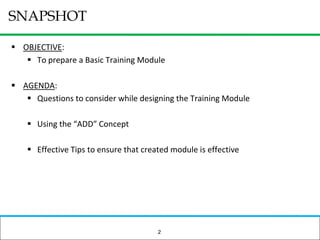
To prepare a Basic Training Module
AGENDA:
Questions to consider while designing the Training Module
Using the “ADD” Concept
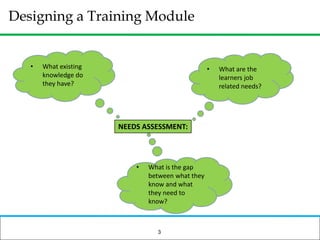
Effective Tips to ensure that created module is effectiveDesigning a Training ModuleWhat existing knowledge do they have?
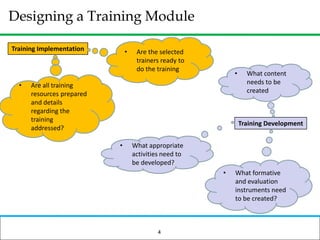
What are the learners job related needs?NEEDS ASSESSMENT:What is the gap between what they know and what they need to know?Designing a Training ModuleAre the selected trainers ready to do the trainingTraining ImplementationWhat content needs to be created
Are all training resources prepared and details regarding the training addressed?Training DevelopmentWhat appropriate activities need to be developed?
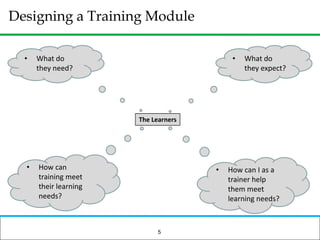
What formative and evaluation instruments need to be created?Designing a Training ModuleWhat do they expect?
What do they need?The LearnersHow can training meet their learning needs?
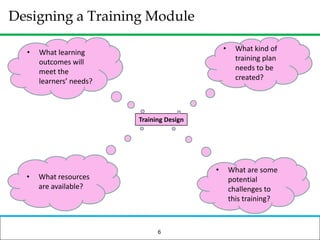
How can I as a trainer help them meet learning needs?Designing a Training ModuleWhat kind of training plan needs to be created?
What learning outcomes will meet the learners’ needs?Training DesignWhat resources are available?
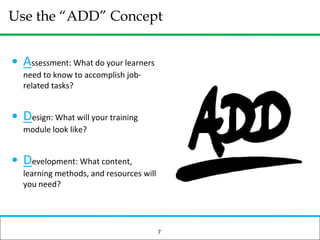
What are some potential challenges to this training?Use the “ADD” ConceptAssessment: What do your learners need to know to accomplish job-related tasks?Design: What will your training module look like?Development: What content, learning methods, and resources will you need?
Assessment (Characteristics of Learners)Need to know: The learners want training delivered when “THEY” need it, when they are ready and wanting to progress to a new task or a new stageSelf Concept: The learners have a desire to be recognized by instructor as independent and self directedLife Experience: The learners expect the instructor to recognize their prior accomplishments and knowledgeTask centered and Practical: The learners feel that the training should help them meet job related needsInternally Motivated: The Learners want to be largely (but not exclusively) driven by internal rewards and not, for e.g., grades or marks.
DesignTrainer Notes: Detailed explanation with questions from students and trainerClass Discussion: Conversation with questions posed to elicit thoughtful responses from learnersGames: Competitive activities that allows learners to test their knowledge and skill in the subject.Small Group Exercises: 4-6 people answering questions or solving problems togetherRole Plays: Smaller groups designed for more intense discussion and problem solving
Design (Cont’d….)Instructional Plan: An instructional plan is a map that outlines the design of your training module and includes the followingTraining Program Title
Overall Description of the Training
Learning Outcomes
Length of Training
Target Learners
Overall Format for Training
Participant Requirements
Instructional Material and Aids needed
Logistical Issues
Content Outline, including:
Major Topics to be addressed
Brief description for each topic
Identification of learning methods usedDevelopmentConsider the following while developing content for the module:Have you taken into consideration primary content, i.e. one-to-one conversations/personal experiences/feedback?Have you provided enough information and learning experiences for trainees to accomplish the stated learning outcomes?Is there a balance of interactive, independent, and instructor led training experiences?Is there enough detail to allow a trainer to use the content outline to teach the training program?
Development (Cont’d….)A training module is built on a series of carefully designed learning experiences. When developing learning experiences, consider the following:Develop learning experiences based on a specific learning outcomeThe learning experience should be appropriate to the learning domain as well as for accomplishing the learning outcomeUse a variety of learning experiencesAllow for questions and student-to-student interaction in each learning experienceConsider the constraints in facilitating each learning experience

How To Prepare A Basic Training Module

  • 1.
    How to Preparea Basic Training Module
  • 2.
  • 3.
    To prepare aBasic Training Module
  • 4.
  • 5.
    Questions to considerwhile designing the Training Module
  • 6.
  • 7.
    Effective Tips toensure that created module is effectiveDesigning a Training ModuleWhat existing knowledge do they have?
  • 8.
    What are thelearners job related needs?NEEDS ASSESSMENT:What is the gap between what they know and what they need to know?Designing a Training ModuleAre the selected trainers ready to do the trainingTraining ImplementationWhat content needs to be created
  • 9.
    Are all trainingresources prepared and details regarding the training addressed?Training DevelopmentWhat appropriate activities need to be developed?
  • 10.
    What formative andevaluation instruments need to be created?Designing a Training ModuleWhat do they expect?
  • 11.
    What do theyneed?The LearnersHow can training meet their learning needs?
  • 12.
    How can Ias a trainer help them meet learning needs?Designing a Training ModuleWhat kind of training plan needs to be created?
  • 13.
    What learning outcomeswill meet the learners’ needs?Training DesignWhat resources are available?
  • 14.
    What are somepotential challenges to this training?Use the “ADD” ConceptAssessment: What do your learners need to know to accomplish job-related tasks?Design: What will your training module look like?Development: What content, learning methods, and resources will you need?
  • 15.
    Assessment (Characteristics ofLearners)Need to know: The learners want training delivered when “THEY” need it, when they are ready and wanting to progress to a new task or a new stageSelf Concept: The learners have a desire to be recognized by instructor as independent and self directedLife Experience: The learners expect the instructor to recognize their prior accomplishments and knowledgeTask centered and Practical: The learners feel that the training should help them meet job related needsInternally Motivated: The Learners want to be largely (but not exclusively) driven by internal rewards and not, for e.g., grades or marks.
  • 16.
    DesignTrainer Notes: Detailedexplanation with questions from students and trainerClass Discussion: Conversation with questions posed to elicit thoughtful responses from learnersGames: Competitive activities that allows learners to test their knowledge and skill in the subject.Small Group Exercises: 4-6 people answering questions or solving problems togetherRole Plays: Smaller groups designed for more intense discussion and problem solving
  • 17.
    Design (Cont’d….)Instructional Plan:An instructional plan is a map that outlines the design of your training module and includes the followingTraining Program Title
  • 18.
  • 19.
  • 20.
  • 21.
  • 22.
  • 23.
  • 24.
  • 25.
  • 26.
  • 27.
    Major Topics tobe addressed
  • 28.
  • 29.
    Identification of learningmethods usedDevelopmentConsider the following while developing content for the module:Have you taken into consideration primary content, i.e. one-to-one conversations/personal experiences/feedback?Have you provided enough information and learning experiences for trainees to accomplish the stated learning outcomes?Is there a balance of interactive, independent, and instructor led training experiences?Is there enough detail to allow a trainer to use the content outline to teach the training program?
  • 30.
    Development (Cont’d….)A trainingmodule is built on a series of carefully designed learning experiences. When developing learning experiences, consider the following:Develop learning experiences based on a specific learning outcomeThe learning experience should be appropriate to the learning domain as well as for accomplishing the learning outcomeUse a variety of learning experiencesAllow for questions and student-to-student interaction in each learning experienceConsider the constraints in facilitating each learning experience

Editor's Notes

  • #9 Internal rewards are related to the satisfaction at achievement of personal goals. Such rewards depend on the systems of personal meaning and values of the individual. For example for those who value hard work the completion of a job will have intrinsic merit.