AP Government UNIT 2 Political Beliefs and Behaviors
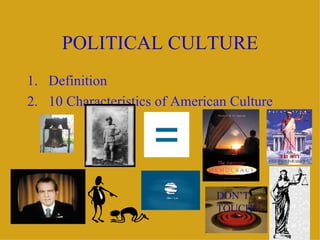
POLITICAL CULTURE Definition 10 Characteristics of American Culture DON’T TOUCH!
IDEOLOGY and PUBLIC POLICY Background Ideology Definition Ideologues
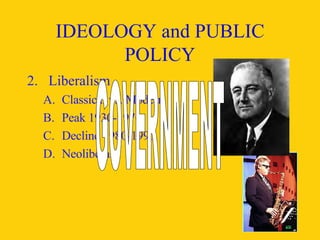
IDEOLOGY and PUBLIC POLICY 2. Liberalism Classical vs. Modern Peak 1930-1970 Decline 1980-1990 Neoliberals GOVERNMENT
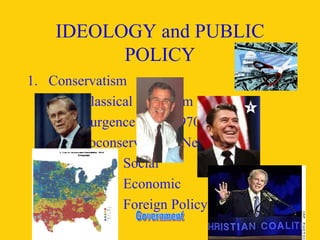
IDEOLOGY and PUBLIC POLICY Conservatism A.  = Classical liberalism B.  Resurgence since 1970s C.  Neoconservatives/ New Right 1. Social 2. Economic 3. Foreign Policy Government
IDEOLOGY and PUBLIC POLICY Socialism Libertarianism
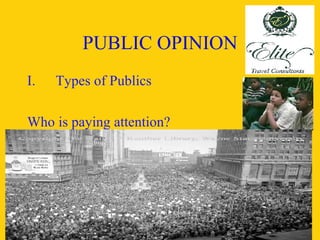
PUBLIC OPINION Types of Publics Who is paying attention?
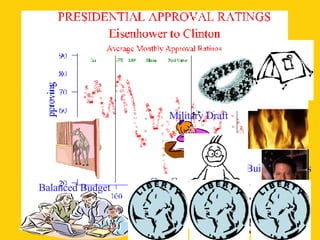
PUBLIC OPINION II. Types of Opinions Death Penalty Presidential Popularity Military Draft Abortion Gun Control Balanced Budget Building Codes ERA
PUBLIC OPINION Measurements of Public Opinion a. Election- but why? b. Straw polls- inaccurate c. Scientific polls 1. Construction 2. Use 3. Abuse of Polls
PUBLIC OPINION IV. Public Awareness and Interest in Politics
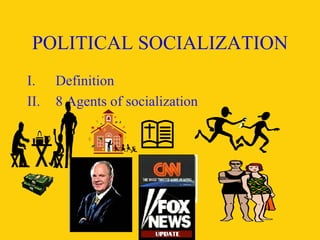
POLITICAL SOCIALIZATION Definition 8 Agents of socialization
VOTER TURNOUT Historical qualifications for suffrage 21
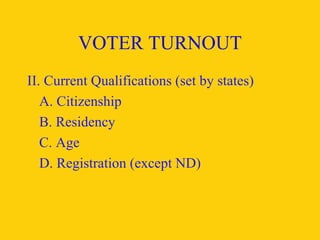
VOTER TURNOUT II. Current Qualifications (set by states) A. Citizenship B. Residency C. Age D. Registration (except ND)
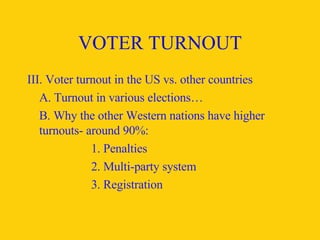
VOTER TURNOUT III. Voter turnout in the US vs. other countries A. Turnout in various elections… B. Why the other Western nations have higher turnouts- around 90%: 1. Penalties 2. Multi-party system 3. Registration
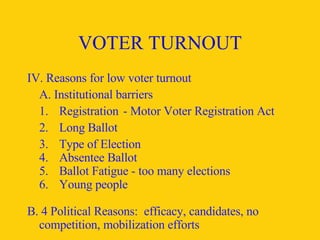
VOTER TURNOUT IV. Reasons for low voter turnout A. Institutional barriers  1. Registration - Motor Voter Registration Act 2. Long Ballot 3. Type of Election 4. Absentee Ballot  5.  Ballot Fatigue - too many elections  6.  Young people B. 4 Political Reasons:  efficacy, candidates, no competition, mobilization efforts
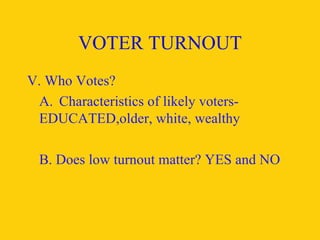
VOTER TURNOUT V. Who Votes?  A. Characteristics of likely voters- EDUCATED,older, white, wealthy B. Does low turnout matter? YES and NO
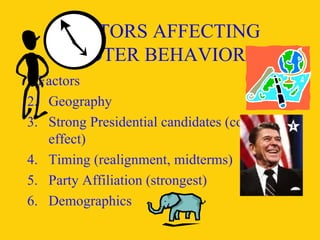
FACTORS AFFECTING VOTER BEHAVIOR 7 Factors Geography Strong Presidential candidates (coattail effect) Timing (realignment, midterms) Party Affiliation (strongest) Demographics
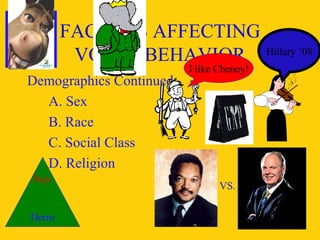
FACTORS AFFECTING VOTER BEHAVIOR Demographics Continued: A. Sex B. Race C. Social Class D. Religion I like Cheney! Hillary ‘08 VS. Rep. Dems
FACTORS AFFECTING VOTER BEHAVIOR 6. Issues Retrospective  - are you better off today than you were four years ago vs.   Prospective - looking ahead at how a candidate will handle something 7. Candidate Appeal 8.  Residency in Florida (in 2000 1,000 people voted for all 10 prez candidates, 700 voted for both Bush and Gore, 3600 voted for all 10 except Bush, 700 voted for all 10 except Gore
CONGRESSIONAL ELECTIONS Intro Schedule Terms Term limits = No-No Single Member Districts
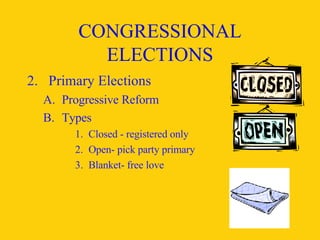
CONGRESSIONAL ELECTIONS 2. Primary Elections Progressive Reform Types Closed - registered only Open- pick party primary Blanket- free love
CONGRESSIONAL ELECTIONS Factors Affecting Outcome of Congressional Elections A. Incumbency- the greatest influence = Permanent congress The Incumbency Advantage Franking Privilege Staff Patronage Gerrymandering = safe seats Committee Service Name recognition: Duncan Hunter vs. Whats His Name Casework Pork Barrel $$$$$$$$$$$$$$$$$$$$ Frank the  mailman Contains work for the district
CONGRESSIONAL ELECTIONS Factors Affecting Outcome of Congressional Elections Continued Type of Elections Incumbent Campaign Weak Challenger Strong Challenger Open Seat- think of musical chairs House vs Senate Midterms = bad for President Somebody fill me ! I have no  chance Oh, my poor opponent!   I can do it!
CONGRESSIONAL ELECTIONS Factors Affecting Outcome of Congressional Elections Continued Coattail Effect Media Party Affiliation Issues- scandals anyone? Campaign Consultants Technology
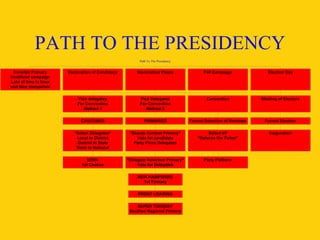
PATH TO THE PRESIDENCY
PATH TO THE PRESIDENCY Pros of Nominating System Cons of Nominating System
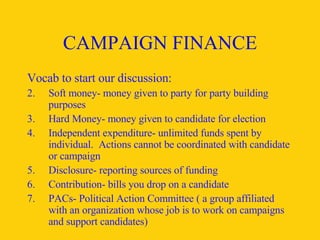
CAMPAIGN FINANCE Vocab to start our discussion: Soft money- money given to party for party building purposes Hard Money- money given to candidate for election Independent expenditure- unlimited funds spent by individual.  Actions cannot be coordinated with candidate or campaign Disclosure- reporting sources of funding Contribution- bills you drop on a candidate PACs- Political Action Committee ( a group affiliated with an organization whose job is to work on campaigns and support candidates)
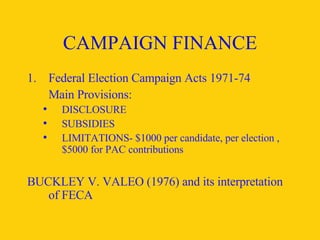
CAMPAIGN FINANCE Federal Election Campaign Acts 1971-74 Main Provisions: DISCLOSURE SUBSIDIES LIMITATIONS- $1000 per candidate, per election , $5000 for PAC contributions BUCKLEY V. VALEO (1976) and its interpretation of FECA
CAMPAIGN FINANCE Campaign Reform Act of 2002 (McCain- Feingold Bill) Bans Soft Money to the National Parties Limits amount and use of soft money to the state parties ($10,000 and GOTV) Doubles individual “hard money” donations ($2000 and tied to inflation) No change for PACs Unions and Corporations banned from soft money contributions
CAMPAIGN FINANCE Ways around McCain-Feingold
CAMPAIGN FINANCE ANALYSIS- points to ponder No subsidies for congressional candidates No limits on Congressional spending No limits on Independent Expenditures (527 groups like swift boat veterans) Lack of subsidies for Minor Party prez candidates Candidate-centered campaigns- whose power suffers as a result of this? Growth of PACs- their $ goes to incumbents Presidential candidates can opt out of funds and not abide by spending limits Hi MR CAMBOU!!!

AP_Unit2

  • 1.
    AP Government UNIT2 Political Beliefs and Behaviors
  • 2.
    POLITICAL CULTURE Definition10 Characteristics of American Culture DON’T TOUCH!
  • 3.
    IDEOLOGY and PUBLICPOLICY Background Ideology Definition Ideologues
  • 4.
    IDEOLOGY and PUBLICPOLICY 2. Liberalism Classical vs. Modern Peak 1930-1970 Decline 1980-1990 Neoliberals GOVERNMENT
  • 5.
    IDEOLOGY and PUBLICPOLICY Conservatism A. = Classical liberalism B. Resurgence since 1970s C. Neoconservatives/ New Right 1. Social 2. Economic 3. Foreign Policy Government
  • 6.
    IDEOLOGY and PUBLICPOLICY Socialism Libertarianism
  • 7.
    PUBLIC OPINION Typesof Publics Who is paying attention?
  • 8.
    PUBLIC OPINION II.Types of Opinions Death Penalty Presidential Popularity Military Draft Abortion Gun Control Balanced Budget Building Codes ERA
  • 9.
    PUBLIC OPINION Measurementsof Public Opinion a. Election- but why? b. Straw polls- inaccurate c. Scientific polls 1. Construction 2. Use 3. Abuse of Polls
  • 10.
    PUBLIC OPINION IV.Public Awareness and Interest in Politics
  • 11.
    POLITICAL SOCIALIZATION Definition8 Agents of socialization
  • 12.
    VOTER TURNOUT Historicalqualifications for suffrage 21
  • 13.
    VOTER TURNOUT II.Current Qualifications (set by states) A. Citizenship B. Residency C. Age D. Registration (except ND)
  • 14.
    VOTER TURNOUT III.Voter turnout in the US vs. other countries A. Turnout in various elections… B. Why the other Western nations have higher turnouts- around 90%: 1. Penalties 2. Multi-party system 3. Registration
  • 15.
    VOTER TURNOUT IV.Reasons for low voter turnout A. Institutional barriers 1. Registration - Motor Voter Registration Act 2. Long Ballot 3. Type of Election 4. Absentee Ballot 5. Ballot Fatigue - too many elections 6. Young people B. 4 Political Reasons: efficacy, candidates, no competition, mobilization efforts
  • 16.
    VOTER TURNOUT V.Who Votes? A. Characteristics of likely voters- EDUCATED,older, white, wealthy B. Does low turnout matter? YES and NO
  • 17.
    FACTORS AFFECTING VOTERBEHAVIOR 7 Factors Geography Strong Presidential candidates (coattail effect) Timing (realignment, midterms) Party Affiliation (strongest) Demographics
  • 18.
    FACTORS AFFECTING VOTERBEHAVIOR Demographics Continued: A. Sex B. Race C. Social Class D. Religion I like Cheney! Hillary ‘08 VS. Rep. Dems
  • 19.
    FACTORS AFFECTING VOTERBEHAVIOR 6. Issues Retrospective - are you better off today than you were four years ago vs. Prospective - looking ahead at how a candidate will handle something 7. Candidate Appeal 8. Residency in Florida (in 2000 1,000 people voted for all 10 prez candidates, 700 voted for both Bush and Gore, 3600 voted for all 10 except Bush, 700 voted for all 10 except Gore
  • 20.
    CONGRESSIONAL ELECTIONS IntroSchedule Terms Term limits = No-No Single Member Districts
  • 21.
    CONGRESSIONAL ELECTIONS 2.Primary Elections Progressive Reform Types Closed - registered only Open- pick party primary Blanket- free love
  • 22.
    CONGRESSIONAL ELECTIONS FactorsAffecting Outcome of Congressional Elections A. Incumbency- the greatest influence = Permanent congress The Incumbency Advantage Franking Privilege Staff Patronage Gerrymandering = safe seats Committee Service Name recognition: Duncan Hunter vs. Whats His Name Casework Pork Barrel $$$$$$$$$$$$$$$$$$$$ Frank the mailman Contains work for the district
  • 23.
    CONGRESSIONAL ELECTIONS FactorsAffecting Outcome of Congressional Elections Continued Type of Elections Incumbent Campaign Weak Challenger Strong Challenger Open Seat- think of musical chairs House vs Senate Midterms = bad for President Somebody fill me ! I have no chance Oh, my poor opponent! I can do it!
  • 24.
    CONGRESSIONAL ELECTIONS FactorsAffecting Outcome of Congressional Elections Continued Coattail Effect Media Party Affiliation Issues- scandals anyone? Campaign Consultants Technology
  • 25.
    PATH TO THEPRESIDENCY
  • 26.
    PATH TO THEPRESIDENCY Pros of Nominating System Cons of Nominating System
  • 27.
    CAMPAIGN FINANCE Vocabto start our discussion: Soft money- money given to party for party building purposes Hard Money- money given to candidate for election Independent expenditure- unlimited funds spent by individual. Actions cannot be coordinated with candidate or campaign Disclosure- reporting sources of funding Contribution- bills you drop on a candidate PACs- Political Action Committee ( a group affiliated with an organization whose job is to work on campaigns and support candidates)
  • 28.
    CAMPAIGN FINANCE FederalElection Campaign Acts 1971-74 Main Provisions: DISCLOSURE SUBSIDIES LIMITATIONS- $1000 per candidate, per election , $5000 for PAC contributions BUCKLEY V. VALEO (1976) and its interpretation of FECA
  • 29.
    CAMPAIGN FINANCE CampaignReform Act of 2002 (McCain- Feingold Bill) Bans Soft Money to the National Parties Limits amount and use of soft money to the state parties ($10,000 and GOTV) Doubles individual “hard money” donations ($2000 and tied to inflation) No change for PACs Unions and Corporations banned from soft money contributions
  • 30.
    CAMPAIGN FINANCE Waysaround McCain-Feingold
  • 31.
    CAMPAIGN FINANCE ANALYSIS-points to ponder No subsidies for congressional candidates No limits on Congressional spending No limits on Independent Expenditures (527 groups like swift boat veterans) Lack of subsidies for Minor Party prez candidates Candidate-centered campaigns- whose power suffers as a result of this? Growth of PACs- their $ goes to incumbents Presidential candidates can opt out of funds and not abide by spending limits Hi MR CAMBOU!!!