1
Medical and Electronic waste
Management project
21-22 May 2019
ToT
E-waste management
Eng. Hoda Shakra, Technical officer, GEF-UNDP project
Empowered Lives.
Resilient nations.
Arab Republic Of Egypt
Ministry Of Environment
2
Agenda
1 • What is E-waste?
2
• Why E-waste is a concern?
3 • E-waste management
4 • How much E-waste is there?
5 • E-waste in Egypt
6 • MEWM project
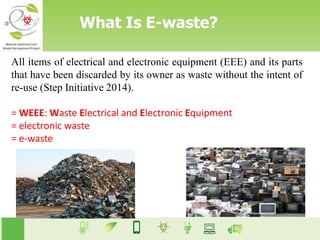
What Is E-waste?
All items of electrical and electronic equipment (EEE) and its parts
that have been discarded by its owner as waste without the intent of
re-use (Step Initiative 2014).
= WEEE: Waste Electrical and Electronic Equipment
= electronic waste
= e-waste
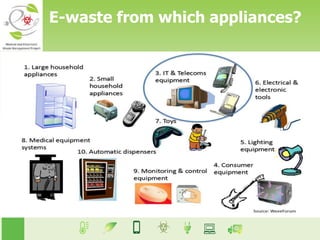
E-waste from which appliances?
 Hazardous substances
 informal recycling
 illegal export and import
Why is e-waste a concern?
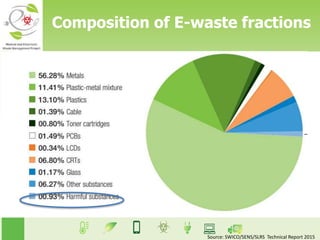
Composition of E-waste fractions
Source: SWICO/SENS/SLRS Technical Report 2015
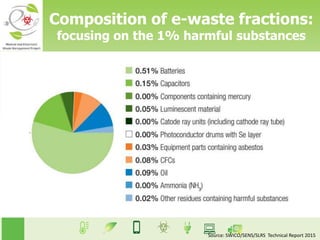
Composition of e-waste fractions:
focusing on the 1% harmful substances
Source: SWICO/SENS/SLRS Technical Report 2015
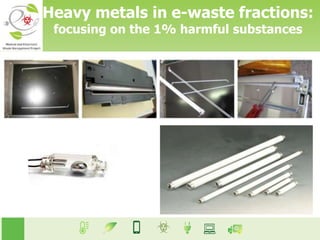
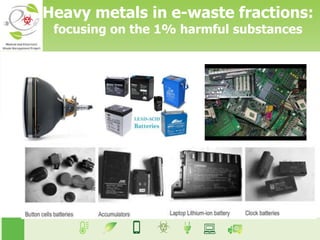
Heavy metals in e-waste fractions:
focusing on the 1% harmful substances
Heavy metals in e-waste fractions:
focusing on the 1% harmful substances
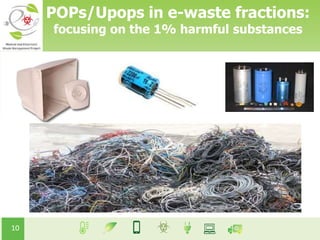
10
POPs/Upops in e-waste fractions:
focusing on the 1% harmful substances
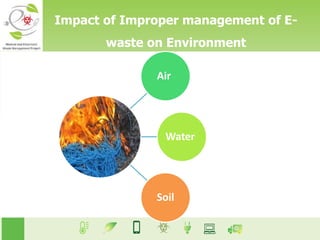
Impact of Improper management of E-
waste on Environment
Air
Water
Soil
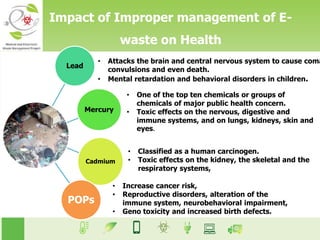
Impact of Improper management of E-
waste on Health
Lead
Mercury
Cadmium
POPs
• One of the top ten chemicals or groups of
chemicals of major public health concern.
• Toxic effects on the nervous, digestive and
immune systems, and on lungs, kidneys, skin and
eyes.
• Attacks the brain and central nervous system to cause coma
convulsions and even death.
• Mental retardation and behavioral disorders in children.
• Classified as a human carcinogen.
• Toxic effects on the kidney, the skeletal and the
respiratory systems,
• Increase cancer risk,
• Reproductive disorders, alteration of the
immune system, neurobehavioral impairment,
• Geno toxicity and increased birth defects.
The problematic informal sector
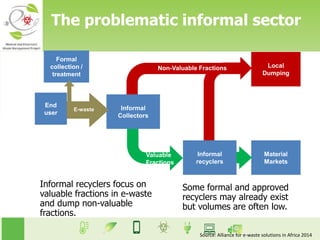
• Informal recyclers focus on
valuable fractions in e-waste
and dump non-valuable
fractions.
Material
Markets
Local
Dumping
Non-Valuable Fractions
Informal
Collectors
Valuable
Fractions
Informal
recyclers
E-waste
End
user
Formal
collection /
treatment
• Some formal and approved
recyclers may already exist
but volumes are often low.
Source: Alliance for e-waste solutions in Africa 2014
Source: Dr. Federico Magalini
Brescia PhD Course
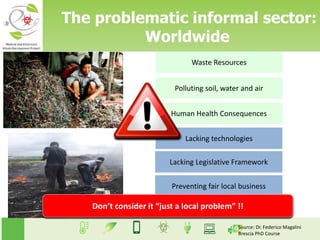
Waste Resources
Polluting soil, water and air
Human Health Consequences
Lacking technologies
Lacking Legislative Framework
Preventing fair local business
Don’t consider it “just a local problem” !!
The problematic informal sector:
Worldwide
15
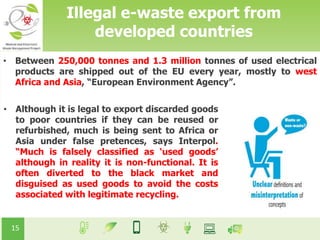
• Between 250,000 tonnes and 1.3 million tonnes of used electrical
products are shipped out of the EU every year, mostly to west
Africa and Asia, “European Environment Agency”.
• Although it is legal to export discarded goods
to poor countries if they can be reused or
refurbished, much is being sent to Africa or
Asia under false pretences, says Interpol.
“Much is falsely classified as ‘used goods’
although in reality it is non-functional. It is
often diverted to the black market and
disguised as used goods to avoid the costs
associated with legitimate recycling.
Illegal e-waste export from
developed countries
Environment
SocietyEconomy
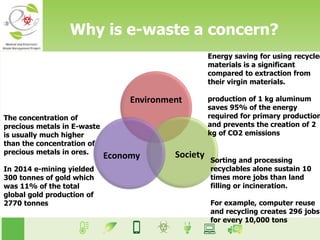
Energy saving for using recycled
materials is a significant
compared to extraction from
their virgin materials.
production of 1 kg aluminum
saves 95% of the energy
required for primary production
and prevents the creation of 2
kg of CO2 emissions
Sorting and processing
recyclables alone sustain 10
times more jobs than land
filling or incineration.
For example, computer reuse
and recycling creates 296 jobs
for every 10,000 tons
The concentration of
precious metals in E-waste
is usually much higher
than the concentration of
precious metals in ores.
In 2014 e-mining yielded
300 tonnes of gold which
was 11% of the total
global gold production of
2770 tonnes
Why is e-waste a concern?
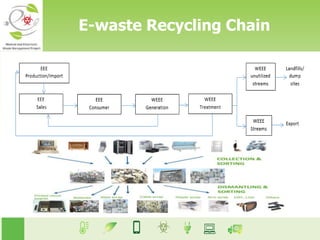
E-waste Recycling Chain
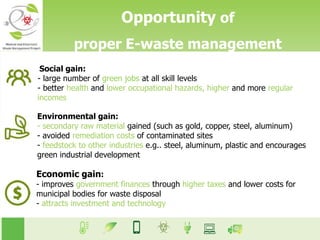
Opportunity of
proper E-waste management
Social gain:
- large number of green jobs at all skill levels
- better health and lower occupational hazards, higher and more regular
incomes
Environmental gain:
- secondary raw material gained (such as gold, copper, steel, aluminum)
- avoided remediation costs of contaminated sites
- feedstock to other industries e.g.. steel, aluminum, plastic and encourages
green industrial development
Economic gain:
- improves government finances through higher taxes and lower costs for
municipal bodies for waste disposal
- attracts investment and technology
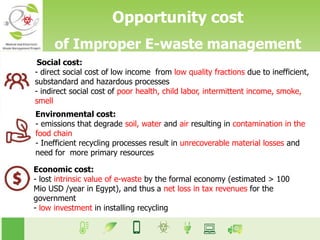
Opportunity cost
of Improper E-waste management
Social cost:
- direct social cost of low income from low quality fractions due to inefficient,
substandard and hazardous processes
- indirect social cost of poor health, child labor, intermittent income, smoke,
smell
Environmental cost:
- emissions that degrade soil, water and air resulting in contamination in the
food chain
- Inefficient recycling processes result in unrecoverable material losses and
need for more primary resources
Economic cost:
- lost intrinsic value of e-waste by the formal economy (estimated > 100
Mio USD /year in Egypt), and thus a net loss in tax revenues for the
government
- low investment in installing recycling
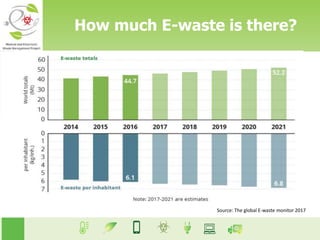
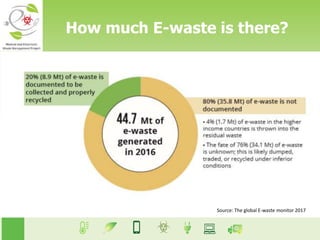
How much E-waste is there?
Source: The global E-waste monitor 2017
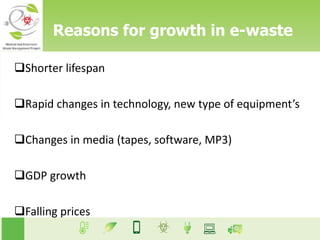
Reasons for growth in e-waste
Shorter lifespan
Rapid changes in technology, new type of equipment’s
Changes in media (tapes, software, MP3)
GDP growth
Falling prices
Source: The global E-waste monitor 2017
How much E-waste is there?
23
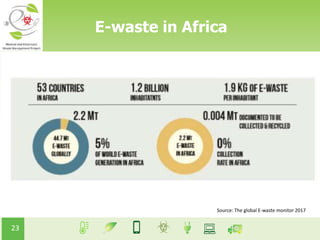
Source: The global E-waste monitor 2017
E-waste in Africa
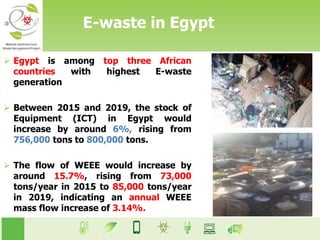
E-waste in Egypt
 Egypt is among top three African
countries with highest E-waste
generation
 Between 2015 and 2019, the stock of
Equipment (ICT) in Egypt would
increase by around 6%, rising from
756,000 tons to 800,000 tons.
 The flow of WEEE would increase by
around 15.7%, rising from 73,000
tons/year in 2015 to 85,000 tons/year
in 2019, indicating an annual WEEE
mass flow increase of 3.14%.
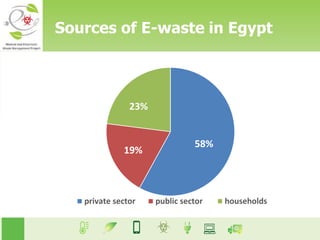
58%
19%
23%
private sector public sector households
Sources of E-waste in Egypt
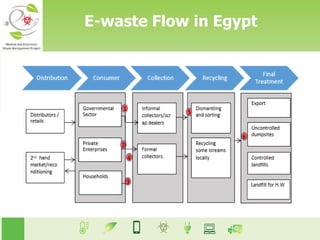
E-waste Flow in Egypt
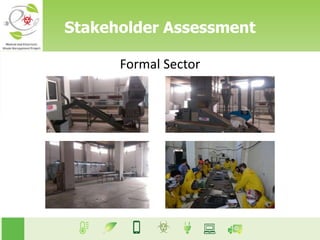
Stakeholder Assessment
Formal Sector
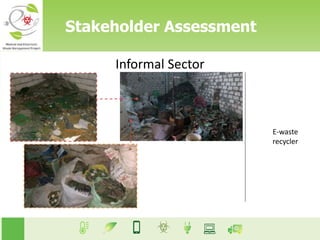
Stakeholder Assessment
Informal Sector
E-waste
recycler
Laws & Regulations: Develop short and succinct law on the disposal of obsolete
electrical equipment as a type of waste, and recognize it with a term such as
WEEE/WEEE.
Collection: Enforce licensing and EHS regulation requirement on
collectors/recyclers participating in auctions for WEEE from governmental sector
and enterprises.
Recycling & Treatment: Empower the formal sector through trainings, technical
and financial scheme. Design a business models for informal sector and incentives
through better prices. Encourage civil society and development NGOs to prioritize
WEEE recycling sector. Awareness and Education: Conduct mass awareness
campaigns supported by booklets and manuals on WEEE.
IMS: Require governmental institutions affiliated with WEEE industry to adopt
digital format of information management and digital based documentation.
EEE Producers/Retailers: integrate end producer/end distributer responsibility in
legal framework with respect to WEEE
Recommendation
30
Medical and Electronic waste
management project
31
MEWM project
The Government of Egypt, represented by the Ministry of Environment
(MOE) in coordination with the Ministry of Foreign Affairs(MoFA) and
the technical support of the United Nations Development Program
(UNDP) has succeeded in obtaining a new package of grants from the Global
Environment Facility (GEF) to implement A five years project (started in May
2016) entitled.
Protect human health and the environment from unintentional
releases of POPs
originating from incineration and open burning of health care- and
electronic waste
32
Project objective
 Protect human- and environmental health by reducing releases of POPs
and other hazardous releases (e.g. mercury, lead, etc.) resulting from the
unsound management of healthcare and electronic wastes by provision
of an integrated institutional and regulatory framework and
demonstrating and promoting BAT & BEP to soundly manage and dispose
of such wastes through:
1. Improving the regulatory system and enhancing its enforcement
2. Raising awareness on POPs
3. Establishing the capacity for safe handling and transport
4. Improving disposal of POPs containing waste
33
Electronic waste Management
Component
34
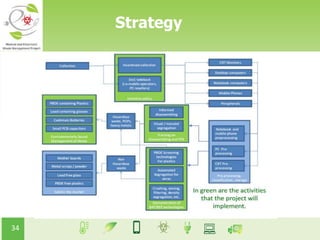
Strategy
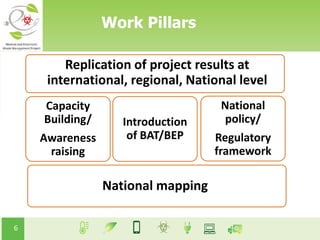
Work Pillars
Replication of project results at
international, regional, National level
National mapping
National
policy/
Regulatory
framework
Capacity
Building/
Awareness
raising
Introduction
of BAT/BEP
6
36
Thank you

E-waste management

  • 1.
    1 Medical and Electronicwaste Management project 21-22 May 2019 ToT E-waste management Eng. Hoda Shakra, Technical officer, GEF-UNDP project Empowered Lives. Resilient nations. Arab Republic Of Egypt Ministry Of Environment
  • 2.
    2 Agenda 1 • Whatis E-waste? 2 • Why E-waste is a concern? 3 • E-waste management 4 • How much E-waste is there? 5 • E-waste in Egypt 6 • MEWM project
  • 3.
    What Is E-waste? Allitems of electrical and electronic equipment (EEE) and its parts that have been discarded by its owner as waste without the intent of re-use (Step Initiative 2014). = WEEE: Waste Electrical and Electronic Equipment = electronic waste = e-waste
  • 4.
    E-waste from whichappliances?
  • 5.
     Hazardous substances informal recycling  illegal export and import Why is e-waste a concern?
  • 6.
    Composition of E-wastefractions Source: SWICO/SENS/SLRS Technical Report 2015
  • 7.
    Composition of e-wastefractions: focusing on the 1% harmful substances Source: SWICO/SENS/SLRS Technical Report 2015
  • 8.
    Heavy metals ine-waste fractions: focusing on the 1% harmful substances
  • 9.
    Heavy metals ine-waste fractions: focusing on the 1% harmful substances
  • 10.
    10 POPs/Upops in e-wastefractions: focusing on the 1% harmful substances
  • 11.
    Impact of Impropermanagement of E- waste on Environment Air Water Soil
  • 12.
    Impact of Impropermanagement of E- waste on Health Lead Mercury Cadmium POPs • One of the top ten chemicals or groups of chemicals of major public health concern. • Toxic effects on the nervous, digestive and immune systems, and on lungs, kidneys, skin and eyes. • Attacks the brain and central nervous system to cause coma convulsions and even death. • Mental retardation and behavioral disorders in children. • Classified as a human carcinogen. • Toxic effects on the kidney, the skeletal and the respiratory systems, • Increase cancer risk, • Reproductive disorders, alteration of the immune system, neurobehavioral impairment, • Geno toxicity and increased birth defects.
  • 13.
    The problematic informalsector • Informal recyclers focus on valuable fractions in e-waste and dump non-valuable fractions. Material Markets Local Dumping Non-Valuable Fractions Informal Collectors Valuable Fractions Informal recyclers E-waste End user Formal collection / treatment • Some formal and approved recyclers may already exist but volumes are often low. Source: Alliance for e-waste solutions in Africa 2014
  • 14.
    Source: Dr. FedericoMagalini Brescia PhD Course Waste Resources Polluting soil, water and air Human Health Consequences Lacking technologies Lacking Legislative Framework Preventing fair local business Don’t consider it “just a local problem” !! The problematic informal sector: Worldwide
  • 15.
    15 • Between 250,000tonnes and 1.3 million tonnes of used electrical products are shipped out of the EU every year, mostly to west Africa and Asia, “European Environment Agency”. • Although it is legal to export discarded goods to poor countries if they can be reused or refurbished, much is being sent to Africa or Asia under false pretences, says Interpol. “Much is falsely classified as ‘used goods’ although in reality it is non-functional. It is often diverted to the black market and disguised as used goods to avoid the costs associated with legitimate recycling. Illegal e-waste export from developed countries
  • 16.
    Environment SocietyEconomy Energy saving forusing recycled materials is a significant compared to extraction from their virgin materials. production of 1 kg aluminum saves 95% of the energy required for primary production and prevents the creation of 2 kg of CO2 emissions Sorting and processing recyclables alone sustain 10 times more jobs than land filling or incineration. For example, computer reuse and recycling creates 296 jobs for every 10,000 tons The concentration of precious metals in E-waste is usually much higher than the concentration of precious metals in ores. In 2014 e-mining yielded 300 tonnes of gold which was 11% of the total global gold production of 2770 tonnes Why is e-waste a concern?
  • 17.
  • 18.
    Opportunity of proper E-wastemanagement Social gain: - large number of green jobs at all skill levels - better health and lower occupational hazards, higher and more regular incomes Environmental gain: - secondary raw material gained (such as gold, copper, steel, aluminum) - avoided remediation costs of contaminated sites - feedstock to other industries e.g.. steel, aluminum, plastic and encourages green industrial development Economic gain: - improves government finances through higher taxes and lower costs for municipal bodies for waste disposal - attracts investment and technology
  • 19.
    Opportunity cost of ImproperE-waste management Social cost: - direct social cost of low income from low quality fractions due to inefficient, substandard and hazardous processes - indirect social cost of poor health, child labor, intermittent income, smoke, smell Environmental cost: - emissions that degrade soil, water and air resulting in contamination in the food chain - Inefficient recycling processes result in unrecoverable material losses and need for more primary resources Economic cost: - lost intrinsic value of e-waste by the formal economy (estimated > 100 Mio USD /year in Egypt), and thus a net loss in tax revenues for the government - low investment in installing recycling
  • 20.
    How much E-wasteis there? Source: The global E-waste monitor 2017
  • 21.
    Reasons for growthin e-waste Shorter lifespan Rapid changes in technology, new type of equipment’s Changes in media (tapes, software, MP3) GDP growth Falling prices
  • 22.
    Source: The globalE-waste monitor 2017 How much E-waste is there?
  • 23.
    23 Source: The globalE-waste monitor 2017 E-waste in Africa
  • 24.
    E-waste in Egypt Egypt is among top three African countries with highest E-waste generation  Between 2015 and 2019, the stock of Equipment (ICT) in Egypt would increase by around 6%, rising from 756,000 tons to 800,000 tons.  The flow of WEEE would increase by around 15.7%, rising from 73,000 tons/year in 2015 to 85,000 tons/year in 2019, indicating an annual WEEE mass flow increase of 3.14%.
  • 25.
    58% 19% 23% private sector publicsector households Sources of E-waste in Egypt
  • 26.
  • 27.
  • 28.
  • 29.
    Laws & Regulations:Develop short and succinct law on the disposal of obsolete electrical equipment as a type of waste, and recognize it with a term such as WEEE/WEEE. Collection: Enforce licensing and EHS regulation requirement on collectors/recyclers participating in auctions for WEEE from governmental sector and enterprises. Recycling & Treatment: Empower the formal sector through trainings, technical and financial scheme. Design a business models for informal sector and incentives through better prices. Encourage civil society and development NGOs to prioritize WEEE recycling sector. Awareness and Education: Conduct mass awareness campaigns supported by booklets and manuals on WEEE. IMS: Require governmental institutions affiliated with WEEE industry to adopt digital format of information management and digital based documentation. EEE Producers/Retailers: integrate end producer/end distributer responsibility in legal framework with respect to WEEE Recommendation
  • 30.
    30 Medical and Electronicwaste management project
  • 31.
    31 MEWM project The Governmentof Egypt, represented by the Ministry of Environment (MOE) in coordination with the Ministry of Foreign Affairs(MoFA) and the technical support of the United Nations Development Program (UNDP) has succeeded in obtaining a new package of grants from the Global Environment Facility (GEF) to implement A five years project (started in May 2016) entitled. Protect human health and the environment from unintentional releases of POPs originating from incineration and open burning of health care- and electronic waste
  • 32.
    32 Project objective  Protecthuman- and environmental health by reducing releases of POPs and other hazardous releases (e.g. mercury, lead, etc.) resulting from the unsound management of healthcare and electronic wastes by provision of an integrated institutional and regulatory framework and demonstrating and promoting BAT & BEP to soundly manage and dispose of such wastes through: 1. Improving the regulatory system and enhancing its enforcement 2. Raising awareness on POPs 3. Establishing the capacity for safe handling and transport 4. Improving disposal of POPs containing waste
  • 33.
  • 34.
  • 35.
    Work Pillars Replication ofproject results at international, regional, National level National mapping National policy/ Regulatory framework Capacity Building/ Awareness raising Introduction of BAT/BEP 6
  • 36.

Editor's Notes

  • #17 E-waste recycling means Sustainable development and SD has 3 dimension considering >>>>>
  • #27 Hot Spots Eol from consumer 1 Waste auction by goveronmental sector has no recycling regulation on collectors – ending with informal sector. 2 Waste auction by enterprises is not subjected to regulation on sustainable recycling. 3 Consumer dump WEEE with household waste. No Extended Producer Responsability, WEEE goes to maintenance and service shops and downstream end with informal sector. Material recovery 4 WEEE management firms: “Cherry picking” of WEEE - WEEE which requires careful handling or low economic revenue eventually ends with informal sector. 5 Informal sector: inappropriate dismantling of hazardous component; child labour; negative health impacts; wires and cables burning. Informal Dumping 6 Emissions from dumped waste; emissions from informal burning sites; not all secondary recourses efficiently are recovered.