ELECTRONI
    C
  WASTE
     Parminder Kaur
Content
What is Electronic Waste?
Electronic Equipments in E-Waste
How these become E-Waste?
Generators of E-Waste
Why E-Waste a problem?
Constituents of E-Waste
E-Waste Disposal
E-Waste in INDIA
E-Waste in CHINA
WEEE Directive
What should be done?
What is Electronic Waste?

It is the term used
to describe old,
end-of-life or
discarded
appliances using
electricity and
battery.
Electronic Equipments
Computers        Mobile       Air
                 Phones       Conditioner


 Laptops          Telephone
                                   Irons


Drill Machines   Treadmills      Printers
How these become E-Waste?
Changes and Advancement in technology
Changes in fashion, style, and status
Changing configuration
Attractive offers from manufacturers
Small life of equipments
Generators of E-Waste

Small business and House hold.
Large businesses,
Institutions and Government
offices.
Equipment manufacturers.
Some examples
 Cell phone upgrades
 Digital TV Conversion
 Software upgrades
 Can't change the battery
in your iPod
 Disposable printers
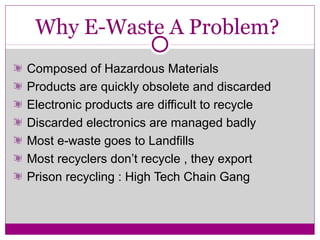
Why E-Waste A Problem?
Composed of Hazardous Materials
Products are quickly obsolete and discarded
Electronic products are difficult to recycle
Discarded electronics are managed badly
Most e-waste goes to Landfills
Most recyclers don’t recycle , they export
Prison recycling : High Tech Chain Gang
Constituents Of E-Waste
Hazardous materials
Valuable materials
Source of e-       Constituent    Health effects
wastes             (Hazardous)
printed circuit    Lead (PB)      •Damage to
boards, computer                  nervous system
monitors                          and kidney
                                  •Affects brain
                                  development of
                                  children.


Chip resistors and Cadmium (CD)   •Accumulates in
semiconductors                    kidney and liver.
                                  •Causes neural
                                  damage.
Relays and          Mercury (Hg)     Chronic damage
switches, printed                    to the brain.
circuit boards                       Respiratory and
                                     skin disorders
Motherboard         Beryllium (Be)   lung cancer


Front panel of      Barium (Ba)      Muscle
CRTs.                                weakness;
                                     Damage to heart,
                                     liver and spleen


                                            BACK
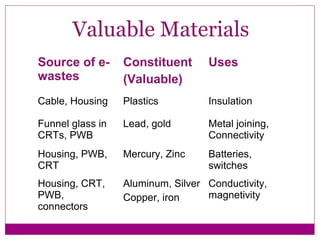
Valuable Materials
Source of e-      Constituent      Uses
wastes            (Valuable)
Cable, Housing    Plastics         Insulation

Funnel glass in   Lead, gold       Metal joining,
CRTs, PWB                          Connectivity
Housing, PWB,     Mercury, Zinc    Batteries,
CRT                                switches
Housing, CRT,     Aluminum, Silver Conductivity,
PWB,              Copper, iron     magnetivity
connectors
Waste Hierarchy

  refers to the "3 R’s"
reduce, reuse and recycle

   Its aim is to extract
         maximum benefits
from products and to
generate the minimum
amount of waste.
E-Waste Disposal

   Methods
 Recycle
 Landfill
 Incineration
 Reuse
E-Waste Recycling
Definition:-
Recycling is defined as the
assembling, developing,
promoting, or buying of
new products, which are
prepared from waste
materials.
Steps in Recycling
Dismantling of E-Waste

Removal of hazardous materials such as
 PCB, HG, removal of plastic etc.

 Strong acids are used to remove valuable metals
such as gold, lead, copper etc.
Methods for recycling

Consumer recycling
Donation
Take back
Exchange
Corporate recycling
Advantages
  Recycled materials can be used in developing
new equipments

  Valuable Materials are retrieved

  Helps environment by avoiding pollution
Land filling
Definition:-
Land fill is also
known as dump, is a
site for the disposal
of waste materials by
burial and is the
oldest form of waste
treatment.
Disadvantages

  Metals like mercury, cadmium, lead leaches into
the soil and ground water making them polluted

Requires large amount of space

It is not a environmentally sound treatment
Incineration
Definition:-
It is a controlled and
complete combustion
process, in which the
waste material is burned in
specially designed
incinerators at a high
temperature (900-
1000oC).
                              Incinerator
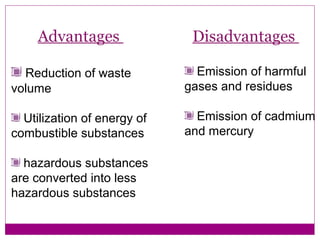
Advantages               Disadvantages

  Reduction of waste           Emission of harmful
volume                       gases and residues

  Utilization of energy of     Emission of cadmium
combustible substances       and mercury

  hazardous substances
are converted into less
hazardous substances
Re-Use
Definition:-
It constitutes direct use
or use after slight
modifications to the
original functioning
equipment.
Advantages
 Electronic equipments like computers, cell phones
etc. can be re-used.

 This method also reduces the volume of e-waste
generation.

no wastage of time and money
E-Waste in INDIA
 over 2 million e-waste is
generated every year

  Harmful techniques like
burning wires are
common practice in the
informal recycling sectors
in big cities in India.
Recycle Steps in INDIA
  Manual Dismantling


  Refining and conditioning

 Solid waste is deposited in a
municipal landfill.
E-Waste in CHINA
 In 2004, China discarded
 4 million refrigerators
 5 million TV sets
 5 million washing machines


  China is receiving 90%
e-waste from other countries.
WEEE Directive

Waste Electrical and
Electronic Equipment
      Directive

                       WEEE
                       Symbol
WEEE Directive
  introduced in January
2007.

   aims to reduce the amount
of electrical and electronic
equipment being produced

  to encourage everyone to
reuse, recycle and recover it.   WEEE Symbol
WEEE Categories
Large household appliances
Lighting Equipment
Electric and Electronic Tools
Toys, sports Equipment
IT and telecommunications equipment
Office, Information & Communication Equipment
Entertainment & Consumer Electronics
Medical devices
Did you know?

   The average lifespan of computers has
dropped from 6 years in 1997 to just 2 years in
2005.

   Mobile phones have a lifecycle of less than
two years in developed countries.

  183 million computers were sold worldwide in
2004 - 11.6 percent more than in 2003.
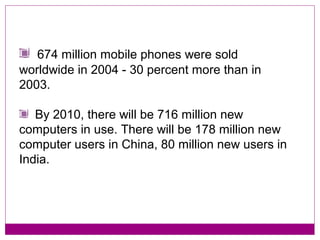
674 million mobile phones were sold
worldwide in 2004 - 30 percent more than in
2003.

   By 2010, there will be 716 million new
computers in use. There will be 178 million new
computer users in China, 80 million new users in
India.
What should be done?
Proper laws and policies should be made
Awareness among consumers and manufacturers
Recycling should be preferred
Products should be made recyclable
Make usage of recycled products
do not throw away old equipments
E waste 33
E waste 33

E waste 33

  • 1.
    ELECTRONI C WASTE Parminder Kaur
  • 2.
    Content What is ElectronicWaste? Electronic Equipments in E-Waste How these become E-Waste? Generators of E-Waste Why E-Waste a problem? Constituents of E-Waste E-Waste Disposal E-Waste in INDIA E-Waste in CHINA WEEE Directive What should be done?
  • 4.
    What is ElectronicWaste? It is the term used to describe old, end-of-life or discarded appliances using electricity and battery.
  • 5.
    Electronic Equipments Computers Mobile Air Phones Conditioner Laptops Telephone Irons Drill Machines Treadmills Printers
  • 6.
    How these becomeE-Waste? Changes and Advancement in technology Changes in fashion, style, and status Changing configuration Attractive offers from manufacturers Small life of equipments
  • 7.
    Generators of E-Waste Smallbusiness and House hold. Large businesses, Institutions and Government offices. Equipment manufacturers.
  • 8.
    Some examples Cellphone upgrades Digital TV Conversion Software upgrades Can't change the battery in your iPod Disposable printers
  • 9.
    Why E-Waste AProblem? Composed of Hazardous Materials Products are quickly obsolete and discarded Electronic products are difficult to recycle Discarded electronics are managed badly Most e-waste goes to Landfills Most recyclers don’t recycle , they export Prison recycling : High Tech Chain Gang
  • 10.
    Constituents Of E-Waste Hazardousmaterials Valuable materials
  • 11.
    Source of e- Constituent Health effects wastes (Hazardous) printed circuit Lead (PB) •Damage to boards, computer nervous system monitors and kidney •Affects brain development of children. Chip resistors and Cadmium (CD) •Accumulates in semiconductors kidney and liver. •Causes neural damage.
  • 12.
    Relays and Mercury (Hg) Chronic damage switches, printed to the brain. circuit boards Respiratory and skin disorders Motherboard Beryllium (Be) lung cancer Front panel of Barium (Ba) Muscle CRTs. weakness; Damage to heart, liver and spleen BACK
  • 13.
    Valuable Materials Source ofe- Constituent Uses wastes (Valuable) Cable, Housing Plastics Insulation Funnel glass in Lead, gold Metal joining, CRTs, PWB Connectivity Housing, PWB, Mercury, Zinc Batteries, CRT switches Housing, CRT, Aluminum, Silver Conductivity, PWB, Copper, iron magnetivity connectors
  • 14.
    Waste Hierarchy refers to the "3 R’s" reduce, reuse and recycle Its aim is to extract maximum benefits from products and to generate the minimum amount of waste.
  • 15.
    E-Waste Disposal Methods  Recycle  Landfill  Incineration  Reuse
  • 16.
    E-Waste Recycling Definition:- Recycling isdefined as the assembling, developing, promoting, or buying of new products, which are prepared from waste materials.
  • 17.
    Steps in Recycling Dismantlingof E-Waste Removal of hazardous materials such as PCB, HG, removal of plastic etc. Strong acids are used to remove valuable metals such as gold, lead, copper etc.
  • 18.
    Methods for recycling Consumerrecycling Donation Take back Exchange Corporate recycling
  • 19.
    Advantages Recycledmaterials can be used in developing new equipments Valuable Materials are retrieved Helps environment by avoiding pollution
  • 20.
    Land filling Definition:- Land fillis also known as dump, is a site for the disposal of waste materials by burial and is the oldest form of waste treatment.
  • 21.
    Disadvantages Metalslike mercury, cadmium, lead leaches into the soil and ground water making them polluted Requires large amount of space It is not a environmentally sound treatment
  • 22.
    Incineration Definition:- It is acontrolled and complete combustion process, in which the waste material is burned in specially designed incinerators at a high temperature (900- 1000oC). Incinerator
  • 23.
    Advantages Disadvantages Reduction of waste Emission of harmful volume gases and residues Utilization of energy of Emission of cadmium combustible substances and mercury hazardous substances are converted into less hazardous substances
  • 24.
    Re-Use Definition:- It constitutes directuse or use after slight modifications to the original functioning equipment.
  • 25.
    Advantages Electronic equipmentslike computers, cell phones etc. can be re-used. This method also reduces the volume of e-waste generation. no wastage of time and money
  • 26.
    E-Waste in INDIA over 2 million e-waste is generated every year Harmful techniques like burning wires are common practice in the informal recycling sectors in big cities in India.
  • 27.
    Recycle Steps inINDIA Manual Dismantling Refining and conditioning Solid waste is deposited in a municipal landfill.
  • 28.
    E-Waste in CHINA In 2004, China discarded  4 million refrigerators  5 million TV sets  5 million washing machines China is receiving 90% e-waste from other countries.
  • 29.
    WEEE Directive Waste Electricaland Electronic Equipment Directive WEEE Symbol
  • 30.
    WEEE Directive introduced in January 2007. aims to reduce the amount of electrical and electronic equipment being produced to encourage everyone to reuse, recycle and recover it. WEEE Symbol
  • 31.
    WEEE Categories Large householdappliances Lighting Equipment Electric and Electronic Tools Toys, sports Equipment IT and telecommunications equipment Office, Information & Communication Equipment Entertainment & Consumer Electronics Medical devices
  • 32.
    Did you know? The average lifespan of computers has dropped from 6 years in 1997 to just 2 years in 2005. Mobile phones have a lifecycle of less than two years in developed countries. 183 million computers were sold worldwide in 2004 - 11.6 percent more than in 2003.
  • 33.
    674 million mobilephones were sold worldwide in 2004 - 30 percent more than in 2003. By 2010, there will be 716 million new computers in use. There will be 178 million new computer users in China, 80 million new users in India.
  • 34.
    What should bedone? Proper laws and policies should be made Awareness among consumers and manufacturers Recycling should be preferred Products should be made recyclable Make usage of recycled products do not throw away old equipments