The document summarizes the evolution of operating systems from early batch systems to modern distributed systems. It describes batch operating systems which executed jobs sequentially in batches. Multiprogramming systems allowed the CPU to run multiple processes by switching between them when one was waiting for I/O. Time-sharing systems further improved resource sharing by rapidly switching between user programs. Real-time systems guarantee response times for critical applications. Network and distributed systems connect multiple computers and allow resources to be shared across a network or distributed architecture.
Evolution/Generation of OperatingSystem
1. Batch Operating System
2. Multiprogramming Operating System
3. Time sharing Operating System
4. Real Time Operating System
5. Distributed Operating System
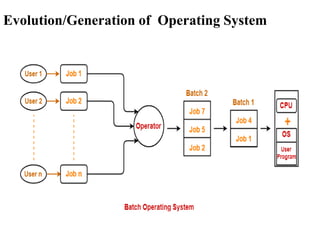
1. Batch Operating System-
In batch operating system,
Firstly, user prepares his job using punch cards.
Then, he submits the job to the computer operator.
Operator collects the jobs from different users and sort the jobs into batches with
similar needs.
Then, operator submits the batches to the processor one by one.
All the jobs of one batch are executed together.
Evolution/Generation of OperatingSystem Conti…
Advantages-
It saves the time that was being wasted earlier for each individual process in context
switching from one environment to another environment.
No manual intervention is needed.
Disadvantages-
All the jobs of a batch are executed sequentially one after the other.
The output is obtained only after all the jobs are executed.
Thus, priority can not be implemented if a certain job has to be executed on an
urgent basis.
If the jobs of a batch require some I/O operation, then CPU must wait till the I/O
operation gets completed.
Since I/O devices are very slow, CPU remains idle for a long time.
CPU can not take any other job and execute it.
4.
Evolution/Generation of OperatingSystem Conti…
2. Multiprogramming Operating System
Multiprogramming is an extension to batch processing where the CPU is always kept
busy.
Each process needs two types of system time: CPU time and IO time.
In a multiprogramming environment, when a process does its I/O, The CPU can start
the execution of other processes.
Therefore, multiprogramming improves the efficiency of the system.
5.
Evolution/Generation of OperatingSystem Conti…
Advantages of Multiprogramming OS
Throughout the system, it increased as the CPU always had one program to execute.
Response time can also be reduced.
Disadvantages of Multiprogramming OS
Multiprogramming systems provide an environment in which various systems
resources are used efficiently, but they do not provide any user interaction with the
computer system.
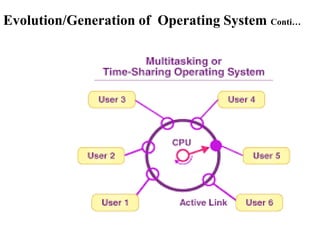
3. Time sharing Operating System
In the Time Sharing operating system, computer resources are allocated in a time-
dependent fashion to several programs simultaneously.
Thus it helps to provide a large number of user's direct access to the main computer.
It is a logical extension of multiprogramming.
In time-sharing, the CPU is switched among multiple programs given by different
users on a scheduled basis.
A time-sharing operating system allows many users to be served simultaneously,
Evolution/Generation of OperatingSystem Conti…
Advantages of Time Sharing Operating System
The time-sharing operating system provides effective utilization and sharing of
resources.
This system reduces CPU idle and response time.
For all operations, each user sets aside time.
End users believe they have complete control over the computer system.
Interaction among users and computers is improved, so user inquiries can result in
quick responses.
Disadvantages of Time Sharing Operating System
It uses a lot of resources with high quality is required.
It has difficulty with consistency.
A security and integrity problem with user programs and data.
8.
Evolution/Generation of OperatingSystem Conti…
4. Real Time Operating System
Real Time Operating System
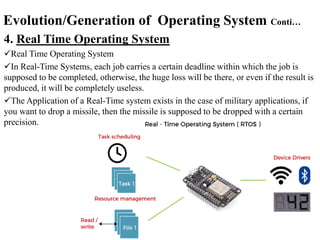
In Real-Time Systems, each job carries a certain deadline within which the job is
supposed to be completed, otherwise, the huge loss will be there, or even if the result is
produced, it will be completely useless.
The Application of a Real-Time system exists in the case of military applications, if
you want to drop a missile, then the missile is supposed to be dropped with a certain
precision.
9.
Evolution/Generation of OperatingSystem Conti…
Advantages of Real-time operating system:
Easy to layout, develop and execute real-time applications under the real-time
operating system.
In a Real-time operating system, the maximum utilization of devices and systems.
Disadvantages of Real-time operating system:
Real-time operating systems are very costly to develop.
Real-time operating systems are very complex and can consume critical CPU cycles.
5. Network Operating System *
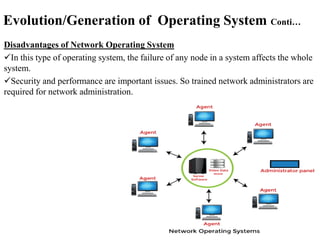
An Operating system, which includes software and associated protocols to
communicate with other computers via a network conveniently and cost-effectively, is
called Network Operating System.
Advantages of Network Operating System
Network traffic reduces due to the division between clients and the server.
This type of system is less expensive to set up and maintain.
10.
Evolution/Generation of OperatingSystem Conti…
Disadvantages of Network Operating System
In this type of operating system, the failure of any node in a system affects the whole
system.
Security and performance are important issues. So trained network administrators are
required for network administration.
11.
Evolution/Generation of OperatingSystem Conti…
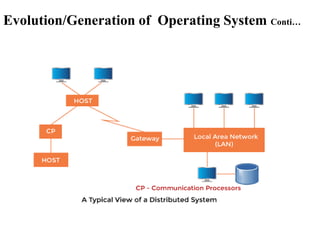
6.Distributed Operating System
The Distributed Operating system is not installed on a single machine, it is divided
into parts, and these parts are loaded on different machines.
A part of the distributed Operating system is installed on each machine to make
their communication possible.
Distributed Operating systems are much more complex, large, and sophisticated
than Network operating systems because they also have to take care of varying
networking protocols.
Advantages of Distributed Operating System
The distributed operating system provides sharing of resources.
This type of system is fault-tolerant.
Disadvantages of Distributed Operating System
Regular updating and maintenance are required.