Types of Operating Systems
BY Sk Akram
Operating System PCC-CS 502
Name: Sk Akram
University Roll No: XXXXXXX
Year: XXXXXX
Branch: XXXXXX
Some widely used operating systems are as
follows-
1. Batch Operating System –
2. Time-Sharing Operating Systems –
3. Distributed Operating System –
4. Network Operating System –
5. Real-Time Operating System –
1. Batch Operating System –
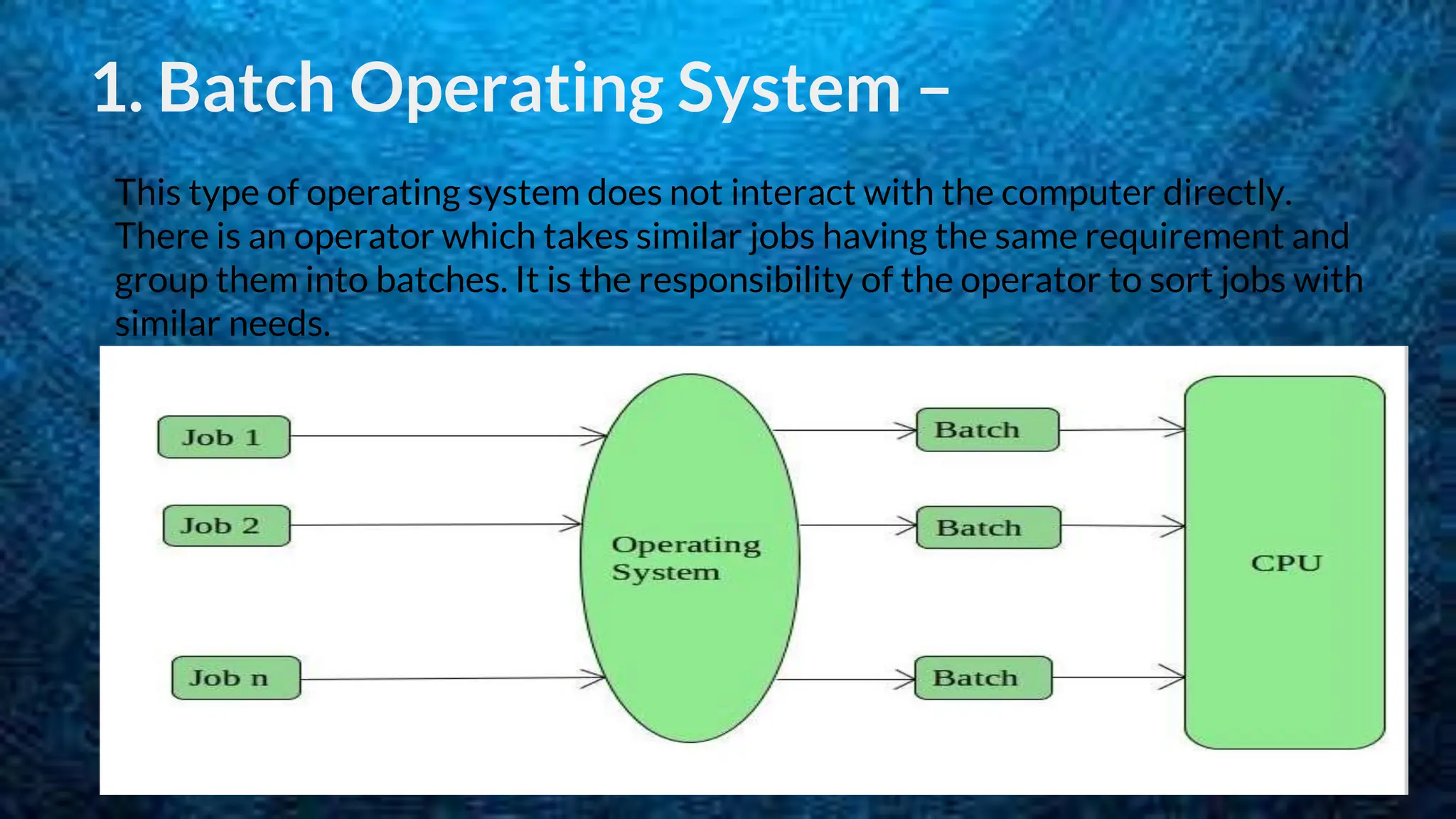
This type of operating system does not interact with the computer directly.
There is an operator which takes similar jobs having the same requirement and
group them into batches. It is the responsibility of the operator to sort jobs with
similar needs.
Advantages of Batch Operating System:
❏ It is very difficult to guess or know the time required for any job to complete.
Processors of the batch systems know how long the job would be when it is in queue
❏ Multiple users can share the batch systems
❏ The idle time for the batch system is very less
❏ It is easy to manage large work repeatedly in batch systems
Disadvantages of Batch Operating System:
❏ The computer operators should be well known with batch systems
❏ Batch systems are hard to debug
❏ It is sometimes costly
❏ The other jobs will have to wait for an unknown time if any job fails
Examples of Batch based Operating System: Payroll System, Bank Statements, etc.
2. Time-Sharing Operating Systems –
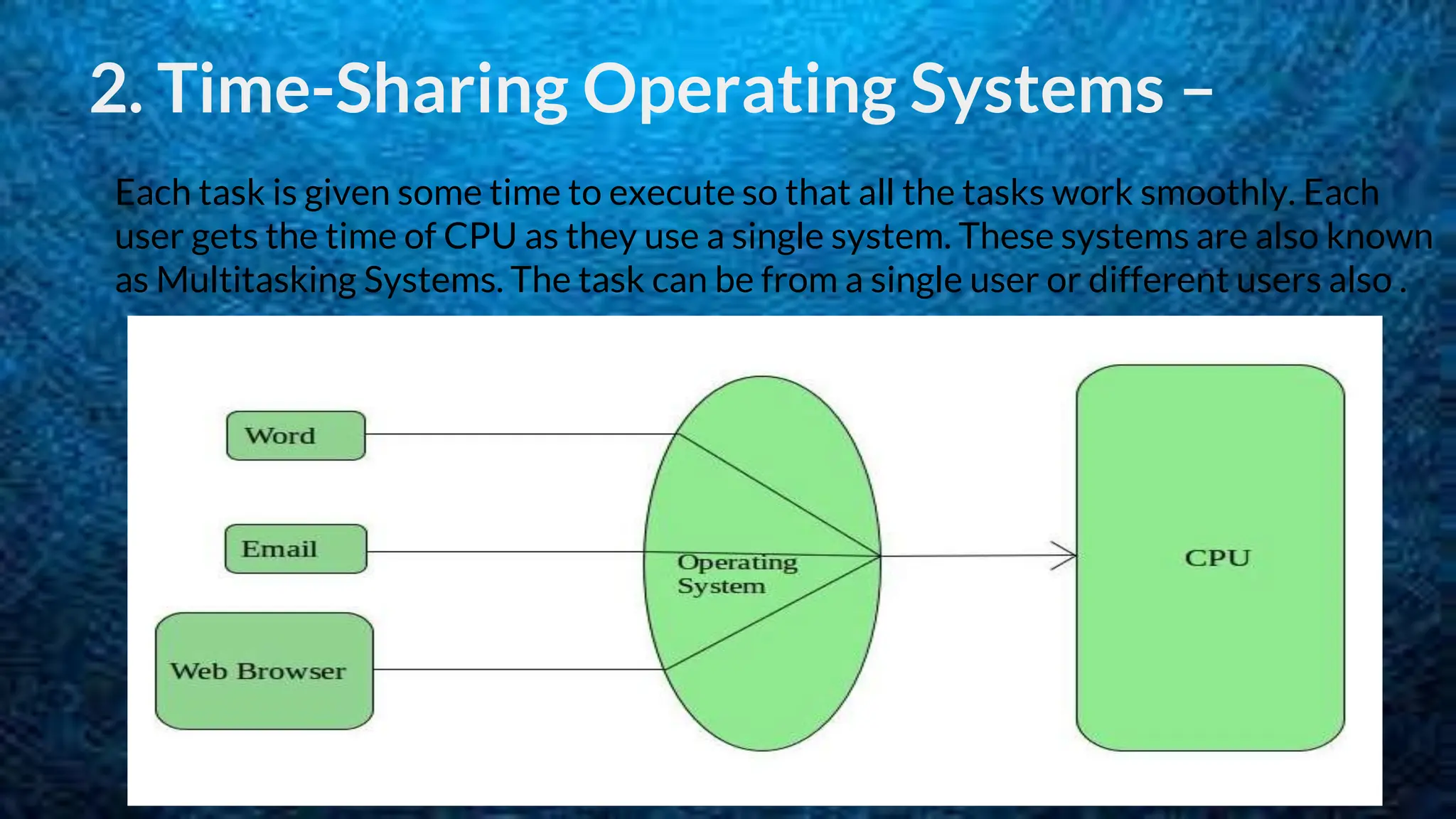
Each task is given some time to execute so that all the tasks work smoothly. Each
user gets the time of CPU as they use a single system. These systems are also known
as Multitasking Systems. The task can be from a single user or different users also .
Advantages of Time-Sharing OS:
❏ Each task gets an equal opportunity
❏ Fewer chances of duplication of software
❏ CPU idle time can be reduced
Disadvantages of Time-Sharing OS:
❏ Reliability Problem
❏ One must have to take care of security and integrity of user programs and data
❏ Data communication problem
Examples of Time -Sharing OSs are: Multics, Unix,, etc.
3. Distributed Operating Systems –
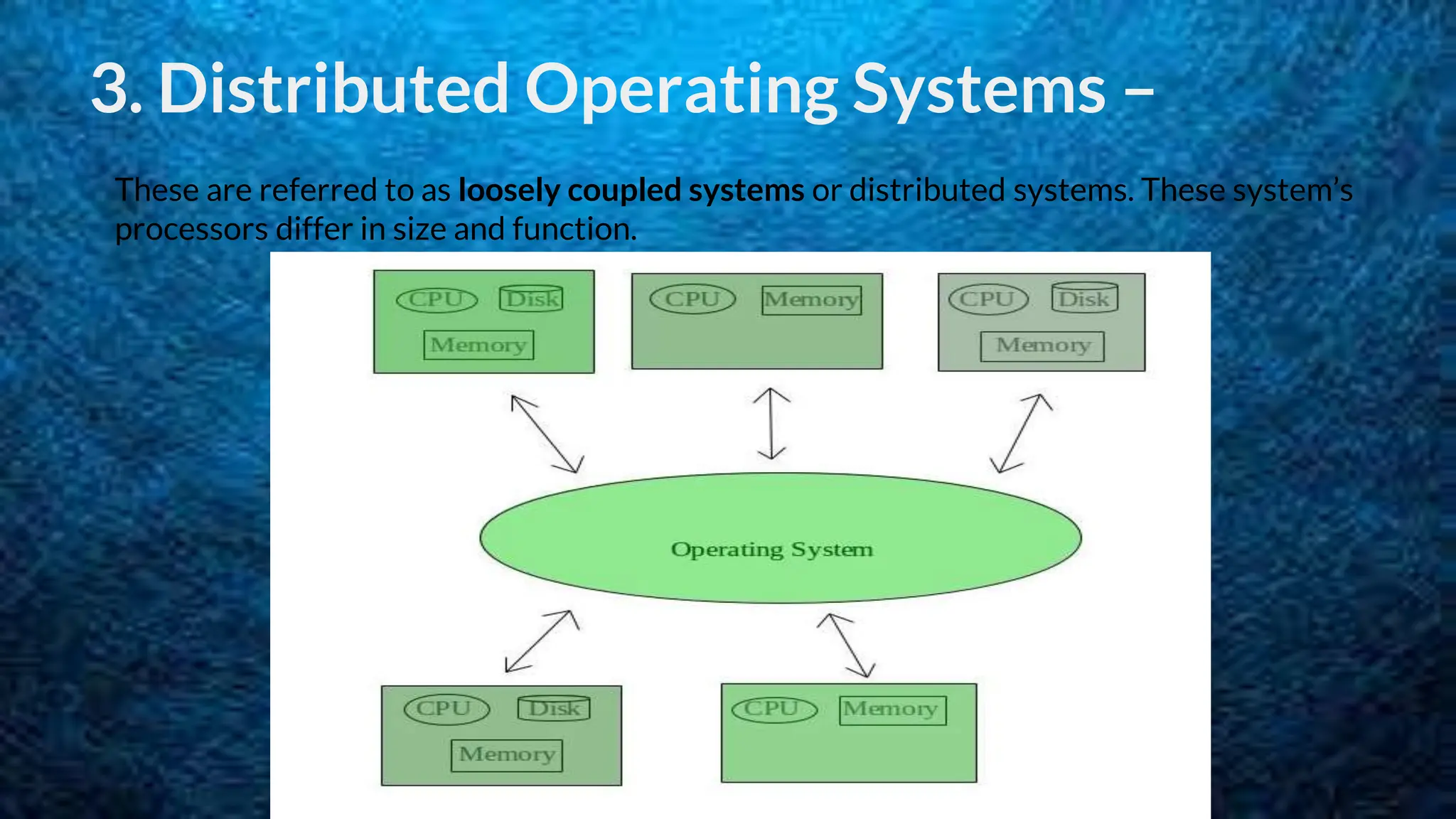
These are referred to as loosely coupled systems or distributed systems. These system’s
processors differ in size and function.
Advantages of Distributed OS:
❏ Failure of one will not affect the other network communication, as all systems are independent
from each other
❏ Electronic mail increases the data exchange speed
❏ Since resources are being shared, computation is highly fast and durable
❏ Load on host computer reduces
❏ These systems are easily scalable as many systems can be easily added to the network
Disadvantages of Distributed OS:
❏ Failure of the main network will stop the entire communication
❏ To establish distributed systems the language which is used are not well defined yet
❏ These types of systems are not readily available as they are very expensive. Not only
that the underlying software is highly complex and not understood well yet
Examples of Distributed OSs are: LOCUS,, etc.
4. Network Operating Systems –
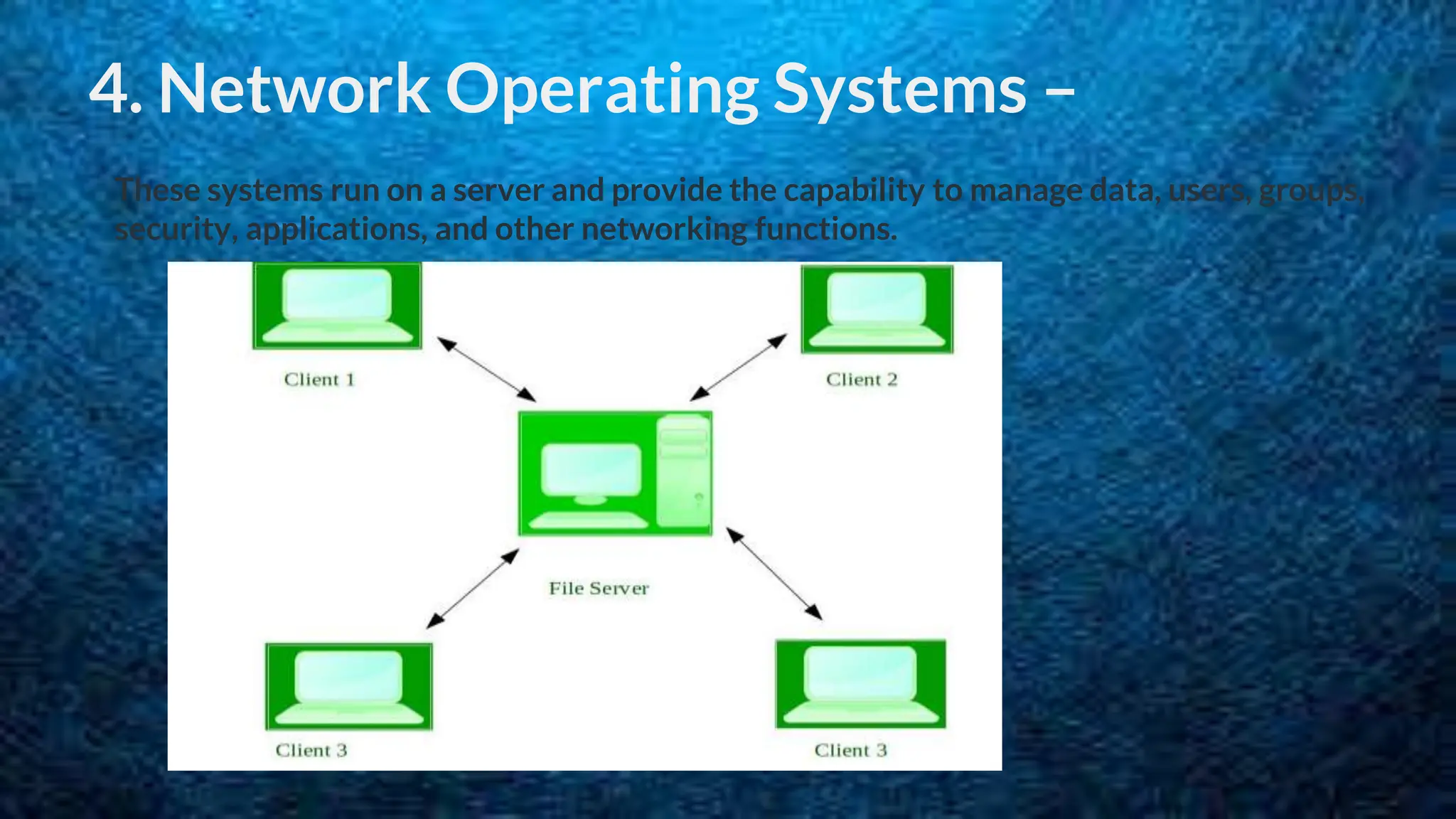
These systems run on a server and provide the capability to manage data, users, groups,
security, applications, and other networking functions.
Advantages of Network OS:
❏ Highly stable centralized servers
❏ Security concerns are handled through servers
❏ New technologies and hardware up-gradation are easily integrated into the system
❏ Server access is possible remotely from different locations and types of systems
Disadvantages of Network OS:
❏ Servers are costly
❏ User has to depend on a central location for most operations
❏ Maintenance and updates are required regularly
Examples of Network OSs are: Microsoft Windows Server 2003, Microsoft Windows Server 2008,
UNIX, Linux, Mac OS X, Novell NetWare, and BSD, etc.
4. Real-Time Operating Systems –
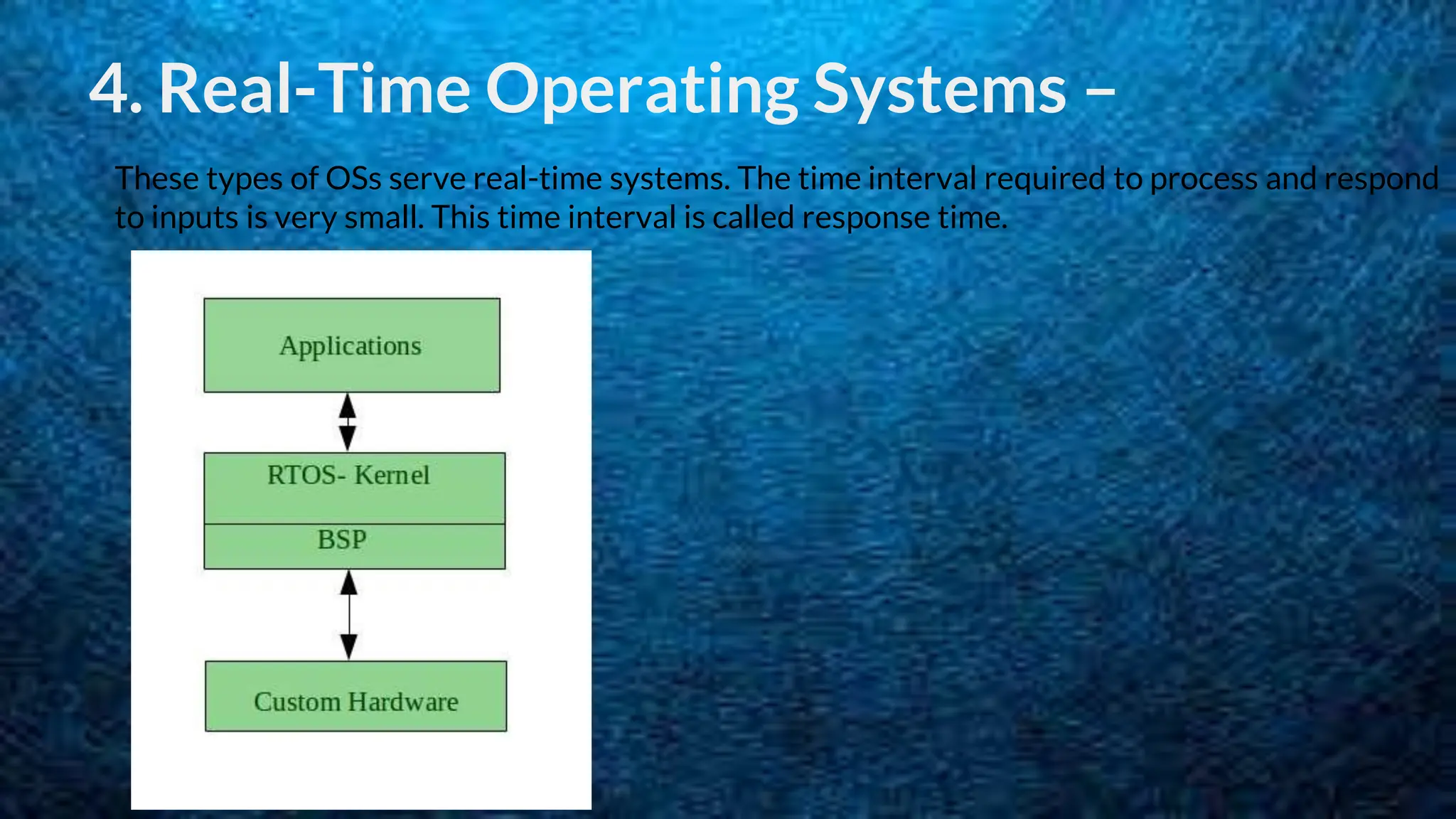
These types of OSs serve real-time systems. The time interval required to process and respond
to inputs is very small. This time interval is called response time.
Advantages of RTOS:
❏ Maximum Consumption: Maximum utilization of devices and system, thus more
output from all the resources
❏ Task Shifting: The time assigned for shifting tasks in these systems are very less. For
example, in older systems, it takes about 10 microseconds in shifting one task to
another, and in the latest systems, it takes 3 microseconds.
❏ Focus on Application: Focus on running applications and less importance to
applications which are in the queue.
❏ Real-time operating system in the embedded system: Since the size of programs
are small, RTOS can also be used in embedded systems like in transport and others.
❏ Error Free: These types of systems are error-free.
❏ Memory Allocation: Memory allocation is best managed in these types of systems.
Disadvantages of RTOS:
❏ Limited Tasks: Very few tasks run at the same time and their concentration is very
less on few applications to avoid errors.
❏ Use heavy system resources: Sometimes the system resources are not so good and
they are expensive as well.
❏ Complex Algorithms: The algorithms are very complex and difficult for the designer
to write on.
❏ Device driver and interrupt signals: It needs specific device drivers and interrupts
signals to respond earliest to interrupts.
❏ Thread Priority: It is not good to set thread priority as these systems are very less
prone to switching tasks.
Examples of Real-Time Operating Systems are: Scientific experiments, medical imaging systems,
industrial control systems, weapon systems, robots, air traffic control systems, etc.
Thank You!!

types_of_operating_systems_sk_akram.pptx

  • 1.
    Types of OperatingSystems BY Sk Akram
  • 2.
    Operating System PCC-CS502 Name: Sk Akram University Roll No: XXXXXXX Year: XXXXXX Branch: XXXXXX
  • 3.
    Some widely usedoperating systems are as follows- 1. Batch Operating System – 2. Time-Sharing Operating Systems – 3. Distributed Operating System – 4. Network Operating System – 5. Real-Time Operating System –
  • 4.
    1. Batch OperatingSystem – This type of operating system does not interact with the computer directly. There is an operator which takes similar jobs having the same requirement and group them into batches. It is the responsibility of the operator to sort jobs with similar needs.
  • 5.
    Advantages of BatchOperating System: ❏ It is very difficult to guess or know the time required for any job to complete. Processors of the batch systems know how long the job would be when it is in queue ❏ Multiple users can share the batch systems ❏ The idle time for the batch system is very less ❏ It is easy to manage large work repeatedly in batch systems Disadvantages of Batch Operating System: ❏ The computer operators should be well known with batch systems ❏ Batch systems are hard to debug ❏ It is sometimes costly ❏ The other jobs will have to wait for an unknown time if any job fails Examples of Batch based Operating System: Payroll System, Bank Statements, etc.
  • 6.
    2. Time-Sharing OperatingSystems – Each task is given some time to execute so that all the tasks work smoothly. Each user gets the time of CPU as they use a single system. These systems are also known as Multitasking Systems. The task can be from a single user or different users also .
  • 7.
    Advantages of Time-SharingOS: ❏ Each task gets an equal opportunity ❏ Fewer chances of duplication of software ❏ CPU idle time can be reduced Disadvantages of Time-Sharing OS: ❏ Reliability Problem ❏ One must have to take care of security and integrity of user programs and data ❏ Data communication problem Examples of Time -Sharing OSs are: Multics, Unix,, etc.
  • 8.
    3. Distributed OperatingSystems – These are referred to as loosely coupled systems or distributed systems. These system’s processors differ in size and function.
  • 9.
    Advantages of DistributedOS: ❏ Failure of one will not affect the other network communication, as all systems are independent from each other ❏ Electronic mail increases the data exchange speed ❏ Since resources are being shared, computation is highly fast and durable ❏ Load on host computer reduces ❏ These systems are easily scalable as many systems can be easily added to the network Disadvantages of Distributed OS: ❏ Failure of the main network will stop the entire communication ❏ To establish distributed systems the language which is used are not well defined yet ❏ These types of systems are not readily available as they are very expensive. Not only that the underlying software is highly complex and not understood well yet Examples of Distributed OSs are: LOCUS,, etc.
  • 10.
    4. Network OperatingSystems – These systems run on a server and provide the capability to manage data, users, groups, security, applications, and other networking functions.
  • 11.
    Advantages of NetworkOS: ❏ Highly stable centralized servers ❏ Security concerns are handled through servers ❏ New technologies and hardware up-gradation are easily integrated into the system ❏ Server access is possible remotely from different locations and types of systems Disadvantages of Network OS: ❏ Servers are costly ❏ User has to depend on a central location for most operations ❏ Maintenance and updates are required regularly Examples of Network OSs are: Microsoft Windows Server 2003, Microsoft Windows Server 2008, UNIX, Linux, Mac OS X, Novell NetWare, and BSD, etc.
  • 12.
    4. Real-Time OperatingSystems – These types of OSs serve real-time systems. The time interval required to process and respond to inputs is very small. This time interval is called response time.
  • 13.
    Advantages of RTOS: ❏Maximum Consumption: Maximum utilization of devices and system, thus more output from all the resources ❏ Task Shifting: The time assigned for shifting tasks in these systems are very less. For example, in older systems, it takes about 10 microseconds in shifting one task to another, and in the latest systems, it takes 3 microseconds. ❏ Focus on Application: Focus on running applications and less importance to applications which are in the queue. ❏ Real-time operating system in the embedded system: Since the size of programs are small, RTOS can also be used in embedded systems like in transport and others. ❏ Error Free: These types of systems are error-free. ❏ Memory Allocation: Memory allocation is best managed in these types of systems.
  • 14.
    Disadvantages of RTOS: ❏Limited Tasks: Very few tasks run at the same time and their concentration is very less on few applications to avoid errors. ❏ Use heavy system resources: Sometimes the system resources are not so good and they are expensive as well. ❏ Complex Algorithms: The algorithms are very complex and difficult for the designer to write on. ❏ Device driver and interrupt signals: It needs specific device drivers and interrupts signals to respond earliest to interrupts. ❏ Thread Priority: It is not good to set thread priority as these systems are very less prone to switching tasks. Examples of Real-Time Operating Systems are: Scientific experiments, medical imaging systems, industrial control systems, weapon systems, robots, air traffic control systems, etc.
  • 15.