Digital Libraries Jack Eapen [email_address] http://www.jackeapen.com
A Brief Overview DL- Some Definitions Benefits& Limitations of  DL Emerging Technologies& Standards Tools Available A Model DL for India Planning a DL Project Challenges in DL Environment
DL- Some Definitions In simple terms, a digital library is a collection of information that is stored and accessed electronically. Terms such as "electronic library" and "virtual library“ are often used synonymously. "The generic name for federated structures that provide humans both intellectual and physical access to the huge and growing worldwide networks of information encoded in multimedia digital formats." ---The University of Michigan Digital Library
DL- Some Definitions Sun Microsystems defines a digital library as the electronic extension of functions users typically perform and the resources they access in a traditional library The Digital Library Federation (DLF) crafted the following definition:  Digital libraries are organizations that provide the resources, including the specialized staff, to select, structure, offer intellectual access to, interpret, distribute, preserve the integrity of, and ensure the persistence over time of collections of digital works so that they are readily and economically available for use by a defined community or set of communities.
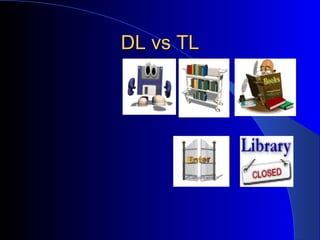
DL vs TL
Benefits of DL DL brings the library to the user  Improved access - Searching and browsing  Information can be shared more easily Easier to keep information current  Information is always available
Benefits of DL New forms of information become possible Wider access  Allow collaboration and exchange of ideas DLs may save money Improved preservation
Limitations of DL Technological obsolescence Hardware Software Cost of content refreshing  Rights management  Inter-operability Network bandwidth
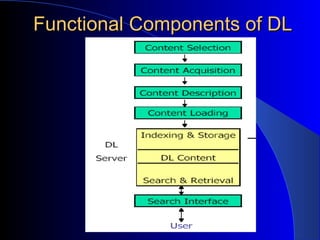
Functional Components of DL
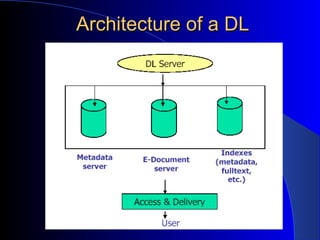
Architecture of a DL
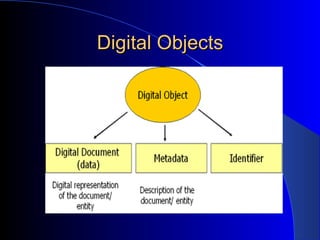
Digital Objects
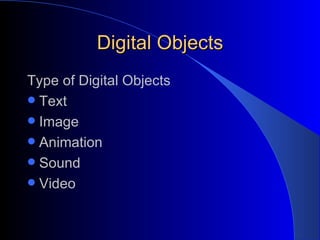
Digital Objects Type of Digital Objects Text  Image  Animation  Sound  Video
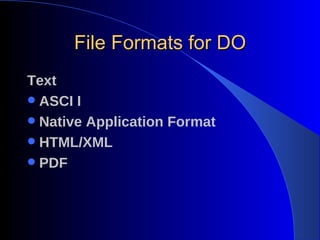
File Formats for DO Text ASCI I  Native Application Format HTML/XML PDF
File Formats for DO Image BMP JPEG PNG GIF TIFF
File Formats for DO Audio MIDI WAV MP3 RAM/RA
File Formats for DO Video AVI Quick  Time (mov/qt) MPEG/MPG
Emerging Technologies &  Standards
Uniform Resource Names Any form of Uniform Resource Name (URN) has three properties:  Location independence -- not tied to a particular computer  Persistence -- long-term validity  Global uniqueness
Uniform Resource Names Handle System by CNRI DOIs by DOI Foundation PURL by OCLC
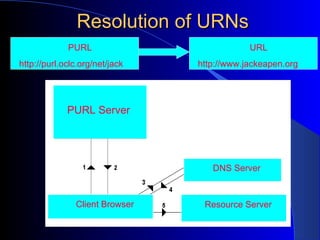
Resolution of URNs PURL Server PURL http://purl.oclc.org/net/jack URL http://www.jackeapen.org DNS Server Resource Server Client Browser
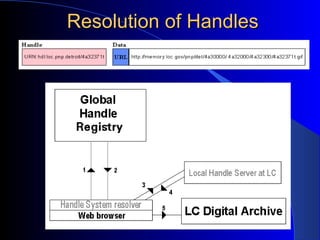
Resolution of Handles
Unicode Unicode Standard is a character coding system designed to support the worldwide interchange, processing, and display of the written texts of the diverse languages   Unicode provides a unique number for every character   Unicode enables a single software product or a single website to be targeted across multiple platforms, languages and countries without re-engineering
Metadata Metadata contains  information about objects (files, images, etc.) A metadata record consists of a set of attributes or elements necessary to describe a particular resource Metadata allows search engines to find and classify resources
Types of Metadata Descriptive Purpose: Resource discovery and identification Ex.: Title, abstract, author, URL, keyword, etc Administrative& Rights management Purpose: help manage a resource Ex.: Who created and when, who can access, content format, rights information, etc. Structural Metadata Purpose: Document structure Ex.: chapter, section, paragraph
Dublin Core Metadata Initiative (DCMI) International standard for describing network digital resources ,  conceived in 1994  Consists of 15 elements, each repeatable, none mandatory  Has reached standard status –   W3C, NISO, ISO  Widely used in several projects around the world Being refined further
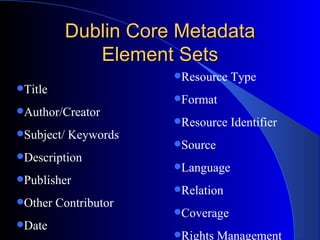
Dublin Core Metadata Element Sets Resource Type Format Resource Identifier Source Language Relation Coverage Rights Management Title Author/Creator Subject/ Keywords Description Publisher Other Contributor Date
Key Features of DC Small and simple element set   Non-specialists can create metadata records   Enable effective search and retrieval Commonly understood semantics DC element set in several languages Extensibility DC record can be embedded in the resource   itself (e.g.  “Meta” tag of HTML) DC elements may be contained in a   record   separate  from the source
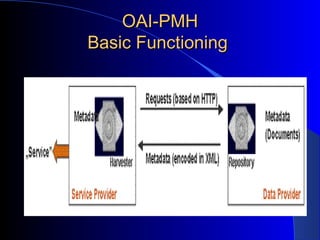
Open Archives Initiative Protocol for Metadata Harvesting  OAI-PMH is a lightweight harvesting protocol for sharing metadata between services  The OAI-PMH gives a simple technical option for data providers to make their metadata available to services, based on the open standards HTTP and XML world-wide consolidation of scholarly archives  free access to the archives (at least: metadata)  consistent interfaces for archives and service provider  low barrier protocol / effortless implementation (e.g., because based on HTTP, XML, DC)
OAI-PMH Basic Functioning
Tools Available
D Space Developed by MIT Libraries and HP Institutional Repository model Support for a Variety of Digital Formats and Content Types  Digital Preservation  Access Control   Open Source Software
D Space        UNIX-like OS-         Java 1.3 or later        JavaBeans Activation Framework        Java Servlet 2.3 and JSP 1.2    Java Servlet Container/Application Server (eg.  Tomcat)        Apache 1.3         Ant 1.5         PostgreSQL 7.3+
Greenstone Developed by the New Zealand Digital Library Project at the University of Waikato Runs on various platforms Highly customizable Collections can be exported to CD ROMs Requires Apache and Perl Open Source
Eprints Developed at the University of Southampton Creates online archives  of the research output of an academic institution Supports variety of document formats Submitted papers go through a moderation process (if administrators desire)  Requires LAMP architecture
A Model Digital Library Perpetual repository of human knowledge Preserves national heritage Protects national wealth Enable learning activities Decrease information gap Develop model tools and practices
Planning a DL Project Define need, purpose and user community Select and analyze source material Determine digital library collection requirements and  features Plan approach to digitization and collection release Determine resource requirements for project implementation Prepare implementation steps and timeline
Challenges in DL Environment Develop improved technology for digitizing analog materials   Design search and retrieval tools that compensate for abbreviated or incomplete cataloging or descriptive information.   Design tools that facilitate the enhancement of cataloging or descriptive information by incorporating the contributions of users.   Establish protocols and standards to facilitate the assembly of distributed digital libraries.   Address legal concerns associated with access, copying, and dissemination of physical and digital materials
Challenges in DL Environment Integrate access to both digital and physical materials Develop approaches that can present heterogeneous resources in a coherent way   Make the digital library useful to different communities of users and for different purposes Provide more efficient and more flexible tools for transforming digital content to suit the needs of end-users.   Develop economic models for the support of the Digital Library
 
Questions?

Digital Libraries

  • 1.
    Digital Libraries JackEapen [email_address] http://www.jackeapen.com
  • 2.
    A Brief OverviewDL- Some Definitions Benefits& Limitations of DL Emerging Technologies& Standards Tools Available A Model DL for India Planning a DL Project Challenges in DL Environment
  • 3.
    DL- Some DefinitionsIn simple terms, a digital library is a collection of information that is stored and accessed electronically. Terms such as "electronic library" and "virtual library“ are often used synonymously. "The generic name for federated structures that provide humans both intellectual and physical access to the huge and growing worldwide networks of information encoded in multimedia digital formats." ---The University of Michigan Digital Library
  • 4.
    DL- Some DefinitionsSun Microsystems defines a digital library as the electronic extension of functions users typically perform and the resources they access in a traditional library The Digital Library Federation (DLF) crafted the following definition: Digital libraries are organizations that provide the resources, including the specialized staff, to select, structure, offer intellectual access to, interpret, distribute, preserve the integrity of, and ensure the persistence over time of collections of digital works so that they are readily and economically available for use by a defined community or set of communities.
  • 5.
  • 6.
    Benefits of DLDL brings the library to the user Improved access - Searching and browsing Information can be shared more easily Easier to keep information current Information is always available
  • 7.
    Benefits of DLNew forms of information become possible Wider access Allow collaboration and exchange of ideas DLs may save money Improved preservation
  • 8.
    Limitations of DLTechnological obsolescence Hardware Software Cost of content refreshing Rights management Inter-operability Network bandwidth
  • 9.
  • 10.
  • 11.
  • 12.
    Digital Objects Typeof Digital Objects Text Image Animation Sound Video
  • 13.
    File Formats forDO Text ASCI I Native Application Format HTML/XML PDF
  • 14.
    File Formats forDO Image BMP JPEG PNG GIF TIFF
  • 15.
    File Formats forDO Audio MIDI WAV MP3 RAM/RA
  • 16.
    File Formats forDO Video AVI Quick Time (mov/qt) MPEG/MPG
  • 17.
  • 18.
    Uniform Resource NamesAny form of Uniform Resource Name (URN) has three properties: Location independence -- not tied to a particular computer Persistence -- long-term validity Global uniqueness
  • 19.
    Uniform Resource NamesHandle System by CNRI DOIs by DOI Foundation PURL by OCLC
  • 20.
    Resolution of URNsPURL Server PURL http://purl.oclc.org/net/jack URL http://www.jackeapen.org DNS Server Resource Server Client Browser
  • 21.
  • 22.
    Unicode Unicode Standardis a character coding system designed to support the worldwide interchange, processing, and display of the written texts of the diverse languages Unicode provides a unique number for every character Unicode enables a single software product or a single website to be targeted across multiple platforms, languages and countries without re-engineering
  • 23.
    Metadata Metadata contains information about objects (files, images, etc.) A metadata record consists of a set of attributes or elements necessary to describe a particular resource Metadata allows search engines to find and classify resources
  • 24.
    Types of MetadataDescriptive Purpose: Resource discovery and identification Ex.: Title, abstract, author, URL, keyword, etc Administrative& Rights management Purpose: help manage a resource Ex.: Who created and when, who can access, content format, rights information, etc. Structural Metadata Purpose: Document structure Ex.: chapter, section, paragraph
  • 25.
    Dublin Core MetadataInitiative (DCMI) International standard for describing network digital resources , conceived in 1994 Consists of 15 elements, each repeatable, none mandatory Has reached standard status – W3C, NISO, ISO Widely used in several projects around the world Being refined further
  • 26.
    Dublin Core MetadataElement Sets Resource Type Format Resource Identifier Source Language Relation Coverage Rights Management Title Author/Creator Subject/ Keywords Description Publisher Other Contributor Date
  • 27.
    Key Features ofDC Small and simple element set Non-specialists can create metadata records Enable effective search and retrieval Commonly understood semantics DC element set in several languages Extensibility DC record can be embedded in the resource itself (e.g. “Meta” tag of HTML) DC elements may be contained in a record separate from the source
  • 28.
    Open Archives InitiativeProtocol for Metadata Harvesting OAI-PMH is a lightweight harvesting protocol for sharing metadata between services The OAI-PMH gives a simple technical option for data providers to make their metadata available to services, based on the open standards HTTP and XML world-wide consolidation of scholarly archives free access to the archives (at least: metadata) consistent interfaces for archives and service provider low barrier protocol / effortless implementation (e.g., because based on HTTP, XML, DC)
  • 29.
  • 30.
  • 31.
    D Space Developedby MIT Libraries and HP Institutional Repository model Support for a Variety of Digital Formats and Content Types Digital Preservation Access Control Open Source Software
  • 32.
    D Space      UNIX-like OS-       Java 1.3 or later       JavaBeans Activation Framework       Java Servlet 2.3 and JSP 1.2  Java Servlet Container/Application Server (eg. Tomcat)       Apache 1.3       Ant 1.5       PostgreSQL 7.3+
  • 33.
    Greenstone Developed bythe New Zealand Digital Library Project at the University of Waikato Runs on various platforms Highly customizable Collections can be exported to CD ROMs Requires Apache and Perl Open Source
  • 34.
    Eprints Developed atthe University of Southampton Creates online archives of the research output of an academic institution Supports variety of document formats Submitted papers go through a moderation process (if administrators desire) Requires LAMP architecture
  • 35.
    A Model DigitalLibrary Perpetual repository of human knowledge Preserves national heritage Protects national wealth Enable learning activities Decrease information gap Develop model tools and practices
  • 36.
    Planning a DLProject Define need, purpose and user community Select and analyze source material Determine digital library collection requirements and features Plan approach to digitization and collection release Determine resource requirements for project implementation Prepare implementation steps and timeline
  • 37.
    Challenges in DLEnvironment Develop improved technology for digitizing analog materials Design search and retrieval tools that compensate for abbreviated or incomplete cataloging or descriptive information. Design tools that facilitate the enhancement of cataloging or descriptive information by incorporating the contributions of users. Establish protocols and standards to facilitate the assembly of distributed digital libraries. Address legal concerns associated with access, copying, and dissemination of physical and digital materials
  • 38.
    Challenges in DLEnvironment Integrate access to both digital and physical materials Develop approaches that can present heterogeneous resources in a coherent way Make the digital library useful to different communities of users and for different purposes Provide more efficient and more flexible tools for transforming digital content to suit the needs of end-users. Develop economic models for the support of the Digital Library
  • 39.
  • 40.