Institutional Repositoriesand Open Access
Movement
RupeshKumarA
Email:a.rupeshkumar@gmail.com
Institutional Repository
‱ An institutional repository (IR) is an online archive for collecting, preserving, and
disseminating digital copies of the intellectual output of an institution, particularly a
researchinstitution.
‱ IR can be defined as "...a set of services that a university offers to members of its
community for the management and dissemination of digital materials created by the
institutionand itscommunity members.”
‱ IR may be defined as “a set of services for the management and dissemination of
digital materials created by the institution and its community members.” (Cliff Lynch,
2003)
‱ IR means and includes “
digital collections capturing and preserving the intellectual
output of a singleormulti universitycommunity.”
Characteristicsof IR
‱ Scholarly Publishing and Academic Resources Coalition
(SPARC) illustrates four characteristics of IR:
– “Institutionally defined”
– “Scholarly content”
– “Cumulative andperpetual”
– “interoperable andopen access”
Advantagesof IR
‱ For users:
– Expansionoftherange ofknowledgethatcanbeshared
– Opportunitiestosimplifyandextenddissemination
‱ For institutions:
– EnablingofIPRtobeexploitedmoreeffectivelyatinstitutionallevel
– Leverage ofexistinginvestmentininformationandcontent
managementsystems
– highlightingofthequalityofintellectualcapital
Advantagesof IR
‱ For all:
– Opportunities for new forms of scholarly communication
– Flexible ways to develop existing scholarly communications
Drawbacksof IR
‱ They rely on unproven methodsfor long term digital
preservation.
‱ They may needquick winstosustaininstitutionalsupport.
‱ Initial costs may be high as contributors perceive high risks
andduplicate effort toreduce them
Open Access
Open Access
‱ Open Access refers to online research outputs that are free of
restrictions on access (e.g. access tolls/charges) and
restrictions on use (certain copyright and licence restrictions).
‱ Open access can be applied to all forms of published research
output, including peer reviewed and non peer-reviewed
academic journal articles, conference papers, theses, book
chapters, and monographs.
Open AccessLiterature
‱ Peter Suber, a pioneer in open access defines, “Open Access
literature is digital, online, free of charge, and free of most
copyright and licensingrestrictions.”
Degreesof Open Access
‱ Gratisopen access:onlineaccess to informationfree of
charge.
‱ Libreopen access: onlineaccess free of charge and some
additional usagerights. Additional usage rights are often
granted throughtheuse of specificCreativeCommons
licenses.
Channelsor Methods of OpenAccess
‱ There are different ways in which open access can be provided:
– Green open access: a method where authors first publish their scholarly work
in some sourceand then self-archive it in a repository where itcan be accessed
for free. In this method, the publisher imposes an ‘embargo’ on when a
publication can be madeavailable for open access.
– Gold open access: authors can make their work open access by publishing it
in such a way that makes their research output immediately available from the
publisher. Many journals charge processing fee to make an article available for
open access.
– Diamond or Platinum open access: making publishing completely open access
without any fee.
Open AccessMovement
‱ Open access movement refers to the efforts and initiatives
across the world to accept and practise open access in
scholarly communication.
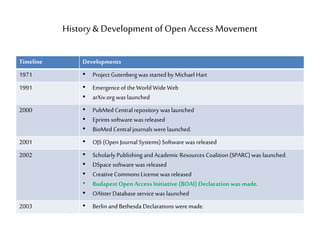
History & Development of Open Access Movement
Timeline Developments
1971 ‱ Project Gutenberg was started by Michael Hart
1991 ‱ Emergenceof the World Wide Web
‱ arXiv.org was launched
2000 ‱ PubMed Centralrepository was launched
‱ Eprints software was released
‱ BioMed Central journals were launched.
2001 ‱ OJS (Open JournalSystems) Software was released
2002 ‱ Scholarly Publishing and Academic Resources Coalition (SPARC) was launched.
‱ DSpace software was released
‱ Creative Commons License was released
‱ Budapest Open Access Initiative (BOAI)Declaration was made.
‱ OAIster Database service was launched
2003 ‱ Berlin and Bethesda Declarations were made.
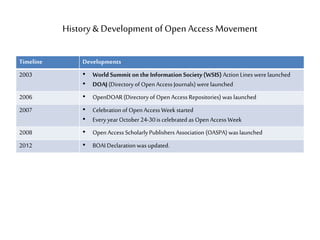
History & Development of Open Access Movement
Timeline Developments
2003 ‱ World Summit on the Information Society(WSIS) Action Lineswerelaunched
‱ DOAJ (Directory of Open Access Journals)were launched
2006 ‱ OpenDOAR (Directory of Open Access Repositories) was launched
2007 ‱ Celebration of Open Access Week started
‱ Every yearOctober 24-30is celebrated as Open Access Week
2008 ‱ Open Access Scholarly Publishers Association (OASPA) was launched
2012 ‱ BOAI Declaration was updated.
A Brief History of Open Access Movement
Project Gutenberg
‱ Founded by Michael Hart in 1971
‱ Containsfree public domain textfiles
‱ More than50,000 ebooks
‱ Downloads: approx. 3 million per month
GNU Project
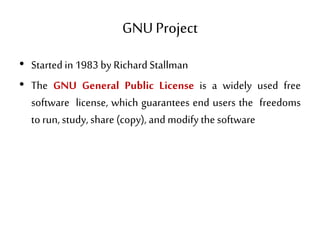
‱ Started in 1983 by Richard Stallman
‱ The GNU General Public License is a widely used free
software license, which guarantees end users the freedoms
torun, study, share (copy), and modify thesoftware
arXiv.org
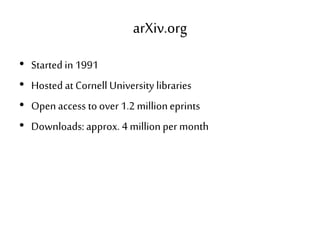
‱ Started in 1991
‱ Hosted at Cornell University libraries
‱ Open access to over 1.2 millioneprints
‱ Downloads: approx. 4 million per month
Public KnowledgeProject(PKP)
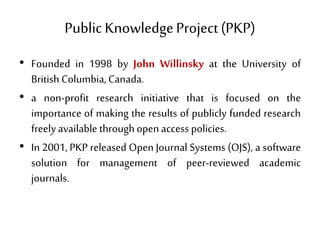
‱ Founded in 1998 by John Willinsky at the University of
British Columbia, Canada.
‱ a non-profit research initiative that is focused on the
importance of making the results of publicly funded research
freely available throughopen access policies.
‱ In 2001, PKP released Open Journal Systems (OJS), a software
solution for management of peer-reviewed academic
journals.
Scholarly Publishingand AcademicResources
Coalition(SPARC)
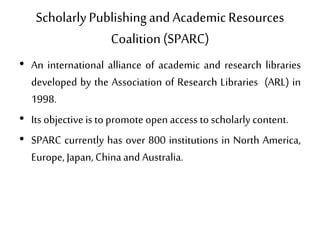
‱ An international alliance of academic and research libraries
developed by the Association of Research Libraries (ARL) in
1998.
‱ Its objective is to promote open access to scholarly content.
‱ SPARC currently has over 800 institutions in North America,
Europe, Japan,Chinaand Australia.
BiomedCentral(BMC)
‱ BMC is an earlyopen-access scholarly publisher.
‱ It is an STM (Science, Technology and Medicine) publisher
witha large portfolio of peer-reviewed open access journals.
‱ Foundedin 2000
‱ Acquired by Springer in 2008
Public Libraryof Science(PLoS)
‱ PLoSwasfoundedin 2001.
‱ a non-profit open access scientific publishing project aimed at
creating a library of open access journals and other scientific
literatureunderan opencontentlicense.
‱ Thefirstjournal PLoSBiologywaslaunchedin2003.
‱ More than 1,50,000open access articlespublishedto date.
‱ 2 milliondownloadsper month
CreativeCommons (CC)
‱ CC was foundedin 2001
‱ an American non-profit organization devoted to expanding
the range of creative works available for others to build upon
legallyand toshare.
‱ As of January 2016 there were an estimated 1.1 billion works
licensedunder thevarious Creative Commons licenses.
Budapest OpenAccess Initiative (BOAI)
‱ BOAI is a public statement of principles relating to open
access to the research literature, which was released to the
public on February 14, 2002.
‱ It arose from a conference convened in Budapest by the Open
Society Institute on December 1–2, 2001 to promote open
access – at the timealso knownas Free OnlineScholarship.
‱ BOAI is considered the most important development in open
access movement.
SHERPA
‱ SHERPA (Securing a Hybrid Environment for Research
Preservation and Access) is an organisation originallyset up in
2002 torun and managethe SHERPAProject.
‱ SHERPA began as an endeavour to support the establishment
of a number of open access institutional repositories based in
UK universities.
SHERPA Services
‱ SHERPA/RoMEO: A definitive listing of publishers' copyright
agreementsand retainedauthorrights.
‱ SHERPA/JULIET: Research funder’s archiving mandates and
guidelines.
‱ OpenDOAR: a directory of worldwide open access
repositories.
PubMed Central(PMC)
‱ PMC is a free digital repository that archives publicly
accessible full-text scholarly articles that have been published
withinthebiomedical and lifesciences journal literature.
‱ Launchedin February 2000.
‱ Containsmore than3 millionarticles.
‱ About 4000 journals voluntarily deposit their article into
PMC.
Directory of OpenAccess Journals(DOAJ)
‱ Founded in 2003.
‱ Lists 9,391 open access journals from 128 countries with
more than23,00,000 articles.
‱ Containsboth APC*and non-APCjournals
*Article Processing Charges
OpenAccess ScholarlyPublishers Association
(OASPA)
‱ A non-profit trade association representing the interests of
open access journal publishers globally in all scientific,
technicaland scholarly disciplines.
‱ Formed in 2008.
‱ OASPA brings together the major open access publishers and
hybrid open access publishers.
ConfederationofOpen Access Repositories(COAR)
‱ COAR was launchedin October 2009.
‱ It is a not-for-profit association of repository initiatives.
‱ It aims to enhance greater visibility and application of
research outputs through global networks of Open Access
digitalrepositories.
Coalitionof OpenAccess PolicyInstitutions
(COAPI)
‱ COAPI is a membership organization that has been working
(in the northern American region) since 2011 to advance the
promotion, passage, and implementation of Open Access
policies at institutionsof highereducation.
‱ COAPInow includes 85 institutions.
‱ Membership is open to all North American institutions with
(open access) policies in place, or those working to pass
policies.
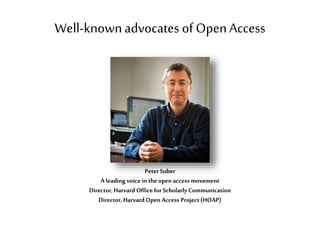
Well-knownadvocates of OpenAccess
Peter Suber
A leading voice in the open access movement
Director,Harvard Office forScholarly Communication
Director,Harvard Open Access Project(HOAP)
Well-knownadvocates of OpenAccess
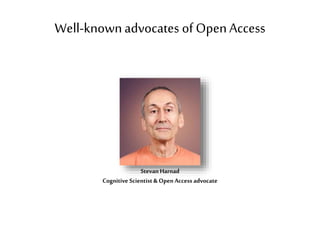
Stevan Harnad
Cognitive Scientist & Open Access advocate
Well-knownadvocates of OpenAccess
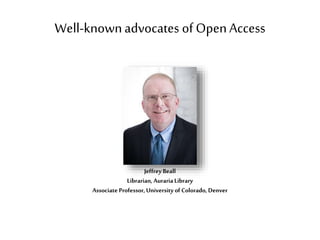
Jeffrey Beall
Librarian, Auraria Library
Associate Professor,University of Colorado, Denver
Well-knownadvocates of OpenAccess
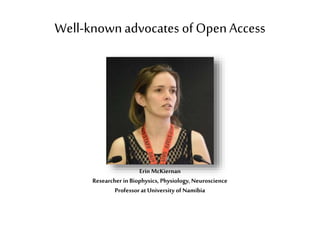
Erin McKiernan
Researcher in Biophysics, Physiology, Neuroscience
Professor at University of Namibia
Well-knownadvocates of OpenAccess
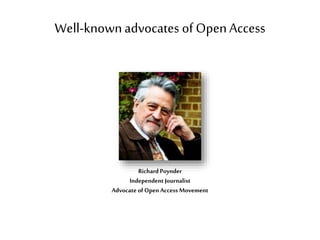
Richard Poynder
Independent Journalist
Advocate of Open Access Movement
Well-knownadvocates of OpenAccess
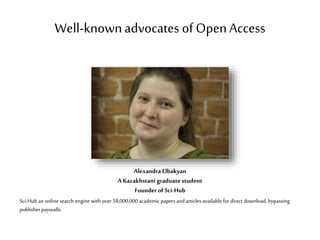
Alexandra Elbakyan
A Kazakhstani graduate student
Founder of Sci-Hub
Sci-Hub an online search engine with over 58,000,000 academic papers andarticles available fordirect download,bypassing
publisher paywalls.

Institutional Repositories and Open Access Movement

  • 1.
    Institutional Repositoriesand OpenAccess Movement RupeshKumarA Email:a.rupeshkumar@gmail.com
  • 2.
    Institutional Repository ‱ Aninstitutional repository (IR) is an online archive for collecting, preserving, and disseminating digital copies of the intellectual output of an institution, particularly a researchinstitution. ‱ IR can be defined as "...a set of services that a university offers to members of its community for the management and dissemination of digital materials created by the institutionand itscommunity members.” ‱ IR may be defined as “a set of services for the management and dissemination of digital materials created by the institution and its community members.” (Cliff Lynch, 2003) ‱ IR means and includes “
digital collections capturing and preserving the intellectual output of a singleormulti universitycommunity.”
  • 3.
    Characteristicsof IR ‱ ScholarlyPublishing and Academic Resources Coalition (SPARC) illustrates four characteristics of IR: – “Institutionally defined” – “Scholarly content” – “Cumulative andperpetual” – “interoperable andopen access”
  • 4.
    Advantagesof IR ‱ Forusers: – Expansionoftherange ofknowledgethatcanbeshared – Opportunitiestosimplifyandextenddissemination ‱ For institutions: – EnablingofIPRtobeexploitedmoreeffectivelyatinstitutionallevel – Leverage ofexistinginvestmentininformationandcontent managementsystems – highlightingofthequalityofintellectualcapital
  • 5.
    Advantagesof IR ‱ Forall: – Opportunities for new forms of scholarly communication – Flexible ways to develop existing scholarly communications
  • 6.
    Drawbacksof IR ‱ Theyrely on unproven methodsfor long term digital preservation. ‱ They may needquick winstosustaininstitutionalsupport. ‱ Initial costs may be high as contributors perceive high risks andduplicate effort toreduce them
  • 7.
  • 8.
    Open Access ‱ OpenAccess refers to online research outputs that are free of restrictions on access (e.g. access tolls/charges) and restrictions on use (certain copyright and licence restrictions). ‱ Open access can be applied to all forms of published research output, including peer reviewed and non peer-reviewed academic journal articles, conference papers, theses, book chapters, and monographs.
  • 9.
    Open AccessLiterature ‱ PeterSuber, a pioneer in open access defines, “Open Access literature is digital, online, free of charge, and free of most copyright and licensingrestrictions.”
  • 10.
    Degreesof Open Access ‱Gratisopen access:onlineaccess to informationfree of charge. ‱ Libreopen access: onlineaccess free of charge and some additional usagerights. Additional usage rights are often granted throughtheuse of specificCreativeCommons licenses.
  • 11.
    Channelsor Methods ofOpenAccess ‱ There are different ways in which open access can be provided: – Green open access: a method where authors first publish their scholarly work in some sourceand then self-archive it in a repository where itcan be accessed for free. In this method, the publisher imposes an ‘embargo’ on when a publication can be madeavailable for open access. – Gold open access: authors can make their work open access by publishing it in such a way that makes their research output immediately available from the publisher. Many journals charge processing fee to make an article available for open access. – Diamond or Platinum open access: making publishing completely open access without any fee.
  • 12.
    Open AccessMovement ‱ Openaccess movement refers to the efforts and initiatives across the world to accept and practise open access in scholarly communication.
  • 13.
    History & Developmentof Open Access Movement Timeline Developments 1971 ‱ Project Gutenberg was started by Michael Hart 1991 ‱ Emergenceof the World Wide Web ‱ arXiv.org was launched 2000 ‱ PubMed Centralrepository was launched ‱ Eprints software was released ‱ BioMed Central journals were launched. 2001 ‱ OJS (Open JournalSystems) Software was released 2002 ‱ Scholarly Publishing and Academic Resources Coalition (SPARC) was launched. ‱ DSpace software was released ‱ Creative Commons License was released ‱ Budapest Open Access Initiative (BOAI)Declaration was made. ‱ OAIster Database service was launched 2003 ‱ Berlin and Bethesda Declarations were made.
  • 14.
    History & Developmentof Open Access Movement Timeline Developments 2003 ‱ World Summit on the Information Society(WSIS) Action Lineswerelaunched ‱ DOAJ (Directory of Open Access Journals)were launched 2006 ‱ OpenDOAR (Directory of Open Access Repositories) was launched 2007 ‱ Celebration of Open Access Week started ‱ Every yearOctober 24-30is celebrated as Open Access Week 2008 ‱ Open Access Scholarly Publishers Association (OASPA) was launched 2012 ‱ BOAI Declaration was updated.
  • 15.
    A Brief Historyof Open Access Movement
  • 16.
    Project Gutenberg ‱ Foundedby Michael Hart in 1971 ‱ Containsfree public domain textfiles ‱ More than50,000 ebooks ‱ Downloads: approx. 3 million per month
  • 17.
    GNU Project ‱ Startedin 1983 by Richard Stallman ‱ The GNU General Public License is a widely used free software license, which guarantees end users the freedoms torun, study, share (copy), and modify thesoftware
  • 18.
    arXiv.org ‱ Started in1991 ‱ Hosted at Cornell University libraries ‱ Open access to over 1.2 millioneprints ‱ Downloads: approx. 4 million per month
  • 19.
    Public KnowledgeProject(PKP) ‱ Foundedin 1998 by John Willinsky at the University of British Columbia, Canada. ‱ a non-profit research initiative that is focused on the importance of making the results of publicly funded research freely available throughopen access policies. ‱ In 2001, PKP released Open Journal Systems (OJS), a software solution for management of peer-reviewed academic journals.
  • 20.
    Scholarly Publishingand AcademicResources Coalition(SPARC) ‱An international alliance of academic and research libraries developed by the Association of Research Libraries (ARL) in 1998. ‱ Its objective is to promote open access to scholarly content. ‱ SPARC currently has over 800 institutions in North America, Europe, Japan,Chinaand Australia.
  • 21.
    BiomedCentral(BMC) ‱ BMC isan earlyopen-access scholarly publisher. ‱ It is an STM (Science, Technology and Medicine) publisher witha large portfolio of peer-reviewed open access journals. ‱ Foundedin 2000 ‱ Acquired by Springer in 2008
  • 22.
    Public Libraryof Science(PLoS) ‱PLoSwasfoundedin 2001. ‱ a non-profit open access scientific publishing project aimed at creating a library of open access journals and other scientific literatureunderan opencontentlicense. ‱ Thefirstjournal PLoSBiologywaslaunchedin2003. ‱ More than 1,50,000open access articlespublishedto date. ‱ 2 milliondownloadsper month
  • 23.
    CreativeCommons (CC) ‱ CCwas foundedin 2001 ‱ an American non-profit organization devoted to expanding the range of creative works available for others to build upon legallyand toshare. ‱ As of January 2016 there were an estimated 1.1 billion works licensedunder thevarious Creative Commons licenses.
  • 24.
    Budapest OpenAccess Initiative(BOAI) ‱ BOAI is a public statement of principles relating to open access to the research literature, which was released to the public on February 14, 2002. ‱ It arose from a conference convened in Budapest by the Open Society Institute on December 1–2, 2001 to promote open access – at the timealso knownas Free OnlineScholarship. ‱ BOAI is considered the most important development in open access movement.
  • 25.
    SHERPA ‱ SHERPA (Securinga Hybrid Environment for Research Preservation and Access) is an organisation originallyset up in 2002 torun and managethe SHERPAProject. ‱ SHERPA began as an endeavour to support the establishment of a number of open access institutional repositories based in UK universities.
  • 26.
    SHERPA Services ‱ SHERPA/RoMEO:A definitive listing of publishers' copyright agreementsand retainedauthorrights. ‱ SHERPA/JULIET: Research funder’s archiving mandates and guidelines. ‱ OpenDOAR: a directory of worldwide open access repositories.
  • 27.
    PubMed Central(PMC) ‱ PMCis a free digital repository that archives publicly accessible full-text scholarly articles that have been published withinthebiomedical and lifesciences journal literature. ‱ Launchedin February 2000. ‱ Containsmore than3 millionarticles. ‱ About 4000 journals voluntarily deposit their article into PMC.
  • 28.
    Directory of OpenAccessJournals(DOAJ) ‱ Founded in 2003. ‱ Lists 9,391 open access journals from 128 countries with more than23,00,000 articles. ‱ Containsboth APC*and non-APCjournals *Article Processing Charges
  • 29.
    OpenAccess ScholarlyPublishers Association (OASPA) ‱A non-profit trade association representing the interests of open access journal publishers globally in all scientific, technicaland scholarly disciplines. ‱ Formed in 2008. ‱ OASPA brings together the major open access publishers and hybrid open access publishers.
  • 30.
    ConfederationofOpen Access Repositories(COAR) ‱COAR was launchedin October 2009. ‱ It is a not-for-profit association of repository initiatives. ‱ It aims to enhance greater visibility and application of research outputs through global networks of Open Access digitalrepositories.
  • 31.
    Coalitionof OpenAccess PolicyInstitutions (COAPI) ‱COAPI is a membership organization that has been working (in the northern American region) since 2011 to advance the promotion, passage, and implementation of Open Access policies at institutionsof highereducation. ‱ COAPInow includes 85 institutions. ‱ Membership is open to all North American institutions with (open access) policies in place, or those working to pass policies.
  • 32.
    Well-knownadvocates of OpenAccess PeterSuber A leading voice in the open access movement Director,Harvard Office forScholarly Communication Director,Harvard Open Access Project(HOAP)
  • 33.
    Well-knownadvocates of OpenAccess StevanHarnad Cognitive Scientist & Open Access advocate
  • 34.
    Well-knownadvocates of OpenAccess JeffreyBeall Librarian, Auraria Library Associate Professor,University of Colorado, Denver
  • 35.
    Well-knownadvocates of OpenAccess ErinMcKiernan Researcher in Biophysics, Physiology, Neuroscience Professor at University of Namibia
  • 36.
    Well-knownadvocates of OpenAccess RichardPoynder Independent Journalist Advocate of Open Access Movement
  • 37.
    Well-knownadvocates of OpenAccess AlexandraElbakyan A Kazakhstani graduate student Founder of Sci-Hub Sci-Hub an online search engine with over 58,000,000 academic papers andarticles available fordirect download,bypassing publisher paywalls.