Digital libraries
• Introduction:
1. What ,why , when ?
2. Building blocks of DLs.
3. Applications and examples .
• Discuss 3 papers
1. A New Framework for Building Digital Library collections .
2. Rich interactions in Digital Library
3. Comprehensive Personalized Information Access in an Educational Digital Library
Contents
Digital libraries :A digital library is a collection of documents in organized electronic
form, available on the Internet or on CD-ROM (compact-disk read-only memory) disks.
Why :
• U can access anytime and any where .
• It brings library to user
• Information retrieval
• Low cost and efficient
• Comprehensive variety
What ,why ,when
• The first major acknowledgment of the importance of digital libraries came in a 1994
• the initiative taken by National Science Foundation (NSF), the Department of Defense
Advanced Research Projects Agency (ARPA), and the National Aeronautics and Space
Administration (NASA)
• The projects were at Carnegie Mellon University, the University of California-Berkeley,
the University of Michigan, the University of Illinois, the University of California-Santa
Barbara, and Stanford University.
What ,why ,when
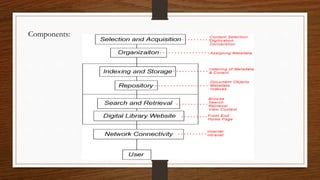
Components:
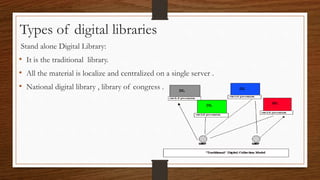
Stand alone Digital Library:
• It is the traditional library.
• All the material is localize and centralized on a single server .
• National digital library , library of congress .
Types of digital libraries
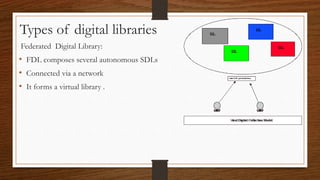
Federated Digital Library:
• FDL composes several autonomous SDLs
• Connected via a network
• It forms a virtual library .
Types of digital libraries
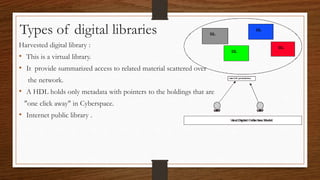
Harvested digital library :
• This is a virtual library.
• It provide summarized access to related material scattered over
the network.
• A HDL holds only metadata with pointers to the holdings that are
"one click away" in Cyberspace.
• Internet public library .
Types of digital libraries
• Museums .
• Institutions
• Research organizations
• Federal institutions
• Many more….
Applications of DLs
We will discuss three research papers :-
1. A new framework for Building digital library .
2. Rich interaction in the Digital Library .
3. Comprehensive personalized Information access in an Education Digital
Library .
Research papers
A new framework for Building digital library
Framework for building digital libraries and contrast it with existing systems
• digital library system “Greenstone”
• “Greenstone 3” vs “Greenstone 2”
• Redesign greenstone system.
Background:
What is greenstone ?
• It provide tools for building digital library collections .collections ..??(we will see later )
• Overview
• operating system compatibility .
• full text indexing
• Cross language support
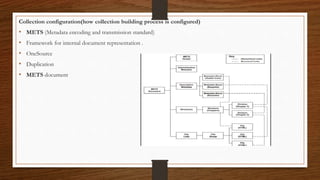
Collection configuration(how collection building process is configured)
• METS (Metadata encoding and transmission standard)
• Framework for internal document representation .
• OneSource
• Duplication
• METS document
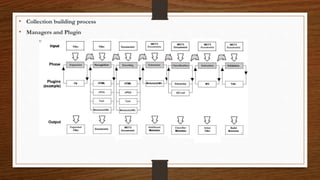
• Collection building process
• Managers and Plugin
The standard interface for extraction, indexation and classification plugins includes:
• getNumberOfPasses Return the number of passes required by the plugin
• startPass(int) Begin a pass for this plugin
• processDocument(Document) Process the given document
• endPass(int) Terminate a given pass
• Tidyup Close the plugin
• configure(XML Node) Pass configuration information from the collection configuration file to the plugin.
• Running each plugin separately and serially keeps memory overheads down
Rich Interactions in the Digital library .
• Effective information access involves rich interactions between users and information residing in diverse
locations
• Users seek and retrieve information from the sources—for example, file servers, databases, and digital libraries—
and use various tools to browse, manipulate, reuse, and generally process the information
• This paper attempts to increase the bandwidth and quality of interaction of user and information in a information
workspace
• Information workspace :it is an environment designed to support information work .
• Conventional retrieval interface are based in which a user formulates a query against a homogenous collection to
obtained matching collections
Techniques supporting rich interactions .
• Iterative query Refinement
techniques : Browsing Subsets Of Source Iteratively.
Viewing context of Query match
Visualizing Passages Within documents
• Source Heterogeneity
techniques : Modeling Sources
Rendering Sources and Results
• Parallel , Interleave led Access
techniques : Reflecting Time Cost of Interaction
Managing Multiple Search process
• Larger work process
techniques : Integrating multiple search and browsing Techniques
Visualizing large Information Sets
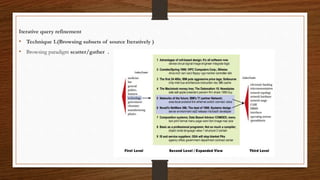
Iterative query refinement
• Technique 1.(Browsing subsets of source Iteratively )
• Browsing paradigm scatter/gather .
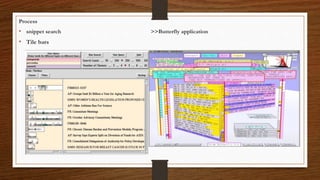
Process
• snippet search >>Butterfly application
• Tile bars
Source modelling
• Functionality
• Access management
• Meta data .
• Important meta information categories
• Content
• Form
• Provenance
Comprehensive Personalized Information Access in an Educational Digital Library
Major techniques of information access:
• Ad-hoc information retrieval (IR)
• Information filtering,
• Hypertext browsing, and
• Information visualization
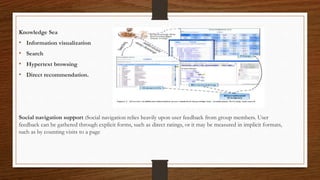
Knowledge Sea
• Information visualization
• Search
• Hypertext browsing
• Direct recommendation.
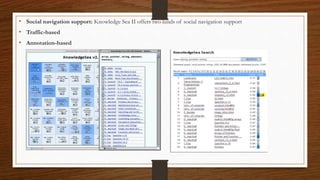
Social navigation support :Social navigation relies heavily upon user feedback from group members. User
feedback can be gathered through explicit forms, such as direct ratings, or it may be measured in implicit formats,
such as by counting visits to a page
• Social navigation support: Knowledge Sea II offers two kinds of social navigation support
• Traffic-based
• Annotation-based
Digital libraries

Digital libraries

  • 1.
  • 2.
    • Introduction: 1. What,why , when ? 2. Building blocks of DLs. 3. Applications and examples . • Discuss 3 papers 1. A New Framework for Building Digital Library collections . 2. Rich interactions in Digital Library 3. Comprehensive Personalized Information Access in an Educational Digital Library Contents
  • 3.
    Digital libraries :Adigital library is a collection of documents in organized electronic form, available on the Internet or on CD-ROM (compact-disk read-only memory) disks. Why : • U can access anytime and any where . • It brings library to user • Information retrieval • Low cost and efficient • Comprehensive variety What ,why ,when
  • 4.
    • The firstmajor acknowledgment of the importance of digital libraries came in a 1994 • the initiative taken by National Science Foundation (NSF), the Department of Defense Advanced Research Projects Agency (ARPA), and the National Aeronautics and Space Administration (NASA) • The projects were at Carnegie Mellon University, the University of California-Berkeley, the University of Michigan, the University of Illinois, the University of California-Santa Barbara, and Stanford University. What ,why ,when
  • 5.
  • 6.
    Stand alone DigitalLibrary: • It is the traditional library. • All the material is localize and centralized on a single server . • National digital library , library of congress . Types of digital libraries
  • 7.
    Federated Digital Library: •FDL composes several autonomous SDLs • Connected via a network • It forms a virtual library . Types of digital libraries
  • 8.
    Harvested digital library: • This is a virtual library. • It provide summarized access to related material scattered over the network. • A HDL holds only metadata with pointers to the holdings that are "one click away" in Cyberspace. • Internet public library . Types of digital libraries
  • 9.
    • Museums . •Institutions • Research organizations • Federal institutions • Many more…. Applications of DLs
  • 10.
    We will discussthree research papers :- 1. A new framework for Building digital library . 2. Rich interaction in the Digital Library . 3. Comprehensive personalized Information access in an Education Digital Library . Research papers
  • 11.
    A new frameworkfor Building digital library Framework for building digital libraries and contrast it with existing systems • digital library system “Greenstone” • “Greenstone 3” vs “Greenstone 2” • Redesign greenstone system. Background: What is greenstone ? • It provide tools for building digital library collections .collections ..??(we will see later ) • Overview • operating system compatibility . • full text indexing • Cross language support
  • 12.
    Collection configuration(how collectionbuilding process is configured) • METS (Metadata encoding and transmission standard) • Framework for internal document representation . • OneSource • Duplication • METS document
  • 13.
    • Collection buildingprocess • Managers and Plugin
  • 14.
    The standard interfacefor extraction, indexation and classification plugins includes: • getNumberOfPasses Return the number of passes required by the plugin • startPass(int) Begin a pass for this plugin • processDocument(Document) Process the given document • endPass(int) Terminate a given pass • Tidyup Close the plugin • configure(XML Node) Pass configuration information from the collection configuration file to the plugin. • Running each plugin separately and serially keeps memory overheads down
  • 15.
    Rich Interactions inthe Digital library . • Effective information access involves rich interactions between users and information residing in diverse locations • Users seek and retrieve information from the sources—for example, file servers, databases, and digital libraries— and use various tools to browse, manipulate, reuse, and generally process the information • This paper attempts to increase the bandwidth and quality of interaction of user and information in a information workspace • Information workspace :it is an environment designed to support information work . • Conventional retrieval interface are based in which a user formulates a query against a homogenous collection to obtained matching collections
  • 16.
    Techniques supporting richinteractions . • Iterative query Refinement techniques : Browsing Subsets Of Source Iteratively. Viewing context of Query match Visualizing Passages Within documents • Source Heterogeneity techniques : Modeling Sources Rendering Sources and Results • Parallel , Interleave led Access techniques : Reflecting Time Cost of Interaction Managing Multiple Search process • Larger work process techniques : Integrating multiple search and browsing Techniques Visualizing large Information Sets
  • 17.
    Iterative query refinement •Technique 1.(Browsing subsets of source Iteratively ) • Browsing paradigm scatter/gather .
  • 18.
    Process • snippet search>>Butterfly application • Tile bars
  • 19.
    Source modelling • Functionality •Access management • Meta data . • Important meta information categories • Content • Form • Provenance Comprehensive Personalized Information Access in an Educational Digital Library Major techniques of information access: • Ad-hoc information retrieval (IR) • Information filtering, • Hypertext browsing, and • Information visualization
  • 20.
    Knowledge Sea • Informationvisualization • Search • Hypertext browsing • Direct recommendation. Social navigation support :Social navigation relies heavily upon user feedback from group members. User feedback can be gathered through explicit forms, such as direct ratings, or it may be measured in implicit formats, such as by counting visits to a page
  • 21.
    • Social navigationsupport: Knowledge Sea II offers two kinds of social navigation support • Traffic-based • Annotation-based