INTRODUCTION TO WIRELESS
  COMMUNICATION


Our ultimate goal is to communicate with
 any type of information with anyone, at
anytime, from anywhere. This is possible
        with the aid of WIRELESS
              TECHNOLOGY
TYPES OF WIRELESS
     COMMUNICATION NETWORKS
1.   CELLULAR NETWORK
     Evolved from mobile telephone as voice
     conversation and communication tools for private
     and business uses


2.   WIRELESS LOCAL AREA NETWORK
     Emerged from computer network. It helps business
     user to expand their service areas by using LAN
     (faster data transport)
WIRELESS APPLICATIONS AND
  SERVICES

WIRELESS APPLICATION
Wireless applications are those which use
 free space as the transmission medium
  and do not involve cabling like fibre or
                   copper
WIRELESS APPLICATIONS AND
         SERVICES (CONT’D)
WIRELESS SERVICES

1)       Voice Data
2)       Video and multimedia applications and services
          VHF, Microwave TV Transmission, Millimeter Wave Data
           Transmission, Cellular Telephony Services, Wireless
           Video Telephony and Video Conferencing, Wireless
           PBX, Wireless Broadband Internet and Internet Access,
           HDTV, Digital Audio Broadcasting (DAB) or Hi-Fi Sound,
           Wireless Geo-Location Services, Wireless E-Mail, PCs
           Interactive Applications using WPANs, WLANs &
           WMANs networks
SOLUTION OFFERED BY
     WIRELESS TECHNOLOGIES

   Wireless solutions for business and
    industry including: -
        - Department stores, and
          warehouse.
        - Trucking and movement of goods
        - Car rental billing and tracking
SOLUTION OFFERED BY
      WIRELESS TECHNOLOGIES
      (CONT’D)
   Wireless solutions for schools
        - In the classroom
        - Remote schools
       
   Wireless solutions for people on the go
        - Real Estate Agents
        - Stock Brokers
        - Doctors
        - Service personnel
        - Airplane Pilots
SOLUTION OFFERED BY
     WIRELESS TECHNOLOGIES
     (CONT’D)
   Wireless solutions for the home
        - Personal Area Networks for the home
        - Personal and home security

   Wireless solutions for police and emergency vehicles
        - Reducing respond time
        - Increasing efficiency
        - Health care services
        - E911 services
EVOLUTION
FROM 1G TO
5G SYSTEM
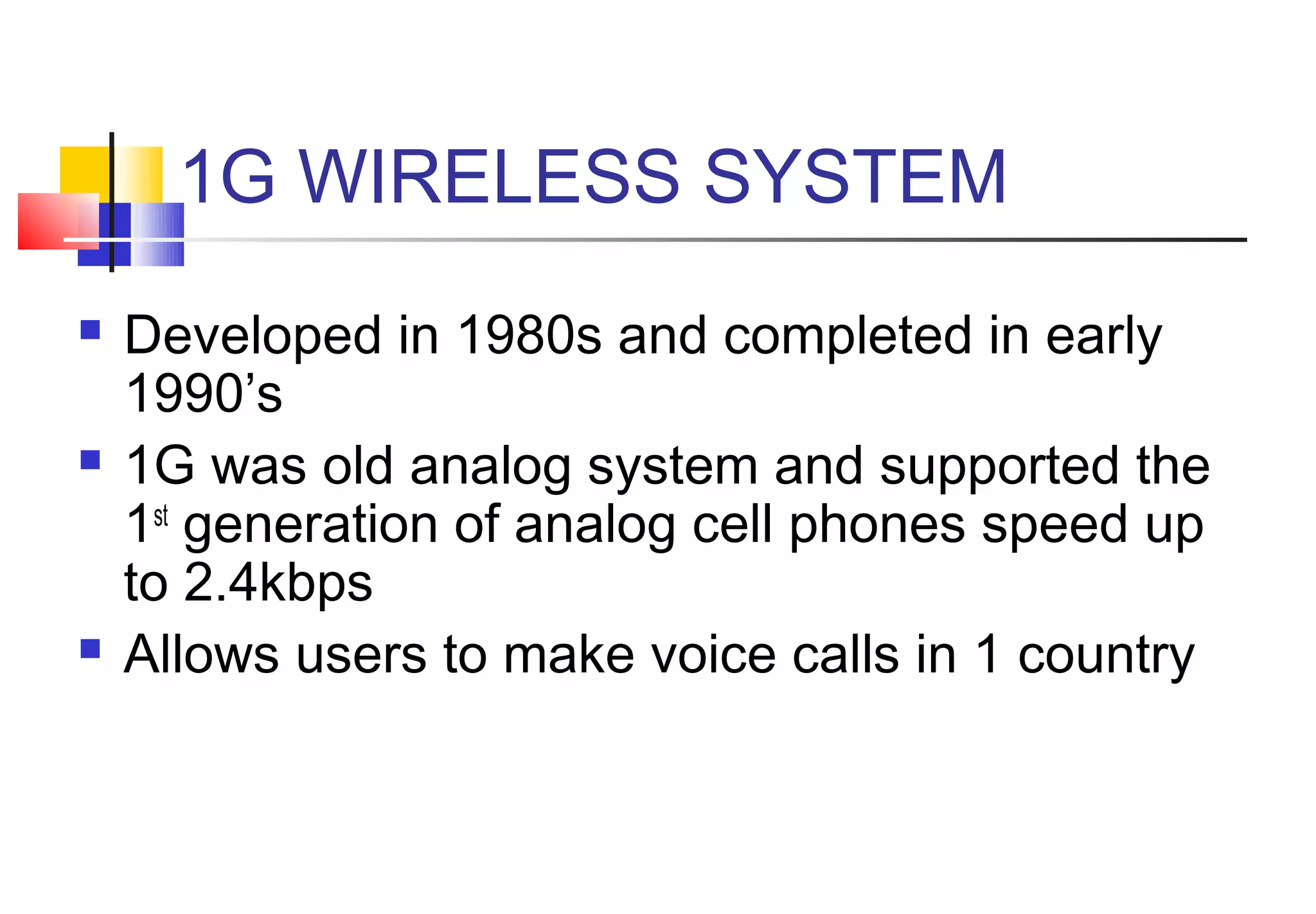
1G WIRELESS SYSTEM
   Developed in 1980s and completed in early
    1990’s
   1G was old analog system and supported the
    1st generation of analog cell phones speed up
    to 2.4kbps
   Allows users to make voice calls in 1 country
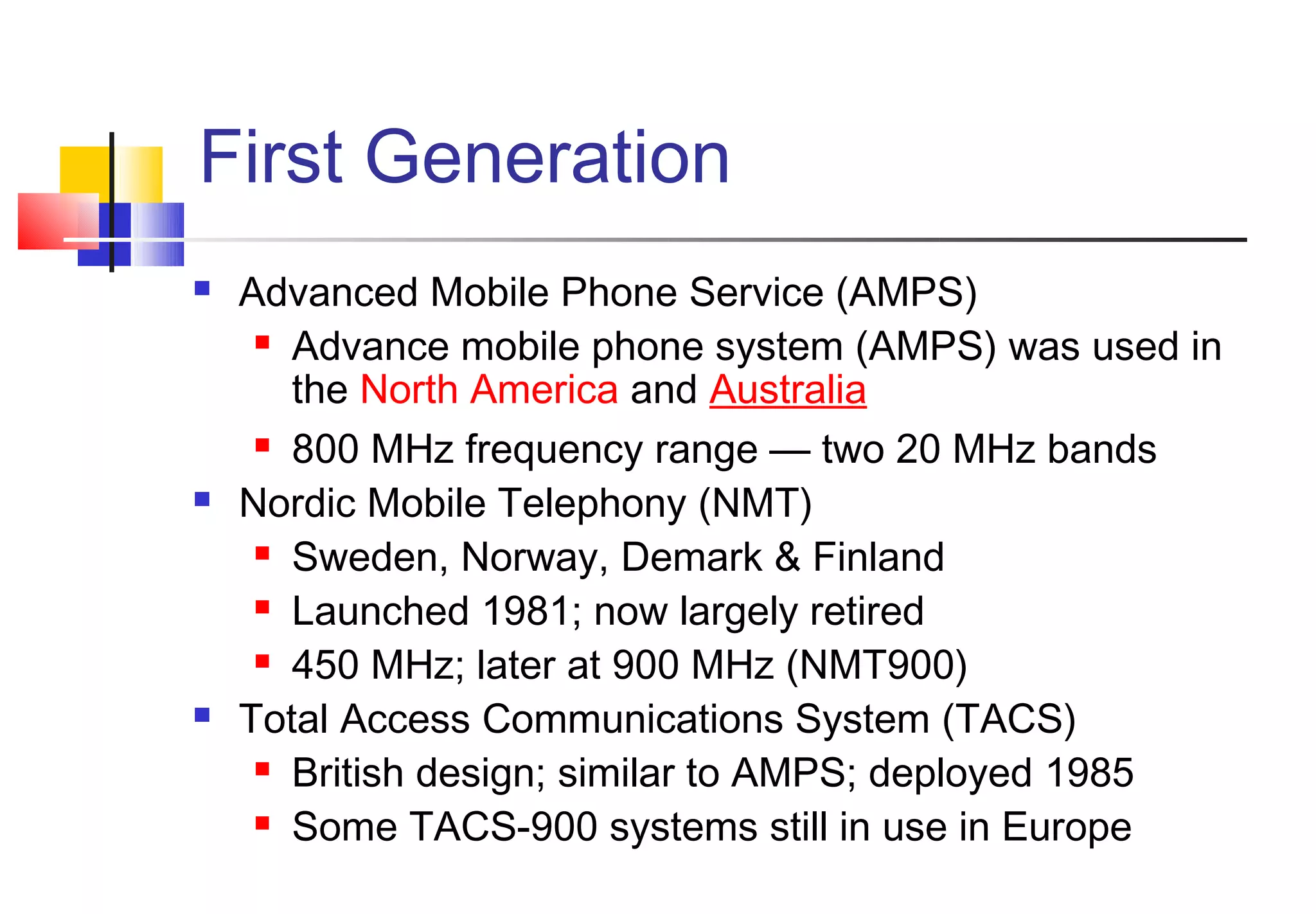
First Generation
   Advanced Mobile Phone Service (AMPS)
      Advance mobile phone system (AMPS) was used in

       the North America and Australia
      800 MHz frequency range — two 20 MHz bands

   Nordic Mobile Telephony (NMT)
      Sweden, Norway, Demark & Finland

      Launched 1981; now largely retired

      450 MHz; later at 900 MHz (NMT900)

   Total Access Communications System (TACS)
      British design; similar to AMPS; deployed 1985

      Some TACS-900 systems still in use in Europe
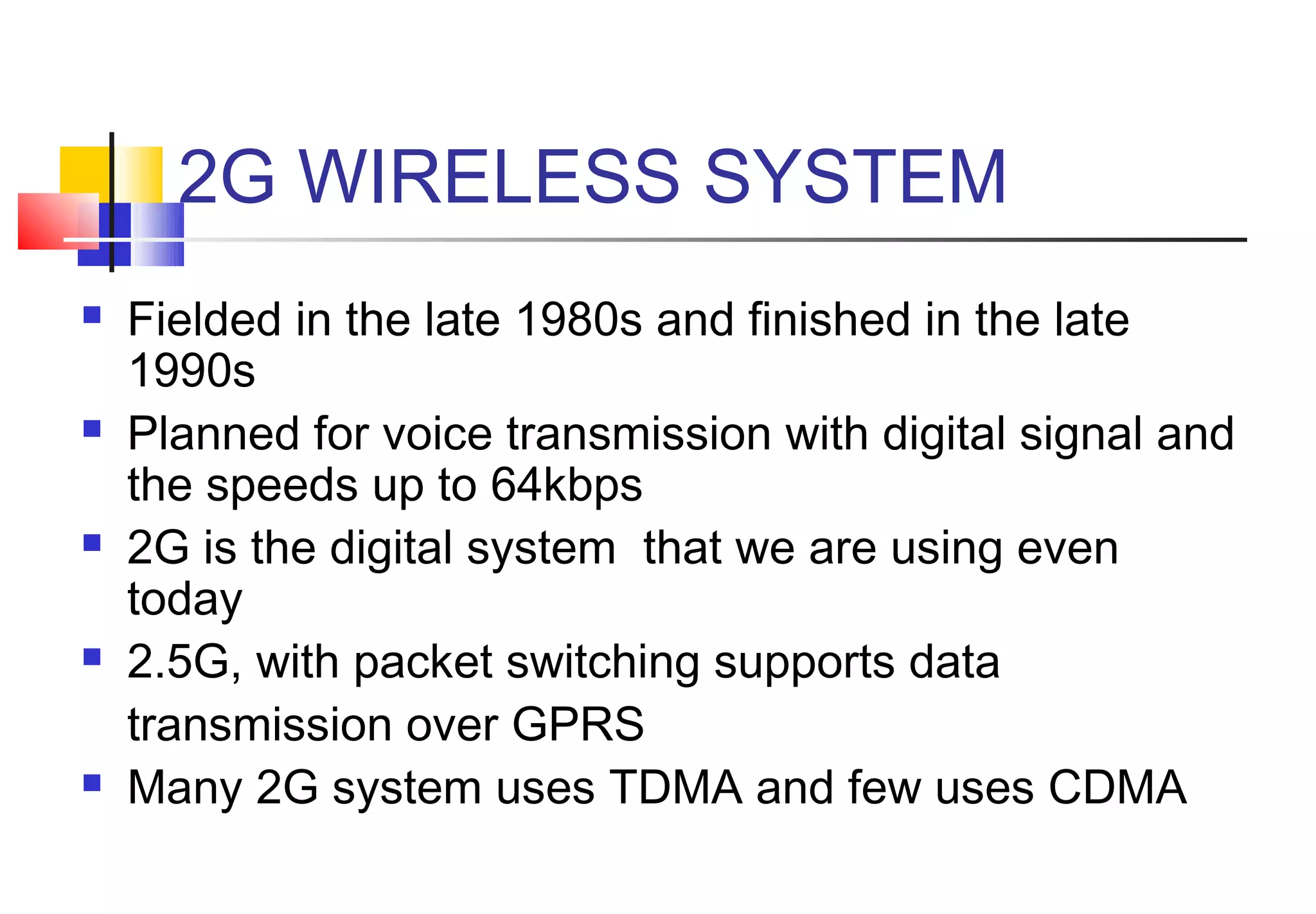
2G WIRELESS SYSTEM
   Fielded in the late 1980s and finished in the late
    1990s
   Planned for voice transmission with digital signal and
    the speeds up to 64kbps
   2G is the digital system that we are using even
    today
   2.5G, with packet switching supports data
    transmission over GPRS
   Many 2G system uses TDMA and few uses CDMA
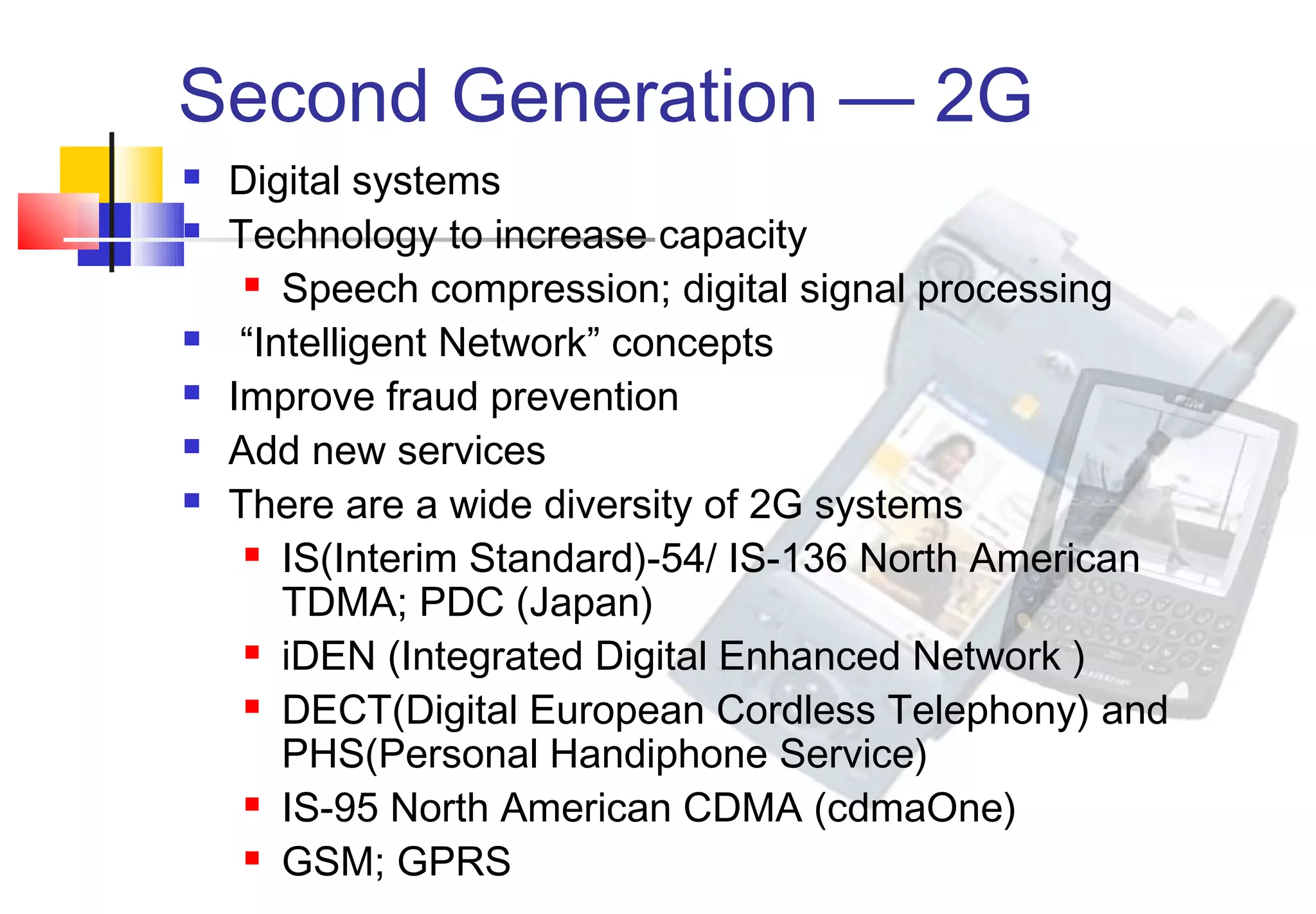
Second Generation — 2G
   Digital systems
   Technology to increase capacity
      Speech compression; digital signal processing

    “Intelligent Network” concepts
   Improve fraud prevention
   Add new services
   There are a wide diversity of 2G systems
      IS(Interim Standard)-54/ IS-136 North American

        TDMA; PDC (Japan)
      iDEN (Integrated Digital Enhanced Network )

      DECT(Digital European Cordless Telephony) and

        PHS(Personal Handiphone Service)
      IS-95 North American CDMA (cdmaOne)

      GSM; GPRS
3G WIRELESS SYSTEM
   Developed in the late 1990s until present
    day
   Japan is the first country having
    introduced 3G nationally, and in Japan
    the transition to 3G is being largely
    completed during 2005/2006
3G WIRELESS SYSTEM (CONT’D)
   Services include:
       Global roaming
       Superior voice quality and video conference
       Data always, add–on services (e-mail, personal
        organizer, etc.)
       Information for web surfing, music, news,
        corporate intranet, transportation service etc.
       Purchasing – on-line shopping / banking, ticketing,
        gambling, games, etc.
3G WIRELESS SYSTEM (CONT’D)
   Transmission speeds from 125kbps to 2Mbps
   In 2005, 3G was ready to live up to its
    performance in computer networking
    (WCDMA, WLAN and Bluetooth) and mobile
    devices area (cell phone and GPS)
   Packet switching
   CDMA is used in many 3G system
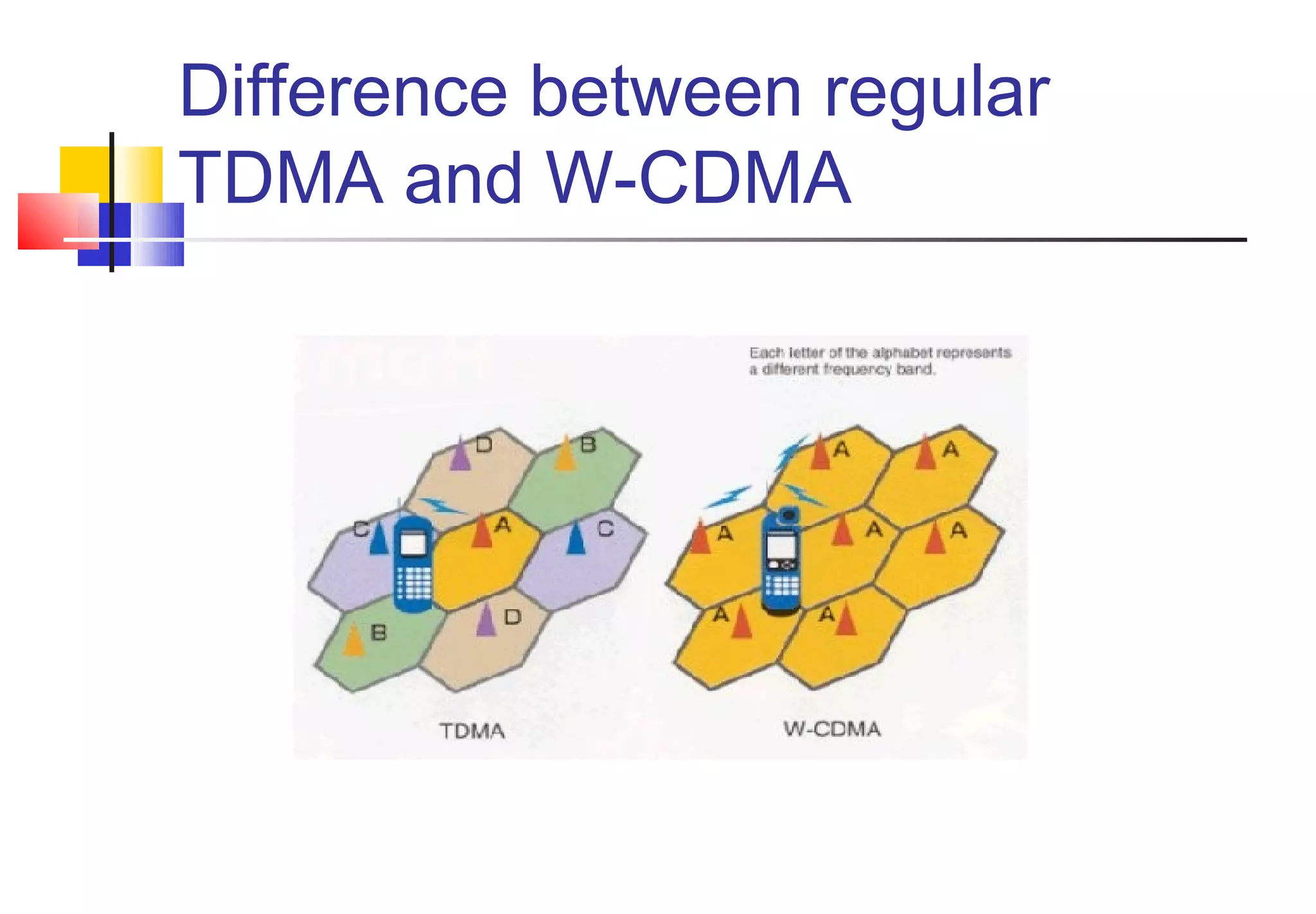
Difference between regular
TDMA and W-CDMA
4G WIRELESS SYSTEM
   4G is a research item for next-generation wide-area
    cellular radio, where you have 1G, 2G, 3G and then
    4G [and 5G]
   4G is a conceptual framework and a discussion point
    to address future needs of a high speed wireless
    network
   It offer both cellular and broadband multimedia
    services everywhere
   Expected to emerged around 2012 - 2015
4G WIRELESS SYSTEM (CONT’D)

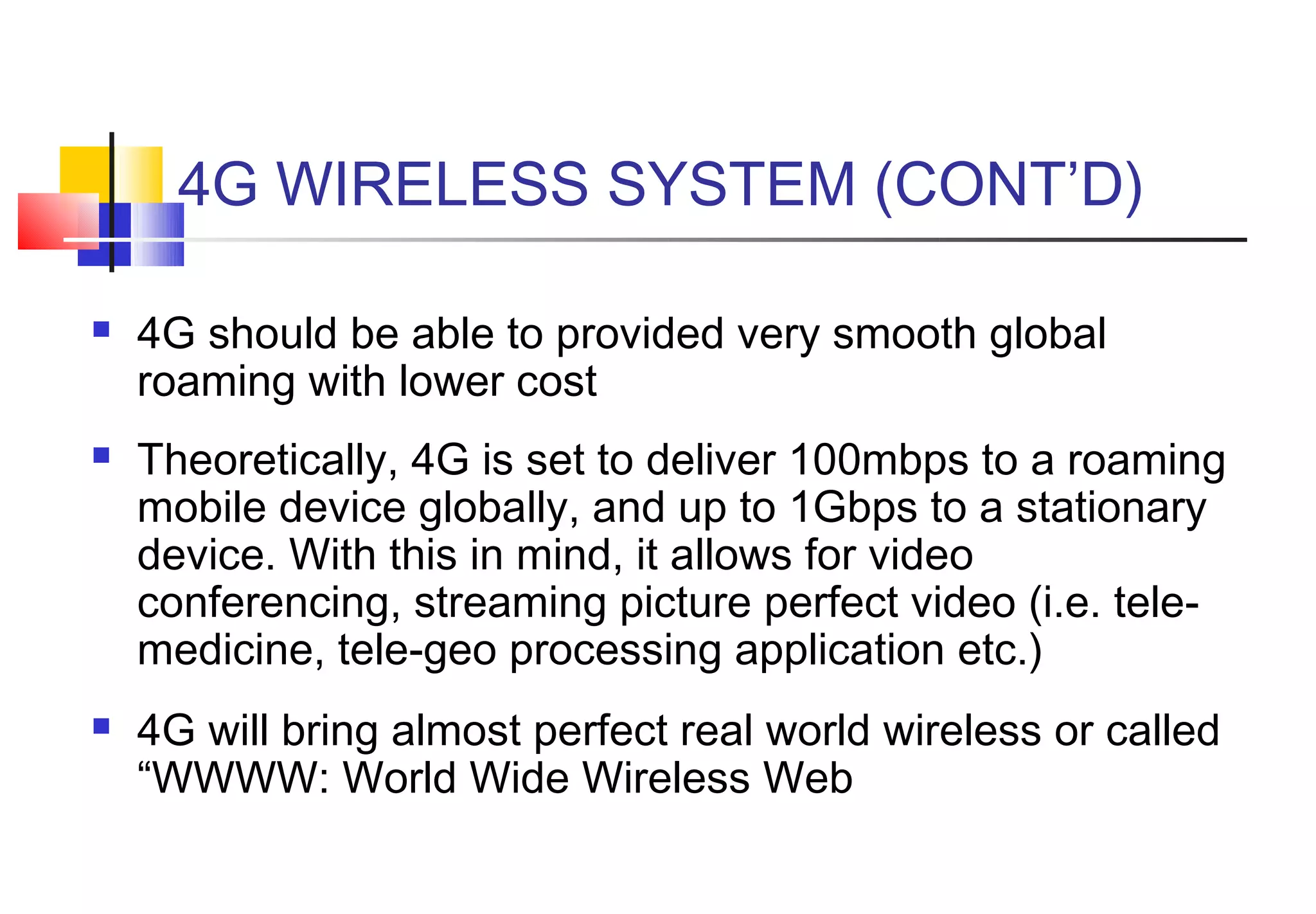
   4G should be able to provided very smooth global
    roaming with lower cost
   Theoretically, 4G is set to deliver 100mbps to a roaming
    mobile device globally, and up to 1Gbps to a stationary
    device. With this in mind, it allows for video
    conferencing, streaming picture perfect video (i.e. tele-
    medicine, tele-geo processing application etc.)
   4G will bring almost perfect real world wireless or called
    “WWWW: World Wide Wireless Web
5G WIRELESS SYSTEM
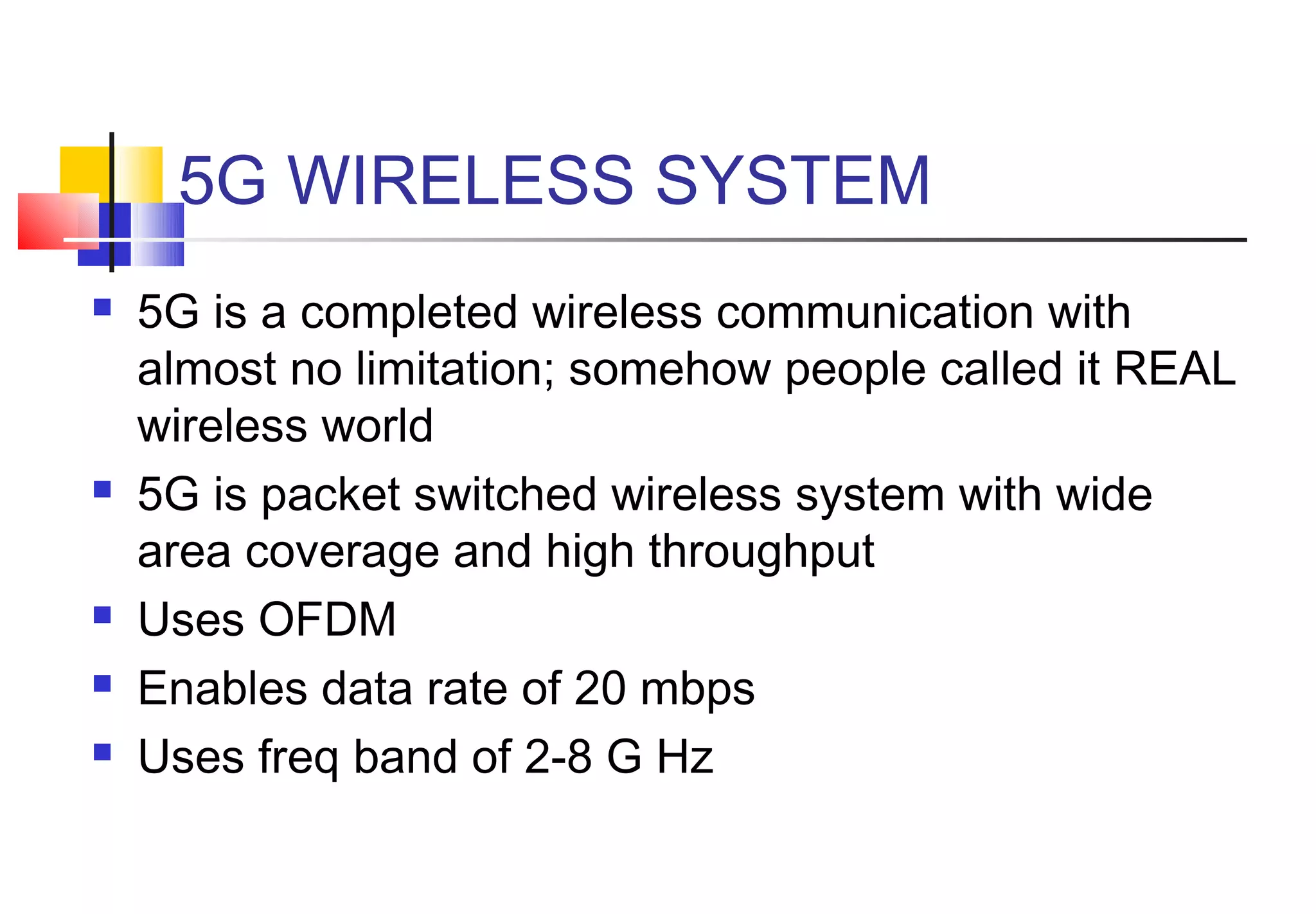
   5G is a completed wireless communication with
    almost no limitation; somehow people called it REAL
    wireless world
   5G is packet switched wireless system with wide
    area coverage and high throughput
   Uses OFDM
   Enables data rate of 20 mbps
   Uses freq band of 2-8 G Hz
5G

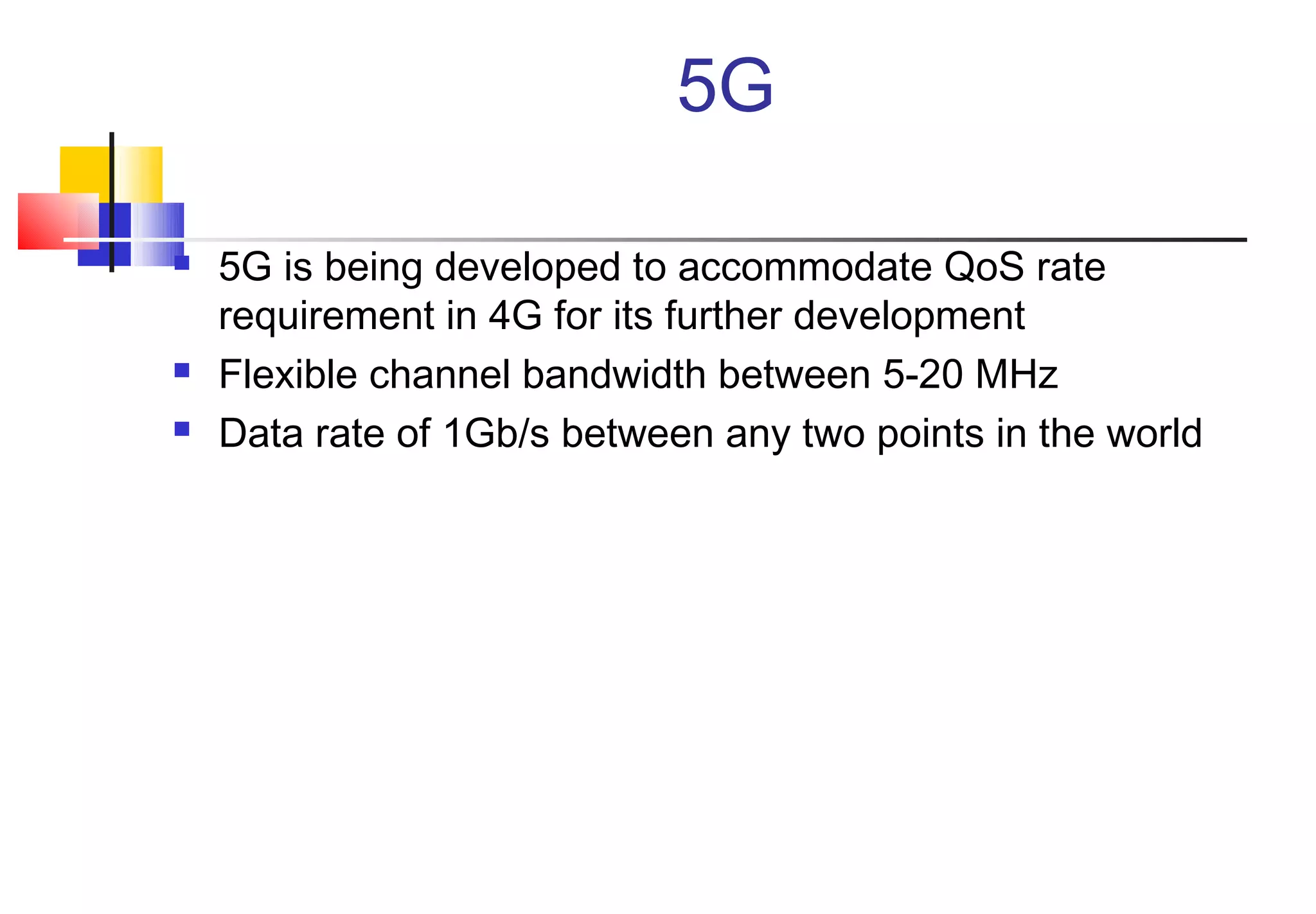
   5G is being developed to accommodate QoS rate
    requirement in 4G for its further development
   Flexible channel bandwidth between 5-20 MHz
   Data rate of 1Gb/s between any two points in the world
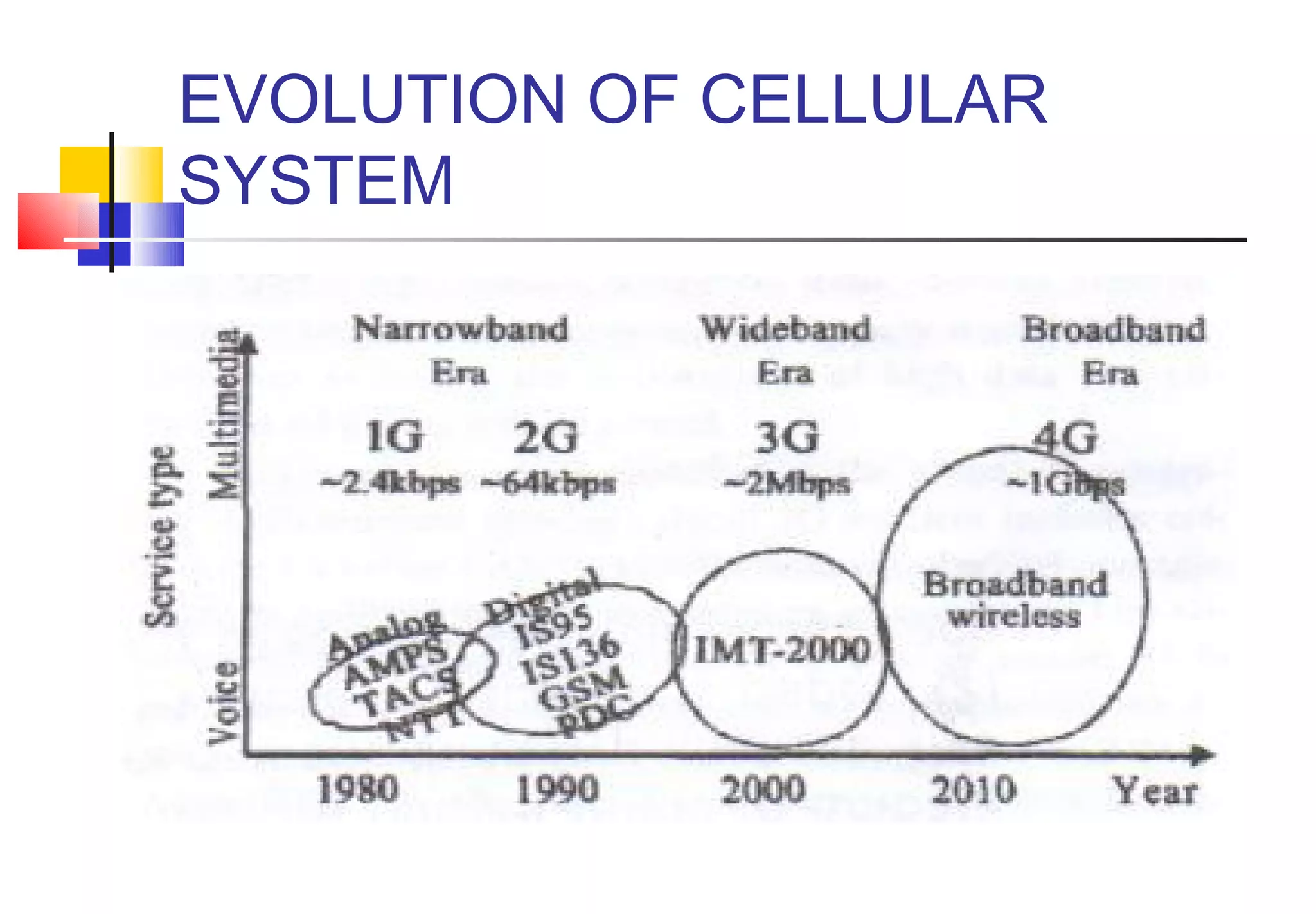
EVOLUTION OF CELLULAR
SYSTEM

Evolution from 1_g_to_5g

  • 1.
    INTRODUCTION TO WIRELESS COMMUNICATION Our ultimate goal is to communicate with any type of information with anyone, at anytime, from anywhere. This is possible with the aid of WIRELESS TECHNOLOGY
  • 2.
    TYPES OF WIRELESS COMMUNICATION NETWORKS 1. CELLULAR NETWORK Evolved from mobile telephone as voice conversation and communication tools for private and business uses 2. WIRELESS LOCAL AREA NETWORK Emerged from computer network. It helps business user to expand their service areas by using LAN (faster data transport)
  • 3.
    WIRELESS APPLICATIONS AND SERVICES WIRELESS APPLICATION Wireless applications are those which use free space as the transmission medium and do not involve cabling like fibre or copper
  • 4.
    WIRELESS APPLICATIONS AND SERVICES (CONT’D) WIRELESS SERVICES 1) Voice Data 2) Video and multimedia applications and services  VHF, Microwave TV Transmission, Millimeter Wave Data Transmission, Cellular Telephony Services, Wireless Video Telephony and Video Conferencing, Wireless PBX, Wireless Broadband Internet and Internet Access, HDTV, Digital Audio Broadcasting (DAB) or Hi-Fi Sound, Wireless Geo-Location Services, Wireless E-Mail, PCs Interactive Applications using WPANs, WLANs & WMANs networks
  • 5.
    SOLUTION OFFERED BY WIRELESS TECHNOLOGIES  Wireless solutions for business and industry including: -     - Department stores, and warehouse.     - Trucking and movement of goods     - Car rental billing and tracking
  • 6.
    SOLUTION OFFERED BY WIRELESS TECHNOLOGIES (CONT’D)  Wireless solutions for schools     - In the classroom     - Remote schools      Wireless solutions for people on the go     - Real Estate Agents     - Stock Brokers     - Doctors     - Service personnel     - Airplane Pilots
  • 7.
    SOLUTION OFFERED BY WIRELESS TECHNOLOGIES (CONT’D)  Wireless solutions for the home     - Personal Area Networks for the home     - Personal and home security  Wireless solutions for police and emergency vehicles     - Reducing respond time     - Increasing efficiency     - Health care services     - E911 services
  • 8.
  • 9.
    1G WIRELESS SYSTEM  Developed in 1980s and completed in early 1990’s  1G was old analog system and supported the 1st generation of analog cell phones speed up to 2.4kbps  Allows users to make voice calls in 1 country
  • 10.
    First Generation  Advanced Mobile Phone Service (AMPS)  Advance mobile phone system (AMPS) was used in the North America and Australia  800 MHz frequency range — two 20 MHz bands  Nordic Mobile Telephony (NMT)  Sweden, Norway, Demark & Finland  Launched 1981; now largely retired  450 MHz; later at 900 MHz (NMT900)  Total Access Communications System (TACS)  British design; similar to AMPS; deployed 1985  Some TACS-900 systems still in use in Europe
  • 11.
    2G WIRELESS SYSTEM  Fielded in the late 1980s and finished in the late 1990s  Planned for voice transmission with digital signal and the speeds up to 64kbps  2G is the digital system that we are using even today  2.5G, with packet switching supports data transmission over GPRS  Many 2G system uses TDMA and few uses CDMA
  • 12.
    Second Generation —2G  Digital systems  Technology to increase capacity  Speech compression; digital signal processing  “Intelligent Network” concepts  Improve fraud prevention  Add new services  There are a wide diversity of 2G systems  IS(Interim Standard)-54/ IS-136 North American TDMA; PDC (Japan)  iDEN (Integrated Digital Enhanced Network )  DECT(Digital European Cordless Telephony) and PHS(Personal Handiphone Service)  IS-95 North American CDMA (cdmaOne)  GSM; GPRS
  • 13.
    3G WIRELESS SYSTEM  Developed in the late 1990s until present day  Japan is the first country having introduced 3G nationally, and in Japan the transition to 3G is being largely completed during 2005/2006
  • 14.
    3G WIRELESS SYSTEM(CONT’D)  Services include:  Global roaming  Superior voice quality and video conference  Data always, add–on services (e-mail, personal organizer, etc.)  Information for web surfing, music, news, corporate intranet, transportation service etc.  Purchasing – on-line shopping / banking, ticketing, gambling, games, etc.
  • 15.
    3G WIRELESS SYSTEM(CONT’D)  Transmission speeds from 125kbps to 2Mbps  In 2005, 3G was ready to live up to its performance in computer networking (WCDMA, WLAN and Bluetooth) and mobile devices area (cell phone and GPS)  Packet switching  CDMA is used in many 3G system
  • 16.
  • 17.
    4G WIRELESS SYSTEM  4G is a research item for next-generation wide-area cellular radio, where you have 1G, 2G, 3G and then 4G [and 5G]  4G is a conceptual framework and a discussion point to address future needs of a high speed wireless network  It offer both cellular and broadband multimedia services everywhere  Expected to emerged around 2012 - 2015
  • 18.
    4G WIRELESS SYSTEM(CONT’D)  4G should be able to provided very smooth global roaming with lower cost  Theoretically, 4G is set to deliver 100mbps to a roaming mobile device globally, and up to 1Gbps to a stationary device. With this in mind, it allows for video conferencing, streaming picture perfect video (i.e. tele- medicine, tele-geo processing application etc.)  4G will bring almost perfect real world wireless or called “WWWW: World Wide Wireless Web
  • 19.
    5G WIRELESS SYSTEM  5G is a completed wireless communication with almost no limitation; somehow people called it REAL wireless world  5G is packet switched wireless system with wide area coverage and high throughput  Uses OFDM  Enables data rate of 20 mbps  Uses freq band of 2-8 G Hz
  • 20.
    5G  5G is being developed to accommodate QoS rate requirement in 4G for its further development  Flexible channel bandwidth between 5-20 MHz  Data rate of 1Gb/s between any two points in the world
  • 21.