
WIRELESS SYSTEMS
CONTENTS
INTRODUCTION
 1G TECHNOLOGY
 2G TECHNOLOGY
3G TECHNOLOGY
 4G TECHNOLOGY
 5G TECHNOLOGY
WIRELESS APPLICATIONS
WIRELESS SERVICES
EVOLUTION FROM 1G TO 5G TECHNOLOGY
CONCLUSION
INTRODUCTION
WHAT IS WIRELESS ?
The word wireless in dictionary is defined “having no wires ” .
In networking terminology , wireless is the term used to describe any
computer network where there is no physical wired connection between
sender and receiver, but rather the network is connected by radio waves
and or microwaves to maintain communications.
1G TECHNOLOGY
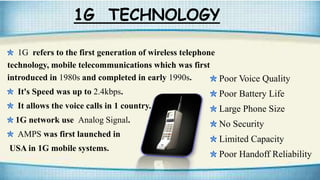
1G refers to the first generation of wireless telephone
technology, mobile telecommunications which was first
introduced in 1980s and completed in early 1990s.
It's Speed was up to 2.4kbps.
It allows the voice calls in 1 country.
1G network use Analog Signal.
AMPS was first launched in
USA in 1G mobile systems.
Poor Voice Quality
Poor Battery Life
Large Phone Size
No Security
Limited Capacity
Poor Handoff Reliability
2G TECHNOLOGY
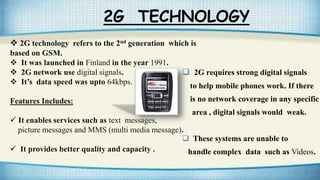
 2G technology refers to the 2nd generation which is
based on GSM.
 It was launched in Finland in the year 1991.
 2G network use digital signals.
 It’s data speed was upto 64kbps.
Features Includes:
 It enables services such as text messages,
picture messages and MMS (multi media message).
 It provides better quality and capacity .
 2G requires strong digital signals
to help mobile phones work. If there
is no network coverage in any specific
area , digital signals would weak.
 These systems are unable to
handle complex data such as Videos.
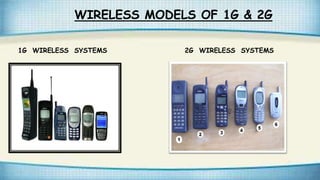
WIRELESS MODELS OF 1G & 2G
1G WIRELESS SYSTEMS 2G WIRELESS SYSTEMS
3G TECHNOLOGY
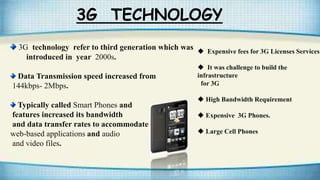
3G technology refer to third generation which was
introduced in year 2000s.
Data Transmission speed increased from
144kbps- 2Mbps.
Typically called Smart Phones and
features increased its bandwidth
and data transfer rates to accommodate
web-based applications and audio
and video files.
 Expensive fees for 3G Licenses Services
 It was challenge to build the
infrastructure
for 3G
 High Bandwidth Requirement
 Expensive 3G Phones.
 Large Cell Phones
4G TECHNOLOGY
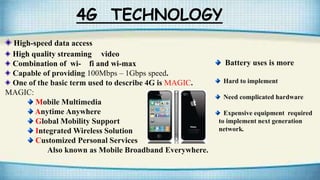
High-speed data access
High quality streaming video
Combination of wi- fi and wi-max
Capable of providing 100Mbps – 1Gbps speed.
One of the basic term used to describe 4G is MAGIC.
MAGIC:
Mobile Multimedia
Anytime Anywhere
Global Mobility Support
Integrated Wireless Solution
Customized Personal Services
Also known as Mobile Broadband Everywhere.
Battery uses is more
Hard to implement
Need complicated hardware
Expensive equipment required
to implement next generation
network.
5G TECHNOLOGY
5G TECHNOLOGY
5G TECHNOLOGY
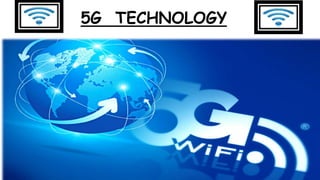
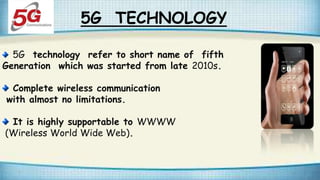
5G technology refer to short name of fifth
Generation which was started from late 2010s.
Complete wireless communication
with almost no limitations.
It is highly supportable to WWWW
(Wireless World Wide Web).
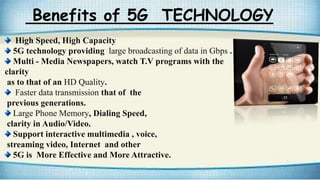
Benefits of 5G TECHNOLOGY
High Speed, High Capacity
5G technology providing large broadcasting of data in Gbps .
Multi - Media Newspapers, watch T.V programs with the
clarity
as to that of an HD Quality.
Faster data transmission that of the
previous generations.
Large Phone Memory, Dialing Speed,
clarity in Audio/Video.
Support interactive multimedia , voice,
streaming video, Internet and other
5G is More Effective and More Attractive.
5G
4G
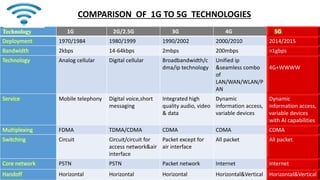
Technology 1G 2G/2.5G 3G 4G 5G
Deployment 1970/1984 1980/1999 1990/2002 2000/2010 2014/2015
Bandwidth 2kbps 14-64kbps 2mbps 200mbps >1gbps
Technology Analog cellular Digital cellular Broadbandwidth/c
dma/ip technology
Unified ip
&seamless combo
of
LAN/WAN/WLAN/P
AN
4G+WWWW
Service Mobile telephony Digital voice,short
messaging
Integrated high
quality audio, video
& data
Dynamic
information access,
variable devices
Dynamic
information access,
variable devices
with AI capabilities
Multiplexing FDMA TDMA/CDMA CDMA CDMA CDMA
Switching Circuit Circuit/circuit for
access network&air
interface
Packet except for
air interface
All packet All packet
Core network PSTN PSTN Packet network Internet Internet
Handoff Horizontal Horizontal Horizontal Horizontal&Vertical Horizontal&Vertical
COMPARISON OF 1G TO 5G TECHNOLOGIES
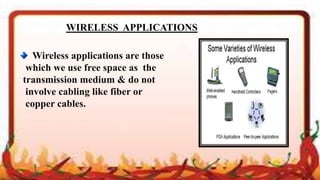
Wireless applications are those
which we use free space as the
transmission medium & do not
involve cabling like fiber or
copper cables.
WIRELESS APPLICATIONS
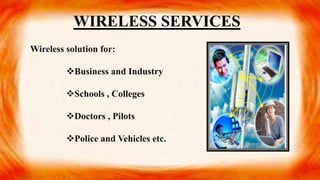
Wireless solution for:
Business and Industry
Schools , Colleges
Doctors , Pilots
Police and Vehicles etc.
WIRELESS SERVICES
 All totally the best way to help all users is to use 5G as the
next wireless system and in totally it is safety and secure
for public, this the need that demands the solution.
 Today’s wired society is going wireless and if it has
problem, 5G is answer.
 5G technology is going to give tough competition to
Computers and Laptops.
 It will be available in the market 2020 at affordable cost
with more reliability than previous mobiles.
Conclusion
References
Google.com
Wikipedia.com
Webpedia.com
Research Papers
5G The Vast Technology

5G The Vast Technology

  • 1.
  • 2.
    CONTENTS INTRODUCTION  1G TECHNOLOGY 2G TECHNOLOGY 3G TECHNOLOGY  4G TECHNOLOGY  5G TECHNOLOGY WIRELESS APPLICATIONS WIRELESS SERVICES EVOLUTION FROM 1G TO 5G TECHNOLOGY CONCLUSION
  • 3.
    INTRODUCTION WHAT IS WIRELESS? The word wireless in dictionary is defined “having no wires ” . In networking terminology , wireless is the term used to describe any computer network where there is no physical wired connection between sender and receiver, but rather the network is connected by radio waves and or microwaves to maintain communications.
  • 4.
    1G TECHNOLOGY 1G refersto the first generation of wireless telephone technology, mobile telecommunications which was first introduced in 1980s and completed in early 1990s. It's Speed was up to 2.4kbps. It allows the voice calls in 1 country. 1G network use Analog Signal. AMPS was first launched in USA in 1G mobile systems. Poor Voice Quality Poor Battery Life Large Phone Size No Security Limited Capacity Poor Handoff Reliability
  • 5.
    2G TECHNOLOGY  2Gtechnology refers to the 2nd generation which is based on GSM.  It was launched in Finland in the year 1991.  2G network use digital signals.  It’s data speed was upto 64kbps. Features Includes:  It enables services such as text messages, picture messages and MMS (multi media message).  It provides better quality and capacity .  2G requires strong digital signals to help mobile phones work. If there is no network coverage in any specific area , digital signals would weak.  These systems are unable to handle complex data such as Videos.
  • 6.
    WIRELESS MODELS OF1G & 2G 1G WIRELESS SYSTEMS 2G WIRELESS SYSTEMS
  • 7.
    3G TECHNOLOGY 3G technologyrefer to third generation which was introduced in year 2000s. Data Transmission speed increased from 144kbps- 2Mbps. Typically called Smart Phones and features increased its bandwidth and data transfer rates to accommodate web-based applications and audio and video files.  Expensive fees for 3G Licenses Services  It was challenge to build the infrastructure for 3G  High Bandwidth Requirement  Expensive 3G Phones.  Large Cell Phones
  • 8.
    4G TECHNOLOGY High-speed dataaccess High quality streaming video Combination of wi- fi and wi-max Capable of providing 100Mbps – 1Gbps speed. One of the basic term used to describe 4G is MAGIC. MAGIC: Mobile Multimedia Anytime Anywhere Global Mobility Support Integrated Wireless Solution Customized Personal Services Also known as Mobile Broadband Everywhere. Battery uses is more Hard to implement Need complicated hardware Expensive equipment required to implement next generation network.
  • 9.
  • 10.
  • 12.
    5G TECHNOLOGY 5G technologyrefer to short name of fifth Generation which was started from late 2010s. Complete wireless communication with almost no limitations. It is highly supportable to WWWW (Wireless World Wide Web).
  • 13.
    Benefits of 5GTECHNOLOGY High Speed, High Capacity 5G technology providing large broadcasting of data in Gbps . Multi - Media Newspapers, watch T.V programs with the clarity as to that of an HD Quality. Faster data transmission that of the previous generations. Large Phone Memory, Dialing Speed, clarity in Audio/Video. Support interactive multimedia , voice, streaming video, Internet and other 5G is More Effective and More Attractive.
  • 14.
  • 15.
    Technology 1G 2G/2.5G3G 4G 5G Deployment 1970/1984 1980/1999 1990/2002 2000/2010 2014/2015 Bandwidth 2kbps 14-64kbps 2mbps 200mbps >1gbps Technology Analog cellular Digital cellular Broadbandwidth/c dma/ip technology Unified ip &seamless combo of LAN/WAN/WLAN/P AN 4G+WWWW Service Mobile telephony Digital voice,short messaging Integrated high quality audio, video & data Dynamic information access, variable devices Dynamic information access, variable devices with AI capabilities Multiplexing FDMA TDMA/CDMA CDMA CDMA CDMA Switching Circuit Circuit/circuit for access network&air interface Packet except for air interface All packet All packet Core network PSTN PSTN Packet network Internet Internet Handoff Horizontal Horizontal Horizontal Horizontal&Vertical Horizontal&Vertical COMPARISON OF 1G TO 5G TECHNOLOGIES
  • 17.
    Wireless applications arethose which we use free space as the transmission medium & do not involve cabling like fiber or copper cables. WIRELESS APPLICATIONS
  • 18.
    Wireless solution for: Businessand Industry Schools , Colleges Doctors , Pilots Police and Vehicles etc. WIRELESS SERVICES
  • 19.
     All totallythe best way to help all users is to use 5G as the next wireless system and in totally it is safety and secure for public, this the need that demands the solution.  Today’s wired society is going wireless and if it has problem, 5G is answer.  5G technology is going to give tough competition to Computers and Laptops.  It will be available in the market 2020 at affordable cost with more reliability than previous mobiles. Conclusion
  • 20.