
Presented By
P.Shirisha
D.Soundarya &
OVERVIEW
 INTRODUCTION TO WIRELESS
COMMUNICATION
 EVOLUTION FROM 1G TO 4G SYSTEM
 5-G WIRELESS SYSTEM
 FUNCTIONAL ARCHITECTURE FOR 5G MOBILE
NETWORKS
 FEATURES OF 5G TECHNOLOGY
 5G APPLICATION
INTRODUCTION TO WIRELESS
COMMUNICATION
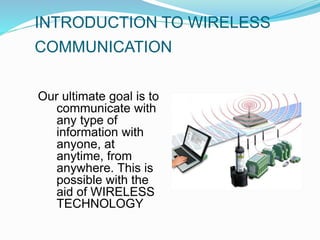
Our ultimate goal is to
communicate with
any type of
information with
anyone, at
anytime, from
anywhere. This is
possible with the
aid of WIRELESS
TECHNOLOGY
HISTORY : EVOLUTION FROM 1G
TO 5G SYSTEM
Different generations
evolved they are
1G WIRELESS SYSTEM
 1980's and completed in
early 1990’s
 Analog system and speed
2.4kbps.
2G WIRELESS SYSTEM
 late 1980s and finished in
the late 1990s
 Digital signal and speeds 64kbps.
 2G,2.5G was the digital handsets that we are used today
3G WIRELESS SYSTEM
 (cdma 2000 in us & w-cdma in europe & japan):2000's
 128kbps (high speed)
 384kbps(slow speed)
 2mbps(stationery)
4G /5G WIRELESS SYSTEM
 (MC-CDMA,OFDM):2010'S.
.
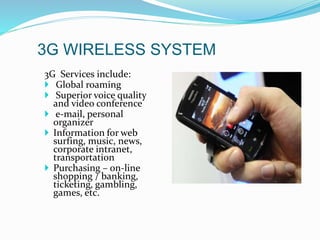
3G WIRELESS SYSTEM
3G Services include:
 Global roaming
 Superior voice quality
and video conference
 e-mail, personal
organizer
 Information for web
surfing, music, news,
corporate intranet,
transportation
 Purchasing – on-line
shopping / banking,
ticketing, gambling,
games, etc.
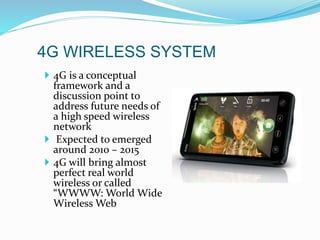
4G WIRELESS SYSTEM
 4G is a conceptual
framework and a
discussion point to
address future needs of
a high speed wireless
network
 Expected to emerged
around 2010 – 2015
 4G will bring almost
perfect real world
wireless or called
“WWWW: World Wide
Wireless Web
Problems in 4G
 SMS - very low rate, highly delay-tolerant & requires more
reliability than voice
 E-mail - very low rate, highly delay-tolerant & requires more
reliability.
 The potentially high level of traffic variation (non-uniformity)
across the area of network’s coverage.
 The fluctuations in traffic demand (both in space and time) will
be at unprecedented levels in future networks, which will result
in tremendous stress to wireless operators.
5G WIRELESS SYSTEM
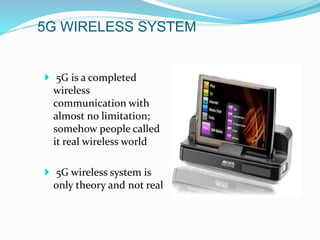
 5G is a completed
wireless
communication with
almost no limitation;
somehow people called
it real wireless world
 5G wireless system is
only theory and not real
 Anywhere, Anytime with Anyone
 Global Mobility Support
 Integrated Wireless Solution
 Customized Personal Service
 Multi-standard wireless system
 Lower cost than previous generations
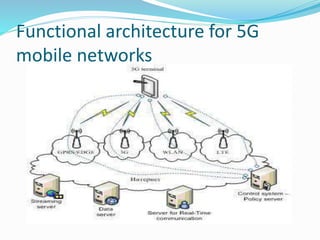
Functional architecture for 5G
mobile networks
FEATURES OF 5G TECHNOLOGY
 Bi-directional large bandwidth.
 Large broadcasting.
 Less traffic.
 25 Mbps connectivity speed.
 Connectivity just about the world.
 Uploading and downloading speed of 5G technology
touching the peak.(up to 1GBPS).
 Better and fast solution.
 Based on Policy to avoid error.
 Support virtual private network.
 More attractive and effective.
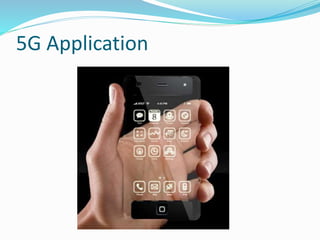
5G Application
WIRELESS APPLICATIONS AND
SEVICES
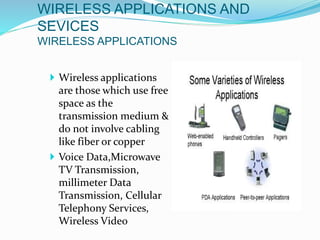
WIRELESS APPLICATIONS
 Wireless applications
are those which use free
space as the
transmission medium &
do not involve cabling
like fiber or copper
 Voice Data,Microwave
TV Transmission,
millimeter Data
Transmission, Cellular
Telephony Services,
Wireless Video
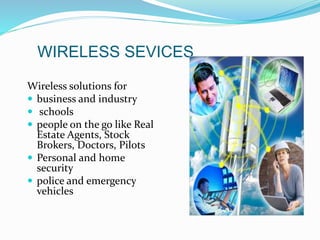
WIRELESS SEVICES
Wireless solutions for
 business and industry
 schools
 people on the go like Real
Estate Agents, Stock
Brokers, Doctors, Pilots
 Personal and home
security
 police and emergency
vehicles
 3G is very attractive and advantageous
 Users get high quality services like excellent sound quality
,fast mobile internet connection, video calls
 3G uses UMTS which yields to existing GSM networks that
exist in almost every small city & village, thus the change of
equipment & software connected with material cost that’s
why only big companies are able to affordable
 4G is set to available around 2010,with the 1billion users
around world
 Users can expect low cost per data bit,as well as speed &
reliability
ADVANTAGES AND DISADVANTAGES
 4G and NGN’s are becoming fast and very cost-
effective
 Service providers are in search of migration to all
IP network ,a more expected to lower high speed
data costs like 3.5G or even 4G,5G
 WWWW (wide wireless web) started from 4G
technologies
 5G should make an important difference and add
more services and benefit to the world over
.
wireless systems becoming an important
infrastructure in our society, network and
internet field. In this paper, it is briefly
introduced the history background of 1G to
5G,A virtual global system is a good solution
that can efficiently connect many dedicated
wireless systems including 2G to 4G cellular
systems, wireless LAN, broadcasting systems,
etc. offering more services and smooth global
roamingwith inexpensive cost.
CONCLUSION
5 g wireless_technology

5 g wireless_technology

  • 1.
  • 2.
    OVERVIEW  INTRODUCTION TOWIRELESS COMMUNICATION  EVOLUTION FROM 1G TO 4G SYSTEM  5-G WIRELESS SYSTEM  FUNCTIONAL ARCHITECTURE FOR 5G MOBILE NETWORKS  FEATURES OF 5G TECHNOLOGY  5G APPLICATION
  • 3.
    INTRODUCTION TO WIRELESS COMMUNICATION Ourultimate goal is to communicate with any type of information with anyone, at anytime, from anywhere. This is possible with the aid of WIRELESS TECHNOLOGY
  • 4.
    HISTORY : EVOLUTIONFROM 1G TO 5G SYSTEM Different generations evolved they are 1G WIRELESS SYSTEM  1980's and completed in early 1990’s  Analog system and speed 2.4kbps. 2G WIRELESS SYSTEM  late 1980s and finished in the late 1990s
  • 5.
     Digital signaland speeds 64kbps.  2G,2.5G was the digital handsets that we are used today 3G WIRELESS SYSTEM  (cdma 2000 in us & w-cdma in europe & japan):2000's  128kbps (high speed)  384kbps(slow speed)  2mbps(stationery) 4G /5G WIRELESS SYSTEM  (MC-CDMA,OFDM):2010'S. .
  • 6.
    3G WIRELESS SYSTEM 3GServices include:  Global roaming  Superior voice quality and video conference  e-mail, personal organizer  Information for web surfing, music, news, corporate intranet, transportation  Purchasing – on-line shopping / banking, ticketing, gambling, games, etc.
  • 7.
    4G WIRELESS SYSTEM 4G is a conceptual framework and a discussion point to address future needs of a high speed wireless network  Expected to emerged around 2010 – 2015  4G will bring almost perfect real world wireless or called “WWWW: World Wide Wireless Web
  • 8.
    Problems in 4G SMS - very low rate, highly delay-tolerant & requires more reliability than voice  E-mail - very low rate, highly delay-tolerant & requires more reliability.  The potentially high level of traffic variation (non-uniformity) across the area of network’s coverage.  The fluctuations in traffic demand (both in space and time) will be at unprecedented levels in future networks, which will result in tremendous stress to wireless operators.
  • 9.
    5G WIRELESS SYSTEM 5G is a completed wireless communication with almost no limitation; somehow people called it real wireless world  5G wireless system is only theory and not real
  • 10.
     Anywhere, Anytimewith Anyone  Global Mobility Support  Integrated Wireless Solution  Customized Personal Service  Multi-standard wireless system  Lower cost than previous generations
  • 11.
    Functional architecture for5G mobile networks
  • 12.
    FEATURES OF 5GTECHNOLOGY  Bi-directional large bandwidth.  Large broadcasting.  Less traffic.  25 Mbps connectivity speed.  Connectivity just about the world.  Uploading and downloading speed of 5G technology touching the peak.(up to 1GBPS).  Better and fast solution.  Based on Policy to avoid error.  Support virtual private network.  More attractive and effective.
  • 13.
  • 15.
    WIRELESS APPLICATIONS AND SEVICES WIRELESSAPPLICATIONS  Wireless applications are those which use free space as the transmission medium & do not involve cabling like fiber or copper  Voice Data,Microwave TV Transmission, millimeter Data Transmission, Cellular Telephony Services, Wireless Video
  • 16.
    WIRELESS SEVICES Wireless solutionsfor  business and industry  schools  people on the go like Real Estate Agents, Stock Brokers, Doctors, Pilots  Personal and home security  police and emergency vehicles
  • 17.
     3G isvery attractive and advantageous  Users get high quality services like excellent sound quality ,fast mobile internet connection, video calls  3G uses UMTS which yields to existing GSM networks that exist in almost every small city & village, thus the change of equipment & software connected with material cost that’s why only big companies are able to affordable  4G is set to available around 2010,with the 1billion users around world  Users can expect low cost per data bit,as well as speed & reliability ADVANTAGES AND DISADVANTAGES
  • 18.
     4G andNGN’s are becoming fast and very cost- effective  Service providers are in search of migration to all IP network ,a more expected to lower high speed data costs like 3.5G or even 4G,5G  WWWW (wide wireless web) started from 4G technologies  5G should make an important difference and add more services and benefit to the world over .
  • 19.
    wireless systems becomingan important infrastructure in our society, network and internet field. In this paper, it is briefly introduced the history background of 1G to 5G,A virtual global system is a good solution that can efficiently connect many dedicated wireless systems including 2G to 4G cellular systems, wireless LAN, broadcasting systems, etc. offering more services and smooth global roamingwith inexpensive cost. CONCLUSION