BY
Shoaib Ayyub
Star.alone40@gmail.com
 INTRODUCTION TO WIRELESS
COMMUNICATION
 TYPES OF WIRELESS COMMUNICATION
NETWORKS
 WIRELESS APPLICATIONS AND SERVICES
 EVOLUTION FROM 1G TO 5G SYSTEM
 COMPARISON BETWEEN 3G, 4G AND 5G
 CONCLUSION
Our ultimate goal is to communicate with
any type of information with anyone, at
anytime, from anywhere. This is
possible with the aid of WIRELESS
TECHNOLOGY
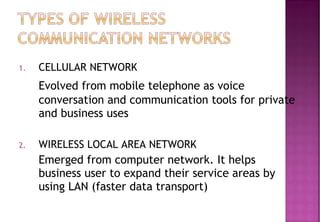
1. CELLULAR NETWORK
Evolved from mobile telephone as voice
conversation and communication tools for private
and business uses
2. WIRELESS LOCAL AREA NETWORK
Emerged from computer network. It helps
business user to expand their service areas by
using LAN (faster data transport)
WIRELESS APPLICATION
Wireless applications are those which use
free space as the transmission medium
and do not involve cabling like fibre or
copper
WIRELESS SERVICES
1) Voice Data
2) Video and multimedia applications and services
 VHF, Microwave TV Transmission, Millimeter Wave Data
Transmission, Cellular Telephony Services, Wireless
Video Telephony and Video Conferencing, Wireless PBX,
Wireless Broadband Internet and Internet Access, HDTV,
Digital Audio Broadcasting (DAB) or Hi-Fi Sound,
Wireless Geo-Location Services, Wireless E-Mail, PCs
Interactive Applications using WPANs, WLANs & WMANs
networks
 Wireless solutions for business and
industry including: -
    - Department stores, and
warehouse.
    - Trucking and movement of goods
    - Car rental billing and tracking
 Wireless solutions for schools
    - In the classroom
    - Remote schools
    - Mobile access for students and student services
 Wireless solutions for people on the go
    - Real Estate Agents
    - Stock Brokers
    - Doctors
    - Service personnel
    - Airplane Pilots
 Wireless solutions for the home
    - Personal Area Networks for the home
    - Personal and home security
 Wireless solutions for police and emergency vehicles
    - Reducing respond time
    - Increasing efficiency
    - Health care services
    - E911 services
EVOLUTION FROM
1G TO 5G
SYSTEM
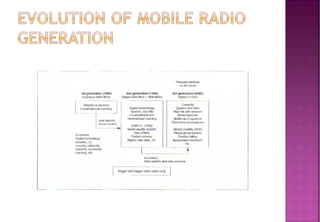
 Developed in 1980s and completed in early 1990’s
 1G was old analog system and supported the 1st
generation of analog cell phones speed up to 2.4kbps
 Advance mobile phone system (AMPS) was first launched
by the US and is a 1G mobile system
 Allows users to make voice calls in 1 country
 Fielded in the late 1980s and finished in the late 1990s
 Planned for voice transmission with digital signal and
the speeds up to 64kbps
 2G was the digital handsets that we are used today,
with 2.5G representing handsets with data capabilities
over GPRS
 Developed in the late 1990s until
present day
 Japan is the first country having
introduced 3G nationally, and in Japan
the transition to 3G is being largely
completed during 2005/2006
 Services include:
 Global roaming
 Superior voice quality and video conference
 Data always add–on services (e-mail, personal organizer, etc.)
 Information for web surfing, music, news, corporate intranet,
transportation service etc.
 Purchasing – on-line shopping / banking, ticketing, gambling,
games, etc.
 Transmission speeds from 125kbps to 2Mbps
 In 2005, 3G is ready to live up to its performance in
computer networking (WCDMA, WLAN and Bluetooth)
and mobile devices area (cell phone and GPS)
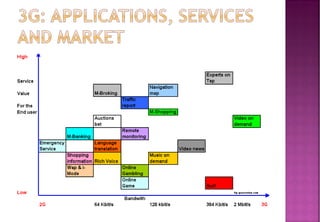
According to Nokia, 3G applications can be divided into:
 Wireless Advertising
 Mobile Information
 Business Solutions
 Mobile Transactions
 Mobile Entertainment
 Person-to-Person Communications
 Bearer Entrance and Periodics
 High input fees for the 3G service licenses
 Great differences in the licensing terms
 Current high debt of many telecommunication
companies, making it more of a challenge to build the
necessary infrastructure for 3G
 Health aspects of the effects of electromagnetic waves
 Expense and bulk of 3G phones
 Lack of 2G mobile user buy-in for 3G wireless service
 Lack of coverage because it is still new service
 High prices of 3G mobile services in some countries
 4G is a research item for next-generation wide-area
cellular radio, where you have 1G, 2G, 3G and then
4G [and 5G]
 4G is a conceptual framework and a discussion point
to address future needs of a high speed wireless
network
 It offer both cellular and broadband multimedia
services everywhere
 Expected to emerged around 2010 - 2015
 4G should be able to provided very smooth global
roaming ubiquitously with lower cost
 Theoretically, 4G is set to deliver 100mbps to a roaming
mobile device globally, and up to 1Gbps to a stationary
device. With this in mind, it allows for video
conferencing, streaming picture perfect video (i.e. tele-
medicine, tele-geo processing application etc.)
 4G will bring almost perfect real world wireless or
called “WWWW: World Wide Wireless Web
 5G is a completed wireless communication with almost
no limitation; somehow people called it REAL wireless
world
 5G wireless system is only theory and not real
COMPARISON BETWEEN 3G, 4G
AND 5G
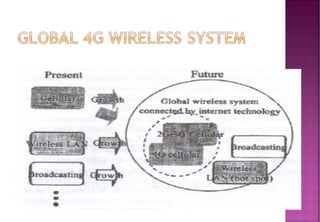
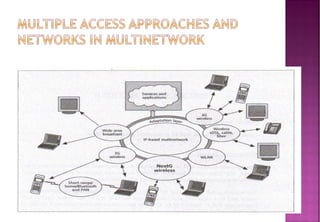
Wireless systems becoming an important
infrastructure in our society. A virtual
global system is a good solution that can
efficiently connect many dedicated
wireless systems including 2G to 4G
cellular systems, wireless LAN,
broadcasting systems, etc.
THANK YOU

Evolution from 3_g_to_4g_and_beyond_5g

  • 1.
  • 2.
     INTRODUCTION TOWIRELESS COMMUNICATION  TYPES OF WIRELESS COMMUNICATION NETWORKS  WIRELESS APPLICATIONS AND SERVICES  EVOLUTION FROM 1G TO 5G SYSTEM  COMPARISON BETWEEN 3G, 4G AND 5G  CONCLUSION
  • 3.
    Our ultimate goalis to communicate with any type of information with anyone, at anytime, from anywhere. This is possible with the aid of WIRELESS TECHNOLOGY
  • 4.
    1. CELLULAR NETWORK Evolvedfrom mobile telephone as voice conversation and communication tools for private and business uses 2. WIRELESS LOCAL AREA NETWORK Emerged from computer network. It helps business user to expand their service areas by using LAN (faster data transport)
  • 6.
    WIRELESS APPLICATION Wireless applicationsare those which use free space as the transmission medium and do not involve cabling like fibre or copper
  • 7.
    WIRELESS SERVICES 1) VoiceData 2) Video and multimedia applications and services  VHF, Microwave TV Transmission, Millimeter Wave Data Transmission, Cellular Telephony Services, Wireless Video Telephony and Video Conferencing, Wireless PBX, Wireless Broadband Internet and Internet Access, HDTV, Digital Audio Broadcasting (DAB) or Hi-Fi Sound, Wireless Geo-Location Services, Wireless E-Mail, PCs Interactive Applications using WPANs, WLANs & WMANs networks
  • 8.
     Wireless solutionsfor business and industry including: -     - Department stores, and warehouse.     - Trucking and movement of goods     - Car rental billing and tracking
  • 9.
     Wireless solutionsfor schools     - In the classroom     - Remote schools     - Mobile access for students and student services  Wireless solutions for people on the go     - Real Estate Agents     - Stock Brokers     - Doctors     - Service personnel     - Airplane Pilots
  • 10.
     Wireless solutionsfor the home     - Personal Area Networks for the home     - Personal and home security  Wireless solutions for police and emergency vehicles     - Reducing respond time     - Increasing efficiency     - Health care services     - E911 services
  • 11.
  • 12.
     Developed in1980s and completed in early 1990’s  1G was old analog system and supported the 1st generation of analog cell phones speed up to 2.4kbps  Advance mobile phone system (AMPS) was first launched by the US and is a 1G mobile system  Allows users to make voice calls in 1 country
  • 13.
     Fielded inthe late 1980s and finished in the late 1990s  Planned for voice transmission with digital signal and the speeds up to 64kbps  2G was the digital handsets that we are used today, with 2.5G representing handsets with data capabilities over GPRS
  • 14.
     Developed inthe late 1990s until present day  Japan is the first country having introduced 3G nationally, and in Japan the transition to 3G is being largely completed during 2005/2006
  • 15.
     Services include: Global roaming  Superior voice quality and video conference  Data always add–on services (e-mail, personal organizer, etc.)  Information for web surfing, music, news, corporate intranet, transportation service etc.  Purchasing – on-line shopping / banking, ticketing, gambling, games, etc.
  • 16.
     Transmission speedsfrom 125kbps to 2Mbps  In 2005, 3G is ready to live up to its performance in computer networking (WCDMA, WLAN and Bluetooth) and mobile devices area (cell phone and GPS)
  • 17.
    According to Nokia,3G applications can be divided into:  Wireless Advertising  Mobile Information  Business Solutions  Mobile Transactions  Mobile Entertainment  Person-to-Person Communications  Bearer Entrance and Periodics
  • 21.
     High inputfees for the 3G service licenses  Great differences in the licensing terms  Current high debt of many telecommunication companies, making it more of a challenge to build the necessary infrastructure for 3G  Health aspects of the effects of electromagnetic waves  Expense and bulk of 3G phones  Lack of 2G mobile user buy-in for 3G wireless service  Lack of coverage because it is still new service  High prices of 3G mobile services in some countries
  • 22.
     4G isa research item for next-generation wide-area cellular radio, where you have 1G, 2G, 3G and then 4G [and 5G]  4G is a conceptual framework and a discussion point to address future needs of a high speed wireless network  It offer both cellular and broadband multimedia services everywhere  Expected to emerged around 2010 - 2015
  • 23.
     4G shouldbe able to provided very smooth global roaming ubiquitously with lower cost  Theoretically, 4G is set to deliver 100mbps to a roaming mobile device globally, and up to 1Gbps to a stationary device. With this in mind, it allows for video conferencing, streaming picture perfect video (i.e. tele- medicine, tele-geo processing application etc.)  4G will bring almost perfect real world wireless or called “WWWW: World Wide Wireless Web
  • 25.
     5G isa completed wireless communication with almost no limitation; somehow people called it REAL wireless world  5G wireless system is only theory and not real
  • 28.
  • 29.
    Wireless systems becomingan important infrastructure in our society. A virtual global system is a good solution that can efficiently connect many dedicated wireless systems including 2G to 4G cellular systems, wireless LAN, broadcasting systems, etc.
  • 30.