5G WIRELESS TECHNOLOGY
NAME : PRAWEEN LAKRA
PURSUING : B.TECH CSE (CTIS)
AP GOYAL SHIMLA UNIVERSITY
CONTENTS
1. Introduction of Wireless Technology.
2. Evolution from 1G to 5G.
3. Vision of 5G Wireless Technology.
4. Hardware & Software for 5G.
5. Features of 5G.
6. Advantages of 5G.
7. Conclusion
8. References
INTRODUCTION OF WIRELESS TECHNOLOGY
• The word Wireless in dictionary defines as “Having no
Wires”.
• No physical wired connection between sender and
receiver, but rather the network is connected by radio
waves and or microwaves to maintain communication.
• Wireless networking utilizes specific equipment such
as NICs and Routers in place of wires (copper or
optical fiber).
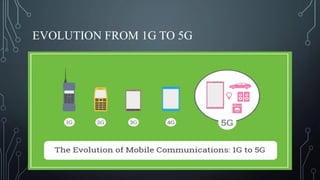
EVOLUTION FROM 1G TO 5G
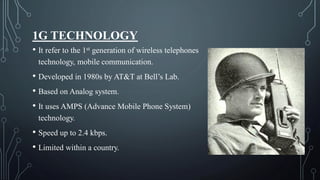
1G TECHNOLOGY
• It refer to the 1st generation of wireless telephones
technology, mobile communication.
• Developed in 1980s by AT&T at Bell’s Lab.
• Based on Analog system.
• It uses AMPS (Advance Mobile Phone System)
technology.
• Speed up to 2.4 kbps.
• Limited within a country.
2G TECHNOLOGY
• 2G technology refers to second generation wireless
technology which is based on GSM.
• Developed in late 1990s.
• Based on digital system.
• Speed up to 64 kbps.
• Semi-global facility.
• Services such as digital voice and SMS with more
clarity.
3G TECHNOLOGY
• 3G technology refers to third generation wireless
technology which was introduced in late 1990s and early
2000s.
• Data transmission speed from 125 kbps to 2 Mbps.
• Superior voice quality.
• Good clarity in video conference.
• Global roaming.
• Data are send though packet switching.
• Voices calls are interpreted using circuit switching.
4G TECHNOLOGY
• 4G refers to fourth generation of cellular wireless
technology.
• Developed in 2010.
• Speed up to 1Gbps.
• High quality of service and high security.
• High speed data access.
• Easy global roaming.
• Low cost.
5G TECHNOLOGY
• 5G technology refers to 5th generation of wireless
technology.
• It is implemented by 2020.
• Complete wireless communication with almost no
limitations.
• Next major phase of mobile telecommunication
and wireless system, i.e. highly supportable to
WWWW(WORLD WIDE WIRELESS WEB).
• Expected speed range 1Gbps and above.
VISION OF 5G WIRELESS TECHNOLOGY
• 5G envision to design a real wireless world, that is free from obstacles of the
earlier generations.
• IPv6, where a visiting care of mobile IP address is assigned according to
location & connected network.
• The user can simultaneously be connecter with several wireless access
technology.
• Multiple concurrent data transfer path.
• This requires an integration of networks.
• 5G aims to design a Multi-Bandwidth Data path by integrating the current
and future networks for new network architecture of 5G real wireless world.
HARDWARE & SOFTWARE FOR 5G
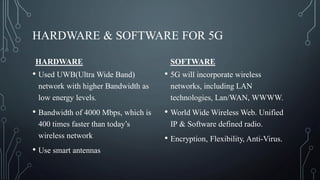
HARDWARE
• Used UWB(Ultra Wide Band)
network with higher Bandwidth as
low energy levels.
• Bandwidth of 4000 Mbps, which is
400 times faster than today’s
wireless network
• Use smart antennas
SOFTWARE
• 5G will incorporate wireless
networks, including LAN
technologies, Lan/WAN, WWWW.
• World Wide Wireless Web. Unified
IP & Software defined radio.
• Encryption, Flexibility, Anti-Virus.
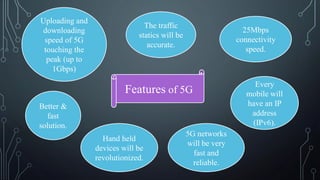
Features of 5G
The traffic
statics will be
accurate.
25Mbps
connectivity
speed.
Uploading and
downloading
speed of 5G
touching the
peak (up to
1Gbps)
Hand held
devices will be
revolutionized.
5G networks
will be very
fast and
reliable.
Every
mobile will
have an IP
address
(IPv6).
Better &
fast
solution.
ADVANTAGES OF 5G
• Data BW of 1Gbps or higher.
• Globally accessible.
• Dynamic information access.
• Worldwide cellular capabilities.
• High connectivity.
• Large phone memory, more dialing speed, more clarity in audio & video.
• Flexibility.
CONCLUSION
• 3G Operator centric, 4G Service centric where 5G user centric.
• The new coming 5G technology will be available in the market at
affordable rates, high peak future and much reliability than the
preceding technologies.
• 5G will bring evolution of active infra-sharing and managed
services and eventually all existing network operators will be
MVNO (Mobile virtual Network Operators)
• 5G technology is going to be new revolution in wireless system
market.
REFERENCES
• https://en.Wikipedg5gia.org/wiki/5G
• https://www.trustedereviews.com/options/what-is-5g-a-rough-guide-to-the-
next-generation-of-mobile-networks
• https://www.quore.com/1g-2g-3g-4g-5g-differnce
THANK YOU…

5 g wireless technology

  • 1.
    5G WIRELESS TECHNOLOGY NAME: PRAWEEN LAKRA PURSUING : B.TECH CSE (CTIS) AP GOYAL SHIMLA UNIVERSITY
  • 2.
    CONTENTS 1. Introduction ofWireless Technology. 2. Evolution from 1G to 5G. 3. Vision of 5G Wireless Technology. 4. Hardware & Software for 5G. 5. Features of 5G. 6. Advantages of 5G. 7. Conclusion 8. References
  • 3.
    INTRODUCTION OF WIRELESSTECHNOLOGY • The word Wireless in dictionary defines as “Having no Wires”. • No physical wired connection between sender and receiver, but rather the network is connected by radio waves and or microwaves to maintain communication. • Wireless networking utilizes specific equipment such as NICs and Routers in place of wires (copper or optical fiber).
  • 4.
  • 5.
    1G TECHNOLOGY • Itrefer to the 1st generation of wireless telephones technology, mobile communication. • Developed in 1980s by AT&T at Bell’s Lab. • Based on Analog system. • It uses AMPS (Advance Mobile Phone System) technology. • Speed up to 2.4 kbps. • Limited within a country.
  • 6.
    2G TECHNOLOGY • 2Gtechnology refers to second generation wireless technology which is based on GSM. • Developed in late 1990s. • Based on digital system. • Speed up to 64 kbps. • Semi-global facility. • Services such as digital voice and SMS with more clarity.
  • 7.
    3G TECHNOLOGY • 3Gtechnology refers to third generation wireless technology which was introduced in late 1990s and early 2000s. • Data transmission speed from 125 kbps to 2 Mbps. • Superior voice quality. • Good clarity in video conference. • Global roaming. • Data are send though packet switching. • Voices calls are interpreted using circuit switching.
  • 8.
    4G TECHNOLOGY • 4Grefers to fourth generation of cellular wireless technology. • Developed in 2010. • Speed up to 1Gbps. • High quality of service and high security. • High speed data access. • Easy global roaming. • Low cost.
  • 9.
    5G TECHNOLOGY • 5Gtechnology refers to 5th generation of wireless technology. • It is implemented by 2020. • Complete wireless communication with almost no limitations. • Next major phase of mobile telecommunication and wireless system, i.e. highly supportable to WWWW(WORLD WIDE WIRELESS WEB). • Expected speed range 1Gbps and above.
  • 10.
    VISION OF 5GWIRELESS TECHNOLOGY • 5G envision to design a real wireless world, that is free from obstacles of the earlier generations. • IPv6, where a visiting care of mobile IP address is assigned according to location & connected network. • The user can simultaneously be connecter with several wireless access technology. • Multiple concurrent data transfer path. • This requires an integration of networks. • 5G aims to design a Multi-Bandwidth Data path by integrating the current and future networks for new network architecture of 5G real wireless world.
  • 11.
    HARDWARE & SOFTWAREFOR 5G HARDWARE • Used UWB(Ultra Wide Band) network with higher Bandwidth as low energy levels. • Bandwidth of 4000 Mbps, which is 400 times faster than today’s wireless network • Use smart antennas SOFTWARE • 5G will incorporate wireless networks, including LAN technologies, Lan/WAN, WWWW. • World Wide Wireless Web. Unified IP & Software defined radio. • Encryption, Flexibility, Anti-Virus.
  • 12.
    Features of 5G Thetraffic statics will be accurate. 25Mbps connectivity speed. Uploading and downloading speed of 5G touching the peak (up to 1Gbps) Hand held devices will be revolutionized. 5G networks will be very fast and reliable. Every mobile will have an IP address (IPv6). Better & fast solution.
  • 13.
    ADVANTAGES OF 5G •Data BW of 1Gbps or higher. • Globally accessible. • Dynamic information access. • Worldwide cellular capabilities. • High connectivity. • Large phone memory, more dialing speed, more clarity in audio & video. • Flexibility.
  • 14.
    CONCLUSION • 3G Operatorcentric, 4G Service centric where 5G user centric. • The new coming 5G technology will be available in the market at affordable rates, high peak future and much reliability than the preceding technologies. • 5G will bring evolution of active infra-sharing and managed services and eventually all existing network operators will be MVNO (Mobile virtual Network Operators) • 5G technology is going to be new revolution in wireless system market.
  • 15.
  • 16.