
By
Dr. Diptansu Bhusan Pati,
(M.A, Ph.D in Education)
Assessment, Measurement,
Evaluation & Examination
Introduction
• Evaluation in its broader concept includes examination of
academic and non-academic components of education. In
assessment you focus on performance of a student in
academic subjects only but in evaluation it is included all
the changes that take place in a student's total personality;
• Evaluation helps you in a number of ways. It is a continuous
process of appraisal of the achievement of aims of
education as well as to bring about continuous
improvement for making education more meaningful and
effective.
• It guides both the student and the teacher in the selection
of learning experience and placement of the student in
special groups. The results of evaluation procedures are
helpful in reporting student's progress to parents.
Define Assessment
• The term 'assessment' usually refers to the process of allotting
a quantitative value to students‘ achievements.
• All types of achievements cannot be assessed by only a single
method.
• Several tools are used to assess different kinds of achievement
which are technically called 'tools of assessment'.
• For the purpose of assessing achievements, objectives are
classified in two categories: (i) content objectives, and (ii)
instructional objectives.
• Content objectives should specify the course content to be
covered in the class. The instructional objectives specify the
level and type of objectives, viz., knowledge, understanding,
application, analysis, synthesis, etc. Instructional objectives are
to be achieved would be fulfilled on successful learning and
completion of course content.
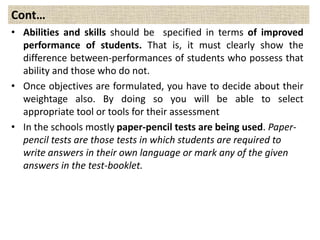
Cont…
• Abilities and skills should be specified in terms of improved
performance of students. That is, it must clearly show the
difference between-performances of students who possess that
ability and those who do not.
• Once objectives are formulated, you have to decide about their
weightage also. By doing so you will be able to select
appropriate tool or tools for their assessment
• In the schools mostly paper-pencil tests are being used. Paper-
pencil tests are those tests in which students are required to
write answers in their own language or mark any of the given
answers in the test-booklet.
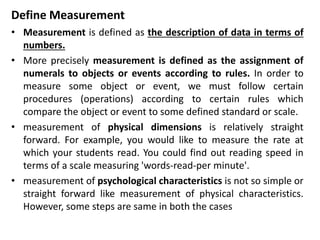
Define Measurement
• Measurement is defined as the description of data in terms of
numbers.
• More precisely measurement is defined as the assignment of
numerals to objects or events according to rules. In order to
measure some object or event, we must follow certain
procedures (operations) according to certain rules which
compare the object or event to some defined standard or scale.
• measurement of physical dimensions is relatively straight
forward. For example, you would like to measure the rate at
which your students read. You could find out reading speed in
terms of a scale measuring 'words-read-per minute'.
• measurement of psychological characteristics is not so simple or
straight forward like measurement of physical characteristics.
However, some steps are same in both the cases
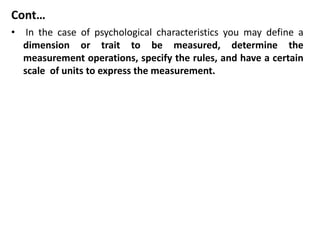
Cont…
• In the case of psychological characteristics you may define a
dimension or trait to be measured, determine the
measurement operations, specify the rules, and have a certain
scale of units to express the measurement.
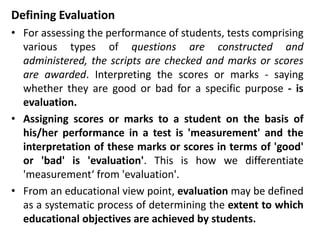
Defining Evaluation
• For assessing the performance of students, tests comprising
various types of questions are constructed and
administered, the scripts are checked and marks or scores
are awarded. Interpreting the scores or marks - saying
whether they are good or bad for a specific purpose - is
evaluation.
• Assigning scores or marks to a student on the basis of
his/her performance in a test is 'measurement' and the
interpretation of these marks or scores in terms of 'good'
or 'bad' is 'evaluation'. This is how we differentiate
'measurement‘ from 'evaluation'.
• From an educational view point, evaluation may be defined
as a systematic process of determining the extent to which
educational objectives are achieved by students.
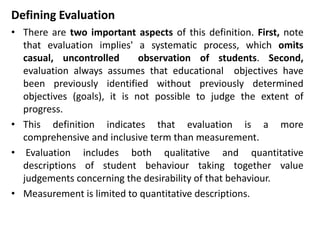
Defining Evaluation
• There are two important aspects of this definition. First, note
that evaluation implies' a systematic process, which omits
casual, uncontrolled observation of students. Second,
evaluation always assumes that educational objectives have
been previously identified without previously determined
objectives (goals), it is not possible to judge the extent of
progress.
• This definition indicates that evaluation is a more
comprehensive and inclusive term than measurement.
• Evaluation includes both qualitative and quantitative
descriptions of student behaviour taking together value
judgements concerning the desirability of that behaviour.
• Measurement is limited to quantitative descriptions.
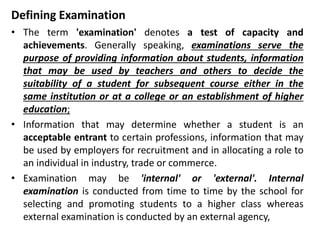
Defining Examination
• The term 'examination' denotes a test of capacity and
achievements. Generally speaking, examinations serve the
purpose of providing information about students, information
that may be used by teachers and others to decide the
suitability of a student for subsequent course either in the
same institution or at a college or an establishment of higher
education;
• Information that may determine whether a student is an
acceptable entrant to certain professions, information that may
be used by employers for recruitment and in allocating a role to
an individual in industry, trade or commerce.
• Examination may be 'internal' or 'external'. Internal
examination is conducted from time to time by the school for
selecting and promoting students to a higher class whereas
external examination is conducted by an external agency,
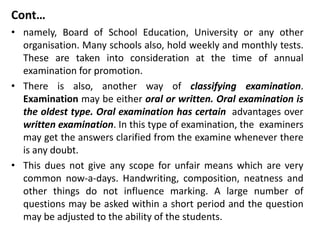
Cont…
• namely, Board of School Education, University or any other
organisation. Many schools also, hold weekly and monthly tests.
These are taken into consideration at the time of annual
examination for promotion.
• There is also, another way of classifying examination.
Examination may be either oral or written. Oral examination is
the oldest type. Oral examination has certain advantages over
written examination. In this type of examination, the examiners
may get the answers clarified from the examine whenever there
is any doubt.
• This dues not give any scope for unfair means which are very
common now-a-days. Handwriting, composition, neatness and
other things do not influence marking. A large number of
questions may be asked within a short period and the question
may be adjusted to the ability of the students.
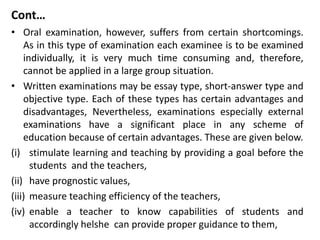
Cont…
• Oral examination, however, suffers from certain shortcomings.
As in this type of examination each examinee is to be examined
individually, it is very much time consuming and, therefore,
cannot be applied in a large group situation.
• Written examinations may be essay type, short-answer type and
objective type. Each of these types has certain advantages and
disadvantages, Nevertheless, examinations especially external
examinations have a significant place in any scheme of
education because of certain advantages. These are given below.
(i) stimulate learning and teaching by providing a goal before the
students and the teachers,
(ii) have prognostic values,
(iii) measure teaching efficiency of the teachers,
(iv) enable a teacher to know capabilities of students and
accordingly helshe can provide proper guidance to them,
Cont…
(v) help in the selection of candidates for different jobs and for
admission to different institutions,
(vi) help a school to compare its performance with other schools,
(vii) provide a common standard which is universal and uniform in
character,
(viii) especially the essay type once, train the students in critical
thinking and in the systematic expression of thought.
Thank You

Assessment and evaluation

  • 1.
    By Dr. Diptansu BhusanPati, (M.A, Ph.D in Education) Assessment, Measurement, Evaluation & Examination
  • 2.
    Introduction • Evaluation inits broader concept includes examination of academic and non-academic components of education. In assessment you focus on performance of a student in academic subjects only but in evaluation it is included all the changes that take place in a student's total personality; • Evaluation helps you in a number of ways. It is a continuous process of appraisal of the achievement of aims of education as well as to bring about continuous improvement for making education more meaningful and effective. • It guides both the student and the teacher in the selection of learning experience and placement of the student in special groups. The results of evaluation procedures are helpful in reporting student's progress to parents.
  • 3.
    Define Assessment • Theterm 'assessment' usually refers to the process of allotting a quantitative value to students‘ achievements. • All types of achievements cannot be assessed by only a single method. • Several tools are used to assess different kinds of achievement which are technically called 'tools of assessment'. • For the purpose of assessing achievements, objectives are classified in two categories: (i) content objectives, and (ii) instructional objectives. • Content objectives should specify the course content to be covered in the class. The instructional objectives specify the level and type of objectives, viz., knowledge, understanding, application, analysis, synthesis, etc. Instructional objectives are to be achieved would be fulfilled on successful learning and completion of course content.
  • 4.
    Cont… • Abilities andskills should be specified in terms of improved performance of students. That is, it must clearly show the difference between-performances of students who possess that ability and those who do not. • Once objectives are formulated, you have to decide about their weightage also. By doing so you will be able to select appropriate tool or tools for their assessment • In the schools mostly paper-pencil tests are being used. Paper- pencil tests are those tests in which students are required to write answers in their own language or mark any of the given answers in the test-booklet.
  • 5.
    Define Measurement • Measurementis defined as the description of data in terms of numbers. • More precisely measurement is defined as the assignment of numerals to objects or events according to rules. In order to measure some object or event, we must follow certain procedures (operations) according to certain rules which compare the object or event to some defined standard or scale. • measurement of physical dimensions is relatively straight forward. For example, you would like to measure the rate at which your students read. You could find out reading speed in terms of a scale measuring 'words-read-per minute'. • measurement of psychological characteristics is not so simple or straight forward like measurement of physical characteristics. However, some steps are same in both the cases
  • 6.
    Cont… • In thecase of psychological characteristics you may define a dimension or trait to be measured, determine the measurement operations, specify the rules, and have a certain scale of units to express the measurement.
  • 7.
    Defining Evaluation • Forassessing the performance of students, tests comprising various types of questions are constructed and administered, the scripts are checked and marks or scores are awarded. Interpreting the scores or marks - saying whether they are good or bad for a specific purpose - is evaluation. • Assigning scores or marks to a student on the basis of his/her performance in a test is 'measurement' and the interpretation of these marks or scores in terms of 'good' or 'bad' is 'evaluation'. This is how we differentiate 'measurement‘ from 'evaluation'. • From an educational view point, evaluation may be defined as a systematic process of determining the extent to which educational objectives are achieved by students.
  • 8.
    Defining Evaluation • Thereare two important aspects of this definition. First, note that evaluation implies' a systematic process, which omits casual, uncontrolled observation of students. Second, evaluation always assumes that educational objectives have been previously identified without previously determined objectives (goals), it is not possible to judge the extent of progress. • This definition indicates that evaluation is a more comprehensive and inclusive term than measurement. • Evaluation includes both qualitative and quantitative descriptions of student behaviour taking together value judgements concerning the desirability of that behaviour. • Measurement is limited to quantitative descriptions.
  • 9.
    Defining Examination • Theterm 'examination' denotes a test of capacity and achievements. Generally speaking, examinations serve the purpose of providing information about students, information that may be used by teachers and others to decide the suitability of a student for subsequent course either in the same institution or at a college or an establishment of higher education; • Information that may determine whether a student is an acceptable entrant to certain professions, information that may be used by employers for recruitment and in allocating a role to an individual in industry, trade or commerce. • Examination may be 'internal' or 'external'. Internal examination is conducted from time to time by the school for selecting and promoting students to a higher class whereas external examination is conducted by an external agency,
  • 10.
    Cont… • namely, Boardof School Education, University or any other organisation. Many schools also, hold weekly and monthly tests. These are taken into consideration at the time of annual examination for promotion. • There is also, another way of classifying examination. Examination may be either oral or written. Oral examination is the oldest type. Oral examination has certain advantages over written examination. In this type of examination, the examiners may get the answers clarified from the examine whenever there is any doubt. • This dues not give any scope for unfair means which are very common now-a-days. Handwriting, composition, neatness and other things do not influence marking. A large number of questions may be asked within a short period and the question may be adjusted to the ability of the students.
  • 11.
    Cont… • Oral examination,however, suffers from certain shortcomings. As in this type of examination each examinee is to be examined individually, it is very much time consuming and, therefore, cannot be applied in a large group situation. • Written examinations may be essay type, short-answer type and objective type. Each of these types has certain advantages and disadvantages, Nevertheless, examinations especially external examinations have a significant place in any scheme of education because of certain advantages. These are given below. (i) stimulate learning and teaching by providing a goal before the students and the teachers, (ii) have prognostic values, (iii) measure teaching efficiency of the teachers, (iv) enable a teacher to know capabilities of students and accordingly helshe can provide proper guidance to them,
  • 12.
    Cont… (v) help inthe selection of candidates for different jobs and for admission to different institutions, (vi) help a school to compare its performance with other schools, (vii) provide a common standard which is universal and uniform in character, (viii) especially the essay type once, train the students in critical thinking and in the systematic expression of thought.
  • 13.