Branches of Philosophy
Reality, Knowledgeand Value
DR.V.S.SUMI
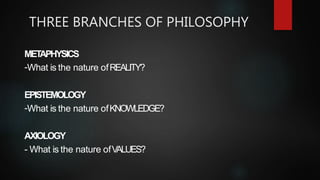
THREE BRANCHES OF PHILOSOPHY
METAPHYSICS
-What is the nature ofREALITY?
EPISTEMOLOGY
-What is the nature ofKNOWLEDGE?
AXIOLOGY
- What is the nature ofV
ALUES?
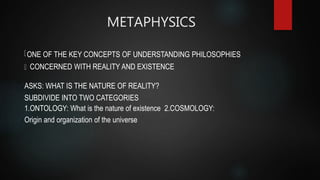
METAPHYSICS
ONE OF THE KEY CONCEPTS OF UNDERSTANDING PHILOSOPHIES
CONCERNED WITH REALITY AND EXISTENCE
ASKS: WHAT IS THE NATURE OF REALITY?
SUBDIVIDE INTO TWO CATEGORIES
1.ONTOLOGY: What is the nature of existence 2.COSMOLOGY:
Origin and organization of the universe
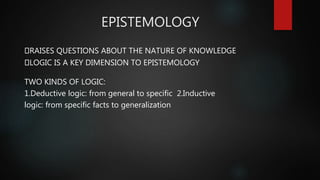
EPISTEMOLOGY
RAISES QUESTIONS ABOUT THE NATURE OF KNOWLEDGE
LOGIC IS A KEY DIMENSION TO EPISTEMOLOGY
TWO KINDS OF LOGIC:
1.Deductive logic: from general to specific 2.Inductive
logic: from specific facts to generalization
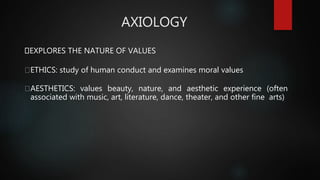
AXIOLOGY
EXPLORES THE NATURE OF VALUES
ETHICS: study of human conduct and examines moral values
AESTHETICS: values beauty, nature, and aesthetic experience (often
associated with music, art, literature, dance, theater, and other fine arts)
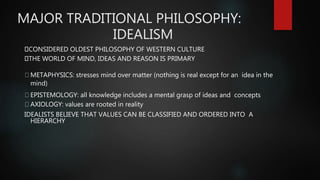
MAJOR TRADITIONAL PHILOSOPHY:
IDEALISM
CONSIDERED OLDEST PHILOSOPHY OF WESTERN CULTURE
THE WORLD OF MIND, IDEAS AND REASON IS PRIMARY
METAPHYSICS: stresses mind over matter (nothing is real except for an idea in the
mind)
EPISTEMOLOGY: all knowledge includes a mental grasp of ideas and concepts
AXIOLOGY: values are rooted in reality
IDEALISTS BELIEVE THAT VALUES CAN BE CLASSIFIED AND ORDERED INTO A
HIERARCHY
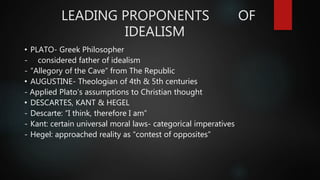
LEADING PROPONENTS OF
IDEALISM
• PLATO- Greek Philosopher
- considered father of idealism
- ”Allegory of the Cave” from The Republic
• AUGUSTINE- Theologian of 4th & 5th centuries
- Applied Plato’s assumptions to Christian thought
• DESCARTES, KANT & HEGEL
- Descarte: “I think, therefore I am”
- Kant: certain universal moral laws- categorical imperatives
- Hegel: approached reality as “contest of opposites”
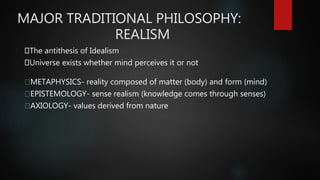
MAJOR TRADITIONAL PHILOSOPHY:
REALISM
The antithesis of Idealism
Universe exists whether mind perceives it or not
METAPHYSICS- reality composed of matter (body) and form (mind)
EPISTEMOLOGY- sense realism (knowledge comes through senses)
AXIOLOGY- values derived from nature
LEADING PROPONENTS OF REALISM
• ARISTOTLE- father of realism
-student of Plato
-argued that knowledge can be acquired through senses
• FRANCIS BACON
-advanced a rigorous form of inductive reason
• JOHN LOCKE
-theory of tabula rasa (no such thing as innate ideas)
• COMENIUS, ROUSSEAU, and PESTALOZZI
MAJOR TRADITIONAL PHILOSOPHY:
NEO-THOMISM
• Datesto the time ofThomasAquinas (1225-1274)
• Alsoknown astheistic realism
“God exists and canbe known through faith andreason”
Metaphysics- Godgivesmeaning to universe
Epistemology- hierarchy of knowingGod
Axiology- unchanging moral laws
CONTEMPORARY PHILOSOPHIES:
PRAGMATISM
Also known as experimentalism- experience or things that work
Philosophy of 20th century developed by John Dewey
Metaphysics- regard reality as an event or process. Meaning is
derived from experience in environment.
Epistemology- truth is not absolute but determined by consequences.
Arrived at by inquiry, testing, questioning, retesting, ect.
Axiology- primarily focused on values. Determined by own
experiences
LEADING PROPONENTS OF
PRAGMATISM
• AUGUSTE COMTE
-suggested science could solve social problems
-problem solving was key
CHARLES DARWIN
-theory of natural selection implied reality was open ended, not fixed
AMERICANS: Charles Pierce, William James and John Dewey
CONTEMPORARY PHILOSOPHIES:
EXISTENTIALISM
Appeared as a revolt against the mathematical, scientific
philosophies that preceded it.
Focus on personal and subjective existence
Metaphysics- no purpose or meaning to universe. No world order or
natural scheme of things
Epistemology- we come to know truth by choice. The authority is
found in self.
Axiology- choice to determine value.
LEADING PROPONENTS OF
EXISTENTIALISM
• SOREN KIERKEGAARD
-Danish philosopher/theologian
-Father of Existentialism
-Rejected scientific objectivity for subjectivity and choice
• MARTIN BUBER
-Jewish philosopher/theologian
-”I/Thou” relationship- divine and human are related
• HUSSERL and HEIDEGGER
• JEAN-PAUL SARTRE
-We construct our own existence
ANALYTIC PHILOSOPHY
Sought out to clarify, and define philosophies
Began in post WWI era- Vienna Circle
Studied the alienation between philosophy and science
Established the concept of logical positivism: there are logical and empirical types
of scientific expression
Shifted to Analytic philosophy in 1950’s
Analytic philosophy has recently focused on political philosophy, ethics and
philosophy of human sciences

Branchesofphilosophy

  • 1.
    Branches of Philosophy Reality,Knowledgeand Value DR.V.S.SUMI
  • 2.
    THREE BRANCHES OFPHILOSOPHY METAPHYSICS -What is the nature ofREALITY? EPISTEMOLOGY -What is the nature ofKNOWLEDGE? AXIOLOGY - What is the nature ofV ALUES?
  • 3.
    METAPHYSICS ONE OF THEKEY CONCEPTS OF UNDERSTANDING PHILOSOPHIES CONCERNED WITH REALITY AND EXISTENCE ASKS: WHAT IS THE NATURE OF REALITY? SUBDIVIDE INTO TWO CATEGORIES 1.ONTOLOGY: What is the nature of existence 2.COSMOLOGY: Origin and organization of the universe
  • 4.
    EPISTEMOLOGY RAISES QUESTIONS ABOUTTHE NATURE OF KNOWLEDGE LOGIC IS A KEY DIMENSION TO EPISTEMOLOGY TWO KINDS OF LOGIC: 1.Deductive logic: from general to specific 2.Inductive logic: from specific facts to generalization
  • 5.
    AXIOLOGY EXPLORES THE NATUREOF VALUES ETHICS: study of human conduct and examines moral values AESTHETICS: values beauty, nature, and aesthetic experience (often associated with music, art, literature, dance, theater, and other fine arts)
  • 6.
    MAJOR TRADITIONAL PHILOSOPHY: IDEALISM CONSIDEREDOLDEST PHILOSOPHY OF WESTERN CULTURE THE WORLD OF MIND, IDEAS AND REASON IS PRIMARY METAPHYSICS: stresses mind over matter (nothing is real except for an idea in the mind) EPISTEMOLOGY: all knowledge includes a mental grasp of ideas and concepts AXIOLOGY: values are rooted in reality IDEALISTS BELIEVE THAT VALUES CAN BE CLASSIFIED AND ORDERED INTO A HIERARCHY
  • 7.
    LEADING PROPONENTS OF IDEALISM •PLATO- Greek Philosopher - considered father of idealism - ”Allegory of the Cave” from The Republic • AUGUSTINE- Theologian of 4th & 5th centuries - Applied Plato’s assumptions to Christian thought • DESCARTES, KANT & HEGEL - Descarte: “I think, therefore I am” - Kant: certain universal moral laws- categorical imperatives - Hegel: approached reality as “contest of opposites”
  • 8.
    MAJOR TRADITIONAL PHILOSOPHY: REALISM Theantithesis of Idealism Universe exists whether mind perceives it or not METAPHYSICS- reality composed of matter (body) and form (mind) EPISTEMOLOGY- sense realism (knowledge comes through senses) AXIOLOGY- values derived from nature
  • 9.
    LEADING PROPONENTS OFREALISM • ARISTOTLE- father of realism -student of Plato -argued that knowledge can be acquired through senses • FRANCIS BACON -advanced a rigorous form of inductive reason • JOHN LOCKE -theory of tabula rasa (no such thing as innate ideas) • COMENIUS, ROUSSEAU, and PESTALOZZI
  • 10.
    MAJOR TRADITIONAL PHILOSOPHY: NEO-THOMISM •Datesto the time ofThomasAquinas (1225-1274) • Alsoknown astheistic realism “God exists and canbe known through faith andreason” Metaphysics- Godgivesmeaning to universe Epistemology- hierarchy of knowingGod Axiology- unchanging moral laws
  • 11.
    CONTEMPORARY PHILOSOPHIES: PRAGMATISM Also knownas experimentalism- experience or things that work Philosophy of 20th century developed by John Dewey Metaphysics- regard reality as an event or process. Meaning is derived from experience in environment. Epistemology- truth is not absolute but determined by consequences. Arrived at by inquiry, testing, questioning, retesting, ect. Axiology- primarily focused on values. Determined by own experiences
  • 12.
    LEADING PROPONENTS OF PRAGMATISM •AUGUSTE COMTE -suggested science could solve social problems -problem solving was key CHARLES DARWIN -theory of natural selection implied reality was open ended, not fixed AMERICANS: Charles Pierce, William James and John Dewey
  • 13.
    CONTEMPORARY PHILOSOPHIES: EXISTENTIALISM Appeared asa revolt against the mathematical, scientific philosophies that preceded it. Focus on personal and subjective existence Metaphysics- no purpose or meaning to universe. No world order or natural scheme of things Epistemology- we come to know truth by choice. The authority is found in self. Axiology- choice to determine value.
  • 14.
    LEADING PROPONENTS OF EXISTENTIALISM •SOREN KIERKEGAARD -Danish philosopher/theologian -Father of Existentialism -Rejected scientific objectivity for subjectivity and choice • MARTIN BUBER -Jewish philosopher/theologian -”I/Thou” relationship- divine and human are related • HUSSERL and HEIDEGGER • JEAN-PAUL SARTRE -We construct our own existence
  • 15.
    ANALYTIC PHILOSOPHY Sought outto clarify, and define philosophies Began in post WWI era- Vienna Circle Studied the alienation between philosophy and science Established the concept of logical positivism: there are logical and empirical types of scientific expression Shifted to Analytic philosophy in 1950’s Analytic philosophy has recently focused on political philosophy, ethics and philosophy of human sciences