RUBRICS: Developing and
Using Rubrics in
Assessing Students’
Learning
MIGUEL ANGELO ROSALES
WHAT IS A RUBRIC?


It also articulates gradations of quality for each
criterion, from excellent to poor.
 Goodrich 1997
WHAT IS A RUBRIC?
A

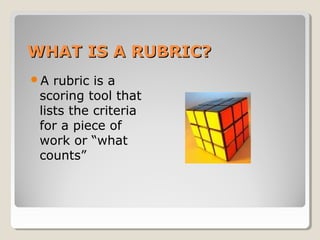
rubric is a
scoring tool that
lists the criteria
for a piece of
work or “what
counts”
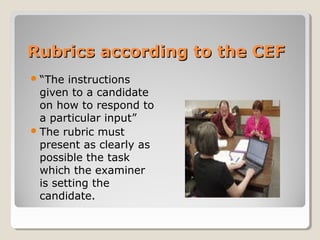
Rubrics according to the CEF
 “The

instructions
given to a candidate
on how to respond to
a particular input”
 The rubric must
present as clearly as
possible the task
which the examiner
is setting the
candidate.
Differences between Rubrics
and checklists
Rubrics

scales.

are rating

Checklists

are

used with
performance
assessment.
Why use rubrics?
Rubrics:
 are powerful tools for
 can improve students

monitor it,
 Help define “quality”,

teaching and assessment,
perfomance as well as
Why use rubrics?



Help students become more thoughtful judges of the quality of their
own and others’ work (peer assessment),



Reduce the amount of time teachers spend evaluating student work,



Teachers appreciate rubrics because their “accordion” nature allows
them to accommodate heterigeneous classes.
Re-examine the learning
objectives to be addressed
by the task.
 Identify specific observable
attributes that you want to
see (as well as those you
don’t want to see) your
students demonstrate in
their product, process, or
performance.
 Brainstorm characteristics
that describe each attribute.
 For holistic rubrics, write
thorough narrative
descriptions for excellent
work and poor work
incorporating each attribute
into the description.











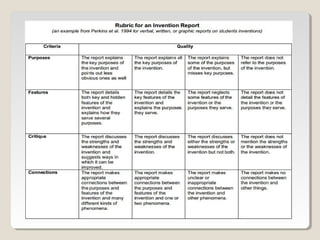
For analytic rubrics, write
thorough narrative descriptions
for excellent work and poor work
for each individual attribute.
For holistic rubrics, complete the
rubric by describing other levels
on the continuum that ranges
from excellent to poor work for
the collective attributes.
For analytic rubrics, complete
the rubric by describing other
levels on the continuum that
ranges from excellent to poor
work for each attribute.
Collect samples of student work
that exemplify each level.
Revise the rubric, as necessary.

Steps in designing of scoring
rubric
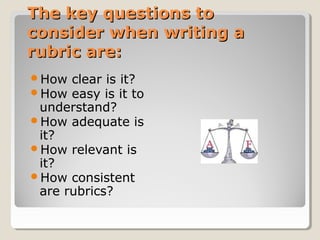
The key questions to
consider when writing a
rubric are:
How
How

clear is it?
easy is it to
understand?
How adequate is
it?
How relevant is
it?
How consistent
are rubrics?
Designing an instructional rubrics takes
time. Needing a rubric tomorrow, you’re
likely to sit down and try to come up with
one. This might if you have vast
experience with rubric design.

How to Make an Instructional
Rubric
Look at models-Review examples of good
and poor work on a project like the one
your students are about to undertake. For
example, if they’re going to give an oral
presentation, show them an excellent
presentation-perhaps a televised speechflawed presentation perhaps a videotaped
speech from one of last year students.
List Criteria-Tell students that you’re going
to ask them to do similar project and you
want to think together about how you
should assess it. Students will draw on the
list generated during discussion of the
models.
Pack and Unpack criteria-You are likely yo
end up with a long list of criteria, many of
which may relate to one another or even
overlap. after class rate time to combine
criteria. Avoid creating categories that are
too big, don’t bury criteria that
Drawing again on students comments
during the discussion of good poor
models, sketch out four levels of quality
for each criterion.
Level 4 – “Yes, Briefly summarized the Plot”
Level 3 – “Yes, I summarized the plot, it I
also included some unnecessary details or
left out key information.
Level 2 “No I didn’t summarize the plot, But
I did include some details from the past.
Level 1 “No, I didn’t summarize the plot”
Create a draft rubric-After class, draft a
rubric that includes the list of criteria that
you generated with your class and expand
on that levels of quality.
Revise the draft-Show the draft to your
students and ask their comments. They
will probably ask you to make a few
revisions. After revision, the rubric is
ready to use. Hand it out with the
assignment and have sdtudents to use it
when assessing their own and their peers
first and second drafts. It’s Important that
you use the rubric assign grdes.

Rubrics final 1

  • 1.
    RUBRICS: Developing and UsingRubrics in Assessing Students’ Learning MIGUEL ANGELO ROSALES
  • 2.
    WHAT IS ARUBRIC?  It also articulates gradations of quality for each criterion, from excellent to poor.  Goodrich 1997
  • 3.
    WHAT IS ARUBRIC? A rubric is a scoring tool that lists the criteria for a piece of work or “what counts”
  • 4.
    Rubrics according tothe CEF  “The instructions given to a candidate on how to respond to a particular input”  The rubric must present as clearly as possible the task which the examiner is setting the candidate.
  • 5.
    Differences between Rubrics andchecklists Rubrics scales. are rating Checklists are used with performance assessment.
  • 6.
    Why use rubrics? Rubrics: are powerful tools for  can improve students monitor it,  Help define “quality”, teaching and assessment, perfomance as well as
  • 7.
    Why use rubrics?  Helpstudents become more thoughtful judges of the quality of their own and others’ work (peer assessment),  Reduce the amount of time teachers spend evaluating student work,  Teachers appreciate rubrics because their “accordion” nature allows them to accommodate heterigeneous classes.
  • 8.
    Re-examine the learning objectivesto be addressed by the task.  Identify specific observable attributes that you want to see (as well as those you don’t want to see) your students demonstrate in their product, process, or performance.  Brainstorm characteristics that describe each attribute.  For holistic rubrics, write thorough narrative descriptions for excellent work and poor work incorporating each attribute into the description.       For analytic rubrics, write thorough narrative descriptions for excellent work and poor work for each individual attribute. For holistic rubrics, complete the rubric by describing other levels on the continuum that ranges from excellent to poor work for the collective attributes. For analytic rubrics, complete the rubric by describing other levels on the continuum that ranges from excellent to poor work for each attribute. Collect samples of student work that exemplify each level. Revise the rubric, as necessary. Steps in designing of scoring rubric
  • 9.
    The key questionsto consider when writing a rubric are: How How clear is it? easy is it to understand? How adequate is it? How relevant is it? How consistent are rubrics?
  • 11.
    Designing an instructionalrubrics takes time. Needing a rubric tomorrow, you’re likely to sit down and try to come up with one. This might if you have vast experience with rubric design. How to Make an Instructional Rubric
  • 12.
    Look at models-Reviewexamples of good and poor work on a project like the one your students are about to undertake. For example, if they’re going to give an oral presentation, show them an excellent presentation-perhaps a televised speechflawed presentation perhaps a videotaped speech from one of last year students.
  • 13.
    List Criteria-Tell studentsthat you’re going to ask them to do similar project and you want to think together about how you should assess it. Students will draw on the list generated during discussion of the models.
  • 14.
    Pack and Unpackcriteria-You are likely yo end up with a long list of criteria, many of which may relate to one another or even overlap. after class rate time to combine criteria. Avoid creating categories that are too big, don’t bury criteria that
  • 15.
    Drawing again onstudents comments during the discussion of good poor models, sketch out four levels of quality for each criterion. Level 4 – “Yes, Briefly summarized the Plot” Level 3 – “Yes, I summarized the plot, it I also included some unnecessary details or left out key information. Level 2 “No I didn’t summarize the plot, But I did include some details from the past. Level 1 “No, I didn’t summarize the plot”
  • 16.
    Create a draftrubric-After class, draft a rubric that includes the list of criteria that you generated with your class and expand on that levels of quality.
  • 17.
    Revise the draft-Showthe draft to your students and ask their comments. They will probably ask you to make a few revisions. After revision, the rubric is ready to use. Hand it out with the assignment and have sdtudents to use it when assessing their own and their peers first and second drafts. It’s Important that you use the rubric assign grdes.