
RUBRICS
It is a scoring tool for subjective assessments. It is a set
of criteria and standards linked to learning objectives
that is used to assess a student's performance on papers,
projects, essays, and other assignments. Rubrics allow for
standardised evaluation according to specified criteria,
making grading simpler and more transparent.
(Wikipedia.org)
It is a scoring guide that seeks to evaluate a student's
performance based on the sum of a full range of criteria
rather than a single numerical score.


A rubric is a working guide for students and teachers,
usually handed out before the assignment begins in
order to get students to think about the criteria on
which their work will be judged.

Rubrics can be analytic or holistic, and they can be
created for any content area including math, science,
history, writing, foreign languages, drama, art, music,
etc...
A rubric is an explicit set of criteria used for
assessing a particular type of work or
performance.


Usually, it also includes levels of potential
achievement for each criterion, and sometimes also
includes work or performance samples that typify
each of those levels.
It is a guide that gives direction to the scoring of
student products and other authentic evaluation.


It is helpful in assessing products such as open-ended
questions, laboratory experiments, debates, oral
presentations, visual presentations, and written
works.
3 COMMON FEATURES
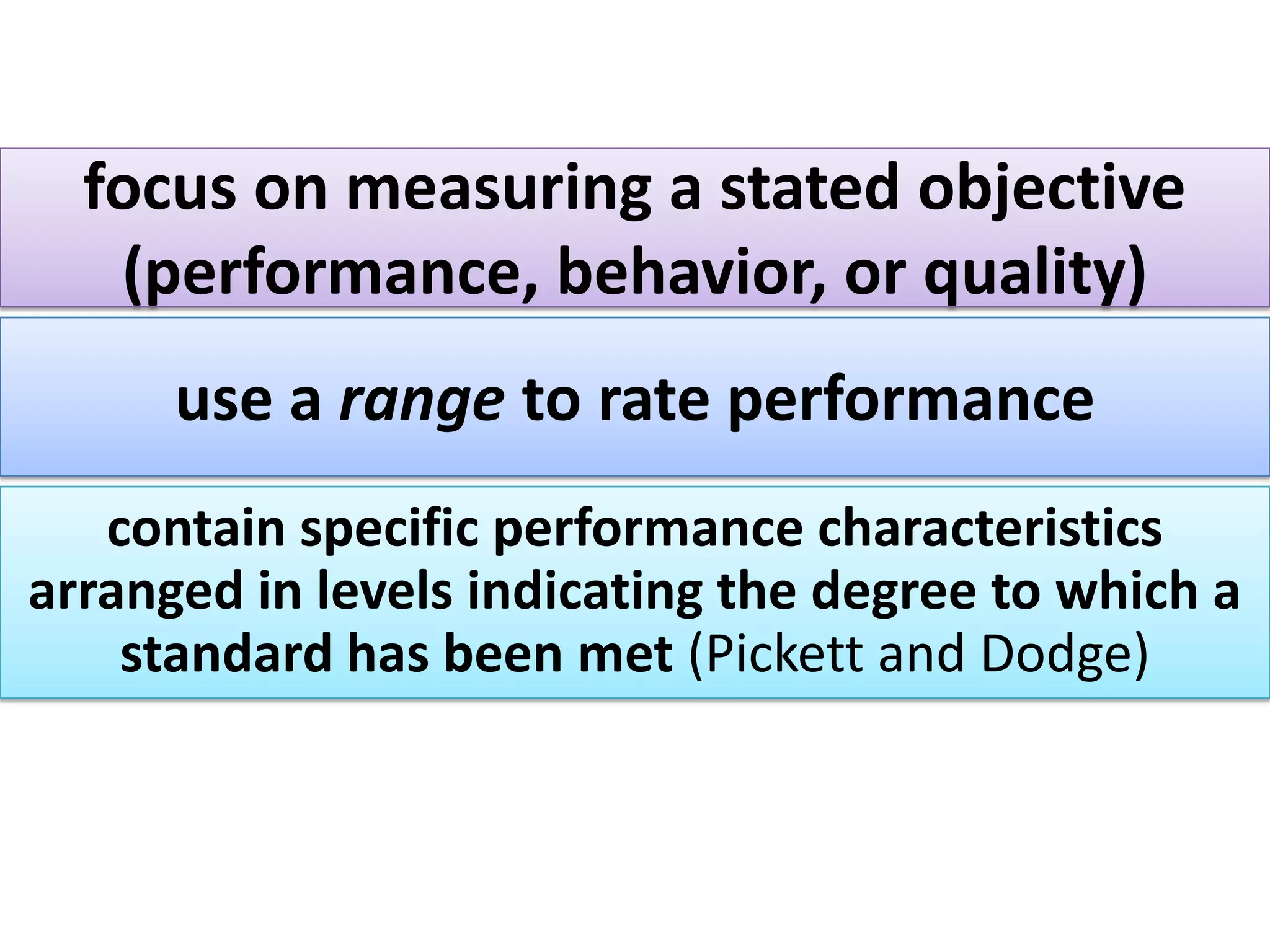
focus on measuring a stated objective
   (performance, behavior, or quality)
      use a range to rate performance
   contain specific performance characteristics
arranged in levels indicating the degree to which a
    standard has been met (Pickett and Dodge)
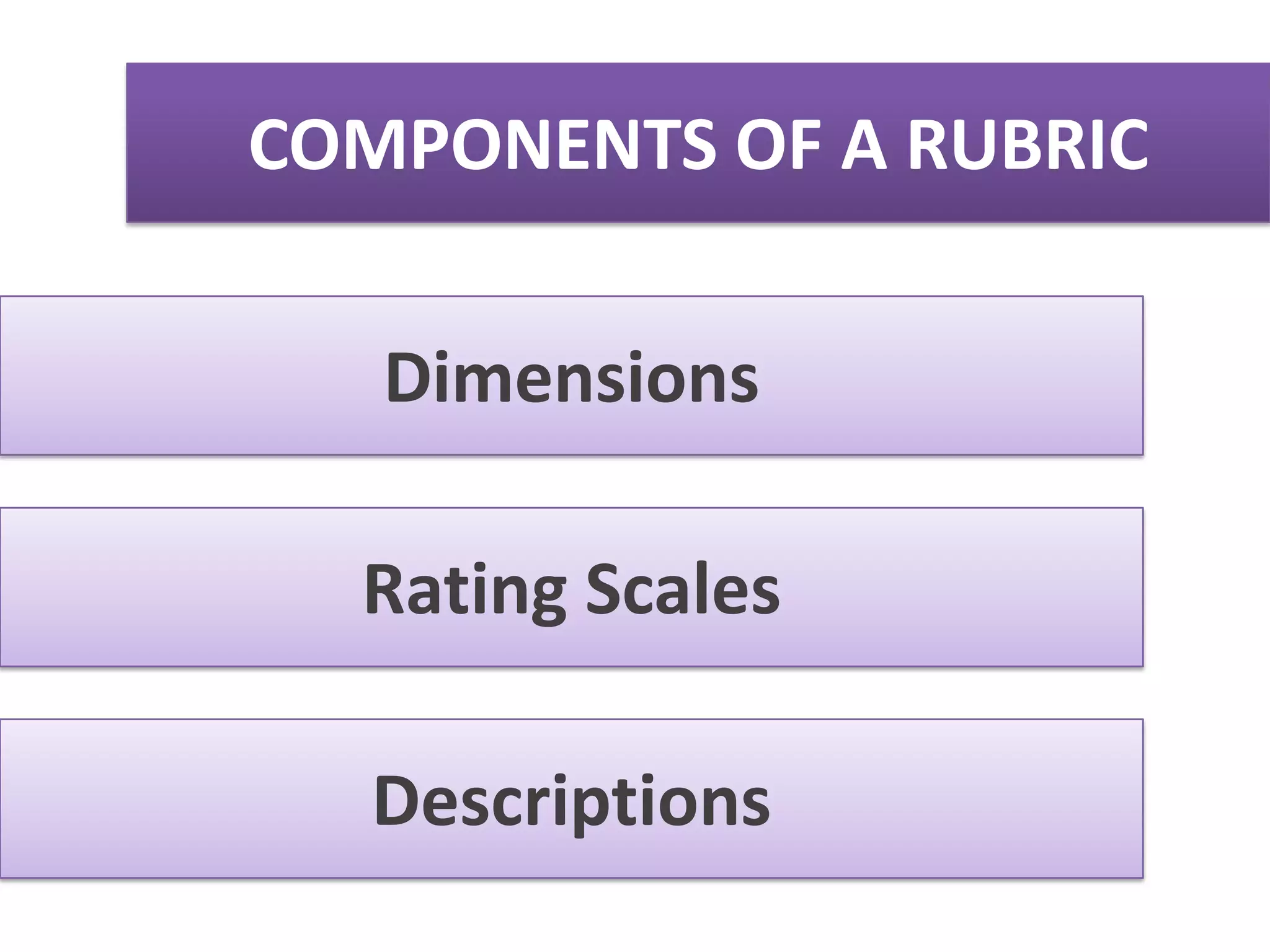
COMPONENTS OF A RUBRIC

   Dimensions

  Rating Scales

   Descriptions
ADVANTAGES

   Teachers can increase the quality of their direct
    instruction by providing focus, emphasis, and
attention to particular details as a model for students.

 Students have explicit guidelines regarding teacher
                   expectations.


   It clearly shows what criteria must be met for a
          student to achieve a desired mark.
Students can use rubrics as a tool to develop
                their abilities


Teachers can reuse rubrics for various activities.


Force clarification of success in the classroom,
establishing clear benchmarks for achievement
Types of Rubrics
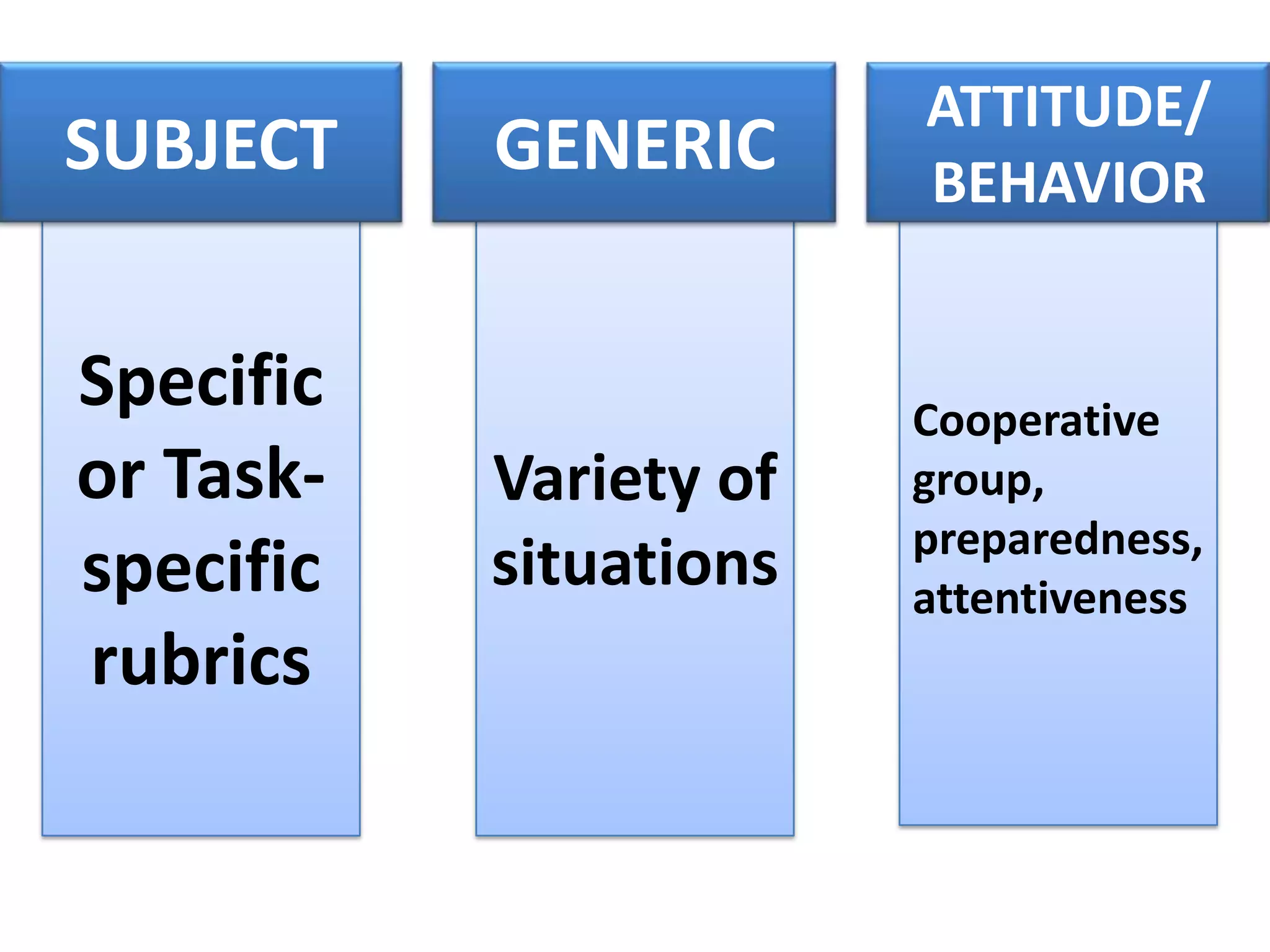
ATTITUDE/
SUBJECT    GENERIC      BEHAVIOR


Specific                Cooperative
or Task-   Variety of   group,
                        preparedness,
specific   situations   attentiveness
rubrics
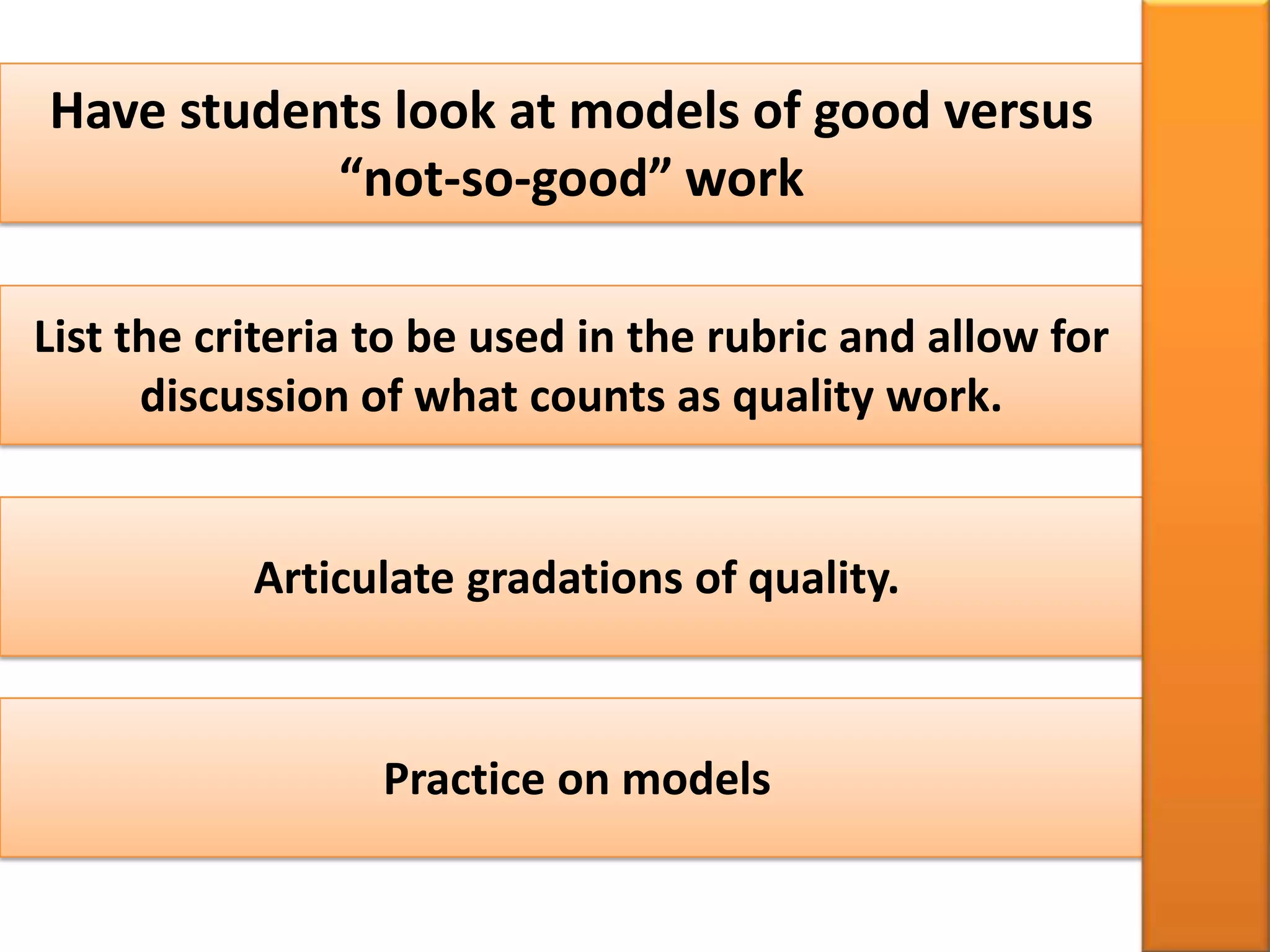
CREATING A RUBRIC
Have students look at models of good versus
           “not-so-good” work

List the criteria to be used in the rubric and allow for
      discussion of what counts as quality work.


           Articulate gradations of quality.


                  Practice on models
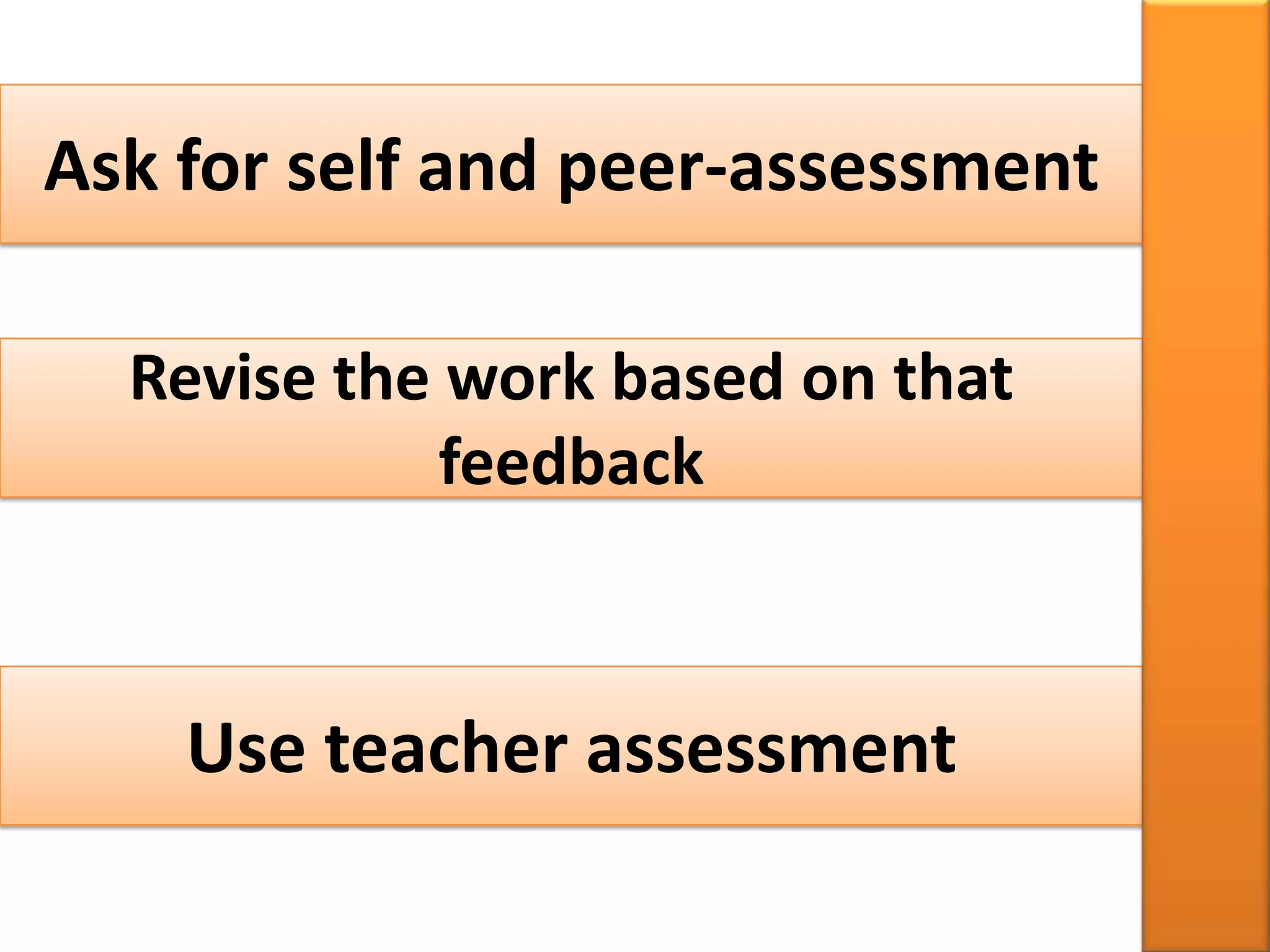
Ask for self and peer-assessment

  Revise the work based on that
             feedback


    Use teacher assessment
Guidelines when Writing Rubrics
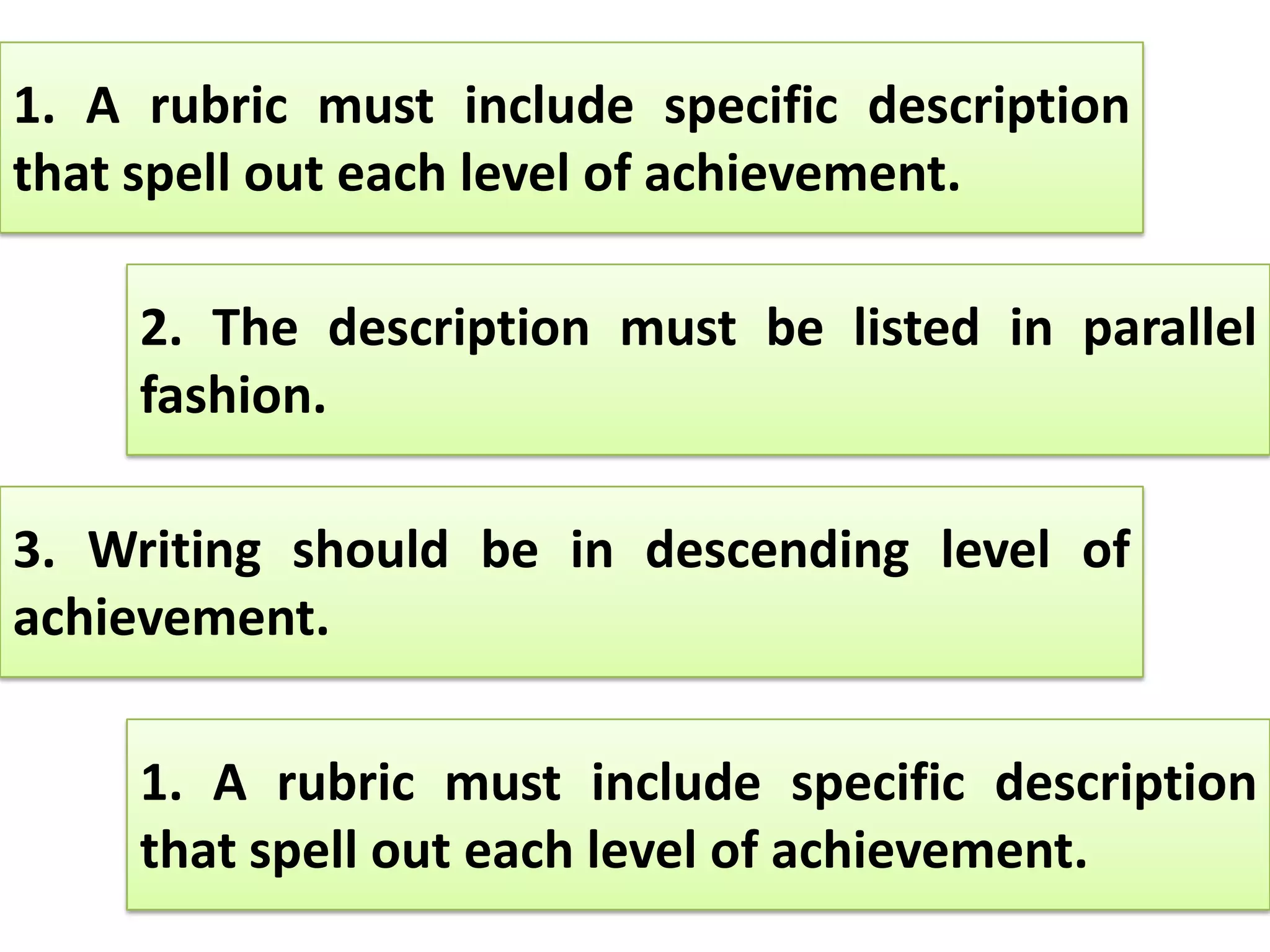
1. A rubric must include specific description
that spell out each level of achievement.

     2. The description must be listed in parallel
     fashion.

3. Writing should be in descending level of
achievement.

     1. A rubric must include specific description
     that spell out each level of achievement.
Determining the Levels of Rubrics
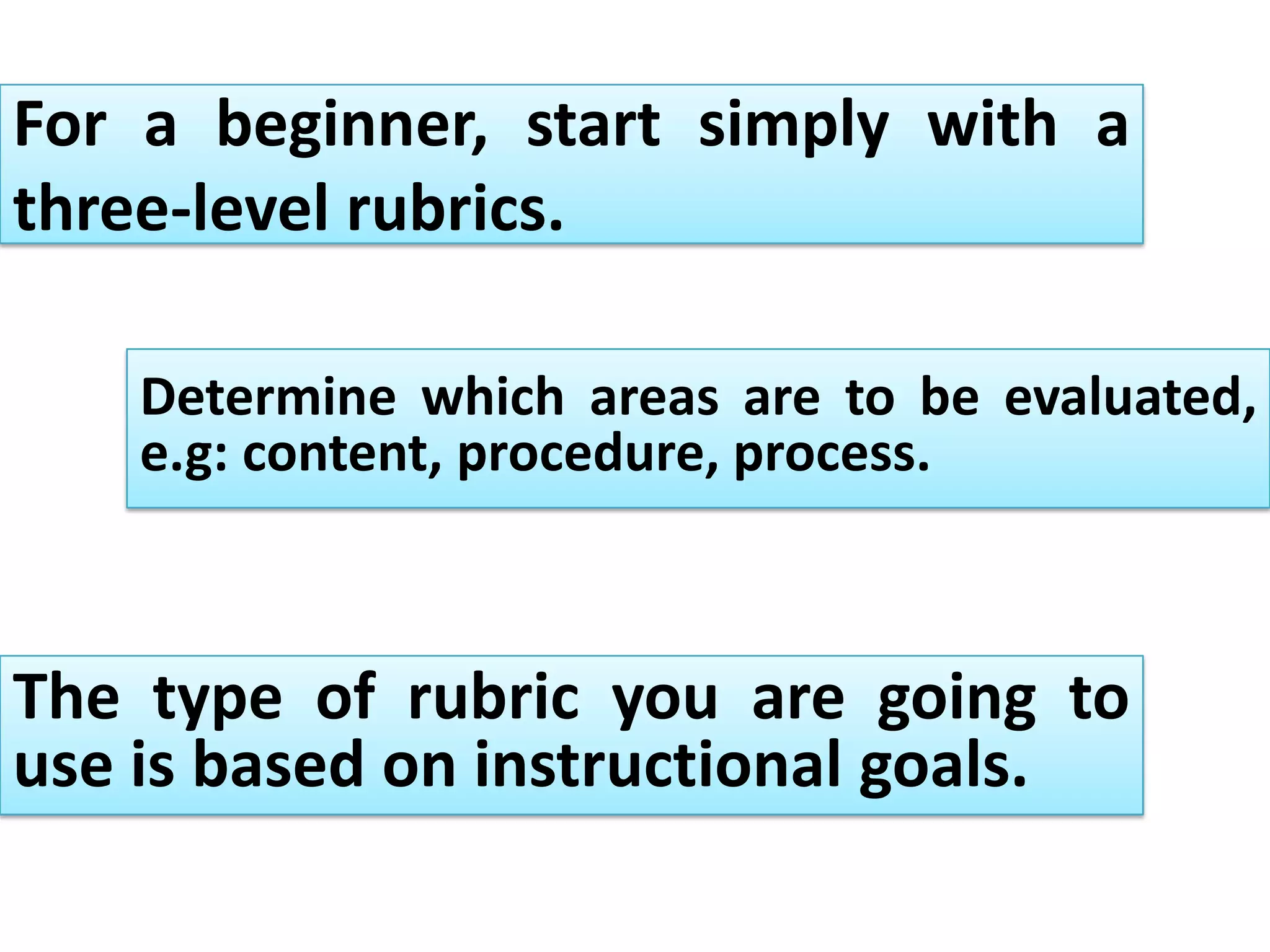
For a beginner, start simply with a
three-level rubrics.

    Determine which areas are to be evaluated,
    e.g: content, procedure, process.


The type of rubric you are going to
use is based on instructional goals.
Variety of Performance Descriptions
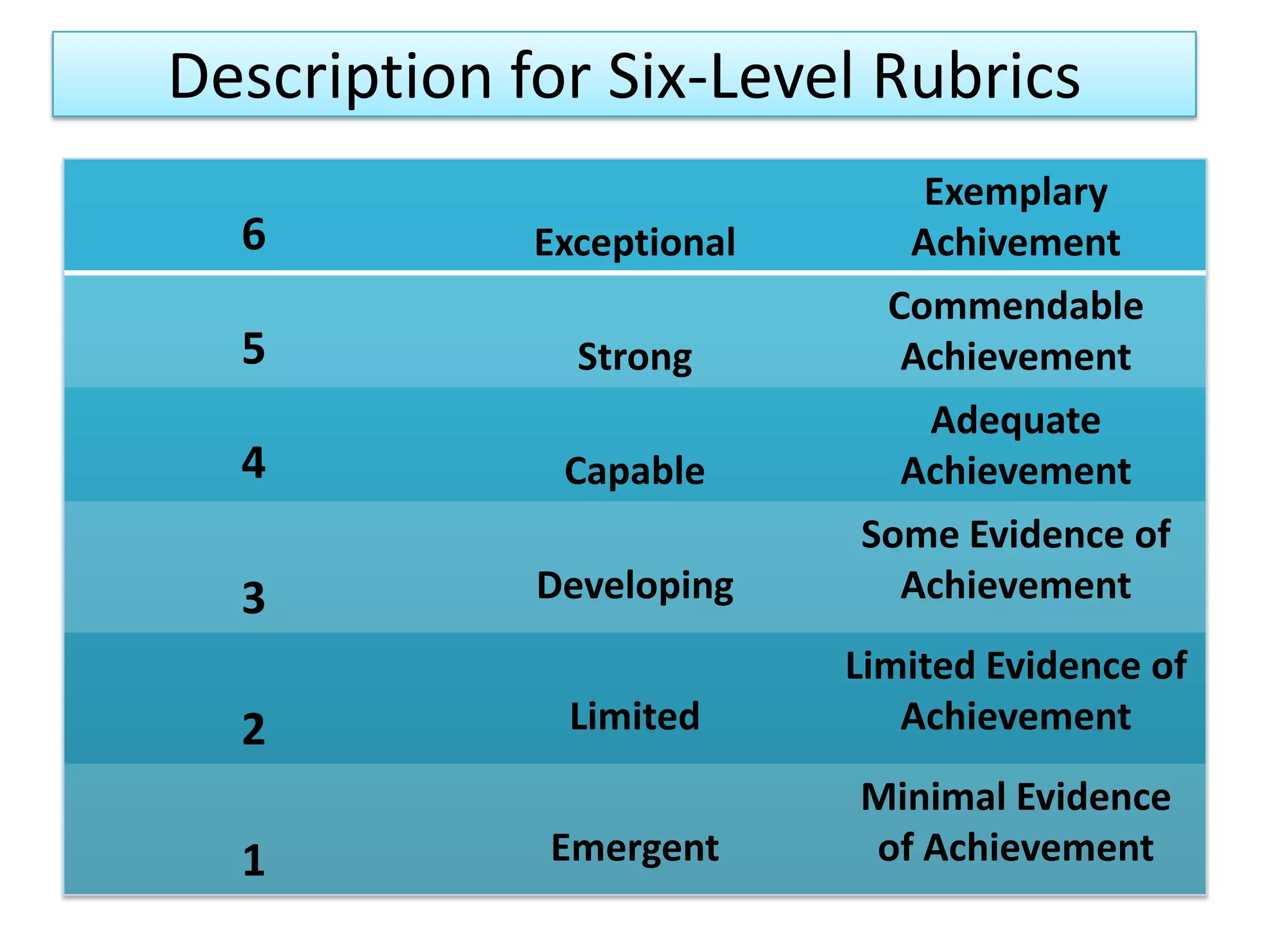
Description for Six-Level Rubrics
                               Exemplary
  6          Exceptional      Achivement
                             Commendable
  5            Strong         Achievement
                               Adequate
  4           Capable         Achievement
                           Some Evidence of
  3          Developing      Achievement
                           Limited Evidence of
  2           Limited         Achievement
                           Minimal Evidence
  1          Emergent      of Achievement
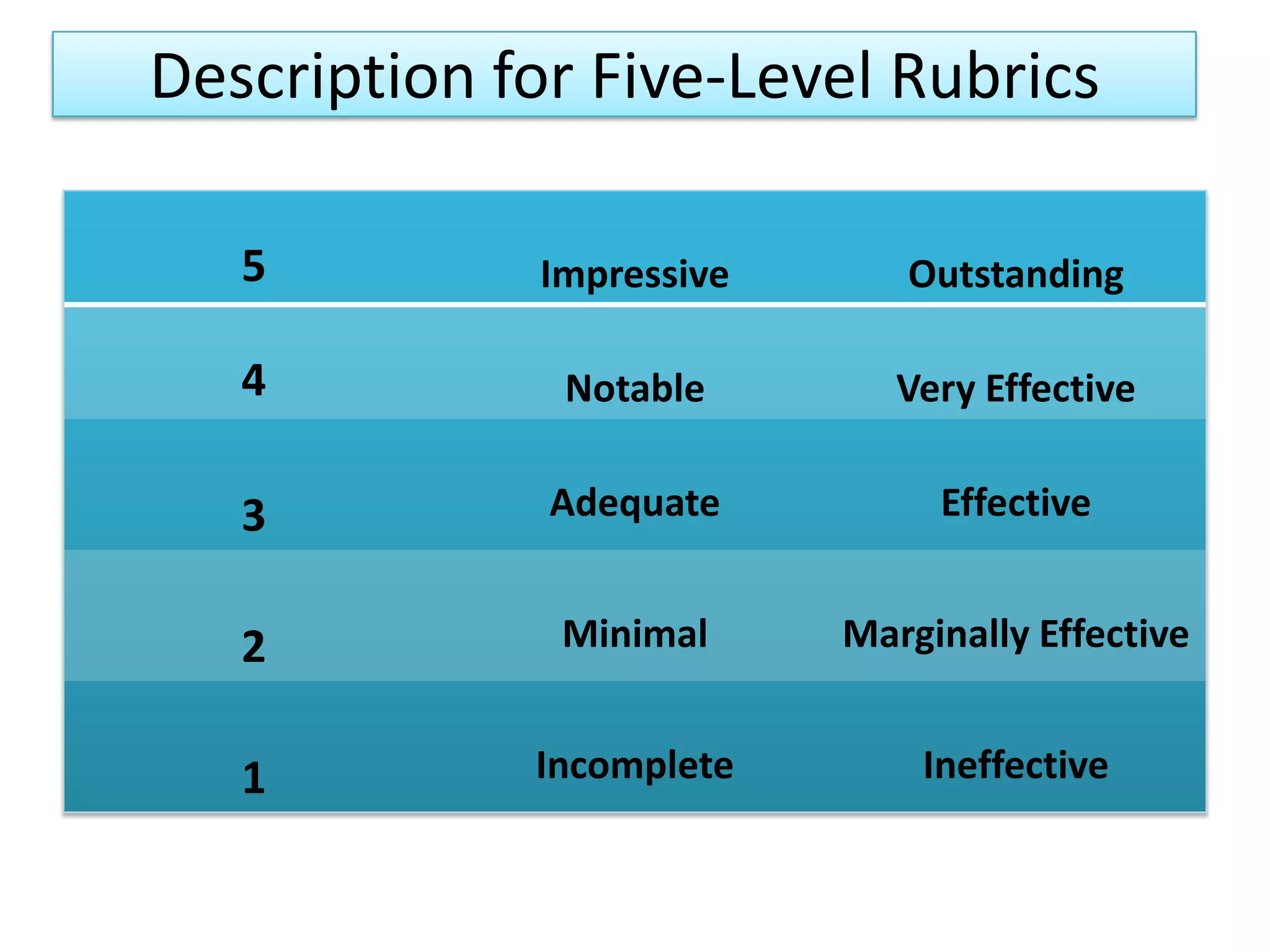
Description for Five-Level Rubrics

   5         Impressive      Outstanding

   4          Notable        Very Effective


   3          Adequate         Effective


   2          Minimal     Marginally Effective


   1         Incomplete       Ineffective
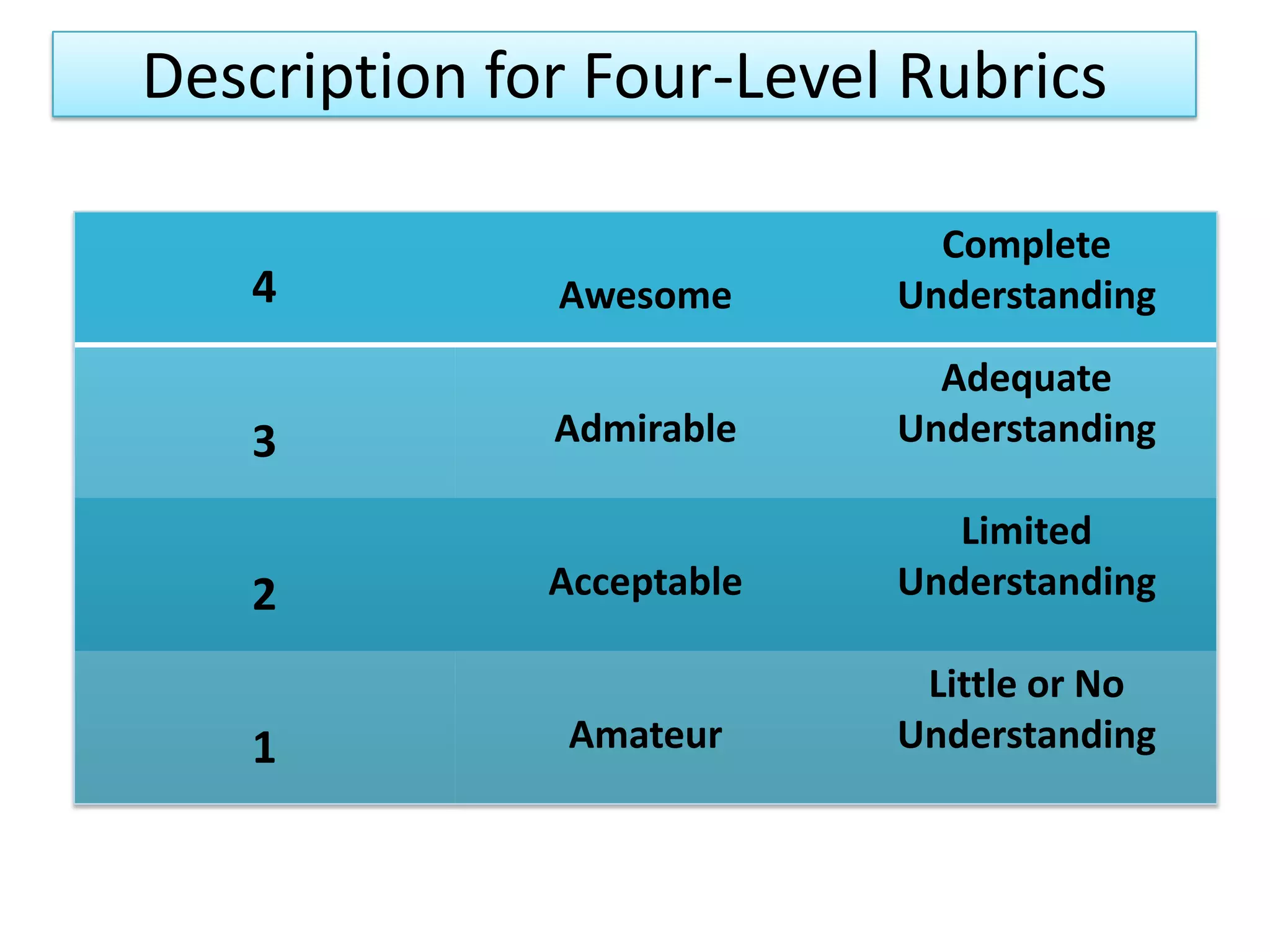
Description for Four-Level Rubrics

                             Complete
   4          Awesome      Understanding
                             Adequate
   3          Admirable    Understanding

                              Limited
   2          Acceptable   Understanding

                            Little or No
   1           Amateur     Understanding
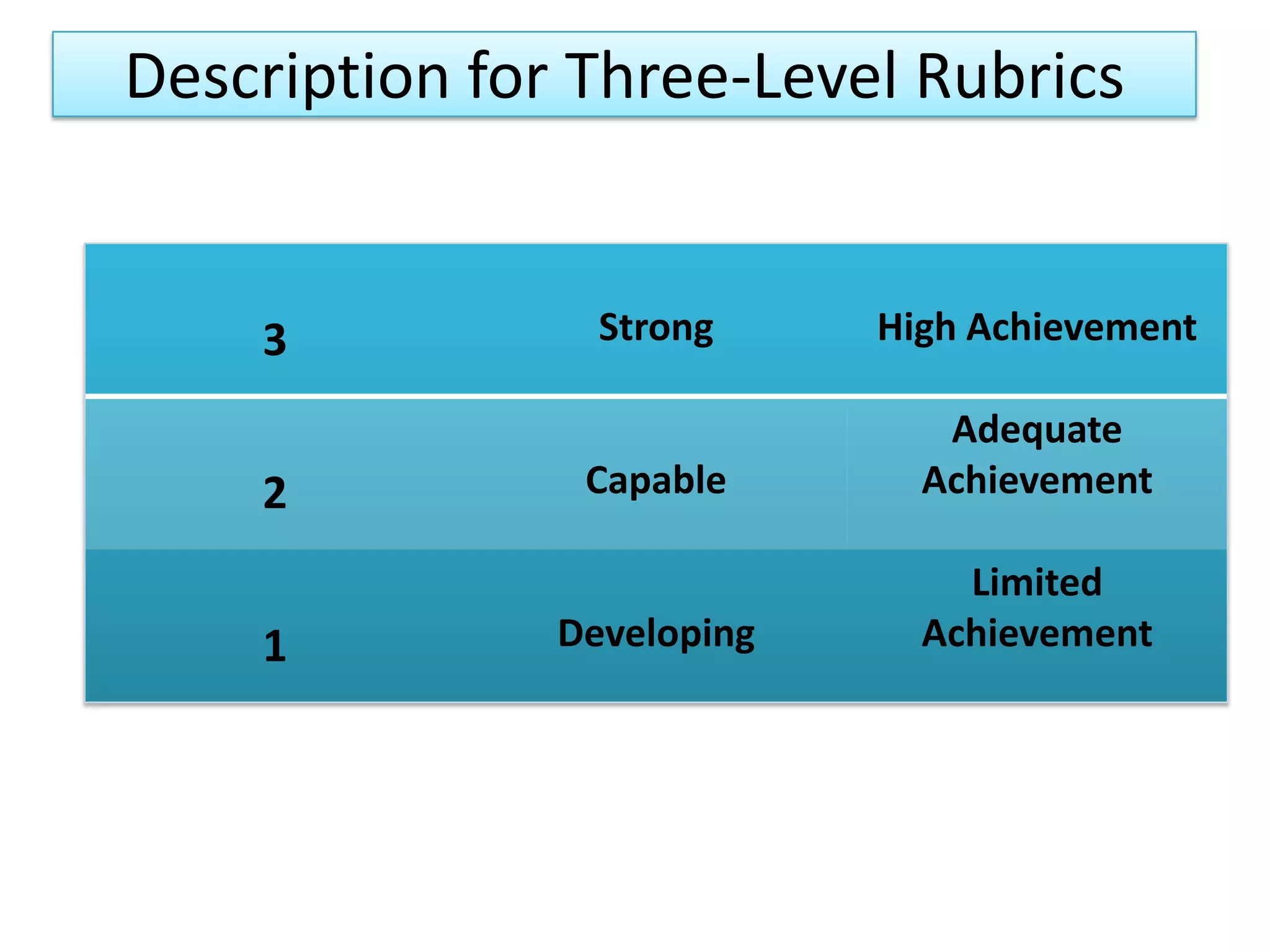
Description for Three-Level Rubrics


    3            Strong     High Achievement

                               Adequate
    2           Capable       Achievement

                                Limited
    1          Developing     Achievement
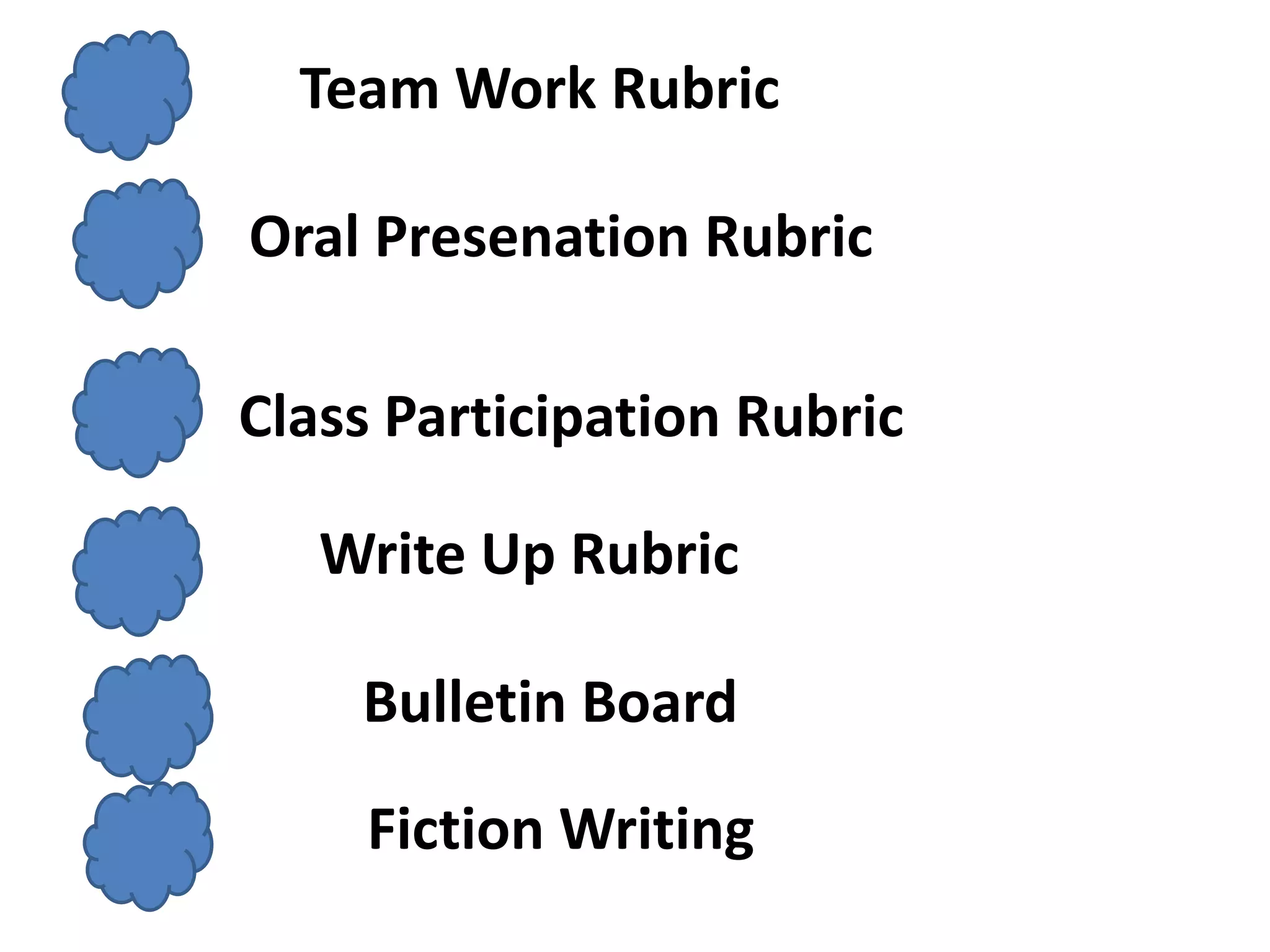
Team Work Rubric

Oral Presenation Rubric

Class Participation Rubric

   Write Up Rubric

    Bulletin Board

     Fiction Writing
Thank You!!!
A
N
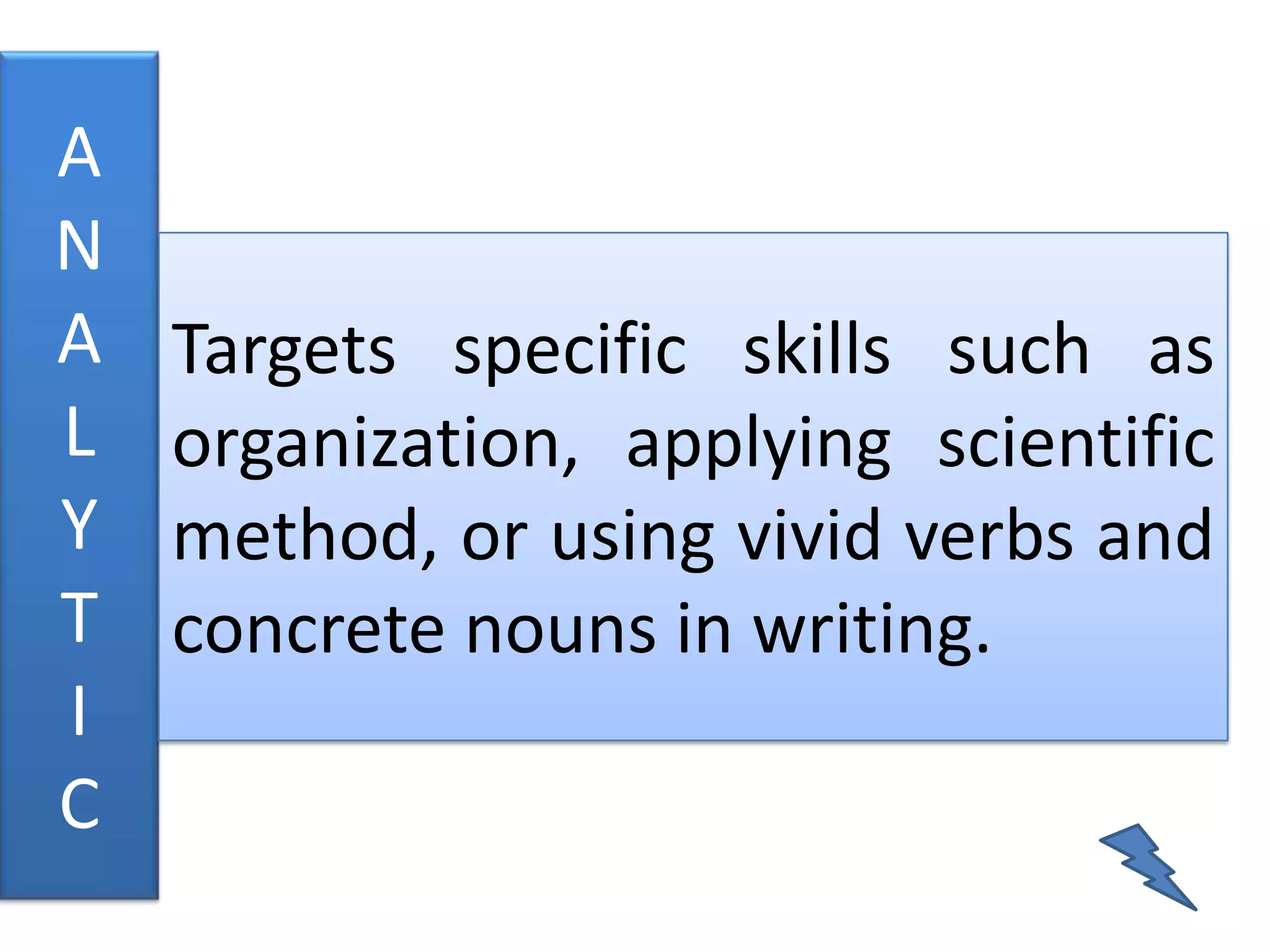
A   Targets specific skills such as
L   organization, applying scientific
Y   method, or using vivid verbs and
T   concrete nouns in writing.
I
C
H
                                   O
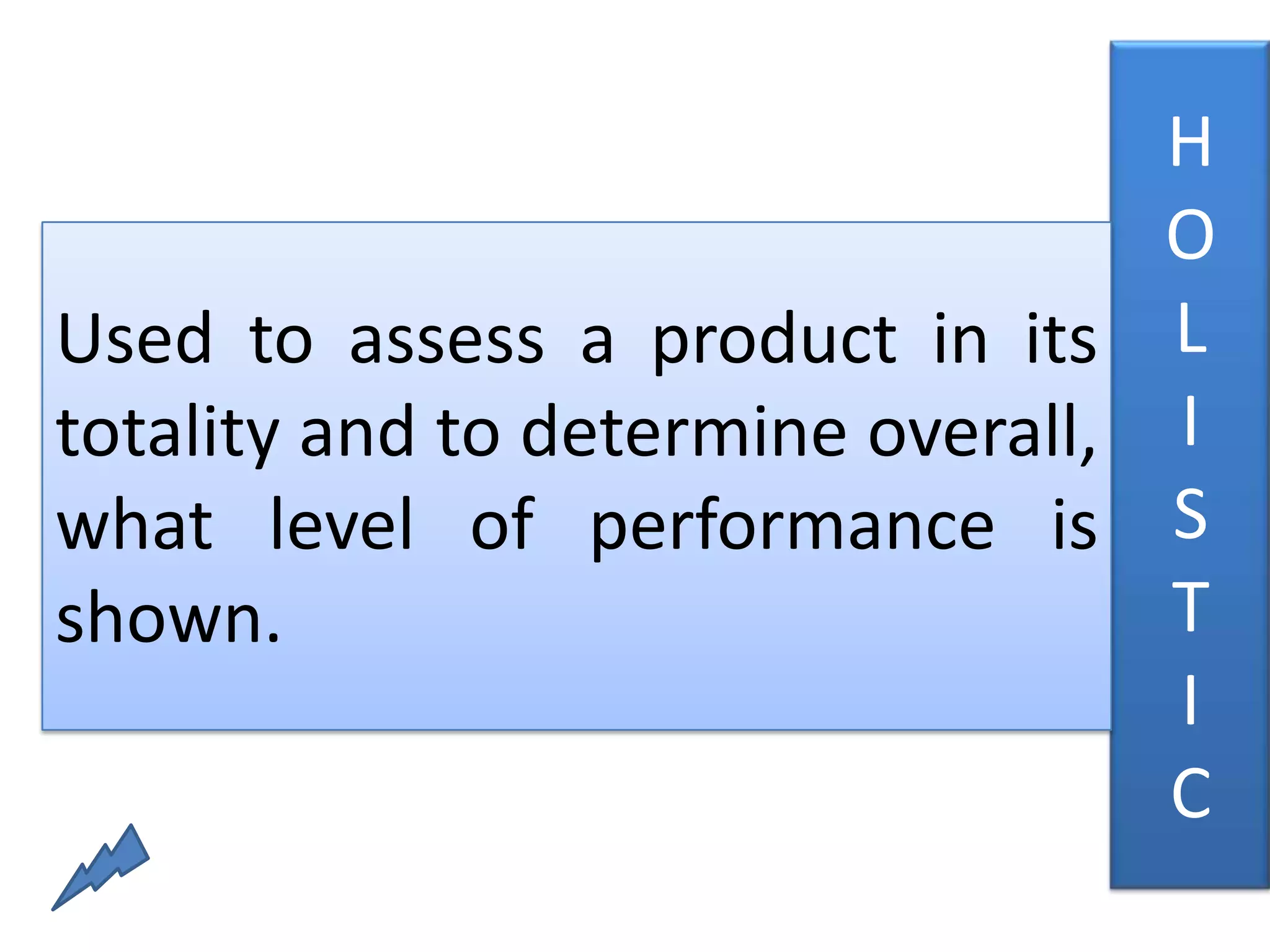
Used to assess a product in its L
totality and to determine overall, I
what level of performance is S
shown.                             T
                                   I
                                   C

R u b r i c s

  • 1.
  • 2.
    It is ascoring tool for subjective assessments. It is a set of criteria and standards linked to learning objectives that is used to assess a student's performance on papers, projects, essays, and other assignments. Rubrics allow for standardised evaluation according to specified criteria, making grading simpler and more transparent. (Wikipedia.org)
  • 3.
    It is ascoring guide that seeks to evaluate a student's performance based on the sum of a full range of criteria rather than a single numerical score. A rubric is a working guide for students and teachers, usually handed out before the assignment begins in order to get students to think about the criteria on which their work will be judged. Rubrics can be analytic or holistic, and they can be created for any content area including math, science, history, writing, foreign languages, drama, art, music, etc...
  • 4.
    A rubric isan explicit set of criteria used for assessing a particular type of work or performance. Usually, it also includes levels of potential achievement for each criterion, and sometimes also includes work or performance samples that typify each of those levels.
  • 5.
    It is aguide that gives direction to the scoring of student products and other authentic evaluation. It is helpful in assessing products such as open-ended questions, laboratory experiments, debates, oral presentations, visual presentations, and written works.
  • 6.
  • 7.
    focus on measuringa stated objective (performance, behavior, or quality) use a range to rate performance contain specific performance characteristics arranged in levels indicating the degree to which a standard has been met (Pickett and Dodge)
  • 8.
    COMPONENTS OF ARUBRIC Dimensions Rating Scales Descriptions
  • 9.
    ADVANTAGES Teachers can increase the quality of their direct instruction by providing focus, emphasis, and attention to particular details as a model for students. Students have explicit guidelines regarding teacher expectations. It clearly shows what criteria must be met for a student to achieve a desired mark.
  • 10.
    Students can userubrics as a tool to develop their abilities Teachers can reuse rubrics for various activities. Force clarification of success in the classroom, establishing clear benchmarks for achievement
  • 11.
  • 12.
    ATTITUDE/ SUBJECT GENERIC BEHAVIOR Specific Cooperative or Task- Variety of group, preparedness, specific situations attentiveness rubrics
  • 13.
  • 14.
    Have students lookat models of good versus “not-so-good” work List the criteria to be used in the rubric and allow for discussion of what counts as quality work. Articulate gradations of quality. Practice on models
  • 15.
    Ask for selfand peer-assessment Revise the work based on that feedback Use teacher assessment
  • 16.
  • 17.
    1. A rubricmust include specific description that spell out each level of achievement. 2. The description must be listed in parallel fashion. 3. Writing should be in descending level of achievement. 1. A rubric must include specific description that spell out each level of achievement.
  • 18.
  • 19.
    For a beginner,start simply with a three-level rubrics. Determine which areas are to be evaluated, e.g: content, procedure, process. The type of rubric you are going to use is based on instructional goals.
  • 20.
  • 21.
    Description for Six-LevelRubrics Exemplary 6 Exceptional Achivement Commendable 5 Strong Achievement Adequate 4 Capable Achievement Some Evidence of 3 Developing Achievement Limited Evidence of 2 Limited Achievement Minimal Evidence 1 Emergent of Achievement
  • 22.
    Description for Five-LevelRubrics 5 Impressive Outstanding 4 Notable Very Effective 3 Adequate Effective 2 Minimal Marginally Effective 1 Incomplete Ineffective
  • 23.
    Description for Four-LevelRubrics Complete 4 Awesome Understanding Adequate 3 Admirable Understanding Limited 2 Acceptable Understanding Little or No 1 Amateur Understanding
  • 24.
    Description for Three-LevelRubrics 3 Strong High Achievement Adequate 2 Capable Achievement Limited 1 Developing Achievement
  • 25.
    Team Work Rubric OralPresenation Rubric Class Participation Rubric Write Up Rubric Bulletin Board Fiction Writing
  • 26.
  • 27.
    A N A Targets specific skills such as L organization, applying scientific Y method, or using vivid verbs and T concrete nouns in writing. I C
  • 28.
    H O Used to assess a product in its L totality and to determine overall, I what level of performance is S shown. T I C