Creating Rubrics A Guide to Development and Use
Credits Materials in this handout were compiled from the following web sites. http://www. carla . umn .edu/assessment/VAC/Evaluation/p_4.html http: //jonathan . mueller .faculty. noctrl . edu/toolbox/rubrics . htm http: //rubistar .4teachers.org http: //valenciacc . edu/learningevidence/rubrics .asp http://faculty. sacredheart . edu/stiltnerb/students/rubrics . htm
Introduction In this workshop we: Explore how to create tools for grading complex assignments. Explore the purpose and characteristics of rubrics. Use RubiStar as a tool for creating a rubric. At the end of the session,  You will have drafted a rubric for an assignment. Given and received feedback from a colleague on your rubric.
Workshop Objectives By the end of the workshop you should be able to: Describe a rubric (what is it?) Describe the purpose of rubrics. Describe the difference between holistic and analytic rubrics. List the characteristics of good rubrics. Develop a rubric for judging the quality of a product (chocolate chip cookie). Create/modify a rubric for an assignment or activity in a class you teach. Identify strengths and weaknesses in a rubric.
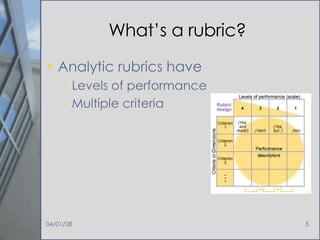
What’s a rubric? Analytic rubrics have Levels of performance Multiple criteria
The TLT defines rubrics as: "Rubrics" explicitly state criteria for assignments.  May lead to a grade or be part of the grading process.  Are more specific, detailed, and disaggregated than a grade.  Show strengths and weaknesses in student work.
Another definition  ( Jon Mueller . Professor of Psychology, North Central College) Assess student performance along a task-specific set of criteria Measures performance against a predetermined criteria Includes essential criteria for the task Has multiple levels of performance
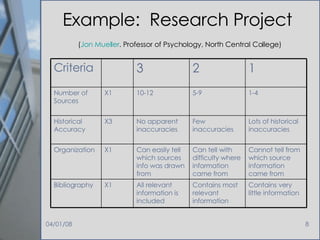
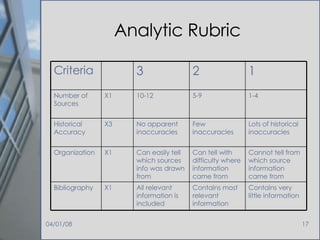
Example:  Research Project   ( Jon Mueller . Professor of Psychology, North Central College) Contains very little information Contains most relevant information All relevant information is included X1 Bibliography Cannot tell from which source information came from Can tell with difficulty where information came from Can easily tell which sources info was drawn from X1 Organization Lots of historical inaccuracies Few inaccuracies No apparent inaccuracies X3 Historical Accuracy 1-4 5-9 10-12 X1 Number of Sources 1 2 3 Criteria
One-Sentence Summary On a 3x5 note card: Write a one-sentence summary that: 1.  Defines a rubric. 2.  Differentiates between performance levels and criteria. 3.  Explains column weight. When directed by facilitator, share your sentences with a partner. Combine your two sentences into one that can be shared with the group.
Characteristics of Rubrics Increase an assessment's construct and content validity Increase an assessment's reliability  set criteria that raters can apply consistently and objectively Established criteria reduces bias Can help teachers clarify goals and improve their teaching Help learners set goals and assume responsibility for their learning
Characteristics Continued Help learners develop their ability to judge quality in their own and others' work Provides specific feedback about areas of strength and weakness Learners can use rubrics to assess their own effort and performance before submitting it
Characteristics Continued Learners and teachers monitor progress over a period of instruction Reduces time spent grading Engaging students in the design empowers them Moves away from subjective grading
Which of these reasons are important to you? Importance   of Reliability Validity of the assessment Reduction of bias in grading Clarifying goals for you as the teacher Communicating expectations to students Improve students ability to judge their own performance Means for providing better feedback to students
Types of Rubrics Ask yourself: For a particular task, do you want to be able to assess how well the students perform on each criterion, or do you want to get a more global picture of the students' performance on the entire task?
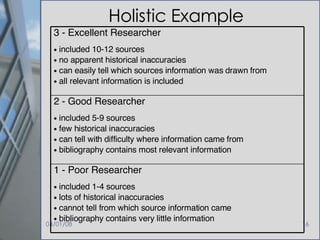
Holistic a holistic rubric does not list separate levels of performance for each criterion a holistic rubric assigns a level of performance by assessing performance across multiple criteria as a whole.
Holistic Example 1 - Poor Researcher included 1-4 sources lots of historical inaccuracies cannot tell from which source information came bibliography contains very little information 2 - Good Researcher included 5-9 sources few historical inaccuracies can tell with difficulty where information came from bibliography contains most relevant information 3 - Excellent Researcher included 10-12 sources no apparent historical inaccuracies can easily tell which sources information was drawn from all relevant information is included
Analytic Rubric Contains very little information Contains most relevant information All relevant information is included X1 Bibliography Cannot tell from which source information came from Can tell with difficulty where information came from Can easily tell which sources info was drawn from X1 Organization Lots of historical inaccuracies Few inaccuracies No apparent inaccuracies X3 Historical Accuracy 1-4 5-9 10-12 X1 Number of Sources 1 2 3 Criteria
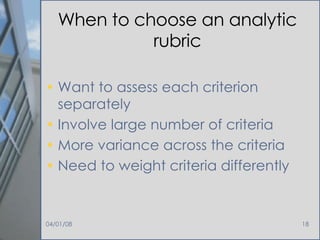
When to choose an analytic rubric Want to assess each criterion separately Involve large number of criteria  More variance across the criteria Need to weight criteria differently
Types of Rubrics Activity In the Lesson Builder materials, page 6, you will find a sorting activity.
Designing an Analytic Rubric Step 1.  Re-examine learning objective to be addressed by the task. Step 2.  Identify observable attributes you want to see (as well as those you don’t want to see) your students demonstrate in the product, process, or performance. Step 3.  Brainstorm characteristics of each attribute.
Design Analytic Continued Step 4b .  Write thorough narrative description for excellent and poor work for each individual attribute. Step 5b.  Complete the rubric by describing other levels on the continuum that ranges from excellent to poor for each attribute.
Hint:  Use Even Number of Levels Use an even number (4 or 6) of levels of performance on the scale.  When there are an odd number of levels, the middle level tends to become a catch-all category.  With an even number of levels, raters have to make a more precise judgment about a performance when its quality is not at the top or bottom of the scale.
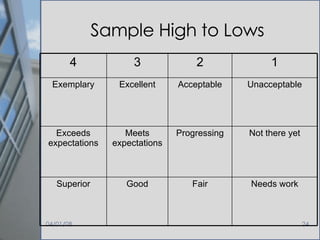
Hint:  Arrange Levels High to Low High to low scale.  Students read first the description of an exemplary performance in each criterion.
Sample High to Lows Needs work Fair Good Superior Not there yet Progressing Meets expectations Exceeds expectations Unacceptable Acceptable Excellent Exemplary 1 2 3 4
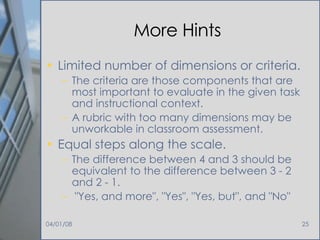
More Hints Limited number of dimensions or criteria. The criteria are those components that are most important to evaluate in the given task and instructional context.  A rubric with too many dimensions may be unworkable in classroom assessment. Equal steps along the scale.  The difference between 4 and 3 should be equivalent to the difference between 3 - 2 and 2 - 1. "Yes, and more", "Yes", "Yes, but", and "No"
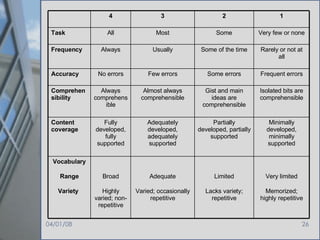
  Very limited Memorized; highly repetitive   Limited Lacks variety; repetitive   Adequate Varied; occasionally repetitive   Broad Highly varied; non-repetitive Vocabulary Range Variety Minimally developed, minimally supported Partially developed, partially supported Adequately developed, adequately supported Fully developed, fully supported Content coverage Isolated bits are comprehensible Gist and main ideas are comprehensible Almost always comprehensible Always comprehensible Comprehensibility Frequent errors Some errors Few errors No errors Accuracy Rarely or not at all Some of the time Usually Always Frequency Very few or none Some Most All Task 1 2 3 4  
Chocolate Chip Cookies Break  into pairs. Compete the worksheet  Creating a Rubric.  Create  a rubric for judging the quality of a chocolate chip cookie. -Be sure to decide if you want to do a holistic or analytic rubric!!!!  Be prepared to defend your decision. Use the handout on Rubric Examples to help you when you get stuck! When you all finished, you will get to judge the cookies using the different rubrics.
Using RubiStar These are some simple steps for getting started with Rubistar.   Access the site  http: //rubistar .4teachers.org . Take a moment to read about the different features. When you are ready to get started, click on the tutorial and choose the option you prefer.
Rubistar Tips If you are using Internet Explorer, you can copy the rubric and paste it into a Word document where you can continue to edit. When first getting started, you might want to choose an existing template. You may find that you can create a rubric you like by combining existing rubrics into one of your own.   You can do this by opening two windows to Rubistar and copying and pasting between windows.
Assignment Create a rubric for an objective/competency you have for a class you teach.  Use the worksheet on creating a rubric to get you started. Divide into teams. Exchange rubrics and use the  Aunt Olive's Rubric on Rubrics  to provide feedback to a colleague on their work.
Review Describe a rubric (what is it). Describe the purpose of rubrics. Describe the difference between holistic and analytic rubrics. List the characteristics of good rubrics. Develop a rubric for judging the quality of a product (chocolate chip cookie). Create/modify a rubric for an assignment or activity in a class you teach. Identify strengths and weaknesses in a rubric.

Creating Rubrics

  • 1.
    Creating Rubrics AGuide to Development and Use
  • 2.
    Credits Materials inthis handout were compiled from the following web sites. http://www. carla . umn .edu/assessment/VAC/Evaluation/p_4.html http: //jonathan . mueller .faculty. noctrl . edu/toolbox/rubrics . htm http: //rubistar .4teachers.org http: //valenciacc . edu/learningevidence/rubrics .asp http://faculty. sacredheart . edu/stiltnerb/students/rubrics . htm
  • 3.
    Introduction In thisworkshop we: Explore how to create tools for grading complex assignments. Explore the purpose and characteristics of rubrics. Use RubiStar as a tool for creating a rubric. At the end of the session, You will have drafted a rubric for an assignment. Given and received feedback from a colleague on your rubric.
  • 4.
    Workshop Objectives Bythe end of the workshop you should be able to: Describe a rubric (what is it?) Describe the purpose of rubrics. Describe the difference between holistic and analytic rubrics. List the characteristics of good rubrics. Develop a rubric for judging the quality of a product (chocolate chip cookie). Create/modify a rubric for an assignment or activity in a class you teach. Identify strengths and weaknesses in a rubric.
  • 5.
    What’s a rubric?Analytic rubrics have Levels of performance Multiple criteria
  • 6.
    The TLT definesrubrics as: "Rubrics" explicitly state criteria for assignments. May lead to a grade or be part of the grading process. Are more specific, detailed, and disaggregated than a grade. Show strengths and weaknesses in student work.
  • 7.
    Another definition ( Jon Mueller . Professor of Psychology, North Central College) Assess student performance along a task-specific set of criteria Measures performance against a predetermined criteria Includes essential criteria for the task Has multiple levels of performance
  • 8.
    Example: ResearchProject ( Jon Mueller . Professor of Psychology, North Central College) Contains very little information Contains most relevant information All relevant information is included X1 Bibliography Cannot tell from which source information came from Can tell with difficulty where information came from Can easily tell which sources info was drawn from X1 Organization Lots of historical inaccuracies Few inaccuracies No apparent inaccuracies X3 Historical Accuracy 1-4 5-9 10-12 X1 Number of Sources 1 2 3 Criteria
  • 9.
    One-Sentence Summary Ona 3x5 note card: Write a one-sentence summary that: 1. Defines a rubric. 2. Differentiates between performance levels and criteria. 3. Explains column weight. When directed by facilitator, share your sentences with a partner. Combine your two sentences into one that can be shared with the group.
  • 10.
    Characteristics of RubricsIncrease an assessment's construct and content validity Increase an assessment's reliability set criteria that raters can apply consistently and objectively Established criteria reduces bias Can help teachers clarify goals and improve their teaching Help learners set goals and assume responsibility for their learning
  • 11.
    Characteristics Continued Helplearners develop their ability to judge quality in their own and others' work Provides specific feedback about areas of strength and weakness Learners can use rubrics to assess their own effort and performance before submitting it
  • 12.
    Characteristics Continued Learnersand teachers monitor progress over a period of instruction Reduces time spent grading Engaging students in the design empowers them Moves away from subjective grading
  • 13.
    Which of thesereasons are important to you? Importance of Reliability Validity of the assessment Reduction of bias in grading Clarifying goals for you as the teacher Communicating expectations to students Improve students ability to judge their own performance Means for providing better feedback to students
  • 14.
    Types of RubricsAsk yourself: For a particular task, do you want to be able to assess how well the students perform on each criterion, or do you want to get a more global picture of the students' performance on the entire task?
  • 15.
    Holistic a holisticrubric does not list separate levels of performance for each criterion a holistic rubric assigns a level of performance by assessing performance across multiple criteria as a whole.
  • 16.
    Holistic Example 1- Poor Researcher included 1-4 sources lots of historical inaccuracies cannot tell from which source information came bibliography contains very little information 2 - Good Researcher included 5-9 sources few historical inaccuracies can tell with difficulty where information came from bibliography contains most relevant information 3 - Excellent Researcher included 10-12 sources no apparent historical inaccuracies can easily tell which sources information was drawn from all relevant information is included
  • 17.
    Analytic Rubric Containsvery little information Contains most relevant information All relevant information is included X1 Bibliography Cannot tell from which source information came from Can tell with difficulty where information came from Can easily tell which sources info was drawn from X1 Organization Lots of historical inaccuracies Few inaccuracies No apparent inaccuracies X3 Historical Accuracy 1-4 5-9 10-12 X1 Number of Sources 1 2 3 Criteria
  • 18.
    When to choosean analytic rubric Want to assess each criterion separately Involve large number of criteria More variance across the criteria Need to weight criteria differently
  • 19.
    Types of RubricsActivity In the Lesson Builder materials, page 6, you will find a sorting activity.
  • 20.
    Designing an AnalyticRubric Step 1. Re-examine learning objective to be addressed by the task. Step 2. Identify observable attributes you want to see (as well as those you don’t want to see) your students demonstrate in the product, process, or performance. Step 3. Brainstorm characteristics of each attribute.
  • 21.
    Design Analytic ContinuedStep 4b . Write thorough narrative description for excellent and poor work for each individual attribute. Step 5b. Complete the rubric by describing other levels on the continuum that ranges from excellent to poor for each attribute.
  • 22.
    Hint: UseEven Number of Levels Use an even number (4 or 6) of levels of performance on the scale. When there are an odd number of levels, the middle level tends to become a catch-all category. With an even number of levels, raters have to make a more precise judgment about a performance when its quality is not at the top or bottom of the scale.
  • 23.
    Hint: ArrangeLevels High to Low High to low scale. Students read first the description of an exemplary performance in each criterion.
  • 24.
    Sample High toLows Needs work Fair Good Superior Not there yet Progressing Meets expectations Exceeds expectations Unacceptable Acceptable Excellent Exemplary 1 2 3 4
  • 25.
    More Hints Limitednumber of dimensions or criteria. The criteria are those components that are most important to evaluate in the given task and instructional context. A rubric with too many dimensions may be unworkable in classroom assessment. Equal steps along the scale. The difference between 4 and 3 should be equivalent to the difference between 3 - 2 and 2 - 1. "Yes, and more", "Yes", "Yes, but", and "No"
  • 26.
      Very limitedMemorized; highly repetitive   Limited Lacks variety; repetitive   Adequate Varied; occasionally repetitive   Broad Highly varied; non-repetitive Vocabulary Range Variety Minimally developed, minimally supported Partially developed, partially supported Adequately developed, adequately supported Fully developed, fully supported Content coverage Isolated bits are comprehensible Gist and main ideas are comprehensible Almost always comprehensible Always comprehensible Comprehensibility Frequent errors Some errors Few errors No errors Accuracy Rarely or not at all Some of the time Usually Always Frequency Very few or none Some Most All Task 1 2 3 4  
  • 27.
    Chocolate Chip CookiesBreak into pairs. Compete the worksheet Creating a Rubric. Create a rubric for judging the quality of a chocolate chip cookie. -Be sure to decide if you want to do a holistic or analytic rubric!!!! Be prepared to defend your decision. Use the handout on Rubric Examples to help you when you get stuck! When you all finished, you will get to judge the cookies using the different rubrics.
  • 28.
    Using RubiStar Theseare some simple steps for getting started with Rubistar.  Access the site http: //rubistar .4teachers.org . Take a moment to read about the different features. When you are ready to get started, click on the tutorial and choose the option you prefer.
  • 29.
    Rubistar Tips Ifyou are using Internet Explorer, you can copy the rubric and paste it into a Word document where you can continue to edit. When first getting started, you might want to choose an existing template. You may find that you can create a rubric you like by combining existing rubrics into one of your own.  You can do this by opening two windows to Rubistar and copying and pasting between windows.
  • 30.
    Assignment Create arubric for an objective/competency you have for a class you teach. Use the worksheet on creating a rubric to get you started. Divide into teams. Exchange rubrics and use the Aunt Olive's Rubric on Rubrics to provide feedback to a colleague on their work.
  • 31.
    Review Describe arubric (what is it). Describe the purpose of rubrics. Describe the difference between holistic and analytic rubrics. List the characteristics of good rubrics. Develop a rubric for judging the quality of a product (chocolate chip cookie). Create/modify a rubric for an assignment or activity in a class you teach. Identify strengths and weaknesses in a rubric.

Editor's Notes

  • #2 Introduction and welcome Sign-in if appropriate Share something cool about yourself. Share expectations Look at my feet and guess example