
LITERATURE
TESTING
Presenter:
Jerra Niña L. Puracan
• Literature testing aims to institutionalize certain
concepts and facts which are part of the literary
learning and to direct attention to the relatively more
important literary skill (Tenbrink, 1998).
• Stern (1987) in her article, “Expanded Dimensions to
Literature in ESL/EFL: An Integrated Approach,”
stressed the great influence of literature to language
learning.
Rationale of Literature Testing
Why should we test literature?
 to develop literary competence
 to bring a literary piece of art to students'
intellectual and emotional baggages
 to develop decision-making and
meaning-making
Formats of Literature Tests
The format of literature tests addresses specific
language skills. It may be oral or written.
• Oral literature tests challenge the speaking and
listening skills of the students.
• Written tests demand skills in reading and
writing.
Common Types
of Literature Tests
 Multiple Choice
 True or False
 Gap-Filling
 Essay Test
 Knowledge Question
 Oral Test
Testing literature has been influenced by theories of
reading, literary theories and criticism, and
teaching styles.
Questions fall into two main categories:
 questions that do not require contact with the text
 questions that do require contact with the text
Literature tests are categorized into two:
 tests of literary information
 tests of literary interpretation
• According to the Taxonomy of Cognitive Questions,
questioned are classified, according to
complexity, as follows:
1. literal comprehension
2. reorganization
3. inferential comprehension
4. evaluation
5. appreciation
Examples of
Literature Tests
1. Testing Literal Comprehension
- includes recall of details, main ideas, sequence,
comparisons, cause and effect relationships
and character traits
a. Objective Type
• Recall of details: Identify the characters who said
the following lines in the story.
• Sequence: Rearrange the order of events
below as they happened in the story.
b. Essay Type
• Comparisons: What are the contrasting
characteristics of the protagonist and the
antagonist as described by the author?
• Character traits: Cite incidents in the story that
show the strained relationship between the
couple.
2. Testing Reorganization
- entails classifying, outlining, summarizing, and
synthesizing ideas
a. Objective Type
• Classifying: Select the item that does not
belong to the group.
• Synthesizing: From the choices given, select the
statement that expresses the theme of each of
the following selections.
b. Essay Type
• Outlining: Construct a topic outline of the essay
providing at least three main heads and a
number of sub-heads.
• Summarizing: Write a one-paragraph summary
of the plot of the story.
3. Testing Inference
- Inferential tests require students to use information
explicitly stated in the text along with personal experience
and knowledge in order to conjecture and to form
hypothesis.Tests include:
• inferring supporting
details
• main idea
• sequence
• comparisons
• cause-and-effect
relationships
• character traits
• author's organization
• predicting outcomes
• interpreting
figurative language
a. Objective Type
• Interpreting figurative language: Choose the best
interpretations of the following figurative lines within the
context of the poem.
• Inferring character traits: Match the adjectives that best
describe the traits of the character as shown by his/her
actions.
b. Essay Type
• Predicting outcomes: What do you think is in store for
Lumnay as the symbols at the end of the story portend?
• Inferring author's organization: Why did Nick Joaquin
use three generations in his story?
4. Testing Evaluation
- Evaluation tests require students to compare
information and ideas in a text with material presented
by the instructor or other authorities and with the
student's own knowledge and experience in order to form
judgements of various kinds.
Tests include judgements of:
• reality and fantasy
• fact or opinion
• adequacy and validity
• appropriateness
• worth
• desirability
• acceptability
a. Objective Type
• Judgment of fact or opinion: Write O if the following
statement expresses an opinion of a reader on the
story, F is the statement is stated by the author in the
story.
b. Essay Type
• Judgments of reality and fantasy: Do the events in the
story depict real-life situations or are they just product
of the author's imagination? Explain.
• Judgment of acceptability: Are the actions of the hero
acceptable from the moral point of view? Why or why
not?
5. Testing Appreciation
- Appreciation tests require students to articulate
emotional and aesthetic responses to the text based on
personal and professional standards of literary forms,
styles, genres, theories, critical approaches.
Tests include:
• giving emotional response to the text
• identifying with characters or incidents
• reacting to author's or speaker's connotative
and denovative use of language
• reacting to imagery
a. Objective Type
• Reacting to author's connotative use of language: Select
the best connotative meaning of the underlined word in
each statement lifted from the story.
b. Essay Type
• Identifying with character or incidents: Which
character in the story can you identify most? What are
your similarities?
• Responding emotionally to the text: How do you feel
towards Hamlet? Do you symphatize with him?
Why or why not?
Evaluating Literature Tests
Objective Type
• easy to evaluate
because there are ready
answer keys to the
questions.
Essay Type
• difficult to assess
because the evaluation
focuses on both content
(substance of the
response) and form
(language of the
response).
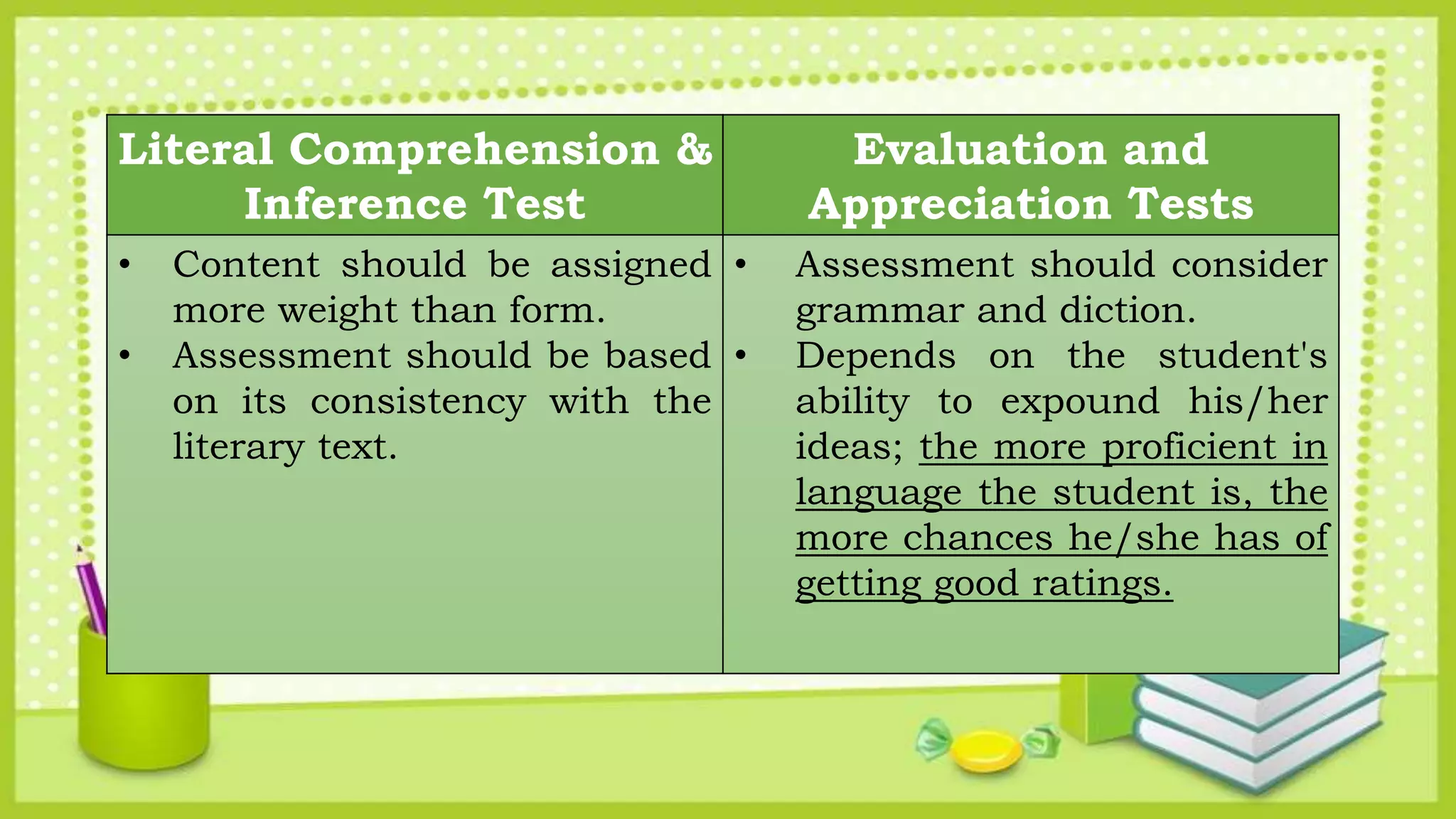
Literal Comprehension &
Inference Test
Evaluation and
Appreciation Tests
• Content should be assigned
more weight than form.
• Assessment should be based
on its consistency with the
literary text.
• Assessment should consider
grammar and diction.
• Depends on the student's
ability to expound his/her
ideas; the more proficient in
language the student is, the
more chances he/she has of
getting good ratings.
THANK YOU!

Literature Testing

  • 1.
  • 2.
    • Literature testingaims to institutionalize certain concepts and facts which are part of the literary learning and to direct attention to the relatively more important literary skill (Tenbrink, 1998). • Stern (1987) in her article, “Expanded Dimensions to Literature in ESL/EFL: An Integrated Approach,” stressed the great influence of literature to language learning. Rationale of Literature Testing
  • 3.
    Why should wetest literature?  to develop literary competence  to bring a literary piece of art to students' intellectual and emotional baggages  to develop decision-making and meaning-making
  • 4.
    Formats of LiteratureTests The format of literature tests addresses specific language skills. It may be oral or written. • Oral literature tests challenge the speaking and listening skills of the students. • Written tests demand skills in reading and writing.
  • 5.
    Common Types of LiteratureTests  Multiple Choice  True or False  Gap-Filling  Essay Test  Knowledge Question  Oral Test
  • 6.
    Testing literature hasbeen influenced by theories of reading, literary theories and criticism, and teaching styles. Questions fall into two main categories:  questions that do not require contact with the text  questions that do require contact with the text Literature tests are categorized into two:  tests of literary information  tests of literary interpretation
  • 7.
    • According tothe Taxonomy of Cognitive Questions, questioned are classified, according to complexity, as follows: 1. literal comprehension 2. reorganization 3. inferential comprehension 4. evaluation 5. appreciation
  • 8.
  • 9.
    1. Testing LiteralComprehension - includes recall of details, main ideas, sequence, comparisons, cause and effect relationships and character traits a. Objective Type • Recall of details: Identify the characters who said the following lines in the story. • Sequence: Rearrange the order of events below as they happened in the story.
  • 10.
    b. Essay Type •Comparisons: What are the contrasting characteristics of the protagonist and the antagonist as described by the author? • Character traits: Cite incidents in the story that show the strained relationship between the couple.
  • 11.
    2. Testing Reorganization -entails classifying, outlining, summarizing, and synthesizing ideas a. Objective Type • Classifying: Select the item that does not belong to the group. • Synthesizing: From the choices given, select the statement that expresses the theme of each of the following selections.
  • 12.
    b. Essay Type •Outlining: Construct a topic outline of the essay providing at least three main heads and a number of sub-heads. • Summarizing: Write a one-paragraph summary of the plot of the story.
  • 13.
    3. Testing Inference -Inferential tests require students to use information explicitly stated in the text along with personal experience and knowledge in order to conjecture and to form hypothesis.Tests include: • inferring supporting details • main idea • sequence • comparisons • cause-and-effect relationships • character traits • author's organization • predicting outcomes • interpreting figurative language
  • 14.
    a. Objective Type •Interpreting figurative language: Choose the best interpretations of the following figurative lines within the context of the poem. • Inferring character traits: Match the adjectives that best describe the traits of the character as shown by his/her actions. b. Essay Type • Predicting outcomes: What do you think is in store for Lumnay as the symbols at the end of the story portend? • Inferring author's organization: Why did Nick Joaquin use three generations in his story?
  • 15.
    4. Testing Evaluation -Evaluation tests require students to compare information and ideas in a text with material presented by the instructor or other authorities and with the student's own knowledge and experience in order to form judgements of various kinds. Tests include judgements of: • reality and fantasy • fact or opinion • adequacy and validity • appropriateness • worth • desirability • acceptability
  • 16.
    a. Objective Type •Judgment of fact or opinion: Write O if the following statement expresses an opinion of a reader on the story, F is the statement is stated by the author in the story. b. Essay Type • Judgments of reality and fantasy: Do the events in the story depict real-life situations or are they just product of the author's imagination? Explain. • Judgment of acceptability: Are the actions of the hero acceptable from the moral point of view? Why or why not?
  • 17.
    5. Testing Appreciation -Appreciation tests require students to articulate emotional and aesthetic responses to the text based on personal and professional standards of literary forms, styles, genres, theories, critical approaches. Tests include: • giving emotional response to the text • identifying with characters or incidents • reacting to author's or speaker's connotative and denovative use of language • reacting to imagery
  • 18.
    a. Objective Type •Reacting to author's connotative use of language: Select the best connotative meaning of the underlined word in each statement lifted from the story. b. Essay Type • Identifying with character or incidents: Which character in the story can you identify most? What are your similarities? • Responding emotionally to the text: How do you feel towards Hamlet? Do you symphatize with him? Why or why not?
  • 19.
    Evaluating Literature Tests ObjectiveType • easy to evaluate because there are ready answer keys to the questions. Essay Type • difficult to assess because the evaluation focuses on both content (substance of the response) and form (language of the response).
  • 20.
    Literal Comprehension & InferenceTest Evaluation and Appreciation Tests • Content should be assigned more weight than form. • Assessment should be based on its consistency with the literary text. • Assessment should consider grammar and diction. • Depends on the student's ability to expound his/her ideas; the more proficient in language the student is, the more chances he/she has of getting good ratings.
  • 21.