Evaluation: Question 1
In what ways does your media product use,
develop or challenge forms and conventions of real
media products?
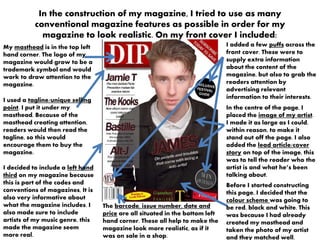
In the construction of my magazine, I tried to use as many
conventional magazine features as possible in order for my
magazine to look realistic. On my front cover I included:
My masthead is in the top left
hand corner. The logo of my
magazine would grow to be a
trademark symbol and would
work to draw attention to the
magazine.
I used a tagline/unique selling
point. I put it under my
masthead. Because of the
masthead creating attention,
readers would then read the
tagline, so this would
encourage them to buy the
magazine.
I decided to include a left hand
third on my magazine because
this is part of the codes and
conventions of magazines, It is
also very informative about
what the magazine includes. I
also made sure to include
artists of my music genre, this
made the magazine seem
more real.
The barcode, issue number, date and
price are all situated in the bottom left
hand corner. These all help to make the
magazine look more realistic, as if it
was on sale in a shop.
I added a few puffs across the
front cover. These were to
supply extra information
about the content of the
magazine, but also to grab the
readers attention by
advertising relevant
information to their interests.
In the centre of the page, I
placed the image of my artist.
I made it as large as I could,
within reason, to make it
stand out off the page. I also
added the lead article/cover
story on top of the image, this
was to tell the reader who the
artist is and what he’s been
talking about.
Before I started constructing
this page, I decided that the
colour scheme was going to
be red, black and white. This
was because I had already
created my masthead and
taken the photo of my artist
and they matched well.
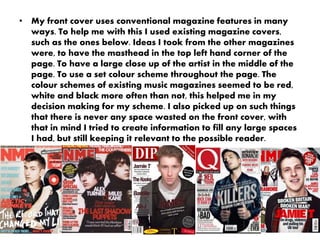
• My front cover uses conventional magazine features in many
ways. To help me with this I used existing magazine covers,
such as the ones below. Ideas I took from the other magazines
were, to have the masthead in the top left hand corner of the
page. To have a large close up of the artist in the middle of the
page. To use a set colour scheme throughout the page. The
colour schemes of existing music magazines seemed to be red,
white and black more often than not, this helped me in my
decision making for my scheme. I also picked up on such things
that there is never any space wasted on the front cover, with
that in mind I tried to create information to fill any large spaces
I had, but still keeping it relevant to the possible reader.
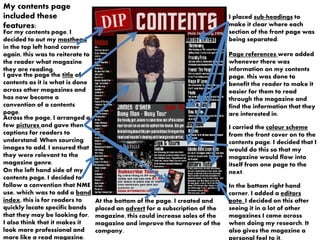
My contents page
included these
features:
For my contents page, I
decided to out my masthead
in the top left hand corner
again, this was to reiterate to
the reader what magazine
they are reading.
I gave the page the title of
contents as it is what is done
across other magazines and
has now became a
convention of a contents
page.
Across the page, I arranged a
few pictures and gave then
captions for readers to
understand. When sourcing
images to add, I ensured that
they were relevant to the
magazine genre.
On the left hand side of my
contents page, I decided to
follow a convention that NME
use, which was to add a band
index, this is for readers to
quickly locate specific bands
that they may be looking for.
I also think that it makes it
look more professional and
more like a read magazine.
At the bottom of the page, I created and
placed an advert for a subscription of the
magazine, this could increase sales of the
magazine and improve the turnover of the
company.
I placed sub-headings to
make it clear where each
section of the front page was
being separated.
Page references were added
whenever there was
information on my contents
page, this was done to
benefit the reader to make it
easier for them to read
through the magazine and
find the information that they
are interested in.
I carried the colour scheme
from the front cover on to the
contents page. I decided that I
would do this so that my
magazine would flow into
itself from one page to the
next.
In the bottom right hand
corner, I added a editors
note. I decided on this after
seeing it in a lot of other
magazines I came across
when doing my research. It
also gives the magazine a
personal feel to it.
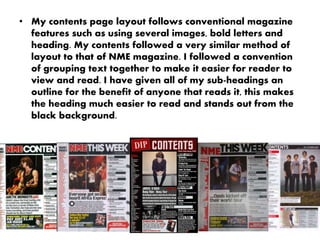
• My contents page layout follows conventional magazine
features such as using several images, bold letters and
heading. My contents followed a very similar method of
layout to that of NME magazine. I followed a convention
of grouping text together to make it easier for reader to
view and read. I have given all of my sub-headings an
outline for the benefit of anyone that reads it, this makes
the heading much easier to read and stands out from the
black background.
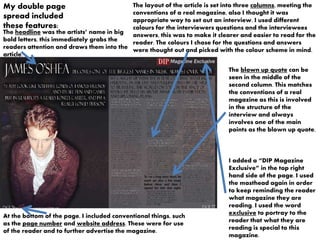
My double page
spread included
these features:
At the bottom of the page, I included conventional things, such
as the page number and website address. These were for use
of the reader and to further advertise the magazine.
The headline was the artists’ name in big
bold letters, this immediately grabs the
readers attention and draws them into the
article.
The layout of the article is set into three columns, meeting the
conventions of a real magazine, also I thought it was
appropriate way to set out an interview. I used different
colours for the interviewers questions and the interviewees
answers, this was to make it clearer and easier to read for the
reader. The colours I chose for the questions and answers
were thought out and picked with the colour scheme in mind.
The blown up quote can be
seen in the middle of the
second column. This matches
the conventions of a real
magazine as this is involved
in the structure of the
interview and always
involves one of the main
points as the blown up quote.
I added a “DIP Magazine
Exclusive” in the top right
hand side of the page. I used
the masthead again in order
to keep reminding the reader
what magazine they are
reading. I used the word
exclusive to portray to the
reader that what they are
reading is special to this
magazine.
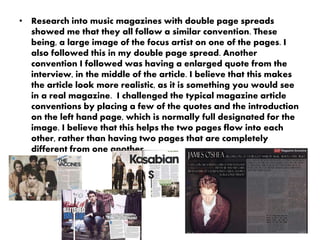
• Research into music magazines with double page spreads
showed me that they all follow a similar convention. These
being, a large image of the focus artist on one of the pages. I
also followed this in my double page spread. Another
convention I followed was having a enlarged quote from the
interview, in the middle of the article. I believe that this makes
the article look more realistic, as it is something you would see
in a real magazine. I challenged the typical magazine article
conventions by placing a few of the quotes and the introduction
on the left hand page, which is normally full designated for the
image. I believe that this helps the two pages flow into each
other, rather than having two pages that are completely
different from one another.

Evaluation Q1

  • 1.
    Evaluation: Question 1 Inwhat ways does your media product use, develop or challenge forms and conventions of real media products?
  • 2.
    In the constructionof my magazine, I tried to use as many conventional magazine features as possible in order for my magazine to look realistic. On my front cover I included: My masthead is in the top left hand corner. The logo of my magazine would grow to be a trademark symbol and would work to draw attention to the magazine. I used a tagline/unique selling point. I put it under my masthead. Because of the masthead creating attention, readers would then read the tagline, so this would encourage them to buy the magazine. I decided to include a left hand third on my magazine because this is part of the codes and conventions of magazines, It is also very informative about what the magazine includes. I also made sure to include artists of my music genre, this made the magazine seem more real. The barcode, issue number, date and price are all situated in the bottom left hand corner. These all help to make the magazine look more realistic, as if it was on sale in a shop. I added a few puffs across the front cover. These were to supply extra information about the content of the magazine, but also to grab the readers attention by advertising relevant information to their interests. In the centre of the page, I placed the image of my artist. I made it as large as I could, within reason, to make it stand out off the page. I also added the lead article/cover story on top of the image, this was to tell the reader who the artist is and what he’s been talking about. Before I started constructing this page, I decided that the colour scheme was going to be red, black and white. This was because I had already created my masthead and taken the photo of my artist and they matched well.
  • 3.
    • My frontcover uses conventional magazine features in many ways. To help me with this I used existing magazine covers, such as the ones below. Ideas I took from the other magazines were, to have the masthead in the top left hand corner of the page. To have a large close up of the artist in the middle of the page. To use a set colour scheme throughout the page. The colour schemes of existing music magazines seemed to be red, white and black more often than not, this helped me in my decision making for my scheme. I also picked up on such things that there is never any space wasted on the front cover, with that in mind I tried to create information to fill any large spaces I had, but still keeping it relevant to the possible reader.
  • 4.
    My contents page includedthese features: For my contents page, I decided to out my masthead in the top left hand corner again, this was to reiterate to the reader what magazine they are reading. I gave the page the title of contents as it is what is done across other magazines and has now became a convention of a contents page. Across the page, I arranged a few pictures and gave then captions for readers to understand. When sourcing images to add, I ensured that they were relevant to the magazine genre. On the left hand side of my contents page, I decided to follow a convention that NME use, which was to add a band index, this is for readers to quickly locate specific bands that they may be looking for. I also think that it makes it look more professional and more like a read magazine. At the bottom of the page, I created and placed an advert for a subscription of the magazine, this could increase sales of the magazine and improve the turnover of the company. I placed sub-headings to make it clear where each section of the front page was being separated. Page references were added whenever there was information on my contents page, this was done to benefit the reader to make it easier for them to read through the magazine and find the information that they are interested in. I carried the colour scheme from the front cover on to the contents page. I decided that I would do this so that my magazine would flow into itself from one page to the next. In the bottom right hand corner, I added a editors note. I decided on this after seeing it in a lot of other magazines I came across when doing my research. It also gives the magazine a personal feel to it.
  • 5.
    • My contentspage layout follows conventional magazine features such as using several images, bold letters and heading. My contents followed a very similar method of layout to that of NME magazine. I followed a convention of grouping text together to make it easier for reader to view and read. I have given all of my sub-headings an outline for the benefit of anyone that reads it, this makes the heading much easier to read and stands out from the black background.
  • 6.
    My double page spreadincluded these features: At the bottom of the page, I included conventional things, such as the page number and website address. These were for use of the reader and to further advertise the magazine. The headline was the artists’ name in big bold letters, this immediately grabs the readers attention and draws them into the article. The layout of the article is set into three columns, meeting the conventions of a real magazine, also I thought it was appropriate way to set out an interview. I used different colours for the interviewers questions and the interviewees answers, this was to make it clearer and easier to read for the reader. The colours I chose for the questions and answers were thought out and picked with the colour scheme in mind. The blown up quote can be seen in the middle of the second column. This matches the conventions of a real magazine as this is involved in the structure of the interview and always involves one of the main points as the blown up quote. I added a “DIP Magazine Exclusive” in the top right hand side of the page. I used the masthead again in order to keep reminding the reader what magazine they are reading. I used the word exclusive to portray to the reader that what they are reading is special to this magazine.
  • 7.
    • Research intomusic magazines with double page spreads showed me that they all follow a similar convention. These being, a large image of the focus artist on one of the pages. I also followed this in my double page spread. Another convention I followed was having a enlarged quote from the interview, in the middle of the article. I believe that this makes the article look more realistic, as it is something you would see in a real magazine. I challenged the typical magazine article conventions by placing a few of the quotes and the introduction on the left hand page, which is normally full designated for the image. I believe that this helps the two pages flow into each other, rather than having two pages that are completely different from one another.