In what ways does your media product use, develop or challenge
forms and conventions of real media products?
My magazine is similar to NME magazine in a way of the way it is presented, for example the main pull
quote is down the right hand side of my page as well as NME etc. however mine is aimed at a completely
different audience.
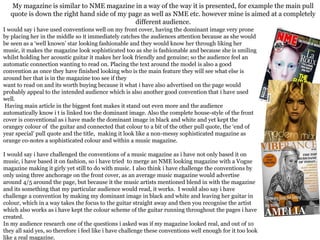
I would say i have used conventions well on my front cover, having the dominant image very prone
by placing her in the middle so it immediately catches the audiences attention because as she would
be seen as a ‘well known’ star looking fashionable and they would know her through liking her
music, it makes the magazine look sophisticated too as she is fashionable and because she is smiling
whilst holding her acoustic guitar it makes her look friendly and genuine; so the audience feel an
automatic connection wanting to read on. Placing the text around the model is also a good
convention as once they have finished looking who is the main feature they will see what else is
around her that is in the magazine too see if they
want to read on and its worth buying because it what i have also advertised on the page would
probably appeal to the intended audience which is also another good convention that i have used
well.
Having main article in the biggest font makes it stand out even more and the audience
automatically know i t is linked too the dominant image. Also the complete house-style of the front
cover is conventional as i have made the dominant image in black and white and yet kept the
orangey colour of the guitar and connected that colour to a bit of the other pull quote, the ‘end of
year special’ pull quote and the title, making it look like a non-messy sophisticated magazine as
orange co-notes a sophisticated colour and within a music magazine.
I would say i have challenged the conventions of a music magazine as i have not only based it on
music, i have based it on fashion, so i have tried to merge an NME looking magazine with a Vogue
magazine making it girly yet still to do with music. I also think i have challenge the conventions by
only using three anchorage on the front cover, as an average music magazine would advertise
around 4/5 around the page, but because it the music artists mentioned blend in with the magazine
and its something that my particular audience would read, it works. I would also say i have
challenge a convention by making my dominant image in black and white and leaving her guitar in
colour, which in a way takes the focus to the guitar straight away and then you recognise the artist
which also works as i have kept the colour scheme of the guitar running throughout the pages i have
created.
In my audience research one of the questions i asked was if my magazine looked real, and out of 10
they all said yes, so therefore i feel like i have challenge these conventions well enough for it too look
like a real magazine.
Name of magazine
Picture of a main feature
and page number
headers
contents
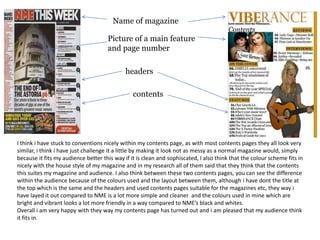
I think i have stuck to conventions nicely within my contents page, as with most contents pages they all look very
similar, i think i have just challenge it a little by making it look not as messy as a normal magazine would, simply
because it fits my audience better this way if it is clean and sophiscated, I also think that the colour scheme fits in
nicely with the house style of my magazine and in my research all of them said that they think that the contents
this suites my magazine and audience. I also think between these two contents pages, you can see the difference
within the audience because of the colours used and the layout between them, although i have dont the title at
the top which is the same and the headers and used contents pages suitable for the magazines etc, they way i
have layed it out compared to NME is a lot more simple and cleaner and the colours used in mine which are
bright and vibrant looks a lot more friendly in a way compared to NME’s black and whites.
Overall i am very happy with they way my contents page has turned out and i am pleased that my audience think
it fits in.
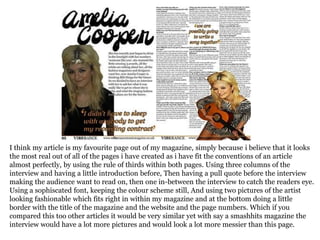
I think my article is my favourite page out of my magazine, simply because i believe that it looks
the most real out of all of the pages i have created as i have fit the conventions of an article
almost perfectly, by using the rule of thirds within both pages. Using three columns of the
interview and having a little introduction before, Then having a pull quote before the interview
making the audience want to read on, then one in-between the interview to catch the readers eye.
Using a sophiscated font, keeping the colour scheme still, And using two pictures of the artist
looking fashionable which fits right in within my magazine and at the bottom doing a little
border with the title of the magazine and the website and the page numbers. Which if you
compared this too other articles it would be very similar yet with say a smashhits magazine the
interview would have a lot more pictures and would look a lot more messier than this page.

Question1

  • 1.
    In what waysdoes your media product use, develop or challenge forms and conventions of real media products?
  • 2.
    My magazine issimilar to NME magazine in a way of the way it is presented, for example the main pull quote is down the right hand side of my page as well as NME etc. however mine is aimed at a completely different audience. I would say i have used conventions well on my front cover, having the dominant image very prone by placing her in the middle so it immediately catches the audiences attention because as she would be seen as a ‘well known’ star looking fashionable and they would know her through liking her music, it makes the magazine look sophisticated too as she is fashionable and because she is smiling whilst holding her acoustic guitar it makes her look friendly and genuine; so the audience feel an automatic connection wanting to read on. Placing the text around the model is also a good convention as once they have finished looking who is the main feature they will see what else is around her that is in the magazine too see if they want to read on and its worth buying because it what i have also advertised on the page would probably appeal to the intended audience which is also another good convention that i have used well. Having main article in the biggest font makes it stand out even more and the audience automatically know i t is linked too the dominant image. Also the complete house-style of the front cover is conventional as i have made the dominant image in black and white and yet kept the orangey colour of the guitar and connected that colour to a bit of the other pull quote, the ‘end of year special’ pull quote and the title, making it look like a non-messy sophisticated magazine as orange co-notes a sophisticated colour and within a music magazine. I would say i have challenged the conventions of a music magazine as i have not only based it on music, i have based it on fashion, so i have tried to merge an NME looking magazine with a Vogue magazine making it girly yet still to do with music. I also think i have challenge the conventions by only using three anchorage on the front cover, as an average music magazine would advertise around 4/5 around the page, but because it the music artists mentioned blend in with the magazine and its something that my particular audience would read, it works. I would also say i have challenge a convention by making my dominant image in black and white and leaving her guitar in colour, which in a way takes the focus to the guitar straight away and then you recognise the artist which also works as i have kept the colour scheme of the guitar running throughout the pages i have created. In my audience research one of the questions i asked was if my magazine looked real, and out of 10 they all said yes, so therefore i feel like i have challenge these conventions well enough for it too look like a real magazine.
  • 3.
    Name of magazine Pictureof a main feature and page number headers contents I think i have stuck to conventions nicely within my contents page, as with most contents pages they all look very similar, i think i have just challenge it a little by making it look not as messy as a normal magazine would, simply because it fits my audience better this way if it is clean and sophiscated, I also think that the colour scheme fits in nicely with the house style of my magazine and in my research all of them said that they think that the contents this suites my magazine and audience. I also think between these two contents pages, you can see the difference within the audience because of the colours used and the layout between them, although i have dont the title at the top which is the same and the headers and used contents pages suitable for the magazines etc, they way i have layed it out compared to NME is a lot more simple and cleaner and the colours used in mine which are bright and vibrant looks a lot more friendly in a way compared to NME’s black and whites. Overall i am very happy with they way my contents page has turned out and i am pleased that my audience think it fits in.
  • 4.
    I think myarticle is my favourite page out of my magazine, simply because i believe that it looks the most real out of all of the pages i have created as i have fit the conventions of an article almost perfectly, by using the rule of thirds within both pages. Using three columns of the interview and having a little introduction before, Then having a pull quote before the interview making the audience want to read on, then one in-between the interview to catch the readers eye. Using a sophiscated font, keeping the colour scheme still, And using two pictures of the artist looking fashionable which fits right in within my magazine and at the bottom doing a little border with the title of the magazine and the website and the page numbers. Which if you compared this too other articles it would be very similar yet with say a smashhits magazine the interview would have a lot more pictures and would look a lot more messier than this page.

Editor's Notes

  • #3 If you have used conventions well, say how and why? If you have challenged conventions well, say how and why? Can your research help this? Audience research ‘does it look real’ .