Empowering
Active TMF
Management
with an eTMF
System
eTMF Bootcamp
Webinar Series
Tuesday, 9 October 2018
2
3
Agenda
LIVE WEBINAR
1. Define passive TMF management and review its
challenges
2. Explore active TMF management, different TMF
management models, and their benefits and
challenges
3. Discuss how to empower active TMF management
through process, people, and technology
House Keeping
4A B O U T T H E C O M P A N Y
5
House
Keeping
L I V E W E B I N A R
• This webinar is being recorded and
will be made available after this
session
• Feel free to use the chatbox to
submit your questions at anytime
• Q&A will take place at the end of
the webinar
6
Meet Your
Speakers
.
Paul Fenton—
CEO, Montrium
Jackie Morrill—
Executive Director of
Clinical Operations,LMK
Clinical Research
Consulting
Passive TMF Management
– A historical way of
working
S E C T I O N # 1
7A B O U T T H E C O M P A N Y
8
What is Passive
TMF Management?
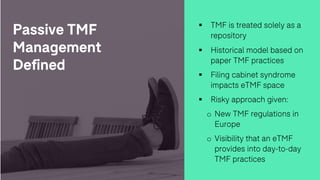
Passive TMF
Management
Defined
§ TMF is treated solely as a
repository
§ Historical model based on
paper TMF practices
§ Filing cabinet syndrome
impacts eTMF space
§ Risky approach given:
o New TMF regulations in
Europe
o Visibility that an eTMF
provides into day-to-day
TMF practices
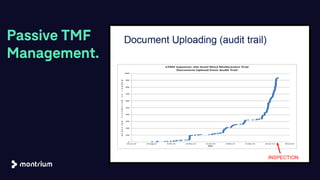
Passive TMF
Management.
11
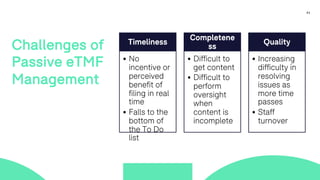
Challenges of
Passive eTMF
Management
Timeliness
• No
incentive or
perceived
benefit of
filing in real
time
• Falls to the
bottom of
the To Do
list
Completene
ss
• Difficult to
get content
• Difficult to
perform
oversight
when
content is
incomplete
Quality
• Increasing
difficulty in
resolving
issues as
more time
passes
• Staff
turnover
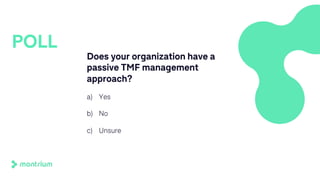
Does your organization have a
passive TMF management
approach?
a) Yes
b) No
c) Unsure
POLL
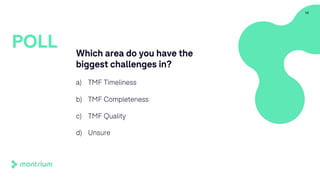
Which area do you have the
biggest challenges in?
a) TMF Timeliness
b) TMF Completeness
c) TMF Quality
d) Unsure
13
POLL
14
What is the
Alternative?
Active TMF Management –
A new way of working
S E C T I O N # 2
15A B O U T T H E C O M P A N Y
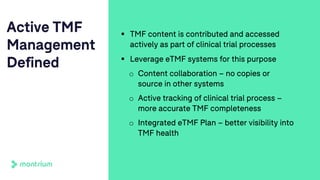
Active TMF
Management
Defined
§ TMF content is contributed and accessed
actively as part of clinical trial processes
§ Leverage eTMF systems for this purpose
o Content collaboration – no copies or
source in other systems
o Active tracking of clinical trial process –
more accurate TMF completeness
o Integrated eTMF Plan – better visibility into
TMF health
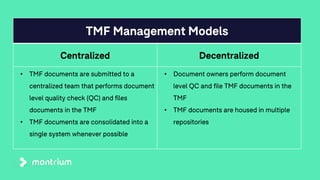
TMF Management Models
Centralized Decentralized
• TMF documents are submitted to a
centralized team that performs document
level quality check (QC) and files
documents in the TMF
• TMF documents are consolidated into a
single system whenever possible
• Document owners perform document
level QC and file TMF documents in the
TMF
• TMF documents are housed in multiple
repositories
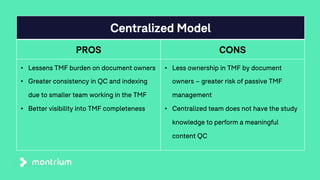
Centralized Model
PROS CONS
• Lessens TMF burden on document owners
• Greater consistency in QC and indexing
due to smaller team working in the TMF
• Better visibility into TMF completeness
• Less ownership in TMF by document
owners – greater risk of passive TMF
management
• Centralized team does not have the study
knowledge to perform a meaningful
content QC
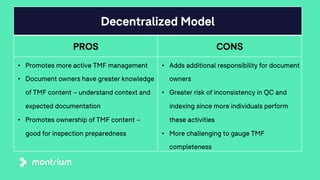
Decentralized Model
PROS CONS
• Promotes more active TMF management
• Document owners have greater knowledge
of TMF content – understand context and
expected documentation
• Promotes ownership of TMF content –
good for inspection preparedness
• Adds additional responsibility for document
owners
• Greater risk of inconsistency in QC and
indexing since more individuals perform
these activities
• More challenging to gauge TMF
completeness
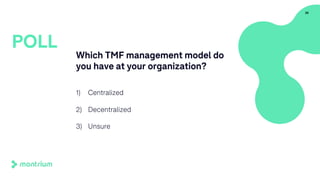
Which TMF management model do
you have at your organization?
1) Centralized
2) Decentralized
3) Unsure
20
POLL
21
How do we get
there?
Roadmap –
Chart a course for success
S E C T I O N # 3
22A B O U T T H E C O M P A N Y
23
Process
24
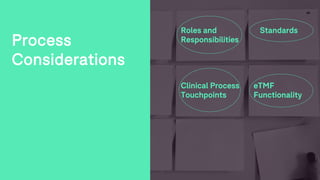
Process
Considerations
Roles and
Responsibilities
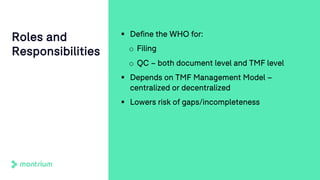
Standards
Clinical Process
Touchpoints
eTMF
Functionality
§ Define the WHO for:
o Filing
o QC – both document level and TMF level
§ Depends on TMF Management Model –
centralized or decentralized
§ Lowers risk of gaps/incompleteness
Roles and
Responsibilities
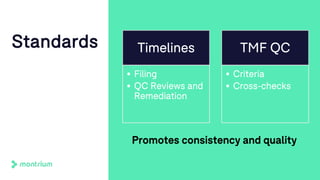
Promotes consistency and quality
Standards Timelines
• Filing
• QC Reviews and
Remediation
TMF QC
• Criteria
• Cross-checks
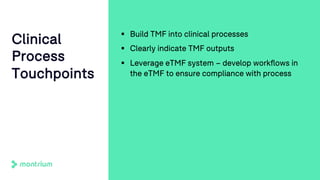
§ Build TMF into clinical processes
§ Clearly indicate TMF outputs
§ Leverage eTMF system – develop workflows in
the eTMF to ensure compliance with process
Clinical
Process
Touchpoints
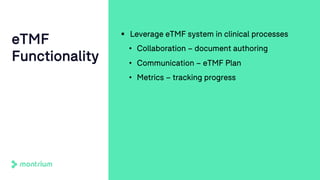
§ Leverage eTMF system in clinical processes
• Collaboration – document authoring
• Communication – eTMF Plan
• Metrics – tracking progress
eTMF
Functionality
29
People
30
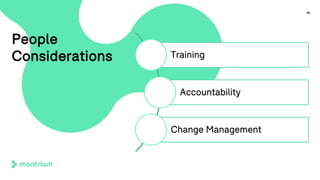
People
Considerations Training
Accountability
Change Management
31
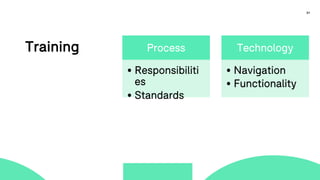
Training Process
• Responsibiliti
es
• Standards
Technology
• Navigation
• Functionality
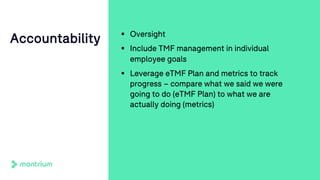
§ Oversight
§ Include TMF management in individual
employee goals
§ Leverage eTMF Plan and metrics to track
progress – compare what we said we were
going to do (eTMF Plan) to what we are
actually doing (metrics)
Accountability
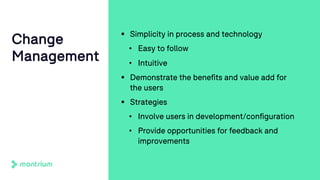
§ Simplicity in process and technology
• Easy to follow
• Intuitive
§ Demonstrate the benefits and value add for
the users
§ Strategies
• Involve users in development/configuration
• Provide opportunities for feedback and
improvements
Change
Management
Technology
Not All eTMF
Solutions are
Created Equal.
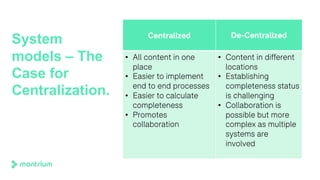
System
models – The
Case for
Centralization.
Centralized De-Centralized
• All content in one
place
• Easier to implement
end to end processes
• Easier to calculate
completeness
• Promotes
collaboration
• Content in different
locations
• Establishing
completeness status
is challenging
• Collaboration is
possible but more
complex as multiple
systems are
involved
Completeness
Calculations
• Completeness calculations are
complex
• Many systems today claim that
they can calculate completeness,
however accuracy is a big issue
• Most systems base completeness
on milestones and expected
document counts
• To truly be able to calculate
accurate completeness we need
more information…
• Information may not be in the
eTMF but in other clinical systems
38
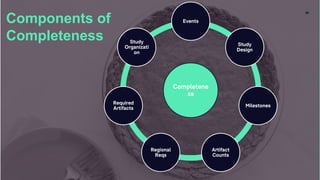
Components of
Completeness
Completene
ss
Events
Study
Design
Milestones
Artifact
Counts
Regional
Reqs
Required
Artifacts
Study
Organizati
on
Predictive
Completeness
and
Placeholders
§ To be able to adequately calculate
completeness requirements in the future all
components of completeness need to be
taken into account
§ By being able to predict required artifacts as
milestones and as events occur means that
we can improve accuracy of completeness
and also prompt stakeholders to provide
content
§ Placeholders can also be tracked for
timeliness based on predefined upload
periods and milestones
§ As systems become more intelligent and
predictive, completeness will improve
Placeholders/
Signposts for
external
systems
§ TMFs today are not just about documents
held in the eTMF
§ Other systems such as EDC, CTMS, Safety
and regulatory systems may hold documents
or data which are considered TMF relevant
§ If possible you should indicate which systems
are holding this information within the eTMF
plan
§ Better still, the system will have the ability to
generate placeholders and/or signposts
which can point to artifacts in other systems
§ Signpost significantly facilitate inspections
and contribute to completeness calculations
Collaboration § eTMF IS NOT JUST A REPOSITORY
§ Most eTMF systems have collaborative
features which allow you to author, review
and approve artifacts directly within the
system
§ By collaborating in the creation of content
within the eTMF, we can significantly improve
timeliness and completeness and avoid
issues such as incorrect versions
§ Workflows help drive processes and also
improve compliance with SOPs
§ Collaboration can be both internal and
external
Use of
Templates
§ Many eTMF solutions provide the ability to
store and distribute templates
§ Templates are useful for facilitating the
authoring of artifacts but also for ensuring
compliance with SOPs
§ Templates also typically improve the quality
of content and can ideally be leveraged
automatically when a placeholder is created
Risk based
QC/review
§ Regulatory authorities are focused on
sponsors taking a risk based approach to
clinical trials
§ 100% QC does not necessarily equal 100%
quality
§ Large volumes of artifacts make QC
laborious and error prone
§ Taking a risk based approach based on
criticality of the clinical process/event and
other factors would allow for a more targeted
QC/review
§ Implementing risk based algorithms to
identify potential risks and target QC
activities is the next step for eTMF systems
Active
content
exchange
using the
eTMF-EMS
§ If you are working in a decentralized model,
exchanging artifacts can be challenging
§ The eTMF-EMS standard will help with
automated transfers from one eTMF to
another
§ Place holders can be filled by automatically
transferring either copies or authoritative
source from other systems
§ This would allow for a centralized-like eTMF
§ For more information on the eTMF-EMS visit
http://tmfrefmodel.com/ems
Features
required for
active TMF
management
§ Ability to author documents directly
within the eTMF
§ Workflows that help drive active
collaboration
§ Ability to project what artifacts are
required in the TMF and generate
placeholders
§ Ability to create sign-posts to other
systems
§ Ability to predict required artifacts
based on completeness components
§ Ability to perform risk based QC
46
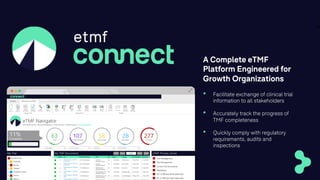
• Facilitate exchange of clinical trial
information to all stakeholders
• Accurately track the progress of
TMF completeness
• Quickly comply with regulatory
requirements, audits and
inspections
A Complete eTMF
Platform Engineered for
Growth Organizations
Are you interested in receiving
more information about eTMF
Connect?
1) Yes, could be useful
2) No, not interested
47
POLL
A B O U T T H E C O M P A N Y
QUESTIONS?
48A B O U T T H E C O M P A N Y
INFO@MONTRIUM.COM
Thank You!

Empowering active tmf management

  • 2.
    Empowering Active TMF Management with aneTMF System eTMF Bootcamp Webinar Series Tuesday, 9 October 2018 2
  • 3.
    3 Agenda LIVE WEBINAR 1. Definepassive TMF management and review its challenges 2. Explore active TMF management, different TMF management models, and their benefits and challenges 3. Discuss how to empower active TMF management through process, people, and technology
  • 4.
    House Keeping 4A BO U T T H E C O M P A N Y
  • 5.
    5 House Keeping L I VE W E B I N A R • This webinar is being recorded and will be made available after this session • Feel free to use the chatbox to submit your questions at anytime • Q&A will take place at the end of the webinar
  • 6.
    6 Meet Your Speakers . Paul Fenton— CEO,Montrium Jackie Morrill— Executive Director of Clinical Operations,LMK Clinical Research Consulting
  • 7.
    Passive TMF Management –A historical way of working S E C T I O N # 1 7A B O U T T H E C O M P A N Y
  • 8.
  • 9.
    Passive TMF Management Defined § TMFis treated solely as a repository § Historical model based on paper TMF practices § Filing cabinet syndrome impacts eTMF space § Risky approach given: o New TMF regulations in Europe o Visibility that an eTMF provides into day-to-day TMF practices
  • 10.
  • 11.
    11 Challenges of Passive eTMF Management Timeliness •No incentive or perceived benefit of filing in real time • Falls to the bottom of the To Do list Completene ss • Difficult to get content • Difficult to perform oversight when content is incomplete Quality • Increasing difficulty in resolving issues as more time passes • Staff turnover
  • 12.
    Does your organizationhave a passive TMF management approach? a) Yes b) No c) Unsure POLL
  • 13.
    Which area doyou have the biggest challenges in? a) TMF Timeliness b) TMF Completeness c) TMF Quality d) Unsure 13 POLL
  • 14.
  • 15.
    Active TMF Management– A new way of working S E C T I O N # 2 15A B O U T T H E C O M P A N Y
  • 16.
    Active TMF Management Defined § TMFcontent is contributed and accessed actively as part of clinical trial processes § Leverage eTMF systems for this purpose o Content collaboration – no copies or source in other systems o Active tracking of clinical trial process – more accurate TMF completeness o Integrated eTMF Plan – better visibility into TMF health
  • 17.
    TMF Management Models CentralizedDecentralized • TMF documents are submitted to a centralized team that performs document level quality check (QC) and files documents in the TMF • TMF documents are consolidated into a single system whenever possible • Document owners perform document level QC and file TMF documents in the TMF • TMF documents are housed in multiple repositories
  • 18.
    Centralized Model PROS CONS •Lessens TMF burden on document owners • Greater consistency in QC and indexing due to smaller team working in the TMF • Better visibility into TMF completeness • Less ownership in TMF by document owners – greater risk of passive TMF management • Centralized team does not have the study knowledge to perform a meaningful content QC
  • 19.
    Decentralized Model PROS CONS •Promotes more active TMF management • Document owners have greater knowledge of TMF content – understand context and expected documentation • Promotes ownership of TMF content – good for inspection preparedness • Adds additional responsibility for document owners • Greater risk of inconsistency in QC and indexing since more individuals perform these activities • More challenging to gauge TMF completeness
  • 20.
    Which TMF managementmodel do you have at your organization? 1) Centralized 2) Decentralized 3) Unsure 20 POLL
  • 21.
    21 How do weget there?
  • 22.
    Roadmap – Chart acourse for success S E C T I O N # 3 22A B O U T T H E C O M P A N Y
  • 23.
  • 24.
  • 25.
    § Define theWHO for: o Filing o QC – both document level and TMF level § Depends on TMF Management Model – centralized or decentralized § Lowers risk of gaps/incompleteness Roles and Responsibilities
  • 26.
    Promotes consistency andquality Standards Timelines • Filing • QC Reviews and Remediation TMF QC • Criteria • Cross-checks
  • 27.
    § Build TMFinto clinical processes § Clearly indicate TMF outputs § Leverage eTMF system – develop workflows in the eTMF to ensure compliance with process Clinical Process Touchpoints
  • 28.
    § Leverage eTMFsystem in clinical processes • Collaboration – document authoring • Communication – eTMF Plan • Metrics – tracking progress eTMF Functionality
  • 29.
  • 30.
  • 31.
    31 Training Process • Responsibiliti es •Standards Technology • Navigation • Functionality
  • 32.
    § Oversight § IncludeTMF management in individual employee goals § Leverage eTMF Plan and metrics to track progress – compare what we said we were going to do (eTMF Plan) to what we are actually doing (metrics) Accountability
  • 33.
    § Simplicity inprocess and technology • Easy to follow • Intuitive § Demonstrate the benefits and value add for the users § Strategies • Involve users in development/configuration • Provide opportunities for feedback and improvements Change Management
  • 34.
  • 35.
    Not All eTMF Solutionsare Created Equal.
  • 36.
    System models – The Casefor Centralization. Centralized De-Centralized • All content in one place • Easier to implement end to end processes • Easier to calculate completeness • Promotes collaboration • Content in different locations • Establishing completeness status is challenging • Collaboration is possible but more complex as multiple systems are involved
  • 37.
    Completeness Calculations • Completeness calculationsare complex • Many systems today claim that they can calculate completeness, however accuracy is a big issue • Most systems base completeness on milestones and expected document counts • To truly be able to calculate accurate completeness we need more information… • Information may not be in the eTMF but in other clinical systems
  • 38.
  • 39.
    Predictive Completeness and Placeholders § To beable to adequately calculate completeness requirements in the future all components of completeness need to be taken into account § By being able to predict required artifacts as milestones and as events occur means that we can improve accuracy of completeness and also prompt stakeholders to provide content § Placeholders can also be tracked for timeliness based on predefined upload periods and milestones § As systems become more intelligent and predictive, completeness will improve
  • 40.
    Placeholders/ Signposts for external systems § TMFstoday are not just about documents held in the eTMF § Other systems such as EDC, CTMS, Safety and regulatory systems may hold documents or data which are considered TMF relevant § If possible you should indicate which systems are holding this information within the eTMF plan § Better still, the system will have the ability to generate placeholders and/or signposts which can point to artifacts in other systems § Signpost significantly facilitate inspections and contribute to completeness calculations
  • 41.
    Collaboration § eTMFIS NOT JUST A REPOSITORY § Most eTMF systems have collaborative features which allow you to author, review and approve artifacts directly within the system § By collaborating in the creation of content within the eTMF, we can significantly improve timeliness and completeness and avoid issues such as incorrect versions § Workflows help drive processes and also improve compliance with SOPs § Collaboration can be both internal and external
  • 42.
    Use of Templates § ManyeTMF solutions provide the ability to store and distribute templates § Templates are useful for facilitating the authoring of artifacts but also for ensuring compliance with SOPs § Templates also typically improve the quality of content and can ideally be leveraged automatically when a placeholder is created
  • 43.
    Risk based QC/review § Regulatoryauthorities are focused on sponsors taking a risk based approach to clinical trials § 100% QC does not necessarily equal 100% quality § Large volumes of artifacts make QC laborious and error prone § Taking a risk based approach based on criticality of the clinical process/event and other factors would allow for a more targeted QC/review § Implementing risk based algorithms to identify potential risks and target QC activities is the next step for eTMF systems
  • 44.
    Active content exchange using the eTMF-EMS § Ifyou are working in a decentralized model, exchanging artifacts can be challenging § The eTMF-EMS standard will help with automated transfers from one eTMF to another § Place holders can be filled by automatically transferring either copies or authoritative source from other systems § This would allow for a centralized-like eTMF § For more information on the eTMF-EMS visit http://tmfrefmodel.com/ems
  • 45.
    Features required for active TMF management §Ability to author documents directly within the eTMF § Workflows that help drive active collaboration § Ability to project what artifacts are required in the TMF and generate placeholders § Ability to create sign-posts to other systems § Ability to predict required artifacts based on completeness components § Ability to perform risk based QC
  • 46.
    46 • Facilitate exchangeof clinical trial information to all stakeholders • Accurately track the progress of TMF completeness • Quickly comply with regulatory requirements, audits and inspections A Complete eTMF Platform Engineered for Growth Organizations
  • 47.
    Are you interestedin receiving more information about eTMF Connect? 1) Yes, could be useful 2) No, not interested 47 POLL A B O U T T H E C O M P A N Y
  • 48.
    QUESTIONS? 48A B OU T T H E C O M P A N Y
  • 49.