Essential Documents and Managing Trial Files
–
the Legal Background and What you Must Have


 Janice Hedgecock, FICR     Nicky Dodsworth, MICR
 ICR GCP Steering Group     ICR GCP Steering Group
 Director, Greatspur        Senior Director, Global
 Clinical Development Ltd   Quality Assurance
                                    Assurance,
                            Premier Research Group Ltd
Content

• The legal background

• TMF requirements
        q

• Hints and tips
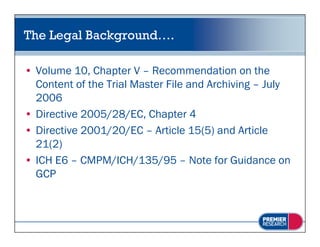
The Legal Background….

• Volume 10, Chapter V – Recommendation on the
  Content of the Trial Master File and Archiving – July
  2006
• Directive 2005/28/EC, Chapter 4
• Directive 2001/20/EC – Article 15(5) and Article
  21(2)
• ICH E6 – CMPM/ICH/135/95 – Note for Guidance on
  GCP
Requirements of the TMF (Vol 10, Chap V)

• Essential documents – which enable both the conduct
  of a clinical trial and the quality of the data to be
  evaluated according to Article 16 2005/28/EC.
• Filed in an organised way that will facilitate
  management of the clinical trial, audit and inspection.
• Unambiguous, signed and dated as appropriate
• Retained securely prior to archive and then archived
  for sufficient periods to allow for audit and inspection
  by regulatory authorities and should be readily
  available on request.
Volume 10, Chapter V - Contents

• Guidance on the content of TMF
• Retention requirements for essential documents
  (Investigator, Sponsor/CRO and others)
• Details on:
      - Minimum set of documents to be retained
      - Quality of documents to be archived
      - Minimum standards for storage conditions,
                                      g         ,
        media transfer and certified copies
      - Retention times
What are Essential Documents?


 ‘Essential documents are those
 documents which individually and
 collectively permit evaluation of the
 conduct of a trial and the quality of the
     d t f t i l d th           lit f th
 data produced.’
Importance of Essential Documents

• Demonstrate compliance of the Investigator,
  Sponsor/CRO, Monitor with GCP standards and
  applicable regulatory requirements.
• Timely filing greatly assists in successful management
  of a trial by the Investigator, Sponsor/CRO, Monitor.
• These files are vital in the audit/inspection process to
  demonstrate validity of trial conduct and integrity of
  the data
      data.
How are Documents Filed? (High level)

• According to the stage of the trial
     - Before the clinical phase
     - During clinical conduct
             g
     - After completion/termination of trial

• According to the file type
     - Investigator
     - Sponsor/CRO
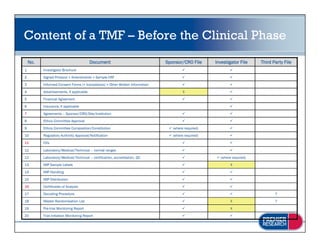
Content of a TMF – Before the Clinical Phase
    No.                                   Document                              Sponsor/CRO File      Investigator File    Third Party File
1         Investigator Brochure

2         Signed Protocol + Amendments + Sample CRF

3         Informed Consent Forms (+ translations) + Other Written Information

4         Advertisements, if applicable                                                  X

5         Financial Agreement

6         Insurance, if applicable
                   ,     pp

7         Agreements – Sponsor/CRO/Site/Institution

8         Ethics Committee Approval

9         Ethics Committee Composition/Constitution                                (where required)

10        Regulatory Authority Approval/Notification                               (where required)

11        CVs

12        Laboratory/Medical/Technical – normal ranges

12        Laboratory/Medical/Technical – certification, accreditation, QC                               (where required)

13        IMP Sample Labels                                                                                   X

14        IMP Handling

15        IMP Distribution

16        Certificates of Analysis

17        Decoding Procedure                                                                                                      ?
18        Master Randomisation List                                                                           X                   ?

19        Pre-trial Monitoring Report                                                                         X

20        Trial Initiation Monitoring Report
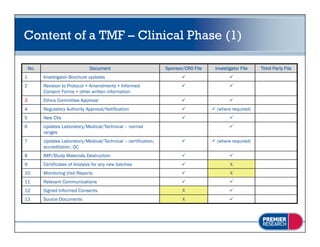
Content of a TMF – Clinical Phase (1)

    No.                         Document                          Sponsor/CRO File   Investigator File   Third Party File
1         Investigator Brochure updates
2         Revision to Protocol + Amendments + Informed
          Consent Forms + other written information
3         Ethics Committee Approval
4         Regulatory Authority Approval/Notification
          R g l t    A th it A        l/N tifi ti                                    (where required)
                                                                                     ( h        i d)
5         New CVs
6         Updates Laboratory/Medical/Technical – normal
          ranges
7         Updates Laboratory/Medical/Technical – certification,                      (where required)
          accreditation, QC
8         IMP/Study Materials Destruction
9         Certificates of Analysis for any new batches                                      X
10        Monitoring Visit Reports                                                          X
11        Relevant Communications
12        Signed Informed Consents                                       X
13        Source Documents                                               X
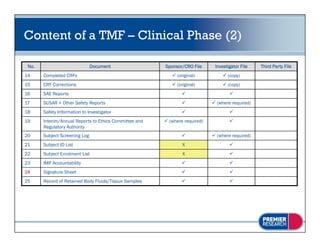
Content of a TMF – Clinical Phase (2)

 No.                           Document                 Sponsor/CRO File    Investigator File   Third Party File
14     Completed CRFs                                        (original)           (copy)
15     CRF Corrections                                       (original)           (copy)
16     SAE Reports
17     SUSAR + Other Safety Reports                                         (where required)
18     Safety Information to Investigator
19     Interim/Annual Reports to Ethics Committee and    (where required)
       Regulatory Authority
20     Subject Screening Log                                                (where required)
21     Subject ID List                                         X
22     Subject Enrolment List                                  X
23     IMP Accountability
24     Signature Sheet
25     Record of Retained Body Fluids/Tissue Samples
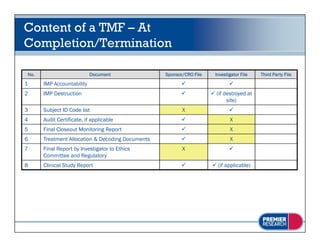
Content of a TMF – At
Completion/Termination

No.                        Document               Sponsor/CRO File
                                                   p     /           Investigator File
                                                                            g            Third Party File
                                                                                                   y
1     IMP Accountability
2     IMP Destruction                                                (if destroyed at
                                                                          site)
3     Subject ID Code list                               X
4     Audit Certificate, if applicable                                      X
5     Final Closeout Monitoring Report                                      X
6     Treatment Allocation & Decoding Documents                             X
7     Final Report by Investigator to Ethics             X
      Committee and Regulatory
8     Clinical Study Report                                           (if applicable)
Media to be Used (1)

• 2005/28/EC (Article 20) states:


  ‘The media used to store essential documents
   The
  shall be such that those documents remain
  complete and legible throughout the required
  period of retention and can be made available
  to the competent authorities on request. Any
  alteration to records shall be traceable.’
Media to be Used (2)

• Storage on electronic, magnetic, optical or other non-
  indelible media cannot be altered without appropriate
  authorisation and the creation of an audit trail.
• Any transfer of data requires validated equipment to
  ensure data cannot be lost/altered. Transfers need to
  be
  b certified b someone with appropriate authority.
         tifi d by           ith         i t   th it
• Appropriate equipment is required for processing to
  render records into readable format
                                 format.
Storage Conditions

• Volume 10, Chapter 5
  (legible, ready for inspection, record change in location, adequate space,
  environmental controls, protect from physical damage)
• ICH E6
  (use of subcontractor, sponsor ultimately responsible, Investigator make
  sponsor aware of storage arrangements, change of ownership and location,
  may use commercial archive, personal data → 95/46/EC)
• 2005/28/EC (Article 19)
  (appoint individuals responsible for archiving restricted access and
                                       archiving,
  withdrawals by named individuals, index/log, tracking and retrieval system)
Duration of Retention


• 2005/28/EC (Articles 17 and 18)

• 2001/83/EC (as amended by Directive 2003/63/EC)
Inspection Findings - Examples

• Inadequate validation [of pivotal computer systems
  (e.g.
  (e g databases)]
• Lack of source documentation of physical exam,
  medical history, concomitant medication, p
                y,                          , primary
                                                    y
  endpoints, key safety assessments
• Evidence of TMF not being maintained as current
• Sig d consent f
  Signed         t forms missing
                            i i g
• Lack of documentation of decisions
• Inadequate facilities for archives and long term
  document retention (archivist, security, environmental
  control, access control, fire prevention)
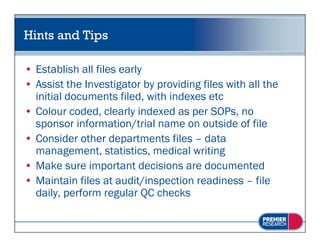
Hints and Tips

• Establish all files early
• Assist the Investigator by providing files with all the
  initial documents filed, with indexes etc
•C l
  Colour coded, clearly indexed as per SOPs, no
             d d l l i d d               SOP
  sponsor information/trial name on outside of file
• Consider other departments files – data
  management, statistics, medical writing
• Make sure important decisions are documented
                  p
• Maintain files at audit/inspection readiness – file
  daily, perform regular QC checks
Essential documents and_managing_trial_files

Essential documents and_managing_trial_files

  • 1.
    Essential Documents andManaging Trial Files – the Legal Background and What you Must Have Janice Hedgecock, FICR Nicky Dodsworth, MICR ICR GCP Steering Group ICR GCP Steering Group Director, Greatspur Senior Director, Global Clinical Development Ltd Quality Assurance Assurance, Premier Research Group Ltd
  • 2.
    Content • The legalbackground • TMF requirements q • Hints and tips
  • 3.
    The Legal Background…. •Volume 10, Chapter V – Recommendation on the Content of the Trial Master File and Archiving – July 2006 • Directive 2005/28/EC, Chapter 4 • Directive 2001/20/EC – Article 15(5) and Article 21(2) • ICH E6 – CMPM/ICH/135/95 – Note for Guidance on GCP
  • 4.
    Requirements of theTMF (Vol 10, Chap V) • Essential documents – which enable both the conduct of a clinical trial and the quality of the data to be evaluated according to Article 16 2005/28/EC. • Filed in an organised way that will facilitate management of the clinical trial, audit and inspection. • Unambiguous, signed and dated as appropriate • Retained securely prior to archive and then archived for sufficient periods to allow for audit and inspection by regulatory authorities and should be readily available on request.
  • 5.
    Volume 10, ChapterV - Contents • Guidance on the content of TMF • Retention requirements for essential documents (Investigator, Sponsor/CRO and others) • Details on: - Minimum set of documents to be retained - Quality of documents to be archived - Minimum standards for storage conditions, g , media transfer and certified copies - Retention times
  • 6.
    What are EssentialDocuments? ‘Essential documents are those documents which individually and collectively permit evaluation of the conduct of a trial and the quality of the d t f t i l d th lit f th data produced.’
  • 7.
    Importance of EssentialDocuments • Demonstrate compliance of the Investigator, Sponsor/CRO, Monitor with GCP standards and applicable regulatory requirements. • Timely filing greatly assists in successful management of a trial by the Investigator, Sponsor/CRO, Monitor. • These files are vital in the audit/inspection process to demonstrate validity of trial conduct and integrity of the data data.
  • 8.
    How are DocumentsFiled? (High level) • According to the stage of the trial - Before the clinical phase - During clinical conduct g - After completion/termination of trial • According to the file type - Investigator - Sponsor/CRO
  • 9.
    Content of aTMF – Before the Clinical Phase No. Document Sponsor/CRO File Investigator File Third Party File 1 Investigator Brochure 2 Signed Protocol + Amendments + Sample CRF 3 Informed Consent Forms (+ translations) + Other Written Information 4 Advertisements, if applicable X 5 Financial Agreement 6 Insurance, if applicable , pp 7 Agreements – Sponsor/CRO/Site/Institution 8 Ethics Committee Approval 9 Ethics Committee Composition/Constitution (where required) 10 Regulatory Authority Approval/Notification (where required) 11 CVs 12 Laboratory/Medical/Technical – normal ranges 12 Laboratory/Medical/Technical – certification, accreditation, QC (where required) 13 IMP Sample Labels X 14 IMP Handling 15 IMP Distribution 16 Certificates of Analysis 17 Decoding Procedure ? 18 Master Randomisation List X ? 19 Pre-trial Monitoring Report X 20 Trial Initiation Monitoring Report
  • 10.
    Content of aTMF – Clinical Phase (1) No. Document Sponsor/CRO File Investigator File Third Party File 1 Investigator Brochure updates 2 Revision to Protocol + Amendments + Informed Consent Forms + other written information 3 Ethics Committee Approval 4 Regulatory Authority Approval/Notification R g l t A th it A l/N tifi ti (where required) ( h i d) 5 New CVs 6 Updates Laboratory/Medical/Technical – normal ranges 7 Updates Laboratory/Medical/Technical – certification, (where required) accreditation, QC 8 IMP/Study Materials Destruction 9 Certificates of Analysis for any new batches X 10 Monitoring Visit Reports X 11 Relevant Communications 12 Signed Informed Consents X 13 Source Documents X
  • 11.
    Content of aTMF – Clinical Phase (2) No. Document Sponsor/CRO File Investigator File Third Party File 14 Completed CRFs (original) (copy) 15 CRF Corrections (original) (copy) 16 SAE Reports 17 SUSAR + Other Safety Reports (where required) 18 Safety Information to Investigator 19 Interim/Annual Reports to Ethics Committee and (where required) Regulatory Authority 20 Subject Screening Log (where required) 21 Subject ID List X 22 Subject Enrolment List X 23 IMP Accountability 24 Signature Sheet 25 Record of Retained Body Fluids/Tissue Samples
  • 12.
    Content of aTMF – At Completion/Termination No. Document Sponsor/CRO File p / Investigator File g Third Party File y 1 IMP Accountability 2 IMP Destruction (if destroyed at site) 3 Subject ID Code list X 4 Audit Certificate, if applicable X 5 Final Closeout Monitoring Report X 6 Treatment Allocation & Decoding Documents X 7 Final Report by Investigator to Ethics X Committee and Regulatory 8 Clinical Study Report (if applicable)
  • 13.
    Media to beUsed (1) • 2005/28/EC (Article 20) states: ‘The media used to store essential documents The shall be such that those documents remain complete and legible throughout the required period of retention and can be made available to the competent authorities on request. Any alteration to records shall be traceable.’
  • 14.
    Media to beUsed (2) • Storage on electronic, magnetic, optical or other non- indelible media cannot be altered without appropriate authorisation and the creation of an audit trail. • Any transfer of data requires validated equipment to ensure data cannot be lost/altered. Transfers need to be b certified b someone with appropriate authority. tifi d by ith i t th it • Appropriate equipment is required for processing to render records into readable format format.
  • 15.
    Storage Conditions • Volume10, Chapter 5 (legible, ready for inspection, record change in location, adequate space, environmental controls, protect from physical damage) • ICH E6 (use of subcontractor, sponsor ultimately responsible, Investigator make sponsor aware of storage arrangements, change of ownership and location, may use commercial archive, personal data → 95/46/EC) • 2005/28/EC (Article 19) (appoint individuals responsible for archiving restricted access and archiving, withdrawals by named individuals, index/log, tracking and retrieval system)
  • 16.
    Duration of Retention •2005/28/EC (Articles 17 and 18) • 2001/83/EC (as amended by Directive 2003/63/EC)
  • 17.
    Inspection Findings -Examples • Inadequate validation [of pivotal computer systems (e.g. (e g databases)] • Lack of source documentation of physical exam, medical history, concomitant medication, p y, , primary y endpoints, key safety assessments • Evidence of TMF not being maintained as current • Sig d consent f Signed t forms missing i i g • Lack of documentation of decisions • Inadequate facilities for archives and long term document retention (archivist, security, environmental control, access control, fire prevention)
  • 18.
    Hints and Tips •Establish all files early • Assist the Investigator by providing files with all the initial documents filed, with indexes etc •C l Colour coded, clearly indexed as per SOPs, no d d l l i d d SOP sponsor information/trial name on outside of file • Consider other departments files – data management, statistics, medical writing • Make sure important decisions are documented p • Maintain files at audit/inspection readiness – file daily, perform regular QC checks