Overview and Version 3.1.0
The sponsor and the investigator shall keep a clinical trial master
file. The clinical trial master file shall at all times contain the
essential documents relating to that clinical trial which allow
verification of the conduct of a clinical trial and the quality of the
data generated […]. It shall be readily available, and directly
accessible upon request, to the Member States.
[EU Regulation 536/2014]
Essential documents are those documents that individually
and collectively permit evaluation of the conduct of a trial
and the quality of the data produced. These documents
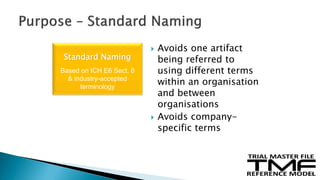
serve to demonstrate the compliance of the investigator,
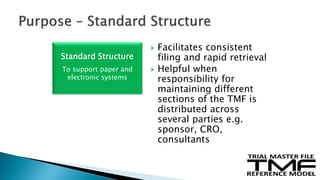
sponsor, and monitor with the standards of GCP and with
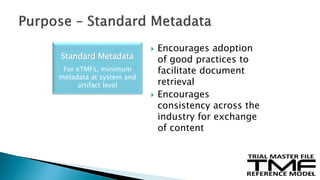
all applicable regulatory requirements.
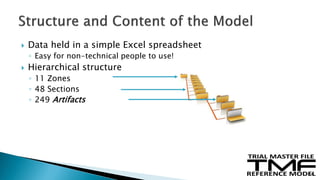
[ICH GCP, Section 8.1]
 ICH GCP Section 8.2 – 8.4
 “The minimum list of essential documents that has been
developed.....”
 ICH GCP does NOT provide a comprehensive contents list for
the TMF
◦ Examples of missing documentation:
 Electronic systems
 Data management and statistical methodology
 Safety monitoring
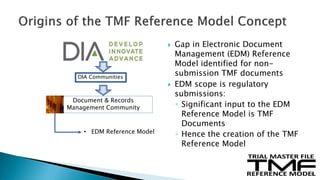
 Gap in Electronic Document
Management (EDM) Reference
Model identified for non-
submission TMF documents
 EDM scope is regulatory
submissions:
◦ Significant input to the EDM
Reference Model is TMF
Documents
◦ Hence the creation of the TMF
Reference Model
5
DIA Communities
Document & Records
Management Community
• EDM Reference Model
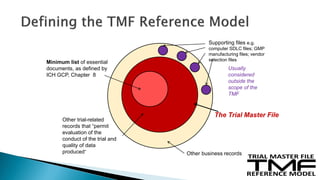
Other business records
Supporting files e.g.
computer SDLC files; GMP
manufacturing files; vendor
selection files
Usually
considered
outside the
scope of the
TMF
Other trial-related
records that “permit
evaluation of the
conduct of the trial and
quality of data
produced”
Minimum list of essential
documents, as defined by
ICH GCP, Chapter 8
The Trial Master File
 Standardizes company content and structure and limits
company customization
◦ We all follow the same regulatory requirements
◦ Inspectors are the same across companies
◦ Company-specific requirements are often driven by tradition, legacy or
personal opinion
 Simplifies engagement of CROs and other third parties
 Simplifies consolidation of disparate documents into a single
TMF structure (in real time, at defined trial events and/or at
study end)
7
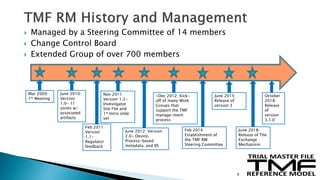
 Managed by a Steering Committee of 14 members
 Change Control Board
 Extended Group of over 700 members
June 2010:
Version
1.0- 11
zones w/
associated
artifacts
Feb 2011:
Version
1.1-
Regulator
feedback
Nov 2011:
Version 1.2-
Investigator
Site File and
1st Intro slide
set
June 2012: Version
2.0- Device,
Process-based
metadata, and IIS
Mar 2009:
1st Meeting
~Dec 2012: Kick-
off of many Work
Groups that
support the TMF
manage-ment
process
Feb 2014:
Establishment of
the TMF RM
Steering Committee
June 2015:
Release of
version 3
June 2018:
Release of The
Exchange
Mechanism
8
October
2018:
Release
of
version
3.1.0
9
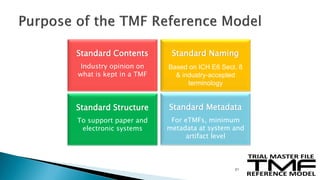
Standard Contents
Industry opinion on
what is kept in a TMF
Standard Naming
Based on ICH E6 Sect. 8
& industry-accepted
terminology
Standard Structure
To support paper and
electronic systems
Standard Metadata
For eTMFs, minimum
metadata at system and
artifact level
21
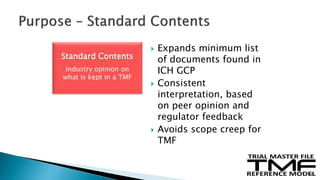
 Expands minimum list
of documents found in
ICH GCP
 Consistent
interpretation, based
on peer opinion and
regulator feedback
 Avoids scope creep for
TMF
10
Standard Contents
Industry opinion on
what is kept in a TMF
 Avoids one artifact
being referred to
using different terms
within an organisation
and between
organisations
 Avoids company-
specific terms
11
Standard Naming
Based on ICH E6 Sect. 8
& industry-accepted
terminology
 Facilitates consistent
filing and rapid retrieval
 Helpful when
responsibility for
maintaining different
sections of the TMF is
distributed across
several parties e.g.
sponsor, CRO,
consultants
12
Standard Structure
To support paper and
electronic systems
 Encourages adoption
of good practices to
facilitate document
retrieval
 Encourages
consistency across the
industry for exchange
of content
13
Standard Metadata
For eTMFs, minimum
metadata at system and
artifact level
 Data held in a simple Excel spreadsheet
◦ Easy for non-technical people to use!
 Hierarchical structure
◦ 11 Zones
◦ 48 Sections
◦ 249 Artifacts
14
15
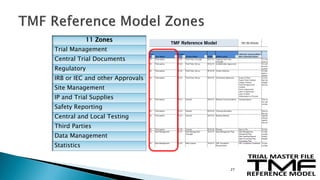
11 Zones
Trial Management
Central Trial Documents
Regulatory
IRB or IEC and other Approvals
Site Management
IP and Trial Supplies
Safety Reporting
Central and Local Testing
Third Parties
Data Management
Statistics
27
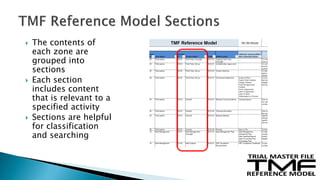
 The contents of
each zone are
grouped into
sections
 Each section
includes content
that is relevant to a
specified activity
 Sections are helpful
for classification
and searching
16
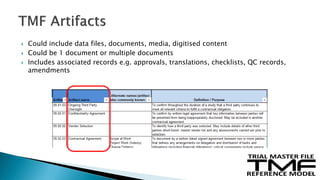
 Could include data files, documents, media, digitised content
 Could be 1 document or multiple documents
 Includes associated records e.g. approvals, translations, checklists, QC records,
amendments
17
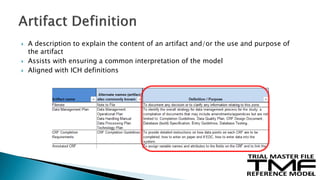
 A description to explain the content of an artifact and/or the use and purpose of
the artifact
 Assists with ensuring a common interpretation of the model
 Aligned with ICH definitions
18
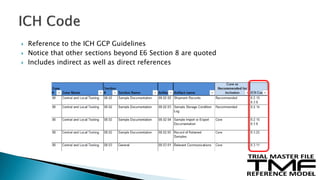
 Reference to the ICH GCP Guidelines
 Notice that other sections beyond E6 Section 8 are quoted
 Includes indirect as well as direct references
19
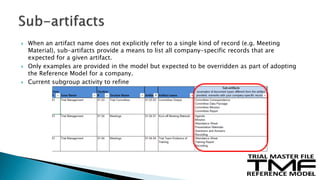
 When an artifact name does not explicitly refer to a single kind of record (e.g. Meeting
Material), sub-artifacts provide a means to list all company-specific records that are
expected for a given artifact.
 Only examples are provided in the model but expected to be overridden as part of adopting
the Reference Model for a company.
 Current subgroup activity to refine
20
21
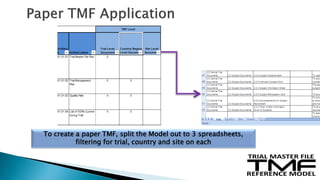
To create a paper TMF, split the Model out to 3 spreadsheets,
filtering for trial, country and site on each
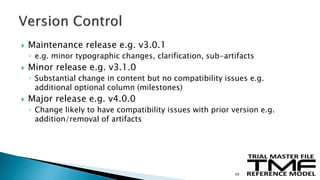
 Maintenance release e.g. v3.0.1
◦ e.g. minor typographic changes, clarification, sub-artifacts
 Minor release e.g. v3.1.0
◦ Substantial change in content but no compatibility issues e.g.
additional optional column (milestones)
 Major release e.g. v4.0.0
◦ Change likely to have compatibility issues with prior version e.g.
addition/removal of artifacts
39
 Documentation Delivered
◦ TMF Reference Model Version 3.1.0
◦ TMF Reference Model Version 3.1.0 Release Notes that provides details on
changes
 Released on 10-Sep-2018 for preview
 Effective as of 10-Oct-2018
 https://tmfrefmodel.com/resources/
 Change Requests ‘By the Numbers’
◦ Total of 64 Change Requests Submitted since October 2015
 23 Approved and included in release 3.1.0
 18 Rejected
 21 Deferred
 Deferred to sub-teams, Steering Committee or next release
 Added deliverables already approved
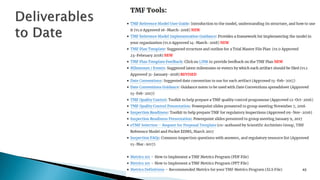
◦ Suggested dating conventions for each artifact (Feb 2017)
◦ Recommended milestones/events (Jan 2018)
 Also scheduled for assessment during 2019 to take account of industry
feedback
 Four minor changes to artifact name
◦ 03.01.02 Regulatory Approval Notification…. Regulatory Approval
Decision
◦ 03.02.02 Import or Export License…. Import or Export Documentation
◦ 03.03.01 Notification to Regulatory Authority of Safety or Trial
Information…. Notification of Safety or Trial Information
◦ 10.03.10 Data QC or QA Plan and Results…. Data Review
Documentation
 Eight minor changes to artifact definition/purpose
◦ 01.05.04 Filenote
◦ 02.01.01 Investigator’s Brochure
◦ 03.01.01 Regulatory Submission
◦ 03.03.01 Notification of Safety or Study Information
◦ 06.01.06 IP Transfer Documentation
◦ 08.02.05 Record of Retained Samples
◦ 11.03.02 Analysis QC Documentation
◦ 11.03.09 Final Analysis Datasets
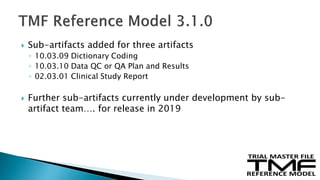
 Sub-artifacts added for three artifacts
◦ 10.03.09 Dictionary Coding
◦ 10.03.10 Data QC or QA Plan and Results
◦ 02.03.01 Clinical Study Report
 Further sub-artifacts currently under development by sub-
artifact team…. for release in 2019
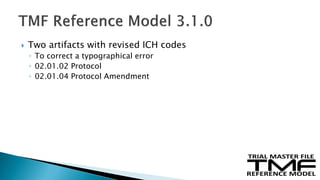
 Two artifacts with revised ICH codes
◦ To correct a typographical error
◦ 02.01.02 Protocol
◦ 02.01.04 Protocol Amendment
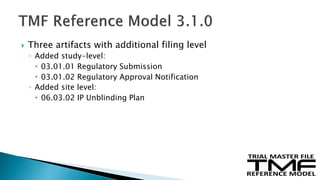
 Three artifacts with additional filing level
◦ Added study-level:
 03.01.01 Regulatory Submission
 03.01.02 Regulatory Approval Notification
◦ Added site level:
 06.03.02 IP Unblinding Plan
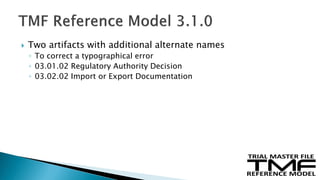
 Two artifacts with additional alternate names
◦ To correct a typographical error
◦ 03.01.02 Regulatory Authority Decision
◦ 03.02.02 Import or Export Documentation
 If you have any feedback on the TMF Reference Model,
including comments on existing artifacts, milestones,
suggestions for additional artifacts or general comments
about the TMF Reference Model, please use the link below
to submit your feedback:
https://tmfrefmodel.com/feedback/
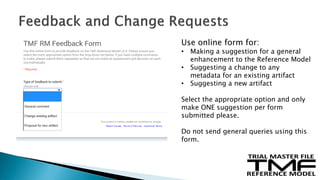
Use online form for:
• Making a suggestion for a general
enhancement to the Reference Model
• Suggesting a change to any
metadata for an existing artifact
• Suggesting a new artifact
Select the appropriate option and only
make ONE suggestion per form
submitted please.
Do not send general queries using this
form.
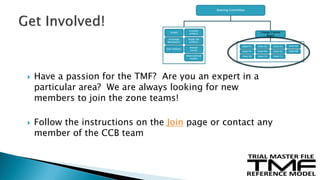
 Have a passion for the TMF? Are you an expert in a
particular area? We are always looking for new
members to join the zone teams!
 Follow the instructions on the Join page or contact any
member of the CCB team
• Release notes give all details to assess impact
• Minor release so minimal impact on overall structure
• Artifact names may change BUT the artifact numbers do not
change
• Includes process aspects such as milestones and dating
conventions – very customised by Sponsors / CROs
What is the Impact?
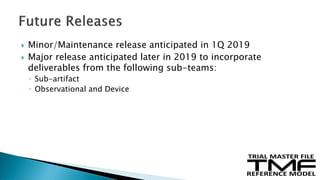
 Minor/Maintenance release anticipated in 1Q 2019
 Major release anticipated later in 2019 to incorporate
deliverables from the following sub-teams:
◦ Sub-artifact
◦ Observational and Device
40
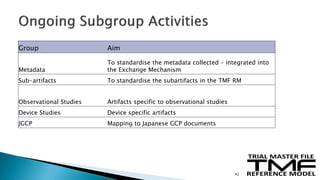
Group Aim
Metadata
To standardise the metadata collected – integrated into
the Exchange Mechanism
Sub-artifacts To standardise the subartifacts in the TMF RM
Observational Studies Artifacts specific to observational studies
Device Studies Device specific artifacts
JGCP Mapping to Japanese GCP documents
42
Join the TMF Reference Model Yahoo! Discussion Group
https://groups.yahoo.com/neo/groups/tmfrefmodel/info
Join the TMF Reference Model Project Team
http://tmfrefmodel.com/join
• Knowledge sharing
• Networking
• Too Much Fun!
QUESTIONS?

TMF PDF.pdf

  • 1.
  • 2.
    The sponsor andthe investigator shall keep a clinical trial master file. The clinical trial master file shall at all times contain the essential documents relating to that clinical trial which allow verification of the conduct of a clinical trial and the quality of the data generated […]. It shall be readily available, and directly accessible upon request, to the Member States. [EU Regulation 536/2014]
  • 3.
    Essential documents arethose documents that individually and collectively permit evaluation of the conduct of a trial and the quality of the data produced. These documents serve to demonstrate the compliance of the investigator, sponsor, and monitor with the standards of GCP and with all applicable regulatory requirements. [ICH GCP, Section 8.1]
  • 4.
     ICH GCPSection 8.2 – 8.4  “The minimum list of essential documents that has been developed.....”  ICH GCP does NOT provide a comprehensive contents list for the TMF ◦ Examples of missing documentation:  Electronic systems  Data management and statistical methodology  Safety monitoring
  • 5.
     Gap inElectronic Document Management (EDM) Reference Model identified for non- submission TMF documents  EDM scope is regulatory submissions: ◦ Significant input to the EDM Reference Model is TMF Documents ◦ Hence the creation of the TMF Reference Model 5 DIA Communities Document & Records Management Community • EDM Reference Model
  • 6.
    Other business records Supportingfiles e.g. computer SDLC files; GMP manufacturing files; vendor selection files Usually considered outside the scope of the TMF Other trial-related records that “permit evaluation of the conduct of the trial and quality of data produced” Minimum list of essential documents, as defined by ICH GCP, Chapter 8 The Trial Master File
  • 7.
     Standardizes companycontent and structure and limits company customization ◦ We all follow the same regulatory requirements ◦ Inspectors are the same across companies ◦ Company-specific requirements are often driven by tradition, legacy or personal opinion  Simplifies engagement of CROs and other third parties  Simplifies consolidation of disparate documents into a single TMF structure (in real time, at defined trial events and/or at study end) 7
  • 8.
     Managed bya Steering Committee of 14 members  Change Control Board  Extended Group of over 700 members June 2010: Version 1.0- 11 zones w/ associated artifacts Feb 2011: Version 1.1- Regulator feedback Nov 2011: Version 1.2- Investigator Site File and 1st Intro slide set June 2012: Version 2.0- Device, Process-based metadata, and IIS Mar 2009: 1st Meeting ~Dec 2012: Kick- off of many Work Groups that support the TMF manage-ment process Feb 2014: Establishment of the TMF RM Steering Committee June 2015: Release of version 3 June 2018: Release of The Exchange Mechanism 8 October 2018: Release of version 3.1.0
  • 9.
    9 Standard Contents Industry opinionon what is kept in a TMF Standard Naming Based on ICH E6 Sect. 8 & industry-accepted terminology Standard Structure To support paper and electronic systems Standard Metadata For eTMFs, minimum metadata at system and artifact level 21
  • 10.
     Expands minimumlist of documents found in ICH GCP  Consistent interpretation, based on peer opinion and regulator feedback  Avoids scope creep for TMF 10 Standard Contents Industry opinion on what is kept in a TMF
  • 11.
     Avoids oneartifact being referred to using different terms within an organisation and between organisations  Avoids company- specific terms 11 Standard Naming Based on ICH E6 Sect. 8 & industry-accepted terminology
  • 12.
     Facilitates consistent filingand rapid retrieval  Helpful when responsibility for maintaining different sections of the TMF is distributed across several parties e.g. sponsor, CRO, consultants 12 Standard Structure To support paper and electronic systems
  • 13.
     Encourages adoption ofgood practices to facilitate document retrieval  Encourages consistency across the industry for exchange of content 13 Standard Metadata For eTMFs, minimum metadata at system and artifact level
  • 14.
     Data heldin a simple Excel spreadsheet ◦ Easy for non-technical people to use!  Hierarchical structure ◦ 11 Zones ◦ 48 Sections ◦ 249 Artifacts 14
  • 15.
    15 11 Zones Trial Management CentralTrial Documents Regulatory IRB or IEC and other Approvals Site Management IP and Trial Supplies Safety Reporting Central and Local Testing Third Parties Data Management Statistics 27
  • 16.
     The contentsof each zone are grouped into sections  Each section includes content that is relevant to a specified activity  Sections are helpful for classification and searching 16
  • 17.
     Could includedata files, documents, media, digitised content  Could be 1 document or multiple documents  Includes associated records e.g. approvals, translations, checklists, QC records, amendments 17
  • 18.
     A descriptionto explain the content of an artifact and/or the use and purpose of the artifact  Assists with ensuring a common interpretation of the model  Aligned with ICH definitions 18
  • 19.
     Reference tothe ICH GCP Guidelines  Notice that other sections beyond E6 Section 8 are quoted  Includes indirect as well as direct references 19
  • 20.
     When anartifact name does not explicitly refer to a single kind of record (e.g. Meeting Material), sub-artifacts provide a means to list all company-specific records that are expected for a given artifact.  Only examples are provided in the model but expected to be overridden as part of adopting the Reference Model for a company.  Current subgroup activity to refine 20
  • 21.
    21 To create apaper TMF, split the Model out to 3 spreadsheets, filtering for trial, country and site on each
  • 22.
     Maintenance releasee.g. v3.0.1 ◦ e.g. minor typographic changes, clarification, sub-artifacts  Minor release e.g. v3.1.0 ◦ Substantial change in content but no compatibility issues e.g. additional optional column (milestones)  Major release e.g. v4.0.0 ◦ Change likely to have compatibility issues with prior version e.g. addition/removal of artifacts 39
  • 23.
     Documentation Delivered ◦TMF Reference Model Version 3.1.0 ◦ TMF Reference Model Version 3.1.0 Release Notes that provides details on changes  Released on 10-Sep-2018 for preview  Effective as of 10-Oct-2018  https://tmfrefmodel.com/resources/  Change Requests ‘By the Numbers’ ◦ Total of 64 Change Requests Submitted since October 2015  23 Approved and included in release 3.1.0  18 Rejected  21 Deferred  Deferred to sub-teams, Steering Committee or next release
  • 24.
     Added deliverablesalready approved ◦ Suggested dating conventions for each artifact (Feb 2017) ◦ Recommended milestones/events (Jan 2018)  Also scheduled for assessment during 2019 to take account of industry feedback
  • 25.
     Four minorchanges to artifact name ◦ 03.01.02 Regulatory Approval Notification…. Regulatory Approval Decision ◦ 03.02.02 Import or Export License…. Import or Export Documentation ◦ 03.03.01 Notification to Regulatory Authority of Safety or Trial Information…. Notification of Safety or Trial Information ◦ 10.03.10 Data QC or QA Plan and Results…. Data Review Documentation
  • 26.
     Eight minorchanges to artifact definition/purpose ◦ 01.05.04 Filenote ◦ 02.01.01 Investigator’s Brochure ◦ 03.01.01 Regulatory Submission ◦ 03.03.01 Notification of Safety or Study Information ◦ 06.01.06 IP Transfer Documentation ◦ 08.02.05 Record of Retained Samples ◦ 11.03.02 Analysis QC Documentation ◦ 11.03.09 Final Analysis Datasets
  • 27.
     Sub-artifacts addedfor three artifacts ◦ 10.03.09 Dictionary Coding ◦ 10.03.10 Data QC or QA Plan and Results ◦ 02.03.01 Clinical Study Report  Further sub-artifacts currently under development by sub- artifact team…. for release in 2019
  • 28.
     Two artifactswith revised ICH codes ◦ To correct a typographical error ◦ 02.01.02 Protocol ◦ 02.01.04 Protocol Amendment
  • 29.
     Three artifactswith additional filing level ◦ Added study-level:  03.01.01 Regulatory Submission  03.01.02 Regulatory Approval Notification ◦ Added site level:  06.03.02 IP Unblinding Plan
  • 30.
     Two artifactswith additional alternate names ◦ To correct a typographical error ◦ 03.01.02 Regulatory Authority Decision ◦ 03.02.02 Import or Export Documentation
  • 31.
     If youhave any feedback on the TMF Reference Model, including comments on existing artifacts, milestones, suggestions for additional artifacts or general comments about the TMF Reference Model, please use the link below to submit your feedback: https://tmfrefmodel.com/feedback/
  • 32.
    Use online formfor: • Making a suggestion for a general enhancement to the Reference Model • Suggesting a change to any metadata for an existing artifact • Suggesting a new artifact Select the appropriate option and only make ONE suggestion per form submitted please. Do not send general queries using this form.
  • 33.
     Have apassion for the TMF? Are you an expert in a particular area? We are always looking for new members to join the zone teams!  Follow the instructions on the Join page or contact any member of the CCB team
  • 34.
    • Release notesgive all details to assess impact • Minor release so minimal impact on overall structure • Artifact names may change BUT the artifact numbers do not change • Includes process aspects such as milestones and dating conventions – very customised by Sponsors / CROs What is the Impact?
  • 35.
     Minor/Maintenance releaseanticipated in 1Q 2019  Major release anticipated later in 2019 to incorporate deliverables from the following sub-teams: ◦ Sub-artifact ◦ Observational and Device
  • 36.
  • 37.
    Group Aim Metadata To standardisethe metadata collected – integrated into the Exchange Mechanism Sub-artifacts To standardise the subartifacts in the TMF RM Observational Studies Artifacts specific to observational studies Device Studies Device specific artifacts JGCP Mapping to Japanese GCP documents 42
  • 38.
    Join the TMFReference Model Yahoo! Discussion Group https://groups.yahoo.com/neo/groups/tmfrefmodel/info Join the TMF Reference Model Project Team http://tmfrefmodel.com/join • Knowledge sharing • Networking • Too Much Fun! QUESTIONS?