Electronic Trial Master Files
Mar 2, 2009
By: Karen Roy
Applied Clinical Trials


                                In Europe today, each study's Trial Master File (TMF) is
                                commonly still paper and is often scattered across many
                                locations in many countries. With this disparate model
                                comes many disadvantages and risks. An Electronic TMF
                                (eTMF), where documents are brought together in one
                                place, backed up electronically, and visible over the
                                Internet from anywhere any time of day, provides a
                                solution.

                                In the world of a project team, the TMF does not get the
attention it deserves. Document managers may use all their efforts to create a perfect and
up-to-date TMF, but the project team is always more focused on the key project
milestones, such as first patient first visit, end of recruitment, database lock, and final
report production.

The TMF, however, relates the story of the trial. According to ICH
Section 8, it "individually and collectively permits the evaluation of
the conduct of the trial and the quality of the data produced" and it
serves to "demonstrate the compliance of the investigator, sponsor,
and monitor with the standards of GCP and the regulatory
requirements."
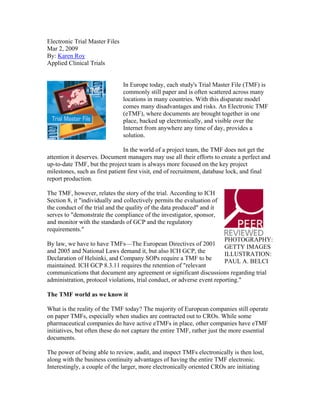
                                                                         PHOTOGRAPHY:
By law, we have to have TMFs—The European Directives of 2001 GETTY IMAGES
and 2005 and National Laws demand it, but also ICH GCP, the              ILLUSTRATION:
Declaration of Helsinki, and Company SOPs require a TMF to be            PAUL A. BELCI
maintained. ICH GCP 8.3.11 requires the retention of "relevant
communications that document any agreement or significant discussions regarding trial
administration, protocol violations, trial conduct, or adverse event reporting."

The TMF world as we know it

What is the reality of the TMF today? The majority of European companies still operate
on paper TMFs, especially when studies are contracted out to CROs. While some
pharmaceutical companies do have active eTMFs in place, other companies have eTMF
initiatives, but often these do not capture the entire TMF, rather just the more essential
documents.

The power of being able to review, audit, and inspect TMFs electronically is then lost,
along with the business continuity advantages of having the entire TMF electronic.
Interestingly, a couple of the larger, more electronically oriented CROs are initiating
eTMFs, reinforcing the significant business advantages they bring to the table.
Nevertheless, paper is still king in Europe.

In the paper world, TMF documentation is spread across numerous countries, and even
more locations. Storage facilities vary, from environmentally protected rooms to the
home offices of clinical research associates (CRAs). Inevitably, this multiple location
TMF ends up containing a huge amount of duplication (everyone wants a copy of all
important documents) and consists of multiple and variable filing systems that are
isolated.

What is potentially more worrying is whether everyone is working from the same
documents. There is nothing worse than reaching an investigator site and realizing that
they haven't received the most recent protocol amendment. Or doing some last minute
audit preparation and finding a key document is missing.

Being so spread out and entirely paper-based means that the TMF fails to be the
management tool it could potentially be. Instead, it is viewed as a huge paper burden at
study close-out, when the various clumps of documentation need to be consolidated into
one clean, concise, and legible TMF. Also, by relying on a paper TMF you unnecessarily
make yourself vulnerable to emergencies, such as a flooded or burned warehouse. If
there's no backup, when it's gone, it's gone.

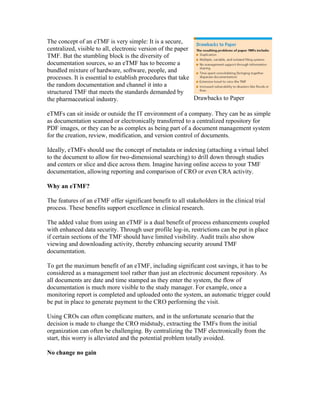
                  To really understand the challenge of the TMF, clarity is needed on the
                  origin of the documents. Unlike the majority of regulatory documents
                  that are created internally and version-controlled, anywhere between
                  10% and 50% of a TMF is created outside of client control, and there is
                  huge variance as to paper (often because of wet-signatures) or electronic
                  collection (see Figure 1).

                  eClinical has landed
Paper vs.
Electronic        Eclinical is firmly embedded in the clinical research industry. Electronic
TMFs              data capture (EDC) has finally taken hold, and the majority of major
                  pharma companies have an eClinical program, with EDC an integral
part of their workflows. The final destination of all successful trial results is a regulatory
submission. The electronic Common Technical Document (eCTD) has been the
mandatory method of electronic submissions since 2008 in the United States and will be
for Europe by the end of 2009. And the starting point for much of eCTD documentation
is the TMF. So why is it still paper?
The concept of an eTMF is very simple: It is a secure,
centralized, visible to all, electronic version of the paper
TMF. But the stumbling block is the diversity of
documentation sources, so an eTMF has to become a
bundled mixture of hardware, software, people, and
processes. It is essential to establish procedures that take
the random documentation and channel it into a
structured TMF that meets the standards demanded by
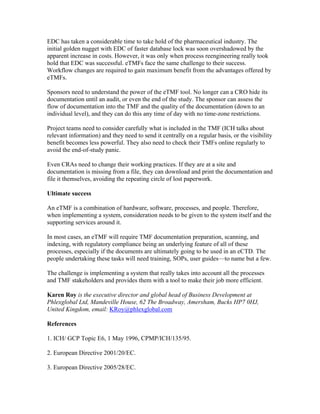
the pharmaceutical industry.                                 Drawbacks to Paper

eTMFs can sit inside or outside the IT environment of a company. They can be as simple
as documentation scanned or electronically transferred to a centralized repository for
PDF images, or they can be as complex as being part of a document management system
for the creation, review, modification, and version control of documents.

Ideally, eTMFs should use the concept of metadata or indexing (attaching a virtual label
to the document to allow for two-dimensional searching) to drill down through studies
and centers or slice and dice across them. Imagine having online access to your TMF
documentation, allowing reporting and comparison of CRO or even CRA activity.

Why an eTMF?

The features of an eTMF offer significant benefit to all stakeholders in the clinical trial
process. These benefits support excellence in clinical research.

The added value from using an eTMF is a dual benefit of process enhancements coupled
with enhanced data security. Through user profile log-in, restrictions can be put in place
if certain sections of the TMF should have limited visibility. Audit trails also show
viewing and downloading activity, thereby enhancing security around TMF
documentation.

To get the maximum benefit of an eTMF, including significant cost savings, it has to be
considered as a management tool rather than just an electronic document repository. As
all documents are date and time stamped as they enter the system, the flow of
documentation is much more visible to the study manager. For example, once a
monitoring report is completed and uploaded onto the system, an automatic trigger could
be put in place to generate payment to the CRO performing the visit.

Using CROs can often complicate matters, and in the unfortunate scenario that the
decision is made to change the CRO midstudy, extracting the TMFs from the initial
organization can often be challenging. By centralizing the TMF electronically from the
start, this worry is alleviated and the potential problem totally avoided.

No change no gain
EDC has taken a considerable time to take hold of the pharmaceutical industry. The
initial golden nugget with EDC of faster database lock was soon overshadowed by the
apparent increase in costs. However, it was only when process reengineering really took
hold that EDC was successful. eTMFs face the same challenge to their success.
Workflow changes are required to gain maximum benefit from the advantages offered by
eTMFs.

Sponsors need to understand the power of the eTMF tool. No longer can a CRO hide its
documentation until an audit, or even the end of the study. The sponsor can assess the
flow of documentation into the TMF and the quality of the documentation (down to an
individual level), and they can do this any time of day with no time-zone restrictions.

Project teams need to consider carefully what is included in the TMF (ICH talks about
relevant information) and they need to send it centrally on a regular basis, or the visibility
benefit becomes less powerful. They also need to check their TMFs online regularly to
avoid the end-of-study panic.

Even CRAs need to change their working practices. If they are at a site and
documentation is missing from a file, they can download and print the documentation and
file it themselves, avoiding the repeating circle of lost paperwork.

Ultimate success

An eTMF is a combination of hardware, software, processes, and people. Therefore,
when implementing a system, consideration needs to be given to the system itself and the
supporting services around it.

In most cases, an eTMF will require TMF documentation preparation, scanning, and
indexing, with regulatory compliance being an underlying feature of all of these
processes, especially if the documents are ultimately going to be used in an eCTD. The
people undertaking these tasks will need training, SOPs, user guides—to name but a few.

The challenge is implementing a system that really takes into account all the processes
and TMF stakeholders and provides them with a tool to make their job more efficient.

Karen Roy is the executive director and global head of Business Development at
Phlexglobal Ltd, Mandeville House, 62 The Broadway, Amersham, Bucks HP7 0HJ,
United Kingdom, email: KRoy@phlexglobal.com

References

1. ICH/ GCP Topic E6, 1 May 1996, CPMP/ICH/135/95.

2. European Directive 2001/20/EC.

3. European Directive 2005/28/EC.

Electronic trial master filest

  • 1.
    Electronic Trial MasterFiles Mar 2, 2009 By: Karen Roy Applied Clinical Trials In Europe today, each study's Trial Master File (TMF) is commonly still paper and is often scattered across many locations in many countries. With this disparate model comes many disadvantages and risks. An Electronic TMF (eTMF), where documents are brought together in one place, backed up electronically, and visible over the Internet from anywhere any time of day, provides a solution. In the world of a project team, the TMF does not get the attention it deserves. Document managers may use all their efforts to create a perfect and up-to-date TMF, but the project team is always more focused on the key project milestones, such as first patient first visit, end of recruitment, database lock, and final report production. The TMF, however, relates the story of the trial. According to ICH Section 8, it "individually and collectively permits the evaluation of the conduct of the trial and the quality of the data produced" and it serves to "demonstrate the compliance of the investigator, sponsor, and monitor with the standards of GCP and the regulatory requirements." PHOTOGRAPHY: By law, we have to have TMFs—The European Directives of 2001 GETTY IMAGES and 2005 and National Laws demand it, but also ICH GCP, the ILLUSTRATION: Declaration of Helsinki, and Company SOPs require a TMF to be PAUL A. BELCI maintained. ICH GCP 8.3.11 requires the retention of "relevant communications that document any agreement or significant discussions regarding trial administration, protocol violations, trial conduct, or adverse event reporting." The TMF world as we know it What is the reality of the TMF today? The majority of European companies still operate on paper TMFs, especially when studies are contracted out to CROs. While some pharmaceutical companies do have active eTMFs in place, other companies have eTMF initiatives, but often these do not capture the entire TMF, rather just the more essential documents. The power of being able to review, audit, and inspect TMFs electronically is then lost, along with the business continuity advantages of having the entire TMF electronic. Interestingly, a couple of the larger, more electronically oriented CROs are initiating
  • 2.
    eTMFs, reinforcing thesignificant business advantages they bring to the table. Nevertheless, paper is still king in Europe. In the paper world, TMF documentation is spread across numerous countries, and even more locations. Storage facilities vary, from environmentally protected rooms to the home offices of clinical research associates (CRAs). Inevitably, this multiple location TMF ends up containing a huge amount of duplication (everyone wants a copy of all important documents) and consists of multiple and variable filing systems that are isolated. What is potentially more worrying is whether everyone is working from the same documents. There is nothing worse than reaching an investigator site and realizing that they haven't received the most recent protocol amendment. Or doing some last minute audit preparation and finding a key document is missing. Being so spread out and entirely paper-based means that the TMF fails to be the management tool it could potentially be. Instead, it is viewed as a huge paper burden at study close-out, when the various clumps of documentation need to be consolidated into one clean, concise, and legible TMF. Also, by relying on a paper TMF you unnecessarily make yourself vulnerable to emergencies, such as a flooded or burned warehouse. If there's no backup, when it's gone, it's gone. To really understand the challenge of the TMF, clarity is needed on the origin of the documents. Unlike the majority of regulatory documents that are created internally and version-controlled, anywhere between 10% and 50% of a TMF is created outside of client control, and there is huge variance as to paper (often because of wet-signatures) or electronic collection (see Figure 1). eClinical has landed Paper vs. Electronic Eclinical is firmly embedded in the clinical research industry. Electronic TMFs data capture (EDC) has finally taken hold, and the majority of major pharma companies have an eClinical program, with EDC an integral part of their workflows. The final destination of all successful trial results is a regulatory submission. The electronic Common Technical Document (eCTD) has been the mandatory method of electronic submissions since 2008 in the United States and will be for Europe by the end of 2009. And the starting point for much of eCTD documentation is the TMF. So why is it still paper?
  • 3.
    The concept ofan eTMF is very simple: It is a secure, centralized, visible to all, electronic version of the paper TMF. But the stumbling block is the diversity of documentation sources, so an eTMF has to become a bundled mixture of hardware, software, people, and processes. It is essential to establish procedures that take the random documentation and channel it into a structured TMF that meets the standards demanded by the pharmaceutical industry. Drawbacks to Paper eTMFs can sit inside or outside the IT environment of a company. They can be as simple as documentation scanned or electronically transferred to a centralized repository for PDF images, or they can be as complex as being part of a document management system for the creation, review, modification, and version control of documents. Ideally, eTMFs should use the concept of metadata or indexing (attaching a virtual label to the document to allow for two-dimensional searching) to drill down through studies and centers or slice and dice across them. Imagine having online access to your TMF documentation, allowing reporting and comparison of CRO or even CRA activity. Why an eTMF? The features of an eTMF offer significant benefit to all stakeholders in the clinical trial process. These benefits support excellence in clinical research. The added value from using an eTMF is a dual benefit of process enhancements coupled with enhanced data security. Through user profile log-in, restrictions can be put in place if certain sections of the TMF should have limited visibility. Audit trails also show viewing and downloading activity, thereby enhancing security around TMF documentation. To get the maximum benefit of an eTMF, including significant cost savings, it has to be considered as a management tool rather than just an electronic document repository. As all documents are date and time stamped as they enter the system, the flow of documentation is much more visible to the study manager. For example, once a monitoring report is completed and uploaded onto the system, an automatic trigger could be put in place to generate payment to the CRO performing the visit. Using CROs can often complicate matters, and in the unfortunate scenario that the decision is made to change the CRO midstudy, extracting the TMFs from the initial organization can often be challenging. By centralizing the TMF electronically from the start, this worry is alleviated and the potential problem totally avoided. No change no gain
  • 4.
    EDC has takena considerable time to take hold of the pharmaceutical industry. The initial golden nugget with EDC of faster database lock was soon overshadowed by the apparent increase in costs. However, it was only when process reengineering really took hold that EDC was successful. eTMFs face the same challenge to their success. Workflow changes are required to gain maximum benefit from the advantages offered by eTMFs. Sponsors need to understand the power of the eTMF tool. No longer can a CRO hide its documentation until an audit, or even the end of the study. The sponsor can assess the flow of documentation into the TMF and the quality of the documentation (down to an individual level), and they can do this any time of day with no time-zone restrictions. Project teams need to consider carefully what is included in the TMF (ICH talks about relevant information) and they need to send it centrally on a regular basis, or the visibility benefit becomes less powerful. They also need to check their TMFs online regularly to avoid the end-of-study panic. Even CRAs need to change their working practices. If they are at a site and documentation is missing from a file, they can download and print the documentation and file it themselves, avoiding the repeating circle of lost paperwork. Ultimate success An eTMF is a combination of hardware, software, processes, and people. Therefore, when implementing a system, consideration needs to be given to the system itself and the supporting services around it. In most cases, an eTMF will require TMF documentation preparation, scanning, and indexing, with regulatory compliance being an underlying feature of all of these processes, especially if the documents are ultimately going to be used in an eCTD. The people undertaking these tasks will need training, SOPs, user guides—to name but a few. The challenge is implementing a system that really takes into account all the processes and TMF stakeholders and provides them with a tool to make their job more efficient. Karen Roy is the executive director and global head of Business Development at Phlexglobal Ltd, Mandeville House, 62 The Broadway, Amersham, Bucks HP7 0HJ, United Kingdom, email: KRoy@phlexglobal.com References 1. ICH/ GCP Topic E6, 1 May 1996, CPMP/ICH/135/95. 2. European Directive 2001/20/EC. 3. European Directive 2005/28/EC.