Practical Steps
to Selecting and
Implementing an
eTMF
eTMF Bootcamp
Webinar Series
Thursday, 16 May 2019
2
House Keeping
3
4
House
Keeping
L I V E W E B I N A R
• This webinar is being recorded and
will be made available after this
session
• Feel free to use the chatbox to
submit your questions at anytime
• Q&A will take place at the end of the
webinar
• We will send these slides to your
email at the end of the webinar
5
Meet Your
Speakers
Paul Fenton
President and CEO,
Montrium
Sholeh Ehdaivand
Founder & President
LMK Clinical Research
• Founded in 2005
• Working Exclusively in the Life Sciences
• Headquartered in Montreal, Canada
• EU HQ in Brussels
• Clients in North America, Europe & Asia
• Leading Content Management Platform
• Over 8000 Users in 20+ Countries
• Experienced Professional Services Group
6
About
Montrium
Connecting People,
Processes & Technology
A B O U T T H E C O M P A N Y
7
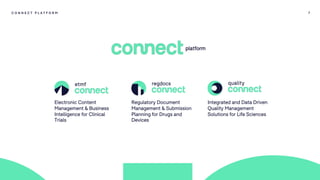
Electronic Content
Management & Business
Intelligence for Clinical
Trials
C O N N E C T P L A T F O R M
Regulatory Document
Management & Submission
Planning for Drugs and
Devices
Integrated and Data Driven
Quality Management
Solutions for Life Sciences
State of the Industry
8
9
Regulatory
evolution –
EMA Guideline
Guideline on the content,
management and archiving of
the clinical trial master file (paper
and/or electronic)
EMA/INS/GCP/856758/2018
Released 6 December 2018
• Legislation does not differentiate between paper
and electronic TMF
• TMF content should be collated in a timely manner
• GCP Inspectors will require direct access to the
eTMF system as used by the organization
• There should be a primary TMF system for holding
essential documents
• Information contained within other systems may
also be considered part of the TMF
10
Regulatory
Evolution - New
EU Directive
• EU Regulation 536/2014 originally released in 2014,
will likely come into effect in 2019
• The sponsor and investigator shall keep a clinical
trial master file….it shall be readily available and
directly accessible upon request.
• The sponsor and the investigator shall archive the
content of the clinical trial master file for at least 25
years after the end of the clinical trial
11
Regulatory
Evolution - ICH
E6 Addendum
R2
• Currently in step 4 (consultation) of the ICH process
and is currently being implemented by ICH
members
• The sponsor and investigator/institution should
maintain a record of the location(s) of their
respective essential documents. The storage
system (irrespective of the media used) should
provide for document identification, search and
retrieval.
12
Regulatory
Evolution - ICH
E6 Addendum
R2
• SOPs should cover system setup, installation
and use. The SOPs should describe:
System validation and functionality testing
Data collection and handling
System maintenance
System security measures
Change control
Data backup and recovery
Contingency planning
Decommissioning
• The responsibilities of the sponsor,
investigator and other parties with respect to
the use of these computerized systems
should be clear, and the users should be
provided with training in the use of the
systems
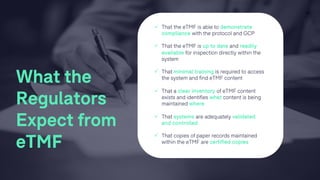
ü That the eTMF is able to demonstrate
compliance with the protocol and GCP
ü That the eTMF is up to date and readily
available for inspection directly within the
system
ü That minimal training is required to access
the system and find eTMF content
ü That a clear inventory of eTMF content
exists and identifies what content is being
maintained where
ü That systems are adequately validated
and controlled
ü That copies of paper records maintained
within the eTMF are certified copies
13
What the
Regulators
Expect from
eTMF
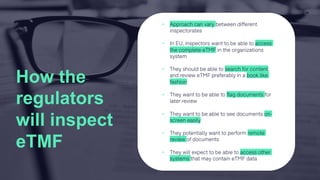
• Approach can vary between different
inspectorates
• In EU, inspectors want to be able to access
the complete eTMF in the organizations
system
• They should be able to search for content,
and review eTMF preferably in a book like
fashion
• They want to be able to flag documents for
later review
• They want to be able to see documents on-
screen easily
• They potentially want to perform remote
review of documents
• They will expect to be able to access other
systems that may contain eTMF data
14
How the
regulators
will inspect
eTMF
15
POLL
A B O U T T H E C O M P A N Y
Have you undergone an inspection that
involved your eTMF?
• Yes and I provided guided access
• Yes and the inspector accessed the
eTMF directly
• No, we have never been inspected or
were inspected using paper
Documents
vs Data
how to
manage
• Recent inspection in the UK identified over 40
electronic systems that contained data that were
relevant to the TMF
• More and more study information which could be
used to demonstrate compliance is contained within
other systems i.e.
- MVRs in CTMS
- Safety reports in PVS
- SAE data in EDC
• Need to clearly identify what you consider to be TMF
relevant in the inventory
• Ensure that you can provide access to information
contained within these systems to inspectors
Documents
vs Data
how to
manage
• Avoid producing PDF outputs of data if possible
or practical
• Evaluate ways of presenting information in a
more holistic way across systems
• Ensure that there is uniformity across systems in
relation to identifiers and metadata
• Ensure that you have a clear process for each of
the areas that is generating eTMF content
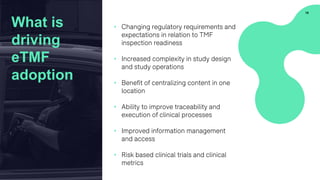
• Changing regulatory requirements and
expectations in relation to TMF
inspection readiness
• Increased complexity in study design
and study operations
• Benefit of centralizing content in one
location
• Ability to improve traceability and
execution of clinical processes
• Improved information management
and access
• Risk based clinical trials and clinical
metrics
18
What is
driving
eTMF
adoption
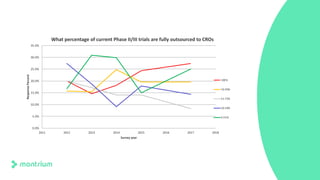
0.0%
5.0%
10.0%
15.0%
20.0%
25.0%
30.0%
35.0%
2011 2012 2013 2014 2015 2016 2017 2018
ResponsePercent
Survey year
What percentage of current Phase II/III trials are fully outsourced to CROs
100%
76-99%
51-75%
26-50%
0-25%
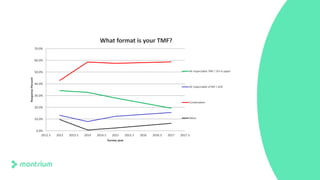
0.0%
10.0%
20.0%
30.0%
40.0%
50.0%
60.0%
70.0%
2012.5 2013 2013.5 2014 2014.5 2015 2015.5 2016 2016.5 2017 2017.5
ResponsePercent
Survey year
What format is your TMF?
All Inspectable TMF / ISF in paper
All Inspectable eTMF / eISF
Combination
Other
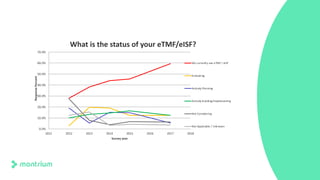
0.0%
10.0%
20.0%
30.0%
40.0%
50.0%
60.0%
70.0%
2011 2012 2013 2014 2015 2016 2017 2018
ResponsePercent
Survey year
What is the status of your eTMF/eISF?
We currently use eTMF / eISF
Evaluating
Actively Planning
Actively Building/Implementing
Not Considering
Not Applicable / Unknown
22
POLL
A B O U T T H E C O M P A N Y
What is the status of eTMF in your
organization:
1. We are still using paper
2. We have a hybrid paper/electronic TMF
3. We use our CROs eTMF
4. We are fully electronic
5. We don’t have a TMF
What are the
key challenges
• TMF complexity with many
stakeholders
• Cost of acquisition and implementation
of eTMF systems
• Ability to fully eradicate paper
• TMF completeness calculation
complexity
• Multiple repositories and systems hold
TMF content
• Organizational change
What does
the future
hold.....
24
• Documents will become data
• eTMF completeness and QC will
be data and event driven
• Standards for content and
metadata
• Improvements in eTMF content
interchange
• Remote inspections
eTMF Vendor Selection
25
26
POLL
A B O U T T H E C O M P A N Y
In your opinion how long does it take
to fully implement an eTMF solution?
a) Less than a month
b) 1-3 months
c) 3-6 months
d) 6-12 months
e) More than a year
27
Process
A B O U T T H E C O M P A N Y
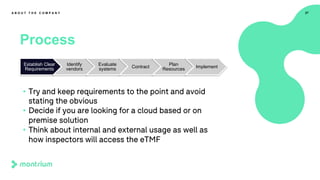
• Try and keep requirements to the point and avoid
stating the obvious
• Decide if you are looking for a cloud based or on
premise solution
• Think about internal and external usage as well as
how inspectors will access the eTMF
Establish Clear
Requirements
Identify
vendors
Evaluate
systems Contract
Plan
Resources Implement
28
Process
A B O U T T H E C O M P A N Y
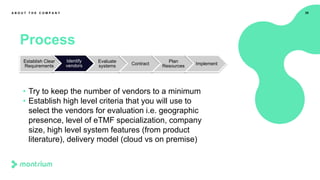
• Try to keep the number of vendors to a minimum
• Establish high level criteria that you will use to
select the vendors for evaluation i.e. geographic
presence, level of eTMF specialization, company
size, high level system features (from product
literature), delivery model (cloud vs on premise)
Establish Clear
Requirements
Identify
vendors
Evaluate
systems Contract
Plan
Resources Implement
29
Process
A B O U T T H E C O M P A N Y
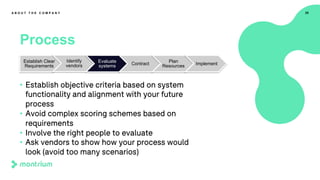
• Establish objective criteria based on system
functionality and alignment with your future
process
• Avoid complex scoring schemes based on
requirements
• Involve the right people to evaluate
• Ask vendors to show how your process would
look (avoid too many scenarios)
Establish Clear
Requirements
Identify
vendors
Evaluate
systems Contract
Plan
Resources Implement
30
Process
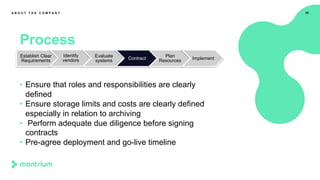
A B O U T T H E C O M P A N Y
• Ensure that roles and responsibilities are clearly
defined
• Ensure storage limits and costs are clearly defined
especially in relation to archiving
• Perform adequate due diligence before signing
contracts
• Pre-agree deployment and go-live timeline
Establish Clear
Requirements
Identify
vendors
Evaluate
systems Contract
Plan
Resources Implement
31
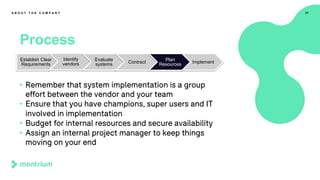
Process
A B O U T T H E C O M P A N Y
• Remember that system implementation is a group
effort between the vendor and your team
• Ensure that you have champions, super users and IT
involved in implementation
• Budget for internal resources and secure availability
• Assign an internal project manager to keep things
moving on your end
Establish Clear
Requirements
Identify
vendors
Evaluate
systems Contract
Plan
Resources Implement
32
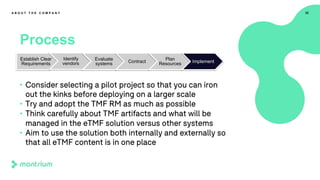
Process
A B O U T T H E C O M P A N Y
• Consider selecting a pilot project so that you can iron
out the kinks before deploying on a larger scale
• Try and adopt the TMF RM as much as possible
• Think carefully about TMF artifacts and what will be
managed in the eTMF solution versus other systems
• Aim to use the solution both internally and externally so
that all eTMF content is in one place
Establish Clear
Requirements
Identify
vendors
Evaluate
systems Contract
Plan
Resources Implement
33
POLL
A B O U T T H E C O M P A N Y
Do you currently have a TMF
Champion in your organization?
a) Yes
b) No
34
Key
attributes to
look for
• Ease of use for all stakeholders
• Flexibility to accommodate different study types
and ability to configure
• TMF auto-classification and fast indexing tools
• Use of TMF RM out of the box
• Ability to evaluate TMF completeness based on
study status and design
• Inspector mode (easy search, review and
tagging)
• Ability to centralize platform for use by all
stakeholders
35
Right sizing
the vendor
• Not all vendors are created equal
• Look for vendors that can support your volume of
business
• Prefer vendors with sound industry knowledge
• Evaluate vendors product roadmap and their
product evolution
• Choose the vendor that best fits your process
and budget
• Look for a business partner type relationship
where you are able to contribute to the evolution
of the product
eTMF Implementation -
Right the First Time!
36
37
Plan
• Have an overall, sustainable strategy: internal implementation needs
• Study assessment in the eTMF
• Change and culture management
• TMF Reference Model mapping
• Go Live!
38
Strategy
Needs Assessment:
• How soon do you need the eTMF to be implemented? Do you have enough
time?
• Understand current TMF document and content location;
• Evaluate if it is possible to bring everything into one system;
• According to the 2015 TMF Reference Model survey, 42% are still using
multiple repositories
• Potential Issues: multiple SOPs, multiple people, easily out of compliance
– not knowing where documents are could raise red flags
39
Assessment
• Clinical trial assessment which studies will utilize the eTMF
technology
• Start with a pilot! A new study that can start in the eTMF
• TMF Migration
§ All studies
§ Risk Based approach
§ Hybrid
40
Change is inevitable
• Culture and change management
• What are your organizations values, believes and norms toward the TMF?
• TMF Champion
• Innovator: renew the TMF through technology, people and process;
• Committed to Change: shepherd organizational change despite opposition;
• New Processes: align with eTMF (technology) and people;
• Change Management Network: within each department to help cascade and support the
change
“You must remain focused on your journey to greatness” Les Brown
41
TMF RM Adoption
• Master TMF Plan: how your organization will file TMF content
• SOP Mapping: understand the required documents (Regulatory
requirements, ICH GCP and your organizations SOPs)
• Naming Conventions: how will documents be named in the eTMF
system
• Date Conventions: consistent way to associate dates to documents
• TMF Plan: study specific conventions and requirements
42
Ready, Set, Go!
• Properly manage the implementation process from concept through
completion
• Control the process
• Don’t be shy – you can change stuff – break things down – people,
process and technology
• Checkpoints along the way!
43
Conclusions & Recommendations
• Have a deep understanding the of regulatory environment
• eTMF vendor selection – choose the one that is right for you!
• Timelines and milestones should be achievable
• Have a plan and be ready for Day 1
• Ask for help when needed
44
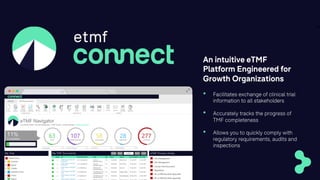
• Facilitates exchange of clinical trial
information to all stakeholders
• Accurately tracks the progress of
TMF completeness
• Allows you to quickly comply with
regulatory requirements, audits and
inspections
An intuitive eTMF
Platform Engineered for
Growth Organizations
Are you interested in receiving
more information about
Montrium’s eTMF Connect?
1) Yes, could be useful
2) No, not interested
45
POLL
QUESTIONS?
46
INFO@MONTRIUM.COM
Thank You!

Practical Steps to Selecting and Implementing an eTMF

  • 2.
    Practical Steps to Selectingand Implementing an eTMF eTMF Bootcamp Webinar Series Thursday, 16 May 2019 2
  • 3.
  • 4.
    4 House Keeping L I VE W E B I N A R • This webinar is being recorded and will be made available after this session • Feel free to use the chatbox to submit your questions at anytime • Q&A will take place at the end of the webinar • We will send these slides to your email at the end of the webinar
  • 5.
    5 Meet Your Speakers Paul Fenton Presidentand CEO, Montrium Sholeh Ehdaivand Founder & President LMK Clinical Research
  • 6.
    • Founded in2005 • Working Exclusively in the Life Sciences • Headquartered in Montreal, Canada • EU HQ in Brussels • Clients in North America, Europe & Asia • Leading Content Management Platform • Over 8000 Users in 20+ Countries • Experienced Professional Services Group 6 About Montrium Connecting People, Processes & Technology A B O U T T H E C O M P A N Y
  • 7.
    7 Electronic Content Management &Business Intelligence for Clinical Trials C O N N E C T P L A T F O R M Regulatory Document Management & Submission Planning for Drugs and Devices Integrated and Data Driven Quality Management Solutions for Life Sciences
  • 8.
    State of theIndustry 8
  • 9.
    9 Regulatory evolution – EMA Guideline Guidelineon the content, management and archiving of the clinical trial master file (paper and/or electronic) EMA/INS/GCP/856758/2018 Released 6 December 2018 • Legislation does not differentiate between paper and electronic TMF • TMF content should be collated in a timely manner • GCP Inspectors will require direct access to the eTMF system as used by the organization • There should be a primary TMF system for holding essential documents • Information contained within other systems may also be considered part of the TMF
  • 10.
    10 Regulatory Evolution - New EUDirective • EU Regulation 536/2014 originally released in 2014, will likely come into effect in 2019 • The sponsor and investigator shall keep a clinical trial master file….it shall be readily available and directly accessible upon request. • The sponsor and the investigator shall archive the content of the clinical trial master file for at least 25 years after the end of the clinical trial
  • 11.
    11 Regulatory Evolution - ICH E6Addendum R2 • Currently in step 4 (consultation) of the ICH process and is currently being implemented by ICH members • The sponsor and investigator/institution should maintain a record of the location(s) of their respective essential documents. The storage system (irrespective of the media used) should provide for document identification, search and retrieval.
  • 12.
    12 Regulatory Evolution - ICH E6Addendum R2 • SOPs should cover system setup, installation and use. The SOPs should describe: System validation and functionality testing Data collection and handling System maintenance System security measures Change control Data backup and recovery Contingency planning Decommissioning • The responsibilities of the sponsor, investigator and other parties with respect to the use of these computerized systems should be clear, and the users should be provided with training in the use of the systems
  • 13.
    ü That theeTMF is able to demonstrate compliance with the protocol and GCP ü That the eTMF is up to date and readily available for inspection directly within the system ü That minimal training is required to access the system and find eTMF content ü That a clear inventory of eTMF content exists and identifies what content is being maintained where ü That systems are adequately validated and controlled ü That copies of paper records maintained within the eTMF are certified copies 13 What the Regulators Expect from eTMF
  • 14.
    • Approach canvary between different inspectorates • In EU, inspectors want to be able to access the complete eTMF in the organizations system • They should be able to search for content, and review eTMF preferably in a book like fashion • They want to be able to flag documents for later review • They want to be able to see documents on- screen easily • They potentially want to perform remote review of documents • They will expect to be able to access other systems that may contain eTMF data 14 How the regulators will inspect eTMF
  • 15.
    15 POLL A B OU T T H E C O M P A N Y Have you undergone an inspection that involved your eTMF? • Yes and I provided guided access • Yes and the inspector accessed the eTMF directly • No, we have never been inspected or were inspected using paper
  • 16.
    Documents vs Data how to manage •Recent inspection in the UK identified over 40 electronic systems that contained data that were relevant to the TMF • More and more study information which could be used to demonstrate compliance is contained within other systems i.e. - MVRs in CTMS - Safety reports in PVS - SAE data in EDC • Need to clearly identify what you consider to be TMF relevant in the inventory • Ensure that you can provide access to information contained within these systems to inspectors
  • 17.
    Documents vs Data how to manage •Avoid producing PDF outputs of data if possible or practical • Evaluate ways of presenting information in a more holistic way across systems • Ensure that there is uniformity across systems in relation to identifiers and metadata • Ensure that you have a clear process for each of the areas that is generating eTMF content
  • 18.
    • Changing regulatoryrequirements and expectations in relation to TMF inspection readiness • Increased complexity in study design and study operations • Benefit of centralizing content in one location • Ability to improve traceability and execution of clinical processes • Improved information management and access • Risk based clinical trials and clinical metrics 18 What is driving eTMF adoption
  • 19.
    0.0% 5.0% 10.0% 15.0% 20.0% 25.0% 30.0% 35.0% 2011 2012 20132014 2015 2016 2017 2018 ResponsePercent Survey year What percentage of current Phase II/III trials are fully outsourced to CROs 100% 76-99% 51-75% 26-50% 0-25%
  • 20.
    0.0% 10.0% 20.0% 30.0% 40.0% 50.0% 60.0% 70.0% 2012.5 2013 2013.52014 2014.5 2015 2015.5 2016 2016.5 2017 2017.5 ResponsePercent Survey year What format is your TMF? All Inspectable TMF / ISF in paper All Inspectable eTMF / eISF Combination Other
  • 21.
    0.0% 10.0% 20.0% 30.0% 40.0% 50.0% 60.0% 70.0% 2011 2012 20132014 2015 2016 2017 2018 ResponsePercent Survey year What is the status of your eTMF/eISF? We currently use eTMF / eISF Evaluating Actively Planning Actively Building/Implementing Not Considering Not Applicable / Unknown
  • 22.
    22 POLL A B OU T T H E C O M P A N Y What is the status of eTMF in your organization: 1. We are still using paper 2. We have a hybrid paper/electronic TMF 3. We use our CROs eTMF 4. We are fully electronic 5. We don’t have a TMF
  • 23.
    What are the keychallenges • TMF complexity with many stakeholders • Cost of acquisition and implementation of eTMF systems • Ability to fully eradicate paper • TMF completeness calculation complexity • Multiple repositories and systems hold TMF content • Organizational change
  • 24.
    What does the future hold..... 24 •Documents will become data • eTMF completeness and QC will be data and event driven • Standards for content and metadata • Improvements in eTMF content interchange • Remote inspections
  • 25.
  • 26.
    26 POLL A B OU T T H E C O M P A N Y In your opinion how long does it take to fully implement an eTMF solution? a) Less than a month b) 1-3 months c) 3-6 months d) 6-12 months e) More than a year
  • 27.
    27 Process A B OU T T H E C O M P A N Y • Try and keep requirements to the point and avoid stating the obvious • Decide if you are looking for a cloud based or on premise solution • Think about internal and external usage as well as how inspectors will access the eTMF Establish Clear Requirements Identify vendors Evaluate systems Contract Plan Resources Implement
  • 28.
    28 Process A B OU T T H E C O M P A N Y • Try to keep the number of vendors to a minimum • Establish high level criteria that you will use to select the vendors for evaluation i.e. geographic presence, level of eTMF specialization, company size, high level system features (from product literature), delivery model (cloud vs on premise) Establish Clear Requirements Identify vendors Evaluate systems Contract Plan Resources Implement
  • 29.
    29 Process A B OU T T H E C O M P A N Y • Establish objective criteria based on system functionality and alignment with your future process • Avoid complex scoring schemes based on requirements • Involve the right people to evaluate • Ask vendors to show how your process would look (avoid too many scenarios) Establish Clear Requirements Identify vendors Evaluate systems Contract Plan Resources Implement
  • 30.
    30 Process A B OU T T H E C O M P A N Y • Ensure that roles and responsibilities are clearly defined • Ensure storage limits and costs are clearly defined especially in relation to archiving • Perform adequate due diligence before signing contracts • Pre-agree deployment and go-live timeline Establish Clear Requirements Identify vendors Evaluate systems Contract Plan Resources Implement
  • 31.
    31 Process A B OU T T H E C O M P A N Y • Remember that system implementation is a group effort between the vendor and your team • Ensure that you have champions, super users and IT involved in implementation • Budget for internal resources and secure availability • Assign an internal project manager to keep things moving on your end Establish Clear Requirements Identify vendors Evaluate systems Contract Plan Resources Implement
  • 32.
    32 Process A B OU T T H E C O M P A N Y • Consider selecting a pilot project so that you can iron out the kinks before deploying on a larger scale • Try and adopt the TMF RM as much as possible • Think carefully about TMF artifacts and what will be managed in the eTMF solution versus other systems • Aim to use the solution both internally and externally so that all eTMF content is in one place Establish Clear Requirements Identify vendors Evaluate systems Contract Plan Resources Implement
  • 33.
    33 POLL A B OU T T H E C O M P A N Y Do you currently have a TMF Champion in your organization? a) Yes b) No
  • 34.
    34 Key attributes to look for •Ease of use for all stakeholders • Flexibility to accommodate different study types and ability to configure • TMF auto-classification and fast indexing tools • Use of TMF RM out of the box • Ability to evaluate TMF completeness based on study status and design • Inspector mode (easy search, review and tagging) • Ability to centralize platform for use by all stakeholders
  • 35.
    35 Right sizing the vendor •Not all vendors are created equal • Look for vendors that can support your volume of business • Prefer vendors with sound industry knowledge • Evaluate vendors product roadmap and their product evolution • Choose the vendor that best fits your process and budget • Look for a business partner type relationship where you are able to contribute to the evolution of the product
  • 36.
    eTMF Implementation - Rightthe First Time! 36
  • 37.
    37 Plan • Have anoverall, sustainable strategy: internal implementation needs • Study assessment in the eTMF • Change and culture management • TMF Reference Model mapping • Go Live!
  • 38.
    38 Strategy Needs Assessment: • Howsoon do you need the eTMF to be implemented? Do you have enough time? • Understand current TMF document and content location; • Evaluate if it is possible to bring everything into one system; • According to the 2015 TMF Reference Model survey, 42% are still using multiple repositories • Potential Issues: multiple SOPs, multiple people, easily out of compliance – not knowing where documents are could raise red flags
  • 39.
    39 Assessment • Clinical trialassessment which studies will utilize the eTMF technology • Start with a pilot! A new study that can start in the eTMF • TMF Migration § All studies § Risk Based approach § Hybrid
  • 40.
    40 Change is inevitable •Culture and change management • What are your organizations values, believes and norms toward the TMF? • TMF Champion • Innovator: renew the TMF through technology, people and process; • Committed to Change: shepherd organizational change despite opposition; • New Processes: align with eTMF (technology) and people; • Change Management Network: within each department to help cascade and support the change “You must remain focused on your journey to greatness” Les Brown
  • 41.
    41 TMF RM Adoption •Master TMF Plan: how your organization will file TMF content • SOP Mapping: understand the required documents (Regulatory requirements, ICH GCP and your organizations SOPs) • Naming Conventions: how will documents be named in the eTMF system • Date Conventions: consistent way to associate dates to documents • TMF Plan: study specific conventions and requirements
  • 42.
    42 Ready, Set, Go! •Properly manage the implementation process from concept through completion • Control the process • Don’t be shy – you can change stuff – break things down – people, process and technology • Checkpoints along the way!
  • 43.
    43 Conclusions & Recommendations •Have a deep understanding the of regulatory environment • eTMF vendor selection – choose the one that is right for you! • Timelines and milestones should be achievable • Have a plan and be ready for Day 1 • Ask for help when needed
  • 44.
    44 • Facilitates exchangeof clinical trial information to all stakeholders • Accurately tracks the progress of TMF completeness • Allows you to quickly comply with regulatory requirements, audits and inspections An intuitive eTMF Platform Engineered for Growth Organizations
  • 45.
    Are you interestedin receiving more information about Montrium’s eTMF Connect? 1) Yes, could be useful 2) No, not interested 45 POLL
  • 46.
  • 47.