A Case Study of an
eTMF Implementation
at a Small Biotech

Adair Turner, MSc, RAC
Regulatory Affairs Manager
Mission3, Inc.
Disclaimer


      The views and opinions expressed in the following PowerPoint slides are
      those of the individual presenter and should not be attributed to Drug
      Information Association, Inc. (“DIA”), its directors, officers, employees,
      volunteers, members, chapters, councils, Special Interest Area
      Communities or affiliates, or any organization with which the presenter is
      employed or affiliated.

      These PowerPoint slides are the intellectual property of the individual
      presenter and are protected under the copyright laws of the United States of
      America and other countries. Used by permission. All rights reserved. Drug
      Information Association, DIA and DIA logo are registered trademarks or
      trademarks of Drug Information Association Inc. All other trademarks are
      the property of their respective owners.


Drug Information Association          www.diahome.org                              2
Agenda


• This session provides a case study of an
  eTMF implementation at a biotechnology
  company currently conducting a pivotal
  Phase 3 clinical study in 70 centers
  worldwide.
• We will discuss our experience, process
  management, and lessons learned.


Drug Information Association   www.diahome.org   3
Problem

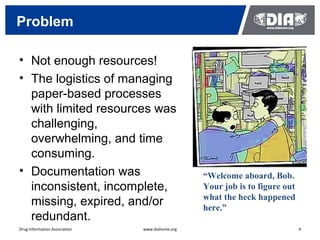
• Not enough resources!
• The logistics of managing
  paper-based processes
  with limited resources was
  challenging,
  overwhelming, and time
  consuming.
• Documentation was                              “Welcome aboard, Bob.
  inconsistent, incomplete,                      Your job is to figure out
                                                 what the heck happened
  missing, expired, and/or                       here.”
  redundant.
Drug Information Association   www.diahome.org                               4
Objective

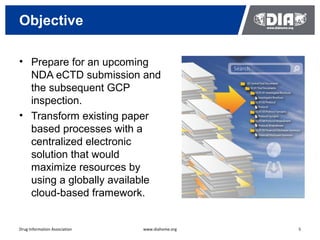
• Prepare for an upcoming
  NDA eCTD submission and
  the subsequent GCP
  inspection.
• Transform existing paper
  based processes with a
  centralized electronic
  solution that would
  maximize resources by
  using a globally available
  cloud-based framework.


Drug Information Association   www.diahome.org   5
Partner’s System Requirements

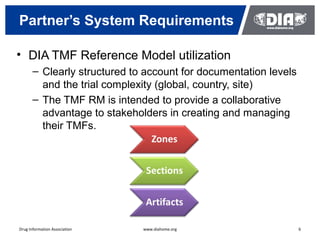
• DIA TMF Reference Model utilization
       – Clearly structured to account for documentation levels
         and the trial complexity (global, country, site)
       – The TMF RM is intended to provide a collaborative
         advantage to stakeholders in creating and managing
         their TMFs.


Drug Information Association   www.diahome.org                    6
Additional Requirements

• Software as a Service delivery model in which software
  and associated data are centrally hosted in the cloud and
  available globally
• Low cost and commitment
• Quickly and easily implemented
• Document management capabilities
       – Check in/check out, version control, audit trail, work flows and
         lifecycles, etc.
       – Ability to use the same system for multiple projects
• Flexible
• Minimal validation required

Drug Information Association       www.diahome.org                          7
Program Plan - 5 Projects

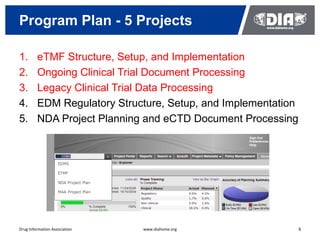
1.       eTMF Structure, Setup, and Implementation
2.       Ongoing Clinical Trial Document Processing
3.       Legacy Clinical Trial Data Processing
4.       EDM Regulatory Structure, Setup, and Implementation
5.       NDA Project Planning and eCTD Document Processing


Drug Information Association   www.diahome.org                 8
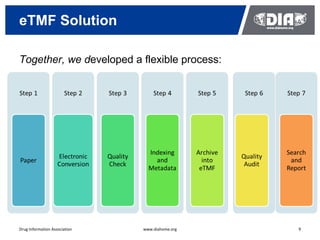
eTMF Solution

Together, we developed a flexible process:


Drug Information Association   www.diahome.org   9
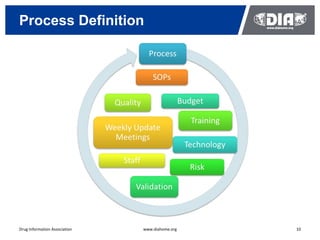
Process Definition


Drug Information Association   www.diahome.org   10
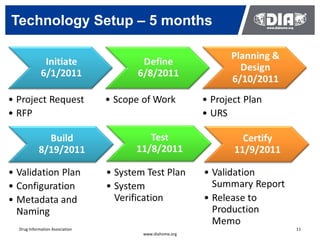
Technology Setup – 5 months


 Drug Information Association                     11
                                www.diahome.org
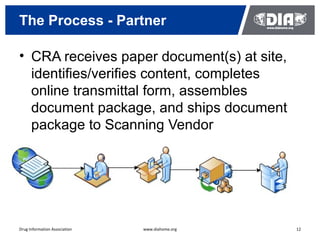
The Process - Partner

• CRA receives paper document(s) at site,
  identifies/verifies content, completes
  online transmittal form, assembles
  document package, and ships document
  package to Scanning Vendor


Drug Information Association   www.diahome.org   12
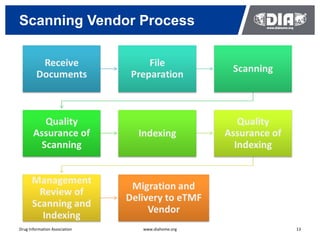
Scanning Vendor Process


Drug Information Association   www.diahome.org   13
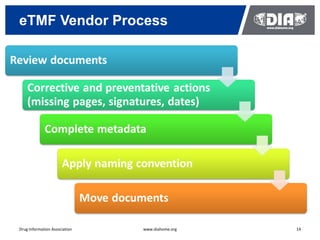
eTMF Vendor Process


Drug Information Association   www.diahome.org   14
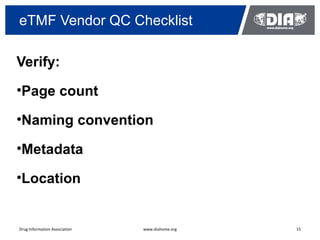
eTMF Vendor QC Checklist

Verify:
•Page count

•Naming convention

•Metadata

•Location


Drug Information Association   www.diahome.org   15
Documentation

• Partner audited both the Scanning Vendor and
  the eTMF Vendor to ensure appropriate quality
  documentation prior to signing.
• SOPs/Methodologies/Working Practices for
  Scanning vendor, eTMF vendor, and Partner
  company that cover each part of the process
• Appropriate and documented training
• Validation documentation


Drug Information Association   www.diahome.org    16
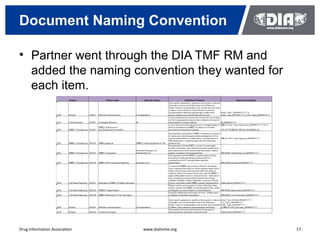
Document Naming Convention

• Partner went through the DIA TMF RM and
  added the naming convention they wanted for
  each item.


Drug Information Association   www.diahome.org   17
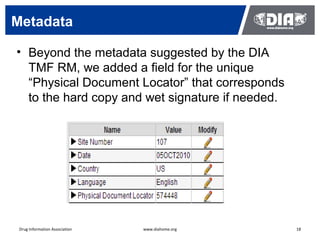
Metadata

• Beyond the metadata suggested by the DIA
  TMF RM, we added a field for the unique
  “Physical Document Locator” that corresponds
  to the hard copy and wet signature if needed.


 Drug Information Association   www.diahome.org   18
Current Study

• We used the current Ph. 3 study as our
  initial project and pilot.
• Together, we wrote, reviewed, and
  implemented Scanning Methodology and
  Work Practice documents.
• Scanned, indexed, and filed approximately
  3500 documents in 6 months.
• Implemented EDMS for Regulatory
  documents during this timeframe as well.
Drug Information Association   www.diahome.org   19
Legacy Process

• More than 60,000 legacy documents were
  shipped to scanning vendor (in 80 boxes).
• The shipment included a MS Excel
  spreadsheet that listed the documents that
  were in the boxes and was organized by
  section of a previous Trial Master File and
  by folder identifier.
• A new methodology document was written
  for scanning the legacy documents.
Drug Information Association   www.diahome.org   20
Legacy Study

• The Scanning Vendor had to do a great deal of
  document reconciliation in order to index and
  scan the documents and timelines were pushed
  back by a couple of months.
• Legacy Study #1 contains approximately 26,500
  documents and must be complete in 2 months!
• In order to meet timelines, documents must be
  reviewed and filed in under 1 min each.
• A weekly status report is provided to our partner
  showing the status of planned completion vs.
  actual completion.
Drug Information Association   www.diahome.org        21
Automated Metadata

• Scanning vendor indexed documents with
  metadata provided on the Excel
  spreadsheet.
• Text file indexes are uploaded with the PDF
  documents to a secure SFTP site.
• The text file is used to populate the
  document metadata as the documents are
  automatically loaded into a “Staging Area.”

 Drug Information Association   www.diahome.org   22
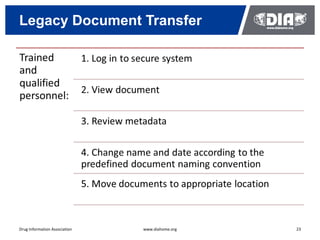
Legacy Document Transfer


Drug Information Association   www.diahome.org   23
How is it better?
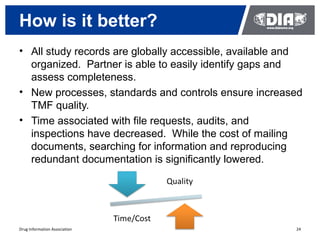
• All study records are globally accessible, available and
  organized. Partner is able to easily identify gaps and
  assess completeness.
• New processes, standards and controls ensure increased
  TMF quality.
• Time associated with file requests, audits, and
  inspections have decreased. While the cost of mailing
  documents, searching for information and reproducing
  redundant documentation is significantly lowered.


Drug Information Association                            24
Lessons Learned


• Establish paper document classification.
• Identify document naming conventions
  and metadata early.
• Correspondence should be relevant and
  organized.
• Planning and communication are the keys
  to estimating and managing program
  timelines.

Drug Information Association   www.diahome.org   25
Let me know if you have any questions!

                               aturner@mission3.com


Drug Information Association         www.diahome.org         26

eTMF Structure, Setup, and Implementation Case Study

  • 1.
    A Case Studyof an eTMF Implementation at a Small Biotech Adair Turner, MSc, RAC Regulatory Affairs Manager Mission3, Inc.
  • 2.
    Disclaimer The views and opinions expressed in the following PowerPoint slides are those of the individual presenter and should not be attributed to Drug Information Association, Inc. (“DIA”), its directors, officers, employees, volunteers, members, chapters, councils, Special Interest Area Communities or affiliates, or any organization with which the presenter is employed or affiliated. These PowerPoint slides are the intellectual property of the individual presenter and are protected under the copyright laws of the United States of America and other countries. Used by permission. All rights reserved. Drug Information Association, DIA and DIA logo are registered trademarks or trademarks of Drug Information Association Inc. All other trademarks are the property of their respective owners. Drug Information Association www.diahome.org 2
  • 3.
    Agenda • This sessionprovides a case study of an eTMF implementation at a biotechnology company currently conducting a pivotal Phase 3 clinical study in 70 centers worldwide. • We will discuss our experience, process management, and lessons learned. Drug Information Association www.diahome.org 3
  • 4.
    Problem • Not enoughresources! • The logistics of managing paper-based processes with limited resources was challenging, overwhelming, and time consuming. • Documentation was “Welcome aboard, Bob. inconsistent, incomplete, Your job is to figure out what the heck happened missing, expired, and/or here.” redundant. Drug Information Association www.diahome.org 4
  • 5.
    Objective • Prepare foran upcoming NDA eCTD submission and the subsequent GCP inspection. • Transform existing paper based processes with a centralized electronic solution that would maximize resources by using a globally available cloud-based framework. Drug Information Association www.diahome.org 5
  • 6.
    Partner’s System Requirements •DIA TMF Reference Model utilization – Clearly structured to account for documentation levels and the trial complexity (global, country, site) – The TMF RM is intended to provide a collaborative advantage to stakeholders in creating and managing their TMFs. Drug Information Association www.diahome.org 6
  • 7.
    Additional Requirements • Softwareas a Service delivery model in which software and associated data are centrally hosted in the cloud and available globally • Low cost and commitment • Quickly and easily implemented • Document management capabilities – Check in/check out, version control, audit trail, work flows and lifecycles, etc. – Ability to use the same system for multiple projects • Flexible • Minimal validation required Drug Information Association www.diahome.org 7
  • 8.
    Program Plan -5 Projects 1. eTMF Structure, Setup, and Implementation 2. Ongoing Clinical Trial Document Processing 3. Legacy Clinical Trial Data Processing 4. EDM Regulatory Structure, Setup, and Implementation 5. NDA Project Planning and eCTD Document Processing Drug Information Association www.diahome.org 8
  • 9.
    eTMF Solution Together, wedeveloped a flexible process: Drug Information Association www.diahome.org 9
  • 10.
    Process Definition Drug InformationAssociation www.diahome.org 10
  • 11.
    Technology Setup –5 months Drug Information Association 11 www.diahome.org
  • 12.
    The Process -Partner • CRA receives paper document(s) at site, identifies/verifies content, completes online transmittal form, assembles document package, and ships document package to Scanning Vendor Drug Information Association www.diahome.org 12
  • 13.
    Scanning Vendor Process DrugInformation Association www.diahome.org 13
  • 14.
    eTMF Vendor Process DrugInformation Association www.diahome.org 14
  • 15.
    eTMF Vendor QCChecklist Verify: •Page count •Naming convention •Metadata •Location Drug Information Association www.diahome.org 15
  • 16.
    Documentation • Partner auditedboth the Scanning Vendor and the eTMF Vendor to ensure appropriate quality documentation prior to signing. • SOPs/Methodologies/Working Practices for Scanning vendor, eTMF vendor, and Partner company that cover each part of the process • Appropriate and documented training • Validation documentation Drug Information Association www.diahome.org 16
  • 17.
    Document Naming Convention •Partner went through the DIA TMF RM and added the naming convention they wanted for each item. Drug Information Association www.diahome.org 17
  • 18.
    Metadata • Beyond themetadata suggested by the DIA TMF RM, we added a field for the unique “Physical Document Locator” that corresponds to the hard copy and wet signature if needed. Drug Information Association www.diahome.org 18
  • 19.
    Current Study • Weused the current Ph. 3 study as our initial project and pilot. • Together, we wrote, reviewed, and implemented Scanning Methodology and Work Practice documents. • Scanned, indexed, and filed approximately 3500 documents in 6 months. • Implemented EDMS for Regulatory documents during this timeframe as well. Drug Information Association www.diahome.org 19
  • 20.
    Legacy Process • Morethan 60,000 legacy documents were shipped to scanning vendor (in 80 boxes). • The shipment included a MS Excel spreadsheet that listed the documents that were in the boxes and was organized by section of a previous Trial Master File and by folder identifier. • A new methodology document was written for scanning the legacy documents. Drug Information Association www.diahome.org 20
  • 21.
    Legacy Study • TheScanning Vendor had to do a great deal of document reconciliation in order to index and scan the documents and timelines were pushed back by a couple of months. • Legacy Study #1 contains approximately 26,500 documents and must be complete in 2 months! • In order to meet timelines, documents must be reviewed and filed in under 1 min each. • A weekly status report is provided to our partner showing the status of planned completion vs. actual completion. Drug Information Association www.diahome.org 21
  • 22.
    Automated Metadata • Scanningvendor indexed documents with metadata provided on the Excel spreadsheet. • Text file indexes are uploaded with the PDF documents to a secure SFTP site. • The text file is used to populate the document metadata as the documents are automatically loaded into a “Staging Area.” Drug Information Association www.diahome.org 22
  • 23.
    Legacy Document Transfer DrugInformation Association www.diahome.org 23
  • 24.
    How is itbetter? • All study records are globally accessible, available and organized. Partner is able to easily identify gaps and assess completeness. • New processes, standards and controls ensure increased TMF quality. • Time associated with file requests, audits, and inspections have decreased. While the cost of mailing documents, searching for information and reproducing redundant documentation is significantly lowered. Drug Information Association 24
  • 25.
    Lessons Learned • Establishpaper document classification. • Identify document naming conventions and metadata early. • Correspondence should be relevant and organized. • Planning and communication are the keys to estimating and managing program timelines. Drug Information Association www.diahome.org 25
  • 26.
    Let me knowif you have any questions! aturner@mission3.com Drug Information Association www.diahome.org 26